
Guides · Relocating
Moving to Nairobi: The Complete 2026 Guide for Americans
Moving to Nairobi: The Complete 2026 Guide for Americans


Nairobi at a glance.
Moving to Nairobi is more straightforward than most Americans expect, and a little different from what they imagine. English is an official language, so you’ll never be stuck. The climate is mild all year because the city sits a mile high. A US salary stretches a long way. And a growing number of Americans — remote workers, retirees, families, diplomats, and African Americans coming home — are choosing Nairobi on purpose, not by accident.
This guide walks you through the whole move, start to finish: the visa you actually need, where to live, what it costs, how healthcare and schools work, and what your first month on the ground really looks like. It’s written for someone who has never set foot in Kenya. Read it once before you commit to anything, then keep it close during the move.

The quick version
You enter Kenya on a $30 online travel authorization (eTA), use that first trip to choose a neighborhood and view homes, then file the residence permit that fits your situation. Most expats live in a handful of leafy, secure western suburbs — Gigiri, Karen, Lavington, Westlands and a few others. A comfortable professional can live well on roughly $2,000–4,000 a month including a furnished home, with rent the biggest variable. Healthcare is genuinely good if you carry private international insurance and use the private hospitals. Internet is fast and cheap. Safety is fine with normal big-city habits. The single best way to land softly is to book a serviced apartment for your first month while you sort everything else out.
Why Americans are moving to Nairobi
Nairobi is East Africa’s business and diplomatic capital — home to a major UN headquarters, hundreds of embassies and NGOs, and a fast-growing tech scene people call the “Silicon Savannah.” That gives it an unusually large, settled international community, which makes arriving easier. You won’t be the only newcomer figuring things out.
The practical draws are real. The weather is hard to beat: mile-high elevation keeps temperatures around 15–26°C (59–79°F) all year, with two rainy seasons rather than a punishing summer or winter. The time zone (UTC+3) works neatly for remote roles — your Nairobi afternoon overlaps a US East Coast morning. Day-to-day costs are a fraction of US prices. And the lifestyle is genuinely good: weekend safaris, the coast a short flight away, a strong food and coffee scene, and a national park with lions and rhino minutes from downtown.
For many African American movers, there’s something deeper than logistics — a sense of returning to the continent and building a life there. Nairobi makes that easier than most African capitals, with the language, the infrastructure and the community already in place.
None of this means Nairobi is effortless. Traffic is the city’s real tax on your time. Power cuts happen, so you’ll want a home with a backup generator. Petty theft exists, as in any big city. Bureaucracy takes patience. We’ll be honest about all of it as we go — that’s the only way this guide is useful.
How the move actually works, in order
The mistake people make is doing things out of sequence — signing a year-long lease from abroad, or trying to open a bank account before they have the right paperwork. Kenya has a logical order, and following it saves weeks.
- Visit first on the eTA. Come for a scouting trip, see neighborhoods in person, and view apartments before you commit.
- Land softly. Base yourself in a serviced apartment for the first few weeks so you’re secure and settled while you decide.
- File the right permit. Engage a local immigration lawyer and apply for the residence permit that fits — remote worker, employee, or investor.
- Register your KRA PIN. This tax ID (from itax.kra.go.ke) is the key that unlocks almost everything else.
- Open a bank account, then sign your lease. With your permit and KRA PIN in hand, the local admin falls into place.
Hold that sequence in your head and the rest of this guide slots into it.
Visas: which one you actually need
Every visitor needs an approved eTA (Electronic Travel Authorization) before flying. It costs $30, you apply online at the official portal etakenya.go.ke, and it lets you enter within 90 days. Paying by card can add a surcharge of about $9, and if you’ll come and go a lot, US citizens can instead buy a 5-year multiple-entry eTA for around $185. It’s perfect for a scouting trip — but it does not let you work or reside long-term. Apply at least a week ahead; approvals usually land within 24–72 hours.
For living here, the route depends on your situation:
| Route | Indicative cost (2026) | Best for |
|---|---|---|
| eTA (visit) | $30 · enter within 90 days | Scouting trips, short stays — not working or residing |
| Digital Nomad (Class N) | $200 + $1,000/yr | Remote employees and freelancers paid from abroad |
| Work permit (Class D) | Employer-sponsored | Taking a job with a Kenyan employer |
| Investor (Class G) | Investment-based | Starting or buying into a business |
| Dependant’s pass | Linked to sponsor | Spouse and children of a permit holder |
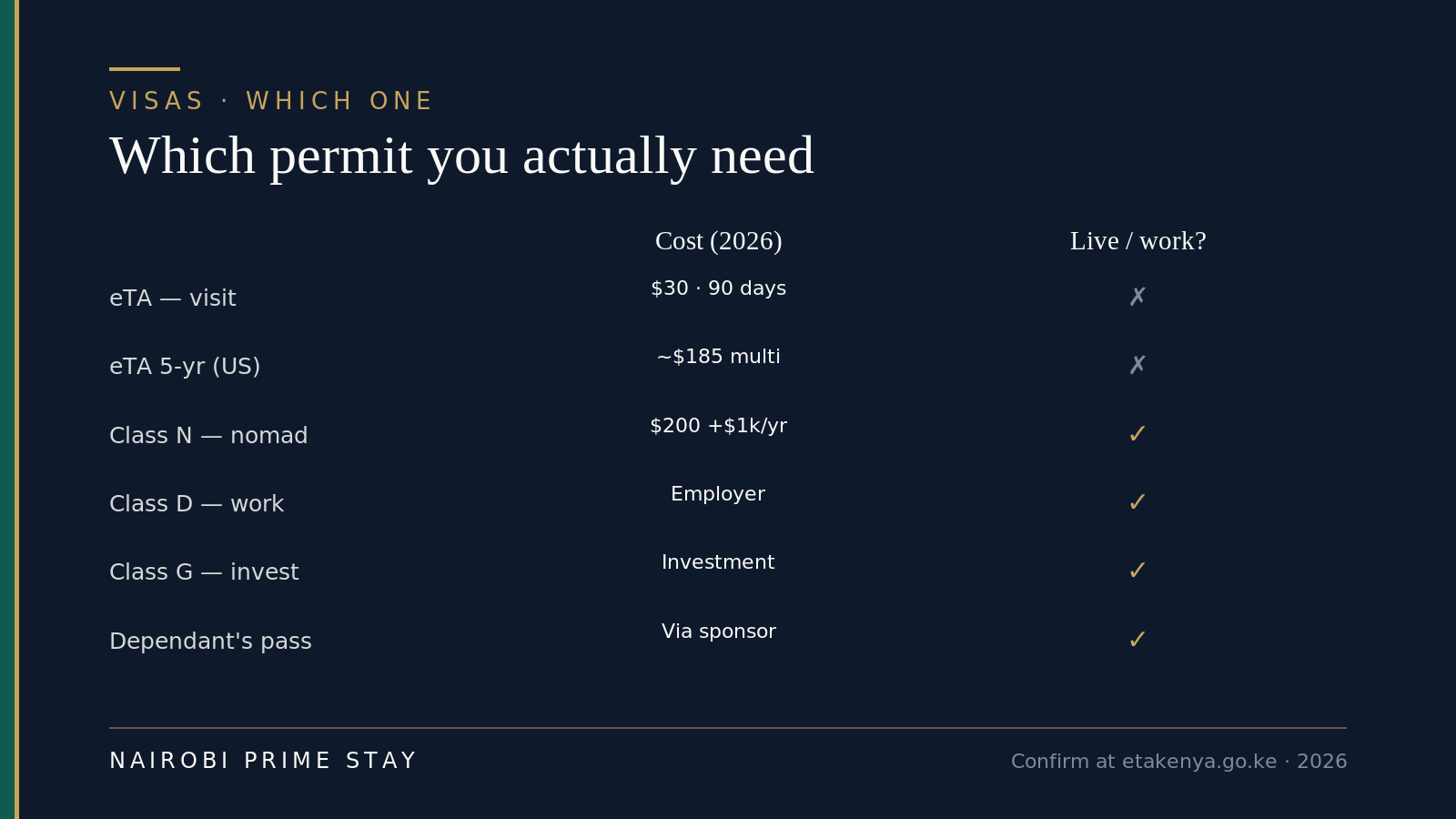
The routes at a glance — only the eTA is for visiting; living here needs a permit.
Kenya’s Class N digital nomad permit is the headline option for remote workers, introduced under 2024 regulations for people paid from outside Kenya. The government fees are $200 plus $1,000 a year. There’s no fixed minimum-income figure anymore; you show steady foreign income with three months of bank statements or payslips, plus proof of accommodation and a clean record. It runs one to two years and is renewable. The rules are still settling, so confirm the current requirements on Kenya’s official eFNS immigration portal before you count on it.
Visa fees and rules change, and this isn’t legal advice. Always confirm against the official sources and use a Kenyan immigration lawyer for anything beyond a visit. Our full Kenya visa guide for Americans breaks down each route, the documents you’ll need, and the smart sequence in detail.
Where to live: Nairobi’s expat suburbs
Expat life concentrates in a cluster of green, secure suburbs on the city’s west and north sides. Each has a distinct character, and your choice shapes your daily life more than almost anything — because of traffic, the area you pick effectively decides your commute, your school run and your weekend.
Here’s the shorthand. Rents are indicative monthly figures for furnished homes in 2026; unfurnished and longer leases cost less.
| Neighborhood | Character | Furnished rent / mo | Suits |
|---|---|---|---|
| Gigiri | Diplomatic heart — UN HQ and embassies, heavily patrolled, calm | $1,500–4,000+ | UN / embassy / NGO staff |
| Runda & Muthaiga | Large gated homes and gardens, very secure | $1,800–4,000+ | Families wanting space |
| Karen | Leafy, low-density, equestrian calm, great schools nearby | $1,000–3,000 | Families, space-seekers |
| Lavington | Cosmopolitan, family-friendly, central-ish | $700–1,800 | Families, professionals |
| Kileleshwa | Quiet, modern apartments, discreet | $650–1,500 | Couples, professionals |
| Westlands | Urban energy — restaurants, nightlife, offices | $550–1,200 | Singles, social professionals |
| Kilimani | Central, modern, busy, most affordable prime area | $500–1,000 | Remote workers, first-timers |
| Riverside | High-end residences and embassies by the river | $900–2,500 | Executives wanting central calm |
| Upper Hill | Business district, hospitals and HQs | $700–1,600 | Executives wanting a short commute |
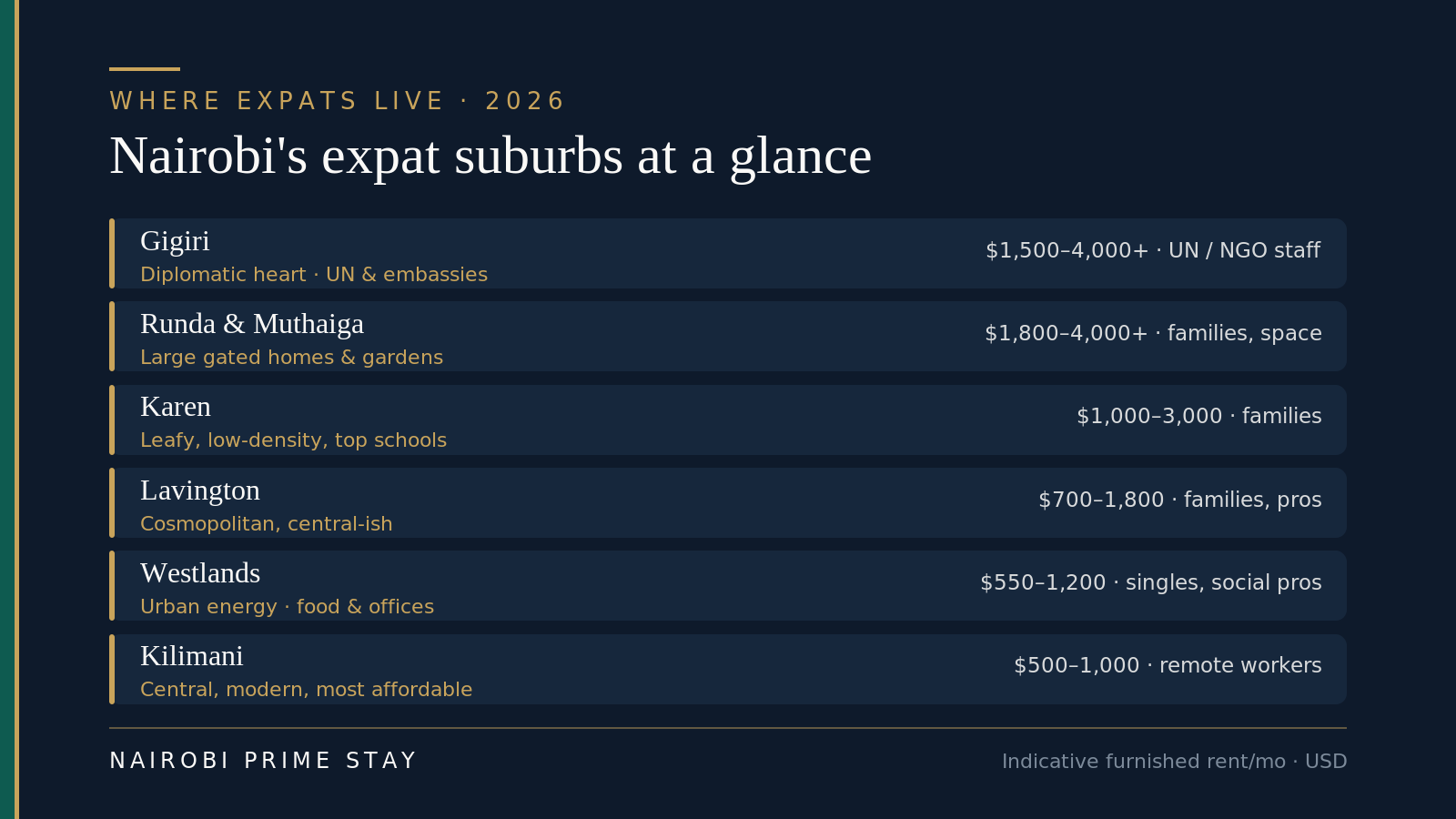
The prime expat suburbs at a glance — rent rises with space and security.
If you’re UN, embassy or NGO staff, start in Gigiri, Runda, Muthaiga or the secure Nyari estate, with quiet, leafy Thigiri a house-dominant pocket just off Limuru Road in the same cluster — all minutes from the UN complex. Families with school-age kids gravitate to Karen, Lavington and Runda for the schools and space — with neighboring Lang’ata offering the same leafy, family-friendly feel beside Nairobi National Park at better value — while Loresho and Kitisuru offer leafy, spacious, gated family living a short drive from the International School of Kenya, and Rosslyn sits right by the top international schools on Limuru Road, and Ridgeways brings leafy, gated family living off Kiambu Road beside Karura Forest at better value than Runda or Muthaiga. Remote workers and younger professionals tend to like Westlands, Kilimani and Riverside for being social and central, while Parklands offers the same central convenience with the city’s best food and top hospitals at better value, and Kileleshwa is the calmer, leafier option next door, and Spring Valley a green, low-density family pocket just north-west of Westlands. Executives who want to live beside the office towers look at Upper Hill, with neighboring Hurlingham offering central, value-priced apartments a short hop from the same offices and hospitals. Our best neighborhoods in Nairobi guide profiles each one in depth, with drive-times and the trade-offs.
Before you sign anywhere, check what locals call the “Nairobi Five”: a backup generator (power cuts happen), reliable water supply and storage, 24/7 security with gates and cameras, fibre internet already serving the building, and responsive on-site management. A beautiful apartment without a generator is a frustrating apartment.
The soft landing: start in a serviced apartment
Here’s the single most useful piece of advice in this guide: don’t lock into a year-long lease from abroad. Photos flatter, neighborhoods feel different in person, and the commute you imagine is not the commute you’ll drive.
Instead, base yourself in a serviced apartment for your first four to eight weeks. It’s a secure, fully equipped home from day one — Wi-Fi, cleaning, backup generator and security all included, on flexible monthly terms. From that base you can view homes properly, test the traffic at rush hour, and choose your neighborhood with confidence. Then you move once, when you’re sure.
This is exactly what we do at Nairobi Prime Stay. We handpick a vetted apartment to match your budget, dates and work location; a $50 deposit reserves it, and you settle the balance on arrival — nothing more to pay before you travel. You can browse serviced apartments or tell our AI relocation assistant your dates and budget and let it shortlist options in a couple of minutes.
What it costs to live in Nairobi
Nairobi rewards a Western income. You can live very comfortably for well under what the same lifestyle costs in a major US city. The big variables are rent, school fees if you have kids, and how much you dine out and hire help.
Here’s a realistic monthly budget for a comfortable professional or couple, in US dollars:
| Item | Indicative / month |
|---|---|
| Furnished serviced apartment (1–2 bed), utilities + internet + cleaning included | $1,000–1,800 |
| Groceries | $250–450 |
| Transport (ride-hailing or fuel) | $80–200 |
| Domestic help (part-time) | $100–250 |
| Dining and leisure | $150–400 |
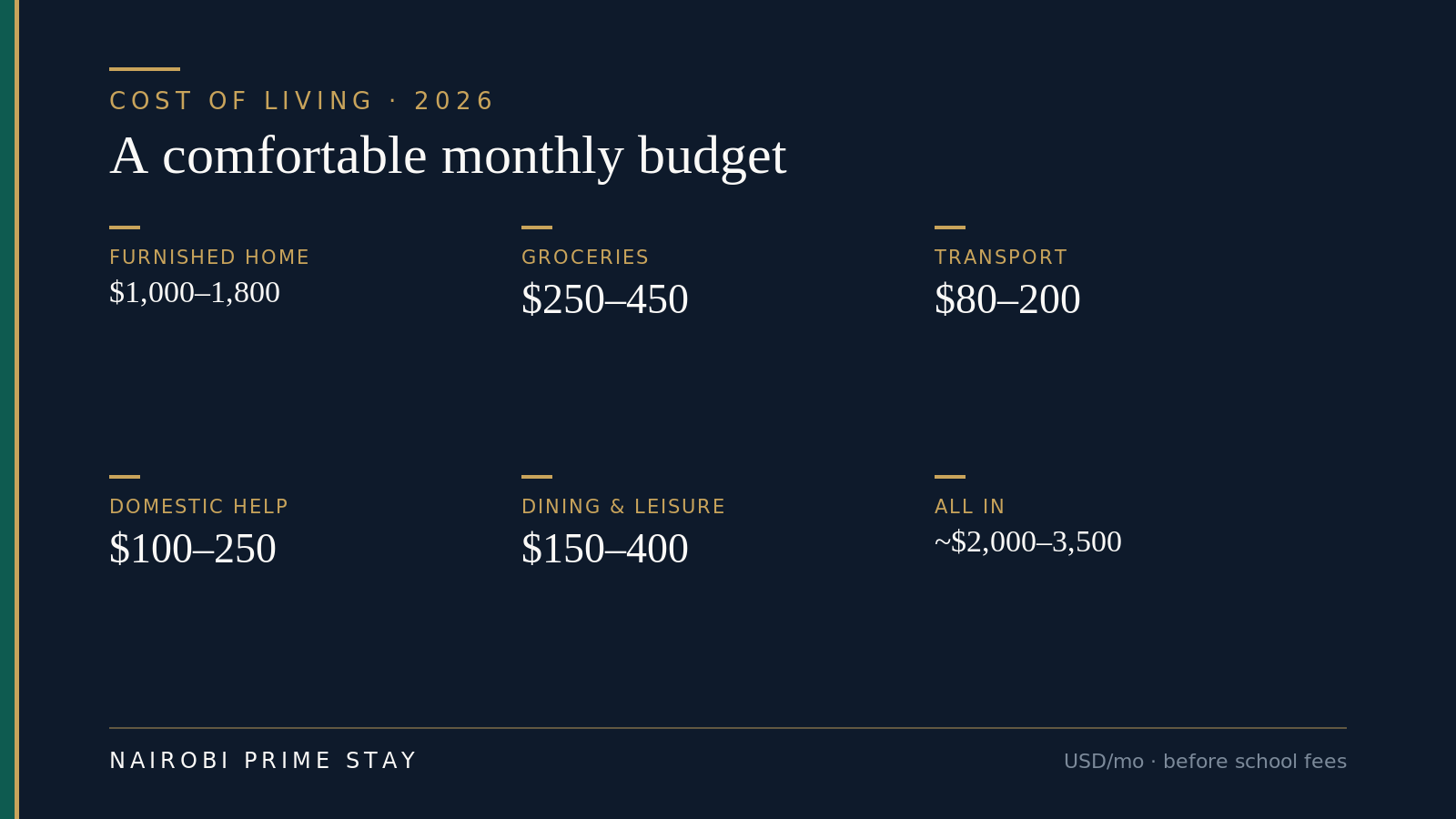
A comfortable monthly budget, before school fees.
That lands most people somewhere around $2,000–3,500 a month, all in, before school fees. A specialist doctor’s visit runs about $15–40. A short ride across town on Uber or Bolt is a few dollars. For the full picture — lean, comfortable and family budgets side by side — see our Nairobi cost of living guide. As a reference point, the shilling has traded around 129–130 to the US dollar through 2026. Curious how that compares to home? See our Nairobi vs the US cost of living breakdown.
Money: M-Pesa and banking
Kenya more or less invented mobile money, and M-Pesa runs daily life. You’ll use it for taxis, rent, the market and your internet bill. Register a SIM and M-Pesa at the airport when you land — the Safaricom kiosk at the airport does it in minutes with just your passport — and it quickly becomes your main wallet. For how to register as a foreigner, pay for everything, handle fees and limits, and avoid the common scams, see our M-Pesa guide for newcomers.
A local bank account comes later in the sequence. You’ll typically need a valid permit, your KRA PIN, passport and proof of address. Tourists on an eTA generally can’t open one, which is why the order matters; for the step-by-step — resident versus the diaspora route you can open from abroad — see opening a bank account in Kenya as a foreigner. Major banks include Equity, KCB, Stanbic, NCBA, Absa and Standard Chartered. To move money in, Wise and standard bank transfers handle USD to KES easily, and you can top up M-Pesa from abroad. For the cheapest, safest way to move money in both directions, see our guide to sending money to and from Kenya. The dollar buys around 130 shillings in 2026 — our USD to KES currency guide explains the live rate, where to change money and how to budget around the exchange rate. Keep a US card for international spending; Visa and Mastercard are widely accepted. For the full picture — which banks suit expats, opening an account, USD versus shilling accounts, fees and linking your bank to M-Pesa — see our banking in Nairobi guide.
One thing to plan for early: spend more than 183 days in a tax year and you may become a Kenyan tax resident. The US taxes its citizens worldwide, so talk to a cross-border accountant before you move. Our taxes for expats in Kenya guide covers the 183-day rule, KRA bands and your US filing.
Healthcare
Nairobi has some of the best private hospitals in Africa, with English-speaking specialists and standards close to what you’re used to. The key is simple: carry strong private or international insurance — ideally with regional cover and medical evacuation — and use the private system.
The hospitals expats rely on include Aga Khan University Hospital (JCI-accredited, in Parklands), The Nairobi Hospital (Upper Hill), Karen Hospital for the southern suburbs, MP Shah, and Gertrude’s Children’s Hospital for families. Private consultations are inexpensive by US standards at roughly $15–40; larger procedures cost far less than at home but are still worth insuring against. Bring a supply of any prescription meds with documentation, and check your routine vaccines are current. Our healthcare in Nairobi guide covers hospitals, insurance and finding a doctor in detail. Expecting a baby? Our having a baby in Nairobi guide covers the maternity hospitals, real delivery costs and registering the birth. Need a dentist or a specialist? Our dentists and specialists in Nairobi guide covers costs, where clinics cluster and what to fly home for.
Schools
If you’re moving with children, the schools are one of Nairobi’s quiet strengths. The city has a deep bench of international schools, several following the American curriculum, and most cluster around Gigiri, Runda and Karen — which is part of why families settle where they do.
The International School of Kenya (ISK) in Gigiri follows an American and IB curriculum and draws diplomats and US families; Rosslyn Academy in Runda offers American and AP programs; Braeburn and Brookhouse follow the British curriculum. Fees vary widely, from around $10,000 a year to $40,000 or more at the top end. ISK’s senior grades now run about $37,000 in tuition plus a one-time capital levy, while Rosslyn sits nearer $10,000. The best schools have waitlists, so begin enquiries months ahead and gather transcripts early. Pick the school first, then let it guide your neighborhood, so the daily school run stays short. For the full breakdown — every curriculum, the flagship schools, real 2026 fee ranges and how admissions work — see our international schools in Nairobi guide. If you want the American or IB route specifically — ISK, Rosslyn Academy and the IB Diploma — see our American and IB schools in Nairobi guide. For younger children, our nursery and daycare in Nairobi guide covers Montessori, play-based and international early-years options for under-fives. And if you’re weighing the whole move as a family, our moving to Nairobi with kids guide pulls together the best family suburbs, schools, pediatric care, help at home and a first-months plan. And for teens approaching college, our universities and higher education in Kenya guide covers studying locally, including the American-system USIU-Africa, and applying to US colleges from Nairobi.
Internet and working remotely
Nairobi is a genuinely good place to work remotely. Home fibre is fast and cheap — Safaricom Home Fibre spans from around 40 Mbps up to 1 Gbps with free installation, and Zuku and Faiba are solid alternatives. Just confirm a provider already serves your specific building before you sign.
The one thing to design around is power. Outages happen, so a home with a backup generator (or your own inverter or UPS) keeps your calls and Wi-Fi alive — non-negotiable if you work from home. Coworking is excellent too, with spaces like Nairobi Garage and Ikigai across Westlands, Kilimani, Lavington and Karen. Add the friendly time-zone overlap with the US, and it’s no surprise remote workers thrive here. Our internet and remote work guide goes deeper on providers, speeds and where to work.
Staying safe
With sensible precautions, expats live comfortably and happily in Nairobi. Most live in gated communities with 24/7 guards, and the prime suburbs are well patrolled. The honest picture: the main risk is opportunistic petty crime — phone snatching in traffic, the occasional break-in — not personal danger. You treat it like any major city.
The habits that matter: keep your phone and valuables out of sight, especially in stopped traffic; use Uber or Bolt after dark rather than walking; keep car doors locked in jams; and withdraw cash inside malls or banks rather than at quiet ATMs. Choose a home with guards, gates and cameras, save the emergency numbers (999 or 112), and enrol in the US State Department’s free STEP program. Thousands of American and international families live here without incident. Our is Nairobi safe guide gives the full, balanced rundown.
Getting around
Uber and Bolt are the expat default — safe, cheap and payable by card or M-Pesa, with most city trips costing a few dollars. Matatus (shared minibuses) are the local lifeblood and dirt cheap, but they take some learning. Many residents eventually buy a car for school runs and weekends — our guide to buying a car in Nairobi covers the yards, the NTSA logbook transfer and avoiding the scams — and if you plan to drive yourself, our driving in Nairobi guide covers licences, driving on the left and the honest traffic reality. For the full picture — ride-hailing, matatus, boda boda safety, the Expressway and whether you actually need a car — see our getting around Nairobi guide. And for what to expect the moment you land, our JKIA airport guide covers immigration, picking up a SIM and cash, and getting from the airport into town.
Kenya drives on the left. You can use your US license short-term with an International Driving Permit; for a longer stay you’ll convert to a Kenyan one. The real challenge isn’t the driving, it’s the traffic — distances are short but rush hour is slow, which loops back to the single most important decision you’ll make: where you live relative to work and school.
Your first 30 days
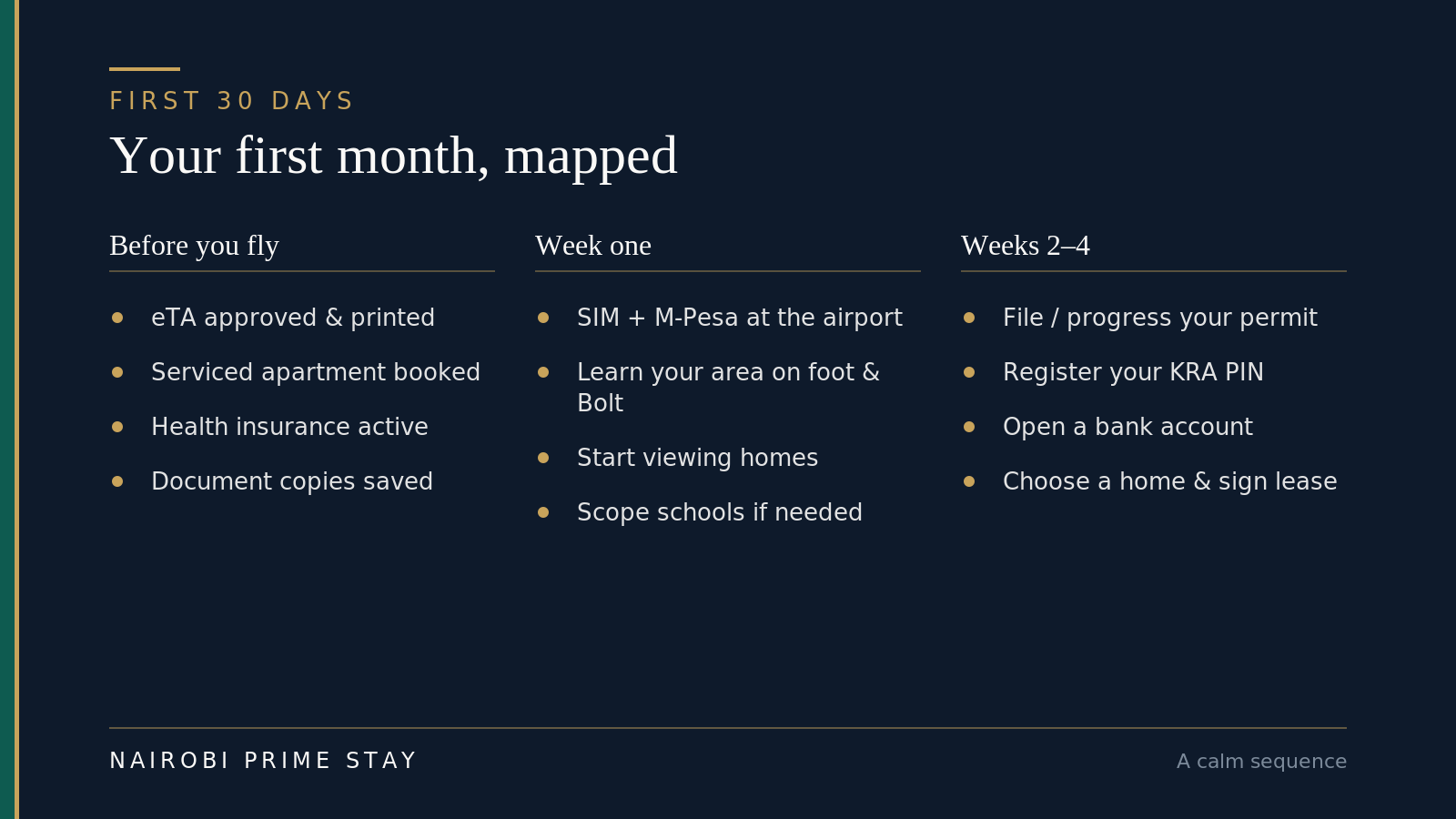
Your first month, mapped.
A rough timeline that keeps the move calm:
- Before you fly: eTA approved and printed; first-month serviced apartment booked; international health insurance active; digital and paper copies of every document; airport pickup arranged.
- Week one: pick up a SIM and M-Pesa at the airport; settle in and learn your area on foot and by Bolt; start viewing homes in two or three neighborhoods; meet your agent or relocation contact; scope schools if you have kids.
- Weeks two to four: file or progress your permit; register your KRA PIN; open a bank account; choose your home and sign the lease; set up fibre, utilities and any household help.
What to bring, and what to buy here
Travel lighter than you think. Nairobi’s malls and markets stock most things, and prime apartments often come furnished, so shipping a full household is rarely worth it — sea freight is cheap but slow, air freight fast but costly. The rule of thumb: bring what’s hard to replace and personal, buy the bulky and everyday here.
A few specifics. Kenya runs 240V on UK-style Type G plugs, so US devices need adapters and, for anything not dual-voltage, a converter. Pack any specific medications and a doctor’s letter. Bring an unlocked phone for a local SIM. And if you’re moving a pet, start early (see our full guide to bringing pets to Kenya) — you’ll need an import permit, a recent health certificate and up-to-date rabies vaccination, and airline pet bookings fill up.
The honest pros and cons
| The good | The trade-offs |
|---|---|
| Mild, mile-high climate all year | Two rainy seasons; carry an umbrella |
| English everywhere; large expat community | Bureaucracy takes patience |
| US income goes a long way | Imported goods can be pricey |
| Fast, cheap internet; remote-friendly time zone | Power cuts — you need a generator |
| Excellent private healthcare | Public system is not the expat choice |
| Safari and coast on your doorstep | Traffic is the daily tax on your time |
| Genuinely warm, welcoming culture | Petty crime means city habits matter |

The honest balance, side by side.
Frequently asked questions
Is it hard for an American to move to Nairobi? No, but it pays to do things in order. Visit on the $30 eTA, choose your neighborhood, then file the residence permit that fits your situation through a local immigration lawyer. Most people land softly in a serviced apartment while they sort the paperwork and find a long-term home.
How much money do I need to live comfortably in Nairobi? A comfortable professional or couple can live well on roughly $2,000–3,500 a month including a furnished home, before school fees. Rent is the biggest variable, ranging from about $500 a month in Kilimani to $4,000+ in Gigiri or Runda.
Is Nairobi safe for Americans? Yes, with normal big-city precautions. Most expats live in gated suburbs with 24/7 security and rarely have problems. The main risk is opportunistic petty theft, not violence — keep valuables out of sight, use ride-hailing at night, and pick a home with guards and gates.
Can I work remotely from Nairobi? Easily. Home fibre runs from 40 Mbps to 1 Gbps, mobile data is cheap, and the UTC+3 time zone overlaps the US morning. Just choose a building with a backup generator so power cuts don’t interrupt your work, and consider the Class N digital nomad permit if you’ll stay long-term.
Do I need to speak Swahili? No. English is an official language and spoken everywhere, so you’ll get by from day one. A few Swahili greetings — Jambo, Karibu, Asante — are warmly appreciated and open doors, but they’re a courtesy, not a requirement.
Which visa do I need to live in Kenya? For a scouting visit, the eTA. To live and work remotely, the Class N digital nomad permit; to take a local job, an employer-sponsored Class D work permit; to start a business, the Class G investor permit. Confirm current rules at the official immigration portal, as details change.
Where do most American expats live in Nairobi? Gigiri and Runda for UN, embassy and NGO staff; Karen and Lavington for families; Westlands, Kilimani and Riverside for younger and remote-working professionals. All are leafy, secure western suburbs.
How long does it take to move to Nairobi? A scouting trip takes a week or two. Going from landing to fully settled — permit filed, KRA PIN registered, bank account open and a lease signed — usually takes one to three months, with permit processing the main variable. Most people live in a serviced apartment for the first month or two while it all comes together.
When is the best time of year to move to Nairobi? Any time works — the climate is mild year-round. The easiest months to arrive and house-hunt are the drier stretches, roughly January to February and June to September; try to avoid landing during the long rains from March to May. Families usually time the move to the school year, as most international schools start in August. See our Nairobi weather and climate guide for the month-by-month picture.
Can foreigners buy property in Nairobi? Yes, within limits. Non-citizens can own apartments and homes on leasehold title, which is capped at 99 years, but cannot own freehold or agricultural land. Many expats rent first and buy later once they know the city. Our property investment guide covers the law, taxes and the safe buying sequence.
Final thoughts
Nairobi rewards people who arrive with a plan and an open mind. Get the sequence right — visit, land softly, file the permit, then settle — and the move feels far less daunting than it looks from across the world. The city does the rest: the climate, the community and the pace win most people over within a month.
When you’re ready to take the first real step, the easiest one is choosing where you’ll stay when you land.
Related reading
- Kenya visas for Americans: which one you actually need
- Retiring in Kenya: an honest guide — the Class K visa, real costs, healthcare and the honest trade-offs for American retirees
- Moving to Kenya as an African American — the welcome, identity and belonging, and the honest trade-offs for the diaspora
- Best neighborhoods in Nairobi for expats
- Gigiri neighborhood guide and Karen neighborhood guide
- Gigiri vs Westlands: which one suits you? — the quiet diplomatic suburb vs the central city hub, compared
- Karen vs Runda: which family suburb? — space and British schools vs gated security near the American schools and the UN, compared
- Kilimani vs Kileleshwa: which central suburb? — best-value buzz vs leafy calm, two central apartment areas compared
- Lavington vs Westlands: leafy calm or central buzz? — the leafy family suburb vs the central city hub, compared
- Where UN & diplomatic staff live in Nairobi — the Gigiri belt (Gigiri, Nyari, Rosslyn, Runda, Muthaiga) compared on commute, security and rent
- Serviced apartments in Nairobi: a complete guide
- How to rent an apartment in Nairobi — where to search, agents and fees, deposits and the scams to avoid, step by step
- Furnished vs unfurnished in Nairobi — the cost difference, what each really includes, and when a serviced apartment wins
- Furnishing a home in Nairobi — where to buy furniture, what it costs for a 1–2 bed, and the secondhand and custom routes that cut the bill
- Shipping your belongings to Kenya — ship vs buy local, sea vs air freight, customs duties and the duty-free First Arrival rule
- Banking in Nairobi for expats — the main banks, opening an account, USD versus shilling accounts, fees, and linking your bank to M-Pesa
- Opening a bank account as a foreigner — resident vs non-resident routes, the documents, KRA PIN and FATCA
- M-Pesa explained for newcomers — register a line, load and spend, pay rent and bills, link your bank, and stay safe from scams
- Sending money to and from Kenya — Wise, Remitly, Sendwave, banks and M-Pesa compared, with real fees, FX spreads and big-transfer tips
- USD to KES currency guide — today’s dollar-to-shilling rate, where to change money safely, holding USD versus KES, and budgeting around the exchange rate
- Setting up utilities in Nairobi — prepaid power tokens, the water-storage reality, backup power and what it all costs each month
- Taxes for expats in Kenya — the 183-day residency rule, KRA tax bands, and how the FEIE and Foreign Tax Credit stop you being taxed twice
- Health insurance for expats in Kenya — international vs local plans, why medical evacuation matters, and what the national SHA scheme covers for foreigners
- Leases, deposits and tenant rights in Kenya — your rights, getting your deposit back, and what a fair lease includes
- Getting around Nairobi: transport options explained — Uber and Bolt, matatus, boda boda safety, the Expressway and tolls, and whether you need a car
- Driving in Nairobi: a practical guide — using your US license, converting to a Kenyan licence, traffic, insurance and safety
- JKIA airport guide: arriving in Nairobi — the eTA and immigration, a SIM and cash at the airport, and the safest ways into the city
- Importing a car to Kenya — the 8-year rule, how the duties stack, and whether to import or buy locally
- Buying a car in Nairobi — where to look, what used cars cost in 2026, the NTSA logbook transfer, insurance and the scams to dodge
- Corporate housing & relocation packages in Nairobi — serviced apartments for assignees, what packages cover, billing and the areas that suit executives
- Embassy, UN & NGO housing in Nairobi — how diplomatic, UN and NGO housing works: the security rules, allowances, leases and the soft landing
- Investing in Kenyan property as a foreigner — yields, the law, taxes and the safe buying sequence
- Property management in Nairobi — fees, licensed agents and what to expect for landlords
- Can foreigners buy property in Kenya? — what non-citizens may legally own
- Buying land in Kenya safely — the official search, due diligence and the scams to avoid
- Conveyancing in Kenya — what your property lawyer does and what it costs
- Property taxes in Kenya — stamp duty, capital gains, rental income tax and the US double-tax angle
- Financing property in Kenya — mortgages for foreigners and diaspora, plus the cash-buyer reality
- Nairobi property prices in 2026 — real price bands by area and type, yields, and which areas are rising or cooling
- Best areas to invest in Nairobi real estate — prime apartment areas vs growth corridors, ranked by yield and tenant demand
- Buying off-plan property in Nairobi — the discounts, the real risks, and how to vet a developer before you pay
- Commercial property investment in Nairobi — office, retail, industrial and warehouse space, with honest yields and risks
- New developments and satellite cities around Nairobi — Tatu City, Konza, Tilisi, Northlands and Two Rivers, and which are real versus still a promise
- Investing in Kenyan REITs — own a slice of Nairobi real estate, hands-off, from a few thousand shillings
- Diaspora property investment in Kenya — buying back home safely from abroad: escrow, power of attorney, diaspora mortgages and the scams to dodge
- Common property scams in Kenya and how to avoid them — fake titles, double sales and vanishing agents, and the checks that stop them
- Family life in Nairobi: things to do with kids — animal parks, forests, malls, sports clubs, weekend getaways, and how to find your expat-parent community
- Nairobi weather and climate — what to expect month by month, the two rainy seasons, the strong high-altitude sun, and what to pack
- Kenyan culture and etiquette for newcomers — greetings, the local sense of time, tipping, dress, faith and the everyday faux pas to avoid
- Learning Swahili: the basics that help — the phrases that earn warmth, easy phonetic pronunciation, and the best ways to learn
- Building a social life as an expat in Nairobi — the expat scene, clubs, sports, faith and online groups, and how to make friends fast
- Restaurants and dining in Nairobi — the food scene, real 2026 prices, the best areas, nyama choma, and honest food-safety advice
- Shopping in Nairobi: malls, markets and groceries — the best malls, the supermarkets you’ll use, fresh and Maasai markets, and what’s hard to find
- Nairobi nightlife and going out — where the night happens in Westlands and Kilimani, what a night costs, the calmer side, and how to get home safely
- Gyms, fitness and wellness in Nairobi — gyms and studios, the altitude running bonus, the green outdoors, and how to ease in
- Coworking spaces and cafés in Nairobi — the best spaces and laptop cafés, 2026 day-pass and membership prices, and what to check before you commit
- Weekend trips from Nairobi — the best getaways: Naivasha, Lake Nakuru, Amboseli, Nanyuki and the Maasai Mara, with 2026 drive times, park fees and how to book
- Nairobi to the coast: Mombasa, Diani & beyond — how to reach the Kenyan coast by train, flight or road, where to go (Diani, Mombasa, Watamu, Lamu), and the best time to travel
- Safaris from Nairobi — your first wildlife trips, from Nairobi National Park inside the city to the Maasai Mara, Amboseli and Tsavo, with 2026 park fees, real costs and how to book reputably
- Regional travel from Nairobi: East Africa on your doorstep — easy hops to Zanzibar, Uganda, Rwanda and Ethiopia, with the East Africa Tourist Visa, flights and real 2026 costs
- Cost of living in Nairobi · Healthcare · Is Nairobi safe? · Internet & remote work
Planning your move? Browse our serviced apartments for a secure, all-inclusive soft landing, or ask our AI relocation assistant to build a first-month plan around your dates, budget and work location — day or night. A $50 deposit reserves your place; you pay the balance when you arrive.
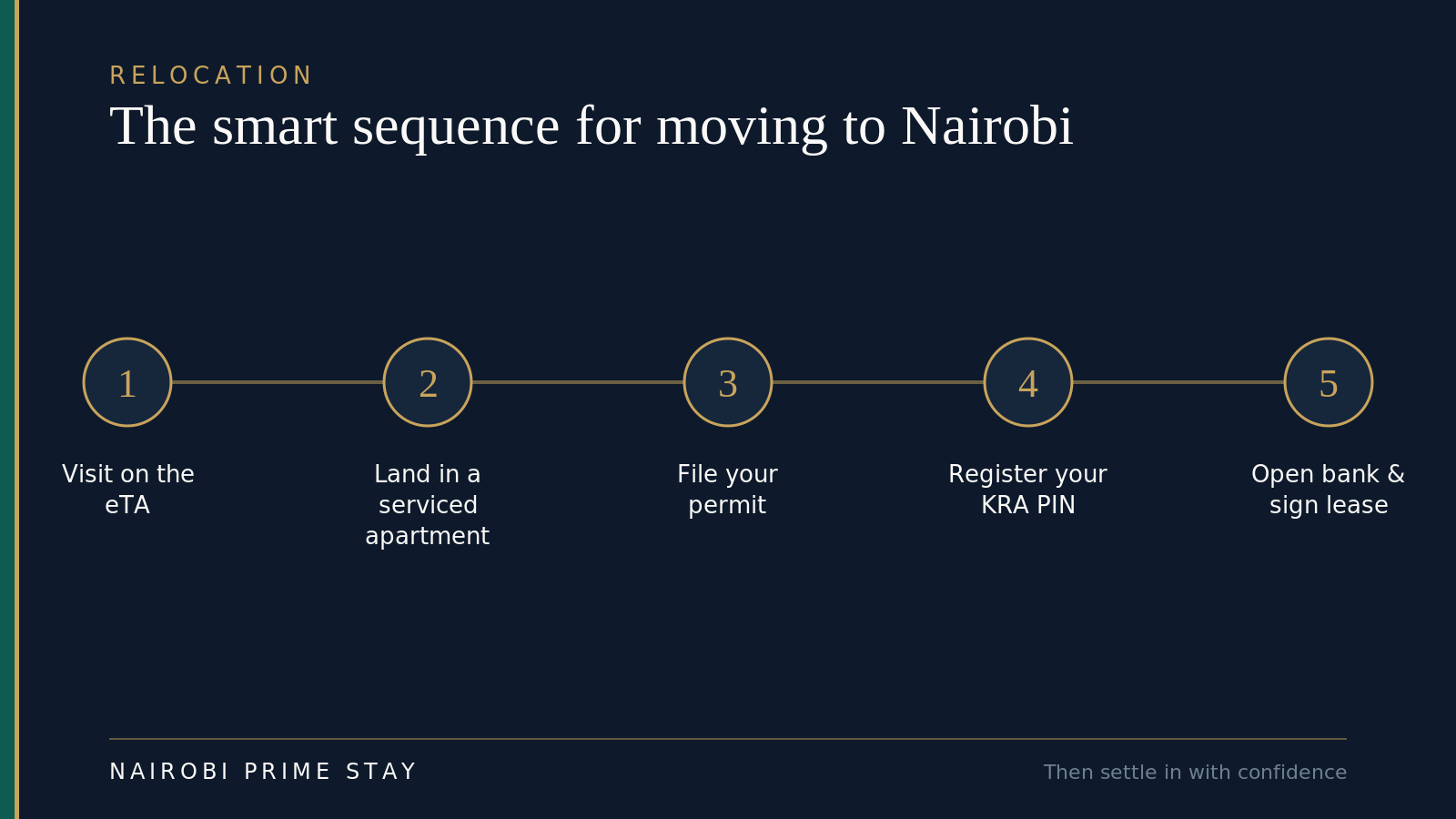
The smart sequence for a calm move.
Ready to look?
Find your apartment in Nairobi
Browse verified serviced apartments, or ask the AI concierge which area fits your life.