
Guides · Relocating
Bringing Pets to Kenya: How to Move Your Dog or Cat to Nairobi (2026)
Bringing Pets to Kenya: How to Move Your Dog or Cat to Nairobi (2026)

Yes, you can bring your dog or cat to Nairobi, and most people do it without drama. Kenya is a pet-friendly place to land. There is no routine quarantine if your paperwork is in order, the vets here are good, and plenty of homes in the leafy western suburbs come with gardens and walls made for a dog. The work is in the preparation, not the welcome.
The whole thing comes down to four documents and a flight: a microchip, a current rabies vaccination, a government-endorsed health certificate, and a Kenyan import permit. Your pet then flies as air cargo, you clear it at the airport, and you are home. Miss a step or leave it too late and you get delays, extra cost, or a stressful scramble at the gate, so the value of this guide is in the order and the timing.
This is written for Americans moving to Nairobi with a pet, whether that is one cat in a cabin-friendly carrier or two large dogs that need crates and a cargo booking. We name the real authority that issues the permit, the real cost ranges in 2026, and the official portals to confirm against. Rules change, so treat the numbers as current ranges and verify the specifics before you book anything.
TL;DR: To bring a dog or cat to Kenya you need an ISO microchip, a valid rabies vaccination, an international health certificate completed by a licensed vet and endorsed by your country’s government (USDA APHIS for US pets), and a Kenyan import permit from the Directorate of Veterinary Services (DVS) — not KEPHIS, which handles plants. Apply for the permit online through the DVS portal on eCitizen; it takes about 2–3 working days and is valid 90 days. Pets fly as manifest cargo in an IATA crate (service dogs can go in the cabin). There is no routine quarantine when documents are correct and the animal is healthy. Budget a few hundred dollars in fees plus the airline cargo cost if you do it yourself, or roughly $2,000–6,000+ for a full-service relocation agent door to door. Start at least 1–2 months ahead, longer if you might ever move the pet back to the US or on to Europe. Confirm current rules with DVS (dvs.ecitizen.go.ke) and your USDA-accredited vet.
Start early — this is the one mistake to avoid
The single thing that goes wrong is leaving it late. Almost everything in a pet move has a clock on it. Rabies shots need time to be valid. Import permits are issued only a few weeks out and expire after 90 days. Health certificates must be signed close to travel, then endorsed by a government office that has its own queue. Airlines limit how many animals fly per plane, and the best cargo slots go early.
Give yourself a clear two months for a straightforward move from the US, and three or more if your pet might one day return to the US or move on to the EU or UK, because those journeys need a rabies blood test done before you leave a high-rabies country like Kenya. Booking the vet, the permit and the flight in the right sequence is the whole game.
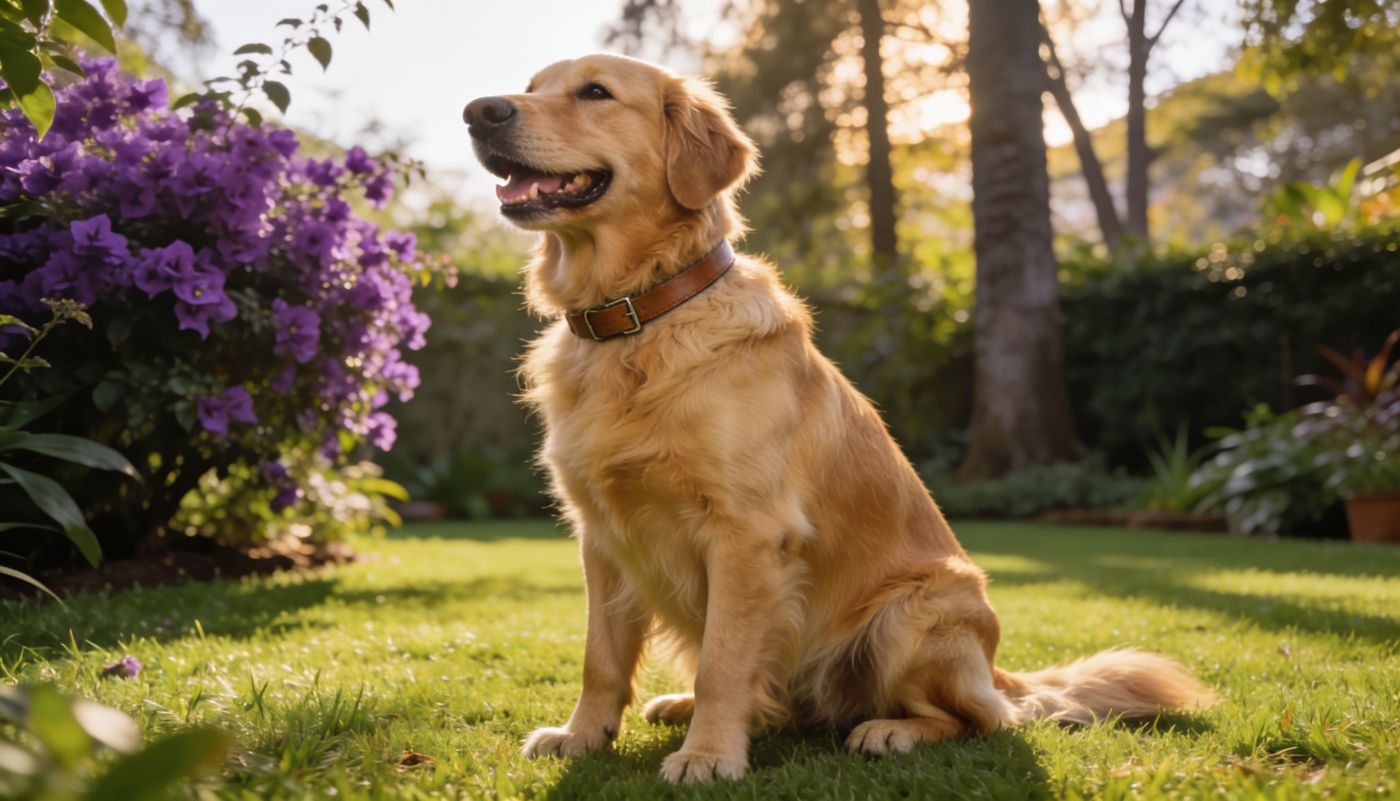
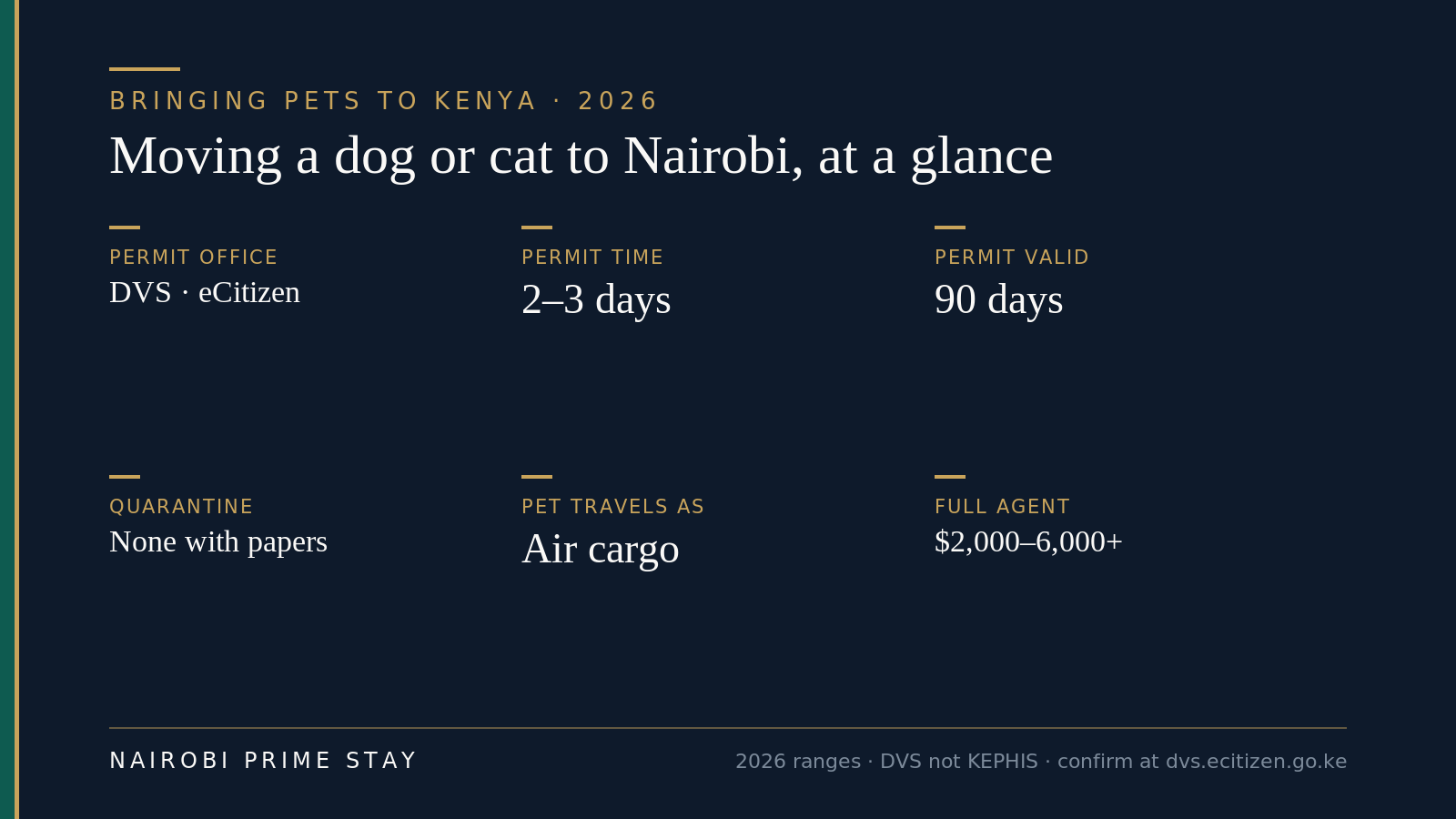 The headline facts for a US-to-Nairobi pet move in 2026. Confirm current details with DVS and your USDA-accredited vet.
Who actually issues the permit (it’s DVS, not KEPHIS)
The Kenyan import permit for a dog or cat comes from the Directorate of Veterinary Services (DVS), the government’s animal-health authority under the Ministry of Agriculture and Livestock Development. You will see KEPHIS mentioned in some checklists, and it is worth clearing up: KEPHIS is the Kenya Plant Health Inspectorate Service, and it deals with plants, seeds and produce, not pets. For a live animal, DVS is your office.
The good news is that DVS now runs its approvals online. You apply and pay for the import permit through the DVS service on the national eCitizen platform (dvs.ecitizen.go.ke), rather than chasing paper in person. American owners have a second, older channel too: the Kenya Embassy in Washington, D.C. processes a pet import licence by mail for a fee of about $50 per pet, with a request letter, your passport bio page, and your pet’s vaccination records. Either route gets you the same thing — a permit that lets your animal enter Kenya. Your vet or a pet-relocation agent can handle the DVS application for you if you would rather not.
Whichever way you apply, the permit is issued in roughly 2–3 working days, is valid for 90 days, and covers a single shipment. So you apply a few weeks before travel, not months — early enough to have it in hand, late enough that it does not expire before the flight.
The four things every pet needs
Strip away the detail and a dog or cat needs the same four things to enter Kenya. Get these right and the rest is logistics.
1. An ISO microchip. Your pet should have a 15-digit ISO-standard microchip (ISO 11784/11785) so its identity links to every certificate. Have the chip implanted before the rabies vaccination, so the vaccination record references the chip number. If your pet was chipped with an older, non-ISO chip, bring your own scanner or ask your vet, because Kenyan and airline scanners read the ISO standard.
2. A current rabies vaccination. This is non-negotiable. Your pet needs a valid rabies shot, and the certificate must state the vaccine type, manufacturer, batch number, the date given, and your pet’s age at vaccination. Give the shot in good time — for a first-ever rabies vaccination, allow several weeks before travel so it is fully in effect. One wrinkle to know: if your pet was vaccinated less than six months before arrival, older Kenyan rules can ask for an extra letter from a government vet confirming there has been no rabies near the animal’s home in the previous six months. Your vet or agent will confirm whether that applies to you.
3. A government-endorsed health certificate. A licensed vet examines your pet and completes an international veterinary health certificate saying it is healthy and free of contagious disease. That certificate then has to be endorsed by your country’s government animal-health authority. For US pets that means USDA APHIS endorsement: your vet must be USDA-accredited, the certificate goes through the USDA’s VEHCS system, and APHIS ink-signs and embosses it. The endorsement fee starts at about $38. This certificate is time-sensitive — it is completed close to travel, commonly within a few days of the flight (some guidance says within five days), with a fit-to-fly check shortly before departure. Confirm the exact window with your USDA-accredited vet, since it is the document most likely to trip people up.
4. A Kenyan import permit. The DVS permit covered above. Carry the original plus copies.
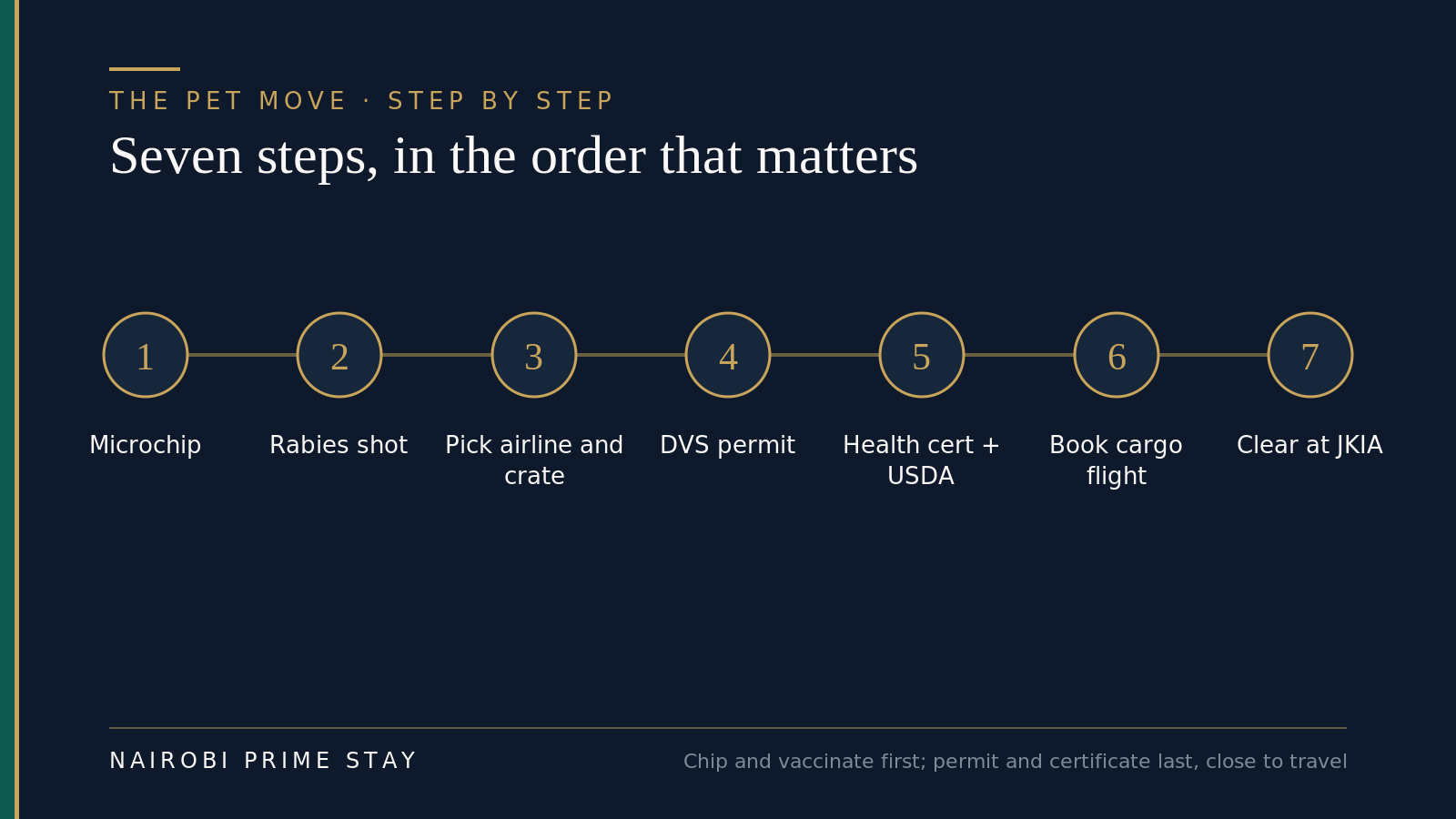 The order matters more than anything. Chip and vaccinate first; the permit and health certificate come last, close to travel.
The step-by-step, in the right order
Here is the sequence that keeps a move calm. Adjust the calendar to your dates, but keep the order.
- Two months out — chip and vaccinate. Confirm the ISO microchip, give or update the rabies vaccination, and ask your vet for a written record of both. If there is any chance your pet will return to the US or move to Europe later, do the rabies titre blood test now (more on that below), because the clock on it is long.
- Two months out — pick the airline and crate. Decide on a route, check the airline’s pet-cargo rules and crate sizing, buy an IATA-compliant crate, and start letting your pet sleep in it so travel day is not its first time inside.
- Three to four weeks out — apply for the DVS permit. File through dvs.ecitizen.go.ke (or have your agent or vet do it). It is valid 90 days, so this timing leaves margin without risking expiry.
- Three to four weeks out — book the cargo space. Airlines cap animals per flight. Reserve your pet’s spot as soon as the permit is moving.
- Final week — health certificate and endorsement. Your USDA-accredited vet completes the health certificate; submit it for USDA APHIS endorsement; arrange the fit-to-fly exam in the final 48 hours or so.
- Travel day — fly. Your pet travels as manifest cargo in its crate, with copies of every document attached to the crate and the originals with you (or your agent).
- Arrival — clear at JKIA. Present the permit and certificates to the veterinary and customs officers at Jomo Kenyatta International Airport, pay any small handling fee, and collect your pet. An agent can do this for you so the animal clears faster.
Rabies and the titre test — what you really need to know
For entry into Kenya, you need proof of a valid rabies vaccination. You do not need a rabies titre test (a blood test that measures antibody levels) to bring a pet into Kenya. A titre result is not a substitute for the vaccination certificate either — Kenya wants the vaccination, full stop.
So why does the titre keep coming up? Because of the journey in the other direction. Kenya is classified as a high-rabies-risk country. If you ever plan to bring your pet back to the US, or move it on to the EU or UK, those destinations require a rabies blood test drawn before the animal leaves the high-risk country, followed by a waiting period that can run three months or more. If that test was never done, you can be stuck waiting it out before your pet can travel. The honest move is simple: if there is any realistic chance your pet returns to the US or heads to Europe later, do the titre test in the US before you fly to Nairobi, while it is cheap and easy. It is insurance you hope not to use.
Returning a dog specifically to the US has also become stricter. The CDC now sets extra conditions for dogs arriving from high-rabies countries, including a microchip and an import form, and sometimes a serology test or an approved arrival facility. Plan the return before you leave, keep your US rabies paperwork, and you avoid the headache.
Quarantine: the reassuring part
There is no routine quarantine for a healthy dog or cat entering Kenya with correct paperwork. This is the question that worries people most, and the answer is genuinely good. Your pet flies in, clears at the airport, and goes home with you the same day.
The honest caveats: Kenya can hold or further test an animal whose documents are incomplete or whose health looks off on arrival, and you would pay for that testing. Pets arriving from a short list of rabies-free countries (Australia, Ireland, New Zealand, Norway, Sweden and the United Kingdom) are exempt from certain certificate clauses. The US is not on that list, but the standard vaccinated route means a US dog or cat with the right documents still walks out of the airport without quarantine. Get the paperwork right and this simply is not a problem.
Flying your pet: cargo, crates and routing
Most pets travel to Nairobi as manifest air cargo, not in the cabin and not as checked baggage. Kenya Airways, the main carrier into Nairobi, requires animals to move as cargo. The exception is a genuine service or assistance dog, which may travel in the cabin under the airline’s rules. So for a typical family dog or cat, plan for a cargo booking handled through the airline’s cargo desk or your relocation agent.
A few things shape the trip:
- The crate. It must be IATA-compliant: rigid, well-ventilated, leak-proof, with a water dish you can fill from outside, and big enough for your pet to stand, turn and lie down. Buy it early and let your pet get comfortable inside before travel day.
- Routing. Fewer connections mean less stress and fewer things to go wrong. A near-direct route is worth paying for. Avoid routing through the EU unless you have to, because EU transit can trigger its own certificate.
- Heat and breed rules. Airlines impose summer heat embargoes on live-animal cargo, and many restrict or refuse snub-nosed (brachycephalic) breeds like bulldogs, pugs and Persian cats because they are vulnerable in flight. Check your breed against the airline’s policy before you book.
- Booking early. Each flight takes only so many animals. The cargo slot is often the binding constraint, so reserve it as soon as your permit is in motion.
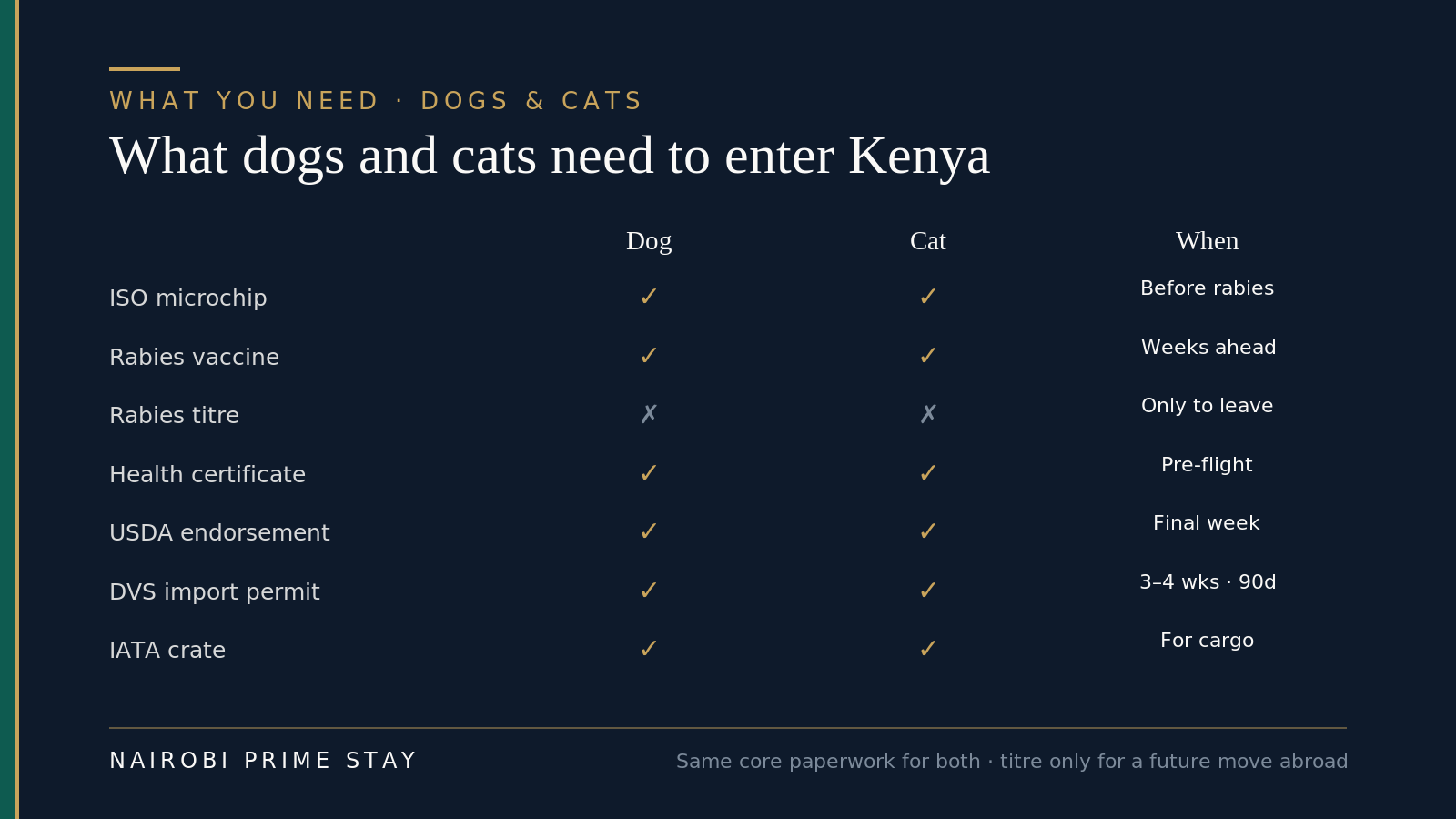 Dogs and cats need the same core paperwork. The titre test is only for a future move back to the US or Europe, not for entering Kenya.
What it costs in 2026
Costs split into two worlds: doing the paperwork yourself, or hiring a relocation agent to manage the whole door-to-door move. Both are legitimate. The right choice depends on your budget, your bandwidth, and how big and complex the move is.
Here is a realistic 2026 breakdown. Treat every figure as a range to confirm, not a quote — the airline cargo charge in particular swings a lot with your pet’s weight, the crate size and the route.
| Item | Indicative 2026 cost | Notes |
|---|---|---|
| DVS import permit / Kenya Embassy licence | ~$50 per pet | eCitizen fee modest; D.C. embassy route is $50/pet |
| USDA APHIS endorsement | from ~$38 | Federal endorsement of the health certificate |
| Vet health-certificate visit | ~$75–250+ | USDA-accredited vet; varies by clinic |
| Microchip + rabies vaccination | ~$50–120 | If not already done |
| Rabies titre test (optional) | ~$200–400 | Only if a future US/EU move is likely |
| IATA-compliant crate | ~$50–300+ | By size; large dogs cost more |
| Airline cargo (the big variable) | ~$1,000–4,000+ | Long-haul, by weight, crate and route |
| Full-service relocation agent | ~$2,000–6,000+ | Door-to-door; replaces most of the above legwork |
If you do it yourself with a small, simple-route pet, your fixed fees might total a few hundred dollars plus the airline cargo charge. A large dog moved door-to-door by an agent can reach several thousand. Neither is hidden; you can price your exact case in an afternoon of calls.
Do it yourself or hire an agent?
Both paths work. The question is how much of the legwork you want to own.
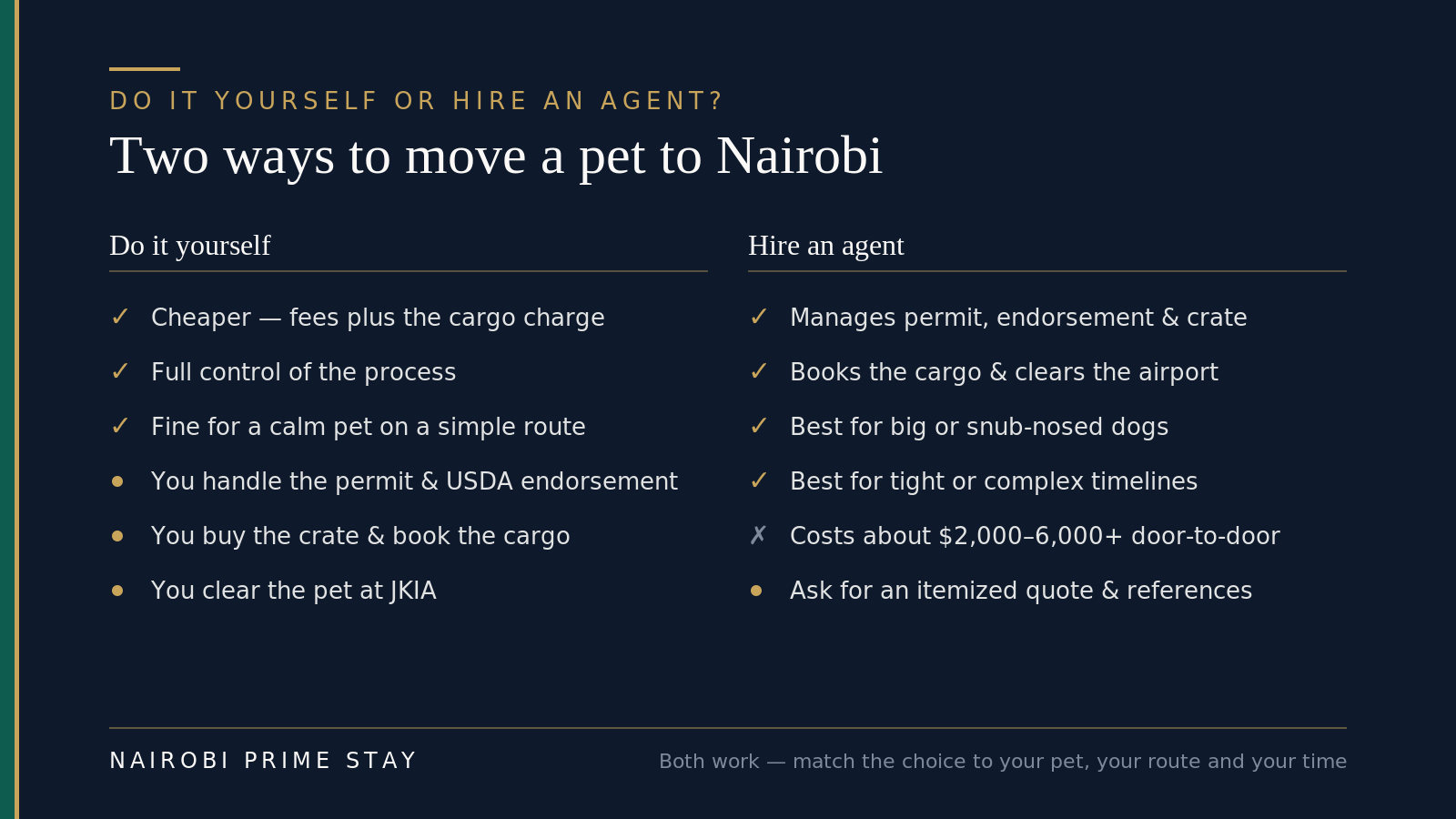 A calm cat on a near-direct route is very doable yourself. A large or snub-nosed dog, a tight timeline, or a multi-leg route is where an agent earns the fee.
Do it yourself if your pet is easy-going, the route is simple, you have time to make the calls, and you want to save money. You will personally handle the permit application, the USDA endorsement, the crate, and the cargo booking. Thousands of people manage it fine.
Hire a relocation agent if you are moving a large dog, a snub-nosed breed, more than one animal, or on a complex multi-leg route — or if you are simply too busy with your own move to project-manage the pet’s. A good agent handles the permit, the endorsement paperwork, an IATA crate, the cargo booking and airport clearance, and troubleshoots when something slips. Kenya has experienced operators; some Nairobi vet clinics are IATA or IPATA accredited for exactly this. Ask for references and a written, itemized quote so you can compare it against the do-it-yourself total.
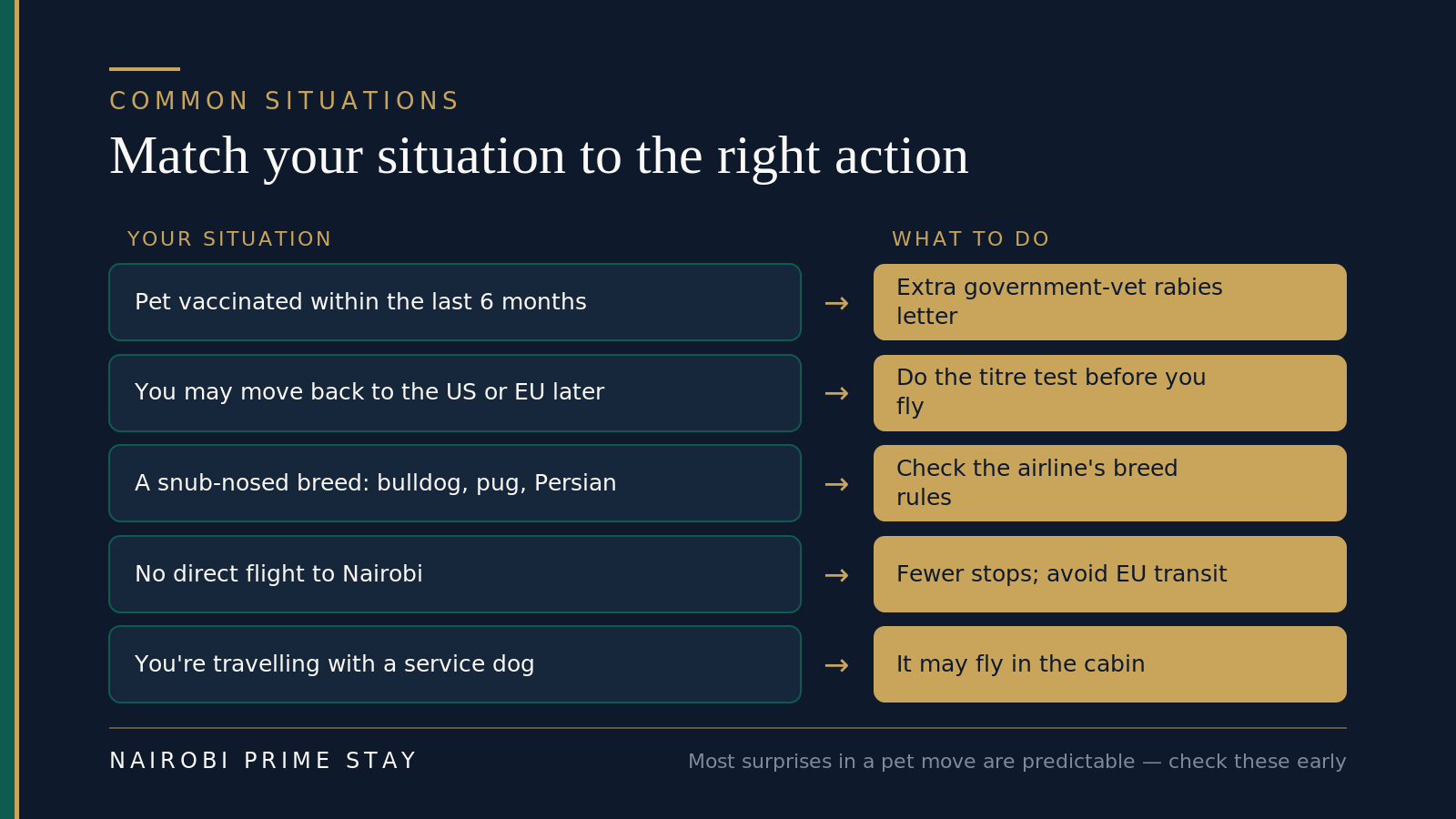 Match your situation to the action. Most surprises in a pet move are predictable if you check these early.
Arriving at JKIA
Your pet lands at Jomo Kenyatta International Airport (JKIA) in the cargo area, not the passenger carousel. A veterinary officer checks the documents and the animal, customs releases it, you pay any small handling charge, and you are on your way. With clean paperwork this is quick. If you used an agent, they meet the shipment and clear it, often before you have finished your own arrival formalities, which spares your pet time in its crate.
Have the originals of the import permit, the rabies certificate and the endorsed health certificate ready, plus copies. Keep your own move’s documents — your visa or permit paperwork — separate and to hand, because you are clearing yourself and your pet at the same time.
Vets and pet care in Nairobi
Nairobi has good private veterinary care, much of it clustered in the same western suburbs where expats live. You will find well-equipped clinics in and around Karen, Langata, Kileleshwa and Westlands offering routine care, surgery, vaccinations and the export paperwork you will eventually need if you move on. A few names that come up repeatedly among Nairobi pet owners include Small Five Vet Clinic in Karen, Mobivet, and Ducknet Veterinary Clinic, while agencies such as Prestige Pets Africa handle international shipping; confirm current locations, services and prices directly, and ask other expats or your landlord for a referral once you arrive.
Register with a local vet in your first week or two. Keep rabies boosters current, since rabies is present in the wider region, and ask your vet about tick and tick-borne disease prevention — ticks are the routine local health issue for dogs here, and a monthly preventive sorts it. Good pet food, both local and imported brands, is sold in the larger supermarkets and pet shops.
Pet-friendly housing in Nairobi
This is where your choice of neighborhood and home matters, and it is genuinely one of Nairobi’s strengths for pet owners. The leafy western and southern suburbs are built for dogs.
Karen and Langata are the classic dog neighborhoods: large plots, gardens, low density and room to walk, plus the equestrian, green character that southern Nairobi is known for. Runda, Kitisuru and the wider Gigiri area also offer big gated homes with walls and grounds. If you have a couple of energetic dogs, a house with a garden in one of these areas is the easy answer, and our guide to the best neighborhoods for expats maps how they compare on space, schools and commute.
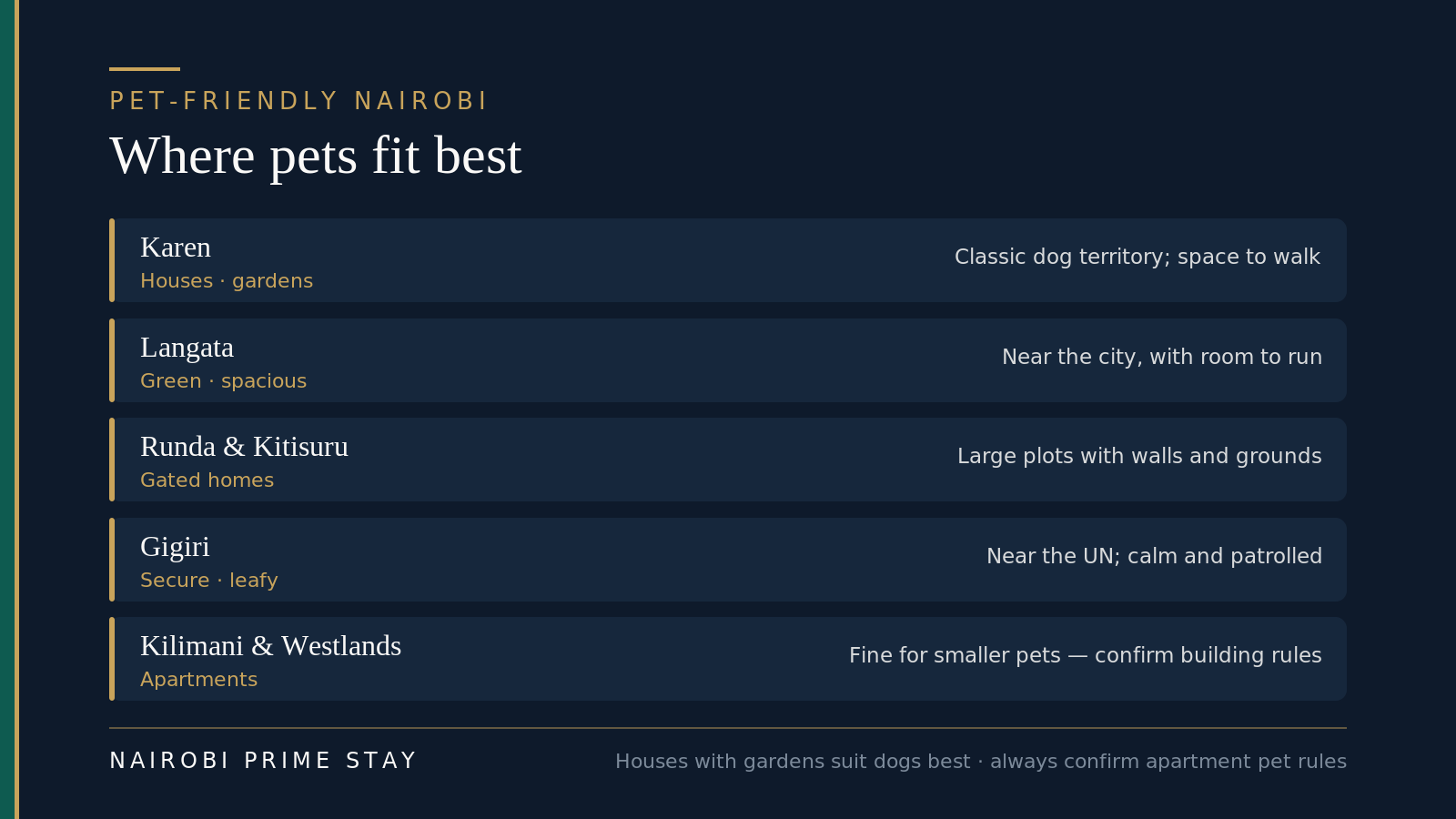 Houses with gardens in Karen, Langata and Runda suit dogs best. In apartment areas, always confirm the building’s pet rules before you sign.
Apartments are a different conversation. Many modern blocks in Kilimani, Westlands, Kileleshwa and Riverside allow pets, especially smaller or indoor ones, but plenty have rules or limits, so never assume — confirm the building’s pet policy in writing before you commit. The same goes for serviced apartments: some welcome pets and some do not, and it is worth asking up front rather than arriving with a dog and a problem.
That last point is the practical reason to sort housing and pet timing together. A common, low-stress plan is to land first, settle into a pet-friendly base, then choose a long-term home once you have seen areas in person. If you want help finding a place that takes your dog or cat, our AI relocation assistant can filter for pet-friendly homes in the right area for your budget and commute.
Settling your pet in
Nairobi is an easy place for a pet to adjust. The climate is mild and spring-like all year, around 15–26°C, and the altitude of roughly 1,795 meters bothers very few animals — give an older or unwell pet a quiet few days to acclimate, as you would yourself. Keep water available, especially after the flight.
A few local notes. Many homes keep a guard dog, and gated compounds usually have day and night askaris (security guards) who will get to know your pet. Walking is pleasant in the quieter suburbs; keep dogs leashed near roads, since traffic is the real hazard. Use the tick prevention your vet recommends and keep vaccinations current. Beyond that, life with a pet here looks a lot like life with a pet anywhere — walks, the vet, good food and a garden to lie in.
A real-world example
Say you are a family moving from Denver with a four-year-old Labrador. Two months out, your US vet confirms her ISO chip and updates her rabies shot, and because you might rotate back to the States in a few years, you do the rabies titre test now. You buy a large IATA crate and start feeding her dinner inside it. Three weeks out, your relocation agent files the DVS permit through eCitizen and books her cargo space on a near-direct routing. In the final week, your USDA-accredited vet completes the health certificate, USDA APHIS endorses it, and she has her fit-to-fly exam. On travel day she flies as cargo; the agent clears her at JKIA and delivers her to your rented house in Karen, where the garden is already fenced. Total elapsed effort: a handful of vet visits and some calls. She is asleep on the lawn by the weekend.
Your pet-move checklist
- Confirm your pet has an ISO 15-digit microchip (chip before the rabies shot).
- Update the rabies vaccination; keep the certificate with vaccine type, batch, date and pet’s age.
- Decide if a rabies titre test is worth doing now (likely yes if you may return to the US or move to the EU/UK later).
- Choose an airline and route; buy an IATA-compliant crate and start crate-training.
- Check your breed against the airline’s snub-nosed and heat-embargo rules.
- Apply for the DVS import permit via dvs.ecitizen.go.ke (valid 90 days) — or use the Kenya Embassy route.
- Book the cargo space early; flights cap the number of animals.
- Have your USDA-accredited vet complete the health certificate and get USDA APHIS endorsement.
- Do the fit-to-fly exam in the final ~48 hours.
- Carry originals plus copies of every document for JKIA clearance.
- Line up a pet-friendly home and a local vet before you land.
Frequently asked questions
Can I bring my dog or cat to Kenya?
Yes. Kenya allows you to import dogs and cats, and most people do it without trouble. Your pet needs an ISO microchip, a valid rabies vaccination, a government-endorsed international health certificate, and a Kenyan import permit from the Directorate of Veterinary Services. With those documents and a healthy animal, there is no routine quarantine — your pet flies in as cargo, clears at the airport, and goes home with you the same day.
Who issues the pet import permit for Kenya — is it KEPHIS?
It is the Directorate of Veterinary Services (DVS), not KEPHIS. KEPHIS is the plant-health authority and does not handle animals. You apply for the DVS import permit online through the eCitizen platform (dvs.ecitizen.go.ke); American owners can also process a pet import licence by mail through the Kenya Embassy in Washington, D.C. for about $50 per pet. The permit is usually issued in 2–3 working days and is valid for 90 days, so apply a few weeks before you travel.
Is there quarantine for pets entering Kenya?
No, there is no routine quarantine for a healthy dog or cat that arrives with correct paperwork. Kenya can hold or further test an animal only if its documents are incomplete or it shows signs of disease on arrival, and you would pay for that testing. Pets from a few rabies-free countries are exempt from certain certificate clauses, but a US pet on the standard vaccinated route still clears the airport without quarantine. Getting the documents right is what keeps quarantine off the table.
Does Kenya require a rabies titre (blood) test?
No — a rabies titre test is not required to bring a pet into Kenya, and it does not replace the rabies vaccination certificate, which is mandatory. The titre matters for the journey in reverse: because Kenya is a high-rabies-risk country, bringing your pet back to the US or on to the EU or UK later requires a rabies blood test drawn before leaving, plus a waiting period. If a future move like that is possible, do the titre test before you fly to Nairobi while it is simple and cheap.
How much does it cost to bring a pet to Kenya from the US?
If you handle the paperwork yourself, the fixed fees — import permit (~$50), USDA endorsement (from ~$38), vet visit, microchip and crate — usually total a few hundred dollars, plus the airline cargo charge, which is the big variable and can run roughly $1,000–4,000+ on a long-haul depending on your pet’s size and route. A full-service relocation agent that manages everything door-to-door typically costs about $2,000–6,000 or more. Price your exact case, since a large dog costs far more to fly than a cat.
How long does it take to bring a pet to Kenya?
Plan for at least one to two months for a straightforward move from the US, and three or more months if your pet might later return to the US or move to Europe, because that needs a rabies titre test with a long waiting period done before you leave. The sequence drives the timeline: microchip and rabies vaccination first, then the import permit and cargo booking about three to four weeks out, then the health certificate and endorsement in the final week. Starting early is the single best thing you can do.
Can my pet fly in the cabin to Nairobi?
Usually no — pets travel to Nairobi as manifest air cargo, not in the cabin or as checked baggage, and Kenya Airways requires this. The main exception is a genuine service or assistance dog, which may fly in the cabin under the airline’s rules. Your pet rides in an IATA-compliant crate, and you book the space through the airline’s cargo desk or a relocation agent. Reserve early, because each flight carries a limited number of animals.
Is Nairobi a good place to have a dog?
Yes, it is one of the city’s quiet strengths for pet owners. The western and southern suburbs — especially Karen, Langata, Runda and Kitisuru — offer houses with gardens, walls and space to walk, and the climate is mild all year. Veterinary care is good, with well-equipped clinics across Karen, Langata and Westlands. If you are renting an apartment or a serviced apartment, confirm the building’s pet policy in writing first, since rules vary.
Final thoughts
Bringing a pet to Kenya is a project, not a gamble. The rules are clear, the quarantine worry is mostly unfounded, and the welcome on the other end is real — gardens, good vets and mild weather. What separates a calm move from a stressful one is timing and order: chip and vaccinate early, get the import permit and the endorsed health certificate in the right window, and book the cargo before the flight fills.
Do that, and the hardest part of the whole thing is the wait at the cargo terminal. Your dog or cat clears, you drive home, and Nairobi becomes their city too.
This is general guidance for 2026, not veterinary or legal advice. Rules and fees change, so confirm the current requirements with the Directorate of Veterinary Services (dvs.ecitizen.go.ke), your USDA-accredited vet, and your airline before you book.
Related reading
- Moving to Nairobi: the complete guide - the hub that ties your whole relocation together, pet included.
- Shipping your belongings to Kenya - the household-goods side of the move, with timelines that pair well with your pet’s.
- Karen neighbourhood guide - space, gardens and the classic dog-friendly suburb.
- Langata neighbourhood guide - green, spacious and close to the city, another strong pick for dogs.
- Best neighbourhoods for expats - how the areas compare on space, schools and commute.
- Serviced apartments in Nairobi - a soft-landing base while you find a pet-friendly long-term home.
- Cost of living in Nairobi - where pet care and vet bills fit into a monthly budget.
The easiest way to land well with a pet is to have a secure, comfortable base waiting. A serviced apartment for your first weeks is all-inclusive - Wi-Fi, cleaning, security and a backup generator - so you can settle the animal, view homes and check which areas and buildings are genuinely pet-friendly before signing a year-long lease. Browse our serviced apartments in Nairobi for honest monthly pricing, or ask our AI relocation assistant to shortlist pet-friendly options for your budget and commute. A $50 deposit reserves a place, with the balance paid on arrival.
Ready to look?
Find your apartment in Nairobi
Browse verified serviced apartments, or ask the AI concierge which area fits your life.