
Guides · Visas
Kenya Visas for Americans: Which One You Actually Need (2026)
Kenya Visas for Americans: Which One You Actually Need

Every American needs an approved eTA to enter Kenya, but the eTA only covers visits — to live or work in Nairobi you’ll need a residence permit that matches your situation. For remote workers there’s the Class N digital nomad permit; for employees, an employer-sponsored Class D work permit; for business owners, the Class G investor permit. The smart path for most people is to visit first on the eTA, then file the right permit from the ground.
This guide explains each route, what it costs, who it’s for, and the sequence that saves you weeks of hassle. Visa rules and fees change, and this isn’t legal advice — always confirm the current requirements on Kenya’s official portals or with a Kenyan immigration lawyer before you act. We flag the official sources throughout.

The quick version
To visit Kenya, every American needs an eTA (electronic travel authorization): $30, applied for online at etakenya.go.ke, valid to enter within 90 days, and good for stays up to 90 days — but not for working or residing. To live and work remotely, the Class N digital nomad permit ($200 + $1,000/year) is the headline option — there’s no longer a fixed published income figure, but you’ll need to show steady foreign income with three months of bank statements or payslips. To take a local job, you’ll need an employer-sponsored Class D work permit; to run a business, a Class G investor permit. The usual smart sequence: enter on the eTA, choose your home, then file the permit that fits with a local lawyer’s help.
The routes at a glance
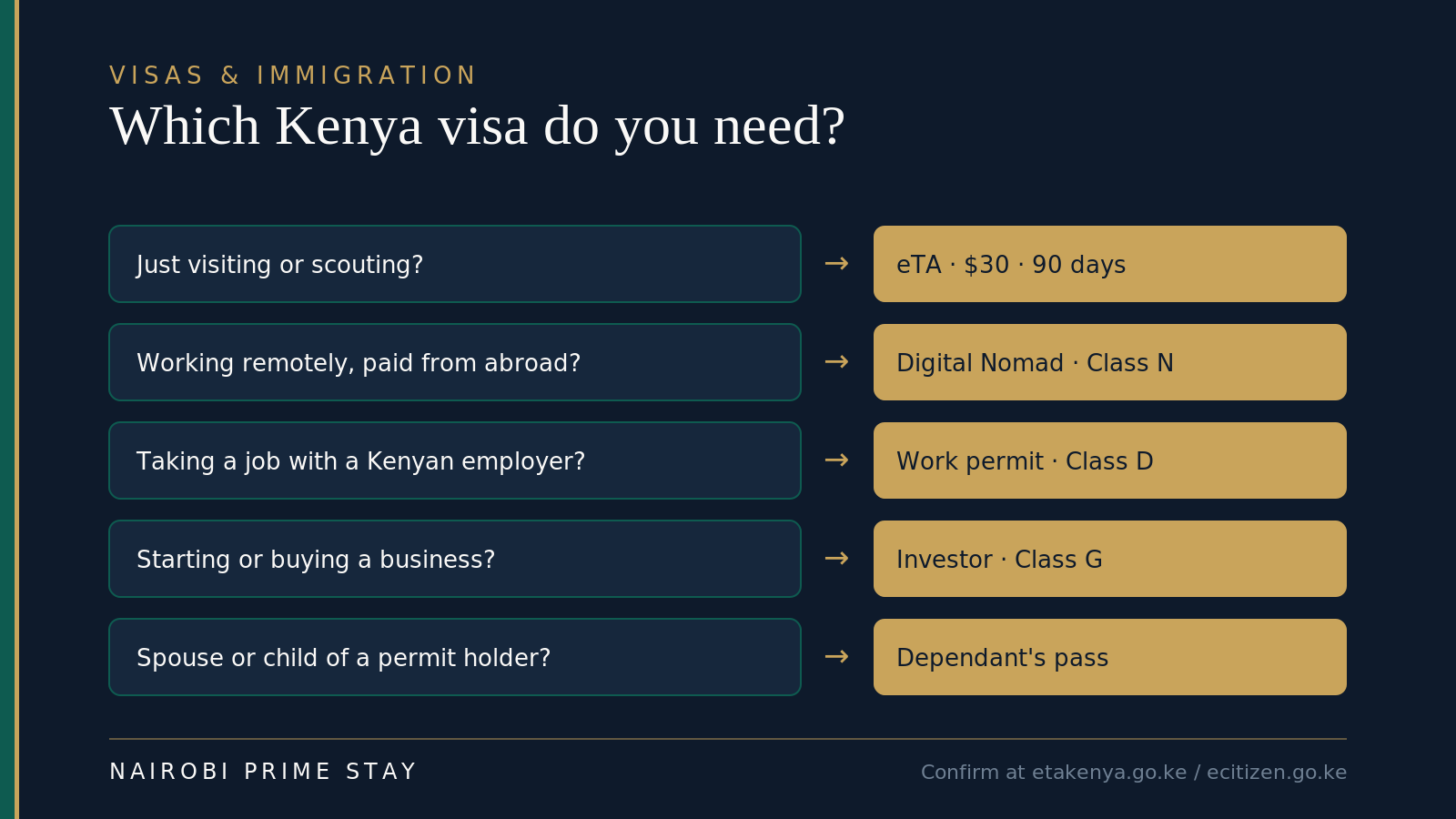
Which Kenya visa fits your situation.
| Route | Indicative cost (2026) | Best for | Lets you work? |
|---|---|---|---|
| eTA (visit) | $30 · enter within 90 days | Scouting trips, short stays | No |
| Digital Nomad (Class N) | $200 + $1,000/yr | Remote workers paid from abroad | Remote only, not local |
| Work permit (Class D) | Employer-sponsored | Taking a job with a Kenyan employer | Yes, for that employer |
| Investor (Class G) | Investment-based | Starting or buying a business | Yes, in your business |
| Dependant’s pass | Linked to sponsor | Spouse and children of a permit holder | Per the pass terms |
Always confirm current fees and rules on Kenya’s official portals (etakenya.go.ke and ecitizen.go.ke) before you rely on any figure here — they change.
The eTA: how every visit starts
An eTA is Kenya’s electronic travel authorization — an online approval you must get before you fly. Standard processing costs $30 at the official portal etakenya.go.ke — use only the official site. Two things the headline price hides: paying by credit card can add a surcharge of about $9, so a $30 eTA can ring up closer to $39; and if you’ll fly in and out while your permit is processed, US citizens can buy a 5-year multiple-entry eTA for around $185 instead of repeating the single-entry application each trip. Check the current total for the option you choose before you pay. It lets you enter Kenya within 90 days of issue, for a stay of up to 90 days. It’s designed for tourism and short visits, including a scouting trip to choose your neighborhood and view homes in person. It does not permit working or long-term residence.
To apply you’ll typically need a passport valid at least six months with a blank page, a passport photo, your travel itinerary and proof of accommodation. Processing is officially 3–5 business days and often faster, but apply at least a week ahead to be safe. Print your approval and carry it. The eTA is the easy part — the residence permits below are where to focus your real planning.
“Isn’t Kenya visa-free now?” Not for Americans. In 2025 Kenya dropped the eTA for most African nationals and several Caribbean countries, and the headlines made it sound as though Kenya had gone visa-free for everyone. It hasn’t. As of 2026, travelers from the US, UK and EU still need an approved eTA before flying. So if you’re American, treat the eTA as a required step — just confirm the latest rules on etakenya.go.ke, because this is exactly the kind of policy that keeps changing.
How to apply for the eTA, step by step
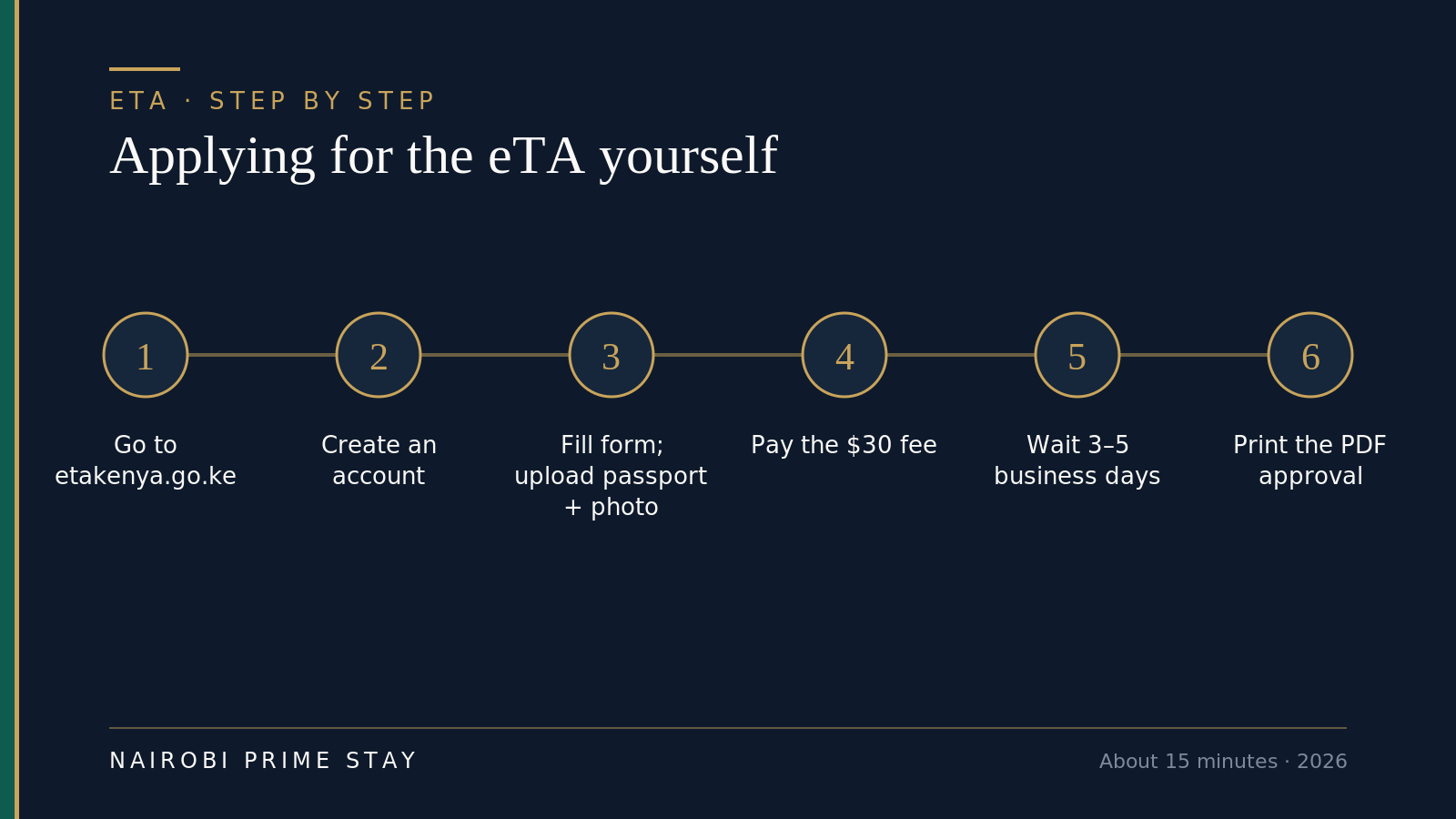
Applying for the eTA yourself takes about fifteen minutes.
You don’t need an agent for the eTA — it’s a form you can fill in yourself in about fifteen minutes. Go to etakenya.go.ke, create an account, and enter your passport, travel and accommodation details. Upload a passport photo and the photo page of your passport, pay the $30 fee, and submit. Approval usually arrives by email in three to five business days — often sooner — as a PDF. Print it and carry a copy; you’ll show it when you check in for your flight and again when you land at JKIA. Apply at least a week before you fly. If you’re coming to scout neighborhoods and get a feel for the city first, our honest take on safety in Nairobi is worth a read before you land.
Watch out for the fake eTA websites
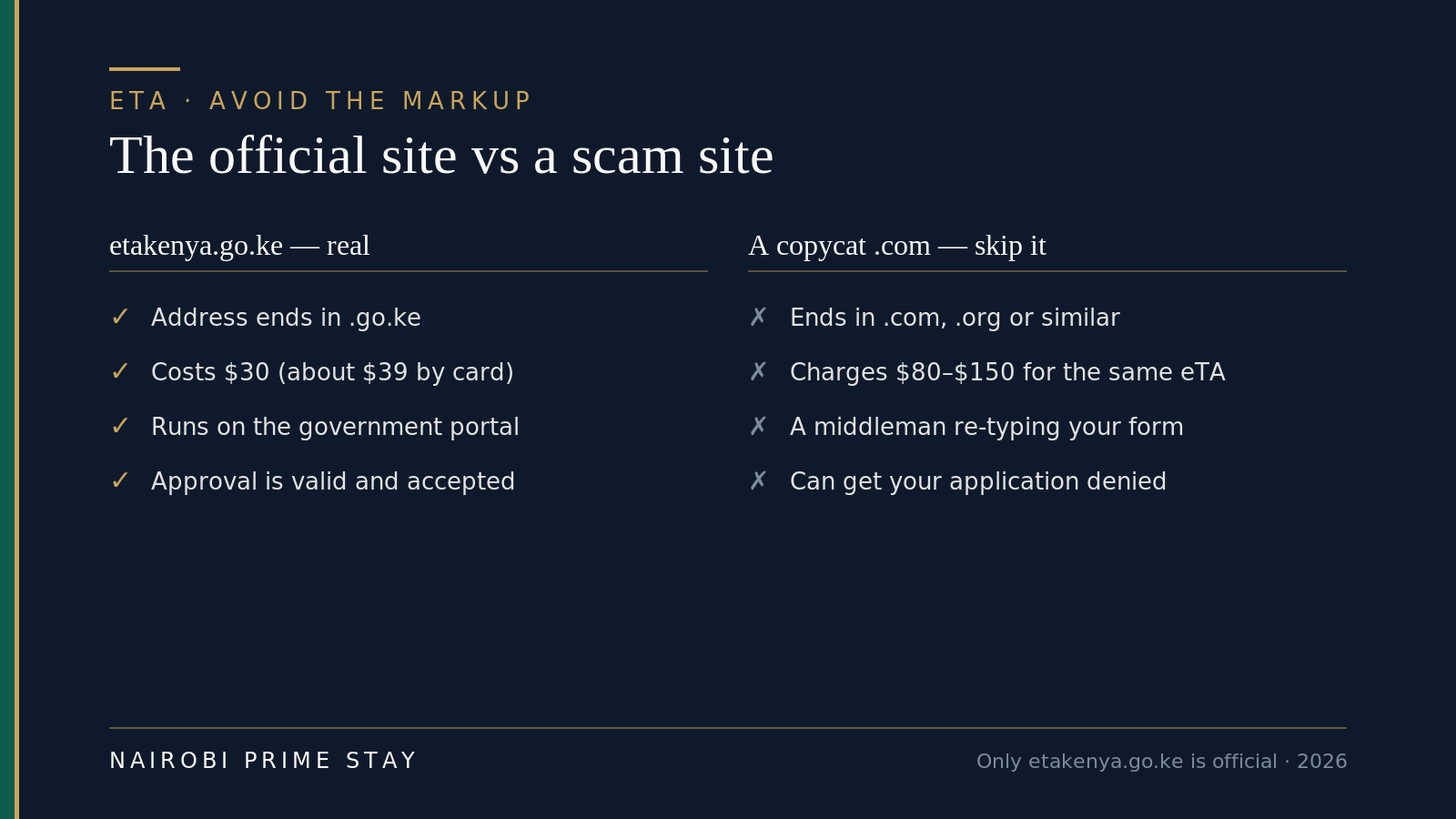
Only etakenya.go.ke is the real thing — everything else is a middleman or worse.
This is the one part of the visa process where people lose real money, so it’s worth a blunt warning. Since Kenya launched the eTA in 2024, dozens of copycat websites have appeared that look almost identical to the government portal. They buy the top ad slots on Google, so when you search “Kenya eTA” the first results are often not the official site. These sites charge $80 to $150 for the same eTA that costs $30 at the source — and some file your application poorly or through the wrong channel, which can get it denied.
The rule is simple: the only official eTA portal is etakenya.go.ke, and real Kenyan government sites end in .go.ke. If an address ends in .com, .org, or anything else, it’s a third party charging you a markup at best. Check the exact web address before you type in your passport number or card details, and ignore the sponsored ads at the top of the search page. Paying $30 at the source instead of $130 to a middleman is the easiest money you’ll save on this whole move.
Class N: the digital nomad permit
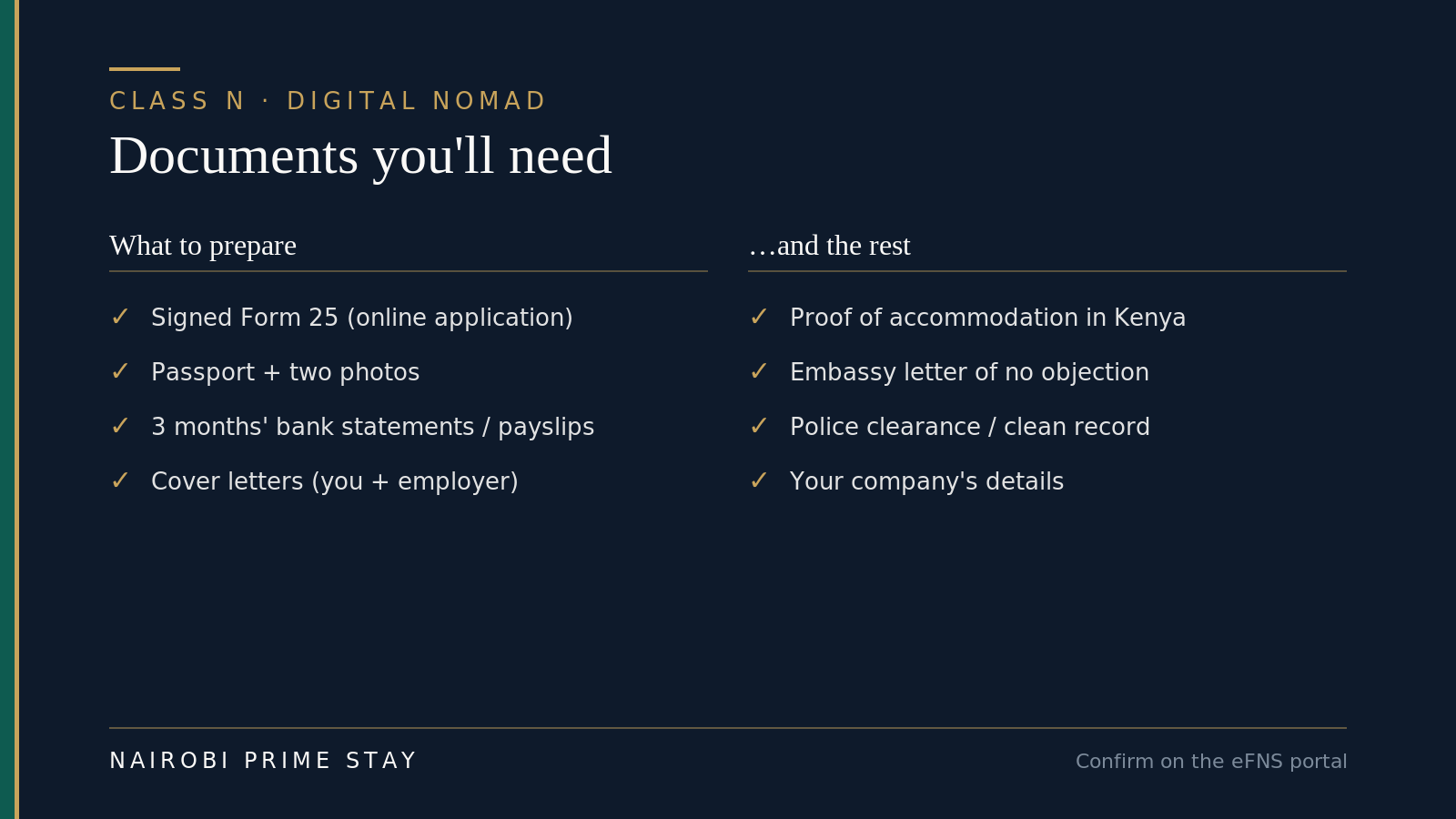
What to prepare for Class N.
Kenya’s Class N permit lets you live in Kenya while working remotely for employers or clients outside the country — the route most remote workers and freelancers will want. It was formally introduced under the Kenya Citizenship and Immigration (Amendment) Regulations, 2024. The official government fees are $200 (processing, non-refundable) plus $1,000 per year (issuance), paid in US dollars through the eFNS portal. It’s typically issued for one or two years and is renewable.
On income, the rules have shifted, and it’s worth getting right. Earlier guidance floated a benchmark of around $24,000 a year, but the current official requirement is no longer a fixed dollar figure — it’s proof of steady foreign income, shown with three months of bank statements or payslips. Focus on demonstrating consistent earnings from outside Kenya rather than hitting a magic number. You may still see older figures like $24,000, $36,000 or even $55,000 quoted around the web; treat them as historical until the official eFNS portal says otherwise.
Here’s what the official checklist actually asks for:
- A completed, signed Form 25 (the online application)
- A passport valid for your stay, plus two passport photos
- Three months of bank statements or payslips showing your foreign income
- A cover letter from you, and one from your overseas employer or company
- Proof of accommodation in Kenya (a lease, or even a hotel reservation to start)
- A letter of no objection from your home country’s embassy in Kenya
- A police clearance / clean criminal record
- Your company’s details (physical address, contact person)
One caution worth knowing: if you’re self-employed with many clients, immigration may look closely at whether your work truly fits Class N or looks more like running a local business — which can point to a Class G (investor) or Class K permit instead. Get advice on the right category before you file, since a mismatch causes delays or refusals. And remember you can’t take a Kenyan job or earn from Kenyan clients on this permit. Confirm everything on the immigration portal (eFNS, via ecitizen.go.ke), and if you’ll work remotely from Nairobi, pair this with our internet and remote work guide and our cost of living guide to plan your setup and budget.
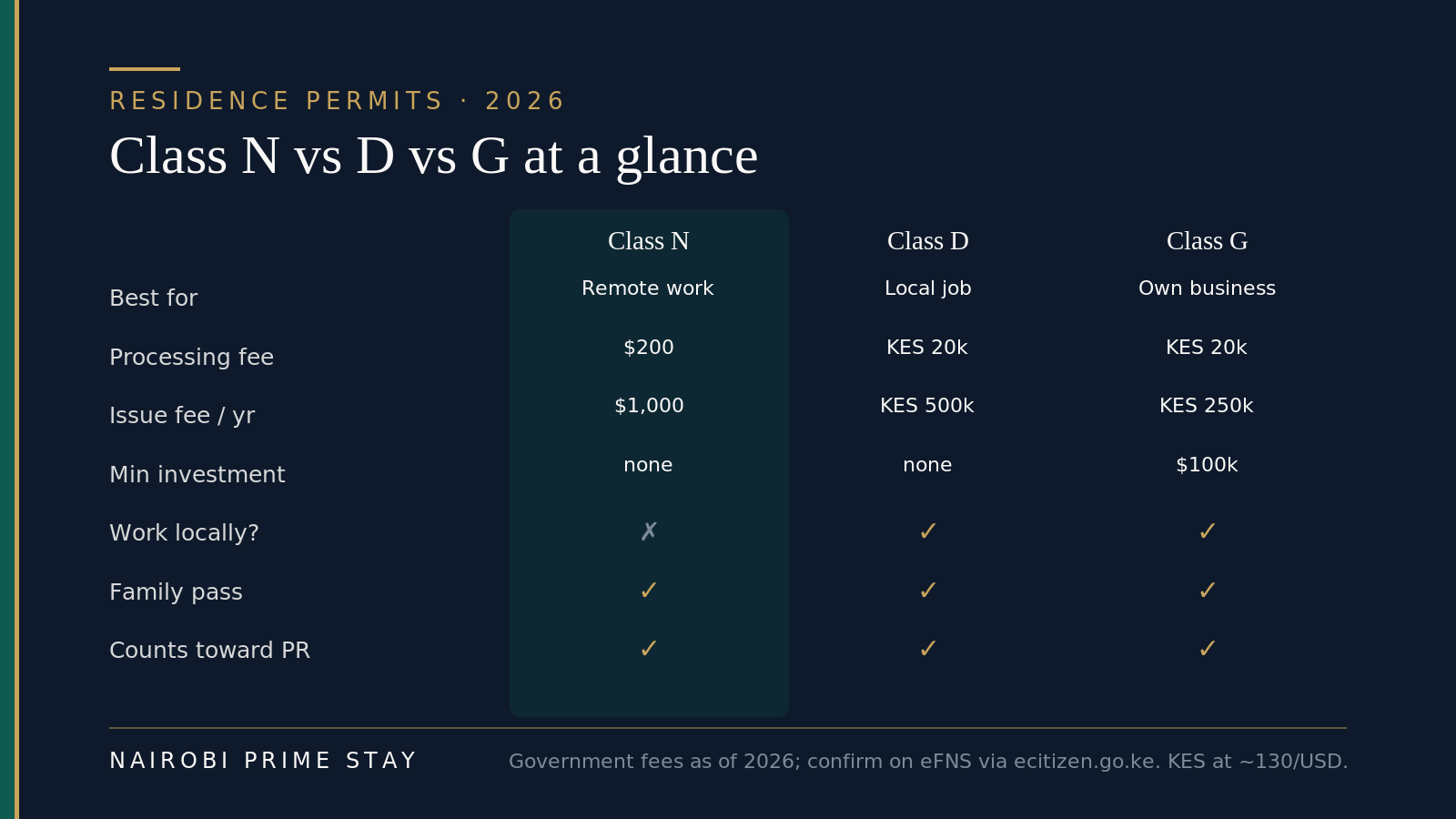
The three residence permits side by side — government fees as of 2026, confirm on the eFNS portal.
Class D: the work permit
If a Kenyan employer hires you, they sponsor a Class D work permit tied to that job. The employer handles much of the process, demonstrating the role and your qualifications. It’s the route for anyone taking a local position rather than bringing income from abroad. These permits take time to process, so coordinate early with your employer and start before you plan to begin work. Your employer’s HR or a local immigration advisor will guide the specifics.
On cost, Class D isn’t cheap, and it’s usually the employer who pays. As of 2026 budget roughly KES 20,000 for the non-refundable processing fee plus KES 500,000 per year for issuance once it’s approved — about $3,800 a year at current exchange rates. The permit is granted where a role needs skills or qualifications not readily available locally, so the employer has to justify the hire. You apply through the eFNS portal on ecitizen.go.ke: pay the processing fee to submit, then the larger issuance fee only after approval, against the invoice the system generates. Once it’s granted you’ll register a KRA PIN and open a Kenyan bank account to get paid locally.
Class G: the investor permit
If you’re starting or buying into a business in Kenya, the Class G investor permit is the relevant route, based on your investment in the venture. Like the work permit, it requires documentation and time, and it’s best handled with a local immigration lawyer and often an accountant. If entrepreneurship is your reason for moving, build the permit timeline into your business plan from the start.
The headline requirement is real money in the business: immigration wants documentary proof of a minimum investment of USD 100,000 (about KSh 15 million) in the venture. The fees echo the work permit but cost less to renew — roughly KES 20,000 processing plus KES 250,000 per year for issuance, around $1,900 a year. Expect to show company registration documents, a CR12, company and personal KRA PINs, tax compliance and Forms 25 and 27, with a cover letter to the Director General of Immigration. It’s first issued for one or two years and renewed on evidence the business genuinely operates — audited accounts, Kenyan staff on the payroll, tax compliance. One honest distinction: buying an apartment or building a house is not the same as qualifying for an investor permit, so if property is your real goal, start with our property investing in Kenya guide.
Dependant’s pass: for your family
Spouses and children of a permit holder are covered by a dependant’s pass, linked to the main applicant’s permit. This is how families move together — one person holds the work, investor or nomad permit, and dependants are tied to it. If you’re relocating with children, our guide to moving to Nairobi with kids covers schools, neighborhoods and the practical side. File the passes alongside the main permit, and confirm the current requirements and any work rights for spouses on the official portal.
Other passes worth knowing: Special Pass and Pupil’s Pass
Two shorter-term passes fill the gaps around the main permits. A Special Pass is a short-term authorization — up to six months — that lets you work or run a business while a longer permit is processed, or covers a short assignment that doesn’t justify a full permit. It’s the bridge to use if you need to start before your Class D or G comes through. A Pupil’s Pass covers a child studying in Kenya, so if your kids will be enrolled in school here, ask your immigration advisor whether they belong on your dependant’s pass or need their own pupil’s pass. For the day-to-day of moving a family — schools, help at home, weekends — our guide to family life in Nairobi covers the ground. Returning African Americans exploring a move home will find the same permit routes walked through, with that journey in mind, in our relocation guide for the diaspora.
The smart sequence

The right order saves weeks.
Doing things in the right order saves weeks. The path most settled expats recommend:
- Enter on the eTA and use the visit to choose your neighborhood and view apartments in person.
- Engage a Kenyan immigration lawyer to file the right permit for your situation.
- Register your KRA PIN as soon as your permit is issued.
- Open a bank account, then sign your lease — both need the permit and KRA PIN.
This is why a serviced apartment for your first weeks works so well: you’re secure and settled while the paperwork progresses, without having committed to a long lease before your permit is even approved. Our complete guide to moving to Nairobi lays out the whole timeline.
What if your 90 days runs out? Extensions and overstays
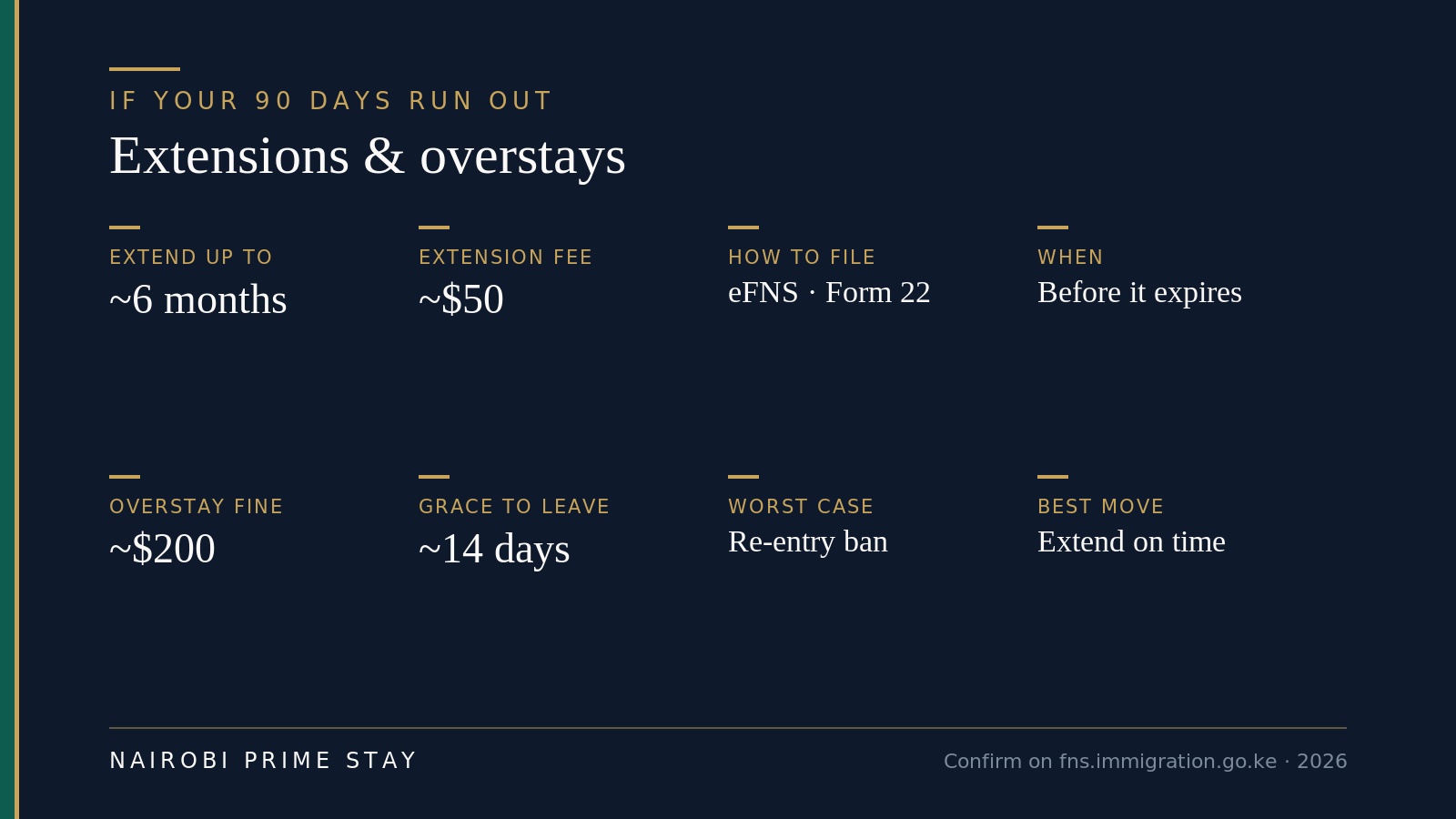
Extend before you expire — overstaying is the expensive mistake.
Permits take time, and sometimes your 90-day eTA stay runs down before yours is approved. You have two honest options. The clean one is to extend your visitor’s pass: apply on the eFNS portal (fns.immigration.go.ke) with Form 22 before your current stay expires. Extensions come in blocks — commonly 30 days at a time — up to a total stay of about six months, and as of 2026 each one carries a fee of around $50. Keep your approval, your onward ticket and proof of funds handy.
The costly option is to do nothing and overstay. Don’t. Overstaying breaks immigration law: expect a fixed fine of about $200, and you’ll still have to file the extension to cover the days you missed. Once you’ve paid, immigration typically gives a short grace period — around 14 days — to leave. Push it further and you risk detention, deportation, and even a ban on returning. None of that is worth it when a $50 extension, filed on time, keeps you clean. If your permit is genuinely dragging, the better move is often to fly out for a short trip and re-enter — but confirm the right approach with your immigration lawyer first.
Your KRA PIN
Once you hold a permit, register for a KRA PIN (your Kenyan tax ID) at itax.kra.go.ke. You’ll need it for almost everything that follows — opening a bank account, signing a lease, buying a car, setting up utilities — so make it an early priority the moment your permit comes through. It’s a quick but essential step, and the rest of your setup waits on it.
A note on tax residency
Spending more than 183 days in Kenya in a tax year can make you a Kenyan tax resident, with obligations that follow. At the same time, the US taxes its citizens on worldwide income wherever they live. Here’s the catch most Americans miss: the US and Kenya have no double-tax treaty, and no Social Security totalization agreement — so there’s no automatic treaty relief to fall back on. What protects you instead are the standard tools for US expats, chiefly the Foreign Earned Income Exclusion and the Foreign Tax Credit (IRS Form 1116), which, used correctly, keep most people from genuinely paying tax twice. Because there’s no treaty to lean on, the details matter — talk to a cross-border accountant early, especially if you’ll keep US income or run a business. Our guide to taxes for expats in Kenya goes deeper on residency, the Foreign Earned Income Exclusion and what to actually file. This guide is general information, not tax or legal advice.
The long game: permanent residence
If Nairobi becomes home, you don’t have to renew a permit forever. After seven years of continuous, lawful residence on a valid work permit — with at least the three years immediately before you apply spent living in Kenya without a break — you can apply for permanent residence. PR lets you live, work and run a business without renewing permits or visas, which is a real relief after years of annual paperwork.
A few honest caveats. Permanent residence is not citizenship: it doesn’t give you a Kenyan passport or the vote, and naturalization is a separate, longer path with its own rules on dual citizenship. Family can follow, but the main applicant has to be granted PR first — you can’t file jointly. And the bar is real: you’ll need to show sustained lawful residence, good character, financial self-sufficiency and a genuine contribution to Kenya. Applications go through the same eFNS system on ecitizen.go.ke. For most people the practical takeaway is simpler — keep every permit current and unbroken from year one, because those years are what eventually count.
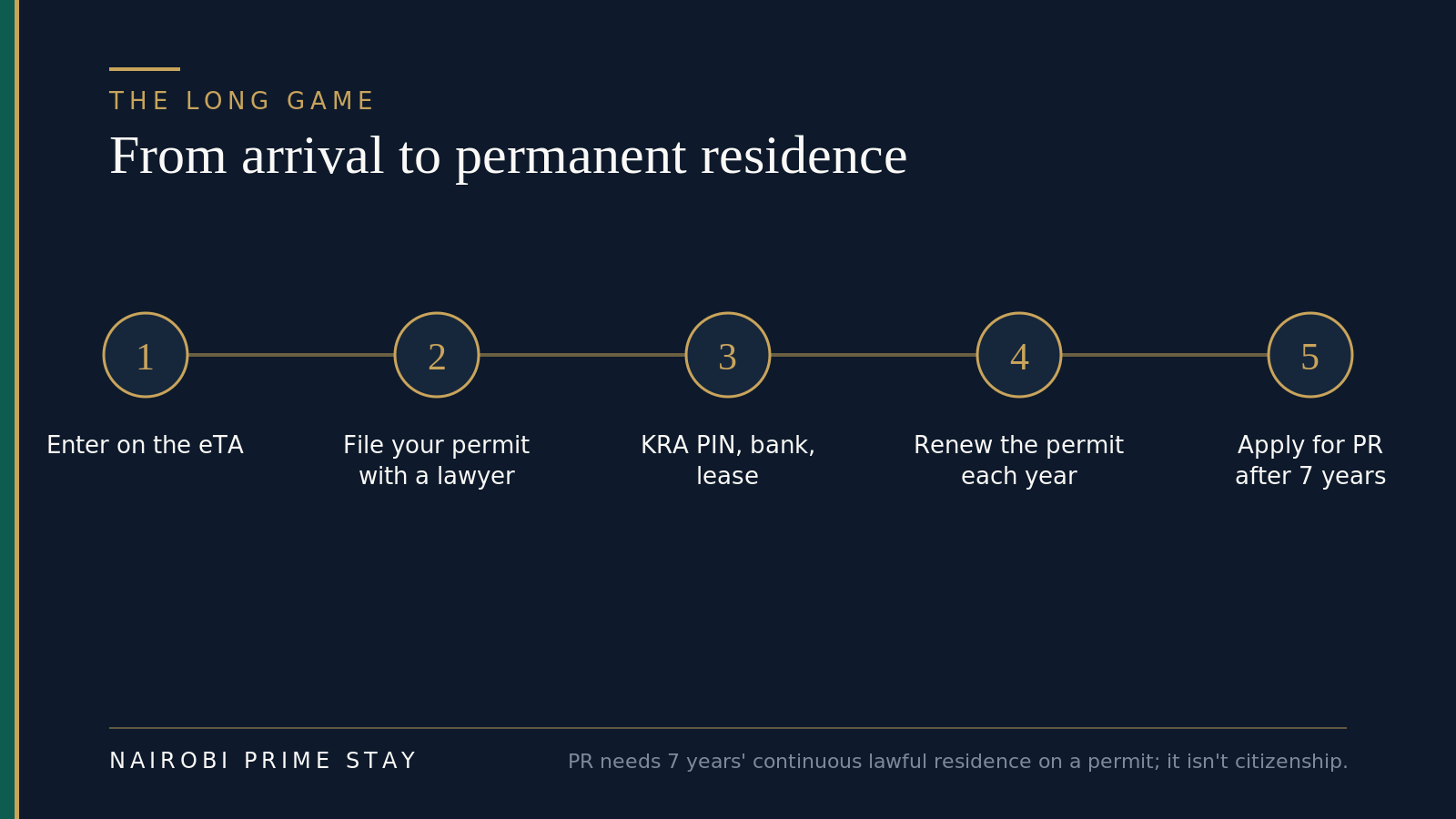
Permanent residence is a seven-year horizon — and the years only count if your permits stay continuous.
How to apply, and when to use a lawyer
The eTA you can handle yourself online at etakenya.go.ke. For residence permits, use a Kenyan immigration lawyer or a reputable relocation advisor — the permit categories have specific documentation, the process takes time, and small mistakes cause big delays. A good advisor is well worth the fee for a Class N, D or G permit. Start early, keep digital and paper copies of every document, and confirm requirements directly on the official portals as you go.
Official sources and the fine print
Always verify against the official sources, because fees and rules change:
- eTA: etakenya.go.ke (the only official eTA portal)
- Immigration and permits: ecitizen.go.ke (eFNS / immigration services)
- KRA PIN and tax: itax.kra.go.ke
- US Embassy Nairobi: ke.usembassy.gov
This article is general guidance as of 2026, not legal, tax or immigration advice. Confirm current requirements with the Kenyan authorities or a qualified immigration lawyer before you act on anything time-sensitive.
Frequently asked questions
Do Americans need a visa to enter Kenya? Americans need an approved eTA (electronic travel authorization) before flying — $30 for standard processing, applied for online at etakenya.go.ke, valid to enter within 90 days and good for visits up to 90 days. It doesn’t permit working or residing; for that you need a residence permit.
Is Kenya visa-free for Americans in 2026? No. Kenya dropped the eTA for most African nationals and several Caribbean countries in 2025, but US, UK and EU travelers still need an approved eTA before flying. For Americans the eTA remains a required step — apply at etakenya.go.ke and confirm the latest rules, since the policy has been changing.
What visa do I need to live in Kenya as an American? It depends on your situation: the Class N digital nomad permit for remote workers paid from abroad, an employer-sponsored Class D work permit for a local job, or a Class G investor permit for running a business. The eTA only covers visits, so you’ll move to one of these to reside.
How much does the Kenya digital nomad visa cost? As of 2026, the Class N permit costs $200 (non-refundable processing) plus $1,000 per year (issuance), paid in US dollars. It’s issued for one or two years and is renewable. There’s no fixed minimum-income figure anymore — you show steady foreign income with three months of bank statements or payslips. Confirm current figures on Kenya’s eFNS immigration portal.
Can I work remotely in Kenya on a tourist eTA? The eTA is for visits, not work or residence. For working remotely from Kenya long-term, the Class N digital nomad permit is the designed route. Many people visit first on the eTA to choose where to live, then apply for the nomad permit.
How long does it take to get a Kenyan work or nomad permit? Residence permits take time — often weeks to months — and the exact timeline depends on the category and your documentation. Start early, use a Kenyan immigration lawyer, and consider a serviced apartment for your first weeks while the process runs.
How do I avoid Kenya eTA scam websites? Apply only at the official portal, etakenya.go.ke — real Kenyan government sites end in .go.ke. Since the eTA launched in 2024, copycat sites (often ending in .com or .org) have bought the top Google ad slots and charge $80 to $150 for the same $30 eTA; some even get applications denied. Check the exact web address before you enter your passport or card details, and skip the sponsored ads at the top of the results.
What happens if my Kenya eTA or visitor’s pass runs out? Extend before it expires. You can extend a visitor’s pass on the eFNS portal with Form 22, in roughly 30-day blocks up to about six months total, for a fee of around $50 as of 2026. Overstaying is a breach of immigration law — expect a fine of about $200, a short grace period (around 14 days) to leave, and a possible re-entry ban. If a permit is dragging, ask your immigration lawyer whether to extend or briefly exit and re-enter.
Can I apply for the Kenya eTA myself, or do I need an agent? You can do it yourself in about 15 minutes at etakenya.go.ke — there’s no need for an agent, and third-party services just add a markup. Create an account, complete the form, upload your passport photo page and a photo, pay $30, and wait three to five business days for the PDF approval. Only the residence permits — Class N, D and G — are worth handling with a Kenyan immigration lawyer.
Will I have to pay tax in Kenya as an American? Spending more than 183 days in a tax year can make you a Kenyan tax resident, and the US taxes citizens on worldwide income regardless of where they live. The US and Kenya have no double-tax treaty, so Americans rely on the Foreign Earned Income Exclusion and the Foreign Tax Credit (IRS Form 1116) to avoid genuinely paying twice. Consult a cross-border accountant early. This is general information, not tax advice.
How much does a Kenya work permit (Class D) cost? As of 2026, a Class D employment permit runs about KES 20,000 for non-refundable processing plus KES 500,000 per year for issuance — roughly $3,800 a year at current exchange rates — and the employer usually pays. You pay processing to submit on eFNS and the issuance fee only after approval. A Class G investor permit is cheaper to issue (about KES 250,000 a year) but needs proof of at least $100,000 invested. Confirm the live figures on ecitizen.go.ke.
Can I get permanent residency in Kenya? Yes. After seven years of continuous, lawful residence on a valid work permit — with the three years immediately before applying spent in Kenya — you can apply for permanent residence through the eFNS portal. PR lets you live and work without renewing permits, but it isn’t citizenship and doesn’t grant a passport or the vote. Keep your permits unbroken from the start, since those years are what count.
Final thoughts
The visa picture for Americans is more navigable than it first looks: a $30 eTA gets you in to scout, and one of three residence permits — nomad, work or investor — fits almost everyone who stays. The two rules that matter are to do things in the right order, and to confirm everything against the official portals, because the details shift. Get a local lawyer for the permit, and the rest falls into place.
Related reading
- Moving to Nairobi: the complete guide — the end-to-end overview, and the hub that ties every step together.
- Cost of living in Nairobi — real monthly budgets, so you can show the steady income a Class N permit asks for.
- Serviced apartments in Nairobi — how a flexible, all-inclusive base works while your permit is processed.
- Internet and remote work in Nairobi — get set up to work the day your nomad permit comes through.
- Best neighborhoods in Nairobi for expats — where to scout on your eTA visit before you commit.
- Taxes for expats in Kenya — residency rules, the FEIE and Foreign Tax Credit, and what you actually file.
- Opening a bank account in Kenya as a foreigner — what you need once your permit and KRA PIN are sorted.
- Retiring in Kenya — the Class K route for financially independent retirees, with real costs and healthcare.
Sort your soft landing while the paperwork runs
While your permit is processed, the easy win is a secure place to stay. Browse our serviced apartments for a flexible first base — all-inclusive, with Wi-Fi, cleaning, a backup generator and security — or ask our AI relocation assistant to plan your first month around your dates. A $50 deposit reserves a place and you pay the balance on arrival, so you can land on the eTA, view homes in person, and file the right permit without rushing into a year-long lease.
Ready to look?
Find your apartment in Nairobi
Browse verified serviced apartments, or ask the AI concierge which area fits your life.