
Guides · Cost of living
Cost of Living in Nairobi for Americans: A 2026 Breakdown
Cost of Living in Nairobi for Americans: A 2026 Breakdown
A comfortable life in Nairobi costs most Americans far less than the same life back home. A professional or couple can live well — a furnished home in a leafy, secure suburb, eating out, with part-time help — for roughly $2,000 to $3,500 a month. Families pay more, and the line that moves the needle most is school fees, not daily living.
This guide breaks down what you’ll actually spend, category by category, with real 2026 numbers. It’s written for someone pricing out a move from the US who wants honest figures rather than a glossy “live like royalty for pennies” pitch. The truth is more useful: Nairobi is excellent value, with a few costs that will surprise you in both directions.

The quick version
Rent is your biggest and most flexible cost, running from about $500 a month for a modern apartment in Kilimani to $4,000-plus for a large home in Gigiri or Runda. Groceries run $250–450, transport $80–200, part-time domestic help $100–250, and dining and leisure $150–400. A specialist doctor’s visit is $15–40. The shilling has held around 129 to the US dollar through 2026, so your dollars stretch — though local prices, especially food and fuel, have risen this year. For families, international school fees ($10,000 to $40,000+ a year) are a separate, major line. Most of what’s cheaper is anything local and service-based; most of what’s pricier is imported.
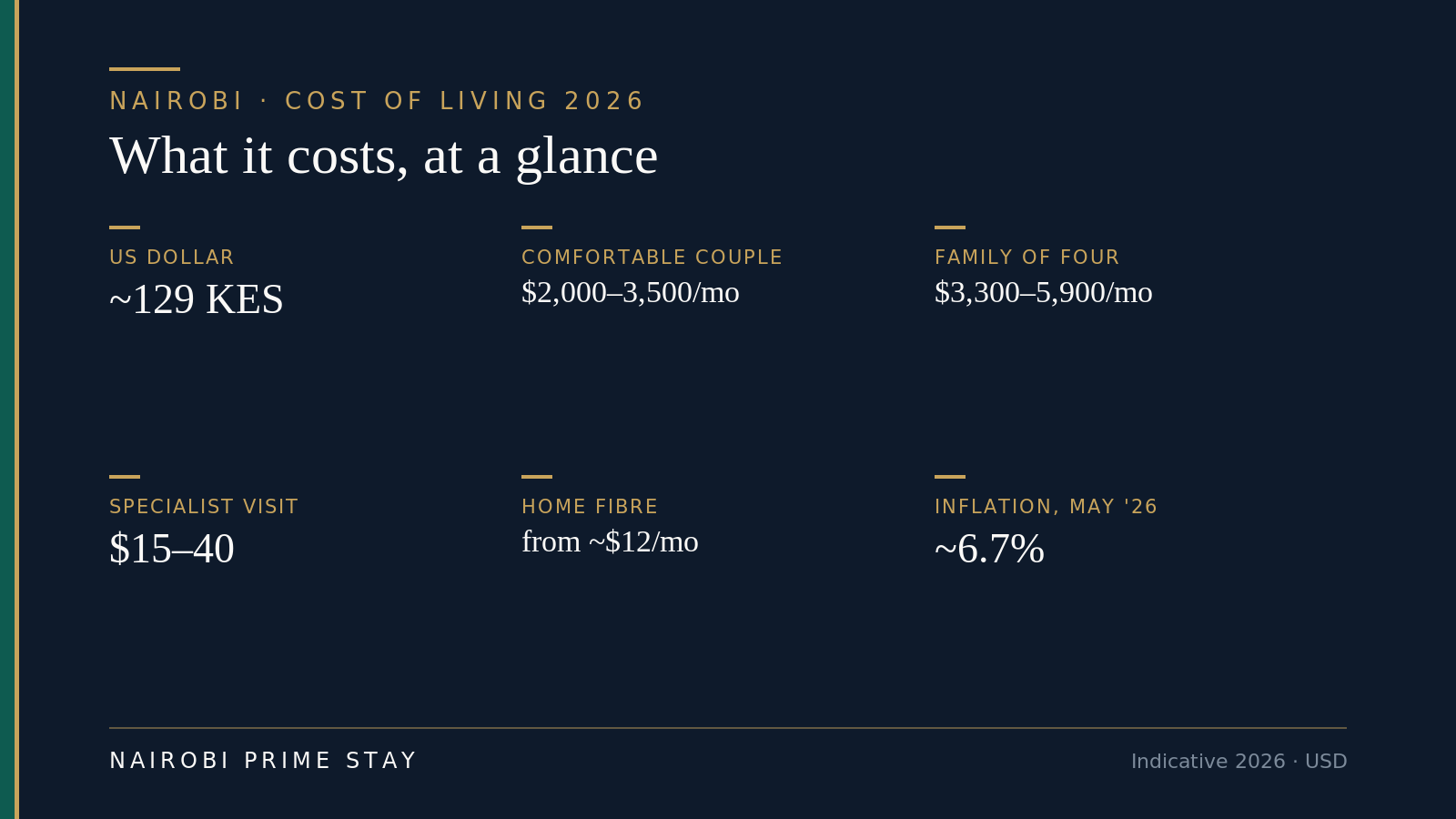
The numbers that frame this guide, at a glance.
Does a US income really go far here?
Yes — meaningfully. Local goods and services (rent, food, transport, labor, healthcare) cost a fraction of US prices, while anything imported (electronics, foreign wine, brand-name cosmetics) costs about the same or more. If you earn or keep a Western salary, your day-to-day spending power rises, and the bulk of a relocating American’s lifestyle is built from local services.
A quick note on currency, since it frames every number below. One US dollar has bought roughly 129 Kenyan shillings (KES) through the first half of 2026, and the rate has been notably stable. Rates move, so check a live source like the Central Bank of Kenya or Wise before you transfer money. We quote costs in US dollars throughout for clarity.
One honest caveat on 2026: while the shilling has held steady against the dollar, local prices have been climbing. Kenya’s headline inflation rose to about 6.7% in May 2026 — the highest in over a year — led by food, transport and fuel after a sharp rise in pump prices earlier in the year. For a dollar-earner that mostly means your shilling costs creep up rather than spike, but it’s worth budgeting a little headroom on groceries, transport and any generator diesel. Check the Kenya National Bureau of Statistics or the Central Bank of Kenya for the current figure.
Three monthly budgets at a glance
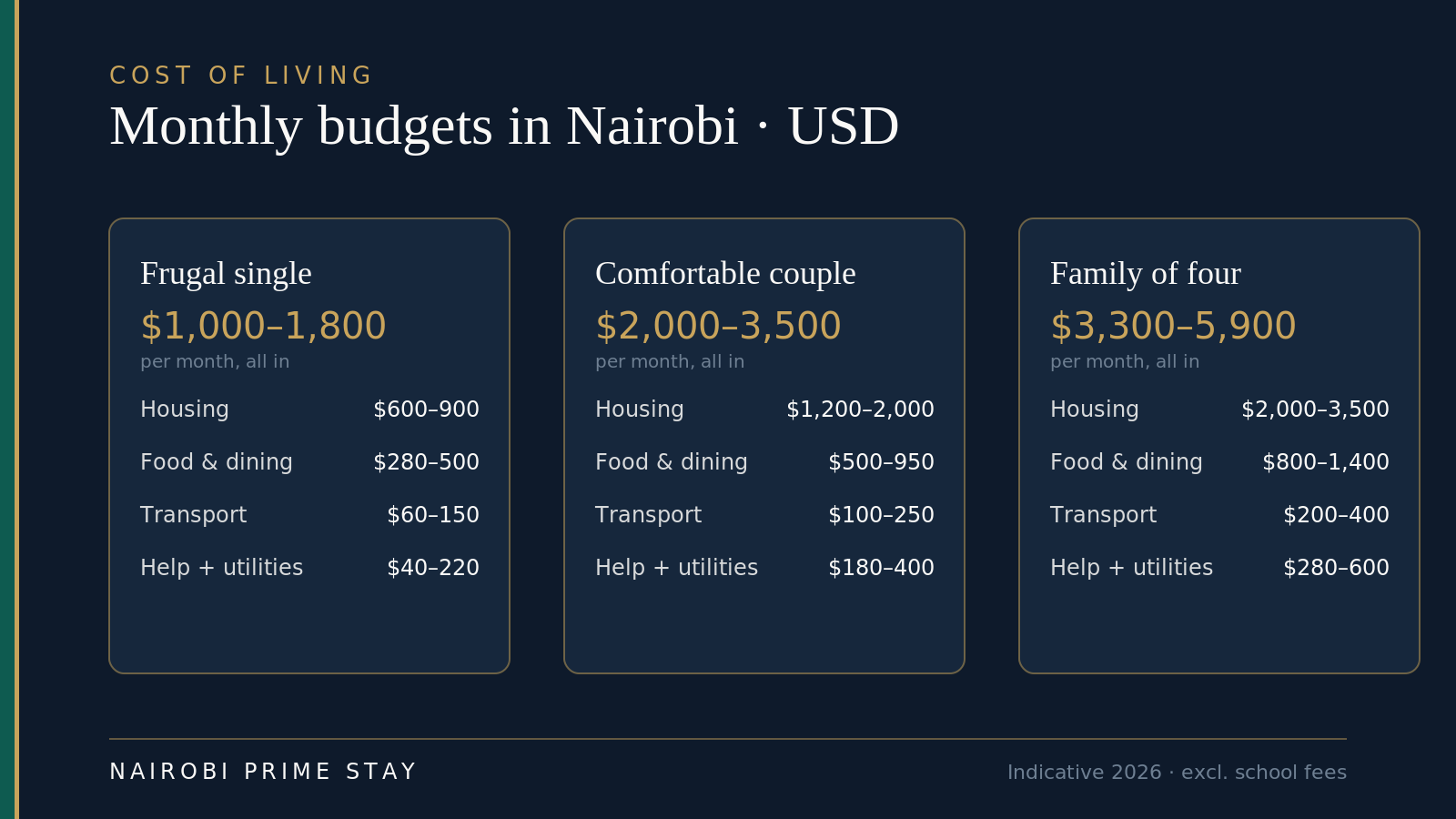
Three realistic monthly budgets (USD).
Here’s what a realistic month looks like for three common profiles. All figures are indicative 2026 ranges in US dollars, and exclude one-time setup costs and school fees (covered below).
| Category | Frugal single | Comfortable couple | Family of four |
|---|---|---|---|
| Housing (furnished) | $600–900 | $1,200–2,000 | $2,000–3,500 |
| Groceries | $200–300 | $300–500 | $500–800 |
| Dining & leisure | $80–200 | $200–450 | $300–600 |
| Transport | $60–150 | $100–250 | $200–400 |
| Domestic help | $0–120 | $120–250 | $200–400 |
| Utilities, internet, phone | $40–100 | $60–150 | $80–200 |
| Monthly total (excl. school) | ~$1,000–1,800 | ~$2,000–3,500 | ~$3,300–5,900 |
These are honest middle-of-the-road ranges, not the cheapest corner of the city or the most extravagant. Your number lands wherever your neighborhood and habits put it.
Rent: your biggest and most flexible cost
Where you live decides most of your budget, and Nairobi’s prime suburbs span a wide range. The figures below are indicative monthly rents for furnished homes in 2026; unfurnished places and longer leases cost noticeably less.
| Neighborhood | Character | Furnished rent / mo |
|---|---|---|
| Kilimani | Central, modern apartments, most affordable prime area | $500–1,000 |
| Westlands | Urban, social, walkable-ish, near offices | $550–1,200 |
| Kileleshwa | Quiet, modern, central | $650–1,500 |
| Lavington | Cosmopolitan, family-friendly | $700–1,800 |
| Upper Hill | Business district, short commutes | $700–1,600 |
| Riverside | High-end, central, leafy | $900–2,500 |
| Karen | Space, greenery, low density | $1,000–3,000 |
| Gigiri | Diplomatic, secure, near the UN | $1,500–4,000+ |
| Runda & Muthaiga | Large gated family homes | $1,800–4,000+ |
A practical tip: furnished and serviced apartments cost more per month than a bare long-term lease, but they fold in utilities, internet, cleaning, security and a backup generator, and they don’t tie up two or three months of deposit. For your first weeks — or a stay of a few months — that often works out cheaper and far less stressful once you count setup costs. Our best neighborhoods guide compares the areas in depth, and the Gigiri and Karen guides go deeper on each.
Groceries and eating out
Expect to spend about $250–450 a month on groceries for a couple, more for a family. Local produce, meat and staples are cheap and good; the cost climbs when you fill your cart with imported brands. Supermarkets like Carrefour and Naivas stock both, so you control the dial — buy Kenyan avocados, mangoes and vegetables at local prices, and pay a premium only for the imported cereal or cheese you can’t live without. Fresh markets are cheaper still if you enjoy them.
Eating out is one of Nairobi’s quiet pleasures and easy on the wallet. A casual meal runs a few dollars; a good restaurant dinner for two with drinks might be $30–60, less than half what you’d pay in a major US city. Nairobi’s coffee is excellent and cheap, and the dining scene spans Ethiopian, Indian, Swahili-coast and international. Budget $150–400 a month for dining and leisure depending on how often you go out.
Getting around
Most expats spend $80–200 a month on transport, and many never buy a car. Uber and Bolt are the default — safe, cheap and payable by card or M-Pesa — with a typical cross-town ride costing a few dollars. Matatus (shared minibuses) are the local option at well under a dollar a trip, though they take some learning.
If you do buy a car for school runs and weekends, factor in fuel, insurance and the occasional repair, plus the reality of Nairobi traffic. Many families run one car and rely on ride-hailing for everything else. Whichever you choose, your commute is shaped more by where you live than by the mode you pick.
Domestic help
Hiring help is normal and affordable in Nairobi, and it’s a big reason daily life feels easier here. Part-time cleaning or a house helper runs roughly $100–250 a month; a full-time, live-in helper, nanny or gardener costs more, but still a fraction of US rates. Pay fairly, agree terms in writing, and follow Kenyan labor norms on hours and time off — our guide to hiring domestic help in Nairobi covers fair 2026 pay and your legal duties in full. As an employer you’re also expected to register your helper for the statutory deductions — SHIF (health) and NSSF (pension) — which add a small amount on top of the wage; many households also pay a customary extra month’s pay at year-end. Many families build in help they’d never have budgeted for at home — it’s one of the lifestyle upgrades a Western income buys here.
Utilities, internet and phone
In a serviced apartment, utilities, internet and cleaning are usually bundled into one monthly price — one of the reasons they’re popular for relocations, and a real saving once you count the headache they remove. Our serviced apartments guide explains what’s included. If you rent unfurnished, you’ll pay these yourself, so here’s what to expect.
Electricity is billed by Kenya Power, usually through a prepaid token meter you top up by M-Pesa. The 2026 domestic tariff runs about KES 12–19 per unit (kWh) depending on how much you use — roughly $0.10–0.15 — before a fixed charge, 16% VAT, and fuel and foreign-exchange adjustments that push the effective rate higher. In practice a one- or two-bed apartment lands around $30–70 a month; running air conditioning, an electric water heater, or a generator during outages pushes it up. Cooking gas (LPG) is bottled and cheap, a few dollars a month for most households. Water is modest where the city supply is reliable, but in drier suburbs some homes top up from delivered tankers, so ask before you sign. For the full how-to — prepaid power tokens, the water-storage reality and backup power — see our guide to setting up utilities in Nairobi.
Home internet is genuinely cheap and fast. After Safaricom’s April 2026 speed upgrade, Home Fibre plans start near KES 1,500 a month (about $12) for an entry plan and run up past KES 20,000 for gigabit; alternatives like Zuku and Faiba are competitive. Most households are comfortable on a 40–150 Mbps plan at roughly $25–50 a month — just confirm a provider already serves your specific building before signing. Mobile data is inexpensive too: a Safaricom or Airtel SIM costs little, and M-Pesa runs your daily payments. Our internet and remote work guide covers providers and speeds in detail.
Healthcare and insurance
Out-of-pocket healthcare is cheap by US standards — a private specialist consultation is about $15–40, and routine care and medicines cost far less than at home. The cost that matters is insurance. Carry strong private or international health cover, ideally with regional reach and medical evacuation; premiums vary widely by age and coverage, so get quotes early. Used well, the private system is excellent and affordable. Our healthcare in Nairobi guide explains hospitals, insurance and costs.
School fees: the big one for families
If you’re moving with children, international school fees will likely be your largest single expense — often bigger than rent. Indicative annual tuition in 2026 runs from around $10,000 at Rosslyn Academy to roughly $20,000–40,000+ at the top, with British-curriculum schools like Braeburn and Brookhouse in between. The well-known International School of Kenya (American + IB, near the UN in Gigiri) sits at the high end: its tuition climbs by grade to roughly $37,000 a year in the senior grades, and new families also face one-time charges — an application fee plus a capital levy that can run $10,000 or more. Add transport, lunches and exam fees on top. The best schools have waitlists, so enquire months ahead, and because fees vary by grade and rise most years, confirm current figures directly with each school. For the full breakdown — every curriculum, the flagship schools, real 2026 fee ranges and how admissions and waitlists work — see our international schools in Nairobi guide.
One-time setup costs
Budget for a few upfront costs in your first month or two. Here’s the shape of it, then the detail:
| One-time cost | Rough 2026 figure | Notes |
|---|---|---|
| Rental deposit (long lease) | 1–3 months’ rent | Plus first month up front; serviced apartments skip it |
| Furnishing (if unfurnished) | Varies widely | Avoid it by renting furnished |
| Bank account opening | ~KES 1,000–5,000 | A small opening deposit |
| SIM + M-Pesa setup | A few dollars | Buy on arrival at the airport or a shop |
| Permit + immigration lawyer | Varies by route | Depends on your visa |
| Shipping a container | Often best avoided | Usually cheaper to buy bulky items here |
- Rental deposit: if you sign a long lease, expect one to three months’ rent as a deposit, plus the first month up front. Serviced apartments skip this.
- Furniture and household goods: only if you rent unfurnished. Many people start furnished precisely to avoid this.
- SIM, M-Pesa and a bank account: the SIM is a few dollars; a local bank account needs a small opening deposit (around KES 1,000–5,000). Our banking guide covers which banks suit expats and how to open an account.
- Immigration and legal: permit fees plus a local immigration lawyer’s time (see our visa guide).
- Shipping: usually best avoided — buy bulky items here rather than ship them.
Costs Americans don’t think to budget for
A few costs catch newcomers off guard — not because they’re huge, but because nothing back home prepared you for them. None of these should break a comfortable budget, but knowing they exist keeps your first months from feeling like a run of surprises.
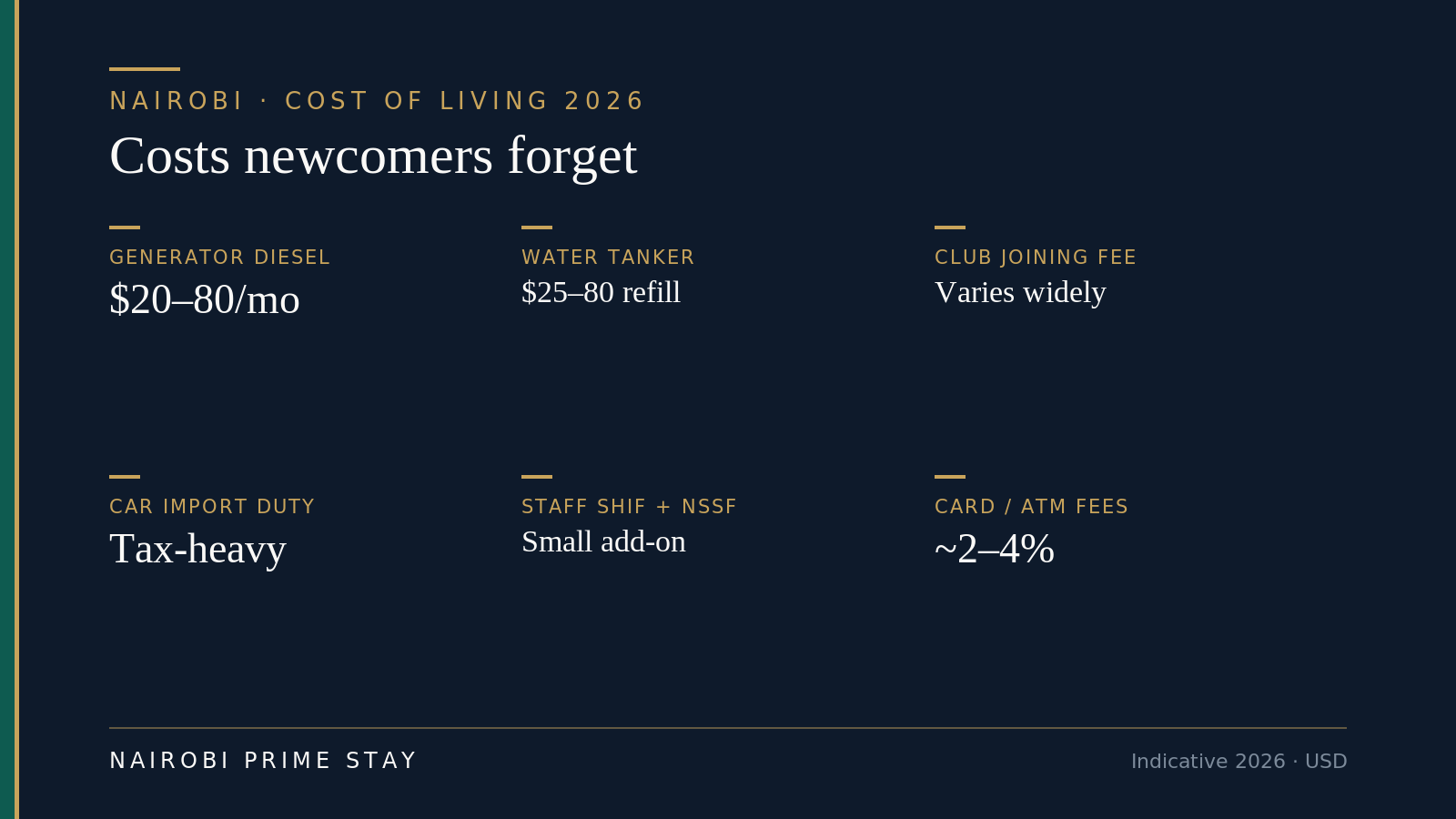
The line items that surprise people — small, but easy to miss.
Backup power. Power cuts happen, so most good buildings keep a generator — and running it burns diesel. In a serviced apartment that’s baked into your rent. In your own unfurnished place, a shared generator’s fuel is billed back to residents, often $20–80 a month depending on how often the grid drops. A small inverter or UPS keeps your Wi-Fi and laptop alive through short cuts for far less.
Water. Where the city mains are reliable, water is cheap. In some drier suburbs — parts of Karen, Runda, Kitisuru — homes top up from delivered tankers in the dry season, and a refill runs roughly KES 3,000–10,000 ($25–80). Always ask a landlord how the house gets its water before you sign.
Club memberships. A lot of Nairobi’s social life runs through country and sports clubs — golf, tennis, pools, restaurants. They’re a real pleasure, but joining fees vary enormously and the big-name clubs can be steep, sometimes with a waitlist or a member nomination. Monthly dues are far gentler than the one-time joining fee. Treat it as an optional lifestyle line, not a given.
Import duty on big-ticket items. Anything imported carries tax, and cars are the standout: by the time duty, excise and VAT are stacked on, a used import can cost well above its price abroad. Electronics and appliances carry duty too. The honest move is to buy big items locally rather than ship or import them.
Employing people properly. If you hire domestic help, you’re an employer. You’re expected to register staff for the statutory health (SHIF) and pension (NSSF) deductions, which add a little on top of the wage, and many households pay a customary extra month’s salary at year-end. Our domestic help guide sets out fair 2026 pay and your duties.
Moving money. Turning dollars into shillings has a cost. Card foreign-transaction fees, ATM withdrawal charges and poor airport-kiosk rates all nibble at the edges; a service like Wise or a sensible bank transfer usually beats them. Our US dollar to shilling guide and the M-Pesa guide cover how to pay for everything once you land.
How to keep your costs down
Most of the savings in Nairobi come from living a little more locally — and not over-paying for the soft landing once you’ve found your feet.
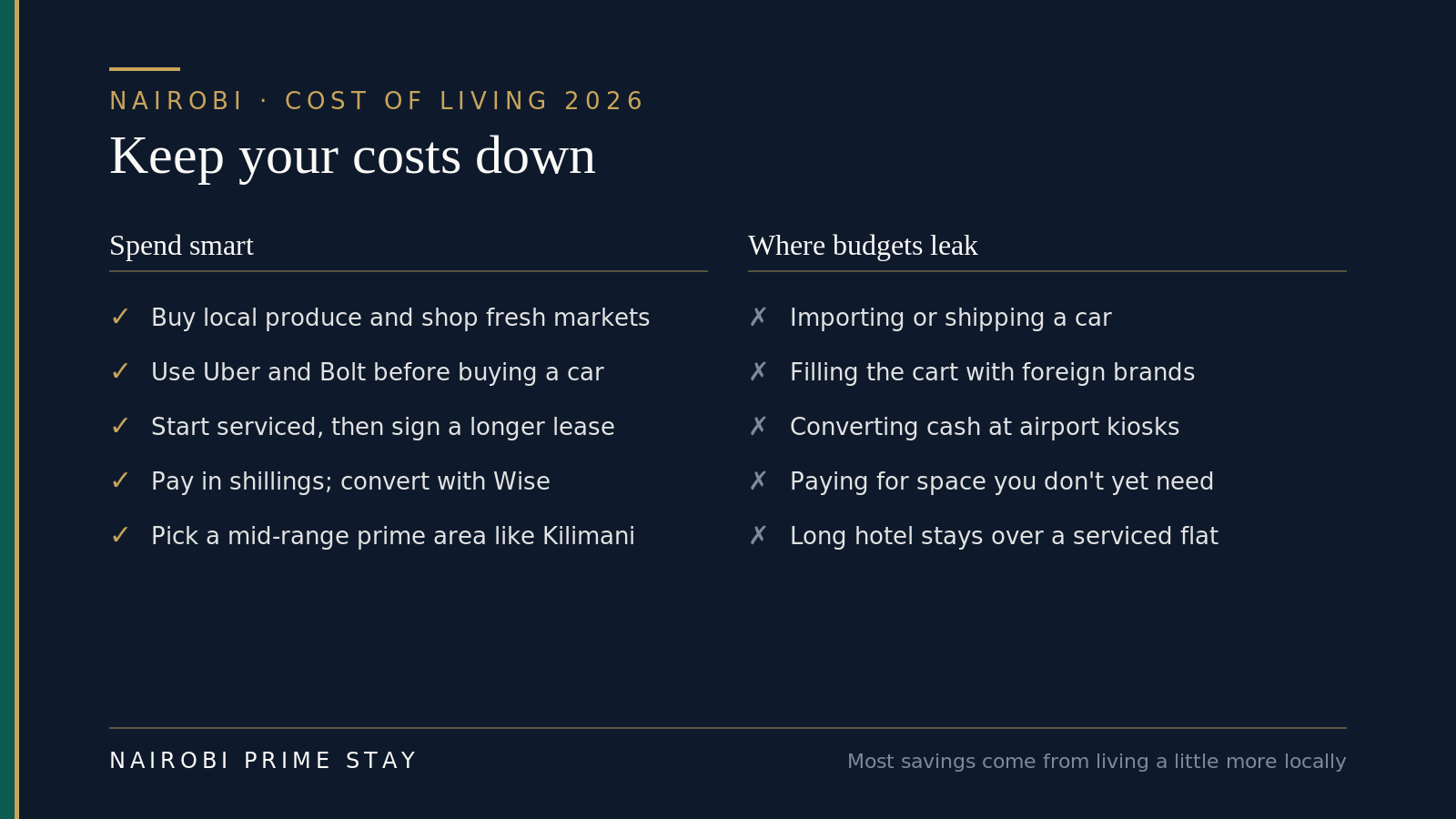
Where to spend smart — and where budgets quietly leak.
The biggest lever is rent. A longer unfurnished lease costs far less per month than a furnished or serviced one, so once you know the city, signing a year can cut your housing bill. The trade is the upfront deposit, furnishing the place, and the time it takes to set up utilities and internet yourself. Many people start serviced for the first month or three — predictable, all-inclusive, no deposit — then move to a long lease once they’ve tested the commute and the neighborhood. Our serviced apartments guide walks through that math.
Beyond rent: shop the local aisles and fresh markets rather than the imported shelf, lean on Uber and Bolt instead of buying a car in your first month, and pay in shillings wherever you can. Keep an eye on the imported-goods premium — that bottle of familiar shampoo or foreign wine is where a “cheap” city quietly gets expensive.
What’s cheaper, and what’s pricier than the US
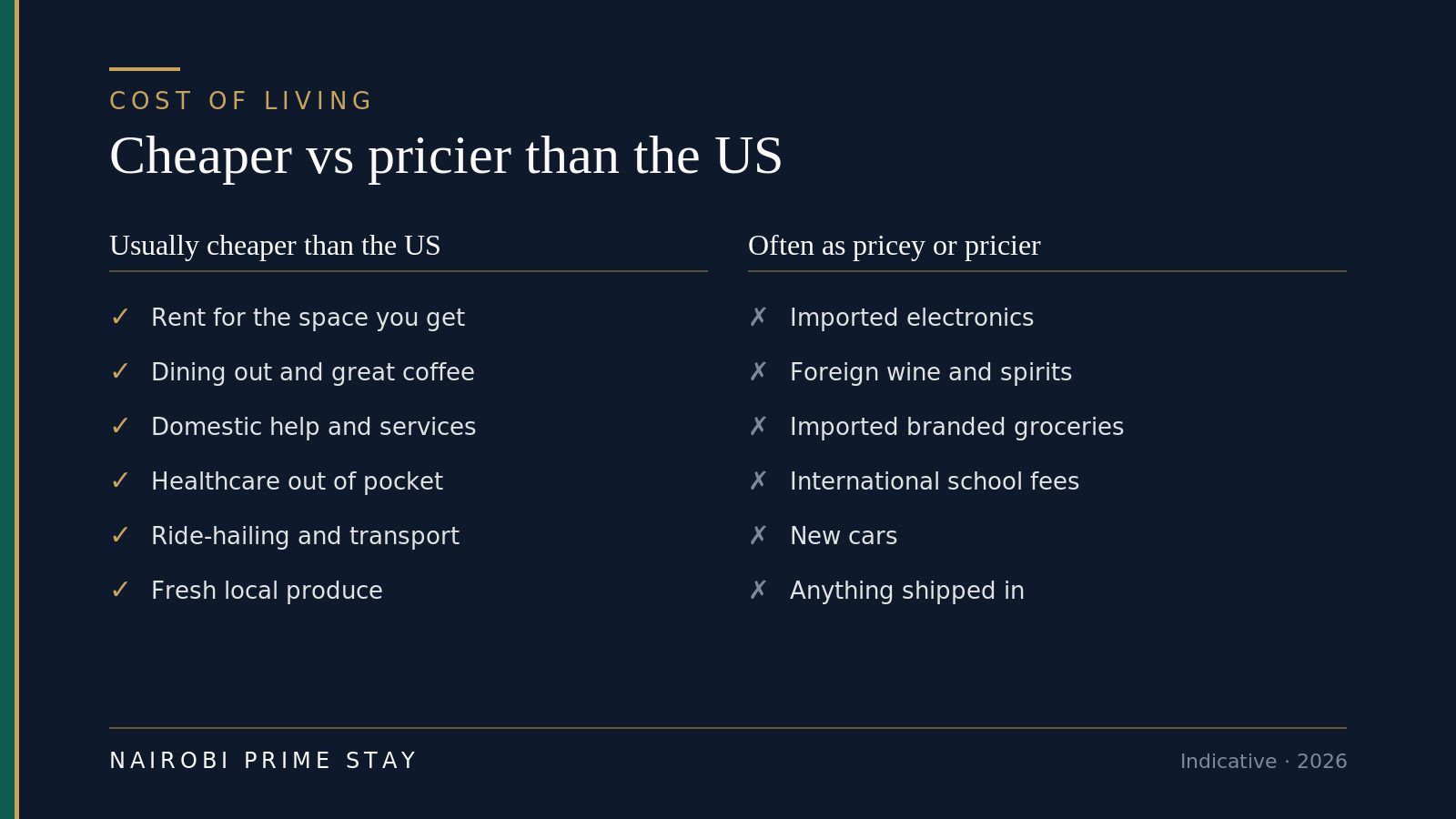
Where Nairobi saves you money — and where it doesn’t.
| Usually cheaper than the US | Often as pricey or more |
|---|---|
| Rent for the space you get | Imported electronics and appliances |
| Dining out and coffee | Foreign wine and spirits |
| Domestic help and services | Brand-name imported groceries |
| Healthcare (out of pocket) | International school fees |
| Ride-hailing and local transport | New cars |
| Fresh local produce | Anything shipped from abroad |
For a full side-by-side against US cities — New York, San Francisco and mid-size metros — see our dedicated Nairobi vs the US cost of living comparison.
A few real scenarios
A remote-working couple in Kilimani. A modern two-bed serviced apartment around $1,200–1,500 all-in, groceries and dining near $600, ride-hailing $150, a cleaner twice a week. They live very comfortably for roughly $2,300–2,800 a month, banking the difference against a US salary.
A family of four in Karen with two kids at school. Rent $2,000–2,800, groceries $700, a car plus help, and a fuller social life put daily living around $4,500–5,500 a month — before school fees, which can rival or exceed the rent. Space, gardens and good schools are the trade for a higher number.
A retiree in Lavington. A one-bed furnished apartment, simpler routines, occasional travel and good private insurance land a comfortable, quiet life around $2,000–2,800 a month, with healthcare a manageable line rather than a worry.
Frequently asked questions
How much money do you need to live comfortably in Nairobi? A single person or couple can live comfortably on about $2,000–3,500 a month, including a furnished home in a secure suburb, eating out and part-time help. Families typically spend $3,300–5,900 a month before school fees, with rent and schooling the biggest variables.
Is Nairobi cheaper than living in the US? For most relocating Americans, yes. Local services — rent for the space you get, dining, healthcare, transport and household help — cost far less, while imported goods cost about the same or more. A Western income generally goes considerably further.
How much is rent in Nairobi? Furnished homes in the prime expat suburbs range from about $500 a month in Kilimani to $4,000-plus in Gigiri or Runda in 2026. Unfurnished places and longer leases cost less; serviced apartments cost more per month but bundle in utilities, internet, cleaning and security.
What is the average monthly budget for an expat in Nairobi? A common comfortable budget is roughly $2,000–3,500 a month for a couple, before school fees. Where you land depends mostly on your neighborhood, whether you hire help, and how often you dine out and travel.
Are groceries expensive in Nairobi? Local produce, meat and staples are inexpensive; imported brands are where costs climb. A couple typically spends $250–450 a month, more for a family, and you control the total by how much imported food you buy.
Can a single person live well in Nairobi on $1,500 a month? Yes, comfortably if you keep things local. A frugal single covers a modest furnished one-bed in a mid-range area, local groceries, ride-hailing and the odd meal out for about $1,000–1,800 a month, so $1,500 sits in the comfortable middle. It gets tight if you want a top-tier suburb, your own car, or a cart full of imported food. A couple at $1,500 would need to budget carefully.
How much does a nanny or full-time house helper cost in Nairobi? Part-time cleaning or a house helper runs roughly $100–250 a month; a full-time, live-in nanny, helper or gardener costs more, but still a fraction of US rates. On top of the wage you’re expected to register staff for the statutory health (SHIF) and pension (NSSF) deductions, and many households pay a customary extra month’s salary at year-end. Pay fairly and put the terms in writing.
How much does electricity cost in Nairobi? Kenya Power’s 2026 domestic tariff is roughly KES 12–19 per unit (about $0.10–0.15), before a fixed charge, 16% VAT and fuel and exchange-rate adjustments that lift the effective rate. A typical one- or two-bed apartment runs around $30–70 a month, more with air conditioning, electric water heating or a generator. Most apartments use prepaid token meters you top up by M-Pesa.
How much are international school fees in Nairobi? Indicative 2026 annual tuition runs from around $10,000 to over $40,000 depending on the school, curriculum and grade. Top-tier schools like the International School of Kenya reach roughly $37,000 a year in the senior grades, plus one-time charges such as a capital levy, with transport and lunches on top. Confirm current figures with each school, as fees rise most years.
Has the cost of living in Nairobi gone up in 2026? Yes, modestly. Kenya’s inflation rose to about 6.7% in May 2026, driven by food, transport and fuel after pump prices jumped earlier in the year. The shilling has stayed stable near 129 to the dollar, so dollar-earners feel it as gentle creep rather than a spike — but it’s worth budgeting a little headroom on groceries, transport and generator fuel.
Final thoughts
Nairobi is genuinely good value, but the smart way to plan is by category, not by a single headline number. Pin down your rent and — if you have kids — your school fees first, because those two lines decide most of your budget. The rest of daily life tends to cost less than you expect, which is what gives a move here its comfortable margin.
The easiest way to test your numbers is to price a real home. Browse serviced apartments to see honest, all-inclusive monthly rates, or tell our AI relocation assistant your budget and it’ll shortlist options that fit. For the full picture of the move, start with our complete guide to moving to Nairobi.
Related reading
- Moving to Nairobi: the complete guide — the end-to-end overview that ties every cost here to the rest of your move.
- Best neighborhoods in Nairobi for expats — where your rent budget actually lands, area by area.
- Serviced apartments in Nairobi — all-inclusive monthly rates, and how a soft landing keeps your first month predictable.
- Investing in Kenyan property as a foreigner — if you’re weighing buying over renting: yields, costs, taxes and the law.
- Healthcare in Nairobi — what private cover, GP visits and insurance really cost.
- Gigiri and Karen neighbourhood guides — two of the suburbs that anchor the rent ranges above.
When you’re ready to put real numbers against a real home, browse our serviced apartments for honest monthly pricing, or tell the AI relocation assistant your budget and it’ll shortlist options that fit.
Ready to look?
Find your apartment in Nairobi
Browse verified serviced apartments, or ask the AI concierge which area fits your life.