
Guides · Healthcare
Healthcare in Nairobi for Expats and Retirees (2026 Guide)
Healthcare in Nairobi for Expats and Retirees
Nairobi has some of the best private hospitals in Africa, with English-speaking specialists and standards close to what Americans are used to. The key to using it well is simple: carry strong private or international insurance with medical evacuation, and use the private system rather than the public one. Do that, and quality everyday and specialist care is both accessible and far cheaper than in the US.
This guide gives you the honest picture of healthcare in Nairobi: the leading hospitals, what care actually costs, why insurance matters so much, how to handle pharmacies and prescriptions, and what retirees in particular should plan for. It’s written for someone moving here who wants to know they and their family will be well looked after.
The quick version
Nairobi’s private hospitals — Aga Khan University Hospital, The Nairobi Hospital, Karen Hospital, MP Shah and Gertrude’s Children’s Hospital — offer strong specialist care with English-speaking doctors. A private specialist consultation runs about $15–40, and procedures cost far less than in the US, though still enough to want insurance. The non-negotiable is good private or international cover that includes medical evacuation. Pharmacies are well stocked in the suburbs, and you should bring a supply of any prescription medication with documentation. For emergencies, dial 999 or 112. Malaria risk in the city itself is very low, thanks to the altitude. Used properly, the private system is excellent.
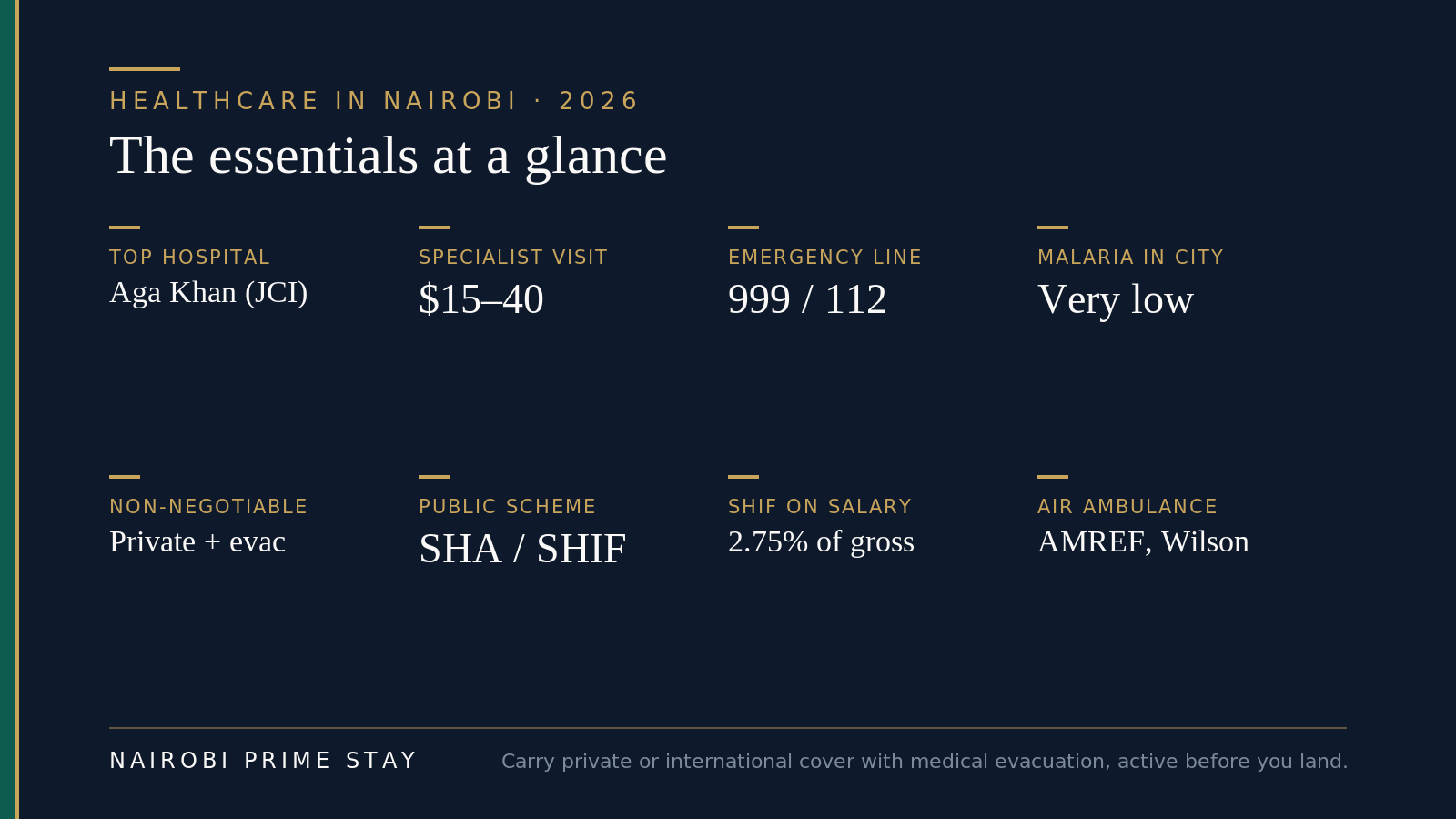
The numbers that matter most, at a glance.
Private vs public healthcare
Nairobi has both public and private healthcare, and expats use the private system almost exclusively. Public hospitals serve enormous numbers of people and can be under-resourced and crowded; they’re not what you’ll rely on. The private hospitals and clinics, by contrast, are modern, well-equipped and staffed by specialists many of whom trained abroad, and they’re geared toward the standard of care international residents expect.
The practical model is straightforward: hold private insurance, register with a private hospital or clinic network, and use it for everything from a child’s fever to specialist treatment. The cost of doing so is modest by US standards, and the quality is high.
One change worth knowing: in October 2024 Kenya replaced the old National Hospital Insurance Fund (NHIF) with the Social Health Authority (SHA) and its Social Health Insurance Fund (SHIF). If you’re on a Kenyan payroll, contributions are now 2.75% of your gross pay (a minimum of KES 300 a month, with no upper cap), deducted like a tax — so higher earners pay considerably more than under the old flat NHIF bands. The scheme is aimed at residents and still bedding in, and as a newcomer you won’t lean on it for your actual care; that runs through private insurance and private hospitals. Treat any SHIF deduction as a public baseline, not a replacement for private cover. Recognize the name if it comes up, and check the official SHA portal (sha.go.ke) rather than older NHIF information for current rules.
The leading private hospitals
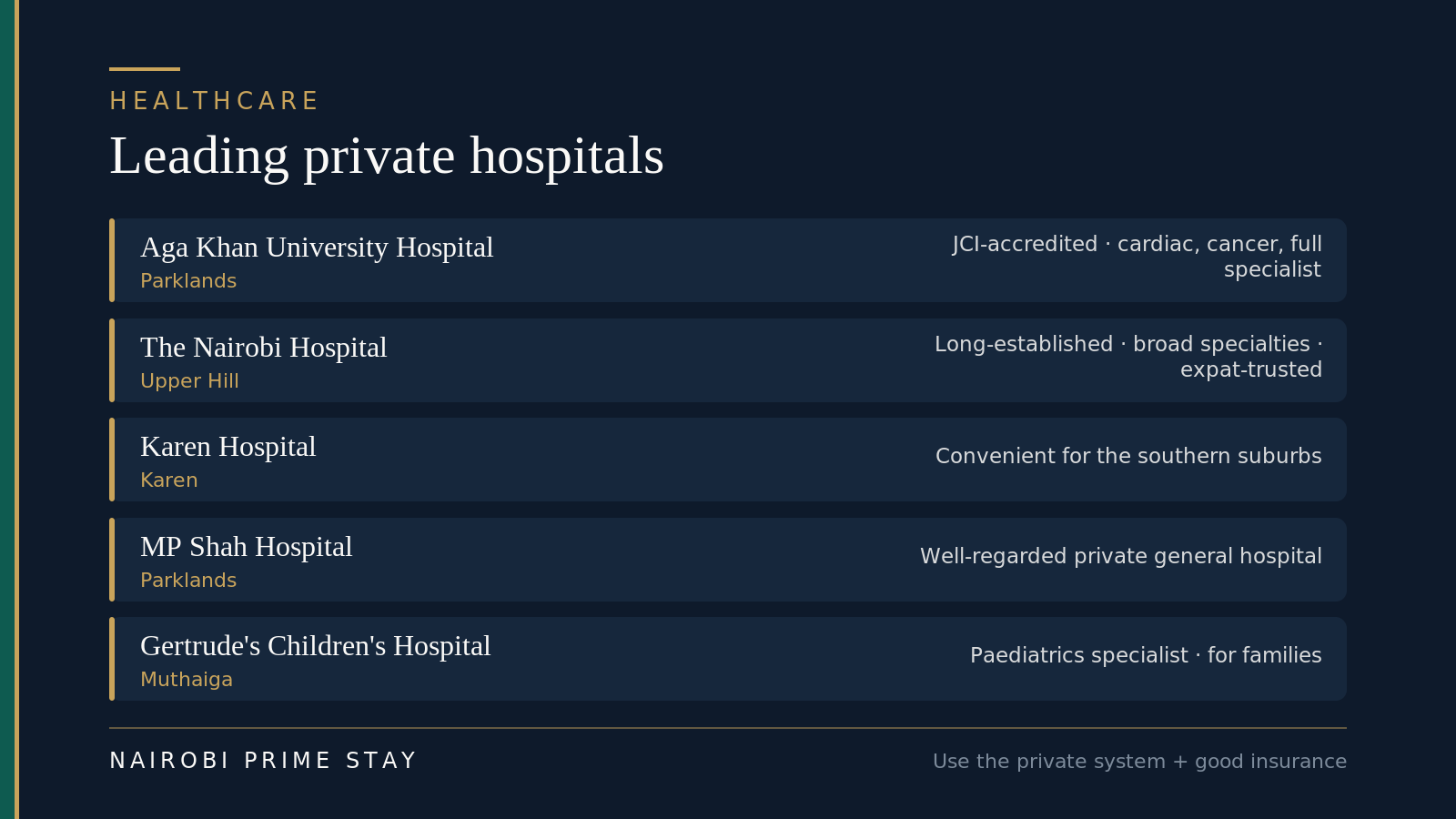
Where expats go for care.
These are the hospitals expats most often rely on, spread across the suburbs where international residents live.
| Hospital | Area | Known for |
|---|---|---|
| Aga Khan University Hospital | Parklands | JCI-accredited; cardiac, cancer and full specialist care |
| The Nairobi Hospital | Upper Hill | Long-established, broad specialties, expat-trusted |
| Karen Hospital | Karen | Convenient for the southern suburbs |
| MP Shah Hospital | Parklands | Well-regarded private general hospital |
| Gertrude’s Children’s Hospital | Muthaiga | Pediatrics specialist — for families |
Aga Khan University Hospital is internationally accredited (JCI) and a regional referral center for complex care. The Nairobi Hospital in Upper Hill is a long-established favorite among expats for its breadth of specialties. Families value Gertrude’s for children’s care, and Karen Hospital is handy for the southern suburbs. Where you live shapes which hospital is your nearest, so it’s worth factoring in — especially for families and retirees. If you settle around Gigiri, Muthaiga or Runda, Aga Khan and MP Shah in nearby Parklands and Gertrude’s in Muthaiga are your closest; down in Karen and the southern suburbs, the Karen Hospital is on your doorstep, with Aga Khan and The Nairobi Hospital a longer drive. See our best neighborhoods guide for what’s close to each area.
What healthcare costs
Out-of-pocket care is inexpensive compared with the US. A private specialist consultation typically runs about $15–40. Routine tests, dental visits and medicines are similarly affordable. Larger procedures and hospital stays cost far less than equivalent US care, but they’re still meaningful sums — enough that you don’t want to pay them in cash if you can insure against them.
This is why the real healthcare decision isn’t which hospital, it’s which insurance. The hospitals are good and affordable for everyday needs; the financial risk is in the rare major event, which insurance exists to cover. Our cost of living guide puts healthcare in the context of your wider budget.
Here’s a rough sense of what everyday private care costs out of pocket in 2026. These are honest ranges, not quotes — your bill depends on the hospital, the specialist and your cover — so confirm before you commit.
| Care | Typical out-of-pocket price (2026) |
|---|---|
| Private GP visit | $10-25 |
| Specialist consultation | $15-40 |
| Dental cleaning / check-up | $30-60 |
| Routine blood tests | $15-50 |
| MRI or CT scan | $150-400 |
| Emergency-room visit | $30-80 |
| Night in a private ward | $120-300 |
| Normal delivery | KES 100,000-150,000 |
| Planned C-section | KES 180,000-350,000+ |
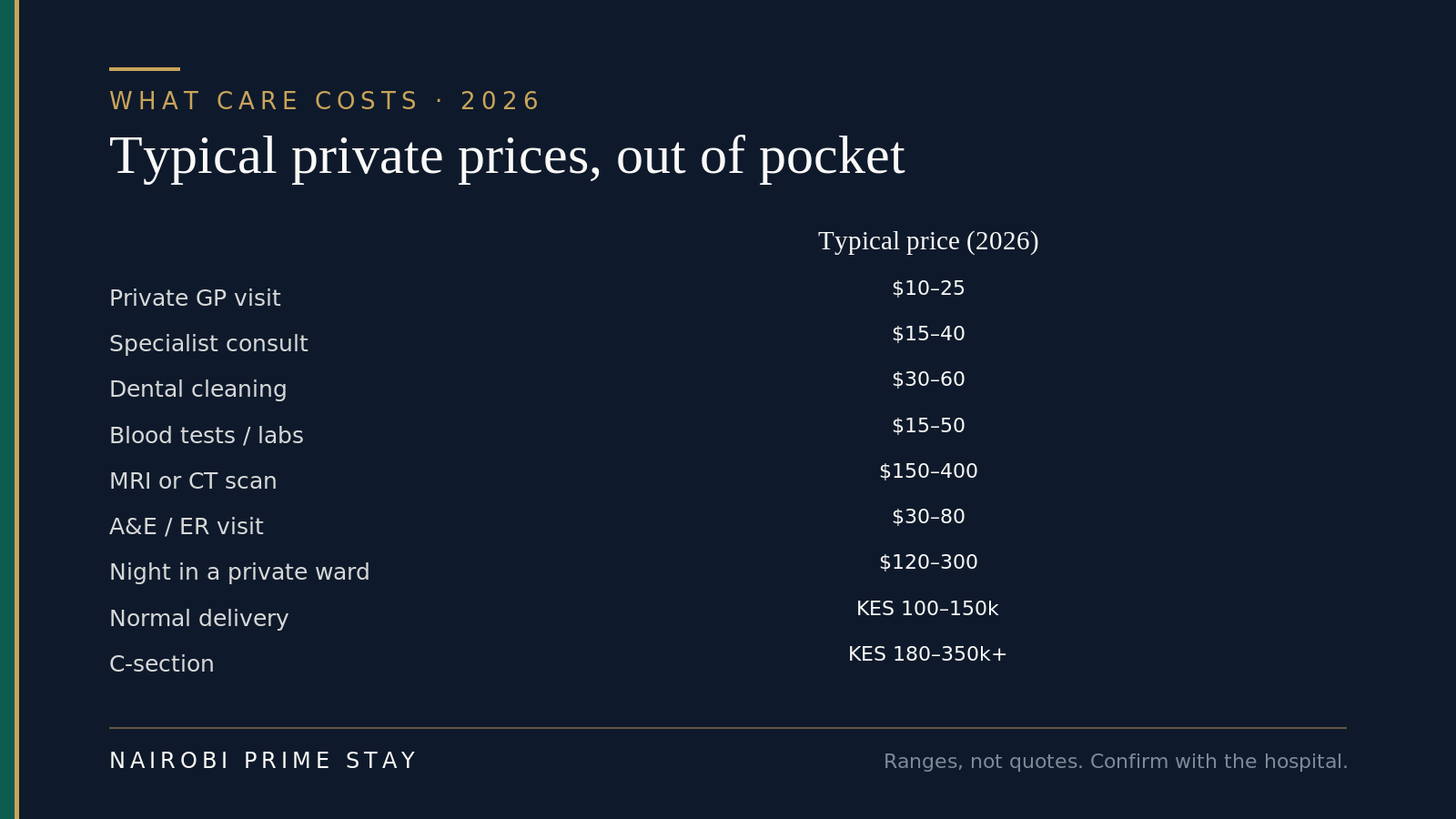
Everyday care is cheap by US standards; insure against the rare big bill.
For pregnancy and birth specifically — hospital choices, what’s included and the insurance waiting-period trap — see our having a baby in Nairobi guide.
Insurance and medical evacuation — the essential piece
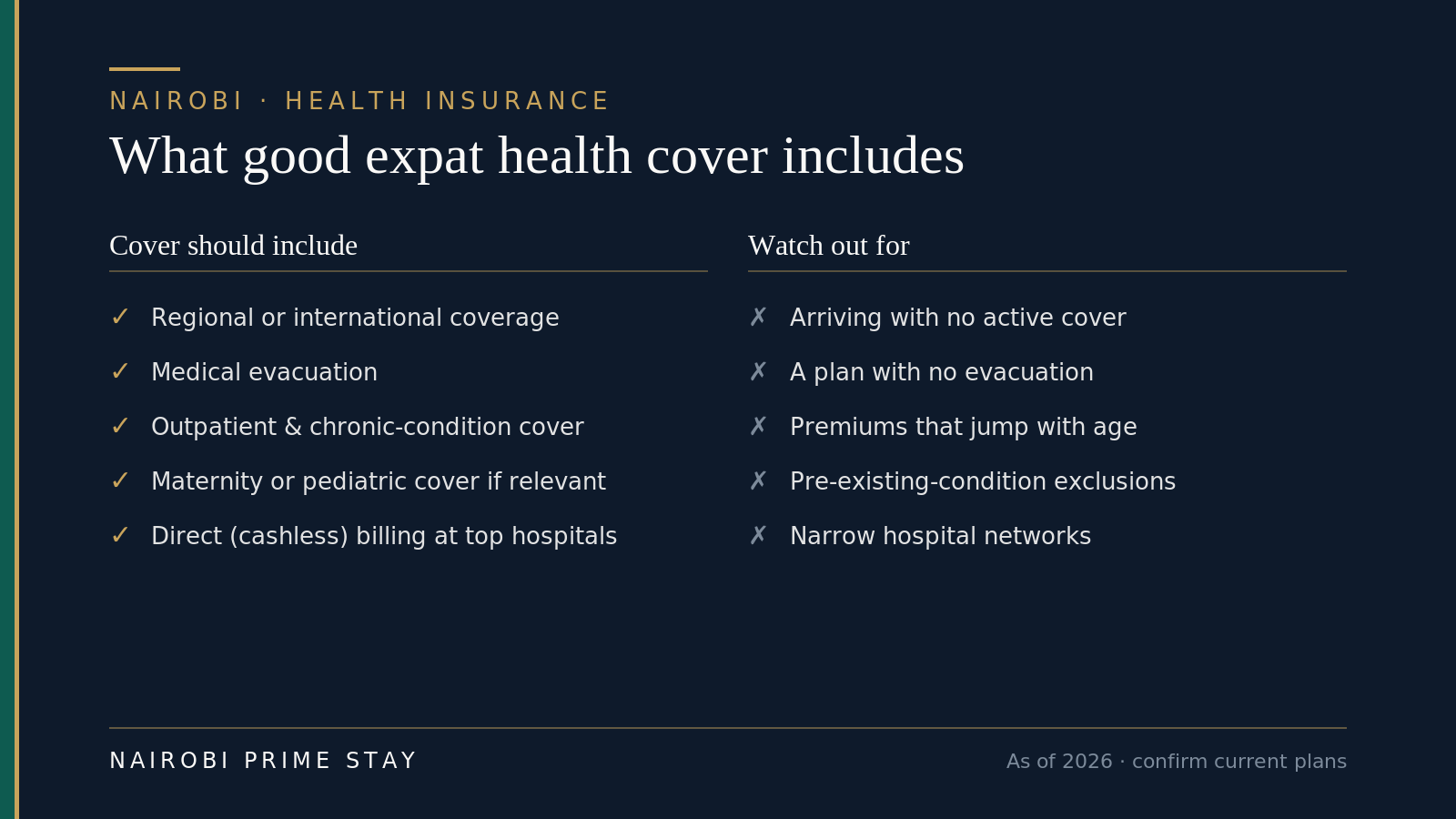
Insurance is the real healthcare decision — sort it before you fly.
Carry strong private or international health insurance, and make sure it includes medical evacuation. This is the single most important thing to arrange before you move.
A few things to look for:
- Regional or international cover, so you’re protected across Kenya and, ideally, for treatment abroad if needed.
- Medical evacuation, which covers being flown to a hospital with the right specialists for a serious emergency — invaluable peace of mind, especially if you’ll travel within the region.
- Outpatient and chronic-condition cover suited to your family’s needs, including maternity or pediatric cover if relevant.
- Direct billing with the major private hospitals, so you’re not paying large sums upfront.
Premiums vary widely by age, coverage and pre-existing conditions, so get quotes early in your planning. Retirees and older movers should pay particular attention to chronic-condition and evacuation cover. Don’t arrive without active cover in place.
How people actually buy it: some take an international expat policy that travels with them and covers treatment abroad plus evacuation; some use a Kenyan health insurer for everyday and outpatient care; many combine the two — a local plan for day-to-day visits and an international layer for evacuation and major events. Both local insurers and the big international expat names operate here. Compare current plans, the hospital networks each one covers, and who provides the evacuation, and confirm the policy offers direct billing (sometimes called cashless) at the hospitals nearest your home. A serviced apartment for your first weeks buys time to sort all this properly — see our serviced apartments guide.
For the full breakdown — international vs local plans, what SHA covers for foreigners, medical evacuation and premiums by age — see our dedicated health insurance for expats in Kenya guide.
Pharmacies and prescriptions
Pharmacies are well stocked in the suburbs and malls, and many common medicines are available, often without the hurdles you’d expect at home. Still, plan ahead for anything you depend on:
- Bring a supply of any prescription medication, along with a doctor’s letter and the generic names, in case your exact brand isn’t stocked.
- Check availability of long-term medications early so you can establish a local source or arrange supply.
- Keep medicines in original packaging with documentation when you travel in with them.
For everyday needs — a course of antibiotics, allergy medicine, first-aid supplies — a local pharmacy will sort you out quickly and cheaply.
Before you arrive: vaccines and prep
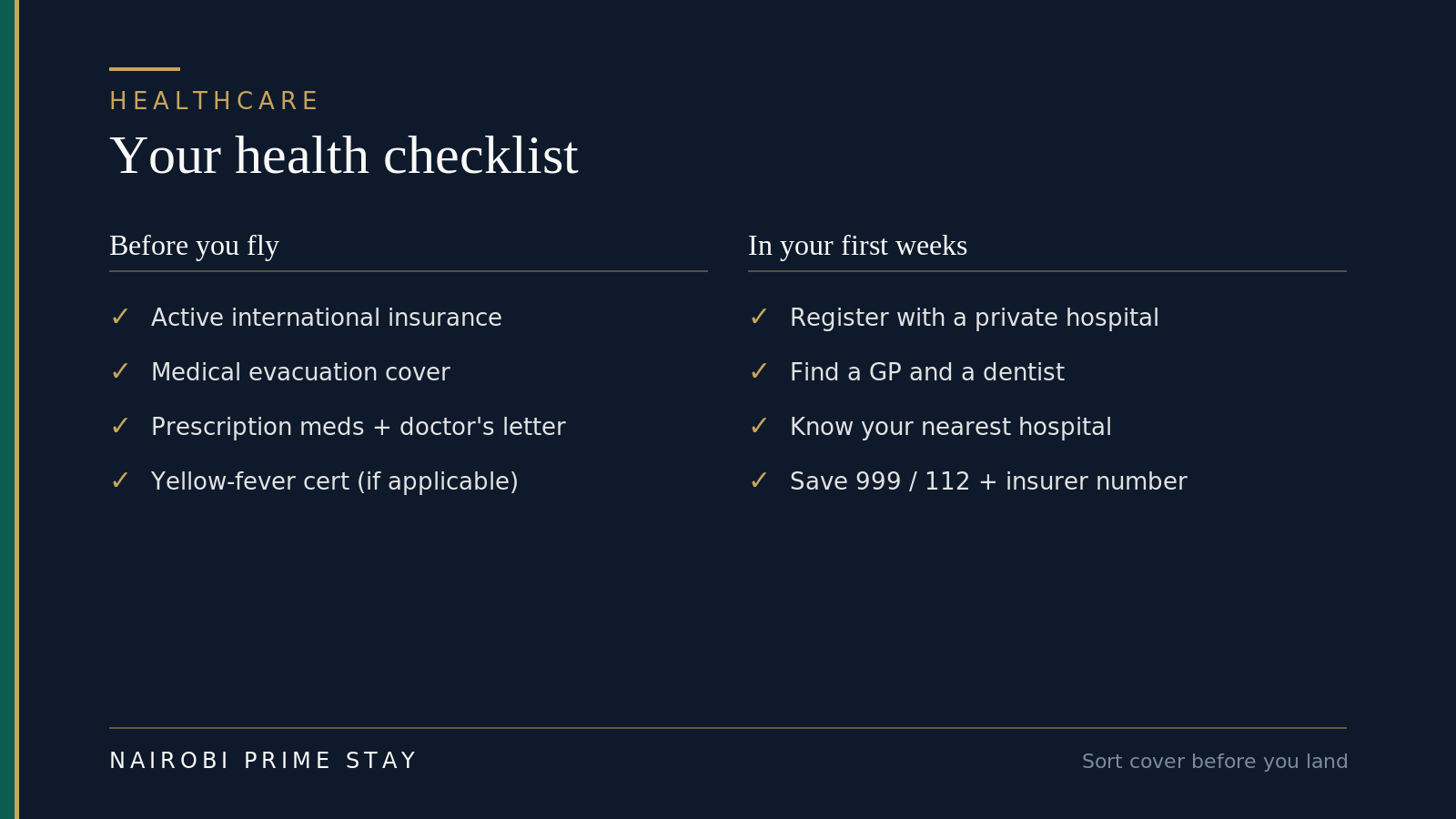
Sort cover before you land.
A little health admin before you fly saves trouble later:
- Yellow fever: bring a vaccination certificate if you’re arriving from a country where yellow fever is a risk; it can be required at entry.
- Routine vaccines: check yours are current, and discuss any travel vaccines with a travel-health clinic before you go.
- Prescriptions and records: carry your medications with documentation and a summary of any ongoing conditions.
- Insurance active from day one: make sure cover starts before you land.
Malaria, altitude and staying well
Two questions come up more than any other: do I need malaria pills, and will the altitude get to me? Both answers are reassuring.
Malaria risk in Nairobi city is very low. The city sits at about 1,795 meters (5,900 feet), and that elevation keeps malaria-carrying mosquitoes scarce. Major travel-health authorities, including the US CDC, treat Nairobi itself as a very-low-risk area and don’t routinely recommend antimalarial tablets for a stay confined to the city and the highlands. That changes the moment you leave town: the coast around Mombasa and Diani, the Lake Victoria basin and the lowland safari parks do carry malaria risk, and antimalarials are usually advised for those trips. Because the right call depends on exactly where you’ll go and your own health, confirm your plan with a travel clinic or the CDC’s Kenya page before you fly, and again before any trip to the coast or a lowland park.
Either way, avoid bites. Mosquitoes are most active from dusk to dawn, so use repellent in the evenings and favor screened or air-conditioned rooms when you travel to warmer areas. Risk ticks up a little during and just after the rainy seasons — the long rains from March to May, the short rains from October to December — when there’s more standing water about.
The altitude is mild but real. At nearly 1,800 meters, some new arrivals feel slightly breathless on stairs, sleep lightly, or tire faster for the first week. It’s a world away from serious altitude sickness — just ease in, drink plenty of water, go easy on alcohol and hard workouts at first, and your body adjusts quickly. The upside is that the same elevation that keeps mosquitoes away also gives Nairobi its mild, spring-like climate year-round. One thing to respect: the equatorial sun is strong up here, so sunscreen and a hat earn their keep even when it doesn’t feel hot.
Finding a doctor and dentist
Once you arrive, registering with a private hospital network or a good local clinic gives you a regular GP and easy referrals to specialists. Expats often find a trusted family doctor and dentist within their first weeks, frequently on the recommendation of neighbors, colleagues or the international community — and our AI relocation assistant can point you toward the right facilities near your home. Dental and optical care are good and affordable in the private sector, so they’re easy to keep up with — see our dentists and specialists in Nairobi guide for what things cost and where the clinics cluster.
Maternity, children and mental health
Family and specialist care is well covered in the private system. Maternity care is a particular strength — the major private hospitals have modern maternity units — and Gertrude’s Children’s Hospital is the go-to for pediatrics, with clinics around the city. For mental health, Nairobi has private psychologists, counselors and psychiatrists, mostly clustered in the western suburbs; many international insurance plans include mental-health cover, so check what yours includes. If you take regular medication for any chronic or mental-health condition, bring a supply with a doctor’s letter and line up a local prescriber early.
Everyday care has gone digital too. Several online pharmacies and telemedicine services now operate in Nairobi, delivering medicines and offering video consultations — handy for repeat prescriptions and minor issues without sitting in traffic.
Notes for retirees
Nairobi can be a comfortable base for retirees, and healthcare is a big part of why. The private hospitals handle the specialties that matter more with age, the mild climate is easy on the body year-round, and out-of-pocket costs are low. The priorities are clear: secure comprehensive insurance with strong chronic-condition and evacuation cover, choose a home near a good hospital (Karen, Lavington, Gigiri and Upper Hill all score well here), and establish a local doctor early. With those in place, many retirees find day-to-day healthcare easier and more affordable than they expected. If a longer-term move is on your mind, our guide to retiring in Kenya covers the Class K permit, Medicare’s gap abroad and budgeting for care as you age.
Emergencies
In an emergency, dial 999 or 112 for police, ambulance or fire (on a Safaricom line, 911 routes through too). Be honest with yourself about one thing first: Nairobi has no single, fast national ambulance dispatch the way US cities do, and any vehicle can be slowed by traffic. So most expats line up a private ambulance service in advance and save the direct number in their phone.
The main private services are AMREF Flying Doctors (based at Wilson Airport — air ambulance plus ground ambulances, with a 24-hour control room and aircraft that can be airborne in around 20 minutes), AAR Ambulance (24/7, with basic and advanced life-support units around the city) and Kenya Red Cross E-Plus. For a serious event far from the right hospital — or out on safari or the coast — medical evacuation is what gets you to specialist care fast. Your international policy may include it; if not, an AMREF Maisha membership is a cheap standalone layer (individual annual plans run from roughly $50-100, with regional tiers covering East Africa, and include unlimited emergency flights and a 24-hour medical helpline). It’s evacuation cover, not health insurance — it won’t pay your hospital bill — so treat it as a layer on top of real insurance, not a substitute.
Two habits make all the difference: know in advance which private hospital is nearest your home and how you’d get there (an Uber or Bolt is often faster than waiting for an ambulance in traffic), and keep your insurer’s number, any evacuation-service line and digital copies of key medical documents saved on your phone. A little preparation means that if something happens, you act rather than scramble. Our safety guide covers wider emergency prep.
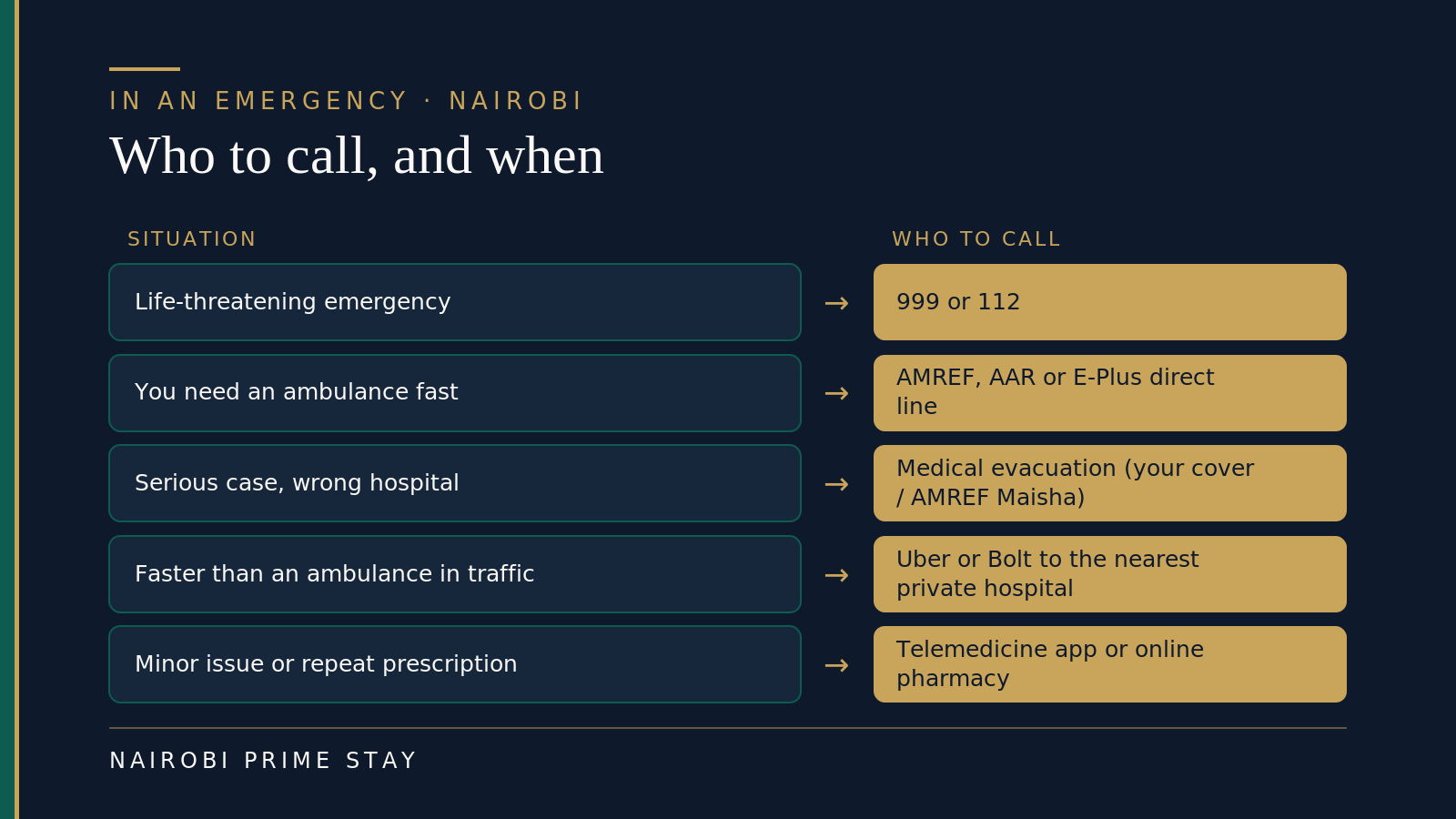
Decide who you’d call before you ever need to.
Your first-month healthcare checklist
A simple order of operations once you’ve decided to move:
- Buy insurance before you fly — private or international cover with medical evacuation, active from your arrival date.
- Sort your medications — bring a supply in original packaging with a doctor’s letter and the generic names, and check local availability of anything long-term.
- Handle vaccines and travel-health advice — routine vaccines current, a yellow-fever certificate if you need one, and a quick word with a travel clinic about malaria for any onward travel.
- Register with a private hospital or clinic near your home in the first couple of weeks, and find a GP and a dentist.
- Save the essentials in your phone — 999/112, your nearest hospital, your insurer’s number, and any evacuation-service line.
- Keep digital copies of your insurance, prescriptions and key medical records.
A serviced apartment for the first month makes this easier: you land somewhere secure and connected, near good hospitals, while you get set up.
The honest balance
| Reassuring | Worth planning for |
|---|---|
| Excellent private hospitals and specialists | The public system isn’t built for expats, so go private |
| English-speaking, often foreign-trained doctors | Major procedures still cost real money, so insure against them |
| Low out-of-pocket costs for everyday care | Premiums rise with age and pre-existing conditions |
| Well-stocked pharmacies and growing telemedicine | Your exact brand may not be stocked, so bring a supply |
| Very low malaria risk in the city itself | The coast and safari lowlands do carry malaria risk |
| Medical evacuation is available | You must arrange evacuation cover yourself, before you fly |
Final thoughts
Healthcare is one of the easier parts of moving to Nairobi to feel good about, as long as you do one thing well. Get strong private or international insurance with medical evacuation in place before you fly, register with a private hospital near your home, and the day-to-day reality is high-quality care at a fraction of US prices. The honest caveats are simple: lean on the private system, insure against the rare big event, and keep a supply of any medication you depend on. This is general information rather than medical advice, so confirm specifics with your insurer and a doctor. Do that, and you and your family will be well looked after.
Related reading
- Healthcare is one piece of the bigger picture, so start with our complete guide to moving to Nairobi.
- See where healthcare fits your wider budget in the cost of living in Nairobi guide.
- Get the insurance right with our deep-dive on health insurance for expats in Kenya — international vs local plans, evacuation and SHA.
- For teeth, eyes and specialists, see dentists and specialists in Nairobi — honest 2026 costs and where to go.
- Pick a home near the right hospital with our best neighborhoods in Nairobi guide, or the area deep-dives on Gigiri and Karen.
- Emergency prep and everyday street sense are covered in our honest safety guide.
- For a secure, connected first month near good hospitals, see our serviced apartments guide.
A serviced apartment for your first month puts you somewhere secure and connected, close to the major private hospitals, while you arrange insurance, register with a doctor and find your feet. Browse our serviced apartments in Nairobi; honest monthly pricing with Wi-Fi, cleaning, a backup generator and security included, a $50 deposit reserves your dates and the balance is paid on arrival. Not sure which area keeps you closest to the right hospital and within budget? Our AI relocation assistant can shortlist options in a couple of minutes, day or night.
Frequently asked questions
Is healthcare good in Nairobi?
Yes. Nairobi has some of the best private hospitals in Africa, with English-speaking specialists, modern equipment and standards close to what Americans are used to. The key is to carry private or international insurance and use the private system rather than the public one. Used that way, everyday and specialist care is both high quality and far cheaper than in the US.
What are the best private hospitals in Nairobi?
The hospitals expats rely on most are Aga Khan University Hospital (Parklands, JCI-accredited, strong in cardiac and cancer care), The Nairobi Hospital (Upper Hill, long-established and broad), Karen Hospital (handy for the southern suburbs), MP Shah (Parklands) and Gertrude’s Children’s Hospital (Muthaiga, for pediatrics). Which one is your nearest depends on where you live, so it’s worth factoring in when you choose a neighborhood, especially for families and retirees.
How much does healthcare cost in Nairobi?
Everyday care is inexpensive by US standards. A private specialist consultation typically runs about $15-40, and routine tests, dental visits and medicines are similarly affordable. Larger procedures and hospital stays cost far less than equivalent US care but are still meaningful sums, which is exactly why good insurance matters.
Do I need health insurance to live in Nairobi?
Yes. Carry strong private or international health insurance, and make sure it includes medical evacuation. This is the single most important thing to arrange before you move. Look for regional or international cover, outpatient and chronic-condition cover suited to your family, and direct (cashless) billing at the major private hospitals. Don’t arrive without active cover in place.
Do I need malaria pills for Nairobi?
Not for the city itself. Nairobi sits at about 1,795 meters (5,900 feet), and that altitude keeps malaria risk very low; major authorities including the US CDC treat the city and highlands as very-low-risk and don’t routinely recommend antimalarial tablets for a stay confined there. The coast (Mombasa, Diani), the Lake Victoria basin and lowland safari parks are different and usually do call for antimalarials, so confirm your plan with a travel clinic or the CDC’s Kenya page before any such trip.
What is SHA/SHIF, and do expats use it?
SHA (the Social Health Authority) and its Social Health Insurance Fund (SHIF) are Kenya’s public health scheme, which replaced the old NHIF in October 2024. It’s aimed at residents and still bedding in. As a newcomer you won’t rely on it; your care runs through private insurance and private hospitals. Just recognize the name if it comes up, and check the official SHA portal rather than older NHIF information.
Is Nairobi a good place to retire for healthcare?
It can be very comfortable. The private hospitals handle the specialties that matter more with age, the mild year-round climate is easy on the body, and out-of-pocket costs are low. The priorities for retirees are clear: comprehensive insurance with strong chronic-condition and evacuation cover, a home near a good hospital (Karen, Lavington, Gigiri and Upper Hill all score well), and a local doctor lined up early.
What is the emergency number in Nairobi?
Dial 999 or 112 for police, ambulance or fire. Because traffic can slow an ambulance, it’s wise to know in advance which private hospital is nearest your home; an Uber or Bolt is often the faster way there. Keep your insurer’s number and any evacuation-service line saved in your phone, along with digital copies of key medical documents.
Can I bring my prescription medication to Kenya?
Yes. Bring a supply of anything you depend on in its original packaging, with a doctor’s letter and the generic (not just brand) names in case your exact brand isn’t stocked. For long-term medication, check local availability early so you can set up a reliable source, and line up a local prescriber in your first weeks.
How do I call an ambulance in Nairobi?
Dial 999 or 112 for emergency services, but know there’s no single fast national ambulance dispatch, and traffic can slow any vehicle. Most expats sign up with a private service — AMREF Flying Doctors, AAR Ambulance or Kenya Red Cross E-Plus — and save the direct number in their phone. For a serious case far from the right hospital, medical evacuation (through your insurer or an AMREF Maisha membership) is what gets you to specialist care fast. An Uber or Bolt to the nearest private hospital is often quicker than waiting.
Do expats have to pay SHIF (SHA) in Kenya?
If you’re on a Kenyan payroll, yes — SHIF contributions are 2.75% of gross pay (a minimum of KES 300 a month, with no upper cap), deducted like a tax, so higher earners pay much more than under the old NHIF. It’s a public baseline, not a substitute for private cover: your actual care still runs through private insurance and private hospitals. If you’re not employed locally you won’t be contributing through payroll. Check the official SHA portal (sha.go.ke) for current rules.
Ready to look?
Find your apartment in Nairobi
Browse verified serviced apartments, or ask the AI concierge which area fits your life.