
Guides · Serviced apartments
Serviced Apartments in Nairobi: A Complete 2026 Guide
Serviced Apartments in Nairobi: A Complete Guide
A serviced apartment is a fully furnished home with hotel-style services built in — Wi-Fi, regular cleaning, 24/7 security and a backup generator — rented by the month on flexible terms. In Nairobi, it’s the smartest way to arrive: you get a secure, ready-to-live-in base from day one, without the deposits, furniture and setup headaches of a long lease, while you find your feet and choose where to settle.
This guide explains exactly what serviced apartments include, what they cost across Nairobi’s neighborhoods, who they suit, what to check before you book, and how the booking actually works. It’s for anyone relocating to Nairobi, staying for a few months, or wanting a soft landing before committing to a year-long home.

The quick version
Serviced apartments combine a furnished apartment with included utilities, internet, cleaning, security and backup power, on monthly terms — ideal for relocations, corporate stays, embassy and UN postings, medical visits, and remote workers. In Nairobi they run roughly $1,000–1,800 a month for a comfortable one or two-bedroom with everything included, more in premium areas like Gigiri. Versus a hotel, you get far more space and value for a long stay; versus a long lease, you skip the deposit, furnishing and utility setup, and keep the flexibility to move once you know the city. With Nairobi Prime Stay, a $50 deposit reserves your apartment and you pay the balance on arrival.
Serviced apartments at a glance
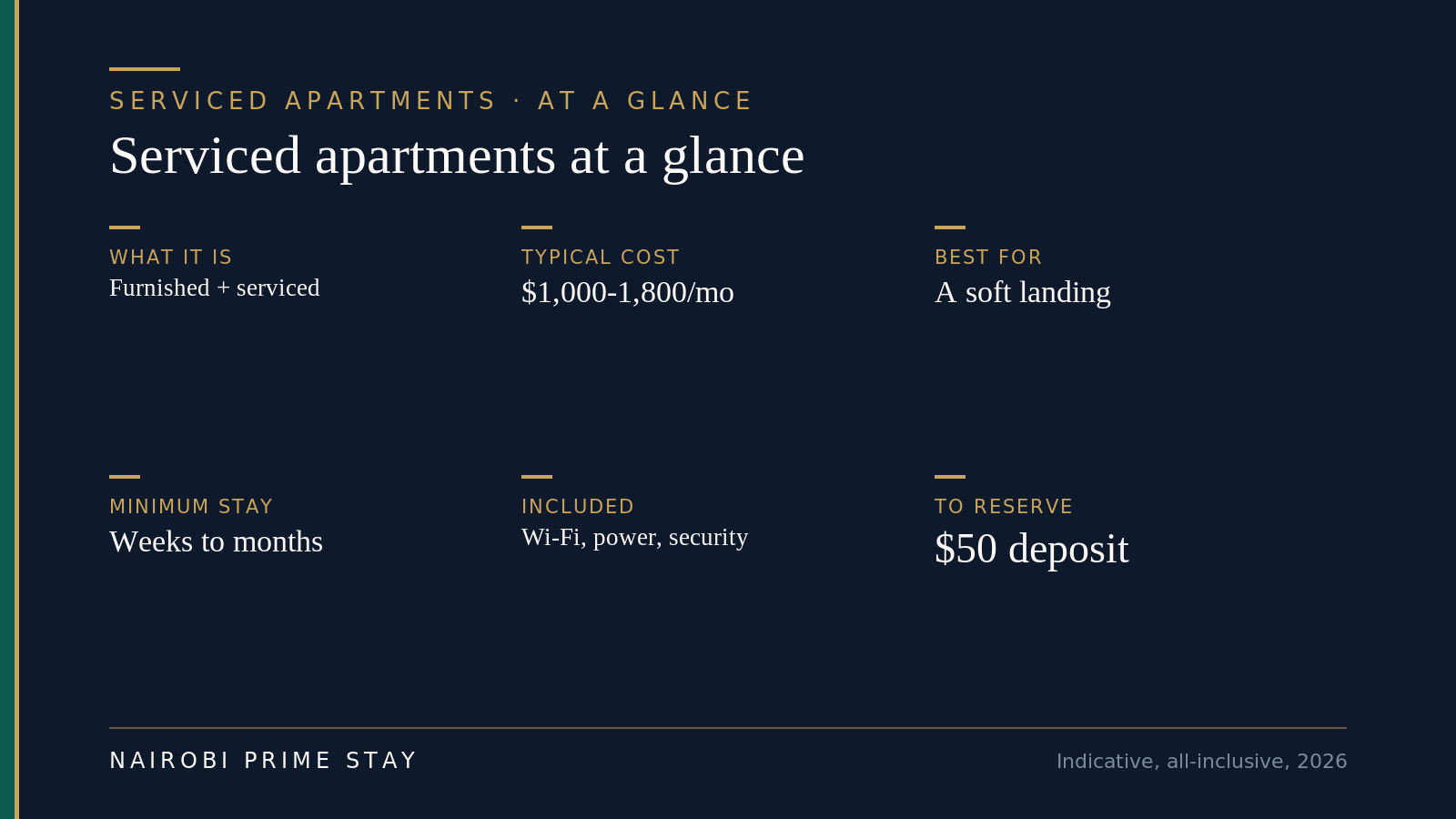
The essentials in one view.
If you read nothing else, here’s the shape of it. A serviced apartment is a furnished home with the bills, internet, cleaning, security and backup power bundled into one monthly price. Most comfortable one and two-bedrooms run $1,000–1,800 a month, more in diplomatic areas. You can stay a few weeks or many months, and with us a $50 deposit reserves it — you pay the balance when you arrive.
What is a serviced apartment, exactly?
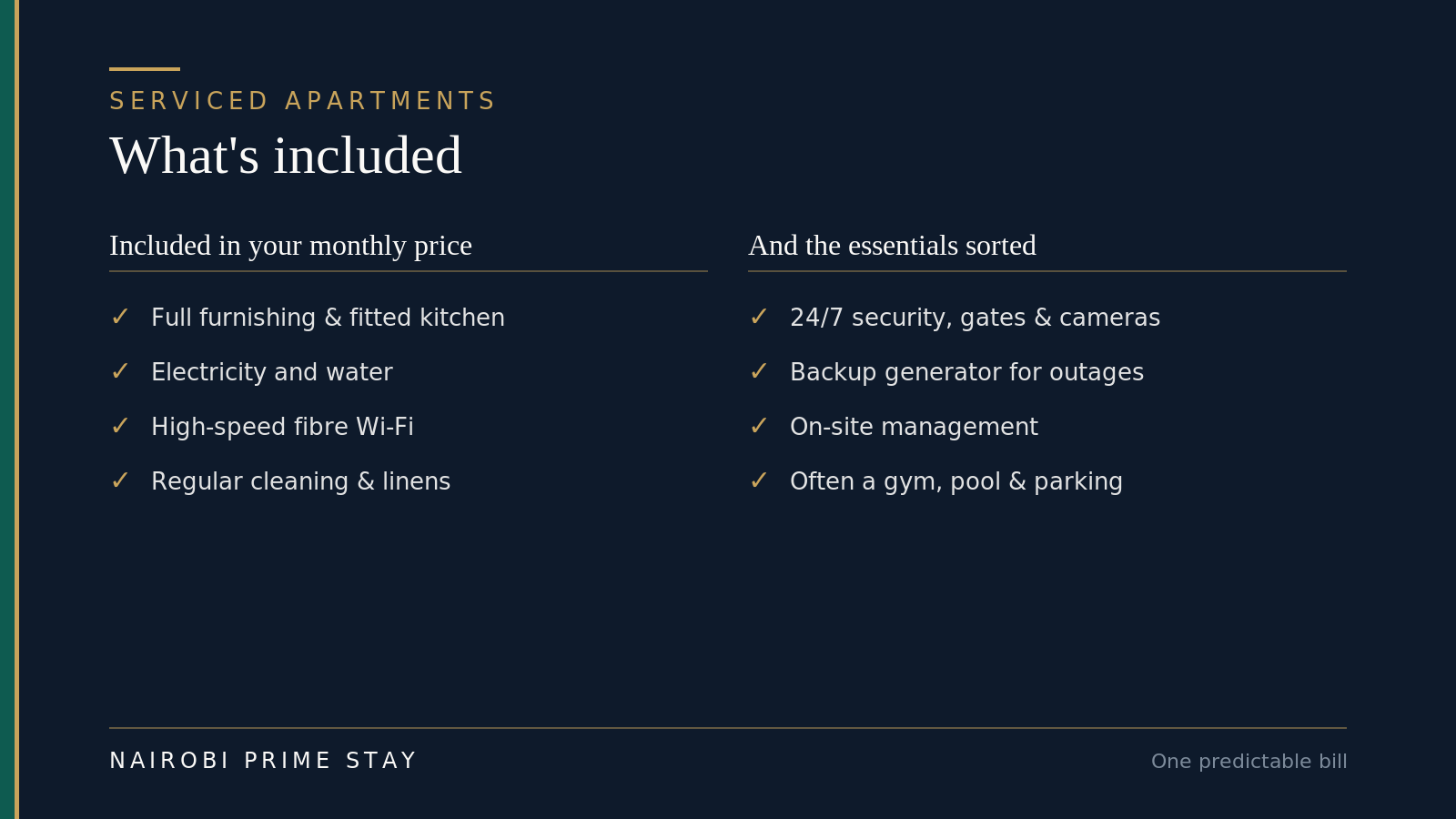
Everything in one predictable bill.
It’s a private, furnished apartment you rent by the month, with services and bills bundled into one price. Think of it as the middle ground between a hotel and an unfurnished rental: the independence and space of your own home, with the convenience and security of a managed building.
A typical serviced apartment in Nairobi includes:
- Full furnishing — beds, sofas, a dining area, a fitted kitchen, often a work desk.
- Utilities included — electricity and water in the monthly price, with no separate accounts to open.
- High-speed internet — fibre Wi-Fi already installed and working.
- Regular cleaning — housekeeping on a schedule, with linens and towels.
- 24/7 security — guards, gated access and cameras.
- A backup generator — so power cuts don’t interrupt your life or your work.
- On-site management — someone to call when something needs fixing.
- Often extras like a gym, pool, parking and laundry, depending on the building.
The appeal is simple: you open the door and start living, with nothing to set up and one predictable bill.
Serviced apartment vs hotel vs long-term lease
| Serviced apartment | Hotel | Long-term lease | |
|---|---|---|---|
| Furnished | Yes | Yes | Usually no (or costs more) |
| Bills & internet included | Yes | Yes | No — you set them up |
| Cleaning & security | Yes | Yes | You arrange |
| Space & kitchen | Full apartment | One room | Full home |
| Deposit | Small / none | None | 1–3 months |
| Minimum commitment | Flexible monthly | Nightly | Usually 12 months |
| Best for | Stays of weeks to months | A few nights | Settled, long-term living |
| Value for a long stay | High | Low | High once set up |
For a relocation, the serviced apartment wins the first chapter: it’s cheaper than a hotel over weeks, and far less of a commitment than a lease before you know the city. Once you’ve chosen your neighborhood, a long lease can make sense for the years that follow — see our moving to Nairobi guide for the full sequence.
Serviced, furnished or corporate housing — what’s the difference?
People use these terms loosely, so here’s the plain-English version. A furnished apartment comes with furniture, but you usually still set up and pay your own utilities and internet, arrange your own cleaning, and sign a longer lease. A serviced apartment goes further: the furniture is there too, but so are the bills, fast Wi-Fi, housekeeping, 24/7 security and a backup generator, all in one monthly price on flexible terms. Corporate housing is simply a serviced apartment booked by a company for an employee on assignment — the same product, often billed to the employer with a little extra paperwork.
| Furnished apartment | Serviced apartment | Corporate housing | |
|---|---|---|---|
| Furniture | Yes | Yes | Yes |
| Bills & internet | You set up & pay | Included | Included |
| Cleaning | You arrange | Included | Included |
| Lease length | Usually 6–12 months | Flexible monthly | Project length |
| Billed to | You | You | Often the employer |
| Best for | Settled stays, your own setup | Relocations & flexible stays | Company assignments |
For most newcomers arriving without furniture or a local utility account, the serviced route is the least friction. If your employer is footing the bill, see our corporate housing guide; if you’re weighing a longer unfurnished lease later, our furnished vs unfurnished guide lays out the math.
Who serviced apartments are for
Serviced apartments suit a wide range of people moving through or settling into Nairobi:
- Relocating families and professionals who want a soft landing while they view long-term homes and test commutes.
- Corporate and executive stays — consultants, project teams and managers on assignments of weeks to months.
- UN, embassy and NGO postings that need secure, ready housing immediately on arrival.
- Remote workers and digital nomads who want fast fibre and a reliable setup, a desk and flexible terms.
- Medical visitors seeking comfortable, private accommodation near Nairobi’s private hospitals.
- Long-stay visitors who find hotels cramped and expensive over time.
If any of those sound like you, the value is in the convenience and the flexibility — you’re not betting on a neighborhood or a building before you’ve experienced it.
The soft-landing strategy
Here’s the advice almost every settled expat gives newcomers: don’t sign a year-long lease from abroad. Photos flatter, neighborhoods feel different in person, and the commute you imagine isn’t the one you’ll drive. Instead, book a serviced apartment for your first four to eight weeks.
From that secure base you can view long-term homes properly, test the traffic at rush hour, compare neighborhoods like Gigiri and Karen on the ground, and judge each building’s security and amenities for yourself. Then you move once, when you’re certain. It turns the riskiest part of a move — choosing where to live sight unseen — into a calm, informed decision.
How it plays out: three real scenarios
The value of a serviced apartment looks different depending on why you’re moving. Here’s how it works for three common arrivals.
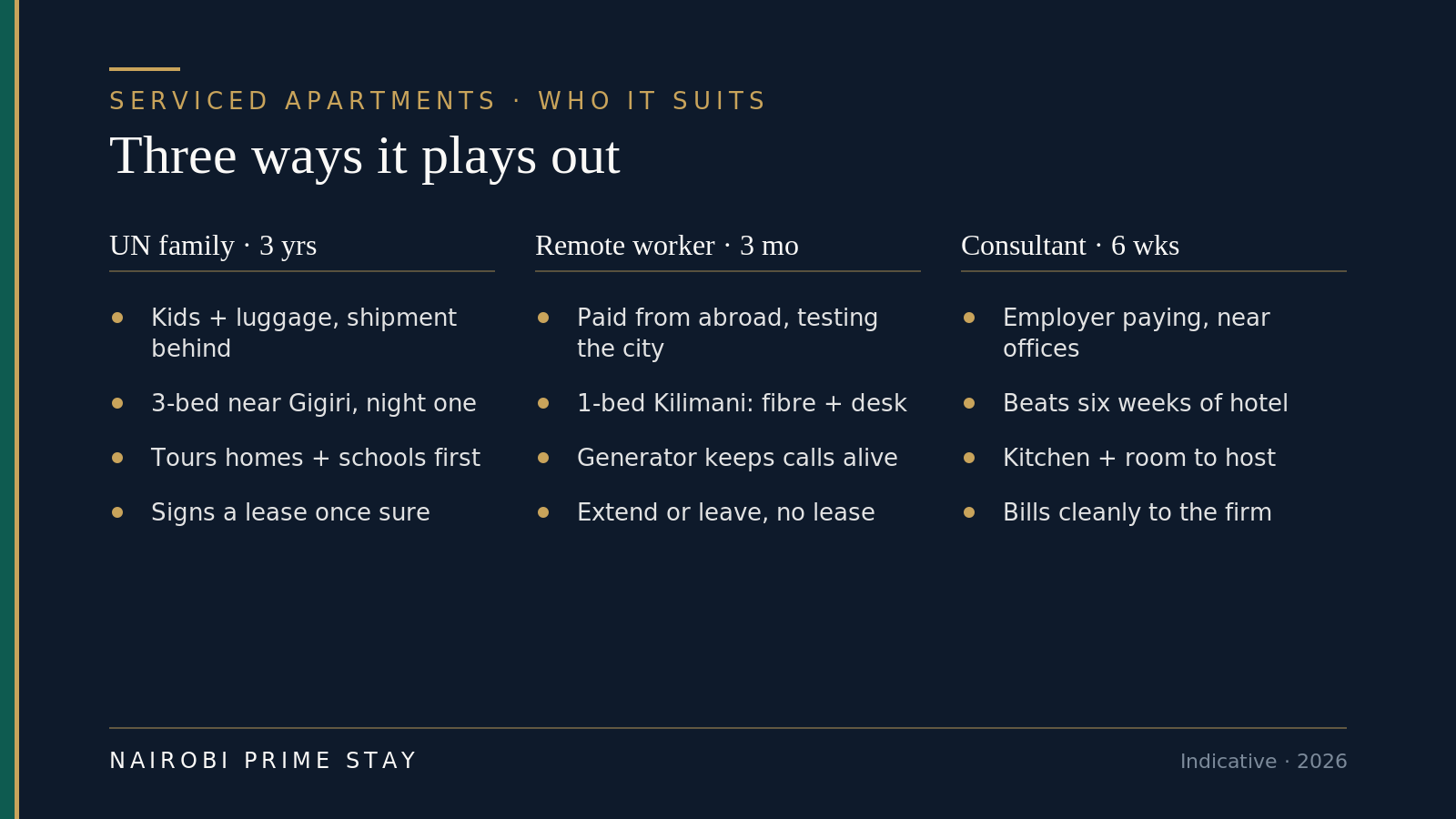
Who it suits, and how they use it.
The UN family, three-year posting. You land at JKIA with two kids and eight suitcases, and your shipment is six weeks behind you. A three-bedroom serviced apartment in or near Gigiri gives you a secure, furnished base from night one — close to the UN complex and the international schools you’re about to tour. You spend the first month viewing long-term houses in Gigiri, Runda and Muthaiga, doing the school run to test the traffic, and only then sign a year’s lease. See where UN staff live and our embassy and UN housing guide for the diplomatic-cluster details.
The remote worker, three months. You’re paid from abroad and want to try Nairobi before committing. A one-bedroom in Kilimani or Westlands with fast fibre and a desk lets you work from day one, and the generator keeps your calls alive through any outage. Flexible monthly terms mean you can extend if you fall for the city or move on if you don’t — no lease to break. Plenty of digital nomads do exactly this while they sort a longer-term permit.
The consultant, six-week project. Your employer is paying, and you need to be productive immediately near the offices in Westlands or Upper Hill. A serviced apartment booked as corporate housing costs less than six weeks of hotel, gives you a kitchen and a living room to work and host in, and bills cleanly to the company. You arrive, the keys are waiting, and you start work the next morning.
What serviced apartments cost in Nairobi
Pricing depends on the neighborhood, the size, and the building’s amenities. As a guide, a comfortable one or two-bedroom serviced apartment with everything included runs roughly $1,000–1,800 a month, with premium and diplomatic areas costing more. Indicative 2026 monthly ranges:
| Neighborhood | All-inclusive USD / mo | Rough KES / mo | Notes |
|---|---|---|---|
| Kilimani | $700–1,600 | ~KES 90,000–207,000 | Central, modern, best value among prime areas |
| Westlands | $900–1,800 | ~KES 116,000–232,000 | Social, near offices and malls |
| Riverside | $1,200–2,200 | ~KES 155,000–284,000 | Central, leafy, higher-end |
| Karen | $1,200–2,200 | ~KES 155,000–284,000 | Space and gardens, family-friendly |
| Gigiri | $1,800–3,000+ | ~KES 232,000–387,000+ | Diplomatic, very secure, near the UN |
KES converted at ~129 to the dollar (2026); the shilling fluctuates — check the Central Bank of Kenya or Wise for the live rate.
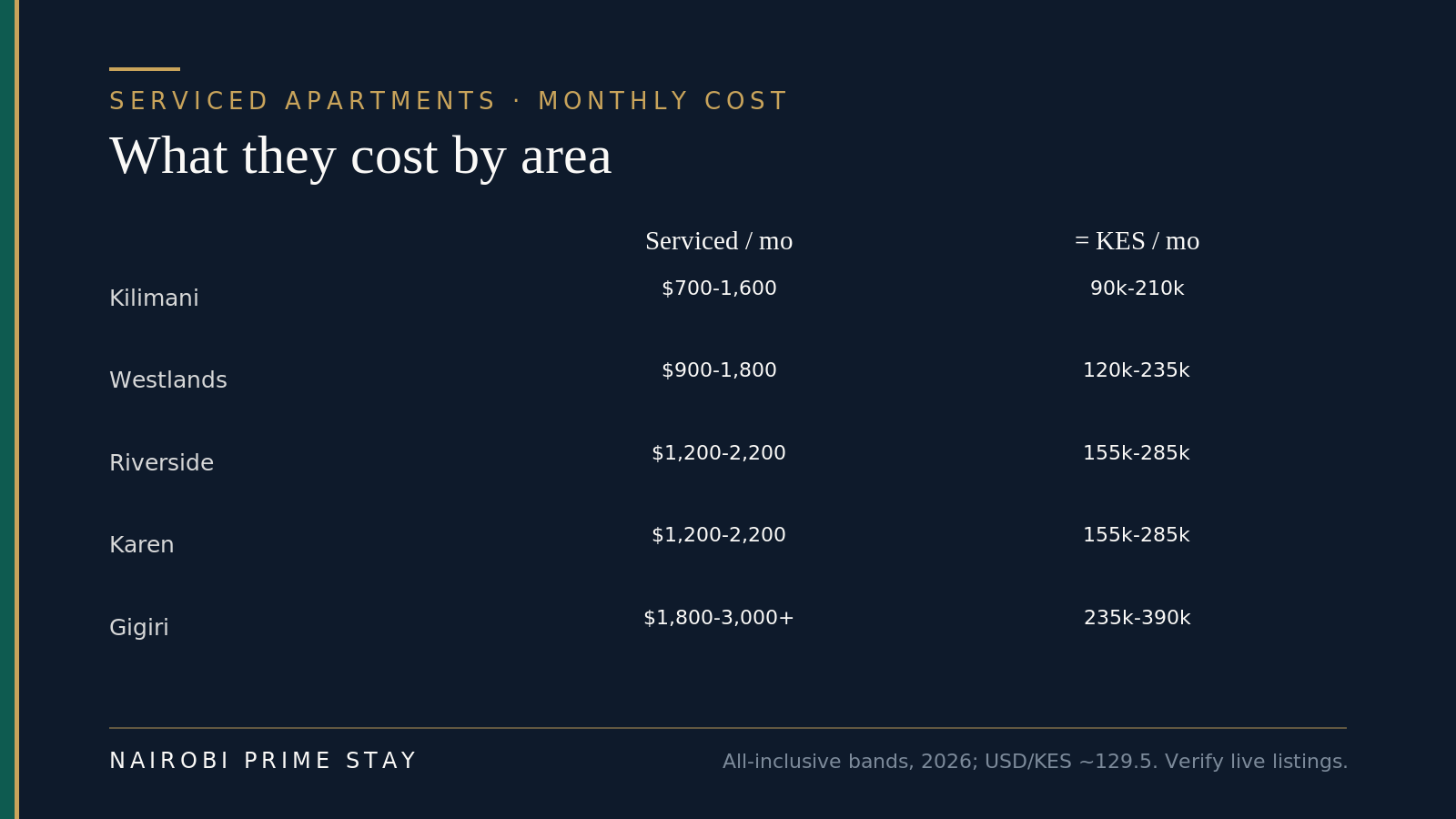
All-inclusive monthly bands by area, 2026.
What it costs by apartment size
Size moves the price as much as the address does. These are indicative 2026 all-inclusive bands for a good building in a prime area — utilities, internet, cleaning, security and a generator included:
| Size | Indicative all-inclusive / mo | Typically suits |
|---|---|---|
| Studio / compact 1-bed | $700–1,100 | Solo stays, tight budgets, short projects |
| 1-bedroom | $900–1,500 | Remote workers, couples, most soft landings |
| 2-bedroom | $1,200–2,000 | Couples wanting an office, small families |
| 3-bedroom / family | $1,800–3,000+ | Families, longer postings, room for a delayed shipment |
Rates also soften the longer you stay, so it’s always worth asking for a monthly rate on a three-month booking. Figures are indicative — confirm the live price for your dates.
Remember these include utilities, internet, cleaning, security and a generator — so compare them against an unfurnished rent plus all those bills and the setup time, not against bare rent alone. For the full money picture, see our cost of living guide.
What drives the price
Four things move a serviced apartment’s monthly rate more than anything else: the neighborhood (Gigiri and Riverside sit at the top; Kilimani is the best value among the prime areas), the size and number of bedrooms, the building’s amenities (a pool, gym, lifts and ample parking all cost more to run), and the length of stay — most providers drop the monthly rate for longer bookings, so it’s always worth asking. Newer buildings with better finishes and faster fibre command a premium too.
A serviced apartment vs a hotel: the monthly math
Here’s why the numbers favor a serviced apartment for any stay beyond a week or so. A mid-range Nairobi hotel room at, say, $120 a night comes to roughly $3,600 over a month — for one room, with no kitchen, and a restaurant bill on top of every meal. A comfortable serviced one-bedroom in Kilimani or Westlands, all-inclusive, lands around $900–1,500 for the whole month, with a full kitchen so you’re not eating out three times a day. Over a four-to-eight-week relocation that gap is real money — often thousands of dollars — and you get more space and a calmer base while you house-hunt. See our cost of living guide for how the rest of a monthly budget adds up.
Serviced apartment vs Airbnb: which wins for a long stay?
For a relocation, a vetted serviced apartment usually beats an Airbnb — but it’s worth understanding the real difference, because Airbnb is the first place many Americans look.
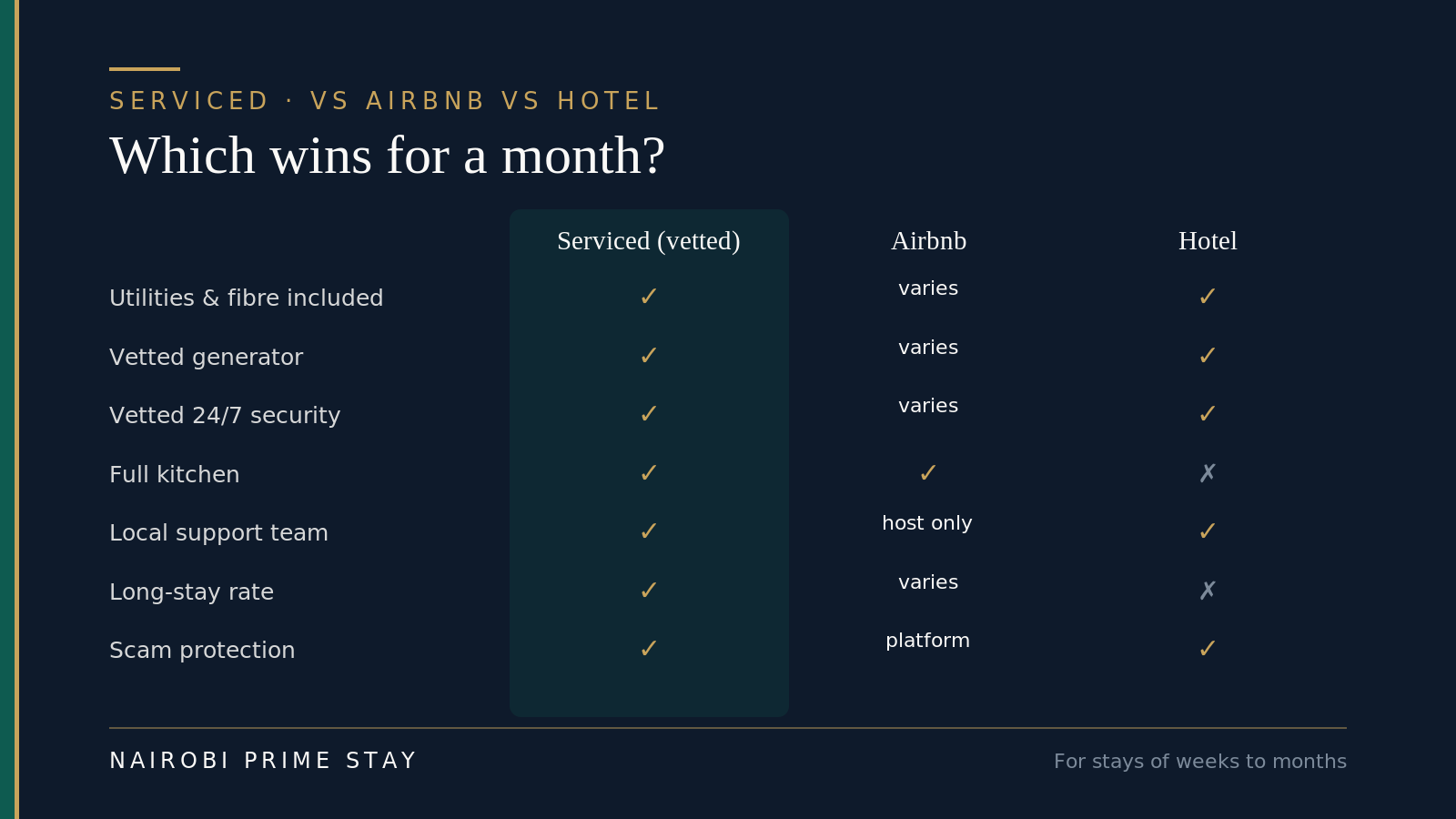
The honest comparison for a month or more.
Airbnb has the most listings and public reviews, and you can book it yourself in minutes from abroad. The catch is consistency. On Airbnb, what’s included varies listing to listing — some have a generator and fast fibre, many don’t, and in Nairobi those two things are the difference between a good month and a miserable one. Cleaning fees and long-stay markups add up, support is just the host, and the platform can’t confirm whether a building’s security or water supply is what the photos suggest.
A serviced apartment through a vetted local provider fixes the variables. Utilities and fast fibre are genuinely included, the generator and 24/7 security are confirmed before you arrive, the rate is built for weeks-to-months rather than nightly tourism, and there’s a local team to call when the water tank needs topping up or the Wi-Fi drops. You also sidestep the biggest online risk: paying for a place that turns out not to exist.
So when does Airbnb win? For a short stay of a few nights, or if you want to self-serve and a specific listing has glowing recent reviews and a confirmed generator. For the four-to-eight-week soft landing this guide is about, the vetted serviced route is lower-risk. Curious about that market from the owner’s side? Our Airbnb investment guide covers how short-lets actually perform here.
The honest tradeoffs
Serviced apartments aren’t the right answer for every situation, and we’d rather you know that up front. They cost more per month than a bare, unfurnished rental, because you’re paying for the furniture, the bills, the cleaning and the flexibility in one figure. For a settled, multi-year stay, an unfurnished lease usually works out cheaper once you’ve absorbed the setup. And a one or two-bedroom apartment, however comfortable, isn’t a four-bedroom house with a garden — families wanting space sometimes move on to a long-let home in Karen or Runda after the soft landing.
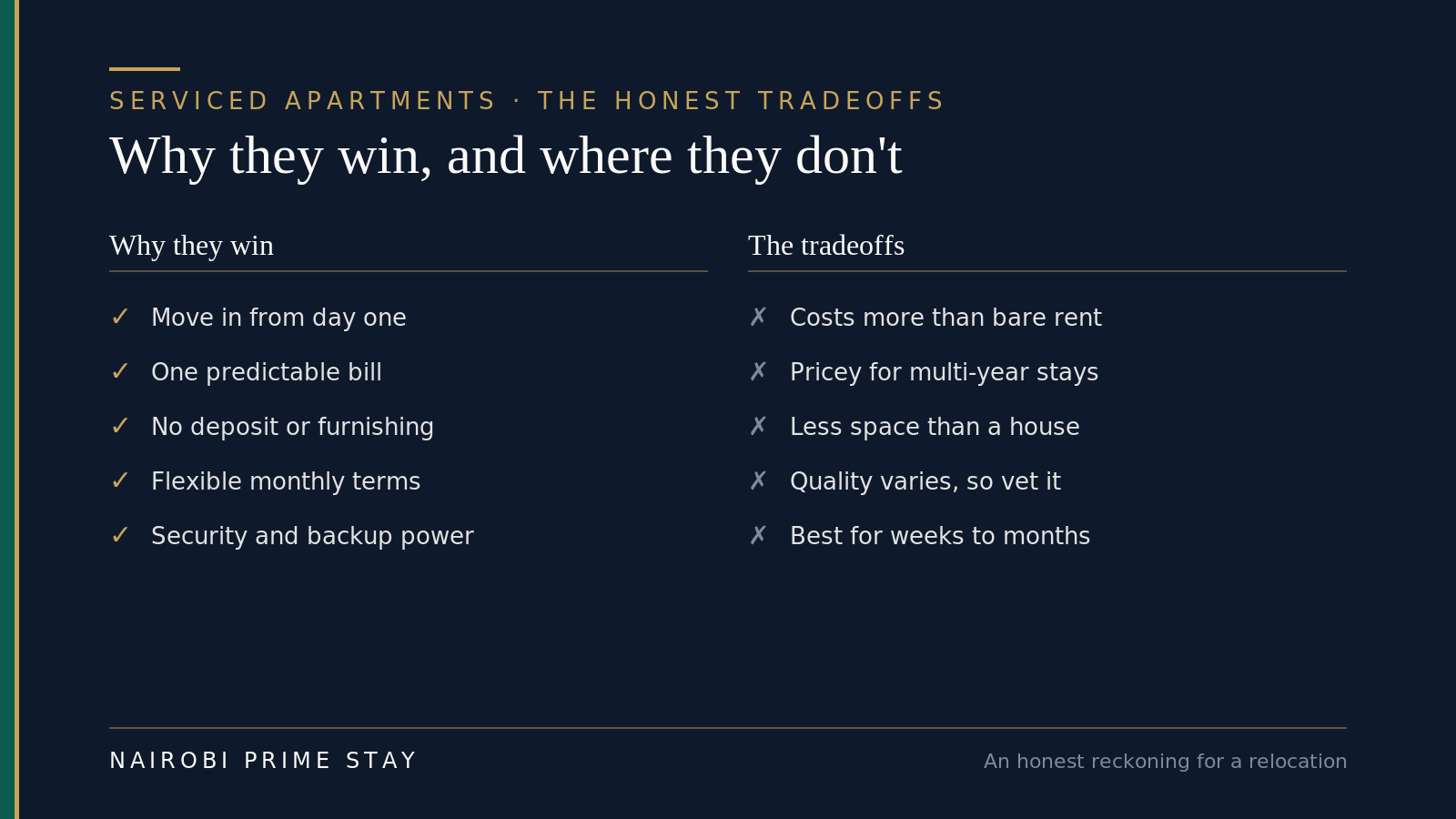
Why they win, and where they don’t.
Where they’re hard to beat is the first chapter of a move: the weeks when you’re learning the city, viewing homes, and don’t want to gamble a year’s lease and a furniture shipment on a neighborhood you’ve only seen in photos. Quality does vary between providers, so the vetting in the next section matters — but a good serviced apartment removes almost every headache of arriving.
What’s not included: the extras to ask about
A good all-inclusive rate covers the furniture, electricity, water, fibre Wi-Fi, cleaning, 24/7 security and a generator. A few things can sit outside it, and the honest move is to ask before you book — not discover them on the invoice:
- Heavy electricity use. Some providers include power up to a fair-use cap, then bill the excess. If you’ll run air conditioning or heaters hard, ask how it’s metered.
- Extra or deep cleaning. Scheduled housekeeping is included; an extra mid-week clean or an end-of-stay deep clean can cost more.
- Laundry beyond linens. Bed linen and towels are covered; personal laundry may be a paid add-on or a nearby service.
- A second parking bay. One spot is usual; a second car often costs extra where space is tight.
- Airport transfers and groceries. A pickup or a stocked welcome fridge is sometimes offered, sometimes charged.
- Short-stay levies. Bookings under a month can attract tourism levy or VAT that longer stays don’t.
None of these are dealbreakers — they’re just the questions that separate a transparent provider from a vague one. Get the full inclusions list in writing.
What to check before you book
Whether you book with us or anyone else, run the “Nairobi Five” check — they’re what separate a comfortable stay from a frustrating one:
- Backup generator — power cuts happen; you want uninterrupted cover for your Wi-Fi and life.
- Water supply and storage — tanks or a borehole smooth out any shortages.
- 24/7 security — guards, gated access and cameras.
- Fibre internet — confirm it’s installed and fast, especially if you work from home.
- Responsive management and cleaning — someone who answers when you need them.
Then confirm the practical things: exactly what’s included in the monthly price, the cleaning schedule, parking, and the terms for extending or leaving. A good provider is transparent about all of it. And never wire a deposit for a place you haven’t been able to verify — book through a reputable, vetted provider. Our safety guide covers avoiding rental scams.
The questions to ask before you pay
The Nairobi Five tell you whether the building is sound. These questions tell you whether the deal is. Run through them with any provider before you send a deposit:
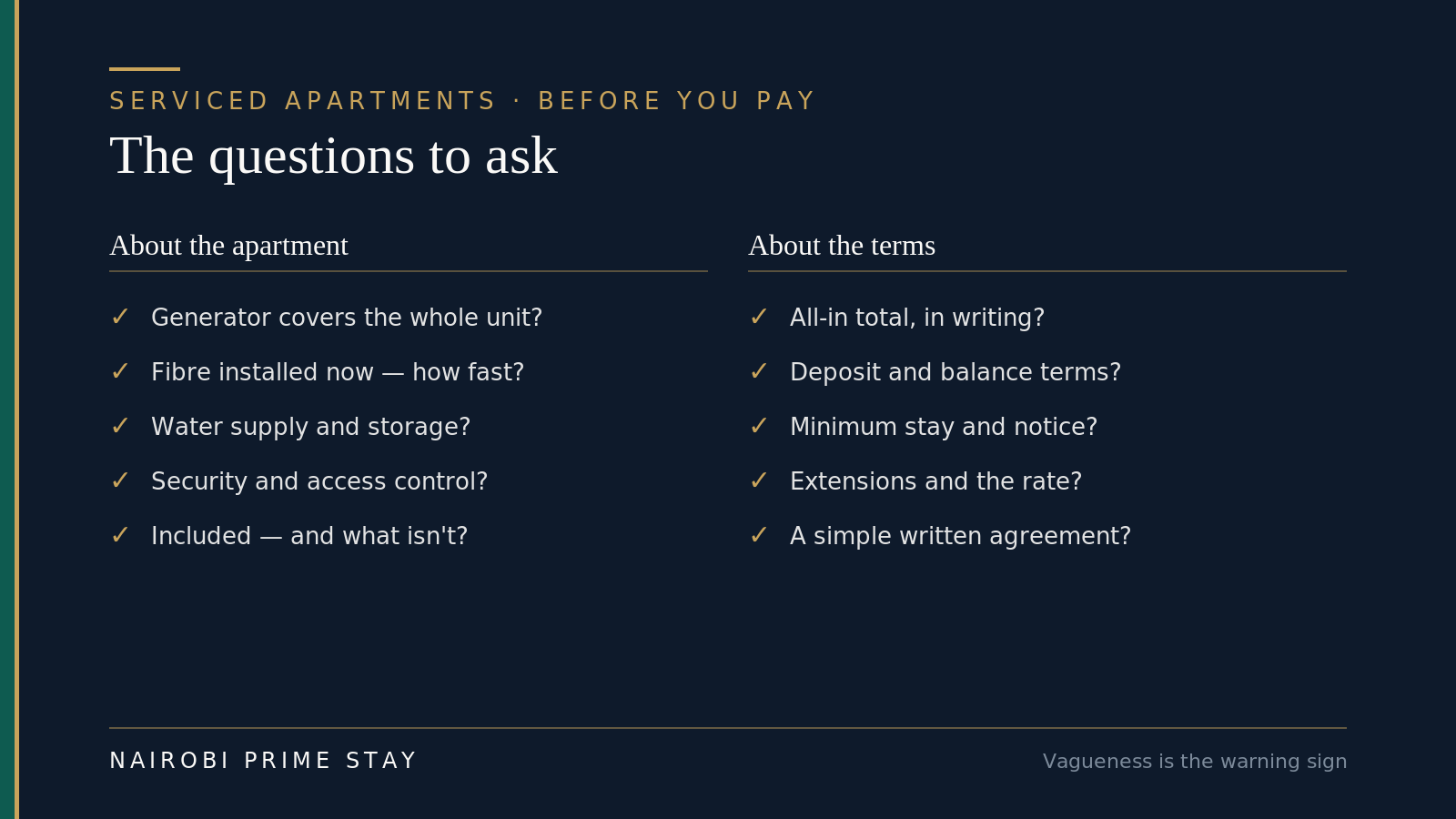
Two checklists: the home, and the terms.
About the apartment: Is there a backup generator, and does it cover the whole unit? What’s the actual fibre speed, and is it installed now? How is water supplied and stored? Who provides security, and how is access controlled? Exactly what’s included in the monthly price — and what isn’t?
About the terms: What’s the all-in total for my dates, in writing? How much is the deposit, and how do I pay the balance? What’s the minimum stay and the notice period to leave? Can I extend, and at what rate? Is there a simple written agreement covering all of it?
A provider who answers all of this clearly and in writing is one you can trust; vagueness is the warning sign. See our tenancy, leases and deposits guide for how the paperwork and protections work.
How booking works with Nairobi Prime Stay
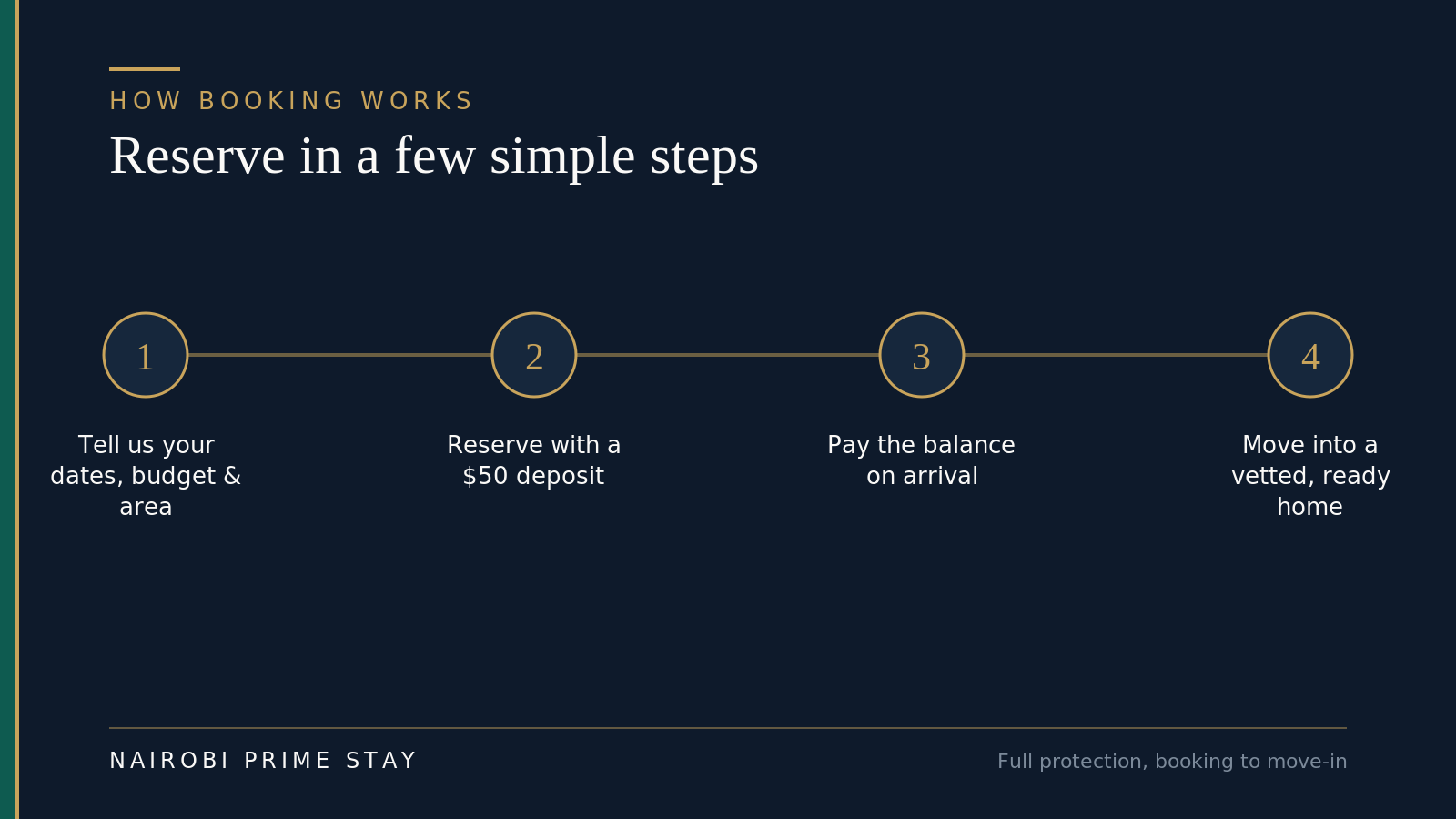
Reserve in a few simple steps.
We keep it simple and low-risk, because the whole point is to take the stress out of arriving. We don’t just hand you a list — we help you handpick the right apartment from a large, carefully vetted selection, matched to your budget, dates and work location.
- Tell us what you need. Your budget, move-in date, length of stay, neighborhood and any requirements — to us directly or via our AI relocation assistant, which can shortlist options in minutes, day or night.
- Reserve with a $50 deposit. This small deposit secures your chosen apartment and locks in your dates.
- Pay the balance on arrival. The rest is settled on your day of arrival — nothing more to pay before you travel.
- Full protection, end to end. Vetted apartments, honest pricing and guaranteed quality from booking to move-in.
It’s designed so you can commit to a secure home before you land without overcommitting your money. When you’re ready, browse our serviced apartments or get in touch.
Your first day, and how you pay
Arrival is the easy part, and that’s the point. Here’s how the first day usually goes, and how payment works.
On arrival. Pick up a Safaricom SIM and register M-Pesa right at JKIA with your passport — it takes minutes, and you’ll use it for almost everything. A good provider meets you, hands over the keys, walks you through the apartment, and shows you how to reach the on-site team. You unpack into a home that already works: power on, water running, Wi-Fi live, a made bed.
How you pay. With Nairobi Prime Stay, a $50 deposit reserves your apartment and locks your dates; you pay the balance on arrival, so there’s nothing more to send before you travel. Many providers quote in US dollars and also accept Kenyan shillings by card, bank transfer or M-Pesa once you’re set up — the shilling trades around 129 to the dollar as of 2026 (check the live USD/KES rate before you convert a large sum). The golden rule holds: never wire the full amount for a place you haven’t been able to verify.
Best neighborhoods for serviced apartments
The right area depends on why you’re here. UN, embassy and NGO staff usually want Gigiri for security and the short commute to the complex. Remote workers and younger professionals lean toward Kilimani, Westlands and Riverside for being central and social. Families often prefer Karen or Lavington for space and schools. Executives wanting a short commute look at Riverside, Westlands and Upper Hill. Our best neighborhoods guide compares them all.
Frequently asked questions
What is a serviced apartment in Nairobi?
A fully furnished apartment rented by the month with hotel-style services included — Wi-Fi, cleaning, 24/7 security and a backup generator — and utilities folded into one monthly price. It gives you the space and independence of a home with the convenience and security of a managed building.
How much do serviced apartments cost in Nairobi?
A comfortable one or two-bedroom with everything included runs roughly $1,000–1,800 a month in 2026, with premium and diplomatic areas like Gigiri costing more. Because the price includes utilities, internet, cleaning and security, compare it to unfurnished rent plus all those bills, not to bare rent.
Are serviced apartments cheaper than hotels in Nairobi?
For stays of a week or more, almost always. You get far more space and a full kitchen, and the monthly rate works out well below a comparable hotel over time, while still including cleaning, security and internet.
How long can you stay in a serviced apartment?
Terms are flexible — from a few weeks to many months, and often renewable. They’re ideal for relocations and assignments, and many people use one as a soft landing before signing a long-term lease.
Do serviced apartments include internet and utilities?
Yes. High-speed fibre Wi-Fi, electricity and water are typically included in the monthly price, along with cleaning, security and a backup generator. Always confirm exactly what’s covered before booking.
Are serviced apartments in Nairobi safe?
Yes — security is one of their main advantages. Reputable serviced apartments sit in gated buildings or compounds with 24/7 guards, controlled access and cameras, in Nairobi’s safer suburbs like Gigiri, Westlands, Kilimani and Karen. The bigger risk is online: never wire a deposit for a place you haven’t been able to verify. Book through a vetted provider and confirm the apartment is real before paying.
What’s the minimum stay, and is there a contract?
Most serviced apartments take bookings from about a week up, and the sweet spot is the four-to-eight-week soft landing, though many people stay several months and renew. You’ll sign a short, simple agreement covering the dates, what’s included and the terms for extending or leaving — far lighter than a 12-month lease with its multi-month deposit. Always confirm the minimum stay and notice period before you book.
Should I choose a serviced or a furnished apartment?
For your first weeks in Nairobi, a serviced apartment is usually the easier choice: the bills, internet, cleaning and security are handled and the terms are flexible, so you can move in the day you land. A plain furnished apartment can be cheaper month-to-month, but you set up your own utilities and internet and commit to a longer lease. Many people use a serviced apartment as a soft landing, then sign a furnished or unfurnished lease once they’ve chosen their area.
How do I book a serviced apartment in Nairobi with Nairobi Prime Stay?
Tell us (or our AI relocation assistant) your budget, dates, neighborhood and needs, and we’ll handpick a vetted match. A $50 deposit reserves it and locks your dates; you pay the balance on arrival, with full protection from booking to move-in.
Is a serviced apartment better than Airbnb for a month in Nairobi?
For a relocation, usually yes. A vetted serviced apartment guarantees the things that actually matter here — utilities and fast fibre included, a tested backup generator, 24/7 security and a local team to call — with a rate that drops for longer stays. Airbnb has more listings and public reviews, but quality and what’s included vary widely, cleaning fees add up, and you carry the risk of a place that isn’t as described. If you do book Airbnb, insist on a generator and confirm the area before paying.
What’s not included in a Nairobi serviced apartment?
Most all-inclusive rates cover furniture, electricity, water, fibre Wi-Fi, cleaning, security and a generator. What can cost extra: heavy electricity use above a fair-use cap, deep or extra cleaning, laundry beyond linens, a second parking bay, airport transfers, and short-stay tourism levy or VAT on bookings under a month. Ask for the full inclusions list in writing before you book.
Can I pay for a serviced apartment in US dollars?
Often yes. Many Nairobi providers quote and accept US dollars, and you can also pay in Kenyan shillings by card, bank transfer or M-Pesa once you’re set up. The shilling trades around 129 to the dollar as of 2026 — check the Central Bank of Kenya or Wise for the live rate. With Nairobi Prime Stay a $50 deposit reserves your apartment and the balance is paid on arrival; never wire the full amount for a place you haven’t verified.
Final thoughts
For anyone arriving in Nairobi, a serviced apartment solves the hardest part of the move: it gives you a secure, comfortable, fully equipped home from the moment you land, without locking you into a neighborhood or a lease before you know the city. Use it as a base, take your time, and choose your long-term home with confidence.
When you’re ready, browse our serviced apartments for honest, all-inclusive monthly rates, or ask our AI relocation assistant to match your budget and dates in a couple of minutes. Want to talk it through? Get in touch — a $50 deposit is all it takes to reserve your place.
Related reading
- Moving to Nairobi: the complete guide for Americans
- Best neighborhoods in Nairobi for expats
- Gigiri neighborhood guide · Karen neighborhood guide
- Where UN staff live in Nairobi — the diplomatic-cluster areas most serviced-apartment guests choose
- Cost of living in Nairobi
- Furnishing a home in Nairobi — for when you move from the serviced apartment into an unfurnished place
- How to rent an apartment in Nairobi — the full renting process for when you leave the serviced apartment
- Corporate housing in Nairobi — how companies house assignees: serviced apartments, packages, billing and budgets
Ready for a soft landing? Browse serviced apartments across Nairobi’s best neighborhoods, or tell our AI relocation assistant your dates and budget. A $50 deposit reserves your home; you pay the balance when you arrive — nothing more before you travel.
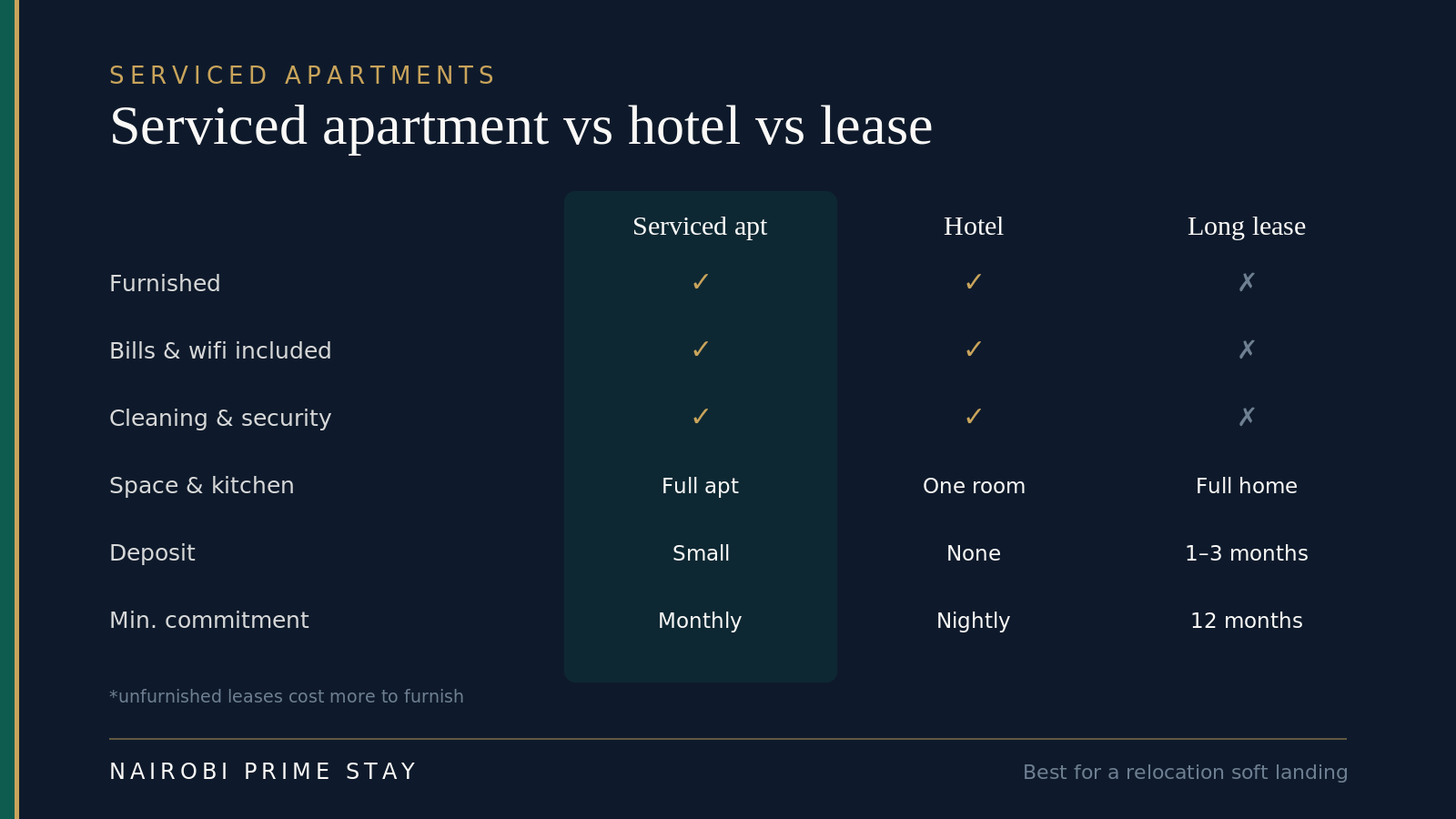
Serviced apartment vs hotel vs long lease at a glance.
Ready to look?
Find your apartment in Nairobi
Browse verified serviced apartments, or ask the AI concierge which area fits your life.