
Guides · Serviced apartments
Embassy, UN and NGO Housing in Nairobi: How It Actually Works (2026)
Embassy, UN and NGO Housing in Nairobi: How It Actually Works (2026)

If you’ve been posted to Nairobi with an embassy, the UN, or an NGO, your housing won’t work like a normal expat rental. Someone else may assign your home, or your home may need to pass a security inspection before you can sign, or your rent may be partly reimbursed — and all of it runs on the organization’s timeline, not yours.
This guide explains, honestly, how housing actually works for the three groups who arrive in Nairobi with an institution behind them: diplomatic mission staff, UN and UNON staff, and NGO and development-sector staff. We’ll cover who arranges your home, the residential security rules that decide which homes you can rent, what allowances typically cover, the leases you’ll sign, and how to land softly in your first weeks before any of it is settled.
If you’re brand new to the city, start with our complete guide to moving to Nairobi. If you mainly want to know which suburb to live in, our guide to where UN and diplomatic staff live maps the belt suburb by suburb. This page is about how the housing itself works.

TL;DR — how org housing works in Nairobi
- Embassy and diplomatic staff usually get a home assigned and leased by the mission, picked to a rank-and-family-size standard, security-vetted, and often sorted before you land.
- UN and UNON staff generally find their own home on the open market — but it has to pass a residential security clearance (the standard known as RSM, which replaced MORSS), and a rental subsidy may help with the cost.
- NGO staff sit on a spectrum: large agencies may arrange housing or follow UN-style security; many simply give a housing allowance and a checklist and let you find your own.
- Everyone clusters in the same corner — the Gigiri “diplomatic belt” in north-west Nairobi — because it’s close to the UN, the embassies, and the international schools, and it’s among the safest ground in the city.
- A serviced apartment is the standard soft landing. Most people use one for the first 4–8 weeks while a permanent home is found, cleared, and furnished.
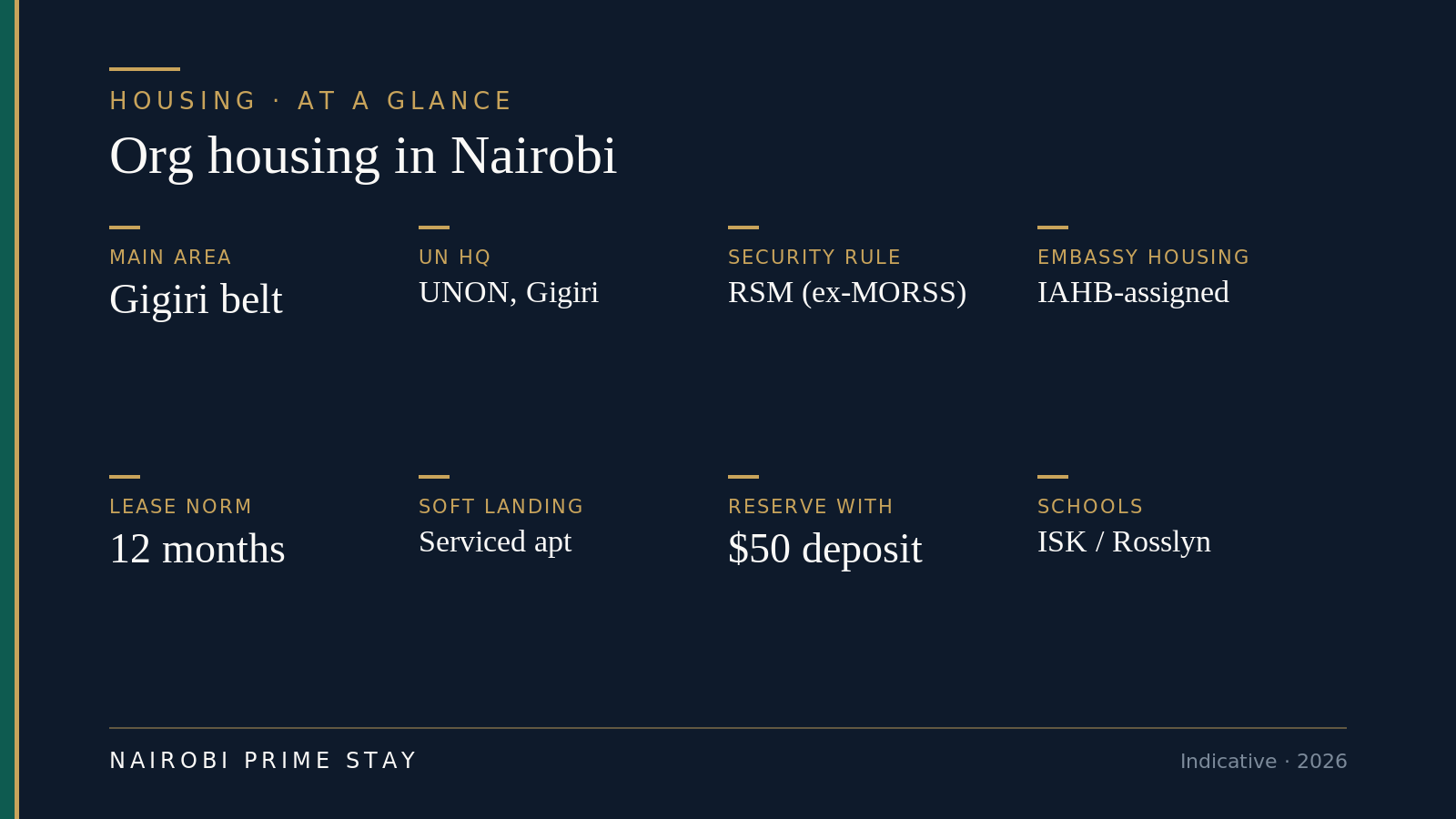 Org housing in Nairobi at a glance — the belt, the security rule, and how arrivals land softly.
Why housing is different when you arrive with an organization
A normal expat picks an area, views a few apartments, and signs. When you arrive with an institution, three extra things shape your housing.
First, security compliance. Embassies and the UN don’t let staff live just anywhere. Your home has to meet a defined residential security standard, and that quietly removes a lot of otherwise-lovely houses from your shortlist.
Second, money is tied to rules. Whether you get a government-leased home, a rental subsidy, or a flat housing allowance changes what you can spend and how you account for it. The figure in your offer letter is rarely the whole story.
Third, timing. Housing boards aim to assign homes before you arrive; UN security clearances take time; your shipped furniture may be weeks behind you. You’ll often land before your real home is ready. That gap is the single most common reason organizations book a serviced apartment for new arrivals.
Get these three right and the rest is ordinary Nairobi house-hunting. Get them wrong and you sign something your employer won’t reimburse or your security office won’t approve.
The three housing tracks
Almost everyone arriving with an institution falls into one of three tracks. Find yours first — it determines everything else.
1. Embassy and diplomatic mission staff
For most diplomatic missions, you don’t find your own home — the mission assigns it. At a US embassy, an Interagency Housing Board (IAHB) assigns leased residences to all US-citizen personnel under chief-of-mission authority, regardless of which agency they work for. Homes come from the mission’s housing pool; when one person leaves, their lease goes back into the pool and is reassigned to the next arrival.
Your home is matched to a space standard based on your rank and family size, so you can’t simply rent the biggest house you can find. Properties must meet the mission’s residential security standards — for US posts, the rules in 12 FAH-6, with the Bureau of Overseas Buildings Operations (OBO) evaluating each property for safety, seismic and security compliance. Furniture is often supplied from a government pool, and the General Services Office (GSO) handles leasing, maintenance and utilities.
Timing is structured: agencies are expected to give GSO around 120 days’ notice of an arrival, and the housing board aims to make an assignment roughly 60 days before you land. So if the system works, your home is waiting. Some missions — and many locally-hired or junior staff — instead pay a housing allowance and let you find your own place, still subject to security vetting. Either way, the US Embassy sits on United Nations Avenue in Gigiri, so diplomatic housing concentrates there and in neighbouring Runda and Muthaiga.
2. UN and UNON staff
Nairobi is a major UN city. It hosts UNON — the United Nations Office at Nairobi — the organization’s headquarters in Africa, in Gigiri, alongside UNEP, UN-Habitat and a long list of agencies. That means a large UN staff population, and a housing pattern of its own.
Unlike most embassy staff, UN staff usually find their own home on the open market. The catch is security. Your residence has to meet the UN’s residential security requirements, set under the UN Security Management System (UNSMS) and overseen by the UN Department of Safety and Security (UNDSS). The current framework is called Residential Security Measures (RSM) — the standard that replaced the older MORSS (Minimum Operating Residential Security Standards). The required measures scale to the assessed risk and can include a walled or fenced perimeter, a 24/7 guard, security lighting, grilles and reinforced doors, a safe haven, and an alarm or panic link. A Security Risk Assessment underpins what’s required, so confirm the exact, current expectations with your security focal point or UNDSS — they change with conditions.
On arrival you’ll also register with the security system, get a briefing, and your residence will be logged into the warden system used to account for staff in an emergency. On cost, the UN operates a rental subsidy scheme that can reimburse part of your rent when it exceeds a set share of your salary, for a limited period — eligibility, thresholds and caps vary, so check the specifics with your HR or administrative office rather than assuming. For short missions or temporary duty, you’re more likely to receive a daily subsistence allowance and stay in a hotel or serviced apartment than to sign a lease at all.
3. NGO and development-sector staff
NGO housing is the most varied of the three, so the honest answer is “it depends on your organization.” Large international NGOs and development agencies often look a lot like the UN: they may arrange or strongly steer your housing, and they frequently follow UN-aligned security guidance. Many participate in the Saving Lives Together (SLT) framework, through which NGOs share UNDSS security advisories — so even when secure housing isn’t strictly mandated, you’ll usually be pointed toward a gated, guarded home in an approved area.
Smaller NGOs are more hands-off. The common pattern is a housing allowance plus a security checklist, and you find your own home — often in the same diplomatic belt, or in Lavington, Westlands or Kilimani if you’d rather have more city life and a shorter list of security boxes to tick. Before you fly, ask your admin team three plain questions: Do you arrange housing or do I? Is there an allowance, and what’s the cap? And what security standard must my home meet? The answers place you on this spectrum and tell you how much freedom you actually have.
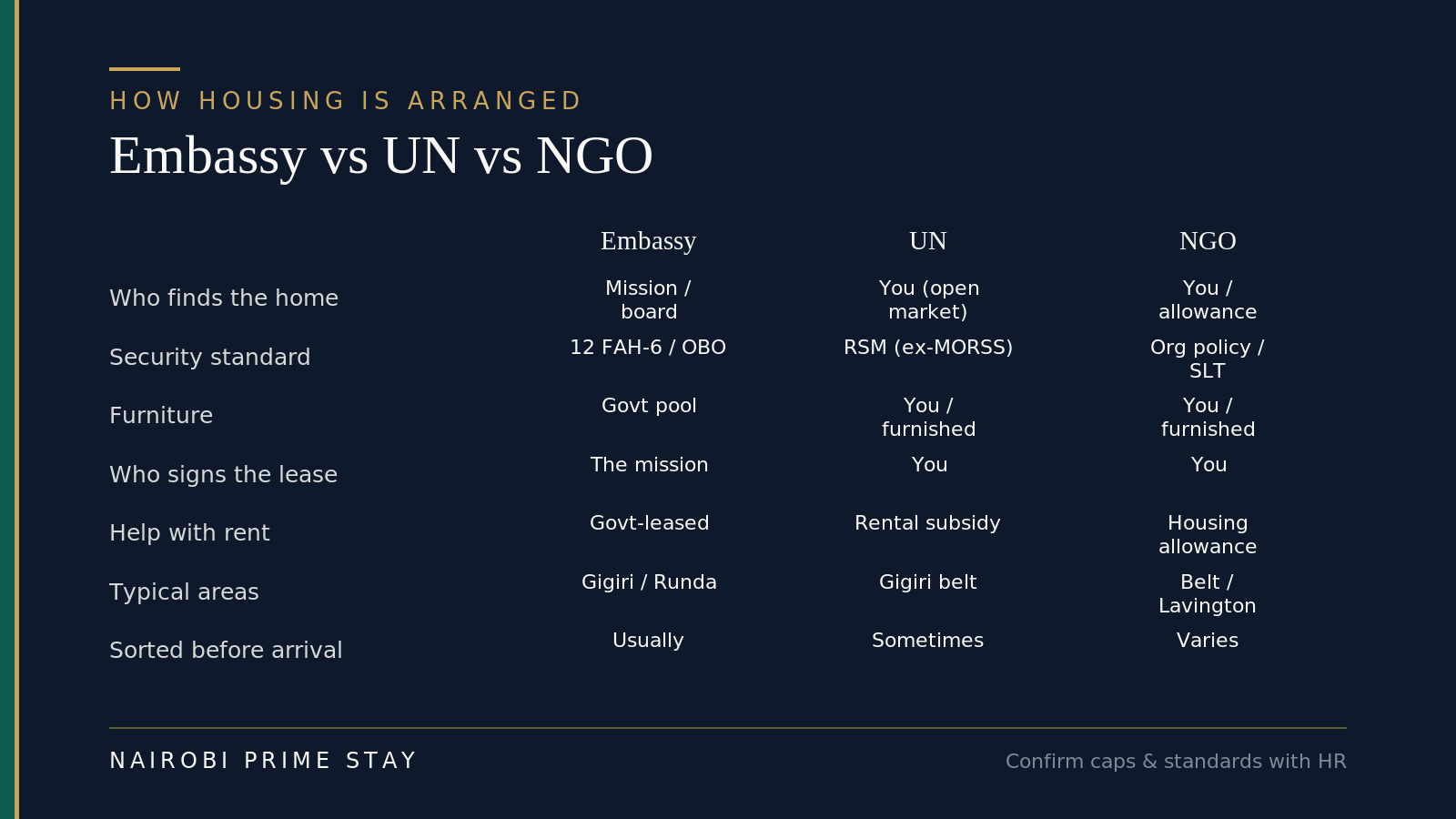 Three tracks, three sets of rules — confirm your own with HR before you sign anything.
What if you’re a UN Volunteer, a consultant or on a short contract?
Not everyone arrives on a staff contract, and the entitlements differ enough to catch people out.
UN Volunteers (UNVs) receive a monthly living allowance that is meant to cover accommodation, and typically a settling-in grant — but no assigned housing. You find your own place, and the same UNDSS security guidance applies to where and how you live. Because the allowance is a fixed figure, most UNVs end up in the more affordable edges of the belt or in secure compounds in Westlands and Kilimani, rather than a Runda villa. Confirm the current allowance and any security requirements with your UNV programme office before you commit to anything.
Consultants and individual contractors usually get nothing housing-specific at all: the fee is intended to be all-inclusive, there is no rental subsidy, and no housing board. For a typical 3–6 month contract, signing a 12-month lease makes no sense — which is why most consultants take a serviced apartment on monthly terms and keep the flexibility.
Short missions and temporary duty (TDY) run on a daily subsistence allowance, and you stay in an approved hotel or serviced apartment rather than signing anything. If that’s you, this guide’s lease sections don’t apply — book somewhere secure in the belt and skip the paperwork entirely.
Where embassy, UN and NGO staff actually live
Almost everyone in these three tracks lives within a 15-minute drive of the UN complex in Gigiri. The pull is simple: work, the international schools, and the safest, most heavily patrolled suburbs in Nairobi are all in the same north-west corner.
The core of the belt is Gigiri (wrapped around the UN and the embassies), Runda and Muthaiga (large gated homes and gardens), Nyari (a small, ultra-secure estate with its own police post), and Rosslyn (calm and school-focused along Limuru Road). Just outside it sit Thigiri, Spring Valley and Kitisuru — quieter, house-heavy pockets a touch below the very top of the market.
This guide won’t re-rank those suburbs, because we’ve already done it. For the side-by-side comparison — rents, commute times, the feel of each — read our dedicated guide to where UN and diplomatic staff live, and for the wider picture see our best neighborhoods in Nairobi overview.
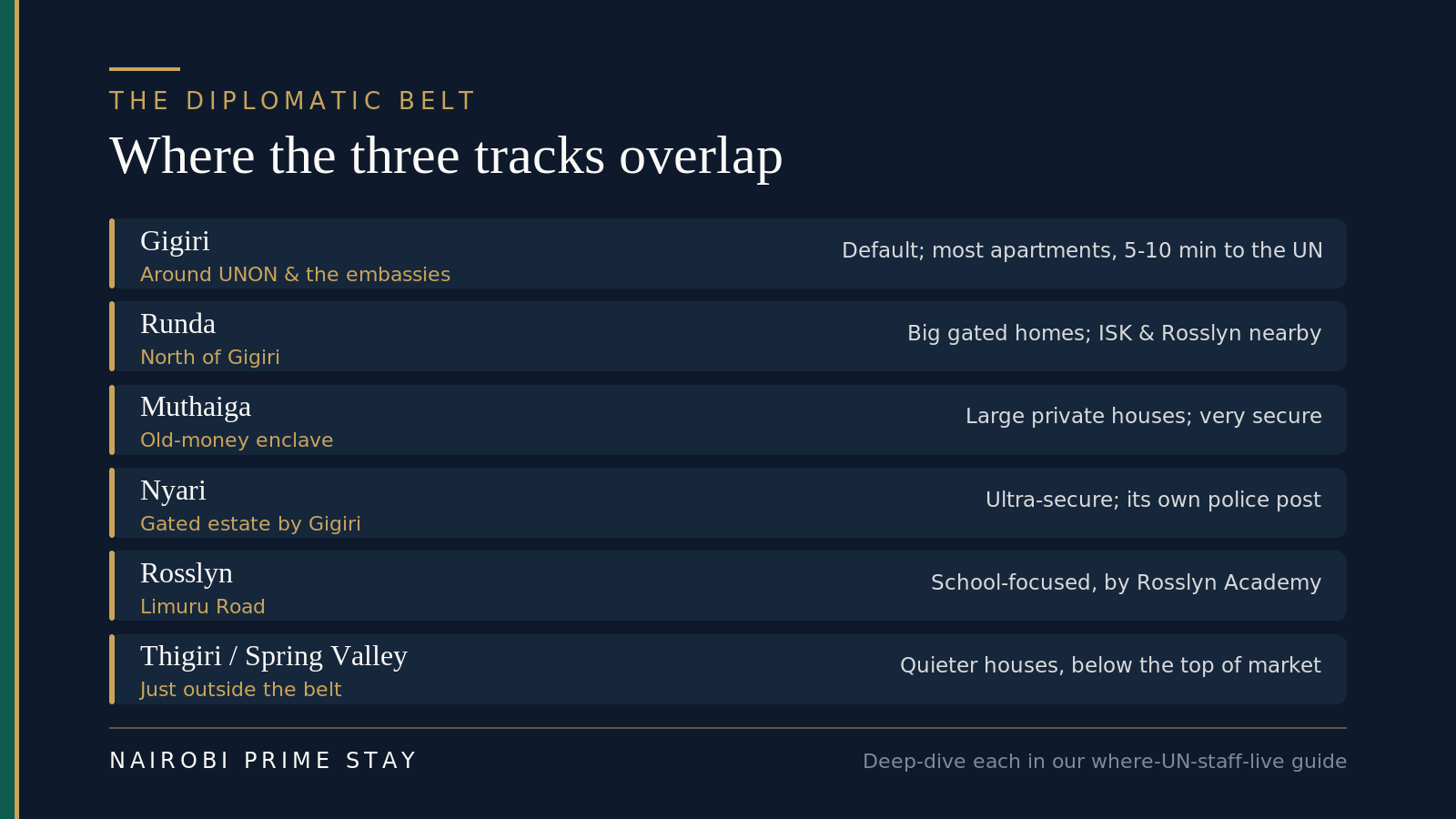 The diplomatic belt — where the three tracks overlap. Deep-dive each suburb in our where-UN-staff-live guide.
What does a home in the diplomatic belt cost in 2026?
Indicative furnished monthly rents, as of July 2026 (the shilling traded near KES 129.4 to the US dollar on 1 July 2026 — see our USD/KES currency guide):
| Suburb | Furnished rent/mo | Housing stock |
|---|---|---|
| Gigiri | $1,500–4,000+ | Apartments and houses |
| Rosslyn | $1,500–3,500 | Houses, some flats |
| Runda | $1,800–4,000+ | Big gated houses |
| Muthaiga | $1,800–4,000+ | Big private houses |
| Nyari | $2,000–4,000+ | Large villas |
Unfurnished homes and longer leases cost meaningfully less — our furnished vs unfurnished comparison walks through the maths. Two budgeting points matter more than the headline rent. First, the up-front cash: with a deposit of 1–3 months plus the first month, moving into a $2,500/month house can mean $5,000–10,000 before you get the keys — one more reason embassy-leased housing (where the mission signs) is such a quiet perk. Second, compliance costs: a home that needs grilles, extra lighting or an alarm link to pass security either gets those works negotiated into the lease or priced into your decision. In the belt, most purpose-built gated homes already meet the bar; it’s the charming older houses that need work.
These figures are indicative and move with demand and the exchange rate — confirm against current listings, and see the wider cost of living guide for what everything else costs.
Residential security: what makes a home “compliant”
This is the part that surprises people. For embassy and UN staff especially, a home isn’t just “safe enough” — it has to meet a defined standard, and a security officer signs off before you move in. Many genuinely nice houses don’t pass without modifications, so it’s worth knowing the bar before you fall in love with a place.
The standards differ on paper — US missions work to 12 FAH-6 and OBO evaluations; the UN works to RSM under UNDSS — but in practice they ask for the same kind of home. A compliant residence in Nairobi typically has a secure walled or fenced perimeter with a controlled gate, a 24/7 manned guard, exterior security lighting, grilles on accessible windows and solid reinforced doors with good locks, a safe haven (a securable internal room you can retreat to), and an alarm or panic button linked to a rapid-response company. The exact list scales to the assessed risk level, and your security office has the final word — so treat the points below as the shape of it, not a substitute for their checklist.
The good news: this overlaps almost exactly with the “Nairobi Five” every sensible renter checks anyway — backup generator, reliable water storage, 24/7 security, fibre internet, and responsive management. A guarded, gated building in the belt is usually built to this standard already. For the wider safety picture — areas, street sense, what’s actually risky — see our honest guide to whether Nairobi is safe.
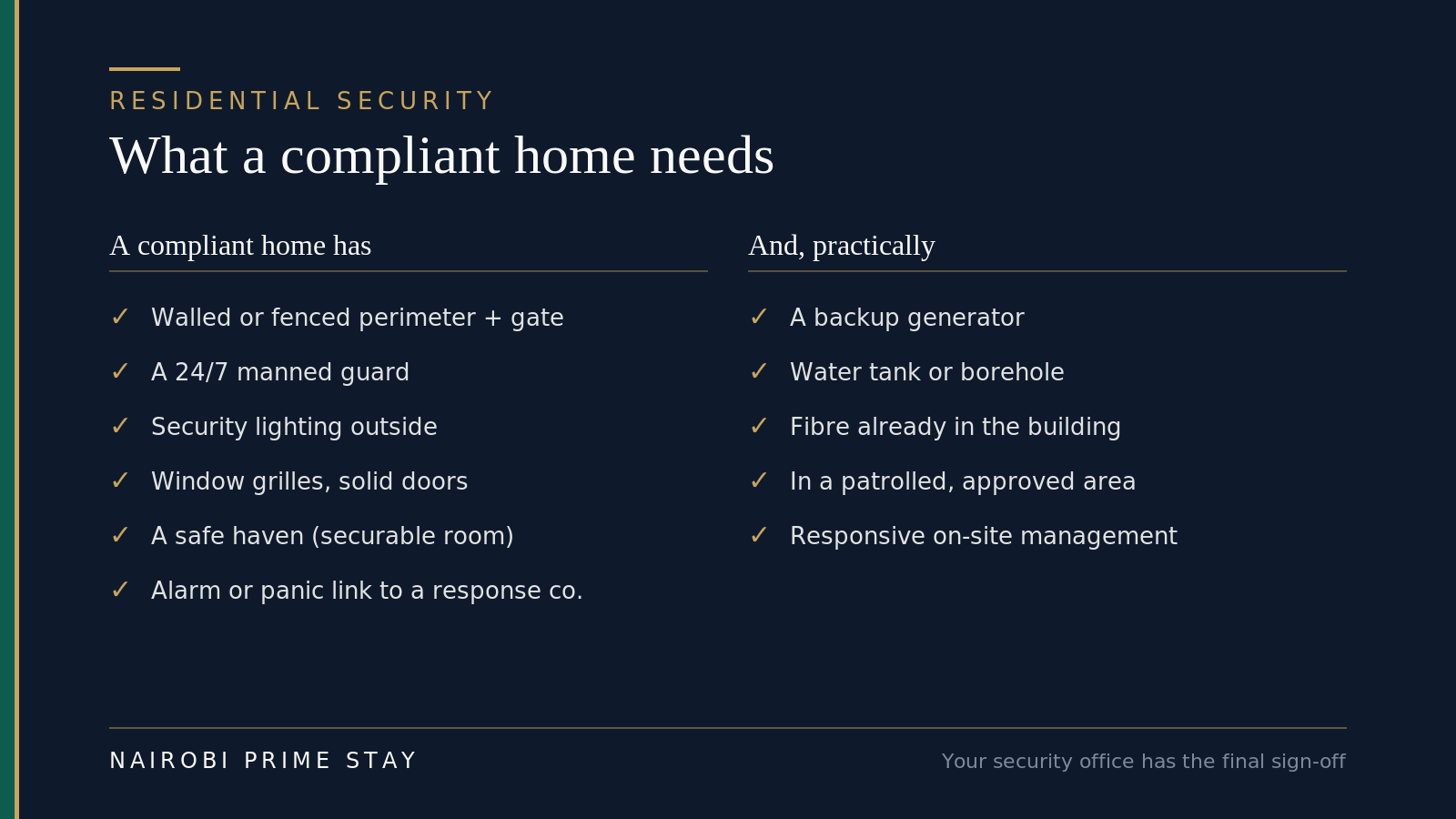 Compliance and the “Nairobi Five” mostly overlap — but your security office has the final sign-off.
Leases, allowances and what’s typically covered
Once a home is found and cleared, the paperwork looks like any prime Nairobi rental — with a few institutional twists.
The lease. Prime homes let furnished or unfurnished on a 12-month written lease, with a deposit of 1–3 months plus the first month up front. You’ll need a KRA PIN (Kenya’s tax ID) and your ID or permit to sign, and you should always get a written lease and a signed inventory. For the full mechanics — what to check, how deposits and notice work — see our guides to how to rent an apartment in Nairobi and the wider cost of living.
Who signs. For embassy-leased homes, the mission signs the lease and you’re housed in it. UN and most NGO staff usually sign personally (sometimes the organization co-signs or guarantees). That distinction matters: if your name is on the lease, the deposit, the inventory and the exit condition are your responsibility, not the organization’s.
What’s covered. This is where the three tracks diverge most. Government-leased embassy housing usually bundles rent, furniture and maintenance. UN staff may claim the rental subsidy for part of rent above a salary threshold. NGO staff typically get a flat housing allowance. Post differentials and cost-of-living adjustments exist for some employers but vary widely. We’re deliberately not quoting subsidy percentages or allowance figures here — they change, they’re employer-specific, and acting on a number you read on a blog is exactly how people get caught short. Confirm yours in writing with HR.
Tax. Housing allowances can be taxable depending on your status, and US citizens are taxed on worldwide income regardless of where they live. Spending 183+ days in a Kenyan tax year can also make you a Kenyan tax resident. None of this is tax advice — get cross-border guidance early, and treat the official sources as the authority.
Here’s how the three tracks compare on the points that matter most:
| What | Embassy / diplomatic | UN / UNON | NGO |
|---|---|---|---|
| Who finds the home | The mission (housing board) | You, on the open market | You — or the org, if large |
| Sorted before arrival? | Usually (board assigns ~60 days ahead) | Sometimes; often you arrive first | Varies by organization |
| Security standard | 12 FAH-6 / OBO evaluation | RSM (formerly MORSS), UNDSS | Org policy; often SLT-aligned |
| Furniture | Often a government pool | You (or rent furnished) | You (or rent furnished) |
| Who signs the lease | The mission | You (org may co-sign) | You |
| Help with rent | Government-leased home | Rental subsidy (conditions apply) | Housing allowance (varies) |
| Typical areas | Gigiri, Runda, Muthaiga | The Gigiri belt | Belt, or Lavington / Westlands |
Indicative, as of 2026. Confirm your own rules, caps and security standard with your HR or admin office — these vary by employer and change over time.
Serviced apartments: the standard soft landing
Here’s the practical reality almost every arrival hits: you land before your real home is ready. Maybe the housing board hasn’t finalised your assignment, maybe your lease is still in security clearance, maybe your shipped furniture is six weeks out, or maybe you’re on a short mission that doesn’t justify a year-long lease at all. A serviced apartment fills that gap.
It works well for this group for a specific reason. A serviced apartment in a secure, gated Gigiri building already sits broadly in line with residential-security expectations — it’s guarded, gated, has a backup generator and fibre, and comes fully equipped. It’s all-inclusive (Wi-Fi, cleaning, security and power), it’s flexible on monthly terms, and there’s no furniture to buy or utilities to set up. You get a safe, comfortable base while you do the real house-hunt properly: viewing homes in daylight, testing the commute, and only signing once your security office has approved the place.
It’s also clean for the organization. One all-inclusive monthly invoice, a simple booking rather than a 12-month commitment, and none of the deposit-and-setup overhead. If your stay is being arranged by an employer, our corporate housing and relocation guide covers the HR and billing side in detail.
The booking itself is light: we handpick from a vetted selection, a $50 deposit reserves your place and locks your dates, and the balance is paid on arrival — nothing more before you travel. You can browse serviced apartments in Gigiri, right next to the UN and the embassies, or read how the soft-landing approach works in full.
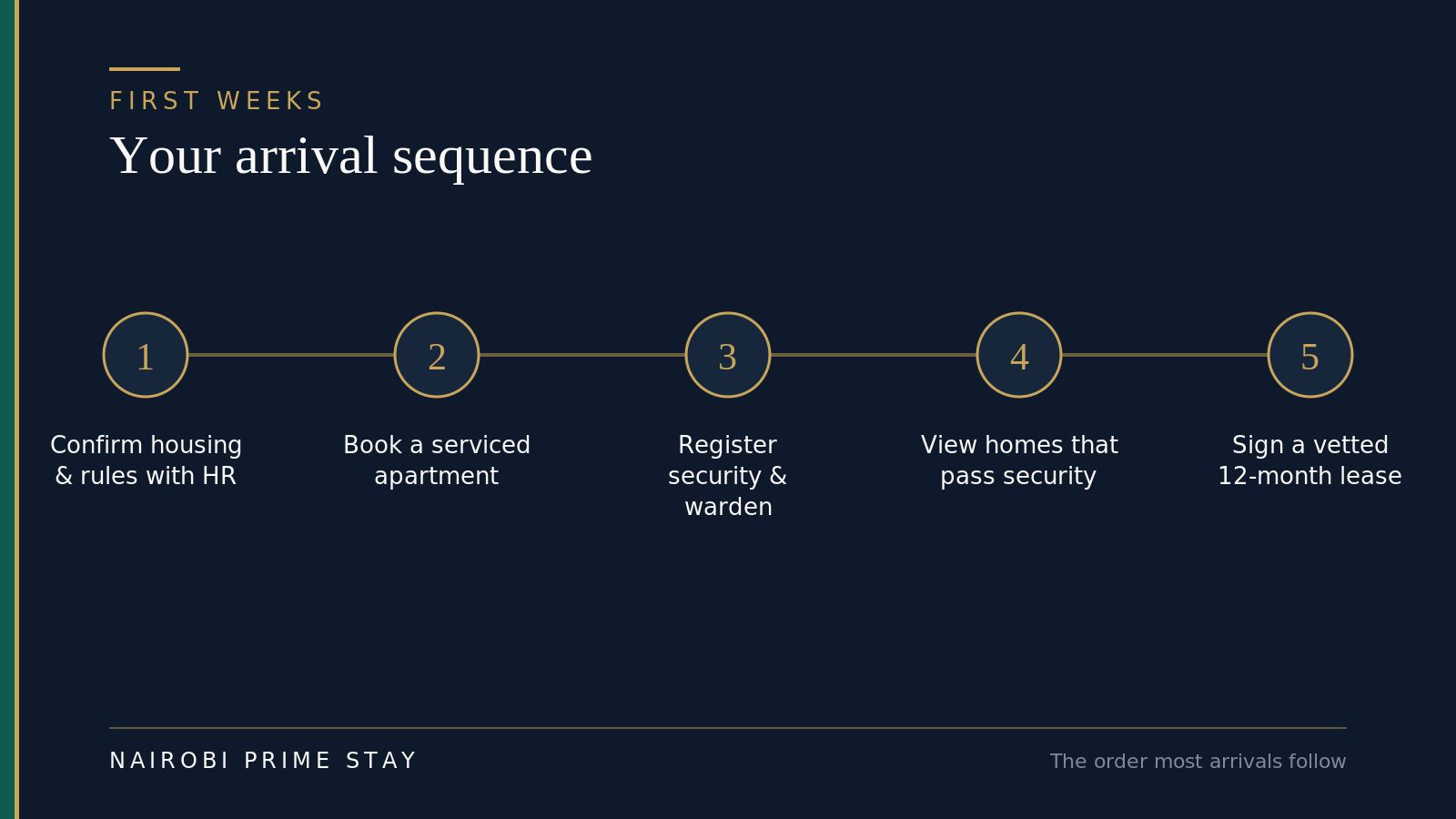 The arrival sequence most embassy, UN and NGO staff follow in their first weeks.
Schools: pairing your home with ISK and Rosslyn
If you’re moving with children, schools usually decide the suburb. The two anchors are the International School of Kenya (ISK) — American curriculum plus IB, in Gigiri — and Rosslyn Academy, an American-curriculum school in Runda. Both sit inside the diplomatic belt, which is exactly why UN and embassy families pair a Gigiri, Runda or Rosslyn home with a short school run.
The catch is timing: the best schools have waitlists, so enquire months ahead, gather transcripts and records early, and confirm current fees and places directly with the school. A serviced apartment in the belt is a sensible base while you finalise a place and a home together, rather than committing to a lease before you know where your child has a seat.
A realistic example
Say you’re a UN officer arriving in March with a partner and two school-age kids. Your shipment is on the water and won’t clear for six weeks. Here’s how it usually plays out.
Before you fly, you confirm the essentials with HR: you’ll find your own home, you may claim the rental subsidy above a salary threshold, and your residence must pass UNDSS residential security. You reserve a two-bedroom serviced apartment in Gigiri with a $50 deposit, dates locked, balance due on arrival. You land, settle the kids into a calm, all-inclusive base, and get the admin moving — security registration and warden enrolment, a KRA PIN, a SIM and M-Pesa.
Then you house-hunt properly. You view guarded townhouses near ISK in daylight, rule out two that won’t pass security without grille work, and find a third that already has a perimeter wall, a 24/7 guard and a safe room. Your security focal point signs off, you sign a 12-month lease with a written inventory, and you file the subsidy paperwork. By the time your furniture clears, you’re moving into a home you’ve actually seen, that your employer will reimburse, and that your security office has approved. The serviced apartment cost a known monthly figure and saved you from signing something unseen in your first jet-lagged week.
Can you arrange housing from the US before you fly?
Partly — and knowing which part saves you money and grief. What you can sort from abroad: your track and your rules (get the allowance, subsidy and security standard from HR in writing), your school applications, and your soft landing — a serviced apartment is bookable and verifiable from the US, ours with a $50 deposit and the balance on arrival. You can also browse listings to calibrate prices and shortlist areas.
What you should not do from abroad is sign a 12-month lease on a home you haven’t seen. It usually can’t pass security sign-off remotely anyway, and it exposes you to the classic Nairobi rental scam: a polished listing at a slightly-too-good rent, a “landlord” who is conveniently overseas, pressure to wire a deposit to hold the house, and payment requested to a personal M-Pesa number or foreign account. Real belt landlords work through agents, show houses in person, and take deposits against a written lease — usually into a company or lawyer’s account. Our property scams guide covers the red flags in detail, and our tenancy, leases and deposits guide explains what a proper Kenyan lease looks like before you sign one.
The sequence that works: confirm rules with HR → book the soft landing → arrive and register with security → view in daylight → security sign-off → sign a written lease with an inventory, following our step-by-step renting guide.
A practical arrival checklist
Work it in three phases.
Before you fly
- Confirm with HR/admin: do they arrange housing, or do you?
- Get your housing allowance or rental-subsidy rules — and the cap — in writing.
- Ask exactly what residential security standard your home must meet.
- Book a soft-landing serviced apartment for the first 4–8 weeks.
- If you have kids, start school applications — the good ones have waitlists.
Your first week
- Register with your security system and the warden network; get briefed.
- Apply for a KRA PIN; you’ll need it to sign any lease.
- Get a SIM and M-Pesa — it’s how daily life is paid for here.
- Start viewing homes, in daylight, that can realistically pass security.
Before you sign
- Get your security office’s sign-off on the specific property.
- Insist on a written lease and a signed inventory.
- Check the “Nairobi Five”: generator, water storage, 24/7 security, fibre, management.
- Confirm the deposit terms and exactly whose name is on the lease.
- File any subsidy or allowance paperwork promptly.
What trips people up
Three mistakes recur. The first is signing before security sign-off — the home you love may need grilles, a higher wall or a safe room before it’s approved, and undoing a lease is painful. The second is assuming an allowance figure instead of confirming it in writing, then renting above what’s actually reimbursed. The third is renting sight-unseen from abroad to “save time,” which is both a security risk and the most common way newcomers get scammed. A serviced apartment for the first weeks removes the pressure behind all three — you house-hunt calmly, on the ground, with your security office in the loop.
Frequently asked questions
What is RSM (or MORSS) housing in Nairobi?
RSM stands for Residential Security Measures — the UN’s residential security standard, which replaced the older MORSS (Minimum Operating Residential Security Standards). It means your home has to meet defined requirements, typically a walled perimeter and gate, a 24/7 guard, security lighting, window grilles, a safe haven and an alarm link. The exact measures scale to the assessed risk, and UNDSS signs off before you move in.
Does the UN provide housing in Nairobi?
Generally no — UN staff in Nairobi find their own home on the open market. The UN sets the security standard your residence must meet (RSM, formerly MORSS) and operates a rental subsidy that can reimburse part of your rent above a salary threshold. Confirm eligibility and caps with your HR office, because the rules vary by grade and change over time.
Who arranges housing for US embassy staff in Nairobi?
At a US mission, an Interagency Housing Board (IAHB) assigns leased homes to staff under chief-of-mission authority, matched to your rank and family size. Properties must meet US residential security standards (12 FAH-6), with the Bureau of Overseas Buildings Operations evaluating each one. The board aims to assign your home before you arrive, and the General Services Office handles the lease, furniture and maintenance.
Do NGOs provide housing in Nairobi?
It depends on the organization. Large international NGOs may arrange housing and follow UN-aligned security guidance, often through the Saving Lives Together framework. Smaller NGOs usually pay a housing allowance and let you find your own home against a security checklist. Ask your admin team three things: do they arrange housing, what is the allowance cap, and what security standard applies.
Where do embassy and UN staff live in Nairobi?
Overwhelmingly in the Gigiri diplomatic belt in north-west Nairobi — Gigiri, Runda, Muthaiga, Nyari and Rosslyn — all within roughly a 15-minute drive of the UN complex and the international schools, and among the most heavily secured suburbs in the city. Our guide to where UN and diplomatic staff live compares them suburb by suburb.
How much does a home in the diplomatic belt cost in 2026?
Indicative furnished monthly rents as of July 2026: Gigiri $1,500–4,000+, Rosslyn $1,500–3,500, Runda and Muthaiga $1,800–4,000+, and Nyari $2,000–4,000+ (the shilling traded near KES 129.4 to the US dollar on 1 July 2026). Unfurnished homes and longer leases cost less, and you should budget a deposit of 1–3 months plus the first month up front.
What is a residential security clearance, and will it limit my choices?
Yes, it narrows the field. Before embassy or UN staff can sign a lease, a security officer checks the property against the required standard — perimeter, guarding, lighting, grilles, a safe haven and an alarm link. Plenty of attractive homes don’t pass without modifications, so confirm the standard early and only shortlist homes that can realistically meet it.
Is there a UN rental subsidy in Nairobi?
The UN operates a rental subsidy scheme that can reimburse part of your rent when it exceeds a set share of your salary, for a limited period. Thresholds, caps and eligibility vary by grade and circumstances, so check the current rules with your HR or administrative office rather than relying on a fixed figure you read online.
Do UN Volunteers and consultants get housing help in Nairobi?
UN Volunteers receive a monthly living allowance intended to cover accommodation and find their own home, following the same UNDSS security guidance as staff. Consultants and individual contractors normally get no housing entitlement at all — the fee is meant to be all-inclusive — so most take a serviced apartment on monthly terms for a contract of a few months. Confirm your exact entitlements with your programme or hiring office.
Can I arrange a compliant home from the US before I arrive?
You can arrange the rules and the soft landing from abroad, but not usually the lease itself. Confirm your track and allowance with HR, book a serviced apartment for the first weeks, and browse listings to calibrate prices — then view in person and get security sign-off before signing. Never wire a deposit for a house you haven’t seen; upfront payment for an unseen home is the classic Nairobi rental scam.
Can I use a serviced apartment while I find a compliant home?
Yes — it’s the standard approach. A serviced apartment in a secure, gated Gigiri building is all-inclusive and already broadly aligned with residential-security expectations, so it’s a safe base for the 4–8 weeks while you view homes, get security sign-off and wait for your shipment. A $50 deposit reserves it, with the balance paid on arrival.
How long before arrival is housing usually sorted?
For embassy staff, missions aim to assign a home before you land — agencies typically give about 120 days’ notice and the housing board assigns roughly 60 days ahead. For UN and NGO staff who find their own home, it’s often after you arrive, which is why most people book a serviced apartment for the first weeks and house-hunt on the ground.
Final thoughts
Housing for embassy, UN and NGO staff in Nairobi isn’t complicated once you know which of the three tracks you’re on. Diplomats are housed by their mission; UN staff find their own home and clear it on security; NGO staff land somewhere on that spectrum. The two things that catch people out are the residential security standard — which quietly decides what you can rent — and the gap between when you arrive and when your real home is ready.
Sort both early. Confirm your rules in writing before you fly, only shortlist homes that can pass security, and give yourself a calm, secure base for the first few weeks rather than signing something unseen. Do that and the move is straightforward — you’ll be settled in the belt, near work and the schools, in good time.
Related reading
- Moving to Nairobi: the complete guide — the end-to-end overview for new arrivals.
- Where UN and diplomatic staff live in Nairobi — the diplomatic belt, suburb by suburb.
- Gigiri neighborhood guide and Runda neighborhood guide — the two core diplomatic suburbs.
- Is Nairobi safe? — an honest look at the security picture behind the compliance rules.
- Corporate housing and relocation packages — the HR and billing side of an organization-paid move.
- Serviced apartments in Nairobi — how the soft-landing approach works.
- International schools in Nairobi — ISK, Rosslyn and the rest, for families pairing a home with a school.
Land softly while your housing is arranged
When you arrive before your assigned home is ready — or before a lease clears security — a serviced apartment in the belt gives you a secure, all-inclusive base to house-hunt from. Browse serviced apartments in Gigiri, minutes from the UN and the embassies, or the full serviced-apartment catalogue across the belt — or tell our AI relocation assistant your organization, family size and dates and it’ll shortlist options in a couple of minutes. A $50 deposit reserves your place, with the balance paid on arrival — nothing more before you travel.
Ready to look?
Find your apartment in Nairobi
Browse verified serviced apartments, or ask the AI concierge which area fits your life.