
Guides · Serviced apartments
How to Rent an Apartment in Nairobi: A Step-by-Step Guide (2026)
How to Rent an Apartment in Nairobi: A Step-by-Step Guide (2026)
Renting in Nairobi is straightforward once you know the rhythm: pick your area, search online and through a good agent, view in person, check the building properly, then sign a 12-month lease and pay a deposit plus the first month up front. The whole thing can take a week or two if you’re organized.
This guide is for Americans renting their first place in Nairobi. We’ll walk through where to search, how agents and fees actually work, how to view safely, what to check before you sign, and the deposit and lease norms — plus the scams to sidestep and the one move that saves most newcomers a lot of stress: a serviced apartment for the first month while you look.
The short version is below. The rest of the guide fills in the detail you’ll want before you hand over any money.

TL;DR — the short version
Here’s renting in Nairobi in a nutshell, as of 2026:
- Where to search: the main portals are BuyRentKenya, Property24, Jiji and Kenya Property Centre, plus a reputable local agent and expat groups. Most people use two or three at once.
- Agents and fees: agents are normal and useful. Commission is typically half a month to one month’s rent, sometimes shared between landlord and tenant. Never pay a “viewing fee” to be shown a place — that’s a scam.
- Money up front: expect a deposit of 1–3 months’ rent plus the first month in advance, paid only after you’ve viewed the place and verified the landlord.
- The lease: usually a 12-month written agreement with an inventory. You’ll need a KRA PIN and your ID or permit to sign.
- What to check: the “Nairobi Five” — backup generator, water storage, 24/7 security, fibre internet, and responsive management.
- The smart move: book a serviced apartment for your first 4–8 weeks, view homes in person, then sign once you’re sure. Don’t rent a place you’ve never seen.
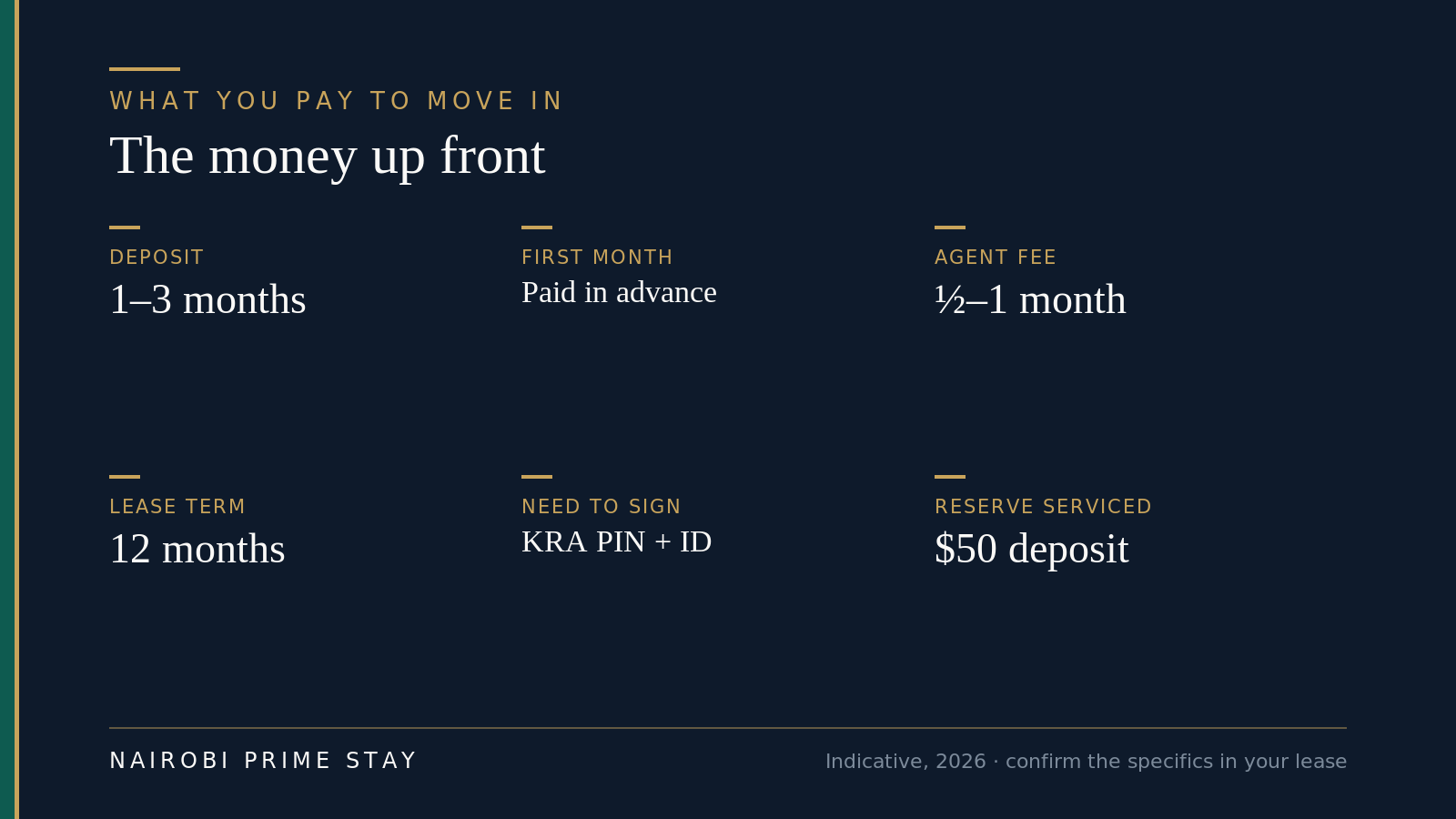 Indicative move-in costs for a Nairobi rental in 2026 — confirm the exact figures in your own lease.
Why renting in Nairobi works a little differently
Two things shape renting here, and both reward a little patience.
First, distances are short but traffic is not. Where you live relative to work and school matters more than almost anything else. A place that looks central can mean an hour in the car at rush hour. So choosing the right area comes before choosing the right apartment.
Second, you shouldn’t rent sight unseen. Listings can be out of date, over-edited, or — occasionally — entirely fake. The building next door might have a generator and fibre while yours doesn’t. The only way to know is to stand in the apartment, run the tap, and ask about the power. That’s why the people who settle best almost always spend their first month in a serviced apartment, viewing homes in daylight and learning the traffic before they commit to a year.
If you’re brand new to the city, read the complete guide to moving to Nairobi first for the big picture. This page is the practical how-to for the renting itself.
Step 1: Decide where to look before you look
Pick your area first. It narrows everything and saves you from falling for a beautiful apartment in the wrong place.
Nairobi’s expat life clusters in a handful of western and northern suburbs, each with its own feel. Gigiri, Runda and Muthaiga suit UN, embassy and NGO staff and families near the international schools. Karen and Lavington offer space, gardens and a family pace. Westlands and Kilimani are the busy, social, apartment-heavy areas that young professionals and remote workers tend to love. Kileleshwa and Riverside sit quietly in between. Our best neighborhoods in Nairobi guide breaks down each one, and the cost of living guide shows how rent fits the rest of your monthly budget.
A simple way to choose: start from your anchor point — the office, the UN, the school — and work outward. Then weigh that against the vibe you want and what you can spend. Furnished apartment rents in the prime areas run roughly $500–4,000+ a month depending on the suburb, size and finish, so your budget will quickly shorten the list.
Step 2: Where to actually search
Use more than one channel. No single source has everything, and cross-checking is how you spot a listing that’s too good to be true.
Online portals. These give you the widest view and a feel for prices fast:
- BuyRentKenya — large, agent-driven, well-organized by area and budget.
- Property24 — the Kenyan arm of a big regional portal; lots of apartments and houses to rent.
- Jiji — a huge general marketplace with many rentals; more mixed, so verify carefully.
- Kenya Property Centre — another solid listings site worth a scan.
Treat photos as a starting point, not gospel. Filter by your area and budget, shortlist a handful, and line up viewings for the same day so you can compare back to back.
A local agent. A good agent is genuinely useful — they know which buildings have generators and fibre, they arrange viewings, and they handle the lease paperwork. Many of the best apartments never get a public listing; an agent hears about them first. The trade-off is the fee and the need to pick someone reputable (more on both below).
A serviced apartment. This is the soft-landing route: you book a fully furnished, all-inclusive place for the first month or two, then search at your own pace from a secure base. It costs more per night than a bare 12-month lease, but it buys you time, safety and zero setup. We cover it in full in the serviced apartments guide.
Word of mouth and expat groups. Facebook groups like “Expats in Nairobi,” company relocation contacts, and colleagues already in the city are gold for trusted leads and honest warnings. The pool is smaller, but the signal is high.
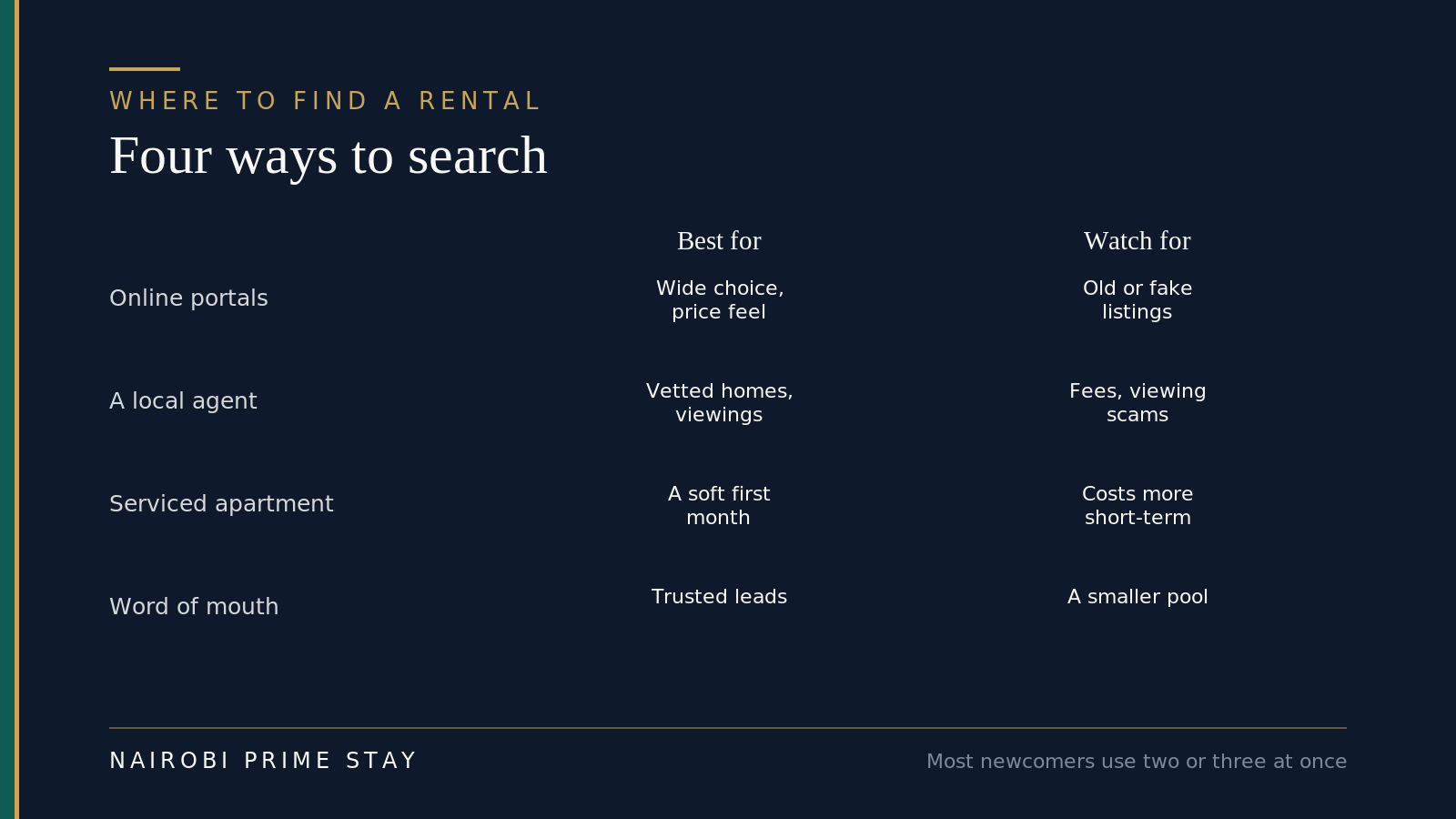 Most newcomers use two or three of these at once — portals to scan the market, an agent to view, and a serviced apartment to land softly.
Working with agents — and the fees nobody explains
Agents are normal in Nairobi, and a good one earns their fee. But the fee structure is worth understanding so nothing surprises you.
For rentals, agent commission is typically half a month to one month’s rent, covering viewings, negotiation and preparing the tenancy agreement. In some deals it’s shared between the landlord and the tenant rather than falling entirely on you, so ask early and get it in writing. There’s no single fixed rate, so confirm the number before you start viewing with someone.
Here’s the honest catch. A minority of “agents” and brokers charge a viewing fee — a small upfront payment, often a few hundred shillings to a couple of thousand, just to be shown a property. Sometimes the apartment is already let, or doesn’t match the photos, or doesn’t exist. This is a well-known hustle in Nairobi. A legitimate agent earns commission when you actually sign a lease; they don’t charge you to open a door. If someone asks for money before a viewing, walk away.
To find a good agent: ask your serviced-apartment host, your employer’s HR or relocation contact, or expat groups for a name; check they’re tied to a real, reviewable agency; and judge them on whether they listen to your brief rather than pushing whatever pays them most.
Step 3: View in person — and view safely
See the apartment before you pay anything. This is the single most important rule.
Line up several viewings in a day and go in daylight, when you can see the light, the water pressure and the state of the building honestly. Bring a friend, your partner or your agent — never go alone to an unfamiliar address, and use Uber or Bolt rather than meeting a stranger off a quiet street. Nairobi is manageable with normal big-city sense; our honest safety guide has the full picture, but the short version is to keep valuables out of sight and trust your gut.
While you’re there, actually test things. Turn on taps. Ask when the power last went out and whether the generator kicks in automatically. Check phone signal inside. Look at the road in and the security at the gate. Talk to a guard or a current resident if you can — two minutes of honest local chat tells you more than any brochure.
The “Nairobi Five” — what to check in any building
Before you fall for a kitchen, check five things. Locals call them the essentials, and they separate a comfortable home from a daily headache:
- Backup generator. Power cuts happen. A building with an automatic generator keeps your lights, Wi-Fi and water pump running. Without one, you’re in the dark and offline at the worst moments.
- Water supply and storage. Look for tanks or a borehole. City water isn’t always constant, and good storage means you never open a dry tap.
- 24/7 security. Guards, a controlled gate and cameras. Most expats live in gated compounds for exactly this reason.
- Fibre internet already in the building. If a provider like Safaricom, Zuku or Faiba already serves the block, you’re online in days. If not, installation can drag. Essential if you work from home — our internet and remote work guide compares the providers.
- Responsive management. Who fixes a leak, and how fast? A present, organized caretaker or management company is worth a lot over a year.
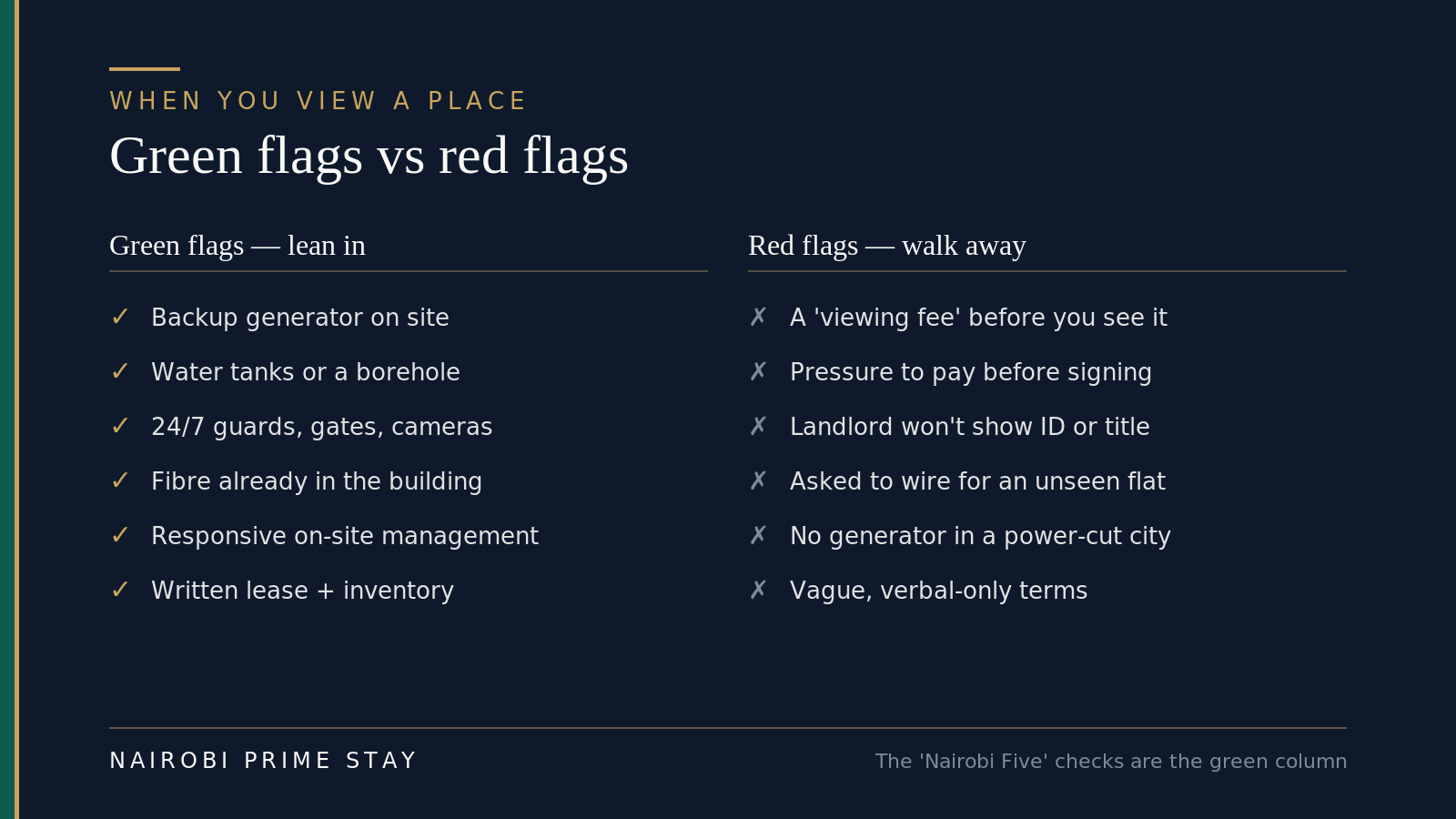 The green column is the “Nairobi Five” plus a written lease. The red column is your cue to keep looking.
Step 4: The money — deposit, rent in advance and what’s normal
Once you’ve found the place, here’s what changes hands. None of it should happen before you’ve viewed the apartment and confirmed who you’re paying.
You’ll usually pay a security deposit of one to three months’ rent, plus the first month’s rent in advance. The deposit is held against damage or unpaid rent and is returnable at the end of the tenancy if you leave the place in good order. Rent after that is normally paid monthly, in advance. A few landlords ask for several months up front, but that’s the exception, not the rule — and you’re entitled to push back on anything that feels unusual.
To sign, you’ll generally need a KRA PIN (Kenya’s tax ID) and your passport plus your permit or ID. The KRA PIN is quick to get online once you hold a permit, and you’ll want it early anyway — it’s needed for a bank account, utilities and a car too. Payment is usually by bank transfer or M-Pesa, Kenya’s mobile money that runs daily life here. Always get a written, signed receipt for every shilling, and keep it.
A quick orientation on the numbers. The exchange rate sits around USD/KES 129.4 as of July 1, 2026 (it floats — check the Central Bank of Kenya or Wise for the live rate, and see our dollar-to-shilling guide for how to think in both currencies). Here’s a rough picture of what it costs to move in, using a $1,000-a-month furnished apartment as the example:
| Move-in cost | Typical amount | On a $1,000/mo place |
|---|---|---|
| Security deposit | 1–3 months’ rent | $1,000–3,000 |
| First month’s rent | 1 month, in advance | $1,000 |
| Agent commission (if used) | ½–1 month, sometimes shared | $500–1,000 |
| Up-front total | roughly 2.5–5 months | ~$2,500–5,000 |
Treat these as indicative for 2026 — the exact split depends on the landlord, the area and whether you use an agent. Budget toward the higher end so nothing catches you short.
What your rent doesn’t cover: the service charge and the other bills
The quoted rent is rarely the whole monthly number. In managed apartment blocks there’s often a service charge on top — the building’s shared bill for security, common-area cleaning, lifts, generator fuel and water storage. As of 2026 it commonly runs about KES 3,000–15,000 a month, and it can reach KES 25,000 in high-end Kilimani or Westlands towers with gyms and pools. Sometimes it’s baked into the quoted rent; sometimes it lands on top. “Is that inclusive of service charge?” is the single most useful question when you’re comparing listings — ask it early, and make sure the lease says who pays.
Then come your own bills. Electricity in most buildings is prepaid: you buy Kenya Power tokens by M-Pesa and load them into your meter, so you see exactly what you’re using. Water and garbage are usually billed through the building at a modest flat rate. Fibre internet runs roughly KES 4,000–6,000 a month for a fast home connection. Our utilities setup guide walks through getting all of it running in your first week.
 The rent is the headline, not the total. Ask whether the service charge is included before you shortlist.
Can you negotiate the rent?
Yes — politely, and with a reason attached. Negotiation is normal in Nairobi, asking prices often have some room in them, and a courteous offer rarely causes offence.
Here’s where the room usually is. A unit that’s sat empty for a month or two costs the landlord money every week, so a fair offer gets heard. A longer lease — two years instead of one, or simply a firm 12 months from a reliable tenant — is commonly worth 5–15% off, because turnover is expensive. Paying a few months up front can earn a similar discount. And move-in condition is quietly negotiable too: “we’ll take it at the asking price if you repaint and fix the water heater first” often works better than pushing the number down. Two more asks worth making: splitting the agent’s fee with the landlord, and — since Kenya has no rent control at the prime end of the market — a cap on renewal increases written into the lease.
Where there’s little room: a freshly listed, fairly priced furnished apartment in Gigiri or Westlands during the July–September arrival season will often have a queue behind you, and a long negotiation can lose you the place. The honest play is to find out what comparable units in the same building actually rent for — your agent or a current resident will know — and negotiate from facts. If the “Nairobi Five” all check out and the price matches the neighbors’, take the win.
 Negotiate politely, with a reason, from comparable rents in the same building — and know when to take the win.
Step 5: The lease — what a fair tenancy agreement includes
Get everything in writing. A handshake is not a lease, and a written agreement protects you far more than it protects the landlord.
Most prime rentals run on a 12-month written tenancy agreement. A fair one spells out the rent and when it’s due, the deposit amount and the conditions for getting it back, the notice period for either side (often one to two months), who is responsible for repairs, and who pays the service charge, security and water. Insist on a signed inventory that lists the condition and contents of the place on the day you move in — photograph everything yourself too. That inventory is what protects your deposit when you leave.
A few sensible asks: confirm the rent is fixed for the lease term or capped on renewal; clarify whether utilities are separate or included; and make sure the person signing actually owns or manages the property — ask to see ID and, for a house, proof of title. Our guide to leases, deposits and tenant rights in Kenya goes deeper on your rights and how to get your deposit back. This article is general information, not legal advice; for a high-value or complicated lease, have a local lawyer glance over it before you sign.
Furnished or unfurnished?
Decide this early, because it changes your shortlist and your budget.
Furnished places cost more per month but you move in with nothing but a suitcase — ideal for stays under a couple of years, remote workers, and anyone who doesn’t want to buy a fridge in week one. Unfurnished is cheaper monthly and suits longer stays, but you’ll spend time and money kitting it out, and Kenyan “unfurnished” often means truly bare, sometimes without light fittings or kitchen appliances. A serviced apartment is the all-inclusive extreme — furniture, Wi-Fi, cleaning, generator and security bundled into one monthly price. We compare the trade-offs in detail in furnished vs unfurnished apartments in Nairobi.
Scams to avoid
Most landlords and agents are honest. A few aren’t, and newcomers are the easiest targets. These are the ones to know:
- Viewing fees. As above — paying to be shown a property is a red flag. Real agents earn commission on a signed lease, not on opening a door.
- Sight-unseen deposits. A “landlord” abroad asks you to wire a deposit to “hold” a place you can’t view, often with a sympathetic story. Never send money for a home you or someone you trust hasn’t physically seen.
- Fake or duplicated listings. The same gorgeous photos appear under different agents at suspiciously low rents. Reverse-image-search the photos if a price looks too good, and verify the address exists.
- The double-let. A fake agent “rents” you a place they don’t control, takes the deposit and disappears. Verify ownership or management before paying, and pay traceably — bank transfer or M-Pesa with a receipt, never untraceable cash.
- Pressure and urgency. “Three other people want it, pay now to secure it.” Real deals survive a day’s due diligence. Pressure is the scammer’s main tool.
The throughline: view first, verify who you’re paying, pay traceably, and never let urgency rush you. Do that and you sidestep almost every rental scam in the city. For the full con list — including the buying side — see our guide to property scams in Kenya.
What you can do from the US before you fly
More than you’d think — as long as no money for a long-term apartment changes hands before you’ve stood in it.
From your sofa in the US you can pick two or three target areas with the neighborhoods guide, join the expat Facebook groups and read a few months of honest chatter, scan BuyRentKenya and Property24 until the prices stop surprising you, and ask your employer or the groups for an agent recommendation so someone credible is expecting you. You can also book your serviced apartment — a $50 deposit locks the dates — and gather the paperwork you’ll need to sign later: passport, permit or pass, and the details for your KRA PIN application.
What waits for arrival is everything involving money and signatures: viewing in person, verifying the landlord, getting the KRA PIN, paying the deposit traceably, and signing the lease with its inventory. The scams that catch newcomers almost all start with a wire transfer for an apartment nobody has seen. Research travels well; money doesn’t.
 The prep travels; the payments don’t. Do the research from home and keep your money until you’ve stood in the apartment.
The soft-landing sequence — how the smart movers do it
The people who settle most happily rarely sign a lease in their first week. They follow a sequence that keeps them safe and unrushed.
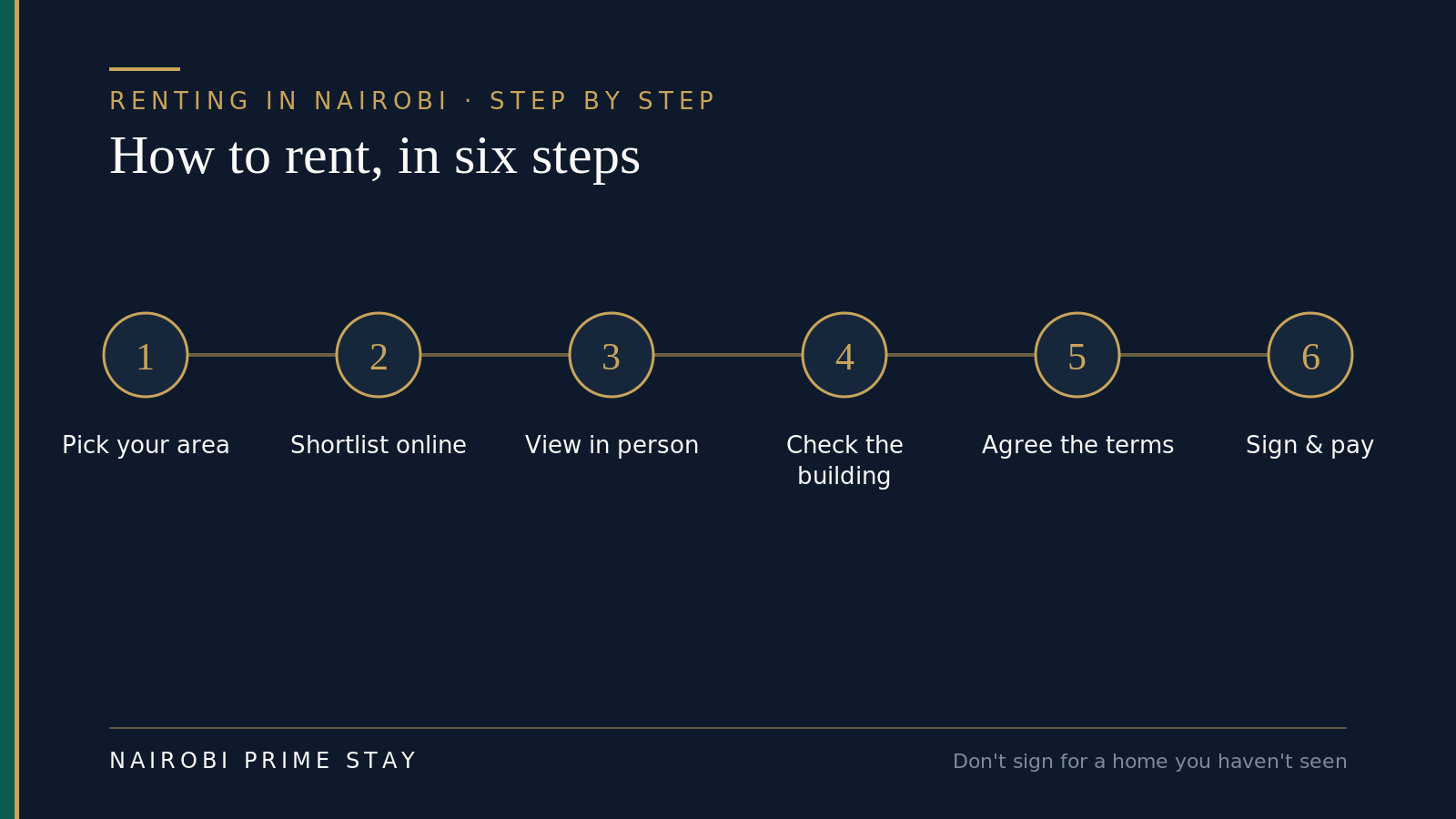 The calm way to do it — and the soft-landing version puts a serviced apartment at the start, before step three.
Here’s the playbook in practice. Book a serviced apartment for your first 4–8 weeks — fully furnished and all-inclusive, with Wi-Fi, cleaning, a generator and security already sorted. From that secure base, you scout neighborhoods at your own pace, view long-term apartments in daylight, test the commute to your office or school, and learn which buildings actually deliver on the “Nairobi Five.” Then you sign a 12-month lease on a place you’ve stood inside, with a landlord you’ve met. You move once, into the right home, instead of twice into a rushed one.
With us, a serviced apartment is handpicked from a vetted selection, a $50 deposit reserves it and locks your dates, and you pay the balance on arrival — nothing more before you travel. It’s the lowest-stress way to begin.
A realistic example
Say you’re a remote-working couple from Denver, arriving in August, no kids, working US hours. You want a modern one-bed with reliable internet, somewhere social, on a budget of about $900 a month.
You book a serviced apartment in Westlands for six weeks and land on a Saturday. Week one, you settle in, get M-Pesa and a SIM at the airport, and apply for your KRA PIN. Weeks two and three, you shortlist eight apartments across Westlands and Kilimani on BuyRentKenya and through an agent a colleague recommended, and you view them in batches on two afternoons. Two look nothing like their photos; one has no generator; one is perfect but at the top of your budget. You test the commute and realize the Kilimani option means a shorter trip to your coworking space.
You choose a Kilimani one-bed with fibre and a generator at $850. The deposit is two months, plus the first month in advance, and the agent’s fee is half a month, shared with the landlord. You sign a 12-month lease with a photographed inventory, pay by M-Pesa with receipts, and move in at the end of week five — calm, sure, and settled. That’s the whole game.
How to rent in Nairobi — your checklist
Work through this in order and you’ll cover everything that matters:
- Choose your area first — anchored to your office, the UN, or your kids’ school. See the best neighborhoods guide.
- Set a realistic budget, including deposit, first month and any agent fee. Cross-check with the cost of living guide.
- Book a serviced apartment for your first 4–8 weeks as a soft landing.
- Search two or three channels — portals, a recommended agent, expat groups.
- Line up viewings in daylight, in batches, and never go alone to a strange address.
- Check the “Nairobi Five” — generator, water, security, fibre, management.
- Verify the landlord or agent owns or manages the property before paying anything.
- Refuse viewing fees and any request to wire money for an unseen place.
- Get your KRA PIN and have your passport and permit ready to sign.
- Read the lease and inventory carefully; photograph the apartment’s condition on day one.
- Pay traceably — bank transfer or M-Pesa — and keep a signed receipt for everything.
- Move once, into a home you’ve seen, with terms you understand.
Frequently asked questions
How much deposit do you pay to rent an apartment in Nairobi?
Expect a security deposit of one to three months’ rent, plus the first month’s rent paid in advance. The deposit is held against damage or unpaid rent and is returnable at the end of the tenancy if you leave the place in good condition. Pay it only after you’ve viewed the apartment and confirmed who the landlord is, and always get a signed receipt.
Do you need an agent to rent an apartment in Nairobi?
No, but a good agent helps. Many of the best apartments are never publicly listed, and an agent arranges viewings and handles the lease paperwork. Commission is usually half a month to one month’s rent, sometimes shared between the landlord and tenant — agree the fee in writing before you start. You can also rent directly through portals like BuyRentKenya, Property24 and Jiji, or through expat groups.
Should I pay a viewing fee to see an apartment in Nairobi?
No. Paying a fee just to be shown a property is a common scam. Legitimate agents earn their commission when you actually sign a lease, not for opening a door. If someone asks for money before a viewing, walk away and find another agent.
Can you rent an apartment in Nairobi from abroad without seeing it?
You can, but you shouldn’t. Listings can be out of date or fake, and wiring a deposit for a place you’ve never seen is the most common way newcomers get scammed. The safer path is to book a serviced apartment for your first few weeks, then view long-term homes in person before signing. If you must act before arriving, have someone you trust view the place for you.
Can you negotiate rent in Nairobi?
Yes, politely and within reason. Asking prices often have some room, especially if a unit has sat empty for a month or two. Offering a longer lease or a few months’ rent up front commonly earns 5–15% off, and you can also negotiate repairs or repainting before move-in, or a cap on renewal increases. Freshly listed furnished apartments in high-demand areas move fast, so there’s less room there — check comparable rents in the same building first and negotiate from facts.
What is a service charge, and is it included in the rent?
In managed apartment blocks, a monthly service charge covers security, common-area cleaning, lifts, generator fuel and water storage. As of 2026 it commonly runs about KES 3,000–15,000 a month, and can reach around KES 25,000 in high-end Kilimani or Westlands buildings. Sometimes it’s inside the quoted rent and sometimes it’s on top, so ask before you shortlist and make sure the lease states who pays it.
What documents do you need to rent an apartment in Nairobi?
You’ll generally need a KRA PIN (Kenya’s tax ID), your passport, and your permit or ID. The KRA PIN is quick to get online once you hold a permit, and you’ll need it for a bank account and utilities anyway. You’ll also sign a written tenancy agreement and an inventory of the apartment’s condition.
How long are apartment leases in Nairobi?
Most prime rentals run on a 12-month written tenancy agreement. The lease should state the rent, the deposit and how to get it back, the notice period (often one to two months), and who pays the service charge, security and water. Shorter and more flexible stays are usually handled through serviced apartments rather than standard leases.
How much does it cost to rent an apartment in Nairobi?
Furnished apartments in the prime expat areas run roughly $500–4,000+ a month as of 2026, depending on the suburb, size and finish. Kilimani and Westlands are at the more affordable end; Gigiri, Runda and Muthaiga are at the top. Unfurnished and longer leases cost less. Rents float with the market and the USD/KES rate (around 129.4 as of July 1, 2026), so treat any figure as indicative.
What can I do from the US before I arrive in Nairobi?
Plenty: choose two or three target areas, join the expat groups, scan the portals so you know real prices, line up a recommended agent, book a serviced apartment for your first month, and gather your documents. What shouldn’t happen from the US is money — never wire a deposit for a long-term apartment you haven’t seen. Viewing, verifying the landlord, paying and signing all wait for arrival.
Is it better to rent furnished or unfurnished in Nairobi?
It depends on how long you’re staying. Furnished costs more per month but lets you move in immediately, which suits stays under a couple of years and remote workers. Unfurnished is cheaper monthly but you’ll spend time and money kitting it out, and Kenyan unfurnished places are often truly bare. A serviced apartment bundles furniture, Wi-Fi, cleaning, a generator and security into one all-inclusive price — the easiest option for your first weeks.
Final thoughts
Renting in Nairobi rewards patience, not speed. Choose your area, search a few channels, view in daylight, check the “Nairobi Five,” verify who you’re paying, and sign a written lease with an inventory. Refuse viewing fees and never wire money for a place you haven’t seen. Do those things and you’ll land somewhere you’re happy to call home for a year — without the rookie mistakes that cost newcomers their deposit or their peace of mind.
The one habit worth keeping above all: don’t sign for a home you’ve never stood inside. A first month in a serviced apartment buys you the time to get it right, and right beats fast every time.
Related reading
- Moving to Nairobi: the complete guide — the big picture, start here.
- Serviced apartments in Nairobi — your soft-landing first month.
- Furnished vs unfurnished apartments in Nairobi — which to choose, and what each costs.
- Leases, deposits and tenant rights in Kenya — your rights and getting your deposit back.
- Best neighborhoods in Nairobi for expats — pick the right area first.
- Cost of living in Nairobi — how rent fits the rest of your budget.
- Is Nairobi safe? — an honest take, including viewing safely.
- Property scams in Kenya — the full con list and how to sidestep it.
- Setting up utilities in Nairobi — power tokens, water and Wi-Fi in week one.
Ready to land softly?
When you’re ready to look, the calmest way to start is from a secure base. Browse our serviced apartments in Nairobi — handpicked, all-inclusive, with honest monthly pricing — and use the first month to view long-term homes at your own pace. A $50 deposit reserves your place and locks your dates; you pay the balance on arrival.
Not sure which area fits your commute and budget? Our AI relocation assistant can shortlist apartments and answer your renting questions in a couple of minutes, any time of day.
Ready to look?
Find your apartment in Nairobi
Browse verified serviced apartments, or ask the AI concierge which area fits your life.