
Guides · Safety
Is Nairobi Safe? An Honest Guide for Expats and Americans (2026)
Is Nairobi Safe? An Honest Guide for Expats and Americans

Yes — Nairobi is safe to live in with normal big-city precautions, and thousands of American and international families do so happily. The honest caveat is that the main risk is opportunistic petty crime, not personal danger, and a little street sense plus a secure home handles most of it. Treat Nairobi the way you’d treat any large city you didn’t grow up in, and you’ll be fine.
This guide gives you the balanced picture: what the real risks are and aren’t, what the official travel advisory actually says, which neighborhoods are safest, the daily habits that matter, and how to set up a home and routine that let you stop thinking about security and start enjoying the city. It’s written for someone weighing a move who wants the truth, not a brochure.
The quick version
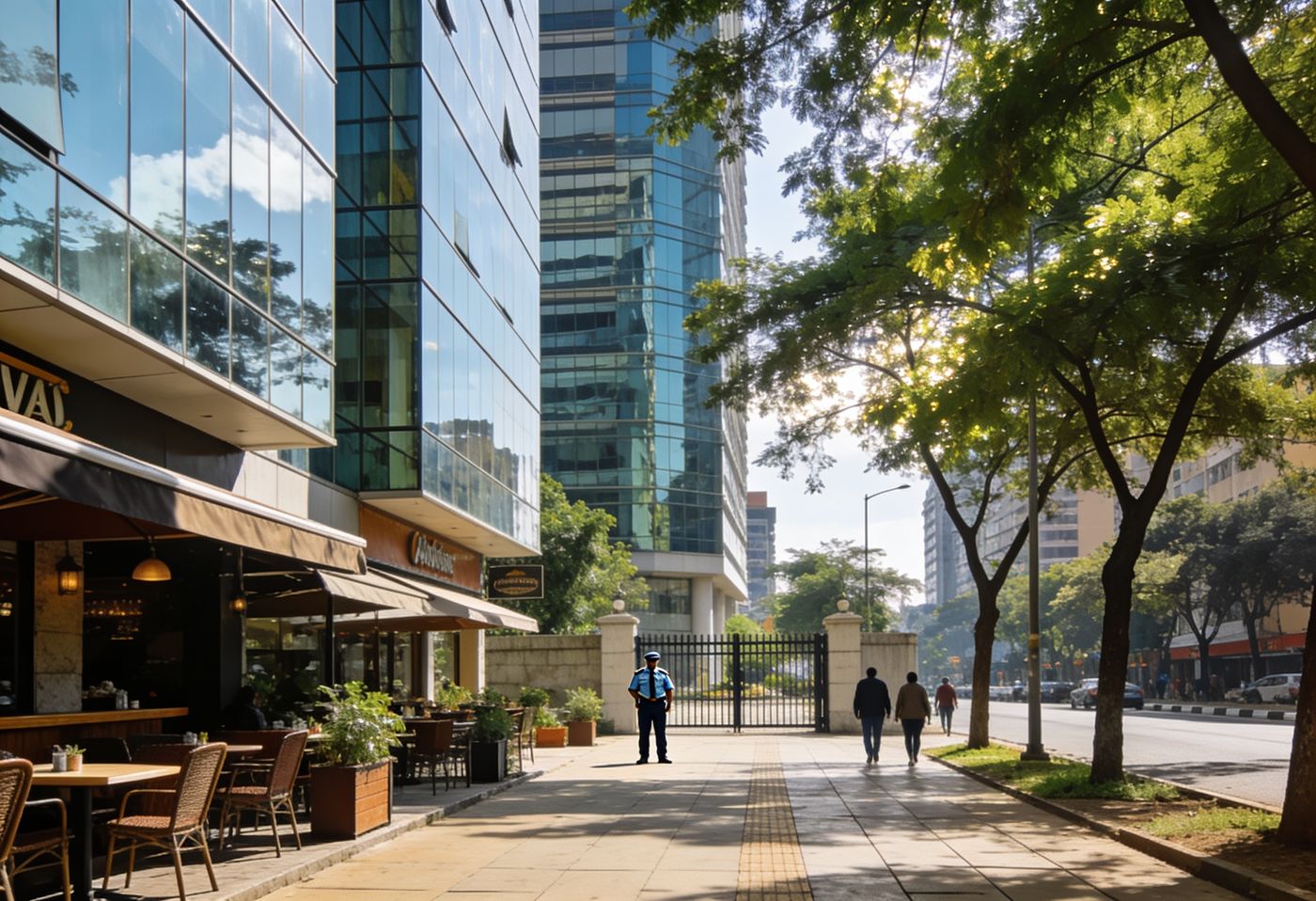
Most expats live in gated communities with 24/7 guards in well-patrolled western suburbs like Gigiri, Runda, Karen and Lavington, and rarely have a problem. The crime you actually need to plan for is opportunistic: phone snatching in traffic, the occasional break-in, bag theft in crowds. Violent crime against residents is uncommon, especially in the prime areas. The fixes are simple — choose a secure home, use Uber or Bolt after dark, keep valuables out of sight, and trust local advice on where and when to go. Do that, and Nairobi feels comfortable quickly.
Is Nairobi safe? The honest answer
Nairobi is a big African capital of several million people, with the same broad pattern as most large cities: comfortable, secure neighborhoods alongside areas you simply won’t have reason to visit. Expat life concentrates in the green, gated western suburbs, which are calm and heavily secured. The risk profile there is low, and the lifestyle is relaxed.
What changes the picture from a US city is mostly the texture of daily security, not the danger level. You’ll see guards, gates and cameras everywhere, and that infrastructure does a lot of quiet work. The trade-off is that you adopt a few habits — locking car doors in traffic, not flashing a phone on the street — that quickly become second nature. None of it should put you off. It’s the normal rhythm of the city, and residents barely notice it after a month.
What the real risks are — and what they aren’t
The most common issues are property crimes of opportunity:
- Phone and bag snatching, especially when you’re distracted on a street or stopped in traffic with a window down.
- Smash-and-grab from cars in slow traffic — which is why locals keep doors locked, windows up and bags out of sight.
- Burglary, which a home with guards, gates and an alarm largely designs out.
- Scams, especially rental scams targeting newcomers and the occasional ATM or card trick.
What’s far less common for residents in the prime suburbs is random violent crime. There’s a low background risk of terrorism too, as in many global cities — worth keeping in proportion rather than dwelling on, and we put it in context with the official advisories just below. The practical takeaway: plan for petty theft, and let good habits and a secure home handle the rest.
What the travel advisories actually say
The US State Department rates Kenya Level 2: Exercise Increased Caution — the same level it assigns much of Western Europe as of 2026. The cited reasons are crime, terrorism, civil unrest and kidnapping. Read past the headline, though, because the detail is what matters, and it’s reassuring for anyone moving to the western suburbs.
The State Department’s Level 4 “Do Not Travel” zones inside Kenya are all far from Nairobi: the northeastern counties bordering Somalia (Mandera, Wajir, Garissa), Lamu and the coast north of Malindi, and remote border areas of Marsabit and Turkana. These are hundreds of miles from the city — nowhere an expat would live or pass through. Within Nairobi itself, the advisory singles out just two neighborhoods, Eastleigh and Kibera, for higher crime. Neither is somewhere expats live, work or have reason to visit, and the prime suburbs aren’t flagged at all.
The honest reading: Level 2 means “be a switched-on adult,” not “don’t come.” It’s the standard advice for most of the world. Pair it with two free steps — enrol in the State Department’s STEP program (step.state.gov) for real-time alerts, and follow the US Embassy in Nairobi’s notices — and you’ll hear about anything that matters before it reaches you. Advisory levels do change, so check travel.state.gov for the current wording before you travel.
Terrorism sits in that advisory for a reason, but keep it in proportion. Serious incidents are rare and years apart, and the visible response is everywhere: malls, hotels and office buildings run bag checks and vehicle searches as routine. Stay aware in crowded public venues, follow advisories, and otherwise let it fade into the background the way residents do.
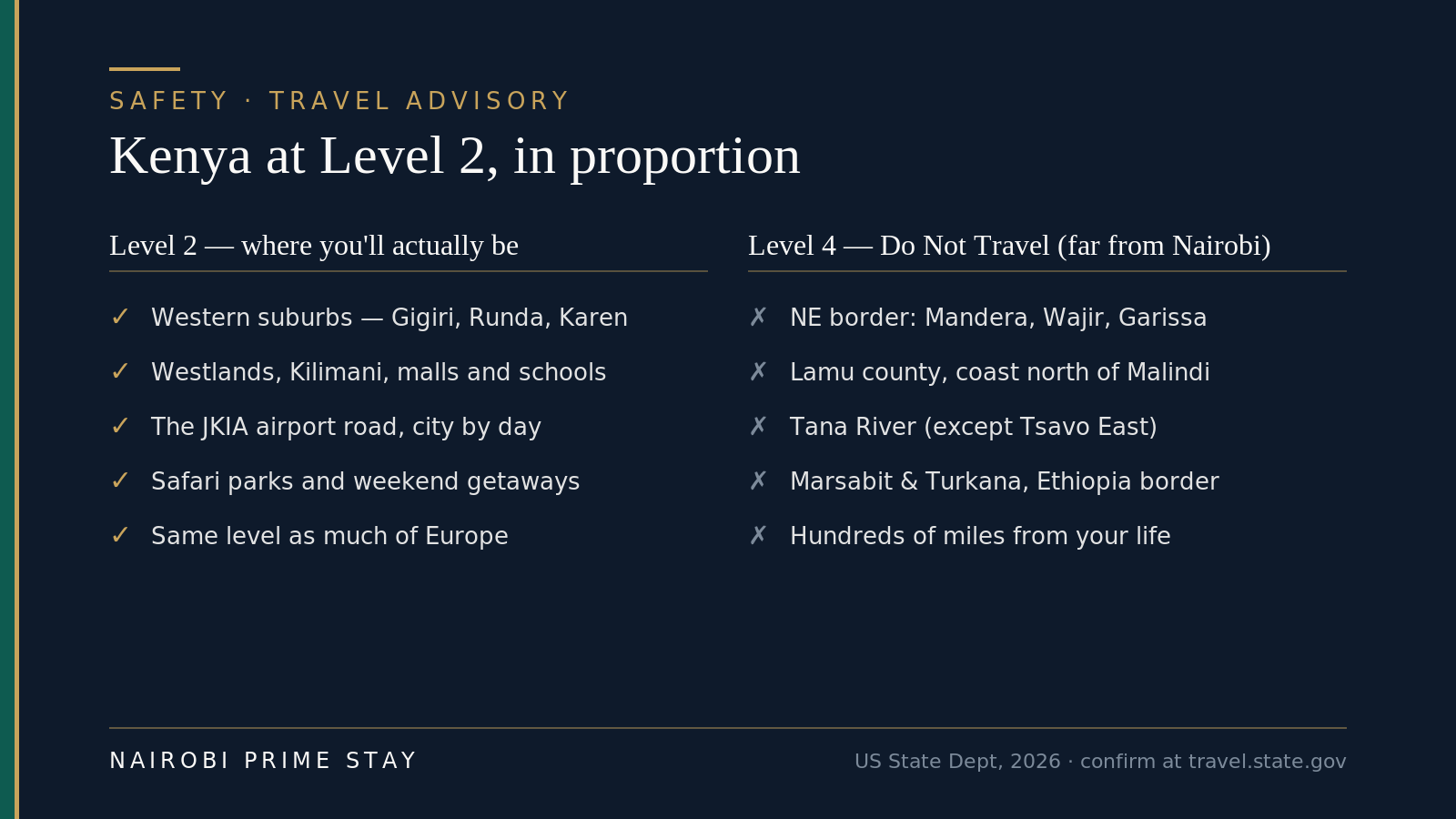
The advisory in proportion — Level 2 covers everywhere you’ll live and go; the Do Not Travel zones are remote border areas far from the city.
The safest neighborhoods for expats
Expat life clusters in a handful of secure, leafy suburbs, most built around gated communities and apartment compounds with round-the-clock security.
| Area | Why it feels secure | Best for |
|---|---|---|
| Gigiri | Diplomatic zone around the UN and embassies; heavily patrolled | UN / embassy / NGO staff |
| Runda & Muthaiga | Large gated estates, controlled access, quiet | Families wanting space |
| Karen | Low-density, walled compounds, suburban calm | Families, space-seekers |
| Lavington | Established, residential, embassies nearby | Families, professionals |
| Kileleshwa | Quiet, modern apartment blocks with security | Couples, professionals |
If security is high on your list, Gigiri and Runda are about as reassuring as the city gets, thanks to the diplomatic presence and patrols. Karen offers space and gardens behind walls. Our best neighborhoods guide compares all of them, including the trade-offs between security, commute and lifestyle. If you’re UN, NGO or embassy staff, our guide to where UN staff live in Nairobi maps the areas built around the Gigiri commute.
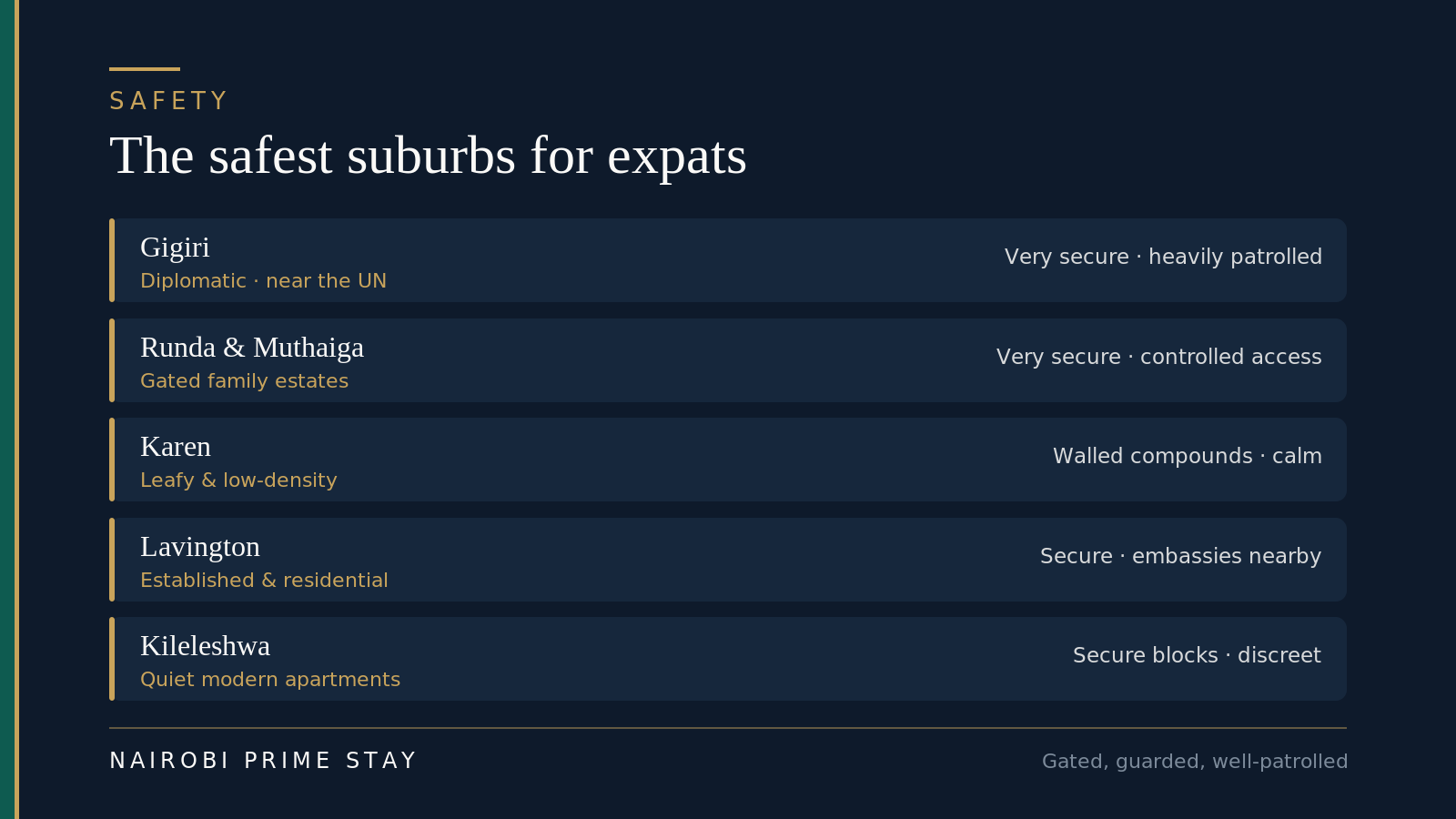
Where expat life clusters — gated, guarded, well-patrolled western suburbs.
The areas most expats never see
For balance, a few parts of Nairobi carry a higher-crime reputation and simply aren’t on the expat map: Eastleigh, Kibera, and stretches of the downtown CBD and Eastlands after dark. You won’t have reason to go to them — homes, offices, schools, malls and social life all sit in the western suburbs — but it’s worth knowing they exist so you can take a local’s “let’s not go there at night” at face value. Cost tracks safety here, too: the secure western suburbs cost more, and that premium is part of what you’re budgeting for (see our cost-of-living guide).
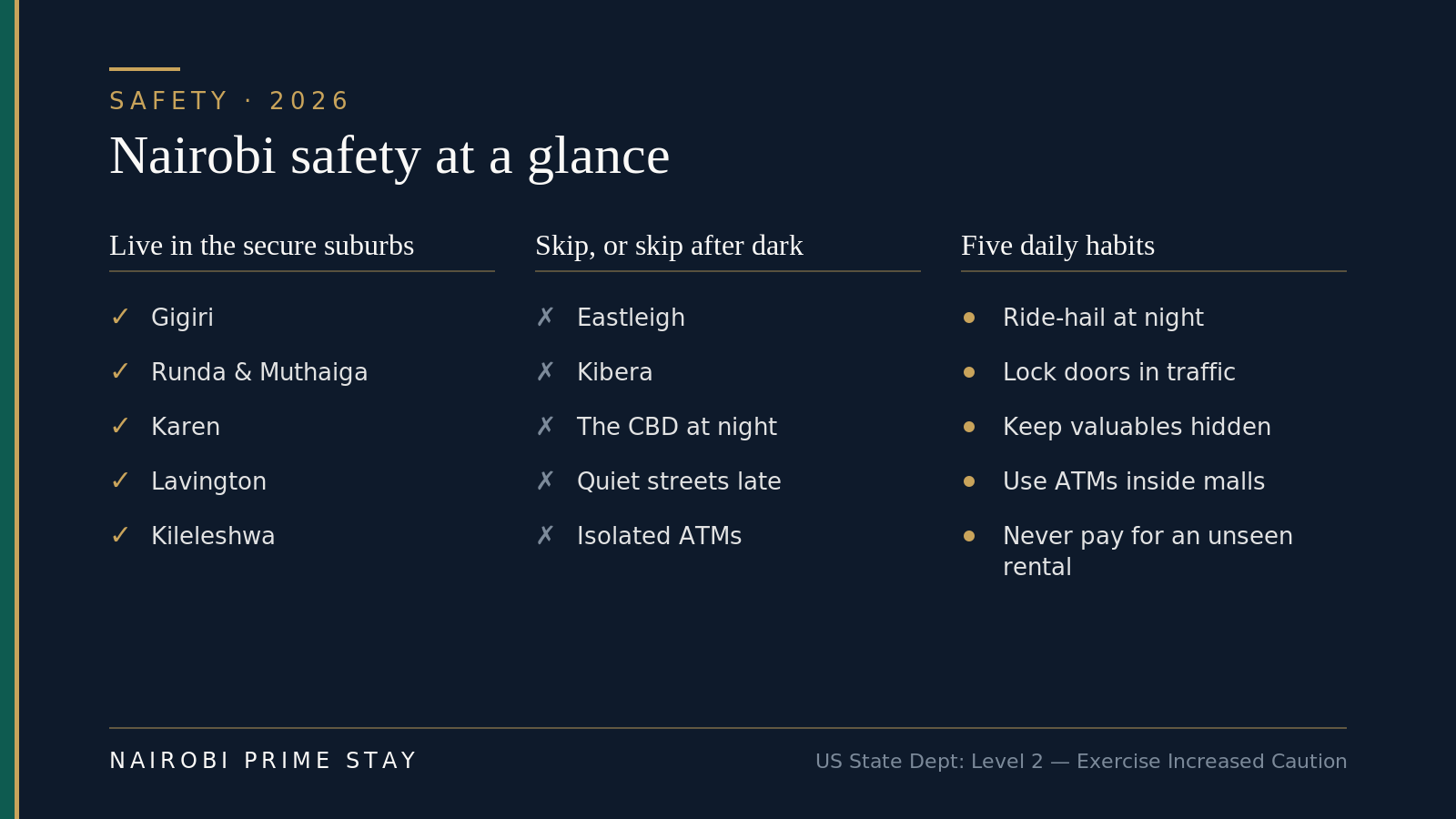
Nairobi safety at a glance — the official advisory, where expats live, and the habits that handle most of the risk.
Everyday street sense
The habits that matter most are small and easy:
- Keep your phone and valuables out of sight, especially walking on busy streets or stopped in traffic.
- In a car, keep doors locked and windows up in jams, and keep bags off the seat or out of view.
- Use Uber or Bolt after dark rather than walking, and avoid boda-boda (motorbike) taxis.
- Withdraw cash inside malls or banks, not at quiet street ATMs.
- Don’t wear flashy jewelry or wave expensive cameras and laptops around in public.
- Trust local advice on which areas and times to skip — your neighbors and colleagues know.
None of this is unique to Nairobi; it’s the same playbook you’d use in any large city where you stand out as a newcomer. A little local etiquette — greetings first, smart-casual dress — also helps you blend in rather than read as a fresh arrival, which quietly lowers your profile.
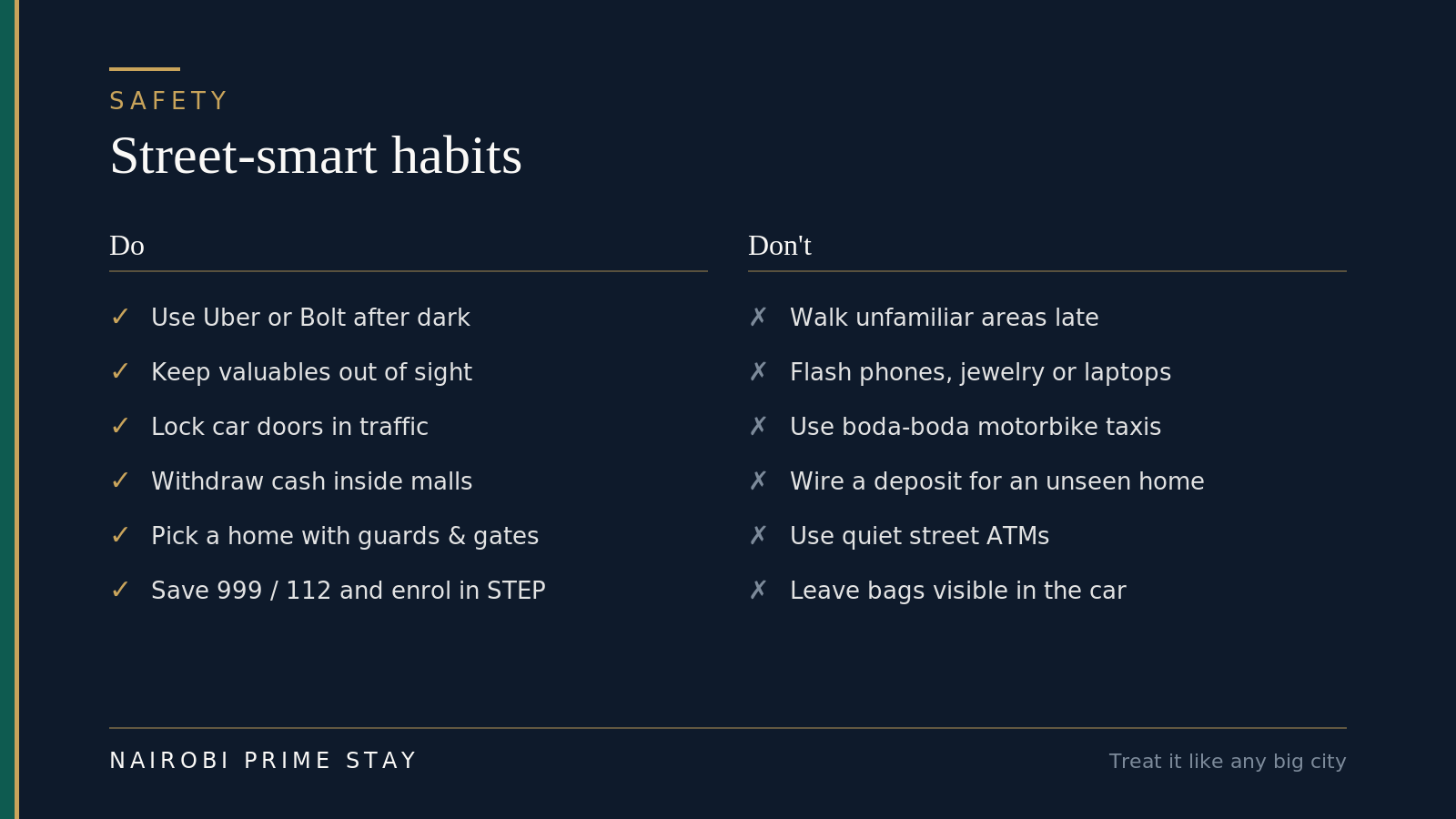
The daily habits that handle most of the risk — they become second nature within a month.
Setting up a secure home
A good home does most of the security work for you, which is why locals tell newcomers to prioritize it. Before you sign anywhere, check what residents call the “Nairobi Five”: a backup generator, reliable water supply and storage, 24/7 security with gates and cameras, fibre internet, and responsive on-site management. Two of those five are about safety directly, and the rest keep daily life smooth.
This is also a strong argument for a soft landing in a serviced apartment when you first arrive. You get a vetted building with security, a generator and management already in place from day one — no negotiating alarms or guards while you’re still learning the city. From that secure base you can view long-term homes and judge each building’s security in person before committing. If you already know you want maximum reassurance, our serviced apartments in Gigiri sit in the most heavily patrolled part of the city.
Getting around safely
Ride-hailing is the expat default for good reason: Uber and Bolt are trackable, payable by card or M-Pesa, and let you avoid both street hails and motorbike taxis. Our getting around Nairobi guide walks through every transport option and its honest risks. Keep doors locked once you’re in. For your own car, the same in-traffic habits apply — locked doors, raised windows, bags out of sight. Our guide to driving in Nairobi covers the roads, matatus and boda-bodas in more detail.
The bigger daily issue isn’t crime, it’s traffic. Distances are short but rush hour is slow, so plan trips around it and don’t put yourself in a position of walking unfamiliar areas late because a ride felt expensive. A few dollars for a Bolt is always the right call after dark.
Demonstrations and protests
Kenya is a lively democracy, and that occasionally means demonstrations — usually in central Nairobi, around government buildings and major roads, and sometimes called at short notice. They can snarl traffic and are best given a wide berth, but they rarely reach the residential western suburbs where expats live. The playbook is simple: avoid crowds and protest routes, don’t try to drive through or photograph them, keep an eye on STEP alerts and local news, and work from home or reroute on a flagged day. For visitors and residents alike, this is a “stay aware and stay away” issue, not a daily concern.
Money, rentals and scams
The scam most likely to catch a newcomer is the rental scam: a too-good listing, pressure to wire a deposit for a home you haven’t seen, or a “landlord” who can’t quite meet in person. The rule is simple and absolute — never pay a deposit for a place you haven’t viewed and whose owner or agent you haven’t verified. Use a reputable agent or a vetted serviced-apartment provider, and pay only after seeing the property.
For everyday money, M-Pesa is secure and ubiquitous; guard your PIN and ignore unsolicited “you’ve won” or “send money back” messages. At ATMs, use machines inside malls and banks. Keep a US card for international spend and treat online payments with the same caution you would anywhere.
If something does happen
Most expats go years without a real incident. Still, it’s worth knowing the playbook, because calm beats panic and a few of these calls aren’t obvious to a newcomer.
If your phone or bag gets snatched, let it go. It isn’t worth chasing anyone into traffic, and your things are insured or replaceable. Report it at the nearest police station if you need a reference number for an insurance claim, and call Safaricom to block and replace a lost SIM — they do it quickly.
If there’s a break-in or your home alarm goes off, call your building’s rapid-response company first — they’re minutes away and it’s what they’re paid for — then the police on 999 or 112. This is exactly why locals prize a managed building with guards and a response contract: the heavy lifting is arranged before you ever need it.
After a minor car bump, the local habit is to stay calm, not argue on the road, and drive to the nearest police station to file it rather than settle on the spot. Photograph the scene, call your insurer, and don’t hand over cash. For anything serious, call 999.
Once in a while a newcomer is asked for an informal “fee” over a small infraction. You’re not obliged to pay a bribe. Stay polite, ask for the official charge and a receipt, and say you’ll sort it at the station — the request usually fades. It’s the exception, not the rule, but it helps to know your footing.
And if a place or a situation simply feels wrong, trust that and leave. Order an Uber or Bolt, head to a busy, well-lit spot, and call a friend or colleague. Your instincts are part of your security kit.
For anything involving your passport, a serious crime or an emergency, the US Embassy in Nairobi (in Gigiri) and your STEP enrolment are your backstops. Save their details before you ever need them.
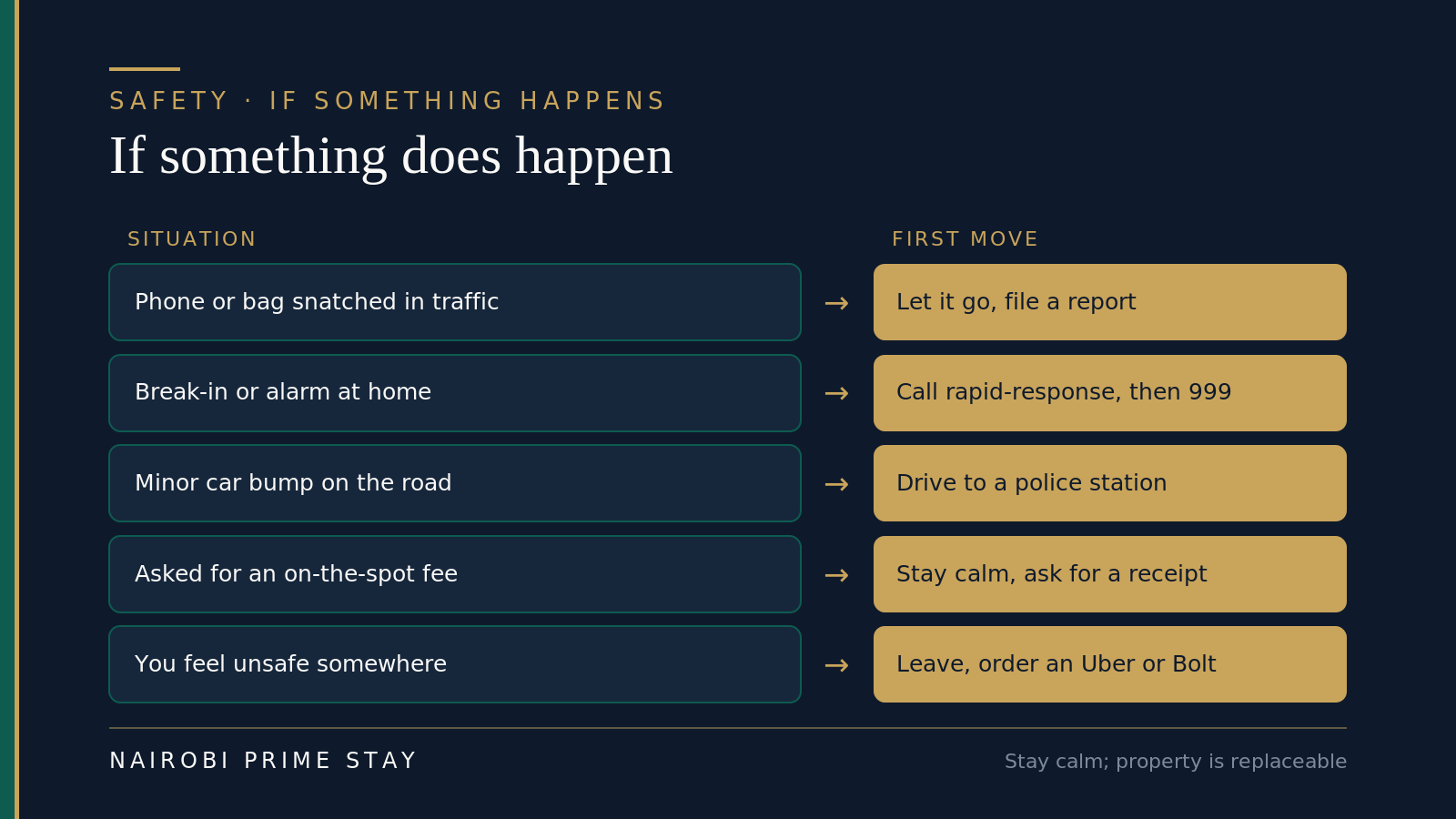
A calm first move for each situation — most never come up, but it pays to know them.
Notes for women, solo movers and families
Solo women and solo travelers live and work in Nairobi comfortably, using the same precautions as anyone — ride-hailing at night, awareness in crowds, a secure home. Many find the prime suburbs relaxed and friendly. Street harassment, where it happens, is usually more nuisance than threat; dressing smart-casual, walking with purpose and sticking to busier, well-lit areas after dark all help. Trust your instincts, build a local network quickly, and lean on colleagues’ advice about specific venues and areas.
Families do very well here, which is part of why so many settle. Gated communities give kids room to play securely, schools run organized bus routes, and the international community is large and welcoming. Teach children the same simple habits, know your nearest private hospital, and you’ll find day-to-day family life feels safe and easy. Our guide to moving to Nairobi with kids covers schools, bus routes and the day-to-day in more depth.
Is Nairobi safe at night?
It’s fine with sensible choices. Socializing happens across Westlands, Kilimani, Karen and the malls, and people go out regularly. The key habits at night are to travel by Uber or Bolt rather than on foot, stick to known venues and busier areas, keep valuables discreet, and not walk unfamiliar streets alone late. In the gated suburbs where most expats live, evenings are quiet and uneventful.
Be prepared, just in case
A little setup buys peace of mind:
- Save the emergency numbers: 999 or 112.
- Choose a home with guards, gates and cameras.
- Enrol in the US State Department’s free STEP program (step.state.gov) for alerts.
- Keep digital and paper copies of your passport, permit and insurance.
- Know your nearest private hospital and how you’d get there — see our healthcare guide.
- Carry good insurance with medical evacuation.
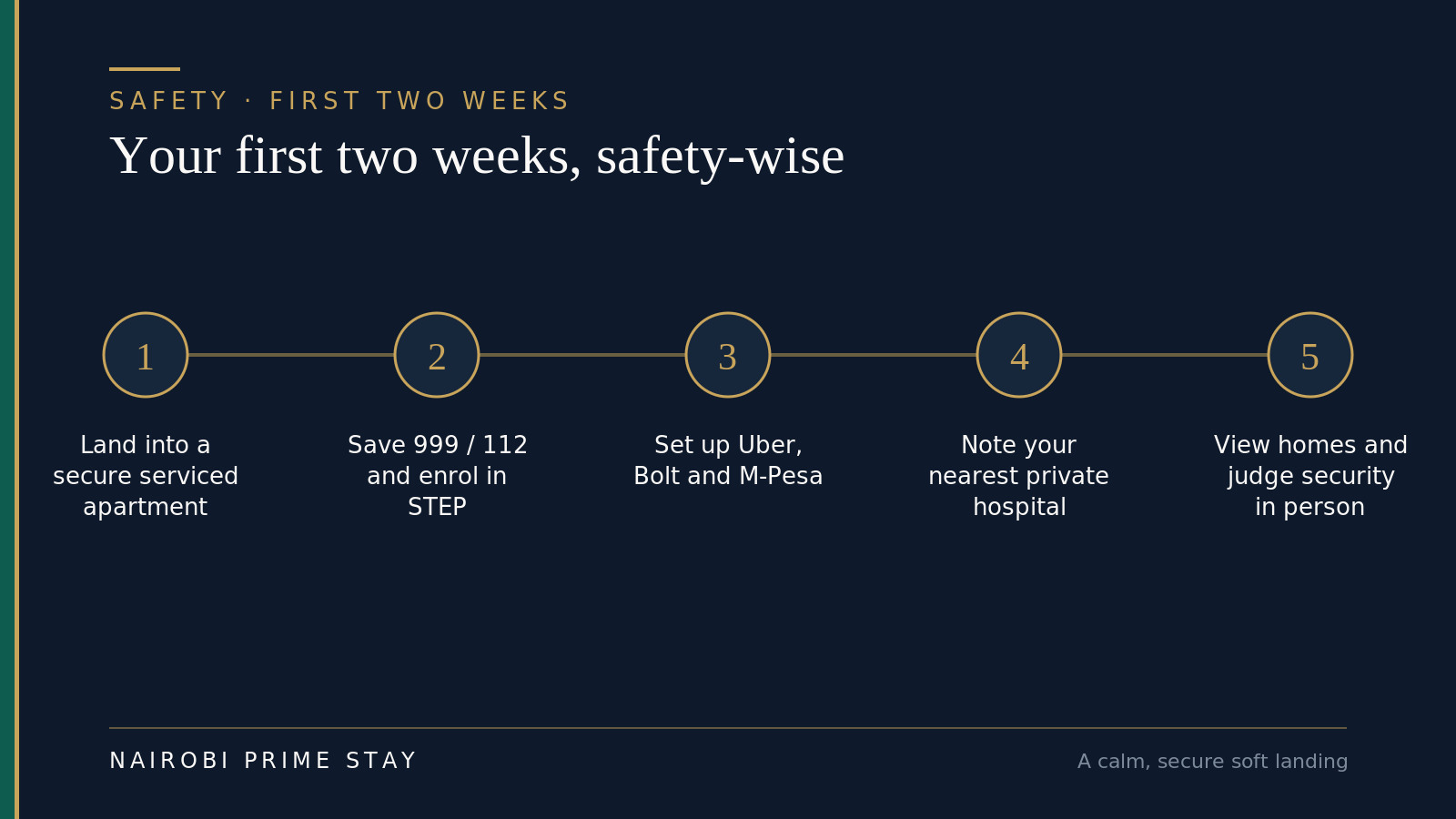
A calm, secure soft landing — the sequence that lets you stop thinking about security fast.
From the moment you land — see our airport arrival guide for that first ride into town — a secure base makes everything that follows easier.
A week in the life, safety-wise
Here’s how this actually feels once you’re settled. Picture a family that has just moved to Gigiri for a UN posting.
Monday, the kids catch the school bus from inside the compound gate while a guard waves it through. One parent takes a Bolt to a Westlands meeting, doors locked in the morning jam, bag on the floor out of sight. Wednesday evening they eat at a mall restaurant; the car park has a boom gate and a quick bag check at the door, and nobody thinks twice about it. Friday night they Bolt to dinner in Karen rather than drive home late, and split a ride back with neighbors. Saturday they’re on the road early for a weekend by Lake Naivasha, home before dark.
Nothing dramatic happens, because that’s the point. The security is mostly invisible and mostly automatic — a guarded gate here, a locked door there, a ride-hail instead of a late walk. After a month it’s just how you live, and the city opens up: the restaurants, the parks, the expat community and the weekends away.
Keeping perspective
| Reasons to feel reassured | Reasons to stay mindful |
|---|---|
| Most expats live in gated, guarded communities | Petty theft is real — keep valuables hidden |
| Prime suburbs are calm and well-patrolled | Smash-and-grab happens in slow traffic |
| Violent crime against residents is uncommon | Rental scams target newcomers |
| Travel advisory sits at Level 2, like much of Europe | Occasional demonstrations disrupt central Nairobi |
| Large, supportive international community | Some areas and late hours are best avoided |
| Ride-hailing makes safe transport easy | You’ll adopt a few new daily habits |
Thousands of American and international families live in Nairobi without incident. Good habits and a secure home do most of the work — then you’re free to enjoy the city, the climate and the weekends away.
Frequently asked questions
Is Nairobi safe for American expats? Yes, with normal big-city precautions. Most expats live in gated western suburbs with 24/7 security and rarely have problems. The main risk is opportunistic petty theft, not violence — keep valuables out of sight, use ride-hailing at night, and choose a home with guards and gates.
What are the safest neighborhoods in Nairobi? Gigiri, Runda, Muthaiga, Karen, Lavington and Kileleshwa are the suburbs most expats choose, built around gated communities with round-the-clock security. Gigiri and Runda feel especially secure thanks to the diplomatic presence and heavy patrols.
Is Nairobi safe to walk around? In the quiet residential suburbs, yes, in daylight. In busier commercial areas keep your phone and valuables out of sight, and after dark take an Uber or Bolt rather than walking. Avoid walking unfamiliar areas alone late at night.
Is Nairobi safe for solo female travelers? Many solo women live and travel here comfortably using standard precautions — ride-hailing at night, awareness in crowds, and a secure home. Build a local network early and trust local advice about specific venues and areas.
What are the main safety risks in Nairobi? Opportunistic property crime: phone and bag snatching, smash-and-grab from cars in slow traffic, occasional burglary, and rental or ATM scams. Violent crime against residents in the prime suburbs is uncommon. A secure home and a few daily habits handle most of the risk.
What’s the US travel advisory level for Kenya? As of 2026 the US State Department rates Kenya Level 2, “Exercise Increased Caution” — the same level it gives much of Western Europe. The Level 4 “Do Not Travel” zones are remote border and coastal areas (Mandera, Wajir, Garissa, Tana River, Lamu county and the coast north of Malindi), not Nairobi. Within the city only Eastleigh and Kibera are singled out, and expats don’t live there. Check the current advisory at travel.state.gov before you fly.
Which areas of Nairobi should I avoid? Eastleigh, Kibera and Mathare, the downtown CBD after dark, and isolated spots late at night. Expats rarely have a reason to be in any of them — homes, offices, international schools and malls all sit in the western suburbs. Stick to areas you know after dark, and take a ride-hail instead of walking.
Are demonstrations and protests a risk for residents? Occasionally. Central Nairobi sometimes sees political demonstrations that can turn disruptive, but they’re concentrated in the CBD and a few main roads, and they’re usually announced ahead of time. The western suburbs where expats live are rarely affected. Skip protest areas on the day, keep some cash and water at home, and follow local news and the US Embassy’s alerts.
Do I need guards or an alarm at home in Nairobi? In practice yes, and it’s completely standard. Almost every expat home sits in a gated compound or apartment block with 24/7 guards, and most have an alarm linked to a rapid-response company. If you choose a serviced apartment or a managed building it’s already built in, so you arrange none of it yourself — one reason expats feel secure day to day.
What should I do if my phone is snatched in Nairobi? Let it go — don’t chase anyone into traffic. Phones are insured or replaceable. Report it at the nearest police station if you need a reference number for an insurance claim, and call Safaricom to block and replace the SIM. For a break-in or home alarm, call your building’s rapid-response company first, then the police on 999 or 112.
Will I have to pay bribes in Nairobi? Rarely, and you’re not obliged to. Once in a while a newcomer is asked for an informal ‘fee’ over a small matter. Stay polite, ask for the official charge and a receipt, and offer to sort it at a police station — the request usually fades. It is the exception, not the rule, for everyday expat life in the secure western suburbs.
Related reading
- Moving to Nairobi: the complete guide — the hub that ties visas, cost, neighborhoods and your first 30 days together.
- The best neighborhoods in Nairobi for expats — where the safe, leafy suburbs are and who each one suits.
- Gigiri neighborhood guide and the Karen neighborhood guide — the two areas newcomers ask about most.
- Cost of living in Nairobi — what a comfortable, secure life really costs each month.
- Healthcare in Nairobi — hospitals, insurance and staying well.
- Serviced apartments in Nairobi — secure, all-inclusive homes for a soft landing.
A safer first month
The easiest way to feel safe from day one is to start in a home that’s already secure. Our serviced apartments sit in gated western-suburb buildings with 24/7 guards, backup generators and fibre, all-inclusive — a $50 deposit reserves a place and you pay the balance on arrival. Not sure which area fits your commute and comfort level? Our AI relocation assistant can shortlist secure options in a couple of minutes, day or night.
Ready to look?
Find your apartment in Nairobi
Browse verified serviced apartments, or ask the AI concierge which area fits your life.