
Guides · Transport
Driving in Nairobi: A Practical 2026 Guide for Americans
Driving in Nairobi: A Practical 2026 Guide for Americans
Yes, you can drive in Nairobi as an American. Your US license works for your first 90 days, you switch to driving on the left, and for a longer stay you convert to a Kenyan licence. None of that is the hard part. The traffic is.
This guide is for Americans moving to Nairobi who are weighing whether to get behind the wheel themselves. We’ll cover the licence rules, what changes when you drive on the left, the honest reality of Nairobi roads, the speed limits and new cameras, insurance, and the simple habits that keep driving here uneventful. By the end you’ll know whether to drive, ride-hail, or do what many expats do and mix the two.
We’ll be straight with you throughout. Driving in Nairobi is very doable, and thousands of foreign residents do it every day. It also asks more of you than driving in a quiet US suburb. Knowing that up front is half the battle.

The short answer
You can drive on your valid US license for up to 90 days after you enter Kenya, because it’s printed in English. Carry an International Driving Permit too; it’s a cheap official translation and a useful backup. Kenya drives on the left, in right-hand-drive cars, so the gear shift is on your left and roundabouts feel mirror-image at first. For any stay beyond about three months, you convert to a Kenyan licence through the NTSA (the National Transport and Safety Authority) on the eCitizen portal. Third-party insurance is required by law. The real challenge isn’t rules or paperwork; it’s rush-hour traffic, busy roundabouts, and roads you have to read carefully.
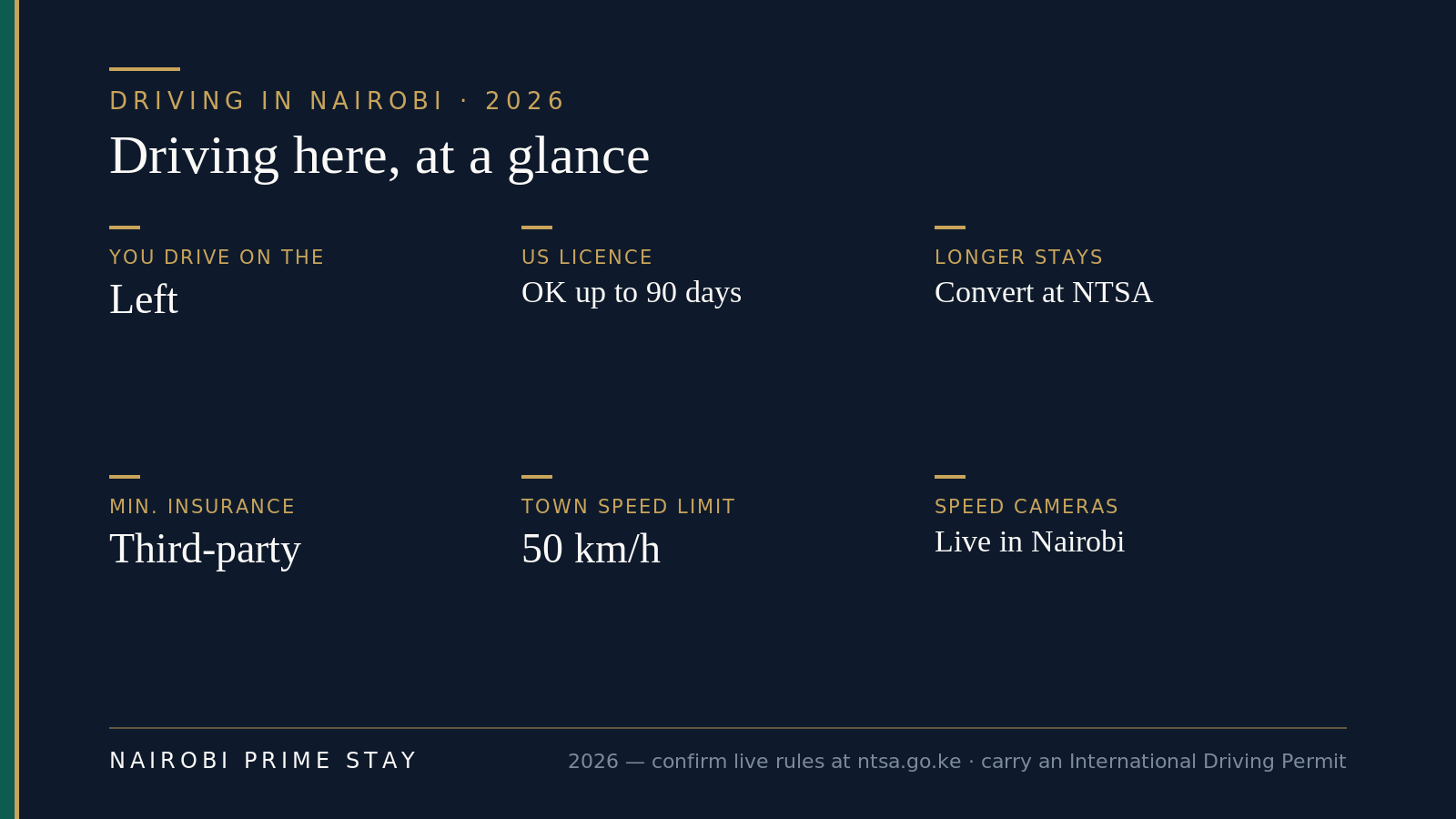
The essentials at a glance. Always confirm current rules and fees at the official NTSA portal, ntsa.go.ke.
Should you drive at all?
Decide this before you ship a car or buy one. Plenty of expats in Nairobi never drive themselves, and they get along fine.
For your first weeks, ride-hailing covers almost everything. Uber, Bolt and the local app Little are cheap, cashless and safe, and a city hop costs a few dollars. You skip insurance, parking, fuel queues and the stress of learning the roads while jet-lagged. For a deeper look at every option, see our guide to getting around Nairobi.
A car earns its place when your week has a shape that apps don’t serve well: a daily school run on a fixed schedule, a home in a quieter outer suburb, frequent weekend trips out of town, or a family that needs to move on its own clock. Many residents land somewhere in between and hire a driver, which is more affordable here than in the US and takes the traffic off your plate.
Our honest advice: arrive, settle in, and use ride-hailing for a month while you learn the city. You’ll know your real routine soon enough, and only then is the car question easy to answer. Where you choose to live shapes this more than anything; a short commute can make a car optional, while the wrong side of town can make one feel essential. The moving to Nairobi hub walks through how the pieces of your relocation fit together.
Can you drive on your US license?
Yes, for up to 90 days from the day you enter Kenya. Your US license is valid here because it’s issued in English, which Kenyan authorities accept. That window is plenty for a scouting trip or your first settling-in weeks.
Two practical tips. First, carry an International Driving Permit (IDP) alongside your home license. It doesn’t replace your US license or extend the 90 days, but it’s an officially recognized translation, and it smooths things over with traffic police or a car-hire desk. You get one before you travel from AAA in the States; it’s inexpensive and valid one to three years. Second, keep your physical US license on you when driving, not just a photo.
After 90 days, the expectation is that you hold a Kenyan licence. If you’re here on a short visit you’ll never hit that limit. If you’re relocating, start the conversion early, because the processing time can run into weeks.
Driving on the left: what changes for an American
Kenya drives on the left, the same as the UK, and cars are right-hand drive. You sit on the right and shift gears with your left hand. Most rentals and a lot of private cars here are automatic, which removes the trickiest part of the adjustment.
A few things take a day or two to feel natural:
- Roundabouts go clockwise. You give way to traffic coming from your right and enter when there’s a gap. Nairobi has many roundabouts, and some are busy and unmarked, so go slowly and follow the car in front until the rhythm clicks.
- Your road position shifts. Keep yourself toward the center line, which means hugging the right side of your seat to the center of the lane. New left-side drivers tend to drift left and clip the curb; stay aware of it.
- Turns cross differently. A right turn now takes you across oncoming traffic, the way a left turn does in the US. Indicators and wipers may be reversed from what you’re used to, so expect to flick the wipers a few times before muscle memory updates.
- Overtaking is on the right. On highways, slower traffic keeps left and you pass on the right.
If you’ve never driven on the left, give yourself an easy first outing: a quiet neighborhood on a weekend morning, not Mombasa Road at 6pm. Within a week it stops feeling foreign.
Getting a Kenyan licence: converting your US license
For a longer stay, you convert your US license to a Kenyan one through the NTSA using the TIMS system on the eCitizen portal (accounts.ecitizen.go.ke). Kenya recognizes licences from countries with established testing standards, so the route is a conversion rather than starting from scratch, though you should confirm the current requirements, as the process is increasingly digital and the details do shift.
Here’s the path most foreign residents follow.
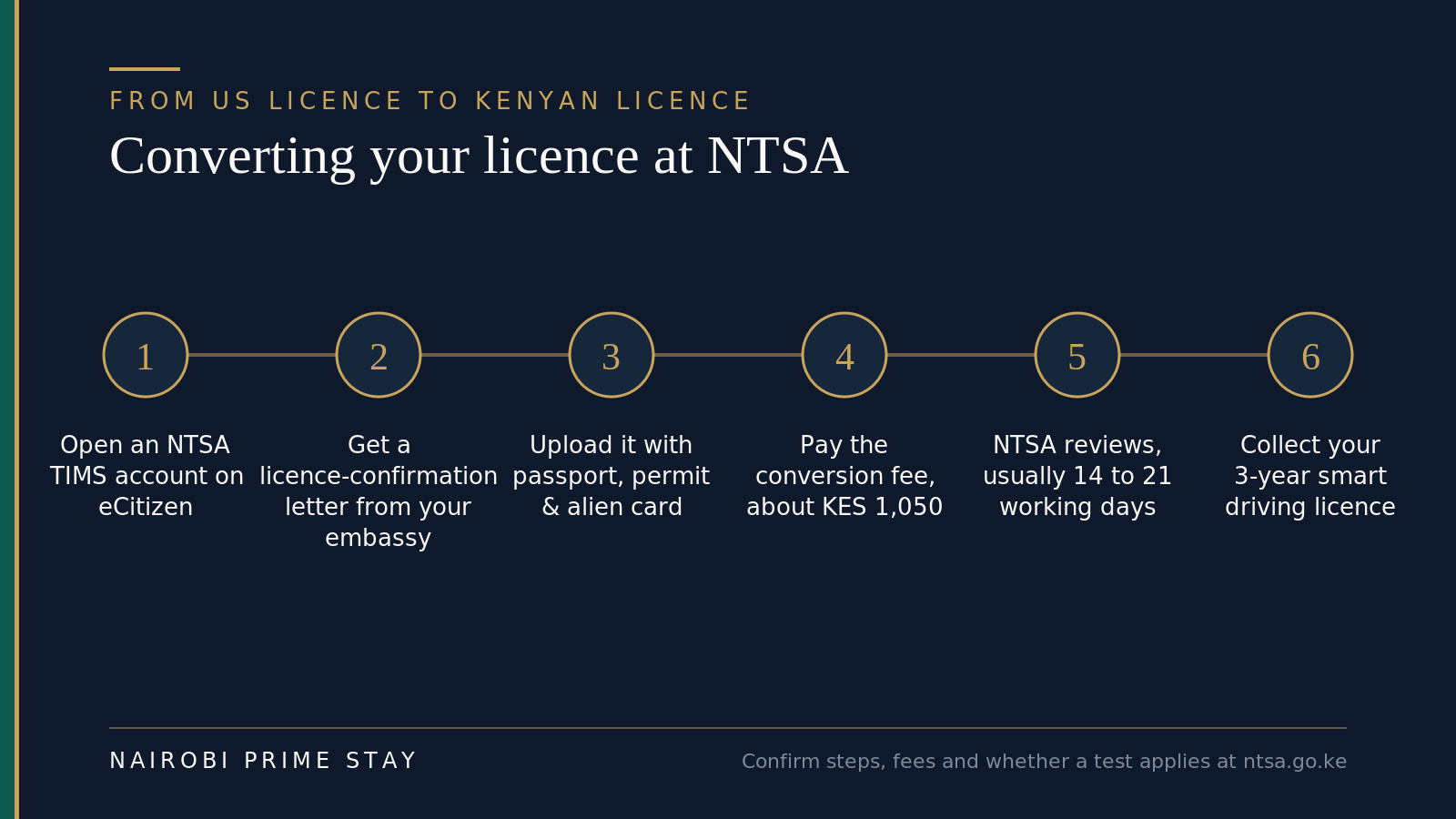
The licence-conversion sequence. Fees and steps change, so confirm the latest at ntsa.go.ke before you start.
What you’ll generally need:
- A registered NTSA TIMS account, created through eCitizen with your details.
- Your passport with a valid permit or visa, and your alien/residence card (or an exemption letter from the immigration department).
- A licence-confirmation letter from the US embassy, or from the authority that issued your license, verifying it’s genuine and current.
- Passport photos and the application form generated in TIMS.
Fees and timing, as of 2026: the conversion fee is around KES 1,050, and the Kenyan smart driving licence costs about KES 3,050 and is valid for three years. Processing typically takes 14 to 21 working days once your documents are accepted. Pay through the portal; M-Pesa is the usual method.
One honest caveat: because the US drives on the right and isn’t a Commonwealth country, some applicants are asked for extra steps, occasionally including a competence test, where a UK or other left-driving licence might convert more directly. Treat the figures and steps above as a guide, not a guarantee, and check the live requirements on the NTSA portal or with a licensed agent before you queue. The standard disclaimer applies: this is general guidance, not legal advice, and the rules can change.
The honest reality of Nairobi traffic and roads
This is the part no one should sugarcoat. The roads are why some expats happily drive and others never do.
Traffic is the headline. Distances in Nairobi are short; the time to cover them is not. A five-kilometer trip can take ten minutes at 11am and an hour at 6pm. The worst of it runs roughly 7 to 9 in the morning and 5 to 8 in the evening, and rain makes everything slower. Plan around the peaks and your day improves enormously.
The traffic mix is busy. You’ll share the road with matatus (the shared minibuses) that stop suddenly and merge assertively, boda bodas (motorbike taxis) that thread between lanes, handcarts, and pedestrians crossing where they can. None of it is aimed at you; it’s just a denser, more improvised flow than most Americans are used to. Drive defensively, leave space, and don’t assume anyone will yield because they should.
Road quality varies block to block. Main roads and the newer highways are good. Side roads can have potholes, and speed bumps are common and often unmarked, so a road that looks clear can have a jarring bump you didn’t see. In the long rains (March to May) some low-lying roads flood; if water looks deep, don’t chance it.
Fuel and parking are easy enough. Stations are plentiful and many have attendants who fill up for you. In town and at malls you’ll usually park in guarded lots, sometimes with a small fee or an attendant who waves you in. Street parking in the CBD is metered through a county app and watched by attendants.
None of this should scare you off. It’s simply a city you read actively rather than cruise through on autopilot. Once you know the rhythm, it becomes ordinary.
Speed limits, rules and the new automated cameras
Kenya’s speed limits are lower than US highway speeds, and as of 2026 they’re enforced by cameras, not just officers. Take them seriously.
The general limits: 50 km/h (about 31 mph) in towns and built-up areas, 80 km/h on open roads, and up to 110 km/h on select dual carriageways like the Nairobi–Nakuru highway. On the Nairobi Expressway, the limit is 80 km/h. Watch the signs, because limits drop without much warning as you enter a town or a school zone.
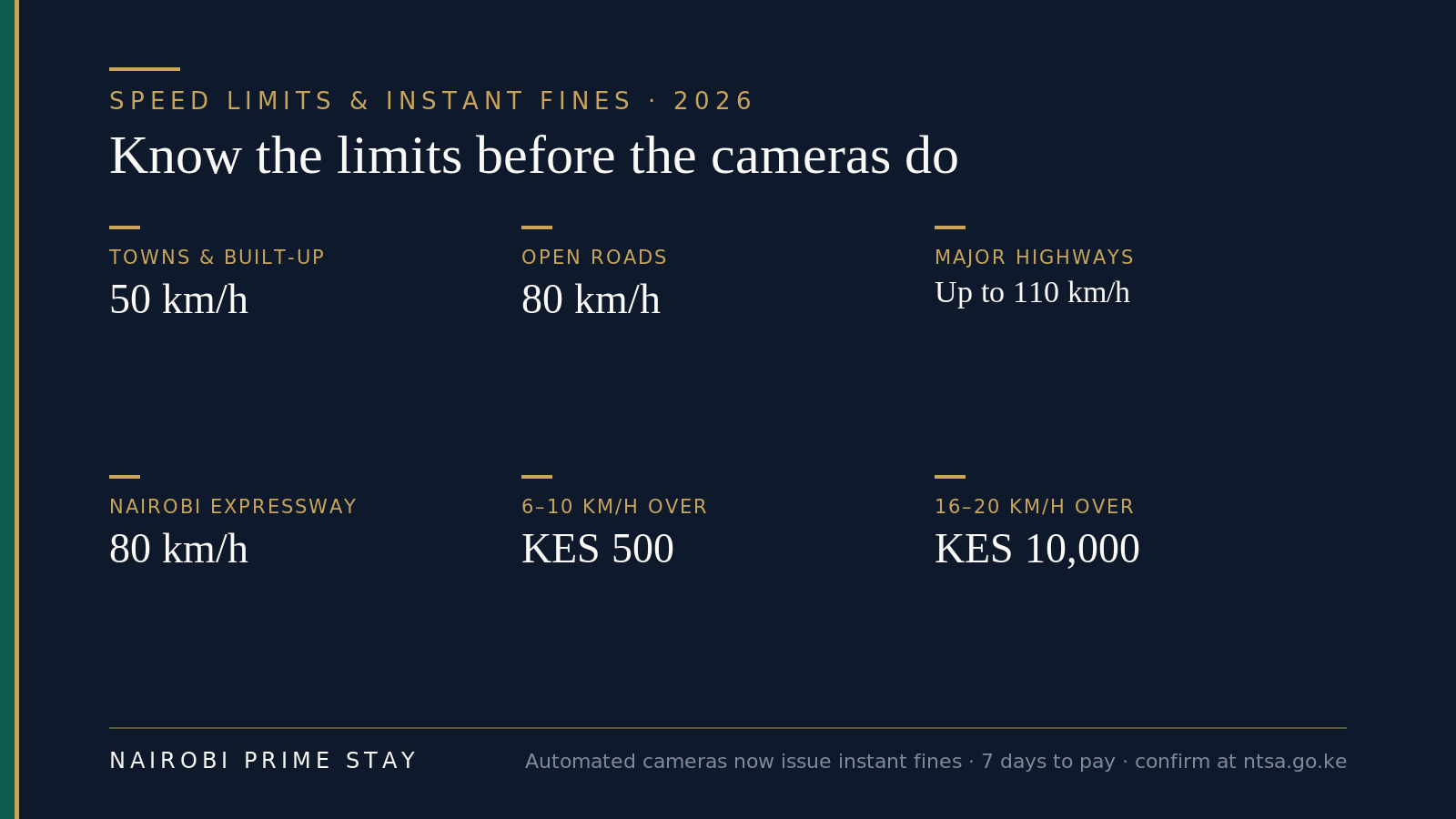
Speed limits and the new instant-fine bands. Confirm current figures at ntsa.go.ke.
What’s new is enforcement. The NTSA has switched on a network of automated speed cameras across Nairobi that issue instant digital fines. The penalty scales with how far over you are: roughly KES 500 for 6 to 10 km/h over, KES 3,000 for 11 to 15 over, and KES 10,000 for 16 to 20 over, with stiffer consequences above that. You generally have seven days to pay, through bank channels, mobile money or NTSA’s digital services. The lesson is simple: keep to the limit, especially on the Expressway and Mombasa Road where cameras are active.
The other rules will feel familiar. Seat belts are mandatory front and back. Using a handheld phone while driving is an offense. Drink-driving is taken seriously and breath-tested. Commercial vehicles must run speed governors capped at 80 km/h, which is part of why matatus and trucks sometimes sit stubbornly in the fast lane. Keep your licence, insurance sticker and vehicle papers in the car; police checkpoints are routine, usually quick, and almost always uneventful if your documents are in order.
Insurance: what the law requires
You must have motor insurance to drive legally in Kenya. The legal minimum is third-party cover under the Motor Vehicles Third Party Risks Act. It pays for injury or damage you cause to other people, their passengers or their property; it does not cover your own car or your own injuries. Driving without valid cover risks heavy fines, and the law allows for far worse, so it isn’t a corner to cut.
Most expats buy comprehensive insurance instead, and we’d suggest you do too. It adds cover for your own vehicle against accidents, theft and vandalism, which matters given the value of cars here and the cost of parts. Comprehensive premiums are commonly priced as a percentage of the car’s value each year; get quotes from a few established insurers or a broker, and confirm exactly what’s included, your excess, and whether it covers driving outside Nairobi. If you buy a car, the dealer or your bank can usually point you to an insurer, but it’s worth comparing rather than taking the first offer.
Staying safe behind the wheel
Driving safety in Nairobi is mostly about a few habits, not constant vigilance. The honest picture: the main day-to-day risk is opportunistic theft when you’re stopped in traffic, and the bigger danger is night driving on highways outside the city. Violent carjacking exists but is uncommon in the well-patrolled suburbs where most expats live. For a fuller, balanced view of risk in the city, see is Nairobi safe?.
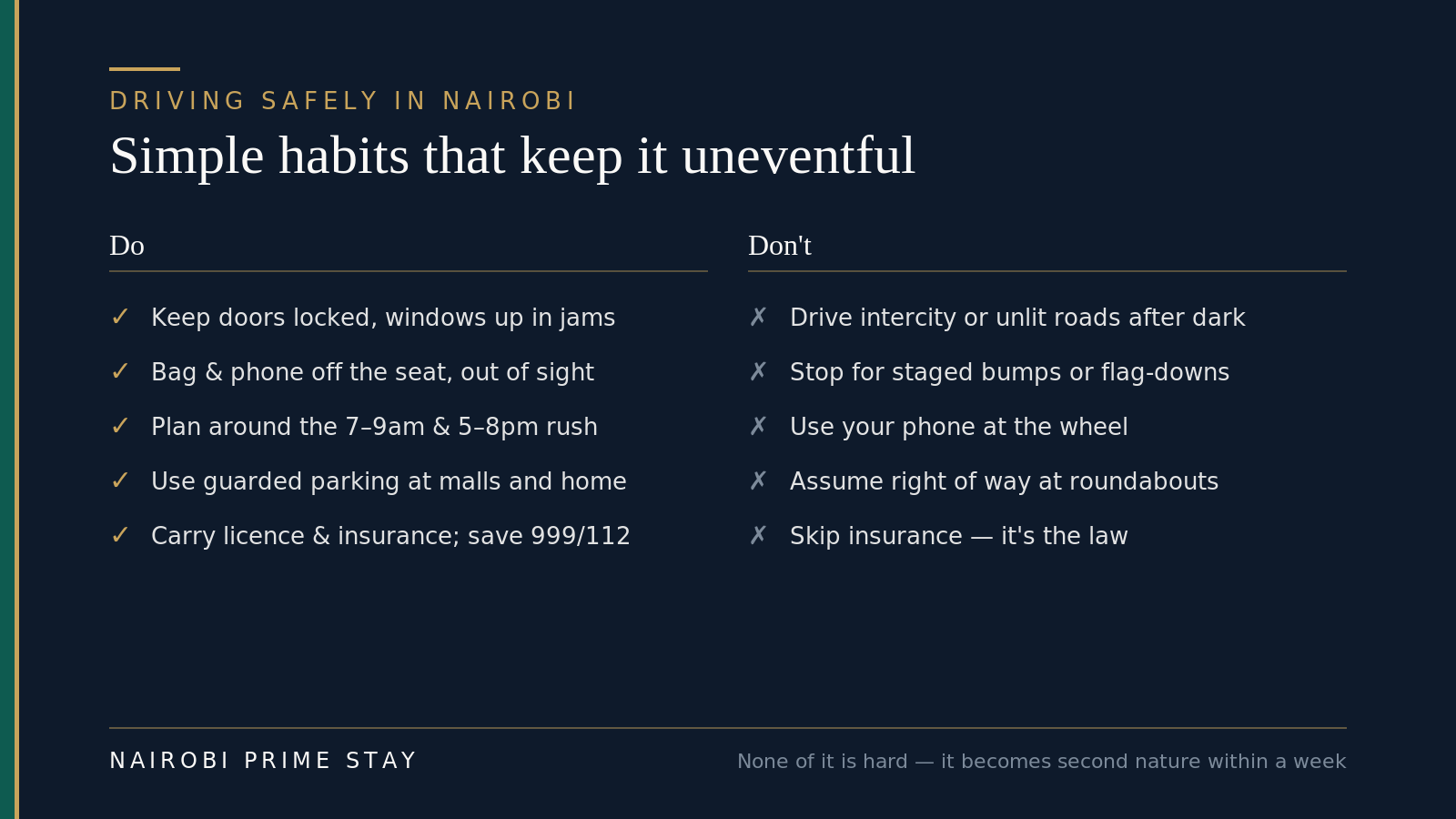
The habits that keep driving here uneventful.
The practical rules:
- Lock the doors and keep windows up in slow or stopped traffic, especially at junctions. Keep bags, phones and laptops off the seats and out of sight, ideally in the footwell or trunk.
- Don’t drive intercity or on unlit rural roads after dark if you can avoid it. Poor lighting, livestock, pedestrians and unlit vehicles make night highway driving the real hazard. For a long trip, go by day or fly.
- Be wary of staged incidents. A minor bump or someone signaling that something’s wrong with your car can be a setup. In a quiet spot, it’s reasonable to drive on to a busy, lit area or a petrol station before stopping.
- Use guarded parking. Malls, hotels and good apartment buildings have secured lots with attendants. It’s the norm here, and it’s worth using.
- Keep your documents and emergency numbers handy. Save 999 or 112 for emergencies. Carry your licence, insurance and vehicle papers.
Treat these as routine, not as a reason to worry. Set up sensibly and the overwhelming majority of expat drivers go years without an incident.
What it costs to run a car
Owning a car here is cheaper than the US on some lines and dearer on others. Fuel is a meaningful monthly cost and prices are reviewed regularly by the energy regulator. Comprehensive insurance, routine servicing and the occasional pothole-related repair add up. Parking is mostly cheap or free outside the CBD. As a rough monthly transport budget, a comfortable professional spends in the region of $80 to $200 on ride-hailing or fuel, before the cost of buying and insuring a car itself; our cost of living in Nairobi guide puts that in the context of a full budget.
If you decide a car is worth it, you’ve got two routes: buy locally or import. Each has its own math on price, duties and reliability. We cover them in detail in buying a car in Nairobi and importing a car to Kenya. For many newcomers, buying a well-kept used car locally is the simpler path; importing can make sense for a specific model or a longer stay.
What does fuel cost, and what’s the real monthly bill?
Fuel is the running cost you’ll feel most. Kenya’s pump prices are set monthly by the energy regulator, EPRA, announced on the 14th and effective from the 15th, so they drift a little in either direction through the year. In mid-2026, super petrol in Nairobi runs around KES 178 a litre and diesel around KES 167 — roughly $5 for the equivalent of a US gallon at today’s rate, so meaningfully more than most Americans pay at home. Check the current figure at epra.go.ke before you budget.
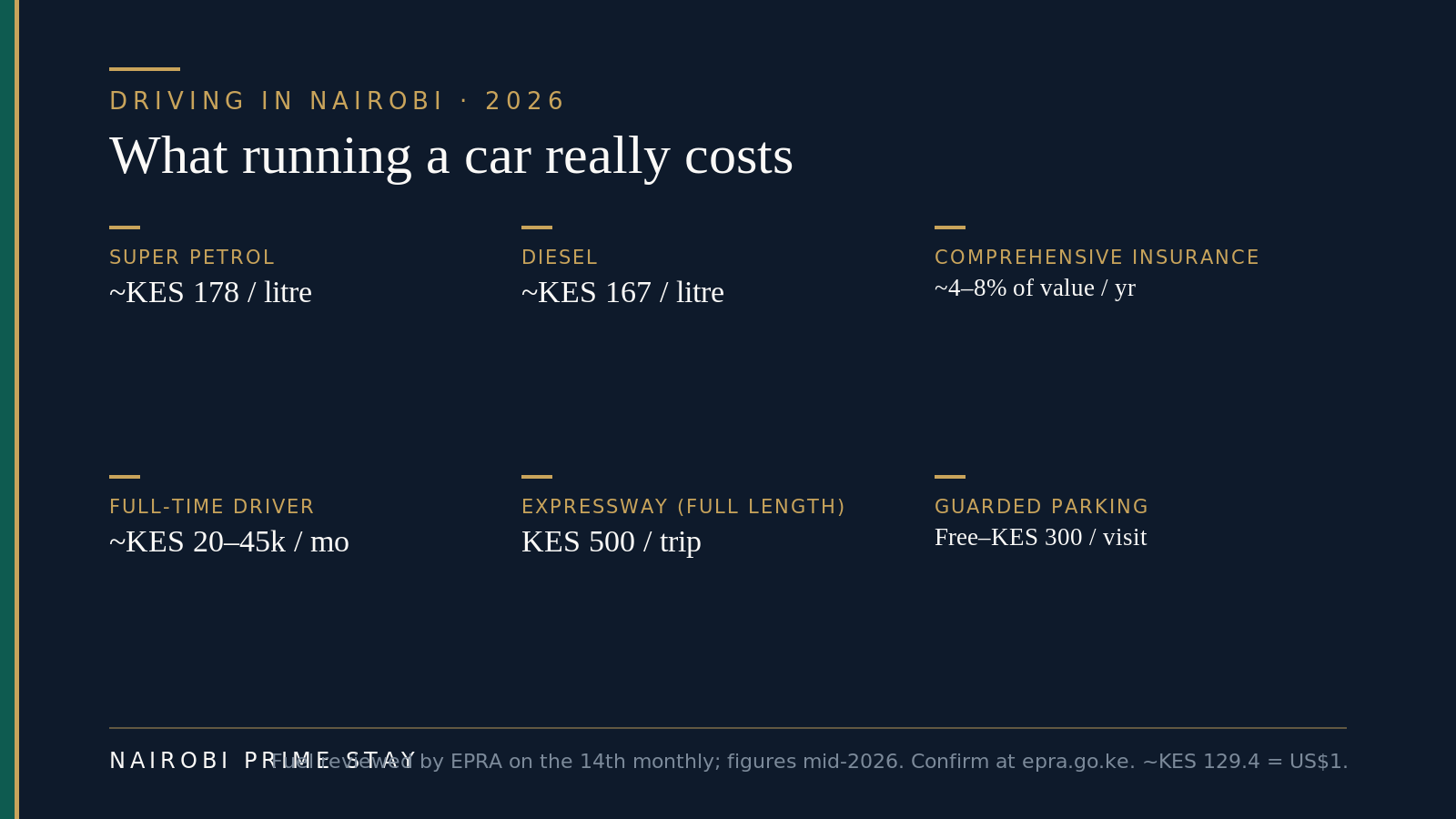
What a car really costs to run in 2026. Confirm fuel at epra.go.ke; see our USD to KES currency guide for the exchange rate.
Add it up and a car is a real line in your budget: fuel, comprehensive insurance (commonly 4 to 8 percent of the car’s value a year), routine servicing, the odd pothole repair, and Expressway tolls if you use them. Parking is mostly cheap or free outside the CBD. None of it is shocking, but it’s more than “just gas.” Our cost of living in Nairobi guide sets transport against a full monthly budget. Most drivers pay for fuel and tolls by card or mobile money; if you’re new to the latter, our M-Pesa guide explains the payment app nearly everyone here uses.
Using the Nairobi Expressway
The Nairobi Expressway is the elevated toll road above Mombasa Road, running from JKIA and Mlolongo in the southeast to Westlands in the northwest. It’s the single best traffic hack in the city: a cross-town trip that crawls for over an hour on the road below often takes 15 to 20 minutes up top. For an airport run or a fixed commute, it’s worth every shilling.
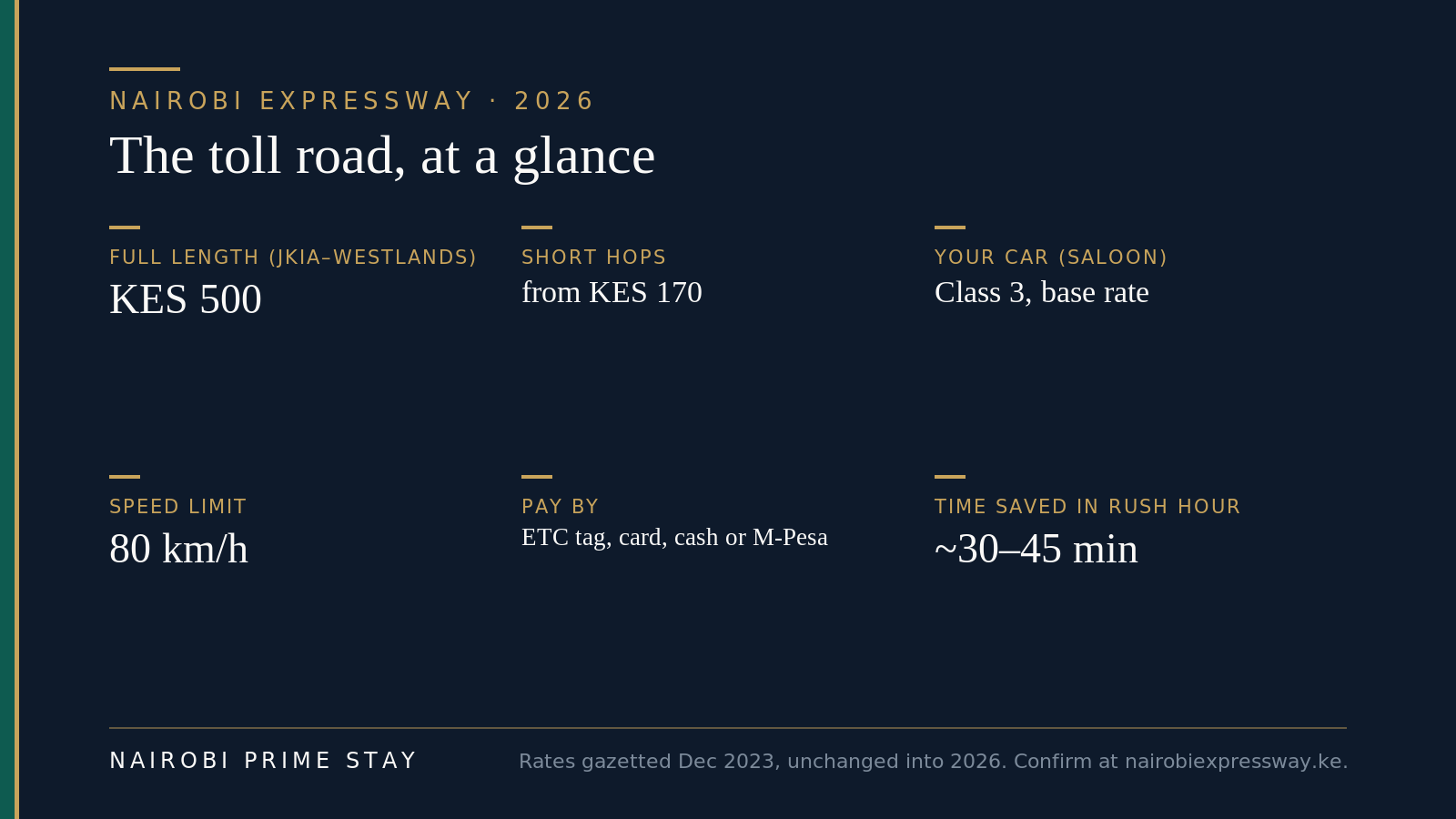
The toll road at a glance. Confirm current rates at nairobiexpressway.ke.
You pay by distance. A standard saloon car is Class 3, the base rate. Short hops start around KES 170, and the full run from Mlolongo to Westlands is about KES 500 — rates gazetted in late 2023 that haven’t risen since. There are three ways to pay: an ETC (electronic toll collection) tag on your windshield that debits automatically as you pass, a pre-loaded card, or manual lanes that take cash and mobile money. For a car you’ll drive daily, get the tag; for the occasional airport trip, the cash or M-Pesa lanes are fine. The limit up there is 80 km/h and cameras enforce it, so keep your speed honest. Heading to or from the airport, our JKIA airport guide covers the routes and timings.
Hiring a driver instead of driving yourself
Here’s the option most Americans don’t expect: hiring your own driver is common, affordable, and takes the traffic off your plate entirely. A full-time private driver in Nairobi is commonly paid KES 20,000 to 45,000 a month depending on experience and hours, or roughly KES 1,000 to 2,000 a day for casual work — a fraction of what a chauffeur costs in the US. Plenty of families and busy professionals go this route and never learn the roads themselves.
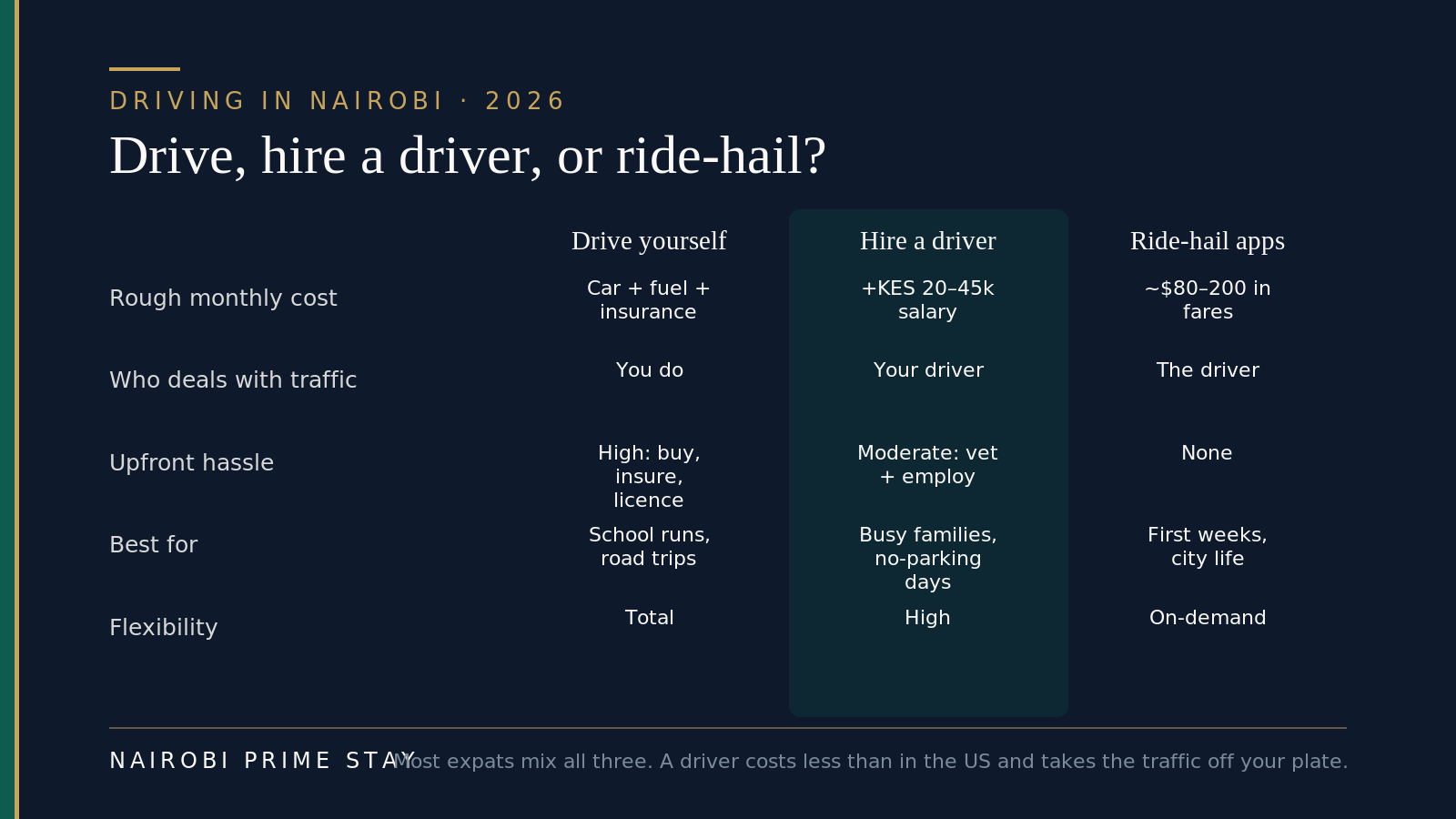
Three ways to get around, and who each suits. Most expats mix all three.
A driver earns their place when your week has a lot of fixed movement — a daily school run, meetings across town, kids’ activities — and you’d rather not spend two hours a day at the wheel. You own or lease the car; the driver drives it, parks it, waits, and handles the fuel stops. Treat it as employment: agree the salary, hours and overtime in writing, check references, and confirm they hold a valid Kenyan licence. It’s the same care you’d bring to any household staff, and our domestic help in Nairobi guide covers hiring well and fairly. For many people the honest sweet spot is a blend: a driver or your own car for the school run, ride-hailing for evenings out, and the Expressway when the road below is hopeless.
A realistic example
Say you’re a family of four relocating to Runda, with two kids starting at the International School of Kenya nearby. For the first month you stay in a serviced apartment and use Bolt for everything while you find your feet. It works, but the twice-daily school run on a fixed timetable quickly makes a case for your own car. You buy a used right-hand-drive SUV locally, take out comprehensive insurance, and one parent starts the NTSA conversion so you both hold Kenyan licences within a couple of months. You still use ride-hailing for evenings out, so no one has to worry about parking or a drink at dinner. That blend, a car for the school run and apps for the rest, is how a lot of expat families settle it.
A single remote worker in Westlands often lands differently: they never buy a car at all, because work, gyms, restaurants and friends are a few cheap app rides away.
The honest pros and cons of driving yourself
Pros
- Freedom and flexibility, especially for school runs, errands and weekend trips out of town.
- Often cheaper per trip than ride-hailing once you’re driving a lot each day.
- Independence from surge pricing, driver availability and waiting in the rain.
- Easier with kids, pets, luggage and big grocery runs.
Cons
- You deal with the traffic yourself, every day, including the rush-hour grind.
- Up-front cost and hassle: buying or importing, insurance, the licence conversion, maintenance.
- A learning curve driving on the left and reading busy, improvised roads.
- Parking, fuel stops and the small daily risks of theft in traffic become your problem.
For many people the sweet spot is a car for the trips that need one and apps for everything else, or a hired driver if the traffic simply isn’t how you want to spend your time.
Your driving setup checklist
Work through these in order once you’ve decided to drive:
- Use ride-hailing first. Give yourself a few weeks to learn the city before you commit to a car.
- Bring an International Driving Permit from home, and keep your US license on you.
- Drive your first outings somewhere quiet to get used to the left side and the roundabouts.
- Sort your residence paperwork (permit, alien card, KRA PIN) so you can convert your licence and register a car.
- Start the NTSA licence conversion on eCitizen early; allow a few weeks for processing.
- Buy the right cover. Comprehensive insurance, not just the third-party minimum, from an established insurer.
- Choose your car wisely. Decide between buying locally and importing, and have any used car inspected before you pay.
- Set your safety habits from day one: doors locked, valuables hidden, guarded parking, no night highway runs.
Frequently asked questions
Can Americans drive in Nairobi?
Yes. Your valid US license works for up to 90 days after you enter Kenya, because it’s issued in English, which the authorities accept. Carry an International Driving Permit as an official translation and backup. You drive on the left in a right-hand-drive car, and for any stay beyond about three months you convert to a Kenyan licence through the NTSA.
How do I convert my US license to a Kenyan licence?
Through the NTSA’s TIMS system on the eCitizen portal. You’ll generally need a registered TIMS account, your passport with a valid permit, your alien or residence card, and a licence-confirmation letter from the US embassy or your issuing authority. The conversion fee is about KES 1,050 and the smart licence about KES 3,050, valid three years, with processing usually 14 to 21 working days. Confirm the current steps, and whether a test applies, at ntsa.go.ke.
How long can I drive on my US license in Kenya?
Up to 90 days from the day you enter the country, as long as your licence is valid and printed in English. After that you’re expected to hold a Kenyan licence. An International Driving Permit doesn’t extend the 90 days; it just serves as an official translation and a useful backup.
How much does fuel cost in Nairobi?
In mid-2026, super petrol in Nairobi is around KES 178 a litre and diesel around KES 167 — roughly $5 for the equivalent of a US gallon, and more than most Americans pay at home. Kenya’s energy regulator, EPRA, sets pump prices monthly, announced on the 14th and effective the 15th, so they shift a little through the year. Check the current figure at epra.go.ke.
How do I pay the Nairobi Expressway toll?
You pay by distance. A standard saloon car is Class 3, the base rate: short hops start around KES 170 and the full Mlolongo-to-Westlands run is about KES 500. Pay with an ETC tag that debits automatically, a pre-loaded card, or in manual lanes that take cash and M-Pesa. The road saves serious time in rush hour and has an 80 km/h, camera-enforced limit.
How much does it cost to hire a driver in Nairobi?
A full-time private driver is commonly paid KES 20,000 to 45,000 a month depending on experience and hours, or about KES 1,000 to 2,000 a day for casual work — far less than a chauffeur costs in the US. Many families and busy professionals hire one and never drive themselves. Agree the salary, hours and overtime in writing, check references, and confirm a valid Kenyan licence.
Is driving in Nairobi difficult for foreigners?
The hard part isn’t the rules, it’s the conditions. You’ll deal with heavy rush-hour traffic, driving on the left in a right-hand-drive car, busy roundabouts, matatus and boda bodas that move unpredictably, potholes and unmarked speed bumps, and flooding in the rains. Most Americans adjust within a week or two, and many still prefer Uber or Bolt for daily trips while keeping a car mainly for school runs and weekends.
Which side of the road does Kenya drive on?
The left, like the UK. Cars are right-hand drive, so the gear shift is on your left and you give way to the right at roundabouts. If you’ve only ever driven on the right, take your first few days slowly, especially at roundabouts and when turning across oncoming traffic.
Do I need car insurance to drive in Kenya?
Yes, by law. Third-party motor insurance is the legal minimum under the Motor Vehicles Third Party Risks Act. It covers injury or damage you cause to others, not your own car or injuries. Driving without it risks heavy penalties. Given vehicle theft and repair costs, most expats buy comprehensive cover instead, which we’d recommend.
Is it safe to drive at night in Nairobi?
Within the well-lit, familiar parts of the city it’s generally fine with normal precautions. The bigger risk is intercity highways and unlit roads after dark, where poor visibility, livestock and other vehicles raise the danger. Keep doors locked and windows up in slow traffic, keep valuables out of sight, and use guarded parking. For a long trip that would mean driving after dark, consider going by day or flying.
Should I buy a car or just use Uber and Bolt?
Start with ride-hailing. For many newcomers it covers daily life for a few dollars a trip, with no insurance, parking or maintenance to handle. A car earns its place if you have a daily school run, live in an outer suburb, or travel out of town at weekends, and some expats hire a driver instead. Give it a month before you decide.
Final thoughts
Driving in Nairobi is very doable, and most Americans who try it adjust within a week or two. The licence rules are clear, the paperwork is bureaucratic but manageable, and the safety habits become second nature fast. The honest sticking point is traffic, so let your daily routine decide rather than a guidebook. Many people drive for the trips that need a car and ride-hail for the rest, some hire a driver, and plenty never buy a car at all.
Start with the apps, learn the city, and make the call once you know your week. Whatever you choose, where you live shapes your driving life more than any app or car ever will.
Related reading
- Moving to Nairobi: the complete guide — the hub that ties together every part of your relocation.
- Getting around Nairobi — ride-hailing, matatus, the Expressway and whether you need a car at all.
- Is Nairobi safe? — a balanced look at risk and the precautions that matter, on the road and off.
- Buying a car in Nairobi — dealers, inspections, paperwork and avoiding the common pitfalls.
- Importing a car to Kenya — the age rule, duties, and whether importing beats buying locally.
- JKIA airport guide — the Expressway, taxis and the airport-to-city routes.
- Domestic help in Nairobi — how to hire a driver or house staff well and fairly.
- Cost of living in Nairobi — where transport and running a car fit in a full monthly budget.
Planning a soft landing? A serviced apartment for your first weeks gives you a secure base to learn the roads and test your commute before you commit to a car or a neighborhood. Browse what’s available, or let our AI relocation assistant match you to an area that keeps your daily drive short.
Ready to look?
Find your apartment in Nairobi
Browse verified serviced apartments, or ask the AI concierge which area fits your life.