
Guides · Transport
Importing a Car to Kenya vs Buying Locally: The 2026 Guide
Importing a Car to Kenya vs Buying Locally: The 2026 Guide

Most Americans moving to Nairobi don’t need to import a car. You can buy the same models locally, often for a similar price once you add up shipping and taxes. Importing earns its place when you want a specific car, a specific spec, or you’re staying for years and plan to keep it.
This guide walks through the real decision: the rules that limit what you can bring, how Kenya’s car taxes stack up, what clearing actually costs and takes, and the honest math against buying from a Nairobi car yard. Figures are current as of 2026 — confirm the live numbers with the KRA import duty calculator and your clearing agent before you commit.
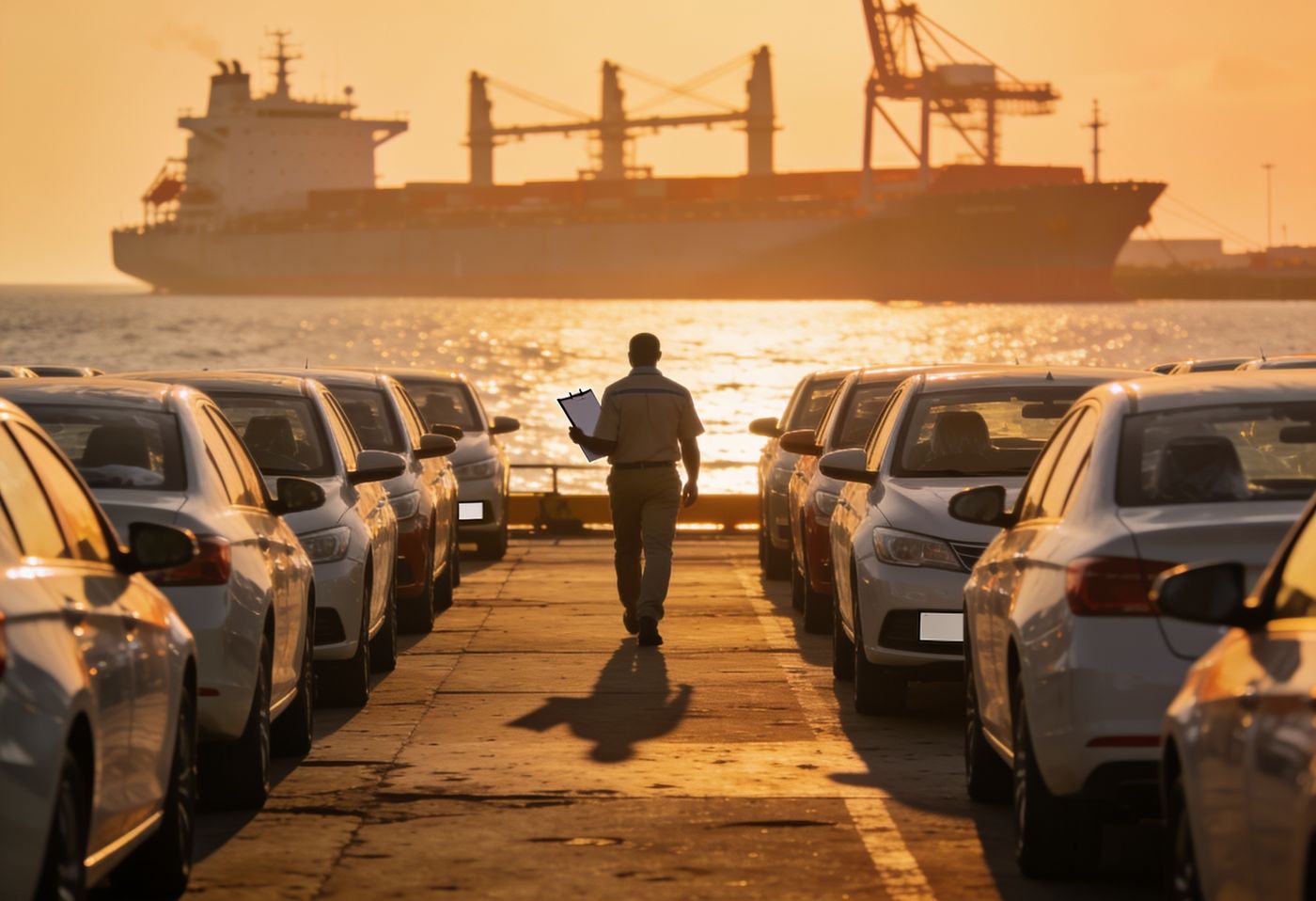
Quick answer (TL;DR)
You can import a used car to Kenya, but two rules decide what’s even allowed: it must be right-hand drive, and it must be less than 8 years old from its year of first registration — so in 2026, first registered in 2019 or later. On top of the car’s price, budget roughly 80–100%+ of its customs value in taxes: import duty (25%), excise duty (20–35% by engine), VAT (16%), an import declaration fee (3.5%) and a railway levy (2%), all stacked on the value KRA assigns from its CRSP price list. Then add shipping (about $1,000–2,000 from Japan), clearing and registration. Importing from Japan takes roughly 6–10 weeks door to Nairobi. For most expats, buying locally is faster and simpler; importing wins when you want control over the exact car. Either way, you’ll be driving on the left.
Why this matters
A car is one of the biggest purchases you’ll make in your first year, and the rules are unforgiving. Ship the wrong car — left-hand drive, or a year too old — and it can be refused at the port and sent back at your expense. Misjudge the taxes and you’ll get a clearing bill far bigger than the sticker price suggested. Get it right and you’ll have a reliable car that holds its value well, because Kenya’s used-car market is deep and Toyotas seem to run forever here.
If you haven’t settled on where you’ll live yet, wait. Where you are relative to work and school decides whether you even need a car — our guide to getting around Nairobi covers the ride-hailing-first life many expats keep for months.
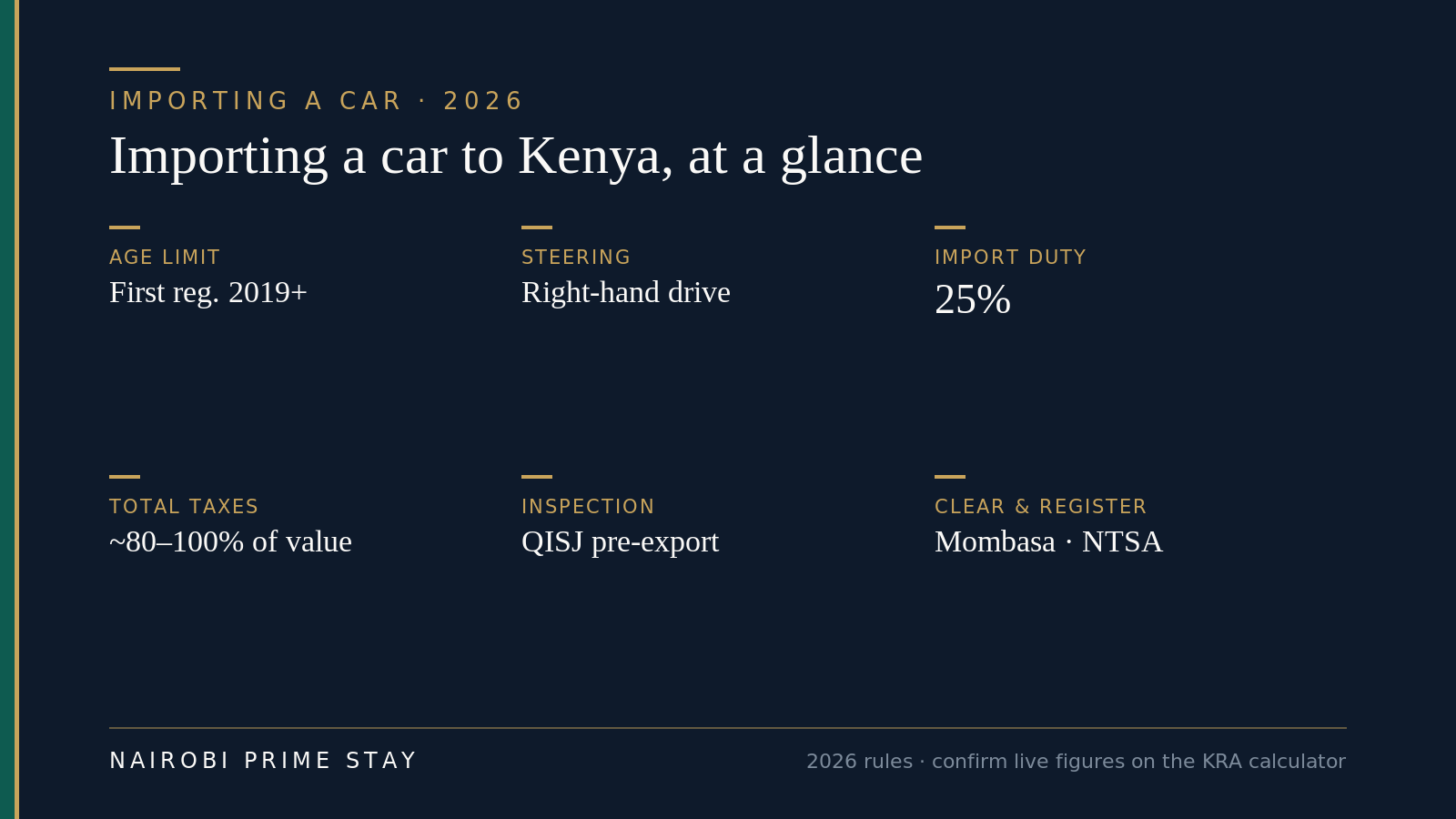 The rules and the rough numbers at a glance — confirm live figures on the KRA calculator.
The two rules that decide what you can import
Before you fall for a listing, check these. They’re not negotiable, and they’re the most common reason an import goes wrong.
The 8-year rule: it must be first registered in 2019 or later
Kenya bans the import of any vehicle more than 8 years old, counted from its year of first registration — not its model year or its manufacture date. The rule lives in Kenya Standard KS 1515:2000, enforced by the Kenya Bureau of Standards (KEBS).
From 1 January 2026, that means only vehicles first registered on or after 1 January 2019 can be cleared. A car first registered in 2018 or earlier is non-compliant and will be rejected at the port — and sent back at your cost. The window moves forward every January, so a car that’s legal to ship in December may not be in January. Build in a buffer; don’t cut it fine.
It must be right-hand drive
Kenya drives on the left, so imported cars must be right-hand drive (RHD). A left-hand-drive car — the standard in the US — generally cannot be registered for normal road use. Narrow exceptions exist for special vehicles like ambulances, fire engines and certain machinery, with approval, but not for an ordinary family car.
This is the single biggest reason importing your American car rarely works: it’s almost certainly left-hand drive. Expats who import instead buy a fresh RHD car from Japan, the UK, the UAE, Thailand, Singapore or South Africa — markets that drive on the left and export to Kenya routinely.
Every car is inspected before it ships
Kenya requires a pre-export inspection in the country of origin, and the car ships with a Certificate of Roadworthiness (CoR). KEBS contracts this to Quality Inspection Services Japan (QISJ), which inspects in the main export markets (Japan, the UK, the UAE, Thailand, Singapore and South Africa). The check covers roadworthiness, mileage and the age rule. No certificate, no clearance — so buy from an exporter who handles QISJ inspection as standard. Reputable Japanese exporters do this every day.
How Kenya’s car-import taxes stack up
Kenya taxes imported cars heavily, and the taxes compound — each one is charged on the running total, not just the car’s price. Here’s the order, with 2026 rates published by the KRA.
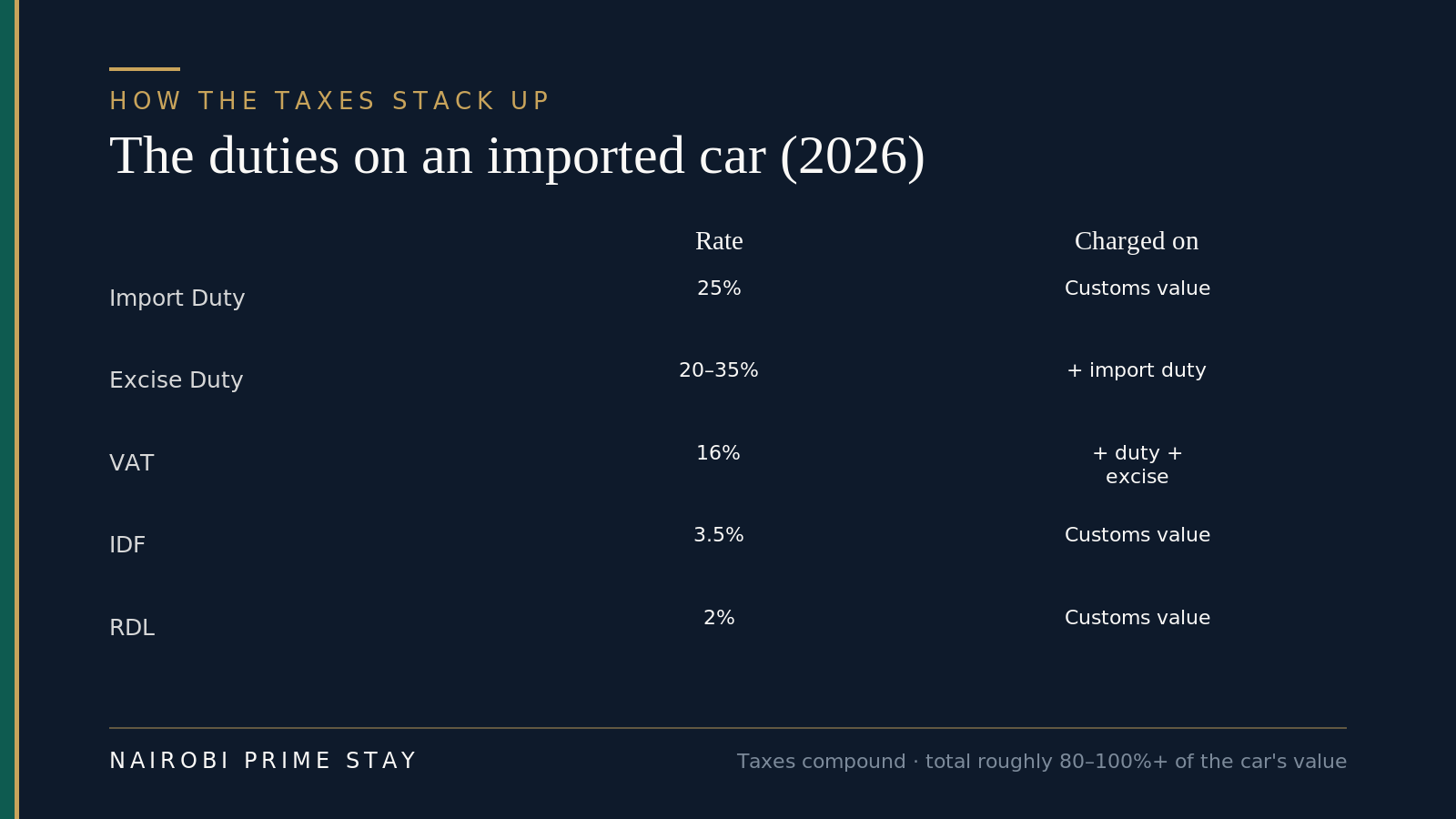 The taxes compound — each is charged on the running total. Confirm your car’s figures on the KRA calculator.
The taxes, in the order they’re applied:
- Import Duty — 25% of the customs value. (Ambulances and hearses: 0%.)
- Excise Duty — usually 20% or 25%, charged on (customs value + import duty), by engine type and size. Most imported cars sit in these two bands; the largest engines have historically attracted up to 35%, so confirm your car’s exact rate:
- Petrol 1,000–1,500cc: 20%
- Petrol 1,500–3,000cc: 25%
- Petrol over 3,000cc: 35%
- Diesel up to 2,500cc: 25%
- Diesel over 2,500cc: 35%
- Hybrids (petrol or diesel + electric): 25%
- Fully electric: 10%
- VAT — 16%, charged on (customs value + import duty + excise duty).
- Import Declaration Fee (IDF) — 3.5% of the customs value.
- Railway Development Levy (RDL) — 2% of the customs value.
What is “customs value”? The CRSP, explained
KRA doesn’t simply tax what you paid. It values your car using its Current Retail Selling Price (CRSP) — a database of new-car prices — then depreciates for the car’s age, and compares that to your invoice. It taxes the higher of the two. So a suspiciously cheap invoice won’t lower your bill; the CRSP sets the floor. The depreciation grows with age: an eight-year-old car — the oldest you can import — gets the maximum discount, around 65% off the new-car CRSP, while a nearly new one barely depreciates. An older but still-compliant car is therefore taxed on a much smaller base.
Here’s the catch in 2026: which CRSP applies is itself unsettled. KRA published a new CRSP schedule meant to take effect on 1 July 2025, expanding the list from about 3,000 to over 5,200 models and raising the assessed value of many cars. Importers challenged it, and the High Court suspended the new list, so KRA reverted to the older (2019/2020) CRSP while the case is heard. The practical upshot: don’t assume either figure. Run your exact car through a current KRA-based import duty calculator close to when you ship, and ask your clearing agent which schedule KRA is applying that week — it can move your total tax by a lot.
A worked example
Say KRA assigns your car a customs value of KES 1,500,000 (about $11,600 at roughly 129–130 KES/$ in mid-2026 — see our USD–KES currency guide), and it’s an 1,800cc petrol SUV — so 25% excise. The taxes work out roughly like this:
| Tax | Rate | Charged on (KES) | Amount (KES) |
|---|---|---|---|
| Import Duty | 25% | 1,500,000 | 375,000 |
| Excise Duty | 25% | 1,875,000 | 468,750 |
| VAT | 16% | 2,343,750 | 375,000 |
| IDF | 3.5% | 1,500,000 | 52,500 |
| RDL | 2% | 1,500,000 | 30,000 |
| Total taxes | ~1,301,250 |
That’s about 87% of the customs value in taxes alone — before shipping, the agent or registration. Smaller engines land closer to 80%; anything over 3,000cc, or a large diesel (35% excise), can push the tax bill past 100% of the car’s value. This is the number that surprises people, so run your specific car through a calculator first.
Can you import a car duty-free? (UN, diplomats and returning residents)
Here’s the part that changes the math for a lot of our readers: some people don’t pay these taxes at all. Kenya grants duty-free vehicle import to a few categories, and two of them map directly onto people moving to Nairobi. Qualify, and you skip import duty, excise and VAT on one car — easily KES 1–2 million saved. Don’t, and you pay the full stack above. It’s worth knowing which side of the line you’re on before you ship anything.
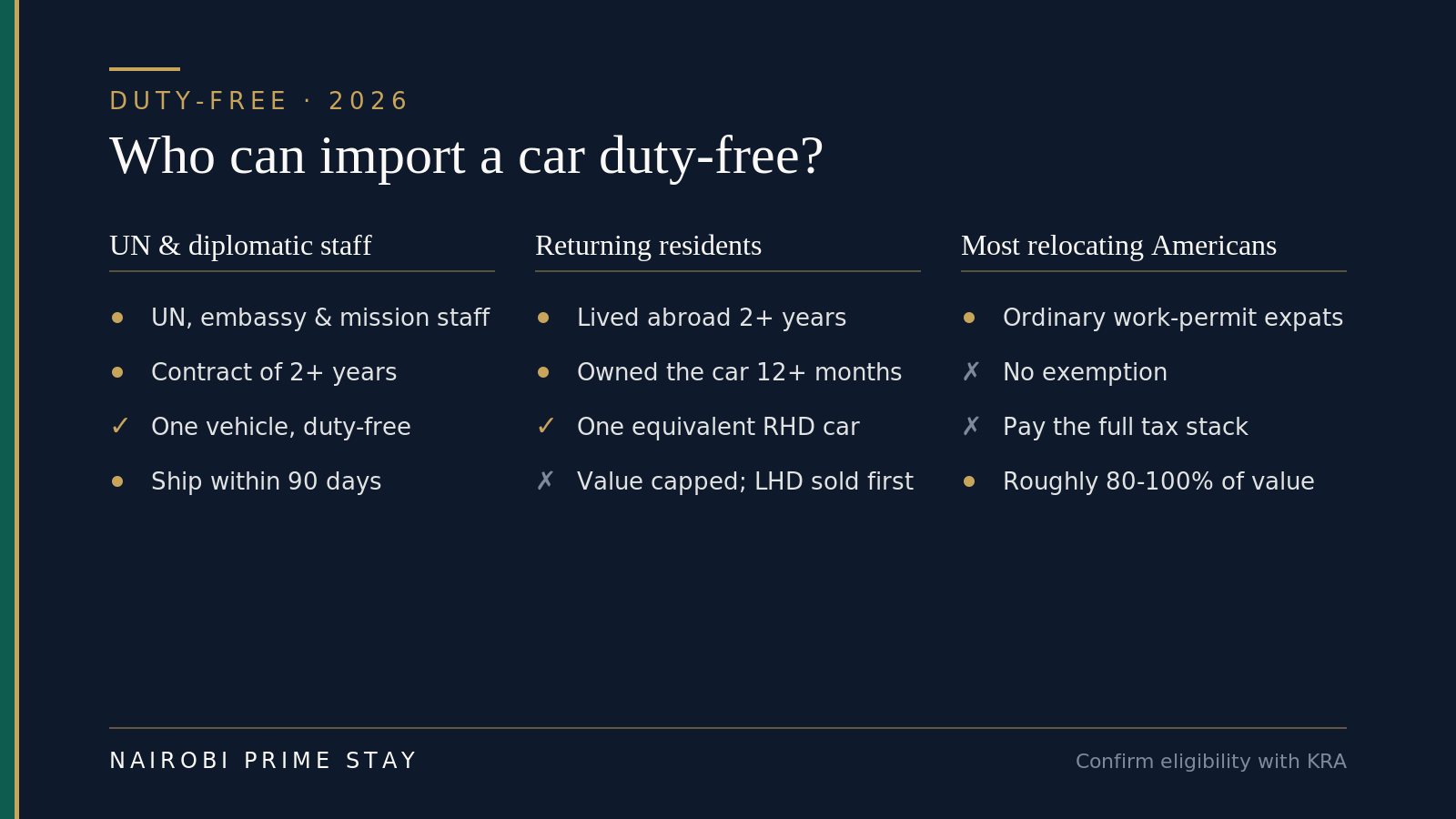 Three buckets — and most ordinary expats fall in the third. Confirm your eligibility with KRA.
UN, embassy and diplomatic staff
If you’re posted to Nairobi with the UN, a specialized agency, an embassy, a high commission or a diplomatic mission, Kenya’s “first arrival” and diplomatic privileges let you bring one motor vehicle free of import duty, excise and VAT — provided your contract runs at least two years. You ship the car (and your household effects) within 90 days of arriving, extendable up to 360 days with the Commissioner’s approval. Given how much of Nairobi’s expat community is UN and diplomatic — see where UN staff live in Nairobi and our guide to embassy and UN housing — this is the most common duty-free route here. Your employer’s admin or HR team usually handles the paperwork, but the car still has to be right-hand drive and meet the 8-year rule.
Returning residents
The returning-resident exemption covers people changing their residence to Kenya after living abroad, and it’s not limited to Kenyan citizens — a genuine relocation can qualify. The headline conditions, as of 2026:
- You’ve resided outside Kenya for at least two continuous years, with only short visits home.
- You owned and used the vehicle for at least 12 months before you return.
- You clear the car within 90 days of arriving.
- It’s still right-hand drive and within the 8-year limit — no exceptions.
- You get the exemption on one vehicle, and only once every four years.
There’s a specific path for people coming from a left-hand-drive country like the US: you can’t bring your American (LHD) car, but you may import one equivalent right-hand-drive car duty-free instead — provided you prove you sold or transferred the old LHD car before moving, and the replacement’s value doesn’t exceed that of the car you disposed of. It’s a fair rule once you see the logic, but the paperwork is exacting and KRA scrutinizes these claims, so line up an experienced clearing agent early.
Everyone else pays full duty
If you’re an ordinary expat on a work permit — most relocating Americans — you don’t get an exemption. You pay the full 80–100%+ tax stack on any car you import, exactly as above. That’s not a reason to give up; it’s a reason to price the all-in cost honestly and compare it against a car that’s already sitting on a Nairobi lot.
A caveat that covers all of these: “duty-free” rarely means “free.” You can still owe minor port and administrative levies, and you always need a clearing agent, the right documents and an RHD car under eight years old. Treat the exemption as a question to settle with KRA and your agent before you commit, not an assumption — the official rules live on KRA’s returning-residents and diplomatic-privileges pages at kra.go.ke.
How importing actually works, step by step
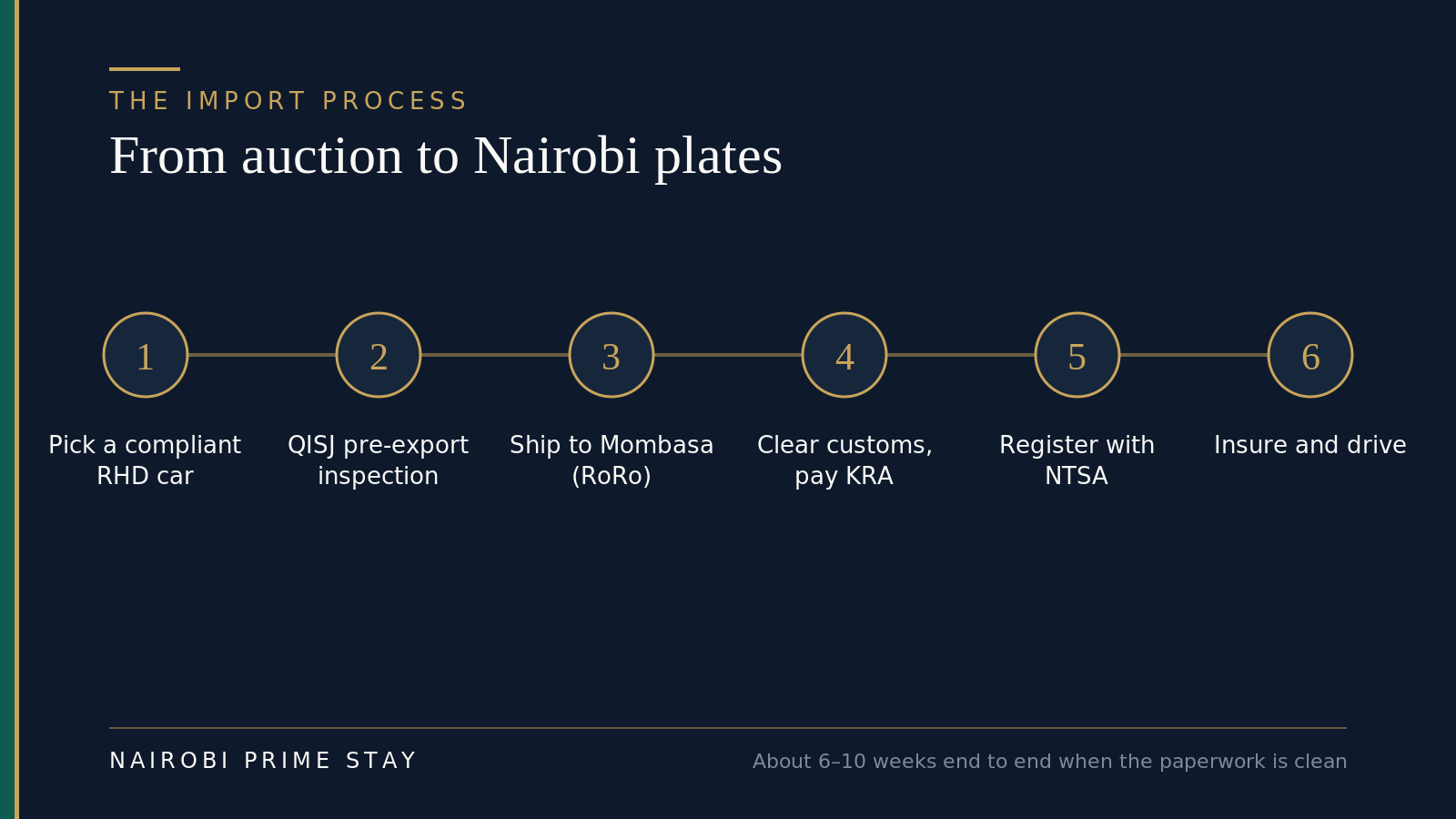 From a Japanese auction to Nairobi plates — the path most imports follow.
- Pick a compliant car. Right-hand drive, first registered 2019 or later, from a reputable exporter who arranges QISJ inspection. Check the CRSP and run the taxes before you pay.
- Pre-export inspection (QISJ). The exporter books it; the car ships with its Certificate of Roadworthiness.
- Ship to Mombasa. Most cars come by roll-on/roll-off (RoRo) or in a container, usually from Japan. Sea freight runs roughly 4–6 weeks.
- Clear customs at the port. Your clearing agent files the entry, KRA assesses the taxes off the CRSP, and you pay. Port and handling charges apply on top.
- Register with NTSA. The National Transport and Safety Authority issues your Kenyan logbook and number plates, using the original (cancelled) foreign logbook.
- Insure and drive. Third-party cover is the legal minimum; comprehensive is strongly advised. Then it’s yours.
Clearing agents, timelines and the extra costs
Use a licensed clearing agent — it’s effectively required, and a good one saves you far more than the fee in avoided delays and demurrage. Expect to pay the agent somewhere around KES 30,000–80,000 for a standard car clearance; quotes vary, so get two or three.
Beyond the taxes and the agent, budget for port and handling charges. These commonly include port and SGR/handling charges (often around KES 100,000–120,000), a verification fee (about KES 15,000), an Interpol check (about KES 15,000) and small levies. These are indicative 2026 figures — your agent will give you the current schedule.
Many imports don’t actually clear at the coast. Your car can be loaded onto the standard-gauge railway (SGR) at Mombasa and railed to the Inland Container Depot (ICD) in Embakasi, on the edge of Nairobi, where your agent clears it — so you collect it in the city rather than driving to the port. That’s where the SGR/handling line in your quote comes from.
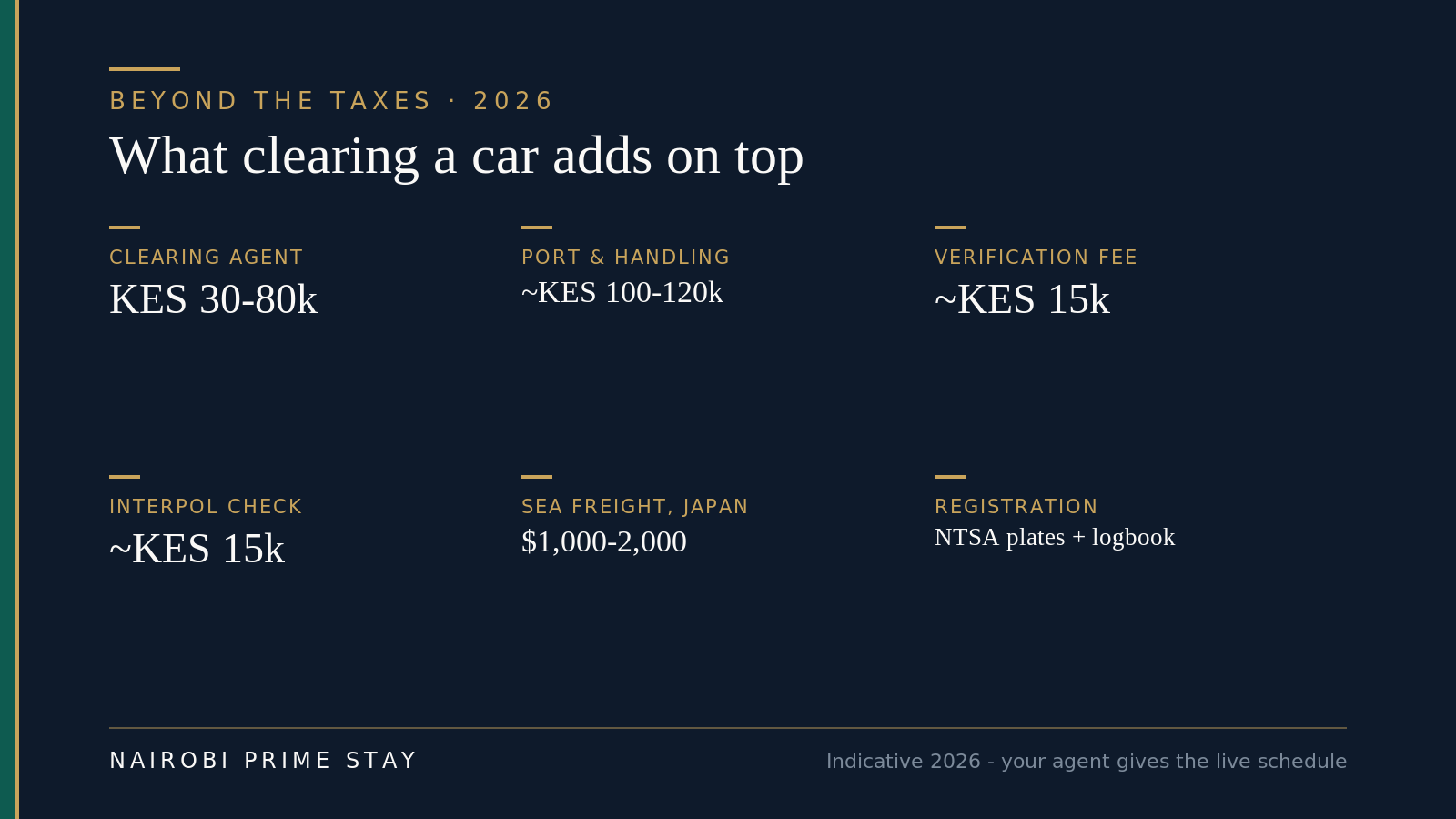 The line items beyond the tax stack — indicative 2026 figures; your agent gives the live schedule.
Timeline, end to end: from buying in Japan to driving in Nairobi, plan on roughly 6–10 weeks — about 4–6 weeks shipping, plus 1–2 weeks to clear and register if your paperwork is clean. Missing or wrong documents are what cause the expensive delays (and storage charges), so get them right up front.
The documents you’ll need
- Original commercial invoice
- Original logbook from the export country, cancelled in the country of origin (NTSA needs this to issue your Kenyan logbook)
- Original bill of lading
- Pre-shipment inspection certificate (the Certificate of Roadworthiness)
- A copy of your KRA PIN certificate
You’ll need a KRA PIN to import and register a car — the same tax ID you use to open a bank account, sign a lease or file your Kenyan taxes. It’s an early-priority errand when you arrive; our complete guide to moving to Nairobi covers the sequence. If you’re also shipping your household, our guide to shipping your belongings to Kenya walks through that side.
Import it yourself, or buy from a Nairobi car yard?
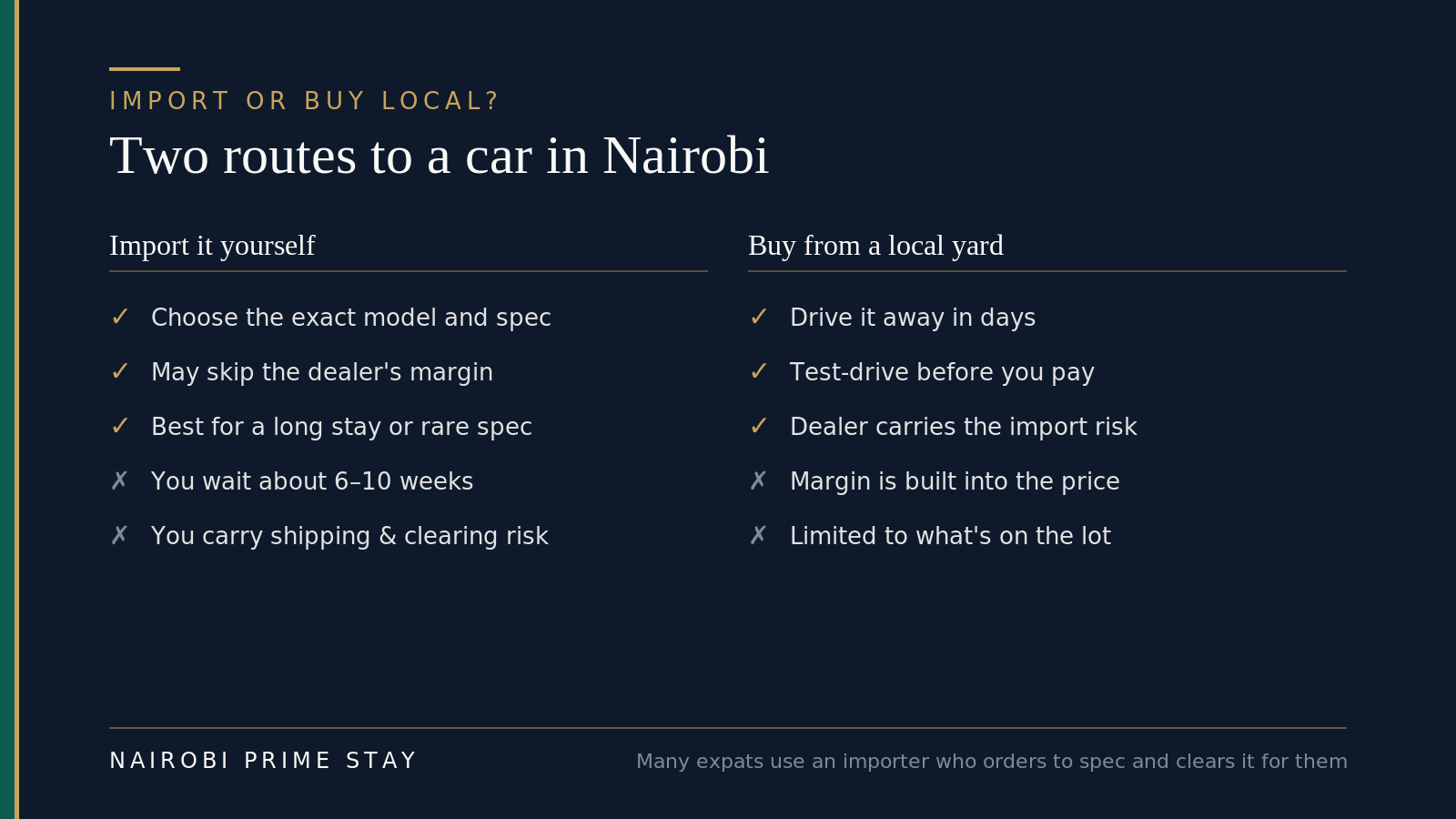 Neither is “right” for everyone — it comes down to time, control and appetite for risk.
The honest version: for most expats, buying locally is the simpler choice, and it’s often no more expensive. A Nairobi car yard has already imported the car, paid every tax above and added a margin — but they’ve also absorbed the risk, the wait and the paperwork, and you can test-drive the actual car today.
Importing wins when you want a specific model, mileage or spec that’s hard to find locally, you’re confident about the taxes, and you’re staying long enough to make the effort worthwhile. Buying locally wins when you want the car now, you’d rather inspect before you pay, and you don’t want shipping or clearing risk while you’re still finding your feet.
A middle path many expats take: buy from a local importer who orders to spec. You get a fresh import chosen to your brief, but they carry the clearing risk and hand you a registered car. You pay a margin for that — usually worth it for your first car in a new country.
| Import it yourself | Buy from a local yard | |
|---|---|---|
| Price | Sometimes lower; you skip the dealer margin | Margin included, but no surprises |
| Speed | About 6–10 weeks | Same day to a few days |
| Choice | Any compliant car worldwide | What’s on the lot |
| Risk | You carry shipping, taxes, clearing | Dealer carries it |
| Inspect first | No — you buy on photos and a report | Yes — test-drive it |
| Best for | A specific spec, a long stay | Most expats, a first car |
For the local-buying side — car bazaars, price-checking, the NTSA logbook transfer and dodging fake-logbook scams — see our dedicated guide to buying a car in Nairobi.
The cars that make sense here
Whatever you choose, buy what Nairobi can fix. Toyota is king because parts and mechanics are everywhere and resale is strong. The used favorites:
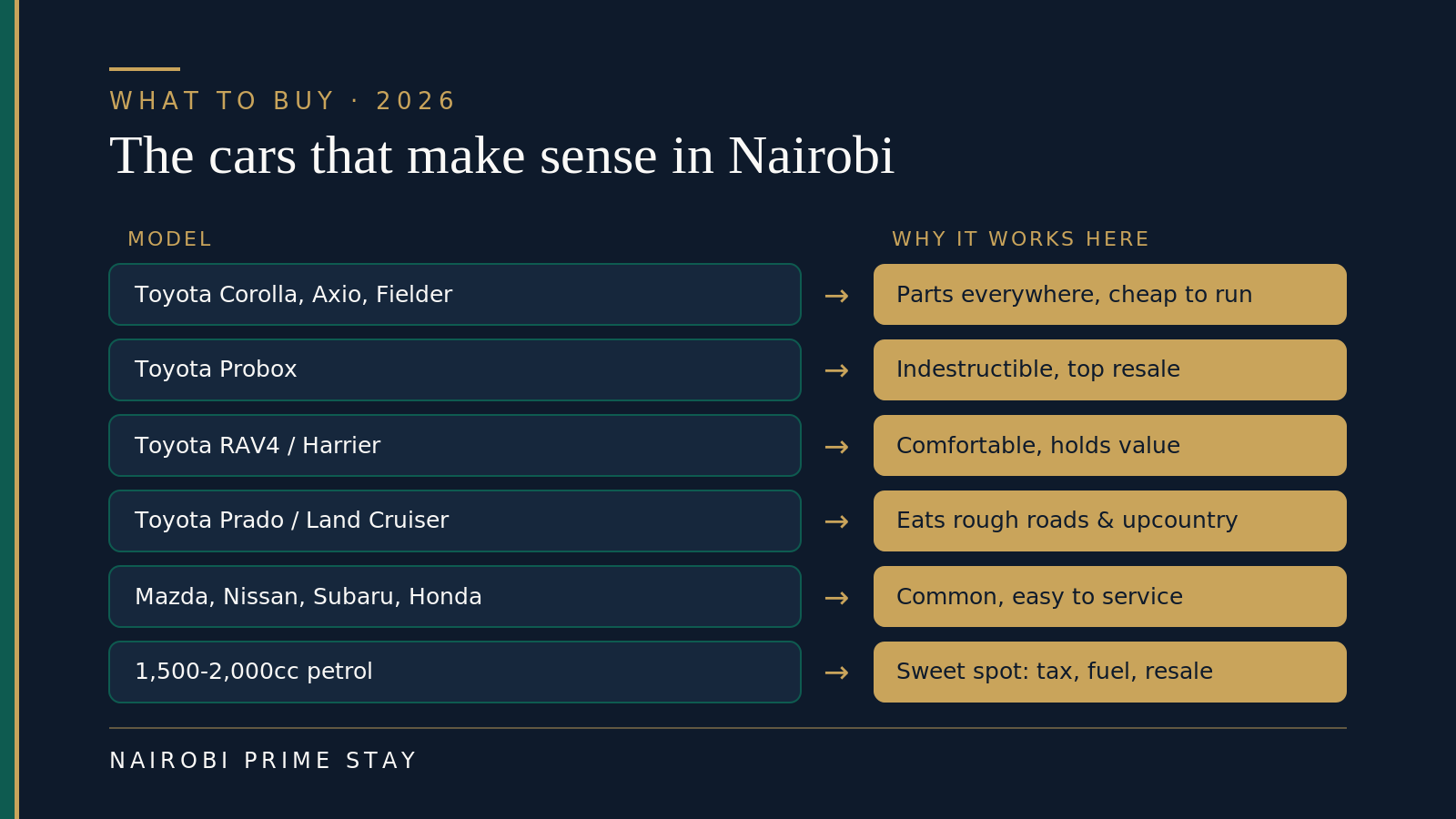 Buy what the city can service — Toyota leads on parts, mechanics and resale.
| Model | Type | Why it works here |
|---|---|---|
| Toyota Corolla / Axio / Fielder | Compact sedan / wagon | Cheap to run, parts on every corner |
| Toyota Probox | Workhorse wagon | Nearly indestructible; legendary resale |
| Toyota RAV4 / Harrier | Crossover SUV | Comfortable, popular, holds value |
| Toyota Prado / Land Cruiser | Full SUV | Eats rough roads and trips upcountry |
| Mazda Demio / CX-5 | Hatch / SUV | Efficient, well-priced |
| Nissan X-Trail / Note | SUV / hatch | Common, easy to service |
| Subaru Forester / Outback | AWD wagon | Loved for grip; slightly higher upkeep |
| Honda Fit / CR-V | Hatch / SUV | Reliable, economical |
Diesel and big engines cost more in tax (35% excise over 2,500cc diesel or 3,000cc petrol) and more at the pump. A 1,500–2,000cc petrol Toyota is the sweet spot for cost, tax and resale.
A real scenario
Say you’re moving for a two-year posting with two school-age kids in Karen. You want a 7-seater for the school run and weekend trips to Naivasha. You could import a 2019 Toyota Prado from Japan — clean, low mileage, exactly the spec you want — but with a big engine the taxes are steep and you’ll wait two months while you’re still settling in. The pragmatic move: spend your first weeks on ride-hailing from a serviced apartment, then buy a locally-available Prado or RAV4 from a trusted importer once you know your routine — and skip the shipping risk entirely. If you were staying five years and wanted a rare spec, importing would tip the other way.
Before you import: a checklist
- Confirm the car is right-hand drive and first registered 2019 or later (the 2026 rule).
- Look up the car’s CRSP value and run the full tax stack on a KRA calculator.
- Budget 80–100%+ of customs value in taxes, plus shipping, agent and port fees.
- Buy only from an exporter who arranges QISJ pre-export inspection.
- Register your KRA PIN before the car arrives.
- Line up a licensed clearing agent and get two or three quotes.
- Gather the documents: invoice, original cancelled logbook, bill of lading, roadworthiness certificate, PIN.
- Arrange insurance (third-party minimum; comprehensive advised) before you drive.
- Compare the all-in import cost against the same car on a Nairobi lot before committing.
Frequently asked questions
Can a foreigner import a car to Kenya?
Yes. You don’t need to be a Kenyan citizen to import a car, but you do need a KRA PIN (Kenya’s tax ID) to clear and register it, and you pay the full import taxes. The car must also meet Kenya’s rules: right-hand drive and less than 8 years old from its year of first registration.
What is Kenya’s 8-year rule for importing cars?
Kenya only allows imports of vehicles up to 8 years old, counted from the year of first registration rather than the model year. From 1 January 2026, the car must have been first registered in 2019 or later. Older cars are rejected at the port, and the cut-off moves forward every January.
How much does it cost in taxes to import a car to Kenya?
The taxes stack: import duty 25%, excise duty 20-35% (by engine type and size), VAT 16%, an import declaration fee of 3.5% and a railway levy of 2%, all calculated on the customs value KRA sets from its CRSP price list. As a rule of thumb, budget roughly 80-100%+ of the car’s customs value in taxes, before shipping and clearing.
Can I import a car to Kenya duty-free?
Some people can. UN, embassy and diplomatic staff on contracts of at least two years can bring one vehicle free of import duty, excise and VAT under Kenya’s first-arrival privileges. Returning residents who lived abroad for at least two years and owned the car for 12 or more months can import one equivalent right-hand-drive vehicle duty-free, subject to conditions. Most expats on ordinary work permits get no exemption and pay the full taxes. Confirm your eligibility with KRA and a clearing agent before you ship.
Is Kenya’s new CRSP car valuation in force in 2026?
Not straightforwardly. KRA’s new CRSP schedule, due on 1 July 2025, was challenged in court and the High Court suspended it, so KRA fell back to the older (2019/2020) list while the case is heard. Because the valuation basis can shift, run your exact car through a current KRA import duty calculator close to shipping, and ask your clearing agent which schedule KRA is applying.
How much does it cost to ship a car from Japan to Kenya?
Sea freight from Japan to Mombasa typically runs about $1,000 to $2,000, depending on the car’s size and whether it travels roll-on/roll-off or in a container. That’s separate from the import taxes and from clearing costs — budget another roughly KES 150,000 to 250,000 for the clearing agent, port and handling, verification and Interpol checks. Get a couple of quotes, as rates vary.
Is it cheaper to import a car or buy one locally in Nairobi?
Often it is about the same. A local car yard has already paid the import taxes and added a margin, but it carries the risk and you can inspect the car today. Importing can save the dealer’s margin and lets you choose the exact spec, but you wait about 6-10 weeks and take on the shipping and clearing risk yourself.
How long does it take to import a car to Kenya?
Plan on roughly 6-10 weeks from buying in Japan to driving in Nairobi: about 4-6 weeks of sea freight, plus 1-2 weeks to clear customs at Mombasa and register with NTSA if your documents are in order. Missing paperwork is the main cause of costly delays and storage charges.
Can I import a left-hand-drive car to Kenya?
No, not for normal road use. Kenya drives on the left and requires right-hand-drive vehicles, so left-hand-drive cars generally cannot be registered, with narrow exceptions for special vehicles like ambulances and fire engines. This is why most Americans cannot bring their own car and buy a right-hand-drive car from Japan or the UK instead.
What documents do I need to import a car to Kenya?
You need the original commercial invoice, the original logbook from the export country (cancelled there), the original bill of lading, the pre-shipment Certificate of Roadworthiness from the KEBS-appointed inspector (QISJ), and a copy of your KRA PIN certificate. Your clearing agent uses these to clear the car, and NTSA uses the old logbook to issue a Kenyan one.
Which used cars are most reliable and affordable to run in Kenya?
Toyota dominates because parts and mechanics are everywhere and resale is strong: the Corolla, Axio, Fielder, Probox, RAV4, Harrier and Prado are all common. Mazda, Nissan, Subaru and Honda are also well supported. A 1,500-2,000cc petrol engine is the sweet spot for tax, fuel and resale.
Final thoughts
Importing a car to Kenya is straightforward once you respect the two rules — right-hand drive, under 8 years old — and go in clear-eyed about the taxes. For a specific car or a long stay, it can be the right call. For most people arriving in Nairobi, buying locally, or buying through an importer who clears it for you, is simpler, faster and rarely costs more. Whichever way you go, price the all-in cost first, use a licensed agent, and never wire money for a car you haven’t had verified.
This is general guidance, not legal or tax advice, and figures move. Confirm the current rates and rules with the KRA and your clearing agent before you commit.
Related reading
- Moving to Nairobi: the complete guide — the hub that ties your whole move together.
- Driving in Nairobi — licences, converting your US licence, and the honest road reality.
- Getting around Nairobi — whether you even need a car, and the ride-hailing-first life.
- Buying a car in Nairobi — yards, inspections, logbook transfer and scam-proofing.
- Shipping your belongings to Kenya — the household-goods side of the move.
- Cost of living in Nairobi — where a car fits in a monthly budget.
When you land, keep it simple
A car can wait. From the moment you land at JKIA, Uber and Bolt can cover your first weeks, and a serviced apartment gives you a secure base with Wi-Fi, cleaning and backup power while you test commutes and decide whether you even need to drive. Browse our serviced apartments, or let our AI relocation assistant shortlist a neighbourhood and a soft-landing stay in a couple of minutes.
Ready to look?
Find your apartment in Nairobi
Browse verified serviced apartments, or ask the AI concierge which area fits your life.