
Guides · Transport
Getting Around Nairobi: Transport Options Explained (2026)
Getting Around Nairobi: Transport Options Explained (2026)
Most newcomers get around Nairobi the same way: they open Uber or Bolt and ride. It’s the default for a reason — it’s cheap by US standards, you pay by phone, and you skip the two hardest parts of driving here, which are the traffic and the parking. Plenty of expats live in Nairobi for a year without ever owning a car.
That said, Nairobi gives you real choices, and they’re not equal. A ride-hailing car, a 14-seater matatu, a motorbike taxi and your own car are four very different trade-offs in cost, comfort and safety. Some are a genuinely good idea. One of them — the boda boda — we’ll ask you to think hard about, because the honest risk is higher than the convenience suggests.
This guide is for Americans who’ve just landed, or are about to, and want to know how to move around the city day to day. We’ll cover ride-hailing, matatus, boda bodas, regular taxis, the Nairobi Expressway and its tolls, the reality of walking, and the question everyone asks in month one: do I actually need a car? Prices are 2026 ranges in Kenyan shillings (KES) and US dollars at roughly KES 129.4 to the dollar (the shilling traded near KES 129.4 on 1 July 2026) — treat them as current guidance and check the apps for live fares.
TL;DR: For day-to-day travel in Nairobi, ride-hailing apps — Uber, Bolt and the local Little — are the expat default: safe, cashless (M-Pesa or card), and a few dollars for most city hops. Matatus (shared minibuses, KES 50–150 a trip) are the cheapest option and a real local experience, but take some learning and care. Boda bodas (motorbike taxis) are fast and beat traffic, but Kenya’s road-safety numbers make them the one mode we’d ask you to avoid or use sparingly — always with a helmet. The Nairobi Expressway is a 27 km elevated toll road that skips the worst jams (about KES 170–500 for a car); motorbikes and tuk-tuks aren’t allowed on it. Walking works inside malls and compounds and some leafy suburbs by day, but it isn’t a primary way to cross the city. Many newcomers skip owning a car at first and add one later for school runs, weekends or family life. Traffic — not distance — is the real challenge, so where you live relative to work and school matters more than anything.
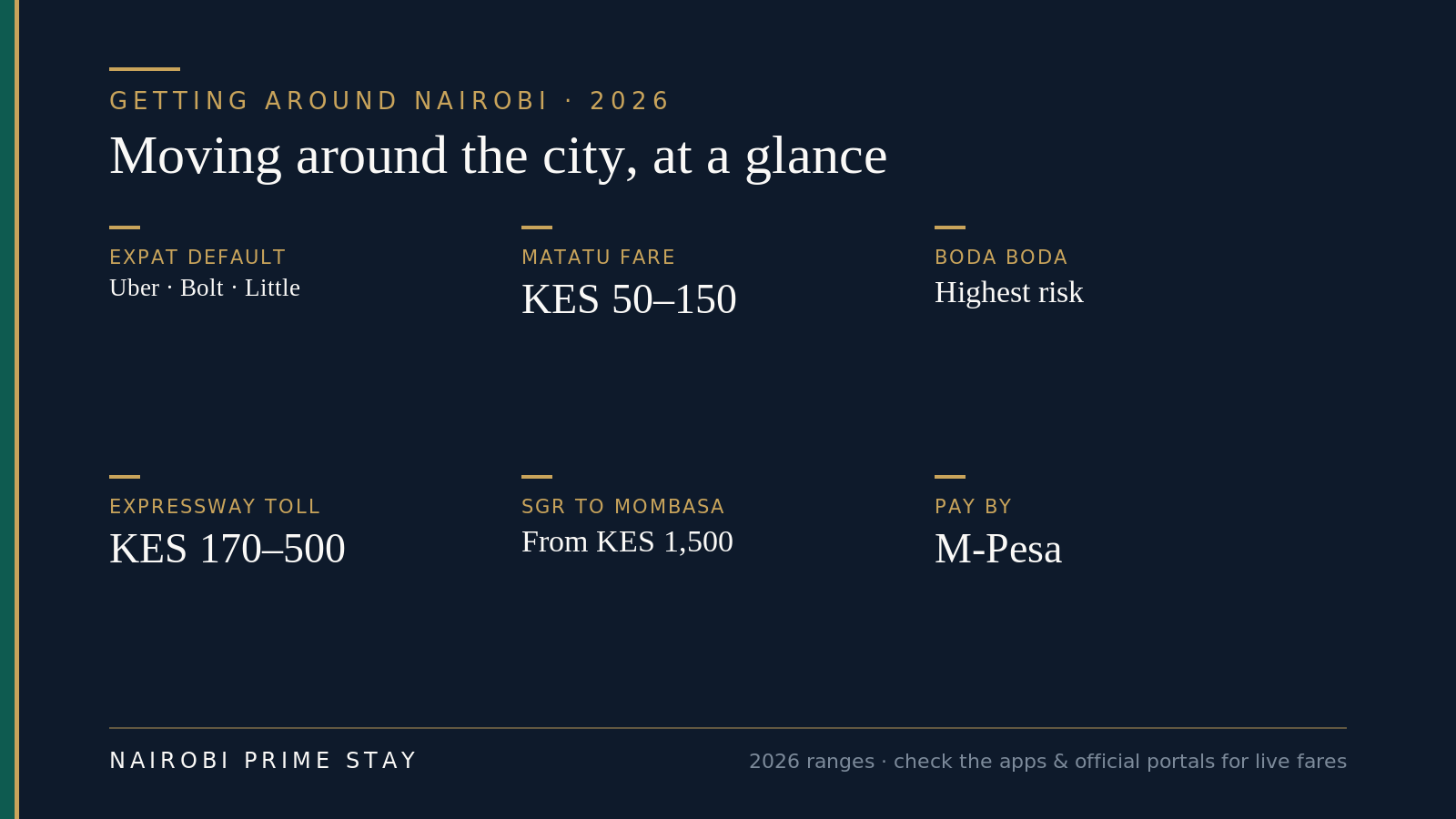 The headline facts for moving around Nairobi in 2026. Fares are ranges in Kenyan shillings — check the apps and official portals for live prices.

Do you even need a car?
Probably not at first, and many expats never get one. Here’s the honest version. If you live and work in the western suburbs and your life is mostly home, office, a few malls and the occasional night out, ride-hailing covers nearly everything for a fraction of what a car costs to run. No insurance, no parking hunt, no sitting in a jam wishing someone else were driving. For your first weeks especially — while you’re still learning the city — leaning on Uber and Bolt is the easy, safe choice.
A car starts to earn its place when your week includes things ride-hailing does badly: a daily school run on a fixed schedule, weekend trips out of town, a home in a quieter outer suburb where cars are scarcer at off-peak hours, or simply a family that doesn’t fit neatly into one sedan several times a day. Owning a car here means real costs — fuel, insurance, servicing, secure parking — and it means driving in Nairobi traffic yourself, which is its own skill. Many families solve it by hiring a driver rather than fighting the jams.
A common pattern works well: arrive, settle into a serviced apartment or rental, use ride-hailing for a month or two while you learn your routes and where you’ll actually live, and only then decide whether a car is worth it. If you do go that way, our companion guides on driving in Nairobi and the costs involved will help — and your choice of neighbourhood will shape the answer more than anything, because the closer you are to work and school, the less a car matters.
Ride-hailing: Uber, Bolt and Little (the expat default)
Ride-hailing is how most expats get around Nairobi, and it’s the first thing to set up. Three apps matter: Uber and Bolt, the two big international players, and Little (Little Cab), a Kenyan-built app that’s strong on airport runs and central areas. Download all three. They compete, so prices and car availability differ trip to trip — it’s normal to check two apps and take whichever is closer or cheaper.
The appeal is simple. You see the price and the driver before you book, you can share your trip with someone, and you pay by M-Pesa, card or cash — no haggling. For an American used to Uber at home, it works exactly as you’d expect, just much cheaper. A typical short hop across the western suburbs runs a few dollars; a longer cross-town trip in traffic is still usually under ten.
A few things are worth knowing. Kenyan law sets a minimum fare (around KES 300) and, after driver protests in late 2025, the government ordered the apps to raise per-kilometre rates by roughly half toward the Automobile Association of Kenya’s recommended pricing — so fares crept up over 2025 and may keep nudging upward. Expect a little surge pricing in the rain or at rush hour. Drivers sometimes call to ask your destination or nudge you to pay cash and cancel in-app; you’re free to decline and rebook. Sit in the back, check the car and plate match the app, and you’ll have the same uneventful experience you would anywhere.
There’s also a motorbike version of these apps — Uber Boda, Bolt Boda and local players like Faras — which brings us to the mode that needs the most honesty.
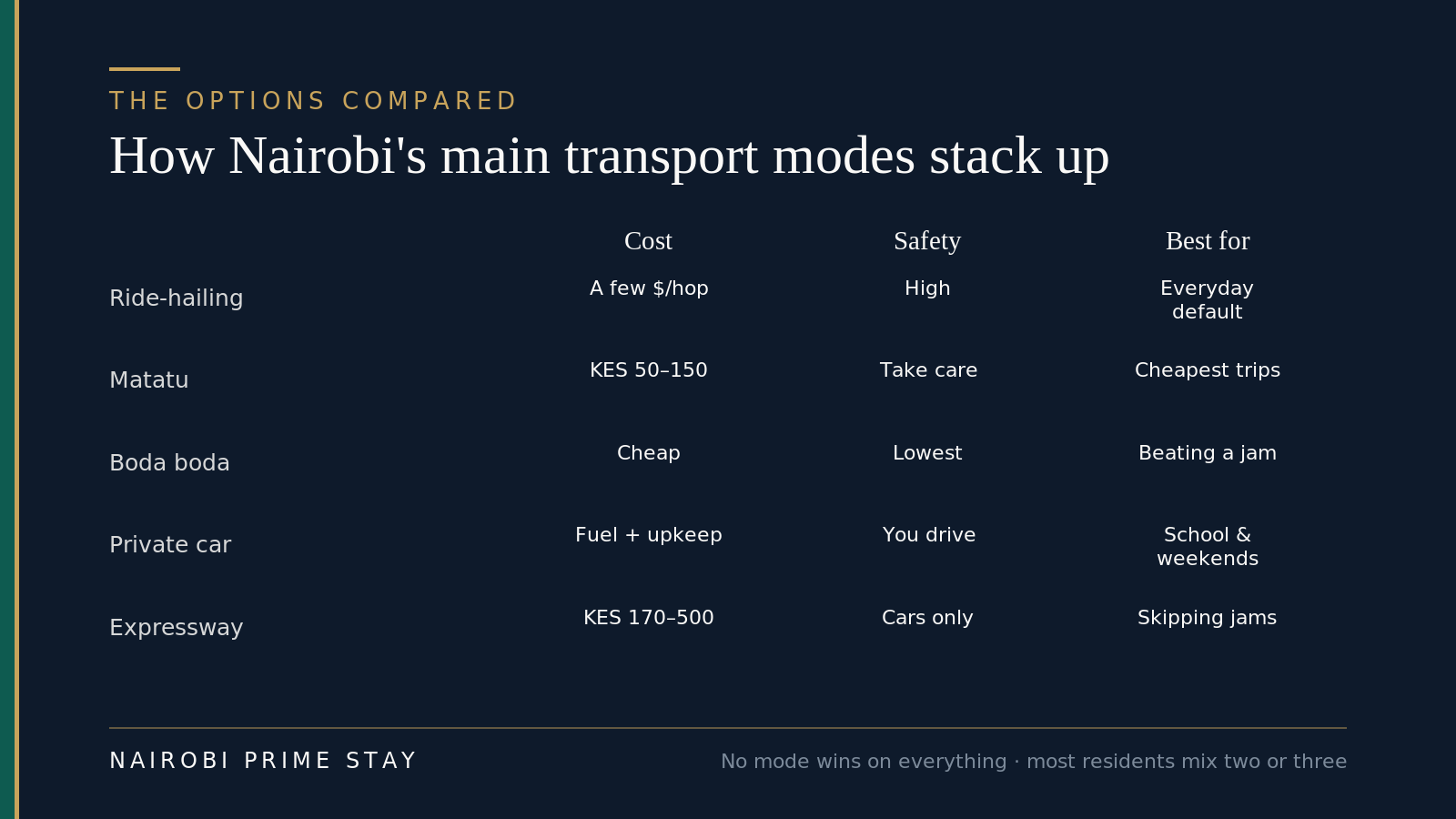 A quick read on the trade-offs. No single mode wins on everything — most residents mix two or three.
Matatus: the cheapest way, and a real local experience
Matatus are Nairobi’s backbone: privately run 14-seater minibuses (and bigger buses) that follow set routes across the city, identified by route numbers and, often, loud paint jobs and sound systems. They’re how most of the city actually moves, and a fare is cheap — roughly KES 50 to 150 a trip depending on distance and time of day, rising a little at rush hour, on weekends and when it rains. You pay the conductor in cash, though many now take M-Pesa too.
For a newcomer, matatus are more of an experience than a default. The upside is obvious: they’re a fraction of any other option, they go almost everywhere, and riding one is a genuine slice of Nairobi life. The learning curve is real, though. Routes aren’t always obvious, stops can be informal, drivers can be aggressive in traffic, and crowded matatus are a known spot for pickpocketing and phone-snatching. Apps like Ma3Route help you figure out routes and live traffic.
If you want to try one, go in daylight, keep your phone and wallet out of sight, carry small change, and ideally go with someone who knows the route the first time. Plenty of expats ride them happily once they’ve settled in; few make them their airport-with-luggage or after-dark choice. For that, an app car is worth the extra few dollars.
Boda bodas: fast, cheap — and the one to think hard about
Boda bodas are motorbike taxis, and they’re everywhere because they do one thing brilliantly: cut straight through gridlock that leaves cars sitting still. For a short trip when you’re late, nothing beats one. They’re also cheap, and the app versions (Uber Boda, Bolt Boda, Faras) give you a set price and a traceable rider.
Here’s the honest part, because it matters more than the convenience. Kenya’s roads are dangerous, and motorbikes carry the sharp end of that risk. National road deaths rose to roughly 5,000 in 2025, up from about 4,750 the year before, and motorcyclist deaths climbed to around 1,270 — with hundreds of boda riders and their passengers killed in just the first eight months of the year. The causes are consistent: speeding, riding at night without lights or reflective gear, skipping helmets, and weaving through traffic. As a passenger you’re exposed, often without a helmet, in fast-moving traffic.
So our advice is plain: treat boda bodas as a last resort, not a habit. If you do take one, use an app rather than a street rider, insist on a helmet (carry your own if you’ll ride often), go in daylight, keep trips short, and skip them in rain or after dark. For most newcomers, the few minutes a boda saves aren’t worth the odds — a Bolt or Uber car gets you there safely for a couple of dollars more. We say the same in our wider Nairobi safety guide.
Regular taxis
Traditional taxis still wait outside malls, hotels and the airport, and they’re a fine backup when your phone’s dead or there’s no signal. The catch is price: without a meter, you negotiate the fare upfront, and a cabbie reading you as a new arrival will often quote high. Agree the number before you get in, and know that it’ll usually beat an app only when no app car is nearby. At the airport especially, a pre-booked transfer or an app pickup is calmer and cheaper than the taxi touts at arrivals — more on that in our JKIA airport guide.
The Nairobi Expressway and tolls
The Nairobi Expressway is a 27 km elevated toll road running from Mlolongo, near Jomo Kenyatta International Airport (JKIA), through the city to Westlands and the James Gichuru junction. It exists for one reason — to let you skip Mombasa Road’s notorious crawl — and on a bad-traffic day it turns an hour-plus slog into a 20-minute glide. For an airport run during rush hour, it’s worth every shilling.
You pay by vehicle class. For a normal saloon car (Class 3), the toll runs from about KES 170 for a short segment to KES 500 end to end, with larger vehicles paying multiples of that. These are the rates gazetted in January 2024 and unchanged through 2026, though tolls can be revised, so check the official figure for your trip. Crucially, motorbikes and tuk-tuks are banned from the Expressway — it’s cars and up only. If your Uber or Bolt takes it, the toll is added to your fare; you can ask the driver to use it or avoid it.
| Trip (saloon car, Class 3) | Indicative toll (2026) |
|---|---|
| Short hop between adjacent interchanges | ~KES 170 |
| Mid-length section | ~KES 250–360 |
| Full length (Mlolongo ↔ Westlands) | ~KES 500 |
| Motorbikes / tuk-tuks | Not permitted |
Rates per the 2024 gazette, unchanged in 2026; confirm current tolls before you rely on them. Pay by electronic tag, manual lane or on the spot.
Walking: real, but limited
Let’s be straight about walking. Within a mall, a gated compound, a leafy stretch of Karen or Gigiri, or a quiet suburban street in daylight, walking is pleasant and normal. Across the city, it isn’t a primary way to get around. Footpaths are patchy or missing on many roads, drivers don’t always yield, and after dark it’s better to take a car than walk even a short distance with a phone in your pocket.
Treat walking as something you do at each end of a ride, not as your commute. If you want a neighbourhood where more of daily life is on foot — a café, a shop, a gym within a short, safe walk — that’s a real factor in choosing where to live, and worth asking about before you sign a lease.
Timing your day: rush hour is the real map
Here is the single most useful thing to understand about moving around Nairobi: the clock matters far more than the map. Two neighbourhoods five kilometres apart can be a ten-minute hop at 11am and a punishing hour at 6pm. Distance barely predicts your journey — timing does.
The peaks are predictable. Mornings clog from roughly 7:00 to 9:30am as the city drives to work and school; evenings from about 5:00 to 8:00pm as it all reverses. Friday evening is the worst window of the week, when the going-home crush overlaps with people heading out. Rain turns any of these into gridlock — budget an extra 30 to 60 minutes on a wet afternoon, and end-of-month paydays add their own snarl as the city goes shopping.
The flip side is that the middle of the day is calm. Roughly 10am to 3pm is your friend for viewings, errands and cross-town meetings, and weekend mornings are quiet before traffic builds. If you have any say over your schedule — and remote workers usually do — steering appointments into those windows changes your whole experience of the city. It is also why where you live relative to work and school is the biggest single lever you have: a short, off-peak commute beats any transport hack.
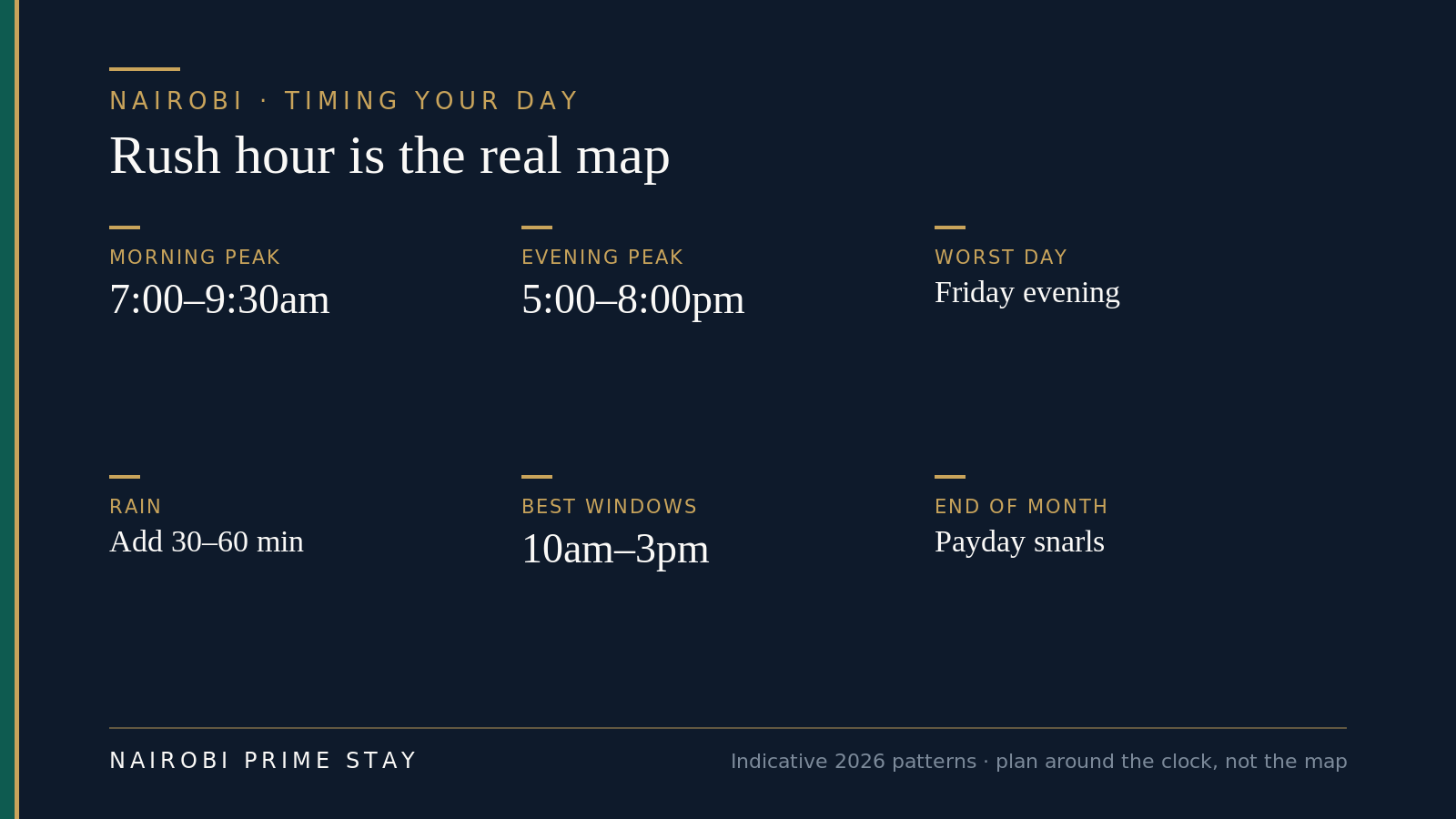 Nairobi runs on the clock, not the map. Steer appointments into the mid-day lull whenever you can.
Getting further afield: trains, flights and weekend trips
Day to day you’ll stay in the city, but it helps to know what’s beyond it. The SGR Madaraka Express is Kenya’s modern standard-gauge train from Nairobi to Mombasa — about 5 to 6 hours over 592 km, with fares from roughly KES 1,500 in economy, KES 4,500 first class, and a premium class above that. It’s comfortable, scenic and far calmer than the highway; book ahead at the official Kenya Railways portal or at the station. There’s also a Nairobi commuter rail with services toward Ngong and Suswa, useful on certain corridors.
For longer hops, domestic flights from Wilson Airport (light aircraft and safari flights) and JKIA (bigger routes) reach the coast and the safari parks quickly. When you’re ready to explore beyond the city, those are your main arteries; for now, just know they’re there.
Buses, the BRT and commuter rail
Beyond matatus, Nairobi has a scattering of public transport worth knowing, even if newcomers rarely lean on it. Larger city buses — brands like Citi Hoppa and the long-running Kenya Bus Service (KBS) — run some corridors more calmly than a matatu, at similar low fares. And the Nairobi commuter rail runs cheap suburban trains toward Ruiru, Embakasi, Syokimau and Kikuyu; on the right corridor at the right hour it can beat the road, though services are limited and not built around expat routes.
You may also have read about Nairobi’s Bus Rapid Transit (BRT) — dedicated bus lanes meant to transform the commute. Be clear on the honest 2026 status: it is still being built, not running. BRT Line 2 along Thika Road has renewed momentum (including a plan for electric buses), and a large EU-funded core line, Line 3, is on the drawing board — but as of mid-2026 there is no BRT line carrying passengers yet. Treat it as a promising future, not a current option. For now, ride-hailing and matatus remain how the city actually moves.
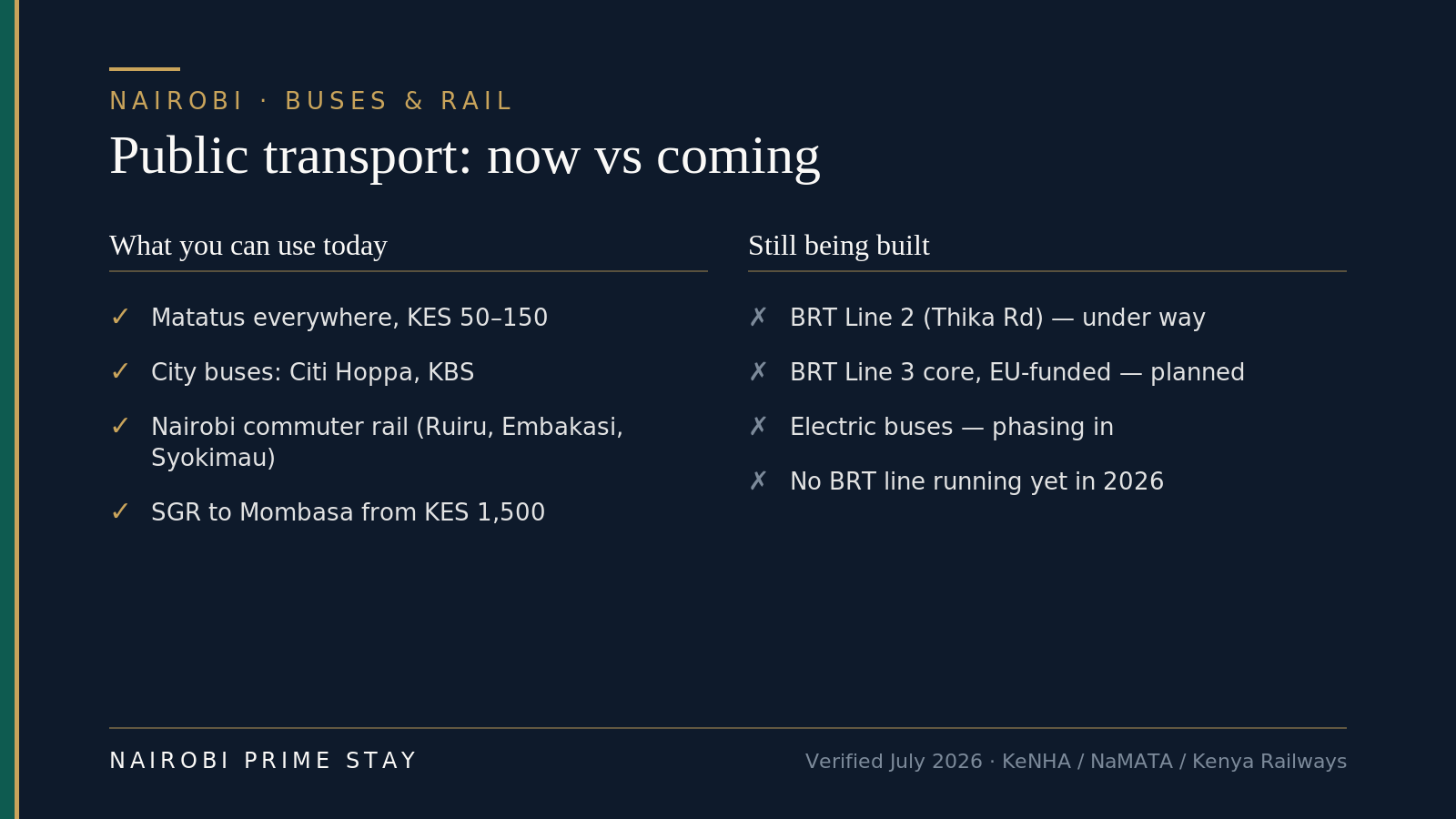 What you can actually use today versus what’s still under construction. The BRT is coming, but it isn’t here yet.
What it costs to get around
Your monthly transport bill depends almost entirely on how you travel. Lean on matatus and you’ll spend very little; live in app cars and it climbs; own and run a car and you trade fares for fuel, insurance and parking. Here’s a realistic picture for a comfortable professional in 2026.
| How you mostly travel | Indicative monthly cost |
|---|---|
| Mostly matatus / public transport | ~KES 3,000–5,000 ($25–40) |
| Daily ride-hailing (Uber / Bolt / Little) | ~KES 15,000–30,000 ($115–230) |
| Owning and running a car (fuel, insurance, servicing) | Varies; fuel + upkeep often $150–350+ |
| Plus a hired driver (optional, common for families) | Add a monthly salary on top |
Indicative 2026 ranges; your mileage, traffic and driving habits move these a lot. Our cost-of-living guide puts transport in the context of a full monthly budget.
For most newcomers, a few hundred dollars a month of ride-hailing buys a car-free, parking-free, stress-light life — which is exactly why so many people here never rush to buy a car.
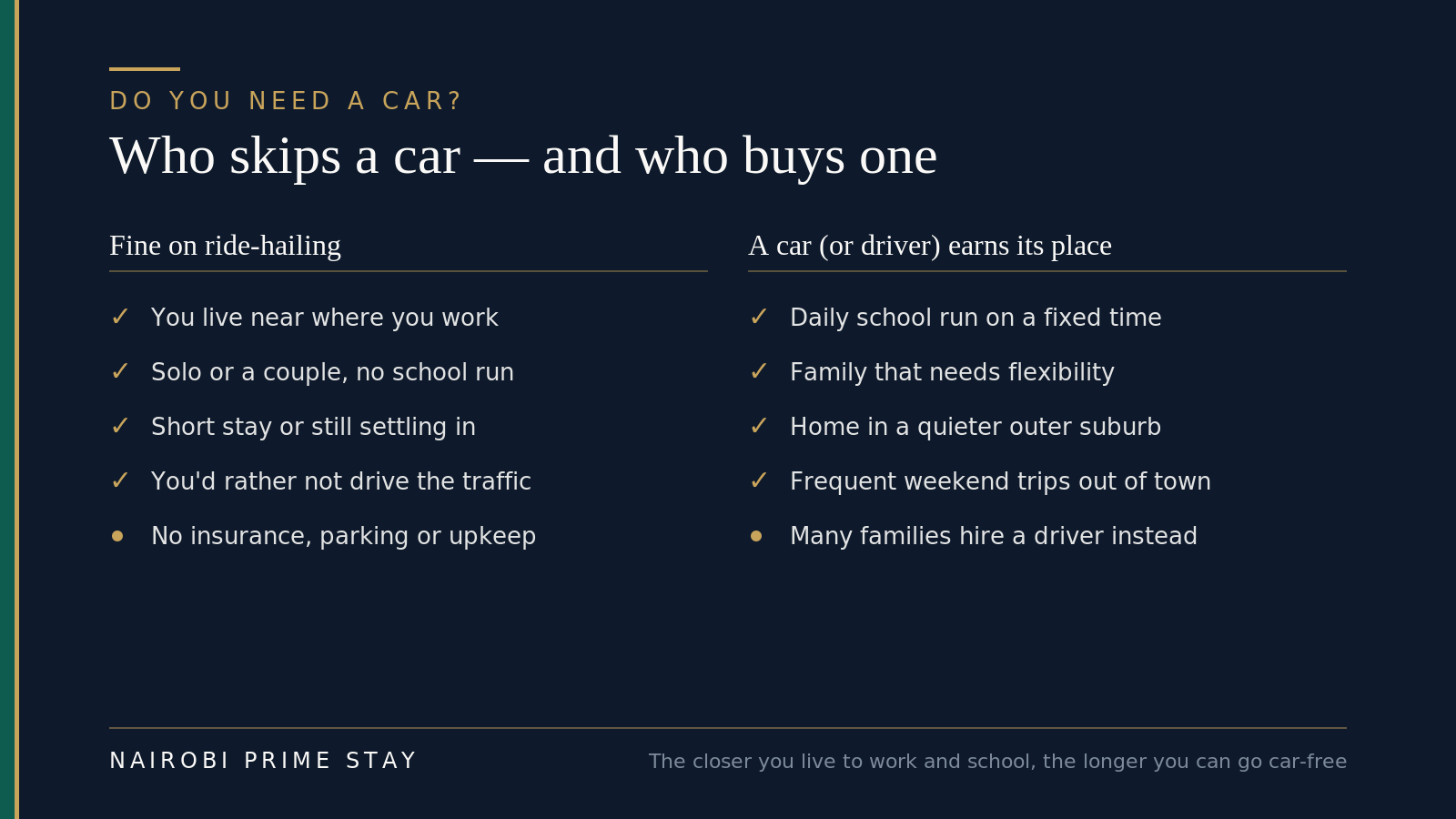 A rough guide to the car question. The closer you live to work and school, the longer you can happily go without one.
A realistic first month
Say you’re a remote worker who’s just landed and taken a serviced apartment in Westlands while you look for a longer-term place. Day one, you buy a Safaricom SIM and set up M-Pesa at the airport, then book a Bolt into town. For the next few weeks, that’s your pattern: Uber or Bolt to viewings, to co-working spaces, to dinner — usually KES 300 to 700 a trip, paid by M-Pesa, no cash, no fuss. You take the Expressway back from a late airport pickup and pay a small toll to skip Mombasa Road.
You try a matatu once, with a colleague, to see what it’s like — fun, cheap, and not something you’d do with a laptop bag after dark. You skip boda bodas after reading the road-safety numbers, except once when you’re badly late and take a Bolt Boda with a helmet, in daylight, for a five-minute hop. By week four you’ve settled on a neighbourhood near your co-working space, decided you don’t need a car yet, and budgeted around KES 20,000 a month for rides. That’s a completely normal Nairobi starting point.
Getting around with kids and car seats
If you are moving with young children, one thing catches American parents off guard: car seats are not standard here. Ride-hailing cars almost never carry one, and neither do matatus or taxis. If you rely on an infant or toddler seat at home — and you should — bring your own, or buy one soon after you arrive, and fit it yourself in whatever car you are in. A compact travel or foldable booster is worth packing for exactly this reason.
The daily school run is the other reality. Most international schools run their own bus services along set routes, which many families use; others hire a private driver for the school-and-activities shuttle, which is far more affordable here than in the US and takes the daily traffic off your plate. Matatus have no seatbelts, and boda bodas are simply not an option with a child — that one is not a judgment call.
For a family, this is often what tips the decision toward owning a car or hiring a driver rather than living on ride-hailing. Our guide to moving to Nairobi with kids covers the school and family-life side in more depth.
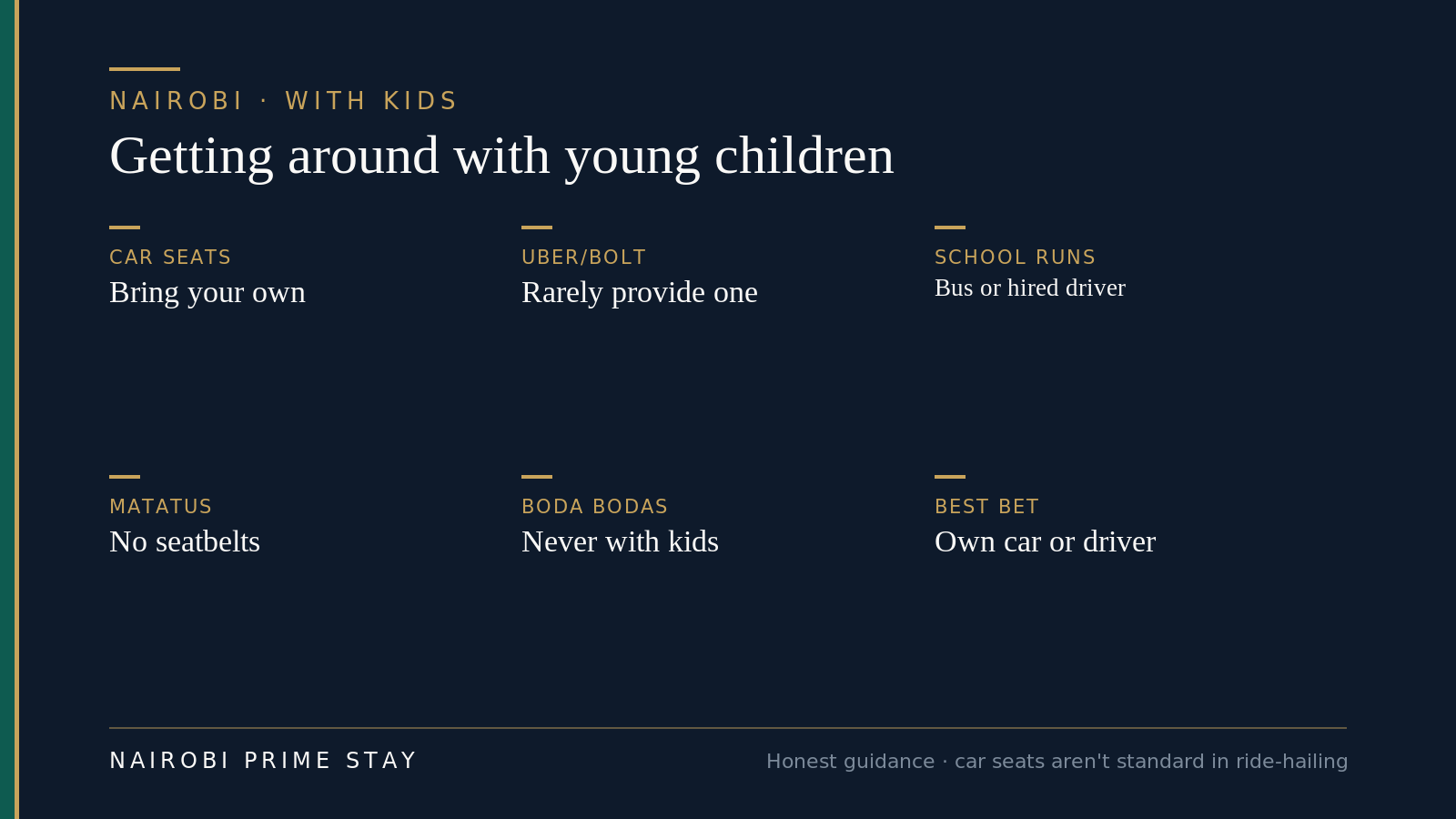 Car seats aren’t standard in Nairobi ride-hailing — bring your own and plan the school run around a bus or a driver.
The honest pros and cons
| Mode | Pros | Cons |
|---|---|---|
| Ride-hailing (Uber/Bolt/Little) | Safe, cashless, priced upfront, everywhere | Surge in rain/rush hour; fares rising; occasional driver friction |
| Matatus | Cheapest by far; go everywhere; local experience | Learning curve; pickpocket risk; aggressive driving; not ideal after dark |
| Boda bodas | Beat traffic; fast; cheap for short hops | Highest safety risk by far; often no helmet; avoid in rain/at night |
| Regular taxis | Reliable backup with no app/signal | Negotiated fares; often pricier; touts at the airport |
| Own car | Freedom, school runs, weekends, family-friendly | Cost, insurance, parking, and you drive the traffic yourself |
| Expressway | Skips the worst jams; fast airport runs | Tolls; cars only (no bikes/tuk-tuks) |
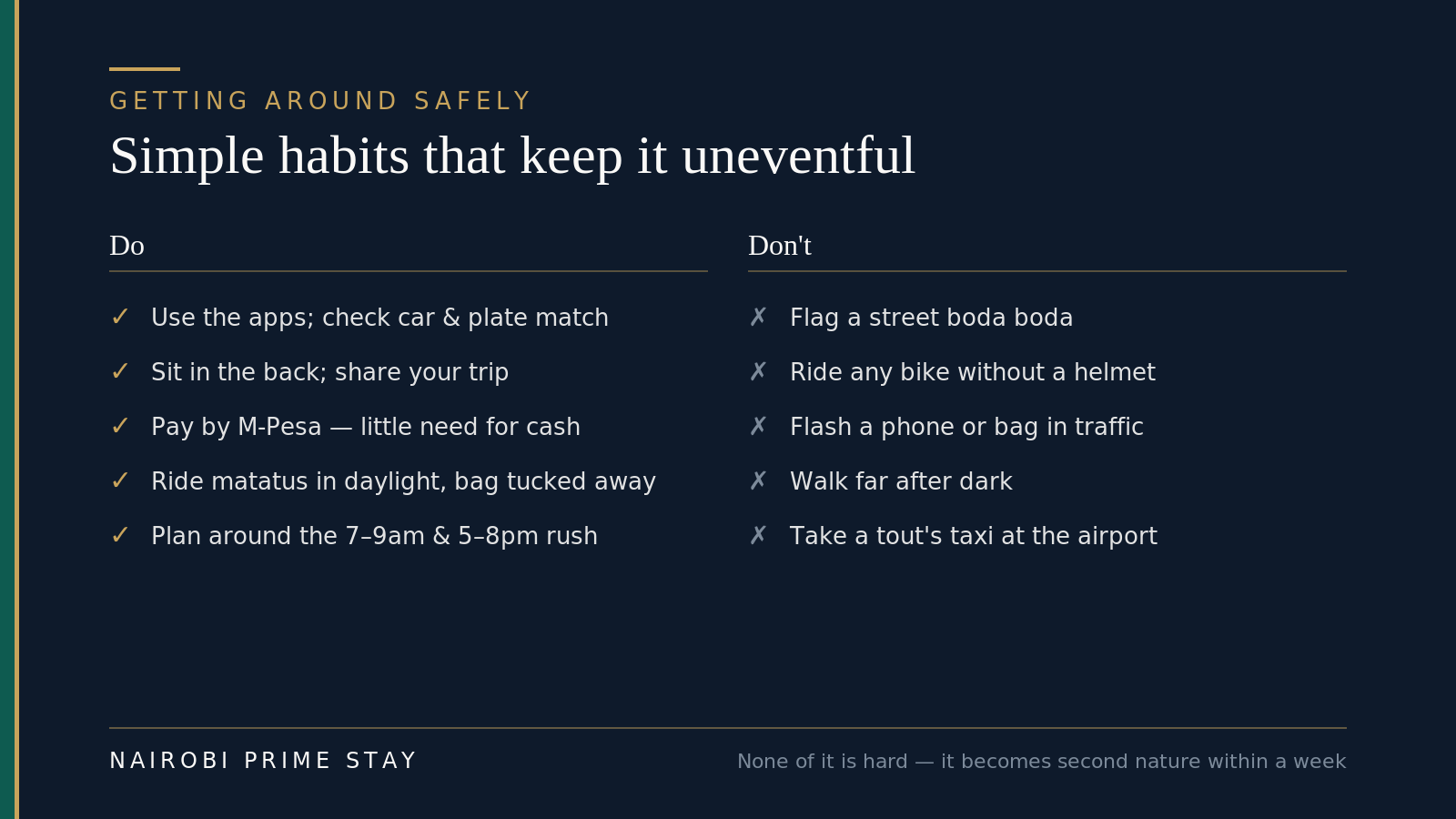 The habits that keep getting around uneventful. None of it is hard — it just becomes second nature fast.
A simple plan for your first weeks
- Buy a Safaricom SIM and set up M-Pesa on arrival (passport needed) — it pays for almost every ride.
- Download Uber, Bolt and Little, and add M-Pesa or a card so you can pay cashless.
- For your airport arrival, use a pre-booked transfer or an app pickup, not a tout; take the Expressway if traffic is bad.
- Make ride-hailing your default for the first month while you learn routes and traffic.
- Try a matatu in daylight with someone who knows the route, phone and wallet tucked away.
- Avoid boda bodas where you can; if you must, use an app, wear a helmet, ride in daylight, keep it short.
- Plan around rush hours (roughly 7–9:30am and 5–8pm) — they’re the real constraint, not distance.
- Decide on a car only after you’ve chosen your neighbourhood and know your weekly pattern.
Frequently asked questions
Do I need a car to live in Nairobi?
Not at first, and many expats never buy one. If you live near where you work and your week is mostly home, office, malls and dinners, ride-hailing covers nearly everything for a few dollars a trip — no insurance, parking or traffic to deal with yourself. A car earns its place if you have a daily school run, take frequent weekend trips, live in an outer suburb, or have a family that needs more flexibility. Most people use ride-hailing for the first month or two, then decide once they know their routine.
Is Uber or Bolt cheaper in Nairobi?
It varies trip to trip, which is why most residents have both apps (plus the local Little) and check whichever is closer or cheaper before booking. Bolt has often been a touch cheaper, but the gap is small and shifts with surge pricing in rain or at rush hour. After driver protests in late 2025, Kenya ordered the apps to raise per-kilometre rates, so fares have crept up across all of them. For most short city hops you’re still looking at a few dollars.
Are Uber and Bolt safe in Nairobi?
Yes, with the same common sense you’d use anywhere. You see the driver, car and plate before booking, can share your trip, and pay cashless by M-Pesa or card, which removes a lot of friction. Check that the car and plate match the app, sit in the back, and decline if a driver asks you to cancel and pay cash off-app. Ride-hailing is the default for expats precisely because it’s the safe, predictable option.
How do I get from JKIA airport into the city?
The easiest options are a pre-booked airport transfer or an app pickup (Uber, Bolt or Little) — both are calmer and usually cheaper than the taxi touts at arrivals. Depending on traffic and where you’re staying, the trip takes roughly 30 to 60-plus minutes, and your driver can take the Nairobi Expressway to skip the worst of Mombasa Road for a small toll. Set up a SIM and M-Pesa at the airport first so you can pay by phone. See our JKIA airport guide for the full arrival walk-through.
Are matatus safe for foreigners?
They’re safe enough to use, but they take care and a little local know-how. The main risks are petty theft in crowded vehicles and aggressive driving, not anything aimed at you for being foreign. Ride in daylight, keep your phone and wallet out of sight, carry small change, and ideally learn a route with someone the first time. Many expats enjoy matatus once they’ve settled in, but few choose them for airport runs with luggage or for travel after dark.
Are boda bodas (motorbike taxis) safe?
This is the mode we’d ask you to be most careful with. Kenya’s road-safety record is poor, and motorcyclists bear a large share of it — motorcyclist deaths rose to around 1,270 in 2025, with hundreds of boda riders and passengers killed in just the first eight months. As a passenger you’re exposed, often without a helmet, in fast traffic. If you must take one, use an app rather than a street rider, insist on a helmet, ride in daylight, keep the trip short, and avoid them in rain or after dark. For most trips, a Bolt or Uber car is far safer for a couple of dollars more.
How much is the Nairobi Expressway toll?
For a normal saloon car, the toll runs from about KES 170 for a short segment to around KES 500 for the full length between Mlolongo (near the airport) and Westlands, with larger vehicles paying more. These are the rates gazetted in 2024 and unchanged through 2026, though they can be revised. Motorbikes and tuk-tuks aren’t allowed on the Expressway at all. If your ride-hailing trip uses it, the toll is simply added to your fare.
Can I pay for transport with my phone in Nairobi?
Yes — M-Pesa mobile money runs daily life here, including transport. Ride-hailing apps let you pay by M-Pesa or card, many matatus now accept M-Pesa alongside cash, and the Expressway and SGR train have their own digital payment options. Set up a Safaricom SIM and M-Pesa when you land (you just need your passport), and you’ll rarely need cash for getting around. Keep a little cash anyway for matatus and the odd driver who prefers it.
When is Nairobi’s rush hour?
Mornings clog from roughly 7:00 to 9:30am and evenings from about 5:00 to 8:00pm, with Friday evening the worst window of the week. Rain turns any of these into gridlock, so add 30 to 60 minutes on a wet afternoon, and end-of-month paydays snarl the roads as the city goes shopping. The calm window is roughly 10am to 3pm, plus early weekend mornings. In Nairobi the clock matters far more than distance, so steer appointments into the mid-day lull whenever you can.
Is there a train or bus rapid transit (BRT) system in Nairobi?
There are matatus everywhere, some larger city buses like Citi Hoppa and KBS, and a cheap Nairobi commuter rail toward Ruiru, Embakasi, Syokimau and Kikuyu that can beat the road on the right corridor, plus the SGR train to Mombasa from about KES 1,500. The much-discussed Bus Rapid Transit (BRT) with dedicated bus lanes is still being built as of mid-2026 — Line 2 on Thika Road has renewed momentum and an EU-funded core line is planned, but no BRT line is carrying passengers yet. Treat it as a promising future, not a current option.
Can I get an Uber with a car seat in Nairobi?
Not reliably — car seats are not standard here, and ride-hailing cars, matatus and taxis almost never carry one. If you are moving with young children, bring your own infant or toddler seat or buy one soon after you arrive, and fit it yourself in whatever car you use. A compact travel or foldable booster is worth packing. Many families with kids end up hiring a driver or owning a car for the school run, since matatus have no seatbelts and boda bodas are never an option with a child.
Final thoughts
Getting around Nairobi is easier than first-timers expect, as long as you respect one truth: the challenge is traffic, not distance. Two neighbourhoods five kilometres apart can be ten minutes or an hour apart depending on the clock. Lean on ride-hailing while you learn the city, be sensible about matatus, be cautious about boda bodas, and let your daily routine — not a guidebook — tell you whether a car is worth it. Where you choose to live shapes all of this more than any app does.
Take it slow your first month, and getting around quickly becomes second nature.
Related reading
- Moving to Nairobi: the complete guide — the hub that ties together every part of your relocation.
- Driving in Nairobi — licences, converting a US licence, traffic and the honest road reality if you do get a car.
- JKIA airport guide — arrival, SIM and cash, and getting from the airport into town.
- Is Nairobi safe? — a balanced look at risk and the simple precautions that matter.
- Cost of living in Nairobi — where transport fits in a full monthly budget.
- Best neighbourhoods in Nairobi — because where you live decides how much getting around even matters.
When you’re planning a soft landing, a serviced apartment for your first weeks gives you a secure base to learn the city’s routes and traffic before you commit to a neighbourhood — browse what’s available, or let our AI relocation assistant match you to an area that keeps your daily commute short.
Ready to look?
Find your apartment in Nairobi
Browse verified serviced apartments, or ask the AI concierge which area fits your life.