
Guides · Relocating
Moving to Nairobi With Kids: An Honest 2026 Guide for American Families
Moving to Nairobi With Kids: An Honest 2026 Guide for American Families
Nairobi is one of the easier big cities in the world to move to with children. English is everywhere, so your kids will never be lost in a classroom. The schools run deep, several follow the American curriculum, and good ones cluster in the same green suburbs where families want to live. Help at home is affordable in a way that quietly changes how a family functions. And the weather is mild all year, so children spend more of their lives outdoors than they would in most US cities.
None of that means it’s effortless. Traffic turns short distances into long school runs. The top schools have waitlists. The first few months come with tummy bugs and a fair bit of figuring things out. And you’ll be a long flight from grandparents.
This guide is for an American family that has never been to Kenya and is weighing the move. It covers the suburbs that suit families, how schools and pediatric care actually work, the safety picture, the help-at-home question, what families do for fun, the honest adjustment, and a sane order to do everything in. Read it once before you commit, then keep it close during the move. For the wider picture, start with our complete guide to moving to Nairobi.

TL;DR — moving to Nairobi with kids
Nairobi works well for families. The smoothest path: pick the school first, then live near it, because traffic — not distance — decides your daily life. Most expat families settle in Karen, Runda, Lavington, Gigiri or Kileleshwa, where the good schools, secure compounds and other expat families are. International school fees run roughly $10,000 to $40,000+ a year. Pediatric care is genuinely good — Gertrude’s Children’s Hospital and the big private hospitals are English-speaking and well-equipped — but carry strong private insurance with medical evacuation. Affordable, reliable home help (a nanny, a house manager) is the thing that surprises most American parents and makes family life easier. Kids tend to settle within a term. Spend your first month in a serviced apartment so you can tour schools and test the traffic before you sign a lease.
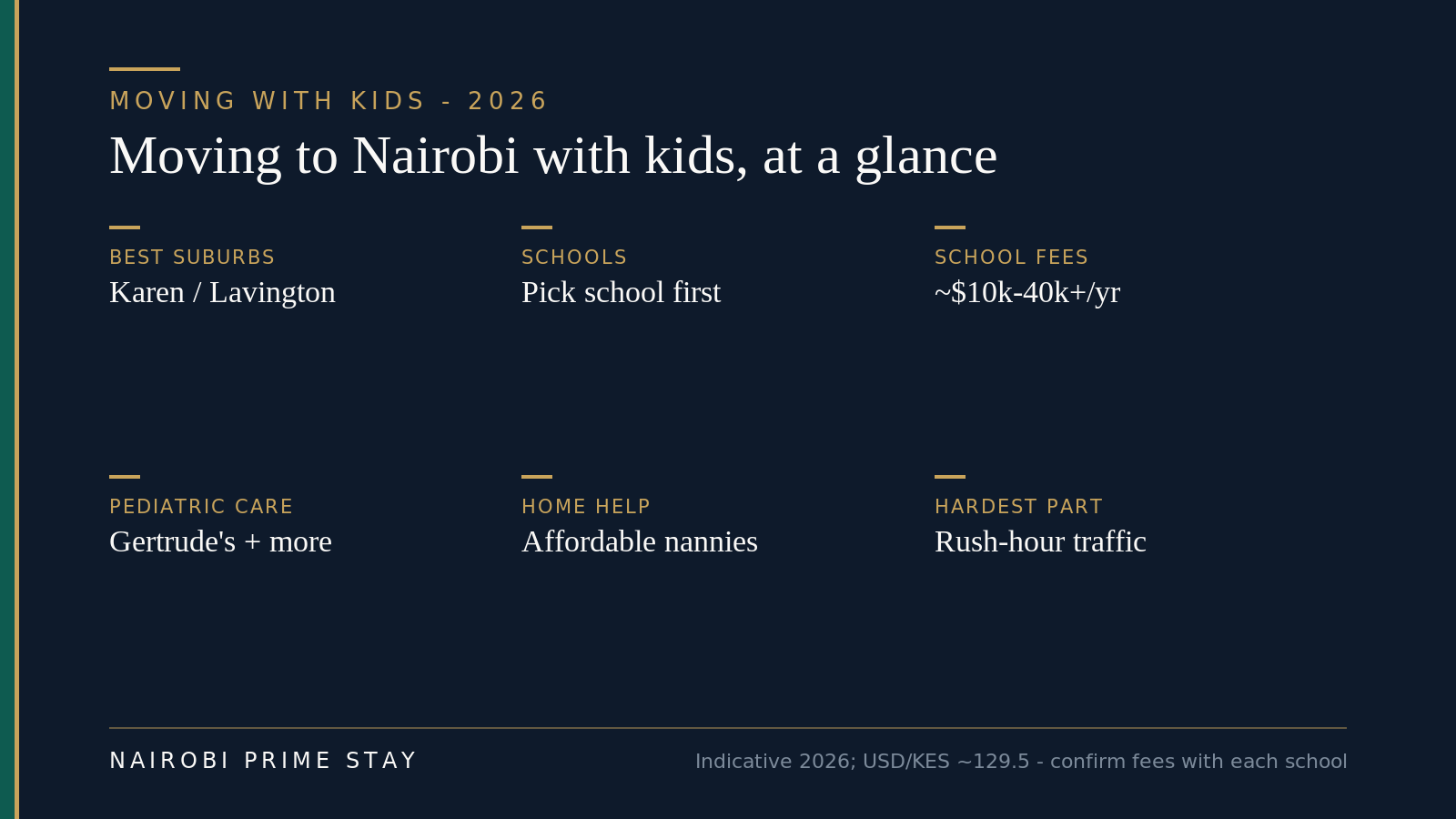
The family snapshot. Figures are indicative for 2026; the dollar traded around 129–130 shillings through the year.
Why getting this right matters
For a family, the move is bigger than for a single person or a couple. You’re not just choosing a neighborhood — you’re choosing a school, a commute, a pediatrician, a peer group and a weekend routine all at once, and they’re linked. Get the order right and the rest falls into place. Get it backwards — sign a lease, then discover the school you want is an hour away in traffic — and you’ll feel it every single morning.
The good news is that thousands of American and international families do this every year and land well. Nairobi has been a posting for diplomats, UN staff and NGO workers for decades, so the infrastructure for family life — schools, pediatric hospitals, clubs, activities, other expat parents who’ve been through it — is mature and welcoming. You’re walking a well-worn path.
The best neighborhoods in Nairobi for families
Most families end up in one of a handful of green, secure suburbs on the city’s west and north sides. They cluster near the schools and around other families, which is exactly what you want in the first year. Here’s the honest comparison.
| Suburb | Character | Furnished rent/mo | Schools nearby | Best for |
|---|---|---|---|---|
| Karen | Leafy, low-density, equestrian calm; big gardens | $1,000–3,000 | Brookhouse, Hillcrest, Banda | Space, gardens, outdoor childhood |
| Runda | Large gated homes and gardens, very secure | $1,800–4,000+ | Rosslyn Academy, ISK | Security plus short school runs |
| Gigiri | Diplomatic heart by the UN; calm, heavily patrolled | $1,500–4,000+ | ISK | UN, embassy and NGO families |
| Lavington | Cosmopolitan, family-friendly, fairly central | $700–1,800 | Braeburn, several nurseries | Central life at better value |
| Kileleshwa | Quieter, modern apartments and townhouses, central | $650–1,500 | Short run to several schools | Apartment living, easy commute |
| Lang’ata | Leafy and family-friendly beside the national park | $700–1,500 | The Banda School | Parkside calm on a budget |
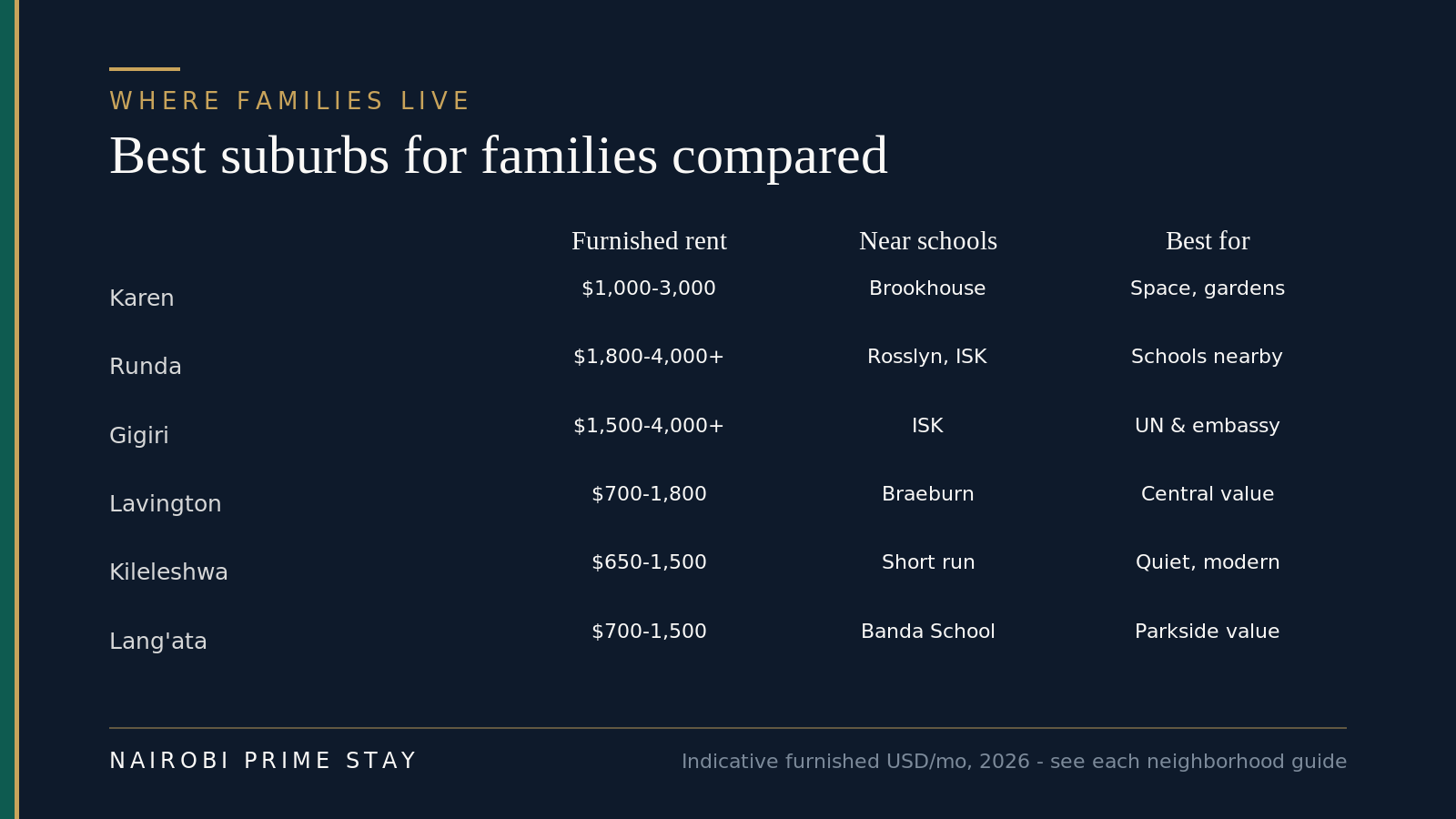
Indicative furnished rents in US dollars per month, 2026. Each links to a fuller guide.
If you’re UN, embassy or NGO staff, Gigiri and Runda put you minutes from the International School of Kenya and the diplomatic community. If you want the most space and a garden your kids can disappear into, Karen is the classic family choice — low-density, green, a little out of town. Lavington and Kileleshwa give you a more central life and gentler rents, which matters once school fees are in the picture. Lang’ata sits right by Nairobi National Park and offers the same leafy feel as Karen at better value. Our best neighborhoods in Nairobi guide profiles each one with drive-times and trade-offs.
One rule above all: choose the school first, then live near it. Nairobi’s distances are short but its traffic is not, and a school run that looks like a 15-minute hop on the map can be 50 minutes at 7:30am. Families who pick the home first and the school second usually regret it.
Schools: Nairobi’s quiet strength for families
Schools are one of the best reasons to feel confident about moving here. The city has a deep bench of international schools, several following the American curriculum, most clustered around Gigiri, Runda and Karen.
The headline names: the International School of Kenya (ISK) in Gigiri follows an American and IB curriculum and is the default for diplomats and US families; Rosslyn Academy in Runda offers a North American program with one of Africa’s largest selections of AP courses; Brookhouse and Braeburn follow the British system; and there’s a French school, a German school and a full IB continuum at the Aga Khan Academy too. Fees vary widely, from around $10,000 a year to $40,000 or more at the top. As of the 2025/26 year, ISK’s senior grades run about $37,000 in tuition plus a one-time capital levy of roughly $11,000 for new families, while Rosslyn sits nearer $10,000 — confirm current figures directly with each school, since they change yearly.
The best schools keep waitlists, so start enquiries months ahead and gather your kids’ transcripts, records and immunization history early. Many align to a US-style August start. For the full breakdown — every curriculum, the flagship schools, real 2026 fee ranges and how admissions work — see our international schools in Nairobi guide. If you want the American or IB route specifically, our American and IB schools guide goes deeper on ISK, Rosslyn and the IB Diploma. And for the under-fives, our nursery and daycare in Nairobi guide covers Montessori, play-based and international early-years options.
Healthcare and pediatrics: better than most Americans expect
Pediatric care in Nairobi is genuinely good, and that’s the worry most parents arrive with. The anchor is Gertrude’s Children’s Hospital, a long-established, not-for-profit pediatric hospital with a 24-hour main campus in Muthaiga and a network of satellite clinics dotted across the suburbs — so there’s usually a Gertrude’s outpatient clinic near wherever you settle. The doctors are English-speaking and used to expat families.
Beyond Gertrude’s, the big private hospitals all have strong pediatric and emergency departments: Aga Khan University Hospital (JCI-accredited, in Parklands), The Nairobi Hospital (Upper Hill), Karen Hospital for the southern suburbs and MP Shah. Private consultations are inexpensive by US standards at roughly $15–40; larger procedures cost far less than at home but are still worth insuring against. Our healthcare in Nairobi guide covers hospitals, insurance and finding a doctor in detail.
Three things to sort before you fly:
- Insurance with regional and international cover, plus medical evacuation. This is the non-negotiable. Day-to-day care is cheap, but you want serious cover for anything major and an evacuation policy in case a specialist procedure is better done elsewhere.
- Vaccinations and records. Check your children’s routine vaccines are current and bring the records — schools ask for them. A yellow-fever certificate is only required if you’re arriving from a country where it’s endemic, which the US is not, but confirm the latest entry rules. Talk to a travel clinic or check current CDC guidance for Kenya before you go.
- A word on malaria. Nairobi sits about a mile high, and that altitude means malaria risk in the city itself is very low — one reason families feel comfortable here. The coast, Lake Victoria and other low-lying regions are a different story, so if you’ll travel there, get current advice on prophylaxis for the kids from a doctor. Don’t self-prescribe; confirm with a travel-health professional.
Once you arrive, register your children with a pediatric clinic early — Gertrude’s or a private hospital’s pediatric department — so you have somewhere to call before the first fever, not during it.
Is Nairobi safe for kids?
Honestly: yes, with the same big-city sense you’d use anywhere, and most families settle into a comfortable routine quickly. The expat suburbs are gated, guarded and well-patrolled, and the main risk across Nairobi is opportunistic petty crime — a snatched phone in traffic — not violence against people. The US State Department rates Kenya at Level 2, “exercise increased caution,” which is the same level as plenty of European countries. Our is Nairobi safe guide gives the full, balanced rundown.
For families specifically, the habits that matter:
- Choose a home with 24/7 guards, a gate and cameras — standard in the family suburbs. Kids can play outdoors safely inside a secure compound or estate.
- Keep phones and valuables out of sight in stopped traffic, and keep car doors locked on the school run.
- Use Uber or Bolt after dark rather than walking, and teach older kids to do the same.
- Brief your nanny and house help on the household’s safety routine — who opens the gate, what to do in a power cut, your emergency contacts.
- Save the emergency numbers (999 or 112), enrol in the US State Department’s free STEP program, and know your nearest pediatric hospital.
The biggest day-to-day risk for children isn’t crime — it’s the road. Traffic is busy and unpredictable, sidewalks are patchy, and boda-boda motorbikes weave everywhere. Most families don’t let young kids walk or cycle on public roads, and stick to compounds, malls, clubs and parks for free play. That’s a real adjustment from a quiet US street, and worth knowing going in.
Help at home: the thing that changes family life
Here’s what surprises American parents most. Reliable, affordable home help is normal in Nairobi, and it quietly transforms how a family runs. A nanny who knows your kids, a house manager who handles the shopping and cooking, a gardener once a week — this is ordinary middle-class life here, not a luxury.
What it costs, roughly, in 2026: a live-out nanny runs about KES 22,000–35,000 a month, a cook or house manager more, with live-in arrangements and experience pushing the figure up. That’s a few hundred dollars a month for help that would be unthinkable at US prices. The flip side is that you become an employer, with real legal and ethical duties — a written contract, fair pay above the gazetted Nairobi minimum, the statutory deductions (NSSF and the health levy), leave and a weekly rest day. Treat it seriously and you’ll build a relationship that makes your whole posting easier; cut corners and you won’t.
For new parents especially, this is the difference-maker. A trusted nanny means both parents can work, date nights happen, and a sick day doesn’t derail the week. Many families pair a half-day nursery with an afternoon nanny — structure and playmates in the morning, flexible cover after. Our hiring domestic help in Nairobi guide covers current pay, contracts, the legal duties and how to find and vet someone fairly. Read it before you hire — getting this right matters, for your family and for the person you employ.
Activities, weekends and finding your community
This is where Nairobi shines for kids. Few cities put real wildlife, big green space and an easy outdoor life this close to home. Weekends fill themselves.
The classics, all family-friendly and close in:
- The Sheldrick Wildlife Trust elephant orphanage, on the edge of Nairobi National Park, opens to the public for one hour a day (around 11am to noon, as of 2026) to watch the orphaned baby elephants at their mud bath. It’s by advance booking, costs about $20 per person, and you pay the park gate fee separately — confirm times and booking on the day. Kids love it.
- The Giraffe Centre in Lang’ata lets children hand-feed Rothschild’s giraffes from a raised platform. It’s open daily, roughly 9am to 5pm, with a modest entry fee (around KES 750 for a non-resident child as of 2026). Mornings are best, when the giraffes are hungriest.
- Nairobi National Park itself — lions, rhino and giraffe with the city skyline behind them, twenty minutes from the western suburbs. A half-day game drive is a genuine “we live here now” moment.
- Karura Forest, between Gigiri and Muthaiga, is a huge, safe, gated forest with walking and cycling trails, a waterfall, caves and picnic spots. It’s a weekend staple for Nairobi families.
- Malls with kid stuff. Village Market in Gigiri has mini-golf, water slides and a playground alongside the shops; Two Rivers, Sarit and The Hub all have play areas, cinemas and space for a birthday party.
Beyond the days out, the community is what makes a family posting work. Nairobi has a large, warm expat scene that’s used to people arriving mid-year and folding them in. School parent groups are the fastest way in — once your kids are enrolled, the WhatsApp groups, playdates and weekend invitations follow. Sports clubs and country clubs (rugby, swimming, tennis, riding in Karen) run busy junior programs. Churches, mosques and temples have active family communities. And neighborhood and nationality groups online will answer the small questions — a good pediatric dentist, a birthday venue, a swim coach — within minutes. Our family life in Nairobi guide goes deeper on clubs, activities and building your weekends.
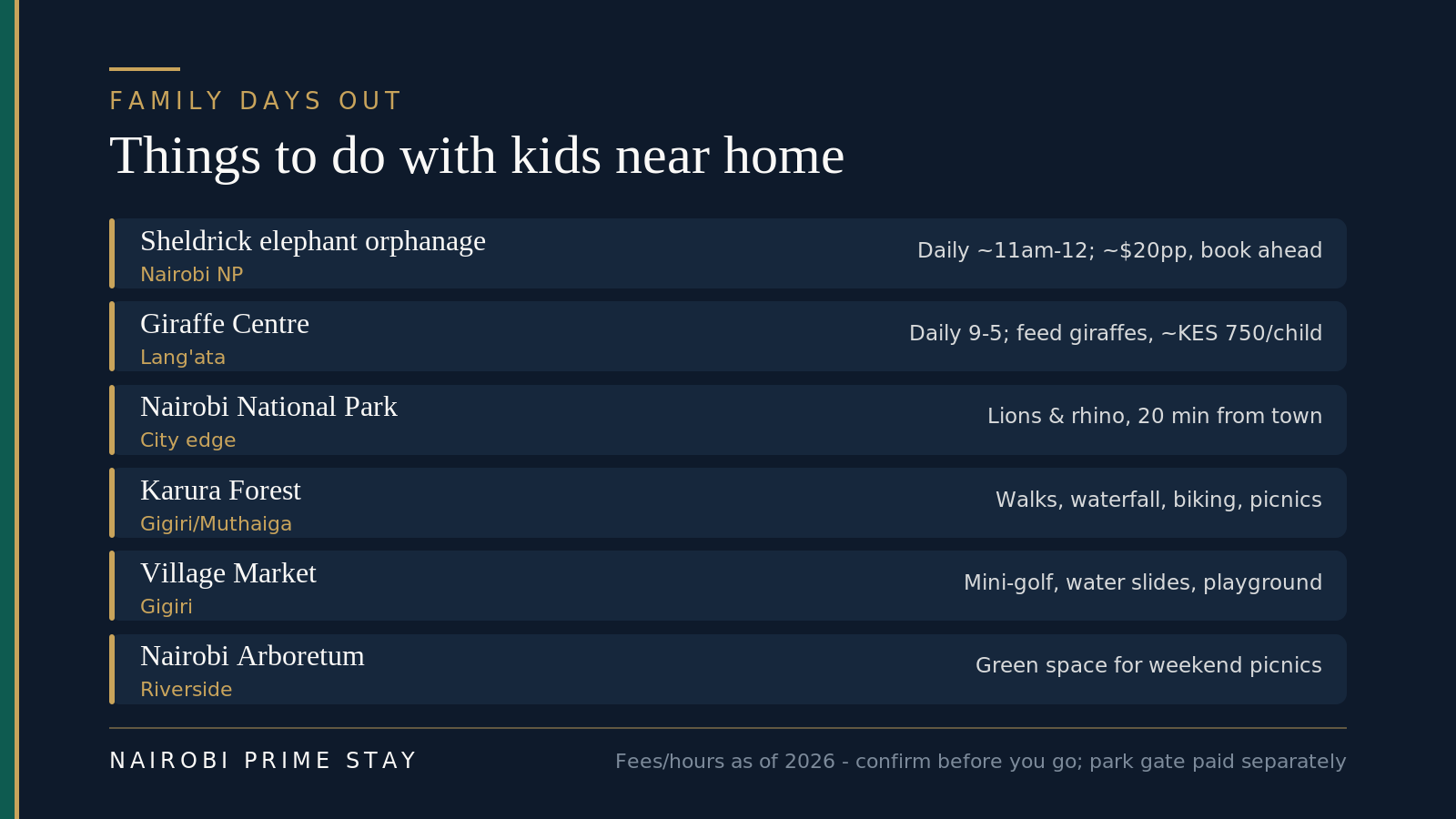
Fees and hours are indicative for 2026 — confirm before you go, and pay any park gate fee separately.
The honest adjustment
Every family’s move has a wobble in the first few months. Knowing what’s coming makes it easier.
What tends to be harder than expected: the traffic, which makes school runs and after-school logistics a real daily tax — this is the single most common complaint, and the reason “live near the school” matters so much. Stomach bugs are common in the first few months as little ones adjust to new water and food; it passes, but stock rehydration salts and have your pediatric clinic on speed dial. Waitlists at the top schools can force a compromise or a term’s wait. And the distance from home — grandparents, cousins, familiar holidays — is a quiet ache that hits kids and parents at different moments.
What tends to be easier than expected: kids adapt fast, usually within a term, especially with school as a ready-made social world. The affordable help frees up parents in a way that lowers the whole family’s stress. The outdoor, mild-weather life suits children. And the expat community is genuinely welcoming, so you’re rarely figuring it out alone.
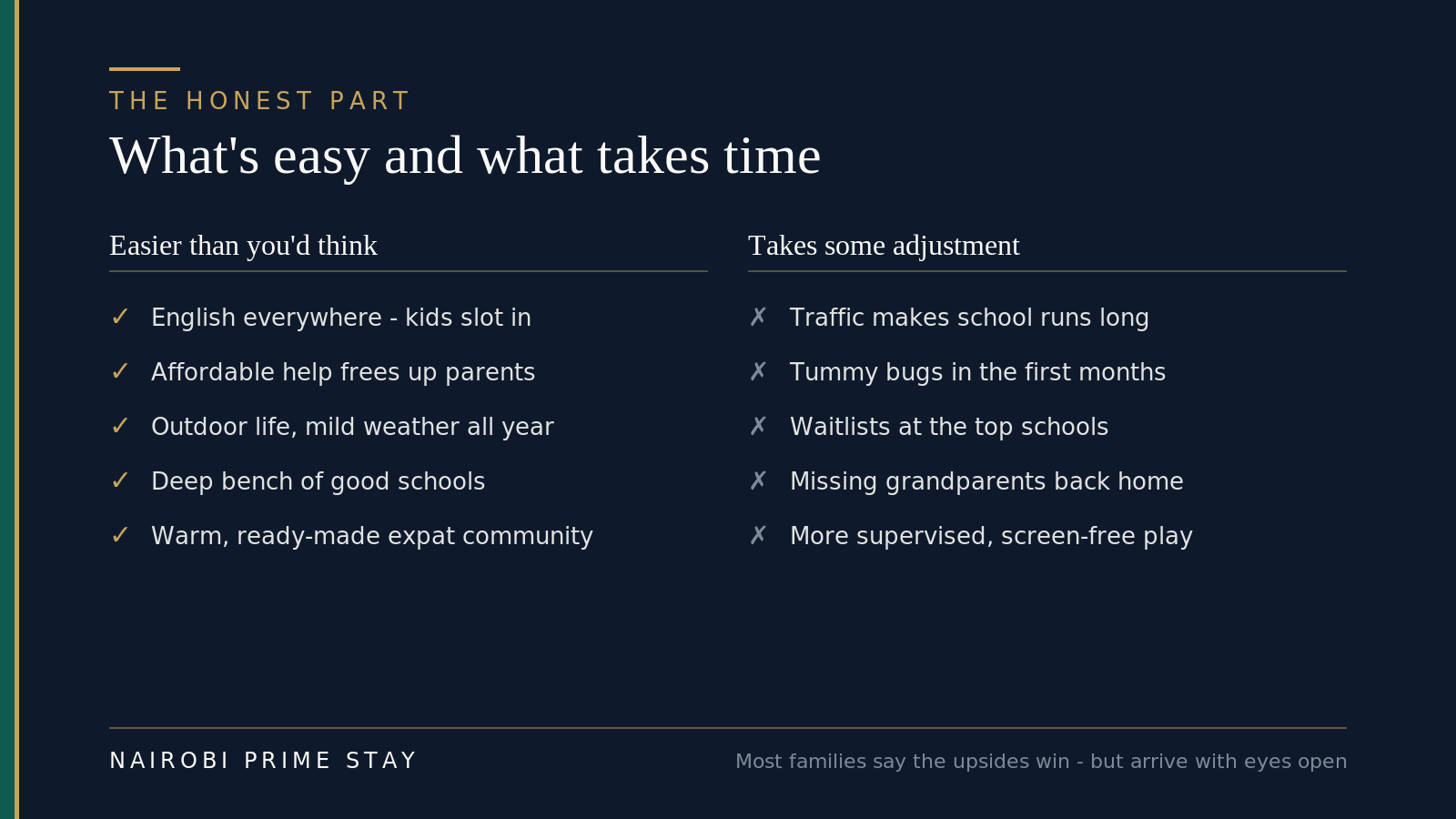
Most families say the upsides win comfortably — but it helps to arrive with eyes open.
A gentle truth: the parents who struggle most are usually the ones who tried to lock everything in before arriving — leased a house sight-unseen, committed to a school from a website. The ones who settle fastest give themselves a few weeks on the ground to choose. Which leads to the plan.
Your first months: a sane order to do things in
The move goes smoothly when you do things in the right sequence. School first, home second.
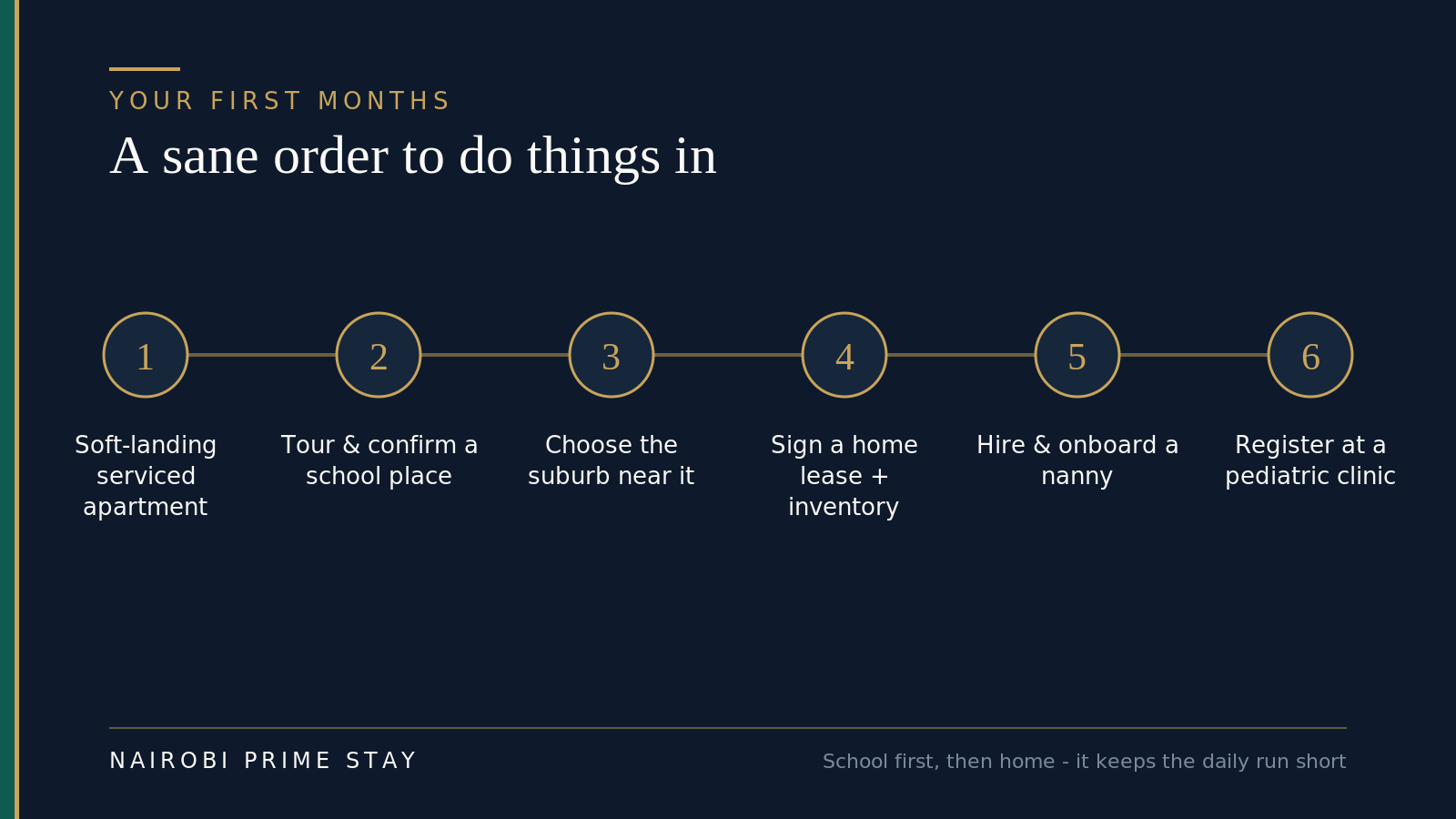
The order that keeps the daily school run short and the first months calm.
- Land in a serviced apartment. Give yourself four to eight weeks in a secure, fully-equipped base — Wi-Fi, cleaning, generator and security included — while you get your bearings. No furniture or utility headaches in week one.
- Tour schools in person and confirm a place. You’ll have shortlisted and emailed ahead, but visit before you commit. Seeing the classrooms, meeting the head and feeling the commute at school-run time tells you more than any brochure.
- Choose the suburb around the confirmed school. Now you can pick a home that keeps the morning run short. This is the whole reason for the order.
- Sign a home lease with a written inventory. Prime homes let on 12-month leases, with a deposit of one to three months plus the first month up front. Get everything in writing, check the “Nairobi Five” (generator, water storage, security, fibre, responsive management), and never wire money for a place you haven’t seen.
- Hire and onboard your home help. Find a nanny or house manager through school-parent referrals or a reputable agency, with a written contract and fair pay. Build in a paid trial.
- Register with a pediatric clinic and settle the routine. Sign up at Gertrude’s or a private hospital’s pediatric department, set up the school WhatsApp groups, find your weekend spots, and let the kids start to feel at home.
A quick family-move checklist
- Shortlist schools and email admissions months ahead; ask about waitlists and entry points.
- Gather transcripts, school reports, immunization records and birth certificates.
- Sort international health insurance with regional cover and medical evacuation.
- Check the kids’ routine vaccines are current; see a travel clinic about any coast travel.
- Apply for your eTA and start the right permit and dependant’s passes with a lawyer.
- Book a serviced apartment for the first month as your soft landing.
- Pack comfort items, specific medications and a couple of familiar things for each child.
- On arrival: SIM and M-Pesa at the airport, then tour schools, choose the suburb, sign the lease.
- Hire home help on a fair written contract; register with a pediatric clinic.
Which suburb fits your family?
A quick way to narrow it down. As always, confirm the school first, then live near it.
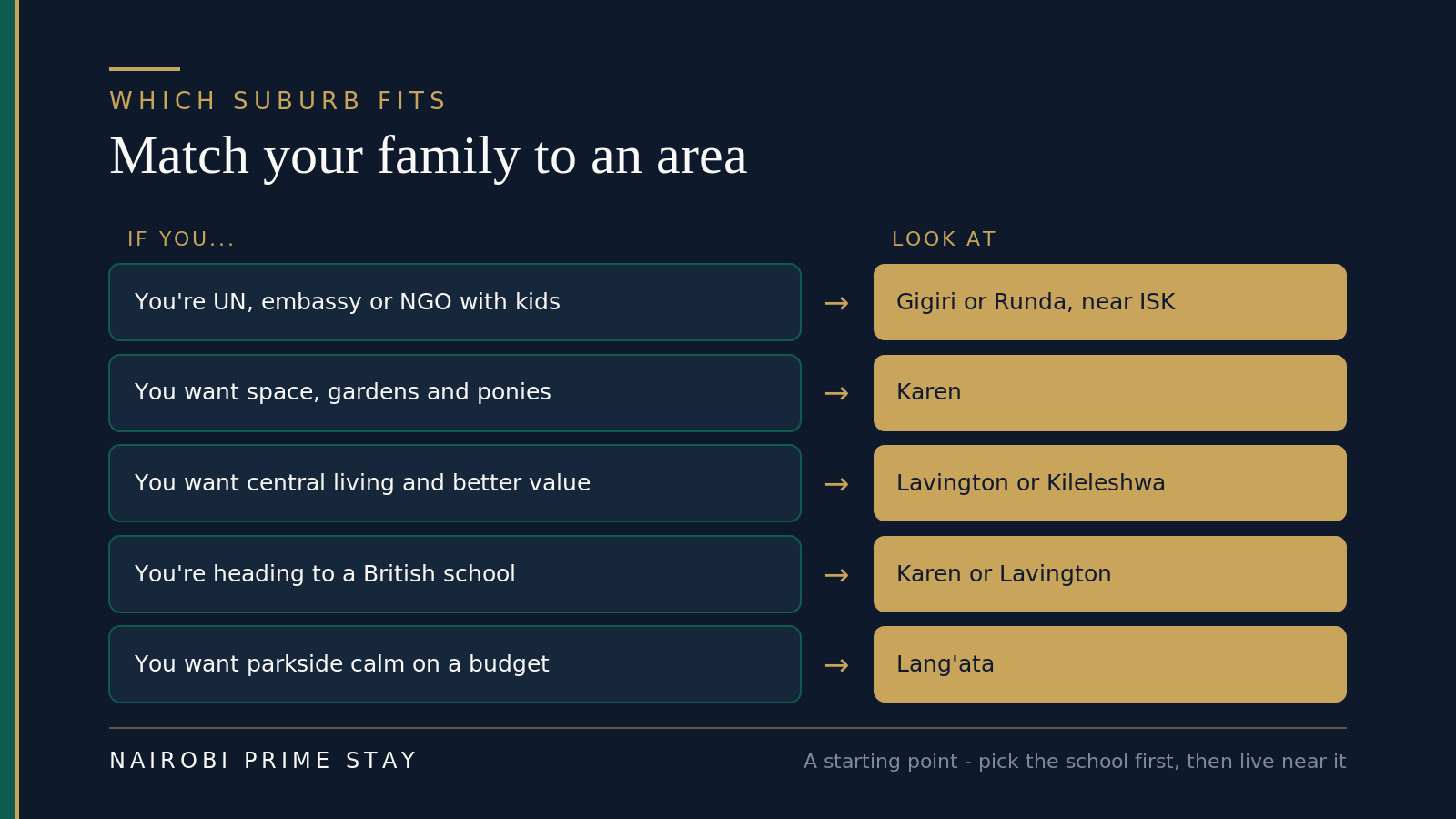
A starting point, not a rule. Visit two areas before you decide.
How it plays out: the Carters from Colorado
Say a family of four moves from Denver — two parents, kids aged 6 and 9, one parent working remotely for a US company. They book a two-bedroom serviced apartment in Gigiri for six weeks. In the first fortnight they tour three schools and accept a place at Rosslyn Academy in Runda for the August start. That decides the suburb: they lease a gated four-bedroom in Runda, ten minutes from the school gate. They hire a nanny on a written contract through another parent’s referral, register the kids at the nearby Gertrude’s clinic, and join the school’s parent WhatsApp group. By the second month the 9-year-old has a weekend rugby club and the 6-year-old has three playdates a week. The hardest part wasn’t safety or schools — it was the first round of stomach bugs and the FaceTime calls home at bedtime. By the end of the first term, Nairobi feels like theirs. (An illustrative example, not a specific family.)
Pros and cons of raising kids in Nairobi
| The upsides | The trade-offs |
|---|---|
| Deep bench of international schools, several American-curriculum | Top schools have waitlists; fees run high |
| Affordable, reliable home help frees up parents | You become an employer, with real legal duties |
| Outdoor life, mild weather, wildlife on the doorstep | Traffic makes school runs and logistics a daily tax |
| Strong, English-speaking pediatric care | You need good insurance with medical evacuation |
| Warm, ready-made expat and school community | Far from grandparents and familiar support |
| Kids usually settle within a term | Stomach bugs and an adjustment dip early on |
| A US income stretches a long way | International-school fees can eat the savings |
Frequently asked questions
Is Nairobi a good place to raise kids as an American family? Yes, for most families it works well. The city has a deep bench of international schools, several following the American curriculum, plus affordable home help, strong English-speaking pediatric care and an outdoor, mild-weather life that suits children. The trade-offs are heavy traffic, high school fees and the distance from family back home. Thousands of American and international families live here happily, so you’re walking a well-worn path.
What are the best neighborhoods in Nairobi for families with children? Most expat families settle in Karen, Runda, Gigiri, Lavington, Kileleshwa or Lang’ata. Karen offers the most space and gardens; Runda and Gigiri are secure and close to the International School of Kenya and Rosslyn Academy; Lavington and Kileleshwa are more central and better value. The golden rule is to choose your child’s school first, then live near it, because traffic rather than distance decides your daily school run.
How much are international school fees in Nairobi? Roughly $10,000 to $40,000 or more per child per year, depending on the school and grade. As of the 2025/26 year, the International School of Kenya’s senior grades run about $37,000 in tuition plus a one-time capital levy near $11,000 for new families, while Rosslyn Academy sits closer to $10,000. Add registration, transport and meals, and confirm current figures directly with each school, since they change yearly.
Is Nairobi safe for children? Yes, with normal big-city precautions. Expat families live in gated, guarded suburbs where kids play outdoors safely, and the main risk across the city is opportunistic petty theft, not violence. The biggest real hazard for children is the road — busy traffic, patchy sidewalks and motorbikes — so most families keep young kids to compounds, malls, clubs and parks rather than public streets. Choose a secure home, use ride-hailing after dark, and save the emergency numbers 999 or 112.
Do I need to worry about malaria or vaccinations for my kids in Nairobi? Nairobi sits about a mile high, so malaria risk in the city itself is very low — one reason families feel comfortable here. The coast and low-lying regions do carry risk, so get a doctor’s advice on prophylaxis before traveling there with children. Check your kids’ routine vaccines are current and bring the records, since schools ask for them; a yellow-fever certificate is only needed if you arrive from an endemic country, which the US is not. Confirm the latest guidance with a travel clinic or current CDC advice before you fly.
How much does a nanny or domestic help cost in Nairobi? A live-out nanny runs roughly KES 22,000–35,000 a month as of 2026, with experience and live-in arrangements costing more — a few hundred US dollars for reliable, full-time help. You’ll have legal duties as an employer: a written contract, fair pay above the gazetted Nairobi minimum, statutory NSSF and health deductions, leave and a weekly rest day. Many families pair a half-day nursery with an afternoon nanny. It’s the single thing that most changes how a family functions here.
What do families do on weekends in Nairobi? Plenty, and a lot of it is outdoors. Popular family outings include the Sheldrick elephant orphanage and the Giraffe Centre, a game drive in Nairobi National Park twenty minutes from the suburbs, walks and biking in Karura Forest, and malls like Village Market with mini-golf, slides and play areas. Sports clubs, swimming, riding in Karen and active school-parent communities fill out the rest. The mild climate means weekends spent outside are the norm rather than the exception.
How long does it take kids to adjust to moving to Nairobi? Most children settle within a school term, often faster, because school gives them an instant social world and English removes the language barrier. Expect a wobble in the first few weeks — homesickness, a few stomach bugs, new routines — which is normal and passes. Parents can ease it by arriving with a soft-landing month in a serviced apartment, enrolling the kids quickly and leaning on the welcoming expat and school community.
Final thoughts
Moving to Nairobi with kids is more doable than it looks from a US kitchen table, and more rewarding than most families expect. The schools are good, the help is real, the wildlife is on your doorstep, and the community will fold you in. The hard parts — traffic, waitlists, the distance from home, the first round of tummy bugs — are real but manageable, and they fade. Do things in the right order, give yourself a few weeks on the ground to choose, and let the school decide the suburb. Get that right and the rest of family life here tends to take care of itself.
Related reading
- Moving to Nairobi: the complete guide — the end-to-end overview for your whole move.
- Best neighborhoods in Nairobi for expats — compare the family suburbs with drive-times.
- Karen neighborhood guide and Runda neighborhood guide — two of the top family areas, in depth.
- International schools in Nairobi — curricula, flagship schools and real 2026 fees.
- Nursery and daycare in Nairobi — early-years options for the under-fives.
- Healthcare in Nairobi — hospitals, pediatrics, insurance and finding a doctor.
- Hiring domestic help in Nairobi — pay, contracts and how to hire a nanny fairly.
- Family life in Nairobi — clubs, activities and building your weekends.
- Is Nairobi safe? — the balanced safety picture for families.
- Cost of living in Nairobi — real monthly budgets, before and after school fees.
Ready to plan your family’s soft landing?
A serviced apartment for your first month lets you tour schools, test the traffic and choose your suburb before you sign a year-long lease — with Wi-Fi, cleaning, a generator and security included, so week one is calm. Browse our serviced apartments, or tell our AI relocation assistant your kids’ ages, your school shortlist and your budget, and it’ll suggest family-friendly areas and apartments in a couple of minutes. A $50 deposit reserves your place, with the balance paid on arrival.
Ready to look?
Find your apartment in Nairobi
Browse verified serviced apartments, or ask the AI concierge which area fits your life.