
Guides · Schools
International Schools in Nairobi: The Complete 2026 Guide for Expat Families
International Schools in Nairobi: The Complete 2026 Guide for Expat Families
Nairobi has one of the deepest benches of international schools in Africa. You can choose an American curriculum, a British one, the International Baccalaureate, French, or German — usually within a 20-minute drive of where expats live. For most American families, the real question isn’t whether a good school exists. It’s which one fits your child, your budget, and your commute.
This guide gives you the honest version. What each curriculum actually means, the flagship schools and where they sit, real 2026 fee ranges, how admissions and waitlists work, and how to line up your school choice with your neighbourhood so the daily school run doesn’t eat your life. We’ll point you to the deeper guides — British schools and American and IB schools — where it helps.
A quick honesty note up front: school fees here move every year, and the top schools layer on one-time levies, capital fees and transport on top of tuition. Treat every number below as “as of 2026, confirm with the school,” and always ask for the full fee schedule in writing before you fall in love with a place.
TL;DR — international schools in Nairobi at a glance
Nairobi’s international schools cluster in the leafy western and northern suburbs — Gigiri, Runda, Karen, Lavington and Lang’ata. The big names are the International School of Kenya (ISK) in Gigiri (American + IB), Rosslyn Academy in Runda (American + AP, Christian), Brookhouse in Karen and Runda (British + IB, day and boarding), plus Braeburn, Hillcrest and The Banda School on the British side, and the French (Lycée Denis Diderot) and German (Deutsche Schule) national schools.
Indicative annual tuition runs from about $6,000 at the more affordable end to $37,000+ at the senior grades of the priciest school, before levies and transport. Best schools have waitlists, so enquire 6–12 months ahead. Where you live matters: pick a home near your school and you trade a brutal commute for a 10-minute run. Our neighbourhood guides and AI relocation assistant can match a home to your shortlist.
Why your school choice comes first
For a relocating family, the school decision usually drives everything else — including where you live. Nairobi’s distances are short but its traffic is not, so a school across town can mean two hours in the car each day. Families who get this right tend to choose the school first, then rent nearby.
The good news: the schools and the best family suburbs overlap. ISK sits in Gigiri, beside Runda and Muthaiga where most UN and embassy families live. The Karen schools sit among the big gardens of Karen and Lang’ata. So the same decision that sorts your child’s education also narrows your home search to two or three areas. That’s why we treat schools, neighbourhoods and apartments as one linked decision, not three separate ones.
The five curricula, plainly explained
Nairobi offers five main school systems. Pick the one that matches where your child is likely to finish school and go to university.
American. Familiar K–12 structure, a US high-school diploma, often with Advanced Placement (AP) courses for college credit. Easiest to transfer into from a US school and back again. ISK and Rosslyn Academy lead here. School year runs roughly August to June, like home.
British. Primary years, then IGCSE exams around age 16, then A-levels (or sometimes the IB) at 18. Rigorous and specialised in the final years — students narrow to three or four subjects. Strong fit if you’re heading to a UK university or staying in the British system long-term. Braeburn, Hillcrest, Brookhouse and Banda run it. School year runs September to July in three terms.
International Baccalaureate (IB). A globally portable, broad-and-balanced programme; the IB Diploma at 18 is recognised by universities everywhere and is genuinely demanding. Good if your family moves often or you want maximum university options. ISK offers the IB Diploma alongside its American track; the Aga Khan Academy in Parklands is fully IB.
French. The full French national curriculum at the Lycée Denis Diderot, accredited by France’s education ministry. The natural choice for French-speaking families or anyone planning a French-system university path.
German. The German curriculum at the Deutsche Schule Nairobi (the Michael-Grzimek-Schule), leading to German qualifications. Small and community-focused; ideal for German-speaking families.
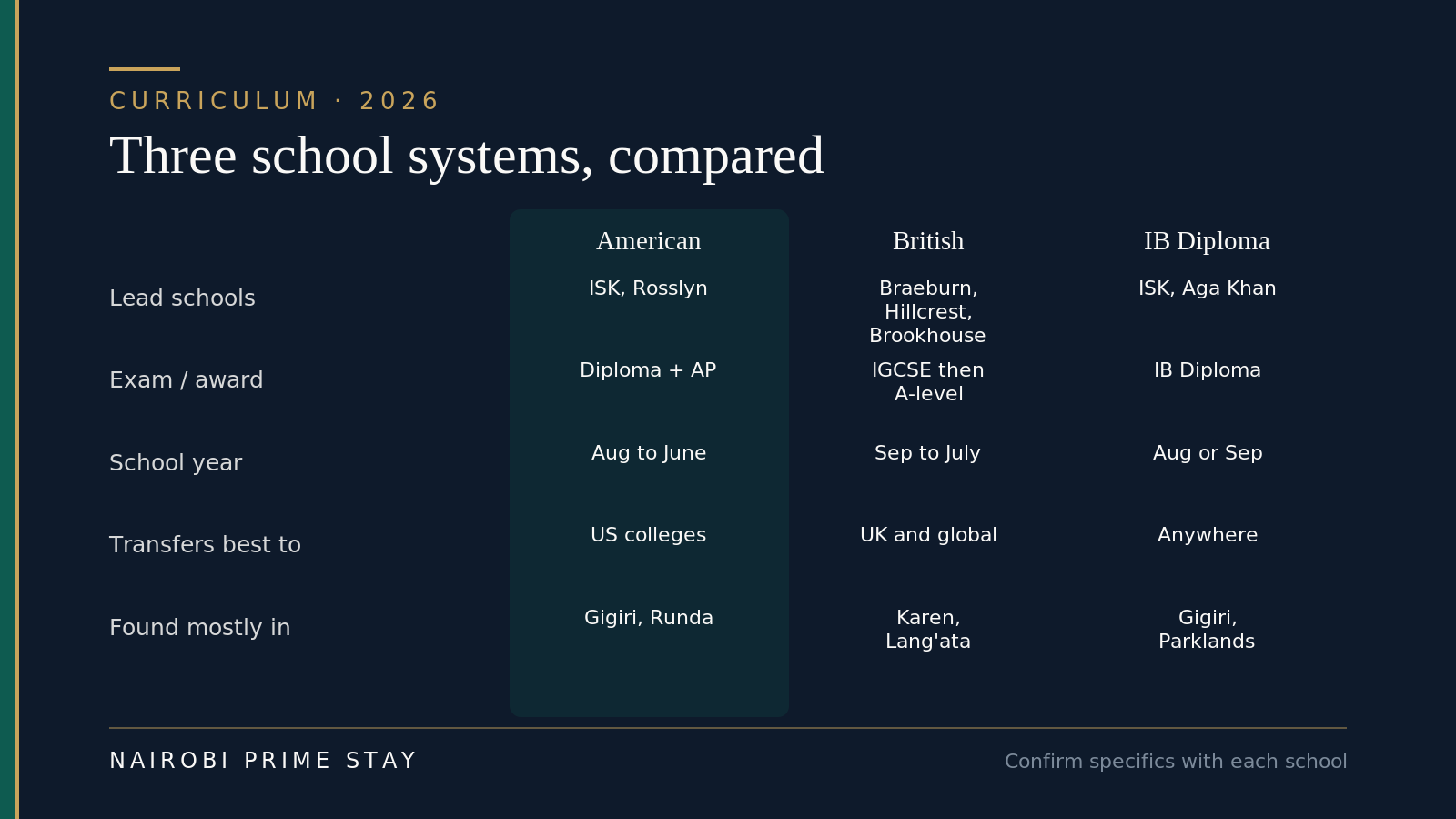 The three systems most American families weigh up — and how they differ on exams, calendar and fit.
For most Americans the choice comes down to three: stick with the American system for an easy transfer home, go British if you want IGCSE/A-levels or you’re UK-bound, or choose the IB if you value portability and breadth. There’s no wrong answer — only the one that fits your child and your next move. Our deeper British schools guide and American and IB schools guide break each down school by school.
Where do graduates go? University destinations
Nairobi’s international schools send graduates all over the world, and the curriculum you pick shapes the smoothest route. This matters more than parents expect: colleges read an applicant against the system they studied, so a diploma that lines up with your target country saves headaches later.
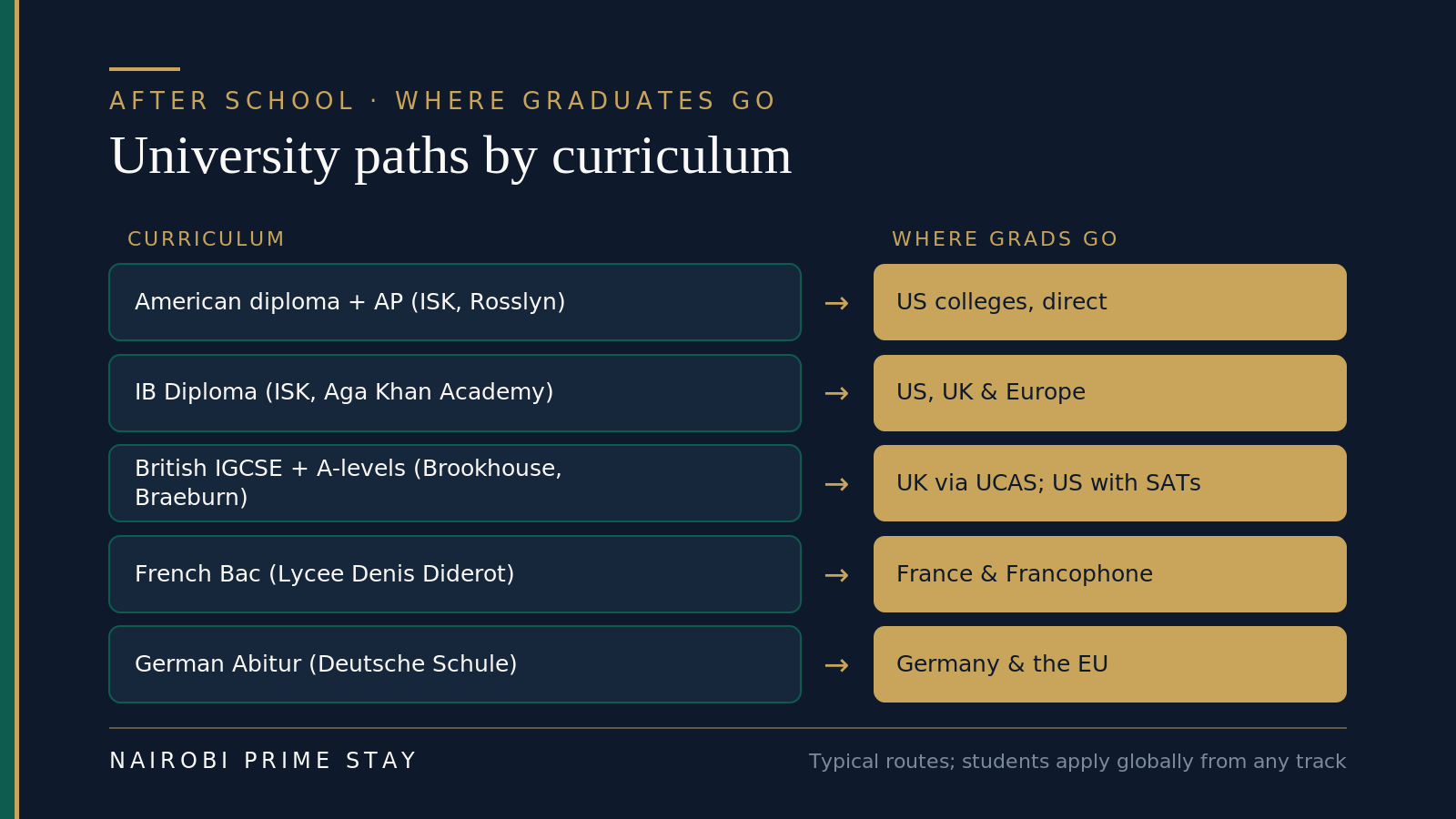 Typical university routes by curriculum — though students apply globally from any track.
An American-diploma graduate from ISK or Rosslyn applies to US colleges exactly as they would from a US high school — transcript, GPA, and the SAT or ACT, plus AP scores for credit. The IB Diploma is the most globally portable: US, UK and European universities all recognise it, and top US colleges value it. British A-levels feed straight into the UK’s UCAS system, and US colleges accept them too if you add the SAT. The French and German schools point naturally toward universities in France and Germany. Whichever track you choose, students from Nairobi’s schools land at strong universities every year, and if college in Kenya is on the table, our universities and higher education guide covers that route too.
The flagship schools — who they are and where they sit
These are the schools expat families ask about most. Profiles are short on purpose; the comparison and fee tables below put them side by side.
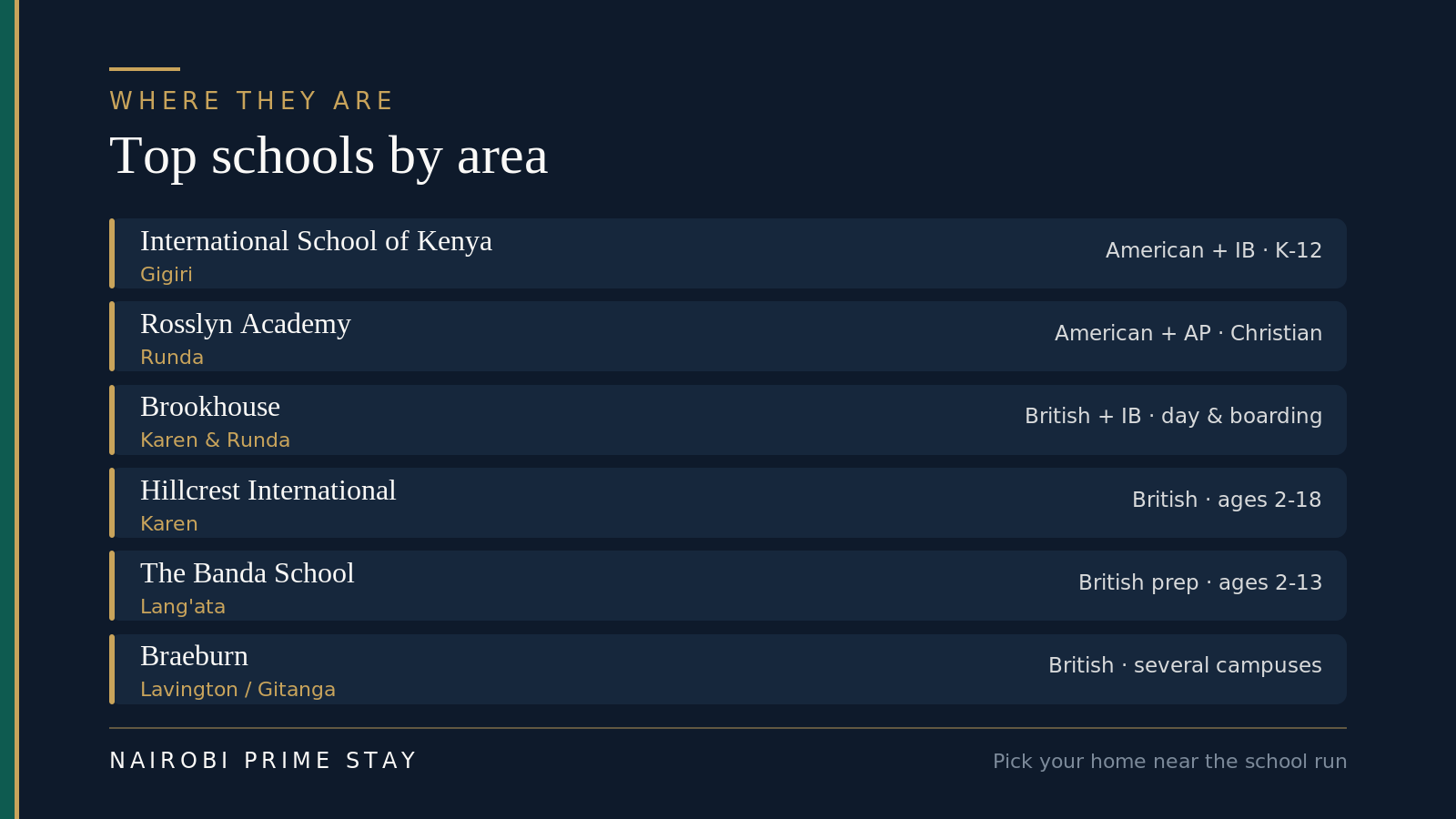 Where the main schools sit — choose your home near the one you pick, and the school run stays short.
International School of Kenya (ISK) — Gigiri. The best-known international school in the country, founded by the American and Canadian embassies. American curriculum plus the IB Diploma, K–12, on a large green campus minutes from the UN headquarters. It’s the default for many diplomatic and UN families — and the most expensive. Strong academics, sport and arts, and a famously international student body.
Rosslyn Academy — Runda. American curriculum with AP courses, run on Christian foundations. Long-established, warm community, and noticeably more affordable than ISK. A favourite for missionary, NGO and many American families who want the US system without the top-tier price tag.
Brookhouse Schools — Karen and Runda. British curriculum with an IB option, offering both day and boarding. Two Nairobi campuses (Karen and Runda), polished facilities and a big co-curricular programme. One of the prestige British names in the city.
Braeburn — Lavington, Gitanga Road and beyond. A large British-curriculum group with several Nairobi campuses, which makes places easier to find than at the single-campus schools. Solid, established, mid-to-upper on price, and spread across the city so there’s often one near where you’d want to live.
Hillcrest International — Karen. British curriculum from ages 2 to 18 on a leafy Karen campus, now incorporating the former GEMS Cambridge students. Day school with a strong all-through pathway and sport.
The Banda School — Lang’ata. A traditional British prep school for ages 2 to 13, on a large green site in Lang’ata next to Karen. Well-regarded, family-feel, and a common feeder into the senior British schools. Note it stops at 13 — you’ll move up to a senior school afterward.
Peponi — Ruiru (with Peponi House prep in Nairobi). A respected British boarding-and-day senior school on the city’s northern edge, with its prep school (Peponi House) inside Nairobi. The boarding option suits families outside the city or those who travel.
Lycée Denis Diderot — Nairobi. The French international school, following the French national curriculum and subsidised by the French state, which keeps fees noticeably lower than the British and American schools.
Deutsche Schule Nairobi — Nairobi. The German school, small and close-knit, following the German curriculum for German-speaking families.
Beyond these, the Aga Khan Academy (Parklands) offers a full IB pathway, and there are smaller and newer options — Crawford, Nairobi Waldorf and others — worth a look depending on your child and budget.
Schools compared at a glance
| School | Curriculum | Area | Ages | Day / Boarding | Known for |
|---|---|---|---|---|---|
| International School of Kenya (ISK) | American + IB Diploma | Gigiri | K–12 | Day | The flagship; UN/embassy default; top facilities |
| Rosslyn Academy | American + AP (Christian) | Runda | K–12 | Day | Affordable US system; warm community |
| Brookhouse | British + IB | Karen & Runda | 2–18 | Day & boarding | Prestige British name; polished campuses |
| Braeburn | British | Lavington, Gitanga, +more | 2–18 | Day (some boarding) | Several campuses; easier to find a place |
| Hillcrest International | British | Karen | 2–18 | Day | All-through Karen campus; sport |
| The Banda School | British prep | Lang’ata | 2–13 | Day | Traditional prep; strong feeder |
| Peponi | British | Ruiru / Nairobi (prep) | 2–18 | Day & boarding | Boarding option; senior reputation |
| Lycée Denis Diderot | French | Nairobi | 3–18 | Day | French national curriculum; lower fees |
| Deutsche Schule Nairobi | German | Nairobi | 3–18 | Day | Small German-curriculum community |
| Aga Khan Academy | IB | Parklands | varies | Day | Full IB pathway |
What international schools cost in 2026
Plan for $6,000 to $37,000+ a year in tuition, depending on the school and the grade. Fees rise as your child gets older, so a school that looks affordable in the early years gets more expensive through high school. The American and top British schools sit at the upper end; Rosslyn, the French school and the smaller schools sit lower. Fees are usually quoted and paid in US dollars (Kenyan citizens can pay in shillings); at around KES 129.4 to the dollar in mid-2026, a $30,000 fee is roughly KES 3.9 million — our USD/KES currency guide explains how the rate moves.
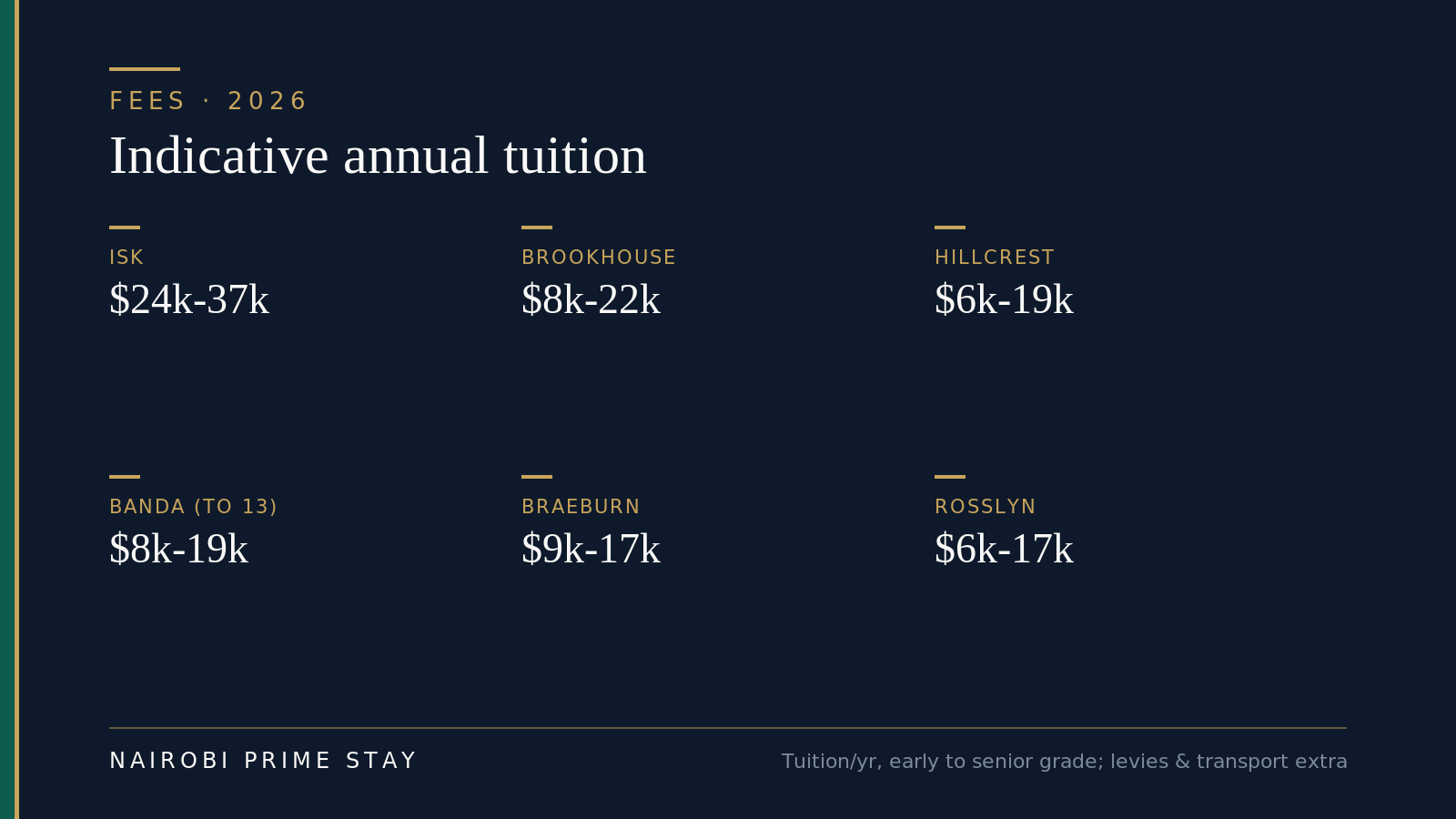 Indicative annual tuition, early to senior grade. Levies, capital fees and transport are extra. Confirm the current schedule with each school.
Here’s the part schools don’t put on the headline page. Tuition is only part of the bill. Expect some mix of these, depending on the school:
- A one-time capital levy or development fee. At ISK this is around $11,000 for new K–12 entrants (reduced for siblings), plus a smaller annual capital levy of roughly $1,550 for returning students. Most top schools charge something similar.
- A non-refundable application or registration fee — usually a few hundred dollars (ISK’s is about $400; others charge KES 26,000–45,000).
- A refundable caution deposit at some British schools — KES 100,000–500,000 — returned when your child leaves.
- Transport, lunches, uniforms, trips and exam-entry fees in the final years. ISK’s optional bus, for example, runs about $2,200 a year.
A useful rule of thumb: add 15–25% on top of headline tuition for the all-in first-year cost, and budget for annual fee increases. Many schools offer sibling discounts (Braeburn’s run from 10% for a second child up to 40% for a fifth), and a small discount for paying a full year up front (ISK gives about 1%).
| Fee component | Typical range (2026) | Notes |
|---|---|---|
| Annual tuition | $6,000 – $37,000+ | Rises with grade; varies hugely by school |
| One-time capital / development levy | $0 – $11,000 | Biggest at ISK; reduced for siblings |
| Application / registration | ~$300 – $450 (or KES 26,000–45,000) | Non-refundable |
| Caution deposit (some schools) | KES 100,000 – 500,000 | Refundable on exit |
| Transport (optional) | ~$1,500 – $2,500/yr | Worth it if you live across town |
| Boarding (where offered) | Adds significantly | Brookhouse, Peponi |
For context on how school fees sit alongside rent, groceries and the rest, see our Nairobi cost-of-living guide — for families, schooling is usually the single biggest line in the budget after housing.
How do Nairobi’s fees compare to US private schools?
If you’re pricing this against home, Nairobi’s international schools land in roughly the same league as US private schools — cheaper than the elite ones, pricier than the average. The average US private school runs about $14,100 a year, but that figure is pulled down by faith-based and small schools. The fair comparison for an expat family is the independent day school: median tuition at US independent schools now runs near $29,000 in the early grades and close to $38,400 for high school, with elite urban day schools topping $40,000.
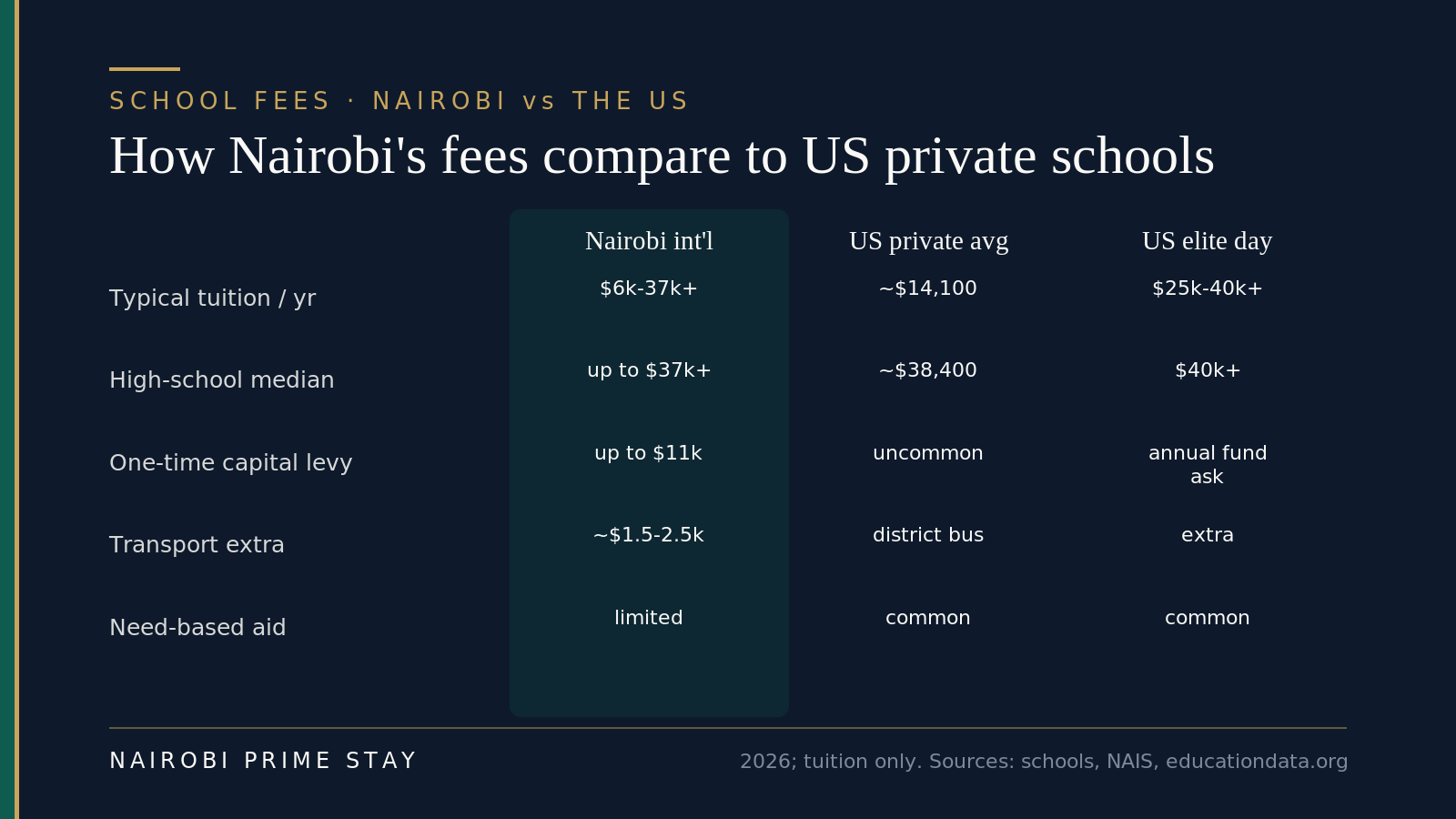 Nairobi’s top schools cost about what an elite US day school does — and well below a US boarding school.
Seen that way, ISK at the top of its range is comparable to a good US independent day school, and the mid-tier British schools and Rosslyn come in well below that. Two honest differences: Nairobi’s top schools add a one-time capital levy (up to about $11,000 at ISK) that most US schools don’t, and need-based financial aid is thinner here than at a US private school. On the other side, you’re often moving for a job that comes with an education allowance — many UN, embassy, NGO and corporate packages cover school fees in part or in full, which changes the maths entirely. Ask about it before you assume the sticker price is yours to pay.
Admissions and waitlists — how to actually get a place
Start early. The best schools — ISK, Banda, Brookhouse — run waitlists, especially at popular entry points and mid-year. Six to twelve months ahead is sensible; if you’re moving for the August or September start, begin the term before. Places do open up, and admissions teams are used to relocating families, but you don’t want your move held hostage by a single school.
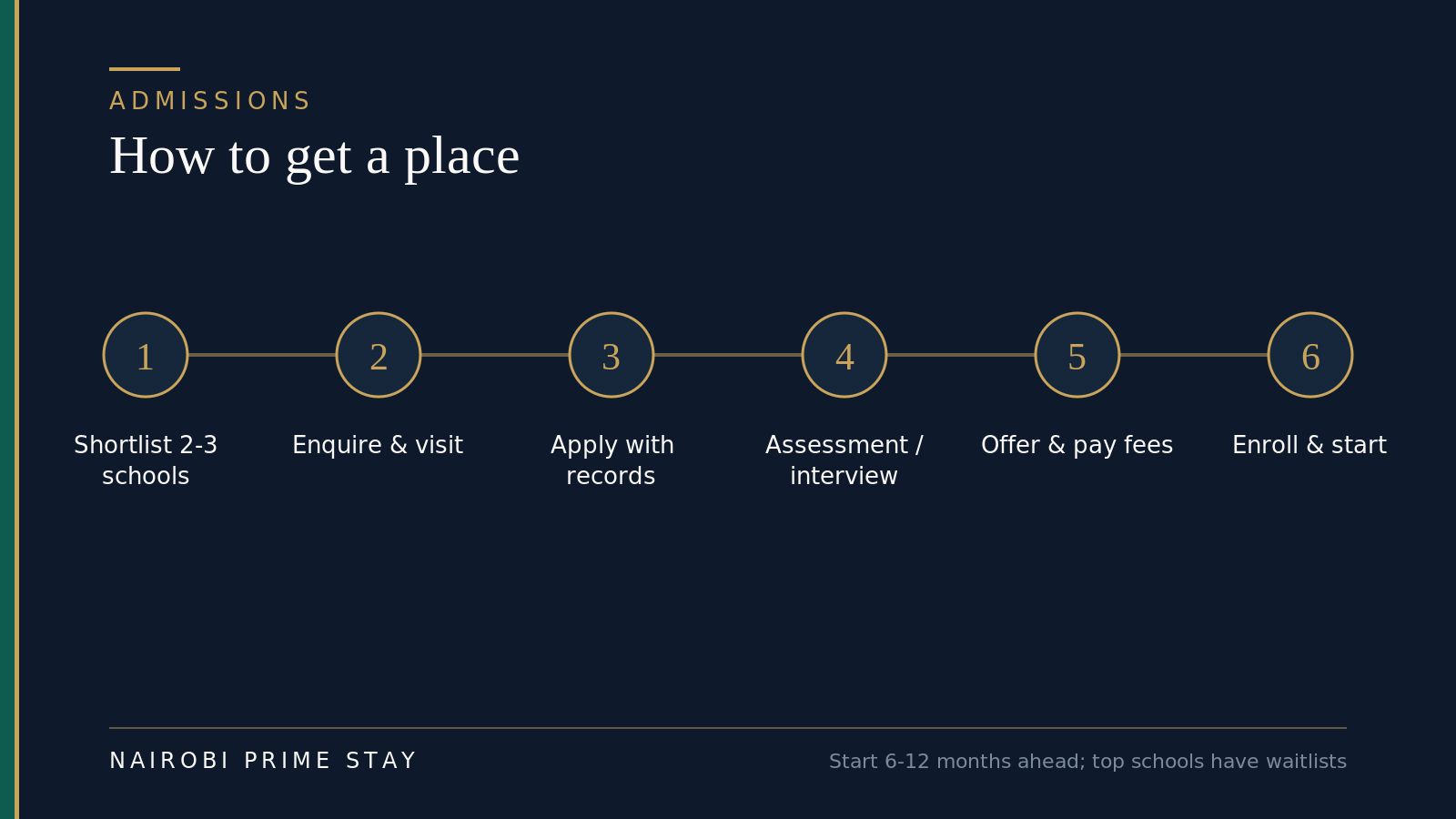 The admissions path is similar everywhere. Apply to two or three schools, not just your first choice.
The process is broadly the same across schools:
- Shortlist two or three schools. Don’t pin everything on one. Match curriculum, area and budget first.
- Enquire and visit. Email admissions, ask for the full fee schedule, and tour if you can — even a video call helps. Ask about current waitlists for your child’s grade.
- Apply with records. You’ll need the application form and fee, the last two to three years of school reports/transcripts, a reference from the current school, and passport copies.
- Assessment or interview. Many schools assess in English and maths, or hold an informal interview, to place your child correctly. It’s about fit and level, not a pass/fail gate.
- Receive an offer and pay. Secure the place with the registration fee and any deposit or capital levy. Read what’s refundable.
- Enroll and start. Sort uniforms, transport and start dates.
A practical admissions checklist:
- Decide on a curriculum (American / British / IB / French / German)
- Shortlist 2–3 schools that match your area and budget
- Email admissions and ask for the full fee schedule in writing and current waitlist status
- Gather 2–3 years of transcripts/reports, a school reference and passport copies
- Book tours or video calls; ask about assessment dates
- Apply to more than one school
- Confirm what’s refundable before paying deposits/levies
- Line up a home near your likely school (a serviced apartment makes this easy)
If a school you love is full, ask to join the waitlist and keep a second option warm. Mid-year places open more often than you’d think, as other expat families rotate out.
Match the school to where you live
The single best move for your sanity is to live near your school. Nairobi traffic turns short distances into long mornings, so a 10-minute school run is worth real money. Here’s how the main areas line up.
| If your school is… | Live in… | Why |
|---|---|---|
| ISK (Gigiri) | Gigiri, Runda, Muthaiga | Minutes from campus; the UN/embassy heartland |
| Rosslyn Academy (Runda) | Runda, Gigiri, Nyari | Quiet, gated, family suburbs right beside it |
| Brookhouse, Hillcrest, Banda (Karen / Lang’ata) | Karen, Lang’ata | Space, gardens and the southern school cluster |
| Braeburn, Lycée (Lavington side) | Lavington, Kileleshwa | Central, family-friendly, close to several campuses |
| Aga Khan Academy (Parklands) | Parklands, Westlands | Walk/short drive to campus |
This is exactly why we treat schools and neighbourhoods as one decision. If you’re UN or embassy staff with kids at ISK, Gigiri or Runda gives you a short run to both work and school. If you want British schooling and big gardens, Karen is the natural home. Our best-neighbourhoods overview and the individual area guides go deeper, and a serviced apartment near your shortlist lets you test the actual school-run traffic before you sign a year-long lease.
How to choose the right school for your family
Beyond curriculum and fees, weigh the things that don’t show up on a brochure. Class sizes and how stretched the teachers are. How your child learns — a small school like Banda or Rosslyn feels very different from a big campus like ISK. The strength of the subjects or sports your child cares about. How easily they’ll transfer to wherever you go next. And the practical stuff: the commute, the bus route, and whether your friends’ kids are there too, because community matters more than parents expect.
A few honest pointers from families who’ve done it:
- Visit if you possibly can. Brochures flatter. Ten minutes on a campus tells you more than ten pages of glossy PDF.
- Talk to current parents, not just admissions. The expat networks — and our AI relocation assistant — can connect you.
- Don’t over-optimise for prestige. The “best” school is the one your specific child thrives in, not the one with the highest fees.
- Mind the transfer back. If you’ll likely return to the US in a few years, the American or IB route keeps that door open most cleanly.
Three quick scenarios
UN family, two kids, posted for three years. ISK is the obvious anchor — American + IB, beside the UN HQ. Live in Gigiri or Runda for a short run to both work and school. Budget at the top of the range, including the one-time capital levy.
American remote-working couple, one child, open-ended stay. Rosslyn Academy gives you the US system at a friendlier price, with a warm community in Runda. Or ISK if budget allows and you want the IB option. Either way, a northern suburb keeps the commute sane.
Family heading back to the UK in a few years. Go British — Brookhouse, Hillcrest, Braeburn or Banda — so IGCSE and A-level transfer cleanly. Karen suits the senior British schools; Lavington works for Braeburn’s central campuses.
Special educational needs and learning support
Be honest with yourself about this one before you fall for a school. Nairobi’s international schools do offer learning support — most have some provision, and big schools like ISK have dedicated special-needs staff, counsellors and English-as-an-additional-language help. Mild accommodations and gifted extension are common. But it’s lighter than what a well-funded US public district provides, and there’s no local equivalent of the legal right to services you get under US IDEA law. Provision varies a lot from school to school.
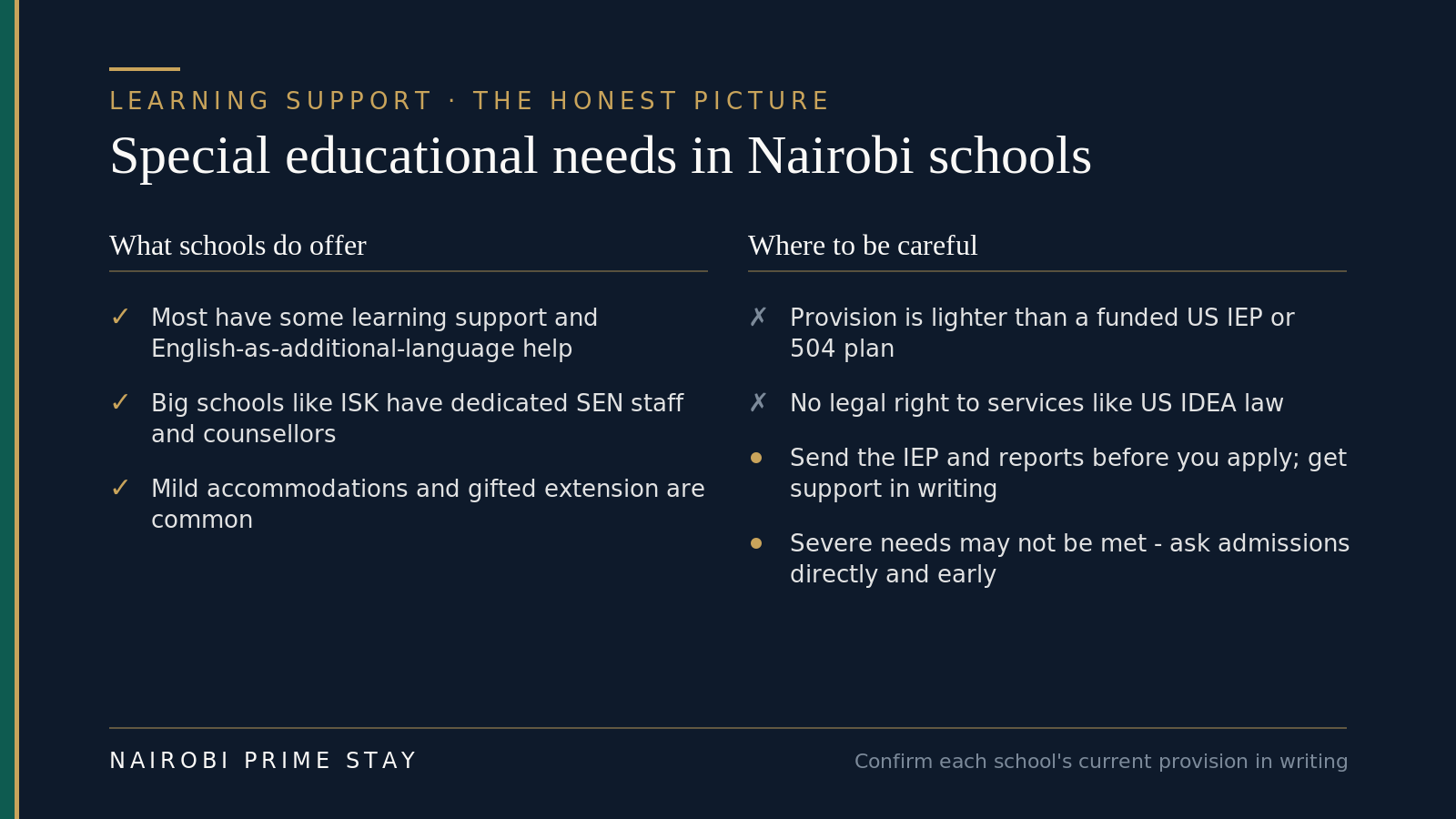 The honest picture on learning support — send your documentation early and get any support in writing.
If your child has an IEP, a 504 plan or any diagnosed need, do two things early. First, send the full documentation — reports, assessments, the current plan — to admissions before you apply, not after you arrive, and ask directly what the school can and can’t do. Second, get any agreed support in writing as part of the offer. A school that’s honest about its limits is doing you a favour; a severe or complex need may be better met at one particular school, or occasionally not well met in Nairobi at all, and you want to know that before you move. Our moving to Nairobi with kids and family life in Nairobi guides have more on settling children in.
The honest pros and cons
| Pros | Cons |
|---|---|
| One of Africa’s deepest benches of international schools | Top schools are genuinely expensive, and fees rise yearly |
| Easy transfers in and out of US/UK/IB systems | One-time capital levies add a big first-year hit |
| Campuses cluster near the best family suburbs | Best schools have waitlists — you must plan ahead |
| Small, international communities; warm welcomes | Traffic punishes you if you live far from campus |
| English throughout; smooth for American kids | Less choice and higher cost than a typical US suburb |
A realistic example
The Mwangi-Petersens, an American-Kenyan family with a 9- and a 13-year-old, moved from Denver for a two-year posting. They shortlisted ISK and Rosslyn, toured both on a scouting trip on the eTA, and chose Rosslyn for the community and the gentler fees — the older child could still slot back into a US high school later. They booked a serviced apartment in Runda’s orbit for the first six weeks, drove the school run a few times in real traffic, then signed a lease ten minutes from campus. Total time from landing to settled: about five weeks. The lesson they pass on: apply to two schools, and live near the one you pick.
Frequently asked questions
How much do international schools in Nairobi cost? Plan for roughly $6,000 to $37,000+ a year in tuition as of 2026, depending on the school and your child’s grade, with fees rising as they get older. The American and top British schools sit at the upper end; Rosslyn Academy, the French school and smaller schools sit lower. Budget another 15-25% on top for one-time levies, registration, transport and uniforms, and confirm the current schedule with each school, as fees change yearly.
Which is the best international school in Nairobi? There is no single best school; it depends on your child and your plans. The International School of Kenya (ISK) in Gigiri is the most prestigious and the default for UN and embassy families, offering American and IB tracks. Rosslyn Academy is the standout affordable American option, and Brookhouse, Hillcrest and Braeburn lead on the British side. Visit two or three before deciding.
American, British or IB — which curriculum should I choose in Nairobi? Choose American (ISK, Rosslyn) for the easiest transfer back into a US school. Choose British (Brookhouse, Hillcrest, Braeburn, Banda) if you want IGCSE and A-levels or you are heading to a UK university. Choose the IB (ISK, Aga Khan Academy) for a broad, globally portable diploma if your family moves often. For most American families staying short-term, American or IB keeps the most doors open.
How do Nairobi’s school fees compare to US private schools? They land in roughly the same league. The average US private school is about $14,100 a year, but the fair comparison is an independent day school, where US high-school tuition runs close to $38,400 and elite urban schools top $40,000. Nairobi’s ISK at the top of its range is comparable to a good US independent day school, and the mid-tier British schools and Rosslyn cost well less. Two differences: Nairobi’s top schools add a one-time capital levy (up to ~$11,000) and need-based aid is thinner here.
Where do graduates from Nairobi international schools go to university? All over the world, shaped by the curriculum. American-diploma graduates (ISK, Rosslyn) apply to US colleges with a transcript and the SAT or ACT. The IB Diploma is recognised in the US, UK and Europe. British A-levels feed the UK via UCAS and are accepted in the US with the SAT. The French and German schools point toward France and Germany. Counselling offices here regularly send students to strong universities in the US and UK.
Do Nairobi international schools support special educational needs? Somewhat, but it is lighter than a funded US district and there is no local equivalent of US IDEA law. Most schools offer some learning support and English-as-an-additional-language help, and big schools like ISK have dedicated special-needs staff. Provision varies a lot. If your child has an IEP or 504 plan, send the documentation to admissions before you apply, ask directly what the school can do, and get any agreed support in writing.
Do international schools in Nairobi have waitlists? Yes. The most popular schools like ISK, The Banda School and Brookhouse often have waitlists, especially mid-year and at common entry grades. Enquire 6-12 months ahead, apply to more than one school, and ask admissions about current availability for your child’s specific grade. Places do open up as expat families rotate out, so join a waitlist and keep a backup warm.
Where do most international schools cluster in Nairobi, and where should we live? They cluster in the western and northern suburbs: ISK and the IB options near Gigiri, Rosslyn in Runda, and the main British schools (Brookhouse, Hillcrest, Banda) around Karen and Lang’ata. Live near your chosen school - Gigiri or Runda for ISK, Karen for the southern British cluster - because Nairobi traffic makes a far-away school run brutal. A short school run is one of the best quality-of-life upgrades here.
When does the school year start in Nairobi? It depends on the curriculum. American and IB schools generally run August to June, like the US. British schools run September to July across three terms. A few schools follow the Kenyan January-to-December calendar. Plan your move around your school’s start date, and ask whether mid-year entry is possible if your timing does not line up.
Are there more affordable international school options in Nairobi? Yes. Rosslyn Academy offers the American curriculum at noticeably lower fees than ISK, the state-subsidised French school (Lycee Denis Diderot) is among the cheaper international options, and smaller or newer schools often cost less than the flagships. You can get a quality international education in Nairobi for well under the headline $30,000-plus figures, just expect fees to climb through the senior grades.
Can my child transfer back into the US system after a Nairobi international school? Yes, and this is a real strength of Nairobi’s schools. Children at American-curriculum schools (ISK, Rosslyn) transfer back into US schools most smoothly, and the IB Diploma is widely recognised by US universities. British-system students can also return, though aligning IGCSE and A-level timing with US grades takes a little planning. Keep transcripts and records organised throughout, as you will need them for any move.
Final thoughts
Nairobi makes the school part of a move easier than most families expect. The choice is wide, the quality is high, and the campuses sit right where expat families want to live. The two things that trip people up are cost and timing — so get the full fee schedule in writing, budget for the levies on top of tuition, and start your applications early enough to beat the waitlists.
Choose the curriculum that fits your child and your next move, shortlist a couple of schools, and then pick your home around the school run. Do that, and the rest of the relocation gets a lot simpler.
Related reading
- Moving to Nairobi: the complete guide — the end-to-end overview that ties schools, visas, housing and the rest together.
- Moving to Nairobi with kids — the family-specific playbook, from childcare to weekends.
- British curriculum schools in Nairobi and American & IB schools in Nairobi — the deep dives on each system.
- Nursery and daycare in Nairobi — Montessori, play-based and international early-years options for the under-fives.
- Cost of living in Nairobi — where school fees fit in the wider family budget.
- Neighbourhood guides for Gigiri, Runda, Karen and Lavington — the suburbs around the main schools.
Ready to match a home to your school shortlist?
Once you know your two or three schools, the next job is a home with a short school run. Browse our serviced apartments near Gigiri, Runda and Karen — all-inclusive, with honest monthly pricing — or let our AI relocation assistant shortlist places near your chosen school in a couple of minutes. A serviced apartment for your first month lets you tour schools and drive the real traffic before you commit to a year-long lease. A $50 deposit reserves a place; you pay the balance on arrival.
Ready to look?
Find your apartment in Nairobi
Browse verified serviced apartments, or ask the AI concierge which area fits your life.