
Guides · Schools
British Schools in Nairobi: IGCSE, A-Levels and How to Choose (2026)
British Schools in Nairobi: IGCSE, A-Levels and How to Choose (2026)
Nairobi has more British-curriculum schools than schools of any other system. If you want your child on the IGCSE-then-A-level path — the one that feeds universities in the UK, across the Commonwealth, and increasingly in the US — you have real choice here. That ranges from day schools fifteen minutes from the western suburbs to full boarding schools up in the highlands.
This guide is for American parents weighing the British system, or who have already chosen it and want to know which school, where, and at what cost. We will keep it honest. The British system is excellent and well supported in Kenya, but it works differently from the one you grew up with, and fees at the top schools rival a US private college.
By the end you will understand how the British system is structured here, which schools teach it and where they sit, what they cost in 2026, how admissions work, and how to match a school to where you will live. For the wider view across all curricula, start with our international schools in Nairobi guide. For the alternative, see American and IB schools in Nairobi.
TL;DR — British schools in Nairobi at a glance
- The British curriculum is the most widely offered international system in Nairobi. Children move through Early Years, primary, then IGCSE (around age 16) and A-levels (around 18), almost always with Cambridge as the exam board.
- The established expat schools cluster in and around Karen, Runda, Lavington and Lang’ata, plus genuine boarding schools an hour or two out of town.
- Day fees at the well-known schools run roughly KES 1–2.8 million a year (about $8,000–22,000). Senior boarding can reach KES 4–4.5 million ($30,000–35,000). Mid-range Cambridge schools cost far less.
- Big names: Brookhouse (Karen and Runda), the Braeburn group (several campuses), Hillcrest (Karen), The Banda School (Lang’ata prep), and boarding at Peponi, Greensteds and St Andrew’s, Turi.
- Apply early — good schools keep waitlists. Choose the school first, then live within a sane commute of it. Traffic, not distance, is what wears families down.
Why this matters for your family
Your child’s school shapes the whole move. It decides where you live, sets a big line in your monthly budget, fixes your daily drive, and largely determines how smoothly your kids settle. Get the curriculum right and much of the relocation arranges itself around that one choice.
The British system carries an extra consideration most families miss until they are deep in it: continuity. A child who has been in a British or international British school in the US, the Middle East or Asia slots in cleanly. A child coming straight from a US public or private school is making a real switch — in calendar, in year-group labels, and in how the final years and exams work. None of that is a problem. It is just worth understanding before you fall in love with a campus.
How the British system works in Kenya
A British-curriculum school takes a child from age 3 to 18 along a single, well-mapped ladder. Here is the whole thing in plain terms.
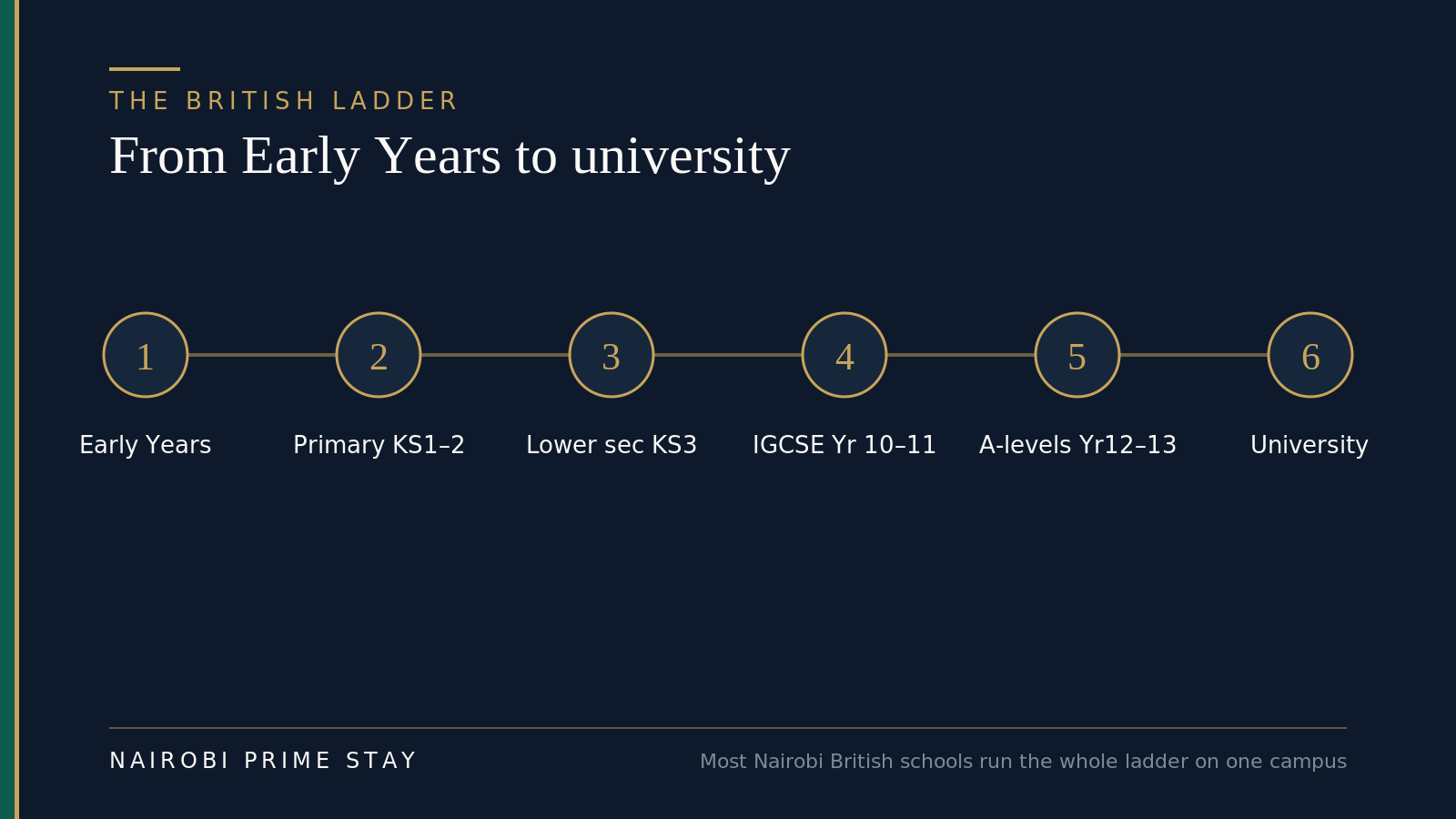 The British ladder, from Early Years to university. Most Nairobi schools run all of it on one campus.
- Early Years Foundation Stage (EYFS): nursery and Reception, roughly ages 3–5. Play-based, with early reading and numbers.
- Key Stages 1 and 2 (Years 1–6, ages 5–11): primary school.
- Key Stage 3 (Years 7–9, ages 11–14): lower secondary, a broad subject load.
- Key Stage 4 (Years 10–11, ages 14–16): the IGCSE years.
- Sixth Form, or Key Stage 5 (Years 12–13, ages 16–18): AS and A-levels.
What IGCSE and A-levels actually are
IGCSE stands for the International General Certificate of Secondary Education. It is Cambridge’s global version of the British GCSE, taken at the end of Year 11. Students sit exams in around six to ten subjects — English, maths and sciences, plus choices. Think of it as the broad academic foundation before a student specializes.
A-levels (Advanced Levels) come next: deep study of three or four subjects across Years 12 and 13, examined at the end of Year 13. A-levels are the main currency for university admission in the UK and across the Commonwealth, and US universities recognize them well — strong grades often earn college credit, much like AP exams. A student aiming at medicine or engineering, for example, would pick the matching three or four subjects and go deep.
What American parents need to know
Three honest translations save a lot of confusion.
First, year groups run about one ahead of US grade labels, and the age cutoff differs. A rough rule is that a UK Year equals the US grade plus one. A US fifth-grader of about ten usually slots into Year 6. Schools place by age and a short assessment, not by the number on a transcript, so do not over-worry the label — just expect it to look “off by one.”
Second, the school year runs September to July, in three terms with a long break in December, not the US August-to-June calendar. Moving mid-year from a US school is doable but takes planning, especially in the exam years. Many families time the move for the summer so the child starts fresh in September.
Third, there is no high-school diploma or GPA. Universities look at IGCSE grades, predicted and final A-level grades, and a school reference. For US college applications your child still takes the SAT or ACT and writes essays; A-levels sit alongside those and strong ones are a genuine asset. If keeping a US-style transcript and GPA matters to you, weigh the American and IB schools too.
The exam boards
Most British schools in Nairobi examine through Cambridge (Cambridge International, also called CAIE). Some use Pearson Edexcel. Both are recognized worldwide, so the choice rarely matters for university entry. Kenya has more than 80 registered Cambridge exam centers, which tells you how deep and well-supported the system is here. When you visit a school, ask which board it uses and to see recent IGCSE and A-level results.
The main British schools — who they are and where they sit
Nairobi’s British schools fall into three groups: established day schools in the western suburbs, prep schools that prepare children for senior school at 11–13, and boarding schools out of the city. Here are the names you will hear most, with honest notes. All fees are 2025/26 and move every year, so treat them as ranges and confirm directly with each school.
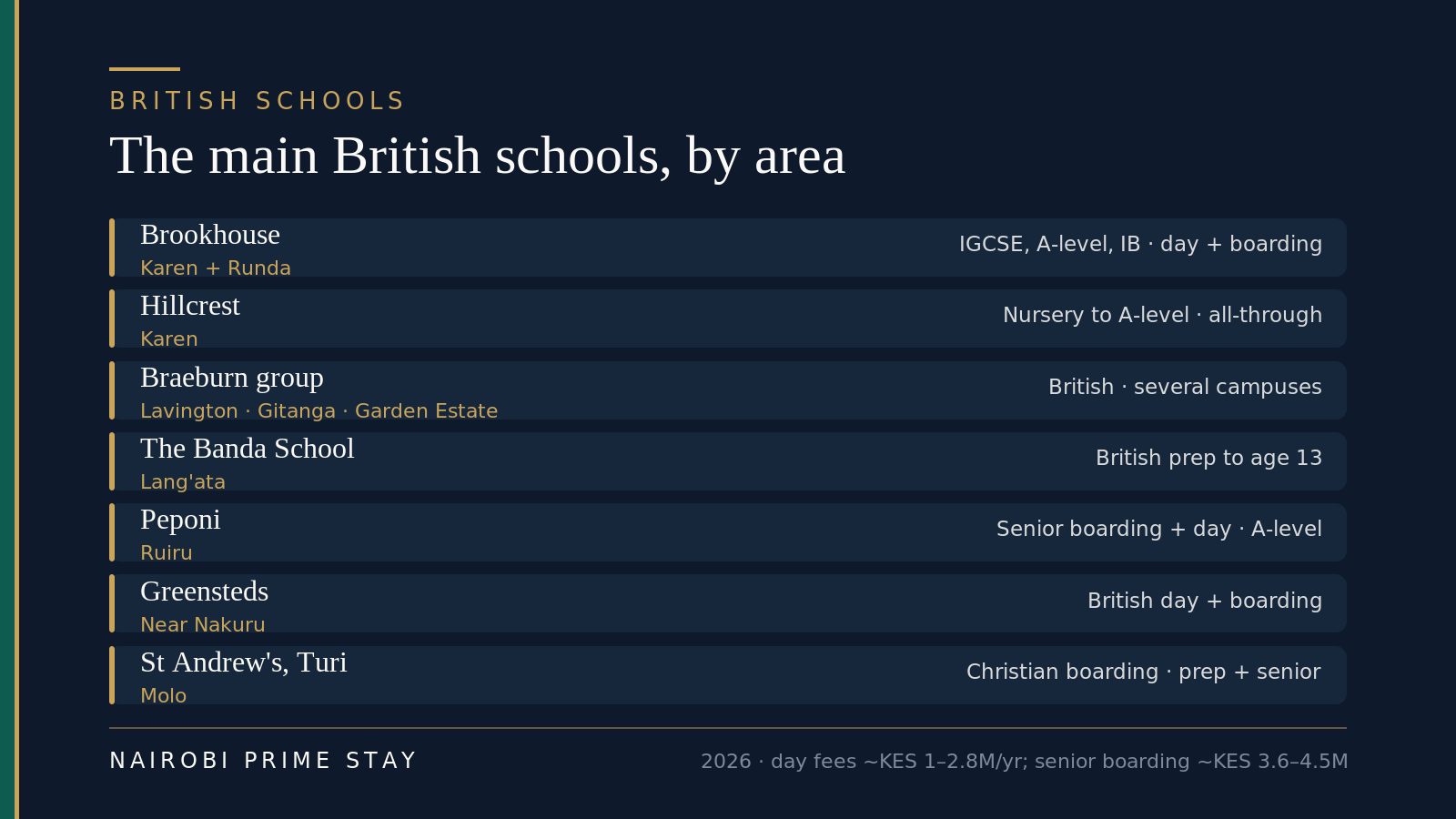 Where the main British schools sit. Day schools cluster west and south; boarding sits well out of town.
Brookhouse Schools (Karen and Runda)
Two Nairobi campuses — Karen, which offers boarding, and Runda, which is day only. Brookhouse teaches the British curriculum through IGCSE and A-level, and also offers the IB Diploma in Sixth Form, so older students can choose their path. It is one of the best-known names for university-bound leavers. Fees are billed per term in the lower years and by semester in Years 11 and 13, rising steeply with age; with boarding, the senior years sit at the top of the Nairobi market. Expect a registration fee around KES 45,000, refundable caution money of roughly KES 100,000–200,000, and lunch included.
The Braeburn group (several campuses)
Braeburn is the largest British-curriculum network in the region, with around a dozen-plus schools across Kenya. In Nairobi that includes campuses on Gitanga Road, at Garden Estate, and Braeside in Lavington. It runs the British National Curriculum, IGCSE and A-levels. Fees span a wide band by age and campus — very roughly KES 1–2.4 million a year — and the group offers meaningful sibling discounts, which adds up for families with two or three children. Fees often bundle lunch and school transport. Braeburn is a practical choice if you want a solid British school close to Lavington, Kileleshwa or the northeastern suburbs.
Hillcrest International Schools (Karen)
Part of the Braeburn group, on a large Karen campus, Hillcrest takes children from about age 2 to 18 — nursery all the way to A-levels on one site. Annual fees run roughly KES 730,000 to KES 2.4 million depending on age. Families in Karen and Lang’ata like the space and the all-through continuity: your child can stay put from toddler to Sixth Form without another admissions round.
The Banda School (Lang’ata)
The Banda is a traditional British prep school. It takes children to about age 13 (Year 8) and prepares them, through Common Entrance and scholarships, for senior schools in Kenya, the UK or beyond. The leafy Lang’ata campus near Nairobi National Park is sought after, and per-term fees run roughly KES 84,000–836,000 by age. One planning note: if you choose a prep school like Banda, map out the senior-school step from the start, because that transition at 11–13 is part of the British model, not an afterthought.
Boarding schools (out of the city)
Kenya has something the American system here does not: genuine British boarding schools, a legacy of the old highlands schools, now modern and internationally minded. They suit families who travel for work, who want the full British boarding experience, or whose child thrives with that structure.
- Peponi School (Ruiru, about 45 minutes northeast of the city): British senior boarding and day to A-level, with a strong academic record. Senior boarding fees are among the highest in Kenya — well over KES 3.6 million a year. Peponi House is its linked prep school closer to town.
- Greensteds International School (near Nakuru, about two hours northwest): British day and boarding on a large rural campus, and one of Kenya’s pricier schools.
- St Andrew’s School, Turi (Molo, about three hours northwest): a long-established Christian British boarding school with prep and senior sections. Full senior boarding (Years 9–13) runs about KES 1.45 million a term — roughly KES 4.4 million a year — plus a substantial refundable caution deposit.
- Also worth knowing: Pembroke House (Gilgil), a well-regarded prep boarding school.
Mid-range and budget British schools
You do not have to pay $20,000. Because Kenya has more than 80 Cambridge exam centers, plenty of mid-range private schools teach IGCSE and sometimes A-levels for a fraction of the elite fees — names like Nairobi Academy, Cavina, Makini’s Cambridge stream, Rusinga, Oshwal Academy and Crestview, among others. The trade-offs are usually facilities, class sizes, the depth of the expat community, and how practiced the school is at moving leavers into UK and US universities. Visit and compare. A lower fee is not automatically lower quality, and a high one does not guarantee the right fit for your child.
British schools compared at a glance
A quick side-by-side of the schools families ask about most. Fees are indicative 2025/26 annual day fees unless noted, rounded, and best confirmed with each school.
| School | Area | Day / boarding | Ages | Exams | Indicative fees/yr |
|---|---|---|---|---|---|
| Brookhouse | Karen + Runda | Both (Karen boards) | 2–18 | IGCSE, A-level, IB | ~KES 1.3–2.8M day |
| Braeburn (group) | Gitanga, Garden Estate, Lavington | Day | 2–18 | IGCSE, A-level | ~KES 1.0–2.4M |
| Hillcrest | Karen | Day | 2–18 | IGCSE, A-level | ~KES 0.73–2.4M |
| The Banda School | Lang’ata | Day (prep to 13) | 3–13 | Common Entrance prep | ~KES 0.25–2.5M |
| Peponi | Ruiru | Boarding + day | 11–18 | IGCSE, A-level | ~KES 3.6M+ boarding |
| Greensteds | Near Nakuru | Boarding + day | 2–18 | IGCSE, A-level | High end (confirm) |
| St Andrew’s, Turi | Molo | Boarding | 3–18 | IGCSE, A-level | ~KES 4.4M boarding |
What British schools cost in 2026
Budget for more than the tuition line. The headline figure is what families anchor on, but it is rarely the whole bill.
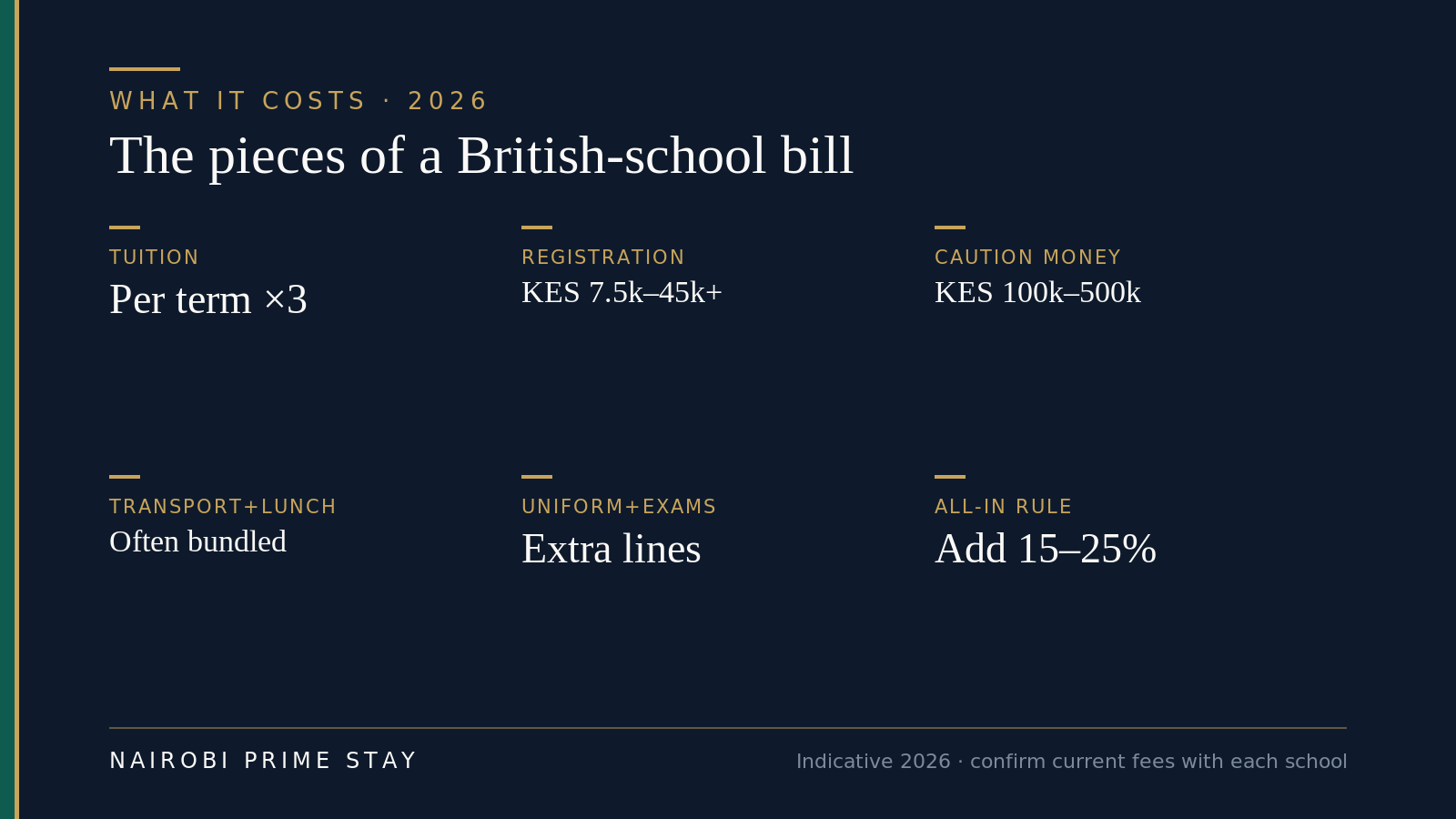 The pieces of a British-school bill. Add 15–25% to headline tuition for the all-in cost.
Here is how the bill actually builds:
- Tuition is published per term (three a year) or, in the exam years, by semester (two). Multiply accordingly. A “KES 800,000 a term” school is roughly KES 2.4 million a year.
- One-off costs include a registration or application fee (KES 7,500–45,000+) and refundable caution money or a deposit (KES 100,000–500,000 at the top schools). Some add a one-time capital or development levy.
- Recurring extras: transport, lunch (often bundled), uniform, exam entry fees, trips and after-school activities.
A useful planning rule is to add 15–25% to the headline tuition for the realistic all-in cost. Here is the lay of the land by tier:
| Tier | Examples | Indicative annual fee |
|---|---|---|
| Mid-range Cambridge day | Nairobi Academy, Cavina, Makini, Oshwal | ~KES 250,000–900,000 |
| Established expat day | Braeburn, Hillcrest, Brookhouse (day) | ~KES 1.0–2.8 million |
| Senior boarding | Peponi, Greensteds, St Andrew’s Turi | ~KES 3.6–4.5 million |
Two published 2025/26 anchors to make that concrete. Brookhouse lists secondary day fees of about KES 840,000–940,000 per term for Years 7–10, with the exam years billed by semester and boarding at Karen adding roughly KES 550,000–830,000 a term. St Andrew’s, Turi publishes full boarding for Years 10–11 at KES 1,179,000 per term (about $9,900) — roughly KES 3.5 million a year — plus a place-securing deposit of half a term’s fees and a 5% discount for second and subsequent children. Schools reset fees each academic year, so treat anything more than a year old as a floor, not a quote.
Convert at KES 129.4 to the US dollar (the rate on 1 July 2026; it moves, so check before you budget — our dollar-to-shilling guide explains how to handle it). That puts established day schools at about $8,000–22,000 a year and senior boarding at $28,000–35,000. For where school fees fit in a wider family budget, see our cost of living in Nairobi guide. One honest caution: fees are set in shillings, so if the rate moves, your dollar cost moves with it.
How admissions work
Most British schools admit year-round when they have space, but the sought-after ones run waitlists. Apply as early as you sensibly can — ideally 6–12 months ahead of your move. The process is straightforward:
- Shortlist two or three schools by curriculum, area and budget.
- Enquire and book a visit. A virtual tour and a call work fine from the US; an in-person visit is better if you can fold it into a scouting trip.
- Submit the application with the registration fee, the last two years of school reports or transcripts, and any references the school asks for.
- Assessment. Younger children have an informal, play-based visit. Older children usually sit assessments — often the CAT4, plus English and maths papers — and may have an interview.
- Offer and acceptance. Pay the deposit or caution money to secure the place.
- Prep-to-senior step. If you choose a prep school, plan the Common Entrance or senior-school assessment that comes at 11–13.
Gather these before you apply, so nothing stalls the process:
- Passports and your residence permit or visa status
- Two years of school reports or transcripts
- Any standardized test results (MAP, state tests, and so on)
- An educational psychologist’s report if your child has learning-support needs
- Immunization records
- A reference from the current school
- Birth certificate
- The registration fee, ready to pay
The waitlist reality
The most in-demand year groups — often the early primary years and the Sixth Form — fill first, and a popular school can have no space in the exact year you need even when it has room elsewhere. Two practical moves help. Apply to your top two or three schools at once rather than waiting on a single first choice. And if your timing is tight, a serviced apartment for the first month or two lets you stay flexible on neighborhood while a place firms up, so you are not signing a year-long lease next to a school that cannot take your child yet.
Match the school to where you’ll live
Choose the school first, then live within a short, predictable commute of it. In Nairobi the distance on the map means little; the traffic between you and the gate means everything. A 6-kilometer school run can be twenty minutes at 6:45 a.m. and over an hour at 7:30.
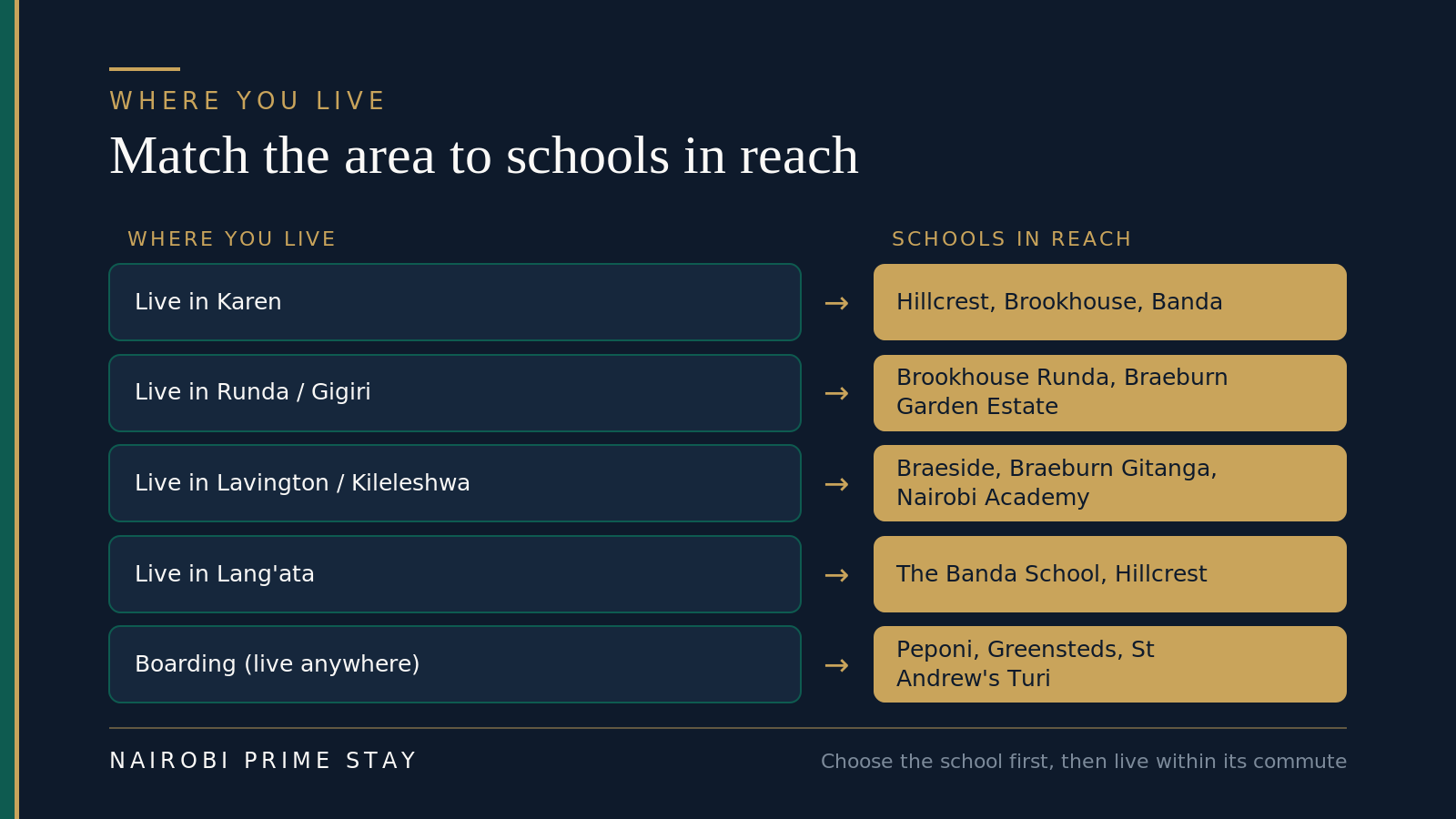 Pick the school, then live within its commute. These pairings keep the morning run short.
| Where you live | British schools within a sane commute |
|---|---|
| Karen | Hillcrest, Brookhouse (Karen), The Banda School (Lang’ata), Braeburn (Gitanga Rd) |
| Runda / Gigiri | Brookhouse Runda, Braeburn Garden Estate |
| Lavington / Kileleshwa | Braeside (Braeburn), Braeburn Gitanga Rd, Nairobi Academy |
| Lang’ata | The Banda School, Hillcrest (nearby in Karen) |
| Anywhere (boarding) | Peponi, Greensteds, St Andrew’s Turi — visit on exeat weekends |
If you are still deciding where to base yourselves, our guide to moving to Nairobi with kids pairs schools with the suburbs that suit family life.
Is the British system right for your child?
There is no universally best curriculum — only the one that fits your child and your likely path after Nairobi. The British system is a strong choice for some families and the wrong one for others.
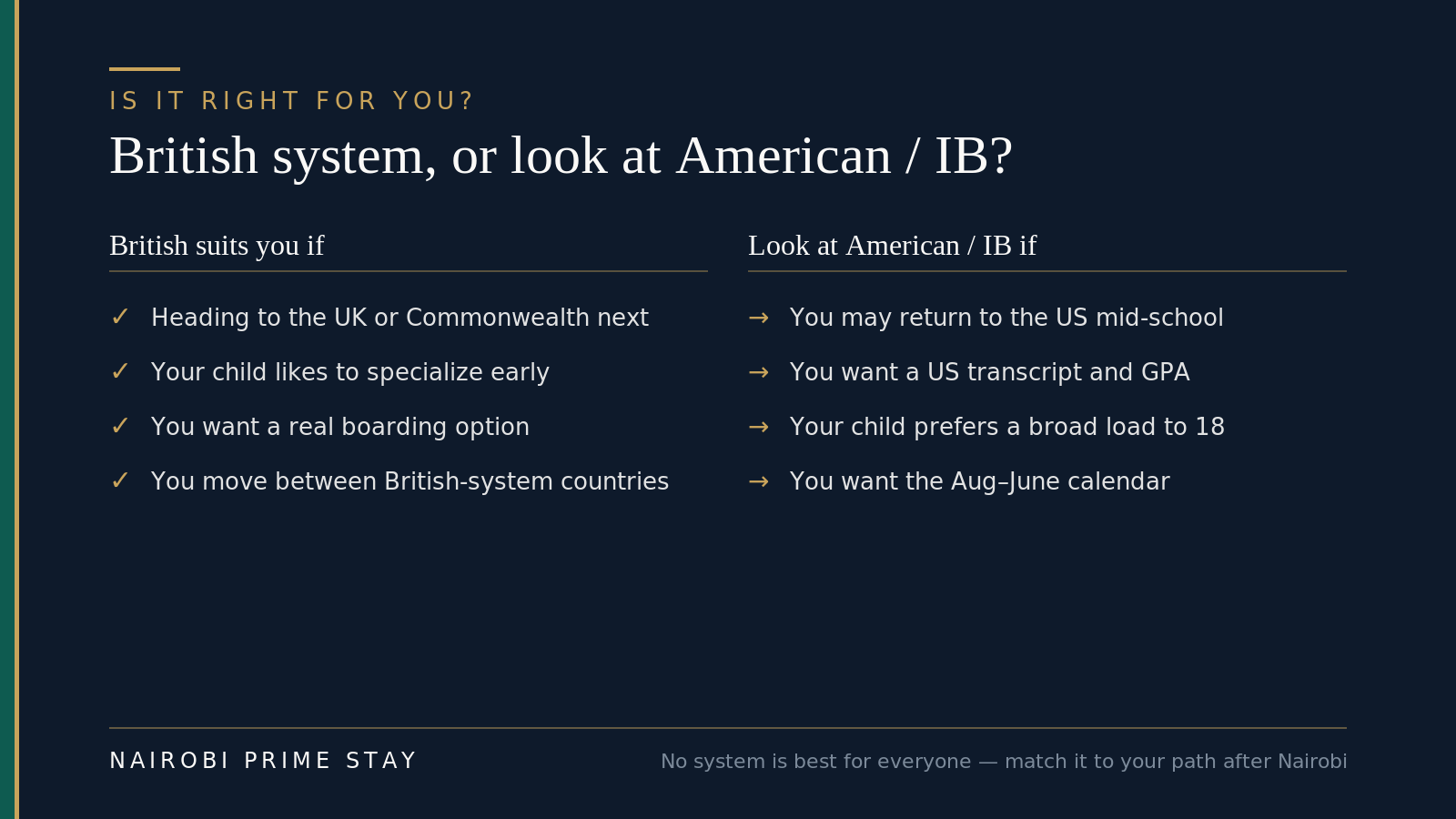 A quick gut-check. If the right column sounds like you, weigh the American and IB options too.
The British system suits you if:
- You are likely headed to the UK, Europe or the Commonwealth after Nairobi, or back into the British international-school circuit elsewhere.
- Your child does well specializing — going deep on three or four A-level subjects rather than carrying ten to graduation.
- You want the option of genuine boarding, which the system here offers and the American track does not.
- You value the structure, the uniforms and the clear year-on-year progression.
Look harder at American or IB if:
- You may return to the US partway through and want continuity with a US transcript and GPA. The American and IB schools guide covers ISK and Rosslyn Academy.
- Your child prefers a broad academic load to age 18. The IB Diploma keeps six subject areas going, which some students prefer to A-level specialization.
- The August-to-June calendar matters to you for family or work reasons.
A realistic example
The Carters move from Atlanta on a two-year corporate posting, with a 14-year-old and an 8-year-old. They expect to head back to the US afterward, so continuity matters — but they also like the idea of A-levels for their older child, who already wants to study engineering. They shortlist Brookhouse (British plus an IB option in Sixth Form) and an American school, visit both virtually, and choose Brookhouse Runda for the British academics and the IB fallback. They rent in Runda, a ten-minute run to the gate, and use a serviced apartment for the first six weeks while the lease and the school place line up. The 8-year-old slots into Year 4; the 14-year-old starts Year 10, the first IGCSE year, in September.
How the British school year works — and when to move
The British school year in Nairobi runs September to early July, split into three terms — autumn, spring and summer — each broken by a half-term week. Boarding schools add exeat weekends, when boarders go home or to a guardian. That is a different clock from the American schools’ August–June year, and a very different one from Kenya’s own CBC calendar, which runs January to November — so never assume your neighbor’s term dates match yours.
The smoothest entry point is the start of the school year in September, which for most American families means landing in Nairobi by mid-August: time to settle the house, run the uniform errands and do the school’s induction day without a scramble. January entry into the spring term is usually workable in the non-exam years — schools admit year-round when they have space.
The timing that genuinely hurts is a mid-cycle move in the exam years. IGCSE (Years 10–11) and A-levels (Years 12–13) are two-year syllabi, often with coursework that builds across both years, and exam boards differ school to school. Dropping a 15-year-old into the middle of Year 11 means new teachers, possibly a new exam board, and half the course already taught. If a posting forces a move in those windows, talk to both schools early — some will bridge, others will honestly tell you to wait for the next September. Younger children are far more forgiving: primary years absorb mid-year joiners easily, and nurseries and daycares take children year-round, so the calendar pressure really starts at Year 10.
If the school place and the lease refuse to line up, a serviced apartment for the first month or two keeps you flexible on neighborhood until the offer letter fixes your geography.
Will A-levels get your child into a US college?
Yes — US universities admit A-level students routinely, and the path is better trodden than most American parents expect. Here is how it actually works from a Nairobi British school:
- Applications go through the Common App, the same as from a US high school. The difference is that your child applies with predicted grades — the school’s forecast of their A-level results — since final results only land in August, after US decisions are out.
- There is no GPA. The school assembles a transcript-equivalent from internal reports and IGCSE results, plus teacher references. Admissions offices at US universities read A-level applications every cycle; this is not exotic to them.
- Strong A-levels can earn college credit. Many US universities treat A-level grades the way they treat AP scores — grades of A*–C can convert to course credit or advanced standing, sometimes a full semester or more. Policies vary by university, so check each one’s international credit page.
- SAT or ACT may still matter. Many US universities remained test-optional as of mid-2026, but several selective ones have reinstated testing — verify each college’s current policy rather than assuming. The bigger Nairobi schools can arrange SAT sittings locally.
- Ask the school about US counseling before you enroll. This is where the schools differ most. The established names — Brookhouse, Hillcrest, Peponi — place students in US universities every year and can name recent admits; a smaller Cambridge school may know UCAS cold but have little US-application experience. Ask for the last two years of US placements and who on staff owns Common App support.
One planning note: A-level students pick three or four subjects at 16, so if your child is aiming at, say, engineering in the US, choose maths and physics at A-level — the specialization that looks narrow from an American angle becomes an asset when it matches the intended major.
What a first year actually costs: a worked example
Take an 8-year-old joining Year 4 at an established expat day school in the Karen–Lavington belt, at a mid-table tuition of KES 550,000 a term. The first-year bill builds like this: registration fee about KES 30,000 (one-off), refundable caution money around KES 150,000, tuition KES 1,650,000 for three terms, then transport, lunch, uniform, exam and activity extras of roughly KES 250,000 across the year. That is about KES 2.08 million all-in — roughly $16,000 at 129.4 — against a headline tuition of KES 1.65 million. The 15–25% rule holds almost exactly.
The boarding version, using St Andrew’s, Turi’s published 2025/26 figures for a Year 10 pupil: KES 1,179,000 a term of full boarding is KES 3,537,000 a year, plus the deposit of half a term’s fees (about KES 590,000, held against your account) and personal extras — call it KES 3.7–4 million (about $28,500–31,000) in year one. A second child at the same school trims 5% off basic fees. Fees are set in shillings, so your dollar cost tracks the exchange rate — budget at the current rate, not last year’s.
The honest pros and cons
| Pros | Cons |
|---|---|
| The widest choice of schools and campuses in Nairobi | Top day and boarding fees rival US private colleges |
| A clear, internationally portable path: IGCSE then A-levels | Year labels and the Sept–July calendar take adjustment from a US school |
| Recognized everywhere, including by US universities | A-level specialization narrows subjects early — not for every child |
| Real boarding options the American track lacks | Mid-year moves are awkward, especially in exam years |
| Mid-range Cambridge schools make it accessible below the elite tier | No US-style transcript or GPA; you manage US applications separately |
Frequently asked questions
What’s the difference between IGCSE and A-levels?
IGCSE is the broad qualification taken at the end of Year 11, around age 16, usually across six to ten subjects. A-levels come next: deep study of three or four subjects over Years 12 and 13, examined at about age 18. IGCSE is the foundation; A-levels are what universities, including US ones, look at most closely for admission.
How do British schools in Nairobi compare to American or IB schools?
All three are well represented and respected in Nairobi. The British system offers the most schools and the only real boarding options, and it suits families heading to the UK or Commonwealth and children who like to specialize. American and IB schools (such as ISK and Rosslyn Academy) suit families who want a US-style transcript and GPA or a broader load to age 18. Choose by your likely path after Nairobi and your child’s learning style, not by prestige.
How much do British schools in Nairobi cost in 2026?
Established expat day schools run roughly KES 1–2.8 million a year, about $8,000–22,000 at a rate near KES 130 to the dollar. Senior boarding at schools like Peponi and St Andrew’s Turi can reach KES 4–4.5 million, about $30,000–35,000. Mid-range Cambridge day schools cost far less, often KES 250,000–900,000. Budget an extra 15–25% over tuition for registration, deposits, transport and extras, and confirm current fees with each school.
Will A-levels work for US college applications?
Yes. US universities recognize A-levels well, and strong grades often earn college credit, much like AP exams. Your child still takes the SAT or ACT and writes the usual application essays; the A-levels and a school reference sit alongside those. Schools with experience sending leavers to the US can guide the process — ask about it when you visit.
Which British schools in Nairobi offer boarding?
Brookhouse boards at its Karen campus. The classic British boarding schools sit out of the city: Peponi near Ruiru (about 45 minutes), Greensteds near Nakuru (about two hours) and St Andrew’s, Turi, near Molo (about three hours). They suit families who travel for work or want the full boarding experience, and you visit on exeat weekends.
How early should we apply?
Aim for 6–12 months ahead of your move. Popular schools and the busiest year groups, often early primary and Sixth Form, keep waitlists and can be full in the exact year you need. Apply to your top two or three at once rather than waiting on a single first choice, and a serviced apartment for the first weeks keeps your neighborhood flexible while a place firms up.
What year group will my American child go into?
Roughly, a UK Year equals the US grade plus one, so a US fifth-grader of about ten usually slots into Year 6. Schools place by age and a short assessment rather than by the transcript label, so expect the number to look about one ahead of what you are used to. The school confirms the placement after the assessment.
Are there affordable British-curriculum schools, or only the expensive ones?
There are affordable options. Kenya has more than 80 registered Cambridge exam centers, so many mid-range private schools teach IGCSE and sometimes A-levels for a fraction of the elite fees. The trade-offs are usually facilities, class sizes, the expat community and how practiced the school is at university transitions. Visit and compare — a lower fee is not automatically lower quality.
When does the British school year start in Nairobi?
In September, running to early July across three terms with half-term breaks — unlike Kenya’s local CBC schools (January–November) or the American-curriculum schools (August–June). Aim to arrive by mid-August for a September start. January entry works in non-exam years, but avoid joining mid-way through the two-year IGCSE (Years 10–11) or A-level (Years 12–13) courses if you possibly can.
Do British schools in Nairobi prepare students for US college applications?
The established ones do — Brookhouse, Hillcrest and Peponi place students in US universities most years. Applications go through the Common App using predicted A-level grades, the school builds a transcript-equivalent (there is no GPA), and strong A-level results can convert to US course credit much like AP scores. Before enrolling, ask the school for its recent US placements and who on staff handles Common App support — this varies far more between schools than the academics do.
What extra costs should we budget beyond tuition?
A registration or application fee (KES 7,500–45,000), refundable caution money or a deposit — at St Andrew’s, Turi it is half a term’s fees — plus transport, lunch, uniform, exam entry, trips and activities. Adding 15–25% to headline tuition is a reliable planning rule; a KES 1.65 million day-school year lands nearer KES 2.1 million all-in. Some schools give sibling discounts of around 5% on basic fees.
Final thoughts
The British curriculum is the deepest, most flexible school system in Nairobi, with options from accessible Cambridge day schools to some of the best boarding schools in the region. The honest work is not finding a good British school — there are many — but matching one to your child, your budget and the path you expect after Kenya, then living close enough that the morning run stays sane.
Start early, apply to more than one, and visit if you can. Get the school right and the rest of your move tends to fall into place around it.
Related reading
- The complete moving to Nairobi guide — the hub that ties the whole relocation together.
- Nurseries and daycare in Nairobi — for the under-fives, who can join year-round.
- International schools in Nairobi — the overview across all five curricula.
- American and IB schools in Nairobi — ISK, Rosslyn Academy and the IB Diploma.
- Moving to Nairobi with kids — family suburbs, healthcare and settling in.
- Cost of living in Nairobi — where school fees fit in a family budget.
- Neighborhood guides: Karen, Runda and Lavington.
Planning your move around a school?
Once you know your shortlist, the smart play is to land softly while the lease and the school place line up. A serviced apartment for your first month or two gives you a secure, fully equipped base — Wi-Fi, cleaning, generator and security included — close to the schools you are considering, so you can do the runs, test the traffic and choose your neighborhood before signing a year-long lease. A $50 deposit reserves a place and the balance is paid on arrival.
Not sure which area pairs best with your school shortlist? Our AI relocation assistant can match apartments to your child’s school and your commute in a couple of minutes, day or night.
Ready to look?
Find your apartment in Nairobi
Browse verified serviced apartments, or ask the AI concierge which area fits your life.