
Guides · Schools
Nursery and Daycare in Nairobi: A 2026 Guide for Expat Families
Nursery and Daycare in Nairobi: A 2026 Guide for Expat Families
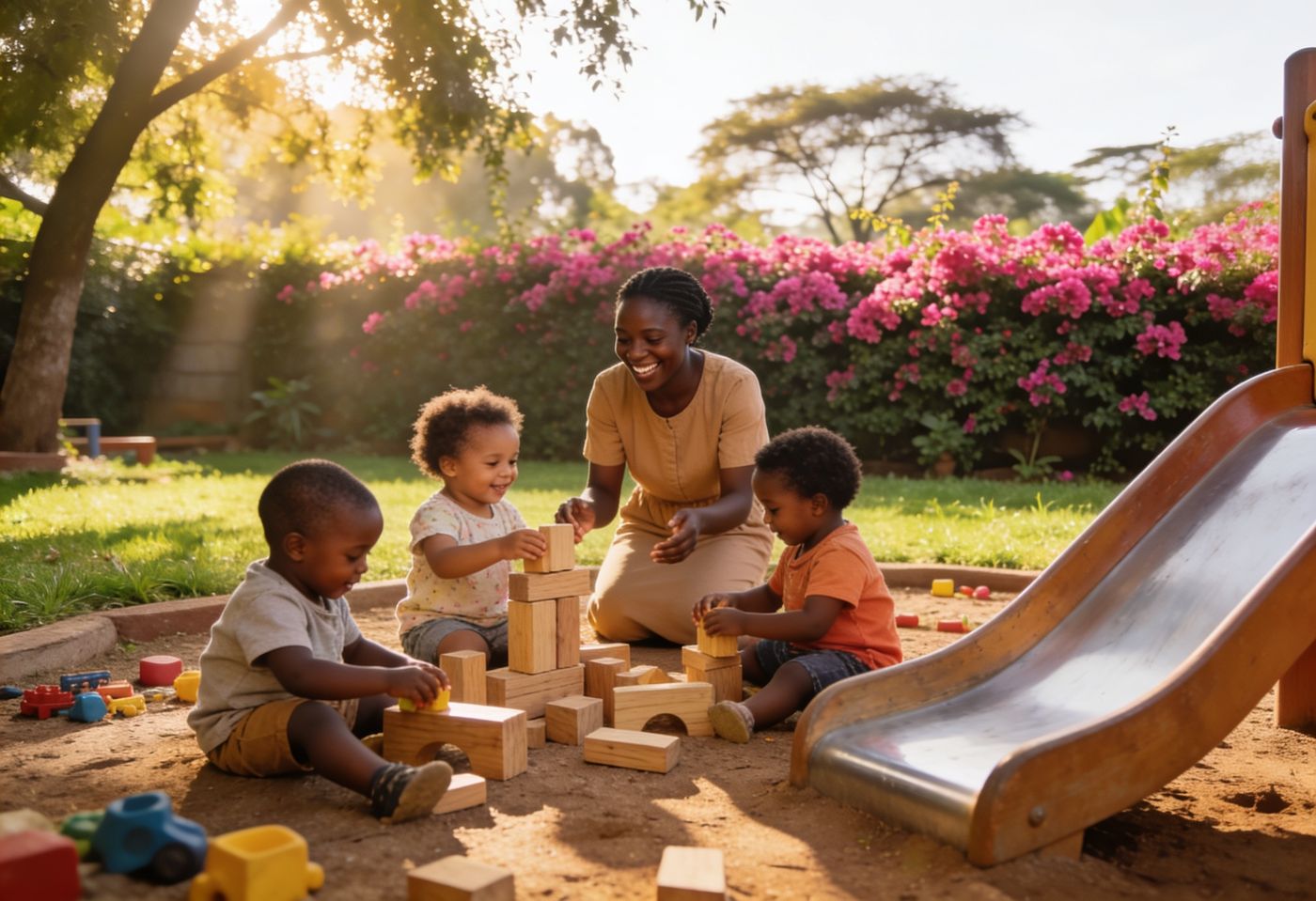
Most expat toddlers in Nairobi end up in one of three places: a small home-based daycare, a Montessori or play-based nursery, or the early-years wing of an international school. Which one fits comes down to your budget, your child’s age, and the “big school” you’re aiming for next.
The good news is that Nairobi has a deep bench of options, and qualified help is affordable, so most families settle their little ones within a few weeks of arriving. The honest caveat is that quality varies widely, the best places run waitlists, and fees jump sharply as you move up the tiers.
This guide is for American and other expat parents with a child roughly six months to five years old. By the end you’ll know the real cost tiers, the main teaching approaches, which areas have the most choice, how the nanny-plus-nursery combo works, and exactly what to check before you enroll.
Quick answer: nursery and daycare in Nairobi
Nairobi has plenty of nurseries and daycares, and because domestic help is affordable, most families find care quickly. Costs fall into three broad tiers (all as of 2026 — confirm directly): home-based daycare from roughly KES 15,000–35,000 a month; Montessori and structured nurseries at about $1,500–5,000 a year; and international-school early years at roughly $5,000–10,000+ a year. The densest cluster of options sits in Lavington, Karen, Gigiri/Runda and Westlands. Many parents pair a half-day nursery with a nanny for full-day cover. Visit in person, check the adult-to-child ratio and the security, and choose a nursery that feeds into the school you want later.
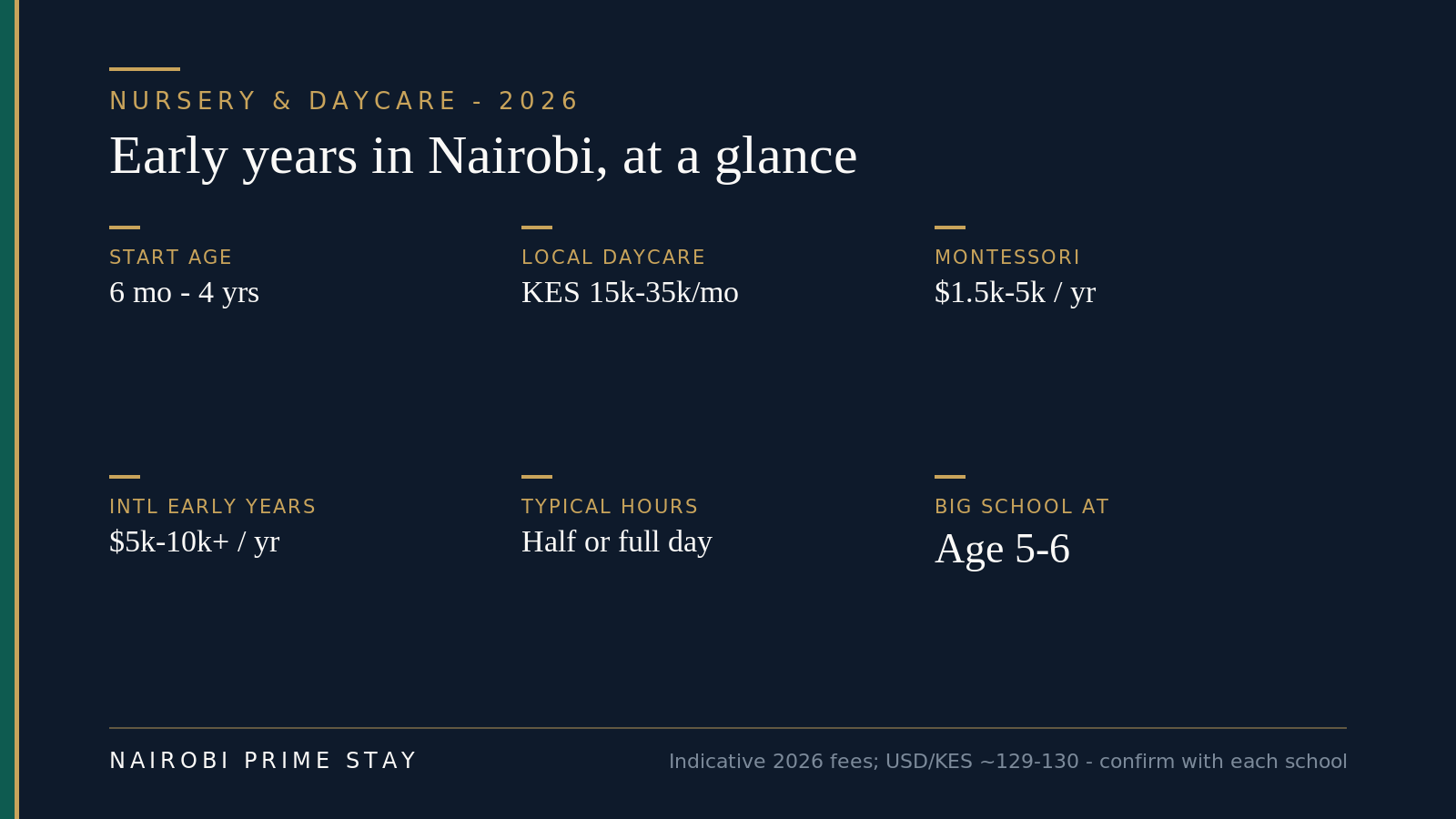 Indicative 2026 figures — fees move, so confirm with each school and check the live USD/KES rate.
Why this matters for your move
Where your toddler spends the day shapes your whole week — your commute, your work hours, and how much traffic you sit in twice a day. Get it right and the rest of family life falls into place. Get it wrong and you’re re-doing the search after you’ve already signed a lease.
Early-years choices also quietly set up the bigger decision later. The popular international schools have waitlists, and a child who’s already in a school’s nursery often has an easier path into its primary years. So even at age two or three, it’s worth knowing roughly which “big school” you’re heading for. If you haven’t thought that far ahead yet, start with our guide to international schools in Nairobi and work backwards.
When can my child start? Ages and stages
Most nurseries take children from around 15 to 18 months, and a handful of daycares take babies from about six months. There’s no single national cut-off — it varies by provider — so if you have an infant, ask each place directly.
Here’s how the early years map out, with the labels you’ll hear locally:
- Daycare / creche (about 6 months–2 years). Care first, gentle play and routine second. Mostly home-based or small centers.
- Toddler / pre-nursery (about 18 months–3 years). The first structured setting — songs, stories, messy play, learning to share.
- Nursery / pre-primary (about 3–5 years). Real early-years learning. In Kenya’s Competency-Based Curriculum this is Pre-Primary 1 and 2 (PP1 and PP2); in the British system it’s Nursery and Reception; in the American system it’s Pre-K and Kindergarten.
- Big school (about age 5–6). Grade 1 (American/CBC) or Year 1 (British). This is the entry point most families plan their nursery choice around.
The practical takeaway: a US four-year-old slots neatly into PP2, Reception or Pre-K, and starts “real” school at five or six — much like back home, just with different names on the door.
When does the school year start? Timing your move
The answer depends on which system you’re aiming for, and it’s worth knowing before you book flights. Nairobi runs on two different school calendars.
American and IB international schools — the International School of Kenya, Rosslyn Academy and the like — follow a US-style year that runs from about mid-August to June. Rosslyn’s 2026–27 year starts on 10 August 2026, for example. If a US-curriculum “big school” is the goal, landing between June and August lines you up with the start of the year and the main intake.
Kenyan CBC and many local and mid-range private schools run the national calendar instead: January to November, in three terms. The 2026 school year opened on 5 January. British-curriculum schools sit in between and vary by school — some follow the January-start Kenyan rhythm, others a September start — so confirm the calendar with each one.
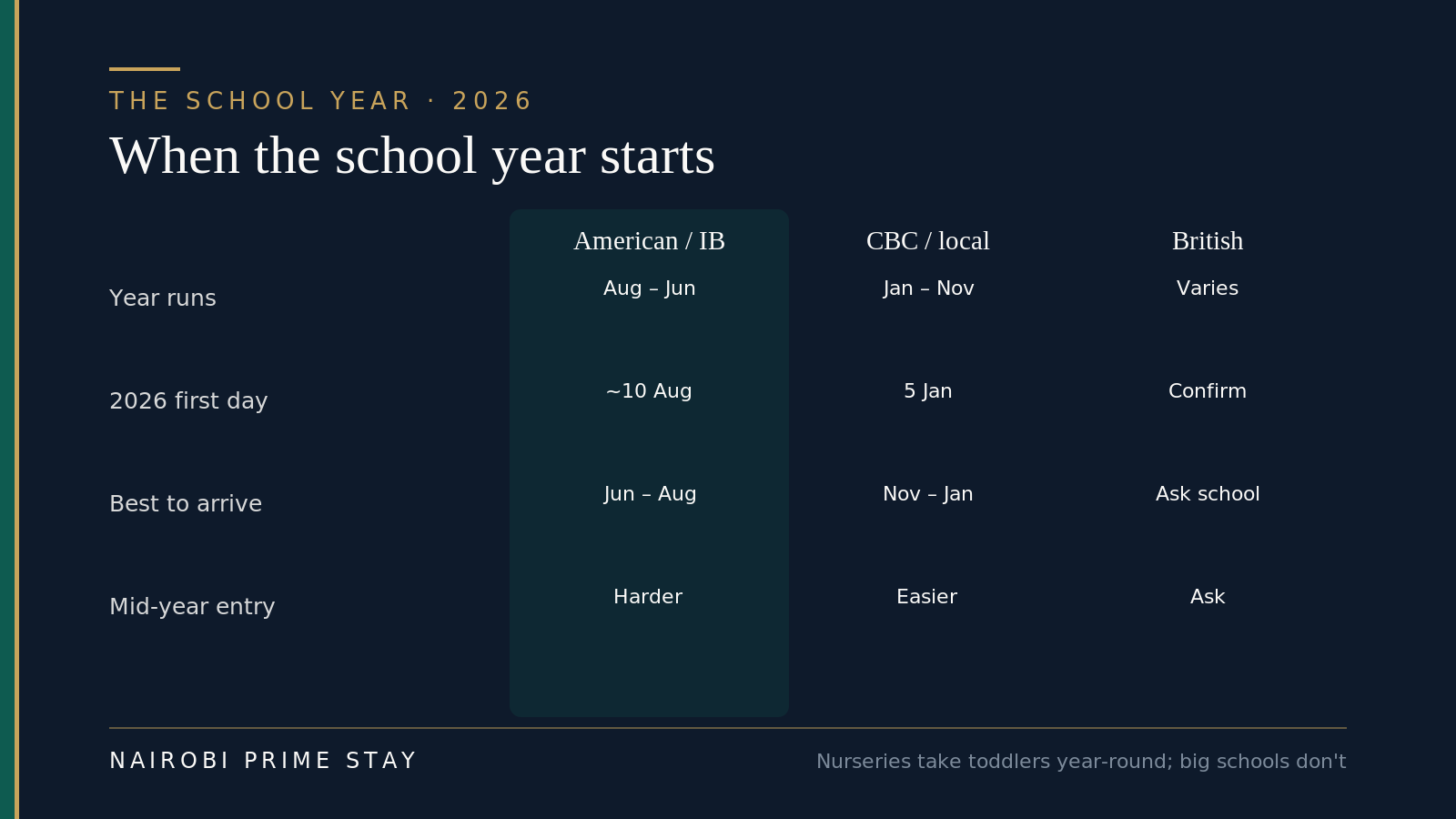 American and IB schools start in August; national schools in January. Confirm exact dates with each school.
Here’s the reassuring part for the youngest ones: nurseries and daycares are far more flexible than big schools. Most take toddlers whenever a space opens, not just at the start of a term. So while the “big school” intake is worth planning around, you can usually settle a two- or three-year-old within weeks of arriving, whatever the month. If you’re weighing a move date around the whole family’s rhythm, our moving to Nairobi with kids guide covers the timing in more depth.
What nursery and daycare cost in Nairobi (2026)
Plan for three cost tiers. A home-based daycare can cost a tenth of an international-school nursery, and both have a place depending on what you need.
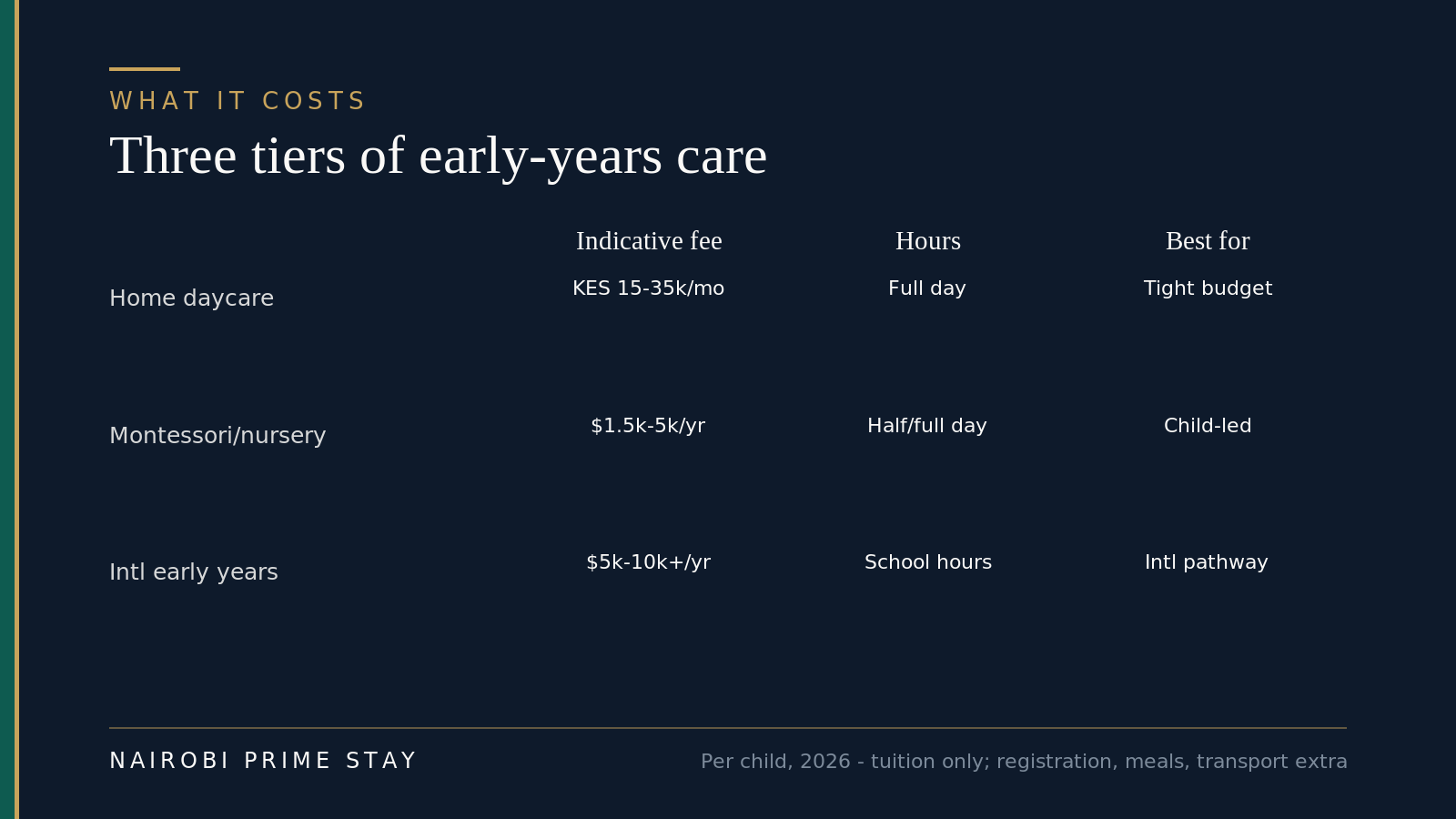 Per child, 2026 — tuition only; registration, meals and transport are usually extra.
Tier 1 — home-based daycare and neighborhood playgroups. The budget option, and what many local families use. Expect roughly KES 15,000–35,000 a month, though some charge by the day (around KES 1,000, meals included) or by the term. Quality ranges from wonderful to worrying, so this is the tier where visiting and checking references matters most.
Tier 2 — Montessori and structured nurseries. The expat sweet spot for many. Figure on about $1,500–5,000 a year. A well-known Montessori like the Montessori Learning Centre in Westlands runs roughly KES 570,000–675,000 a year (about $4,400–5,200) for its kindergarten, while a mid-range international nursery such as Braeburn’s Imani campus has been around KES 335,000 a year (about $2,600) for a four-year-old. Playschools can start near KES 220,000 a year.
Tier 3 — international-school early years. The premium tier, and the one with the smoothest path into a top primary school. Roughly $5,000–10,000+ a year. Braeburn’s early years on Gitanga Road, for example, has run about KES 860,000–1.1 million a year (roughly $6,600–8,500) depending on creche or nursery and half or full days; a kindergarten place at an international school like SABIS has been near KES 670,000 a year (about $5,200) plus books. At the very top, a few families pay upwards of KES 2.7 million for an under-seven.
A few cost notes that catch newcomers out:
- Fees are usually quoted per term, and there are three terms a year. Multiply by three for the annual figure.
- Tuition is rarely the whole bill. Budget for a one-off registration fee (often a few thousand shillings — the Montessori Learning Centre’s is about KES 5,000), plus meals, transport and sometimes a refundable caution deposit.
- The exchange rate matters. The shilling traded near KES 129.4 to the US dollar on 1 July 2026. Fees are set in shillings, so your dollar cost moves with the rate — check the live USD/KES rate before you budget.
For the bigger family-budget picture — rent, help, groceries and the rest — see our Nairobi cost of living guide.
Teaching approaches, explained for US parents
Nairobi’s nurseries fall into a few broad camps. None is “best” — the right one depends on your child and where you’re heading next.
Montessori is the most common branded approach you’ll see, and it’s the real thing at many schools, not just a label. Mixed-age classrooms, child-led work with hands-on materials, long uninterrupted “work cycles,” and a calm, independent feel. Good if you want a gentle, self-directed start. Ask whether teachers hold a recognized Montessori qualification — the word isn’t trademarked here, so standards vary.
Play-based and Reggio-inspired nurseries lean into free play, art and exploration, with less formal structure. The Canadian-rooted Maple Bear nurseries are a play-based example with branches in several suburbs. This suits younger toddlers and parents who want learning through play rather than worksheets.
British EYFS (the Early Years Foundation Stage) is the structured early-years framework used by British-curriculum schools like Braeburn, Banda and Hillcrest. If you’re planning a British prep school next, an EYFS nursery is the natural feeder. See our British schools in Nairobi guide for how that pathway runs.
American and IB early years are run by the international schools that follow those systems. The International School of Kenya and Rosslyn Academy both have early-childhood programs that feed straight into their primary years. If a US-style or IB education is the goal, starting in that school’s nursery is the cleanest route — our American and IB schools guide covers it.
Kenyan CBC (the Competency-Based Curriculum) is the national system, used by local and mid-range private schools. Pre-Primary 1 and 2 line up with Pre-K and Kindergarten. It’s perfectly good, more affordable, and worth a look if you want your child mixing with Kenyan classmates — just confirm how it would transfer if you move on to an international school later.
Where expats send toddlers — by area
The richest cluster of nurseries sits in the leafy western suburbs, close to where most expat families live. Here’s the lay of the land.
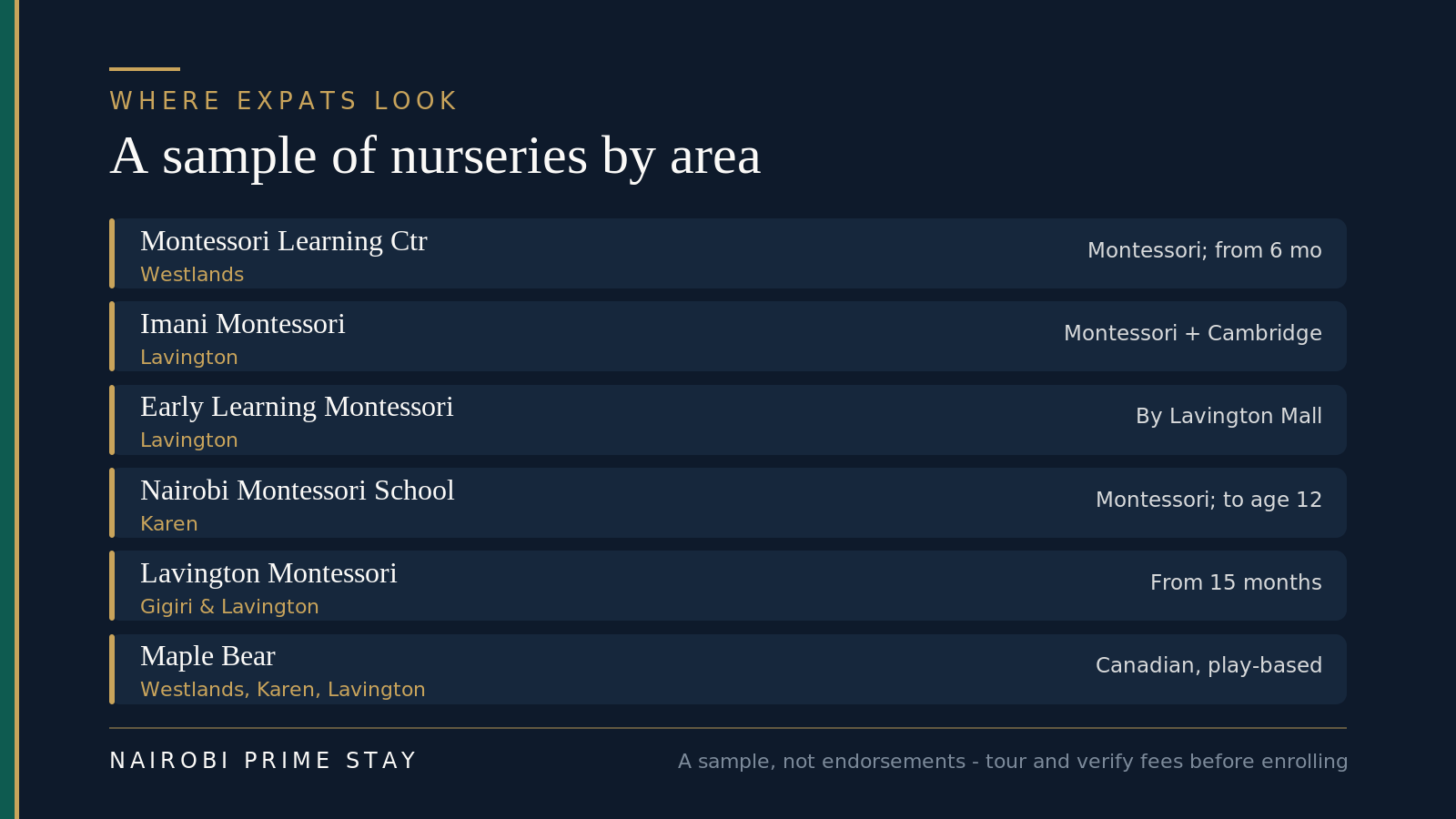 A sample to show the spread, not endorsements — always tour and verify current fees before enrolling.
Lavington is the unofficial nursery capital — central, green and family-friendly, with options like Imani Montessori and Early Learning Montessori within a short drive. It’s a sensible base if schooling is your priority; see the Lavington neighborhood guide.
Karen suits families who want space and gardens. Nairobi Montessori School sits on Ngong Road, and several British-style preps with nurseries are nearby. Trade-off: it’s farther from the city, so weigh the commute. The Karen neighborhood guide has the detail.
Gigiri and Runda are the diplomatic heartland, popular with UN and embassy families. The International School of Kenya’s early years is here, and there are Montessori branches close by — handy if you want a short school run near the UN.
Westlands, Kilimani and Kileleshwa are the apartment-dense, central areas where many remote workers and younger families settle. The Montessori Learning Centre is in Westlands, and smaller nurseries are dotted throughout — convenient if you want everything within a few minutes.
Hours, meals and the nanny combo
Most nurseries run either mornings only (roughly 8:00 to 12:30) or a full day (to about 3:00 or 4:00), and many expat families bridge the gap with a nanny. This is the single most useful thing to understand about childcare here: good domestic help is affordable, so a half-day nursery plus a trusted nanny is both common and workable.
That combo gives you the best of both — your child gets structured mornings and playmates, and you get reliable cover for afternoons, school runs and the odd late meeting. A full-time nanny commonly costs in the region of KES 20,000–45,000 a month depending on hours and whether they live in; for current pay norms, contracts and how to hire well, read our domestic help in Nairobi guide.
Here’s an honest side-by-side of the three ways most families cover the day:
| Home daycare | Full-time nanny | Montessori / nursery | |
|---|---|---|---|
| Cost (2026) | ~KES 15,000–35,000/mo | ~KES 20,000–45,000/mo | ~$1,500–5,000/yr |
| Hours | Long, flexible | Whatever you need | Half or full day |
| Learning | Light, informal | Depends on the nanny | Structured early-years |
| Social side | A few other children | One-on-one | Lots of peers |
| Best for | Babies, tight budgets | Infants, odd hours, siblings | Ages 2–5, school prep |
Most nurseries offer a morning snack and a hot lunch (sometimes included, sometimes billed separately), and many run a school van. If you’d rather do drop-off yourself, Uber and Bolt are cheap and easy — more on getting around in our moving to Nairobi guide.
How to choose: green flags and red flags
Visit before you commit, and trust what you see over what the brochure says. A good nursery will welcome an unannounced visit and let you watch a normal morning; a place that won’t is telling you something.
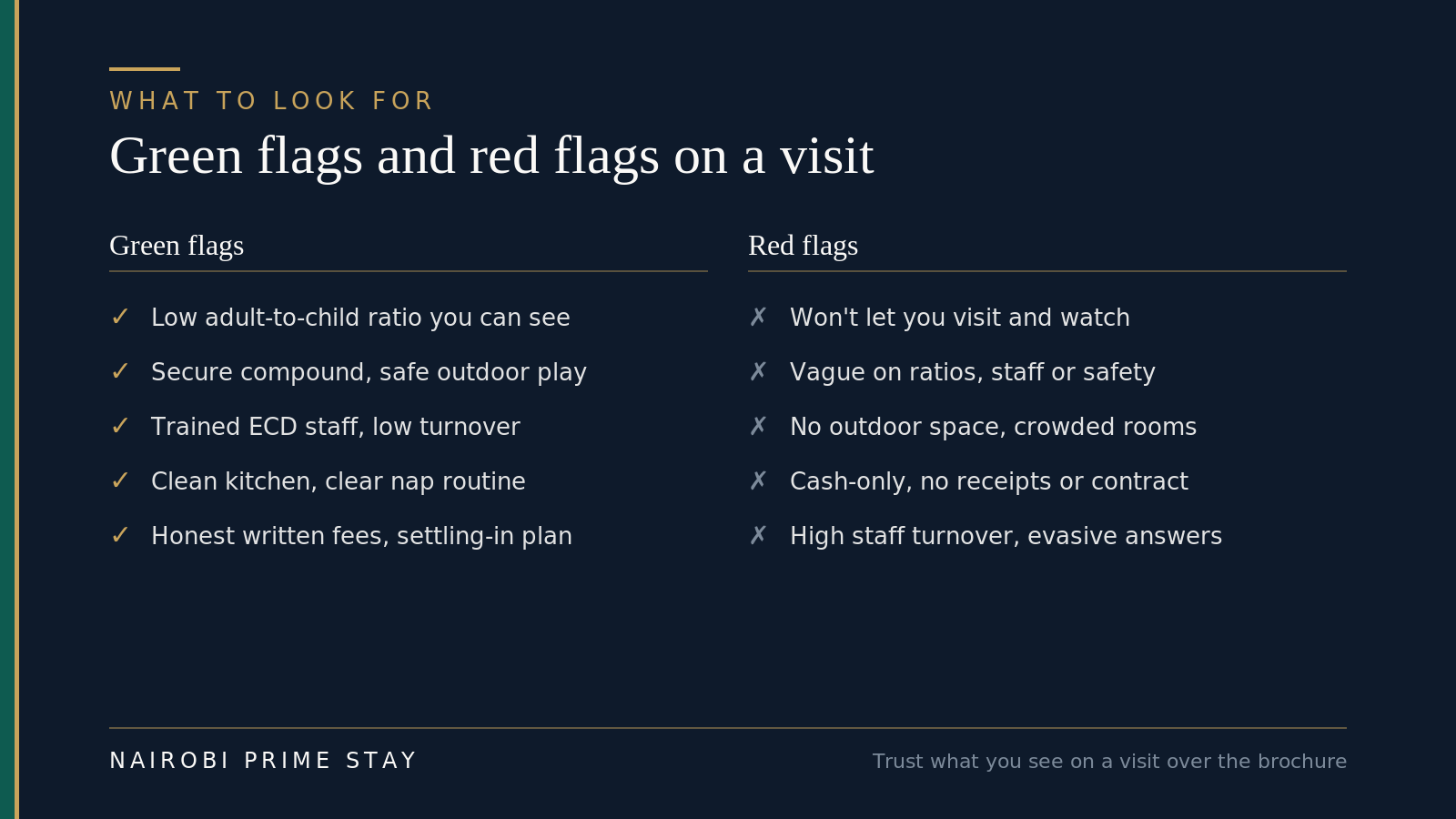 Trust what you see on a visit over the brochure.
The things that matter most are the ones you can observe: how many adults per child, whether the outdoor space is safe and shaded, how the staff actually speak to the children, and whether the kitchen looks clean. Ask how long the teachers have been there — low turnover is one of the best signs a place is well run.
Your nursery-search checklist
Work through this in order and you’ll avoid the common mistakes:
- Decide your “big school” direction first — international, British, American/IB or local CBC — so the nursery feeds the right way.
- Shortlist three places near where you’ll live, not across town.
- Visit each in person, ideally mid-morning when class is in full swing.
- Count the adults and children in a room and ask the ratio for your child’s age.
- Check the basics: secure gate and compound, safe outdoor play, clean kitchen, nap area, sick-child policy.
- Ask about staff: qualifications and how long they’ve been there.
- Get fees in writing — per term, what’s included, registration, deposit, meals, transport.
- Confirm hours and whether they fit your work and any nanny cover.
- Ask about the waitlist and the start dates, especially for popular international options.
- Sort care before you sign a year-long lease — keep your home options open until your child has a place.
Lining up a nursery from the US before you land
You can do a lot from abroad, and for the popular international nurseries you should. Their early-years places are limited and waitlisted, so apply and get on the list months ahead — often while you’re still sorting visas. For a home daycare or a smaller neighborhood nursery, there’s no need to lock anything in before you fly; you can arrange a place within a week or two of landing.
The one rule that matters: don’t send money for a nursery you’ve only seen in photos. The same fake-listing scams that hit apartment hunters show up in childcare — a polished page, warm WhatsApp replies, and a request to wire a “registration deposit” to a personal M-Pesa number before you’ve confirmed anything. Treat it the way you’d treat renting a home sight-unseen.
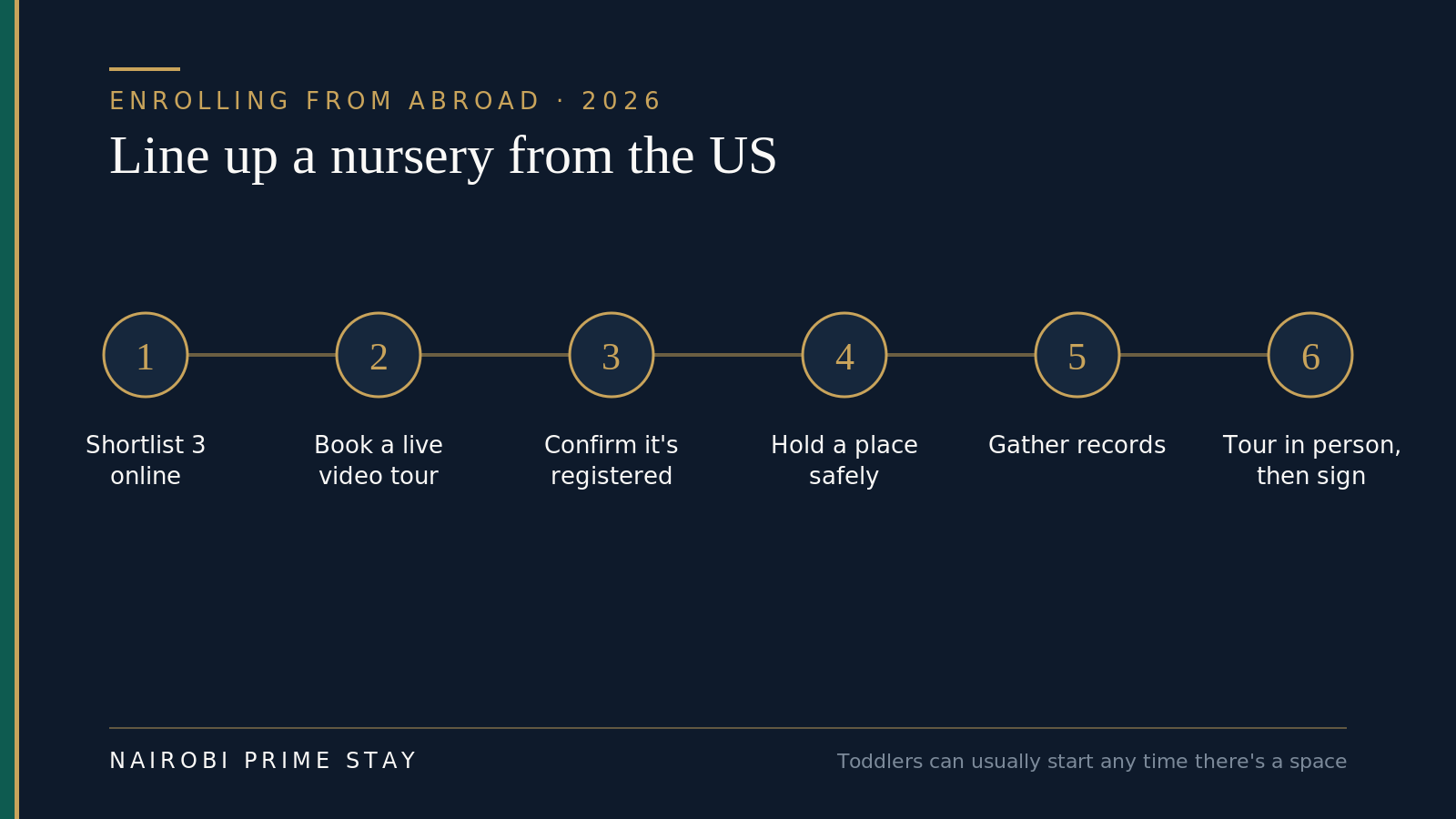 Do the homework from home, but confirm in person before you fully commit.
So do it in this order. Shortlist two or three nurseries near where you plan to live. Ask each for a live video walkthrough — a real one showing the classrooms and the outdoor space, not a glossy clip. Confirm the school is a real, registered setting with a verifiable address and references from current parents. If you do pay a registration fee to hold a place, pay only a school with a genuine presence, and keep it to the published figure. Then plan to tour in person during your first weeks — a serviced apartment for your soft landing lets you visit nurseries and test the school-run traffic before you sign anything long-term. If you’re still choosing an area, our best neighborhoods for families guide is the place to start.
Gather the paperwork before you fly. Nurseries here ask for less than the big schools, but have the basics ready: your child’s up-to-date immunization records, their birth certificate with copies, any previous nursery or school reports, their passport with the relevant visa or pass, and a few passport-size photos. Most places have their own enrollment form, and some ask for a recent medical note.
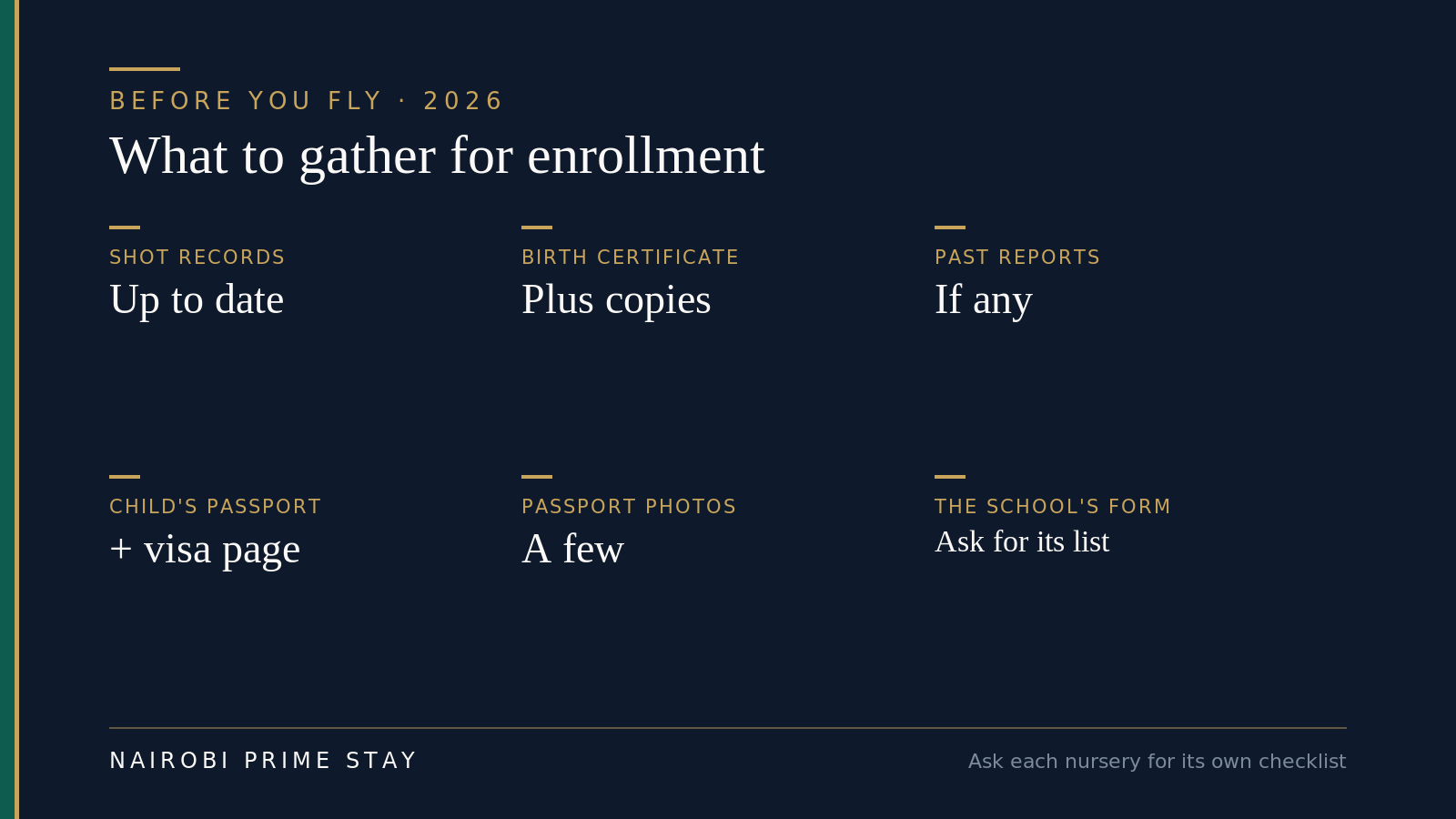 Requirements vary by nursery — ask each for its own list.
Two more things worth sorting early from home. Set up your child’s health insurance, so a clinic visit in the first weeks isn’t a scramble. And get a realistic read on whether Nairobi is safe for day-to-day family life — the short version is that the good nurseries sit in the same secure, gated pockets where most expat families live. If you’re arriving with a baby rather than a toddler, our guide to having a baby in Nairobi covers the newborn end that daycares pick up from around six months.
Which option fits your family?
Match the choice to your situation, not to what sounds most impressive. Here’s a starting point — then go and visit two before you decide.
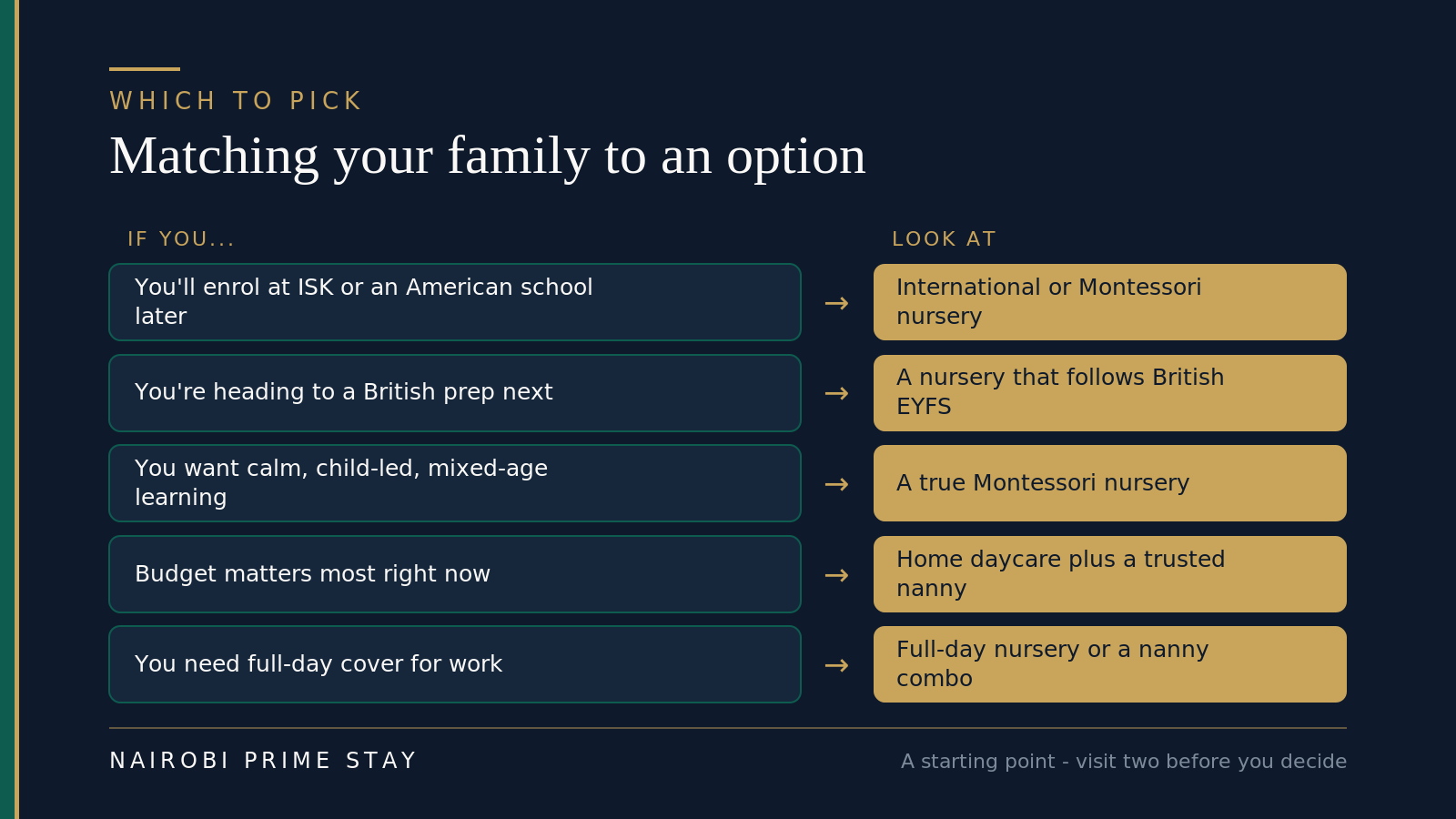 A starting point, not a rule — every child is different.
A real-world example
Say you’re a remote-working couple who’ve just landed in Lavington with a two-year-old. You don’t yet know which big school you’ll choose, and you both work US hours, which means afternoon calls.
A sensible play: enroll your toddler in a half-day Montessori nursery nearby for the structure and the playmates, and hire a full-time nanny for the afternoons and the witching hour before dinner. Your mornings are free for heads-down work, the nanny covers your overlapping US-afternoon calls, and your child is settled and social. Total childcare might land around $700–1,200 a month all in — far less than the equivalent in most US cities — and you’ve bought yourself time to tour the bigger schools without rushing the decision. When you do choose a primary school, you move the nursery place accordingly.
The honest pros and cons
Going premium early has real benefits and real costs. Weigh them against your actual plans.
Pros of an international-school nursery
- A smoother, often priority path into a sought-after primary school.
- Internationally trained staff and strong facilities.
- An easy social network of other expat families.
- Curriculum continuity if you’ll stay in that system for years.
Cons — and where a simpler option wins
- Fees are several times higher than a good local Montessori.
- If you might move again soon, you’re paying for continuity you won’t use.
- Smaller neighborhood nurseries can be warmer and closer to home.
- A nanny-plus-nursery combo is cheaper and more flexible for the under-threes.
Frequently asked questions
How much does nursery or daycare cost in Nairobi? It depends on the tier. A home-based daycare runs roughly KES 15,000–35,000 a month, a Montessori or structured nursery about $1,500–5,000 a year, and an international-school early-years place roughly $5,000–10,000 or more a year (all as of 2026). Fees are usually quoted per term across three terms, and tuition rarely includes registration, meals or transport. Always confirm the current figure directly, and check the USD/KES rate, which traded near KES 129.4 on 1 July 2026.
What age can my child start nursery in Nairobi? Most nurseries take children from about 15 to 18 months, and some daycares accept babies from around six months. Structured nursery learning usually begins at three, and children move up to “big school” — Grade 1 or Year 1 — at about five or six. There’s no national cut-off, so ask each place what they offer for your child’s exact age.
Is Montessori common in Nairobi? Yes — Montessori is one of the most common branded approaches, with established schools across Westlands, Lavington, Karen and Gigiri. Quality varies because the name isn’t regulated, so ask whether the teachers hold a recognized Montessori qualification and watch a class before enrolling. A genuine Montessori setting has mixed-age rooms, hands-on materials and a calm, child-led rhythm.
Should I use a nanny or a nursery? Many expat families in Nairobi use both, because affordable domestic help makes it easy. A half-day nursery gives your child structure and playmates, while a nanny covers afternoons, school runs and flexible hours. For an infant, odd work hours, or several young children, a full-time nanny alone can be the simpler and cheaper choice — see our domestic help guide for current pay and contracts.
Which areas have the best nurseries for expats? Lavington, Karen, Gigiri/Runda and Westlands have the densest cluster of well-regarded nurseries and the most expat families. Lavington is especially central and full of options; Karen suits those who want space and gardens; Gigiri and Runda are convenient for UN and embassy families near the International School of Kenya. Choose a nursery close to where you’ll live, since traffic, not distance, is the real constraint.
Do I need to book a nursery before I move to Nairobi? For a home daycare or a smaller nursery, no — you can usually arrange a place within a week or two of arriving. For the popular international-school early-years programs, yes, enquire several months ahead, because they run waitlists at key entry points. A smart approach is to spend your first weeks in a serviced apartment, tour nurseries in person, and only sign a year-long home lease once your child’s place is confirmed.
Are Nairobi nurseries safe? The good ones are, with secure compounds, controlled gates and attentive staff — but standards vary, so you have to look for yourself. Visit in person, check the adult-to-child ratio, look at the outdoor space and kitchen, and ask about staff turnover and sick-child policy. A nursery that won’t let you visit and watch a normal morning is a red flag.
Will a Nairobi nursery prepare my child for a US or international school? Yes, if you match the nursery to the system you’re heading for. An international-school nursery feeds straight into its own primary years; a Montessori or play-based nursery transitions well into most international schools; and a British-style EYFS nursery sets up a British prep. If you’ll return to the US, an international or Montessori start maps cleanly onto American kindergarten and first grade.
When does the school year start in Nairobi? It depends on the curriculum. American and IB international schools like ISK and Rosslyn run a US-style year from about mid-August to June — Rosslyn’s 2026–27 year starts on 10 August 2026. Kenyan CBC and many local schools run January to November in three terms; the 2026 school year opened on 5 January. British-curriculum schools vary, so confirm with each. Nurseries and daycares are the flexible exception — most take toddlers whenever a space opens, not just at the start of a term.
Can I enroll my child in a Nairobi nursery from the US before we move? For a popular international-school nursery, yes — and often you should, since places are limited and waitlisted, so apply months ahead. For a home daycare or smaller nursery, you usually don’t need to; you can arrange a place within a week or two of arriving. Whatever the tier, don’t wire a deposit to a nursery you’ve only seen in photos. Ask for a live video tour, confirm the school is real and registered, pay any fee only to a school with a verifiable presence, and tour in person during your first weeks before you fully commit.
What documents do I need to enroll my child in nursery in Nairobi? Bring your child’s up-to-date immunization records, their birth certificate with copies, any previous nursery or school reports, their passport with the relevant visa or pass, and a few passport-size photos. Most nurseries also have their own enrollment form and may ask for a recent medical note. Requirements vary by school, so ask each place for its exact list before you fly.
Final thoughts
Settling a toddler in Nairobi is one of the easier parts of the move. The options are plentiful, qualified help is affordable, and most families find a happy fit within a few weeks. The two things worth doing well are visiting in person before you commit, and choosing a nursery that points toward the school you want next. Do those, and you can take your time on the bigger decisions — the home, the lease, the long-term school — without your child missing a beat. For the wider rhythm of raising kids here, our family life in Nairobi guide picks up where this one leaves off.
Related reading
- Moving to Nairobi: the complete guide — the end-to-end overview for your move.
- International schools in Nairobi — the next step after nursery, all curricula compared.
- American and IB schools in Nairobi and British schools in Nairobi — pick the pathway your nursery should feed.
- Moving to Nairobi with kids — the wider family playbook.
- Domestic help in Nairobi — how the nanny side works, with current pay norms.
- Lavington and Karen — two of the best areas for young families.
- Cost of living in Nairobi — where childcare fits in the family budget.
- Best neighborhoods in Nairobi — where families cluster, and why.
- Family life in Nairobi — the wider rhythm of raising kids here.
Find a nursery near your new home
The easiest way to choose a nursery is to be here while you do it. A serviced apartment for your first month gives you a secure, all-inclusive base — Wi-Fi, cleaning, generator and security included — so you can tour nurseries, test the school-run traffic, and pick your area before signing a year-long lease. A $50 deposit reserves your dates, with the balance paid on arrival.
Not sure which neighborhood matches your child’s nursery and your commute? Our AI relocation assistant can shortlist apartments near the right schools in a couple of minutes, any time of day.
Ready to look?
Find your apartment in Nairobi
Browse verified serviced apartments, or ask the AI concierge which area fits your life.