
Guides · Relocating
Family Life in Nairobi: Things to Do With Kids in 2026
Family Life in Nairobi: Things to Do With Kids in 2026

Here is the thing that surprises most American parents: Nairobi is a genuinely great city to raise kids who like being outdoors. You can feed a giraffe before lunch, walk a forest trail in the afternoon, and watch lions in a national park twenty minutes from your house — all in the same weekend, all in shorts, in the middle of what your friends back home call winter.
The weather does a lot of the work. It is mild and sunny most of the year, so children spend more of their lives outside than they would in most US cities. Around that, there is a deep bench of animal sanctuaries, forests, parks, malls with proper play areas, sports clubs and a warm, ready-made expat-parent community that absorbs new families fast.
This guide is for an American family already in Nairobi, or about to arrive, wondering what you will actually do together. It covers the animal experiences worth the hype, the green spaces locals love, the rainy-day and mall options, sports and clubs and lessons, weekend getaways within reach, and — the part that matters most long term — how to find your people. For the move itself (suburbs, schools, healthcare, the logistics), start with our companion guide to moving to Nairobi with kids, and for the big picture see the complete guide to moving to Nairobi.

TL;DR — family life in Nairobi
Nairobi is unusually good for family weekends. The headline draws are the animals: the Giraffe Centre (feed giraffes by hand), the Sheldrick elephant orphanage on the edge of Nairobi National Park, and the park itself, where you can see lions and rhino without leaving the city. Day to day, families lean on Karura Forest and the Arboretum for walks and bikes, and on malls like Village Market and Two Rivers for play areas and rainy afternoons. Sports, swimming, riding and holiday camps are easy to arrange and affordable, and country clubs are a big part of family social life. Bigger adventures — Lake Naivasha, the Maasai Mara, the coast — are a short drive or flight away. The community is the quiet superpower: school networks, parent WhatsApp and Facebook groups, churches and playgroups mean you rarely stay lonely for long. Most fees have a much cheaper resident rate once you have a permit, so always ask. Confirm prices and hours before you go — they change.

Why weekends and community make or break the move
For a relocating family, the logistics get all the attention — the visa, the school place, the lease. But six months in, what decides whether everyone is happy is smaller and more human: does your eight-year-old have somewhere to run on a Saturday, a team to play on, a friend two compounds over? Do you, the parent, have other parents to text when the school sends home a confusing notice?
Nairobi delivers here, and it is one of the real joys of the place. The outdoor life is constant. The kid activities are plentiful and cheap by US standards. And the expat-and-local parent community is unusually welcoming, partly because everyone was new once and remembers it. Getting this part right is what turns “we moved for a job” into “we love it here.” This guide is the map.
The animal experiences worth the hype
Nairobi’s best-known family outings are its wildlife ones, and they live up to it. A few are genuine bucket-list days; treat them as the backbone of your first month of weekends.
The Giraffe Centre (Lang’ata). The classic. You stand on a raised platform and hand-feed endangered Rothschild’s giraffes, who lean in at eye level — small kids are usually thrilled and a little awestruck. It is run by a conservation charity (AFEW), open daily 9am to 5pm, and there is a quiet forest nature trail across the road included with your ticket. As of 2026, entry is KES 1,500 (about $12) for non-resident adults and KES 750 for children, while Kenya residents pay KES 400 per adult and KES 200 per child — a big gap, so carry your resident permit. Under-3s are free, and payment is cashless (M-Pesa or card). It pairs naturally with a visit to nearby Karen.
The Sheldrick elephant orphanage (Nairobi National Park). The David Sheldrick Wildlife Trust raises orphaned baby elephants and, for one hour a day, lets the public watch them feed, play and roll in the mud. It is daily from 11am to 12 noon, by advance booking only (book on the Sheldrick Wildlife Trust site — slots fill). The visit is a donation of around $20 per person as of 2026. Note an important recent change: because the nursery sits inside the national park boundary, KWS now expects park gate entry to be paid as well in some cases — confirm exactly what you owe when you book so there are no surprises at the gate. If your kids fall in love (they will), you can foster an elephant for about $50 a year, which also earns you a quieter private evening visit.
Nairobi National Park. This is the one nobody believes until they see it: a full national park — lions, rhino, giraffe, zebra, buffalo — with the city skyline on the horizon, about 20 minutes from the western suburbs. You can do a morning game drive and be home for lunch. As of July 2026 the KWS fee is roughly $80 per non-resident adult and $40 per child, while Kenya residents pay about KES 1,350 per adult and KES 675 for youth — another reason to sort your permit. One caveat: a late-2025 court case suspended a planned KWS fee increase, so pricing has been in flux — confirm the current figure on the eCitizen portal when you book. Tickets are bought online through the KWS/eCitizen system; you will want a vehicle with decent clearance or a booked safari van. Early morning is best for animals and cooler for kids.
Other animal days. The Nairobi Animal Orphanage at the main park gate is a low-key, low-cost option for a quick wildlife fix with younger children. Mamba Village in Lang’ata has crocodiles, ostriches and pony rides. And the Bomas of Kenya nearby mixes a cultural dance show with space to run around. None of these are full days, but they fill a Saturday morning nicely.
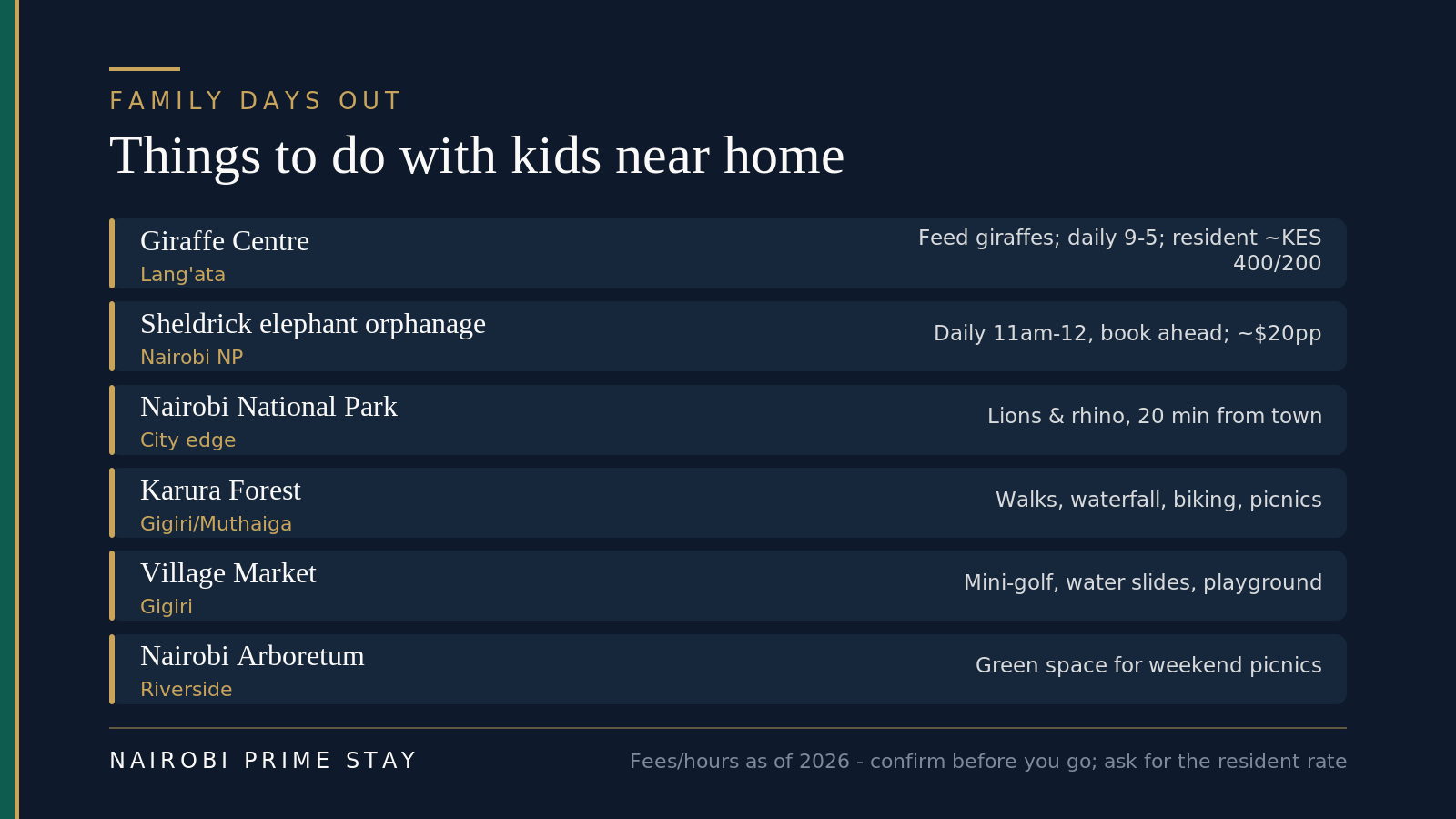 Fees and hours are as of 2026 — always confirm before you go, and ask for the resident rate once you have a permit.
Parks, forests and green space
Beyond the marquee attractions, the everyday rhythm of Nairobi family life runs on green space — and there is a lot of it. This is where you will spend ordinary Saturdays.
Karura Forest is the favorite, and deservedly. It is a large, safe, well-managed urban forest between Gigiri, Muthaiga and Runda, with gravel trails for walking and cycling, a small waterfall, caves, picnic lawns, a couple of cafes and bike hire. Families with kids of any age can lose a whole morning here. As of 2026, entry is tiny for residents — around KES 174 per adult and KES 55 per child (ages 2–12) — and roughly KES 850 / KES 450 for non-resident adults and children. Payment is digital only (eCitizen or M-Pesa), and you bring proof of status at the gate. Open from 6am, last entry around 5:45pm.
The Nairobi Arboretum (near Riverside) is smaller, leafier and cheaper still — a beloved spot for weekend picnics, monkeys in the trees, joggers and birthday parties. Oloolua Nature Trail in Karen offers forest walks, a waterfall and a bamboo tunnel kids enjoy. City Park in Parklands has indigenous forest and a famous troop of cheeky monkeys. And the big municipal greens — Uhuru Park and Central Park near the city center, recently refreshed — are fine for a stroll if you are already downtown, though the suburban forests are where families really go.
The point: you are never far from somewhere your kids can run, climb and be outside, all year round. That is rarer than it sounds, and it is one of the best things about raising children here.
Malls, play areas and rainy-day plans
Two rainy seasons (the long rains March–May and short rains October–December — see our Nairobi weather guide for the full rhythm) mean you need indoor options, and Nairobi’s malls are genuinely good for families — clean, secure, and built with kids in mind.
Village Market (Gigiri) is the family standout, especially for diplomatic and UN families nearby. It has mini-golf, water slides and a bowling alley, a big playground, a Friday Maasai market, restaurants and a cinema — easily a half-day. Two Rivers (Runda/Ruaka), East Africa’s largest mall, has a Ferris wheel, an amusement park area (Funtasia), go-karts and plenty of space. Garden City (Thika Road) has an outdoor events lawn and play zone. The Hub Karen has a lovely lakeside boardwalk, a playground and a relaxed weekend feel popular with Karen and Lang’ata families. Sarit (Westlands) and Westgate round out the central options with cinemas, kids’ zones and food courts.
Beyond malls, look for trampoline parks, indoor soft-play centers, aquariums and the planetarium-style science spots that pop up and change — your school parent group will know the current favorites. For a sit-down meal with kids in tow, many garden restaurants are built for families, with lawns and play areas; our Nairobi dining guide covers the family-friendly ones.
Sports, clubs and lessons
This is where Nairobi quietly shines for families, and where a lot of social life happens. Kids’ activities are plentiful, the weather lets them run year-round, and prices are a fraction of US equivalents.
Country and sports clubs are central to family life here in a way that can feel old-fashioned and lovely. Karen Country Club, Muthaiga Country Club, Windsor, Sigona and others offer pools, tennis, golf, squash and kids’ programs; many expat families take out a membership largely for the weekend swimming and the social scene. Some have long waitlists or require nomination, so ask early.
Swimming is a near-universal kids’ activity — most clubs, many schools and several hotels run lessons and squads, and the climate means it is a year-round sport, not a summer one. Horse riding is a Karen specialty, with several stables offering lessons for children. Team sports — football (soccer), rugby, cricket, hockey, basketball — run through schools and weekend academies, and there are junior leagues to join. You will also find martial arts, gymnastics, ballet and music lessons, plus holiday camps during school breaks that are a lifesaver for working parents.
A practical note that makes all of this easier: affordable, reliable home help. A nanny or house manager is normal here and genuinely changes how a family operates — someone to do the school run, cover an activity drop-off, or stay home with a napping toddler while you take the older one to a match. We cover how it works honestly in our domestic help guide.
Weekend getaways within reach
Some of the best family memories happen outside the city, and Nairobi is well placed for it. Keep these on a list and work through them.
Day trips and overnights (1–3 hours out). Lake Naivasha (boat rides, hippos, Crescent Island walking safari) and Hell’s Gate National Park (cycle and walk among zebra and giraffe — a rare park where you can) are classic family weekends. Mount Longonot is a doable hike for older kids. Lake Nakuru adds flamingos and rhino. Paradise Lost and the Kiambu coffee-farm cafes are closer still for a half-day. Many of these are an easy Saturday-out or a one-night stay.
Bigger adventures (a flight or a longer drive). The Maasai Mara is the headline safari, especially July–October for the wildebeest migration; Amboseli sits under Mount Kilimanjaro with huge elephant herds; and the coast — Diani, Watamu, Mombasa — is the go-to for beach holidays, reachable by a short flight or the SGR train. These deserve their own planning; see our guides to weekend trips from Nairobi and safaris from Nairobi.
The honest caveat is the same one that shapes all Nairobi life: traffic. Leaving the city on a Friday evening or returning Sunday afternoon can be slow. Families learn to leave very early, or stay the extra night and drive back Monday morning — our driving in Nairobi guide covers what to expect behind the wheel.
Finding your community
This is the part that decides whether a family thrives, and the good news is that Nairobi makes it easier than almost anywhere. You do not have to build a social life from scratch — you plug into one.
School is the front door. The international schools are the center of expat family life. The moment your child starts, you are pulled into a class WhatsApp group, parent coffees, sports fixtures, fairs and fundraisers. If you are choosing a school, our international schools guide covers the options; socially, the school you pick will shape your circle more than the suburb you live in.
Parent groups online. Nairobi has active Facebook and WhatsApp groups for expat parents, neighborhood mums, buy-and-sell, activities and recommendations. They are where you will find a pediatric dentist, a birthday-party venue, a second-hand bike or a last-minute babysitter. Ask your school or a neighbor to add you — most are invite-or-request based.
Faith and culture communities. Churches, mosques and temples across the city run family services, kids’ programs and newcomer welcomes, and they are a fast way to meet people if that is part of your life. There are also national and cultural associations (American, and many others) that host family events and holidays.
Clubs, teams and the nanny network. Country clubs, sports teams and activity classes are social glue for the whole family. And there is a quieter network you will discover: the nannies and house managers themselves know each other, organize playdates at the park, and will fold your kids into theirs. It is one of the unexpected warmths of the place.
Other families were all new once. The single most reassuring thing is how normal moving is here. (For the adult side of this — clubs, InterNations, the Hash, making your own friends — see our expat community guide.) Nairobi’s expat community turns over constantly, so people are practiced at welcoming newcomers and quick to share what they know. Say yes to the first few invitations and the rest tends to follow.
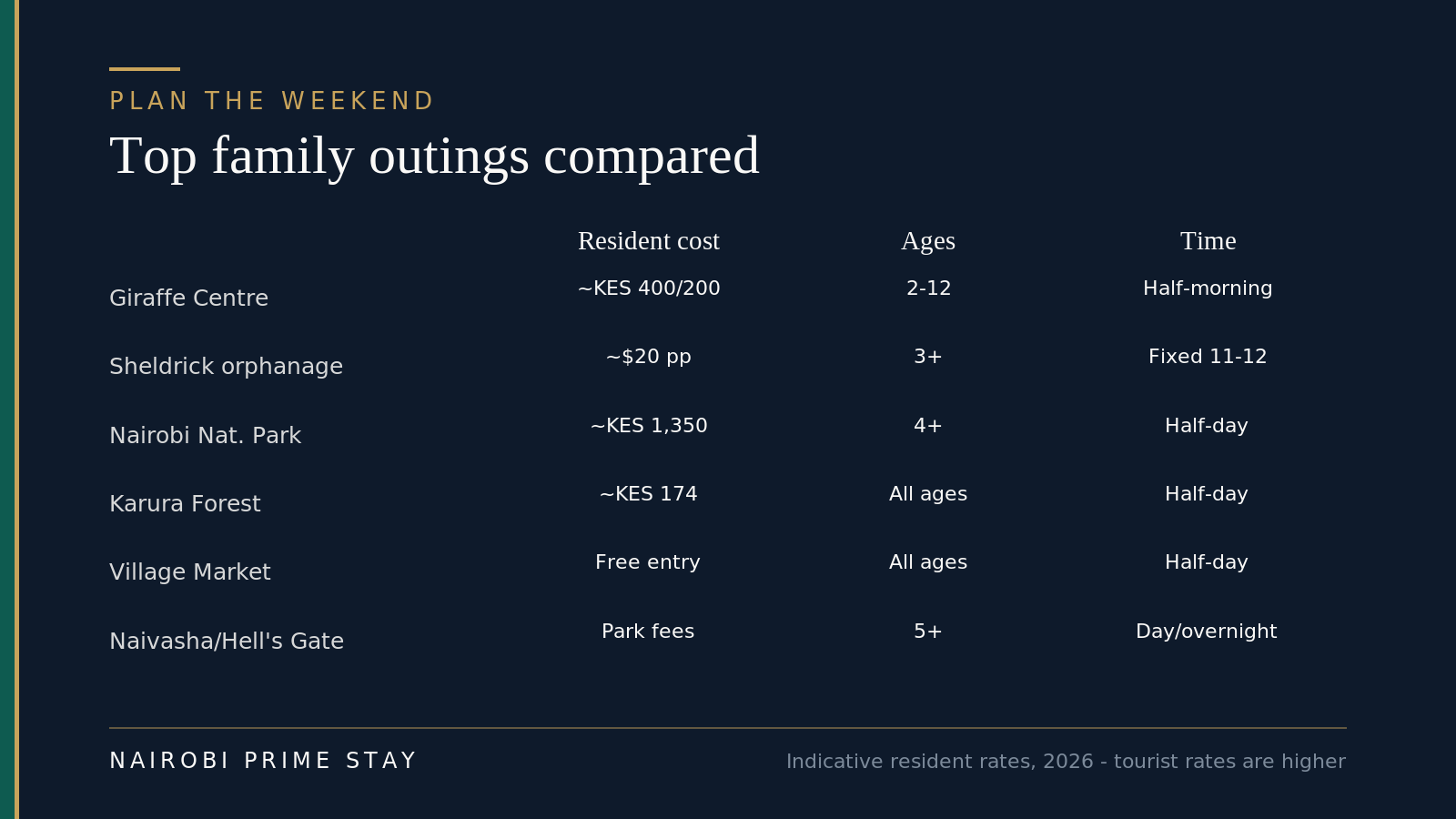
Top family outings compared
A quick reference for planning. Resident rates apply once you hold a permit; tourist rates are higher. All figures are indicative for 2026 — confirm before you go.
| Outing | Area | Best for ages | Indicative cost (resident) | Time needed |
|---|---|---|---|---|
| Giraffe Centre | Lang’ata | 2–12 (all ages ok) | ~KES 400 adult / 200 child | Half-morning |
| Sheldrick elephant orphanage | Nairobi NP | 3+ | ~$20 pp donation (book ahead) | 1–2 hrs (fixed 11am–12) |
| Nairobi National Park | City edge | 4+ | ~KES 1,350 adult / 675 youth | Half-day |
| Karura Forest | Gigiri/Muthaiga | All ages | ~KES 174 adult / 55 child | Half-day |
| Nairobi Arboretum | Riverside | All ages | Small entry fee | 1–3 hrs |
| Village Market | Gigiri | All ages | Free entry; pay per activity | Half-day |
| Two Rivers (Funtasia) | Runda/Ruaka | 3+ | Free entry; pay per ride | Half-day |
| Lake Naivasha / Hell’s Gate | ~1.5–2 hrs out | 5+ | Park + boat fees vary | Full day / overnight |
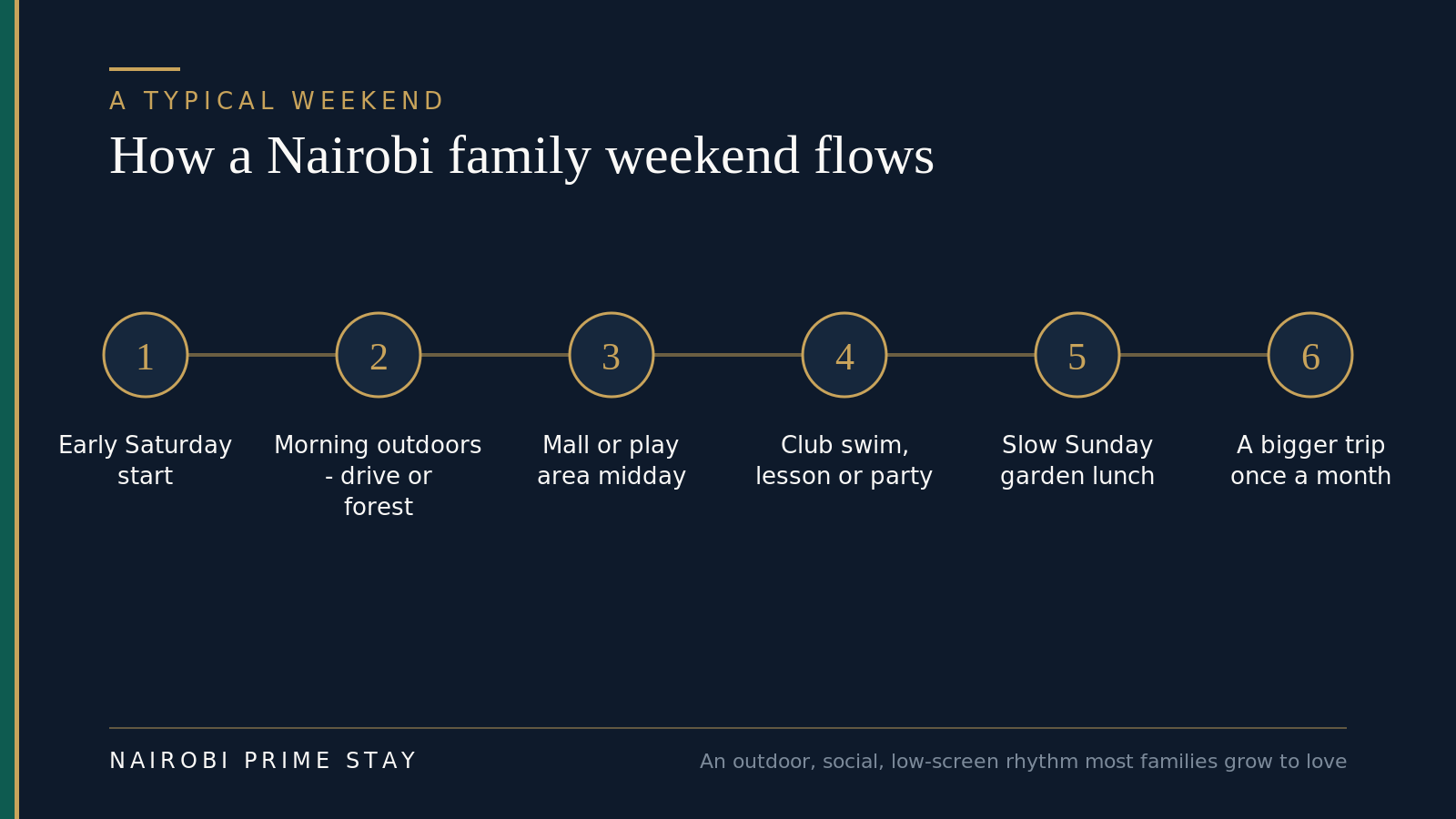
A typical Nairobi family weekend
Here is how it actually plays out for many families, to make it concrete.
Saturday starts early — kids are up, the light is gorgeous, and you beat the heat and the crowds. You might do a 7am game drive in Nairobi National Park and be home by 11, or head to Karura for a bike ride and a cafe breakfast. Late morning is errands or a mall with a play area while the day warms. Afternoons are often a club: a swim, a tennis lesson, a birthday party (there is always a birthday party). Sunday might be slower — a long lunch at a garden restaurant with a lawn, a walk in the Arboretum, friends over for a braai (barbecue). Roughly once a month, you make it a bigger one: an overnight at Naivasha, or a school-holiday week at the coast.
It is an outdoor, social, low-screen rhythm, and most families say it is healthier and more connected than the weekends they left behind.
Pros and cons of family life in Nairobi
An honest reckoning, the way a friend would give it.
| The upside | The trade-offs |
|---|---|
| Outdoor life year-round; mild, sunny weather | Two rainy seasons mean muddy trails and indoor days |
| Giraffe, elephant and lion days in and near the city | Tourist rates are steep until you get resident status |
| Affordable activities, lessons, clubs and camps | Top clubs can have waitlists or need a nomination |
| Warm, easy-to-join expat-parent community | High turnover means friends rotate out every few years |
| Affordable home help frees parents’ time | You are a long flight from grandparents |
| Big adventures (Mara, coast) on the doorstep | Traffic eats into getaway time; leave early |

Which outing fits your kids?
A quick starting point by age and mood.

A family-fun starter kit: your first month
A simple checklist to get the good weekends going quickly.
- Sort your resident permit as a priority — it means far cheaper entry at parks, the Giraffe Centre and forests.
- Set up M-Pesa and a card on arrival — almost every gate is now cashless (see M-Pesa basics in the moving guide).
- Ask the school to add you to the parent WhatsApp/Facebook groups — your fastest source of recommendations.
- Do the three headline animal days in your first month: Giraffe Centre, Sheldrick (book ahead), and a Nairobi National Park drive.
- Find your forest — most families pick Karura or the Arboretum as their default Saturday spot.
- Visit your nearest family mall (Village Market, Two Rivers, The Hub) and scout the play areas for rainy days.
- Sign the kids up for one activity each — swimming is the easy first one.
- Look into a club membership if you want a pool and a ready social base; ask about waitlists early.
- Plan one overnight getaway (Naivasha is the easy first trip) for the end of the month.
- Say yes to the first few invitations — community compounds fast here.
What does a family weekend actually cost?
Cheaper than the tourist prices suggest — once your resident status lands. At about 129.4 shillings to the dollar (July 2026), a resident family of four spends roughly KES 1,200 (under $10) at the Giraffe Centre, under KES 500 at Karura Forest, and about KES 4,000 in park fees for a Nairobi National Park drive, plus fuel or a hired van. Add a cafe breakfast and a club swim and a full, memorable Saturday often comes in under KES 10,000 ($75) for the whole family.
The same weekend at non-resident rates is a different story: the park alone can run $250–350 for a family of four. That gap is the single best argument for prioritizing your permit paperwork — and for sequencing the expensive headline outings after your resident status comes through, while filling the early weeks with the forests, malls and the Arboretum, where the stakes are a few hundred shillings either way. Everyday costs beyond outings are covered in our cost of living guide.
Birthday parties, babysitting and playdates
The social machinery of family life here runs smoother than most American parents expect, mostly because help is affordable and the community is dense.
Birthday parties are a genuine institution — garden venues, mall party packages (Village Market and Two Rivers both do them), bouncy-castle and entertainer hire, and farm or stable parties out in Karen. Costs are a fraction of US equivalents, and the parent WhatsApp group will hand you a vetted list of venues and cake-makers within minutes of asking.
Babysitting rarely means a stranger from an app. Most families use their own nanny or house manager for evenings, agreed as extra hours at a rate you set together, and recommendations for occasional sitters circulate through the school groups and the nanny network itself. How employment, pay and etiquette work is covered honestly in our domestic help guide.
Playdates happen at compound playgrounds, the forests and club pools, and are often nanny-coordinated — the nannies of a neighborhood know each other long before the parents do, and will fold a new child into the circuit within a week or two. Say yes early; it compounds.
Setting up family weekends from the US, before you land
You can have your first month of weekends half-arranged before wheels-down. In order:
- Book the Sheldrick elephant orphanage — the daily 11am visit is by advance reservation on the Trust’s website and slots fill weeks ahead in high season (July–October, December).
- Join the parent groups — once you have a school place, ask admissions or another parent to add you to the class WhatsApp and the main expat-parents Facebook groups. Recommendations start flowing before you fly.
- Shortlist a club — Karen, Muthaiga, Windsor and others can have long waitlists or need a member’s nomination; an early email costs nothing.
- Base yourself near the school — a serviced apartment close to your school keeps the first school runs short and the weekends unhurried while you choose a suburb.
- Leave the rest unplanned — the Giraffe Centre, the forests and the malls are turn-up-and-go. Your first Saturday sorts itself.
For the wider pre-move sequence — visas, shipping, schools — start with moving to Nairobi with kids.
Frequently asked questions
What is there to do with kids in Nairobi?
A lot, mostly outdoors. The headline outings are animal experiences — feeding giraffes at the Giraffe Centre, watching baby elephants at the Sheldrick orphanage, and a game drive in Nairobi National Park, all within or beside the city. Day to day, families use Karura Forest and the Arboretum for walks and bikes, malls like Village Market and Two Rivers for play areas and rainy days, and clubs for swimming and sports. Bigger trips to Lake Naivasha, the Maasai Mara and the coast are a short drive or flight away.
Is Nairobi a good place to raise a family?
Yes, for families who like the outdoors and don’t mind some logistics. The mild, sunny climate means kids live outside year-round, activities and home help are affordable, the international schools are strong, and the expat-parent community is warm and easy to join. The honest trade-offs are traffic that lengthens the day, being far from grandparents, and tourist-level prices until you get resident status. Most families say the upsides clearly win.
How much does it cost to take a family to Nairobi National Park?
As of July 2026, KWS charges non-residents about $80 per adult and $40 per child, while Kenya residents pay roughly KES 1,350 per adult and KES 675 per youth — so getting your resident permit makes a big difference. Note that a late-2025 court case suspended a planned KWS fee increase, so pricing has been in flux; confirm the current figure on the KWS eCitizen portal when you book. You’ll need a vehicle with decent clearance or a booked safari van, and early morning is best for animals.
Can you really feed giraffes in Nairobi?
Yes. The Giraffe Centre in Lang’ata lets you hand-feed endangered Rothschild’s giraffes from a raised platform, and it’s a hit with kids. It’s open daily 9am to 5pm; as of July 2026 entry is KES 1,500 (about $12) for non-resident adults and KES 750 for children, with much cheaper resident rates of KES 400 per adult and KES 200 per child. Payment is cashless (M-Pesa or card) and a forest nature trail across the road is included.
What do families do in Nairobi when it rains?
Nairobi has two rainy seasons (roughly March–May and October–December), so indoor options matter. The malls are the default: Village Market has mini-golf, water slides and bowling; Two Rivers has an indoor amusement area and Ferris wheel; The Hub Karen and Sarit have cinemas and kids’ zones. Trampoline parks, soft-play centers and cinemas round it out — your school parent group will know the current favorites. The rain usually falls as afternoon downpours, so mornings often stay usable.
How do expat parents make friends in Nairobi?
The school is the main route — class WhatsApp groups, parent coffees and fixtures pull you in quickly. Beyond that, Nairobi has active Facebook and WhatsApp groups for expat parents, plus churches, clubs, sports teams and cultural associations that welcome newcomers. The community turns over constantly, so people are practiced at welcoming new families; saying yes to the first few invitations is usually all it takes.
What are the best weekend trips from Nairobi with kids?
For a first easy trip, Lake Naivasha (boat rides, hippos, the Crescent Island walk) and nearby Hell’s Gate (cycle among zebra and giraffe) are family favorites about 1.5–2 hours out. Lake Nakuru adds flamingos and rhino. Bigger adventures — the Maasai Mara for the migration, Amboseli under Kilimanjaro, and the Diani/Watamu beaches — are a longer drive or a short flight. Leave very early to beat traffic out of the city.
Do I need a car for family life in Nairobi?
Most families with kids end up with one, mainly for school runs and weekend outings, because public transport isn’t built around them and ride-hailing every trip adds up. That said, plenty of families manage with Uber and Bolt plus a nanny who handles drop-offs, especially in the first months. If you’re weighing it up, our moving to Nairobi with kids guide covers the school-run reality, and a serviced apartment near your school can shorten the commute while you decide.
How much should a family budget for a weekend of outings in Nairobi?
Less than you’d expect once you have resident rates. A resident family of four can do the Giraffe Centre for about KES 1,200 (under $10 at 129.4 shillings to the dollar in July 2026), Karura Forest for under KES 500, and a Nairobi National Park drive for roughly KES 4,000 in park fees plus fuel or a van. Before your permit comes through, the same weekend at non-resident rates can run $250–350 for the park alone, so sequence the expensive outings for after your resident status lands.
Is babysitting easy to arrange in Nairobi?
Yes — easier than in most US cities. Most families rely on their nanny or house manager for evening babysitting, agreed as extra hours at a rate you set together, and trusted recommendations circulate constantly through parent WhatsApp groups and the nanny network itself. There are also professional agencies if you want vetted, occasional sitters. The norm of affordable, reliable home help is one of the biggest quality-of-life differences American parents notice.
What family activities can I book before moving to Nairobi?
The main one worth booking ahead is the Sheldrick elephant orphanage — the daily 11am visit is by advance reservation and slots fill weeks out in high season. You can also join school parent Facebook/WhatsApp groups once you have a school place, shortlist a club membership (waitlists can be long), and book a serviced apartment near your school so the first weekends are about giraffes rather than logistics. Everything else — forests, malls, the Giraffe Centre — you simply turn up to.
What is the best time of year for family outings in Nairobi?
There’s no bad season, but the driest, most reliable months are January–February and June–September — ideal for parks and forest days. The long rains (March–May, wettest in April) and short rains (October–December, peaking in November) mean muddier trails and more mall days, though rain usually comes as afternoon downpours with clear mornings. The strong high-altitude sun burns even on cool days, so hats and sunscreen are year-round kit.
Final thoughts
The families who love Nairobi are usually the ones who lean into the outdoor, social life it offers. The animal days really are as good as they sound, the forests and clubs become a happy routine, and the community catches you faster than you expect. Yes, you’ll plan around rain and traffic, and yes, you’ll miss the grandparents. But for a stretch of childhood spent mostly outside, with giraffes down the road and the Mara on the calendar, it’s hard to beat. Arrive with a list, say yes a lot, and the good weekends build themselves.
Related reading
- Moving to Nairobi: the complete guide — the end-to-end overview for American families.
- Moving to Nairobi with kids — the logistics: suburbs, schools, healthcare, nannies and a first-months plan.
- Best neighborhoods in Nairobi — where families settle and why.
- Karen neighborhood guide — space, riding and family calm in the southern suburbs.
- International schools in Nairobi — the schools that anchor expat family life.
- Domestic help in Nairobi — how nannies and house managers work, honestly.
- Is Nairobi safe? — a balanced look, including with children.
- Weekend trips from Nairobi and safaris from Nairobi — bigger family adventures.
Plan your family’s soft landing
The easiest way to start family life here is to land somewhere secure and sorted, then explore at your own pace. A serviced apartment for your first weeks gives you Wi-Fi, cleaning, a generator and security included — a calm base while you tour schools, test the traffic and do those first headline weekends. Not sure which suburb keeps the school run short and the parks close? Our AI relocation assistant can shortlist family-friendly apartments near the right schools in a couple of minutes, any time of day.
Ready to look?
Find your apartment in Nairobi
Browse verified serviced apartments, or ask the AI concierge which area fits your life.