
Guides · Travel
Nairobi to the Coast: Mombasa, Diani & Beyond (2026 Guide)
Nairobi to the Coast: Mombasa, Diani & Beyond (2026 Guide)

You can leave cool, high-altitude Nairobi after breakfast and be on a hot Indian Ocean beach by lunch. That single fact is one of the quiet joys of living here. The coast is the easiest big trip you can take — closer, cheaper and simpler than most newcomers expect.
This guide is for Americans already settled in Nairobi who want to do the coast properly: how to get there, where to go, and when. We’ll be honest about the tradeoffs — the train that’s lovely but leaves from out of town, the drive that looks fine on a map and isn’t, the beach that’s gorgeous but comes with hawkers. By the end you’ll know exactly how to plan a long weekend or a full week by the sea.
The quick answer
To reach the Kenyan coast from Nairobi you have three real choices: the SGR Madaraka Express train (about 4.5 to 6 hours, roughly KES 1,500 in economy as of July 2026), a flight (about an hour, from around $60 to $110 one way), or driving the 480-km Mombasa Road (6 to 8 hours, daylight only). Most people fly when time is short and take the train for the experience. For the beach itself, Diani on the south coast is the easy favorite — white sand, warm reef water, and a short hop from its own airstrip. Watamu is quieter and best for snorkeling, Lamu is for culture, and Mombasa is the gateway city you pass through rather than a beach base. Go in the dry months: December to March, or June to October. Avoid the long rains from mid-March to May.
Why the coast is the easiest big trip from Nairobi
Here’s the thing newcomers underestimate: the contrast. Nairobi sits at about 1,795 meters, so it’s mild and often cool — you’ll wear a layer most evenings. The coast is a different world a few hours away: hot, humid, salty, palm-fringed, and steeped in centuries of Swahili culture. Going from one to the other in an afternoon never quite stops feeling like a magic trick.
It’s also genuinely doable on a normal schedule. A flight gets you sand-side in time for a late lunch. The train turns the journey into half the fun. And unlike a far-flung safari, the coast works for a quick reset — a long weekend is plenty for Diani, and a week lets you add Watamu or Lamu.
If you’re weighing this against closer options, our guide to weekend trips from Nairobi covers the lakes, tea country and parks within a couple of hours of the city. The coast is the natural next step up: a little more planning, a lot more payoff.
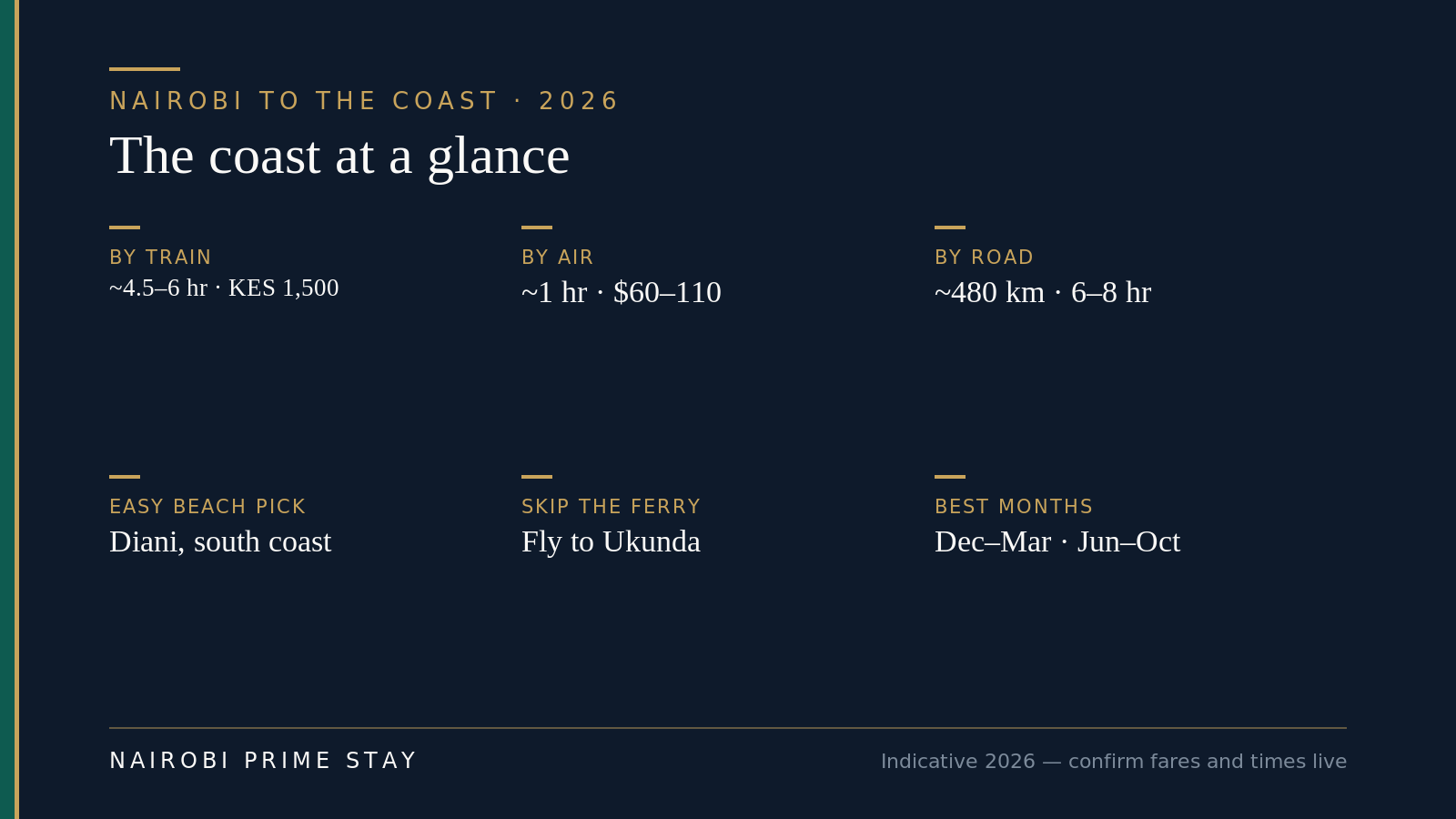 The coast in numbers — times and fares are indicative for 2026; confirm live before you book.
How do you get from Nairobi to the coast?
Three ways are worth your time — the train, a flight, or the drive — plus the budget bus if money is tighter than time. Here’s the honest rundown of each.
The SGR train (Madaraka Express)
The SGR is the sweet spot for a lot of people: comfortable, scenic, and cheap. The Madaraka Express covers the roughly 480 km between Nairobi and Mombasa in about four and a half to six hours, in air-conditioned carriages with assigned seats. You roll through the Tsavo plains and often spot elephants, giraffe or zebra from the window — a small safari thrown in free.
There are usually three trains a day each way, departing around 8am, 3pm and 10pm, including a faster overnight express that skips the small stops. Schedules shift, so check the current timetable when you book.
Fares as of July 2026 are modest: economy is KES 1,500 (~$12) and first class KES 4,500 (~$35) for the full route, with a Premium class at KES 12,000 on select trains if you want the plush end. First class buys a roomier seat and more space; economy is perfectly pleasant for the trip. Children aged 3 to 11 travel at roughly half price, and under-3s ride free on a lap — the train is one of the easiest trips you can do with kids (more in our family life guide). Book online at metickets.krc.co.ke, via USSD *639#, or the M-Tikiti app, ideally a few days ahead — popular trains and holiday weekends sell out.
Now the honest catch: the stations are out of town at both ends. Nairobi Terminus is at Syokimau, about 20 km southeast of the city center (near JKIA), so budget 30 to 45 minutes and a taxi to reach it. In Mombasa, the SGR terminus is at Miritini on the mainland, not on the island or at the beach — you’ll need onward transport from there. Add those transfers to the headline travel time. Arrive at least 30 minutes before departure, and carry your passport or ID; you’ll need it to board.
Flying (the fastest way)
When the weekend is short, fly. Flights from Nairobi to the coast take about an hour and save you the transfers a train still leaves you with. You have two useful airports:
- Moi International Airport (MBA) in Mombasa — served by Jambojet, Kenya Airways, Skyward Express and others, mostly from JKIA.
- Ukunda airstrip (UKA) at Diani — the south-coast gem. Jambojet flies here from JKIA and Safarilink flies from Wilson Airport, dropping you minutes from the Diani hotels. Flying straight to Ukunda skips Mombasa and its ferry crossing entirely — for a Diani trip, it’s the smoothest option going.
One-way fares typically run $60 to $110 (about KES 8,000 to 14,000) as of July 2026, with promotional Safarilink seats from around $58; less if you book ahead and travel light, more at peak holidays. Note which city airport you leave from: Jambojet uses JKIA, Safarilink uses Wilson (the small-aircraft airport closer to town). Our JKIA airport guide covers getting to and through the main airport if you’re connecting.
Driving the Mombasa Road
You can drive it, but for a weekend, think twice. The A109 Mombasa Road runs about 482 km and takes 6 to 8 hours depending on traffic and trucks. It’s tarmac the whole way and much improved in recent years — the SGR pulled a lot of cargo trucks off the route — but long stretches are single-carriageway, potholes appear, and overtaking trucks is where the risk lives.
A few honest rules if you do drive: go in daylight only, keep your fuel and your patience topped up, and don’t make unnecessary stops in empty stretches. The road threads between Tsavo East and Tsavo West national parks for about 100 km, so you might see wildlife from the car — and you can break the journey with a night of safari, which turns a slog into a trip. You want a sound, higher-clearance vehicle. Many residents who “drive to the coast” actually hire a car with a driver, which is calmer and not much dearer once you count fuel and fatigue. For city-driving context before you commit, see our safety guide.
Buses and shuttles
The cheapest option is the long-distance bus. Reputable coast operators run comfortable coaches for roughly KES 1,000 to 2,500 (~$8 to $20), often overnight. It’s a fine budget choice and locals use it constantly, but at 8 to 10 hours it eats a chunk of a short weekend, and overnight travel means you trade a hotel night for a bus seat. For most expat trips, the train or a flight wins.
Getting from Mombasa to Diani: the ferry vs the new bypass
This is the logistics detail that trips people up. Diani is on the south coast, about 30 km past Mombasa Island, across a channel — so if you arrive in Mombasa (by train, by road, or at Moi airport) you still have to cross to reach the best beach.
Two ways across:
- The Likoni ferry — free for foot passengers; cars pay about KES 120 to 180 via M-Pesa (Paybill 423655) as of July 2026, and it runs 24 hours. It carries over 300,000 people a day, so it’s a real slice of coast life, but it gets crowded and occasionally breaks down. Fine on foot, slow with a car at peak times.
- The Dongo Kundu bypass — a new 18-km road and bridge that loops around the channel and skips the ferry altogether. It’s essentially complete and in use, and it has cut the Miritini-station-to-Diani run from 2 hours or more at peak down to roughly 45 minutes. Any decent taxi or transfer will use it.
The simplest fix of all: fly straight into Ukunda (Diani) and you sidestep this whole question.
Getting there at a glance
| Way | Time | Cost (one way) | Comfort | Best for |
|---|---|---|---|---|
| Fly | ~1 hr | $60–110 | High; quick and easy | Short weekends; going straight to Diani |
| SGR train | ~4.5–6 hr | KES 1,500 economy / 4,500 first | High; scenic, AC seats | The journey itself; budget comfort |
| Drive | 6–8 hr | Fuel + wear (or hire a driver) | Medium; tiring, daylight only | A Tsavo safari stop; a group road trip |
| Bus / shuttle | 8–10 hr | KES 1,000–2,500 | Basic; often overnight | Tight budgets, flexible time |
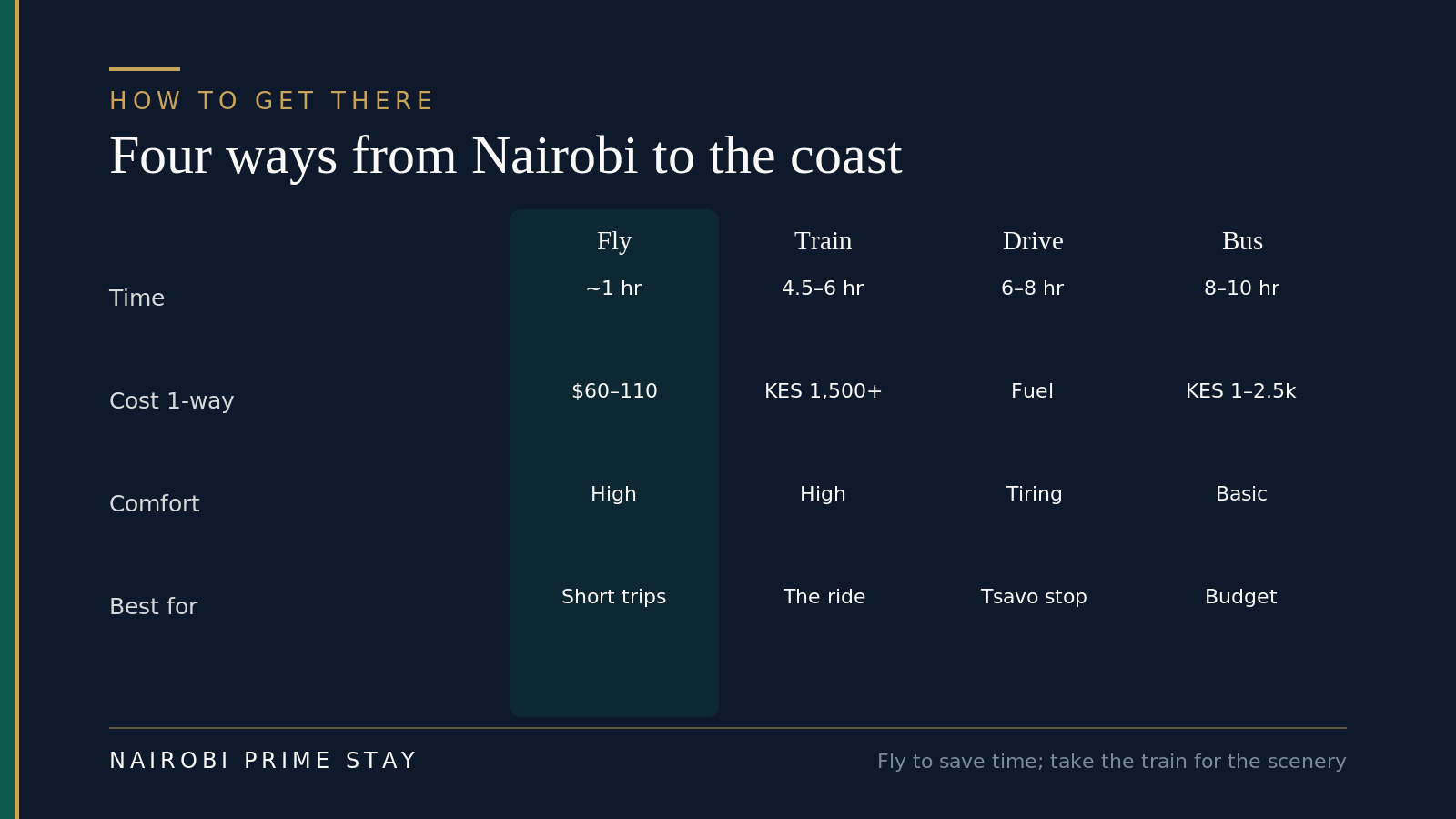 Fly when time is short, take the train for the ride, drive only if you want to stop at Tsavo.
A useful rule of thumb: fly if your time is tight, take the train if the journey is part of the fun, and drive only if you plan to break the trip with a safari or you’re moving a group with luggage. Plenty of residents do the train down and fly back, to get both.
Where should you go? Diani, Mombasa, Watamu or Lamu
The Kenyan coast isn’t one place. The four names you’ll hear most are Diani, Mombasa, Watamu and Lamu, and they suit very different trips. Here’s the honest shape of each.
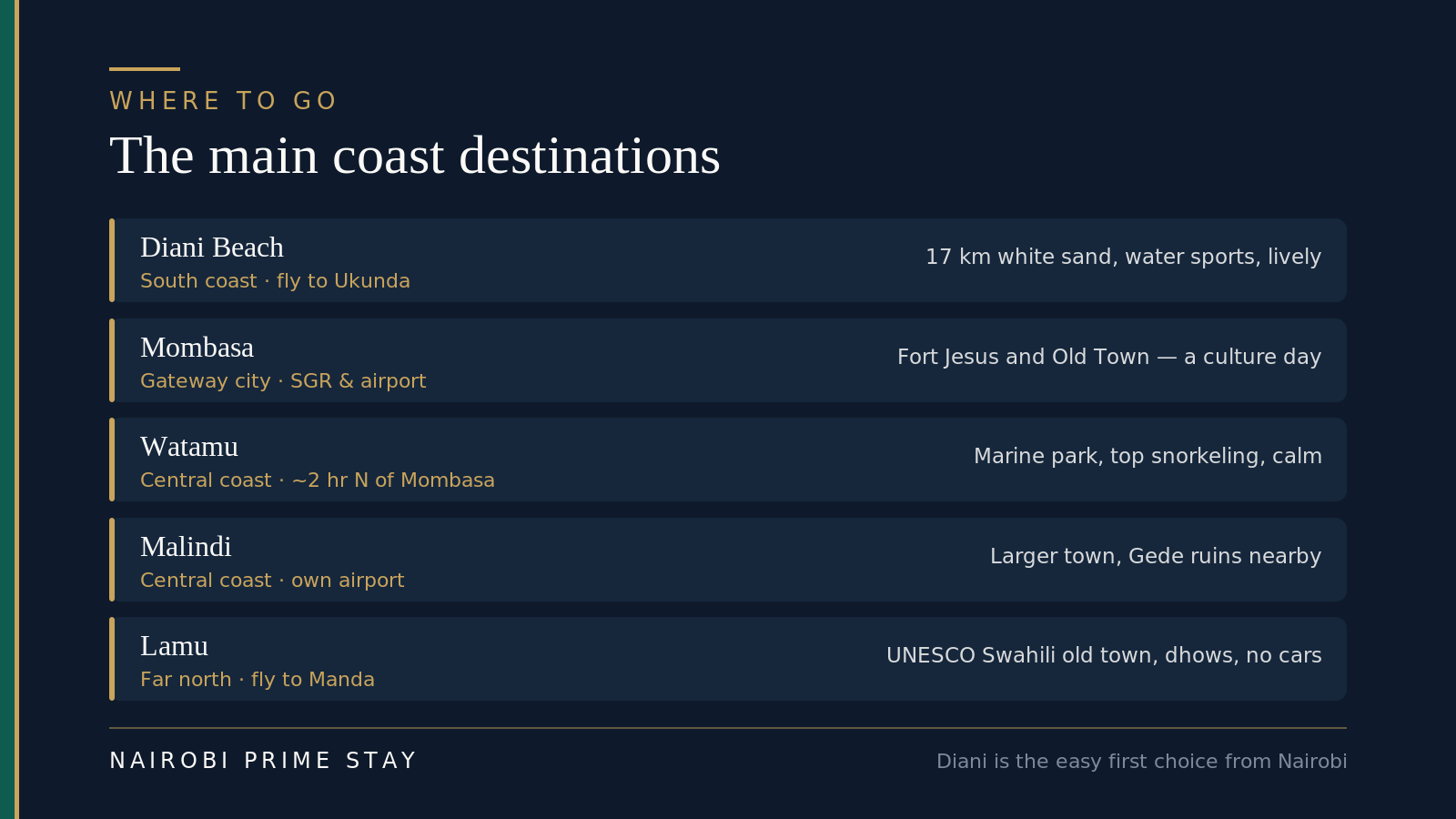 Four very different trips: pick by what you want from the sea.
Diani Beach (south coast)
For most Nairobi residents, Diani is the coast. It’s a long ribbon of white sand — about 17 km of it — backed by palms and lapped by warm, reef-protected water that’s calm enough for easy swimming. It has been the go-to weekend beach for Nairobi and Mombasa families for decades, and it’s the most awarded beach in Africa for good reason.
What makes Diani easy: it has its own airstrip (Ukunda), resorts and villas for every budget, and plenty to do — kitesurfing in the windy season, scuba diving and snorkeling on the reef, dhow trips, and day trips to the Kisite-Mpunguti marine park and Wasini Island. There’s even a troop of rare colobus monkeys you can see at the local conservation project.
The honest caveat: Diani has “beach boys” — young men who walk the sand offering excursions, jet-ski rides, carvings and massages. They’re rarely a safety issue, but the constant approaches annoy some visitors. A friendly, firm “no thank you” — hapana asante — works, and booking activities through your hotel removes the hassle. If you want beach quality, water sports and a lively scene, Diani is the pick.
Mombasa (the gateway city)
Mombasa is the coast’s big city and main port — and it’s better seen as a gateway than a beach base. The city beaches at Nyali and Bamburi, just north of the island, are convenient but feel urban rather than tropical. Where Mombasa shines is history and culture: Fort Jesus, a UNESCO World Heritage site, and the Old Town, a warren of Swahili and Arab-influenced streets, carved doors and spice shops. Give it a day for the culture, then base your beach time elsewhere.
Watamu and Malindi (central coast)
About two hours north of Mombasa, Watamu is the quieter, more natural counterpoint to Diani. Its marine park sits inside a UNESCO Biosphere Reserve and offers some of the best snorkeling and diving in East Africa, plus a well-known sea-turtle conservation project. The pace is slower, the beaches are stunning, and there’s a strong Italian influence in the food and hotels. Neighboring Malindi is the larger town, with an airport and the historic Gede ruins nearby. Choose Watamu if you want reef life and calm over nightlife.
Lamu (far north)
Lamu is a different kind of trip — pure culture rather than resort beach. It’s a UNESCO-listed island where the Old Town has barely changed in centuries: no cars, donkeys and dhows instead, and the best Swahili food you’ll eat anywhere — coconut fish curry, pilau, fresh seafood. The annual Lamu Cultural Festival, usually in November, brings donkey races and dhow regattas. You fly in via Manda airstrip rather than driving.
One honest note: the far-north coast near the Somali border has carried travel advisories at times. Lamu town and the main resort areas are popular and well-visited, but check the current US State Department travel advisory and your insurer’s terms before you book, and fly rather than drive. For more on reading travel risk sensibly, see our Nairobi safety guide.
When is the best time to go?
The coast is warm year-round, so this is about rain and sea conditions, not temperature. Two windows stand out.
December to March is the prime stretch. The dry northeast monsoon (the kaskazi) brings hot, clear days and calm, glassy seas — the best conditions for diving and snorkeling. December is festive and gorgeous but busy and pricier, so book early. June to October is the other sweet spot: drier, sunny and a little less humid, with the southeast kusi monsoon bringing the wind that makes Diani a kitesurfing magnet from roughly June to September.
The time to avoid is the long rains, mid-March to May — the wettest, most humid period, when downpours are heavy and a few smaller north-coast camps close. The short rains in October and November are much lighter and rarely ruin a trip; showers tend to pass quickly.
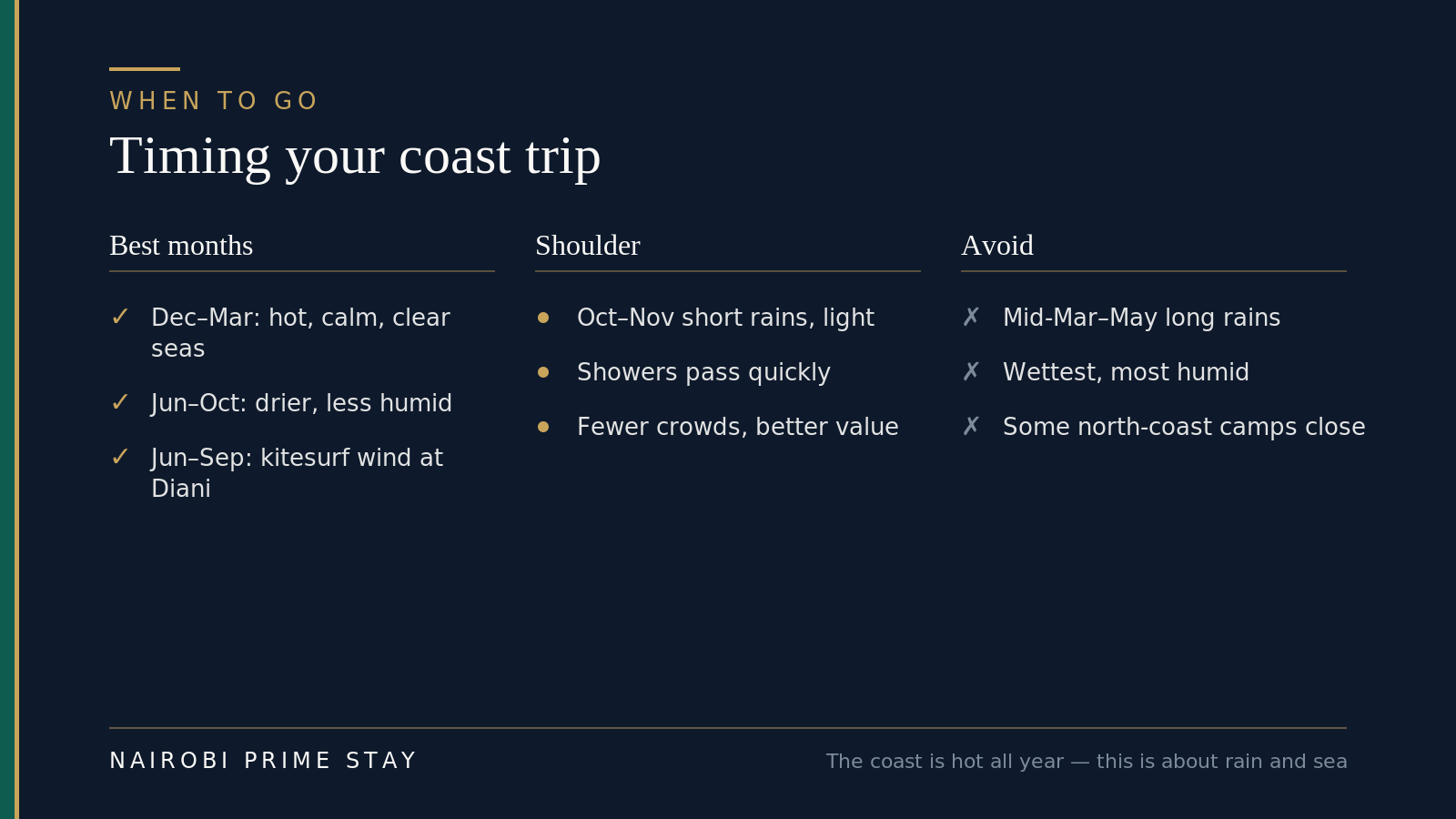 Aim for the dry months; the coast stays hot all year, so this is about rain and sea, not cold.
It’s worth pairing this with how the seasons feel back home in the highlands — the timing doesn’t always match. Our Nairobi weather and climate guide lays out the city’s two rainy seasons, which run on a similar but not identical calendar.
What the coast is actually like
A few honest practicalities so the coast doesn’t surprise you.
It’s hot and humid. After cool Nairobi, the coast feels tropical — days around 28 to 33°C, warm nights, and sea temperatures in the high 20s. Pack light, breathable clothes, real sun protection, and expect to move slowly in the midday heat.
Malaria is a real consideration. Unlike high-altitude Nairobi, where the risk is low, the coast is a malaria zone. Talk to a travel clinic about antimalarial tablets, use repellent, and sleep under a net or with the air-conditioning and screens that most hotels provide. Don’t skip this — and check that your cover travels with you; our health insurance guide for expats explains what Kenyan and international policies pay for outside Nairobi.
The culture is strongly Swahili and largely Muslim. The coast has its own rhythm, language and dress norms. Beachwear is for the beach and resort; in towns, markets, Mombasa Old Town and especially Lamu, dress modestly — cover shoulders and knees. It’s a small courtesy that’s noticed and appreciated. The coast is also the heartland of Swahili, so a few words go a long way; our culture and etiquette guide covers the basics that apply countrywide.
Money works as it does in Nairobi. M-Pesa and cards are widely accepted, but carry some cash for the ferry, tuk-tuks, tips and beach vendors. Around Diani and Mombasa you’ll get around by tuk-tuk, taxi, Uber or Bolt (in the city) and the occasional matatu.
Safety is normal-precautions territory. The coast is well used to visitors. Use hotel safes, don’t flash valuables, avoid isolated beaches after dark, and book activities through reputable operators. None of this is unique to Kenya — it’s standard beach-town sense.
If you’re thinking bigger than the Kenyan coast, neighboring Zanzibar and the wider region are an easy add — see our East Africa regional travel guide for the hops worth making.
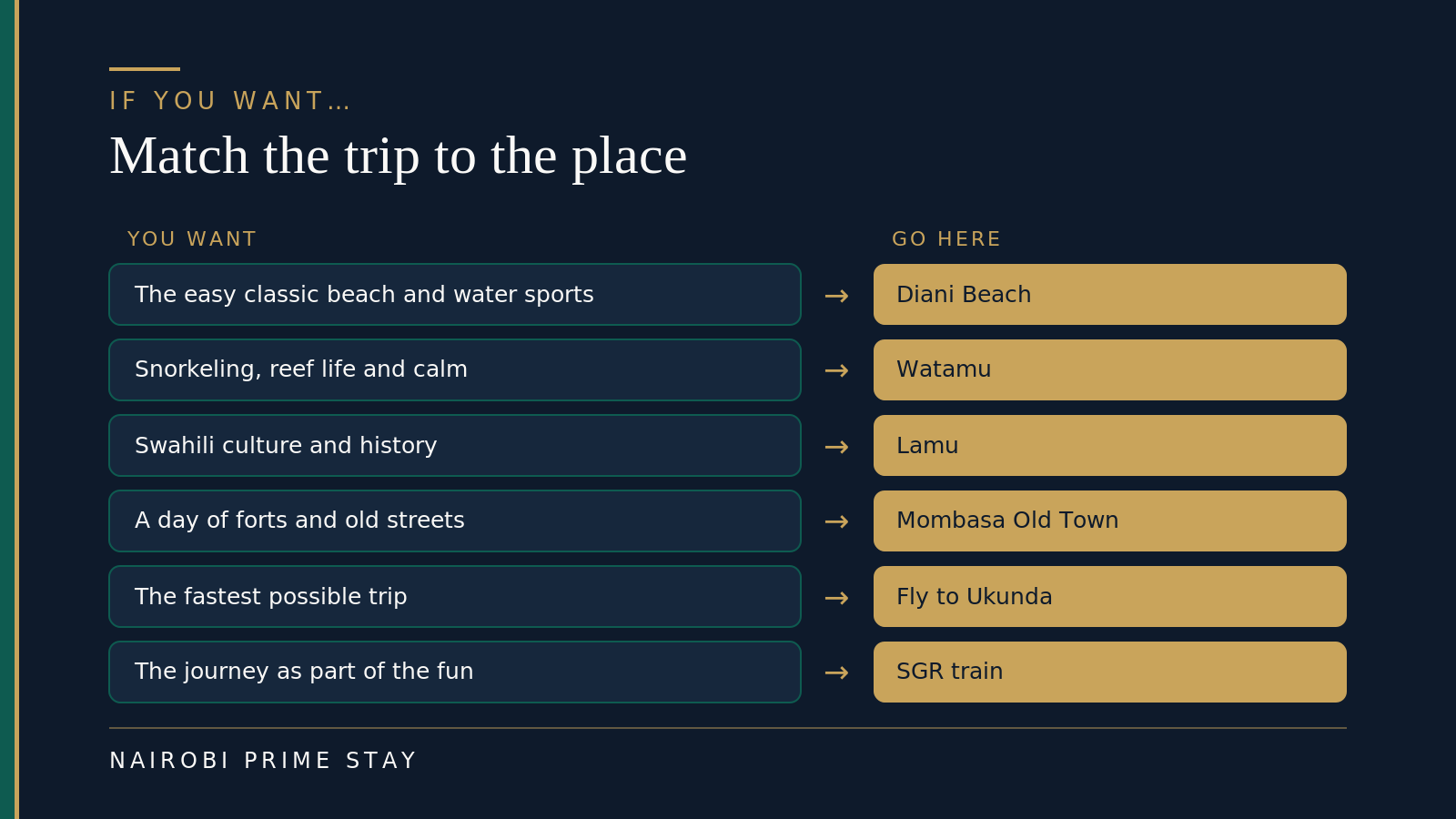 Match the trip to what you actually want from the sea.
A realistic long weekend: Diani in three days
Say you’re a remote-working couple in Nairobi with a Friday-to-Sunday window. Here’s how it actually plays out.
Friday: You finish work early and catch a late-morning Safarilink flight from Wilson straight to Ukunda. By early afternoon you’re checking into a Diani hotel, and you spend the rest of the day on the sand with a swim and a sundowner. Total transit door-to-door: under three hours.
Saturday: A morning snorkeling or diving trip on the reef, or a dhow out to Wasini Island for lunch and dolphins. Afternoon by the pool, evening at one of the beach-road restaurants for fresh seafood and Swahili curry.
Sunday: A slow morning, a last swim, and an afternoon flight back. You’re home in Nairobi for dinner, reaching for a sweater again as the highland evening cools.
That’s the magic of the coast from Nairobi: a genuine change of world inside a normal weekend. Add two days and you could do the train down, a Tsavo stop, or a few nights in quieter Watamu.
Your coast-trip checklist
- Pick your way there — fly for speed, train for the ride, drive only with a safari stop in mind.
- Book transport early for holiday weekends; SGR and cheap flights sell out.
- Match the airport to the airline — Jambojet from JKIA, Safarilink from Wilson; fly to Ukunda for Diani.
- Choose your base — Diani for beach, Watamu for snorkeling, Lamu for culture, Mombasa for a gateway day.
- Go in the dry months (Dec–Mar or Jun–Oct); avoid the mid-March-to-May long rains.
- See a travel clinic about antimalarials and pack repellent.
- Pack for heat and sun — light clothes, strong sunscreen, a hat, and modest layers for town.
- Carry some cash for the ferry, tuk-tuks, tips and vendors, alongside M-Pesa.
- Plan the Mombasa-to-Diani leg — use the Dongo Kundu bypass, or fly straight to Diani to skip it.
- Check advisories for the far-north coast if Lamu is on your list.
Frequently asked questions
How do I get to the Kenyan coast from Nairobi?
You have three good options. The SGR Madaraka Express train runs from Nairobi to Mombasa in about four and a half to six hours for KES 1,500 in economy as of July 2026. A flight takes about an hour and costs around $60 to $110 one way, with airports at Mombasa (Moi International) and Diani (Ukunda airstrip). Or you can drive the 480-km Mombasa Road in six to eight hours, in daylight only. Most people fly when time is short and take the train for the experience. Buses are the cheapest at KES 1,000 to 2,500 but take eight to ten hours, often overnight.
How long is the SGR train from Nairobi to Mombasa, and how much does it cost?
The Madaraka Express covers about 472 km in roughly four and a half to six hours, in air-conditioned carriages with assigned seats. As of July 2026, economy class is KES 1,500 (around $12), first class is KES 4,500 (around $35), and a Premium class runs KES 12,000 on select trains. Children aged 3 to 11 travel at about half price, and under-3s ride free on a lap. There are usually three trains a day each way, around 8am, 3pm and 10pm, with the 10pm night express skipping the small stops. Book at metickets.krc.co.ke, via USSD *639#, or the M-Tikiti app a few days ahead, as popular trains sell out. Remember the stations are out of town at both ends, so budget for taxis to and from them.
Is it better to take the train or fly to the coast?
It depends on your time. Flying is fastest at about an hour and is best for a short weekend, especially if you fly straight to Diani’s Ukunda airstrip and skip Mombasa altogether. The train takes four and a half to six hours but is comfortable, scenic and cheap, and the ride through the Tsavo plains is half the fun. A common move is to take the train down one way and fly back, so you get both. Driving only makes sense if you want to break the trip with a Tsavo safari or you’re travelling as a group with luggage.
Should I go to Diani, Mombasa, Watamu, or Lamu?
For most Nairobi residents, Diani on the south coast is the easy pick: 17 km of white sand, warm reef-protected water, water sports, and its own airstrip. Watamu, about two hours north of Mombasa, is quieter and best for snorkeling and diving in its marine park. Lamu, in the far north, is a UNESCO Swahili island for culture rather than resort beach, reached by flight. Mombasa is the gateway city, worth a day for Fort Jesus and the Old Town but better as a transit point than a beach base. Choose by what you want: beaches and activity (Diani), reef and calm (Watamu), or culture (Lamu).
When is the best time to visit the Kenyan coast?
Go in the dry months. December to March brings hot, clear days and calm seas, the best conditions for diving and snorkeling, though December is busy and pricey. June to October is the other good window, drier and a little less humid, with the wind that makes Diani a kitesurfing spot from about June to September. Avoid the long rains from mid-March to May, the wettest and most humid stretch. The short rains in October and November are light and rarely spoil a trip. The coast is hot all year, so this is about rain and sea conditions, not temperature.
How do I get from Mombasa to Diani Beach?
Diani is about 30 km south of Mombasa Island, across a channel, so you have to cross. The two ways are the Likoni ferry — free on foot, about KES 120 to 180 per car via M-Pesa as of July 2026, running 24 hours but crowded at rush hours — or the Dongo Kundu bypass, an 18-km road and bridge that skips the ferry and has cut the run from Mombasa’s Miritini SGR station or the airport to Diani from two hours or more down to roughly 45 minutes. Any decent taxi or transfer will use the bypass. The simplest way to avoid the whole crossing is to fly straight into Diani’s Ukunda airstrip.
Is the Kenyan coast safe, and do I need malaria pills?
The coast is well used to visitors and safe with normal beach-town precautions: use hotel safes, don’t flash valuables, avoid isolated beaches after dark, and book activities through reputable operators. Malaria is a genuine consideration, though. Unlike high-altitude Nairobi, where the risk is low, the coast is a malaria zone, so see a travel clinic about antimalarial tablets, use repellent, and sleep under a net or with screens and air-conditioning. For Lamu and the far-north coast near the Somali border, check the current US State Department travel advisory before booking and fly rather than drive.
Can I do the coast as a weekend trip from Nairobi?
Yes, easily — that’s one of the joys of living in Nairobi. Fly out on a Friday and you can be on a Diani beach by early afternoon, with a full Saturday for snorkeling or a dhow trip and a Sunday-evening flight home. A long weekend is plenty for Diani. If you have a few more days, you can take the train down, add a Tsavo safari stop on the drive, or settle into quieter Watamu. The change from cool highland Nairobi to the hot Indian Ocean inside an afternoon never quite stops feeling like a magic trick.
How much does a long weekend in Diani cost from Nairobi?
A comfortable couple’s long weekend runs roughly $400 to $900 all-in as of July 2026. Return flights to Ukunda are about $120 to $220 per person; a good beachfront hotel or villa room runs $80 to $250 a night with plenty below and above that; meals at beach-road restaurants are $10 to $25 a head; and a snorkeling or dhow trip is $30 to $70 per person. Doing it on the train with a guesthouse instead can bring a couple’s weekend under $250. December holidays push everything up, so book early for that window.
Do I need my passport for the SGR train or domestic flights?
Carry photo ID for both. SGR bookings are made against an ID or passport number and you may be asked to show it at the station’s airport-style security check, so bring the document you booked with — for Americans that means your passport, since you won’t hold a Kenyan ID. Domestic flights are the same: no visa checks, but the airline will want the ID used in the booking. Kids can use passports too; under-3s ride the train free on a lap.
Is there Uber in Mombasa and Diani?
Uber and Bolt work in Mombasa city and reach Nyali and the airport, and coverage now extends patchily toward the south coast. In Diani itself, most people use tuk-tuks for short hops along the beach road (agree KES 100 to 300 for local runs), local taxis, or transfers arranged by their hotel. For the airport-to-hotel leg, a pre-booked transfer via the Dongo Kundu bypass or from Ukunda airstrip is the least hassle. Boda bodas exist but skip them with luggage.
What should I pack for the coast that I wouldn’t need in Nairobi?
Think tropics, not highlands: light, breathable clothes, swimwear, reef-safe sunscreen (strong UV, and some marine parks encourage it), a hat, sandals, and insect repellent with an antimalarial plan from a travel clinic. Add a light cover-up or modest layer for towns and Mombasa Old Town, where shoulders and knees covered is the courteous norm. Most hotels have nets or screened, air-conditioned rooms, so you rarely need your own net. Leave the sweater for your return to Nairobi — you’ll want it the evening you land back at 1,795 meters.
Final thoughts
The coast is the trip that makes living in Nairobi feel like a gift. You don’t need a big expedition or a week of leave — a flight and a free Friday afternoon put you on warm sand by lunchtime, and the train turns the going there into part of the holiday. Start with Diani, because it’s the easiest and the loveliest for a first run. Once you’ve got the rhythm, branch out to Watamu’s reefs or Lamu’s old streets.
Go in the dry months, take the malaria advice seriously, pack light for the heat, and don’t sweat the logistics too hard — flying straight to Diani sidesteps most of them. The hardest part is going back to the highlands and reaching for a sweater.
Related reading
- Moving to Nairobi: the complete guide — the hub for settling in, with everything that comes before the fun trips.
- Weekend trips from Nairobi — the lakes, tea country and parks within a couple of hours of the city.
- Safaris from Nairobi — how to do the Mara, Amboseli and Tsavo, including the parks you pass on the coast drive.
- East Africa regional travel — Zanzibar, Uganda, Rwanda and the wider region beyond the Kenyan coast.
- Nairobi weather and climate — the city’s seasons, so you can time trips around the rains.
- Nairobi culture and etiquette — the customs and coast dress norms worth knowing.
Plan your base in Nairobi first
A coast trip is easy once your Nairobi life is sorted. If you’re still settling in, a serviced apartment gives you a secure, all-inclusive base — Wi-Fi, cleaning, generator and security included — so you can lock the door, fly to Diani for the weekend, and come home to a place that’s handled. Browse our serviced apartments for honest monthly pricing, or ask our AI relocation assistant to shortlist a home near your work and your nearest airport in a couple of minutes.
Keep reading
Related guides
Ready to look?
Find your apartment in Nairobi
Browse verified serviced apartments, or ask the AI concierge which area fits your life.