
Guides · Travel
Safaris from Nairobi: Your First Wildlife Trips (2026 Guide)
Safaris from Nairobi: Your First Wildlife Trips (2026 Guide)

Here’s the line that sells people on Nairobi: you can land in the morning and watch lions by the afternoon, without leaving the city limits. Nairobi National Park sits on the southern edge of town, and it’s the only national park on earth inside a capital. Beyond it, some of the most famous wildlife country in the world — the Maasai Mara, Amboseli under Kilimanjaro, Tsavo — is a short flight or a half-day drive away. No other capital makes safari this easy.
This guide is the practical version for people who actually live here, not a two-week bucket-list itinerary. It covers which parks to do from Nairobi, what each one is known for, roughly what a trip costs in 2026, how the messy park-fee situation works this year, and how to book without overpaying or getting burned. If you’re still weighing the move, start with the complete guide to moving to Nairobi; this one is about the best thing you’ll do once you’re here. For shorter escapes that aren’t all about wildlife, see our weekend trips from Nairobi guide.
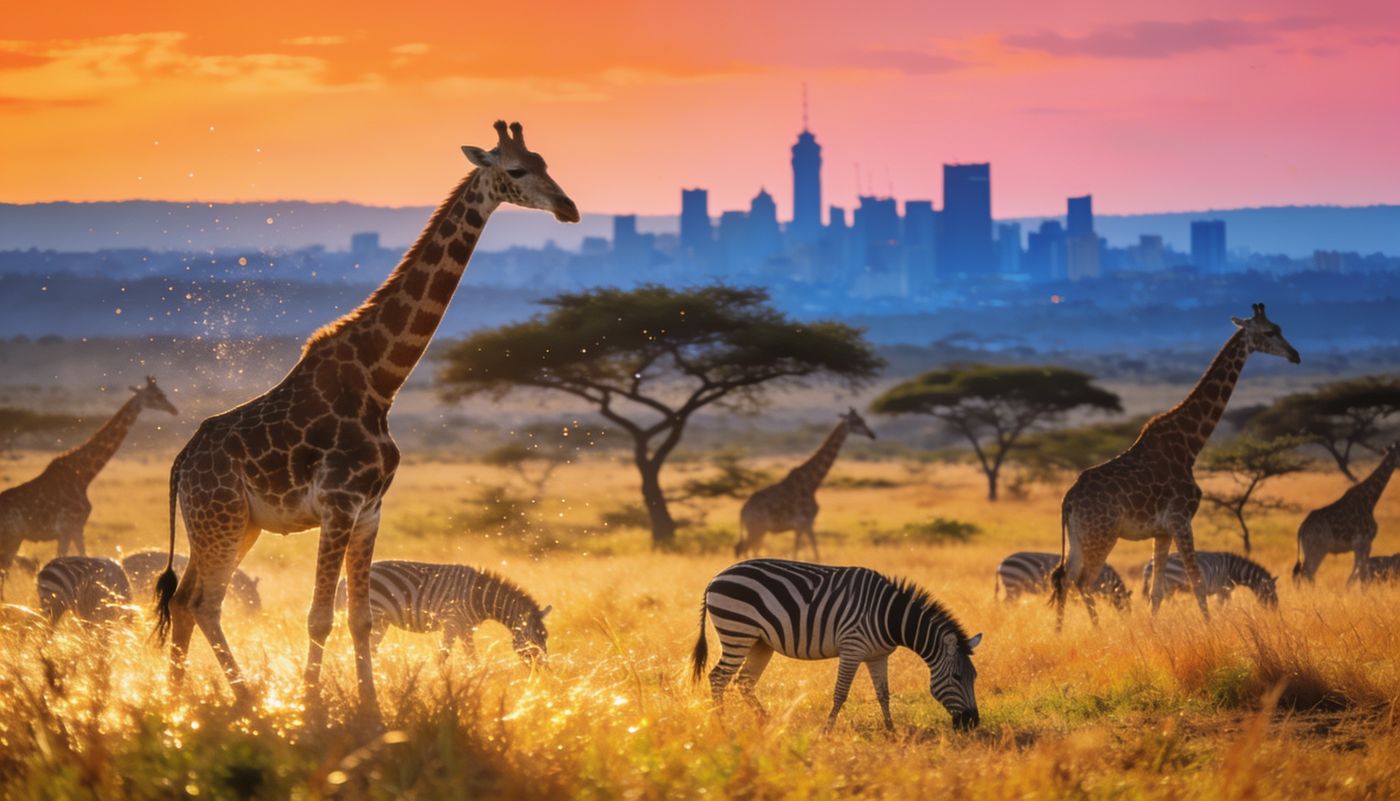
The quick version
Start with Nairobi National Park — lions, rhino, giraffe and buffalo on a half-day, inside the city, for about $80 non-resident entry. When you’re ready for a proper trip, the big three from Nairobi are the Maasai Mara (the classic big-cat plains and the migration, July to October), Amboseli (huge elephant herds under Mount Kilimanjaro, about four hours by road), and Tsavo (vast, wild and on the road to the coast). Lake Nakuru adds rhino and flamingos in an easy package, and Ol Pejeta near Nanyuki has the last two northern white rhinos. You can drive to most, but for the Mara many residents fly — 45 minutes from Wilson Airport beats a six-hour road trip. Budget on roughly $150–300 per person per day for a budget safari, $300–600 mid-range and $600–1,500+ for luxury, plus park fees of $80–200 a day. Park fees are genuinely in flux this year, so confirm the live figure before you book.
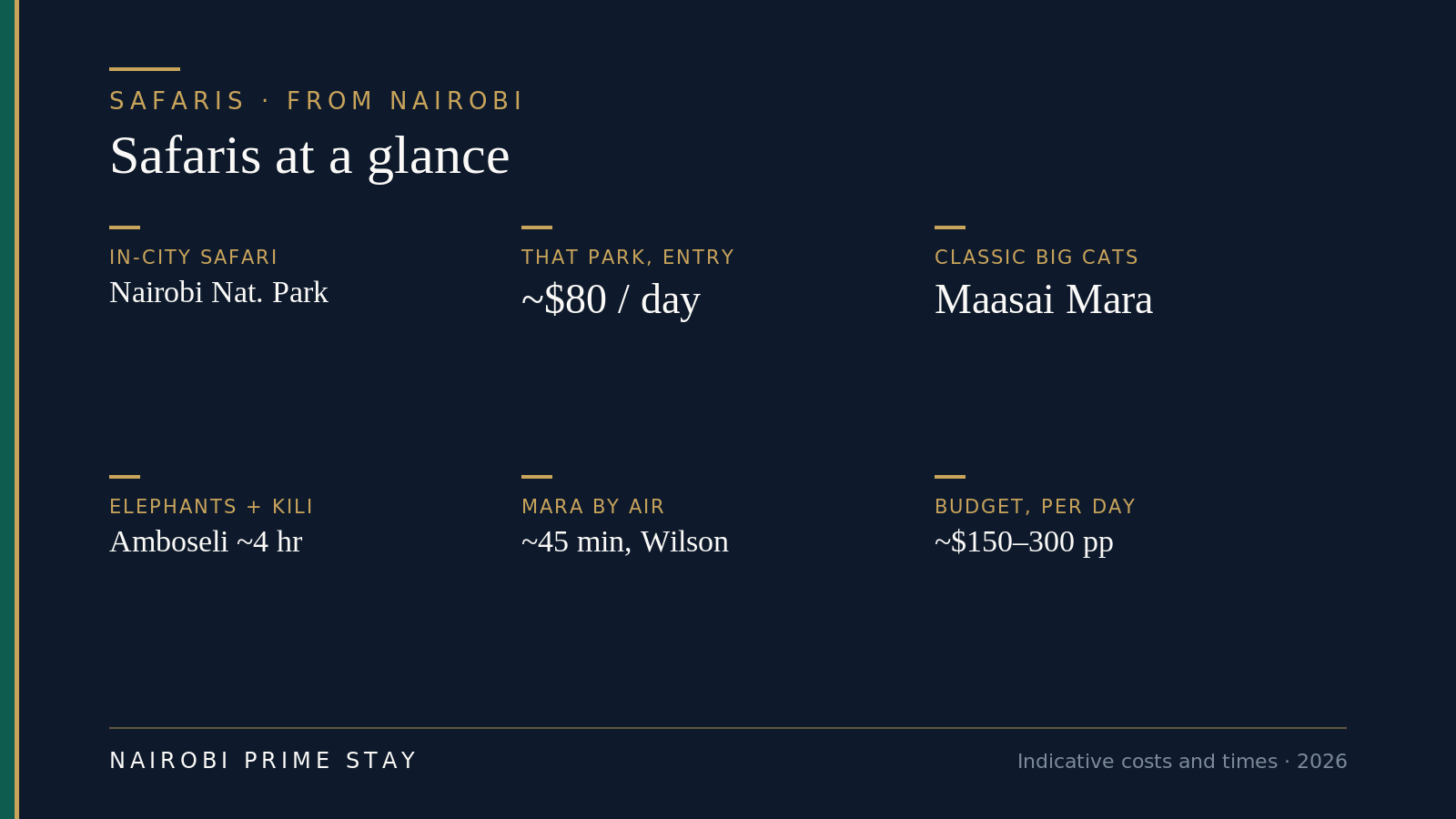
The shape of your options in one screen — costs and drive times are indicative for 2026.
Why Nairobi is the perfect safari base
Most safari trips in the world start with a long-haul flight and then another flight to a remote strip. Living in Nairobi, you skip all of that. Wilson Airport, a 20-minute drive from the western suburbs, runs light aircraft to every major park, and the main road network reaches the rest. You can do a serious safari on a long weekend and be back at your desk on Monday.
The other advantage is repetition. Visitors get one shot and feel they must see everything; you don’t. You can do Nairobi National Park on a Saturday whim, save the Mara for when family visits, and try Amboseli in a different season to see how it changes. Over a couple of years you’ll build a feel for which park suits which mood — and that’s a kind of luxury no two-week holiday can buy.
One thing shapes every number below: Kenya runs a two-tier pricing system. Residents and East African citizens pay far less than foreign visitors at parks and many lodges. Once you hold a work permit or dependant’s pass, ask everywhere about the resident rate and carry proof — it can cut a park fee by more than half. If you’re still sorting your status, our Kenya visa guide for Americans walks through the routes. Until your permit comes through, you’ll pay non-resident prices, which is what the figures here assume.
The parks, one by one
Each park has a personality. Here’s what newcomers actually need to know about the ones you can realistically reach from Nairobi, roughly from the city outward.
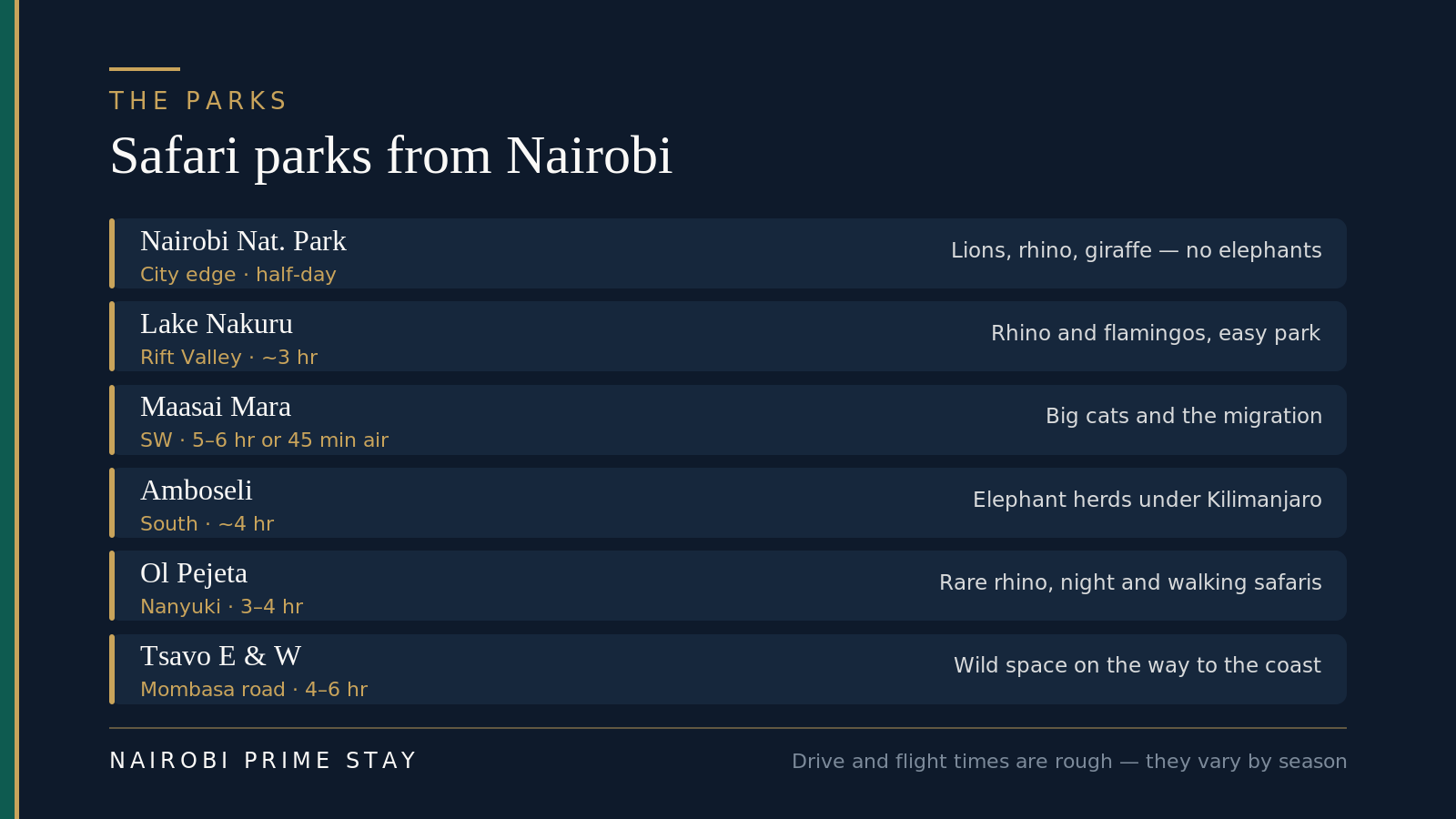
Six parks worth your weekends — drive and flight times are rough and depend on roads and season.
Nairobi National Park — safari before lunch
This is where everyone should start. The park covers about 117 square kilometres on the city’s southern boundary, fenced on the city side and open to the plains on the other, so animals move in and out. You’ll reliably see giraffe, zebra, buffalo, gazelle and, with a little luck, lions and black rhino — all with office towers on the horizon. It’s the easiest, cheapest wildlife you’ll find anywhere: non-resident entry is about $80 in 2026, you don’t need a 4x4 for the main tracks, and a half-day is plenty. The catch is honest — there are no elephants here, and weekend mornings can get busy with vehicles. Pair it with the nearby Giraffe Centre or the elephant orphanage and you’ve got a full, gentle first outing the whole family can do.
The Maasai Mara — the one you’ve seen on TV
The Mara is the headline act: 1,500 square kilometres of open savannah running into Tanzania’s Serengeti, with the densest big-cat population in Kenya. Lions, cheetahs, leopards, elephants and huge herds of grazers are close to a sure thing, and from about July to October the wildebeest migration pours across the Mara River in the scenes that made this place famous. It’s run by Narok County rather than KWS, so its fees and rules work differently (more below). The Mara is five to six and a half hours by road, or a 45-minute light-aircraft hop from Wilson — which is why most residents fly in for two or three nights. It’s the priciest park in peak season and the busiest, but it earns the reputation. If you do one big safari your first year, make it this.
Amboseli — elephants under Kilimanjaro
Amboseli trades the Mara’s big-cat density for the most iconic backdrop in Africa: enormous elephant herds crossing dusty plains with snow-capped Mount Kilimanjaro rising behind them. The terrain is flat and open, so game-viewing is easy and the photography is hard to beat — this is the postcard park. It’s about four hours south of Nairobi by road on reasonable tarmac, making it doable as a long weekend by car, and it’s a premium KWS park at roughly $90 non-resident entry in 2026. Big cats and rhino are scarcer here than in the Mara, but for sheer elephant numbers and that mountain, nothing else is close. It’s also one of the easiest parks for young children — flat, open and reliably rewarding.
Tsavo East and West — big, wild and on the way to the coast
Tsavo is Kenya’s largest protected area, split into East and West, and it’s where you go for space and solitude rather than crowds. Tsavo East is flat, dry and famous for “red elephants” dusted in its rust-coloured soil and big herds along the Galana River; Tsavo West is greener and more dramatic, with the Mzima Springs and lava fields. Wildlife is genuinely wild and a little harder to find than in the Mara, which is part of the appeal. The clever move for residents: Tsavo sits right on the A109 Mombasa road and the SGR railway line, so you can break the trip to the coast with a night or two on safari. Non-resident entry is about $80 a day in 2026. For combining the two, see our Nairobi to the coast guide.
Lake Nakuru and the Rift Valley lakes — rhino and flamingos
About three hours north-west, Lake Nakuru National Park is a compact, easy park wrapped around an alkaline lake. It’s one of the best places in Kenya to see both black and white rhino, often gives you tree-climbing lions, and at times the shallows turn pink with flamingos (numbers swing with water levels, so don’t bank on it). It’s a premium KWS park at roughly $90 non-resident entry. Many people pair it with Lake Naivasha next door — boat rides among hippos and the walking safari on Crescent Island — for a relaxed weekend that mixes wildlife with downtime. Those closer Rift Valley trips are covered in our weekend trips guide.
Ol Pejeta and Laikipia — rhinos and something different
Three to four hours north near Nanyuki, the Laikipia plateau is conservancy country rather than national park, and it offers things the big parks can’t. Ol Pejeta is home to the last two northern white rhinos on the planet, a large black-rhino population and a chimpanzee sanctuary, and because it’s privately run you can do night drives and walking safaris that aren’t allowed in KWS parks. Conservancy fees are separate from KWS and tend to run higher (around $110 a day for non-residents at Ol Pejeta — confirm when you book), but the experience is more intimate and the crowds are thinner. It pairs naturally with a Mount Kenya weekend.
The parks compared at a glance
Here’s the same information as a table you can scan before you pick a trip. Fees are non-resident adult, per day, and indicative for 2026 — always confirm the live figure.
| Park | From Nairobi | Best known for | Non-resident fee/day | Good for |
|---|---|---|---|---|
| Nairobi National Park | On the city edge | Lions, rhino, giraffe in the city | ~$80 | A first half-day safari |
| Maasai Mara | 5–6.5 hr road / ~45 min air | Big cats, the migration | ~$100 (Jan–Jun) / ~$200 (Jul–Dec) | The classic bucket-list trip |
| Amboseli | ~4 hr road | Elephant herds, Kilimanjaro | ~$90 | Easy game-viewing, families |
| Tsavo East & West | 4–6 hr road / on the SGR | Space, “red elephants”, solitude | ~$80 | Combining with the coast |
| Lake Nakuru | ~3 hr road | Rhino, flamingos, easy park | ~$90 | A relaxed weekend |
| Ol Pejeta (Laikipia) | 3–4 hr road | Rare rhino, night & walking safaris | ~$110 (conservancy) | Something different |
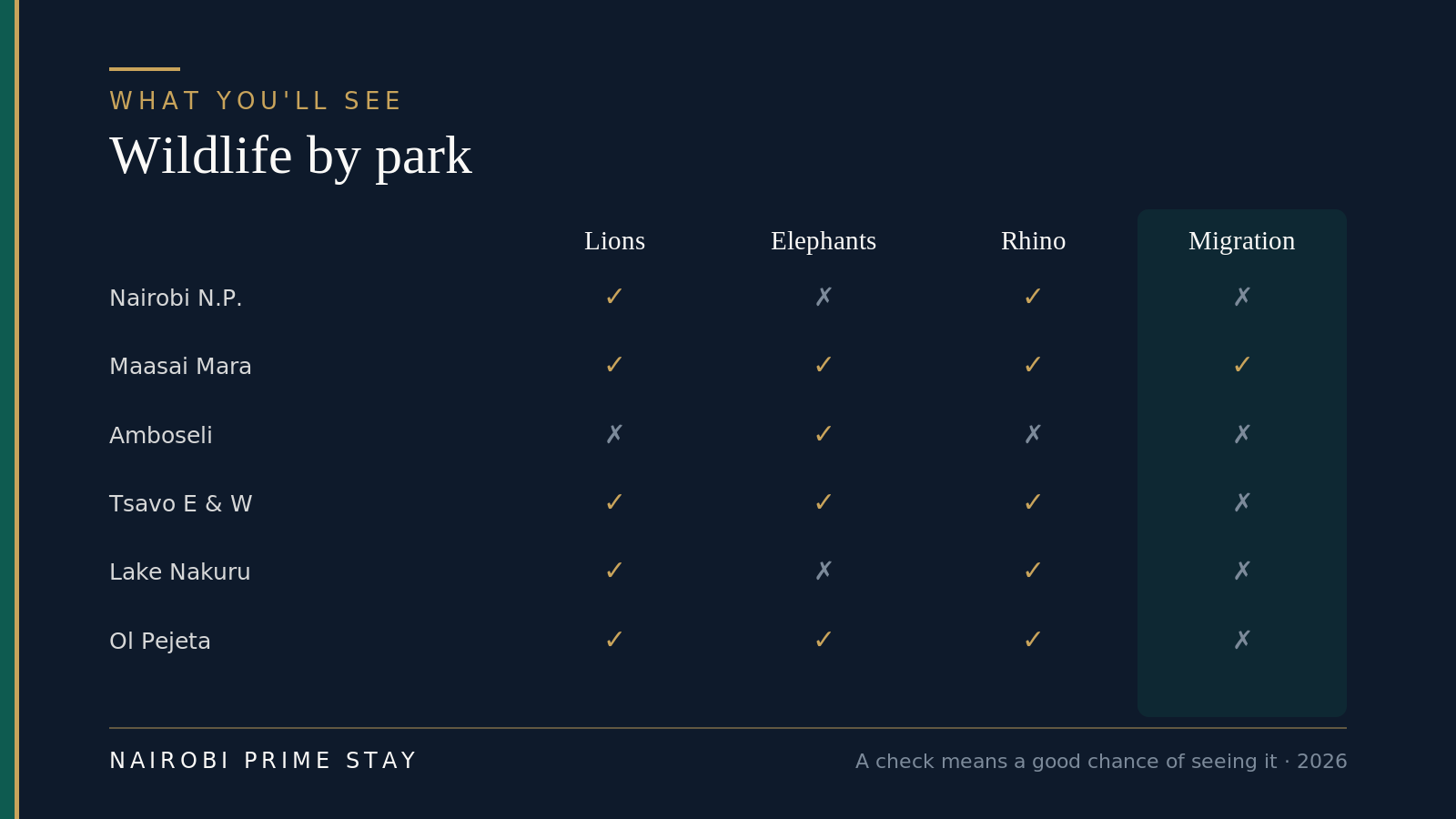
What each park is actually strong for — a checkmark means you’ve got a good chance of seeing it.
Park fees in 2026 — the honest, slightly messy picture
This is the part most guides get wrong, so here’s the real situation. Kenya’s wildlife parks fall into two systems, and 2026 is an unusually confusing year for both.
KWS national parks (Nairobi National Park, Amboseli, Tsavo, Lake Nakuru and most others) are run by the Kenya Wildlife Service. New, higher fees were gazetted to take effect on 1 October 2025 — and within days the High Court suspended them after the Kenya Tourism Federation challenged the short notice given to operators. The case rumbled on into late 2025. In practice, the eCitizen / KWS payment portal has continued to display and charge the 2025 rates, so the figures in this guide reflect what you’re most likely to actually pay: roughly $80 a day for non-resident adults at Nairobi National Park and Tsavo, and about $90 at premium parks like Amboseli and Lake Nakuru. Because this is genuinely unsettled, confirm the live number on the official portal before you budget. One firm change: KWS parks are now cashless. You pay online through eCitizen, not in cash at the gate, so set it up before you travel.
The Maasai Mara plays by its own rules because it’s a national reserve run by Narok County, not KWS. Non-resident entry is about $100 per adult per day from January to June 2026, rising to $200 from July through December — the peak-season price that catches a lot of people out, since a three-night stay means $600 in fees alone. The Mara ticket is valid for a 12-hour window (6am to 6pm), and unlike KWS parks, the main reserve still takes cash (US dollars or shillings) at the gate, though the Mara Triangle on the western side is cashless. The private conservancies bordering the reserve charge their own fee on top — usually $80 to $150 a day — but they limit vehicle numbers and allow night and walking safaris, so many people consider them worth it.
The simplest way to avoid a nasty surprise: when you book through an operator, ask whether park fees are included or extra, and get the per-day figure in writing. When you go independently, check eCitizen the week of your trip.
What a safari actually costs
A safari from Nairobi can cost $120 for a day in Nairobi National Park or $4,000 for three nights in a luxury Mara camp. Most newcomers land somewhere in the middle. Here’s how the tiers break down per person, per day, for 2026 — these figures cover your room, meals, game drives and a guide, but usually not park fees, internal flights, drinks or tips.
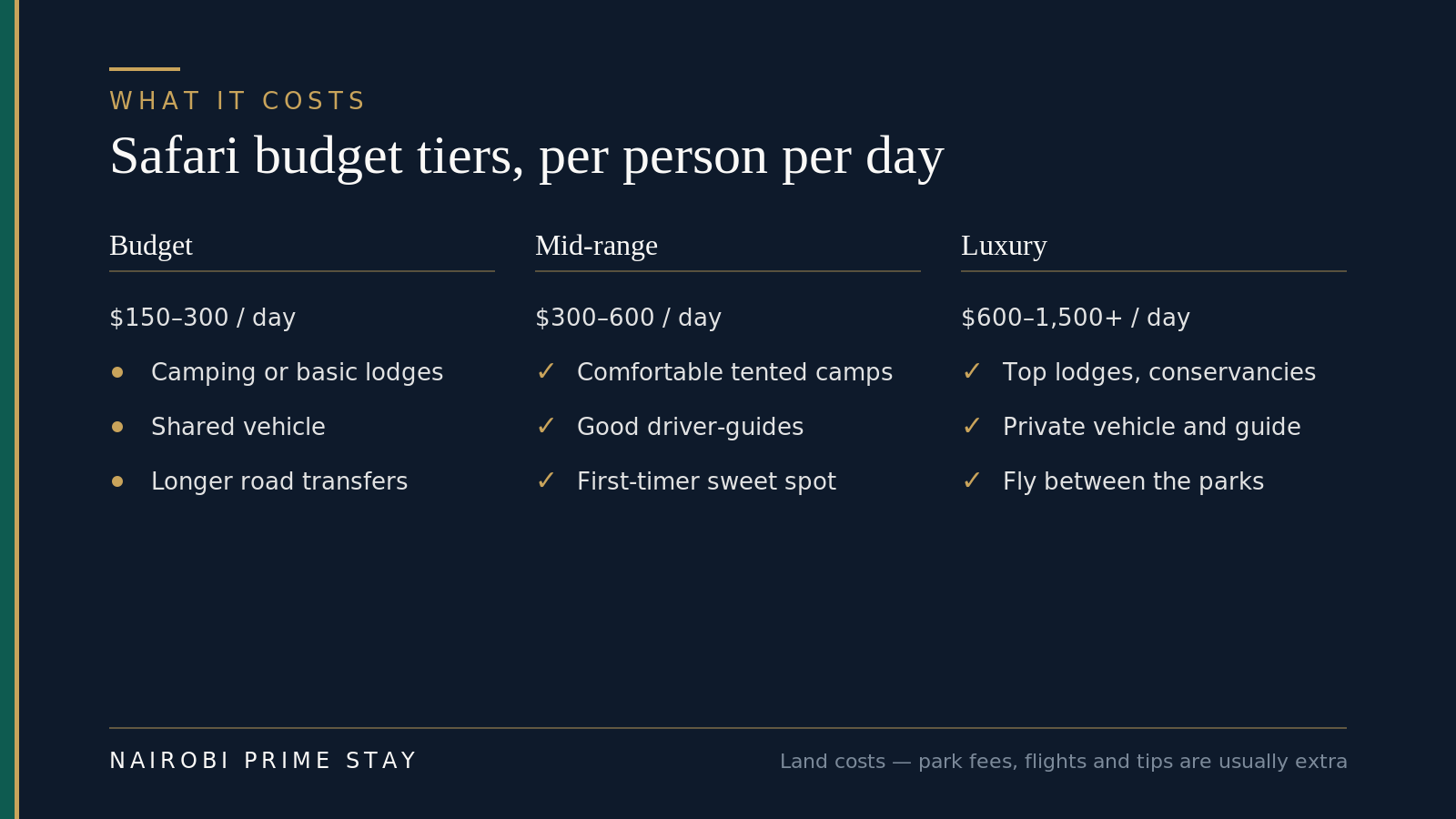
Per-person, per-day land costs for 2026 — park fees, internal flights and tips are usually on top.
Budget — about $150 to $300 a day. Camping or simple lodges, a shared minibus or 4x4, and longer road transfers instead of flights. Done well, a budget safari still gets you the same animals; you’re trading comfort and privacy for price. Group departures keep costs down.
Mid-range — about $300 to $600 a day. This is the sweet spot for most first-timers: comfortable tented camps with proper beds and hot showers, good driver-guides, decent food, and often a shared or small-group vehicle. You get the full experience without the luxury premium.
Luxury — about $600 to $1,500+ a day. Top lodges and private-conservancy camps, a private vehicle and guide, light-aircraft flights between parks, and standout food and service. At the very top, fly-in conservancy camps run well beyond $1,500 a day per person. You’re paying for exclusivity, space and logistics handled for you.
For a concrete example: a two-night, mid-range trip to the Maasai Mara for a couple, flying in and out of Wilson, typically lands somewhere around $1,200 to $2,500 all in once you add flights and peak-season park fees. The same trip by road, staying at a budget camp just outside the reserve, can be done for well under half that. Your two big levers are tier and season.
How to book without getting burned
Book through a licensed operator, and the rest gets easy. The marker to look for is membership of KATO — the Kenya Association of Tour Operators — alongside real, recent reviews and a verifiable physical office. A good operator handles the vehicle, the guide, the park fees and the lodge, and a great guide is the single biggest factor in whether you actually see animals. Spend your research time there.
The scams are predictable, so they’re easy to dodge. Be wary of prices that seem far below everyone else’s, of pressure to decide today, and of anyone asking you to send mobile money to a personal number for a trip you can’t verify. Get the full itinerary, exactly what’s included (park fees? flights? drinks?), and the total price in writing before you pay anything, and pay by a traceable method. The same street-smarts from our Nairobi safety guide apply on the road.
You’ve got three booking routes, roughly:
- A full-service operator packages everything — best for your first trip, for the Mara, and for anyone who wants it handled. Ask neighbours and colleagues for a name they’ve actually used.
- Book the lodge direct and self-drive works for the closer, easier parks — Nairobi National Park, Lake Nakuru, Naivasha — if you have a suitable vehicle and don’t mind navigating.
- Fly-in packages suit the Mara and Amboseli: the camp arranges your flights and game drives, and you turn up with a bag. More expensive, far less hassle.
Drive or fly?
For the closer parks, drive. Nairobi National Park, Lake Nakuru, Naivasha and even Amboseli are comfortable road trips, and driving gives you flexibility and a lower bill. A higher-clearance SUV is more comfortable, and for park tracks at Amboseli or the Mara you want a proper 4x4.
For the Maasai Mara, weigh it up honestly. The road is five to six and a half hours each way and the last stretch is rough; a flight from Wilson Airport is about 45 minutes and lands you near camp. On a two-night trip, flying buys back most of a day at each end — often worth the extra cost. Driving makes more sense with three-plus days, a full vehicle to split fuel, or a wish to stop along the way. Many residents drive the Mara once for the experience, then fly every time after. Wilson handles nearly all safari flights; our airport guide explains how Wilson and JKIA differ.
When to go
The dry seasons are best for game-viewing, full stop. Roughly late June to October and January to February: animals concentrate around water, the grass is shorter, roads are firmer, and you simply see more. These are also the most popular months, so book lodges and flights ahead.
The wildebeest migration in the Maasai Mara usually runs from about July to October, peaking with the famous river crossings. It’s the most dramatic wildlife spectacle on the continent — and the busiest, priciest window, which is also when Mara fees jump to their $200 peak. If the migration is your goal, plan and book months out.
Try to avoid the long rains from March to May (wettest in April), when dirt tracks to Amboseli and the Mara can turn difficult and some camps close. The short rains around November are lighter and often a good-value shoulder season, with green landscapes and newborn animals. For the full month-by-month picture — and what to pack for high-altitude sun and cool evenings — see our Nairobi weather and climate guide.
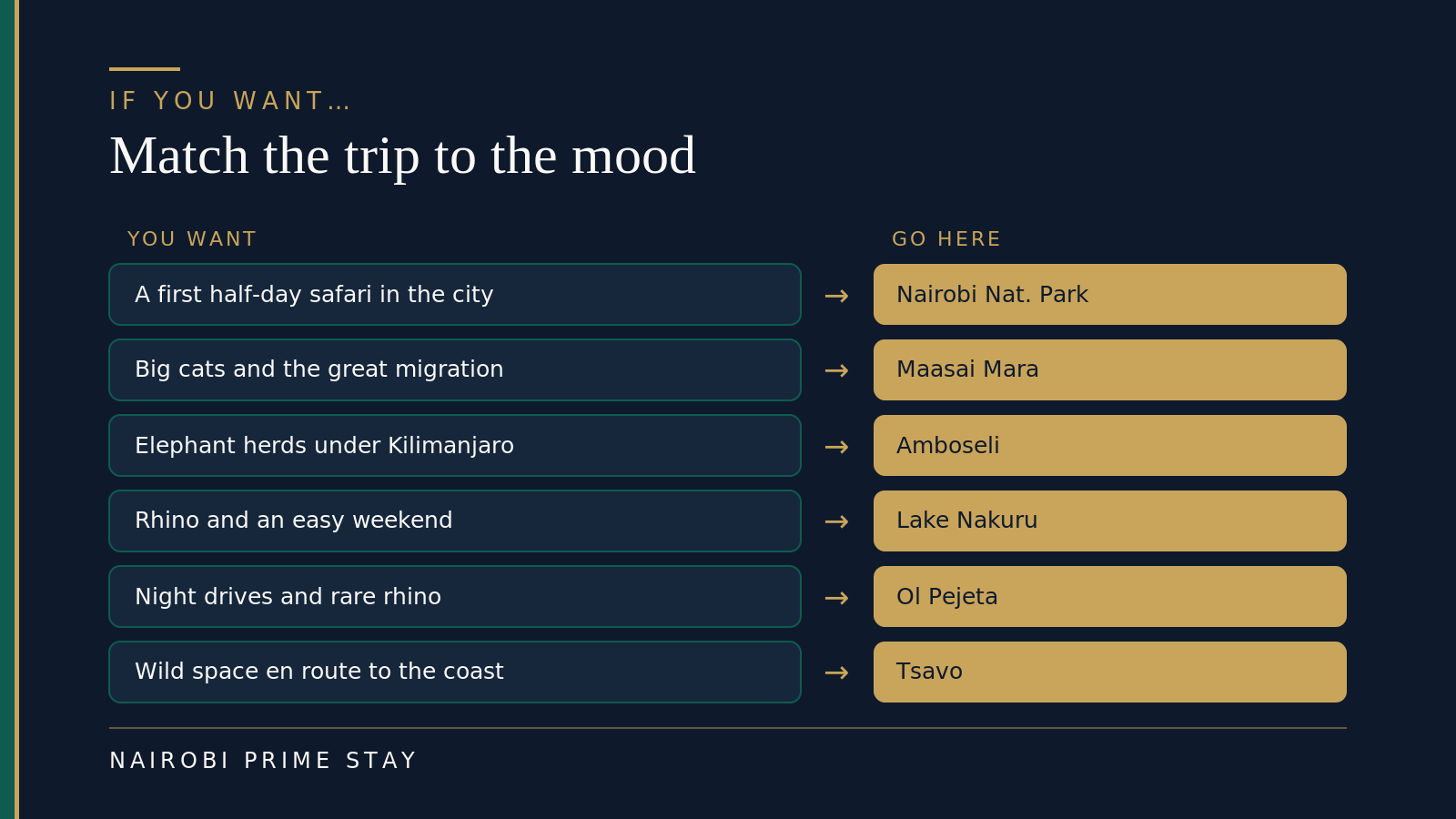
A quick way to match the trip to the mood.
First-timer tips that actually matter
A few things nobody tells you before your first safari:
- Early starts are the whole game. Animals are active at dawn and dusk and asleep in the midday heat. The 6am wake-up is non-negotiable if you want the good sightings.
- Manage your own expectations. This is wild country, not a zoo. Most trips deliver wonderful sightings, but no one guarantees a leopard or a river crossing. A relaxed three-day trip beats a frantic one-day dash.
- A good guide beats a fancy lodge. If you have to choose, spend on the operator and guide. They find the animals, read the bush and keep you safe.
- The high-altitude sun burns even when it’s cool. Bring a hat, high-SPF sunscreen and sunglasses; mornings and evenings on the plains get genuinely cold, so layer.
- Malaria is a real consideration in the lower parks (the Mara, Amboseli, Tsavo) — unlike highland Nairobi, which is low-risk. See a travel clinic about antimalarials and pack repellent.
- Pack light and neutral. Soft bag, not a hard case, for light-aircraft weight limits; greens and khakis, not bright white or blue. Binoculars are worth their weight.
- Tipping is expected. Budget a sensible tip for your guide and camp staff — ask your operator for the going rate.
A realistic first safari
Say you’ve just moved to Nairobi and want a first taste without committing to a big trip. Here’s a weekend that works.
On Saturday morning you’re up before dawn and inside Nairobi National Park by 6:30am, paid through eCitizen the night before. In two hours you’ve watched giraffe drift past office towers, found a rhino in the scrub and, near a waterhole, three lions dozing. You’re home for brunch. The whole thing cost about $80 in entry plus fuel, and it’s hooked you.
A month later, family flies in, so you go bigger: a two-night, mid-range trip to the Maasai Mara, flying from Wilson on the Friday afternoon (45 minutes) into a tented camp just outside the reserve. Saturday is two long game drives — lions on a kill at dawn, elephants and a cheetah by late afternoon — with a lazy lunch between. Sunday morning you squeeze in one more drive, then fly home by lunchtime. For a couple, flights and peak-season fees included, the bill lands around $2,000. Nobody stops talking about it for weeks. That’s the rhythm of living here: the small safari on a whim, the big one when it counts.
The honest pros and cons
Safari from Nairobi is one of the real perks of this move — but go in clear-eyed.
| The upside | The trade-offs |
|---|---|
| World-famous wildlife on your doorstep, much of it a short flight or drive | Foreign-visitor fees are steep until your resident permit comes through |
| Nairobi National Park gives you a genuine safari on a half-day | Peak-season Mara is busy and pricey ($200/day fees July–December) |
| You can repeat trips and learn the parks at your own pace | Long rains (March–May) make some parks tricky and roads rough |
| Two-tier pricing rewards residents — ask for the rate everywhere | 2026 park-fee uncertainty means you must confirm prices before booking |
| Lodges and guides are excellent and used to families | Self-driving the far parks needs a 4x4 and confidence; flying adds cost |
Your first-safari checklist
- Do Nairobi National Park first — pay via eCitizen the night before, arrive by 6:30am.
- Once you have a permit, register for the resident rate and carry proof.
- Pick your park by season — dry months (late June–October, Jan–Feb) for game-viewing.
- For the Mara, decide drive vs fly early, and book flights and camp ahead in peak season.
- Book through a KATO-member operator; get the itinerary, inclusions and total in writing.
- Confirm whether park fees are included or extra, and get the per-day figure.
- See a travel clinic about antimalarials for the lower parks; pack repellent.
- Pack a hat, high-SPF sunscreen, layers, binoculars and a soft bag for flights.
- Set aside tips for your guide and camp staff.
- Charge cameras and download an offline map before you lose signal.
Frequently asked questions
What’s the best safari you can do from Nairobi?
It depends on what you’re after, but the Maasai Mara is the classic — open grassland packed with lions, cheetahs, elephants and, from about July to October, the wildebeest migration. For a first taste without leaving the city, Nairobi National Park gives you lions, rhino, giraffe and buffalo on a half-day drive. Amboseli, roughly four hours south, is famous for big elephant herds framed by Mount Kilimanjaro. Most newcomers do Nairobi National Park first, then the Mara or Amboseli for a proper two- or three-night trip.
Can you really see wild animals inside Nairobi?
Yes. Nairobi National Park sits on the city’s southern edge and is the only national park in the world inside a capital. You can watch lions, rhino, giraffe, zebra and buffalo with the skyline behind them, usually on a half-day game drive. It’s the easiest and cheapest safari you’ll do from Nairobi: non-resident entry is about $80 in 2026, and you can be home for lunch. The one big animal you won’t see here is elephant — the park has none.
How much are Kenya’s national park fees in 2026?
It varies by park, and 2026 is a confusing year for fees. At KWS parks, non-resident adults pay roughly $80 a day at Nairobi National Park and Tsavo, and about $90 at premium parks like Amboseli and Lake Nakuru. The Maasai Mara is run by Narok County, not KWS, and costs non-residents about $100 a day from January to June 2026 and $200 a day from July onward. Higher KWS rates gazetted for October 2025 were challenged in court, so confirm the live figure on the eCitizen / KWS portal before you budget — KWS parks are now cashless and paid online.
How much does a safari from Nairobi cost?
Plan on rough per-person, per-day ranges for 2026: budget camping and basic lodges from about $150 to $300; comfortable mid-range tented camps $300 to $600; and luxury lodges $600 to $1,500 or more. Those figures usually cover your room, meals, game drives and a guide, but not park fees, internal flights, tips or drinks. Park fees alone add $80 to $200 a day per person. A two-night mid-range Mara trip for a couple, flights included, often lands somewhere around $1,200 to $2,500 all in.
Is it better to drive or fly to the Maasai Mara?
For a short trip, flying usually wins. The drive from Nairobi is five to six and a half hours each way and the final stretch is rough; a light-aircraft flight from Wilson Airport takes about 45 minutes and lands near your camp. Flying costs more but hands you most of a day back at each end. Driving makes sense if you have three or more days, want to stop along the way, or are splitting fuel across a full vehicle.
When is the best time to go on safari from Nairobi?
The dry seasons are best for game-viewing: roughly late June to October, and January to February. Animals gather at water, roads are firmer and the grass is shorter, so you see more. The Mara’s wildebeest migration usually runs about July to October — the most dramatic window, and also the busiest and priciest. Try to avoid the long rains from March to May, when some park tracks get tricky. See our Nairobi weather and climate guide for a month-by-month view.
How do I book a safari without getting scammed?
Book through a licensed operator. Look for KATO membership (the Kenya Association of Tour Operators), real reviews and a physical office, and be wary of deep discounts and pressure to pay a stranger by mobile money. Get the full itinerary, what’s included and the total price in writing before you pay, and use a traceable payment method. Many residents start with a well-reviewed mid-range operator for their first trip, then build their own trips as they learn the parks. Our safety guide covers the same common-sense rules that apply on the road.
Is a safari from Nairobi good for families and first-timers?
Very much so. Lodges and camps are used to children, many have family tents and pools, and a good driver-guide does the hard part for you. Nairobi National Park, the Giraffe Centre and the elephant orphanage make gentle first outings, while Amboseli’s flat, open plains and big elephant herds are easy and rewarding for young kids. Bring sun protection, any medication you need, and patience for early starts. See our family life in Nairobi guide for more ideas.
Final thoughts
Safari is the thing that turns living in Nairobi from a posting into an adventure. You don’t have to do it all at once, or spend a fortune to start — a half-day in Nairobi National Park costs less than a nice dinner and delivers lions in the city. Build from there: a relaxed weekend at Nakuru and Naivasha, then the Mara when it matters, then Amboseli in a new season. Watch the fees, ask for the resident rate, book good guides, and go in the dry months when you can. Do that and you’ll spend your years here collecting the kind of mornings most people wait a lifetime for.
Related reading
- Moving to Nairobi: the complete guide — the master guide to relocating, from visas to your first 30 days
- Weekend trips from Nairobi — the closer escapes: Naivasha, the tea country, Nakuru and more, with drive times and costs
- Nairobi to the coast: Mombasa & Diani — combine a Tsavo safari with the Indian Ocean
- East Africa on your doorstep — regional trips beyond Kenya once you’ve got the safari bug
- Nairobi weather and climate — when to go and what to pack for high-altitude sun and cool nights
- Family life in Nairobi — more weekend ideas and outings with kids
- Is Nairobi safe? — the honest, practical take on safety, including on the road
- Kenya visas for Americans — the permits that get you the resident rate at parks
Plan your soft landing first
The best safaris happen once you’re settled, with a comfortable base to come home to. A serviced apartment for your first month gives you a secure, fully equipped place to land — Wi-Fi, cleaning, backup generator and security included — while you find your feet and start planning weekends away. Not sure which neighborhood fits your commute and budget? Our AI relocation assistant can shortlist apartments in a couple of minutes, any time of day. Get the home base right, and Kenya’s wild country is yours to explore.
Keep reading
Related guides
Ready to look?
Find your apartment in Nairobi
Browse verified serviced apartments, or ask the AI concierge which area fits your life.