
Guides · Travel
East Africa From Nairobi: A 2026 Regional Travel Guide
East Africa From Nairobi: A 2026 Regional Travel Guide

Living in Nairobi puts a whole region within easy reach. Five countries’ worth of beaches, mountains, gorillas and ancient cities sit a short flight away, and Jomo Kenyatta International is one of Africa’s busiest hubs. The trip you used to fly sixteen hours for is now a weekend.
This guide is for Americans already settled in Nairobi who want to explore East Africa without guesswork. We’ll cover where to go, how to get there, what each visa actually costs you on a US passport, and the honest tradeoffs. By the end you’ll know how to plan a long weekend in Zanzibar or a week tracking gorillas in Uganda — and roughly what it’ll cost.

The quick answer
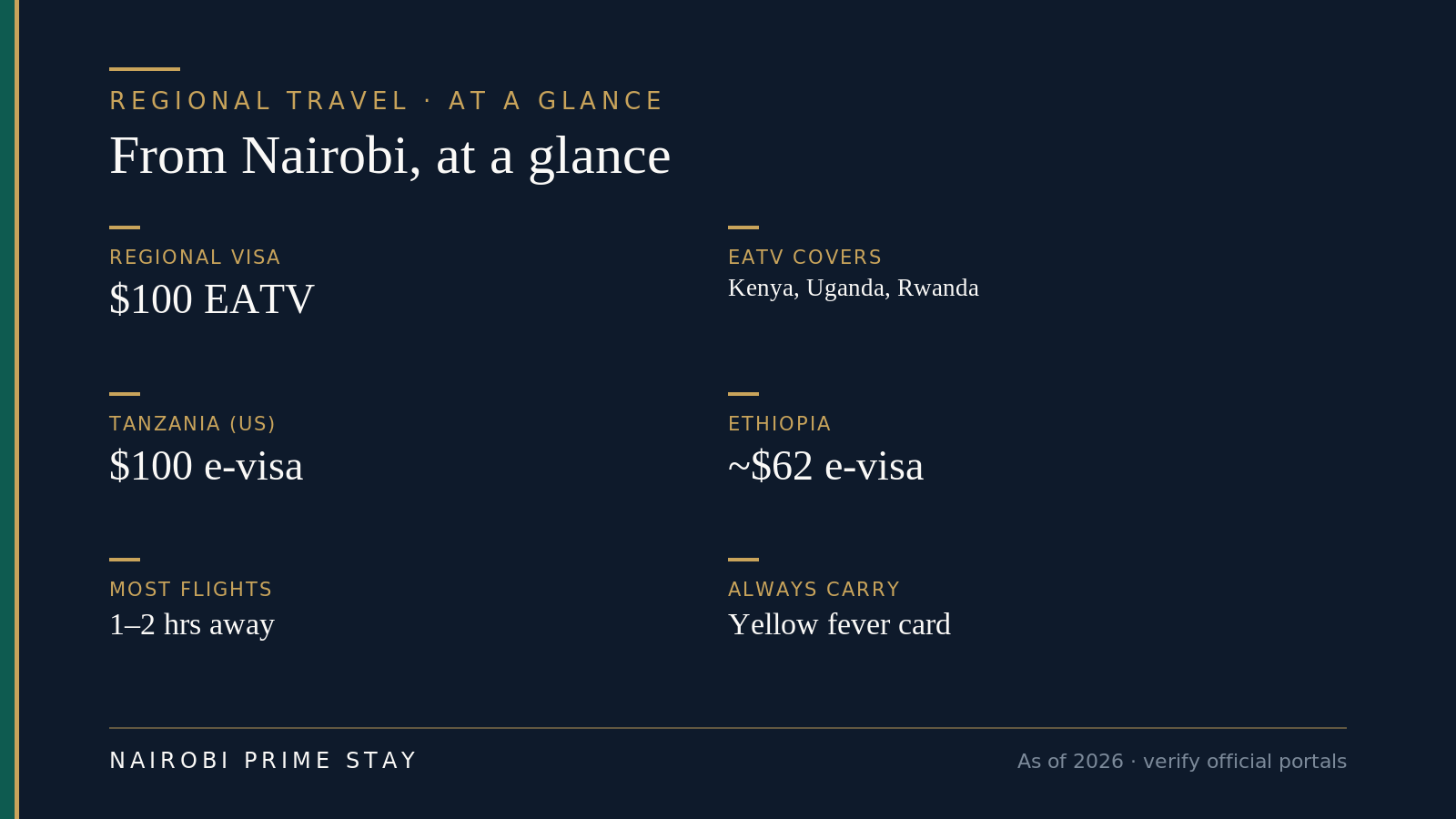
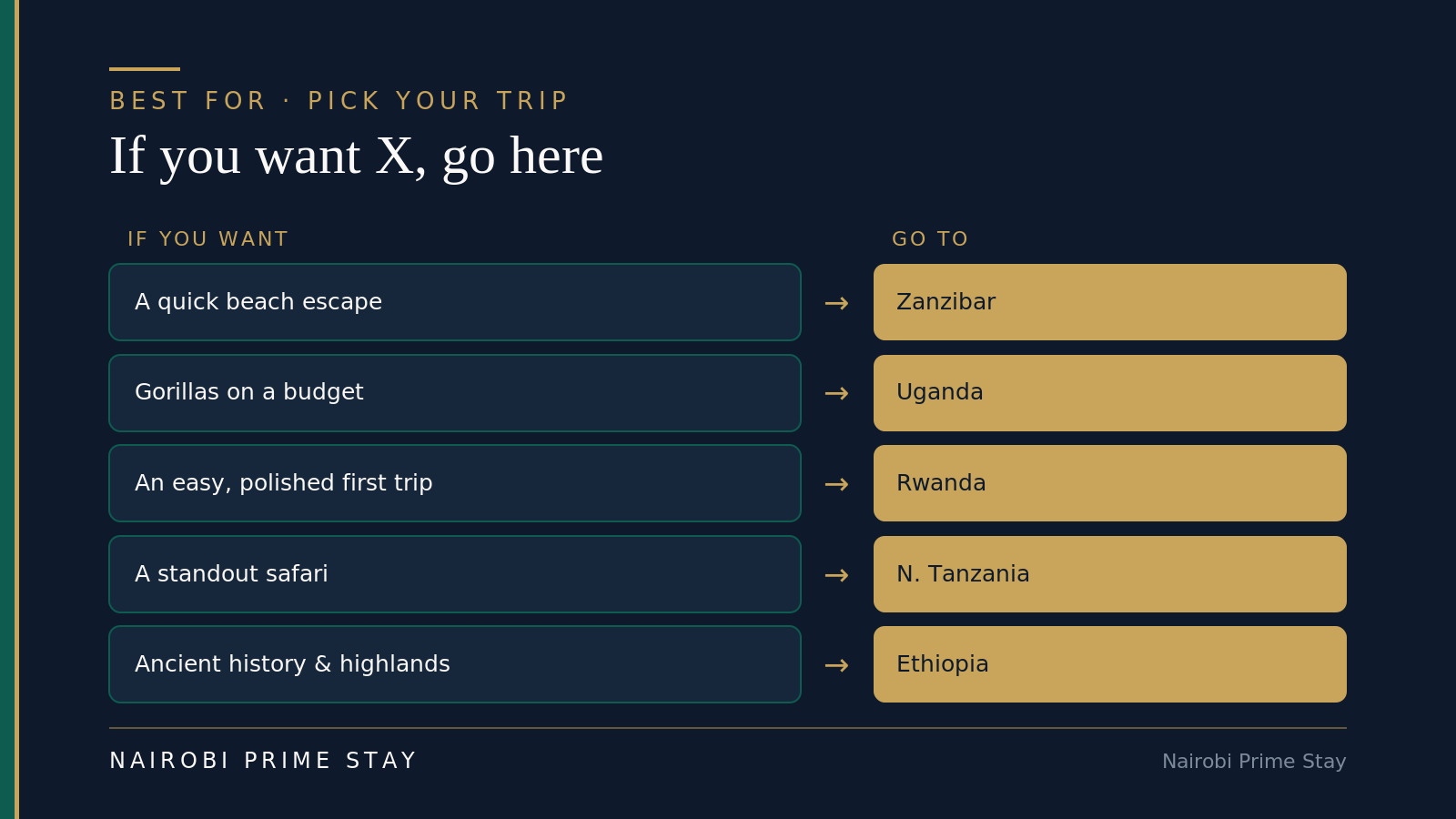
From Nairobi, the easy regional trips are Tanzania and Zanzibar (beaches, the Serengeti, Kilimanjaro), Uganda (gorillas and the source of the Nile), Rwanda (a clean, safe capital and premium gorilla trekking), and Ethiopia (ancient churches and a highland culture unlike anywhere else). Most are a one- to two-hour flight from JKIA.
One thing trips up newcomers: the East Africa Tourist Visa ($100, 90 days, multiple-entry) covers only Kenya, Uganda and Rwanda — not Tanzania or Ethiopia. As a US citizen you’ll pay $100 for Tanzania’s visa (Americans can’t use the cheaper version), about $62 for Ethiopia, and you can fold Uganda and Rwanda into the regional visa. Carry your yellow fever card; you’ll be asked for it. Budget a long weekend for Zanzibar and four to seven days for a gorilla trip.
Why regional travel is one of the real perks of living here
Here’s the quiet upgrade nobody mentions before you move: Nairobi is a launchpad. JKIA connects to dozens of African cities, and the close ones — Entebbe, Kigali, Dar es Salaam, Zanzibar, Addis Ababa — are all one to two and a quarter hours away. Fares are reasonable, schedules are frequent, and you fly at a civilized hour instead of crossing an ocean.
That changes how you travel. A gorilla trek or a Zanzibar beach week stops being a once-in-a-lifetime expedition and becomes a long weekend you book on a Tuesday. Plenty of expats here see more of Africa in two years than they’d managed in a lifetime of long-haul trips.
If you’re still settling in, start closer. Our guide to weekend trips from Nairobi covers the lakes and parks within a couple of hours, and the Kenyan coast is the natural first big trip. Regional travel is the next ring out — a little more paperwork, a lot more range. For the mechanics of flying in and out, see our JKIA airport guide.
The visa picture, in plain English
This is the part worth getting right, because the rules differ by country and a few of them treat US passports specially. Everything below is current as of 2026 — visa fees and rules change, so confirm on each country’s official portal before you book. For Kenya’s own entry rules, see our Kenya visa guide for Americans.
The East Africa Tourist Visa: one visa, three countries
The East Africa Tourist Visa (EATV) is a single $100 visa that covers Kenya, Uganda and Rwanda together. It’s valid for 90 days and is multiple-entry, so you can hop between the three on one document. You apply through the immigration portal of whichever country you’ll enter first — Kenya’s eCitizen, Uganda’s e-visa portal, or Rwanda’s Irembo — and you must physically enter that country first. You’ll need a passport valid six months out, a photo, your yellow fever certificate, an itinerary and a return ticket. Processing runs about three to seven working days, so apply at least a week ahead.
The EATV pays off if you’re touring two or three of those countries on one trip — Rwanda and Uganda for gorillas, say, or a Kampala-then-Kigali loop. If you’re only visiting one, the single-country tourist visa is cheaper. Note the big gap: the EATV does not include Tanzania, Zanzibar or Ethiopia.
Tanzania and Zanzibar: $100 for Americans, plus an insurance fee
Tanzania is the one that surprises people. US citizens are required to buy the multiple-entry visa at $100 (valid up to twelve months, though each individual stay is capped at 90 days) — Americans can’t use the $50 single-entry tourist visa that most other nationalities get. It’s an e-visa only; Tanzania abolished visa-on-arrival in January 2025, so you apply in advance at the official portal (visa.immigration.go.tz) and allow two to ten business days. The same e-visa covers both the mainland and Zanzibar, so there’s no separate Zanzibar permit.
Zanzibar adds one more thing. Since October 2024, every foreign visitor must buy mandatory inbound travel insurance from the Zanzibar Insurance Corporation — about $44 per adult (children 3–17 around $22, under-3 free), valid 92 days. You buy it online at the official Zanzibar portal and show the QR code on arrival. It’s separate from your own travel insurance and there’s no way around it, so build it into the budget.
Uganda and Rwanda on their own
If you skip the regional visa, Uganda’s e-tourist visa is $50 (single entry) from visas.immigration.go.ug, and Rwanda gives US citizens a $50 visa on arrival (30 days) at Kigali airport and land borders, or online via Irembo. Rwanda is the easiest in the region — you can essentially turn up. But if your trip combines Uganda and Rwanda, or either with Kenya, do the math: two $50 visas equal the $100 EATV, and the regional visa saves you the second application and lets you re-enter.
Ethiopia
Ethiopia sits outside the regional bloc. US citizens need an e-visa, about $62, for a 30-day single-entry tourist visa from the official portal (evisa.gov.et). Apply a few days ahead and print the approval. Addis is a two-hour-fifteen flight and a genuinely different world — highland, ancient, and on its own calendar and clock — so the extra paperwork is worth it.
Don’t forget the yellow fever card
Kenya and its neighbors sit in the yellow fever belt. Carry your yellow fever vaccination certificate — the yellow card — whenever you travel in the region. You’ll be asked for it on re-entry to Kenya and at several borders, and it’s required for the EATV. If you didn’t get the shot before moving, any Nairobi travel clinic can sort it. Keep a photo of the card on your phone as backup.
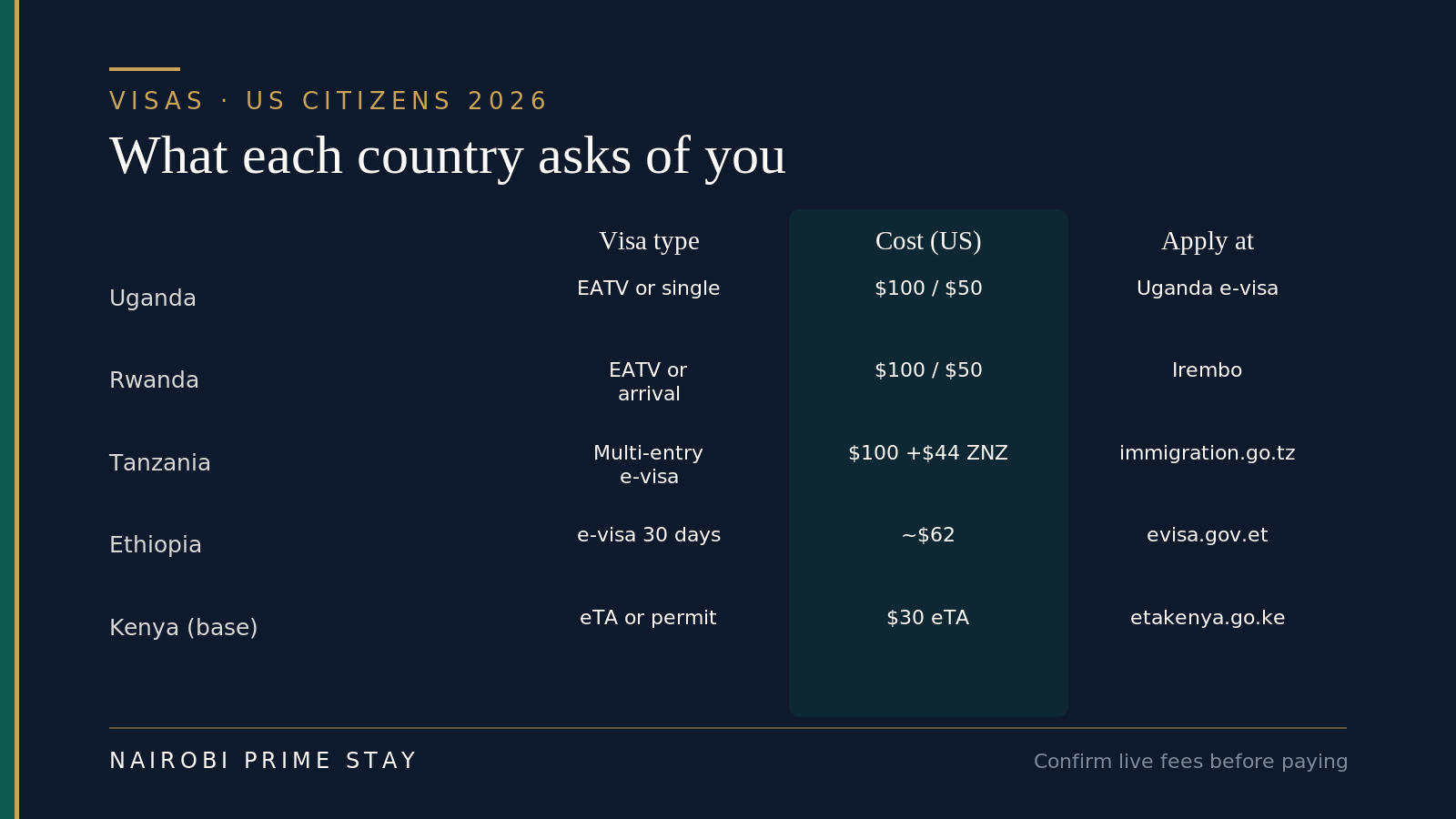
Here’s the same picture as a quick table. Always confirm the live fee on the official portal before paying — third-party “visa” sites add a markup and aren’t the government.
| Destination | Visa for US citizens (2026) | Cost | Apply at |
|---|---|---|---|
| Uganda | EATV, or single e-visa | $100 EATV / $50 single | eCitizen, Uganda e-visa, or Irembo |
| Rwanda | EATV, or visa on arrival | $100 EATV / $50 on arrival | Irembo, or on arrival at Kigali |
| Tanzania + Zanzibar | Multiple-entry e-visa (required for US) + Zanzibar insurance | $100 + ~$44 insurance | visa.immigration.go.tz |
| Ethiopia | e-visa (30-day single entry) | ~$62 | evisa.gov.et |
| Kenya (your base / re-entry) | eTA, or your resident permit | $30 eTA | etakenya.go.ke |
Staying healthy on the road
The health prep is light, but don’t skip it. The one you already know about is your yellow fever card — carry it everywhere in the region, since it’s required for the East Africa Tourist Visa and checked at several borders and on re-entry to Kenya. The bigger day-to-day concern is malaria. Nairobi sits high and cool with low malaria risk, but the places you’ll actually travel to — Zanzibar and the coast, the Ugandan lakes, northern Tanzania — are lower, warmer and higher-risk, so take antimalarial tablets for those trips and use repellent and a net. Keep your routine vaccines current, and ask a clinic about hepatitis A and typhoid.
Two more. If you’re climbing Kilimanjaro or trekking Ethiopia’s Simien Mountains, you’re going high — build in acclimatization days and learn the signs of altitude sickness. And make sure your insurance covers medical evacuation for the activity you’re doing; a helicopter off a mountain or out of a remote park is not a bill you want to face. Any Nairobi travel clinic can sort vaccines and malaria tablets in one visit — plan four to six weeks ahead. For how health cover works day to day once you live here, see our guide to health insurance for expats in Kenya.
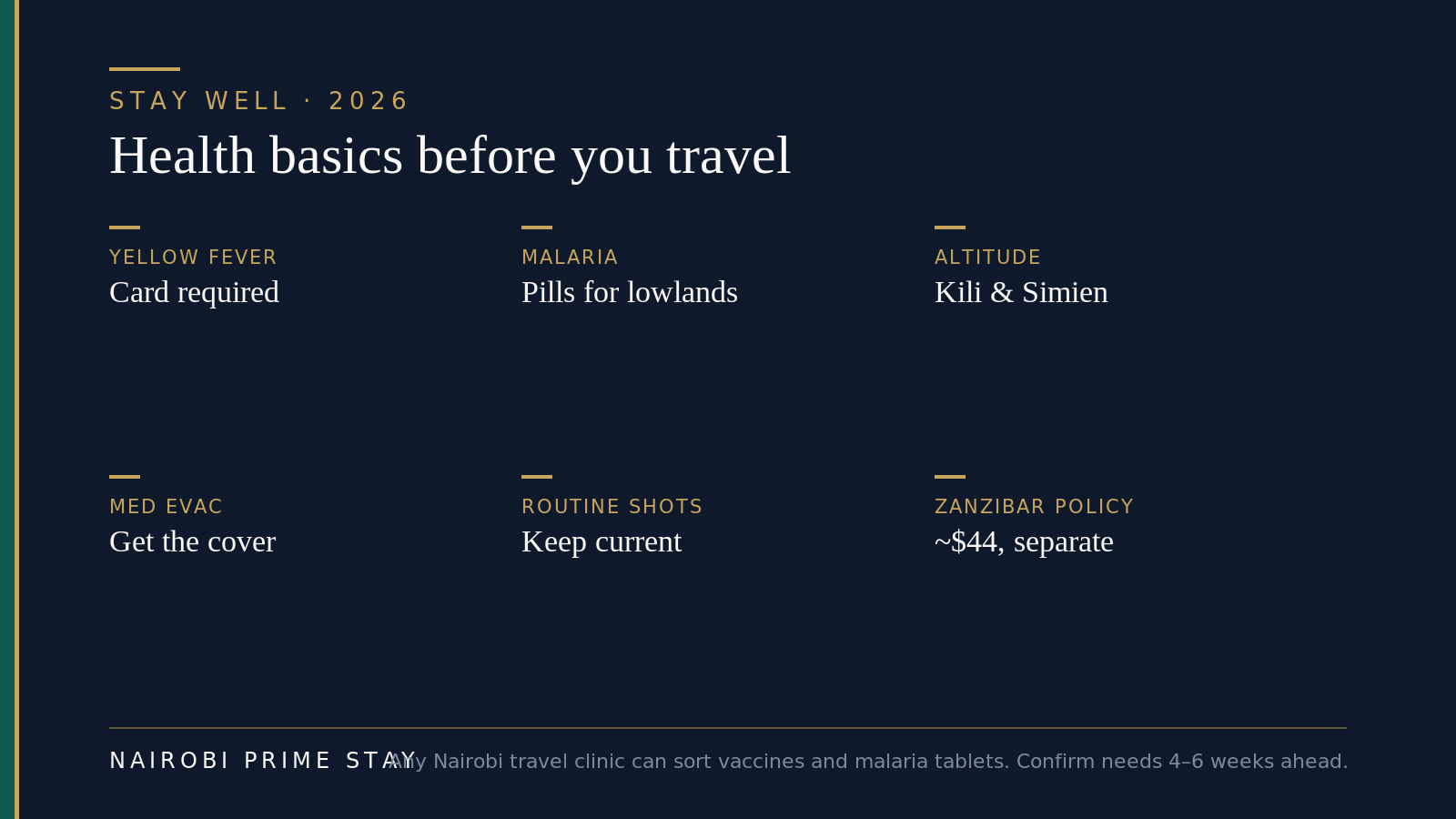
The short list of what to sort before you fly — a Nairobi travel clinic can handle most of it in one visit.
Getting there: fly, mostly — but overland has its place
For all but the shortest borders, flying wins. JKIA has frequent service to every regional capital, and the hops are short. Kenya Airways flies nonstop from Nairobi to dozens of African cities; Uganda Airlines, RwandAir, Ethiopian Airlines, Precision Air, Air Tanzania and budget carrier Jambojet fill in the rest. Here’s the lay of the land, with rough 2026 one-way fares — they swing with season and how early you book, so treat them as ballpark.
| Route from Nairobi | Flight time | Rough one-way fare | Carriers |
|---|---|---|---|
| Entebbe / Kampala (Uganda) | ~1 hr 15 | ~$120–220 | Kenya Airways, Uganda Airlines, Jambojet |
| Kigali (Rwanda) | ~1 hr 30 | ~$120–250 | Kenya Airways, RwandAir |
| Dar es Salaam (Tanzania) | ~1 hr 15 | ~$110–220 | Kenya Airways, Precision Air |
| Zanzibar | ~1 hr 15 – 2 hr (some via Dar) | ~$160–280 | Precision Air, Air Tanzania, Safarilink |
| Addis Ababa (Ethiopia) | ~2 hr 15 | ~$180–320 | Ethiopian Airlines, Kenya Airways |
| Kilimanjaro (for Serengeti / Kili) | ~1 hr | ~$150–280 | Kenya Airways, Precision Air |
Two tips. First, fares from JKIA are usually cheaper booked a few weeks out and mid-week. Second, your departure airport matters: most regional flights leave from JKIA, but a handful of safari and light-aircraft hops use Wilson Airport across town, so check which one you’re flying from before you plan the taxi.
When overland makes sense
Driving across a border is slow, but it’s occasionally the right call. The standout is Nairobi to Arusha, the gateway to the Serengeti, Ngorongoro Crater and Mount Kilimanjaro. A tourist shuttle (Riverside, Impala and similar services) runs about five to six hours via the Namanga border for a modest fare, and it’s a well-worn, easy route. Beyond that, cross-border coaches — Modern Coast, Mash, Easy Coach — run from Nairobi to Kampala, Kigali, Arusha and Dar, but the long ones are twelve-plus hours. Fine if you’re on a tight budget or want to watch the countryside roll by; tedious otherwise. The SGR train doesn’t cross borders — it only runs within Kenya. For most trips, a short flight is worth every dollar. For getting to the airport and around town on either end, see our guide to getting around Nairobi.
Where to go: the regional menu
Five headline destinations, each a different kind of trip. Here’s what each is for and what to expect.
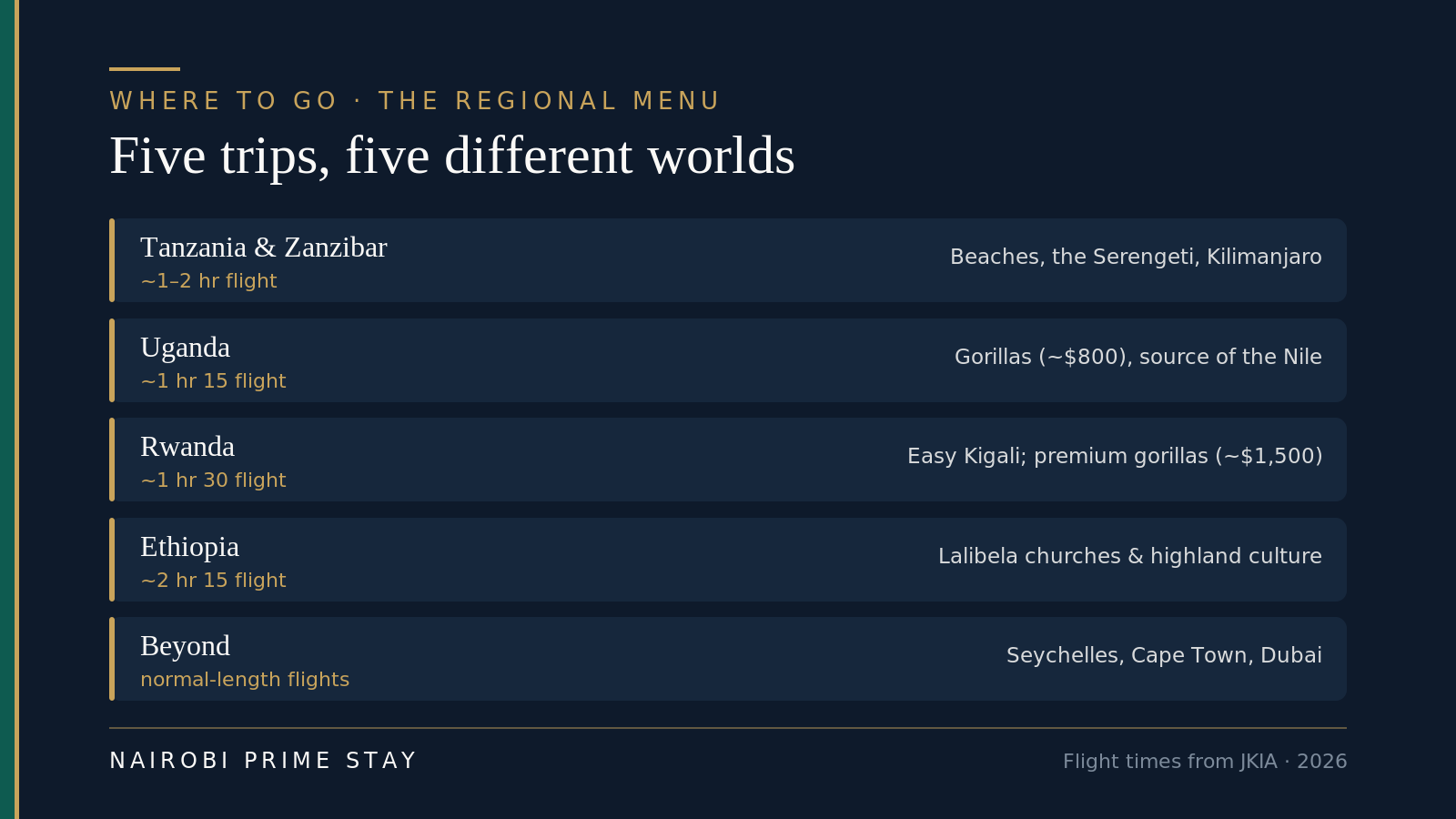
Tanzania and Zanzibar — beaches, the Serengeti and Kilimanjaro
Tanzania is the heavyweight next door, and there are really three trips inside it. Zanzibar is the dream island — Stone Town’s UNESCO old quarter, spice farms, and powder-white beaches on warm turquoise water, reached in a short flight, often via Dar. The northern safari circuit — Serengeti, Ngorongoro Crater, Tarangire — rivals anything in Kenya and pairs naturally with the Maasai Mara across the border; reach it by flying to Kilimanjaro Airport or taking the Arusha shuttle. And Mount Kilimanjaro itself, Africa’s highest peak, is a five-to-eight-day climb for the fit and determined. Remember the US-citizen visa is $100, and Zanzibar’s insurance fee is on top.
Uganda — gorillas and the source of the Nile
Uganda is the green, lush one, often called the Pearl of Africa. The headline is mountain gorilla trekking in Bwindi Impenetrable Forest, where a permit runs about $800 — and around $600 in the low-season months of April, May and November. For a deeper trek, Uganda’s four-hour gorilla habituation experience is about $1,800. Beyond the gorillas, Jinja is the adventure capital at the source of the Nile, with white-water rafting; Murchison Falls and Queen Elizabeth parks deliver classic savanna safari; and you can track chimps in Kibale. Entebbe is a one-hour-fifteen flight, and Uganda is on the EATV alongside Kenya and Rwanda, so a combined trip is cheaper on the visa.
Rwanda — the easy, polished introduction to the region
Rwanda surprises everyone. Kigali is clean, calm, safe and walkable — one of the easiest African cities for a first-timer, and a fine long weekend on its own. The big draw is gorilla trekking in Volcanoes National Park, though it’s premium: the permit is $1,500, roughly double Uganda’s, in exchange for shorter treks and slick infrastructure. Rwanda does cut it by 30% to about $1,050 if you pair the trek with a low-season visit to Akagera or Nyungwe parks. The Kigali Genocide Memorial is a sobering, essential half-day. Visa on arrival makes Rwanda the lowest-friction trip in the region — you can almost decide on a Thursday and go.
Ethiopia — ancient, highland and unlike anywhere else
Ethiopia is the wildcard, and the most culturally distinct. It was never colonized, follows its own calendar and clock, and runs on a cuisine and an alphabet all its own. The rock-hewn churches of Lalibela, the castles of Gondar, the Simien Mountains and the road through ancient Christian highlands make it a trip for the curious rather than the beach-seeker. Addis Ababa is a two-hour-fifteen flight and a major airline hub. Go for history and landscape, not resorts.
Worth knowing for later
A few more are within easy reach once you’ve done the headliners: the Seychelles and Mauritius for upmarket Indian Ocean beaches, Johannesburg and Cape Town for a big-city-and-wine fix, and Dubai as the region’s connecting hub. Nairobi’s web of connections makes all of them a normal-length flight rather than an expedition.
Combining countries: smart loops that save on visas
Because the East Africa Tourist Visa covers Kenya, Uganda and Rwanda on one $100 document, some of the best trips pair two countries. A Uganda-and-Rwanda gorilla loop lets you trek in both parks — Bwindi’s cheaper permit and Volcanoes’ polished one — on a single visa. A Kampala-then-Kigali city-and-culture week does the same. Outside the scheme, Tanzania rewards pairing too: one e-visa covers Zanzibar’s beaches and a northern-circuit safari, so you can do Stone Town and the Serengeti back to back.
The move is simple. Plan the trip around one visa wherever you can, enter through the country you’ll land in first, and let the multiple-entry rule handle the hopping. If a loop crosses into Tanzania or Ethiopia, just add that country’s own visa on top.

Pairing destinations is often cheaper and richer than one-country trips — the regional visa is built for it.
What a regional trip actually costs
Beyond the visa, your big line items are the flight, where you sleep, and any premium activity such as a gorilla permit or a multi-day safari. Here’s a rough per-person sense of a few common trips, as of 2026 — excluding what you spend on dinners and shopping.
| Trip | Typical length | Rough per-person budget (flights + stay + headline activity) |
|---|---|---|
| Long weekend in Zanzibar | 3–4 days | ~$600–1,400 |
| Kigali city break | 2–3 days | ~$400–900 |
| Uganda gorilla trek | 4–6 days | ~$1,800–3,500 (permit ~$800) |
| Rwanda gorilla trek | 3–5 days | ~$2,500–4,500 (permit ~$1,500) |
| Northern Tanzania safari | 4–7 days | ~$1,500–4,000+ |
| Ethiopia history loop | 5–8 days | ~$1,200–2,800 |
Gorilla trips are the splurge — that single permit is most of the gap between Uganda and Rwanda. Zanzibar and Kigali are the value picks for a quick escape. Shoulder-season fares and low-season permits (Uganda, in April, May and November) bring the big trips down.
The visa-run question — and why it’s the wrong plan
If you’re in Kenya on a 90-day eTA and tempted to “reset” it with a quick hop to Tanzania or Uganda, be careful. Leaving and re-entering does not reliably restart your permitted stay. Immigration officers can see the pattern, and the eTA is for visits, not residence. Treating border hops as a way to live here long-term is a gamble that can end with a refused entry and a scramble.
The honest answer: if you’re staying beyond a tourist visit, get the right permit. That’s the digital-nomad (Class N), work (Class D) or investor (Class G) route, laid out in our Kenya visa guide. Travel the region because it’s wonderful — not as a workaround. Once your status is sorted, you can come and go freely without watching the clock.
A realistic first regional trip
Say you’ve been in Nairobi a couple of months and want a real break. You book a Friday-morning flight to Zanzibar a few weeks ahead for about $200 each way. You apply for Tanzania’s $100 e-visa and buy the $44 Zanzibar insurance online the week before, screenshotting both. You land by early afternoon, swap cool highland air for the warm coast, and spend Saturday on a spice tour and a dhow sunset, Sunday snorkeling off the reef. Monday morning you’re back at your desk in Nairobi, mildly sunburned, having done a bucket-list island on a long weekend. With a mid-range hotel, the whole thing lands around $900 a head. That’s the pace regional travel runs at once you live here.
Is regional travel from Nairobi safe?
Mostly yes, with the same street sense you’d use in any big city. The tourist routes are well-worn and the people are welcoming. Rwanda is the standout — Kigali is famously clean, calm and safe, and a fine first trip. Uganda and Tanzania are relaxed on the usual trails, from Zanzibar’s beaches to the safari parks; the real risk there is opportunistic petty theft, not violence, so keep valuables low-key and use registered taxis and reputable operators.
Ethiopia is the honest exception. It’s a wonderful trip, but parts of the country have seen serious unrest in recent years, and travel advisories single out specific regions. Check the current US State Department advisory for wherever you’re headed, stick to the areas that are calm, and you’ll be fine. That’s good practice everywhere: read the advisory, note which regions it flags, register with the embassy for longer trips, and confirm your insurance covers the destination. Our note on staying safe in and around Nairobi applies on the road too.
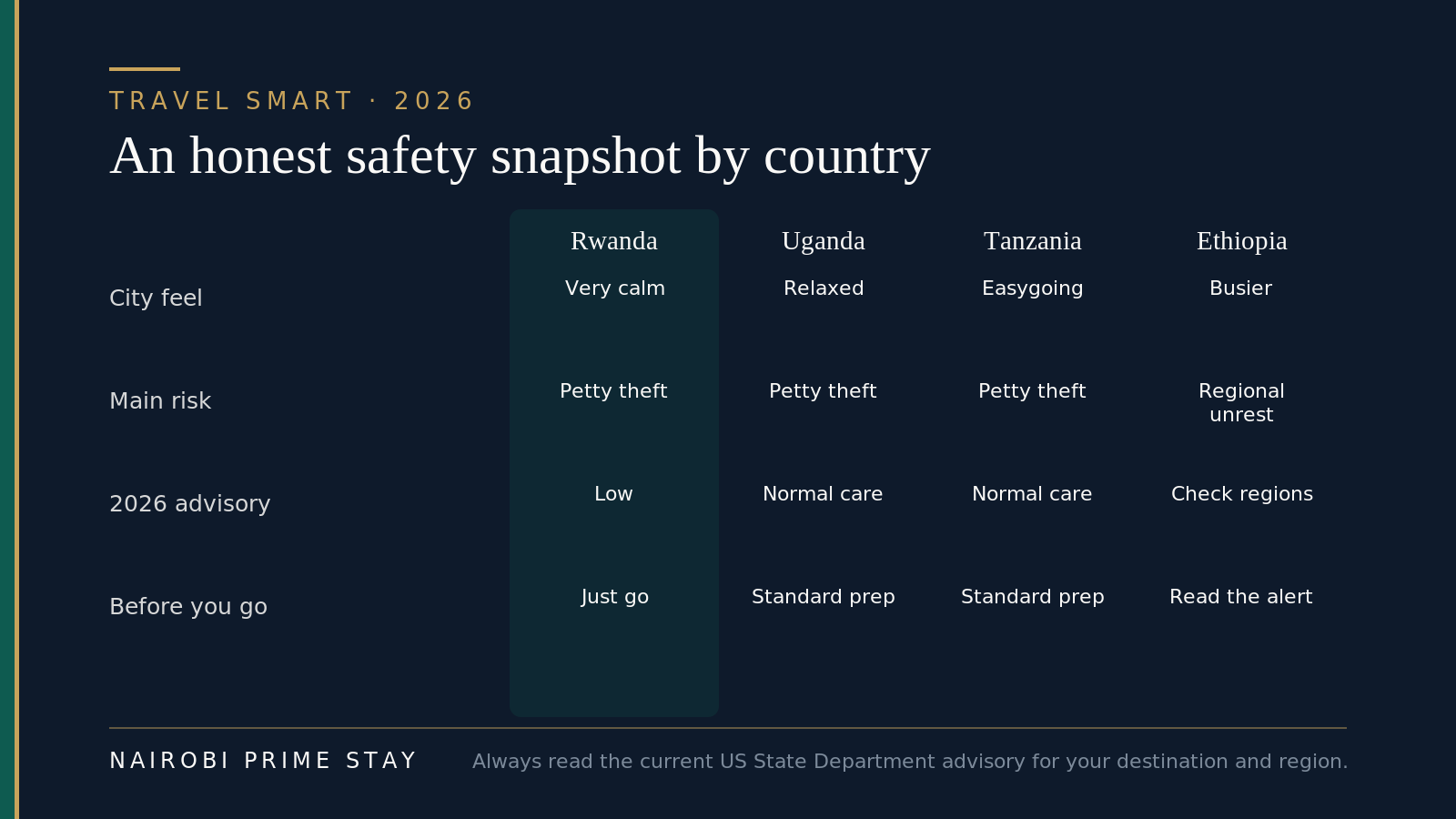
Read the current US State Department advisory for your specific destination and region before booking.
A quick pre-trip checklist
Before any regional trip:
- Check the visa rule for that specific country and apply on the official portal, not a third-party site.
- For Tanzania and Zanzibar, buy the e-visa early and the Zanzibar insurance separately.
- Pack your yellow fever card — and keep a phone photo of it.
- Confirm whether you fly from JKIA or Wilson.
- Book flights a few weeks out, mid-week if you can, for better fares.
- For gorillas or a peak-season safari, book the permit and lodge well ahead — they sell out.
- Check the current US State Department advisory for your destination; see also our note on staying safe.
- Tell your bank you’re traveling, and carry some US dollars; cards and mobile money work in the cities, but cash helps at borders.
- Confirm your travel insurance covers the activity (trekking, diving) and medical evacuation.
Final thoughts
Regional travel is one of the genuine dividends of basing yourself in Nairobi. The continent you used to reach on rare, expensive long-hauls becomes a series of short, frequent flights — gorillas one month, an island the next, ancient churches after that. The paperwork is the only real friction, and once you learn each country’s rule, it’s routine. Get the yellow card, mind the Tanzania and Zanzibar quirks, and go.
This is general travel guidance, current as of 2026. Visa fees, insurance rules and fares change, so confirm the specifics on each official portal before you book.
Related reading
- Moving to Nairobi: the complete guide — the hub that ties the whole relocation together.
- Kenya visas for Americans — the eTA, digital-nomad, work and investor routes, and why border-hopping isn’t a long-term plan.
- Weekend trips from Nairobi — the lakes, parks and tea country within a couple of hours.
- Nairobi to the coast — Mombasa, Diani and the Kenyan beaches.
- Safaris from Nairobi — your first wildlife trips, park by park.
- Nairobi weather and climate — when the rains hit, so you can time trips well.
- JKIA airport guide — getting in and out of Nairobi smoothly.
Travel is easier when home base is sorted. A serviced apartment gives you a secure, all-inclusive place to come back to between trips — Wi-Fi, cleaning, security and a backup generator handled, on flexible monthly terms and with no year-long lease while you find your feet. Not sure which neighborhood fits a travel-heavy life? Our AI relocation assistant can shortlist apartments near JKIA or your office in a couple of minutes, any time of day.
Frequently asked questions
Do I need a separate visa for each East African country?
Not always. The East Africa Tourist Visa is a single $100 visa that covers Kenya, Uganda and Rwanda together for 90 days, multiple-entry — so if your trip stays within those three, one visa does it. Tanzania and Ethiopia are not part of that scheme, so you need their own visas: Tanzania charges US citizens $100 for a multiple-entry e-visa, and Ethiopia is an e-visa of about $62. As of 2026, always confirm fees on each country’s official portal before you pay.
What is the East Africa Tourist Visa and what does it cover?
The East Africa Tourist Visa (EATV) is a joint tourist visa for Kenya, Uganda and Rwanda. It costs $100, is valid for 90 days, and is multiple-entry within those three countries. You apply through the portal of whichever country you enter first — Kenya’s eCitizen, Uganda’s e-visa site, or Rwanda’s Irembo — and you must enter that country first. It does not cover Tanzania, Zanzibar or Ethiopia. It’s worth buying if you’re visiting two or three of the member countries; for just one, the single-country visa is cheaper.
Why do US citizens pay more for a Tanzania visa?
Tanzania requires US passport holders to buy a multiple-entry visa at $100, valid up to twelve months, rather than the $50 single-entry tourist visa most other nationalities use. It’s a reciprocal arrangement specific to American citizens. The visa is e-visa only — Tanzania ended visa-on-arrival in January 2025 — so apply in advance at visa.immigration.go.tz and allow two to ten business days. The same e-visa covers both mainland Tanzania and Zanzibar.
Do I need travel insurance for Zanzibar?
Yes. Since October 2024, Zanzibar requires every foreign visitor to buy mandatory inbound travel insurance from the Zanzibar Insurance Corporation, about $44 per adult (roughly $22 for children 3 to 17, free under 3), valid for 92 days. You buy it online at the official Zanzibar portal and show the QR code on arrival. It’s separate from any personal travel insurance and from your Tanzania visa, so budget for it as an extra cost on any Zanzibar trip.
How long are the flights from Nairobi to the rest of East Africa?
They’re short. From JKIA it’s about 1 hour 15 to Entebbe (Uganda) or Dar es Salaam, around 1 hour 30 to Kigali (Rwanda), roughly 1 hour 15 to 2 hours to Zanzibar (sometimes via Dar), about 1 hour to Kilimanjaro, and about 2 hours 15 to Addis Ababa (Ethiopia). Kenya Airways, Uganda Airlines, RwandAir, Ethiopian Airlines, Precision Air and budget carrier Jambojet cover the routes. Fares are usually cheaper booked a few weeks ahead and mid-week.
Is it cheaper to trek gorillas in Uganda or Rwanda?
Uganda is cheaper. A gorilla permit in Uganda’s Bwindi forest is about $800, dropping to around $600 in the low-season months of April, May and November. Rwanda’s permit for Volcanoes National Park is $1,500 — roughly double — in exchange for shorter, more accessible treks and polished infrastructure close to Kigali. Both are once-in-a-lifetime; the choice is budget versus convenience. Permits sell out, so book months ahead, and confirm current prices with the park authority before you commit.
Can I use trips to Tanzania or Uganda to extend my stay in Kenya?
Not reliably, and it’s risky. Kenya’s eTA is for visits, not residence, and hopping out to a neighboring country and back does not guarantee a fresh stay — immigration can see repeated runs and refuse entry. If you’re staying in Kenya beyond a tourist visit, get the proper permit (digital-nomad Class N, work Class D or investor Class G) rather than relying on border runs. Travel the region for the trips themselves, and sort your Kenyan status separately.
When is the best time to travel around East Africa?
Aim for the dry seasons. Across the region, roughly June to October and December to February are the driest, best windows for safaris, gorilla trekking and beaches, and they line up with Kenya’s own dry spells. The long rains from about mid-March to May are the wettest and the time to avoid for trekking and game drives, though shoulder-season fares and Uganda’s low-season gorilla permits can make it cheaper. Conditions vary by country and altitude, so check the specific destination before booking.
What vaccinations do I need to travel around East Africa?
Carry your yellow fever certificate — the yellow card — for the whole region; it’s required for the East Africa Tourist Visa and checked at several borders and on re-entry to Kenya. Take malaria tablets for lowland and coastal trips like Zanzibar, the Ugandan lakes and northern Tanzania, where risk is higher than in high, cool Nairobi. Keep routine vaccines current, and add hepatitis A and typhoid if a clinic advises it. Any Nairobi travel clinic can sort all of this in one visit — plan four to six weeks ahead.
Is it safe to travel around East Africa from Nairobi?
For the main tourist routes, yes, with normal big-city care. Rwanda’s Kigali is one of the calmest, easiest African cities; Uganda and Tanzania are relaxed on the usual traveler trails, where the real risk is petty theft, not violence. Ethiopia is the exception — parts of the country have had serious unrest, so check which regions the current US State Department advisory flags before you go. Read the advisory for any destination, keep valuables low-key, and use registered transport and reputable operators.
Can I visit two East African countries on one trip to save money?
Yes, and it’s often the smart play. The East Africa Tourist Visa ($100, 90 days, multiple-entry) covers Kenya, Uganda and Rwanda on one document, so a Uganda-and-Rwanda gorilla loop or a Kampala-then-Kigali trip needs just that one visa. Tanzania and Ethiopia sit outside the scheme and need their own visas, but you can still pair Zanzibar’s beaches with a northern Tanzania safari on a single Tanzanian e-visa. Plan the loop around one visa wherever you can.
Keep reading
Related guides
Ready to look?
Find your apartment in Nairobi
Browse verified serviced apartments, or ask the AI concierge which area fits your life.