
Guides · Travel
Weekend Trips from Nairobi: The Best Getaways (2026 Guide)
Weekend Trips from Nairobi: The Best Getaways (2026 Guide)

One of the quiet luxuries of living in Nairobi is how easy it is to leave it. By Friday evening you can be on a boat among hippos at Lake Naivasha, and by Saturday lunch you can be watching elephants walk under Mount Kilimanjaro. Few capital cities put this much wild country within a short drive — and most weekend escapes from Nairobi take one to four hours, not a flight.
This guide is the honest, practical version for people who actually live here. It covers where to go for a weekend, how long each trip really takes, roughly what it costs in 2026, and how to book without overpaying or getting caught out. We’ll go from the closest escapes — a tea farm in Tigoni, a day at Naivasha — out to the big-name safaris in Amboseli and the Maasai Mara. It’s written for newcomers settling into Nairobi who want to start exploring on weekends. If you’re weighing a move, start with the complete guide to moving to Nairobi; this one is about what you do once you’re here.
The quick version
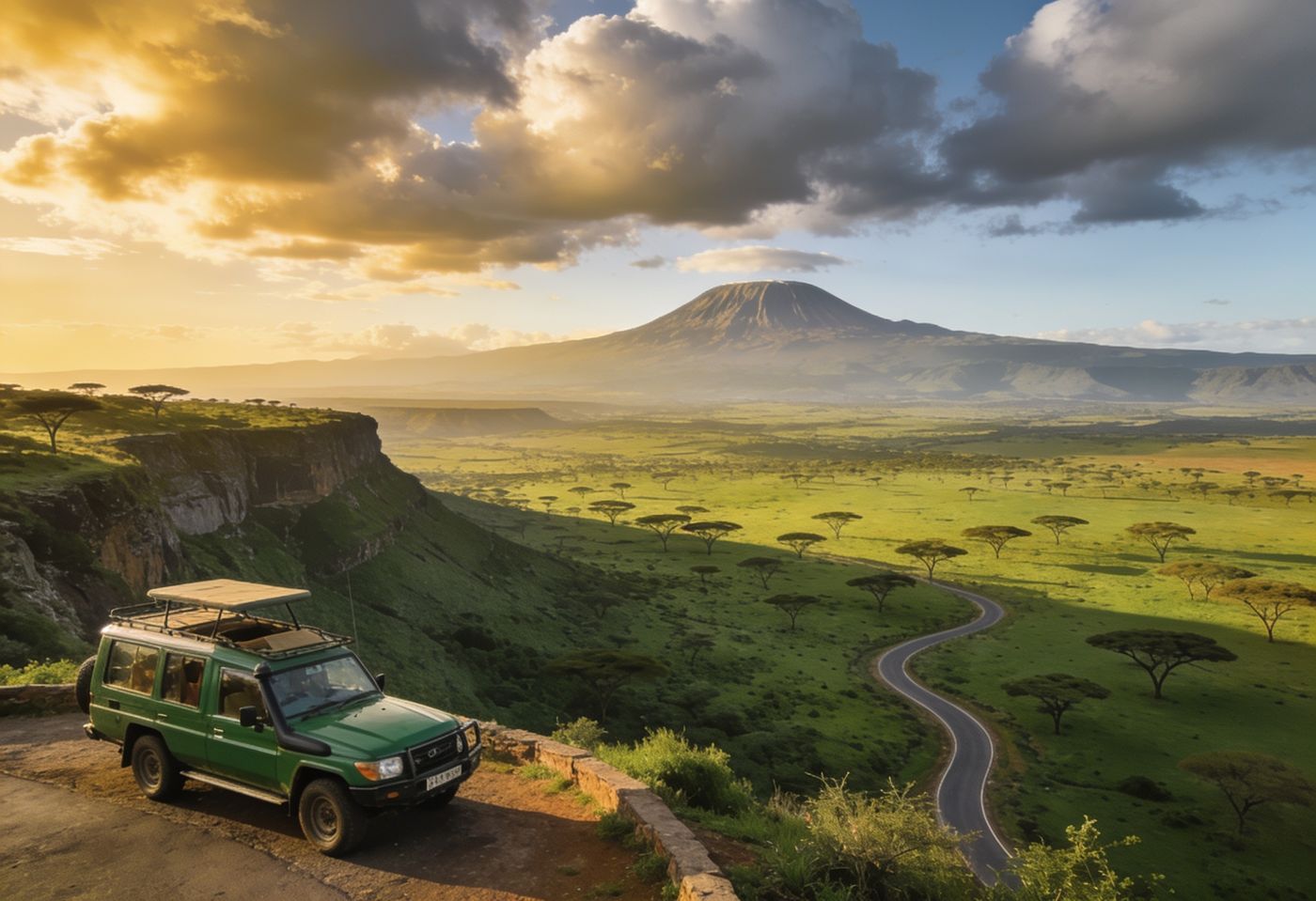
You’re spoiled for choice, and most of it is close. The easiest escapes are Lake Naivasha (about 90 minutes — boats, Crescent Island, Hell’s Gate) and the Tigoni and Limuru tea country (under an hour). Nairobi National Park gives you lions and rhino without leaving the city. With a full weekend you can reach Nanyuki and Mount Kenya (three to four hours) and the Ol Pejeta rhino conservancy, Amboseli under Kilimanjaro (about four hours), Lake Nakuru (around three hours), and the Maasai Mara — five to six hours by road, or a 45-minute flight from Wilson Airport. Lake Magadi, a stark soda lake, is a half-day drive south-west. Park fees are in flux in 2026 (see below), so confirm them before you budget. The dry seasons — roughly late June to September and January to February — are the best time to go.
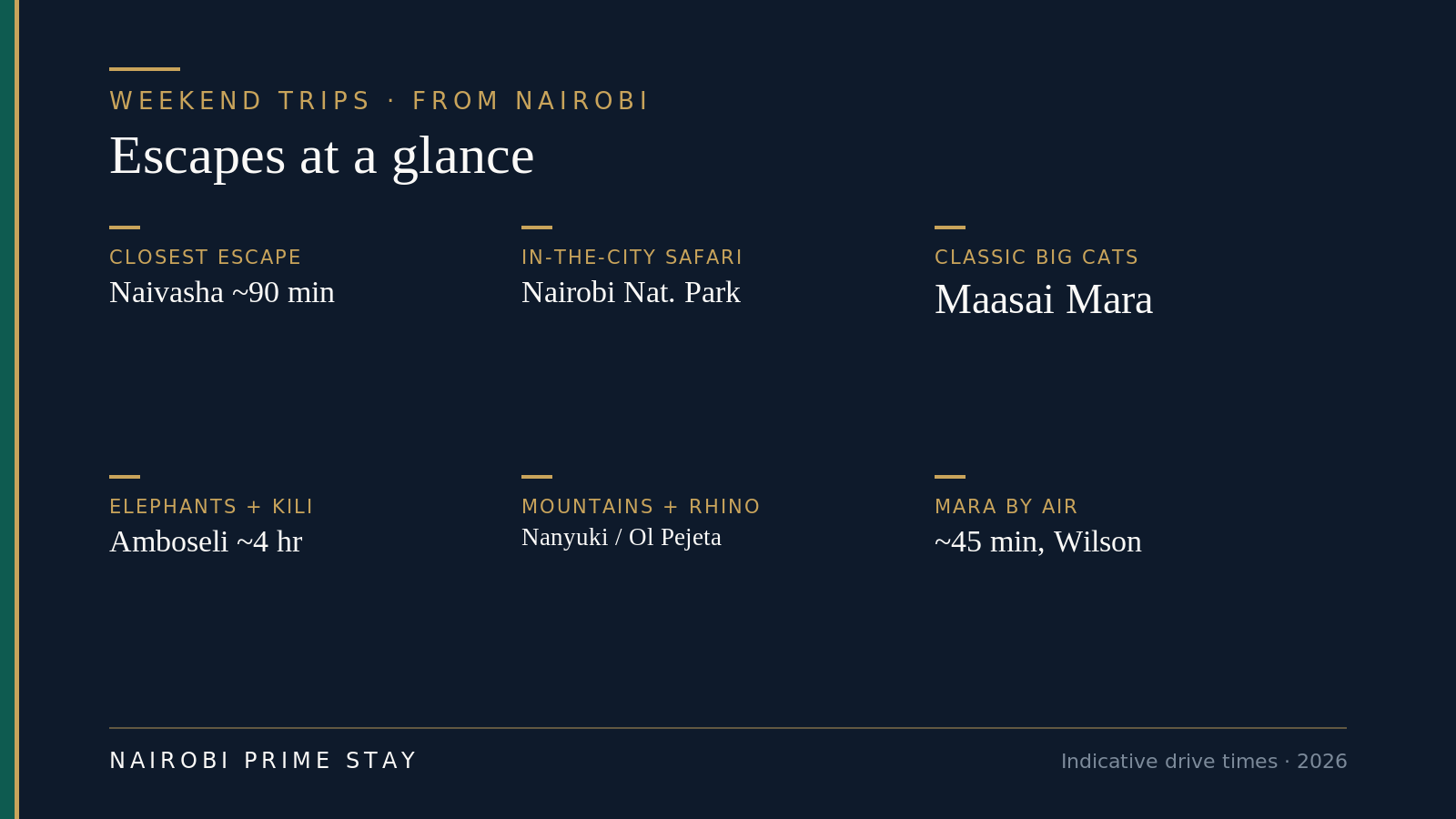
The shape of your options in one screen — drive times are rough and depend on traffic and roads.
Why this matters when you live here
Nairobi rewards people who get out of it. The city is busy and the traffic is real, so a regular change of scene keeps the move feeling like an adventure rather than a grind. It’s also how you make Kenya yours — the lakes, mountains and plains are the reason many people fall for the country in the first place. The good news for a newcomer: you don’t need to plan a two-week expedition. A tank of fuel and a free Saturday are enough to start, and you can build up to the bigger trips as you find your feet.
A quick word on cost, because it shapes everything. Kenya runs a two-tier pricing system: residents (and East African citizens) pay far less than foreign visitors at parks and many lodges. Once you hold a work permit or dependant’s pass, ask everywhere about the resident rate and carry proof — it can cut a park fee by more than half. Until then you’ll pay non-resident prices, which is what the figures below assume.
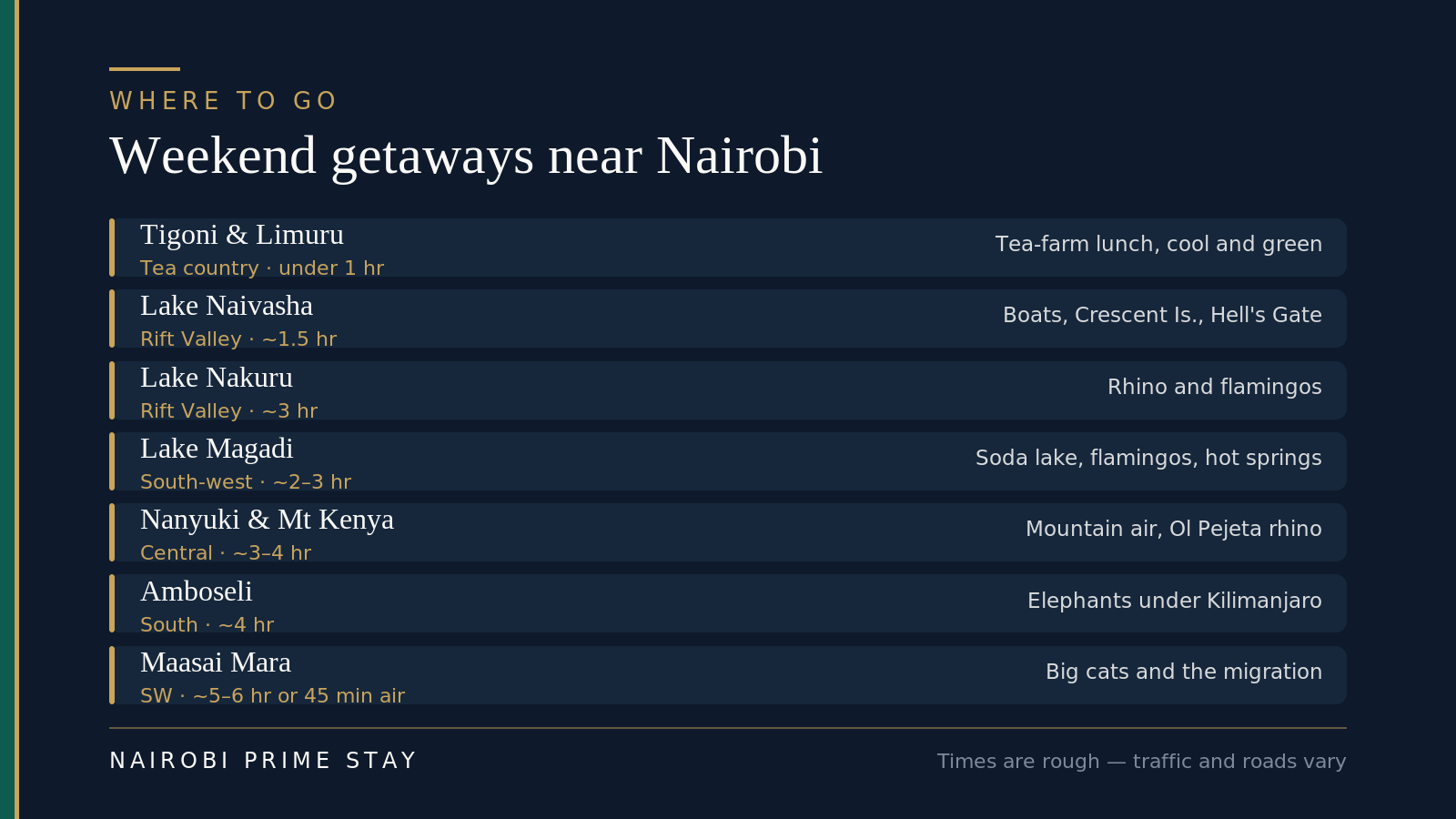
Seven of the best — sorted roughly by how far they are from the city.
The close-in escapes (under two hours)
These are the trips you can do on a whim — a day out, or a single easy night away.
Lake Naivasha — the weekend all-rounder (~90 minutes)
Naivasha is the default Nairobi escape, and for good reason. It’s a freshwater Rift Valley lake about 90 minutes from the western suburbs once you clear the city, ringed by lodges, campsites and old farmhouses. A boat ride takes you out among hippos and fish eagles for an hour or two. Next door, Crescent Island is a private sanctuary you explore on foot — there are no predators, so you walk among giraffe, zebra and waterbuck, which is a thrill for kids and adults alike. Non-residents pay roughly $33 to walk the island, with a boat transfer around $20 on top.
Twenty minutes away is Hell’s Gate National Park, one of the very few parks in Kenya you can cycle or walk through, past zebra and giraffe, into a dramatic gorge. The new 2026 fee for non-resident adults is around $50 (with a small extra charge to cycle), though see the note on fees below. Naivasha works as a long day trip, but it’s nicer as a one-night stay — book a lakeside lodge and you’ll wonder why you don’t come more often.
Tigoni and Limuru — tea country (under an hour)
For the shortest possible escape, head up to the tea farms of Tigoni and Limuru, less than an hour from the western suburbs. The air is cool and the hills roll green in every direction. The classic outing is a guided visit to Kiambethu Farm, a working tea farm that’s hosted visitors for generations: you walk the tea, learn how it’s grown and processed, and sit down to a long lunch with a forest stroll afterward. It runs around KES 4,900 a head (roughly $35) including the tour and lunch, with children half price — book ahead, as it’s a set-time experience. It’s the perfect antidote to a heavy week, and close enough that you’re home for dinner.
Nairobi National Park — a safari inside the city
You don’t even have to leave town for your first safari. Nairobi National Park sits on the city’s southern edge — lions, rhino, giraffe and buffalo grazing with the skyline behind them, which is a sight you won’t see anywhere else on earth. It’s an easy half-day: go at dawn, be back for a late breakfast. Non-residents pay around $80 per adult under the 2026 rates. Pair it with the nearby Giraffe Centre and the elephant orphanage for a full, family-friendly day out — there’s more on those in our family life in Nairobi guide.
Lake Magadi — the stark, beautiful soda lake (~2–3 hours)
For something completely different, drive south-west to Lake Magadi, a vast soda lake about two to three hours from the city. It’s hot, low and otherworldly — pink with flamingos and crusted with white soda, with natural hot springs you can soak in at the southern end. There’s little tourist infrastructure here, so this is one for the adventurous: take a sturdy vehicle, a full tank of fuel, plenty of water and sun protection, and ideally a guide who knows the route. The drop from the highlands down into the heat is dramatic, and the birdlife is extraordinary. Go early, and don’t underestimate the sun.
The bigger weekend trips (a full two or three days)
These need a proper weekend, but they’re the ones you’ll remember. For a deeper, park-by-park breakdown of the wildlife side, see our dedicated guide to safaris from Nairobi.
Nanyuki, Mount Kenya and Ol Pejeta (~3–4 hours)
Head north and the land climbs toward Mount Kenya, Africa’s second-highest peak. Nanyuki is the friendly market town at its foot, about three to four hours from Nairobi and sitting almost exactly on the equator. It’s a hub for mountain treks, horse riding, and country lodges with log fires — the air is cool and the pace slow. Day hikes on the lower slopes are doable in a weekend; summiting Mount Kenya is a multi-day trek you plan separately through the Kenya Wildlife Service.
The headline attraction nearby is Ol Pejeta Conservancy, one of the best wildlife experiences in the country. It’s home to the last two northern white rhinos on the planet, a large black-rhino population, and a chimpanzee sanctuary. Non-resident entry runs around $110 per adult in 2026, with optional add-on experiences (a rhino visit, lion tracking, a behind-the-scenes chimp tour, a night drive) at roughly $70 each. It’s a conservancy rather than a national park, which means fewer vehicles and more flexibility — and it’s superbly run.
Amboseli — elephants under Kilimanjaro (~4 hours)
Amboseli is the classic two-night safari from Nairobi, about four hours south via Emali. It’s famous for two things: huge, relaxed herds of elephants, and the backdrop of Mount Kilimanjaro rising across the border in Tanzania. On a clear morning, with the snow-capped peak behind a line of elephants, it’s as good as African landscapes get. Amboseli is a KWS premium park, so non-resident adults pay around $90 a day under the 2026 rates. The roads in are rough in patches, so a 4x4 is wise, and most people either self-drive with care or book a guided trip with a lodge. Two nights is the sweet spot.
Lake Nakuru — rhino and flamingos (~3 hours)
About three hours from Nairobi, past Naivasha, Lake Nakuru National Park is a compact, reliable safari that pairs well with a Rift Valley weekend. It’s a rhino stronghold — both black and white — with good chances of lion and leopard, and the lake itself draws flamingos and pelicans in numbers. Because it’s fenced and relatively small, game-viewing is efficient: you can see a lot in a day. It’s a KWS premium park, so non-resident pricing is similar to Amboseli, around $90 a day in 2026. Many people combine a night at Naivasha with a day at Nakuru for a satisfying two-day loop.
The Maasai Mara — the big one (~5–6 hours by road, or fly)
The Mara is Kenya’s most famous reserve, and it earns it: rolling grassland thick with lions, elephants, cheetah and, from around July to October, the wildebeest migration thundering across the plains. It’s a bigger commitment — five to six and a half hours by road, with a rough final stretch — which is why so many residents fly instead. A light-aircraft hop from Wilson Airport takes about 45 minutes and lands you near your camp, turning a tiring drive into a short flight; our JKIA and airports guide explains how Wilson handles these safari flights.
One thing to know: the Maasai Mara National Reserve is run by Narok County, not KWS, and its fees are higher — non-residents pay about $200 per person per day in high season (July to December) and around $100 in low season. Many lodges sit in the private conservancies bordering the reserve, which charge their own nightly conservancy fee (often bundled into the lodge rate) and reward you with fewer vehicles, night drives and guided walks. For a weekend, two nights is ideal — and booking the camp and fees ahead is essential in high season.
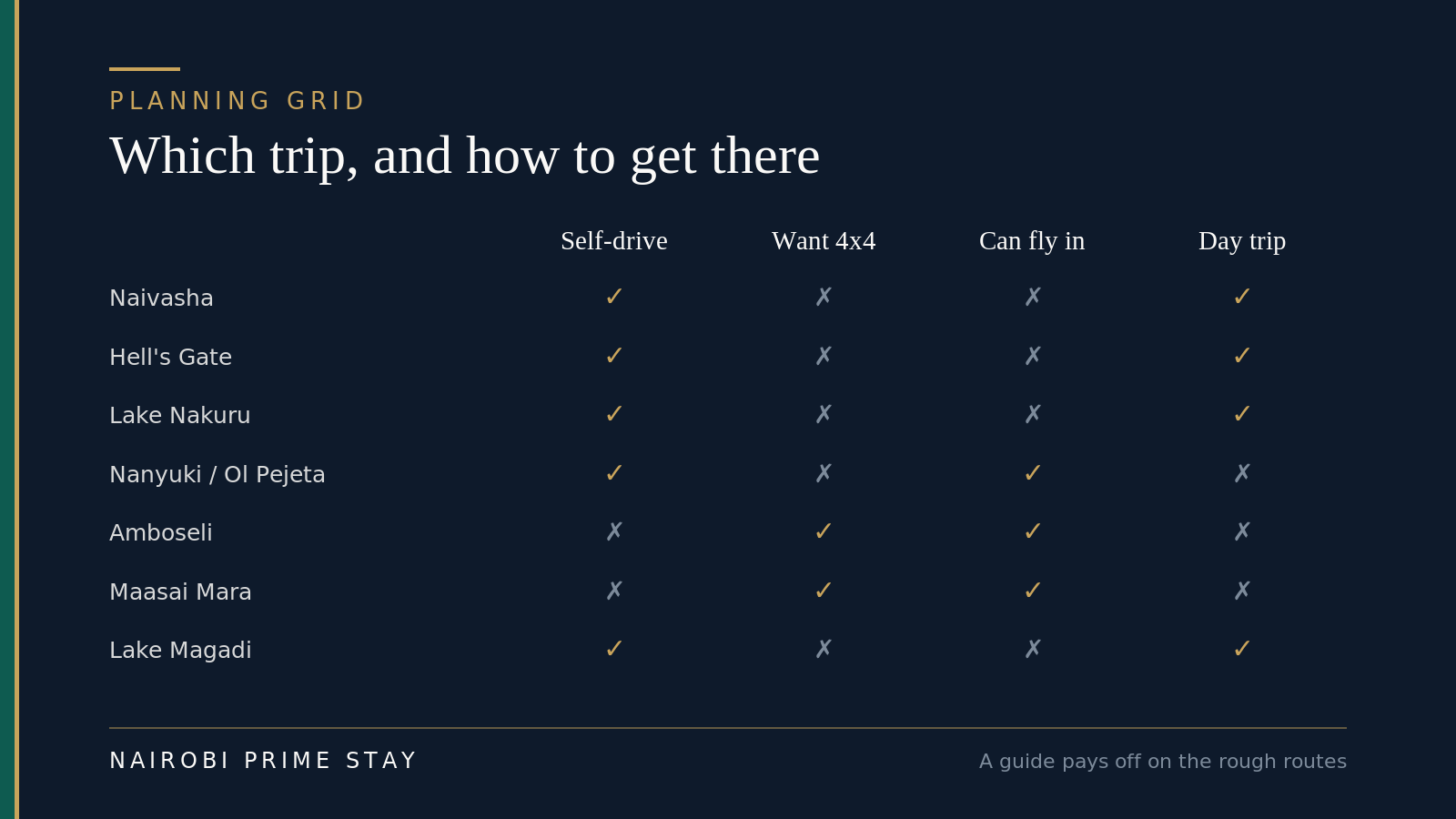
How to get to each, at a glance — a guide or 4x4 pays off on the rougher routes.
Weekend trips from Nairobi compared
Here’s the whole field on one page. Fees are 2026 non-resident rates — read the note below them before you budget, because this is an unusual year.
| Destination | Drive from Nairobi | Best for | Non-resident fee (2026)* | Ideal length |
|---|---|---|---|---|
| Tigoni / Limuru tea country | Under 1 hr | A short, green reset | ~$35 farm tour + lunch | Day trip |
| Nairobi National Park | In the city | A first safari; families | ~$80 / adult | Half day |
| Lake Naivasha | ~1.5 hr | Boats and a walking safari | Crescent Is. ~$33; Hell’s Gate ~$50 | 1 night |
| Lake Magadi | ~2–3 hr | Stark scenery, hot springs | Minimal / none | Day trip |
| Lake Nakuru | ~3 hr | Rhino and flamingos | ~$90 / adult / day | 1–2 nights |
| Nanyuki / Mt Kenya / Ol Pejeta | ~3–4 hr | Mountain air, rare rhino | Ol Pejeta ~$110 / adult | 2 nights |
| Amboseli | ~4 hr | Elephant herds and Kilimanjaro | ~$90 / adult / day | 2 nights |
| Maasai Mara | ~5–6 hr or ~45 min air | Big cats and the migration | ~$100–200 / adult / day | 2–3 nights |
*Drive times are rough and traffic-dependent. Fees are indicative 2026 non-resident adult rates and were being challenged in court (see below) — always confirm the live figure before you travel.
A note on 2026 park fees — read this before you budget
Kenya’s park fees are genuinely confusing in 2026, so here’s the honest picture. The Kenya Wildlife Service gazetted a new, higher fee schedule to take effect on 1 October 2025 — raising non-resident rates to around $90 at premium parks like Amboseli and Lake Nakuru, $80 at Nairobi National Park and $50 at Hell’s Gate. Within days, the High Court suspended the new rates after the tourism industry challenged the short notice, and the matter went to a full hearing. The practical upshot: depending on when you go and how the case lands, you may be charged the old rate or the new one. So treat every figure here as a guide, not gospel.
Two things are reliable. First, KWS parks are now cashless — you pay online through the eCitizen / KWS portal, not in cash at the gate, so sort your tickets before you arrive. Second, the Maasai Mara is separate: it’s run by Narok County, not KWS, and sets its own (higher) fees, currently about $200 a day in the July–December high season. Before any trip, check the current rate on the official eCitizen platform or with your lodge, and remember to ask about the resident rate once you hold a permit — it’s dramatically cheaper.
Getting there: drive or fly?
For the close-in trips — Naivasha, Hell’s Gate, Nakuru, Nanyuki, the tea country, Magadi — driving is the obvious choice. The roads are mostly tarmac, a normal car copes (a higher-clearance SUV is comfier), and the drive is part of the fun, especially the descent into the Rift Valley. If you’re driving yourself, read up on the basics first in our driving in Nairobi guide: Kenya drives on the left, you’ll want an International Driving Permit, and you should plan to be off the highways before dark.
For Amboseli and especially the Maasai Mara, weigh flying. A light-aircraft flight from Wilson Airport reaches the Mara in about 45 minutes versus five to six hours of rough road, which on a two-night trip effectively buys you an extra day of game drives at each end. Flying costs more, but for a short weekend it’s often worth it. Driving wins when you have three or more days, want to stop along the way, or are splitting fuel across a full vehicle. A common pattern: drive once for the experience, then fly thereafter.
How to book without overpaying
Booking is straightforward once you know the moving parts. Park and reserve fees for KWS sites go through the eCitizen / KWS portal online. Lodges and camps you can book directly or through a reputable tour operator; for Amboseli and the Mara, a package that bundles transport, fees, meals and game drives often works out simpler and no more expensive than piecing it together yourself. In the Mara conservancies, the nightly conservancy fee is usually folded into the lodge rate — check what’s included.
A few habits save money and stress. Book high-season Mara trips (July–October) weeks ahead; the best camps fill and prices climb. Ask every lodge whether it has a resident rate and what it includes. Use M-Pesa or a card rather than carrying large amounts of cash. And if you’re new in town and unsure who to trust, ask your building’s management or an established neighbor for an operator they’ve actually used — word of mouth is the best filter here.
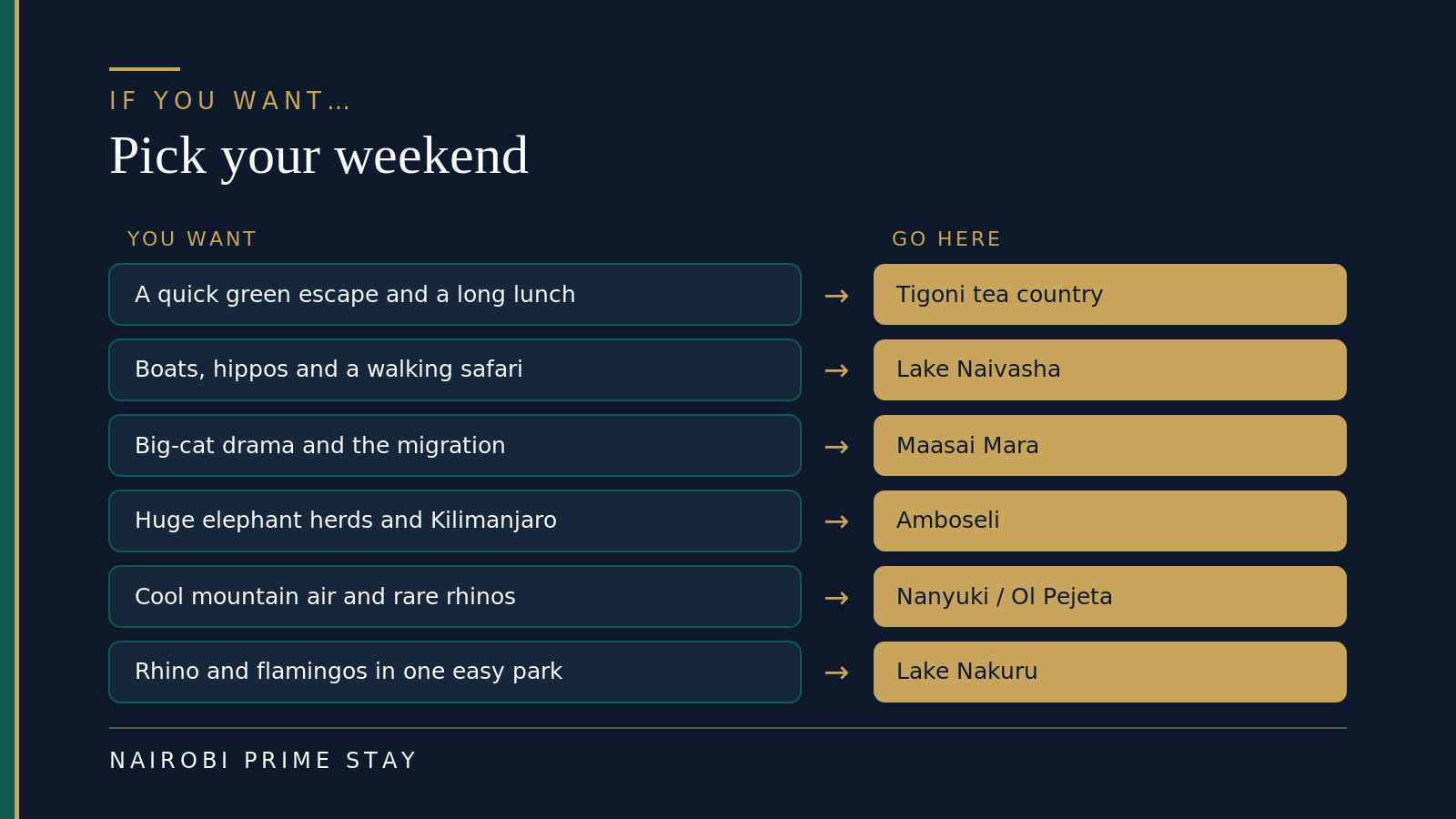
Match the weekend you’re in the mood for to the place that delivers it.
When to go
Timing matters more for the wildlife trips than the close-in ones. The dry seasons — roughly late June to September, and January to February — are the easiest: roads are firmer, dust replaces mud, and animals gather at shrinking water sources, which makes game-viewing better. The Maasai Mara’s wildebeest migration usually runs from about July to October, the most spectacular window and also the busiest and priciest. Try to avoid the long rains (March to May, wettest in April), when dirt access roads to Amboseli and the Mara can turn difficult. The short rains around November are lighter and rarely derail a trip. The close-in escapes — Naivasha, the tea farms, Nairobi National Park — work year-round; just pack a layer and a rain jacket, since Nairobi’s highlands are cooler than people expect. For the full month-by-month picture, see our Nairobi weather and climate guide.
A typical first weekend away
Say you’ve just moved to Nairobi and want an easy first trip. You leave the western suburbs after work on Friday and reach a Naivasha lakeside lodge in about 90 minutes, in time for dinner. Saturday morning you take an hour-long boat ride among the hippos, then walk Crescent Island, where your kids get within photo range of giraffe on foot. After lunch you drive 20 minutes to Hell’s Gate and cycle through the park to the gorge. Sunday you sleep in, have a slow breakfast by the water, and drive home by early afternoon — beating the worst of the returning traffic. Total cost for a couple: a lodge night, fuel, a boat ride, two modest park fees, and meals. It’s the kind of weekend that makes the whole move feel worth it, and it’s repeatable on almost any free Saturday.
Your first weekend-trip checklist
- Confirm the fee online first. Check the current park or reserve rate on the eCitizen / KWS portal and pay ahead — KWS gates are cashless.
- Match the trip to the time you have. Day trip: Tigoni, Nairobi National Park, Magadi. One night: Naivasha. Two nights: Amboseli, Nakuru, Nanyuki, the Mara.
- Decide drive vs fly. For the Mara especially, price a Wilson Airport flight against the long drive before defaulting to the road.
- Book the camp early in high season. July–October Mara trips fill up; reserve weeks ahead.
- Ask about the resident rate. Once you hold a permit, carry proof — it can more than halve a park fee.
- Pack for altitude and sun. Layers for cool mornings, a rain jacket in the wet months, strong sunscreen, a hat, insect repellent and any medication you need.
- Drive smart. Carry an International Driving Permit, keep doors locked in towns, fuel up early, and plan to be off the highways before dark. See our safety guide for the basics.
- Take a 4x4 or a guide on the rough routes. Amboseli, the Mara and Magadi are not the place to test an unfamiliar saloon car.
Final thoughts
The best thing about weekend trips from Nairobi is how low the barrier is. You don’t need a special-occasion budget or a week of leave — you need a free Saturday and a sense of curiosity. Start close with Naivasha or a tea farm, build up to a fly-in weekend in the Mara, and within a few months you’ll have seen lions, elephants, flamingos and a snow-capped equatorial mountain, all from the same home base. That ease of access is one of the quiet reasons people who move to Nairobi tend to stay longer than they planned.
Related reading
- Moving to Nairobi: the complete guide — the hub that ties your whole move together.
- Safaris from Nairobi — a deeper, park-by-park look at the wildlife trips.
- Nairobi to the coast: Mombasa and Diani — when the weekend calls for a beach instead.
- Regional travel from Kenya — Zanzibar, Uganda and Rwanda when you want to go further.
- Nairobi weather and climate — the best months to travel and what to pack.
- Family life in Nairobi — more weekend ideas and outings with kids.
- Driving in Nairobi — road rules, permits and self-drive basics.
A serviced apartment makes the perfect base camp for all this — fully equipped, secure, and easy to lock up and leave for a weekend away. When you’re settling in, browse our serviced apartments in Nairobi; a $50 deposit reserves a place and you settle the balance on arrival. Not sure which neighborhood puts you closest to the road out of town? Our AI relocation assistant can help you weigh commute, budget and weekend access in a couple of minutes, any time of day.
Frequently asked questions
Where can I go for a weekend from Nairobi?
Plenty of places, and most are closer than you’d think. The easy wins are Lake Naivasha (about 90 minutes) for a boat ride, Crescent Island and Hell’s Gate; the Tigoni and Limuru tea country (under an hour) for a tea-farm lunch; and Nairobi National Park, which sits inside the city. With a full weekend you can reach Nanyuki and Mount Kenya (three to four hours) and the Ol Pejeta rhino conservancy, Amboseli under Kilimanjaro (about four hours), Lake Nakuru, or the Maasai Mara (five to six hours by road, or a 45-minute flight from Wilson Airport). Lake Magadi, a dramatic soda lake, is a half-day drive to the south-west.
What’s the closest weekend getaway to Nairobi?
Lake Naivasha and the Tigoni/Limuru tea country are the closest proper escapes. Tigoni is under an hour from the western suburbs, close enough for a long lunch at a tea farm. Naivasha is about 90 minutes once you’re clear of the city and packs in a lot: a boat ride among hippos, a walking safari on Crescent Island (no predators, so you stroll among zebra and giraffe), and Hell’s Gate, where you can cycle past grazing wildlife. Both make easy one-night or even day trips. Nairobi National Park, with lions and rhino minutes from downtown, is the closest wildlife of all.
How much are Kenya national park fees in 2026?
It depends on the park, and 2026 is an unusually messy year for fees. Higher rates were gazetted to start on 1 October 2025 — non-resident adults around $90 at premium parks like Amboseli and Lake Nakuru, $80 at Nairobi National Park, and $50 at Hell’s Gate — but a High Court order suspended them within days after the tourism industry challenged the short notice. So the rate you actually pay may be the old one or the new one depending on when you go. The Maasai Mara, run by Narok County rather than KWS, charges non-residents about $200 a day in high season (July to December) and $100 in low season. Always confirm the live figure on the eCitizen / KWS portal before you budget, and note that KWS parks are now cashless — you pay online, not at the gate.
Can I do a safari in a weekend from Nairobi?
Yes, easily — it’s one of the best things about living here. Nairobi National Park gives you lions, rhino and buffalo on a half-day, without leaving the city. For a fuller weekend, Amboseli (about four hours) offers big elephant herds under Mount Kilimanjaro, Lake Nakuru (around three hours) is known for rhino and flamingos, and the Maasai Mara is the classic big-cat destination. The Mara is five to six hours by road but only a 45-minute light-aircraft hop from Wilson Airport, which is why many residents fly in for two nights. For the full rundown by park, see our safaris from Nairobi guide.
Do I need a 4x4, or can I self-drive these trips?
You can self-drive the closer ones in a normal car — Naivasha, Hell’s Gate, Lake Nakuru, the tea country and Nanyuki are all on tarmac, though a higher-clearance SUV is more comfortable. Amboseli and the Maasai Mara are different: the access roads and park tracks are rough, so you want a proper 4x4 and, ideally, a driver-guide who knows the routes and the animals. Lake Magadi is remote and hot, with little infrastructure, so go with a sturdy vehicle, a full tank and plenty of water. If in doubt, book a guided trip; it’s often no dearer once you count fuel, fees and the stress of unfamiliar roads.
When is the best time for a weekend trip from Nairobi?
The dry seasons are easiest: roughly late June to September, and January to February. Roads are firmer, wildlife gathers at water, and game-viewing is at its best. The Maasai Mara’s wildebeest migration usually runs around July to October — the most spectacular window, and also the busiest and priciest. Try to avoid the long rains (March to May, wettest in April), when dirt roads to places like Amboseli and the Mara can get tricky. For a full month-by-month picture, see our Nairobi weather and climate guide. The closer escapes — Naivasha, the tea farms, Nairobi National Park — work year-round; just carry a layer and a rain jacket.
Is it better to drive or fly to the Maasai Mara?
For a weekend, flying usually wins. The drive is five to six and a half hours each way and the last stretch is rough; a light-aircraft flight from Wilson Airport takes about 45 minutes and drops you near your camp. Flying costs more but buys you most of a day back at each end, which matters on a two-night trip. Driving makes more sense if you have three or more days, want to stop along the way, or are travelling as a group and splitting costs. Many people drive once for the experience, then fly thereafter. Either way, book your park or conservancy fees and your camp ahead of time.
Are weekend trips from Nairobi family-friendly and safe?
Many are excellent for families. Crescent Island lets children walk safely among giraffe and zebra (there are no big predators), Hell’s Gate is one of the few parks you can cycle or walk in, and Nairobi National Park, the Giraffe Centre and the elephant orphanage make easy outings. Safari lodges and camps are used to children, and many have family tents and pools. The usual sensible-travel rules apply: drive in daylight, stick to reputable operators and lodges, watch the strong high-altitude sun, and carry any medication you need. See our family life in Nairobi guide for more weekend ideas, and our safety guide for road and travel basics.
Keep reading
Related guides
Ready to look?
Find your apartment in Nairobi
Browse verified serviced apartments, or ask the AI concierge which area fits your life.