
Guides · Neighborhoods
Best Neighborhoods in Nairobi for Expats: A 2026 Guide
Best Neighborhoods in Nairobi for Expats

Most expats in Nairobi live in a cluster of green, secure suburbs on the city’s west and north sides — Gigiri, Runda, Karen, Lavington, Westlands, Kilimani and a few neighbors. Which one is right for you comes down to three things: where you’ll work or send your kids to school, your budget, and whether you want urban buzz or suburban quiet. Because of traffic, the area you pick effectively decides your daily commute.
This guide compares all the prime areas honestly — character, typical rent, who each one suits, and the trade-offs — so you can shortlist two or three to view in person. It’s written for someone who’s never been to Nairobi and needs a clear map of where life happens.
The quick version
If you’re UN, embassy or NGO staff, look first at Gigiri, Runda and Muthaiga — minutes from the UN complex and very secure (we break this down in where UN staff live in Nairobi). Families with school-age kids gravitate to Karen, Lavington and Runda for space and proximity to top schools. Remote workers and younger professionals tend to prefer Westlands, Kilimani and Riverside for being central and social. Executives wanting a short commute like Upper Hill and Riverside. Rents range from about $500 a month in Kilimani to $4,000-plus in Gigiri or Runda. Don’t pick from a map — shortlist a few and feel them in person.
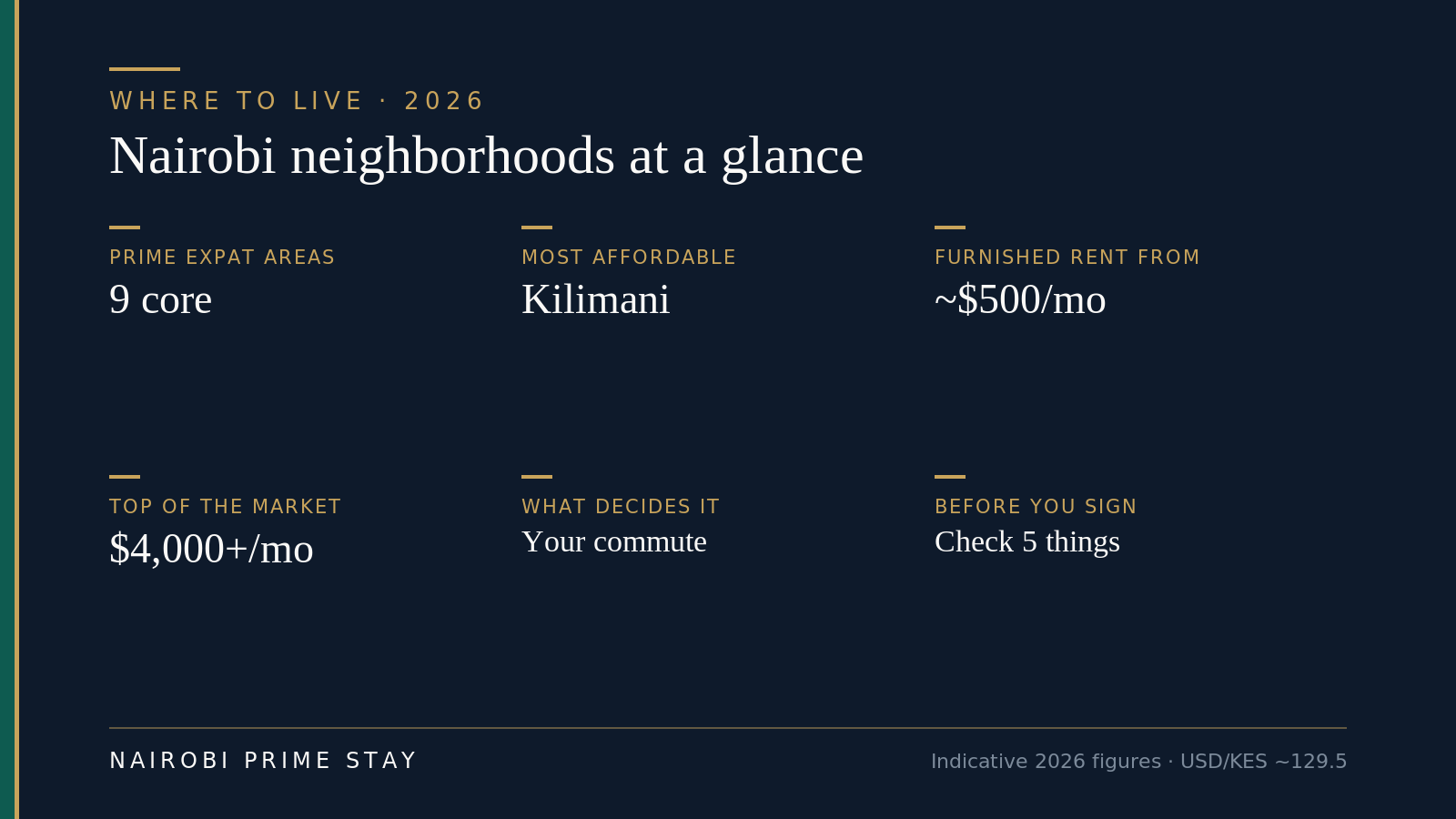
The shape of the decision at a glance — indicative 2026 figures.
How to choose your neighborhood
Start with your anchor, then let it point you to two or three areas. The anchor is whatever is fixed in your week:
- Your office or the UN complex. Nairobi traffic turns short distances into long trips, so living near where you commute daily is the single biggest quality-of-life decision.
- Your children’s school. Most international schools cluster around Gigiri, Runda and Karen. Pick the school first, then live within a short, predictable run of it.
- Your lifestyle. Want restaurants, nightlife and walkability? Lean urban. Want gardens, quiet and space? Lean suburban.
Whatever you shortlist, check the “Nairobi Five” before signing anywhere: a backup generator, reliable water supply and storage, 24/7 security with gates and cameras, fibre internet already in the building, and responsive management. A lovely apartment without a generator becomes a frustrating one during the first power cut.

The five building essentials to verify before you sign — skip one and daily life gets harder.
The prime areas at a glance
| Neighborhood | Character | Furnished rent / mo | Best for |
|---|---|---|---|
| Gigiri | Diplomatic heart — UN and embassies, very secure, green | $1,500–4,000+ | UN / embassy / NGO staff |
| Runda & Muthaiga | Large gated homes and gardens, very secure | $1,800–4,000+ | Families wanting space |
| Karen | Leafy, low-density, equestrian calm, top schools nearby | $1,000–3,000 | Families, space-seekers |
| Lavington | Cosmopolitan, family-friendly, central-ish | $700–1,800 | Families, professionals |
| Kileleshwa | Quiet, modern apartments, discreet | $650–1,500 | Couples, professionals |
| Westlands | Urban energy — restaurants, nightlife, offices, malls | $550–1,200 | Singles, social professionals |
| Kilimani | Central, modern, busy, most affordable prime area | $500–1,000 | Remote workers, first-timers |
| Riverside | High-end residences and embassies by the river | $900–2,500 | Executives wanting central calm |
| Upper Hill | Business district, hospitals and HQs | $700–1,600 | Executives wanting a short commute |
Rents are indicative 2026 figures for furnished homes; unfurnished and longer leases cost less. For the full money picture, see our cost of living guide.
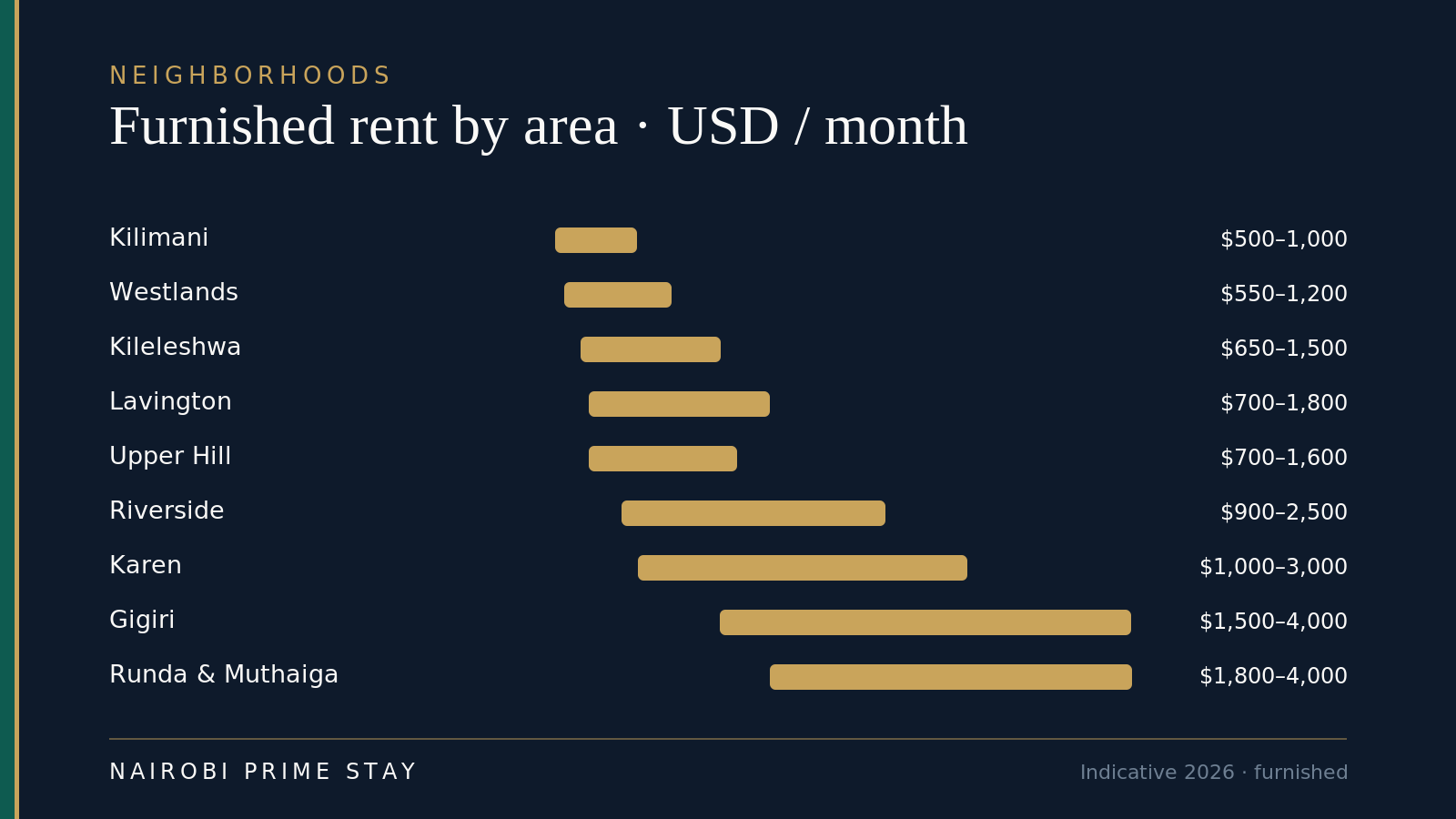
Indicative furnished monthly rents by neighborhood (USD, 2026). Unfurnished and longer leases cost less; serviced apartments cost more but bundle utilities, internet, cleaning and security.
The neighborhoods, one by one
Nairobi’s expat areas fall into three rough clusters: the secure diplomatic north, the leafy west and southwest, and the central, social belt. Find the cluster that fits your week, then read the areas inside it.
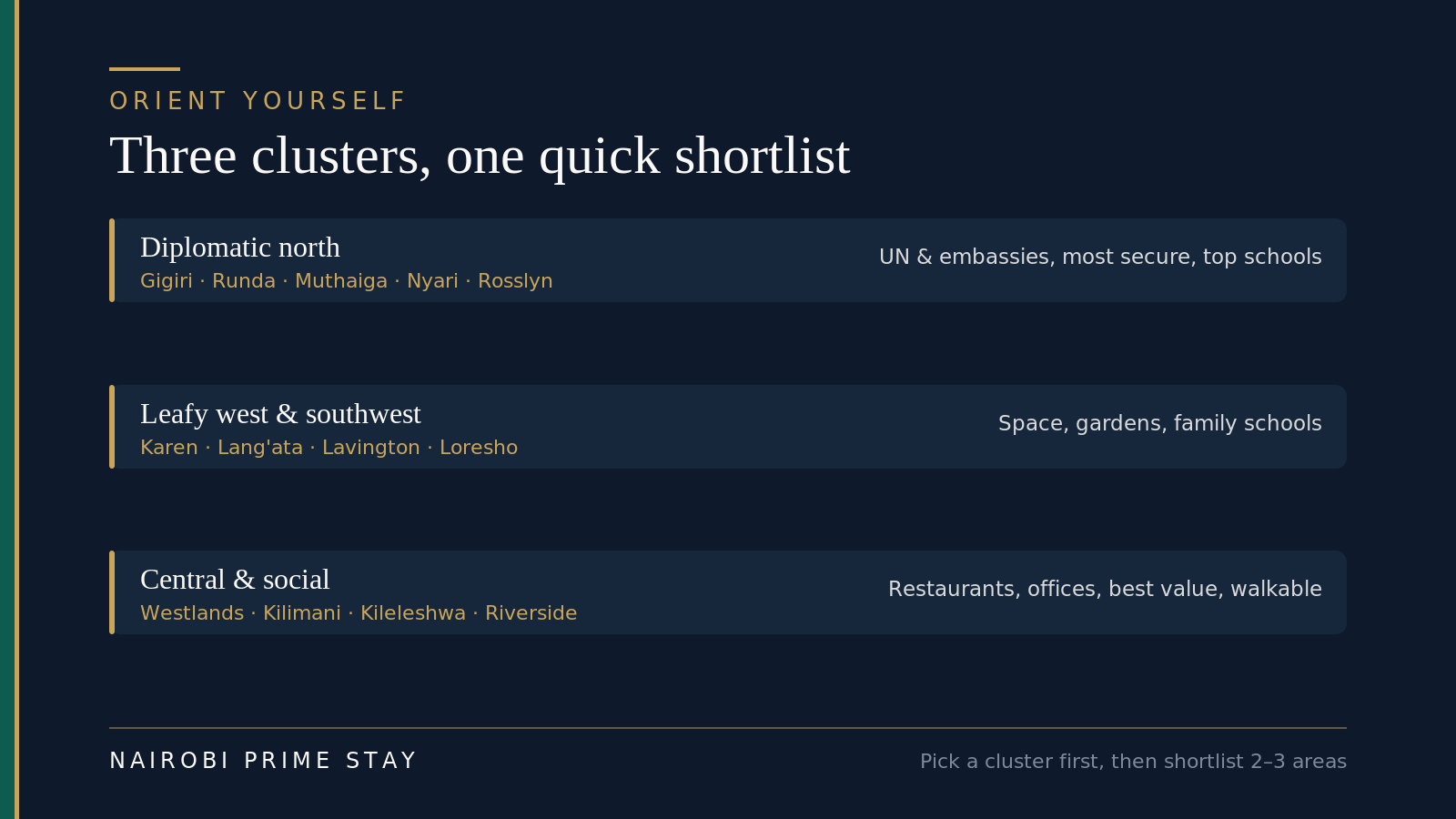
Three clusters — pick one, then shortlist two or three areas inside it.
Gigiri — the diplomatic heart
Gigiri is where the UN headquarters, the US Embassy and dozens of other missions sit, which makes it the default for diplomats, UN and NGO staff. It’s calm, green, heavily patrolled and feels secure in a way few city neighborhoods do. The International School of Kenya is right here, so families with kids at ISK get a short school run. The trade-off is price — it’s one of the priciest areas — and a quieter, more residential feel than the nightlife districts. Read the full Gigiri neighborhood guide for drive-times, shopping and apartments, or browse Gigiri apartments directly.
Runda & Muthaiga — space and security
Just beside Gigiri, Runda and Muthaiga are leafy estates of large gated homes with gardens, popular with families and senior expats who want room and quiet. Security is excellent, and you’re close to the UN cluster and to Rosslyn Academy. These are house-and-garden areas more than apartment districts, and you’ll want a car. If your priority is space behind walls, this is the calmest corner of expat Nairobi. Read the full Runda neighborhood guide for house rents, schools and apartments, or browse Runda apartments. For the old-money, big-plot neighbor next door, read the full Muthaiga neighborhood guide or browse Muthaiga apartments. Further west toward Kitisuru, Loresho is a leafy, spacious, house-dominant family suburb that’s especially handy for the International School of Kenya. Right alongside, Kitisuru is a gated, hilly, quietly exclusive enclave of large walled villas, also minutes from ISK and popular with diplomats and executives who want maximum privacy. And tucked between Gigiri, Runda and Kitisuru, Nyari is a small, ultra-secure gated estate with its own police post — a long-standing favorite with diplomats and UN families. And along Limuru Road by the top schools, Rosslyn is a calm, leafy suburb of gated houses and newer apartments, home to Rosslyn Academy and minutes from the International School of Kenya — or browse Rosslyn apartments. And along Kiambu Road to the east, Ridgeways is a leafy, gated family suburb beside Karura Forest and the Windsor golf course, with much of the same northern feel at better value. And tucked off Limuru Road right beside Gigiri, Thigiri is a small, leafy, house-dominant ridge popular with diplomats and families who want a secure home near the UN at a touch below the very top of the market.
Karen — gardens, schools and calm
Karen is the leafy, low-density suburb to the city’s southwest, known for space, gardens, an equestrian streak and excellent schools like Brookhouse and Hillcrest. Families love it for the room to breathe and the international community. The honest trade-off is distance: Karen is farther from the city center and the UN, so the commute can be long in traffic. If your life is school-and-home centered rather than office-bound downtown, Karen is hard to beat. See the Karen neighborhood guide for the detail, or browse Karen apartments. Right next door, Lang’ata offers much of the same leafy, family-friendly feel beside Nairobi National Park at lower rents.
Lavington — the family all-rounder
Lavington sits between the center and the western suburbs, offering gardens, good schools, embassies and a cosmopolitan, family-friendly feel without Karen’s distance. It’s a sensible middle ground — more central than Karen, more residential than Westlands — which is why so many families and professionals land here. Rents are moderate for the prime areas, and you get a balance of space and access. Read the full Lavington neighborhood guide for rents, schools and apartments, or browse Lavington apartments. Just north-west, Spring Valley is a leafier, lower-density pocket of houses and gated townhouses, a touch closer to Westlands.
Kileleshwa — quiet and central
Kileleshwa is the calmer, more residential neighbor of Kilimani: modern apartments and townhouses, central location, and a discreet, settled feel. It suits couples and professionals who want to be close to the action without living in the middle of it. Rents are reasonable, and the building stock is newer. Read the full Kileleshwa neighborhood guide for rents, schools and apartments, or browse Kileleshwa apartments.
Westlands — urban energy
Westlands is Nairobi’s social and commercial hub — restaurants, nightlife, offices, malls like Sarit and Westgate, and a walkable-ish density unusual for the city. It’s the natural choice for singles and social professionals who want to be where things happen, and it’s a coworking and café hotspot. The trade-off is the buzz itself: busier, louder and more congested than the garden suburbs. Read the full Westlands neighborhood guide for rents, traffic and apartments, or browse Westlands apartments. Just north-east, Parklands is Westlands’ more diverse, food-loving and better-value neighbor, with the city’s best Indian food and top private hospitals on the doorstep — or browse Parklands apartments.
Kilimani — central and affordable
Kilimani is central, modern and the most affordable of the prime apartment areas, which makes it a favorite for remote workers, younger professionals and first-time arrivals. You get new apartment blocks, easy access to Westlands and the center, and a lively, convenient base. It’s busy and built-up rather than leafy, but the value and location are strong. Read the full Kilimani neighborhood guide for rents, the honest downsides and apartments, or browse Kilimani apartments. Just south, Hurlingham is Kilimani’s central, value-focused neighbor — apartment-dense and handy for Upper Hill and top hospitals — or browse Hurlingham apartments.
Riverside — central, leafy, high-end
Riverside Drive threads high-end residences and embassies along a green corridor close to Westlands and the center. It offers a more polished, quieter feel than Westlands while staying central — appealing to executives and professionals who want calm without a long commute. Rents reflect the address. Read the full Riverside neighborhood guide for rents, safety and apartments, or browse Riverside apartments.
Upper Hill — built for the short commute
Upper Hill is Nairobi’s business district, home to corporate headquarters and major hospitals including The Nairobi Hospital. If you’ll work here, living here means a short, predictable commute in a city where that’s gold. It’s more business-like than residential in feel, but for executives who value time over gardens, the trade is worth it. See our Upper Hill neighborhood guide for rents, hospitals and the honest trade-offs.
Other areas you’ll hear about
The areas above are where most newcomers land. A few others come up, so here’s the honest orientation.
Spring Valley and the smaller northern enclaves. Just off the main clusters sit quieter pockets like Spring Valley, Loresho, Kitisuru and Nyari — leafy, low-density, secure and mostly houses rather than apartments. They suit families who want space near the international schools and don’t mind needing a car.
The CBD and downtown. Nairobi’s central business district is for working, not living. Few expats rent there: it empties at night, has little of the housing stock newcomers expect, and the noise and security profile differs from the suburbs. Stay in the western and northern belt and commute in.
Eastlands, South B and South C. These eastern and southern neighborhoods are home to a huge share of Nairobi and have plenty of decent, ordinary middle-class housing. They aren’t no-go zones. They’re simply not where the expat infrastructure sits — fewer serviced and embassy-standard buildings, a thinner international community, and a longer haul to Gigiri or the western offices. Most first-timers find them a harder soft landing, so they’re worth a look only once you know the city.
None of this is a verdict on the people who live in these areas; plenty of Kenyans live very well across all of them. It’s about matching a newcomer to the cluster where settling in is easiest.
What the commute actually looks like
In Nairobi, distances are short but traffic is not. Most prime suburbs sit within about 10 km of the center, yet a rush-hour jam can stretch a 6 km hop to 45 minutes. So judge an area by the drive you’ll actually make each day, not by how close it looks on a map.
Two anchors decide most expat commutes: the diplomatic core around the UN complex and embassies in Gigiri, and the business core of the central business district (CBD) and Upper Hill. Here’s roughly where each area sits relative to both. Treat these as rough rush-hour estimates by Uber or Bolt — always check a live time before you rely on it.
| Area | To the CBD / Upper Hill | To the UN / Gigiri | In short |
|---|---|---|---|
| Gigiri | ~30–50 min | ~5–15 min | Shortest hop to the UN and embassies |
| Runda & Muthaiga | ~30–50 min | ~10–20 min | Beside Gigiri; quick to the UN |
| Westlands | ~15–35 min | ~20–40 min | Central and social, near the CBD |
| Riverside | ~15–35 min | ~20–40 min | Quieter, just off Westlands |
| Kilimani | ~15–35 min | ~25–45 min | Central, affordable, well-connected |
| Kileleshwa | ~15–35 min | ~25–45 min | Calm, central, residential |
| Lavington | ~20–40 min | ~25–45 min | Between the center and Karen |
| Upper Hill | ~5–20 min | ~30–50 min | You’re in the business core already |
| Karen | ~30–60 min | ~40–75 min | Farthest out — anchor life locally |

Rough rush-hour estimates by Uber or Bolt — always check a live time before you rely on it.
A few practical notes. Wilson Airport, the hub for light aircraft to the Maasai Mara and the coast, is closest from Karen and Langata — about 15–25 minutes, a real perk for weekend flyers. JKIA, the international airport, is a cross-city trip from the western suburbs: budget roughly 30–45 minutes from Karen and 45–70 from Gigiri, more in heavy traffic. And whatever the table says, the biggest single lever is when you travel — leaving at 7am or 5pm can double any of these times.
If your week is anchored on the UN, the Gigiri cluster wins on commute. If it’s anchored on the CBD or Upper Hill, the central suburbs — Westlands, Kilimani, Riverside, Kileleshwa and Lavington — keep you closest. Karen trades the longest drive for the most space and quiet. For door-to-door detail on the two ends of that range, see our Gigiri and Karen guides. For how people actually move around — matatus, Uber and Bolt, and whether to buy a car — see getting around Nairobi and our guide to driving in Nairobi.
Match your situation to an area
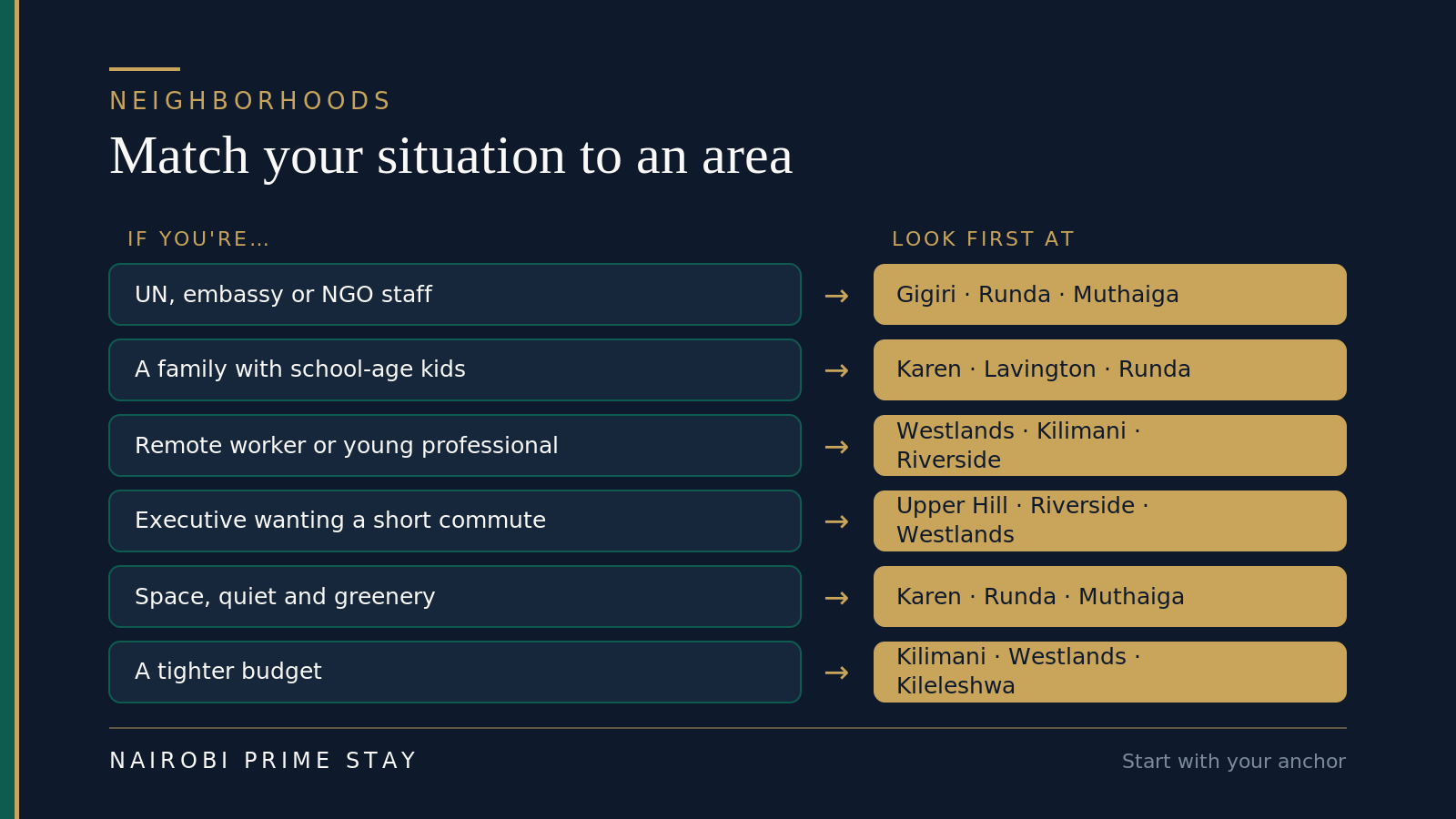
Start with your anchor, then shortlist.
| If you’re… | Look first at |
|---|---|
| UN, embassy or NGO staff | Gigiri, Runda, Muthaiga |
| A family with school-age children | Karen, Lavington, Runda (near top schools) |
| A remote worker or young professional | Westlands, Kilimani, Riverside |
| An executive wanting a short commute | Upper Hill, Riverside, Westlands |
| Seeking space, quiet and greenery | Karen, Runda, Muthaiga |
| On a tighter budget | Kilimani, Westlands, Kileleshwa |
How this plays out
Three quick examples of how the choice usually resolves:
- UN family with two kids. School comes first, so they look at Gigiri and Runda: a 5–15 minute school-and-work run to ISK and the complex, top-tier security, and a ready-made international community. They land in a Gigiri serviced apartment, drive the route for two weeks, then sign a Runda house with a garden.
- Remote-working couple in their 30s. They want cafés, coworking and a livelier base, and they’re paying their own rent. Kilimani and Westlands fit — central, social and the most apartment for the money — with fast fibre and a backup generator at the top of their checklist. They pick a modern Kilimani two-bed.
- Executive on an Upper Hill contract. Time matters more than gardens, so they weigh Upper Hill and Riverside for the short, predictable commute, and keep weekends free to explore farther out.
The pattern never changes: anchor on the fixed point in your week — office, school or lifestyle — then let it pick the area.
Decide in person, not from a map
Photos flatter, and neighborhoods feel different once you’re standing in them and driving the commute at 8am. The smart move is to base yourself in a serviced apartment for your first few weeks, then view long-term homes in two or three shortlisted areas before you commit. You’ll test the traffic, feel the vibe at different times of day, and judge each building’s security and amenities for yourself. It’s the difference between choosing a neighborhood and gambling on one. Our safety guide covers what to check building by building.
The sequence that works: land in a serviced apartment, shortlist two or three areas, and view homes with a reputable agent or through verified listings, running the Nairobi Five on each building. Decide furnished or unfurnished — furnished is faster for a first year — and read the lease, deposit and notice terms closely before you sign. Our full walk-through is in how to rent an apartment in Nairobi.
Frequently asked questions
Where do most expats live in Nairobi? In the green, secure western and northern suburbs: Gigiri and Runda for UN, embassy and NGO staff; Karen and Lavington for families; Westlands, Kilimani and Riverside for younger and remote-working professionals. All are gated, well-patrolled and home to a large international community.
Which is the best area to live in Nairobi for families? Karen, Lavington and Runda are the family favorites, thanks to space, gardens, security and proximity to top international schools. Pick the school first, then choose the area within a short, predictable commute of it.
What’s the safest neighborhood in Nairobi? Gigiri and Runda feel especially secure thanks to the diplomatic presence and heavy patrols, but all the prime expat suburbs — Karen, Lavington, Muthaiga, Kileleshwa — are built around gated communities with 24/7 security. See our dedicated safety guide for details.
Which area is best for young professionals and remote workers? Westlands, Kilimani and Riverside. They’re central, social and well supplied with coworking spaces and cafés, and Kilimani in particular offers the most affordable modern apartments among the prime areas.
How much does it cost to rent in Nairobi’s best neighborhoods? Indicative 2026 furnished rents run from about $500 a month in Kilimani to $4,000-plus in Gigiri or Runda. Unfurnished homes and longer leases cost less; serviced apartments cost more per month but include utilities, internet, cleaning and security.
How far is Karen from the city center? Karen sits southwest of the city, so the drive to the central business district runs roughly 30–60 minutes depending on traffic, and reaching the UN and embassy cluster in Gigiri can take 40–75 minutes at peak times. That distance is the main trade-off for Karen’s space and greenery, which is why families who choose it anchor daily life — school, shops, weekends — close to home. The exception is Wilson Airport, handy for safari and coast flights: it’s only about 15–25 minutes away.
Which is the cheapest neighborhood in Nairobi for expats? Among the prime expat areas, Kilimani is usually the most affordable, with modern furnished apartments from around $500 a month, followed by Westlands and Kileleshwa. You can pay less further from the western suburbs, but most newcomers value the security, fibre and international community the established areas offer. See our cost of living guide for full monthly budgets.
Should I sign a long-term lease before I arrive in Nairobi? No — it’s the one thing we’d steer you away from. Photos flatter, traffic is invisible online, and a building’s security and water supply are hard to judge from abroad. Base yourself in a serviced apartment for the first few weeks, view homes in two or three shortlisted areas, and sign only once you’ve driven the commute yourself.
Do I need a car to live in Nairobi’s expat neighborhoods? It depends on the area and your week. In central, denser suburbs like Westlands, Kilimani and Kileleshwa, Uber and Bolt cover most trips cheaply. In the spread-out garden suburbs — Karen, Runda, Muthaiga — and for daily school runs, most families end up buying a car. Either way, factor the commute into the decision, because traffic shapes life here more than distance does.
Which areas should I avoid, or at least not start in? There’s nowhere in the prime western and northern belt you need to avoid. The areas to think twice about as a first-time arrival are the downtown CBD and the eastern, industrial-side suburbs like Eastlands, South B and South C — not because they’re unsafe, but because they have fewer serviced or embassy-standard buildings, a thinner international community, and a longer commute to the diplomatic and business cores. Start in the established cluster, then explore once you know the city.
How do I actually find an apartment in these neighborhoods? Land soft, then look. Book a serviced apartment for your first few weeks, shortlist two or three areas, and view in person with a reputable agent or through verified listings. Check the Nairobi Five in every building, decide furnished or unfurnished, and read the lease and deposit terms before you sign — our step-by-step rental guide walks through it.
Final thoughts
There’s no single best neighborhood in Nairobi — there’s the best one for your commute, your budget and the life you want. Get the anchor right (office, school or lifestyle), respect what traffic does to short distances, and nine areas narrow to two or three fast. Then do the part that matters most: stand in them, drive the commute, and choose in person.
Related reading
- Moving to Nairobi: the complete guide — the end-to-end overview, and the hub that ties all of this together.
- Cost of living in Nairobi — real monthly budgets, area by area.
- Is Nairobi safe? — an honest, practical safety guide for each suburb.
- Gigiri vs Westlands compared — quiet diplomatic calm vs central city energy, head to head.
- Karen vs Runda compared — space and British schools vs gated security near the UN, head to head.
- Kilimani vs Kileleshwa compared — best-value buzz vs leafy central calm, head to head.
- Lavington vs Westlands compared — leafy family calm vs central convenience, head to head.
- Gigiri and Karen neighborhood guides — deep dives on the two ends of the commute range.
- Serviced apartments in Nairobi — how a soft landing works before you commit.
Find your area, then your apartment
Once you’ve shortlisted a couple of areas, browse our serviced apartments — verified, with honest monthly pricing — or go straight to Gigiri or Karen. Not sure which area fits your commute and budget? Our AI relocation assistant can shortlist places in a couple of minutes, day or night. A $50 deposit reserves a place and you pay the balance on arrival — so you can lock in a soft landing before you fly.
Ready to look?
Find your apartment in Nairobi
Browse verified serviced apartments, or ask the AI concierge which area fits your life.