
Guides · Neighborhoods
Gigiri vs Westlands: Which Nairobi Neighborhood Suits You? (2026)
Gigiri vs Westlands: Which Nairobi Neighborhood Suits You?

Gigiri and Westlands are two of the most popular places for Americans to land in Nairobi, and they could hardly be more different. Gigiri is the quiet, green, heavily guarded suburb wrapped around the UN headquarters. Westlands is the dense, fast-moving heart of the city’s offices, malls and nightlife. Pick the one that matches your daily life and you’ll settle in fast. Pick the wrong one and you’ll spend a year in traffic or in silence.
This guide compares them head to head — vibe, rents, commute, schools, safety and lifestyle — so you can choose with your eyes open. It’s written for people who haven’t lived in Nairobi yet and want the honest version, not a sales pitch.

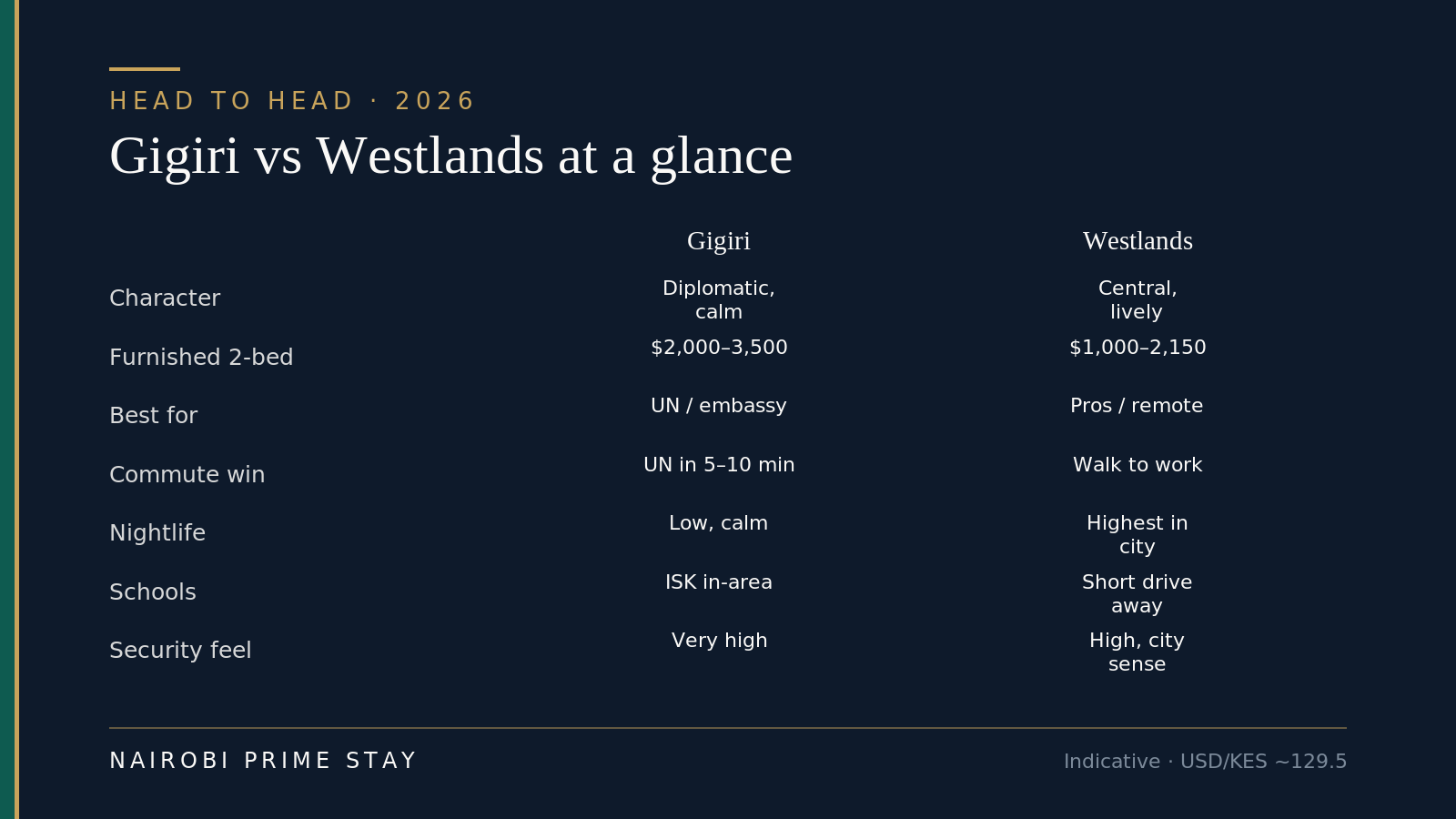
The short answer
Choose Gigiri if you work at the UN, an embassy or an NGO, if you have school-age kids headed to the International School of Kenya, or if you simply want the calmest, most secure, leafiest base in the city and don’t mind paying for it. Choose Westlands if you’re a young professional, a couple, or a remote worker who wants a walkable, social life with cafes, coworking, malls and the city’s best nightlife on your doorstep — at noticeably lower rent.
Put simply: Gigiri is where you live for work and family near the UN; Westlands is where you live for the city itself. Gigiri costs more and trades buzz for calm. Westlands costs less and trades gardens and quiet for energy and convenience. Both are safe, both are well-served, and neither is “better” — they’re built for different lives. If you’re still scouting the whole city, start with our best neighborhoods in Nairobi guide and the full moving to Nairobi guide for the bigger picture.
The 30-second decision
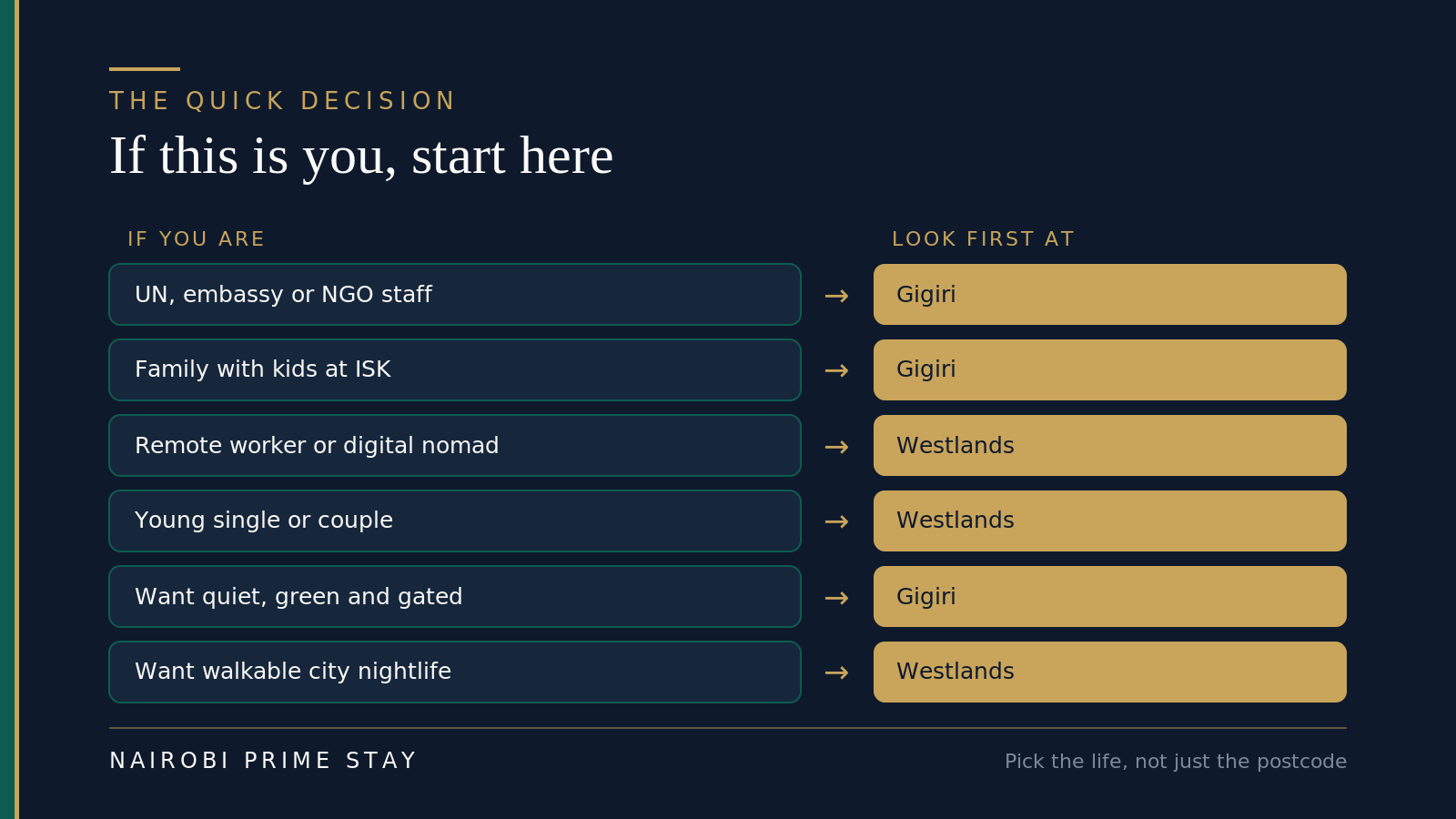
Pick the life you want, not just the postcode — your commute and your evenings matter more than the address.
Side by side: Gigiri vs Westlands
Here’s the comparison at a glance. All figures are indicative for 2026 at roughly KES 129–130 to the US dollar; verify live rents and the exchange rate before you sign (the Central Bank of Kenya or Wise has the current rate).
| Feature | Gigiri | Westlands |
|---|---|---|
| Best for | UN, embassy & NGO staff; families | Young professionals, couples, remote workers |
| Vibe | Quiet, green, diplomatic, residential | Central, dense, social, mixed-use |
| Furnished 1-bed (USD/mo) | ~$1,500–2,200 | ~$700–1,400 |
| Furnished 2-bed (USD/mo) | ~$2,000–3,500 | ~$1,000–2,150 |
| Distance from the CBD | ~10–12 km, northern edge | ~5 km, northwest |
| Commute strength | 5–10 min to the UN & embassies | Walk to work; CBD 10–40 min |
| Airport (JKIA) | ~45–70 min | ~20–30 min via the Expressway |
| Schools | ISK (American + IB) in the neighborhood | Drive to Parklands/Lavington schools |
| Nightlife & dining | Low-key; Village Market is the hub | The city’s nightlife and dining center |
| Walkability | Low — you’ll drive most places | High for daily needs |
| Security feel | Among the city’s highest | High, with normal city sense |
| Green space | Abundant and leafy | Limited; drive to Karura Forest |
Vibe and character: calm diplomat vs city operator
Gigiri feels like a quiet, green diplomatic enclave, because that’s exactly what it is. It surrounds the UN complex and dozens of embassies, including the US Embassy, so the streets are leafy, walled and patrolled, and the pace is slow. Your neighbors are UN staff, diplomats, NGO workers and senior professionals from around the world. It skews toward families and established households rather than young singles. If you want a safe, internationally minded base where settling in is easy and the evenings are peaceful, Gigiri delivers. If you want to walk out your door into a bar, you’ll be driving to Westlands for that.
Westlands is the opposite energy. It’s where Nairobi works, shops and goes out — towers of offices and apartments, three big malls within a short walk of each other, and the busiest nightlife strip in the city. The crowd is younger and more social: Kenyan professionals, expats on shorter postings, remote workers, students and couples. Many people who work in Westlands’ banks, tech firms and law offices live within minutes of their desk. It’s cosmopolitan, convenient and easy to plug into, with fewer large families and more people who want city life over a big plot.
The honest way to frame it: Gigiri is a place you retreat to, and Westlands is a place you’re in the middle of. Some people find Gigiri too quiet and a little isolating, especially if they don’t have the UN or a family anchoring them there. Others find Westlands too loud, too built-up and too short on greenery. Knowing which of those complaints would bother you more is half the decision.
Rents: what your money gets in each
Gigiri is one of the priciest residential areas in Nairobi, and Westlands is mid-range for a prime area — so your budget alone may make the call. Both numbers below are for furnished homes in 2026; unfurnished and longer leases cost less, and serviced apartments (all-inclusive) sit at the top of each range.
| Home size | Gigiri (furnished, USD/mo) | Westlands (furnished, USD/mo) |
|---|---|---|
| 1-bed apartment | ~$1,500–2,200 | ~$700–1,400 |
| 2-bed apartment | ~$2,000–3,500 | ~$1,000–2,150 |
| 3-bed apartment / townhouse | ~$2,800–4,000+ | ~$1,540–2,700+ |
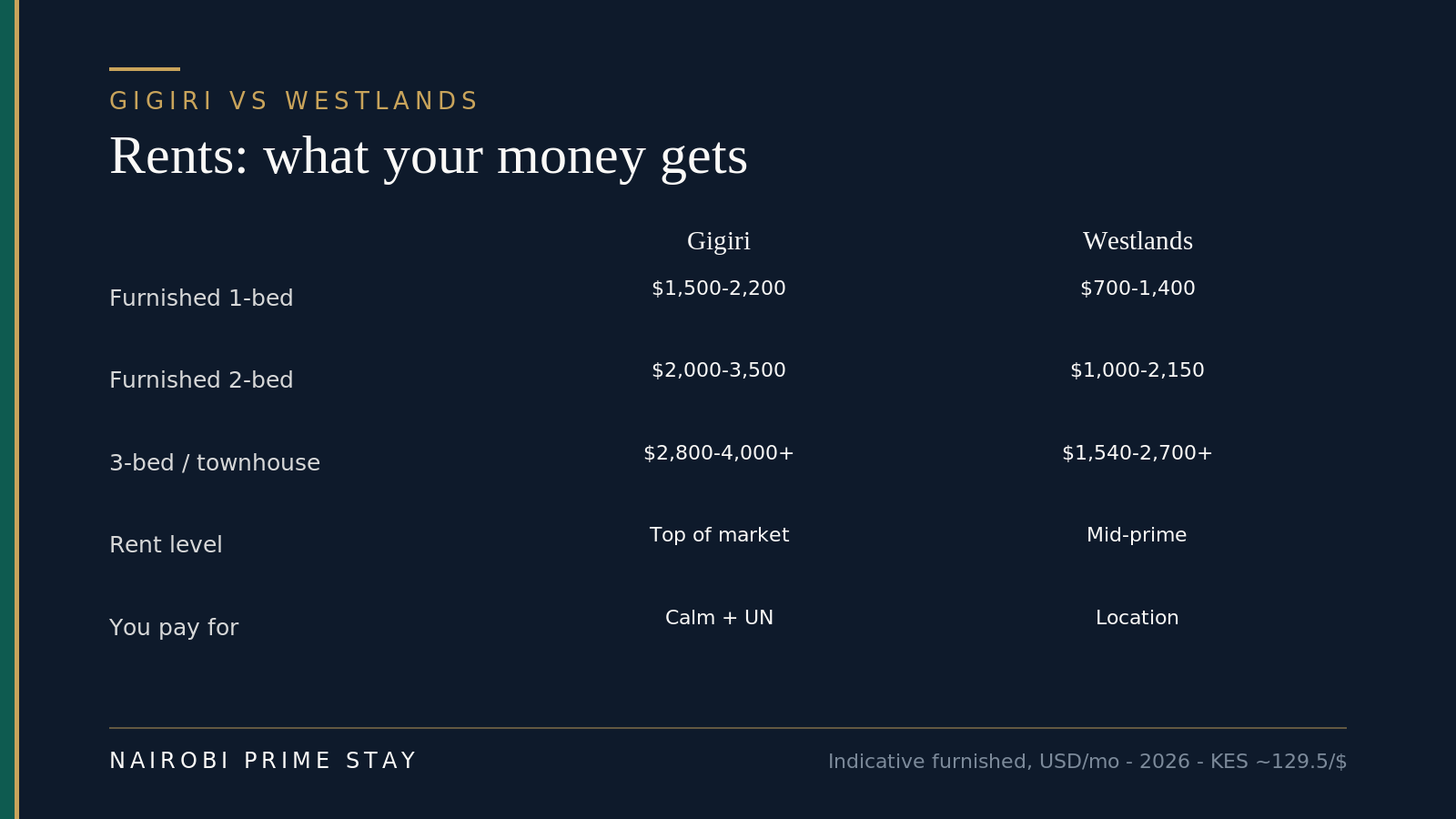
Indicative 2026 furnished rents — Gigiri trades a clear premium for calm and UN proximity; verify live listings before you sign.
In Gigiri you’re paying for security, calm and proximity to the UN. The building stock runs from modern serviced blocks to gated townhouse compounds and standalone houses with gardens. A typical good-fit home is a two-bed in a secure block with a gym, backup generator and fibre, in the low-to-mid $2,000s a month.
In Westlands you’re paying for location and convenience. The same money buys a smaller, more urban footprint — a high-rise one- or two-bed near the malls and coworking, often without a garden but within walking distance of everything. For many remote workers and young professionals, that trade is the whole point. For a deeper budget picture across the city, see our cost of living in Nairobi guide.
Whatever you view in either area, run the “Nairobi Five” check before signing: a backup generator, water storage (tanks or borehole), 24/7 security, fibre internet already serving the building, and responsive on-site management. Quality buildings in both Gigiri and Westlands handle these well, but never assume — ask.
The commute: where each area wins
Commute should drive your choice more than almost anything else, because in Nairobi distances are short but traffic is not. The two areas win at opposite ends of the map.
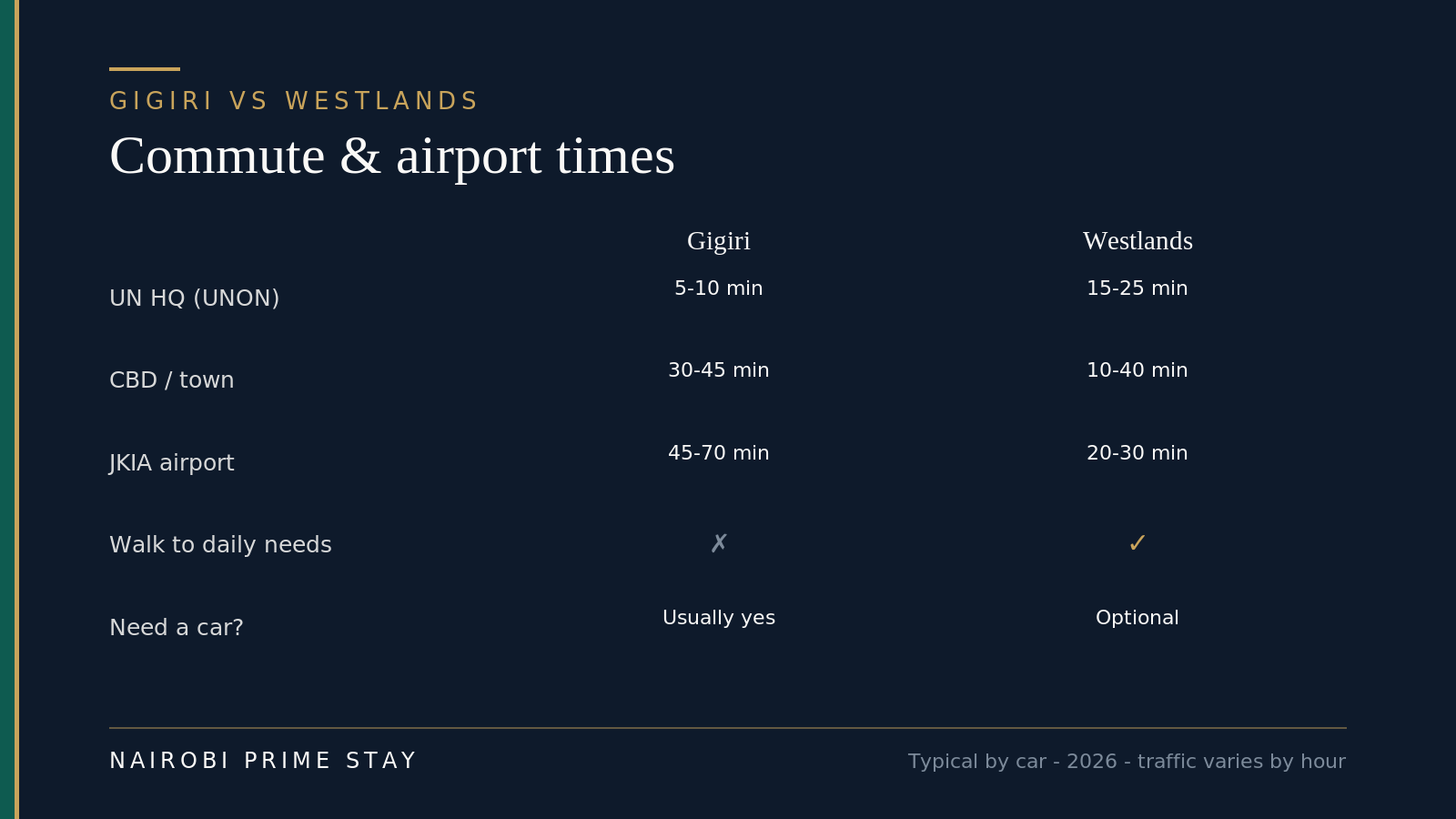
Typical door-to-door drive times in 2026 — Gigiri wins the UN run, Westlands wins the airport and walkability.
Gigiri’s killer advantage is the UN and the embassies. Most homes are a 5–10 minute drive from the UN complex (UNON) and the missions along United Nations Avenue. In a city defined by jams, that’s a genuine luxury — many residents are at their desks before colleagues elsewhere have cleared the first roundabout. The flip side: Gigiri sits on the northern edge of the city, so getting to the CBD or Westlands runs 30–45 minutes or more at rush hour, and the airport (JKIA) is a 45-minute-to-over-an-hour haul. If your daily anchor is the UN, that’s the right side of the trade. If it isn’t, Gigiri’s location works against you.
Westlands wins on everyday convenience and the airport. It’s about 5 km from the CBD, and — crucially — it’s one of the few Nairobi neighborhoods where you can actually walk to daily things: malls, cafes, a gym, coworking. Many residents who work locally skip a car entirely. The downside is the same traffic everyone faces: Waiyaki Way and Ring Road clog at peak hours, so a short trip to town can take 10 minutes off-peak or 40-plus in the thick of it. But the elevated Nairobi Expressway runs from JKIA to a terminus on Westlands’ doorstep, cutting the airport run to roughly 20–30 minutes off-peak. If you travel often, that alone is a strong argument for Westlands.
A simple rule: if your workplace is the UN, an embassy or an NGO clustered near Gigiri, live in Gigiri. If you work remotely, in Westlands itself, or you fly a lot, Westlands is the easier daily life. For the nuts and bolts of moving around either way — Bolt and Uber, matatus, and whether to drive yourself — see our guides to getting around Nairobi and driving in Nairobi.
Schools and families
For families with school-age children, Gigiri usually wins — and it’s often the single deciding factor. The International School of Kenya (ISK), which follows an American and IB curriculum, sits right in the neighborhood. Living in Gigiri (or neighboring Runda) gives ISK families one of the shortest, most predictable school runs in the city, which is a major reason diplomats with kids settle here. ISK is premium: as of the 2025/26 year, senior-grade tuition runs about $37,000 a year, with younger grades lower, plus a roughly $11,000 one-time capital levy per child on entry. Treat those as indicative and confirm the current schedule with ISK directly. Rosslyn Academy (American and AP) is close by in Runda at roughly a third of ISK’s fees, with Braeburn and other options within reach.
Westlands itself is light on big international-school campuses — it’s a commercial core — but good schools sit minutes away. Aga Khan Academy and Oshwal Academy are close by in Parklands, and several British- and international-curriculum schools are a short drive south in Lavington and toward Gitanga Road. ISK is a 15–25 minute drive depending on traffic. So families can absolutely live in Westlands, but if ISK is your school and you want the easy run, Gigiri is the natural fit. Either way, apply early — the best schools keep waitlists. For the full landscape — American, British and IB curricula, fees and how admissions work — see our international schools in Nairobi guide.
Safety
Both areas are safe by Nairobi standards, but in different ways. Gigiri is among the most secure neighborhoods in the city — the concentration of diplomatic missions means a constant, visible security presence and heavy patrols, and homes are almost universally in gated compounds or guarded apartment blocks. Day to day, it feels calm and low-risk.
Westlands is generally safe by day and lively at night, with one big-city caveat: keep your phone and bag close, especially in nightlife spots and in traffic. The real risk is opportunistic petty theft — pickpocketing in crowds, phone-snatching at car windows in jams — not personal danger. The area is busy, well-lit and thick with private security, with guarded buildings, gated parking and mall screening the norm. For the citywide picture and practical precautions, read our honest take on whether Nairobi is safe. The short version: both areas suit expat families and solo arrivals; Gigiri just feels more cocooned, while Westlands asks for the street sense you’d use in any big city.
Lifestyle: nights out, shopping and coworking
This is where the two areas split hardest, and it’s worth being honest with yourself about how you actually spend your evenings.
Westlands is the city’s social and work hub. Three malls anchor daily life — Sarit Centre, Westgate and The Oval/The Mall — all within a short walk, holding Carrefour and Naivas supermarkets, shops, restaurants and a cinema. The food is a highlight: nyama choma, Indian, Italian, Japanese and Ethiopian, plus some of the best coffee in the country. After dark, Westlands is the nightlife center, with bars, lounges and clubs along Mpaka Road and Woodvale Grove drawing people in from across Nairobi. Our guides to Nairobi’s restaurants and dining and nightlife and going out go deeper on both. It’s also the best place in the city for remote work: Nairobi Garage, Ikigai, Workstyle and Regus all have space here, cafes are laptop-friendly, and the fibre is solid. The city’s best coworking spaces and cafes cluster here. If you work from home, our internet and remote-work guide covers providers and backup power.
Gigiri is deliberately quieter. Its social and shopping hub is Village Market — a large mall with supermarkets, restaurants, a craft market and family-friendly amenities — and dining in the area leans toward relaxed, family spots rather than a scene. For a big night out, Gigiri residents drive to Westlands. That’s not a flaw; it’s the point. People choose Gigiri precisely because they want comfortable daily life and peaceful evenings, not buzz. If walkable nightlife is a priority, that gap will frustrate you. If it isn’t, you won’t miss it.
Green space tips the same way you’d expect. Gigiri is leafy throughout and minutes from Karura Forest’s trails and waterfall. Westlands has limited greenery on its own busy streets, though Karura is a short drive for residents who want it.
Healthcare
Both areas are well covered, and they actually share the same hospital cluster. Westlands sits right next to Parklands, home to two of Nairobi’s best private hospitals: MP Shah (minutes away) and Aga Khan University Hospital (JCI-accredited, with full specialist care). Gigiri is a slightly longer but still reasonable drive from the same Parklands hospitals, plus Gertrude’s Children’s Hospital in Muthaiga for families. Private clinics and well-stocked pharmacies serve both neighborhoods for everyday needs. Carry good private or international insurance with regional cover and medical evacuation; our healthcare in Nairobi guide explains how the private system works and what to look for in a policy.
Who should choose which
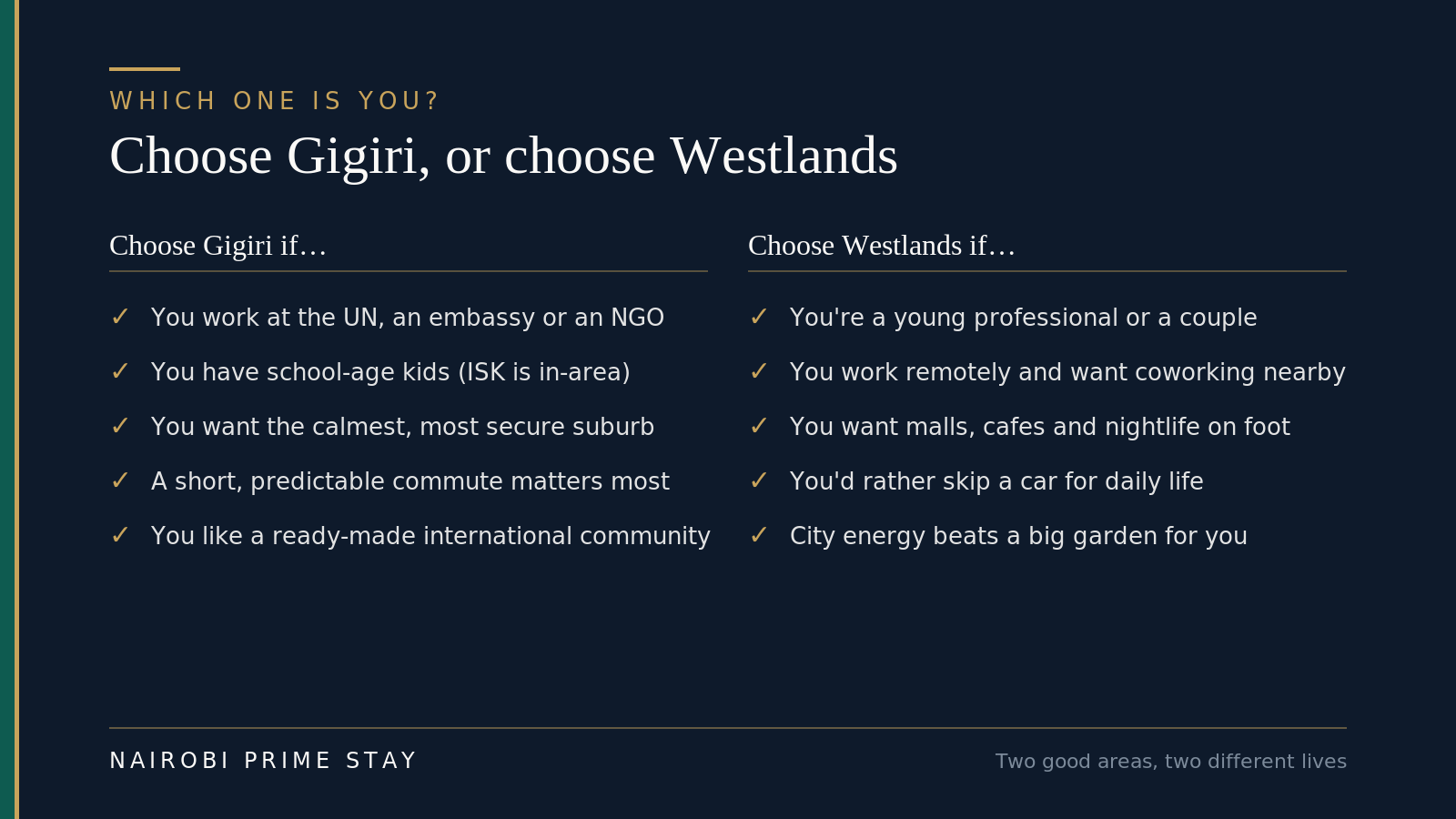
Gigiri is the right call if you work at the UN, an embassy or an NGO; you have kids headed to ISK; you want the calmest, most secure and greenest base in the city; a short, predictable commute matters more than nightlife; or you value a ready-made international community and don’t mind paying a premium for all of it. If you’re posted to the UN, our guide to where UN staff live in Nairobi maps the whole diplomatic belt around Gigiri.
Westlands is the right call if you’re a young professional or a couple; you work remotely and want coworking and cafes nearby; you want malls, restaurants and the city’s best nightlife within walking distance; you’d rather skip a car for daily life; or you simply prefer urban energy to a big garden — and you’d like to spend less on rent while you’re at it.
If you find yourself wanting Gigiri’s calm but Westlands’ convenience, look at the areas between them — Riverside, Lavington and Kileleshwa each strike a middle note — or read the full best neighborhoods in Nairobi guide to widen the shortlist.
The middle ground: between calm and convenience
If you want Gigiri’s calm but Westlands’ convenience, the good news is you don’t have to pick an extreme. A handful of leafy areas sit between the two — closer in than Gigiri, quieter than Westlands — and they’re where plenty of expats settle once they know the city.
Riverside hugs the leafy Riverside Drive corridor just minutes from Westlands, with apartment living and an easy run to town. Kileleshwa is green, central and residential — quiet streets, mid-rise blocks, and a short hop to both Westlands and the CBD. Lavington trades a little buzz for gardens, family houses and a dense cluster of schools while staying central. And Parklands, right beside Westlands, puts you next to the Aga Khan and MP Shah hospitals at slightly gentler rents.
If any of those tempt you, two more head-to-heads help you choose: Lavington vs Westlands weighs leafy family calm against central convenience, and Kilimani vs Kileleshwa compares buzz-and-value against quiet-and-central.
Two scenarios
The UN family. You’ve taken a posting at UNON, your partner will work part-time, and you have two kids starting at ISK in August. Gigiri is almost a foregone conclusion: a furnished three-bed in a gated compound puts you 10 minutes from the office and minutes from school, your neighbors are other UN and embassy families, and the security lets everyone breathe. You’ll budget more for rent and you’ll drive to Westlands for date night — but the daily rhythm, the short school run and the calm are exactly what the next three years need. Pair it with serviced apartments in Gigiri for the first month while you choose the long-term home.
The remote worker. You’re in your early 30s, moving solo, working US hours for part of the day. Westlands fits almost too well. A furnished one-bed near (but not on) Mpaka Road runs around $900–1,100 a month all-in; you walk to Nairobi Garage for a desk and to Sarit for groceries; your afternoons overlap your team back home. You skip a car, use Bolt for nights out, and bank the savings versus Gigiri. Six months in you know the city — and if you decide you want more quiet, you move to Kileleshwa or Riverside with your eyes open. That’s Westlands doing its job: the easiest on-ramp to Nairobi.
Not sure yet? Try before you commit

The soft-landing strategy: stay serviced for four to eight weeks, compare areas in person, then commit.
You don’t have to decide from your laptop at home. The smartest move is to spend your first few weeks in a serviced apartment in whichever area you’re leaning toward, then view long-term homes once you’ve felt the traffic, tested the commute and walked the streets at night. A serviced apartment is all-inclusive — Wi-Fi, cleaning, a backup generator and 24/7 security in one monthly price — so you get a secure base with zero setup while you make up your mind.
That’s the soft-landing strategy we recommend for almost everyone: stay serviced for the first four to eight weeks, use that time to compare areas in person, then sign a year-long lease once you’re sure. Our guide to serviced apartments in Nairobi explains what’s included and how the monthly pricing works. When you’re ready to compare real homes, browse apartments in Gigiri and apartments in Westlands side by side.
Frequently asked questions
Is Gigiri or Westlands better for expats?
Neither is better overall — they suit different people. Gigiri is the top pick for UN, embassy and NGO staff and for families who want calm, security and the ISK school run; furnished homes run higher there. Westlands is better for young professionals, couples and remote workers who want a walkable, social, urban life with coworking and nightlife, at lower rent. Match the area to your work and your evenings.
Is Gigiri or Westlands cheaper?
Westlands is clearly cheaper. Indicative 2026 furnished rents in Westlands are about $700–1,400 for a one-bed and $1,000–2,150 for a two-bed, versus roughly $1,500–2,200 and $2,000–3,500 in Gigiri. You pay the Gigiri premium for security, calm and proximity to the UN. Unfurnished and longer leases cost less in both areas; verify current listings before you sign.
Which is better for families with kids?
Gigiri, in most cases. The International School of Kenya (American and IB curriculum) sits in the neighborhood, giving families one of the shortest, most predictable school runs in the city, plus very high security and quiet streets. Families can live in Westlands too — good schools are a short drive away in Parklands and Lavington — but if ISK is your school, Gigiri is the natural fit.
Which is better for remote workers and digital nomads?
Westlands. It has the best coworking scene in Nairobi (Nairobi Garage, Ikigai, Workstyle, Regus), laptop-friendly cafes, solid fibre and a walkable daily life, so many remote workers skip a car entirely. It’s also cheaper than Gigiri, which matters on a foreign income. Gigiri is calmer and works fine for working from home, but it’s quieter and more car-dependent.
How far is Gigiri from Westlands?
They’re only a few kilometers apart, but budget 30–45 minutes or more by car at rush hour. Gigiri sits on the northern edge of the city and Westlands is about 5 km northwest of the CBD, so the trip crosses some of Nairobi’s busier roads. Off-peak it’s much quicker. Plan around the peaks whichever way you’re traveling.
Which is safer, Gigiri or Westlands?
Both are safe by Nairobi standards. Gigiri is among the most secure neighborhoods in the city thanks to the heavy diplomatic security presence and near-universal gated, guarded homes. Westlands is also safe but busier, so use normal big-city sense against opportunistic petty theft — keep your phone and bag close in crowds and in traffic. The main risk in Westlands is pickpocketing and phone-snatching, not personal danger.
Which is closer to the UN headquarters?
Gigiri, by a wide margin. Most Gigiri homes are a 5–10 minute drive from the UN complex (UNON) and the embassies along United Nations Avenue. From Westlands, allow roughly 15–25 minutes depending on traffic. If your daily anchor is the UN, Gigiri’s short, predictable commute is its single biggest advantage.
Which is better for nightlife and restaurants?
Westlands, easily — it’s the city’s nightlife and dining center, with bars, lounges and clubs along Mpaka Road and Woodvale Grove and a huge range of restaurants and cafes within walking distance. Gigiri is deliberately quiet; its hub is Village Market and dining leans family-friendly, so residents drive to Westlands for a big night out. Choose Westlands if walkable nightlife matters to you.
Should I rent in Gigiri or Westlands before I arrive?
Don’t sign a year-long lease sight-unseen in either area. The safer approach is to book a serviced apartment for your first four to eight weeks in whichever area you’re leaning toward, then view long-term homes once you’ve tested the commute and walked the streets. A serviced apartment is all-inclusive and bookable with a small deposit, so you get a secure base with no setup while you decide.
What areas are between Gigiri and Westlands?
If you want something between Gigiri’s calm and Westlands’ buzz, look at Riverside, Kileleshwa, Lavington and Parklands. They’re greener and quieter than Westlands but more central and better connected than Gigiri, and rents often sit between the two. Parklands also puts you minutes from the Aga Khan and MP Shah hospitals. Our Lavington vs Westlands and Kilimani vs Kileleshwa guides compare the popular middle-ground options.
Do I need a car in Gigiri or Westlands?
In Gigiri, usually yes — it’s spread out and car-dependent, with little within walking distance, so most residents drive or keep a regular driver. In Westlands a car is optional: you can walk to malls, cafes, coworking and a gym, and use Bolt or Uber for the rest. If skipping a car appeals to you, Westlands makes it realistic in a way Gigiri doesn’t.
Final thoughts
There’s no wrong answer here — only the right fit for your life. If your days revolve around the UN, an embassy, an NGO or the ISK school run, and you’ll happily trade buzz for calm and pay for it, Gigiri is hard to beat. If you want a walkable, social, lower-cost base with the city’s best food, nightlife and coworking on your doorstep, Westlands is the easier daily life. Be honest about your commute and your evenings, give the loser a fair hearing, and you’ll choose well. And remember you can test-drive the city before you lock in a year.
Related reading
- Moving to Nairobi: the complete guide — start here for the full relocation picture.
- Best neighborhoods in Nairobi — how every prime area compares, not just these two.
- Gigiri neighborhood guide — the diplomatic suburb in depth.
- Westlands neighborhood guide — the business-and-nightlife hub in depth.
- Is Nairobi safe? — an honest, practical look at safety.
- Cost of living in Nairobi — budget beyond rent.
- Serviced apartments in Nairobi — how the soft-landing month works.
- Where UN staff live in Nairobi — the diplomatic belt around Gigiri, mapped.
- Lavington vs Westlands and Kilimani vs Kileleshwa — more neighborhood head-to-heads.
- Getting around Nairobi — taxis, ride-hailing, matatus and the daily commute.
See real homes in both areas
When you’re ready to compare actual homes, browse our verified serviced apartments in Gigiri and apartments in Westlands — honest monthly pricing, no surprises. Not sure which side of the city fits your commute and budget? Our AI relocation assistant can shortlist apartments in either area in a couple of minutes, day or night, and a $50 deposit reserves your dates with the balance paid on arrival.
Ready to look?
Find your apartment in Nairobi
Browse verified serviced apartments, or ask the AI concierge which area fits your life.