
Guides · Lifestyle
Restaurants and Dining in Nairobi (2026): An Honest Guide for Newcomers
Restaurants and Dining in Nairobi (2026): An Honest Guide for Newcomers

Nairobi eats well. That surprises most people who arrive expecting a hardship posting and find a city with serious coffee, smoky open-air grills, excellent Indian food, garden bistros, sushi, Ethiopian, Italian, and a sociable malls-and-rooftops scene that runs late. You will not go hungry, and you will not be bored.
This is the honest version: what the food is actually like, what it costs in 2026, where the good areas are, the local dishes worth knowing, and how to eat widely without an upset stomach in your first weeks. It is written for Americans who have just moved here and want to eat like a settled local, not a tourist on a three-day stopover.
We name a few well-known places as examples, but we have deliberately not written a stale “top 10.” Restaurants open and close fast, and the best meal you have next month will probably be one a neighbor tips you off to. The goal here is to teach you how the scene works so you can find your own favorites.
The quick answer (TL;DR)
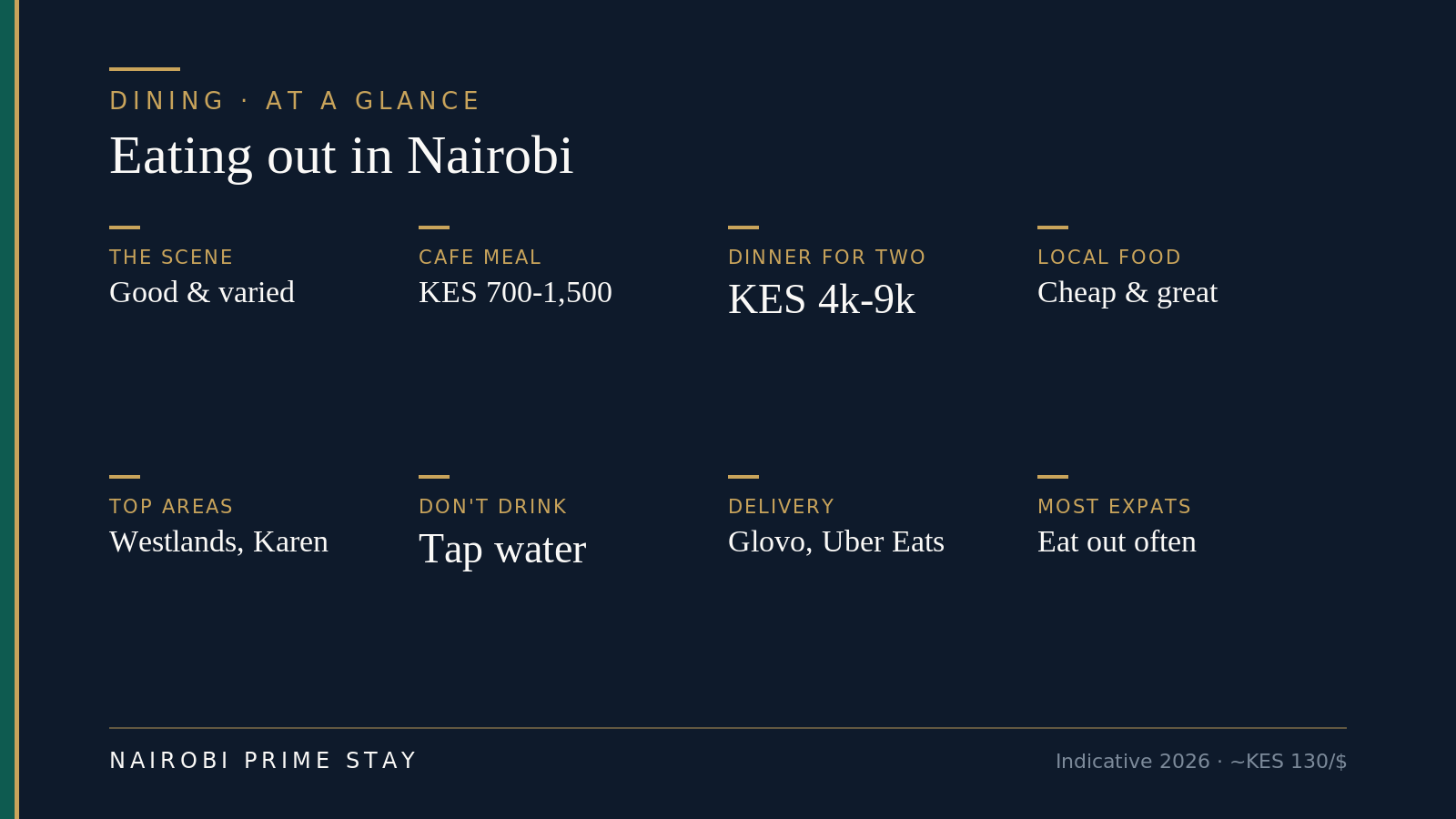
Nairobi has a genuinely good, varied restaurant scene, and it is cheaper than a big US city for the same quality. A casual café meal runs about KES 700–1,500 (roughly $5–12), a mid-range dinner for two with drinks often KES 4,000–9,000 ($30–70), and a proper fine-dining night maybe KES 4,000–8,000 a head. Local food — nyama choma (grilled meat), ugali, fresh tilapia, Swahili-coast dishes — is delicious and inexpensive; the city also has strong Indian, Ethiopian, Italian, Japanese, and international options. The liveliest areas are Westlands and Kilimani (variety, buzz), Karen (upscale, garden settings), and Gigiri (international, near the UN). The one real rule: don’t drink the tap water, and ease into street food while your stomach adjusts. Prices are as of 2026 at roughly KES 129.4 to the dollar (1 July 2026) — confirm current menus, as they move.
Why this matters when you’re settling in
Where and how you eat shapes your first months more than you would think. Eating out is one of the easiest, cheapest pleasures here, so it becomes a big part of your social life — friendships form over long lunches and choma. It is also a daily budget line you can control: cook at home and Nairobi is very affordable; eat at imported-heavy fine-dining spots nightly and it adds up like anywhere. Knowing the scene early means you eat better, spend smarter, and meet people faster. For the wider budget picture, see our Nairobi cost of living guide; this piece zooms in on the table.
The food scene: better than you expect
Nairobi’s restaurant scene is one of the most pleasant surprises of moving here. A few things make it good. The city has a large, long-established international community — UN agencies, embassies, NGOs and regional head offices — so demand for global food is real and the supply has grown to meet it. Kenya’s South Asian community goes back generations, which is why the Indian food is authentic and excellent, not an afterthought. The climate and altitude mean fresh produce, herbs and superb coffee are local. And Kenyans love eating out, so the city has everything from roadside grills to white-tablecloth dining.
What does that mean on a normal week? You can have nyama choma at a loud open-air joint on Friday, a long garden lunch in Karen on Saturday, dosa in Parklands on Sunday, and sushi or a steak in Westlands midweek. There is good Ethiopian, Italian, Lebanese, Thai, Chinese, Brazilian-style churrasco, French-leaning bistros, burger joints, vegan cafés, and rooftop bars with small plates. The coffee deserves its own mention: Kenya grows some of the world’s best beans, and the café culture — local chains and independent roasters alike — is genuinely good.
Is it perfect? No. Top-end fine dining is thinner than in a major Western capital, imported ingredients (good cheese, wine, some seafood) carry a markup, and service can be relaxed in a way that takes adjusting to. But for everyday eating and most special occasions, you will be well looked after and pleasantly surprised by the bill.
What dining out costs in 2026
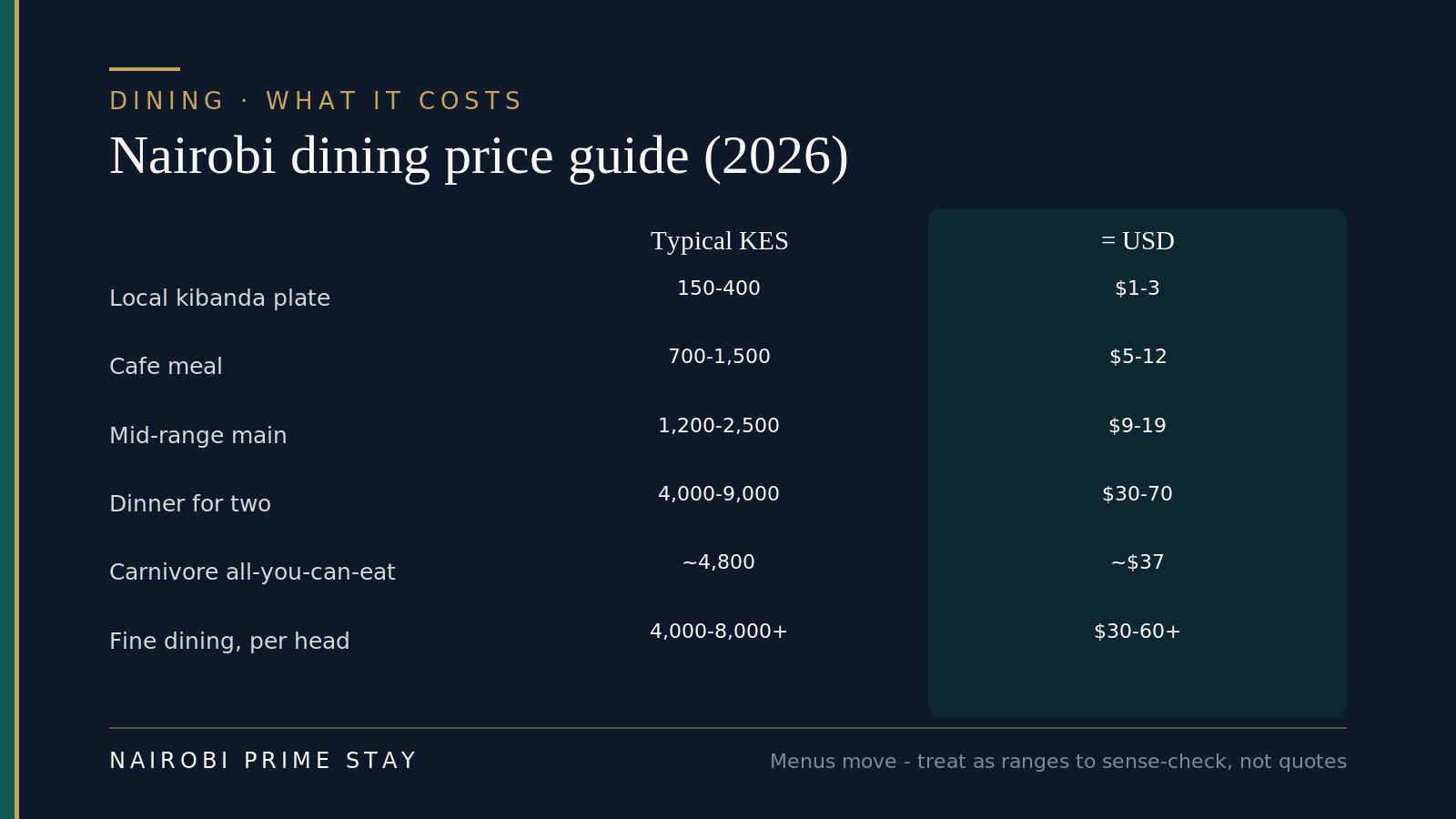
Eating out in Nairobi is cheaper than in a comparable US city, especially for local and casual food. Imported wine and high-end international restaurants narrow the gap, but you can eat very well for very little if you lean local. Here is a realistic price guide as of 2026, at roughly KES 129.4 to the US dollar (1 July 2026); see our USD/KES currency guide for how the rate moves. Menus move, so treat these as ranges to sense-check, not quotes.
| What you’re buying | Typical price (KES) | ≈ USD |
|---|---|---|
| Street / local “kibanda” plate (ugali, greens, stew) | 150–400 | $1–3 |
| Mandazi or samosa, each | 50–280 | under $2 |
| Cappuccino at a café | 290–400 | $2–3 |
| Casual café meal (Java House-style) | 700–1,500 | $5–12 |
| Fast-food combo (KFC, Burger King) | ~700 | ~$5 |
| Local nyama choma meal with sides and a drink | 800–2,000 | $6–15 |
| Mid-range restaurant main course | 1,200–2,500 | $9–19 |
| Mid-range dinner for two, with drinks | 4,000–9,000 | $30–70 |
| Carnivore all-you-can-eat, per person | ~4,800 | ~$37 |
| Fine dining, per head with wine | 4,000–8,000+ | $30–60+ |
| Bottled water, 500ml from a shop | 50–100 | under $1 |
| Cold Tusker beer in a bar | 250–400 | $2–3 |
A few honest notes on the numbers. Drinks are where bills climb: a couple of imported-wine glasses can cost more than the food. Many mid-to-upscale restaurants add a service charge of around 10% to the bill, so check before you tip again — more on that below. And a typical expat household spends somewhere around $150–400 a month on dining and leisure combined, depending on how often you eat out; the cost of living guide breaks the whole budget down.
Kenyan food worth knowing
Start local. Kenyan food is hearty, fresh and built around grilled meat, maize, greens and beans, with a Swahili-coast tradition that brings in coconut, spice and seafood. Here is what to order so you don’t just default to the international menu.
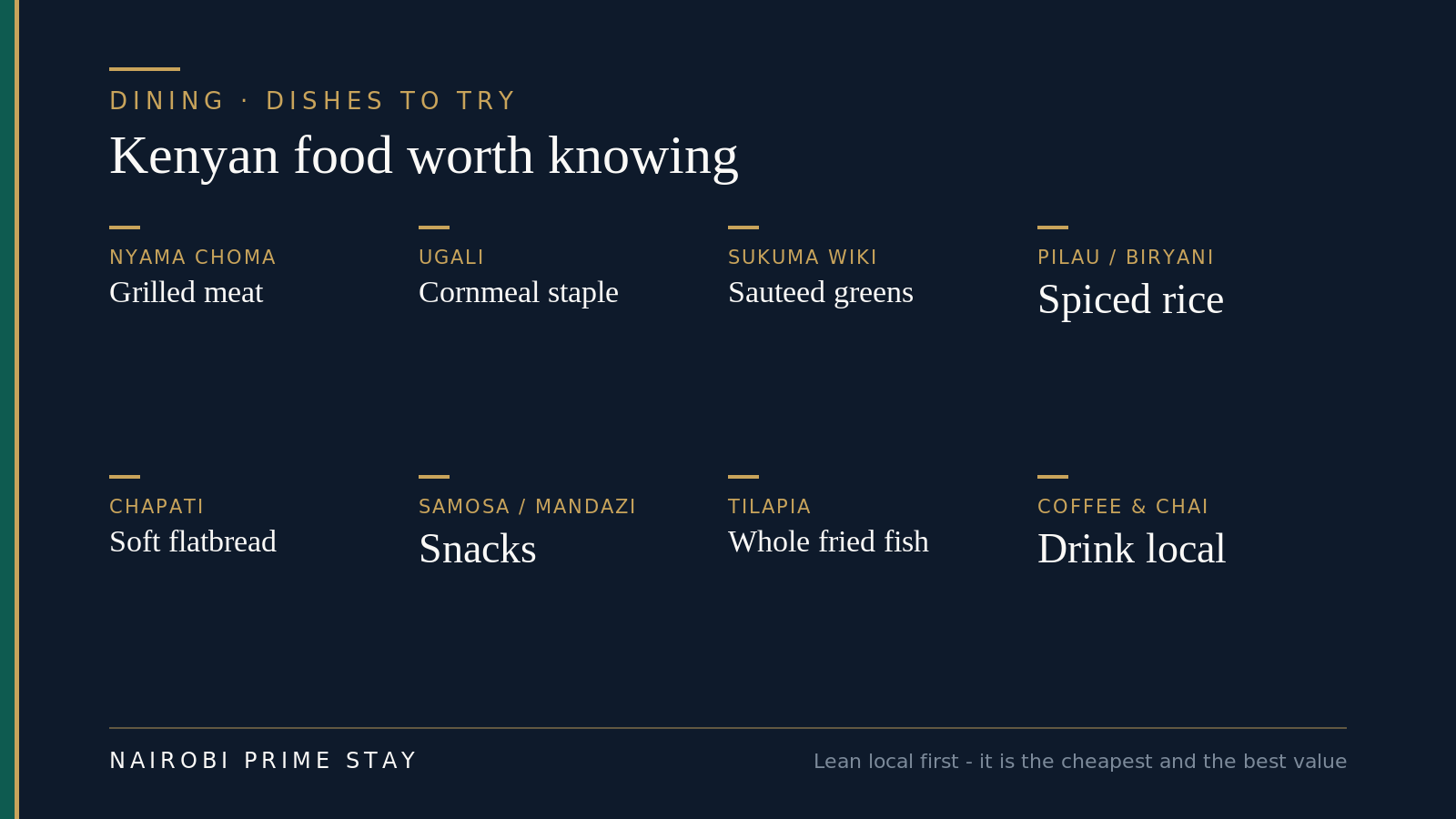
Nyama choma is the national love language — slow-grilled meat, usually goat or beef, sold by weight and eaten with your hands, with a side of ugali and kachumbari. It is social food: you order a kilo or two, it comes to the table on a board, and everyone digs in. Ugali is the staple, a firm cornmeal cake you pinch and use to scoop. Sukuma wiki (sautéed collard greens) and kachumbari (a fresh tomato-onion-chili salad) are the usual sides.
Beyond the grill: pilau and biryani are fragrant spiced-rice dishes from the coast; chapati is a soft, flaky flatbread Kenyans adore; githeri (maize and beans) and mukimo (mashed greens, potato and corn) are home-style classics; and samosas and mandazi (a lightly sweet fried dough) are the everyday snacks. Don’t miss whole fried or grilled tilapia — Mama Oliech in the Hurlingham area built a national reputation on it, and it is the kind of place visiting presidents and tech founders have eaten. To drink, try fresh passion or tamarind juice, chai (sweet milky tea), or a cold Tusker, the local lager.
A note on where to find the real thing: for nyama choma, locals head to dedicated grills rather than hotel restaurants. Carnivore, off Langata Road near Wilson Airport, is the famous all-you-can-eat version — touristy and pricey at around KES 4,800 a head, but a fun one-time experience. For everyday choma, neighborhood joints in places like Kilimani, Hurlingham and Lang’ata do it better and cheaper; Ashaki Grill (Kilimani) and Roadhouse Grill (Hurlingham) are long-running favorites. Ask a Kenyan colleague where they go — that’s how you find the best ones.
Every cuisine you’ll actually find
Nairobi is more international at the table than most newcomers expect. A quick tour of what’s here and reliably good:
- Indian is a genuine strength, thanks to a community that goes back over a century. Parklands and Westlands are the heartland — North Indian, South Indian dosas, Gujarati thalis, the lot. This is some of the best Indian food you’ll eat outside India.
- Ethiopian is excellent and affordable: injera with spiced stews, communal platters, strong coffee ceremonies. Several long-standing spots cluster around Kilimani and Hurlingham.
- Italian runs from wood-fired pizza to proper trattorias; pizza and pasta are everywhere and usually good.
- Japanese and sushi have grown fast in Westlands and the malls, with a few serious sushi rooms.
- Lebanese and Mediterranean, Thai, Chinese, Korean and Brazilian-style churrasco are all represented, mostly in Westlands, Kilimani, Karen and the bigger malls.
- Cafés and brunch are a way of life. Local chains like Java House (reliable, mid-priced, everywhere) and the more upscale Artcaffe (café-bakery-bar, usually in malls) are the safe defaults; independent coffee roasters do the serious beans.
- Vegetarian and vegan options are easy — partly thanks to the Indian influence, partly a growing health-conscious scene — and most menus mark plant-based dishes clearly.
If you’re missing a specific American comfort — good burgers, ribs, brunch, craft beer — Nairobi has versions of all of them. What’s harder to find or expensive is top-tier imported cheese, certain cuts of beef, and a deep wine list at a reasonable price.
Where to eat, by area
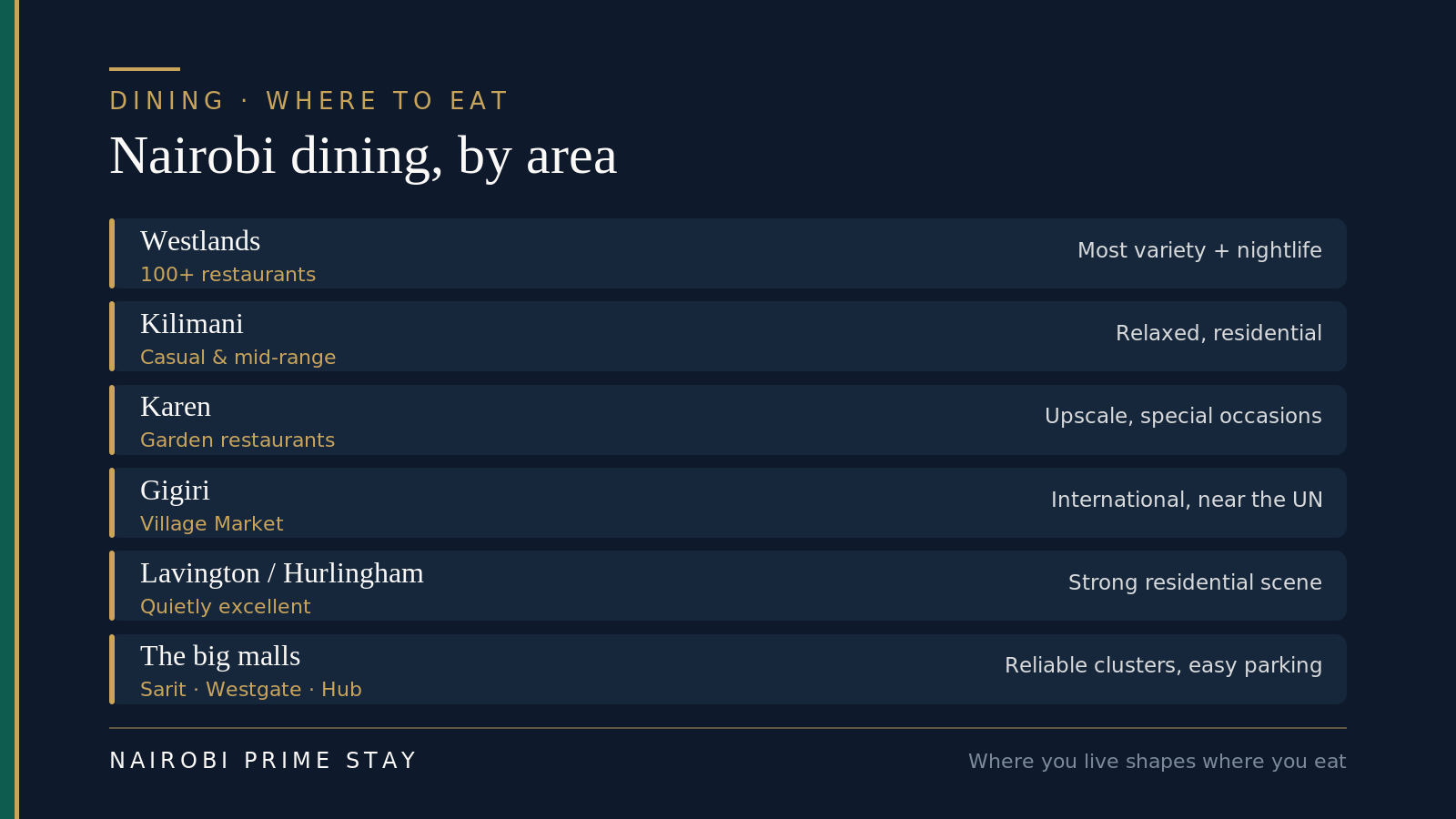
Nairobi’s dining clusters by neighborhood, and where you live shapes where you eat. The four areas most newcomers gravitate to:
Westlands is the engine room — easily 100-plus restaurants packed into a small, walkable-ish core, covering every price point and cuisine, and it rolls straight into the city’s busiest nightlife. If you want the most choice and the most buzz, this is it. See our Westlands neighborhood guide for the full picture.
Kilimani sits just south and is more relaxed: a strong mix of casual and mid-range spots, good choma joints, Ethiopian, cafés and a younger, residential feel. It’s where a lot of remote workers and young professionals end up eating most nights. More in the Kilimani guide.
Karen is the upscale, leafy end of the scene — garden restaurants, long weekend lunches, and special-occasion dining under big trees. Talisman is the classic here: creative plates, local ingredients, a beautiful garden, and the place people book for a celebration. It’s a drive from the center, but worth it. See the Karen guide.
Gigiri revolves around the international community near the UN headquarters. The Village Market complex anchors it, with a food court, international restaurants and a weekend Maasai market, and the surrounding area skews global and family-friendly. Our Gigiri guide covers it for UN and embassy staff.
Beyond these, Lavington and Hurlingham have a quietly excellent residential dining scene, the CBD is better for lunch than dinner, and the big malls — Sarit, Westgate, The Hub, Two Rivers — each hold a cluster of reliable restaurants. For the shopping and grocery side of all this, see our guide to Nairobi’s malls, markets and supermarkets.
Honest categories instead of a stale top 10
Rather than a list that’s out of date the day it’s published, here’s how to think about Nairobi dining by occasion. Slot your own discoveries into these.
- Your everyday café. Find one near home for coffee, brunch and a laptop hour. Java House and Artcaffe are the dependable chains; an independent roaster is the upgrade. This becomes your second living room.
- The choma institution. A loud, social, hands-and-board nyama choma joint for Friday nights with friends. Every Nairobian has one they swear by — ask around and adopt one.
- The special-occasion garden. A leafy Karen or Lavington restaurant for birthdays and visitors. Talisman is the famous one; there are several more.
- The authentic local plate. A no-frills spot for ugali, fish or githeri at local prices — the food that actually tastes of Kenya. Mama Oliech for tilapia is a rite of passage.
- The date-night international. Sushi, Italian or a good steak in Westlands when you want a proper night out without leaving the city.
- The mall fallback. When you can’t decide, a mall food cluster gives everyone in the group a different cuisine under one roof. Reliable, air-conditioned, easy parking.
Build out these six and you have the city covered. The rest is happy accident.
Food safety: the honest basics
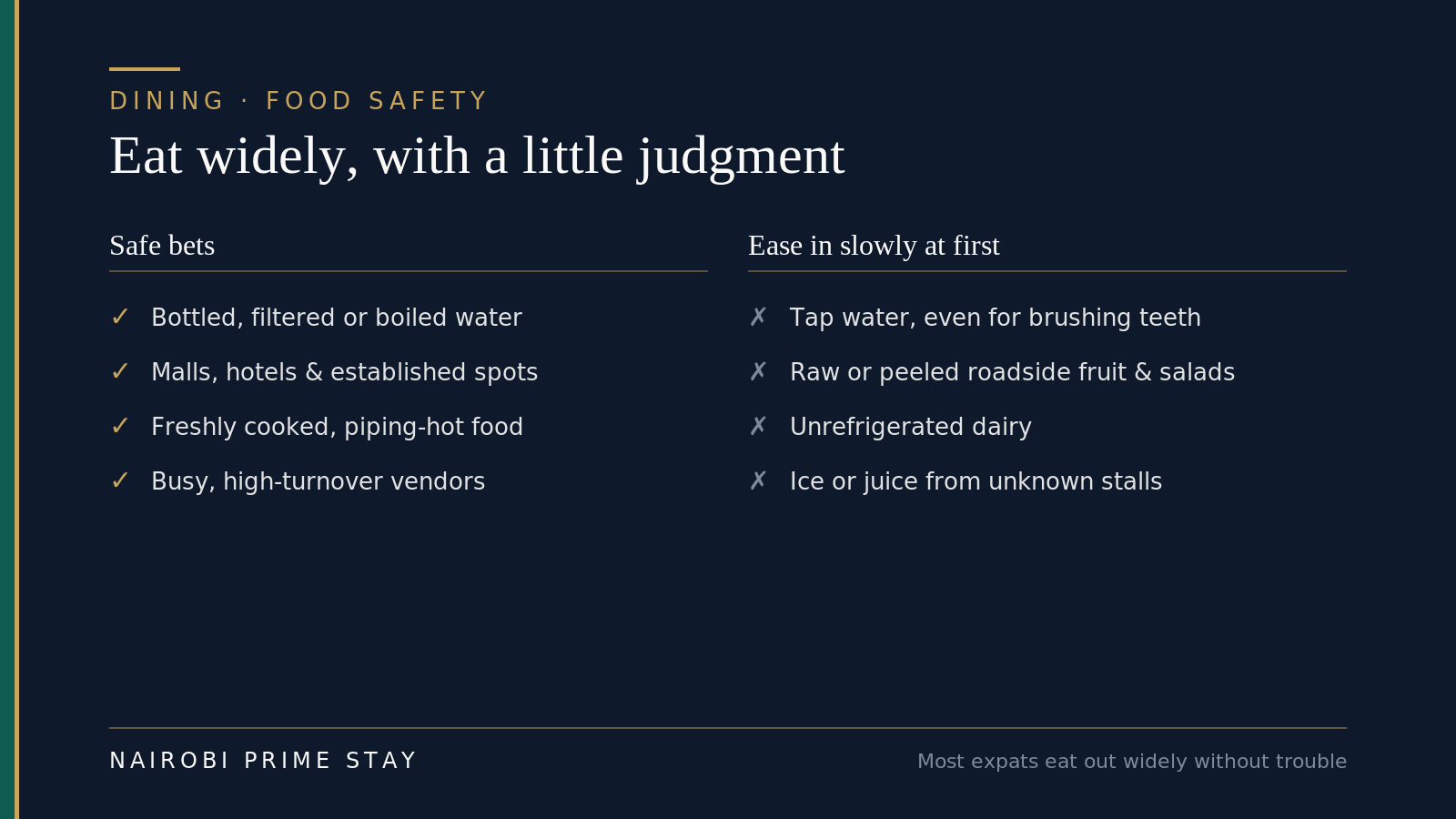
Most expats eat widely in Nairobi without trouble, and you will too — but a few simple habits, especially in your first weeks, save you from the classic newcomer’s stomach upset.
The one firm rule: don’t drink the tap water. Nairobi’s tap water isn’t reliably safe for drinking, so stick to bottled, filtered or boiled water. Most serviced apartments and good homes have a filter or a water dispenser; bottled water is cheap and everywhere. Brush your teeth with safe water too if you have a sensitive stomach, at least until you’ve settled in.
Beyond water, it’s mostly common sense. Malls, hotels and established restaurants are very safe — the kitchens are professional and the ice and salads are made with treated water. Street food can be genuinely good, and millions of Kenyans eat it daily, but it varies by vendor. The trick is to favor busy, high-turnover stalls where the food is freshly cooked and piping hot, and to be cautious with raw or peeled fruit, unrefrigerated dairy, and ice or juice from unknown roadside sources while your gut adjusts. Give yourself a couple of weeks to acclimate, carry oral rehydration salts just in case, and you’ll be fine. This isn’t a scary city to eat in — it’s a rewarding one, with a little judgment.
Tipping, service charge and the small stuff
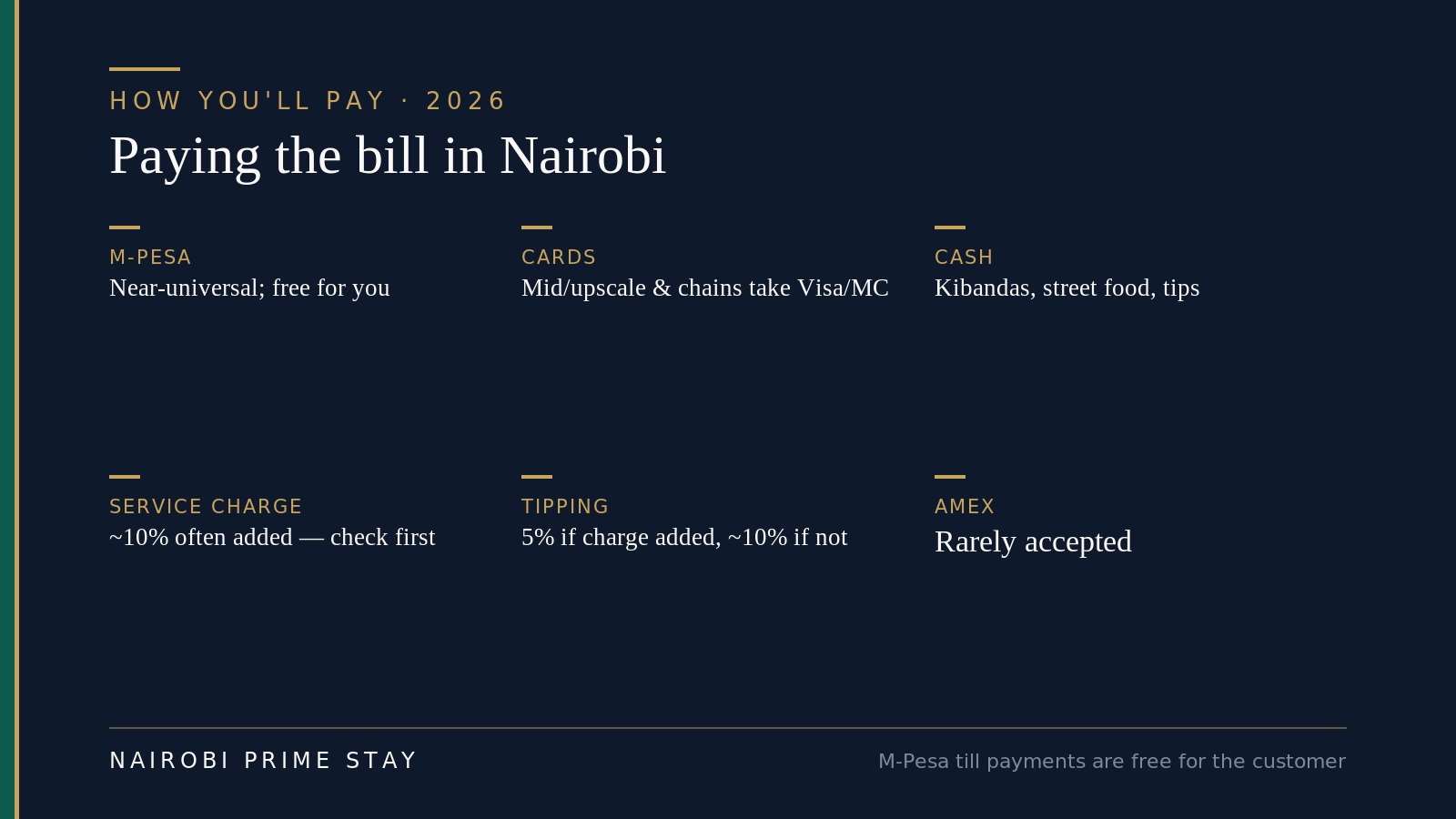
Tipping in Nairobi is appreciated but modest, and there’s one trap to know. Many mid-range and upscale restaurants already add a service charge of around 10% to the bill — so look before you tip. If it’s there, an extra 5% for good service is plenty; if it isn’t, around 10% is the norm for a sit-down meal. For a casual café or a local joint, rounding up or leaving KES 50–200 is fine. You don’t need to tip on a ride-hailing trip. Tip in cash, in shillings, where you can — it’s more likely to reach the staff. For the broader run-down of local customs, see our Nairobi culture and etiquette guide.
How to pay: M-Pesa, cards and cash
Most restaurants in Nairobi take M-Pesa, and it’s the smoothest way to pay. M-Pesa is Kenya’s mobile-money system — you load shillings onto your phone and pay a restaurant’s “till” (Buy Goods) number in seconds. It’s near-universal, from Java House to a roadside choma joint, and, helpfully, paying a till number is free for you as the customer. Restaurants print their till on the menu or the receipt; you type it in, enter the amount, confirm with your PIN, and show the confirmation SMS.
Cards work too, at a narrower set of places. The chains and most mid-range and upscale restaurants take Visa and Mastercard, though a few smaller spots are M-Pesa-or-cash only, and the odd card machine “isn’t working” on the night — so never rely on plastic alone. American Express is rarely accepted. Local kibandas and street vendors are cash or M-Pesa. Keep some small shilling notes for tips and tiny vendors.
The practical setup: get a local SIM and register M-Pesa in your first week — our M-Pesa guide walks through it — carry a card as backup, and hold a little cash. Bills are in shillings; the dollar figures in this guide move with the exchange rate, around KES 129.4 to the dollar on 1 July 2026 (see the USD/KES currency guide).
Eating out with dietary needs and allergies
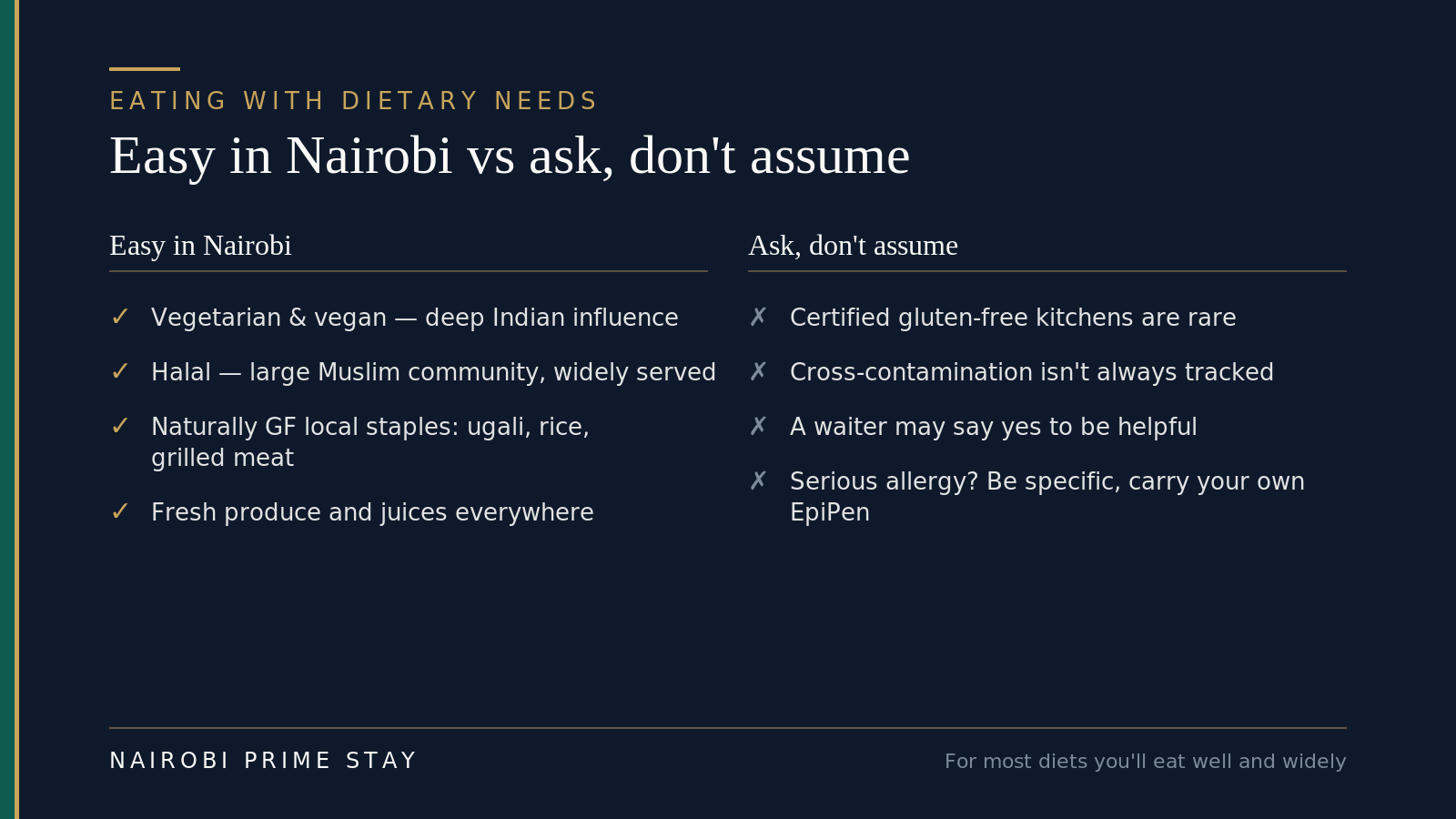
Nairobi is easy for vegetarians and manageable for most diets, with honest caveats for serious allergies. Vegetarian and vegan food is genuinely easy — the deep Indian influence means whole menus of meat-free dishes, and most modern cafés mark plant-based options clearly. Halal food is widely available: Nairobi has a large Muslim community and plenty of Somali and Swahili restaurants, and many mainstream places serve halal meat, though it’s worth asking if it matters to you. Naturally gluten-free local staples are everywhere too — ugali is maize, rice dishes and grilled meat are safe, githeri is maize and beans.
The honest part is dedicated dietary certification and serious allergies. Certified gluten-free kitchens and clearly labeled allergen menus are rare, so you’ll self-navigate rather than trust a “GF” stamp. And kitchens are less allergen-aware than you may be used to in the US: cross-contamination isn’t always tracked, and a waiter may say “yes, no nuts” to be helpful rather than certain. If you have a severe allergy, be specific and repeat it, ask what’s actually in a dish rather than whether it “has” your allergen, favor established restaurants over street stalls, carry your own epinephrine, and consider a written allergy card. For most people and most diets, though, you’ll eat well and widely.
Delivery and eating in
When you don’t feel like going out, food delivery is well developed in Nairobi. Apps like Glovo and Uber Eats cover most restaurants in the main residential areas, with delivery fees that are low by US standards. Supermarkets deliver groceries through the same apps, and many restaurants take orders directly on WhatsApp. If you’re in a serviced apartment with a kitchen, you get the best of both worlds — cook the cheap, fresh local produce on quiet nights, and order in or go out when you want the scene. It’s one reason a serviced apartment makes settling in so easy.
Booking a table, timing and the pace
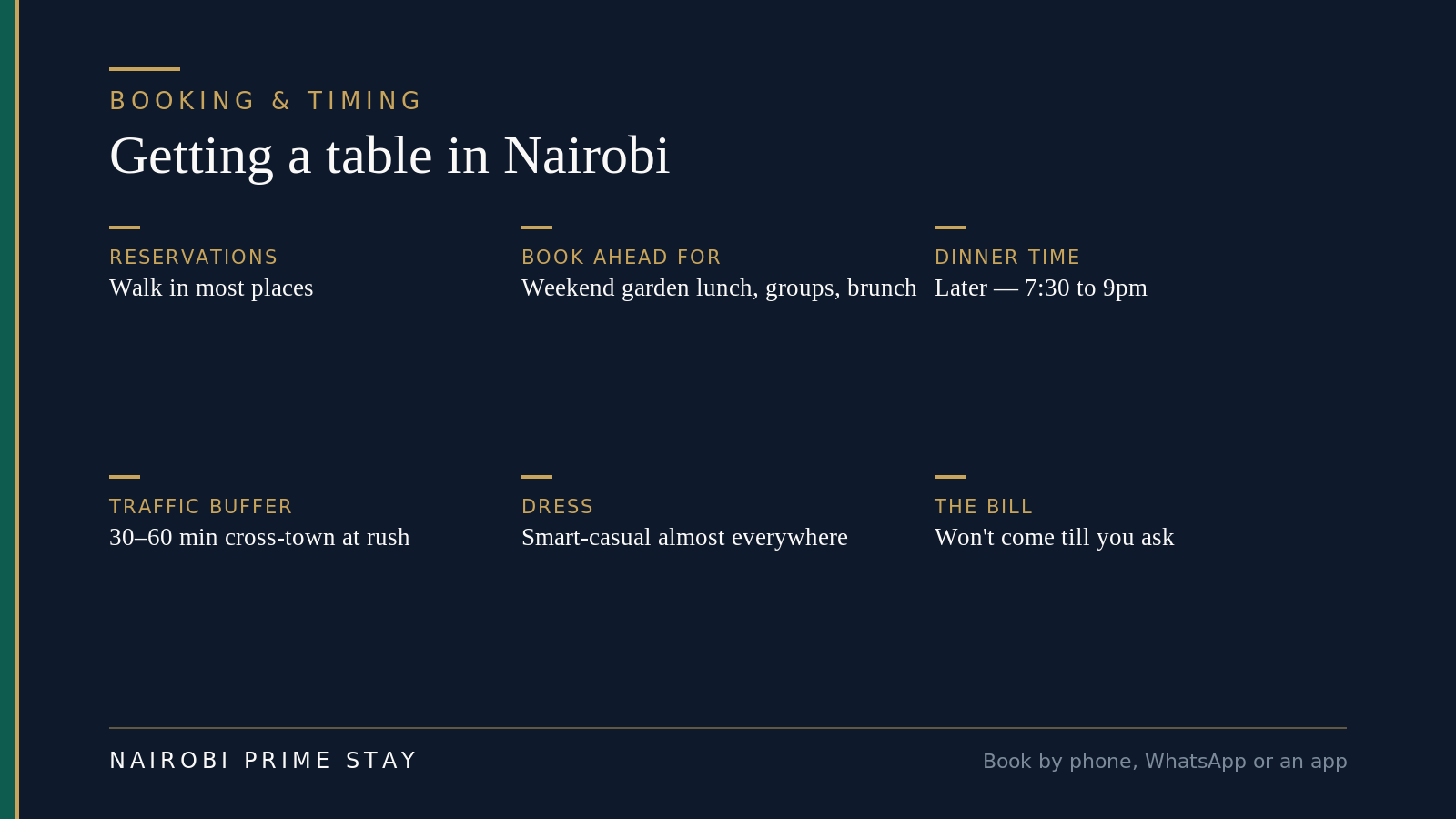
For most meals you can just walk in, but a few habits help. Reservations aren’t needed for casual cafés and everyday spots. They’re worth making for the popular garden restaurants at weekend lunch (Talisman and the Karen favorites fill up), for big groups, and for Sunday brunch, which Nairobi does with real enthusiasm. Book by phone, WhatsApp or, increasingly, an app.
Kenyans eat dinner on the later side — 7:30 to 9pm is normal — and lunch, especially at the weekend, is an unhurried event rather than a quick refuel. Build in traffic: a Karen or Gigiri dinner from Kilimani can be 30 to 60 minutes each way in the evening rush, so many people keep weeknight dinners local and save the cross-town garden lunch for a weekend when the roads are clear. Our getting around Nairobi guide covers the traffic honestly.
Two small things that catch newcomers out. Dress is smart-casual almost everywhere; only a handful of fine-dining rooms lean dressier. And service runs at a gentler pace than in the US — the check won’t arrive until you ask for it (“bill, please,” or “lete bill”), which is courtesy, not neglect. Most restaurants are relaxed and family-friendly, many with gardens where kids can roam, which is part of why those weekend lunches stretch so long. It’s a sociable, low-pressure scene, and a big part of how newcomers build a circle — see making friends and the expat community.
A realistic week at the table
Say you’re a remote worker who’s just moved to Kilimani. Monday to Thursday you mostly cook — fresh produce from the supermarket is cheap, and you’ve found a café two minutes away for morning coffee and the occasional working lunch, maybe KES 1,000 a time. Friday night a Kenyan colleague takes you to a choma joint; you order a kilo of goat, ugali and kachumbari, drink a couple of Tuskers, and the whole evening for two comes to around KES 2,500. Saturday you drive out to Karen for a long garden lunch with new friends — a proper sit-down with wine, closer to KES 4,000 a head. Sunday you’re tired, so you open Glovo and have Ethiopian delivered for KES 1,500. You’ve eaten extremely well all week, tried three cuisines, made two friends, and spent less than a single big night out would cost you back home.
Pros and cons of eating out in Nairobi
| The good | The honest tradeoffs |
|---|---|
| Excellent value, especially for local and casual food | Imported wine and high-end international dining carry a markup |
| Real variety — local, Indian, Ethiopian, Italian, Japanese and more | Top-end fine dining is thinner than in a major Western capital |
| Superb local coffee and a strong café culture | Service can be relaxed; pace is slower than in the US |
| Sociable scene that’s great for making friends | Tap water isn’t drinkable; street food needs judgment at first |
| Well-developed delivery (Glovo, Uber Eats) | Best spots cluster in a few areas, so traffic can shape your choices |
| Outdoor, garden and rooftop settings year-round | Restaurants open and close fast, so “best of” lists go stale |
A newcomer’s dining checklist
Do these in your first few weeks and you’ll feel like a regular fast:
- Find your everyday café near home for coffee and a laptop hour.
- Switch to bottled, filtered or boiled water and confirm your apartment’s water setup.
- Try nyama choma at a local joint — ask a Kenyan where they go, not just the famous tourist grills.
- Eat at Mama Oliech (or any solid local spot) for whole tilapia and proper Kenyan food.
- Have one Karen garden lunch and one Westlands night out to learn both ends of the scene.
- Install Glovo and/or Uber Eats for delivery, and save a couple of go-to restaurants.
- Check the bill for a service charge before you tip.
- Ease into street food: busy stalls, freshly cooked, piping hot.
- Ask neighbors and colleagues for their favorites — local word of mouth beats any list.
Final thoughts
Eating in Nairobi is one of the easy joys of living here. The food is better and cheaper than most newcomers expect, the variety is real, and the scene is sociable in a way that helps you settle. Lean local, drink safe water, take a little care with street food at first, and let neighbors point you to their favorites. Within a month you’ll have your café, your choma joint and your special-occasion garden, and the city will feel like home a lot faster for it.
Related reading
- Moving to Nairobi: the complete guide — the hub that ties all of this together.
- Cost of living in Nairobi — where dining fits in your monthly budget.
- Shopping, malls and markets in Nairobi — groceries, supermarkets and where to buy food.
- Nairobi nightlife and going out — where the evening goes after dinner.
- Westlands, Kilimani, Karen and Gigiri neighborhood guides.
- Is Nairobi safe? — the wider safety picture, including food and water.
Find your table faster
A serviced apartment is the easy way to land well — most come with a kitchen, filtered water, Wi-Fi and security, so you can cook the cheap local produce on quiet nights and explore the scene at your own pace. Browse our serviced apartments in Nairobi or see what’s available now. Not sure which neighborhood matches the way you like to eat and live? Our AI relocation assistant can shortlist apartments near the food scene you want, in a couple of minutes.
Frequently asked questions
What is the food like in Nairobi?
Better and more varied than most newcomers expect. Nairobi has excellent local food built around nyama choma (grilled meat), ugali and fresh greens, plus a strong Swahili-coast tradition, alongside a large international scene with very good Indian, Ethiopian, Italian, Japanese and cafe food. The coffee is some of the best in the world, since Kenya grows the beans. For everyday eating and most special occasions you will be well looked after, and at lower prices than a big US city.
Is eating out in Nairobi expensive?
No, it is generally cheaper than a comparable US city, especially for local and casual food. As of 2026 a casual cafe meal runs about KES 700 to 1,500 (roughly 5 to 12 dollars), a mid-range dinner for two with drinks around KES 4,000 to 9,000, and fine dining maybe KES 4,000 to 8,000 a head. Local food like nyama choma and ugali is cheaper still. Imported wine and high-end international restaurants are where the bill climbs.
What is nyama choma?
Nyama choma is Kenya’s beloved grilled meat, usually goat or beef, slow-cooked over charcoal and sold by weight. It comes to the table on a board and is eaten with your hands, with sides of ugali and a fresh tomato-and-onion salad called kachumbari. It is social, casual food, best enjoyed at a dedicated grill rather than a hotel restaurant. A hearty meal at a local joint with sides and a drink runs roughly KES 800 to 2,000 a head.
Where are the best areas to eat in Nairobi?
Westlands has the most variety and the busiest scene, with well over a hundred restaurants and the city’s main nightlife. Kilimani is more relaxed, with strong casual and mid-range options. Karen is the upscale, leafy end, known for garden restaurants and special occasions. Gigiri, near the UN, is international and family-friendly around the Village Market. Lavington, Hurlingham and the big malls round it out.
Can you drink the tap water in Nairobi?
No. Nairobi tap water is not reliably safe to drink, so stick to bottled, filtered or boiled water. Most serviced apartments and good homes have a filter or a water dispenser, and bottled water is cheap and everywhere. If you have a sensitive stomach, use safe water for brushing your teeth too, at least until you have settled in.
Is street food safe in Nairobi?
It can be, with a little judgment, and millions of Kenyans eat it daily. Favor busy, high-turnover stalls where the food is freshly cooked and served piping hot. Be cautious with raw or peeled fruit, unrefrigerated dairy, and ice or juice from unknown roadside sources while your stomach adjusts in the first weeks. Malls, hotels and established restaurants are very safe.
Do you tip at restaurants in Nairobi?
Yes, modestly, but check the bill first. Many mid-range and upscale restaurants already add a service charge of around 10 percent, in which case an extra 5 percent for good service is plenty. If there is no service charge, around 10 percent is the norm for a sit-down meal, and rounding up or leaving KES 50 to 200 is fine at a casual cafe. Tip in cash, in shillings, where you can.
What are the best restaurants in Nairobi?
There is no fixed top 10, because places open and close fast, so it is better to think by occasion. Carnivore is the famous all-you-can-eat nyama choma experience; Mama Oliech is the legendary spot for whole fried tilapia and Kenyan food; and Talisman in Karen is the classic garden restaurant for a special night. For everyday eating, the Java House and Artcaffe cafe chains are reliable, and the best local choma joints come from word of mouth. Ask Kenyan colleagues and neighbors for their current favorites.
Can you pay by M-Pesa or card at Nairobi restaurants?
Yes to both, but M-Pesa is the smoothest. Most restaurants, from chains to roadside grills, take M-Pesa mobile money, and paying a Buy Goods ‘till’ number is free for you as the customer. The chains and most mid-range and upscale places also take Visa and Mastercard, though some smaller spots are M-Pesa-or-cash only and American Express is rarely accepted. Register M-Pesa with a local SIM in your first week, carry a card as backup, and keep some small cash for tips and street vendors.
Is Nairobi good for vegetarians and people with food allergies?
Nairobi is easy for vegetarians and vegans, thanks to the deep Indian influence, and halal food is widely available. Naturally gluten-free local staples like ugali, rice and grilled meat are everywhere, though certified gluten-free kitchens are rare. The honest caveat is serious allergies: kitchens are less allergen-aware than in the US and cross-contamination isn’t always tracked, so if your allergy is severe, be specific, ask what’s actually in a dish, stick to established restaurants, and carry your own epinephrine.
Do you need to book a table at Nairobi restaurants?
Usually not — you can walk into most cafes and everyday spots. Reservations are worth making for the popular Karen garden restaurants at weekend lunch, for large groups, and for Sunday brunch, which is a big deal here. Book by phone, WhatsApp or an app. Kenyans eat dinner later (around 7:30 to 9pm), service is relaxed, and the bill won’t come until you ask, so allow extra time and leave a traffic buffer for anywhere cross-town.
Ready to look?
Find your apartment in Nairobi
Browse verified serviced apartments, or ask the AI concierge which area fits your life.