
Guides · Relocating
Kenyan Culture and Etiquette: A Newcomer's Guide for Americans (2026)
Kenyan Culture and Etiquette: A Newcomer’s Guide for Americans (2026)

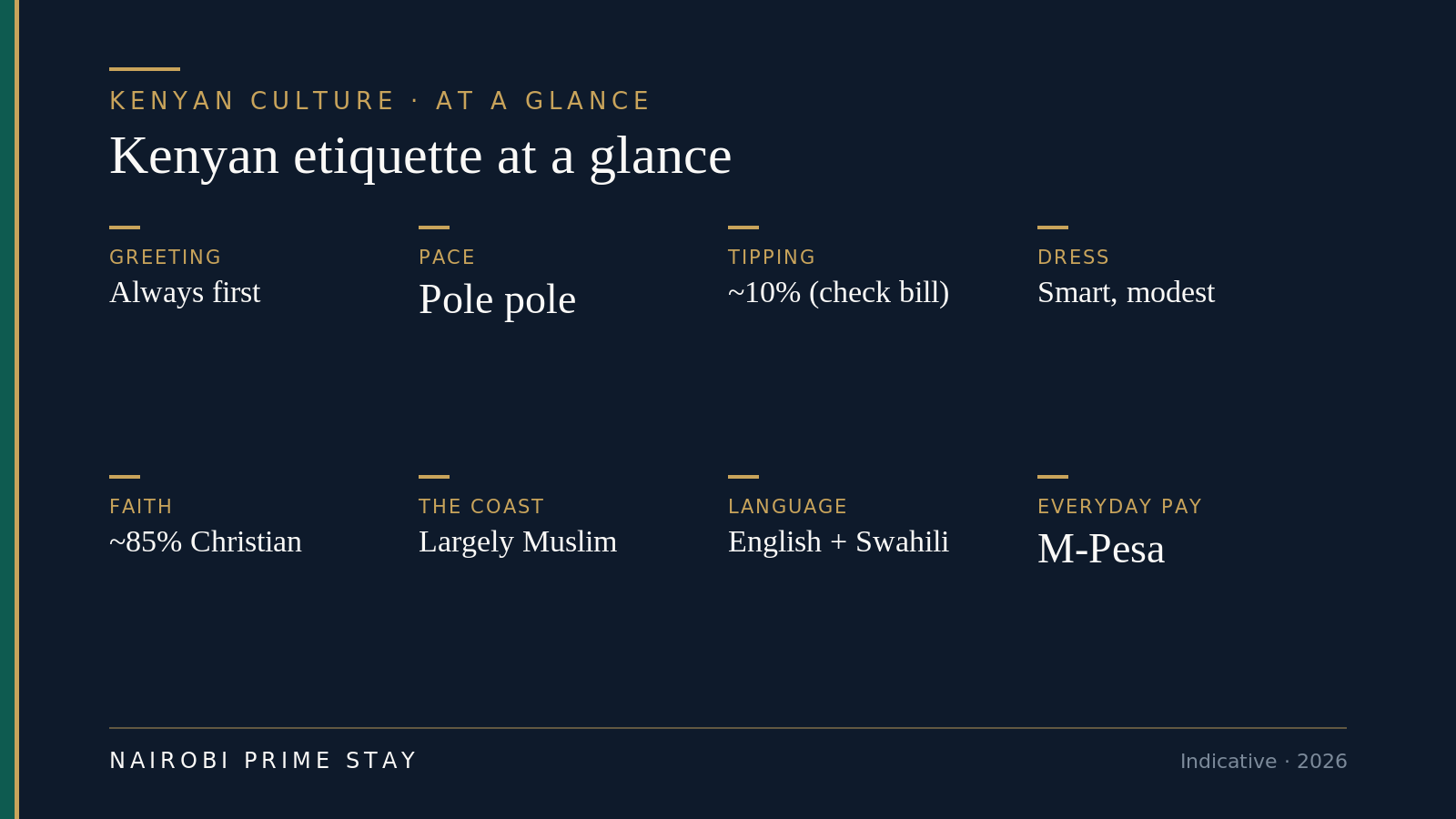
Kenyans are warm, polite, and genuinely welcoming to newcomers. The single most useful thing you can learn before you arrive is this: greet people first, always. Nairobi runs on relationships, and a relationship starts with a proper hello. Get that one habit right and most other things fall into place.
This guide is for Americans moving to Nairobi who have never lived in Kenya. By the end you’ll know how to greet, how the local sense of time works, how much to tip, how to dress, the place of faith in daily life, how business gets done, and the small handful of faux pas worth avoiding.
Here’s the reassuring part. English is everywhere, Kenyans are quick to forgive an honest mistake, and nobody expects you to arrive fluent in local custom. You don’t need to walk on eggshells. A little awareness, offered with a smile, carries you a long way.

The quick answer (TL;DR)
Kenyan culture is warm, social, and built on respect: respect for elders, for hospitality, and for taking the time to greet. Lead with a handshake and a “how are you,” dress smart and modest, use your right hand, and tip around 10% (check the bill for a service charge first). Be patient when things move pole pole (slowly). Faith matters to most Kenyans, so keep religion respectful. Avoid flaunting wealth, losing your temper, photographing people without asking, or wading into politics and ethnicity. Do that, and you’ll settle in faster than you’d expect.
Why this matters for your move
Culture is the part of relocation people under-prepare for. You can sort the visa, the apartment and the school run, then trip over the small daily stuff: rushing a shopkeeper, missing a greeting, misreading “I’m coming” as a promise of speed.
None of it is hard. But getting it right early changes how people treat you. Greet your building’s guard properly on day one and you’ve made a friend who looks out for you. Stay calm and warm in a slow queue and you’re the easy expat, not the difficult one. The payoff for a little effort here is outsized.
Greetings come first — the one habit to master
In Kenya, you greet before you do anything else. Before you ask a guard a question, before you order coffee, before you start a meeting: you say hello and you ask how the person is. Skipping it to “save time” reads as cold, even rude. Slowing down for it is the warmest thing you can do.

A normal greeting goes like this. Smile, make eye contact, and shake hands. Ask “Habari?” (literally “news?”) or just “How are you?” The standard reply is “Mzuri” (good) or “Poa” (cool, in the cities). Then, often, you ask about their family or their day before you get to the point. With an elder or someone senior, a slightly longer, more deferential greeting is a sign of respect, and you’ll sometimes see people support their right forearm with the left hand as they shake.
Two small things Americans notice. Handshakes can linger longer than you’re used to, sometimes through a whole sentence or two, and that’s normal warmth, not a power move. And friends often greet with a long catch-up even when they’re in a hurry. Let it happen. A few seconds of “how are you, how’s the family” is the social glue of the whole place.
”Pole pole” — a different sense of time
Kenya runs at a gentler pace than the US, and pole pole (slowly, slowly) is almost a national motto. Things take the time they take. A plumber who says “I’m coming” may mean within the hour or later this afternoon. Lunch with friends drifts. Patience isn’t optional here; it’s the skill that keeps you sane.
Draw a line, though, between social time and professional time. In corporate Nairobi, with banks, law firms, schools, international organizations and serious businesses, punctuality is expected and respected. Show up on time for meetings and appointments. The flexibility lives more in social plans, informal services and anything involving Nairobi’s traffic, which is the real reason half the city is “running a bit late.”
One genuine source of confusion: Swahili clock time. Traditional Swahili counts hours from dawn, so “saa moja” (hour one) is around 7am, not 1am. Most people will give you Western time in English, but if a fundi (handyman) or a market trader quotes you a Swahili hour, double-check. When in doubt, confirm the time the Western way.
Respect, elders and hierarchy
Age earns respect in Kenya, and it shows in small ways. An older man may be addressed as “Mzee” (a term of respect for an elder), an older woman as “Mama.” You greet the eldest person in a room first. You don’t call senior people by their first name until invited, and professional titles matter: a doctor is “Daktari” or “Doctor,” and “Mr.,” “Madam” or “Engineer” are used more readily than in casual America.
This carries into workplaces and officialdom too. Decisions often move up a hierarchy, so the person in front of you may not be the one who says yes. Pushing hard or going over someone’s head tends to backfire. Courtesy and patience get you further than seniority-blind American directness.
Tipping in Kenya — how much, and when
Tipping is appreciated but modest, and far less automatic than in the US. The headline number for restaurants is around 10%, and your first move is always to check the bill, because many restaurants, hotels and bars already add a service charge of about 10%. If it’s there, an extra tip is optional and only for genuinely good service. If it isn’t, 10% is a generous, normal thank-you.

Here’s the practical rundown:
| Situation | What’s normal |
|---|---|
| Sit-down restaurant | ~10% if no service charge is on the bill; check first |
| Café or casual eatery | Round up, or leave KES 50–200 |
| Uber / Bolt ride | Not expected; rounding up is a kind extra |
| Hotel porter / housekeeping | KES 100–200 |
| Safari guide / driver | ~$10–20 per day, more for excellent service |
| Petrol attendant, car wash, askari (guard) at the holidays | Small amounts, KES 50–200, optional but warmly received |
Two rules cover almost everything. Tip in Kenyan shillings, not dollars, because shillings are easier for staff to use. And tip for service that helped you, not out of guilt or obligation. Over-tipping to “be generous” can feel awkward and isn’t expected. As of 2026 these are customary ranges, not fixed rules, so use your judgment.
How to dress in Nairobi
Dress smart, neat and a little modest, and you’ll never be out of place. Kenyans, especially in Nairobi, take pride in looking put-together. Scruffy, overly casual or revealing clothing stands out more than you’d think. You don’t need to be formal day to day, but “tidy” beats “comfortable slob” every time.
A few specifics help. For business, dress as you would for a smart office in any major city: most professionals lean conservative and well-groomed. For church, people dress up. Outside the home, very short shorts or skimpy tops draw stares, particularly on women, and especially away from the malls and expat enclaves.
The coast is its own case. Mombasa, Lamu, Diani and the wider coastal region are largely Muslim, so cover your shoulders and knees in towns and villages, keep beachwear for the beach and the resort, and dress more conservatively than you might at a Western resort. It’s a small courtesy that’s noticed and appreciated.
Faith and religion in daily life
Kenya is a religious country, and faith is woven openly into daily life. Around 85% of Kenyans are Christian, spread across Catholic, Protestant, Evangelical and African-instituted churches, and roughly 11% are Muslim, concentrated on the coast and in the northeast (2019 census, the latest official figures). There are smaller Hindu, Sikh and Baha’i communities, mostly in Nairobi and Mombasa.
In practice this means Sunday is a big deal: many people are at church in the morning, and some businesses open late or stay quiet. Grace before a meal is common. People may ask which church you go to, or mention God in casual conversation; it’s friendly, not pushy, and a warm, neutral answer is fine. On the coast and during Ramadan, be considerate about eating, drinking or smoking in front of people who are fasting, and expect quieter daytime business hours. You don’t have to share anyone’s faith. Just treat it with the same respect you’d want for your own.
A little Swahili goes a long way
You can live comfortably in Nairobi on English alone; it’s an official language, the language of business and school, and it’s spoken everywhere. But a handful of Swahili words earns instant warmth, because it shows you’re trying. People light up when a newcomer says “Asante” properly.
Start with these: Habari (hello/how are you — what locals actually say; Jambo is mostly for tourists), Karibu (welcome, and you’ll hear it constantly), Asante (thank you), Asante sana (thank you very much), Tafadhali (please), Pole (sorry, for sympathy), Pole pole (slowly), Hakuna matata (no problem), Sawa (okay), and Hapana (no). In Nairobi you’ll also hear Sheng, a fast-moving street slang that mixes Swahili and English; you don’t need it, but you’ll pick up a few words. For a proper starter phrasebook and where to take lessons, see our guide to learning Swahili basics.
Kenyan English: phrases that don’t mean what you think
English in Kenya is fluent, expressive and full of local turns of phrase that trip up newcomers. Decoding a few of them early saves real confusion.
| You hear | It actually means |
|---|---|
| ”I’m coming." | "Wait here — I’ll be back at some point.” It is not a promise of speed. |
| ”You’re lost!" | "I haven’t seen you in ages!” — said warmly, not an insult. |
| ”Sawa” / “sawa sawa" | "Okay / fine / all good.” You’ll say it twenty times a day. |
| ”Mzungu” | A neutral word for a white or Western foreigner. Rarely hostile. |
| ”Pole" | "Sorry” — offered as sympathy for anything bad, even when the speaker is not at fault. Accept it graciously. |
| ”M-Pesa me" | "Send me the money by phone.” A verb now. |
| ”Alight” | To get off a bus or matatu. |
| ”How was the night?” | A normal morning greeting — just “did you sleep well?” |
The bigger adjustment is indirectness. Kenyans often soften a “no” into “we’ll see,” “I’ll try,” or a long pause, because a blunt refusal feels rude. If a plan keeps sliding without a firm yes, read that as a polite no and offer an easy way out. Doing the same in return — declining gently rather than flatly — is noticed and appreciated. For a starter phrasebook on the Swahili side, see our guide to learning Swahili basics.
Hospitality — being a guest in a Kenyan home
Kenyan hospitality is real and generous, and “Karibu” (welcome) is more than a word. If you’re invited to someone’s home, you’ll be fed, and usually well beyond what you expect. The polite move is to accept. Refusing food or tea (chai) outright can feel like a snub, so at least take a little, even if you’re not hungry.
Bring a small gift when you visit: pastries, fruit, a soda or juice, or something for the children. It needn’t be expensive; the gesture is what counts. Follow your host’s lead on shoes, as some homes are shoes-off. And if you host in return, feed people generously. Around weddings, funerals and fundraisers you may also encounter harambee, the Kenyan tradition of pulling together to contribute money for a shared cause. Being asked to chip in is normal and a sign you’re considered part of the community; give what’s comfortable.
Money, markets and friendly bargaining
Daily life runs on M-Pesa, the mobile-money system, far more than on cash or cards. You’ll pay for taxis, the market, your gardener and your rent from your phone. It’s worth setting up a SIM and M-Pesa early; our cost of living guide covers how everyday spending actually works.
On prices, know where to haggle. Supermarkets, malls and most established shops have fixed prices, so don’t bargain there. Open-air markets, curio and craft stalls (like the Maasai markets), and informal services are fair game for friendly negotiation. Keep it good-humored and smiling, never aggressive; it’s a social exchange, not a battle. Start below the asking price, settle somewhere in the middle, and walk away politely if it’s not working. As a foreigner you’ll sometimes get a “mzungu price” (a higher opening offer for a visibly non-local buyer); a calm counter and a smile usually sorts it out.
Business and work etiquette in Nairobi
Business in Kenya is built on relationships and trust, often more than on the deal itself. People want to know you a little before they work with you, so expect early meetings to start with greetings, small talk and tea or coffee before anyone gets to the agenda. Don’t rush that part; it is the work, in a sense.
The practical etiquette: dress smart and conservative, exchange business cards (offer and receive with the right hand or both hands), and use titles and surnames until invited to do otherwise. Be on time even if the other side runs late. Respect seniority in the room, and expect decisions to take time and pass up a hierarchy, so follow up politely in writing and stay patient. Hard-sell American directness can read as brash; warmth, reliability and good follow-through win here.
Working with household staff
This is one of the bigger cultural adjustments for Americans. Domestic help is normal and affordable in Nairobi, and many expat households employ a house help, a nanny, a gardener or a day guard. If you’ve never managed staff before, it can feel strange at first, but it supports local livelihoods and is woven into how middle- and upper-income homes run here.
Do it well and it’s a genuine relationship. Agree a fair wage and a written contract, register and contribute to statutory schemes, give reasonable hours and time off, provide tea and lunch, and treat people with the respect you’d want yourself. Greetings matter here too: start every day with a proper hello. Our domestic help in Nairobi guide walks through fair pay, contracts and the legal duties of an employer.
Sensitive subjects — handle with care
A few topics deserve a lighter touch, especially while you’re new and still reading the room.
Politics. Kenyans discuss politics passionately, but as a newcomer it’s wise to listen more than you opine, and to avoid taking sides. Feelings run high around elections, and there have been periods of protest in recent years. Stay out of demonstrations, follow local news, and see our is Nairobi safe guide for practical guidance on protests and staying clear of trouble.
Ethnicity. Kenya is home to more than 40 ethnic communities, and ethnicity (often called “tribe” locally) intersects with politics in ways that take time to understand. Don’t ask people which community they’re from as an icebreaker, and steer well clear of generalizations or jokes about any group. Let locals raise the subject if they choose to.
LGBTQ+ life. Be aware that same-sex relationships are criminalized under Kenyan law, and public attitudes are largely conservative, more so outside Nairobi’s cosmopolitan circles. There is a discreet community and some welcoming spaces in the capital, but public displays draw attention. LGBTQ+ newcomers should make informed decisions about discretion based on current, on-the-ground advice.
Wealth. Nairobi has real inequality, and quietly understating your means goes over better than flashing them. Keep expensive phones and jewelry out of sight in public (it’s also smart for safety), be gracious about what you have, and don’t complain loudly about prices that are low by US standards.
Everyday courtesies and common faux pas
Most of daily etiquette comes down to warmth, patience and a few small habits.
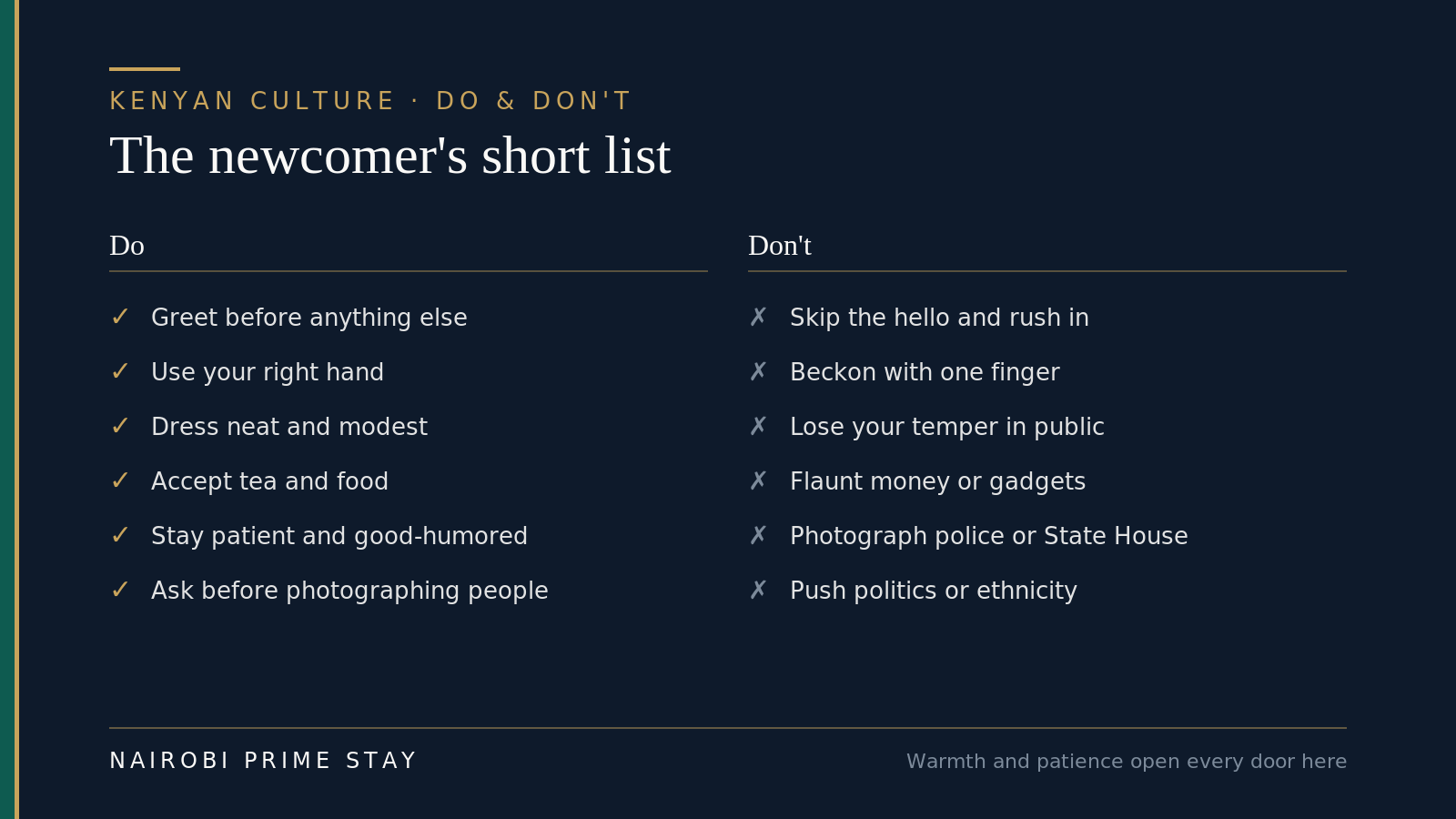
A handful of specifics worth knowing:
- Use your right hand to give, receive, eat and shake. The left hand is traditionally considered unclean, a habit strongest in Muslim and coastal settings, but good manners everywhere.
- Don’t beckon with one finger. To call someone over, wave with your whole hand, palm down. Pointing at people with a finger is rude; Kenyans often gesture with the chin or an open hand instead.
- Keep your cool. Losing your temper or shouting, even when something is genuinely frustrating, makes you lose face and respect. Calm persistence works; anger doesn’t.
- Go easy on public affection. Holding hands with a partner is fine; heavy public displays are frowned on, more so on the coast.
- Don’t misread hand-holding. Two male friends or two female friends holding hands is ordinary friendship here, not romance.
- Ask before photos, and never shoot officials. Always ask before photographing people (a small tip may be expected at markets or with Maasai elders), and never photograph police, the military, airports or State House.
- Mind queues and personal space. Lines can be looser than you’re used to, and personal space is a little closer. A friendly “excuse me” beats visible irritation.
How this plays out: a newcomer’s first week
Picture a couple who’ve just moved from Denver into a serviced apartment in Lavington. Day one, the husband walks past the building’s askari (guard) with a quick American “hey” and heads for the gate. By day three he’s learned to stop, shake hands, and ask “Habari? How’s the family?” The guard now waves their taxi through with a grin and keeps an eye on their car. Small effort, real payoff.
At the Saturday market, the wife is quoted KES 2,000 for a carved bowl. She smiles, says it’s lovely but a bit much, offers 800, and they settle at 1,200 with a laugh and a handshake. That evening a Kenyan colleague invites them to dinner. They bring a box of pastries and a juice for the kids, accept second helpings they didn’t really have room for, and leave having made friends. Nothing about it was complicated. It was just warmth, patience, and paying attention.
What changes from the US
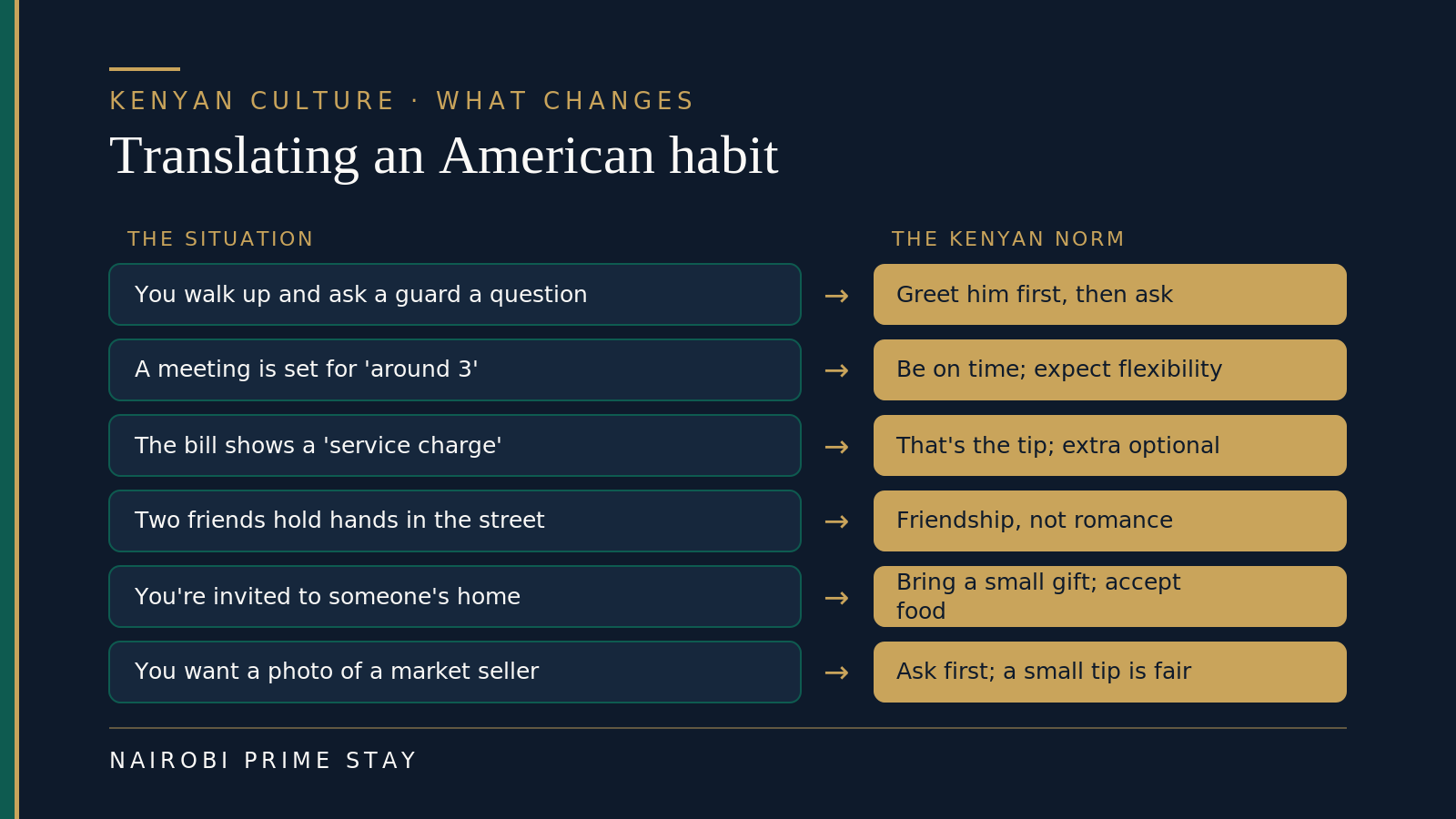
A quick translation of everyday American habits into the Nairobi version:
| In the US, you might… | In Nairobi, do this instead |
|---|---|
| Get straight to the point | Greet and ask “how are you” first, then talk |
| Expect everything on time | Be punctual yourself; allow flexibility socially and in traffic |
| Tip 18–20% by default | Tip ~10%, and check the bill for a service charge first |
| Dress very casually | Lean neat and a little modest, especially at the coast |
| Beckon with a finger | Wave with the whole hand, palm down |
| Photograph freely | Ask people first; never shoot police or State House |
| Debate politics openly | Listen more than you opine; don’t take sides |
| Hand things over with either hand | Use your right hand to give and receive |
What public holidays shape the year in Kenya? (2026)
Kenya has 12 gazetted public holidays in 2026, and they shape the social calendar more than newcomers expect. A holiday that falls on a Sunday is observed the following Monday, and the two Islamic holidays (Idd-ul-Fitr and Idd-ul-Azha) move with the lunar calendar and are confirmed by gazette notice a few days ahead — in 2026, Idd-ul-Fitr was gazetted for Friday 20 March.
| Date (2026) | Holiday | What it means for you |
|---|---|---|
| 1 Jan | New Year’s Day | Quiet city; many families still upcountry |
| 20 Mar | Idd-ul-Fitr | Gazetted late; date moves with the moon |
| 3 & 6 Apr | Good Friday & Easter Monday | Big church weekend; roads out of Nairobi jam |
| 1 May | Labour Day | Public rallies; most offices closed |
| 27 May | Idd-ul-Azha | Lunar date, gazetted ahead |
| 1 Jun | Madaraka Day | Marks internal self-rule (1963); national celebrations |
| 10 Oct | Mazingira Day | Environment day — tree-planting drives |
| 20 Oct | Mashujaa Day | Heroes’ Day; honours the independence struggle |
| 12 Dec | Jamhuri Day | Republic day (1964) — the big national day |
| 25 & 26 Dec | Christmas & Boxing Day | Nairobi empties as families travel upcountry |
Two practical notes. First, long weekends are when Nairobi goes on safari: parks, coast flights and good lodges book out, so plan Easter, Madaraka and Mashujaa trips early — our East Africa travel guide covers the classic long-weekend runs. Second, the December shutdown is real: from mid-December to early January, many businesses slow down, house staff travel to family upcountry (plan leave and a bonus around this — see domestic help in Nairobi), and the city’s social scene shifts to festivals and out-of-town parties. Traffic on holiday-weekend Fridays is some of the worst of the year; our guide to getting around Nairobi helps you plan around it.
The honest balance
Settling into a new culture is mostly a pleasure here, but it’s fair to know what takes adjustment.
| Easy to adjust to | Takes some getting used to |
|---|---|
| English everywhere, so you’re never stuck | Slowing down to greet before every interaction |
| Genuine warmth and quick friendliness | A looser sense of time outside formal settings |
| Forgiving locals who appreciate any effort | Managing household staff for the first time |
| Modest, simple tipping norms | Reading sensitive topics (politics, ethnicity) |
| A big, welcoming expat scene to lean on | Bargaining and the occasional “mzungu price” |
If the social side feels daunting at first, you’re not alone, and it passes fast. Our guide to building a social life in Nairobi covers how newcomers plug in and beat the first-month loneliness.
Your first-weeks etiquette checklist
- Learn five Swahili words before you land: Habari, Karibu, Asante, Pole pole, Sawa (locals greet with Habari or Mambo; Jambo marks you as a tourist).
- Greet your building’s guard and any staff properly, by name, from day one.
- Practice the full greeting: handshake, “how are you,” ask about family, then talk.
- Set up M-Pesa early so you can pay the way everyone else does.
- Default to your right hand for giving, receiving and eating.
- Check restaurant bills for a service charge before adding a tip; carry small shillings.
- Dress a notch smarter than you would at home; pack modest options for the coast.
- Ask before taking photos of people; never photograph officials or government sites.
- Listen, don’t opine, on politics and ethnicity while you find your feet.
- Say yes to invitations, bring a small gift, and accept the food and chai.
Final thoughts
Kenyan etiquette isn’t a test you can fail. It’s a set of warm, sensible habits that make daily life smoother and friendlier, and Kenyans are remarkably gracious with newcomers who try. Lead with a greeting, use your right hand, stay patient and humble, and treat faith, politics and ethnicity with respect. The rest you’ll absorb by watching and asking.
Give it a few weeks and the pole pole pace stops feeling slow and starts feeling like a gift. You’ll greet the guard, chat with the market seller, accept the third cup of chai, and realize you’ve stopped performing the culture and started living in it. That’s the moment Nairobi becomes home.
Related reading
- Moving to Nairobi: the complete guide for Americans — the hub that ties together visas, neighbourhoods, cost and your first 30 days.
- Learning Swahili: the basics that help — a starter phrasebook and where to take lessons.
- Building a social life in Nairobi — clubs, meetups and how newcomers find community.
- Domestic help in Nairobi — fair pay, contracts and being a good employer.
- Eating out in Nairobi — the dining scene, price ranges and where to go.
- Is Nairobi safe? — a balanced, practical look at safety, protests and everyday street sense.
Settling in, the easy way
The smoothest cultural landing starts with a calm base. A serviced apartment for your first few weeks gives you a secure, fully-equipped home while you learn the rhythm of the city, meet neighbours, and find your feet before signing a year-long lease. When you’re ready, browse our serviced apartments, or tell our AI relocation assistant your budget and neighbourhood and it’ll shortlist options in a couple of minutes.
Frequently asked questions
Do I need to speak Swahili to live in Nairobi?
No. English is one of Kenya’s official languages, it’s the language of business and school, and it’s spoken everywhere in Nairobi, so you’ll get by comfortably on English alone. That said, learning a few Swahili words earns real warmth, because it shows you’re making an effort. Start with Habari (hello/how are you — what locals actually say, rather than the touristy Jambo), Karibu (welcome), Asante (thank you) and Pole pole (slowly). People genuinely light up when a newcomer tries.
How much should I tip in Kenya?
Around 10% in a sit-down restaurant, but always check the bill first, because many restaurants and hotels already add a service charge of about 10%. If it’s there, an extra tip is optional. In cafes and casual spots, rounding up or leaving KES 50 to 200 (under $2 at the July 2026 rate of about KES 129 to the dollar) is plenty, and tipping isn’t expected for Uber or Bolt. Tip in Kenyan shillings rather than dollars, and tip for service that helped you rather than out of obligation.
What should I wear in Nairobi?
Smart, neat and a little modest. Nairobians take pride in looking put-together, so scruffy or very revealing clothing stands out. Day to day, smart-casual is fine; for business, lean conservative; for church, people dress up. On the coast, which is largely Muslim, cover your shoulders and knees in towns and keep beachwear for the beach.
Is it rude to skip greetings in Kenya?
Yes. In Kenya you greet before you do anything else, whether you’re talking to a guard, a shopkeeper or a colleague. Launching straight into a request without a hello and a ‘how are you’ reads as cold or rude. A proper greeting, a handshake, asking how someone is, then getting to the point, is the single most important habit to master and it changes how people treat you.
What are the most common cultural mistakes Americans make in Kenya?
The big ones are skipping the greeting and rushing into a request, using the left hand to give or receive, and losing your temper in public, which makes you lose respect rather than win the point. Others are flaunting expensive phones or jewelry, photographing people or officials without asking, and being impatient with the slower pace. None are unforgivable, and Kenyans are gracious about honest mistakes, but avoiding them helps you settle in faster.
How religious is Kenya, and do I need to share the local faith?
Kenya is quite religious and faith is openly part of daily life. About 85% of Kenyans are Christian and roughly 11% are Muslim, mostly on the coast and in the northeast, with smaller Hindu, Sikh and Baha’i communities. You don’t need to share anyone’s faith, but treat it with respect: Sunday is a church day, grace before meals is common, and on the coast and during Ramadan be considerate about eating or drinking in front of people who are fasting.
Can I take photos of people and places in Nairobi?
Ask people before you photograph them, and expect that at markets or with Maasai elders a small tip may be appreciated. Most people are happy to oblige once you’ve asked. The firm rule is never to photograph police, the military, airports or State House, as it can land you in real trouble. When in doubt, ask first or put the camera away.
Is it okay to discuss politics or ethnicity in Kenya?
Tread lightly, especially while you’re new. Kenyans discuss politics passionately, but as a newcomer it’s wiser to listen than to take sides, and feelings run high around elections. Ethnicity, often called ‘tribe’ locally, intersects with politics in complex ways, so avoid asking people which community they’re from as small talk and steer clear of generalizations. Let locals raise these subjects if they choose to.
What are Kenya’s public holidays in 2026?
Kenya has 12 gazetted public holidays in 2026: New Year’s Day (1 Jan), Idd-ul-Fitr (20 Mar), Good Friday and Easter Monday (3 and 6 Apr), Labour Day (1 May), Idd-ul-Azha (27 May), Madaraka Day (1 Jun), Mazingira Day (10 Oct), Mashujaa Day (20 Oct), Jamhuri Day (12 Dec), Christmas Day (25 Dec) and Boxing Day (26 Dec). A holiday falling on a Sunday is observed the following Monday, and the Islamic holidays move with the lunar calendar and are confirmed by gazette notice a few days ahead.
Is bargaining expected in Kenya, and where?
Only in the right places. Supermarkets, malls and established shops have fixed prices, so don’t haggle there. Open-air markets, curio and craft stalls like the Maasai markets, and informal services expect friendly negotiation: start below the asking price, keep it smiling and good-humored, and walk away politely if it’s not working. As a visible foreigner you may get a higher ‘mzungu’ opening price; a calm counter-offer usually settles it. It’s a social exchange, not a battle.
What does ‘I’m coming’ mean in Kenyan English?
It means ‘wait — I’ll be back at some point,’ not ‘I’ll be there in two minutes.’ Kenyan English is full of local phrases: ‘you’re lost’ is a warm ‘I haven’t seen you in ages,’ ‘sawa’ means okay, ‘pole’ is sympathy for any misfortune, and ‘M-Pesa me’ means send money by phone. Kenyans also soften refusals — ‘we’ll see’ or ‘I’ll try’ is often a polite no, so if a plan keeps sliding without a firm yes, read it that way and offer a graceful out.
Should I bring a gift when invited to a Kenyan home?
Yes, something small: pastries, fruit, juice or a treat for the children. It needn’t be expensive; the gesture is what counts. Expect to be fed generously and accept at least a little food and chai, since refusing outright can feel like a snub. Follow your host on shoes at the door. Around weddings, funerals and fundraisers you may be invited to join a harambee, Kenya’s tradition of chipping in for a shared cause; being asked is a sign you’re seen as part of the community, and you give what’s comfortable.
Ready to look?
Find your apartment in Nairobi
Browse verified serviced apartments, or ask the AI concierge which area fits your life.