
Guides · Relocating
Learning Swahili in Nairobi: The Basics That Actually Help (2026)
Learning Swahili in Nairobi: The Basics That Actually Help (2026)

Here’s the honest answer first: you do not need Swahili to live in Nairobi. English is one of Kenya’s two official languages, it’s the language of business, banking and school, and it’s spoken everywhere you’ll go. You can sign a lease, see a doctor, order dinner and run your whole life in English from day one.
But a handful of Swahili words will change how people treat you. Say “Asante” properly to the man who bags your groceries and you’ll get a real smile back. Greet your building’s guard with “Habari?” each morning and you’ve made a friend. The goal isn’t fluency. It’s warmth, and warmth here is cheap to buy and worth a lot.
This guide is for Americans moving to Nairobi who are starting from zero. By the end you’ll know exactly which words to learn first, how to say them, the difference between tourist Swahili and what locals actually say, and the best ways to pick up more if you catch the bug.

The quick answer (TL;DR)
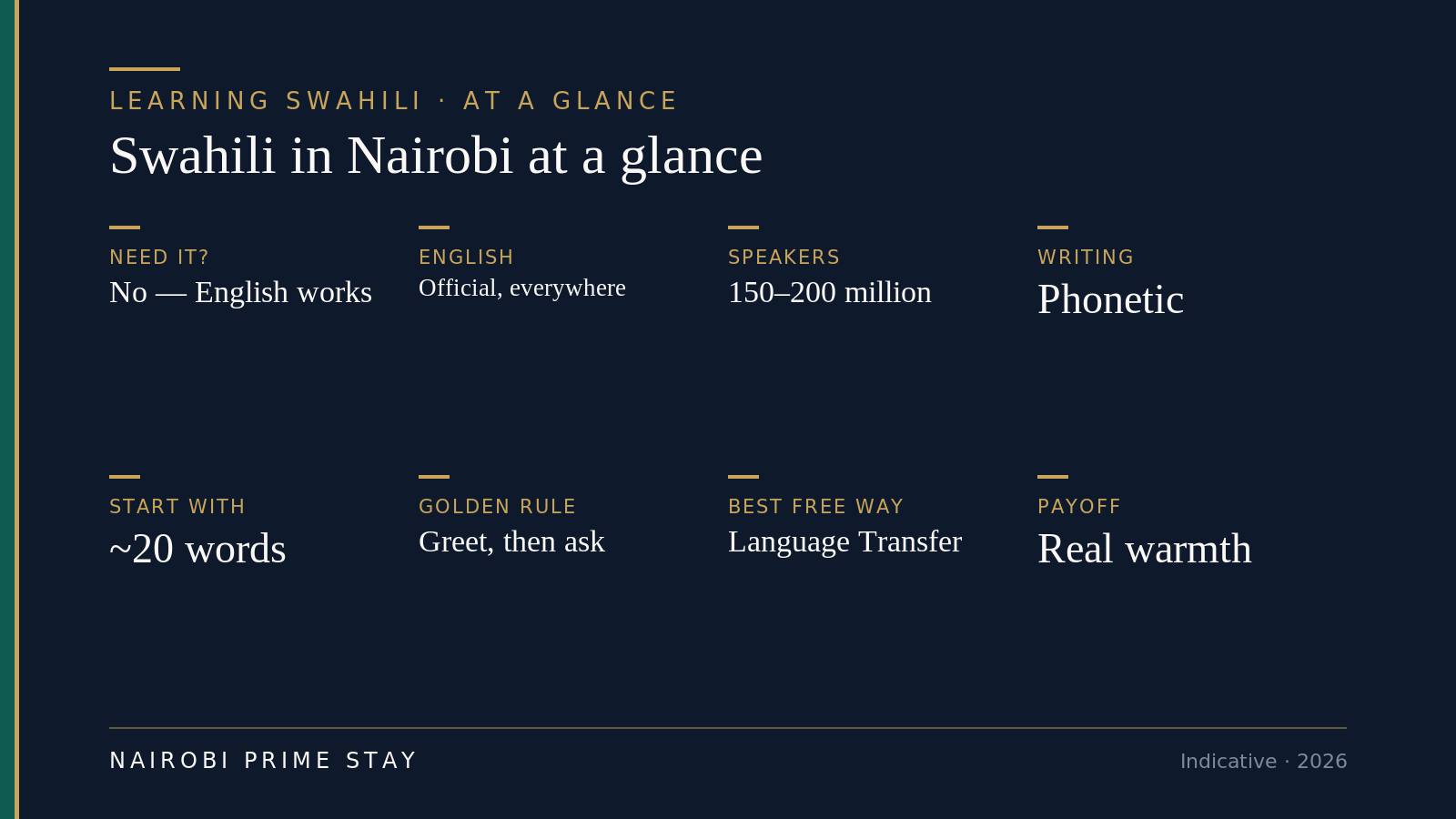
You can live comfortably in Nairobi on English alone, so treat Swahili as a kindness you offer, not a hurdle you have to clear. Learn maybe twenty words to start: greetings (Habari, Mambo, Karibu), courtesies (Asante, Tafadhali, Samahani, Pole), and a few practical ones (Bei gani? for “how much,” Maji for water, Sawa for okay). Pronunciation is easy because Swahili is phonetic, so you read it exactly as it’s written. Say “Habari?” rather than the touristy “Jambo,” lead with a greeting before any request, and you’ll already sound more local than most visitors. If you want to go further, Language Transfer and SwahiliPod101 are excellent and free or cheap, and a local tutor is affordable. Most expats land somewhere happy: enough Swahili to be polite and friendly, with English doing the heavy lifting.
Why bother, if everyone speaks English?
Because effort is the whole point. Kenyans don’t expect a single word of Swahili from a newcomer, so the small effort lands as genuine respect rather than obligation. It signals that you see the place as home, not a posting.
There’s a practical payoff too. The people who keep your daily life running smoothly, your guard, your house help, market traders, taxi drivers, the cleaner at the office, often feel most at ease in Swahili. Meeting them halfway, even badly, softens every interaction. Prices at the market come down a notch when you greet and haggle in a little Swahili. Directions get friendlier. You stop being just another mzungu (a foreigner, usually a white one) and become the neighbour who tries.
And Swahili is worth knowing on its own terms. It’s the lingua franca of East Africa, with somewhere between 150 and 200 million speakers across more than a dozen countries, an official working language of the African Union and the East African Community, and the first African language to get its own UN day (World Kiswahili Language Day, every 7 July). Learn a bit and it travels with you to the coast, to Tanzania, across the whole region.
So do you actually need Swahili in Nairobi?
No, and it’s worth being clear about that so you don’t arrive anxious. Nairobi is one of the easiest African capitals for an English speaker. Here’s the honest breakdown of where English carries you and where a little Swahili helps.
| Situation | English alone? | A little Swahili helps because… |
|---|---|---|
| Banking, visas, leases, paperwork | Completely fine | Everything official is in English |
| Work and business meetings | Completely fine | English is the language of professional Nairobi |
| International schools, hospitals | Completely fine | Staff and specialists work in English |
| Malls, supermarkets, restaurants | Completely fine | Menus and service are in English |
| Uber and Bolt | Fine | A greeting and “twende” (let’s go) warms up the ride |
| Open-air markets and street stalls | Workable | Greeting and bargaining in Swahili gets better prices |
| Your guard, house help, gardener | Workable | They’re often most comfortable in Swahili |
| Matatus and rural day-trips | Patchy | Swahili genuinely helps once you leave the expat bubble |
The pattern is simple. The formal, professional, expat-facing world runs on English. The informal, everyday, neighbourhood world runs more on Swahili (and, in Nairobi, on Sheng, which we’ll get to). You can live entirely in the first world if you want. Most people who are happiest here let a little of the second one in.
The twenty words that do most of the work
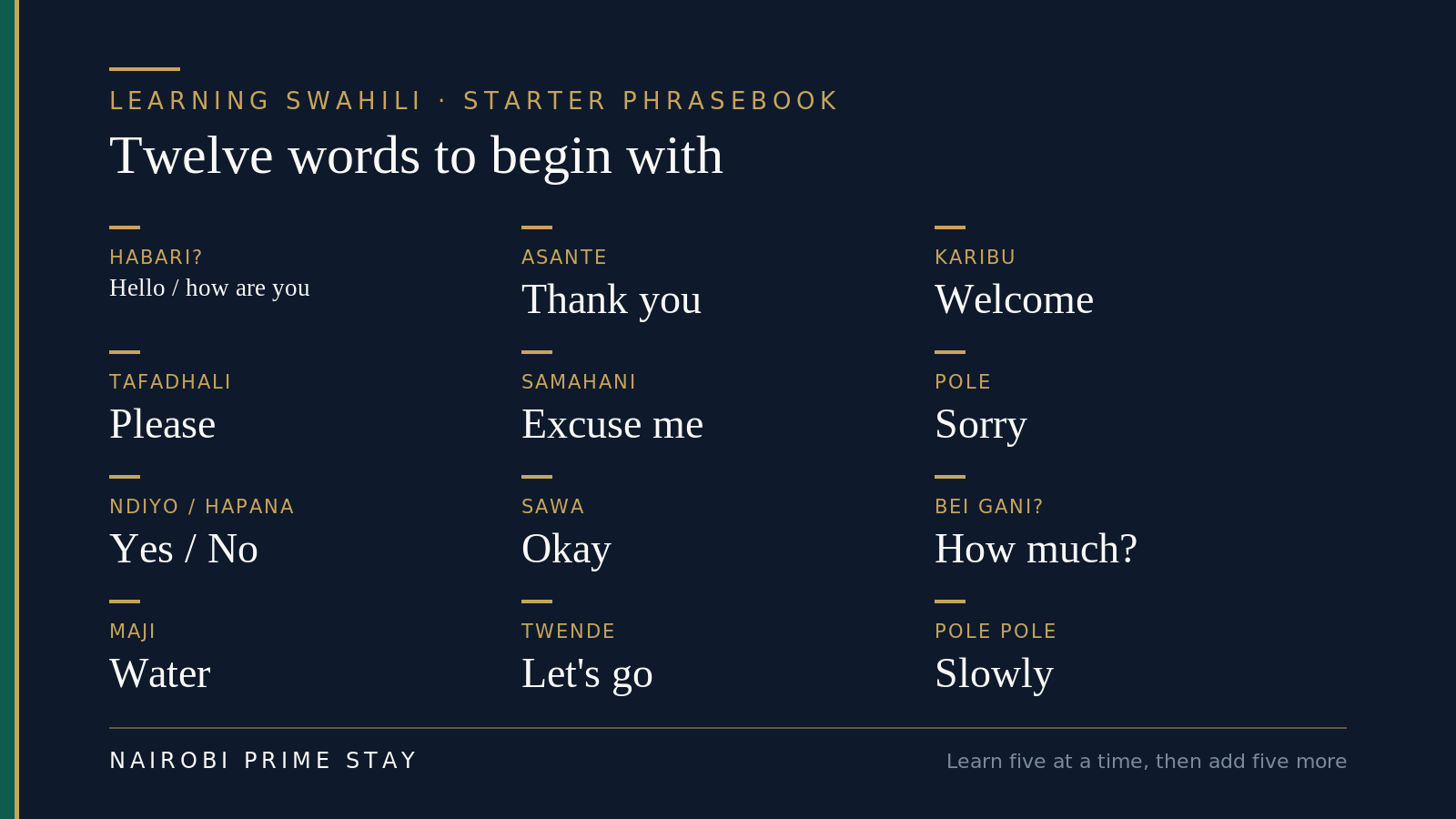
If you learn nothing else, learn these. They cover greetings, thanks, the polite words and a few daily essentials, which is 80% of what you’ll ever need as a friendly newcomer.
| Swahili | Meaning | When you’ll use it |
|---|---|---|
| Habari? | Hello / how are you? | The everyday greeting, to anyone |
| Mzuri | Good / fine | The standard reply to “Habari?” |
| Mambo? / Poa | What’s up? / Cool | Casual greeting and its reply |
| Karibu | Welcome / you’re welcome | You’ll hear it constantly |
| Asante (sana) | Thank you (very much) | Every transaction, every favour |
| Tafadhali | Please | Softens any request |
| Samahani | Excuse me / sorry | To get attention or apologise |
| Pole | Sorry (sympathy) | When someone’s hurt or had bad luck |
| Ndiyo / Hapana | Yes / No | Daily |
| Sawa | Okay / fine | Agreeing, confirming |
| Hakuna shida | No problem | Reassurance (more local than “hakuna matata”) |
| Bei gani? | How much? (price) | Markets, taxis, anywhere you pay |
| Maji | Water | Restaurants, shops |
| Chakula | Food | Ordering, asking |
| Choo | Toilet | Useful in a pinch |
| Wapi? | Where? | ”Choo iko wapi?” = where’s the toilet? |
| Twende | Let’s go | Taxis, friends, kids |
| Pole pole | Slowly | The national pace, and a useful request |
| Rafiki | Friend | Warm, friendly |
| Kwaheri | Goodbye | Leaving |
Don’t try to memorise all twenty in a day. Pick five, use them until they’re automatic, then add five more. Habari, Asante, Karibu, Sawa, Pole pole is a perfect first five.
Greetings, properly
Greetings are where Swahili matters most, because in Kenya you greet before you do anything else. Walk up to a guard and launch straight into a question and it reads as cold. Greet first and you’re warm. (Our Kenyan culture and etiquette guide goes deep on why the greeting comes first.)
The good news is you only need a couple of greeting patterns. The most natural, all-purpose one is “Habari?” It literally means “news?” and works any time of day, with anyone. The reply is “Mzuri” (good) or “Nzuri.” You can stretch it: Habari ya asubuhi? (morning), Habari ya mchana? (afternoon), Habari ya jioni? (evening). Among younger people and friends you’ll hear “Mambo?” or “Sasa?” (what’s up?), answered with “Poa” (cool) or “Safi” (clean/great).
There’s one greeting worth learning purely out of respect: “Shikamoo,” said to an elder or someone clearly senior. It’s a mark of deference, and the elder replies “Marahaba.” Use it with your house help’s grandmother, an older neighbour, a mzee (respected older man), and watch faces light up. It’s a small word that carries real weight.
A note on “Jambo.” You’ll see it in guidebooks and hear it aimed at tourists. It’s friendly and not wrong, but it quietly marks you as a visitor, because locals greeting each other use “Habari” or “Mambo,” not “Jambo.” Saying “Habari?” instead is the single easiest way to sound less like a tourist and more like someone who lives here.
Getting around, shopping and eating
A few situational phrases smooth the parts of daily life where Swahili earns its keep. None of this is essential, but each one is a little gift.
In a taxi or with a driver: a greeting plus “Twende” (let’s go) sets a friendly tone. “Pole pole” asks them to slow down. “Hapa, tafadhali” means “here, please” for where to stop. Most Uber and Bolt drivers speak good English, so this is warmth, not necessity. Our getting around Nairobi guide covers the ride-hailing and matatu basics.
At the market: this is where Swahili pays for itself, literally. Greet first (“Habari?”), then ask “Bei gani?” (how much?). If the price is high, smile and say “Punguza kidogo” (reduce a little) or “Bei ya mwisho?” (last price?). Keep it light and good-humoured. Greeting and haggling in a little Swahili often shaves the “mzungu price” (the inflated opening offer for a foreigner) down to something fairer. Our cost of living guide explains where prices are fixed and where they’re negotiable.
Ordering food: “Naomba…” (literally “I request”) is a polite way to order: Naomba maji (water, please), Naomba chai (tea). “Tamu!” means delicious. “Bili, tafadhali” asks for the bill.
With your household team: if you employ a guard, house help or gardener, a daily greeting in Swahili matters more here than almost anywhere. Many are most comfortable in Swahili, and starting the day with a proper Habari? sets the tone for the whole working relationship. Our domestic help in Nairobi guide covers fair pay, contracts and being a good employer.
Swahili and your kids
If you’re moving with children, here’s a happy surprise: they’ll probably end up speaking more Swahili than you do, and it costs you nothing. Swahili is a timetabled subject in Kenyan schools and in most international schools in Nairobi, so your kids get structured lessons as part of the normal week. Our international schools guide covers which curricula include it and how schools handle a child who arrives with no Swahili at all.
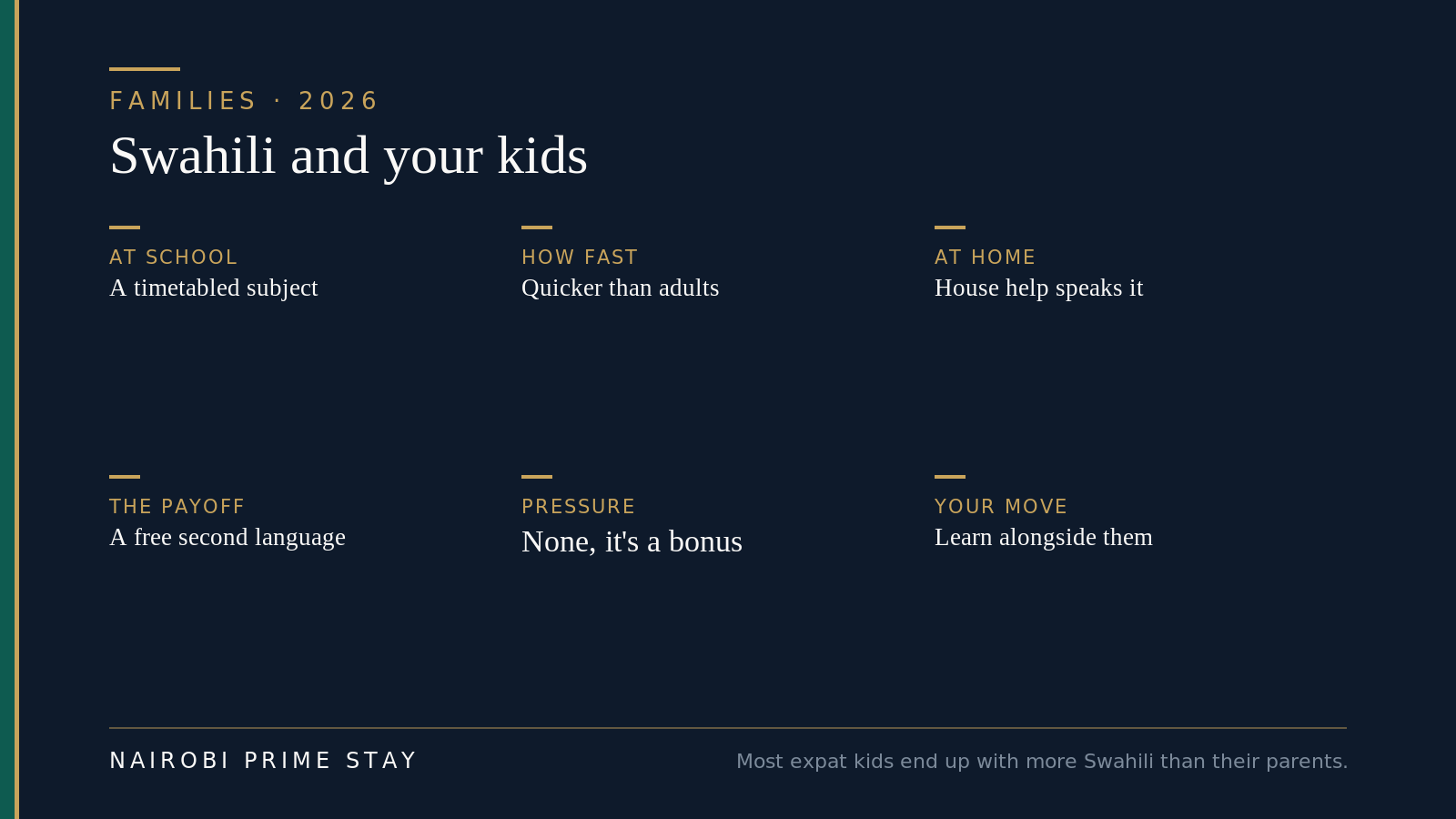
Kids absorb it far faster than you will, partly from class and partly from life: the house help who chats to them, the friends they make, the guard who teaches them a word at the gate. Young children in particular soak up the sounds without effort, and because Swahili is phonetic, the reading and spelling come easily too.
There’s no pressure attached. No school will hold a child back over Swahili, and it rarely carries the weight of the core subjects. Treat it as a genuine bonus, a real second language your child picks up for free, simply by living here. The best thing you can do is learn alongside them, ask what they caught that day, and let them correct your pronunciation. Kids love catching a parent out, and it turns your own practice into a game. For the wider picture of raising a family here, see our moving to Nairobi with kids guide.
Numbers and money
You can get a long way pointing and reading prices, but the numbers one to ten are easy and genuinely handy at markets. They’re written exactly as they sound.
| Number | Swahili | Number | Swahili |
|---|---|---|---|
| 1 | moja | 6 | sita |
| 2 | mbili | 7 | saba |
| 3 | tatu | 8 | nane |
| 4 | nne | 9 | tisa |
| 5 | tano | 10 | kumi |
After ten it’s logical: kumi na moja (11, “ten and one”), ishirini (20), thelathini (30), mia (100), elfu (1,000). So mia tano is 500, the kind of number you’ll hear at a market stall. “Pesa” is money, “Ngapi?” is “how many?” Honestly, most prices get said in English numbers anyway, and everything is paid by M-Pesa off your phone, but knowing the basics means a trader can’t slip a fast one past you.
Pronunciation: easier than you think
Swahili is one of the friendliest languages to pronounce, because it’s almost perfectly phonetic. You say it exactly as it’s written, every letter sounds, and the rules barely bend. Get the five vowels right and you’re most of the way there.
The vowels are pure and consistent: a as in “father,” e as in “they,” i as in “machine” (ee), o as in “go,” u as in “rude” (oo). They never change. So Karibu is “kah-REE-boo,” Asante is “ah-SAHN-teh,” pole is two syllables, “POH-leh,” not the English word “pole.”
Two simple rules cover the rest. First, stress almost always lands on the second-to-last syllable: a-SAN-te, ka-RI-bu, ha-BA-ri. Second, every vowel is spoken, so each syllable gets its beat, with no silent letters and no swallowed endings. Once it clicks you can read any Swahili word aloud and be understood, even if you don’t know what it means. That’s a rare and lovely thing for a learner.
Sheng: the Nairobi street language
Here’s something the guidebooks skip. On Nairobi’s streets, in matatus, and among young people, you’ll hear Sheng, a fast-moving urban slang that blends Swahili, English and bits of local languages. It’s the real soundtrack of the city, and it changes so quickly that what’s current this year sounds dated the next.
You do not need Sheng, and trying too hard to use it can feel forced. But you’ll absorb a few words just by living here, and recognising them is fun. “Sasa?” (hi, what’s up), “Poa” and “fiti” (cool, fine), “buda” or “mzae” (dad, or an older guy), “mresh” (a young woman), “ganji” or “doo” (money), and “mathree” (a matatu) are all Sheng you’ll hear within your first month. Treat it the way you’d treat slang in any city: enjoy it, pick up a little, but let it come to you rather than forcing it. Standard Swahili and English will never let you down; Sheng is the seasoning, not the meal.
Tourist Swahili vs what locals actually say
A few phrases mark you instantly as a visitor. Swapping them for the local version is the quickest upgrade you can make, and it costs nothing.
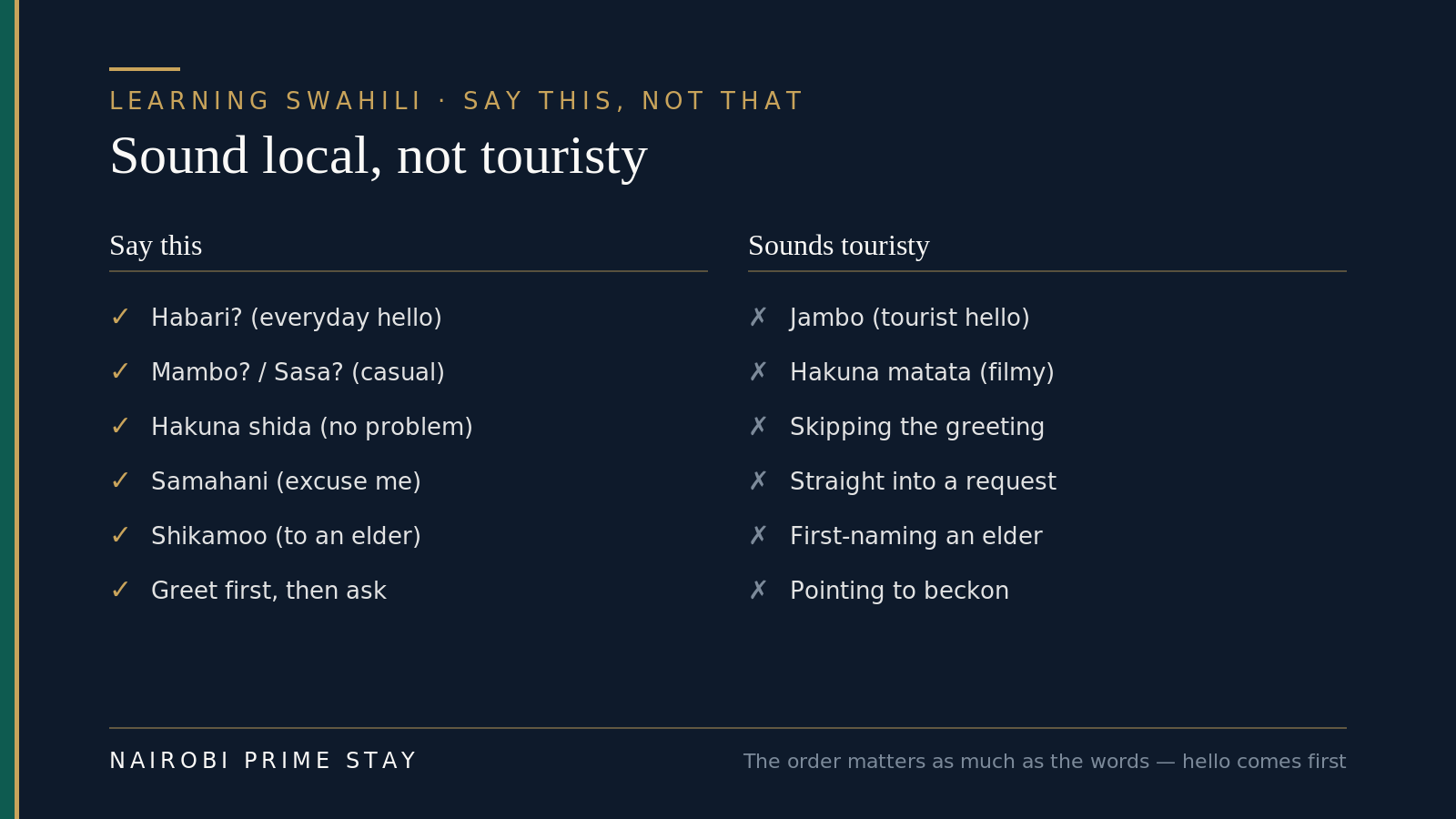
The headline swap is “Habari?” instead of “Jambo.” Both mean roughly hello, but “Jambo” (and the full “Jambo bwana”) is simplified Swahili used with tourists, while “Habari?” is what neighbours actually say to each other. Likewise, “Hakuna shida” or “Hakuna noma” sounds more natural than “Hakuna matata,” which most Kenyans associate with a Disney film more than daily speech.
The bigger upgrade isn’t a word at all, it’s the habit of greeting before you ask for anything. A newcomer who says “Habari?” and waits for the reply before asking the guard a question will be treated far more warmly than one who opens with the question, no matter how good their accent is. Swahili politeness is about the order of things as much as the vocabulary.
One more piece of respect: with elders, reach for “Shikamoo,” and when you need to interrupt or pass someone, “Samahani” (excuse me) is gentler than barging through. Small courtesies, big returns.
The slip-ups newcomers make
A few small habits trip up almost every newcomer, and each one is easy to fix. None will cause offense, since Kenyans are forgiving, but swapping them for the local version makes you sound less like a visitor and more like someone who lives here.
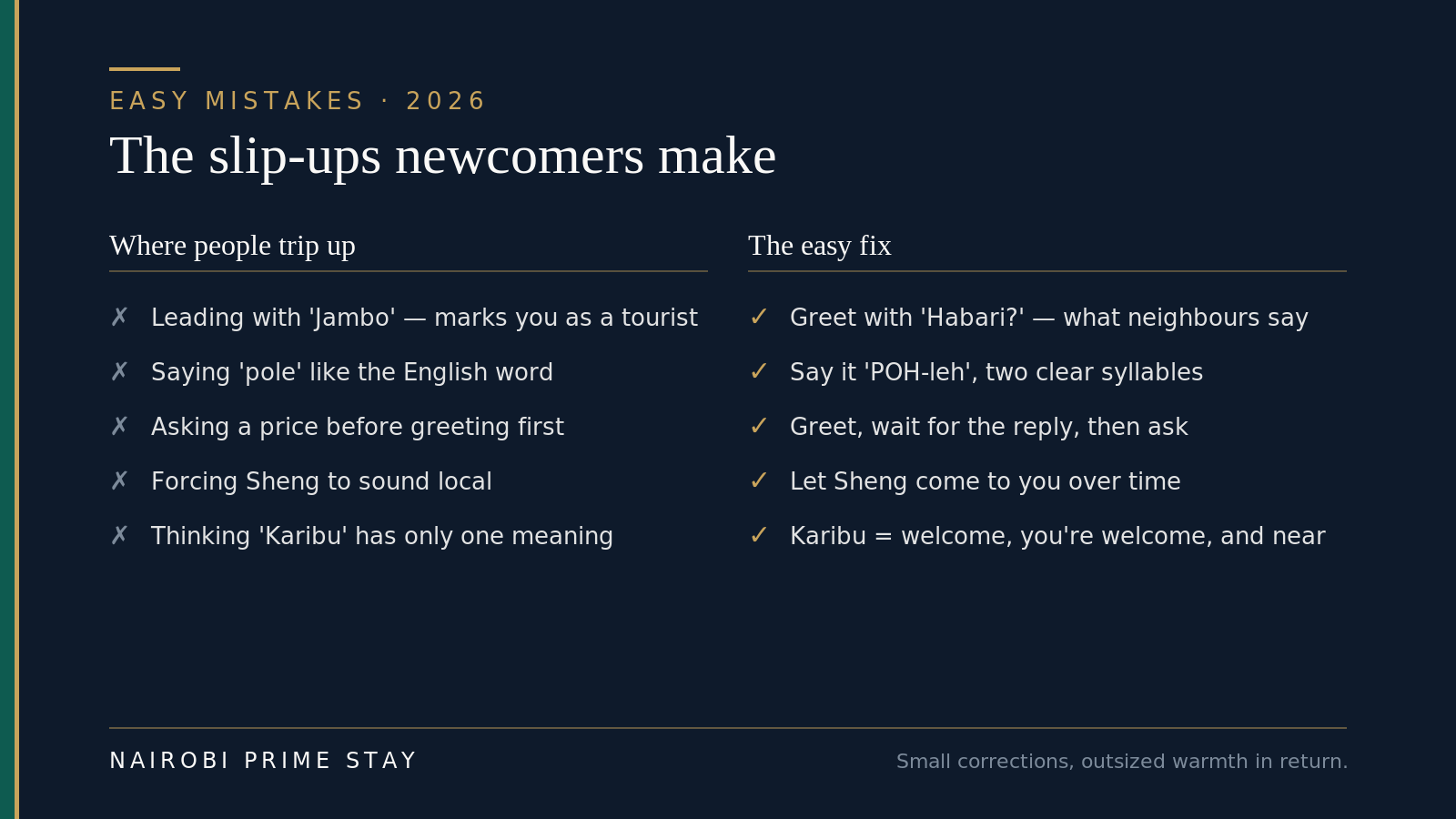
The quick ones are easy to list: leading with “Jambo” instead of “Habari?”, saying “pole” like the English word for a stick rather than “POH-leh,” and asking a price before you’ve greeted the person. We’ve touched on those above. The mistakes that catch people longest are the false friends, words that look or sound like something familiar but don’t mean what you’d guess.
“Karibu” is the big one: it means welcome, you’re welcome, and also near or nearly, so context does all the work. “Bure” means free of charge, not “boor.” And “Nakupenda” (I love you) is warm and romantic, so save it for the person you mean it for, not the waiter who brought your coffee. These aren’t traps so much as small delights once you know them.
The last mistake isn’t a word at all: forcing Sheng to sound local. It reads as trying too hard. Stick to standard Swahili and English, both of which always work, and let Sheng arrive on its own schedule. Get these few right and you’ve cleared a bar most newcomers never even notice is there.
Where to learn, if you want to go further
Plenty of expats stop at twenty friendly words, and that’s fine. But if you want real conversational Swahili, the resources are good, mostly cheap, and some are free. Here’s an honest rundown of what works, from free apps to a local tutor.
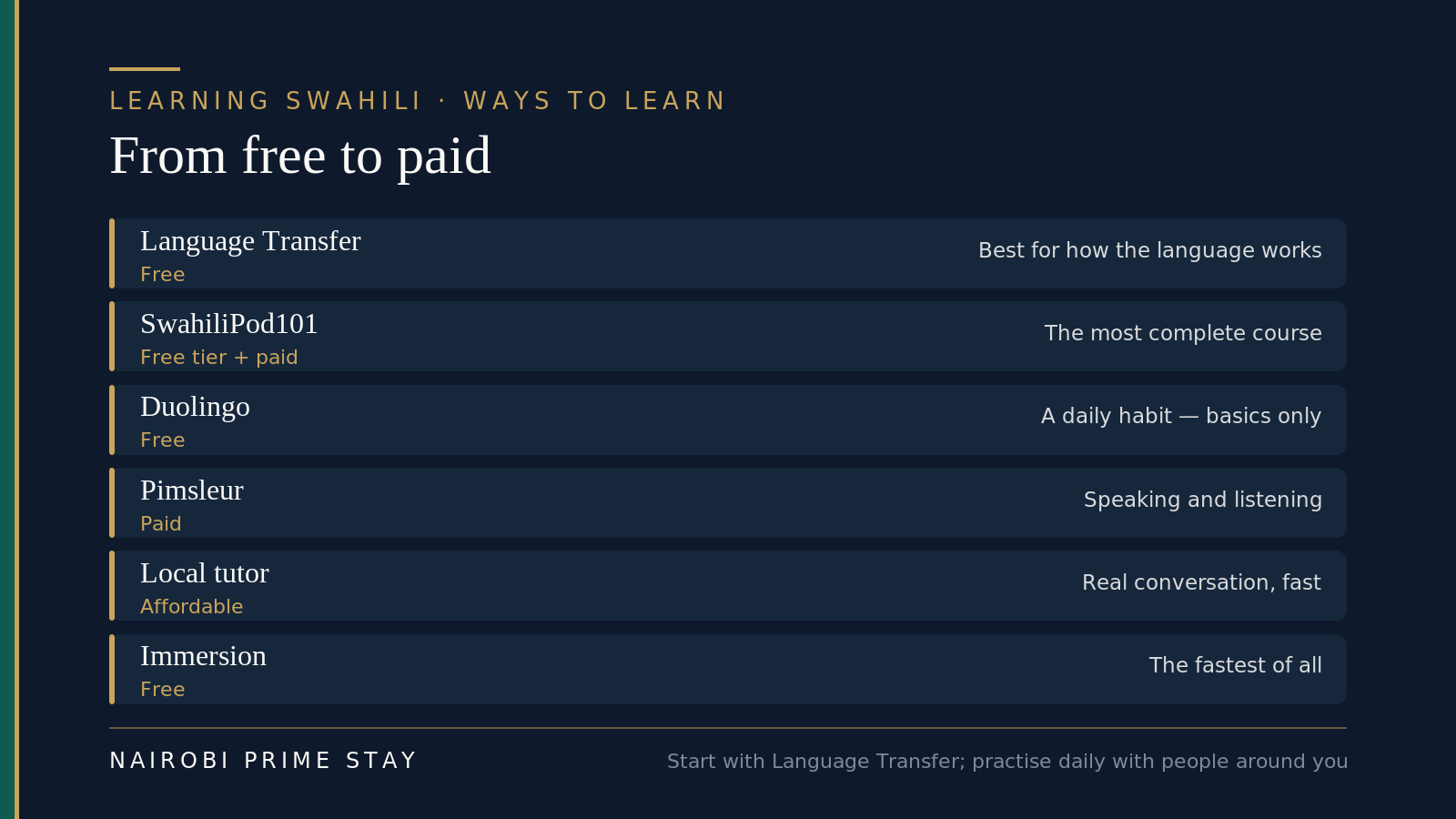
Language Transfer (free) is the one to start with. It’s a free audio course that teaches you how Swahili is built rather than drilling vocabulary, so you start making your own sentences fast. No sign-up, no cost, genuinely excellent. For a lot of people it’s the single best way in.
SwahiliPod101 (free tier, paid for more) is the most complete course out there, with hundreds of podcast-style lessons, vocabulary lists and flashcards. The free level is useful on its own; the paid tiers add the full course.
Duolingo (free) has a Swahili course and it’s fine for building a daily habit and a starter vocabulary, but be realistic: it’s much thinner than Duolingo’s big languages, with no stories or podcast and a ceiling around early-intermediate. Good for streaks and basics, not for fluency.
Pimsleur (paid) is audio-first and strong if your goal is speaking and listening rather than reading. The repetition drills stick.
A local tutor (affordable) is the fastest route to actually conversing, and in Nairobi it’s very affordable by US standards. Many expats do an hour or two a week, often through a language school or a personal recommendation; ask in expat groups (see our building a social life guide) and you’ll get names quickly.
Immersion (free, and the real secret). The fastest progress comes from using what you have, every day, with the people around you. Greet your guard in Swahili. Ask “Bei gani?” at the market. Let your house help correct your pronunciation. Five real exchanges a day beats an hour of an app you don’t enjoy.
How far does your Swahili travel?
Your Nairobi Swahili is a passport that works across a big chunk of the map, and it gets richer the moment you leave the capital. In Nairobi itself, Swahili shares the streets with English and Sheng, and English carries you through almost anything official. Head to the coast, though, and you’ll hear Swahili at its most elegant, because Mombasa, Lamu and the whole coastal strip are the language’s historic home. People there speak it beautifully, and a little effort goes even further.
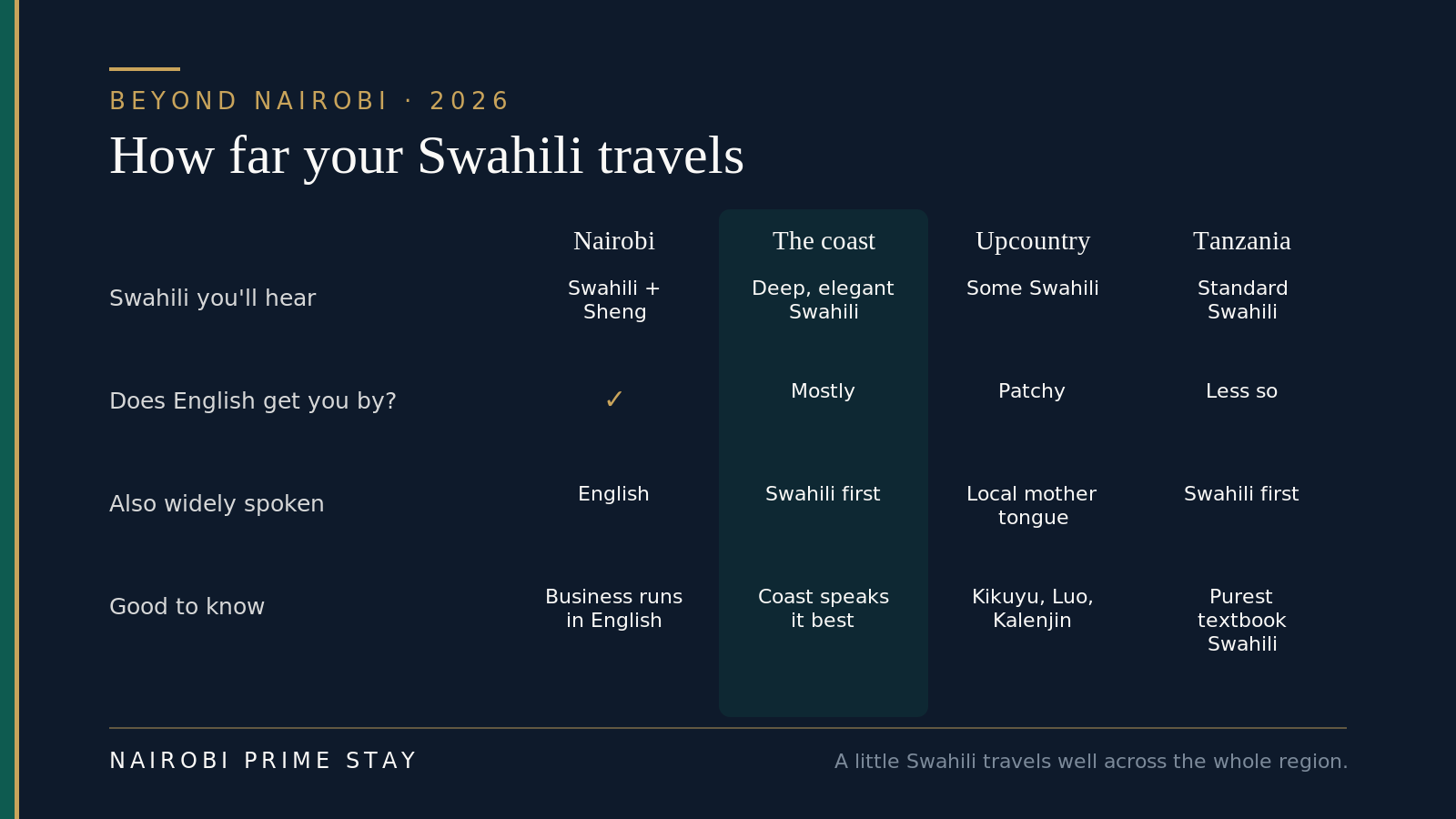
Upcountry, in the rural highlands and around the lake, Swahili mixes with a local first language, Kikuyu, Luo, Kalenjin, Luhya and dozens more, and English gets patchier the further you go from town. That’s exactly where your Swahili earns its keep. And the language crosses borders: Tanzania speaks the purest, most standard Swahili of all, and you’ll be understood in Uganda, Rwanda and beyond. So the words you practise greeting your Nairobi guard will serve you on a beach weekend in Diani or a longer trip across the region. Our weekend trips from Nairobi guide has ideas for putting them to use, and our is Nairobi safe guide covers travelling around sensibly.
A realistic first month
You don’t need a study plan to be polite, but if you want a gentle on-ramp, here’s a month that takes you from zero to genuinely friendly without taking over your life.
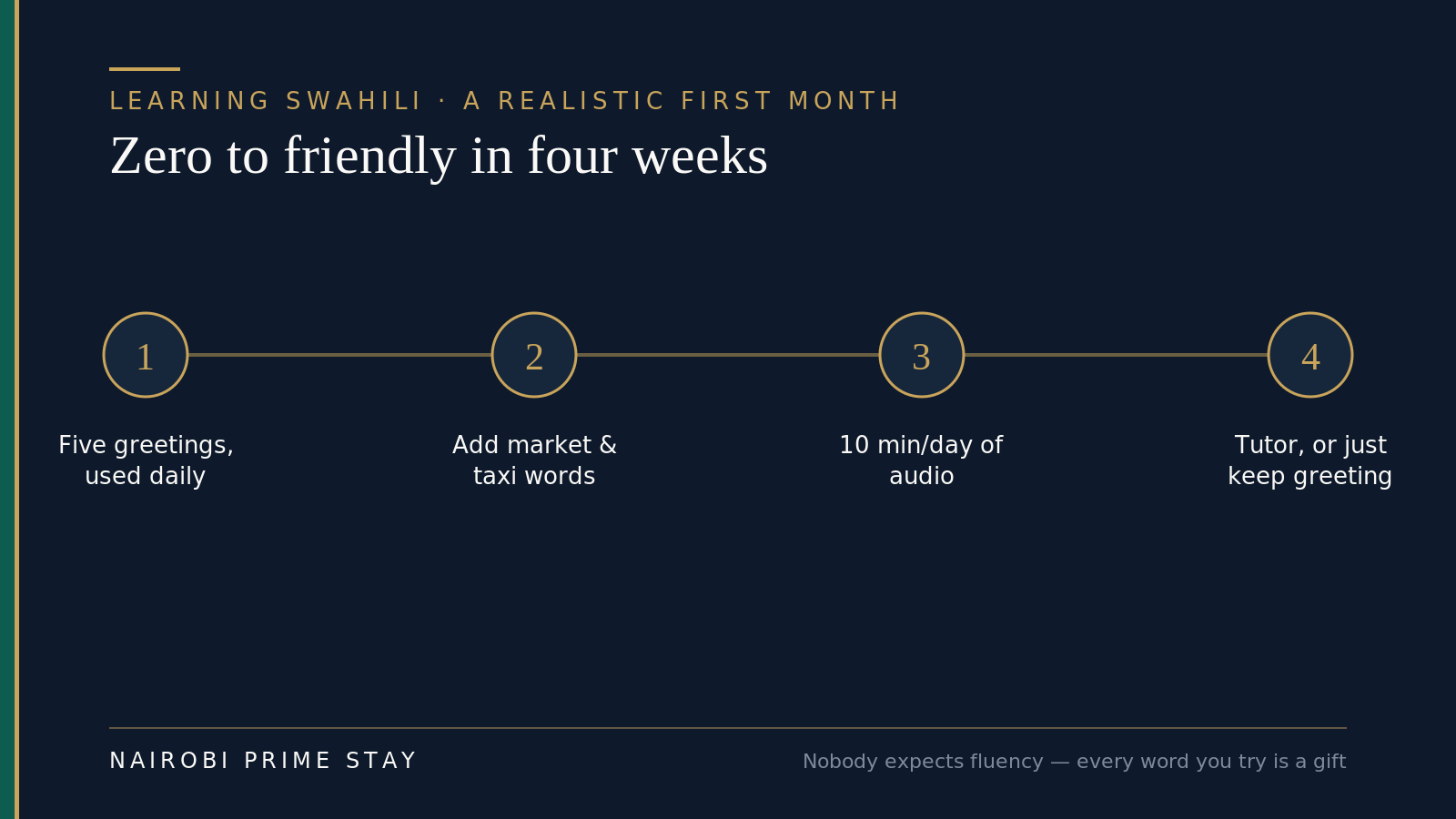
Week 1: master five words and actually use them. Habari, Asante, Karibu, Sawa, Pole pole. Greet everyone, every day.
Week 2: add the practical handful. Bei gani, Maji, Wapi, Twende, Samahani, Shikamoo. Start asking prices in Swahili at the market.
Week 3: if you’ve caught the bug, add ten minutes a day of Language Transfer or a podcast in the car or on a walk. You’ll start to hear how sentences fit together.
Week 4: decide how far you want to go. Book a weekly tutor if you want real conversation, or simply keep greeting everyone and let immersion do the slow, steady work. Either way, you’re already ahead of most newcomers.
How this plays out: a market on Saturday
Picture two newcomers from Chicago, a month into Nairobi, at the Maasai market. The first walks up to a stall and asks “How much for this bowl?” in English. He’s quoted KES 2,500, the standard mzungu opener.
The second greets the trader first: “Habari?” A smile, a “Mzuri.” She admires the carving, then asks, “Bei gani?” Quoted 2,500, she laughs gently and says “Aii, punguza kidogo” (reduce a little). They go back and forth, good-humoured, and settle at 1,200 with a handshake and an “Asante sana.” Same bowl, half the price, and a warmer exchange. She didn’t speak much Swahili. She spoke just enough, in the right order, with a smile. That’s the whole game.
Your Swahili starter checklist
- Learn five words before you land: Habari, Asante, Karibu, Sawa, Pole pole.
- Practise the five vowels (a, e, i, o, u) so your pronunciation is clean from day one.
- Swap “Jambo” for “Habari?” to sound less like a tourist.
- Greet first, every time, before you ask for anything.
- Learn “Shikamoo” for elders; it earns instant respect.
- Learn “Bei gani?” and the numbers one to ten for the market.
- Download Language Transfer (free) for the car or your commute.
- Use your guard, house help and market traders as daily practice.
- Don’t chase Sheng; let it come to you.
- Relax. Nobody expects fluency, and every word you try is a gift.
Final thoughts
Swahili in Nairobi isn’t a barrier to clear before you can live here. English does that job. Swahili is the thing that turns living here into belonging here. The difference between an expat who gets by and one who feels at home is often just a daily “Habari?”, an “Asante” that means it, and a “Pole pole” said with a smile instead of a sigh.
So keep it light. Learn your five words, then your twenty, and let the rest arrive on its own schedule. Greet the guard, thank the trader, try the wrong word and laugh when you’re corrected. Kenyans are generous with anyone who makes the effort, and a little Swahili, offered warmly, opens more doors here than fluency in almost anything else could. Karibu Nairobi.
Related reading
- Moving to Nairobi: the complete guide for Americans — the hub that ties together visas, neighbourhoods, cost and your first 30 days.
- Kenyan culture and etiquette for newcomers — why greetings come first, plus tipping, dress and faux pas to avoid.
- Building a social life in Nairobi — where to find a tutor, language meetups and community.
- Domestic help in Nairobi — fair pay, contracts, and the daily greeting that sets the tone.
- Getting around Nairobi — ride-hailing, matatus and the words that smooth the ride.
- Cost of living in Nairobi — where prices are fixed, where to bargain, and how M-Pesa runs daily life.
Settling in, the easy way
The easiest place to practise your first words is somewhere calm to land. A serviced apartment for your first few weeks gives you a secure, fully-equipped base, with a guard to greet each morning and neighbours to meet, while you find your feet and the city’s rhythm. When you’re ready, browse our serviced apartments, or tell our AI relocation assistant your budget and neighbourhood and it’ll shortlist options in a couple of minutes. Karibu.
Frequently asked questions
Do I need to speak Swahili to live in Nairobi?
No. English is one of Kenya’s two official languages and the language of business, banking and school, so you can run your whole life in Nairobi in English from day one. Swahili is a kindness, not a requirement. Learning even twenty words, especially greetings like Habari and courtesies like Asante, earns real warmth and often better treatment, because Kenyans appreciate any effort from a newcomer.
What basic Swahili phrases should I learn first?
Start with greetings and courtesies: Habari (hello or how are you), Mzuri (good, the reply), Karibu (welcome), Asante and Asante sana (thank you, thank you very much), Tafadhali (please), Samahani (excuse me), Pole (sorry), Sawa (okay) and Pole pole (slowly). Then add a few practical words like Bei gani (how much), Maji (water), Wapi (where) and Twende (let’s go). Learn about five at a time and use them until they’re automatic.
How do you say hello in Swahili?
The most natural everyday greeting is Habari, which literally means ‘news?’ and works any time of day with anyone; the reply is Mzuri or Nzuri (good). With friends and younger people you’ll hear Mambo or Sasa (what’s up), answered with Poa (cool). Avoid leading with Jambo, which is simplified Swahili used mainly with tourists, while locals greeting each other say Habari or Mambo. To an elder, use the respectful Shikamoo, answered with Marahaba.
Is Swahili hard to learn?
Swahili is one of the easier languages for English speakers to start, mainly because it’s almost perfectly phonetic: you say words exactly as they’re written, every letter sounds, and stress usually falls on the second-to-last syllable. The five vowels never change (a, e, i, o, u). You can read most words aloud correctly within a day. Real fluency takes work like any language, but getting to friendly, useful Swahili is quick.
What’s the best app or resource to learn Swahili?
For a free start, Language Transfer is excellent: a free audio course that teaches how the language is built, so you make your own sentences fast. SwahiliPod101 is the most complete course and has a useful free tier. Duolingo works for a daily habit and basic vocabulary but is thin beyond beginner level. Pimsleur is strong for speaking and listening. The fastest route to real conversation is an affordable local tutor, plus daily practice with the people around you.
What is Sheng in Kenya?
Sheng is Nairobi’s urban street slang, a fast-changing blend of Swahili, English and local languages spoken especially by young people and in matatus. You don’t need it, and forcing it can feel awkward, but you’ll naturally pick up a few words like Sasa (hi), Poa (cool), buda (an older guy) and ganji or doo (money). Treat it as seasoning: standard Swahili and English always work, and Sheng comes to you with time.
How do you say thank you in Swahili?
Thank you is Asante, and thank you very much is Asante sana. You’re welcome, and also simply ‘welcome’, is Karibu, which you’ll hear constantly. Please is Tafadhali. Using Asante genuinely, with a smile, in everyday transactions is one of the simplest and most effective things a newcomer can do, because it shows both respect and effort.
Will learning a little Swahili really make a difference in Nairobi?
Yes, more than its size suggests. Because nobody expects Swahili from a newcomer, even a few words land as genuine respect. Greeting your guard with Habari, thanking a trader with Asante, or bargaining a little in Swahili at the market warms interactions and often gets you fairer prices. It shifts you from being just another visitor to the neighbour who tries, and that changes how people treat you day to day.
Will my kids learn Swahili in Nairobi?
Almost certainly, and faster than you will. Swahili is a timetabled subject in Kenyan schools and in most international schools in Nairobi, so children get structured lessons as part of the normal week. They also pick it up from house help, friends and the guard at the gate, and because Swahili is phonetic the reading and spelling come easily. There’s no pressure attached, since it rarely carries the weight of the core subjects, so treat it as a free second language. The best move is to learn alongside them and let them correct your pronunciation.
What are the most common Swahili mistakes newcomers make?
The frequent ones are leading with ‘Jambo’ instead of the more local ‘Habari?’, saying ‘pole’ like the English word rather than ‘POH-leh’, and asking a price before greeting the person. Then come the false friends: ‘Karibu’ means welcome, you’re welcome, and also near; ‘bure’ means free of charge, not ‘boor’; and ‘Nakupenda’ means ‘I love you’, so save it for the right person. The last slip is forcing Sheng to sound local, which reads as trying too hard. Stick to standard Swahili and English and let Sheng come to you.
Does Swahili help outside Nairobi and in other countries?
Yes, and it gets richer the moment you leave the capital. The Kenyan coast, Mombasa, Lamu and the whole strip, speaks the most elegant Swahili and is its historic home. Upcountry it mixes with a local first language like Kikuyu, Luo or Kalenjin, and English gets patchier, so your Swahili earns its keep. It also crosses borders: Tanzania speaks the purest, most standard Swahili, and you’ll be understood in Uganda, Rwanda and beyond. The words you practise in Nairobi travel across the whole region.
Ready to look?
Find your apartment in Nairobi
Browse verified serviced apartments, or ask the AI concierge which area fits your life.