
Guides · Cost of living
Domestic Help in Nairobi: Fair Pay & Hiring Guide (2026)
Domestic Help in Nairobi: Fair Pay & Hiring Guide (2026)

Most expat households in Nairobi hire some domestic help, and it surprises a lot of Americans. Back home, a cleaner every other week feels like a small luxury. In Nairobi, a part-time house help, a nanny or a gardener is normal, affordable, and — done right — genuinely good for everyone involved. You get your time back. Someone reliable gets steady, fair work.
The catch is the “done right” part. Domestic workers in Kenya are protected by real employment law, with a legal minimum wage, social-security and health contributions, paid leave and a weekly day off. Plenty of employers ignore all of that. You don’t have to, and you shouldn’t.
This guide is written for someone who has never employed anyone in their home, let alone in a new country. We’ll cover who hires help and why, what each role costs in 2026, exactly what the law asks of you, how to find someone you can trust, and how to be the kind of employer people want to work for. Honest numbers, no romanticizing, no guilt.
TL;DR: Hiring domestic help in Nairobi is common, affordable and legal — and you’re a proper employer, not just someone handing over cash. Part-time day help runs about $100–250 a month; a full-time house help or nanny is typically KES 22,000–40,000 (~$170–310); cooks and drivers cost more. The legal minimum wage for a domestic worker in Nairobi is KES 18,047 a month (gazetted 1 May 2026), plus a 15% housing allowance if you don’t provide a room. By law you should give a written contract, register and pay NSSF (about 6% from you, matched by 6% from them) and SHIF/SHA health cover (2.75% of pay), and provide 21 days paid leave a year and a weekly rest day. Pay and contributions are easy to handle by M-Pesa or bank transfer. Most people find help through personal referrals or a vetted agency — always check references and ID.
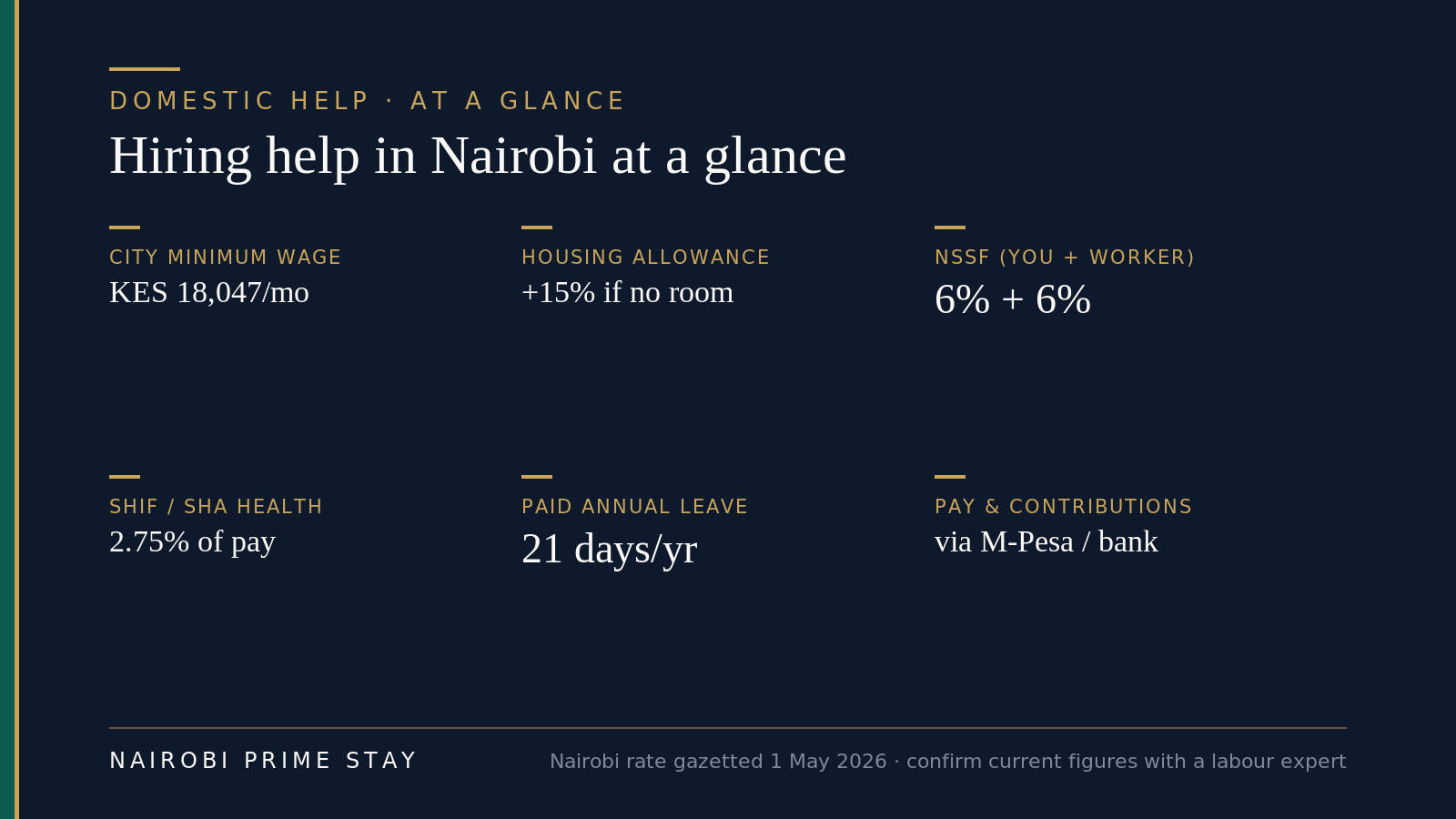 The figures that matter, at a glance. The Nairobi minimum was gazetted on 1 May 2026 — confirm current rates with a labour expert or the Ministry of Labour.

Who hires help in Nairobi — and why
Almost everyone, across budgets. Two-income families hire a nanny because daycare for young children is limited and a trusted in-home carer is the norm. Busy professionals hire a part-time house help to handle cleaning and laundry. Anyone with a garden — and many homes here have one — hires a gardener for a day or two a week. Families in big houses or standalone compounds often add a day guard, though most security is handled by a company rather than a person you employ directly.
There’s a practical reason it’s so common: labor is affordable here relative to a Western income, and homes are run a little differently. Many people hang laundry to dry rather than tumble-dry it, cook from fresh ingredients daily, and maintain gardens and compounds that simply take time. Help isn’t a status symbol; it’s how a household runs.
It’s also a real source of employment. Domestic work supports a huge number of Kenyan families. When you employ someone fairly — at or above the legal wage, with contributions paid and time off respected — you’re not just buying convenience. You’re providing a good job. That framing matters, and it’s the spirit this whole guide is written in.
If you’re still in your first weeks and not ready to take on staff, you don’t have to. A serviced apartment includes cleaning and is fully managed, so you can settle, learn the city, and decide what help you actually need before you hire anyone.
The roles, explained
“Domestic help” covers several distinct jobs. You might hire one person who does a bit of everything, or several specialists. Here’s what each role usually means in Nairobi.
House help (also called a house manager or housekeeper). The core role: cleaning, laundry, ironing, tidying, often some cooking and shopping. Can be live-out (comes daily or a few days a week) or live-in (has a room in the house or in staff quarters). An experienced house help who runs the whole household — manages other staff, handles the shopping and the budget — is often called a house manager and is paid more.
Nanny. Childcare, and usually light related housework — children’s laundry, tidying, preparing their meals. Many families want a nanny who is first-aid aware and comfortable with their parenting style. Live-in nannies are common for families with young children or demanding jobs. If you’re moving with little ones, our guide to moving to Nairobi with kids covers the wider picture.
Cook. A dedicated cook is more common in larger households or where someone entertains often. Many house helps cook well, so a separate cook is a step up in scale, not a default.
Gardener (shamba boy/gardener). Lawns, hedges, flower beds, the kitchen garden, sometimes washing the car and minor outdoor maintenance. Usually part-time — one to three days a week is plenty for most gardens.
Driver. Worth considering if you’ll face long commutes, do daily school runs, or simply don’t want to drive in Nairobi traffic. A driver can also run errands and handle the parking-and-waiting that eats your day. Some families share a part-time driver.
Guard / security. Most expats get security through a company — a firm provides trained guards, a patrol car and a panic-button response — rather than directly employing a watchman. This is usually the safer, simpler choice, and it’s covered in our Nairobi safety guide. If you do employ a day guard directly, the same wage and contribution rules apply as for any other domestic worker.
What domestic help costs in 2026
Less than you’d expect by US standards, but more than the lowball figures you’ll hear repeated online — and the gap between “cheap” and “fair” is exactly where this guide lives. Pay depends on the role, experience, hours, whether it’s live-in (room and meals are part of the package), and the area. Expat households tend to pay at or above the top of local ranges, both to attract experienced people and because it’s the right thing to do.
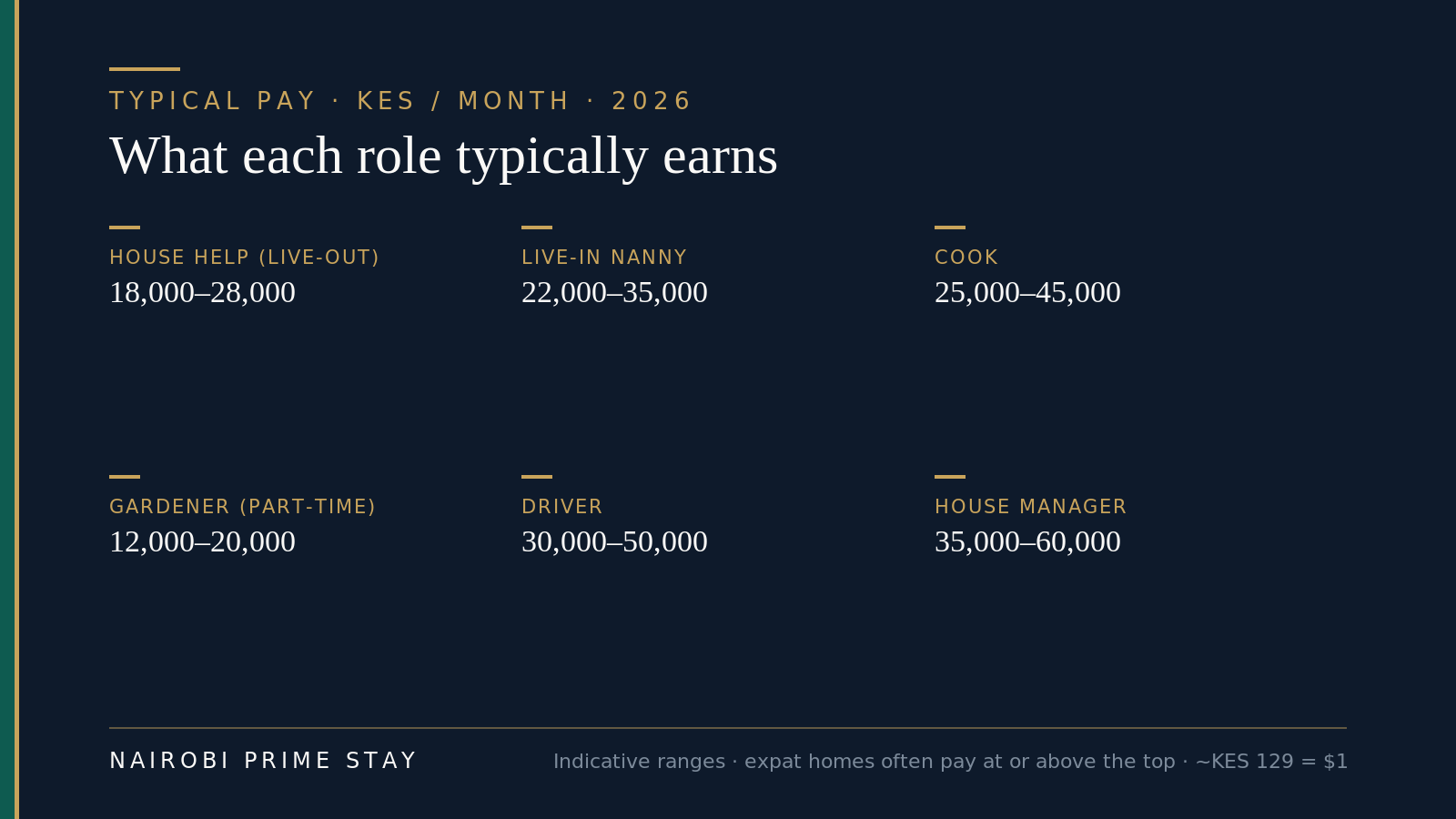 Indicative monthly ranges as of 2026. Expat homes often pay at or above the top of each band. At roughly KES 129 to the dollar, KES 30,000 is about $230.
Here’s the same picture as a table, with a rough US-dollar equivalent at about KES 129 to the dollar. Treat these as orientation, not quotes — confirm current rates with an agency or trusted local contacts.
| Role | Typical pay (KES/month, 2026) | Approx USD | Notes |
|---|---|---|---|
| House help, live-out | 18,000–28,000 | $140–215 | Cleaning, laundry, often light cooking |
| House help, live-in | 15,000–25,000 + room & meals | $115–195 | Cash is lower because housing + food included |
| Nanny, live-in | 22,000–35,000 | $170–270 | More for infant care or extra duties |
| Cook | 25,000–45,000 | $195–350 | Skilled, experienced cooks at the top |
| Gardener, part-time | 12,000–20,000 | $95–155 | 1–3 days a week; full-time earns the minimum+ |
| Driver | 30,000–50,000 | $230–390 | More with long hours or a clean expert record |
| House manager | 35,000–60,000+ | $270–465+ | Runs the household; manages other staff |
Part-time day help — say a cleaner two or three mornings a week — typically costs $100–250 a month all in, which lines up with the domestic-help line in our Nairobi cost of living guide. Many newcomers start here and add more help later.
A few cost notes that catch people out. Live-in pay looks lower because you’re also providing a room and meals — value those honestly and don’t use “live-in” as an excuse to underpay. Pay is monthly, not hourly; daily or “casual” rates exist for one-off work but a regular arrangement is monthly. And on top of wages you’ll cover statutory contributions (small, explained below), and most employers add a 13th-month bonus around December and cover a meal and tea during the workday. Build a little above the headline wage into your budget.
Your legal duties as an employer
Treat it like a real job, because legally it is one. Domestic workers in Kenya are covered by the Employment Act, the same as any other employee, and Kenya has ratified the international convention on domestic workers. Here’s what that means in practice. None of it is hard; most of it is cheap; all of it protects both of you.
Pay at least the minimum wage. As of 1 May 2026, the gazetted minimum for a domestic worker (house help, gardener, day watchman) in Nairobi and other main cities is KES 18,047 per month. If you don’t provide accommodation, the law adds a 15% housing allowance on top. Smaller towns have lower minimums. These figures are reviewed regularly — confirm the current rate with the Ministry of Labour or a labour consultant rather than assuming.
Put it in writing. Any job expected to last more than a few months should have a written contract — names, role, hours, wage, pay date, leave, notice period, and what’s included (meals, accommodation, transport). It protects you as much as them, and it sets clear expectations from day one. Keep it simple and in plain language.
Register and pay NSSF. The National Social Security Fund is Kenya’s pension scheme, and domestic workers are entitled to it. Under the rates phased in through 2026, you deduct 6% of pay from the worker and add a matching 6% as the employer, up to monthly caps. On an KES 18,000 wage that’s roughly KES 1,080 each. You register as an employer and remit monthly.
Register and pay SHIF/SHA. The Social Health Insurance Fund, run by the Social Health Authority, replaced the old NHIF. The contribution is 2.75% of gross pay, with a minimum of KES 300 a month. This gives your employee access to health cover — a meaningful benefit, and a legal requirement.
Give paid leave and a rest day. After 12 months, an employee earns 21 days of paid annual leave. They’re also entitled to a weekly day of rest, paid sick leave, public holidays, and — where relevant — maternity leave (three months) or paternity leave (two weeks). A day off isn’t a favor; it’s the law, and it’s how people stay healthy and loyal.
Handle endings properly. If the job ends, give notice (or pay in lieu), settle any unused leave, and — after long service — be aware that service pay may apply where NSSF wasn’t being paid. Don’t dismiss on the spot without cause or dues.
A quick, honest caveat: this is general guidance for 2026, not legal advice, and the figures move. For anything you’re unsure about — contracts, terminations, the current wage order — check with a Kenyan labour lawyer or HR consultant. It’s a small cost for peace of mind.
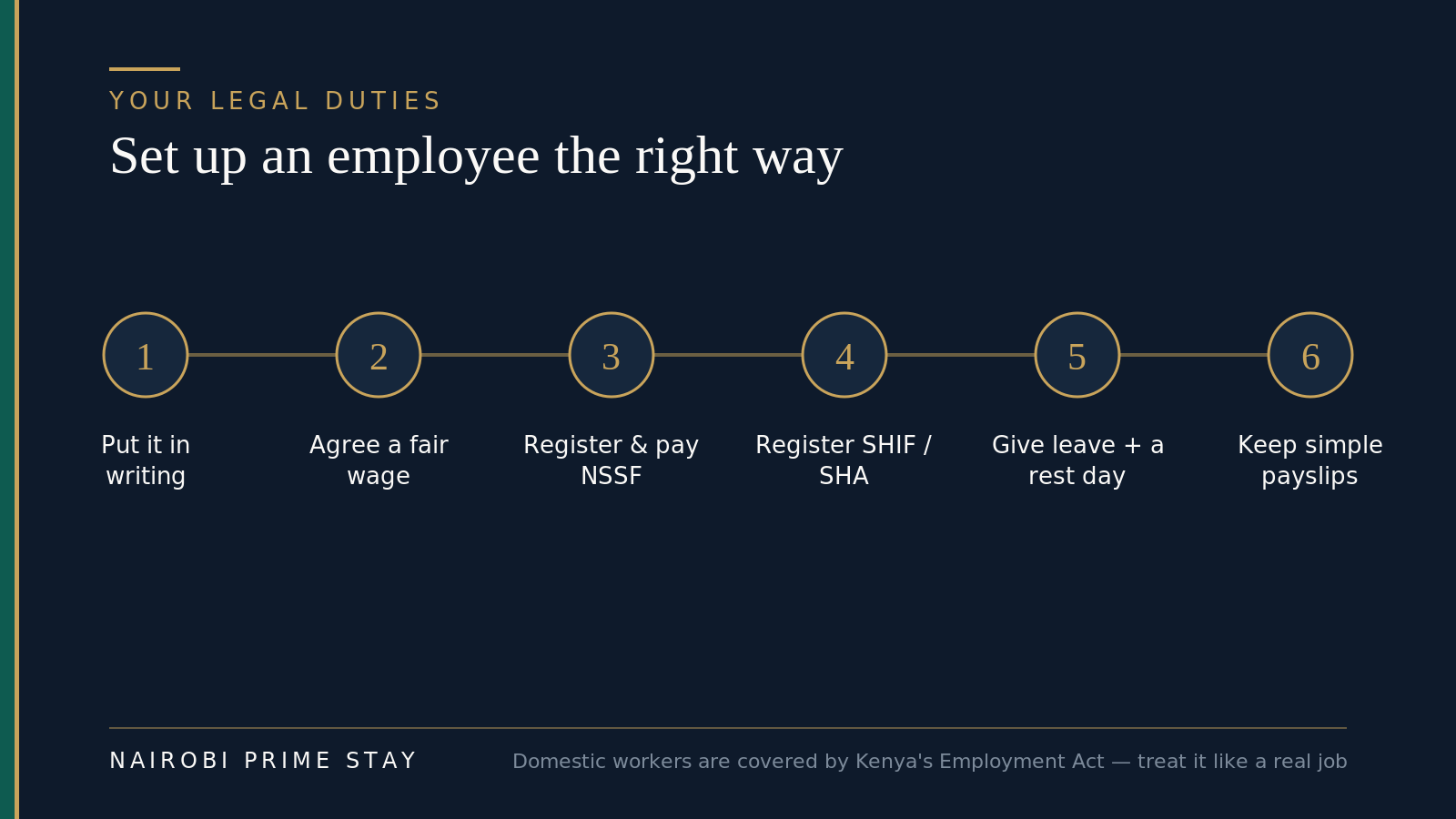 Six steps to employing someone properly. Domestic workers are covered by Kenya’s Employment Act — treat it like the real job it is.
How to pay fairly — the honest part
Pay at least the legal minimum, always, and aim above it for someone you trust with your home and your kids. The math that makes help feel “so cheap” to a US earner is the same math that can quietly become exploitation if you let it. A few hundred dollars a month is a rounding error in a Western budget and a life-changing, stable income for a Kenyan family. Lean toward generosity; you can afford it, and it comes back to you in loyalty and care.
Fairness isn’t only the number on payday. It’s paying on time, every time. It’s covering NSSF and SHIF instead of pocketing the difference. It’s a real day off, not “off, but can you just…”. It’s a decent room and proper meals if they live in, the same food the family eats. It’s notice and dues if you part ways. And it’s treating the person with the everyday respect you’d want — names, greetings, privacy, dignity.
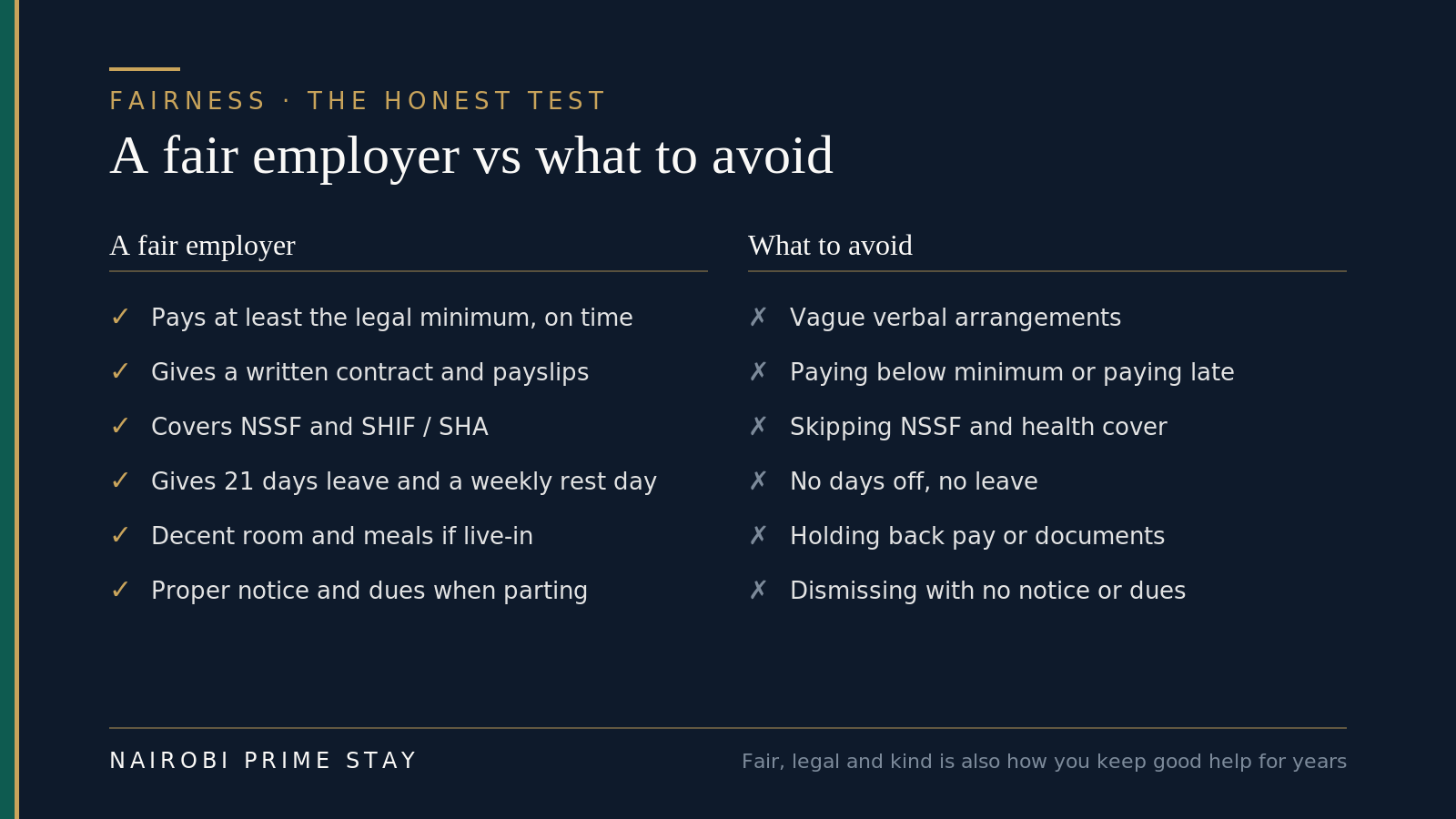 The honest test. Fair, legal and kind is also, not coincidentally, how you keep good help for years.
One cultural note worth saying plainly: language matters. People here say “house help” or “househelp”, not “servant” or “the help.” Use someone’s name. Greetings come first, always — skipping the hello to launch into instructions reads as rude in Kenya. More on this in our guide to Nairobi culture and etiquette.
How to find trustworthy help
Most good arrangements come through personal referrals — ask colleagues, neighbours, your building manager, your kids’ school parents, or expat community groups who they use and trust. A recommendation from someone whose judgment you trust is worth more than any advert.
The other reliable route is a reputable placement agency. Agencies pre-screen candidates, check references and ID, sometimes run background or health checks, and handle the awkward parts. You pay a placement fee — often a portion of a month’s wage, or a flat fee — but for a nanny or a live-in role, the vetting is usually worth it. Confirm exactly what their screening covers before you pay.
However you find someone, do your own checks before you hire:
- Verify ID. See and photograph their Kenyan national ID and note the number.
- Call references. Speak to at least two previous employers — actually call, don’t just read a letter. Ask why the person left.
- Do a paid trial. A week or two of paid trial tells you more than any interview about reliability, attitude and fit.
- Be clear up front. Walk through duties, hours, pay, the rest day and house rules together, then put them in the contract.
- Start with a probation period. A one-to-three-month probation, written into the contract, gives both sides an easy exit if it isn’t working.
Trust builds over time. Start with shorter hours or part-time, keep valuables and cash secured as you would anywhere (sensible for everyone’s sake, not an accusation), and let a good relationship grow from there. Many expat families keep the same house help or nanny for years — and write the glowing reference that helps them next.
Which help fits your household
You don’t need a full staff. Most people start with one role and add only if they genuinely need it. Here’s a rough match.
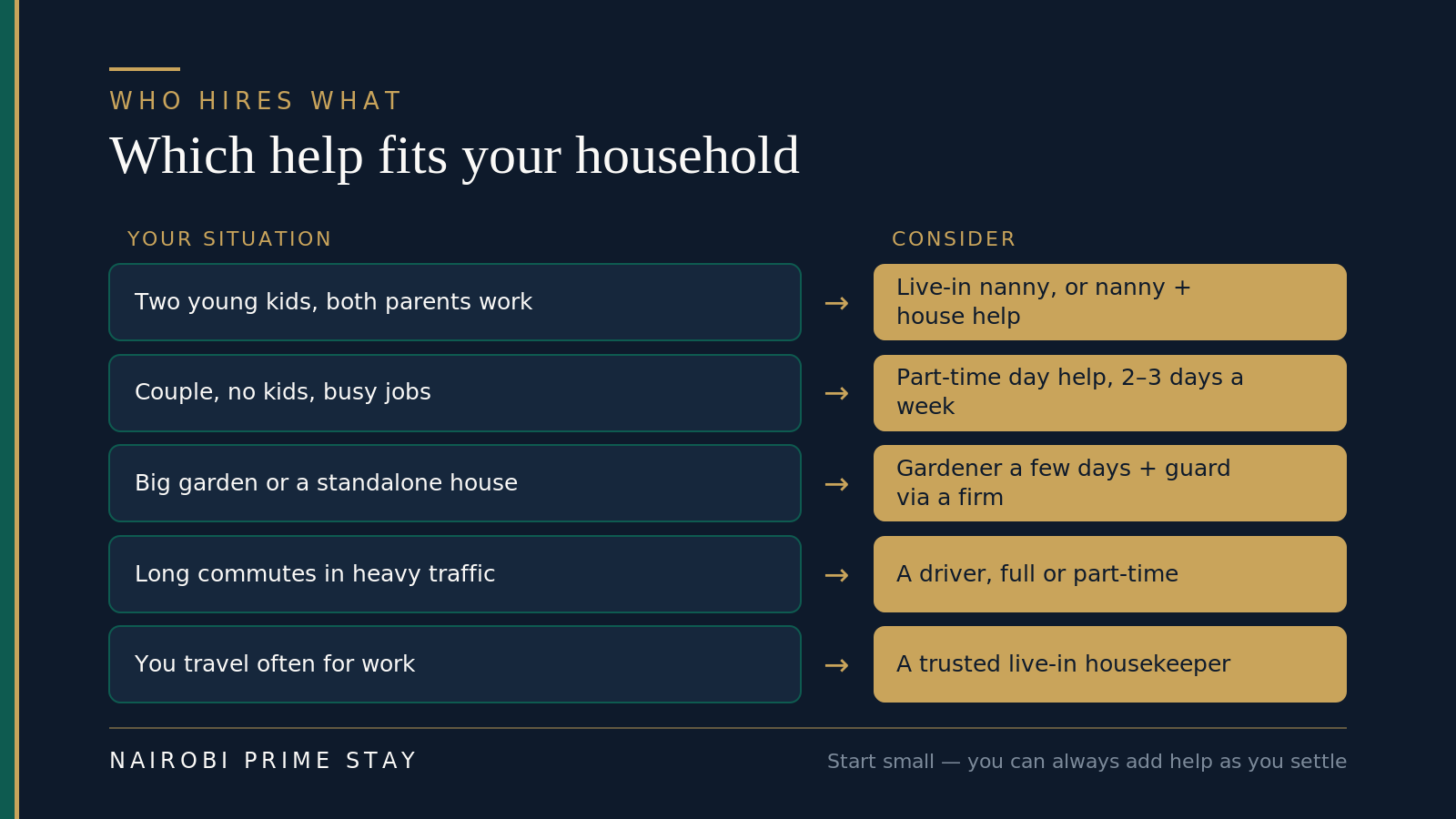 Start with what you actually need. You can always add help as you settle in.
Live-in vs live-out: which to choose
| Live-in | Live-out | |
|---|---|---|
| Best for | Families with young kids, frequent travellers, big homes | Couples, smaller homes, those who value privacy |
| Cash wage | Lower (room + meals included) | Higher (no housing provided) |
| Your cost beyond wage | Room, utilities, food | + 15% housing allowance if required |
| Availability | Early mornings, evenings, flexible | Set hours; commute can delay them |
| Privacy | Less — someone shares your space | More — your home is your own after hours |
| Best fit | School-age kids, demanding schedules | Predictable routines, lighter needs |
Neither is “better.” Families with infants and two demanding jobs often value a live-in nanny’s flexibility; a couple in a two-bed apartment in Kilimani or Westlands may prefer a house help who comes three mornings a week and goes home. Space matters too — the big garden compounds of Karen and Runda lend themselves to live-in staff quarters in a way a city apartment doesn’t.
A realistic example
Say you’re a couple relocating from the US with a four-year-old and a baby. Both of you work, one of you remotely on US hours. You land, and for the first six weeks you stay in a serviced apartment in Gigiri while you find a house and get your bearings — no staff, no setup, cleaning handled.
Once you sign a lease in Runda, you hire a live-in nanny through an agency another UN family recommended. She has two checkable references and ten years with young children. You agree KES 32,000 a month (above the minimum, fair for her experience), a private room in the staff quarters with meals, Sundays off plus a weekday afternoon, and a written contract. You register her for NSSF and SHIF, deducting her share and adding yours — about KES 1,900 of contributions in total, split between you. You pay her, and the contributions, by M-Pesa on the 1st.
A few weeks later you add a gardener two days a week at KES 16,000 a month for the lawn and the kitchen garden, and you arrange security through a company rather than employing a guard. Your all-in monthly cost for help and security lands around $450–550 — less than daycare for two kids would cost in most US cities, for far more flexibility. More importantly, two people have steady, fair, contributed work, and your household runs while you focus on settling your family.
The honest pros and cons
Hiring help is mostly upside here, but go in clear-eyed.
Pros
- Affordable by Western standards — real time and freedom for a fraction of US costs.
- Genuinely useful — childcare, a running household, a maintained garden, no traffic-driving.
- Good employment — done fairly, you’re providing a stable, contributed job.
- Local knowledge — a good house help or nanny knows the markets, the shortcuts, the system.
- Flexibility — live-in help covers the early mornings and evenings daycare can’t.
Cons
- You’re an employer now — contracts, payroll, contributions and the occasional hard conversation.
- Less privacy with live-in staff — your home is also someone’s workplace, and sometimes residence.
- Management takes effort — expectations, training and trust all take time to build.
- Ethical weight — the power imbalance is real; fairness has to be a deliberate, ongoing choice.
- Turnover happens — people move on; occasionally you’ll need to rehire.
What about taxes? PAYE, the housing levy and WIBA
Three things almost no first-time household employer in Nairobi has heard of, explained plainly. None of them is expensive at domestic-wage levels, and knowing about them puts you ahead of most employers in the city.
PAYE (income tax). Kenya’s personal relief of KES 2,400 a month means an employee earning up to about KES 24,000 a month effectively owes no income tax. Most house helps and nannies fall under that line, so in practice there is nothing to deduct. A driver or house manager on KES 30,000–50,000 does cross it, and strictly you should register with KRA as an employer and deduct PAYE from their pay. Many expat households hand this to a small payroll service or labour consultant for a modest monthly fee — the same route covered in our guide to taxes for expats in Kenya.
The Affordable Housing Levy. Since March 2024, employers must deduct 1.5% of gross pay from every employee and add a matching 1.5% themselves, remitted to KRA monthly. The law does not carve out domestic workers, so strictly it applies to your house help too — on a KES 20,000 wage that is KES 300 from each side. Household-level enforcement has been thin so far, but “thin enforcement” is not an exemption; a labour consultant can set up the remittance alongside NSSF in one go.
NSSF after the February 2026 changes. The contribution rate is still 6% from the worker matched by 6% from you. What changed on 1 February 2026 is the earnings bands: Tier I now covers pay up to KES 9,000 and the upper limit rose to KES 108,000, which only matters at high salaries. At domestic-wage levels your sums stay simple — on a KES 20,000 wage, KES 1,200 is deducted and you add KES 1,200.
WIBA (work-injury cover). The Work Injury Benefits Act requires every employer — households included — to insure employees against injury at work. A domestic-workers WIBA policy from a Kenyan insurer typically costs a few thousand shillings per worker per year, and it is the policy that pays if your gardener is hurt on the job. Ask any general insurer for a “domestic servants” or WIBA package, and confirm current pricing when you buy.
Nanny or daycare — which makes sense in Nairobi?
For many American families this is the real question behind hiring help. Nairobi flips the usual US math: a full-time, experienced nanny at KES 22,000–35,000 a month usually costs less than a good daycare or preschool place, which at the schools expat families use commonly runs KES 30,000–80,000 a month and more. A nanny also solves drop-offs, sick days and school holidays in a way daycare can’t. The trade-off is socialisation — which is why many families combine a nanny with a few mornings of playgroup from age two or three. We compare the options properly in our nursery and daycare guide, and the wider picture is in family life in Nairobi.
How do you let someone go fairly?
Sometimes it doesn’t work out, and how you end it matters as much as how you started. Kenyan law — and basic decency — asks for a fair process, not just a payment.
After probation, either side can end the employment with one month’s written notice, or you can pay one month’s wages in lieu and end it immediately. If the issue is conduct or performance, tell the person the reason in writing and give them a chance to respond before you decide — Kenyan courts take fair procedure seriously, and unfair-dismissal claims by domestic workers are real and increasingly common.
On the final day, settle everything: wages up to the last day worked, pay for any accrued untaken leave, and — if you never registered them for NSSF — service pay of roughly 15 days’ wages for each completed year of service (paying NSSF properly is what removes this liability, one more reason to do it). Hand over a simple certificate of service stating the role and dates; the law requires it and it is their reference for the next job. Never withhold pay or documents to force a handover — it is illegal and it will go badly.
Your hiring checklist
Work through this in order and you’ll be a fair, legal, well-organized employer from day one.
- Decide what you actually need — role(s), hours, live-in or live-out.
- Set a fair budget — at or above the KES 18,047 minimum; more for skill and trust.
- Find candidates through referrals or a vetted agency.
- Verify ID and call at least two references.
- Run a paid trial of one to two weeks.
- Write a simple contract — duties, hours, pay, leave, rest day, notice, probation.
- Register for NSSF and SHIF/SHA, and set up the monthly deductions.
- Agree a pay date and method (M-Pesa or bank) — then pay on time, every time.
- Provide a decent room and meals if live-in; agree transport or a meal if live-out.
- Keep simple payslips and a record of leave taken.
- Check in after the first month and adjust fairly.
Frequently asked questions
How much does it cost to hire a house help in Nairobi?
Part-time day help (a cleaner two or three mornings a week) typically runs about $100-250 a month. A full-time live-out house help is usually KES 18,000-28,000 (about $140-215 at roughly KES 129 to the dollar, July 2026), with the legal minimum in Nairobi at KES 18,047 a month. Nannies, cooks and drivers cost more. Expat households often pay at or above the top of these ranges to attract experienced people and to be fair. On top of the wage you also cover small NSSF, SHIF and housing-levy contributions.
What is the legal minimum wage for a domestic worker in Kenya in 2026?
As of 1 May 2026, the gazetted minimum wage for a domestic worker (house help, gardener, day watchman) in Nairobi and other main cities is KES 18,047 per month. If you don’t provide accommodation, the law adds a 15% housing allowance on top. Minimums are lower in smaller towns and rural areas, and the rates are reviewed regularly, so confirm the current figure with the Ministry of Labour or a labour consultant before you set pay.
Do I have to pay NSSF and health insurance for my house help?
Yes. Domestic workers are covered by Kenya’s Employment Act, so you must register as an employer and remit contributions monthly. For NSSF (the pension scheme) you deduct 6% of pay from the worker and add a matching 6% as employer; from 1 February 2026 the earnings bands are Tier I up to KES 9,000 and an upper limit of KES 108,000, so at domestic wages it is simply 6% of gross - about KES 1,200 each on a KES 20,000 wage. For SHIF/SHA (health cover, which replaced NHIF) the rate is 2.75% of gross pay, with a minimum of KES 300 a month. These are legal requirements and real benefits for your employee.
Do I have to deduct PAYE or pay the housing levy for domestic staff?
Usually no PAYE, but yes to the levy. Kenya’s KES 2,400 monthly personal relief means pay up to about KES 24,000 a month effectively attracts no income tax, which covers most house helps and nannies; a driver or house manager on KES 30,000+ does cross the line and should have PAYE deducted. The Affordable Housing Levy (1.5% from the employee plus 1.5% from you, remitted to KRA) has no domestic-worker exemption, so strictly it applies - about KES 300 each side on a KES 20,000 wage. A payroll service or labour consultant can handle both cheaply.
How do I find a trustworthy nanny or house help in Nairobi?
The two reliable routes are personal referrals - ask colleagues, neighbours, your building manager or other parents - and a reputable placement agency that pre-screens candidates. Whichever you use, do your own checks: verify the person’s Kenyan national ID, call at least two previous employers (actually call, don’t just read a letter), run a one-to-two-week paid trial, and write a probation period into the contract. Trust is built over time, so it’s fine to start part-time.
How much should I pay a nanny or a driver in Nairobi?
As a 2026 guide, an experienced live-in nanny is typically KES 22,000-35,000 a month, and a driver KES 30,000-50,000, depending on experience, hours and whether the role is live-in. Live-in pay looks lower because a room and meals are part of the package - value those honestly rather than using them to underpay. For someone you trust with your children or your safety, paying above the minimum is both fair and a good way to keep good help.
Is a nanny cheaper than daycare in Nairobi?
Usually, yes - the opposite of the US. A full-time experienced nanny at KES 22,000-35,000 a month generally costs less than a daycare or preschool place at the schools expat families use, which commonly run KES 30,000-80,000 a month. A nanny also covers sick days, school holidays and drop-offs. Many families combine a nanny with a few mornings of playgroup from age two or three for socialisation.
Is it normal for expats to hire domestic help in Nairobi?
Yes, very. Most expat and many local middle-class households employ some help - a part-time house help, a nanny, a gardener a few days a week. Labour is affordable relative to a Western income, and homes here are run in ways that take more time. It isn’t a status symbol; it’s how households run, and it’s an important source of employment. The key is to do it fairly: at or above the legal wage, with contributions paid and time off respected.
Should I hire live-in or live-out help?
It depends on your household. Live-in help suits families with young children, frequent travellers and larger homes with staff quarters; the cash wage is lower because a room and meals are included, but you give up some privacy. Live-out help suits couples, smaller homes and anyone who values their space; the cash wage is higher and, if you provide no housing, a 15% housing allowance applies. Neither is better - match it to your space, schedule and needs.
What paid leave is a domestic worker entitled to in Kenya?
After 12 months of service, a domestic worker earns 21 days of paid annual leave. They are also entitled to a weekly day of rest, paid sick leave, public holidays, and - where relevant - three months’ maternity leave or two weeks’ paternity leave. A day off is a legal right, not a favour. These provisions come from the Employment Act; confirm the current detail with a labour lawyer if you’re unsure.
How do I legally dismiss a house help in Kenya?
After probation, give one month’s written notice or pay a month’s wages in lieu. If the reason is conduct or performance, put it in writing and let the person respond before you decide - fair procedure matters in Kenyan law, and unfair-dismissal claims are real. On the last day, pay wages owed plus accrued untaken leave, service pay of about 15 days’ wages per year served if you never paid NSSF, and issue a certificate of service. Never withhold pay or documents.
Do I need insurance for my domestic worker?
Yes. The Work Injury Benefits Act (WIBA) requires every employer, households included, to insure employees against injury at work. Kenyan insurers sell domestic-worker WIBA packages for a few thousand shillings per worker per year, and that policy is what pays out if your house help or gardener is hurt on the job. It’s separate from SHIF/SHA health cover, which handles ordinary illness.
Final thoughts
Hiring help in Nairobi is one of the quiet pleasures of living here, and one of the responsibilities. Done well, it gives you back hours, keeps a home running, and provides someone with steady, dignified, contributed work. Done carelessly, it slides into the kind of arrangement nobody should be comfortable with. The difference is entirely in your hands, and it isn’t expensive or complicated to get right: pay fairly and on time, put it in writing, cover NSSF and SHIF, respect the day off, and treat the person the way you’d want to be treated.
Start small. You can always add help as you settle and learn what your household actually needs. And there’s no rush to hire anyone in week one - a managed home buys you time to get it right.
Related reading
- Moving to Nairobi: the complete guide - the hub that ties together every part of your relocation.
- Cost of living in Nairobi - where domestic help fits in a realistic monthly budget.
- M-Pesa guide for Kenya - how you’ll pay wages and statutory contributions each month.
- Is Nairobi safe? An honest guide - security firms versus employing a guard, and sensible home setup.
- Moving to Nairobi with kids - the wider picture if you’re hiring a nanny.
- Nairobi culture and etiquette - greetings, respect and the language that matters at home.
- Karen neighbourhood guide and best neighbourhoods for expats - where space and staff quarters are easiest.
- Kenyan culture and etiquette for newcomers — greetings, respect and how to be a fair, well-regarded employer of household staff
- Nursery and daycare in Nairobi — the nanny-versus-daycare decision in full.
- Family life in Nairobi — the wider picture of running a family household here.
- Taxes for expats in Kenya — PAYE, the housing levy and where household payroll fits.
A serviced apartment is the easy way to start: cleaning, Wi-Fi, security and a backup generator are all included, so you can settle in and decide what help you actually need before you hire anyone. Browse our serviced apartments in Nairobi for honest monthly pricing, or let our AI relocation assistant shortlist a home in a couple of minutes - it can factor in space for staff quarters, your commute and your budget.
Ready to look?
Find your apartment in Nairobi
Browse verified serviced apartments, or ask the AI concierge which area fits your life.