
Guides · Relocating
Building a Social Life as an Expat in Nairobi (2026): How to Make Friends Fast
Building a Social Life as an Expat in Nairobi (2026): How to Make Friends Fast

Here’s the reassuring part first: Nairobi is one of the easiest cities in the world to make friends in as a newcomer. It has a large, settled international community, a culture that’s warm to strangers, and a social calendar that runs on weekends, sports clubs, school gates and WhatsApp groups. Plenty of people arrive knowing nobody and have a real circle within a couple of months.
That doesn’t mean it happens by itself. The friendships are there for the taking, but you have to take them. The expats who feel at home fastest are the ones who say yes to the first three invitations, join one club in their first month, and treat the people in their building and at their local cafe as the start of a network, not background scenery.
This guide is for Americans moving to Nairobi who don’t yet know a soul. By the end you’ll know where people actually meet, which channels work fastest, how the path differs if you’re single, a couple or a family, and how to handle the quiet stretch that almost everyone hits in the first few weeks. It’s an honest picture: the good, the slow, and what to do about it.

The quick answer (TL;DR)
Making friends in Nairobi is genuinely easy if you’re a little proactive, because the expat scene is large and the social culture is open. Plug in through a few channels at once: join an online community (InterNations, Meetup and a couple of Facebook or WhatsApp groups), pick one sport or club (running with the Hash House Harriers, golf or tennis at a country club, a gym class, a hiking group), find your people through faith, hobbies or work, and lean on your neighbourhood and building. Families meet half the city through their kids’ school; singles and couples lean harder on clubs, sports and nightlife. Expect a slow, slightly lonely first few weeks — that’s normal, not a sign anything’s wrong — and expect it to click around the one-to-three month mark once your routines and repeat faces build up. Say yes early and often, and you’ll have a circle before you know it.

Why community matters more than you expect
A move only half-works until you have people. You can sort the visa, the apartment and the school run and still feel unmoored if your evenings and weekends are empty. Community is what turns a posting into a life — it’s who you call when the power’s out, who recommends a dentist, who invites you to Christmas when you can’t fly home.
It matters more in Nairobi than in a city you already know, because so much here runs on word of mouth and trust. The good nanny, the honest mechanic, the plot that’s actually for sale, the house before it hits the listings — these move through networks, not noticeboards. Your social circle is also your information network and, frankly, part of your safety net. People who are connected settle faster, spend less on rookie mistakes, and are far less likely to give up and go home in year one.
The flip side is real too. Isolation is the quiet reason some relocations fail. It rarely shows up as a dramatic problem; it shows up as a slow flatness, especially for a trailing partner who left a job and a friend group behind. Knowing that in advance — and treating “build a social life” as an actual task with actual steps — is half the battle.
The good news: Nairobi has a huge, welcoming scene
Nairobi is East Africa’s diplomatic and business hub, so the international community is deep and long-established. The United Nations runs one of its four global headquarters here, hundreds of NGOs and aid agencies are based in the city, and it’s the regional base for multinationals across tech, finance, logistics and media. That means a constant flow of people exactly like you — arriving, finding their feet, looking for friends.
Two things make it unusually easy to break in. First, turnover. Because diplomatic and NGO postings run on two- and three-year cycles, the community is used to people coming and going, so nobody is a closed book. Newcomers aren’t an oddity; they’re the norm, and “we should get you connected” is a normal thing for someone to say to a stranger. Second, Kenyan culture itself is sociable and hospitable. Greetings matter, people are quick to invite, and “Karibu” (welcome) is meant. You’re not trying to crack a cold city. You’re stepping into one that’s primed to fold you in — if you show up.
Where expats actually meet people in Nairobi
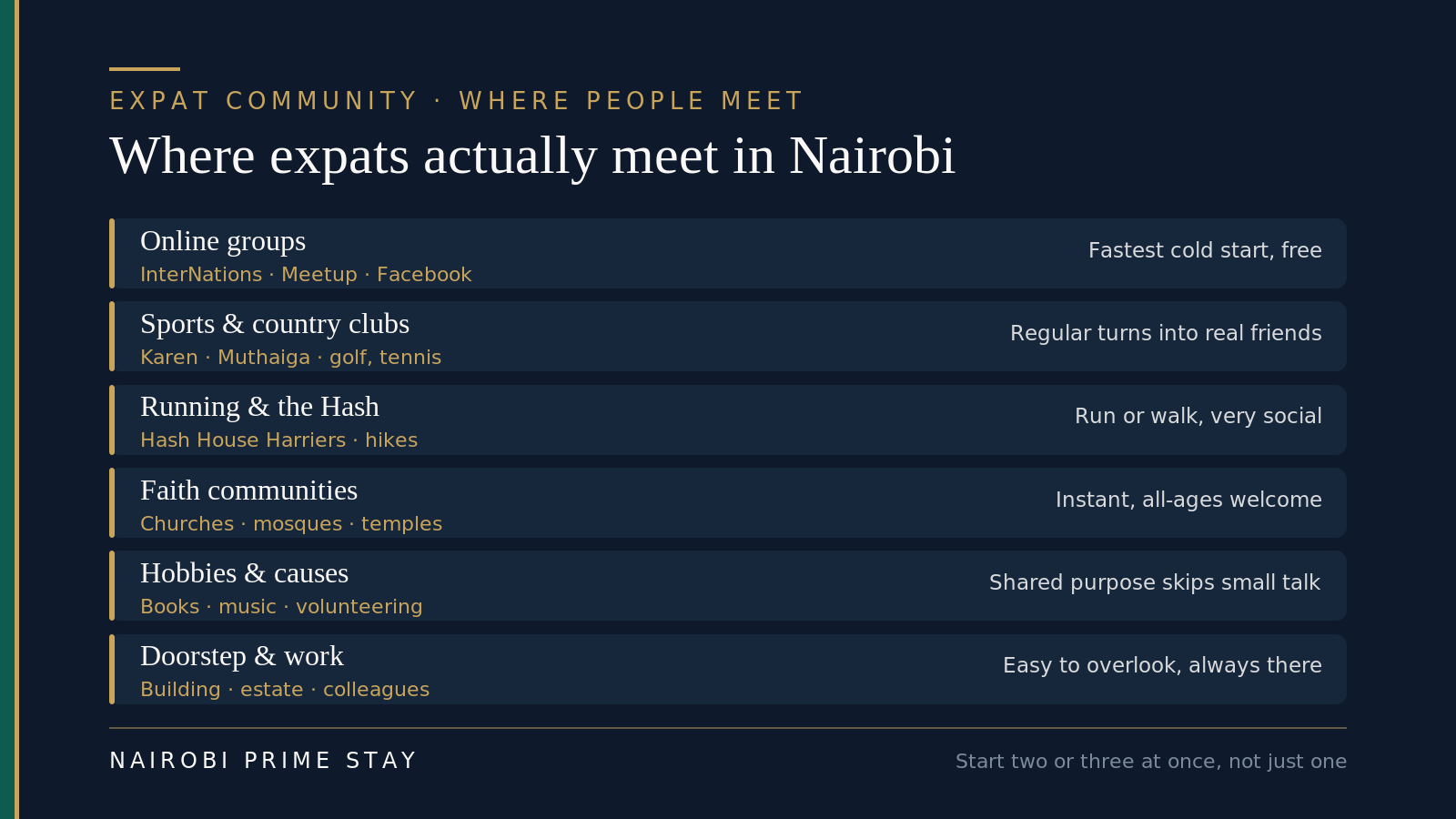
There’s no single hub. People build their circle from a handful of overlapping channels, and the trick is to start two or three at once rather than betting everything on one. Here’s where it really happens.
Online communities and apps
This is the fastest cold start, and where most newcomers begin before they’ve even landed. InterNations runs a Nairobi community with regular in-person events — drinks evenings and themed meetups that are explicitly there for people to walk in alone and leave with numbers. Meetup has active Nairobi groups for hiking, running, tech, board games, books and language exchange. And Facebook is where a lot of daily expat life lives: search for groups along the lines of “Expats in Nairobi” and “Nairobi Mums,” where people swap recommendations, sell furniture, and post the week’s events. Once you arrive, you’ll get pulled into WhatsApp groups for your estate, your building, your sport and your kids’ class — those become your real day-to-day network. The honest caveat: online is the on-ramp, not the destination. Use it to get to the first real-world meetup, then let in-person take over.
Sports and country clubs
Clubs are the backbone of expat social life here, and joining one is the single highest-return move for many people. Nairobi’s country and sports clubs offer golf, tennis, squash, swimming, gyms and, just as importantly, a bar and a calendar of events. Karen Country Club and the historic Muthaiga Country Club (founded in 1913) are the best-known, alongside Muthaiga Golf Club and Royal Nairobi Golf Club; most have specific overseas or expatriate membership categories, often with a short probation period. Be honest with yourself about which kind you want: some people make their closest friends through the golf or squash group and the parties; others find the clubs more about facilities than friendship. Either way, a club gives you a reason to turn up regularly, and regular is how acquaintances become friends. (Membership terms and fees change, so confirm current details directly with each club.)
Running, hiking and the Hash
If you’d rather sweat than golf, Nairobi’s outdoor scene is a gift. The Hash House Harriers — a worldwide, famously unserious running-and-social club that bills itself as “a drinking club with a running problem” — has an active Nairobi chapter and is a classic way for newcomers to meet a wide, mixed crowd; you can run or just walk it. There are weekend hiking groups that head for the Ngong Hills, Karura Forest and beyond, parkrun-style events, cycling crews and trail groups, most coordinated through Meetup or Facebook. Exercise plus a shared Saturday morning is one of the most natural friendship formulas there is. Our gyms, fitness and wellness guide goes deeper on classes and studios, which are their own social scene.
Faith communities
For many expats, a church, mosque, temple or synagogue is the fastest route to an instant, multi-generational community — and one that actively looks after newcomers. Nairobi has large international congregations with English-language services that draw diplomats, NGO staff, business families and long-term residents, plus established Muslim, Hindu, Sikh and Jewish communities. Beyond the service itself, faith communities run small groups, dinners, volunteering and family events, which is where the real connection happens. Even people who aren’t especially religious sometimes find this the warmest welcome going.
Hobbies, interests and causes
Whatever you were into at home, there’s a version of it here. Book clubs, choirs and music groups, amateur theatre, photography walks, wine and supper clubs, padel and pickleball, sailing at Nairobi Sailing Club, motorsport, birdwatching, art classes — they exist, and they’re full of people who’ll talk to you because you already share something. Volunteering is another strong thread: Nairobi has no shortage of community and conservation causes, and giving time is a genuine way to meet committed locals and expats alike. Shared purpose skips the small talk.
Your neighbourhood, building and local spots
Don’t overlook what’s on your doorstep. In a gated estate or apartment building, the other residents are your most convenient network — say hello, accept the braai (barbecue) invite, join the building WhatsApp group. Picking a sociable, walkable area helps a lot; our best neighborhoods guide breaks down which suburbs suit singles, couples and families. Becoming a regular at one good local cafe, deli or weekend market does quiet, steady work too — the same faces, week after week, are how loose ties form. Starting in a serviced apartment for your first month is an underrated social shortcut: you’re often surrounded by other relocating professionals doing exactly what you are.
Work, professional networks and your kids
Two channels do a lot of heavy lifting for the people they apply to. If you’ve moved for a job, your colleagues and their partners are an obvious first circle, and Nairobi has plenty of professional mixers, chamber-of-commerce events and industry meetups. And if you have children, the school is your shortcut to half the city — the international-school gate, class WhatsApp groups, sports fixtures and fundraisers will introduce you to more families than you can keep up with. More on that in our family life in Nairobi guide.
Compare the channels: which fits you?
No single channel is “best” — they trade off speed, cost and the kind of people you meet. Use this to pick your first two.
| Channel | Best for | Effort to start | Cost | How fast it pays off |
|---|---|---|---|---|
| Online groups (InterNations, Meetup, Facebook) | Everyone, especially pre-arrival | Low | Free–low | Days |
| Sports & country clubs | Couples, families, the sporty | Medium (apply, sometimes probation) | Higher (membership) | Weeks |
| Running / hiking / the Hash | Active people, all ages | Low | Free–low | Days–weeks |
| Faith communities | Anyone wanting instant belonging | Low | Free | Days |
| Hobby & interest groups | People with a clear passion | Low–medium | Varies | Weeks |
| Volunteering & causes | The purpose-driven | Medium | Free | Weeks |
| Neighbourhood & building | Everyone | Very low | Free | Ongoing |
| Work network | Those relocating for a job | Low | Free | Days–weeks |
| School gate | Parents | Low (automatic) | Free | Days |

A realistic plan is one online group plus one club or sport plus whatever your life hands you (work, building, school). Three threads is plenty; you don’t need all nine.
What does joining a Nairobi country club actually cost?
More than it used to. At Karen Country Club’s December 2025 AGM, members voted through a steep rise in joining fees for new applicants: KES 1.6 million for a single member (up from 650,000) and KES 2.5 million for a couple (up from 1.15 million), with the old discounted expatriate categories folded into the same rates. At roughly KES 129 to the dollar (July 2026), that’s a one-off of about $12,400 or $19,300. Annual subscriptions stayed put — about KES 121,000 a year for golf and KES 56,000 for social membership, so under $950 and $450 respectively once you’re in.
Karen isn’t the outlier, either. Muthaiga Golf Club’s entrance fee for a couple runs around KES 1.66 million, while the mid-tier is far kinder: Parklands Sports Club at roughly KES 775,000, Vet Lab Sports Club around KES 950,000 for a couple, and Nairobi Club closer to KES 465,000, per the club fee comparison published alongside the Karen decision. All figures change at AGMs, so treat these as a July 2026 snapshot and confirm directly with the membership office before you budget.
Three honest notes for a newcomer. First, entrance fees are one-off and memberships are effectively for life, which is why Kenyan families treat them as an inheritance — the maths looks different if you’re here on a two-year posting, so ask about social (non-golf) categories, monthly guest arrangements, or simply playing as a member’s guest before committing seven figures in shillings. Second, the waiting lists and proposer/seconder requirements are real: most clubs want existing members to vouch for you, which is itself a reason to build your network first and join the club second. Third, you don’t need a club to have a social life here. The Hash House Harriers costs a few hundred shillings a run, padel and gym communities are booming, and most of the friendships in this guide were made nowhere near a fairway.
Single, couple or family: your path differs
The city is friendly to all three, but the easy doors are different.

If you have kids, you have the simplest route by far. The school does most of the work — drop-off chats, class WhatsApp groups, birthday parties, sports matches and fundraisers will surround you with other families within weeks. The risk for parents is that the whole social life becomes child-shaped; keep one thing that’s just yours, a sport or a club, so you’re a person as well as a parent.
If you’re a couple without kids, you have each other, which is lovely and also a trap — it’s easy to cocoon and never push out. Be deliberate. Join things separately as well as together, host early (people reciprocate), and use couple-friendly channels like clubs, supper clubs and the dinner-party circuit. Nairobi entertains at home a lot, so a willingness to host punches above its weight.
If you’re single, you’ll lean hardest on sports, clubs, faith, hobbies and nightlife, and you’ll need to be the most proactive — but singles often build the widest networks precisely because they say yes to more. The nightlife and social scene runs from Westlands bars to Karen garden restaurants, and is a real way to meet people, not just to drink. Westlands and Kilimani suit the young and social; Karen and Lavington skew family and quieter. Solo women relocate here all the time and do fine — see our honest safety guide for the everyday street sense that lets you go out and enjoy the city.
How does dating work in Nairobi as an expat?
The apps you already use work here. Tinder, Bumble and Hinge are all active in Nairobi, busiest among the professional crowd in Westlands, Kilimani and Lavington, and dating across the expat–Kenyan line is completely normal — plenty of the long-term expats in this city stayed because they met someone. Beyond the apps, the same channels that build friendships build relationships: the nightlife and brunch scene, the restaurant culture, sports clubs and mutual friends, which remain the most reliable introduction service in town.
Two honest notes. Take the standard big-city precautions early on — meet in public, tell a friend where you are, and arrange your own ride home (more on safety here). And be alert to the money question: romance scams targeting newcomers exist here as everywhere, so slow-walk anyone who moves quickly from sweet nothings to school fees, “stuck” mobile money transfers or investment opportunities. Neither should put you off; they’re the same rules a sensible person applies in Chicago or London.
Can you start building your network before you land?
Yes — and the people who settle fastest usually do. A month of light groundwork from your sofa in the US means you land with faces to meet rather than a blank calendar.
Start with the online rooms. Join the Nairobi expat Facebook groups, InterNations and a Meetup or two now, read for a week to get the tone, then post one good, specific question — “landing in September with two kids, which estates have the most active WhatsApp groups?” gets warm, useful replies where “any tips?” gets crickets. Second, mine the network you already have: a LinkedIn search for second-degree connections in Nairobi, your university’s alumni chapter (several US universities have active Kenya alumni groups), your company’s other offices, your church’s sister congregations. One warm introduction beats ten cold meetups. Third, choose a sociable landing pad. A serviced apartment or compound in a well-connected neighbourhood gives you neighbours, staff who know everyone, and a building WhatsApp group from day one — the doorstep network this guide keeps coming back to. If you’ll be working remotely, plan on a desk at a coworking space rather than your dining table; it’s the single easiest weekday source of repeat faces. Finally, book your first weekend before you fly: one InterNations event, hash run or service already in the diary means the quiet stretch starts shrinking on day two.
How to plug in fast: your first 90 days
You don’t need a grand strategy. You need a few small actions, early, before the inertia sets in. Here’s a simple arc that works.

Treat this as a checklist, not a race:
- Before you fly: join the InterNations Nairobi community and 2–3 Facebook/Meetup groups; post a friendly “we’re moving in [month], any tips?” — people reply.
- Week 1–2: say yes to every invitation, however small. Introduce yourself to neighbours and your building’s WhatsApp group. Pick one cafe or market to become a regular at.
- Week 2–3: go to one InterNations or Meetup event alone. It’s awkward for ten minutes and worth it.
- Week 3–6: commit to one ongoing thing — a club, a sport, the Hash, a faith community, a class. Ongoing beats one-off, because friendship needs repetition.
- Week 4+: if you have kids, work the school gate; if you have a job, accept the after-work and partner invites.
- Week 6–12: host something tiny — coffee, a braai, drinks. Hosting flips you from guest to connector, and people pay it back.
- Ongoing: keep one thing that’s purely yours, and don’t quit a group after one quiet session. The third time is usually when it clicks.
The honest part: the first few weeks can be lonely
Almost everyone hits a flat patch in the first few weeks, and almost nobody warns you. The novelty of arrival fades, the logistics are handled, your partner may be deep in a new job, and suddenly the weekends feel long and the time difference makes home feel far away. This is normal. It is not a sign that you’ve made a mistake or that Nairobi is unfriendly. It’s the gap between arriving and belonging, and it closes.
What closes it is repetition and patience. The events where you “met no one” are still deposits — the faces repeat, and the fourth time you see someone at the run or the bar, you’re suddenly friends. Most people describe a clear turn somewhere between one and three months, when the routines, the WhatsApp groups and the repeat encounters reach critical mass.
A few things genuinely help: build a routine fast, because friendship grows from regularity, not from grand events; say yes even when you’d rather stay in, especially in the first month; and be the one who follows up — swap numbers and actually send the message. Keep your old friendships warm with scheduled video calls so you’re not relying on Nairobi for everything at once. And if the flatness deepens into something heavier rather than lifting — low mood that lingers, not just homesickness — treat it seriously; Nairobi has good private counsellors and therapists, and reaching out early is the strong move, not the weak one.
A realistic example
Take Dana, who moves to Lavington on a two-year contract, with her partner Sam, who doesn’t yet have a job lined up. Before flying, Dana joins InterNations Nairobi and two Facebook groups and posts that they’re arriving in August; three people reply with tips and one suggests coffee. Week one, they land in a serviced apartment, join the building WhatsApp group, and Sam — facing the emptier days — picks Saturday morning with the Hash House Harriers and a weekday padel group. By week three Dana’s colleagues have folded them into an after-work crowd, and Sam has two regular faces from the run. Week six, they host a small braai on the apartment terrace for eight people, half of whom they barely knew. By month three they’ve got a standing Sunday-lunch group, a couple they travel to the coast with, and a problem they didn’t expect: too many invitations. It wasn’t luck. It was saying yes early, joining ongoing things, and hosting before they felt fully ready.
Pros and cons of the Nairobi social scene
Like everything here, it’s worth seeing clearly.
The upsides
- A large, established international community that’s used to newcomers and quick to include them.
- Warm, sociable local culture — being invited and hosting at home are normal.
- A genuinely full menu: clubs, sports, faith, hobbies, nightlife and causes, year-round (the mild climate helps).
- English is all you need, so there’s no language barrier to a social life from day one.
- For parents, the school gate makes meeting other families almost automatic.
The trade-offs
- High turnover cuts both ways: friends rotate out on two- and three-year cycles, so there’s real churn and repeated goodbyes.
- Some of the social life sits behind club memberships and gated estates, which costs money and can feel exclusive.
- It can skew into bubbles — easy to meet only other expats and never really befriend Kenyans unless you make the effort.
- You have to be proactive; the city rewards the joiners and can feel lonely for those who wait to be found.
- The first few weeks are genuinely quiet before it clicks.
Final thoughts
Nairobi gives back exactly what you put in socially, and the entry price is low: a few yeses, one club, and the patience to let repetition do its work. The community is large, used to newcomers, and genuinely warm — you’re not breaking into a cold city, you’re stepping into one that expects you. Push past the quiet first few weeks, keep one foot in expat circles and one in real Kenyan friendships, and you’ll likely end the year with a fuller social life than you had back home. The people who thrive here aren’t the most outgoing. They’re the ones who showed up, again and again, until the faces became friends.
Related reading
- Moving to Nairobi: the complete guide — the end-to-end overview of the whole move, with everything below linked from it.
- Kenyan culture and etiquette for newcomers — greetings, hospitality and the social cues that make a good first impression.
- Learning Swahili: the basics that help — the handful of words that earn warmth and open doors.
- Nightlife and the social scene in Nairobi — bars, garden restaurants and where the evenings happen.
- Gyms, fitness and wellness in Nairobi — classes, studios and running groups that double as a social life.
- Family life in Nairobi — how parents meet other families, and things to do with kids.
- Best neighborhoods in Nairobi for expats — which suburbs suit singles, couples and families, and how sociable each feels.
- Is Nairobi safe? An honest guide — the everyday street sense that lets you get out and enjoy the city.
Settling in, the easy way
A soft landing makes the social part easier. A serviced apartment for your first month puts you among other relocating professionals, in a secure, all-inclusive base, while you test neighbourhoods and find your feet — browse what’s available or tell our AI relocation assistant your dates, budget and work location and it’ll shortlist options in a couple of minutes, day or night. A $50 deposit reserves your place; you pay the balance on arrival. Get the base right, say yes early, and the friends follow.
Frequently asked questions
How do expats make friends in Nairobi?
Through a mix of channels rather than any single one. The fastest are online communities like InterNations, Meetup and local Facebook groups; sports and country clubs; running and hiking groups such as the Hash House Harriers; faith communities; and your own neighbourhood, building and workplace. Parents meet other families almost automatically through their kids’ school. Join two or three of these at once, say yes to early invitations, and keep showing up, because friendship here grows from repetition.
Is it easy to meet people in Nairobi as a newcomer?
Yes, unusually so. Nairobi has a large, long-established international community built around the UN, NGOs and multinationals, and because diplomatic and aid postings rotate every few years, locals and expats alike are used to welcoming newcomers. Kenyan culture is sociable and quick to invite. You do have to be proactive, since the city rewards joiners, but the doors are wide open.
What are the best apps and groups for expats in Nairobi?
InterNations runs a Nairobi community with regular in-person events designed for people arriving alone. Meetup has active Nairobi groups for hiking, running, tech, books and more. Facebook hosts busy expat groups, such as ones along the lines of ‘Expats in Nairobi’ and ‘Nairobi Mums’, for recommendations and events. Once you arrive, WhatsApp groups for your estate, building, sport and kids’ class become your real day-to-day network. Use online channels to reach the first real-world meetup, then let in-person take over.
Are there clubs for expats in Nairobi?
Yes. Sports and country clubs are the backbone of expat social life. Karen Country Club and the historic Muthaiga Country Club (founded 1913), plus Muthaiga Golf Club and Royal Nairobi Golf Club, offer golf, tennis, squash, swimming and a full social calendar, and most have overseas or expatriate membership categories. There are also less formal options like the Hash House Harriers running club and many hobby groups. Confirm current membership terms and fees directly with each club, as they change.
Will I be lonely when I first move to Nairobi?
Probably a little, for the first few weeks, and that is normal rather than a sign anything is wrong. The novelty fades, logistics get handled, and the gap between arriving and belonging can feel quiet. Most people describe a clear turn somewhere between one and three months, once routines, WhatsApp groups and repeat faces build up. Build a routine fast, say yes to invitations, and follow up with the people you meet to close that gap sooner.
How do families with children make friends in Nairobi?
Through the school, mostly, which is the single biggest shortcut. International-school drop-off, class WhatsApp groups, sports fixtures, birthday parties and fundraisers introduce you to more families than you can keep up with, often within the first weeks. Sports clubs, faith communities and your neighbourhood add more. The main tip for parents is to also keep one activity that is just yours, so your social life is not entirely child-shaped.
Is it harder to make friends in Nairobi if you’re single?
Not harder, just different. Singles lean more on sports, clubs, faith, hobbies and nightlife than on the school gate, and need to be a bit more proactive, but they often end up with the widest networks because they say yes to more. Westlands and Kilimani suit a younger, more social crowd, while Karen and Lavington are quieter and family-leaning. Solo newcomers, including women, settle here all the time.
Do I need to speak Swahili to make friends in Nairobi?
No. English is one of Kenya’s official languages and is spoken everywhere, so you can build a full social life in English from day one. That said, a few words of Swahili, like a warm Habari (hello) or Asante (thank you), go a long way and are appreciated as a sign of effort. The friendship comes through warmth and showing up, not through the language.
How much does it cost to join a country club in Nairobi?
As of July 2026, quite a lot at the top end. Karen Country Club’s December 2025 AGM raised joining fees for new applicants to about KES 1.6 million for a single and KES 2.5 million for a couple (roughly $12,400 and $19,300), with annual subscriptions of about KES 121,000 for golf and KES 56,000 for social membership. Muthaiga Golf Club is comparable or higher, while mid-tier options like Parklands Sports Club (~KES 775,000) and Nairobi Club (~KES 465,000) cost far less. Fees change at every AGM, so confirm with each club, and if you’re only here for a short posting ask about social categories or play as a member’s guest instead.
Can I start making friends in Nairobi before I move?
Yes, and it shortens the lonely stretch considerably. Join the Nairobi expat Facebook groups, InterNations and Meetup while you’re still in the US and ask one specific question about your situation; search LinkedIn for second-degree connections and your university’s Kenya alumni chapter for warm introductions; choose a sociable landing pad such as a serviced apartment or compound with an active building WhatsApp group; and book one event, hash run or service into your first weekend before you fly.
Is there a dating scene for expats in Nairobi?
Yes, and it works much like any big city. Tinder, Bumble and Hinge are all active, busiest among professionals in Westlands, Kilimani and Lavington, and dating between expats and Kenyans is completely normal. Restaurants, nightlife, clubs and mutual friends do the rest. Take standard precautions early on (meet in public, arrange your own ride home) and be wary of anyone who moves quickly from romance to requests for money, as romance scams targeting newcomers exist here as everywhere.
Ready to look?
Find your apartment in Nairobi
Browse verified serviced apartments, or ask the AI concierge which area fits your life.