
Guides · Lifestyle
Gyms, Fitness and Wellness in Nairobi (2026): A Newcomer's Guide
Gyms, Fitness and Wellness in Nairobi (2026): A Newcomer’s Guide
Staying fit in Nairobi is easy, and it costs a fraction of what you pay in the US. There are big gym chains a few minutes from most suburbs, boutique studios for everything from Pilates to Muay Thai, one of Africa’s biggest recreational running clubs, and — the part nobody warns you about — a mild highland climate and a city full of green space that makes training outdoors a pleasure most of the year.
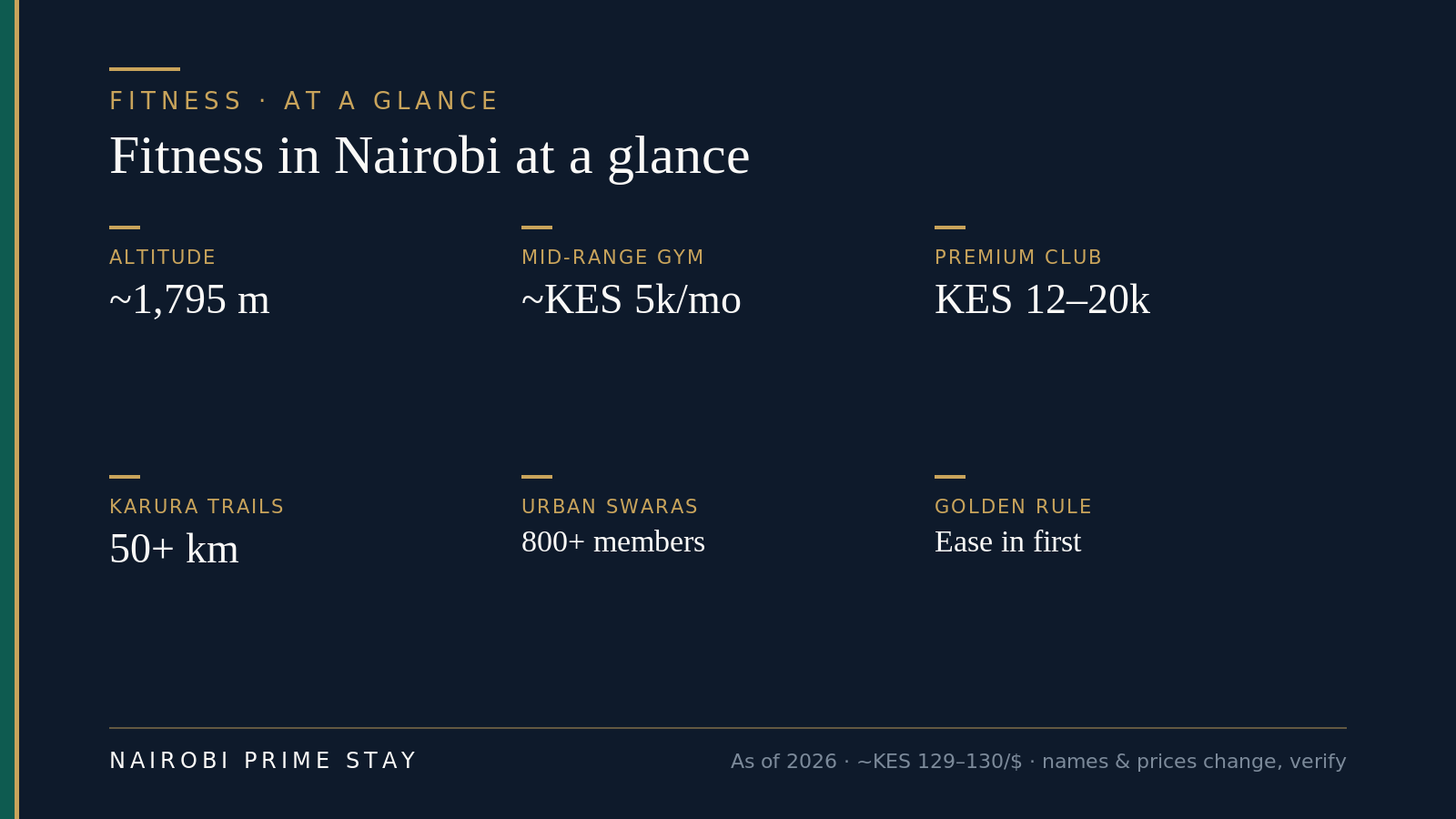
There is also a quiet bonus built into the address: altitude. Nairobi sits at about 1,795 metres, roughly 5,900 feet. That thin air is the same reason Kenya produces the world’s best distance runners, and after a couple of weeks of acclimatizing, you get a real endurance kick from it.
This guide is the honest version for Americans who have just landed: where to find a gym near home, what a membership actually costs in 2026, how to plug into the running scene, where to go outdoors, and how to ease into all of it without flattening yourself in the first week. We name a few well-known places as examples, but Nairobi’s fitness scene grows and changes fast, so treat the names as a starting map and confirm current details before you commit.

The quick answer (TL;DR)
You will not struggle to stay fit here. A solid mid-range gym membership runs about KES 5,000 a month (roughly $40), with budget gyms a little less and premium clubs with pools and spas more like KES 12,000–20,000+. Day passes are common at KES 1,000–3,000 if you would rather not commit. Boutique studios — Pilates, spin, CrossFit, yoga, boxing — charge per class or by package. Running is the city’s real gift: join a club like the Urban Swaras for free-spirited Saturday group runs, and use the altitude to your advantage once you have adjusted. The outdoors is excellent and cheap: Karura Forest has over 50 km of trails for a small entry fee, and the Arboretum, Oloolua and the Ngong Hills are all close. If you like a goal, a personal trainer runs about KES 1,500–6,000 a session and the Standard Chartered Nairobi Marathon (25 October 2026, entry about KES 2,500) anchors the racing calendar. The one rule for newcomers: take it easy for your first week or two while your body adjusts to the altitude, wear sunscreen even when it is cool, and run in groups or known green spaces rather than alone. Prices are as of July 2026 at about KES 129.4 to the dollar — they move, so sense-check them against the current rate.
Why this matters when you’re settling in
Fitness is one of the fastest ways to feel at home here, and one of the cheapest. A gym near your apartment gives your week a shape from day one. A Saturday running club hands you a ready-made group of friends — locals and fellow newcomers — before you have unpacked. And the outdoors gets you out of the relocation bubble and into the green, calm side of Nairobi that surprises everyone who pictured only traffic. For the social side of all this, pair this guide with our piece on building a social life in Nairobi; the two go hand in hand, because a lot of expat friendships here start on a trail or in a class.
The altitude bonus — and how to use it without flattening yourself
Here is the thing that makes training in Nairobi special, and the thing that catches newcomers out: you are living and exercising at altitude. The city sits around 1,795 metres (about 5,900 feet). That is high enough that, for your first week or two, a flight of stairs or an easy jog will leave you more out of breath than it should. This is normal. Your body is making more red blood cells to carry oxygen in thinner air.
Give it time and that adaptation becomes a gift. Once you have acclimatized — usually a couple of weeks — your aerobic engine is quietly bigger than it was at sea level. It is the same physiology that draws elite runners to train in the Kenyan highlands; the famous training town of Iten sits even higher, around 2,400 metres. You are not in Iten, but you are high enough to feel it. Many expats find they get noticeably fitter here just by keeping up their normal routine.
The honest health note: ease in. For your first one to two weeks, dial down the intensity — shorter runs, lighter weights, more rest between sets — and let your breathing tell you when to back off. Hydrate more than you would at home; altitude is dehydrating. And respect the sun. The high-altitude light is strong even on cool, overcast days, so sunscreen and a hat for any outdoor session are not optional. If you have a heart or lung condition, or you are pregnant, get a doctor’s read before you push hard — see our guide to healthcare in Nairobi for how the private system works. For more on the climate you will be training in — the mild days, the cool nights, the two rainy seasons — see our Nairobi weather and climate guide.
Gyms in Nairobi: chains, mid-range and premium
Nairobi has a deep bench of gyms, from no-frills neighbourhood weight rooms to two-floor megaclubs with heated pools. Most expats find a good option within a ten-minute drive of home, and the prime suburbs — Westlands, Kilimani, Lavington, Karen, Kileleshwa and Parklands — are especially well served.
Budget and neighbourhood gyms (around KES 3,000–6,000/month). Plenty of solid, cash-only-friendly gyms sit in malls and office blocks across the city. They have what you need — free weights, machines, cardio, often a class or two — without the frills. If you just want to lift and run on a treadmill near home, this tier does the job cheaply.
Mid-range chains (around KES 5,000/month). The most widespread chain is Smart Gyms, with branches at spots like the Junction Mall on Ngong Road, Diamond Plaza II in Parklands, Southfield on Mombasa Road and The Hub in Karen. As of 2026 a monthly membership is around KES 5,000, with six-month and annual packages bringing the monthly cost down, and longer memberships are often transferable between branches — handy if you move around the city. AfroFit runs branches including Thika Road Mall and Delta Chambers in Westlands; the Westlands branch is the pricier, more premium of the two. This is the sweet spot for most newcomers: clean, well-equipped, central, and cheap by US standards.
Speciality and combat gyms. If you want boxing, Muay Thai or serious bodybuilding, Colosseum in Adams Arcade is a long-running favourite, with per-session, monthly and annual options. Several gyms also run CrossFit-style classes — CrossFit Kwetu in Westlands and Ultra Fitness on Kilimani Road are examples.
Premium clubs (around KES 12,000–20,000+/month). At the top end, W Exclusive in Westgate (Westlands) bills itself as the biggest gym in East Africa, spread over two floors with a 25-metre heated pool. Hotel gyms and full-service clubs add spas, saunas, steam rooms, group studios and pools, and many combine fitness with a spa under one roof — King’s Gym and Spa in Westlands runs studio classes from spin and Pilates to body pump and yoga. You pay more, but you get a one-stop wellness home.
One easy win: if you book a serviced apartment or live in a modern building in the prime suburbs, there is a good chance a decent gym is already downstairs and included. Check before you pay for a separate membership — for many people, the building gym plus a running club is all they need.
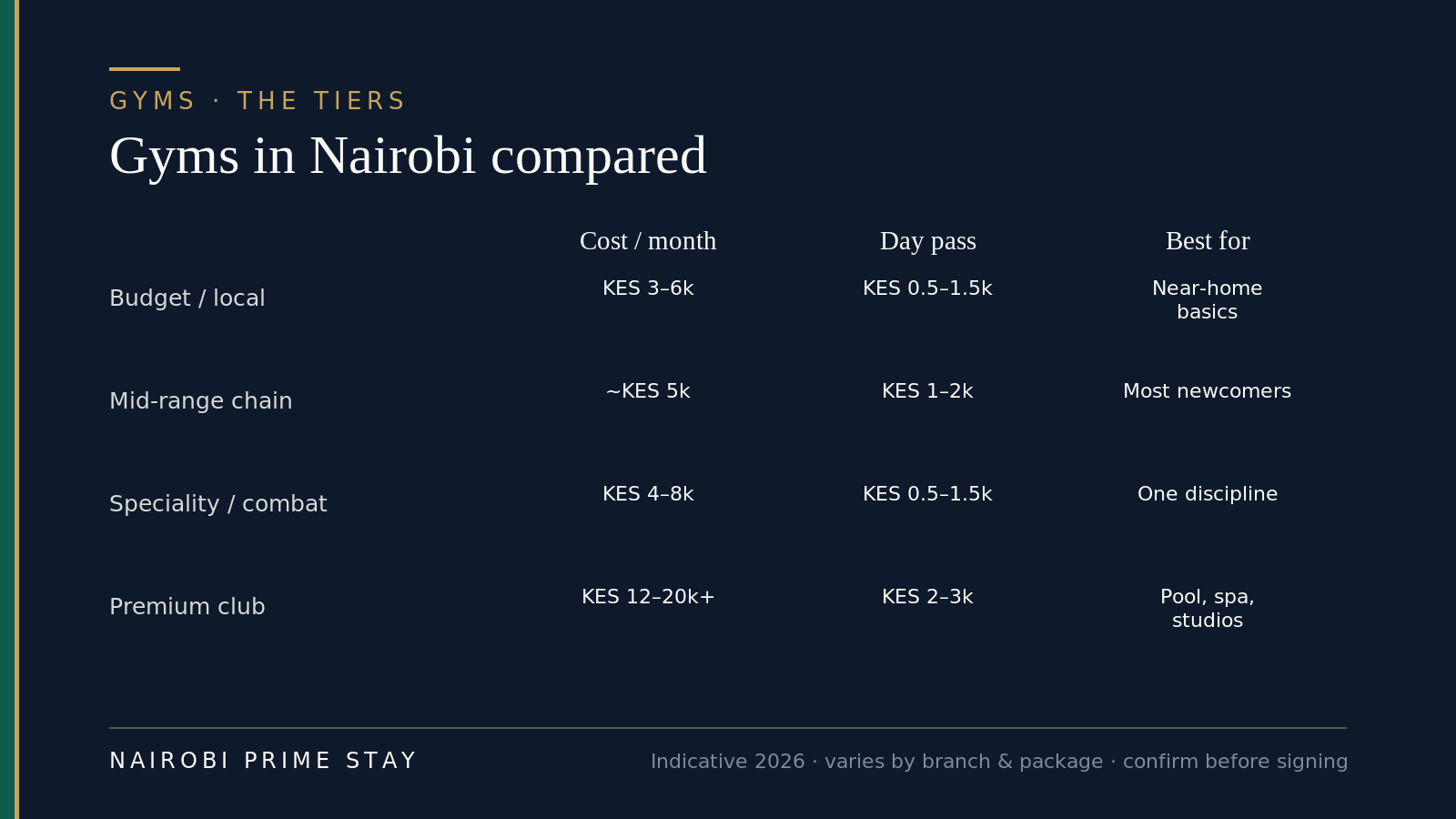
Gym tiers compared (indicative 2026)
| Tier | Indicative cost/month | Day pass | What you get | Best for |
|---|---|---|---|---|
| Budget / neighbourhood | KES 3,000–6,000 | KES 500–1,500 | Weights, machines, cardio; maybe a class | Lifting and cardio near home, on a budget |
| Mid-range chain | ~KES 5,000 | KES 1,000–2,000 | Full kit, classes, multiple branches | Most newcomers — clean, central, cheap |
| Speciality / combat | KES 4,000–8,000 | KES 500–1,500 | Boxing, Muay Thai, CrossFit, bodybuilding | A specific discipline or hard training |
| Premium club | KES 12,000–20,000+ | KES 2,000–3,000 | Pool, spa, sauna, studios, classes | A full wellness home under one roof |
Figures are indicative as of July 2026 at about KES 129.4 to the dollar, and they vary by branch and package — always confirm the current rate and what is included before you sign. Many gyms discount heavily for six-month and annual memberships, so if you know you will stay, the per-month cost drops fast.
Boutique studios: Pilates, spin, CrossFit, yoga and martial arts
If a big gym floor is not your thing, Nairobi’s boutique studio scene has grown quickly, especially in Westlands, Kilimani, Lavington and Karen. These specialise in one discipline and charge per class or by package rather than a flat monthly gym fee.
For Pilates, dedicated studios such as Body Equilibrium have brought reformer and mat classes to the city. Spin, barre and HIIT studios run timetabled classes you book ahead. CrossFit boxes and functional-fitness gyms have a loyal following. And for martial arts and combat sports, you will find boxing, Muay Thai, Brazilian jiu-jitsu and kickboxing gyms scattered across the suburbs. Boutique classes typically cost more per session than a gym visit — think roughly KES 1,000–2,500 a class, with packages bringing that down — but you get coaching, a fixed timetable and a community, which is exactly what many people want.
A practical tip: most studios let you drop in for a single class before committing. Try two or three near home, then buy a package where the coaching and the crowd click. The “near home” part matters more than you would think, because Nairobi traffic can turn a 6pm class across town into an ordeal — the evening peak runs roughly 5pm to 8pm.
Running in Nairobi: the city’s real fitness gift
If you do one thing for your fitness here, run. Nairobi is one of the best big cities in the world to be a runner, and not only because of the altitude. There is a deep running culture, a calendar of races, safe green spaces to train in, and a welcoming club scene that turns a solo habit into a social one.
The Urban Swaras are the headline act — Kenya’s largest recreational running club, with more than 800 members, going since 2006. They meet on Saturday mornings (around 7am) at a different spot in or near Nairobi each week for trail runs, camaraderie and the occasional out-of-town adventure. They cater to all paces, and they are one of the easiest ways for a newcomer to find both fitness and friends. The newer Karura Running Club, founded in 2022, meets early on Saturdays inside Karura Forest and has grown into a friendly community of its own. Beyond those, there is a whole ecosystem of groups — Run Beyond organises free weekly 5km-style social runs, and clubs like Team Jasho, Pace Setters and others run regular sessions. Kenya does not yet have an official parkrun, but the free, weekly, all-welcome spirit is alive and well in these groups.
Where to run. The safest and most pleasant routes are the green spaces rather than the roadside (Nairobi’s traffic, narrow shoulders and exhaust make running on main roads unappealing). Karura Forest, the Arboretum and the Oloolua Nature Trail are the classics — soft trails, shade and clean air. Many residents also run loops inside their own gated estate or compound. Wherever you go, the running safety basics apply: run in daylight or with a group, leave your good watch and phone at home or keep them out of sight, and stick to the known, patrolled green spaces rather than empty stretches alone.
The great outdoors: forests, trails and hills
Nairobi’s green spaces are the secret weapon of fitness here, and they cost very little. You pay a small entry fee, paid digitally, and get trails, fresh air and a complete break from the city.
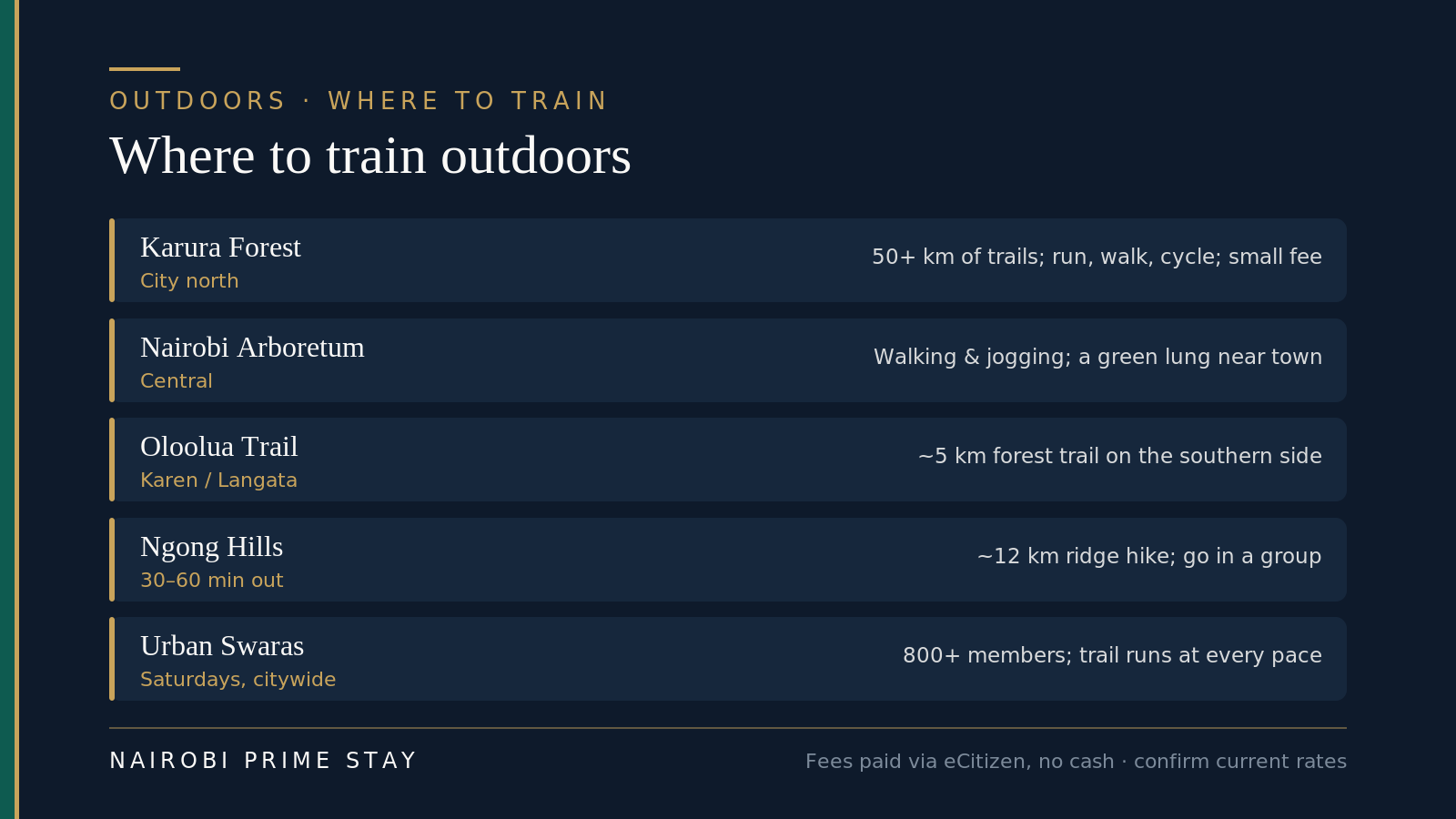
Karura Forest is the jewel: over 50 km of marked trails for running, walking and cycling, with streams, waterfalls and birdlife, right in the city’s leafy north. As of 2026, the gates run on the government’s eCitizen system (no cash — pay by M-Pesa to Paybill 222222 or by card). Entry is around KES 174 for Kenyan citizens and East African residents and KES 850 for non-resident visitors, with a resident rate in between for foreigners who hold a Kenyan permit; parking is about KES 295 per vehicle. Note that the Kenya Forest Service took over the gates in 2025 and suspended the old annual passes, so confirm the current arrangement before you go.
The Nairobi Arboretum is a smaller, central green lung popular with walkers and joggers, near Westlands and the city centre. Entry is modest — around KES 242 for adult citizens in 2025, with resident and non-resident tiers above that — though the fees rose in 2025 and drew some local pushback, so check the latest. The Oloolua Nature Trail near Karen and Langata is a roughly 5 km forest trail, a favourite for a quieter trail run on the southern side of town.
For something bigger on a weekend, the Ngong Hills are a 30–60 minute drive out and offer a classic ridge hike across seven peaks — about 12 km end to end, taking four to six hours, moderately challenging with real climbs. It is wise to go in a group and, for the full traverse, to hire a Kenya Forest Service ranger (around KES 1,000 per group) for safety and navigation. For more day-trips and weekend escapes that double as exercise, see our weekend trips from Nairobi guide.
Outdoor spots and indicative fees (2026)
| Place | What it’s for | Indicative entry (resident/citizen) | Good to know |
|---|---|---|---|
| Karura Forest | Trail running, walking, cycling | ~KES 174 citizen; resident tier above | 50+ km of trails; pay via eCitizen, no cash; parking ~KES 295 |
| Nairobi Arboretum | Walking, jogging | ~KES 242 adult citizen | Central; fees rose in 2025 — check latest |
| Oloolua Nature Trail | Trail run, nature walk | Small KFS fee | ~5 km forest trail near Karen/Langata |
| Ngong Hills | Hiking, hill training | ~KES 200–400 + ~KES 1,000 ranger/group | ~12 km, 4–6 hrs; go in a group |
All fees are paid digitally through eCitizen and are subject to change — confirm the current rate before you set off. For foreigners, getting your residence permit sorted means you pay the middle “resident” tier rather than the higher non-resident rate at most of these spots.
Yoga, Pilates and wellness
The wellness side of Nairobi is gentler and quieter than the gym scene, but it is there. Yoga has a real home here: the Africa Yoga Project, a community-focused social enterprise based around Parklands, runs classes and trains local teachers, and holds outdoor sessions in beautiful spots like Karura Forest and the Arboretum. A handful of dedicated yoga and Pilates studios round out the offering across the western suburbs, alongside the yoga and Pilates classes folded into premium gyms.
For recovery and pampering, spas are plentiful and good value — most premium gyms and hotels have one, and standalone day spas offer massage, sauna and steam at prices well below US rates. Physiotherapy and sports-massage clinics are easy to find in the suburbs if you tweak something. If you are into wellness retreats, several lodges and camps within a few hours of the city run yoga, detox and quiet-weekend escapes, especially around Naivasha and the Rift Valley.
Which races can you train for? Nairobi’s running calendar
Nairobi gives your training a proper goal, and race entry costs a fraction of a US bib. The headline event is the Standard Chartered Nairobi Marathon, whose 23rd edition runs on Sunday 25 October 2026. Individual entry is about KES 2,500 — under $20, versus $200-plus for a big US city marathon — and the day covers eight categories: the full 42 km, a half marathon, a 10 km, a 5 km family fun run, a 21 km wheelchair race, a CEO Challenge (KES 20,000) and even a satellite run in Mombasa. Register early online; the organisers expect several categories to fill faster than in previous years.
The other big date is the Nairobi City Marathon each June — the fifth edition ran on 7 June 2026 — which starts and finishes at Uhuru Park and sends the field out along the Nairobi Expressway. It is the one morning of the year you get to run the toll road with the city skyline to yourself. Beyond the two majors, community groups like Run Beyond keep a running race calendar, and the Urban Swaras’ weekly runs double as steady training with company.
One honest expectation-setter: you are racing at about 1,795 metres. Times run slower up here than at sea level, so treat your first Nairobi race as a benchmark rather than a PR attempt — and enjoy the flip side, which is that when you do race at sea level again, the altitude training pays you back.
Where can you swim in Nairobi?
More easily than most newcomers expect, though rarely for free. The main options, as of July 2026: premium clubs — W Exclusive in Westgate has a 25-metre heated pool — many modern apartment blocks and serviced apartments have a compound pool, and most mid-range and upmarket hotels sell pool day passes at about KES 1,200–1,500 for adults and KES 600–1,000 for kids; some bundle pool, gym, sauna and steam into a roughly KES 2,000 day rate. At the budget end, the YMCA’s aquatic centre near State House Road charges a few hundred shillings for a leisure swim, which makes it one of the cheapest lap pools in the city.
The altitude wrinkle: unheated water stays cool year-round up here, and in the June–August cool season an unheated pool is bracing. If year-round swimming matters to you, ask specifically whether the pool is heated before you commit — see our weather and climate guide for what those cool months feel like. Families are well served: hotel pools and schools run children’s swim lessons across the suburbs, and a compound pool is one of the quiet luxuries of family life in Nairobi.
What does a personal trainer cost in Nairobi?
This is where Nairobi’s fitness value really shows. As of July 2026, a newly certified personal trainer charges about KES 1,500–2,000 a session (roughly $12–15), while a highly experienced trainer with international certifications runs KES 4,000–6,000 — still well under half of a typical $70–100 US session. Monthly packages start around KES 15,000 for a basic program and climb past KES 60,000 for premium one-on-one coaching, with the per-session price dropping the more sessions you buy.
Two local habits make this even more convenient. First, many trainers travel to you — if your building or serviced apartment has a gym, a trainer can meet you downstairs, which removes the traffic excuse entirely. Second, everyone takes M-Pesa, so paying per session or per package is a two-tap affair. Vet the basics before you commit: ask about certifications, take a trial session, and agree the package terms in writing. Word of mouth in your building or running club is the best filter of all.
What it all costs
Fitness is one of the line items where Nairobi clearly beats the US. A mid-range gym membership at around KES 5,000 a month is roughly $40; even premium clubs with pools and spas top out where a basic US gym chain starts. A boutique class at KES 1,000–2,500 is a fraction of a US studio session. Running clubs are free or close to it. A forest entry fee is a dollar or two. The big-ticket wellness spend — a personal trainer, a premium club, regular spa days — is entirely optional, and even those cost far less than at home.
The honest caveat is that imported supplements and branded sportswear carry a markup, so bring your protein powder, your good running shoes and any specific kit with you if you are picky about brands. For how fitness fits the wider budget, see our Nairobi cost of living guide.
A realistic first month, fitness-wise
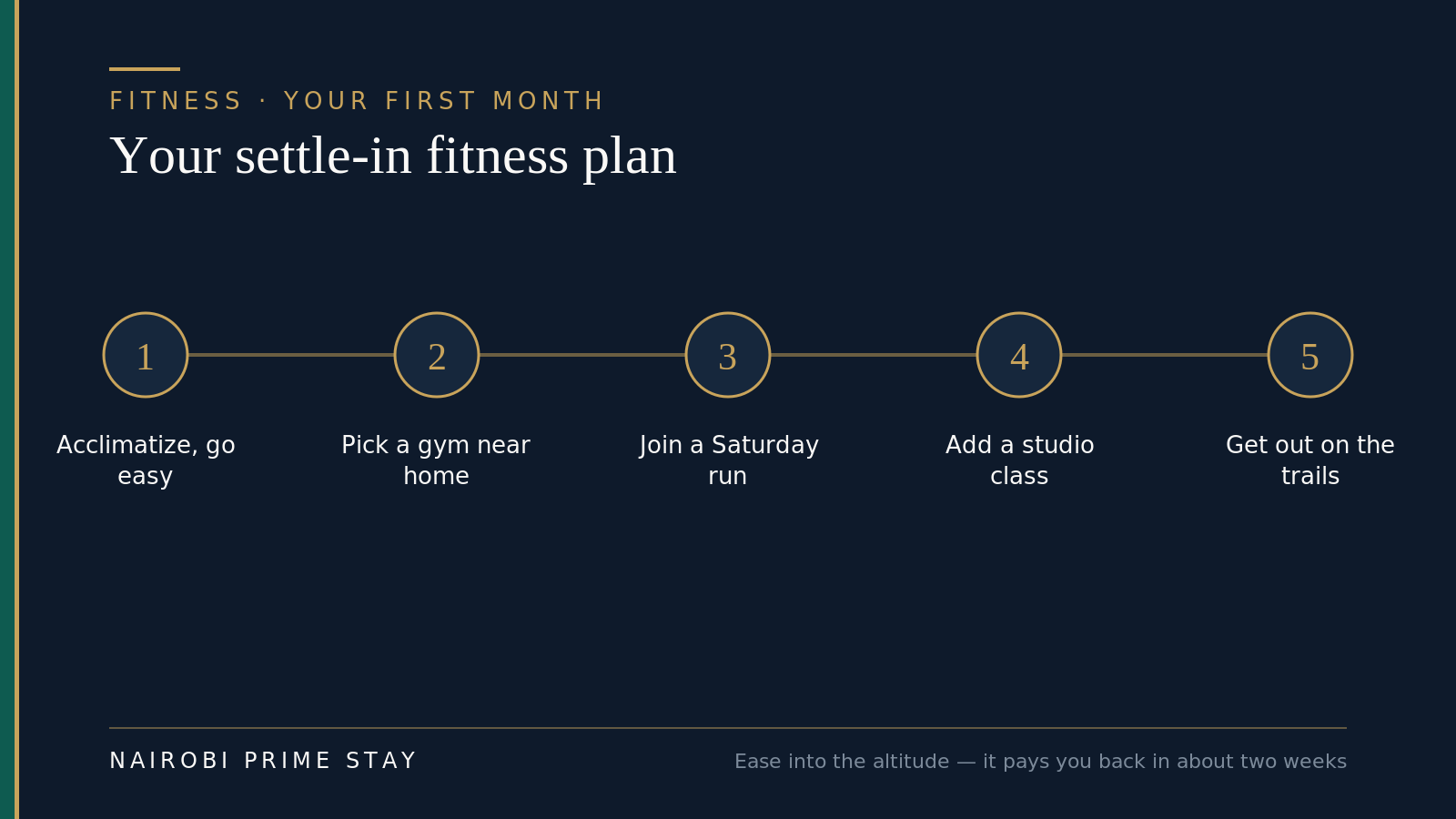
Say you have just moved to Westlands for the social buzz and the short commute. Week one, you take it easy — the altitude has you puffing on the stairs — and you do light sessions in your building’s gym while you settle in. Week two, you feel the adjustment kick in, so you buy a month at a mid-range chain near home for about KES 5,000 and start lifting properly again. That Saturday, a neighbour drags you to a Urban Swaras run; you are slower than you would like at altitude, but you finish, and you leave with three new phone numbers and a plan to meet for coffee. The next weekend you pay your small fee into Karura Forest and do an easy trail jog under the trees, amazed that this exists ten minutes from the office towers. By the end of the month you have a gym, a running crew and a green escape — and you are quietly fitter than when you arrived. That is a very typical Nairobi story.
Pros and cons of staying fit in Nairobi
No place is perfect. Here is the honest reckoning.
The good: it is cheap by US standards; the altitude makes you fitter once you adjust; the outdoors is excellent and close; the running scene is superb and welcoming; the climate is mild enough to train outside most of the year; and gyms and studios are plentiful in the prime suburbs.
The trade-offs: the altitude humbles you for the first week or two; the strong high-altitude sun demands real sun protection; running on roads is unappealing, so you lean on green spaces and clubs; traffic can sabotage an evening class across town; rains can muddy the trails for stretches of the year; and imported supplements and branded kit cost more, so it pays to bring your own.
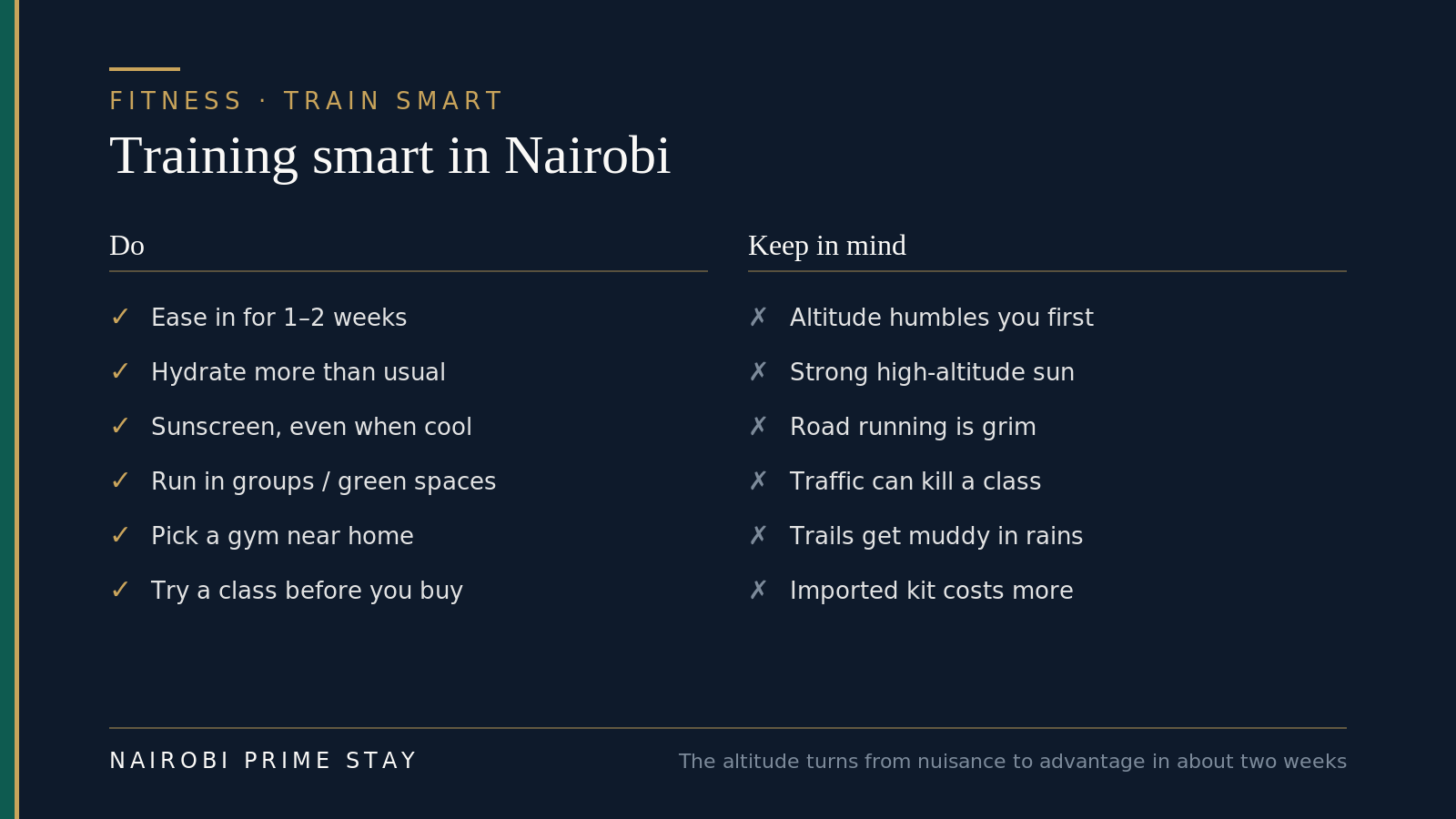
Your first-two-weeks fitness checklist
A simple order of operations to land your routine without overdoing it.
- Ease in first. Keep intensity low for one to two weeks while you acclimatize to the altitude. Let your breathing set the pace.
- Hydrate and protect. Drink more water than at home, and wear sunscreen and a hat for any outdoor session, even on cool days.
- Check what’s already included. If your building or serviced apartment has a gym, use it before paying for a separate one.
- Pick a gym near home. A ten-minute gym beats a great one across town you will skip in traffic. Try a day pass first.
- Join a Saturday run. Look up the Urban Swaras or Karura Running Club and just turn up — it is the fastest social win in this guide.
- Get outdoors. Pay your small fee into Karura or the Arboretum and do one easy trail session. You will be hooked.
- Add a studio if you want structure. Drop in on a Pilates, spin or CrossFit class near home before buying a package.
- Bring your own kit. Pack good running shoes, any supplements you are loyal to, and specialist gear before you fly.
Final thoughts
Nairobi rewards anyone who likes to move. The gyms are good and cheap, the studios are growing, the running scene is among the best you will find anywhere, and the green outdoors is right there waiting. The only real adjustment is the altitude, and that turns from a nuisance into an advantage within a couple of weeks. Go easy at first, protect yourself from the sun, lean on the forests and the clubs, and you will likely end up fitter — and with more friends — than you were back home.
Related reading
- Moving to Nairobi: the complete guide — the hub that ties all of this together.
- Building a social life in Nairobi — running clubs and classes are a fast way in.
- Nairobi cost of living — where fitness fits the wider budget.
- Nairobi weather and climate — the altitude, the sun and the rainy seasons you will train in.
- Is Nairobi safe? — sensible habits for running and being out and about.
- Healthcare in Nairobi — how the private system works if you need a check or a physio.
- Karen neighbourhood guide — leafy, spacious and close to the southern trails.
- Westlands neighbourhood guide — the densest cluster of gyms and studios.
- Kilimani neighbourhood guide — central, modern and full of boutique fitness.
- Weekend trips from Nairobi — hills, lakes and escapes that double as exercise.
- Family life in Nairobi — pools, kids’ sport and the weekend outdoors with children.
- The USD to KES currency guide — the rate behind every price in this guide.
Land somewhere you can train from day one
A soft landing makes building a routine easy. Many of our serviced apartments are in buildings with their own gym and sit minutes from Karura Forest and the western suburbs’ studios — so you can settle in, find your gym and join a Saturday run before you ever sign a year-long lease. Not sure which area fits your training and your commute? Our AI relocation assistant can shortlist apartments near the gyms, trails and clubs that match how you like to move, in a couple of minutes, any time of day.
Frequently asked questions
Are there good gyms in Nairobi?
Yes, lots of them, and most expats find a solid one within a ten-minute drive of home. The prime suburbs — Westlands, Kilimani, Lavington, Karen, Kileleshwa and Parklands — are especially well served. You will find everything from cheap neighbourhood weight rooms to widespread mid-range chains like Smart Gyms and AfroFit, speciality boxing and CrossFit gyms, and premium clubs with pools, spas and studio classes. Many modern apartment buildings and serviced apartments also include a gym, so check what you already have before paying for a separate membership.
How much does a gym membership cost in Nairobi?
A mid-range gym runs about KES 5,000 a month, roughly $40 as of July 2026 at about KES 129.4 to the dollar. Budget neighbourhood gyms can be a little less, while premium clubs with pools and spas are more like KES 12,000 to 20,000 or more. Day passes are common at KES 1,000 to 3,000 if you would rather not commit, and boutique studio classes cost roughly KES 1,000 to 2,500 each. Six-month and annual memberships discount heavily, so the per-month cost drops fast if you know you will stay. Confirm current rates before you sign, as they vary by branch and package.
Does Nairobi’s altitude affect exercise?
Yes, and newcomers feel it. Nairobi sits at about 1,795 metres, nearly 5,900 feet, so for your first week or two even easy efforts leave you more breathless than usual while your body adjusts. After acclimatizing, that same altitude becomes a real endurance bonus — it is the physiology that makes the Kenyan highlands famous for distance running. Ease in for the first couple of weeks, keep intensity low, hydrate more than at home, and wear sun protection, because the high-altitude light is strong even on cool days.
Where can I go running in Nairobi?
Stick to the green spaces rather than the roads, which have traffic, narrow shoulders and exhaust. Karura Forest, with over 50 km of trails, the central Nairobi Arboretum, and the Oloolua Nature Trail near Karen and Langata are the classics — soft ground, shade and clean air. Many residents also run loops inside their own gated estate. Run in daylight or with a group, keep your good watch and phone out of sight, and favour the known, patrolled green spaces over empty stretches alone.
Are there running clubs for expats in Nairobi?
Yes, and joining one is the fastest social win in the city. The Urban Swaras are Kenya’s largest recreational running club, with more than 800 members, meeting on Saturday mornings at a different Nairobi spot each week for trail runs at all paces. The newer Karura Running Club meets early on Saturdays inside Karura Forest, and groups like Run Beyond organise free weekly social runs. The crowd is a friendly mix of locals and newcomers, so you turn up alone and usually leave with phone numbers. Kenya has no official parkrun yet, but these free, all-welcome groups fill the same role.
Are there marathons or races in Nairobi?
Yes. The Standard Chartered Nairobi Marathon — the city’s biggest race — holds its 23rd edition on Sunday 25 October 2026, with individual entry at about KES 2,500 (under $20) across categories from a 5 km family fun run to the full 42 km. The Nairobi City Marathon each June starts and finishes at Uhuru Park and routes the field along the Nairobi Expressway. Expect slower times than at sea level because of the roughly 1,795-metre altitude, and register early, as popular categories fill up.
Is there yoga and Pilates in Nairobi?
Yes. The Africa Yoga Project, a community-focused social enterprise based around Parklands, runs classes and even outdoor sessions in Karura Forest and the Arboretum, and a handful of dedicated yoga and Pilates studios operate across the western suburbs. Premium gyms also fold yoga, Pilates, spin and barre into their class timetables. Boutique classes usually cost more per session than a gym visit but come with proper coaching and a community. Most studios let you drop in for a single class before you buy a package, so try a few near home first.
How much does a personal trainer cost in Nairobi?
As of July 2026, a newly certified trainer charges about KES 1,500 to 2,000 a session (roughly $12 to 15), and a highly experienced trainer with international certifications charges KES 4,000 to 6,000 — well under half a typical US rate. Monthly packages run from about KES 15,000 for a basic program to KES 60,000-plus for premium coaching, and per-session prices drop when you buy a block. Many trainers will come to your building’s gym, and payment is usually by M-Pesa per session or package. Ask about certifications and take a trial session first.
Where can you swim in Nairobi?
Premium clubs like W Exclusive in Westgate have heated pools, many apartment compounds and serviced apartments include one, and most mid-range and upmarket hotels sell pool day passes at about KES 1,200 to 1,500 for adults as of July 2026, with some bundling pool, gym and sauna for around KES 2,000. The YMCA aquatic centre offers leisure swims for a few hundred shillings. One altitude caveat: unheated water stays cool year-round, and in the June to August cool season it is bracing — ask whether a pool is heated if you want to swim year-round.
How much does it cost to enter Karura Forest?
As of 2026 the gates run on the government’s eCitizen system with no cash — you pay by M-Pesa to Paybill 222222 or by card. Entry is around KES 174 for Kenyan citizens and East African residents and about KES 850 for non-resident visitors, with a resident rate in between for foreigners who hold a Kenyan permit, plus roughly KES 295 for parking. The Kenya Forest Service took over the gates in 2025 and suspended the old annual passes, so confirm the current arrangement before you go. Getting your residence permit means you pay the middle resident tier rather than the tourist rate.
Is it safe to exercise outdoors in Nairobi?
Yes, with the same sense you would use in any big city, plus a couple of local habits. Run and walk in daylight or with a group, stick to the known, patrolled green spaces like Karura, the Arboretum and Oloolua rather than quiet or unfamiliar areas, and keep valuables out of sight. The bigger everyday risk is the sun rather than crime — the strong high-altitude light burns even on cool, overcast days, so wear sunscreen and a hat. Most expats train outdoors regularly without any trouble.
What fitness gear should you bring from the US?
Bring your running shoes, any supplements you are loyal to, and specialist kit like heart-rate straps or lifting gear. Imported supplements and branded sportswear carry a real markup in Nairobi — often 1.5 to 3 times US prices — and specific models or sizes can be hard to find. Everyday basics are easy to buy locally, sunscreen is widely available (you will use a lot of it at this altitude), and anything you forget can usually be found at the big malls, just at a price. Pack the picky items and buy the rest here.
Ready to look?
Find your apartment in Nairobi
Browse verified serviced apartments, or ask the AI concierge which area fits your life.