
Guides · Lifestyle
Nairobi Nightlife and Going Out (2026): An Honest Guide for Newcomers
Nairobi Nightlife and Going Out (2026): An Honest Guide for Newcomers

Nairobi goes out, and it goes out well. This is one of the most social cities in Africa, with a nightlife that runs from craft-beer gardens and rooftop sundowners to loud, late, brilliant clubs where the dance floor fills at midnight and empties at dawn. If you pictured a quiet posting, the first Friday night will surprise you.
This is the honest version: where the night actually happens, what the different kinds of evening feel like, what it costs in 2026, and — the part that matters most — how to enjoy it and get home safe. It is written for Americans who have just moved here and want to find their feet socially without a bad first story to tell.
We name a few well-known places as examples, but Nairobi venues open, close and reinvent themselves fast, so treat this as a map of how the scene works rather than a fixed “best of.” The names will shift; the areas and the rules of thumb won’t.
The quick answer (TL;DR)
Nairobi has a lively, varied nightlife, and it is cheaper than a big US city for a comparable night. Westlands is the main hub — the densest cluster of bars, clubs and rooftops, and the place most newcomers start. Kilimani is the trendier, slightly more relaxed sibling just south, big on lounges and supper clubs. Karen and Lavington keep it calmer, with garden bars and live music. A cold Tusker beer runs about KES 250–400 ($2–3), cocktails KES 700–1,500, and a full premium night in Westlands maybe KES 5,000–8,000 a person; a relaxed Kilimani evening is closer to KES 3,000–5,000. The one firm rule: use Uber or Bolt door to door, never street taxis or boda-bodas at night, and never leave your drink unattended. Do that and Nairobi after dark is a pleasure, not a worry. Prices are as of July 2026 at about KES 129 to the dollar — they move, so sense-check them. One rule change to watch: the legal drinking age is 18 today, but a government proposal to raise it to 21 is on the table.


Why this matters when you’re settling in
Going out is how you stop being a stranger here. Nairobi’s social life happens in person and runs late, and a huge amount of expat friendship gets made over drinks on a Friday — colleagues become friends, a quiz night becomes a regular crew, a rooftop introduction becomes your weekend group. Knowing how the scene works, and how to move around it safely, gets you off the sidelines fast. It also keeps a lid on a budget line that can quietly balloon: lean local and a big night is cheap; drink imported spirits in rooftop bars nightly and it adds up like anywhere. For the people side of settling in, pair this with our guide to building a social life in Nairobi; this piece is about the venues and the nights themselves.
What Nairobi nights are actually like
Nairobi nightlife is louder, friendlier and later than most newcomers expect. A few things shape it. The city is young and sociable, with a big music culture — Afrobeats, amapiano, reggae, gengetone, plus hip-hop and house — and live bands are a real part of the scene, not a novelty. There is a large international community of UN, embassy, NGO and corporate staff, so the bars and clubs are genuinely mixed, and you will rarely feel like the only foreigner in the room. And Kenyans take their weekends seriously: Thursday through Sunday is prime time, and a good night starts late and ends very late.
What does that mean in practice? You can have a quiet craft beer in a garden on a Tuesday, a rooftop sundowner on a Wednesday, live Afro-fusion on a Thursday, a big club night in Westlands on a Friday, an all-day “day party” on a Saturday, and a long lazy brunch-into-drinks on a Sunday. The weather helps — the mild highland climate means outdoor terraces, gardens and rooftops work year-round, so a lot of the best nights are partly or wholly open-air.
Is it perfect? No. The same traffic that defines daytime Nairobi means venues cluster, and getting between areas at night needs a plan. Imported spirits and wine carry a markup. And as anywhere with a lively scene, there is an edge you need to respect — pickpockets, the occasional drink-spiking, and overly friendly “company” in some clubs. None of it should scare you off; all of it is manageable with the habits further down this guide.
Where the night happens, by area
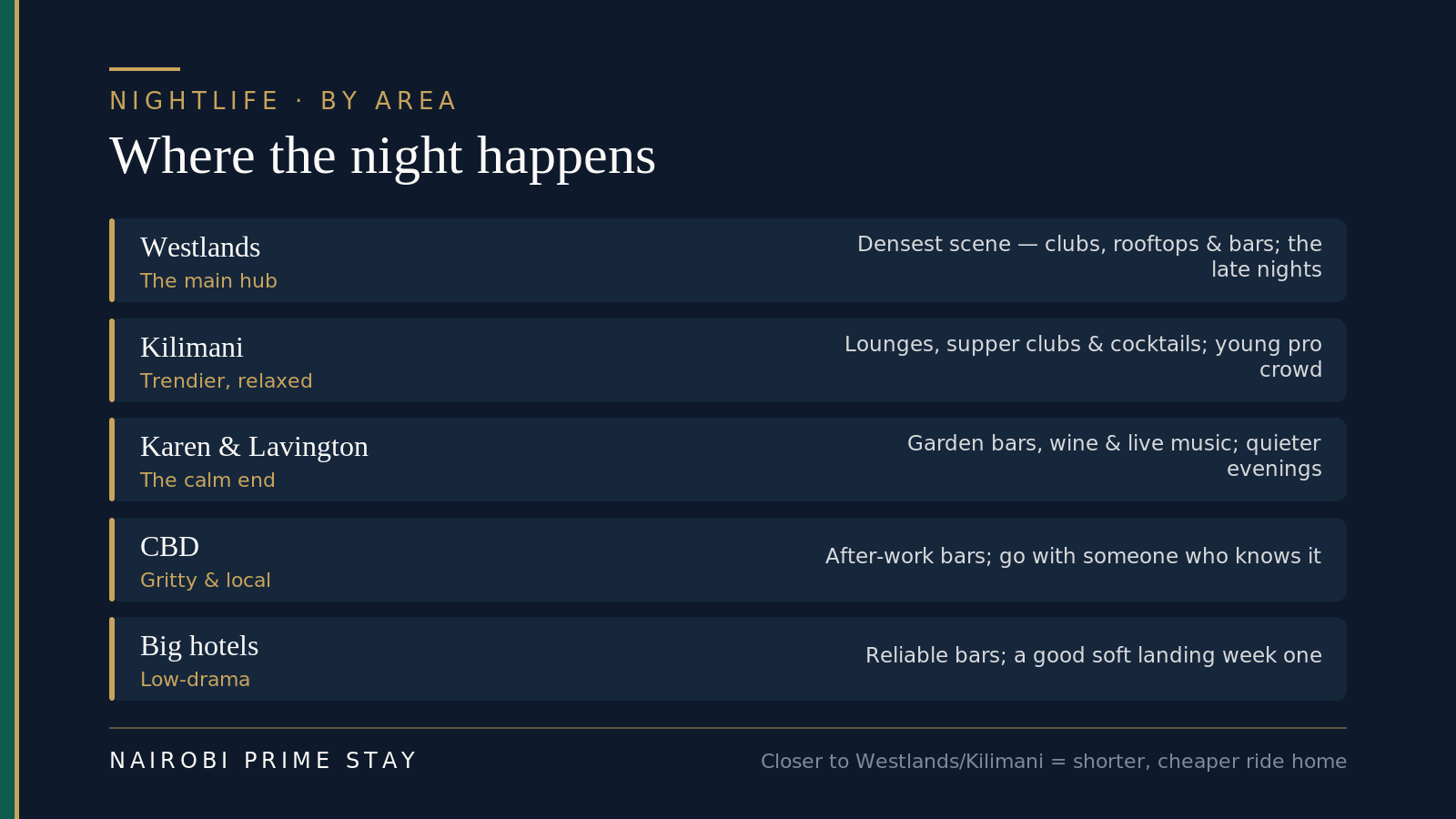
Nairobi nightlife clusters tightly, and where you live shapes where you end up. Four areas cover almost everything a newcomer needs.
Westlands is the engine room — the city’s densest, most varied nightlife, packed into a small, semi-walkable core sometimes nicknamed “Electric Avenue.” Everything is here: huge multi-level clubs, craft-beer bars, rooftop lounges, sports bars, food trucks and late-night bites, side by side. If you want the most choice and the most energy, start here. The trade-off is that it gets loud, busy and a little chaotic on peak nights, so it rewards a plan and a group. Our Westlands neighborhood guide covers living right in the middle of it.
Kilimani sits just south and is the trendier, slightly more grown-up sibling — sophisticated lounges, supper clubs, cocktail bars and rooftop spots, with a younger professional and remote-worker crowd. It is a touch more relaxed than Westlands without being sleepy, and it is where a lot of expats settle into their regular spots. More in the Kilimani guide.
Karen and Lavington are the calm end of the scene. Think garden bars, live-music nights, craft beer under the trees, wine bars and long Sunday sessions rather than thumping clubs. Karen is a proper drive from the center, so it suits people who live out that way or want a quieter evening; the Karen guide has the lay of the land.
Beyond these, the CBD has a grittier, more local after-work bar scene (fun with someone who knows it, not the place to wander green), Ngong Road and Hurlingham have a steady residential-bar life, and the big hotels hold reliable, low-drama bars that are a good soft landing in your first week. As a rule, the closer you live to Westlands or Kilimani, the shorter and cheaper your ride home — worth weighing when you pick an area.
The kinds of nights out
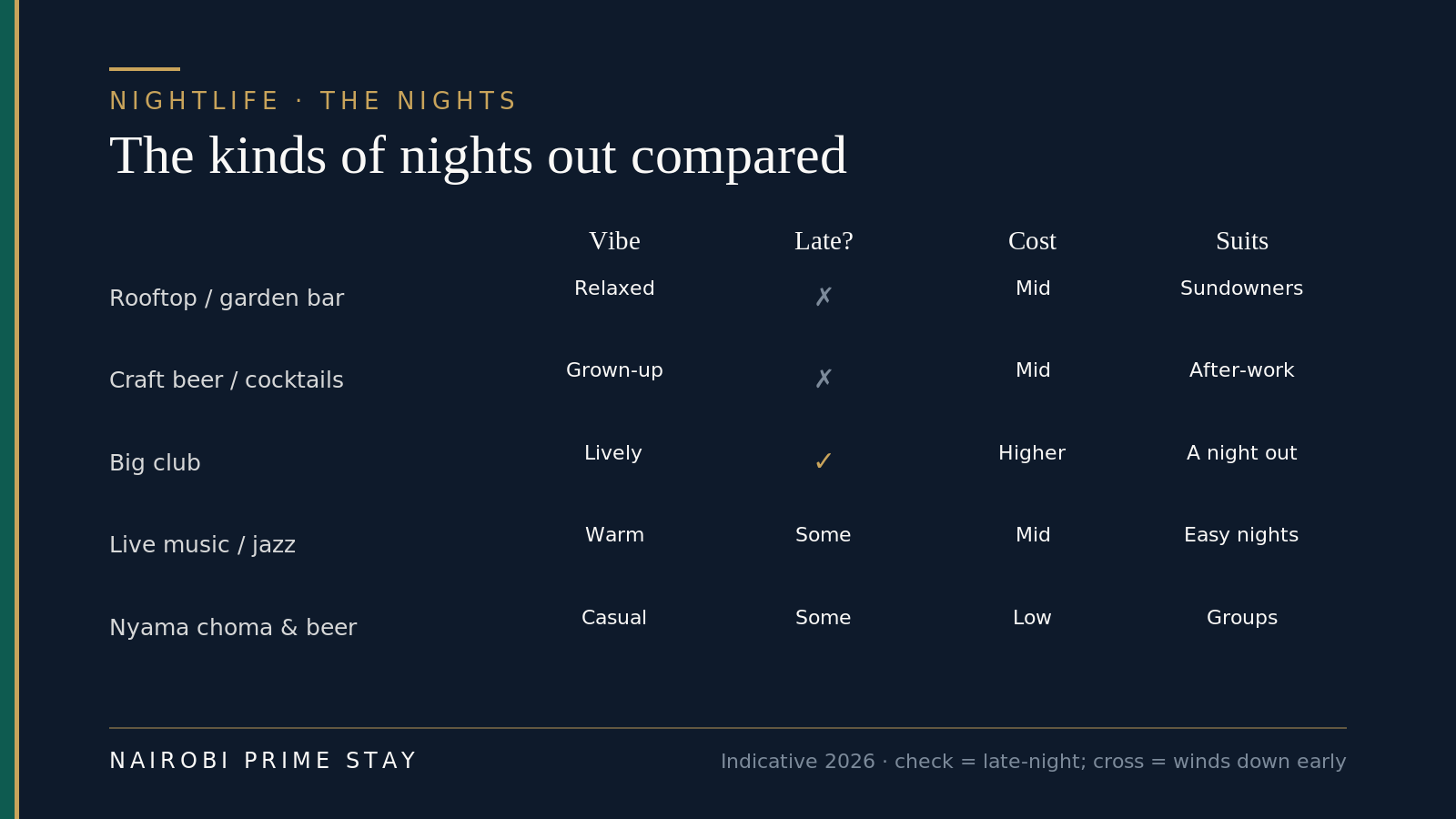
Rather than a top-10 that’s stale by next month, here’s the scene by type of evening. Slot your own discoveries into these.
Rooftop and garden bars. The signature Nairobi night, thanks to the climate. Open-air terraces and rooftops with skyline views, cocktails and a sundowner crowd. Sarabi atop the Sankara hotel in Westlands — a rooftop with an infinity pool — is the famous one; there are several more across Westlands and Kilimani. Great for a first date, a visiting friend, or an early-evening drink before dinner.
Craft beer and cocktail bars. A real scene now. Brew Bistro is the long-running craft-beer name, and there’s a growing crop of cocktail bars and gastropubs with serious drinks and a grown-up feel. This is the after-work, mid-week, “good drink and a conversation” end of things.
Big clubs. Where the late night lives. The Alchemist in Westlands is the institution everyone knows — a sprawling, multi-level venue with a big dance floor, food trucks, market stalls and a daytime-into-night life all its own. Beyond it, Westlands and Kilimani hold a rotating cast of clubs (names like K1 Klub House, B-Club and others come up again and again) playing Afrobeats, amapiano, house and hip-hop to a floor that doesn’t fill until midnight. Expect a cover charge at the bigger ones, a smart-casual dress code, and a 2am-and-beyond finish.
Live music and jazz. Genuinely good and easy to find. Bands play Afro-fusion, rumba, reggae, jazz and benga across the week, in dedicated music venues, restaurants and hotel bars. A live-music night is one of the warmest introductions to the city, and a lot less full-on than a club. Ask around for who’s playing where — the weekly line-up moves.
Nyama choma and beer. The most Kenyan night of all. A loud, social grill where you order meat by the kilo, drink cold Tusker, and stay for hours. It’s casual, cheap and a brilliant way to spend an evening with colleagues. Our restaurants and dining guide covers the food side in depth.
Sports bars, comedy and the quieter stuff. Premier League and big fights pull packed, friendly sports bars; there’s a lively stand-up comedy and spoken-word scene; and plenty of relaxed pubs and wine bars for a low-key night. Not every evening here is a late one — more on the calmer side below.
Which night is which? The weekly rhythm
Nairobi’s week has a shape, and knowing it saves you from turning up to an empty room. Monday and Tuesday are quiet — a craft beer or a low-key dinner, though one-off events pop up even then (The Alchemist’s monthly fight night is a Tuesday institution). Wednesday is the unofficial mid-week night: ladies’ nights, karaoke and rooftop crowds that are lively but not chaotic — a good first outing while you learn the city. Thursday belongs to live music, with jazz, Afro-fusion and band nights across town. Friday and Saturday are the main event: bars fill from 7pm, clubs from 11pm, and the big rooms run to 3 or 4am. Sunday flips to daytime — long garden lunches, jazz brunches, nyama choma with friends — and the city goes home early. If your energy runs out before midnight, build your week around Wednesday, Thursday and Sunday; the year-round mild climate makes outdoor evenings work in any month.
What a night out costs in 2026
Going out in Nairobi is cheaper than a comparable US city, with the gap narrowing only when you drink imported spirits in premium rooms. Here is a realistic guide as of 2026, at roughly KES 129–130 to the dollar. Drinks prices vary a lot by venue, so treat these as ranges to sense-check, not quotes.
| What you’re buying | Typical price (KES) | ≈ USD |
|---|---|---|
| Cold Tusker or local beer in a bar | 250–400 | $2–3 |
| Imported beer / cider | 400–700 | $3–5 |
| Glass of house wine | 600–1,200 | $5–9 |
| Cocktail | 700–1,500 | $5–12 |
| Spirit + mixer | 500–1,000 | $4–8 |
| Club cover charge (bigger venues) | 500–2,000 | $4–15 |
| Casual bar night, a few drinks | 2,000–4,000 | $15–30 |
| Premium Westlands club night, per person | 5,000–8,000 | $40–60 |
| Relaxed Kilimani evening, per person | 3,000–5,000 | $23–40 |
| Bottle service / table (varies hugely) | 10,000+ | $75+ |
| Uber/Bolt across town, late | 400–1,200 | $3–9 |
A few honest notes. Drinks, not entry, are where the bill builds — a round of cocktails for a group adds up fast. Many clubs charge cover on weekend nights and for special events or big-name DJs; some waive it before a certain hour. Bottle service and tables run to whatever you’ll spend. And budget the ride home into every night out — it’s cheap, and it’s the one cost you should never skip to save money. For the wider monthly picture, our cost of living guide puts dining and leisure in context.
How does it compare with a night out in a US city?
Cheaper across the board, with a different clock. A local beer at KES 250–400 ($2–3 as of July 2026) is roughly a quarter of the $8–9 you’d pay in New York, Austin or LA; cocktails at $5–12 undercut the American $16–18 standard; and club covers of $4–15 compare with $20–40 for a similar US room. The ride home is where the gap yawns widest: a late cross-town Uber is $3–9, not the $25–40 an American night ends with. Where Nairobi bites back is imported anything — a glass of decent wine or a pour of bourbon can approach US prices because of duty — and bottle service in the flashiest rooms is priced for show. The clock differs too: dinner at 8, bar at 10, club at midnight is normal here, so a night runs later than most US habits. Budget-wise, a big weekend out fits comfortably inside the entertainment line of our cost of living guide — it’s the nightly imported-spirits habit, not the going out itself, that balloons it.
What are the rules? Drinking age, hours and the 21 proposal
The legal drinking age in Kenya is 18, as of July 2026 — but that may change. The government’s anti-drug agency NACADA has proposed raising it to 21, alongside a ban on app-based alcohol delivery and tighter marketing rules, under a national alcohol policy the Cabinet approved in 2025; ministers repeated the plan in early 2026, but it has not yet been passed into law. For most relocating Americans this is academic, but if you have older teens or student-age family, watch it — clubs will enforce a new limit at the door if it lands. Practical rules as they stand: venues rarely ID an obvious adult, but carry ID on club nights; licensed hours in practice mean bars wind down near midnight on weeknights and clubs run to 3–4am at weekends; drink-driving enforcement is real, with breathalyzer crackdowns on major roads — one more reason the Uber-door-to-door rule in this guide is universal. Smoking is restricted to designated zones, and cannabis is illegal, full stop.
Getting home safely — the one thing to get right
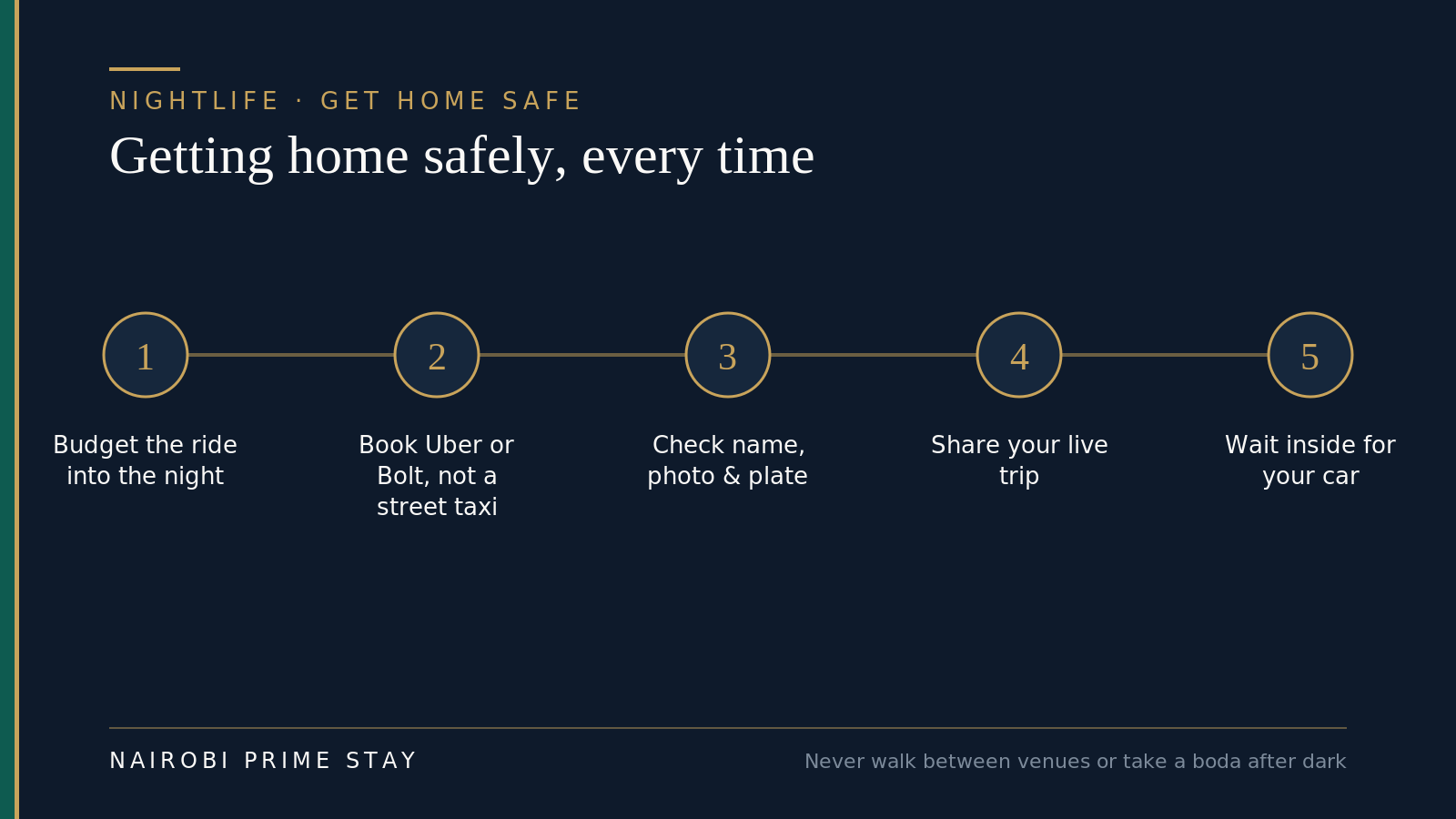
Use Uber or Bolt, door to door, every time. This is the single habit that makes Nairobi nightlife low-stress, and almost every expat follows it without exception. The apps are cheap, everywhere, and give you a named driver, a tracked route, a license plate to check and a record someone else can see. Before you get in, confirm the driver’s name, photo and plate match the app — impersonation is the main ride scam, and a ten-second check kills it. Share your live trip with a friend; it takes one tap and cuts the risk fast.
What not to do is just as important. Don’t take street taxis or flag a car at night, don’t ever take a boda-boda (motorbike taxi) after drinks, and don’t walk between venues after dark — even on a busy Westlands strip where it looks fine. The walk is where phones and bags get snatched; the ride is a couple of dollars. If the app is surging or scarce at closing time, wait inside the venue or ask the security at the door to help you get a car rather than stepping out to the street. Lock in your ride home as part of the plan, not an afterthought at 3am.
Staying safe inside the venue
Nairobi’s nightlife is friendly and overwhelmingly trouble-free, but a few habits keep it that way — the same ones you’d use in any big city, plus a couple specific to here.
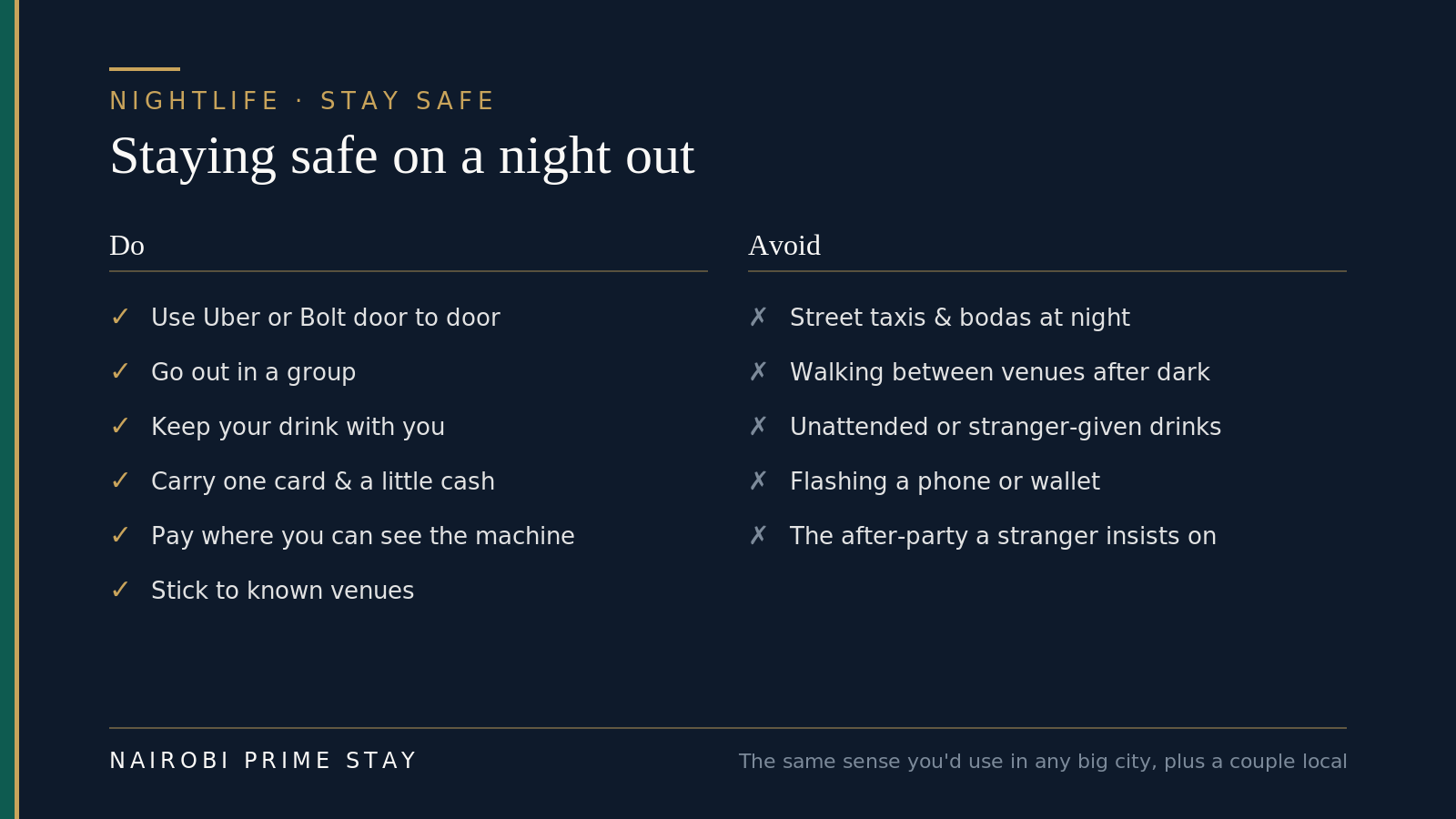
Watch your drink. Drink-spiking does happen in Nairobi bars and clubs, usually as a prelude to theft. Never leave a drink unattended, don’t accept an opened drink from a stranger, and if you lose track of yours, leave it and order another. Go out in a group where you can, especially in your first months, and keep loose tabs on each other.
Keep your valuables low-key. Don’t flash an expensive phone or a thick wallet, carry only the cash and one card you need, and keep your card in sight when you pay — card-skimming and “let me run it at the back” moves are the usual tricks, so pay at the counter or watch the machine. Be a little wary of over-friendly strangers who attach themselves quickly; some clubs have coordinated “company” whose interest is your wallet, and the polite move is simply to keep your distance. And be skeptical of the after-party a taxi driver or a new acquaintance insists you must see — the unknown spot you’re steered to is the classic setup. Stick to known venues in Westlands and Kilimani while you learn the city.
None of this is unique to Nairobi, and none of it should keep you in. For the full picture of staying safe day and night, see our honest guide to whether Nairobi is safe.
The calmer side — for when you don’t want a club
Not every night here is a late one, and the assumption that Nairobi nightlife means thumping clubs sells the city short. There’s a whole relaxed layer for people who’d rather talk than dance.
Rooftop sundowners are the easy win — a cocktail and a skyline at golden hour, done by nine. Garden bars and craft-beer spots in Karen, Lavington and Westlands make a mellow evening out of good drinks and trees. Live jazz and Afro-fusion nights are warm and unhurried. There are quiz nights, wine bars, hotel lounges, comedy shows, and Sunday day-parties that wind down by early evening rather than spinning up. Plenty of expats build their whole social life from these and rarely see a 2am dance floor — and that’s a completely normal way to do Nairobi. The point is that the city flexes to whatever night you want, loud or low-key.
A realistic weekend out
Say you’ve just moved to Kilimani and want to ease in. Thursday after work, a colleague takes you to a craft-beer bar nearby — two rounds, easy conversation, home by eleven for about KES 2,500 between drinks and a short Bolt. Friday you go bigger: pre-drinks on a Westlands rooftop at sunset, dinner, then a club where the floor fills around midnight; you pace yourself, keep your group together, watch your drink, and Uber home at 2am, the whole night maybe KES 6,000 with the cover and the ride. Saturday you keep it light — a Karen garden bar with live music, a couple of glasses of wine, home by midnight. Sunday is a long brunch that drifts into afternoon drinks on a terrace, winding down by six. You’ve been out four nights, met a dozen people, never once taken a street taxi, and spent less than a single big Friday would cost you back home.
Pros and cons of Nairobi nightlife
| The good | The honest tradeoffs |
|---|---|
| Lively, varied and genuinely social — easy to make friends | The scene clusters, so getting between areas needs a plan |
| Cheaper than a comparable US city for a full night | Imported spirits and wine carry a markup |
| Year-round rooftops and gardens thanks to the climate | Peak nights get loud, crowded and a little chaotic |
| Great live music — jazz, Afro-fusion, rumba, more | You must use ride-hailing; walking and street taxis are out |
| A real calmer side, not just clubs | Drink-spiking and petty theft exist; you stay alert |
| Mixed local-and-international crowd; you fit in fast | Nights start and end very late by US habits |
A newcomer’s night-out checklist
Run through these and you’ll go out like a regular, safely, from week one:
- Install Uber and Bolt and set up M-Pesa and a card before your first night.
- Pick your area to match the night — Westlands for big, Kilimani for trendy-relaxed, Karen for calm.
- Go in a group while you’re learning the city, and keep tabs on each other.
- Budget the ride home into the night and book only Uber or Bolt — never a street taxi or boda after dark.
- Check the driver’s name, photo and plate against the app, and share your live trip.
- Keep your drink with you; never accept an opened drink from a stranger.
- Carry one card and a little cash; keep your card in sight when paying.
- Dress smart-casual for clubs — neat shoes, no sportswear or flip-flops.
- Stick to known venues in Westlands and Kilimani at first; skip the “secret” after-party.
- Ask colleagues and neighbors what’s good this month — the line-up changes fast.
Final thoughts
Nairobi after dark is one of the happy surprises of moving here — sociable, varied, year-round outdoors, and cheaper than you’d guess. Lean into it: start in Westlands or Kilimani, find a rooftop and a live-music spot you love, go out with people, and make ride-hailing and a watched drink simple habits rather than chores. Get those right and the city’s nightlife becomes exactly what it should be — the easiest way to turn a new posting into a place full of friends.
Related reading
- Moving to Nairobi: the complete guide — the hub that ties all of this together.
- Building a social life in Nairobi — how to find your people and your crew.
- Restaurants and dining in Nairobi — where the evening usually starts.
- Is Nairobi safe? — the honest, wider safety picture, day and night.
- Getting around Nairobi — Uber, Bolt and the transport basics.
- Kenyan culture and etiquette — tipping, greetings and reading the room.
- Westlands and Kilimani neighborhood guides — living where the night happens.
Land where the night is
The easiest way to find your footing socially is to land somewhere central and sorted. A serviced apartment in Westlands or Kilimani puts you a short, cheap ride from the best of the scene, with Wi-Fi, security and a safe base to come home to — so you can go out, explore and choose your area without signing a lease first. Browse our serviced apartments in Nairobi or see what’s available now. Not sure which neighborhood matches the nights you want? Our AI relocation assistant can shortlist apartments near the scene you’re after, in a couple of minutes.
Frequently asked questions
Is Nairobi’s nightlife any good?
Yes, and it surprises most newcomers. Nairobi is one of the most social cities in Africa, with a lively, varied scene that runs from rooftop sundowners and craft-beer gardens to big late-night clubs and excellent live music. The crowd is a mix of locals and the large international community, the music culture is strong, and the mild climate means outdoor terraces and rooftops work year-round. Thursday through Sunday is prime time, and a good night starts late and ends very late.
Where is the best nightlife in Nairobi?
Westlands is the main hub, with the densest cluster of bars, clubs and rooftops packed into a small core sometimes called Electric Avenue. Kilimani, just south, is the trendier and slightly more relaxed sibling, big on lounges, supper clubs and cocktail bars. Karen and Lavington are the calm end, with garden bars, wine and live music rather than thumping clubs. Most newcomers start in Westlands or Kilimani because they have the most choice and the shortest rides home.
Is it safe to go out at night in Nairobi?
Yes, with sensible precautions, and most expats go out regularly without trouble. Stick to known venues in Westlands and Kilimani, go out in a group while you are learning the city, and keep your valuables low-key. The two firm rules are to use Uber or Bolt door to door rather than street taxis or walking, and to never leave your drink unattended. Petty theft and occasional drink-spiking exist, as in any big nightlife city, but simple habits keep a night out low-stress.
How do I get home safely after a night out in Nairobi?
Use Uber or Bolt, door to door, every time. The apps are cheap and everywhere, and they give you a named driver, a tracked route and a plate to check. Before getting in, confirm the driver’s name, photo and plate match the app, and share your live trip with a friend. Do not take street taxis, do not take a boda-boda motorbike taxi after drinks, and do not walk between venues after dark. If cars are scarce at closing time, wait inside the venue or ask door security to help rather than stepping out to the street.
What does a night out cost in Nairobi?
Less than a comparable US city. As of 2026, at roughly KES 129 to 130 to the dollar, a cold local Tusker beer runs about KES 250 to 400, a cocktail KES 700 to 1,500, and bigger clubs may charge a cover of KES 500 to 2,000 on weekends. A full premium night in Westlands is roughly KES 5,000 to 8,000 a person, while a relaxed Kilimani evening is closer to KES 3,000 to 5,000. Drinks, not entry, are where the bill builds, and a late ride home is a cheap few dollars you should always budget in.
What is the dress code for clubs in Nairobi?
Smart-casual is the safe default. The bigger clubs and rooftop lounges enforce it, so wear neat shoes and avoid sportswear, flip-flops or scruffy gear. Garden bars, craft-beer spots and casual pubs are more relaxed and you can dress down. When in doubt, dress a notch smarter than you would at home, and bring a light layer because Nairobi evenings cool off thanks to the altitude.
Is drink-spiking a risk in Nairobi nightlife?
It happens, usually as a prelude to theft, so it is worth guarding against. Never leave your drink unattended, do not accept an opened drink from a stranger, and if you lose track of your glass, leave it and order a fresh one. Go out in a group where you can and keep loose tabs on each other. Be a little wary of strangers who attach themselves very quickly in clubs. These are the same precautions you would take in any major nightlife city, and they make the risk very small.
Is there a calmer nightlife in Nairobi if I don’t want clubs?
Absolutely. Plenty of expats build a full social life without ever seeing a 2am dance floor. Rooftop sundowners, garden and craft-beer bars in Karen, Lavington and Westlands, live jazz and Afro-fusion nights, wine bars, hotel lounges, quiz nights, comedy shows and Sunday day-parties that wind down by early evening are all easy to find. The city flexes to whatever night you want, loud or low-key, so a quieter evening out is completely normal here.
What is the legal drinking age in Kenya?
It is 18, as of July 2026. Kenya’s anti-drug agency NACADA has proposed raising it to 21 — the plan sits in a national alcohol policy the Cabinet approved in 2025, and ministers repeated the intention in early 2026 — but it has not been passed into law, so 18 still stands. Venues rarely ID anyone who is obviously an adult, but carry a copy of your passport or your Kenyan ID equivalent on big nights, and watch the news: if the change passes, clubs will enforce it at the door.
What time do bars and clubs close in Nairobi?
Bars generally open around 5 to 6pm and wind down near midnight on weeknights. On Fridays and Saturdays the big clubs run to 3 or 4am, sometimes later, and the dance floor rarely fills before midnight. Sundays are for afternoon sessions — garden bars, jazz brunches and nyama choma — rather than late nights. Pace yourself accordingly: arriving at 9pm on a Saturday means an empty room.
Is going out in Nairobi cheaper than in the US?
Yes, clearly, unless you drink imported spirits in premium rooms all night. As of July 2026, a local beer is about $2–3 against $8–9 in a big US city, cocktails run $5–12 against $16–18, and club covers of $4–15 compare with $20–40 for a comparable US venue. A full premium Westlands night at KES 5,000–8,000 ($40–60) a head would cost double or triple in New York or LA — and the Uber home is $3–9, not $30.
Ready to look?
Find your apartment in Nairobi
Browse verified serviced apartments, or ask the AI concierge which area fits your life.