
Guides · Remote work
Coworking Spaces & Cafés to Work From in Nairobi (2026 Guide)
Coworking Spaces & Cafés to Work From in Nairobi (2026 Guide)
Nairobi is an easy city to work from. A day pass at a good coworking space costs about KES 2,000 — roughly $15 — and buys you fast fibre, backup power, decent coffee and a quiet booth for that one call you can’t miss. There’s a real network of spaces, led by Nairobi Garage and Ikigai, plus laptop-friendly cafés on almost every leafy street in the western suburbs. Pair that with a time zone that overlaps the US afternoon, and you can see why remote workers settle here happily.
This guide is the practical version: the main coworking brands and where they are, honest 2026 day-pass and membership prices, the best cafés for a few hours of focused work, what to check before you sign anything, and how the time zone actually plays out. It’s written for remote employees, freelancers and digital nomads weighing Nairobi as a base. For the wider setup — home fibre, Starlink, backup power and how much speed you need — see our internet and remote work guide; this one is about where to actually plant your laptop.

The quick version
Coworking in Nairobi is excellent and affordable. The two names you’ll hear most are Nairobi Garage (big, professional, startup-heavy, five branches) and Ikigai (calm, garden-style, design-led, four branches), with premium options like KOFISI and Workstyle in Westlands and global serviced-office brand Regus in the CBD. A day pass is about KES 2,000 (~$15); a flexible hot desk runs roughly KES 11,000–20,000 a month (~$85–155), and a dedicated desk about KES 20,000–29,000 (~$155–245), all as of 2026 — confirm current rates, since most quote before tax. Westlands is the main hub, with Kilimani, Lavington, Riverside, Karen and the CBD close behind. Cafés like Connect Coffee, Java House and Kesh Kesh are great for solo work, though for an important video call a coworking booth wins. Whichever you choose, check three things: backup generator, upload speed, and somewhere private to take a call.
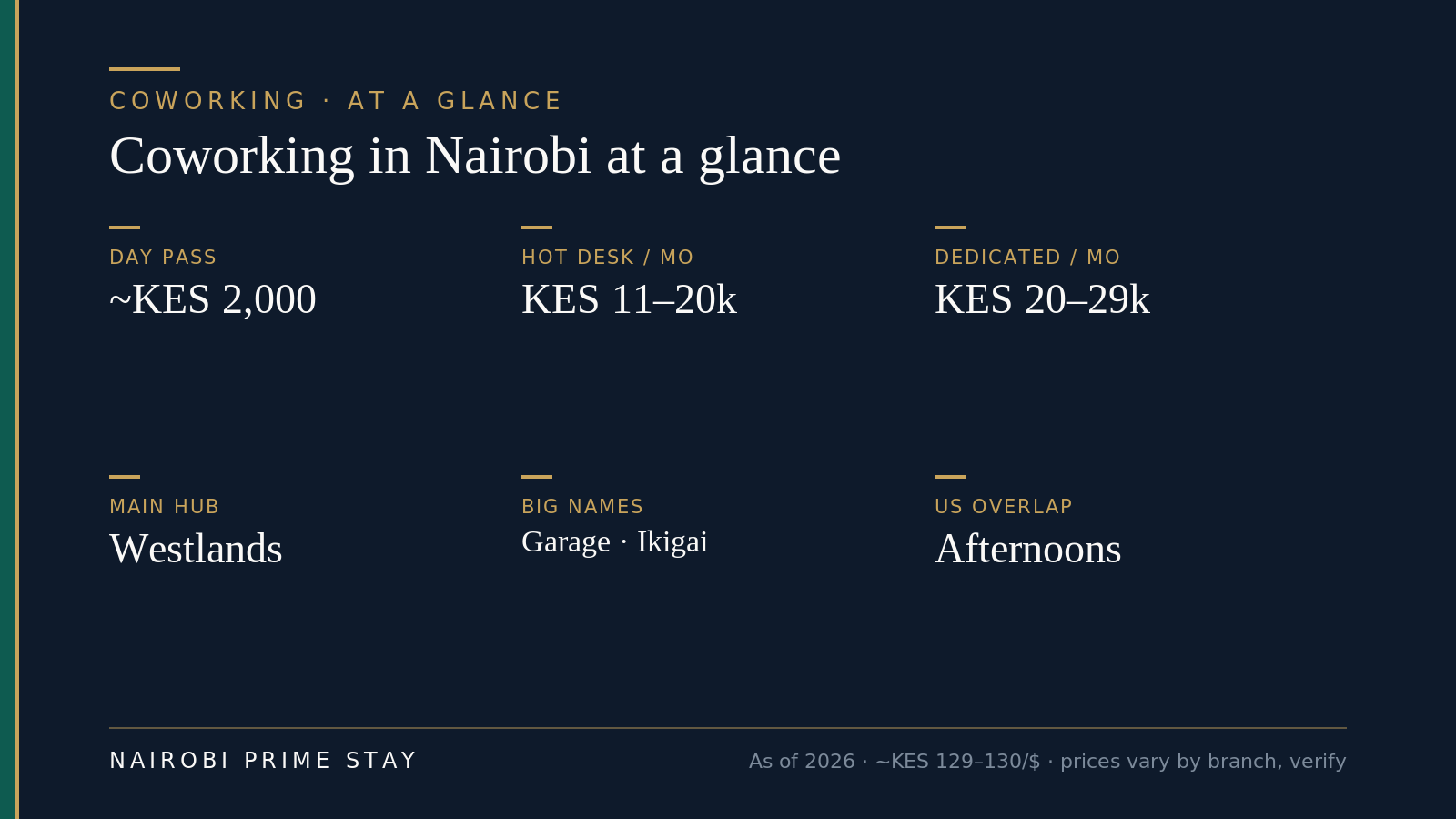
The shape of the market in one screen — confirm exact prices, which vary by branch.
Is coworking good in Nairobi?
Yes — genuinely good, and more developed than newcomers expect. Nairobi calls itself the “Silicon Savannah,” and the coworking scene grew up alongside its startup and NGO worlds. That means real choice: polished corporate spaces, scrappy founder hubs, calm garden campuses and small creative studios, spread across the suburbs where expats actually live. Demand has tilted toward quality in recent years, so the better spaces invest in fast fibre, reliable generators, proper meeting rooms and the kind of community programming — workshops, member nights, investor introductions — that makes a membership more than a desk.
For a newcomer, the appeal is twofold. First, a coworking space gives you a reliable, well-powered base from day one, before your home internet is sorted and while you’re still learning the city. Second, it’s an instant social network. Drop into a hot desk and you’re surrounded by founders, freelancers and other remote workers, many of them new in town themselves. More on that in our expat community guide — but coworking is one of the fastest ways in.
The main coworking spaces, by area
You don’t need to memorize every space — most people try two or three near home and pick one. Here are the names worth knowing and what each is like.
Nairobi Garage
The biggest and best-known network, and a safe first stop. Nairobi Garage is professional and startup-heavy, with branches in Westlands (Delta Corner), Kilimani, Spring Valley, Karen and the CBD. You get fast Wi-Fi, backup power, meeting rooms, phone booths and a busy calendar of events, plus access across locations on most memberships. A day pass is around KES 2,000 + VAT; a Club / hot-desk membership runs roughly KES 11,000 a month, and a dedicated desk about KES 25,000 (as of 2026 — confirm the current package). It’s the easy pick if you want energy, networking and a name people recognize.
Ikigai
Ikigai is the calm, design-led counterpoint — garden settings, specialty-coffee bars, lots of natural light. Spaces sit in Westlands (The Piano, Brookside Drive), Lavington (90 JGO, James Gichuru Road), Riverside (Merchant Square) and Lower Kabete. A day pass is about KES 2,000 for roughly 8:30am–5pm, while the all-locations monthly membership is around KES 20,000 (~$155) with 24/7 access, complimentary parking, free yoga and a couple of hours of meeting-room time a month. Extras like phone booths, prayer rooms, mothers’ rooms and showers are thoughtful touches. If you want somewhere pleasant to spend long days, Ikigai is hard to beat.
The premium end: KOFISI and Workstyle
For a polished, corporate-grade space — the kind you’d happily bring a client to — KOFISI and Workstyle Africa sit at the top, both centred on Westlands. KOFISI’s Westlands centre runs to 30,000-plus square feet with a rooftop café and skyline views; coworking memberships start around KES 7,500 a month and dedicated desks reach roughly KES 29,000 (~$245), with private offices from about $145 a desk. Workstyle prices its monthly flexi-desk near $150, dedicated desks around $250 and private offices from about $350. You pay more, but you get the finish, the quiet and the address.
Global standard: Regus
If you want a familiar international brand with serviced offices and pay-as-you-go flexibility, Regus (part of IWG) operates across Nairobi, including the CBD. Shared-desk memberships run roughly $99–259 a month depending on the location and contract, a CBD dedicated desk starts near $139, and a day office is about $29. Contracts often assume a longer term for the headline price, so read the commitment before you sign. Regus suits people who want consistency, meeting rooms on demand and a business address more than startup buzz.
Creative and smaller hubs
Beyond the big names, smaller spaces serve specific crowds. The Mint in Westlands leans creative, with podcast booths and content-creation studios; shared desks start around KES 13,000 a month and day passes near KES 2,000. You’ll also find neighbourhood hubs and studio-style spaces across Kilimani and Westlands — handy if you want something low-key close to home. These come and go, so check current reviews before committing.
Here’s the quick map of who’s where:
| Area | Coworking options | Good for |
|---|---|---|
| Westlands | Nairobi Garage, Ikigai, KOFISI, Workstyle, The Mint | The widest choice and the premium names; the default hub |
| Kilimani | Nairobi Garage, smaller studio hubs | Central, good value, near modern apartments |
| Lavington | Ikigai | Calm, leafy, residential |
| Riverside | Ikigai | Central but quiet, near Westlands and the CBD |
| Karen | Nairobi Garage | The southern suburbs and families |
| Spring Valley | Nairobi Garage | Quiet, residential, near Westlands |
| CBD | Regus, serviced-office brands | Global-standard offices and meeting rooms on demand |
If you’re still choosing where to live, our best neighborhoods guide lines these areas up side by side. Remote workers tend to land in Westlands for the buzz or Kilimani for value — both are thick with coworking and cafés.
What it costs: day pass vs membership
Pricing is refreshingly simple, and cheaper than most US cities. The honest 2026 picture, at roughly KES 129.4 to the dollar in mid-2026 (check today’s rate):
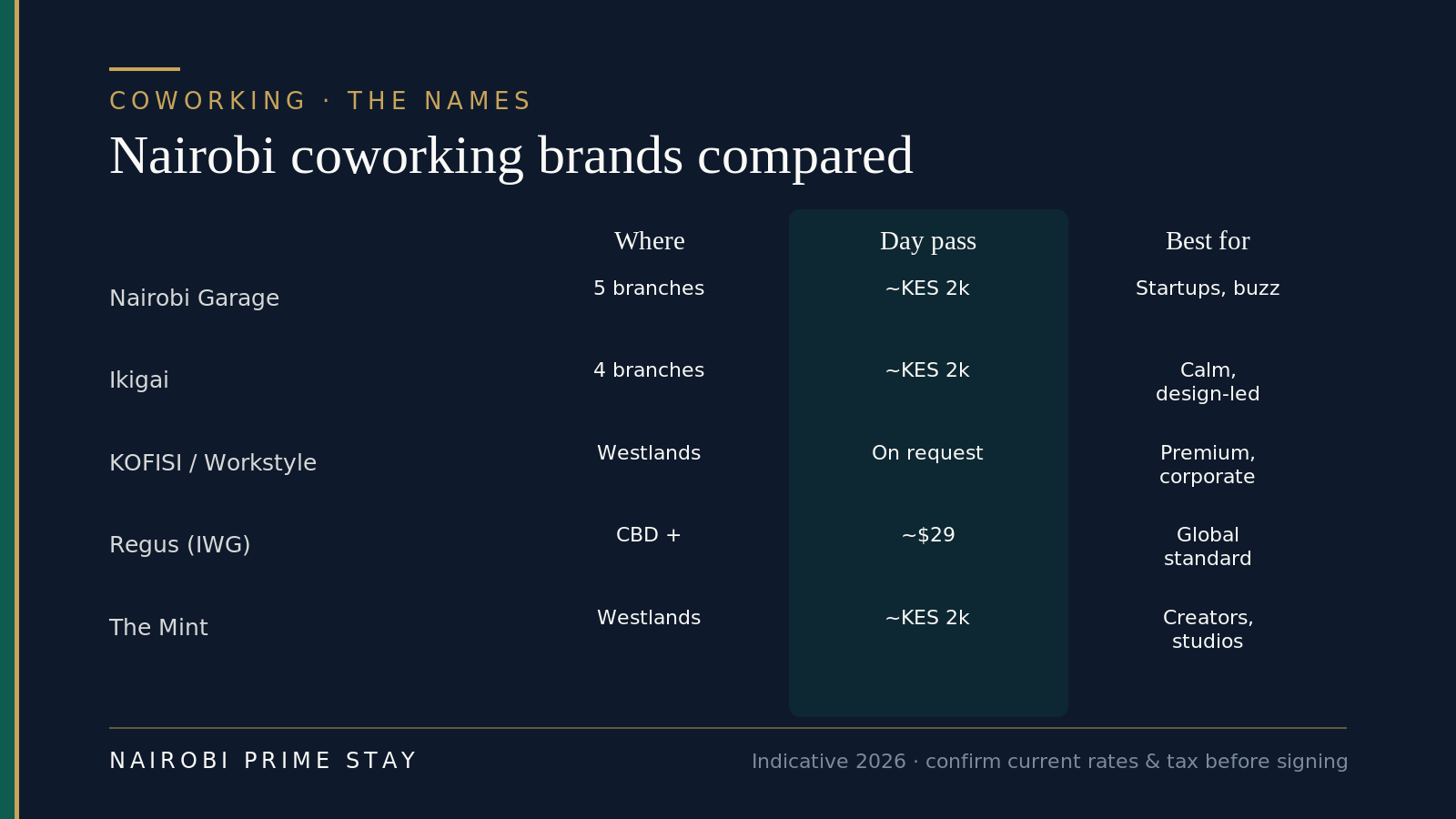
Five names worth knowing, side by side. Prices are indicative for 2026 — confirm before you sign.
| Option | Typical price (2026) | Approx. USD | Best for |
|---|---|---|---|
| Day pass | ~KES 2,000 (+ VAT) | ~$15 | Testing a space, or one well-powered day |
| Day office (Regus) | ~$29 | ~$29 | A private room for a day |
| Hot desk / month | ~KES 11,000–20,000 | ~$85–155 | A flexible seat, your main base |
| Dedicated desk / month | ~KES 20,000–29,000 | ~$155–245 | A desk that’s always yours |
| Private office / month | from ~$145–350+ | varies | Teams, or maximum privacy |
A few honest notes. Most spaces quote before VAT, so add tax to the headline figure. Annual or six-month deals discount heavily, so the per-month cost drops fast once you commit — but you’re locked in, so be sure of the area first. And day passes sometimes run office hours only (roughly 8:30am to 5pm), which matters if your US calls run into the Nairobi evening; check the hours, not just the price. For how coworking fits the wider budget, see our cost of living guide.
How do you book and pay?
Paying is easy, and mostly cashless. For a day pass you can usually just walk in, sign the register and pay on the spot — no booking needed at the big spaces, though reserving through a space’s app or member portal guarantees a seat on a busy morning. Nairobi Garage and the larger networks run online sign-up and booking; smaller spaces take a WhatsApp message or an email.
M-Pesa is the default. Almost every space takes payment to a paybill or till number straight from your phone, and it clears instantly, so a local SIM and an M-Pesa wallet make the whole thing frictionless. If you haven’t set that up yet, our M-Pesa guide walks through it; most spaces also take Visa and Mastercard, and will invoice a company for a team plan. You rarely need cash.
Two things to hold in mind on price. First, most spaces quote before VAT, which adds 16 percent — so a “KES 2,000” day pass is closer to KES 2,320 all-in, and a headline monthly figure is higher than it looks. Second, the dollar figures move with the exchange rate; at around KES 129.4 to the dollar in mid-2026 (current rate here) a KES 2,000 pass is about $15, but check the rate the week you pay.
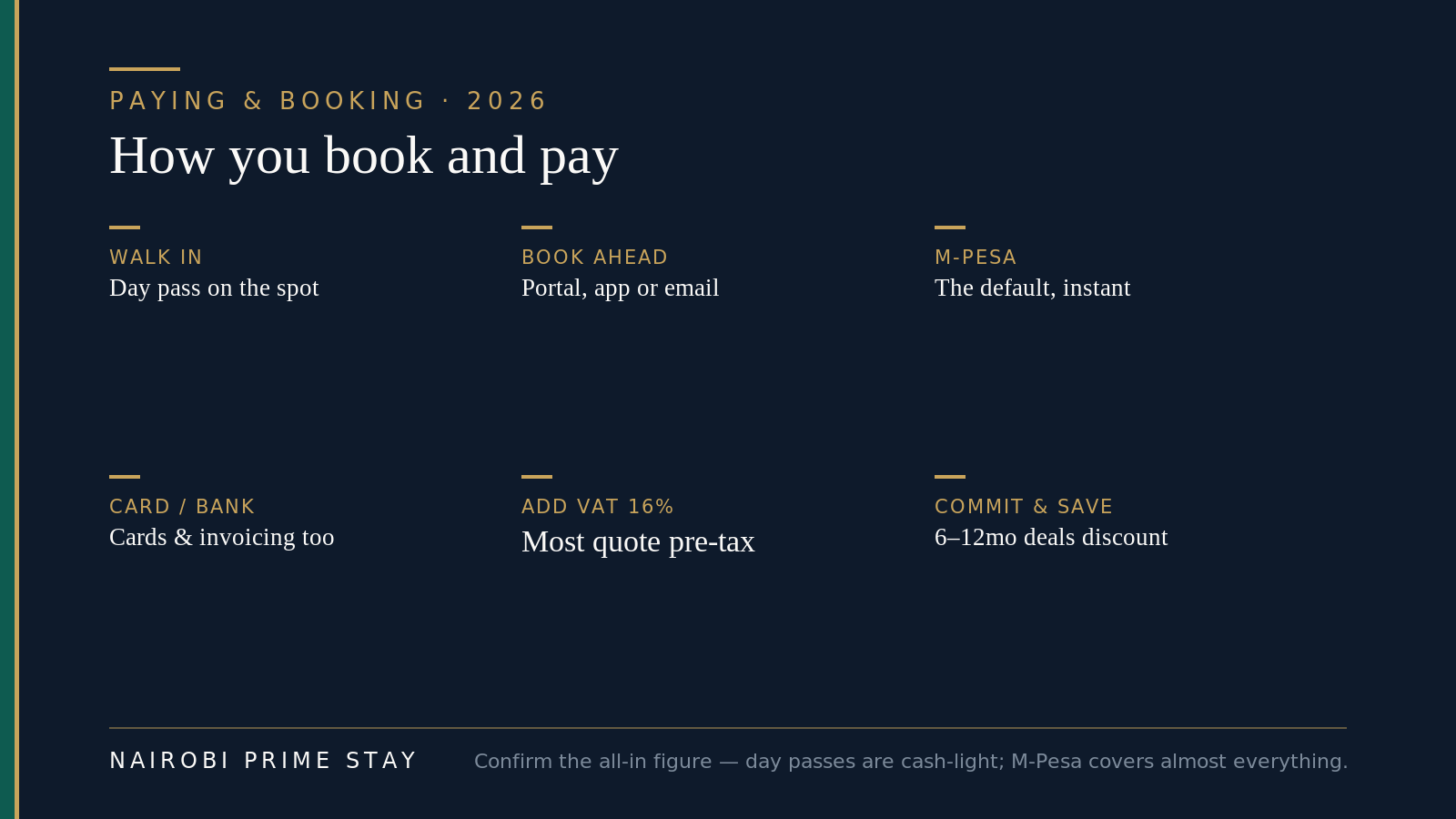
Paying is mostly cashless — M-Pesa covers almost everything; add VAT to the headline figure.
Working as a team, or need a business address?
Coworking scales past a single desk. If you’re bringing a small team, most spaces sell dedicated desks in a cluster or a lockable private office — Nairobi Garage, KOFISI and Regus all do team rooms that grow with you, and you split meeting-room hours and events across the group. Budget roughly KES 20,000 a desk a month for dedicated seats, and from about $145–350 a desk for a private office, depending on the finish and the address.
There’s also the part newcomers miss: a virtual office. For a monthly fee, a space gives you a registered business address, mail handling and pay-as-you-go meeting rooms without renting a desk at all. That’s genuinely useful if you’re registering a Kenyan company, opening a business bank account or applying for a permit and need a real address on the paperwork — Regus and Nairobi Garage both offer it. If you’re setting up a company or working toward a business permit, pair this with our Kenya visa guide.
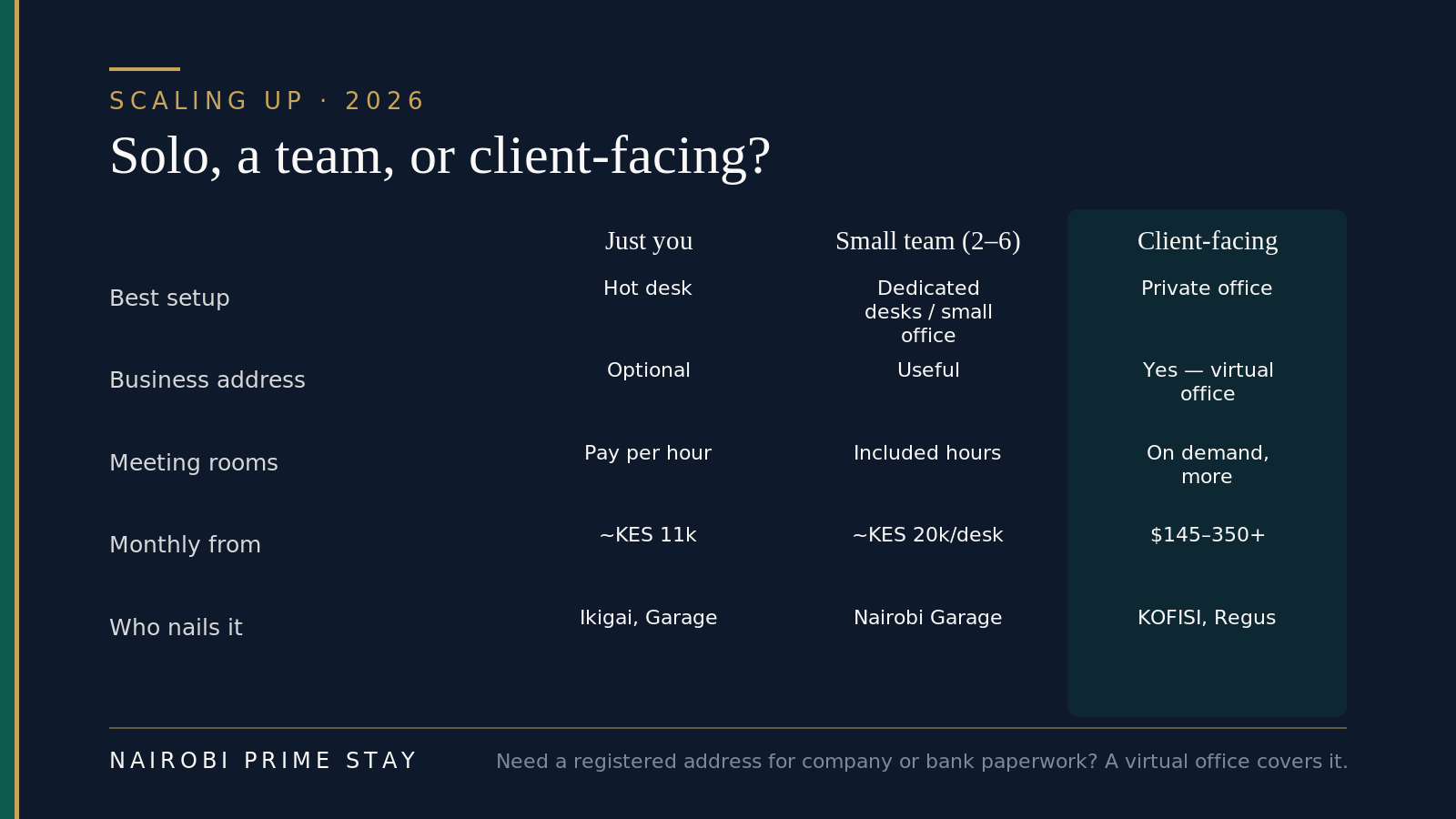
Match the setup to the job — and a virtual office covers the registered address company or bank paperwork asks for.
The best cafés to work from
Nairobi has a strong coffee culture, and plenty of cafés are happy to host a laptop for a few hours. They’re perfect for solo, heads-down work and casual calls — just buy something, tip around ten percent, and keep your laptop in sight (petty theft, not violence, is the real risk in the city — see is Nairobi safe?).
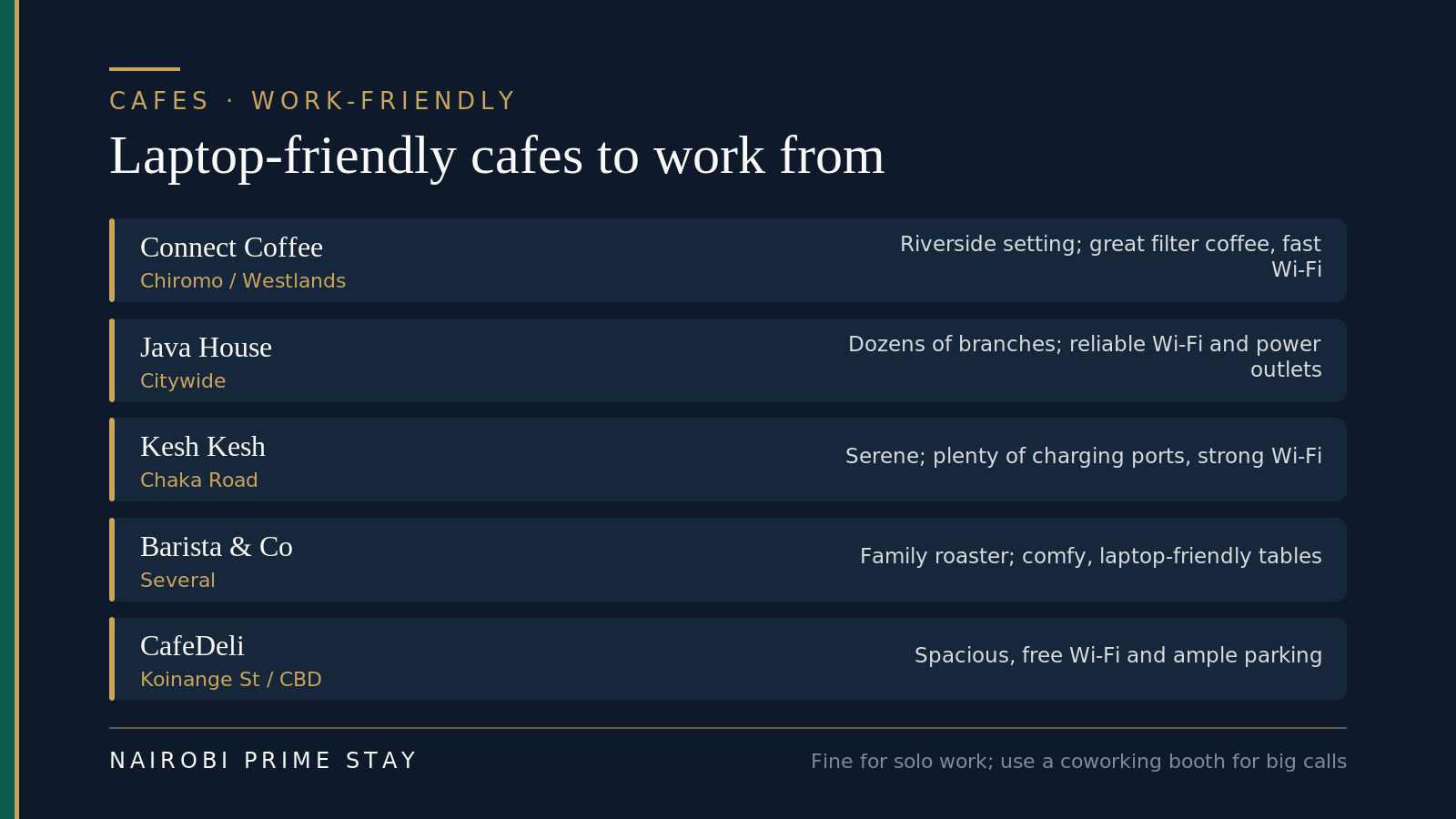
Great for solo work; for a big video call, a coworking booth is safer.
Connect Coffee Roasters by Chiromo Gardens is a remote-worker favourite — a riverside setting, some of the best filter coffee in the city, comfortable seating and fast Wi-Fi. Java House is the dependable workhorse: dozens of branches citywide, reliable Wi-Fi, plenty of power outlets and room to spread out (the Embassy branch is a known laptop haven). Kesh Kesh on Chaka Road is serene, with lots of charging ports, strong Wi-Fi and good Ethiopian and Eritrean food when you need a break. Barista & Co is a family-run roaster with comfortable, laptop-friendly tables, and CafeDeli on Koinange Street offers a spacious, calm room with free Wi-Fi and ample parking. Artcaffe, dotted across the malls and suburbs, is another easy default.
The honest limit: café Wi-Fi is shared and the room can get loud, so for an important video meeting a coworking space — with guaranteed power and a quiet booth — is the safer call. Use cafés for the work that doesn’t depend on a perfect connection, and you’ll love the habit.
Your backup when the Wi-Fi drops
Even good spaces have an off day, and cafés run on shared Wi-Fi — so the calmest remote workers carry a backup, and it costs very little. The move is a local Safaricom SIM (buy it on arrival with your passport and a Kenyan ID or your permit) loaded with a prepaid data bundle. An All-in-One bundle around KES 1,000–2,000 a month gives you roughly 10–17GB plus call minutes — plenty to tether your laptop through a wobble and finish a call. Turn on your phone’s hotspot and you’re back online in seconds.
Add a power bank for the laptop or phone and you’ve covered the two things that actually derail a workday here: a flaky connection and an outage the generator doesn’t quite catch. If your phone supports it you can set up an eSIM before you even land, and some people keep a second SIM (Airtel) as a spare network. None of this is expensive, and it turns a dead café Wi-Fi into a non-event. The full home-setup picture — fibre, Starlink, routers and a UPS — is in our internet and remote work guide, and paying for any of it is easiest over M-Pesa.
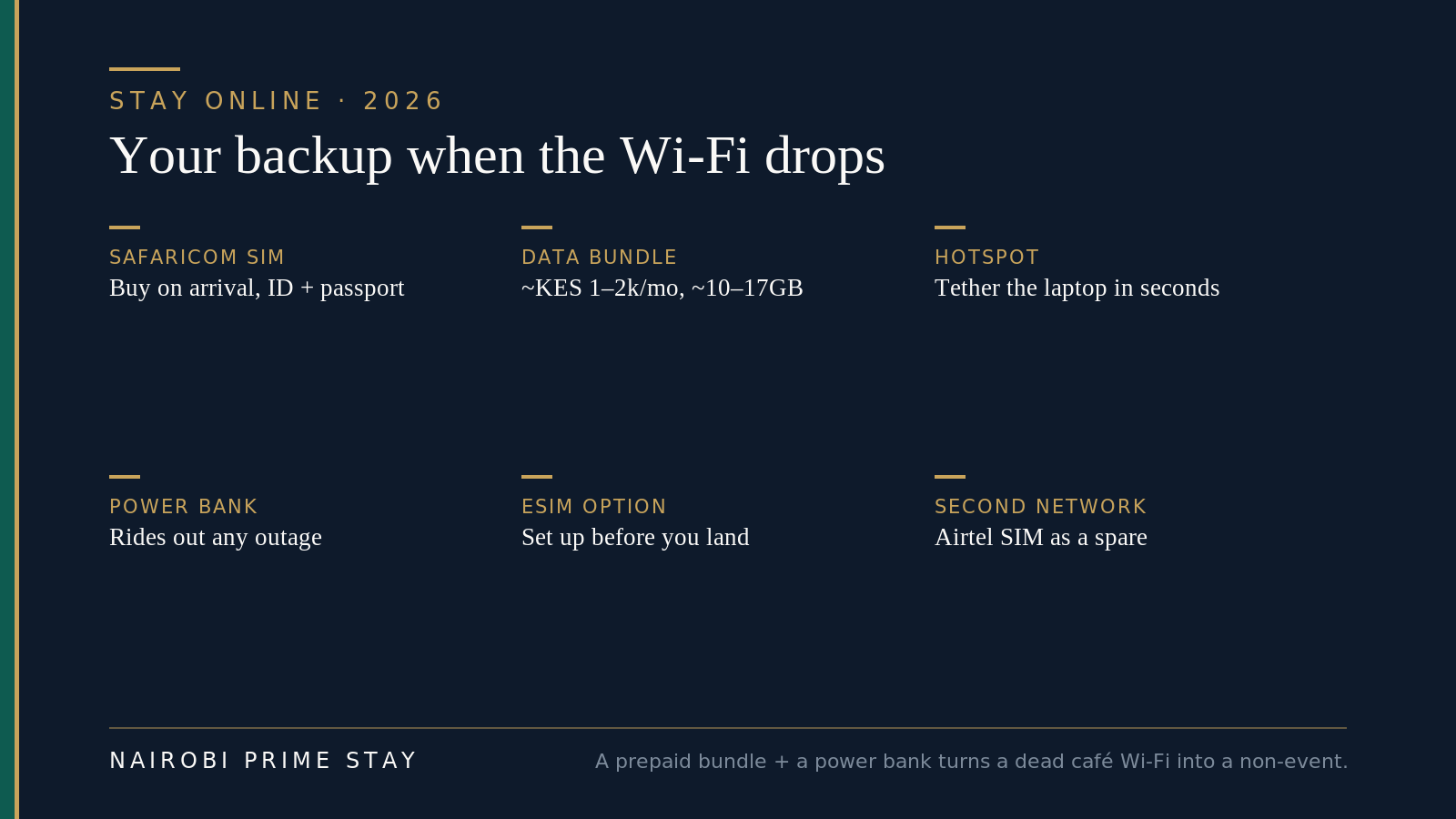
A prepaid bundle plus a power bank turns a dead café Wi-Fi into a non-event.
What to check before you commit
The difference between a smooth coworking choice and a frustrating one comes down to a short checklist. Most spaces look great on a quick tour; these are the things to actually verify.
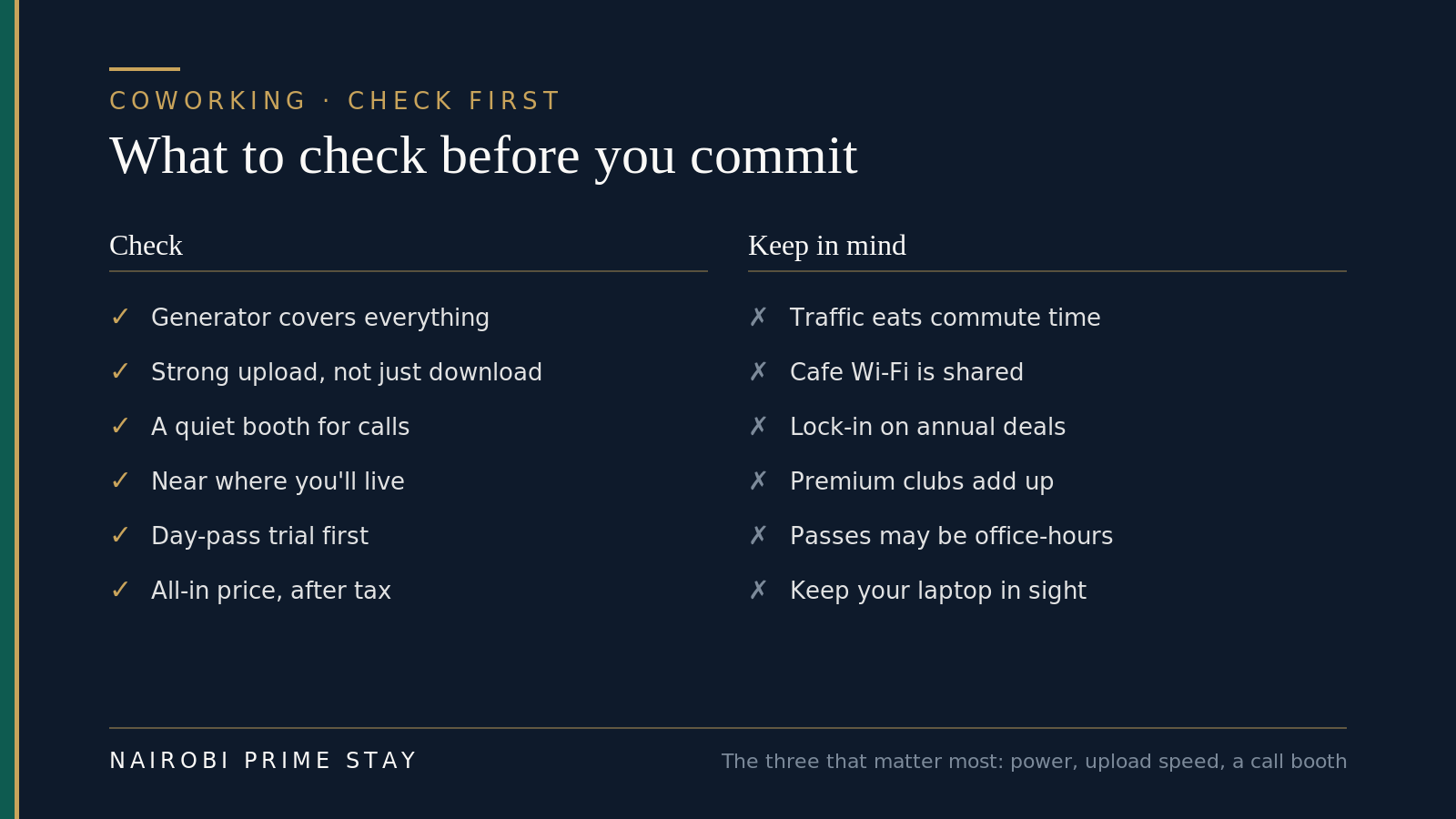
The three that matter most: backup power, upload speed, and a private booth for calls.
Start with power: confirm the backup generator covers the whole space, not just the lights, so a power cut doesn’t kill your Wi-Fi mid-call. Then internet: ask for the upload speed, not only the download — video calls and file sharing lean on upload, and it’s the figure spaces quote least. Then calls: make sure there’s a quiet phone booth or small meeting room you can grab, because open-plan coworking is no better than a café for a sensitive call without one.
After that it’s about fit. Pick a space near where you’ll live — Nairobi traffic is the real tax on your day, and a short commute beats any single amenity. Try a day pass first rather than committing on a tour. And confirm the all-in monthly price after tax, plus what’s included (meeting-room hours, printing, parking, events). Keep the trade-offs in mind too: annual deals lock you in, premium clubs add up, and some day passes are office-hours only.
The time-zone advantage
Nairobi runs on East Africa Time (UTC+3), and for anyone working with the US or Europe, the rhythm is kind. Your Nairobi morning is quiet, heads-down focus time while America sleeps. Your afternoon overlaps the US East-Coast morning, giving you a solid block of real-time collaboration without working through the night — a 4 or 5pm finish in Nairobi catches the start of the US working day. For European clients the overlap is bigger still. It’s one of the underrated reasons Nairobi suits American and European remote workers: you get deep-work mornings and collaborative afternoons, instead of a brutal all-night shift. If you’re settling in for the long haul, Kenya’s Class N digital nomad permit is built for remote workers paid from abroad — the details are in our Kenya visa guide for Americans.
A realistic first week
Here’s how this tends to play out. Say you’re a designer from Austin, landing in Nairobi for a six-month stint and renting in Kilimani. Your home fibre won’t be installed for a week, so on your first Monday you buy a day pass at a Nairobi Garage or Ikigai nearby — about KES 2,000 — and you’re online and on calls within the hour. Over the next few days you try a second space in Westlands and a quieter one closer to home, paying day rates each time. You notice the Westlands branch is a 35-minute crawl in traffic by 9am, while the Kilimani one is ten minutes on a good day. That settles it.
By Friday you take a monthly hot-desk membership at the Kilimani space, because the commute is short and you’ve already met two other remote workers there. You keep a couple of café favourites — Connect Coffee for a change of scene, a Java House near home for early mornings — for the days you don’t need a booth. Total spend for the week of day passes was under $60, and you’ve landed softly without signing anything you’ll regret. A serviced apartment for that first month makes it even smoother, since the Wi-Fi and backup power are already sorted at home too.
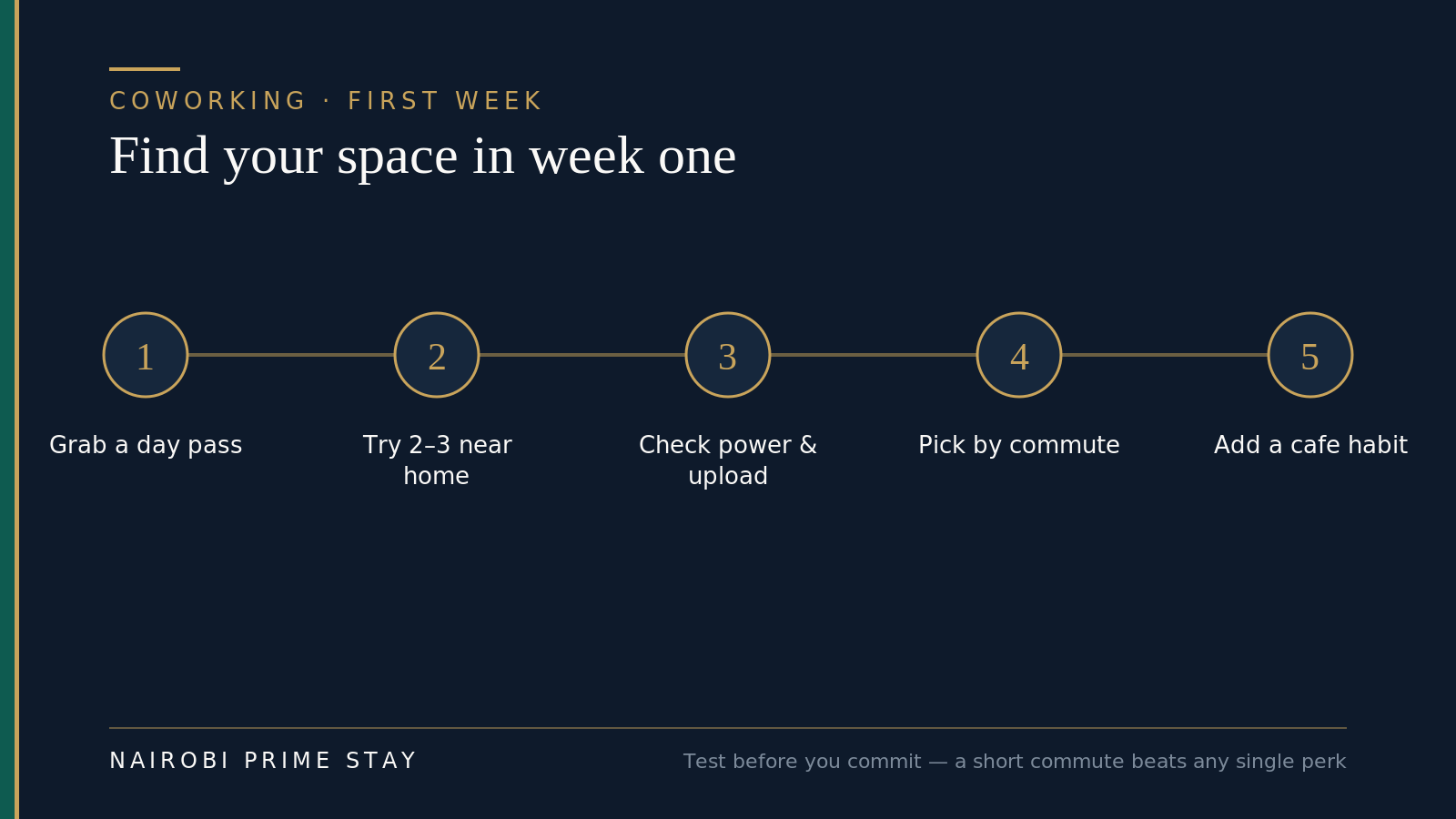
Test before you commit — a short commute beats any single perk.
A quick coworking checklist
- Start with day passes. Try two or three spaces near home (about KES 2,000 each) before committing.
- Check the generator covers the whole space, so outages don’t interrupt your calls.
- Ask for the upload speed, not just the download — it’s what video calls and file sharing need.
- Confirm there’s a quiet booth or small room for important calls.
- Choose by commute. A short hop beats a fancier space across town in Nairobi traffic.
- Confirm the all-in price after tax, and what’s included (meeting rooms, parking, events).
- Mind the hours — some day passes are office-hours only, which matters for late US calls.
- Keep a café or two in rotation for solo days, and never leave a laptop unwatched.
- Sort home backup too — fibre plus a generator or UPS, per our internet & remote work guide.
- Going long-term? Plan your Class N digital nomad permit early.
Frequently asked questions
What are the best coworking spaces in Nairobi?
It depends on what you want, but a few names come up again and again. Nairobi Garage is the big, professional, startup-heavy network, with branches in Westlands, Kilimani, Spring Valley, Karen and the CBD. Ikigai is the calm, design-led, garden-style option, with spaces in Westlands, Lavington, Riverside and Lower Kabete. For a more polished corporate feel, KOFISI and Workstyle Africa sit at the premium end in Westlands, and Regus runs global-standard serviced offices in the CBD and beyond. Smaller hubs like The Mint suit creators who want podcast and content studios. Try a day pass at two or three near your home before you commit.
How much does a coworking day pass cost in Nairobi?
Around KES 2,000 a day at the popular spaces, roughly $15 as of 2026 at about KES 129.4 to the dollar. That is the going rate at Nairobi Garage, Ikigai and The Mint, and it usually buys you a hot desk, fast Wi-Fi, backup power and unlimited tea or coffee for the working day. Global brand Regus charges more for a day office, nearer $29. Day passes are the smart way to test a space, or to cover the odd day you need guaranteed power and a quiet room for one important call. Confirm the current price and the hours, since some passes run office hours only, and note that most spaces quote before 16 percent VAT.
How much is a monthly coworking membership in Nairobi?
A hot desk, meaning a flexible seat in the shared area, runs roughly KES 11,000 to 20,000 a month, about $85 to $155 as of 2026. A dedicated desk that is always yours costs more, around KES 20,000 to 29,000, roughly $155 to $245. Premium clubs like KOFISI and Workstyle sit at the top of those ranges, while Ikigai’s all-locations membership is about KES 20,000 and includes perks like parking and yoga. Private offices start higher again. Prices vary by brand, branch and contract length, and many quote before tax, so confirm the all-in figure before you sign.
Which Nairobi neighbourhoods have the best coworking?
Westlands is the centre of gravity, with the widest choice and most of the premium names, which is why so many remote workers base themselves there. Kilimani is the other big hub, central and good value, and it pairs well with the area’s modern apartments. Lavington and Riverside are calmer and leafier but still well served, mostly through Ikigai. Karen suits the southern suburbs and families with a Nairobi Garage branch. The CBD has the global serviced-office brands. As a rule, pick the area you will live in first, then the space, because Nairobi traffic makes a short commute worth more than any single amenity.
Are Nairobi cafes good for working on a laptop?
Yes, the city has a strong coffee culture and plenty of laptop-friendly spots. Connect Coffee Roasters by Chiromo has a riverside setting and excellent filter coffee, Java House has reliable Wi-Fi and power outlets across dozens of branches, and Kesh Kesh on Chaka Road, Barista and Co, and CafeDeli are all comfortable for a few hours of focused work. Cafes are fine for solo tasks and casual calls. For an important video meeting, a coworking space with guaranteed power and a quiet booth is the safer bet, since a cafe can get busy and the Wi-Fi is shared. Buy something, tip about ten percent, and do not leave a laptop unwatched.
Do Nairobi coworking spaces have backup power and fast Wi-Fi?
Yes, that is largely the point of them. A good coworking space runs on fibre with a backup generator, so your connection and your calls survive the occasional power cut that can interrupt working from home. The better ones also have quiet phone booths or small meeting rooms for video calls, which a busy cafe cannot offer. Before you commit, check three things: that the generator covers the whole space and not just the lights, that the upload speed is solid and not only the download, and that there is somewhere private to take a call. Those three sort out almost every remote-work headache.
Can I use a coworking space just for my first week in Nairobi?
Yes, and it is one of the smartest soft-landing moves you can make. A day pass at around KES 2,000, or a flexible week, gives you a reliable, well-powered base from your very first morning, before your home fibre is installed and while you are still finding your feet. It also drops you into a ready-made network of founders, freelancers and other newcomers, which is the fastest way to make working friends in a new city. Many people start with day passes, settle on a favourite space, then take a monthly membership once they know which area they will live in.
Does Nairobi’s time zone work for remote work with the US?
It works well. Nairobi runs on East Africa Time, UTC+3, which is seven to eight hours ahead of the US East Coast. Your Nairobi morning is quiet, heads-down focus time while America sleeps, and your afternoon overlaps the US East-Coast morning, giving you a solid block of real-time collaboration without working through the night. A four or five o’clock finish in Nairobi catches the start of the US working day. For European clients the overlap is even bigger. It is a genuine reason Nairobi suits American and European remote workers better than many other global bases.
How do you pay for a coworking space in Nairobi?
Mostly by M-Pesa, and it is refreshingly simple. Almost every space takes payment to a paybill or till number from your phone and it clears instantly, so a local SIM and an M-Pesa wallet cover nearly everything. Most spaces also accept Visa and Mastercard and will invoice a company for a team plan, so you rarely need cash. For a day pass you can usually walk in and pay on the spot, while a busy morning is safer booked through the space’s app or member portal. Remember that most quote before 16 percent VAT, so a KES 2,000 day pass is closer to KES 2,320 all-in.
What happens if the coworking Wi-Fi goes down?
Carry a simple backup and it is a non-event. Buy a local Safaricom SIM on arrival and load a prepaid data bundle — an All-in-One bundle around KES 1,000 to 2,000 a month gives you roughly 10 to 17GB — then turn on your phone’s hotspot to tether your laptop through any wobble. Add a power bank for the outage the generator does not quite catch. You can set up an eSIM before you land if your phone supports it, and some people keep a second SIM on Airtel as a spare network. Good spaces rarely drop, but the backup costs little and saves the day when they do.
Can I get a private office or business address for my team in Nairobi?
Yes. Beyond hot desks, most spaces sell dedicated desks in a cluster or a lockable private office that grows with a small team — budget roughly KES 20,000 a desk a month for dedicated seats, and from about $145 to $350 a desk for a private office. Nairobi Garage, KOFISI and Regus all do team rooms. If you only need an address, a virtual office gives you a registered business address, mail handling and pay-as-you-go meeting rooms without renting a desk, which is useful for registering a Kenyan company, opening a business bank account or applying for a permit. Regus and Nairobi Garage both offer it.
Final thoughts
Nairobi makes remote work easy. Coworking is affordable and genuinely good — a day pass costs about the price of lunch back home, the spaces have the power and fibre your calls depend on, and they hand you a ready-made network of people in the same boat. Cafés fill the gaps for solo days, the coffee is excellent, and the time zone is kind to American and European teams. Start with a few day passes, choose the space whose commute you’ll actually tolerate, and you’ll be working comfortably within your first week — without signing anything you’ll regret.
Related reading
- Internet & remote work in Nairobi — home fibre, Starlink, backup power and how much speed you really need.
- Moving to Nairobi: the complete guide — the hub that ties the whole move together.
- Best neighborhoods in Nairobi — where remote workers actually live, side by side.
- Cost of living in Nairobi — how coworking, rent and the rest add up.
- Kenya visa guide for Americans — including the Class N digital nomad permit.
- Building your expat community in Nairobi — coworking is one of the fastest ways in.
When you’re ready to land softly, browse our serviced apartments in Nairobi — each comes with fibre Wi-Fi and a backup generator, so you can work from your first morning while you scout coworking spaces nearby. A $50 deposit reserves a place and you settle the balance on arrival. Not sure which area fits your hours and budget? Our AI relocation assistant can shortlist well-connected apartments near the spaces you’ll use, any time of day.
Ready to look?
Find your apartment in Nairobi
Browse verified serviced apartments, or ask the AI concierge which area fits your life.