
Guides · Lifestyle
Shopping in Nairobi: Malls, Markets & Groceries (2026 Guide)
Shopping in Nairobi: Malls, Markets & Groceries (2026 Guide)

You can buy almost everything you need in Nairobi, and a fair bit you didn’t expect to. The city has glossy modern malls with international supermarkets, lively open-air markets where you bargain for mangoes and carvings, and small neighborhood shops for everything in between. The only real learning curve is knowing which place to go for which thing, and what a fair price looks like.
This guide is the honest map. We’ll cover the malls worth knowing, the supermarkets you’ll actually use, where to buy fresh produce, crafts and second-hand bargains, how you pay, and what’s genuinely hard to find or pricey. By the end you’ll know where to do your weekly shop, where to send your visiting parents for souvenirs, and what to tuck into your suitcase from home.
Quick answer
Most expats settle into a simple rhythm. You do the weekly grocery shop at Naivas or Quickmart (the everyday Kenyan chains), top up imported and specialty items at Carrefour or Chandarana Foodplus, buy fresh produce cheaply at a local market or a fresh-food grocer like Zucchini, and visit the roving Maasai Market for crafts and gifts. The big malls — Two Rivers, Village Market, Sarit, Westgate, The Hub and Garden City — bundle shops, supermarkets, restaurants and cinemas under one secure roof. You pay for nearly everything with M-Pesa mobile money or a card; markets run on M-Pesa or cash. Fresh food is cheap and excellent; imported brands cost more and a few specific items you’ll simply bring from home.
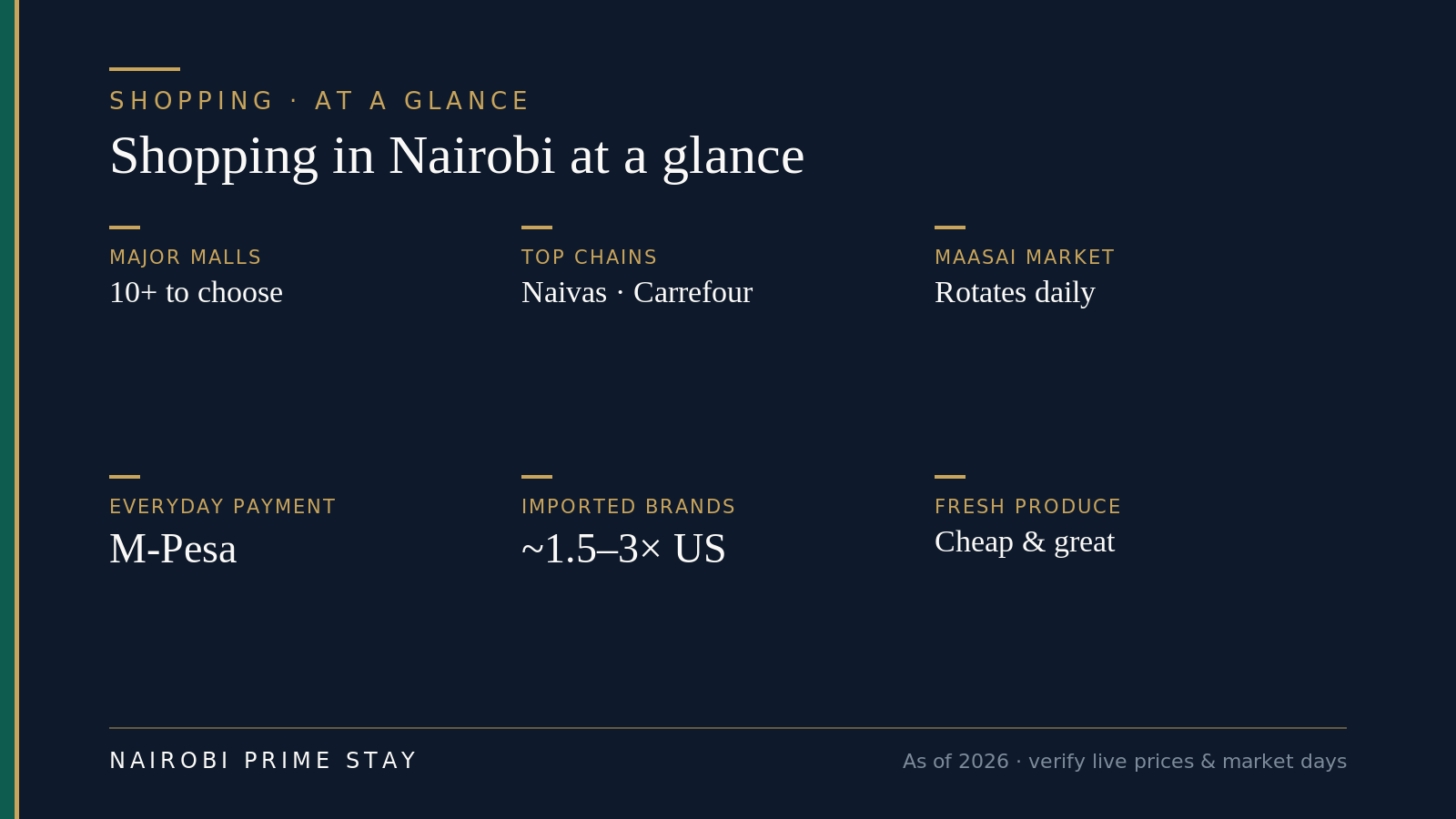 Shopping in Nairobi at a glance — verify live prices and current market days.
Why this matters when you’re new
Shopping is where you feel a new city in your hands. In your first weeks you’ll furnish a kitchen, find the snacks your kids will actually eat, and work out whether to keep buying imported coffee or switch to the (superb) local stuff. Getting the lay of the land early saves money and frustration — and tells you a lot about how daily life here really works. The short version: it’s easier and better-stocked than most newcomers fear, and the things you’ll miss are specific, not general.
The malls worth knowing
Nairobi’s malls are the easy entry point — secure, air-conditioned, and stocked with familiar comforts. Each has at least one big supermarket, ATMs, pharmacies, phone shops, a food court and usually a cinema. Here are the ones expats use most.
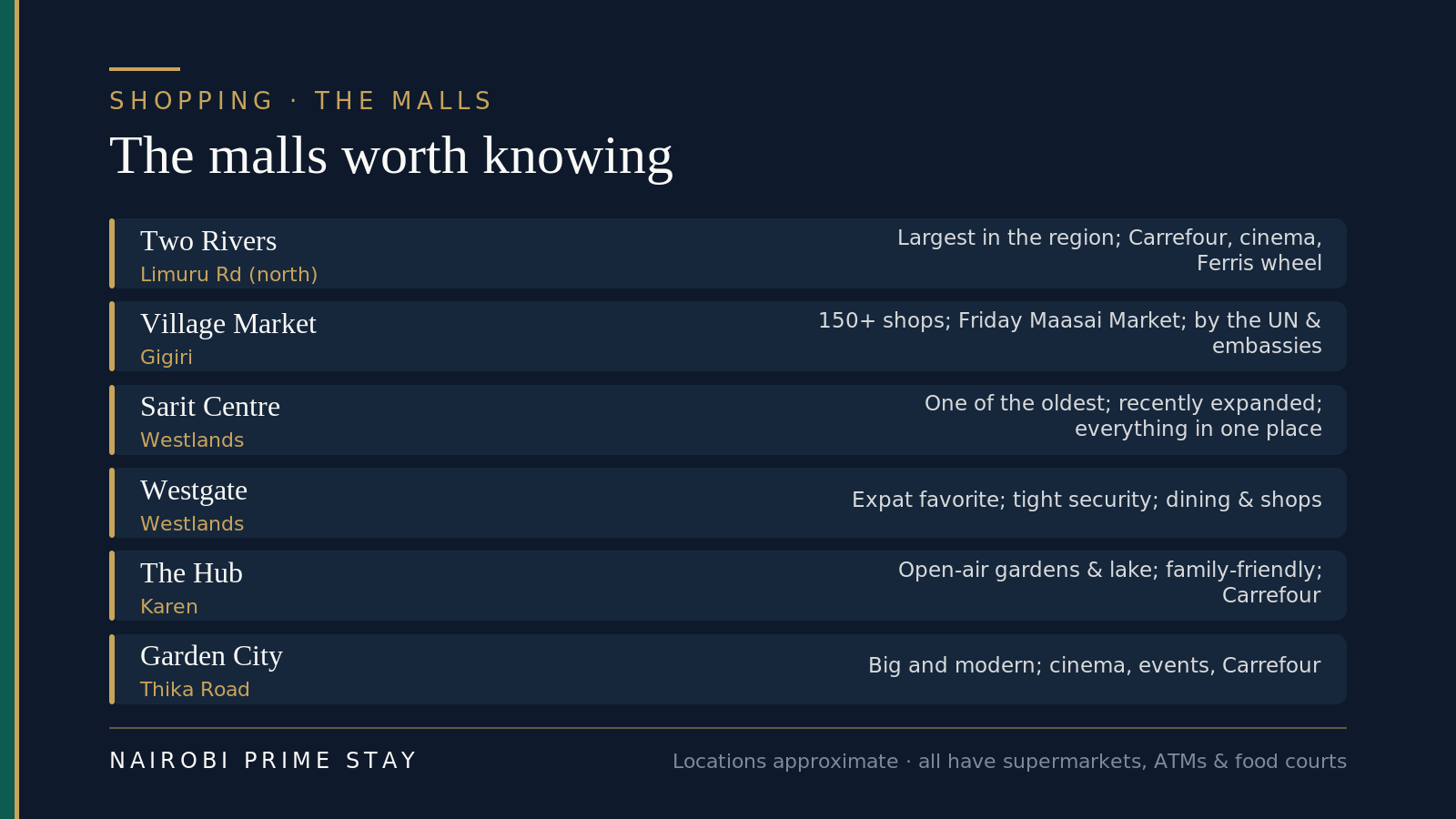 The malls worth knowing — all have supermarkets, ATMs and food courts.
Two Rivers Mall (off Limuru Road, near Runda and Ruaka) is the giant — when it opened in 2017 it was billed as the largest mall in East and Central Africa, with 200-plus stores spread over a huge site, a Carrefour hypermarket, a cinema, and a 60-metre Ferris wheel for the kids. It’s the northern suburbs’ default for a big day out.
Village Market (Limuru Road, Gigiri) is the heart of shopping for the UN and embassy crowd — around 150 outlets on several levels, an outdoor food court, a waterslide and bowling, and the famous open-air Maasai craft market on Fridays. If you live in Gigiri or Runda, this is your local.
Sarit Centre (Westlands) is one of Nairobi’s oldest malls and recently grew with a large modern expansion and an expo center. It’s a true one-stop: fashion, electronics, books, a big supermarket and plenty of food. Handy if you’re based in Westlands.
Westgate (Westlands) is a long-time expat favorite for its mix of shops and restaurants, and it’s known for visibly tight security. Plenty of people fold it into the same trip as Sarit.
The Hub (Karen) is the prettiest — an open-air design with gardens, fountains and a small lake, anchored by a Carrefour and full of family-friendly cafes. It’s the natural choice if you live out in leafy Karen.
Garden City (Thika Road) is big, modern and event-friendly, with a Carrefour, a cinema and a large outdoor events space. It serves the fast-growing northeast of the city.
Beyond these, you’ll hear about The Junction (Ngong Road), the much-loved older Yaya Centre (Hurlingham/Kilimani), Galleria (toward Karen/Langata), Rosslyn Riviera (Gigiri), Lavington Mall, Prestige Plaza (Ngong Road) and Thika Road Mall (TRM). Wherever you settle, there’s a capable mall within a short drive.
| Mall | Area | Known for | Anchor supermarket |
|---|---|---|---|
| Two Rivers | Limuru Rd (north) | Largest in the region; Ferris wheel, cinema | Carrefour |
| Village Market | Gigiri | UN/embassy hub; Friday Maasai Market | Carrefour-area + others |
| Sarit Centre | Westlands | One of the oldest; recently expanded | Yes (large) |
| Westgate | Westlands | Expat favorite; strong security | Yes |
| The Hub | Karen | Open-air gardens; family-friendly | Carrefour |
| Garden City | Thika Road | Modern; cinema and events | Carrefour |
Indicative as of 2026 — anchor tenants and stores change; check the mall directory.
Supermarkets — your weekly shop
For groceries, four names cover almost everything, and most expats use two or three of them.
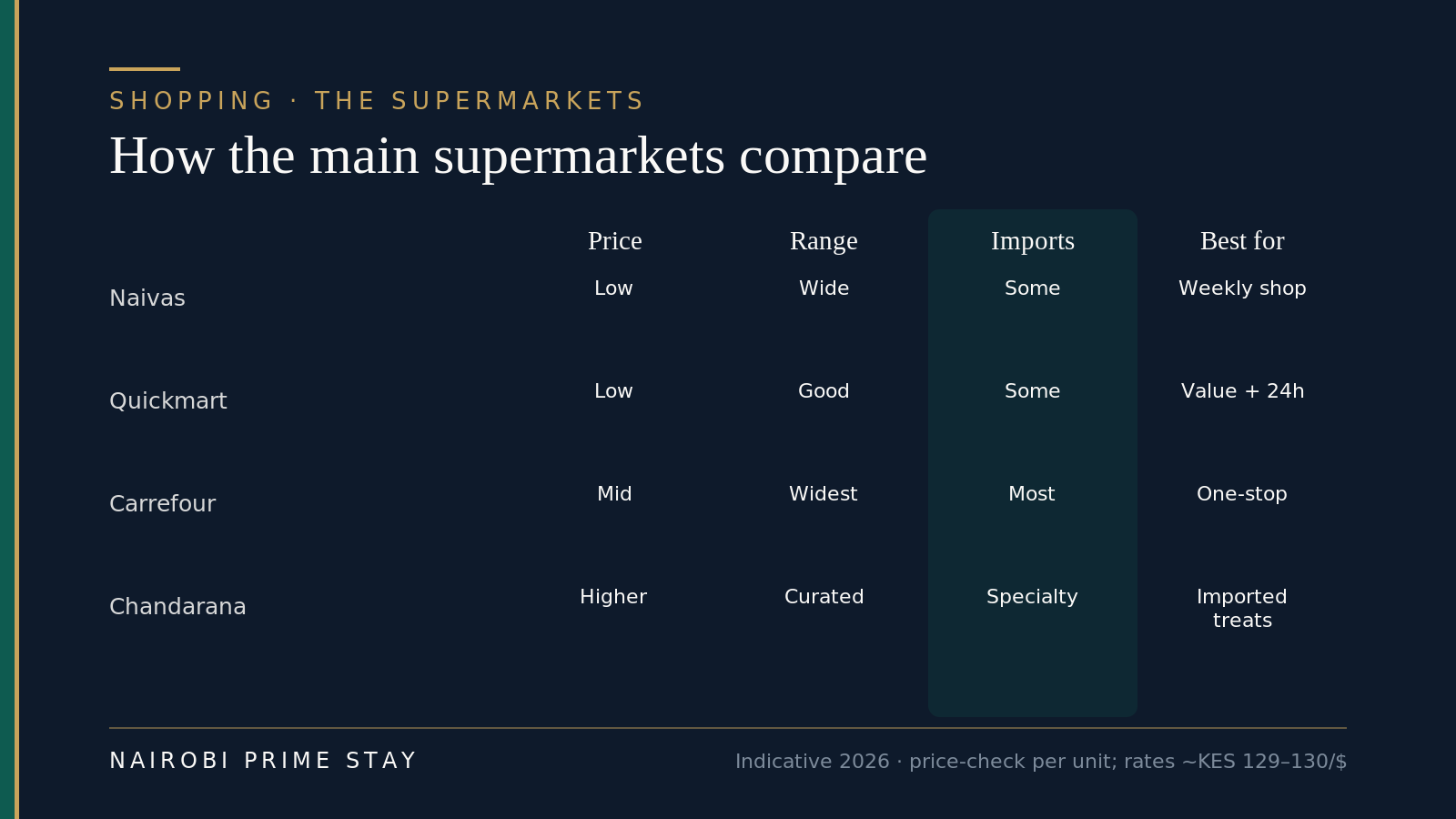 How the main supermarkets compare — price-check per unit; rates around KES 129.4 to the US dollar (1 July 2026).
Naivas is the everyday workhorse and the largest Kenyan chain by store count, with well over a hundred branches across the country as of 2026. It’s Kenyan-owned, keenly priced, runs constant promotions, and you’re rarely far from one. For the bulk of a weekly shop, it’s hard to beat.
Quickmart is the other big local chain — fast-growing, good value, with some 24-hour branches and grocery delivery through apps like Bolt Food. Many people treat Naivas and Quickmart as interchangeable and shop whichever is closer.
Carrefour, the French-style hypermarket run across the region by Majid Al Futtaim, anchors most of the big malls. It has the widest range under one roof and the deepest selection of imported brands — European, American, Indian and Middle Eastern — plus a strong house-brand line that competes hard on price. When you want to do everything in one trip, this is the one.
Chandarana Foodplus is the upmarket grocer. It’s where you go for harder-to-find international and specialty items — particular cheeses, wines, sauces, baking ingredients and brands the others don’t stock. Prices run higher, but for the things only Chandarana carries, that’s the trade.
One honest piece of context, especially if you visited Kenya years ago: the retail scene has been rebuilt. The old giants — Nakumatt, Tuskys and Uchumi — collapsed under debt over the last several years (Nakumatt folded around 2017–2020; Tuskys’ last branch closed in 2023). Naivas, Quickmart and Carrefour have taken their place, and the market is healthier and more competitive for it. The current 2026 trend is these chains pushing smaller stores into middle-income neighborhoods, so a good supermarket keeps getting closer to wherever you live.
A quick money note: no single store wins on everything. Regulars price-check a handful of items and split their shop — staples at Naivas or Quickmart, imports at Carrefour or Chandarana. For how groceries fit a monthly budget, see our cost of living in Nairobi guide and the Nairobi vs US cost comparison.
Getting your shopping delivered
You don’t have to leave the apartment to fill the fridge. Grocery and food delivery is well established in Nairobi, and it’s a lifesaver in your first week before you have a car or know the roads.
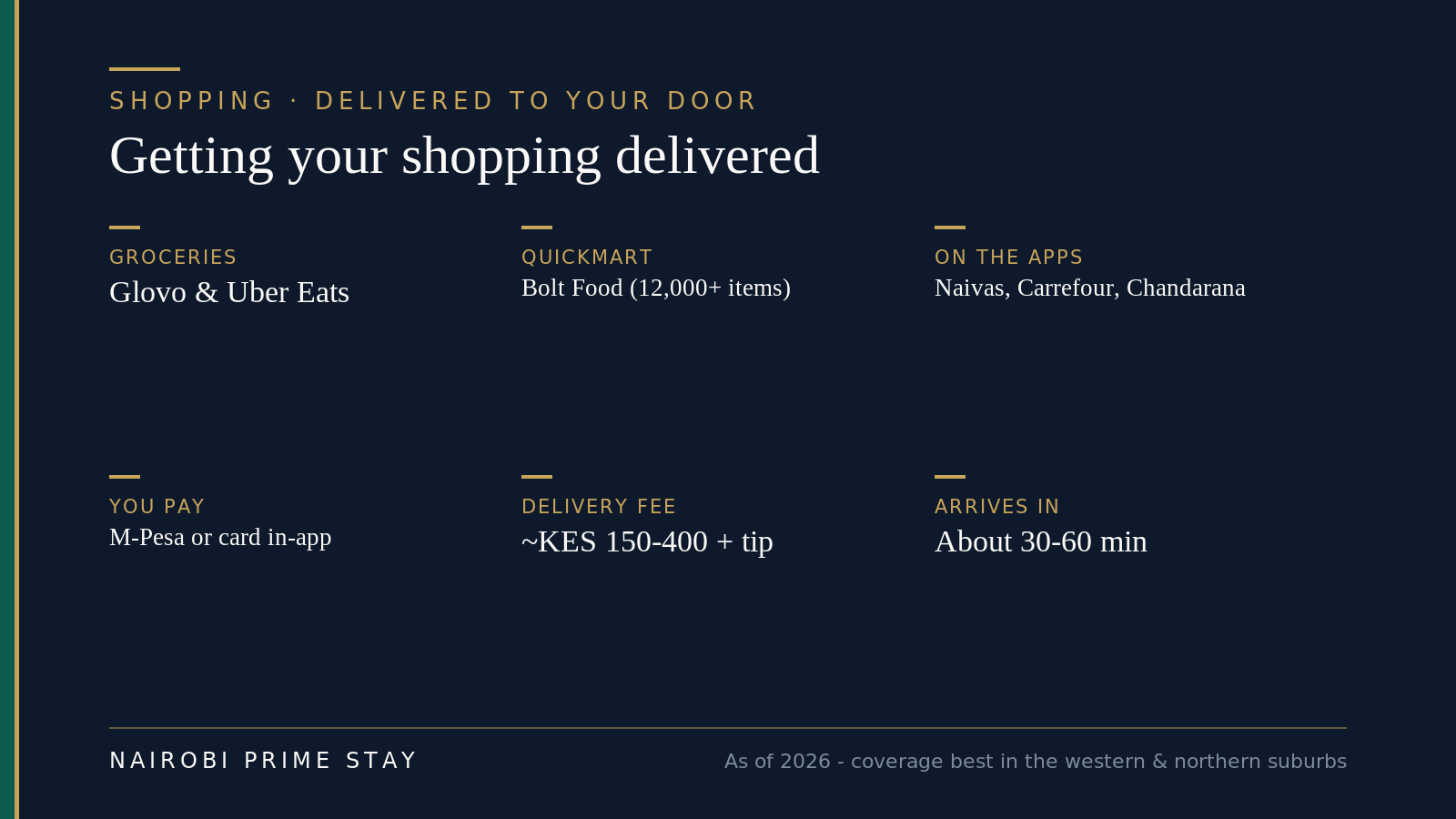 Getting your shopping delivered — coverage is best across the western and northern suburbs.
Glovo and Uber Eats are the big two, and both deliver groceries from the major supermarkets — Naivas, Carrefour, Chandarana Foodplus and Quickmart — alongside restaurant meals. In June 2026, Bolt Food added Quickmart grocery delivery too, putting more than 12,000 products a few taps away. You browse the store inside the app, pay by M-Pesa or card, and an order usually arrives in about 30 to 60 minutes for a delivery fee of roughly KES 150 to 400 plus a tip.
Coverage is strongest where most expats live — the western and northern suburbs — and thinner on the city’s edges. Set up an M-Pesa line first, since it’s the smoothest way to pay in-app. On a day when the traffic is grim or the rain is coming down, having the week’s shop delivered is worth every shilling of the fee.
How much does a week of groceries cost in Nairobi?
Local staples are cheap; imported brands are where the total climbs. That single fact shapes every expat grocery bill here.
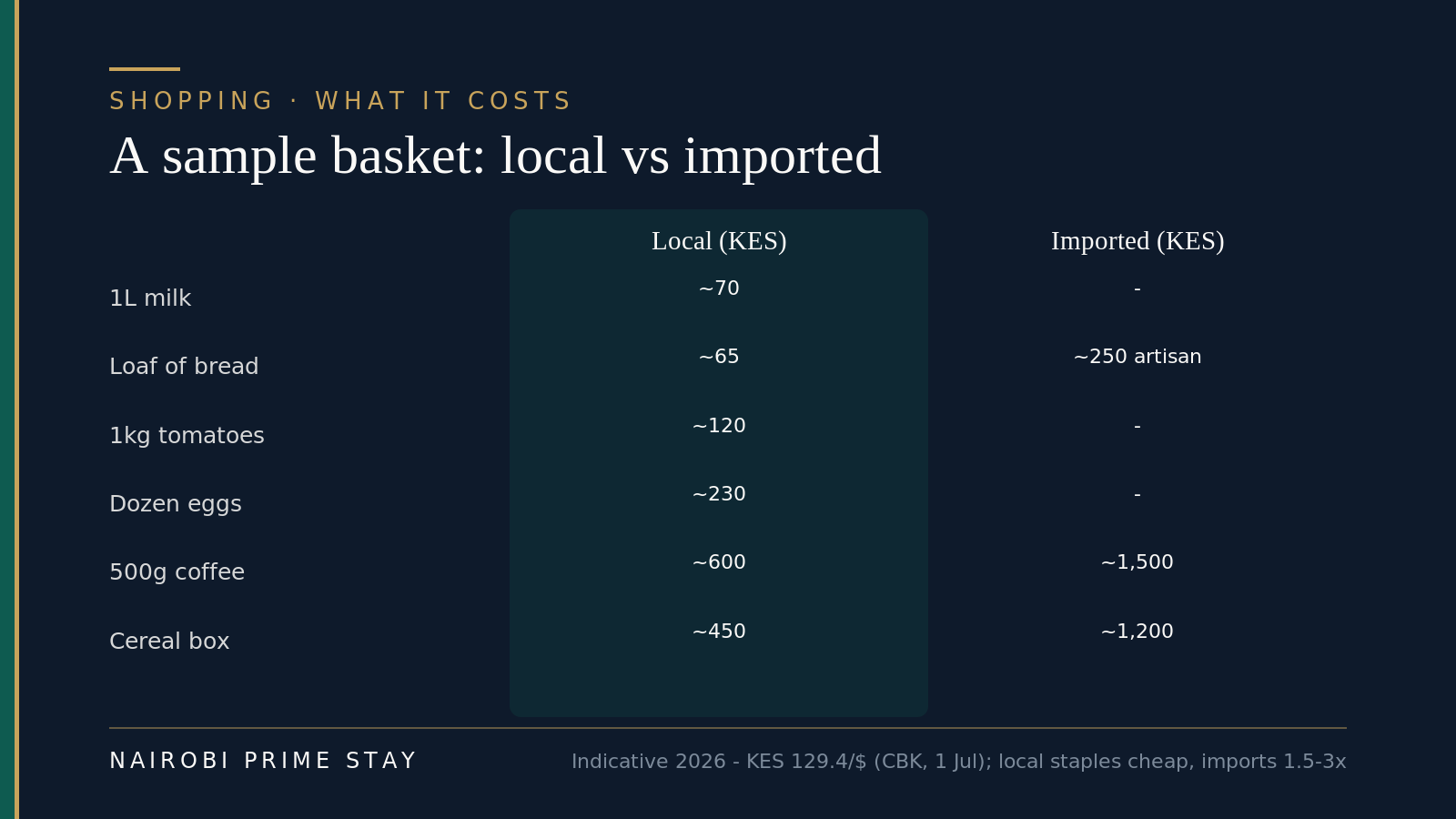 A sample basket — local staples are cheap, imported versions run one and a half to three times more.
As a rough 2026 guide, a litre of milk runs about KES 70, a loaf of bread around KES 65, a dozen eggs about KES 230, and a kilo of tomatoes around KES 120. A family’s fresh-food shop is genuinely affordable. Swap to imported versions, though, and the numbers jump: local coffee near KES 600 against an imported bag around KES 1,500, a local cereal near KES 450 against an imported box around KES 1,200.
At about KES 129.4 to the US dollar as of 1 July 2026 (check the current USD/KES rate), most expats eat well for less than they would at home — as long as they lean on local produce and treat imports as treats. For the full monthly picture, see our cost of living in Nairobi guide.
Fresh markets and farmers’ markets
The best produce in Nairobi isn’t in a supermarket — it’s at a market, and it’s cheap. A few options, from easiest to most local:
Fresh-food grocers like Zucchini (at ABC Place in Westlands and at Village Market) sell excellent fruit, vegetables, herbs and flowers at fixed prices in a clean, easy setting — a gentle first step if open-air markets feel daunting. Kalimoni Greens and similar shops focus on organic produce.
Saturday farmers’ markets pop up around the leafy suburbs — the long-running market at the Karen and Lavington area greenspaces, and others that rotate. They’re as much social occasions as shopping trips: local cheese, honey, baked goods, coffee and crafts, with a flat-white-in-hand atmosphere.
Open-air produce markets are where locals shop and where your money goes furthest. City Market in the CBD is a historic indoor market for produce, flowers and curios; neighborhood markets in Westlands, Kangemi, Karen and elsewhere sell mountains of seasonal fruit and vegetables. Here prices aren’t fixed — a little friendly bargaining is normal, and a vendor you return to will look after you. Bring small notes and your M-Pesa line.
Whatever you can’t finish at the market, the supermarket will have. Between the two, eating well here is easy and affordable.
The Maasai Market — crafts, gifts and bargaining
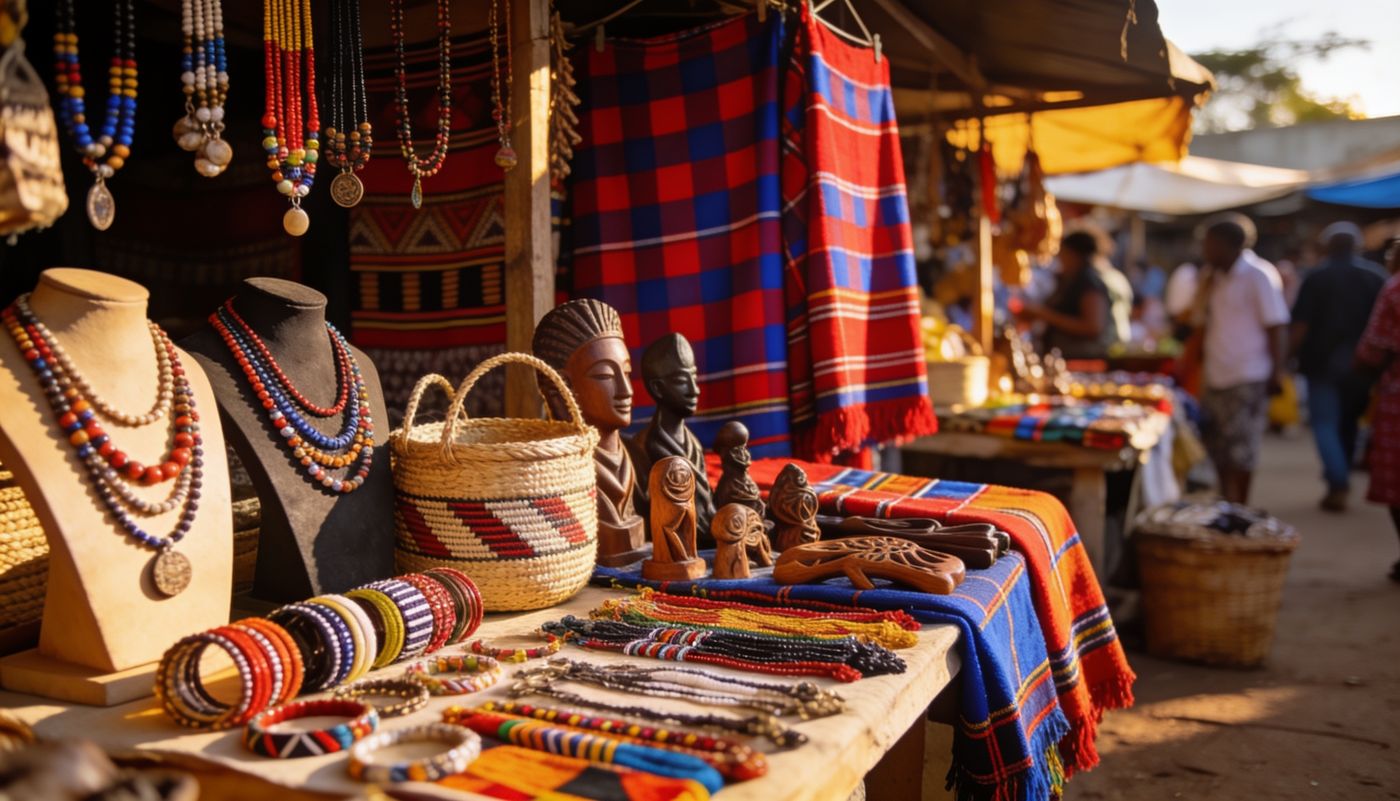
The Maasai Market is Nairobi’s roving open-air craft market, and it’s the answer to “where do I buy gifts and souvenirs?” Artisans sell wood carvings, soapstone, beadwork and jewelry, kikoy and kitenge fabrics, paintings, baskets, sandals and homeware — much of it handmade. It’s colorful, fun and a little chaotic in the best way.
The catch: it isn’t in one fixed place. The market rotates around the city by day of the week. As of 2026 the usual pattern looks like this — but it shifts, and weather can move it, so confirm the current day and spot before you set out.
| Day | Usual location | Area |
|---|---|---|
| Monday | Capital Centre | Mombasa Road |
| Tuesday | Kijabe Street | CBD |
| Wednesday | Capital Centre / varies | Mombasa Road |
| Thursday | The Junction Mall | Ngong Road |
| Friday | Village Market | Gigiri |
| Saturday | Near the High Court | CBD |
| Sunday | Yaya Centre | Hurlingham |
Schedule rotates and changes — verify the current day and location locally before going. If the timing never lines up, Two Rivers Mall hosts a permanent indoor Maasai Market that’s open daily.
Bargaining is expected here, and it’s part of the experience. Prices aren’t fixed; the first number you hear is a starting point, often a high “visitor price.” Greet the seller first, stay friendly and good-humored, and settle somewhere in the middle — walking away politely is a normal part of the dance, and a fair deal leaves everyone happy. Knowing a few words of Swahili and a sense of the going rate helps; our guides to Kenyan culture and etiquette cover how to do this warmly rather than awkwardly. In malls and supermarkets, by contrast, prices are fixed — no haggling.
Second-hand, furniture and electronics
Second-hand clothes (mitumba) are a Nairobi institution — high-quality used clothing, often Western brands, at a fraction of retail. Gikomba is the vast, frantic mother of all mitumba markets near the CBD; it’s cheap and treasure-filled but crowded, so go with a local, dress down and keep your phone and cash well secured. Toi Market (near Adams Arcade/Kibera) is a smaller, more manageable option. These markets are cash-and-M-Pesa, and bargaining applies.
Furniture and homeware are easy to sort locally. Ngong Road is lined with roadside furniture makers selling solid wood pieces, and you can have things made to order surprisingly cheaply; the malls have homeware stores for the rest. If you’re kitting out a place from scratch, our furnishing a home in Nairobi guide walks through buying versus renting furniture and the best places to look. (If you’d rather skip all of this, a furnished serviced apartment arrives ready to live in.)
Electronics and phones are widely available — phone shops fill every mall, and you’ll find laptops, TVs and appliances easily. Just know that import duty pushes prices above what you’d pay in the US, so big-ticket electronics are one category where bringing a device from home can make sense.
Shopping online: Jumia, Kilimall and ordering from the US
Buy online locally — it’s faster and cheaper than importing. Nairobi has a real e-commerce scene, and for most things it beats trying to ship from home.
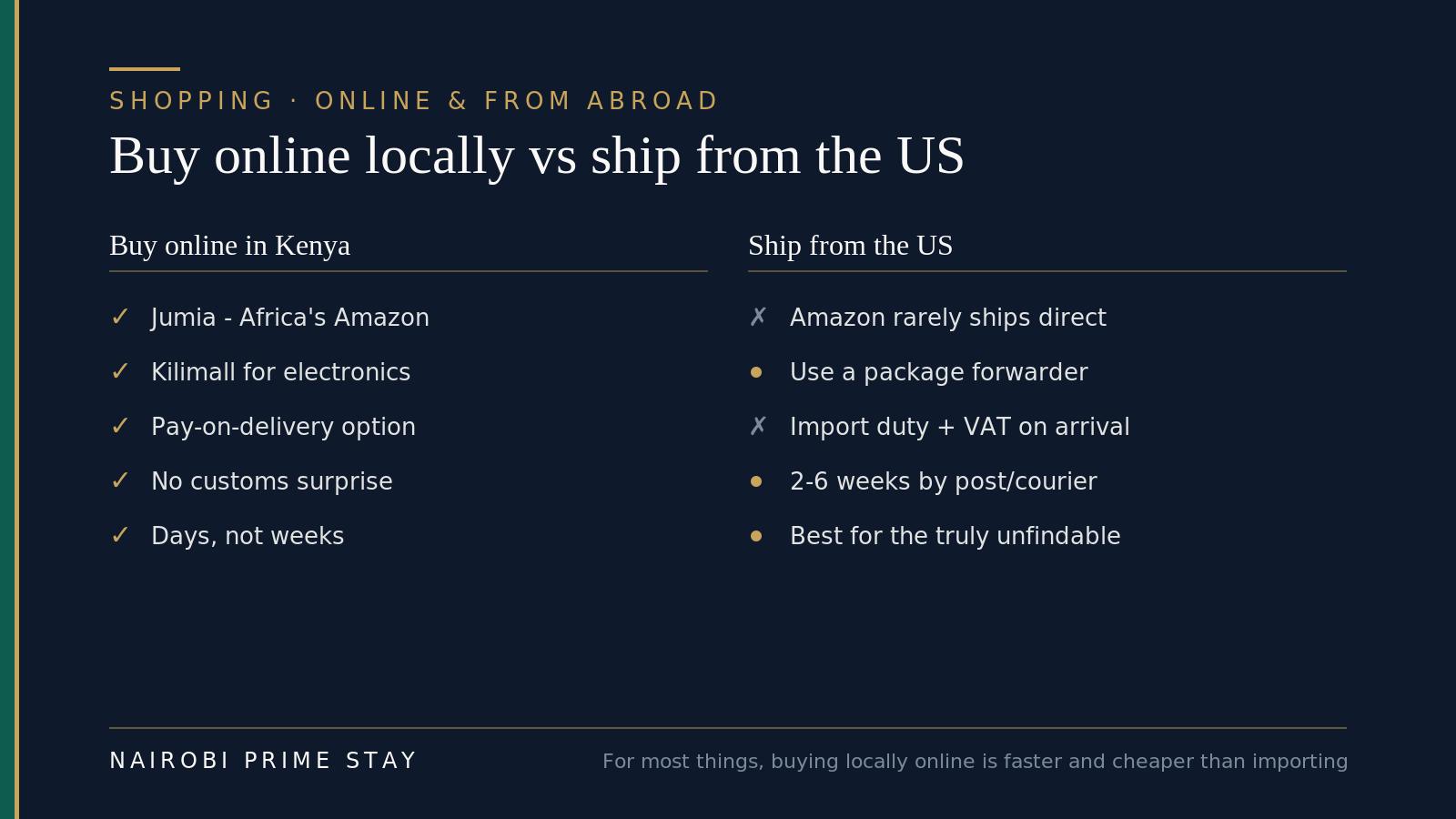 For most things, buying locally online is faster and cheaper than importing.
Jumia is Kenya’s largest online marketplace — think Africa’s Amazon — selling phones, electronics, appliances, home goods, fashion and more, with a handy pay-on-delivery option so you only pay when the box arrives. Kilimall is another big player, especially strong on electronics and gadgets. Between them you can furnish a kitchen or replace a broken kettle without leaving the couch.
Ordering from the US is the harder path. Amazon doesn’t ship most items directly to Kenya, so bringing something in means using a package-forwarding service, then paying import duty and VAT when it lands, plus a two-to-six-week wait. It’s worth it only for the genuinely unfindable. If you’re moving a whole household’s worth of goods rather than one parcel, our guide to shipping your belongings to Kenya covers the container-versus-buy-here math in detail.
What’s cheap, what’s pricier, and what’s hard to find
Here’s the honest picture, because it’s the question every newcomer actually has.
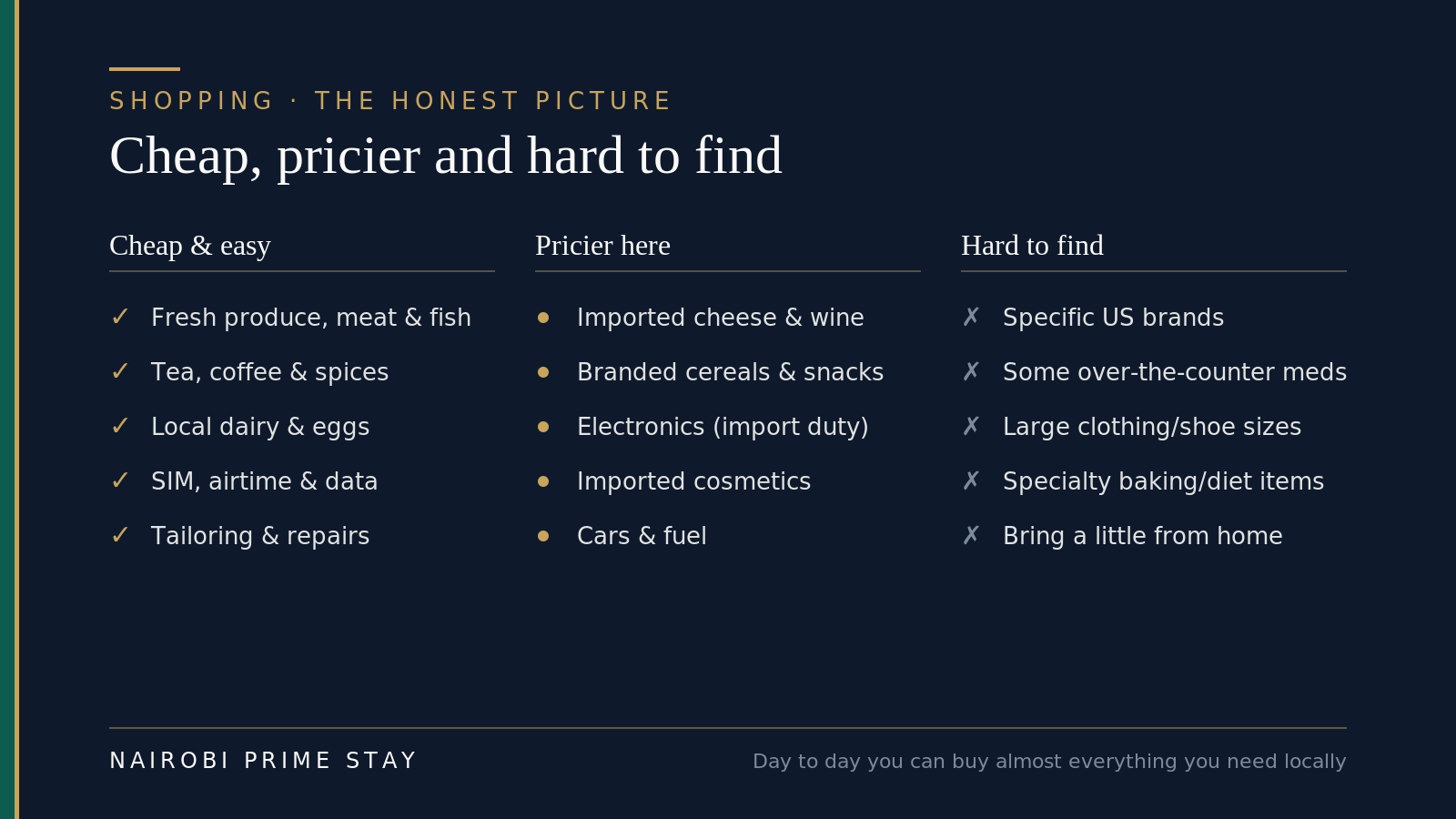 Day to day you can buy almost everything you need locally — the gaps are specific, not general.
Cheap and excellent: fresh fruit and vegetables, meat and fish, local dairy and eggs, famous Kenyan tea and coffee, cut flowers, and services like tailoring, alterations and repairs. A tailor can copy a favorite dress or take in trousers for a few dollars.
Pricier than home: anything imported. Expect imported cheese, wine, branded cereals, snacks and cosmetics to run noticeably more than US prices — often one and a half to three times — because of shipping and duty. Electronics, cars and fuel are also relatively expensive.
Genuinely hard to find: a handful of specific American brands, certain over-the-counter medications you’re loyal to, larger Western clothing and shoe sizes, and niche specialty items (particular baking ingredients, specific diet or allergy products). Carrefour and Chandarana close most of these gaps, but not all. Most expats keep a short “bring from home” list and otherwise switch happily to good local equivalents.
How you pay, and staying safe while you shop
M-Pesa runs daily life. The Safaricom mobile-money service is accepted almost everywhere — supermarkets, malls, a produce stall, a boda rider, your tailor. Set up an M-Pesa line in your first days and most transactions become a quick phone tap. Malls and supermarkets also take Visa and Mastercard without fuss. Open-air markets, kiosks and matatus want M-Pesa or cash, so keep some shillings on you.
On safety, the big malls are among the most secure public places in the city. Expect airport-style screening at the entrance — a vehicle check at the gate, a metal detector or wand, and a quick bag check. It’s routine and reassuring, not a sign of trouble. At open-air markets, use ordinary city sense: keep your phone and bag close and zipped, don’t flash large amounts of cash, and at crowded markets like Gikomba, go with someone who knows it and leave the valuables at home. After dark, take an Uber or Bolt rather than walking with shopping bags. For the fuller picture, see our honest guide to whether Nairobi is safe.
Where to go, at a glance
When you just need the quick answer for a specific errand:
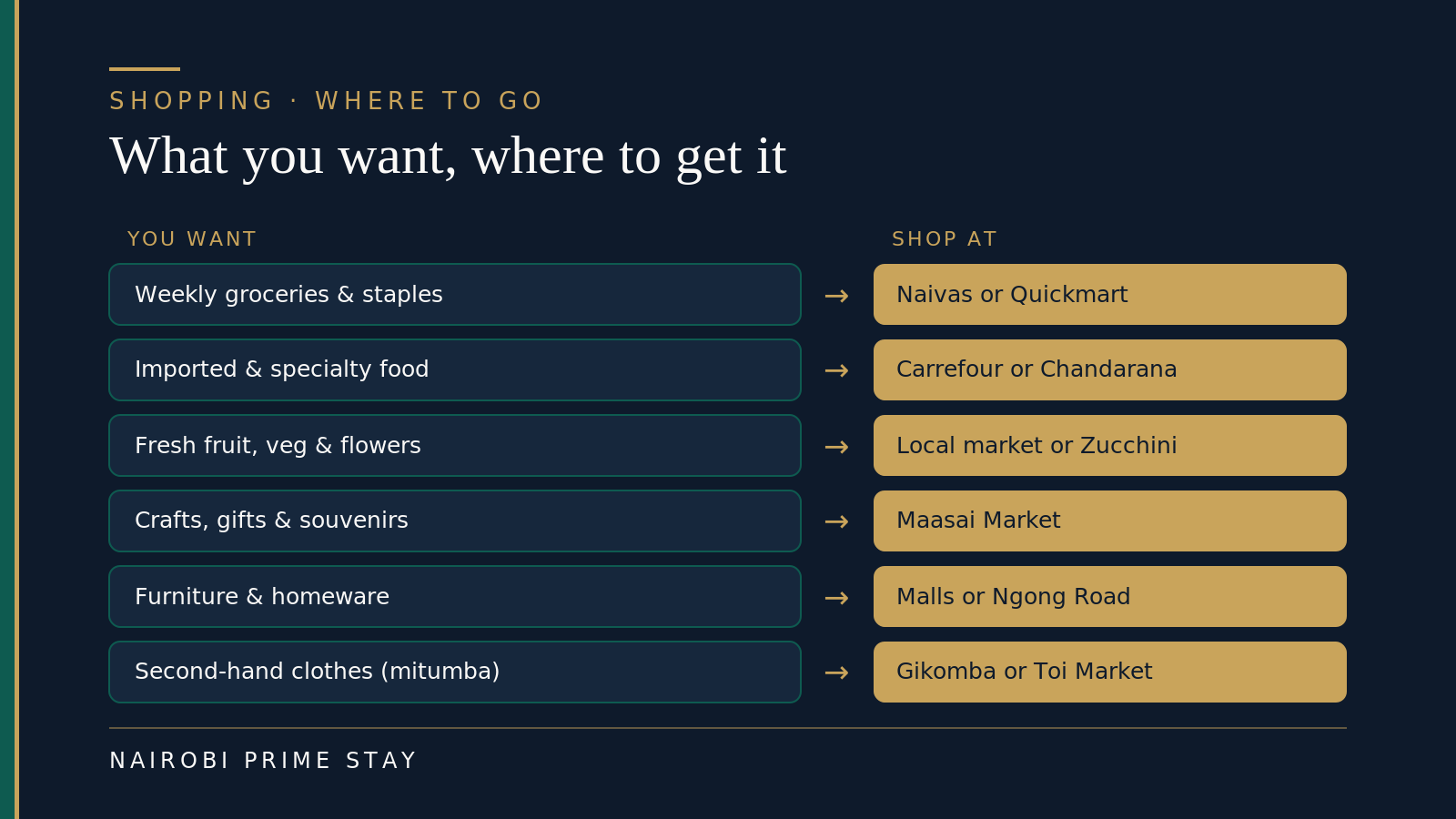 What you want, where to get it.
| You want | Go to |
|---|---|
| The weekly grocery shop | Naivas or Quickmart |
| Imported and specialty food | Carrefour or Chandarana Foodplus |
| Fresh fruit, veg and flowers | A local market or Zucchini |
| Crafts, gifts and souvenirs | The Maasai Market (or Two Rivers, daily) |
| Furniture and homeware | The malls or Ngong Road makers |
| Second-hand clothes (mitumba) | Gikomba or Toi Market |
| Electronics and phones | Any mall — but compare with home prices |
| A relaxed family day out | The Hub (Karen) or Village Market (Gigiri) |
A realistic first-week shopping plan
Say you’ve just landed and you’re settling into a serviced apartment while you find your feet. Here’s how the first week of shopping tends to go for a relocating family.
Day one: sort an M-Pesa line and grab essentials at the nearest Naivas or Quickmart — water, basics, snacks, toiletries. Day two or three: do a proper stock-up at a Carrefour in a big mall, picking up imported comforts and homeware in the same trip. That weekend: hit a Saturday farmers’ market for fresh produce and a coffee, then swing by the Maasai Market for a few pieces to make the apartment feel like home. By the end of week one you’ll know your nearest supermarket, have a fruit-and-veg source, and have learned that the imported peanut butter costs double — so maybe the local brand is fine after all.
A short checklist for your first shopping run:
- Set up M-Pesa — it’s how you’ll pay for nearly everything.
- Keep small shilling notes for markets, kiosks and parking.
- Find your nearest supermarket and one big-mall Carrefour for top-ups.
- Price-check imports before you commit to a brand — local swaps often win.
- Carry a tote or two — bags are charged, and you’ll forget once.
- Note the Maasai Market day nearest you, and confirm it before going.
- Save deliveries — Glovo, Uber Eats and supermarket apps deliver to most suburbs.
Frequently asked questions
Where do expats do their grocery shopping in Nairobi?
Most settle into a routine across two or three stores. Naivas and Quickmart are the everyday Kenyan chains - good value, branches almost everywhere, fine for the bulk of a weekly shop. Carrefour, the French-style hypermarket that anchors the big malls, has the widest range and the most imported brands under one roof. Chandarana Foodplus is the upmarket choice for harder-to-find international and specialty goods. Many newcomers do staples at Naivas or Quickmart and top up imports at Carrefour or Chandarana.
Is Carrefour or Naivas cheaper in Nairobi?
For local staples, Naivas (and Quickmart) usually edge it on price and run frequent promotions. Carrefour competes hard on its own bulk and house-brand lines and can be cheaper on imported goods because it brings them in directly, but its premium international products carry the usual markup. The honest answer is that no single store wins on everything - regulars price-check a few items and split their shop. Compare the shelf price per unit rather than the sticker, and remember the live exchange rate is about 129 shillings per US dollar (KES 129.4 on 1 July 2026).
Can I find American and imported brands in Nairobi?
Yes, far more than most people expect, but not everything and not cheaply. Carrefour and Chandarana Foodplus carry the deepest imported ranges - cereals, sauces, snacks, cheeses, wine and toiletries from Europe, the US, India and the Middle East. Expect imported items to cost noticeably more than at home, often one and a half to three times the US price, because of shipping and duty. A handful of specific American brands simply will not be there, so most expats swap to a good local equivalent for everyday things and save the imports for treats.
What is the Maasai Market and which day is it on?
The Maasai Market is a roving open-air craft market where artisans sell carvings, beadwork, jewelry, paintings, fabrics and souvenirs. It is not in one fixed place - it rotates around the city by day of the week, commonly Capital Centre on Monday, the CBD on Tuesday and Saturday, Junction Mall on Thursday, Village Market in Gigiri on Friday, and Yaya Centre on Sunday. The schedule shifts and weather can move it, so confirm the current day and location before you go. Two Rivers Mall also hosts a permanent indoor Maasai Market that is open daily.
Are shopping malls in Nairobi safe?
Generally yes - the major malls are among the most secure public places in the city. Expect airport-style security at the entrance: a vehicle check at the gate, a metal detector or wand, and a bag check on the way in. This screening is routine and reassuring rather than a sign of danger. Use normal city sense - keep your phone and bag close, park in lit areas, and use Uber or Bolt after dark - and a mall trip is low-stress.
How do I pay in shops and markets in Nairobi - cash, card or M-Pesa?
M-Pesa mobile money is the default for daily life and is accepted almost everywhere, from supermarkets to a market stall. Malls and supermarkets also take Visa and Mastercard without trouble. Open-air markets, small kiosks and matatus run on M-Pesa or cash, so keep some shillings on you. Set up an M-Pesa line in your first days - it makes paying for everything, including market bargains, much simpler.
Should I bargain when shopping in Nairobi?
It depends where you are. Prices are fixed in malls, supermarkets and most formal shops - no haggling there. In open-air craft and produce markets, bargaining is expected and part of the fun; start friendly, expect a high opening price (the so-called visitor price), and settle somewhere in the middle. Greet the seller first and keep it good-humored rather than aggressive. Knowing a few words of Swahili and a sense of the fair price helps you land a better deal.
What is hard to find or expensive in Nairobi?
Fresh local produce, meat, dairy, tea and coffee are excellent, plentiful and cheap. What costs more or takes hunting are specific imported brands, certain over-the-counter medicines, larger Western clothing and shoe sizes, specialty diet or baking ingredients, and well-priced electronics (import duty pushes prices up). Carrefour and Chandarana cover most import gaps. For anything truly specific, many expats bring a small supply from a trip home or order it in, but day to day you can buy almost everything you need locally.
Can I get groceries delivered in Nairobi?
Yes, and it is easy. Glovo and Uber Eats both deliver from the big supermarkets - Naivas, Carrefour, Chandarana Foodplus and Quickmart - and in June 2026 Bolt Food added Quickmart grocery delivery with more than 12,000 products. You browse in the app, pay by M-Pesa or card, and an order usually lands in about 30 to 60 minutes for a delivery fee of roughly KES 150 to 400 plus a tip. Coverage is best across the western and northern suburbs where most expats live. It is a genuinely useful backup for a rainy afternoon or a first week with no car.
Can I shop online in Nairobi, or order from Amazon?
Shop online locally - it is faster and cheaper than importing. Jumia is Kenya’s largest online marketplace (think Africa’s Amazon) with phones, electronics, appliances, home goods and a pay-on-delivery option; Kilimall is another big player, strong on electronics. Amazon does not ship most items directly to Kenya, so bringing something in from the US means a package-forwarding service plus import duty and VAT on arrival and a two-to-six-week wait. For the vast majority of things, buy on Jumia or in a local store and save importing for the truly unfindable.
How much does a week of groceries cost in Nairobi?
Local staples are cheap, and imported brands are where the bill climbs. As a rough 2026 guide, a litre of milk runs about KES 70, a loaf of bread around KES 65, a dozen eggs about KES 230 and a kilo of tomatoes around KES 120 - so a family’s fresh-food shop is very affordable. Swap to imported versions and prices jump: local coffee near KES 600 versus imported around KES 1,500, a local cereal near KES 450 versus an imported box around KES 1,200. At about KES 129.4 to the dollar, most expats eat well for less than at home by leaning on local produce and reserving imports for treats.
Final thoughts
Shopping is one of the easy wins of life in Nairobi. The malls are modern and secure, the supermarkets are well-stocked and competitive, fresh food is cheap and genuinely good, and the markets are a pleasure once you find your rhythm. You’ll trade a few specific brands for local ones, pay a premium on imports, and gain a tailor who can make you a shirt for the price of a sandwich back home. It’s a fair swap, and most people stop missing the old aisles within a month.
Related reading
- Moving to Nairobi: the complete guide — the big-picture hub for your whole relocation.
- Cost of living in Nairobi and the Nairobi vs US cost comparison — where groceries and shopping fit your monthly budget.
- Furnishing a home in Nairobi — buying, renting and where to find furniture and homeware.
- Eating out in Nairobi — the dining scene that pairs with all this good food.
- Kenyan culture and etiquette — how to bargain warmly and greet first.
- Neighborhood guides for Westlands, Karen and Gigiri — the suburbs and the malls that serve them.
Settling in
Want a soft landing while you learn the city? A furnished serviced apartment for your first weeks comes ready to live in — so your only shopping worry is which market to explore first. Not sure which neighborhood puts you near the right malls and your commute? Our AI relocation assistant can shortlist apartments to fit your budget and daily life in a couple of minutes, any time of day.
Ready to look?
Find your apartment in Nairobi
Browse verified serviced apartments, or ask the AI concierge which area fits your life.