
Guides · Cost of living
Cost of Living: Nairobi vs the US (2026 Comparison)
Cost of Living: Nairobi vs the US (2026 Comparison)
Nairobi is far cheaper than almost any major US city for the things that eat most of an American budget: rent, childcare, household help, healthcare and eating out. The comfortable life that costs a coastal-city professional $6,000 or $7,000 a month often runs $2,500 to $3,500 in a leafy, secure Nairobi suburb. That is the headline, and it holds up.
The catch is narrow but real. Imported goods, cars and good international schools cost about the same as the US or more. For a family paying its own school fees, that one line can swallow most of the savings. So the honest answer to “is Nairobi cheaper than the US?” is: yes, usually a lot, unless your basket is heavy on imported things and private schooling.
This guide puts the two side by side, category by category, in 2026 dollars. It is written for Americans deciding whether the math of a move actually works: remote workers, families, retirees, and people taking a job here. We use real ranges, name the official sources to check against, and flag where the comparison flatters Nairobi and where it doesn’t. For the Nairobi side on its own, in more detail, see our full cost of living in Nairobi breakdown; this page is the comparison.
TL;DR: At about KES 130 to the dollar (2026), Nairobi beats the US median, and crushes New York or San Francisco, on rent, domestic help, healthcare and dining. A single remote worker lives very well on $2,000–2,800 a month; a couple on $2,500–3,500; a family on $3,500–6,000 before school fees. Where Nairobi is not cheaper: imported electronics and groceries, cars (heavy import duty), wine, and international school fees of roughly $10,000–28,000 per child per year. If your employer covers housing and schooling, the gap in your favour is huge. If you pay school fees yourself, run those numbers first. Figures are 2026 ranges; confirm live rates with the Central Bank of Kenya and current listings.
Why this comparison is worth doing carefully
“Nairobi is cheap” is true and lazy. What actually matters is your basket. A single remote worker who rents a furnished apartment, takes Ubers and eats out a few times a week will see jaw-dropping savings versus a US city. A family of four who wants a large house, two cars, imported groceries and two seats at a top international school will save far less, and could even spend more than they did in a mid-cost US suburb.
So read the categories below against your own life, not the average. We have ordered them roughly from “where Nairobi wins biggest” to “where the US can be cheaper”, because that order is the whole story.
First, the exchange rate, because it sets everything
One US dollar buys about KES 129–130 as of early July 2026 (129.4 on 2 July). The Central Bank of Kenya doesn’t fix the rate; it floats on supply and demand, so check the USD/KES currency guide and a live source like the Central Bank or Wise before you move real money. For budgeting, use KES 130 to the dollar and add a small buffer, so a KES 200,000 rent pencils in at roughly $1,540, not a hopeful $1,500.
One honest caveat up front: you carry currency risk. The shilling fell hard in 2024 (it briefly touched about 163 to the dollar), then recovered and has held near 129–130 for roughly two years. That recovery is good news for someone earning dollars, but a reminder that a rate is a snapshot, not a promise. If you earn in USD and spend in KES, a weaker shilling makes you richer here and a stronger one makes you poorer; budget with a margin so a swing doesn’t break your month.
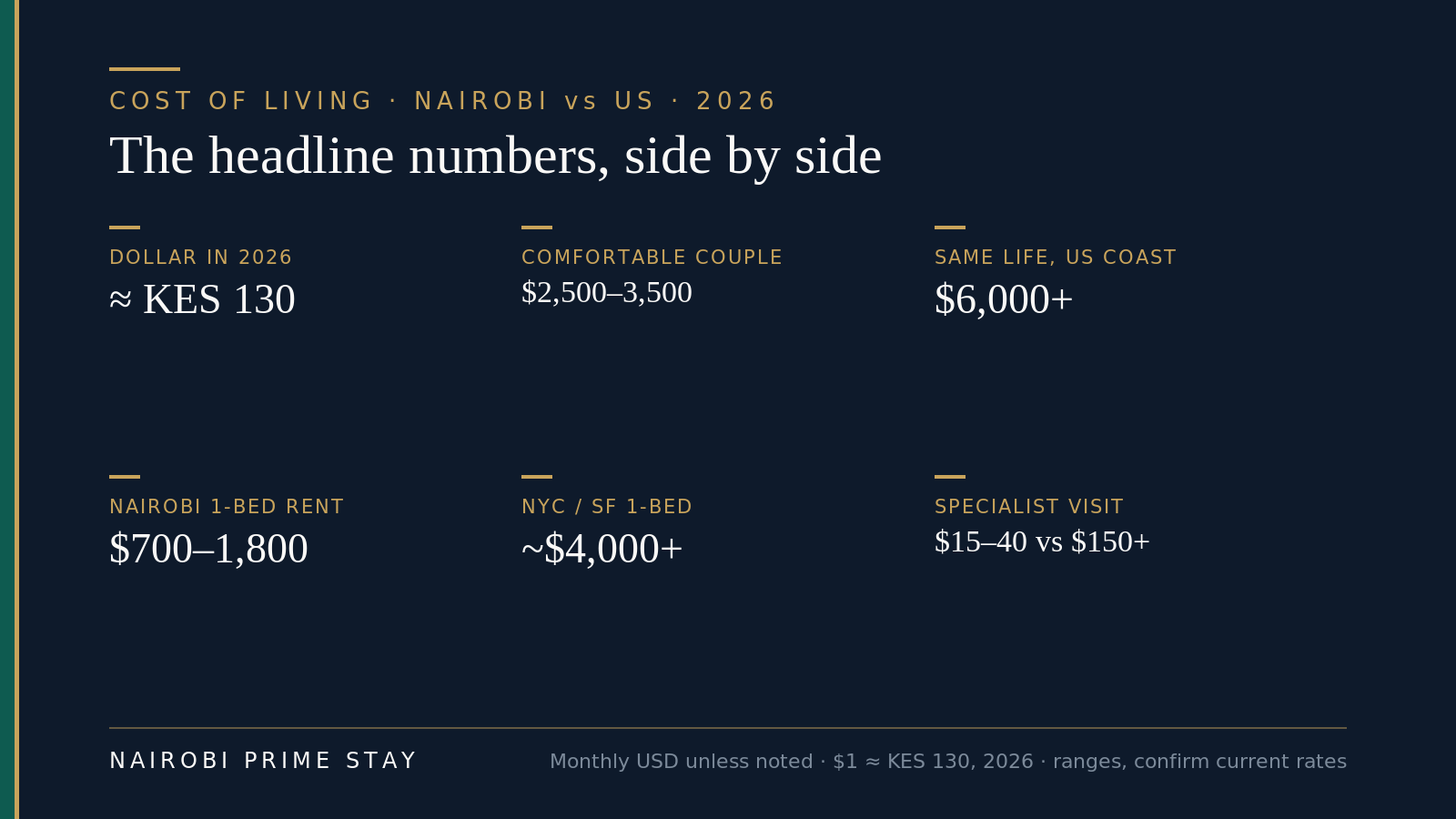 The headline numbers, side by side. Nairobi wins biggest on rent, help and healthcare.
Nairobi vs the US, category by category
Here is the side-by-side, in 2026 US dollars per month unless noted. Nairobi figures are for a comfortable professional in a prime western suburb; US figures use the national median plus a high-cost benchmark (New York or San Francisco). Treat every cell as a range to confirm against current listings, not a quote.
| Monthly category | Nairobi (prime suburb) | US national median | New York / San Francisco |
|---|---|---|---|
| Furnished 1–2 bed rent | $700–1,800 | ~$1,530 (1-bed, Jun 2026) | ~$4,000–4,600 (1-bed) |
| Groceries (one person) | $250–450 | $350–600+ | $500–800+ |
| Dining out (meal for two, mid-range) | $25–60 | $60–100 | $90–150+ |
| Full-time childcare / nanny | $170–400 | $2,700–3,500 | $3,500–4,500 |
| Part-time house help | $100–250 | rarely affordable | rarely affordable |
| Specialist doctor visit (cash) | $15–40 | $150–400 | $200–500 |
| City transport (ride-hailing) | $80–200 | $150–400 (+ car) | $120–300 (transit/rideshare) |
| Fast home fibre internet | $30–60 | $50–90 | $60–100 |
| Good coffee out | $2–4 | $4–6 | $5–7 |
Sources: Nairobi ranges from our 2026 Relocation Handbook and current listings; US rent from Zumper’s June 2026 national report (national 1-bed median $1,526; New York $4,563; San Francisco $3,995); US childcare from 2026 nanny and daycare cost surveys (national full-time nanny roughly $2,700–3,500 a month). Confirm any figure you plan to act on.
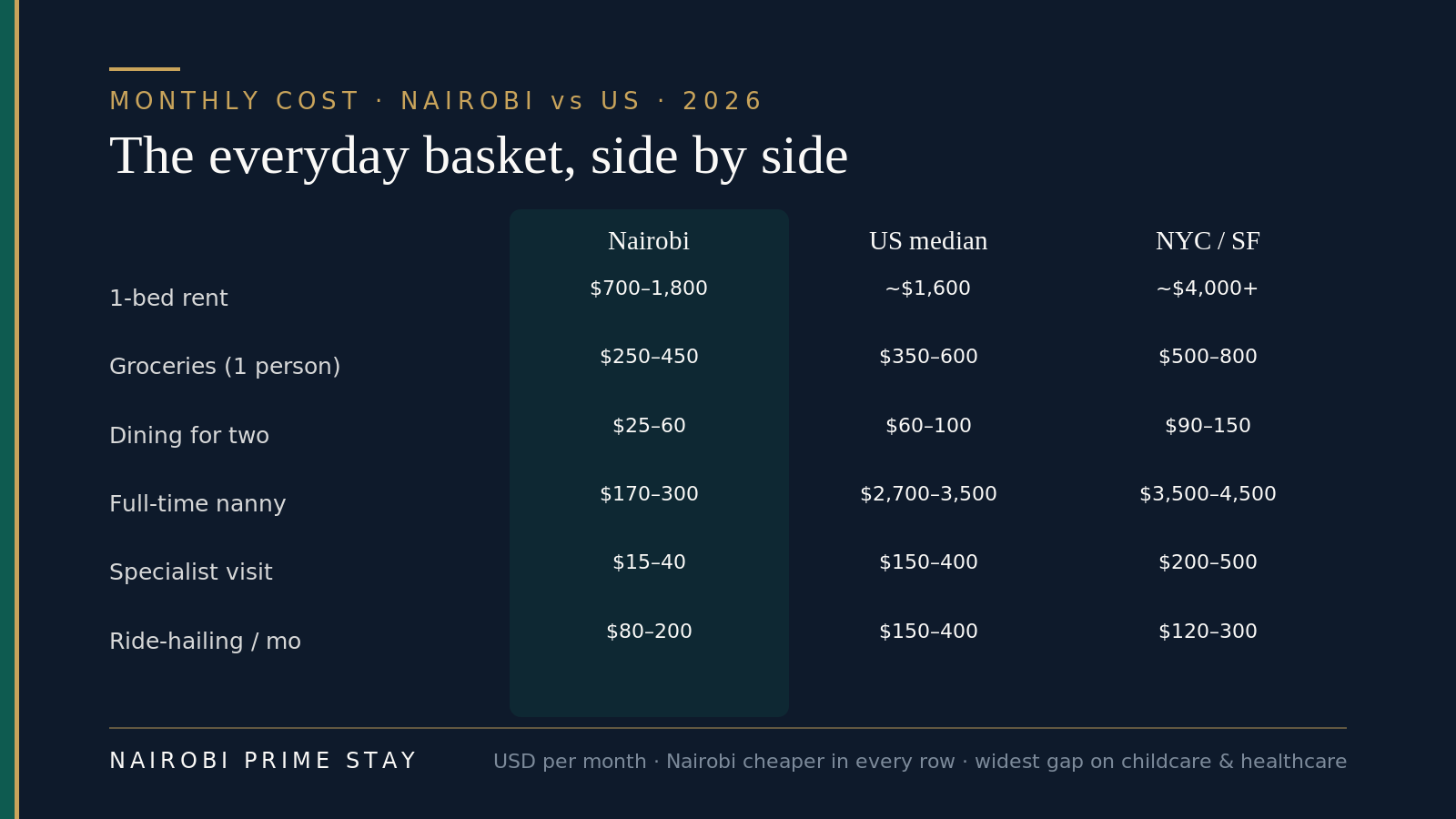 Across the everyday basket, Nairobi is cheaper in every row. The gap is widest on childcare, help and healthcare.
Rent and housing: Nairobi’s biggest win
Rent is where most Americans feel the difference first, and it is large. A furnished one or two-bed in a secure, leafy Nairobi suburb runs roughly $700–1,800 a month, depending on the area: Kilimani and Westlands at the lower end, Lavington and Kileleshwa in the middle, Karen and the diplomatic belt of Gigiri, Runda and Muthaiga at the top. A serviced apartment with utilities, Wi-Fi, cleaning, security and a backup generator all included sits around $1,000–1,800 for a one or two-bed.
Now the US side. The national median one-bedroom was about $1,526 a month in June 2026 (Zumper), but national medians hide the cities Americans actually leave. A median one-bed in New York was about $4,563 and San Francisco about $3,995 in June 2026, with San Francisco rents setting records into the summer. So a professional paying $4,000 for a small New York one-bed can rent a large, furnished, staffed home in Lavington or Karen and pocket the difference. Even against a mid-cost US city at $1,300–1,800, Nairobi is competitive, and you usually get more space, a garden and security for the money. See the best neighborhoods in Nairobi for who fits where, and what each area costs.
The honest asterisk: the cheapest Nairobi rents come unfurnished on a 12-month lease with a deposit of one to three months plus the first month up front, and you furnish it yourself. The all-inclusive, move-in-today comfort that matches a US furnished rental is the serviced-apartment band, which is why it is the fair like-for-like number for a newcomer.
Groceries and eating out
Local groceries are cheaper; imported groceries are not. A single professional shopping at Naivas or Carrefour for local produce, eggs, bread, chicken and staples spends around $250–450 a month, comfortably under a typical US bill. Fresh fruit, vegetables, meat and coffee are excellent and inexpensive. The moment you fill the trolley with imported cereals, branded snacks, cheese and wine, the bill climbs toward US levels or past them, because those items carry shipping and duty. The trick most expats learn fast: eat local, treat imported brands as occasional luxuries. Where to shop for what, from Naivas to the markets, is in our shopping in Nairobi guide.
Eating out is the fun one. A good mid-range dinner for two runs $25–60; a great one at a top Nairobi restaurant might be $80–120, still below a comparable New York night. Street and casual food (a plate of nyama choma, a local lunch) costs a few dollars. Compared with $60–100 for an ordinary US restaurant dinner for two, Nairobi lets you eat out far more often for the same money, which is exactly why many residents do. For where to actually eat, see restaurants and dining in Nairobi.
Childcare and domestic help: the quiet game-changer
This is where the comparison stops being “cheaper” and becomes “a different universe”. A full-time US nanny averages roughly $2,700–3,500 a month in 2026, more in DC or California, and licensed daycare is in the same range. In Nairobi, an experienced full-time nanny is about KES 22,000–35,000, or $170–270 a month, and part-time house help runs $100–250. Many expat families employ a nanny, a house help and a gardener for less than the cost of a single US daycare place.
Two things matter here. First, this changes daily life: hours you spent on chores and childcare in the US come back to you. Second, do it fairly. Domestic work is real, legally protected employment in Kenya, with a Nairobi minimum wage, statutory contributions and paid leave. Our hiring domestic help in Nairobi guide covers fair pay, contracts and the legal duties in full. Paying well above the minimum is both right and how you keep good people for years.
Healthcare: pay cash, spend a fraction
Nairobi has some of the best private hospitals in Africa, with English-speaking specialists, and cash prices are a fraction of the US. A private specialist consultation is about $15–40; even procedures that cost thousands in the US are far less here. Aga Khan, The Nairobi Hospital, MP Shah, Karen Hospital and Gertrude’s (for children) are the names expats trust. Our healthcare in Nairobi guide goes deep on which hospital for what.
The comparison is stark. In the US, a specialist visit without insurance commonly runs $150–400+, and family health premiums reach into the tens of thousands a year. In Nairobi, you pay modest cash prices and carry a private international insurance plan, often a few thousand dollars a year for solid cover. The non-negotiable: make sure your policy includes medical evacuation, the one line you should never trim. Net, healthcare is firmly in Nairobi’s column, but only if you insure properly for the serious, rare event.
Transport and cars: cheap to ride, pricey to own
Getting around by app is cheap. Uber and Bolt are the expat default, safe and a few dollars a hop, so many people skip car ownership entirely and budget $80–200 a month on rides. Against a US life that usually requires a car, with payment, insurance, gas and parking easily $500–800 a month per vehicle, ride-hailing in Nairobi is a clear saving. A matatu (shared minibus) hop is under a dollar if you learn the routes.
Buying a car is the flip. Kenya layers heavy import duty, VAT and levies on vehicles, so a used car often costs more than the equivalent in the US, and fuel is relatively expensive too. Families who want a car for school runs and weekend trips do buy one, but it is a category where the US is cheaper. If your life can run on Uber and Bolt, your transport bill stays tiny; if you need to own, price it like a US purchase, not a bargain. The duty math, the eight-year age rule and what a landed car really costs are in our importing a car into Kenya guide.
Schools: the line that changes everything for families
For families, international school fees are the single biggest variable, and the one that can erase the savings. Indicative 2026 fees: the International School of Kenya (American and IB) runs roughly $20,000–28,000 a year, Rosslyn Academy around $10,000, and British-curriculum schools like Braeburn around $16,000–20,000, with one-off capital levies on top at some schools. Two children at a top school is a $40,000–56,000 line before anything else. Current fee tables and how to choose a curriculum are in our international schools in Nairobi guide.
Here is the fair way to compare. If your children would attend free US public school, then Nairobi schooling is a brand-new cost you didn’t have, and it can outweigh the rent and help savings. If they would attend US private school (often $25,000–40,000 a year per child in major metros), Nairobi’s international schools cost about the same or less, and the rest of your budget is far cheaper, so you come out well ahead. And if your employer or posting covers school fees, as many UN, embassy, NGO and corporate packages do, the comparison swings decisively in Nairobi’s favour. Sort out which of these three you are before you judge the whole move on cost.
Utilities and internet
Day-to-day utilities are modest. Fast home fibre (Safaricom, Zuku, Faiba) runs roughly $30–60 a month, a touch cheaper than typical US broadband and plenty for video calls. Electricity, water, gas and refuse for an apartment add up to a manageable monthly figure, with the local wrinkle that power and water can be intermittent, so you want a building with a backup generator and water storage. In a serviced apartment these are bundled and invisible to you. The remote-work essentials, fibre plus backup power, are covered in our internet and remote work guide.
Where Nairobi is much cheaper, and where it isn’t
Put the categories in two columns and the pattern is clear. Nairobi wins on everything tied to local labour and services, and loses on anything imported or import-taxed.
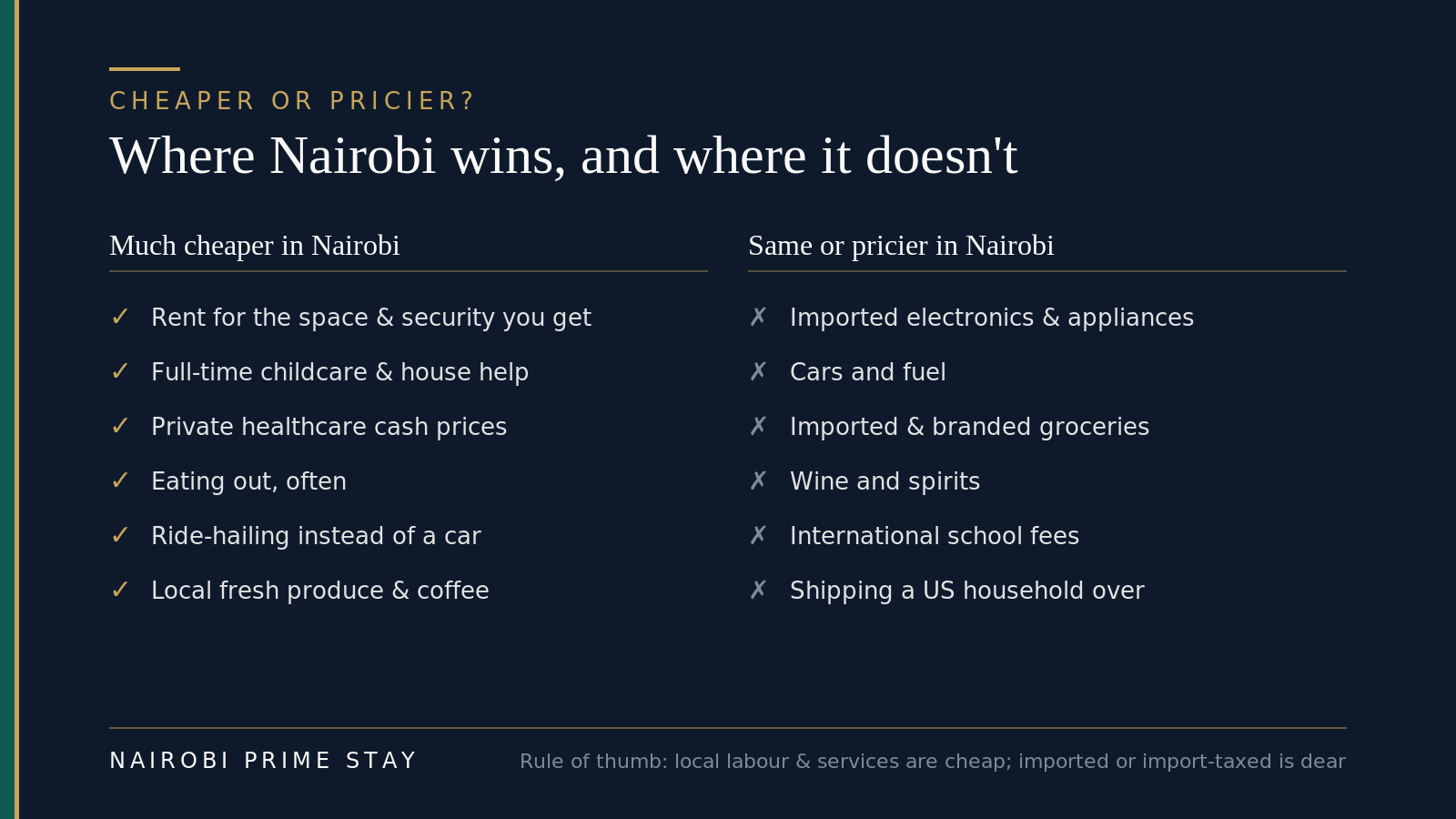 The rule of thumb: local labour and services are far cheaper; anything imported or import-taxed is the same or more.
Much cheaper in Nairobi: rent for the space and security you get, full-time childcare and household help, private healthcare cash prices, dining out, ride-hailing, local fresh produce and coffee, and home fibre. These are the categories that make a US income feel generous here.
The same or pricier in Nairobi: imported electronics and appliances, cars and fuel, imported or branded groceries, wine and spirits, and international school fees. Shipping a full US household over is its own cost; many people find it cheaper to bring less and buy locally. If a big share of your spending sits in this second column, your savings shrink, so be honest about your tastes.
What a US salary actually buys in Nairobi
Numbers land better as lives. Here are three realistic 2026 scenarios. They assume you earn in dollars and spend in shillings, and they exclude US taxes, which still apply because the US taxes citizens on worldwide income (see taxes for American expats in Kenya; not tax advice).
The remote worker on $70,000. In a coastal US city, $70,000 after tax barely covers a small one-bed and the basics, with little left over. In Nairobi, the same income funds a furnished two-bed in Kileleshwa or Lavington (~$900–1,500), Ubers everywhere, eating out several times a week, part-time house help, fast fibre, weekend trips to the Mara or the coast, and real monthly savings. This is the profile that benefits most: high US-style income, low Nairobi-style basket.
The family of four on $120,000, one earner. In a mid-cost US suburb, $120,000 stretches thin: a modest house, two cars, and daycare alone eating $2,500–3,500 a month. In Nairobi, the same family rents a large gated home with a garden in Karen or Runda, employs a full-time nanny, a house help and a gardener for a fraction of one US daycare bill, and lives very comfortably, until you add international school fees. Two children at a top school can be $40,000+ a year out of pocket. If the employer covers schooling, this family is far better off than in the US. If not, the school line is the whole decision, so price it first.
The retiree on a fixed income. Dollars stretch, healthcare cash prices are affordable, and a calm, staffed life in a secure suburb is very achievable on a pension that would feel tight in the US. The two lines to plan for are robust international health insurance with evacuation cover, and the visa path for a longer stay. Build those in and a fixed income goes a long way; our retiring in Kenya guide covers the visa options and the healthcare plan in full.
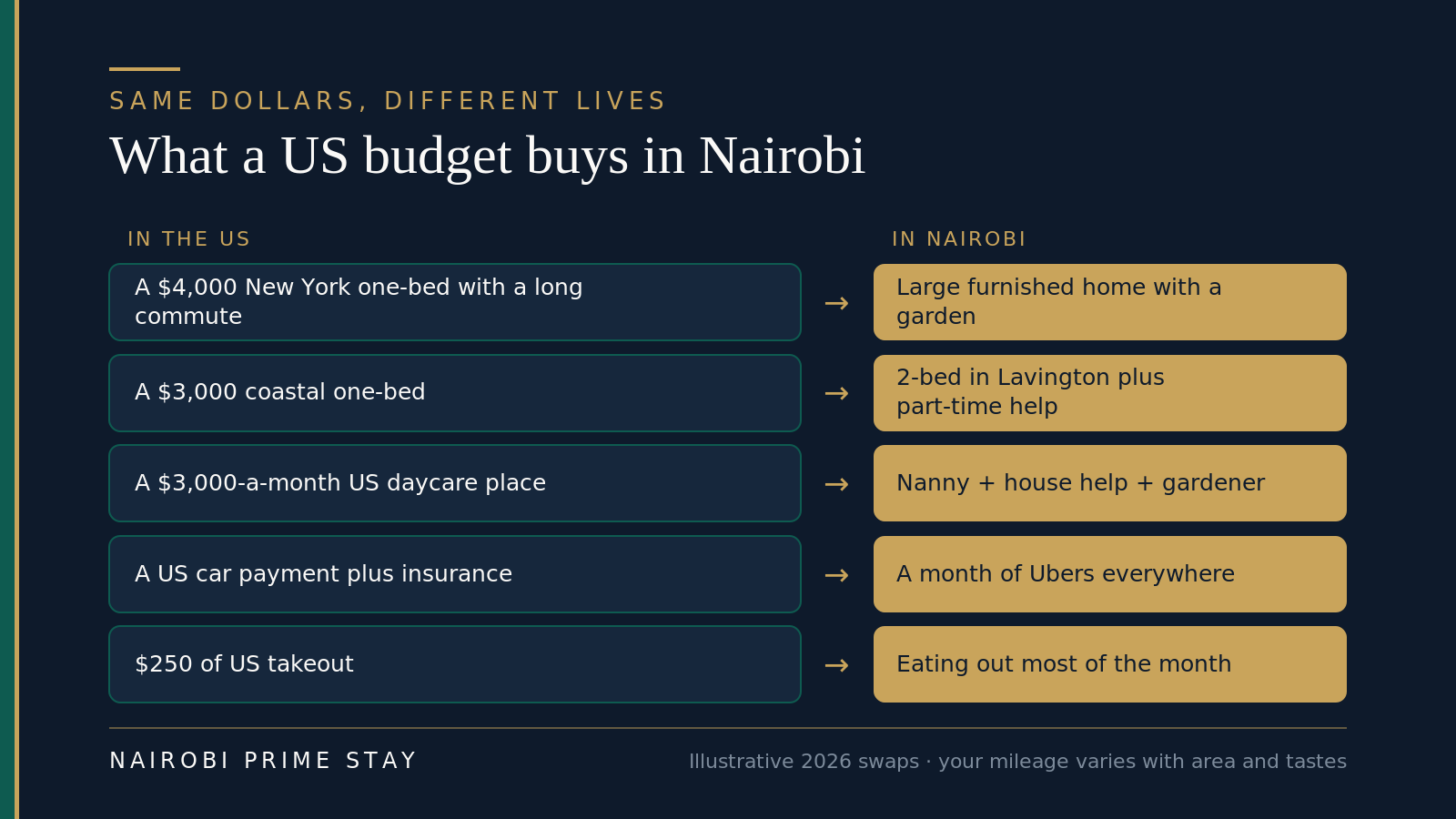 Same dollars, very different lives. The swap is most dramatic on housing, childcare and dining.
What does a real month actually cost? Three sample budgets
Ranges are useful; a worked month is better. Here are three illustrative Nairobi budgets at KES 130 to the dollar, as of July 2026, using mid-points of the ranges in this guide. Your numbers will differ, but the shape won’t.
| Monthly line | Single remote worker (Kilimani) | Couple (Lavington) | Family of four (Karen)* |
|---|---|---|---|
| Housing (furnished/serviced) | $1,100 | $1,500 | $2,200 |
| Groceries & household | $350 | $550 | $800 |
| Dining out & leisure | $300 | $450 | $500 |
| Domestic help / childcare | $120 (part-time) | $200 | $500 (nanny + help + gardener) |
| Health insurance (monthly share) | $150 | $280 | $450 |
| Transport | $150 | $250 | $450 |
| Internet, phone, utility top-ups | $80 | $110 | $150 |
| Total | ~$2,250 | ~$3,340 | ~$5,050 |
*Before international school fees. Two children at a mid-to-top international school add roughly $1,700–4,700 a month ($20,000–56,000 a year), which is why schooling is the swing line for families.
Set the same three lives in a coastal US city, where the housing line alone can be $4,000+ and full-time childcare $2,700–3,500, and the single roughly halves their spending, the couple does better still, and the family’s outcome depends almost entirely on who pays the school fees.
City by city: Nairobi vs New York, San Francisco and a mid-size US city
Versus New York or San Francisco, it is not close. A median one-bed in either city now rents for roughly $4,000–4,600 (June 2026). That one line alone is more than a comfortable all-in Nairobi month for a couple. Add US childcare, healthcare and dining on top and the comparison becomes almost unfair. If you are leaving a high-cost coastal city, expect your money to roughly double or triple in lifestyle terms, more if you had childcare costs.
Versus a mid-cost US city (think Austin, Denver, Atlanta, Raleigh), the gap is smaller but still real. Rent is roughly comparable to a touch cheaper for more space and security; groceries, dining, healthcare, help and transport are clearly cheaper; cars and imported goods are pricier. A family that used free public school in the US has to weigh new international school fees. Net, most singles and couples save meaningfully; families save unless out-of-pocket schooling tips the scale.
Versus a low-cost US town, Nairobi’s edge narrows further, and a family paying full international fees could spend more overall. The savings story is strongest for people coming from expensive cities and for anyone whose housing or childcare costs were high.
Taxes, tipping and the hidden differences that surprise Americans
A few structural differences never show up in a price table but change what you actually spend.
Prices include tax. Kenya’s 16% VAT is baked into the shelf and menu price. The number you see is the number you pay, with no at-register sales tax and no separate tax line on a restaurant bill.
Tipping is modest. Around 5–10% at restaurants is appreciated and generous; nobody expects the American 20–25%. Between included tax and lighter tipping, a $40-menu dinner in Nairobi really costs about $42–44, where the same menu prices in much of the US become $50–55. Your dining line quietly shrinks before the food itself is even cheaper.
Everyday money runs on M-Pesa. Kenya’s mobile-money system handles everything from rent to a bag of mangoes, person-to-person fees are small (often zero for small amounts), and card surcharges are rare. Setup and how it works alongside a US account are in our banking in Nairobi guide.
Moving money from the US is cheap if you fund it right. Since 1 January 2026 the US applies a 1% excise tax to remittances funded with cash, money orders or cashier’s checks, but transfers funded from a US bank account or card are exempt, which is how most expats send money anyway. Routes and real costs are in sending money to Kenya.
Two tax systems can apply. Stay long enough and you may become Kenyan tax-resident while the US continues to tax your worldwide income. The Foreign Earned Income Exclusion and Foreign Tax Credit usually prevent true double taxation, but filing in two systems is real admin, so get cross-border advice early (not tax advice).
The honest caveats
A fair comparison names what doesn’t show up in a table.
- Lifestyle inflation is real. Help and dining are so affordable that you do more of both. That is part of the appeal, but it means your actual spend often rises to a comfortable level rather than collapsing to the theoretical minimum.
- School fees can erase the savings for families paying out of pocket. This is the single biggest swing factor. Decide your schooling plan before you judge the move on cost.
- Imported tastes cost more. If you need US brands, specific foods, wine and the latest electronics, budget up. Living mostly local is what makes Nairobi cheap.
- You carry currency risk. Earning dollars and spending shillings is usually an advantage, but the shilling has moved before. Keep a buffer.
- Some conveniences change. No next-day everything, more planning around traffic, occasional power and water interruptions (mitigated by the right building). You gain space, weather, help and time; you trade some friction.
- US taxes still apply. Citizenship-based taxation, FEIE, the Foreign Tax Credit and FBAR all matter. Get cross-border advice early.
How to build your own Nairobi-vs-home budget
Averages won’t tell you what you will spend. Build the comparison from your real life, in five steps.
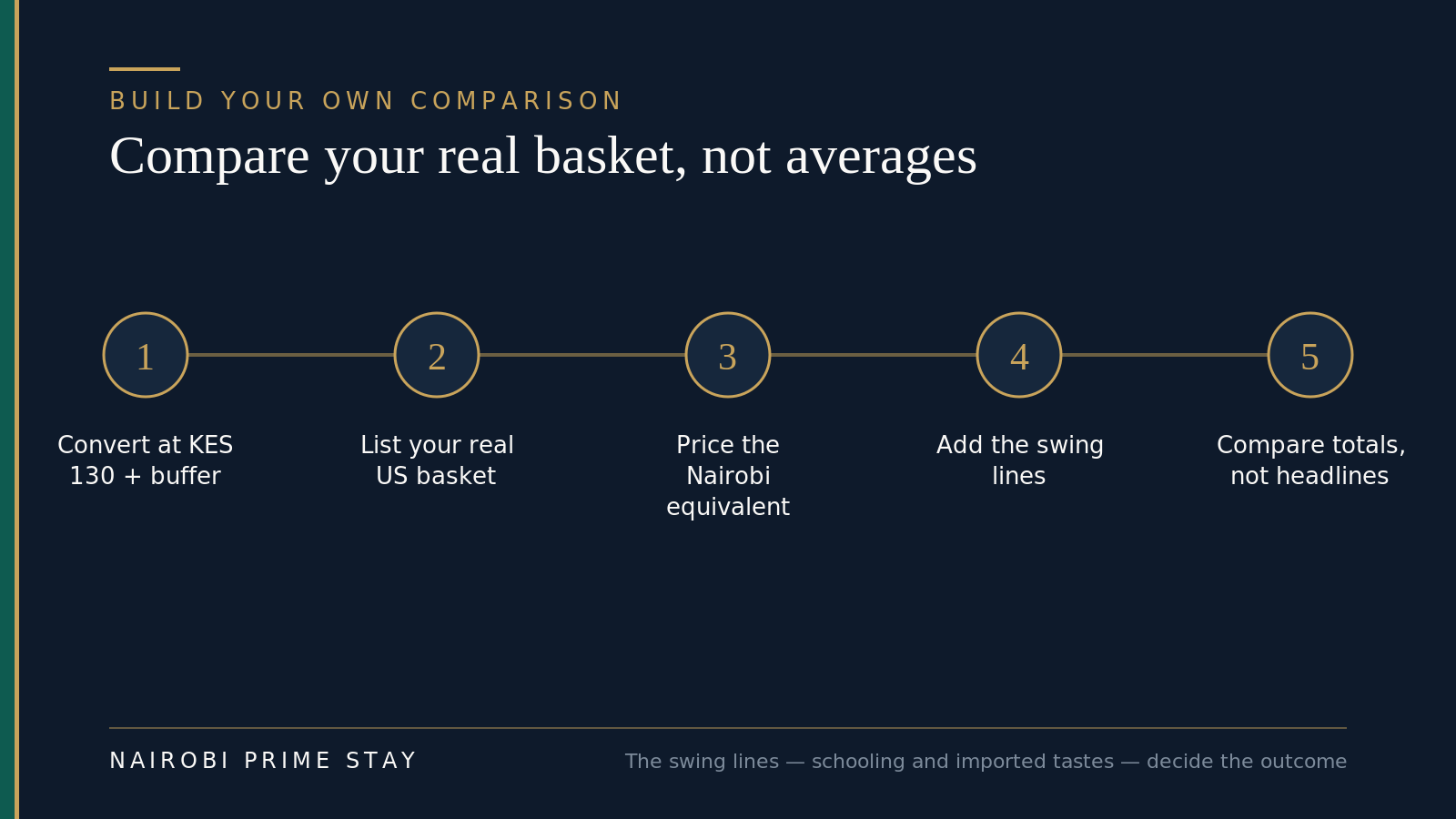 Compare your own basket, not the averages. The swing lines, schooling and imported tastes, decide it.
- Convert at KES 130 to the dollar, plus a buffer. Use a round, slightly conservative rate so a currency wobble doesn’t surprise you.
- Write down your real US monthly basket. Rent, groceries, dining, childcare, healthcare, transport, the lot, what you actually spend, not the average.
- Price the Nairobi equivalent from the categories above and current listings. Use the serviced-apartment band for housing if you want a true like-for-like for a newcomer.
- Add the swing lines. International school fees per child, whether you’ll own a car, and how much of your basket is imported. These decide the outcome.
- Compare the totals, not the headlines. For most singles and couples Nairobi wins big. For families it depends almost entirely on schooling. Now you know which you are.
A cheap, low-commitment way to test the real numbers is to spend your first month in a serviced apartment. You live the actual costs, see homes, test the traffic, and only sign a year-long lease once your real budget is in front of you.
The financial pros and cons of moving to Nairobi
| In Nairobi’s favour | The honest downsides |
|---|---|
| Rent buys far more space and security than a US city | Cars and fuel cost more than the US |
| Full-time childcare and help for a fraction of US cost | Imported goods, electronics and wine are pricier |
| Private healthcare cash prices a fraction of the US | International school fees ($10k–28k/child) can erase savings |
| Eating out is affordable, so you do it more | Currency risk: you earn USD, spend KES |
| Ride-hailing is cheap; you may not need a car | Power and water can be intermittent without the right building |
| A US income often doubles or triples in lifestyle terms | US taxes still apply on worldwide income |
The pattern is consistent: Nairobi rewards people whose costs were dominated by housing, childcare and services, and asks more of people whose spending leans on imports, cars and private schooling. Know which one you are, and the decision gets simple.
Frequently asked questions
Is Nairobi cheaper than the US?
Yes, usually by a wide margin, for the things that dominate most American budgets. Rent, full-time childcare and household help, private healthcare, dining out and ride-hailing are all far cheaper in Nairobi than in a typical US city, and dramatically cheaper than in New York or San Francisco. The exceptions are imported goods, cars and international school fees, which cost about the same or more. So whether you save a lot or a little comes down to your basket: local-services-heavy budgets win big, import-and-private-school-heavy budgets win less.
How much money do I need to live comfortably in Nairobi as an American?
As a 2026 guide, a single remote worker lives very comfortably on about $2,000-2,800 a month, a couple on $2,500-3,500, and a family on roughly $3,500-6,000 before school fees. Those figures cover a furnished home in a secure western suburb, ride-hailing, eating out, fast internet and some domestic help. International school fees are a separate and much larger line for families, often $10,000-28,000 per child per year, so add those on top if you pay them yourself.
How does the cost of living in Nairobi compare to New York?
It is not close. A median one-bedroom in New York rented for about $4,560 a month in June 2026 (Zumper), which is more than a comfortable all-in monthly budget for a couple in Nairobi. Add New York childcare, healthcare and dining and the gap widens further. Most people leaving an expensive coastal US city find their money roughly doubles or triples in lifestyle terms after moving to Nairobi, even more if they had childcare costs.
What is more expensive in Nairobi than in the US?
Anything imported or import-taxed. Cars carry heavy duty and often cost more than the US equivalent, and fuel is relatively expensive. Imported electronics, appliances, branded groceries, cheese and wine are pricier than at home. International school fees of roughly $10,000-28,000 per child per year are a major cost, and shipping a full US household over adds up. If a big share of your spending sits in these categories, your overall savings shrink.
How much is rent in Nairobi compared to the US?
A furnished one or two-bed in a prime Nairobi suburb runs about $700-1,800 a month, and an all-inclusive serviced apartment about $1,000-1,800. The US national one-bedroom median was about $1,526 in June 2026 (Zumper), while New York was about $4,560 and San Francisco just under $4,000. So Nairobi is competitive with mid-cost US cities and far cheaper than the expensive coastal ones, and you usually get more space, a garden and security for the money.
Can I afford a nanny and house help in Nairobi?
Almost certainly, and far more easily than in the US. An experienced full-time nanny in Nairobi is about KES 22,000-35,000 a month, roughly $170-270, and part-time house help is about $100-250, compared with $2,700-3,500 for a full-time US nanny. Many expat families employ a nanny, a house help and a gardener for less than one US daycare place. Do it fairly: domestic work is legally protected employment in Kenya, with a minimum wage, statutory contributions and paid leave.
Is healthcare cheaper in Nairobi than the US?
Much cheaper at the point of care. Nairobi has excellent private hospitals with English-speaking specialists, and a private specialist consultation costs about $15-40, versus $150-400 or more in the US without insurance. Most expats pay modest cash prices for routine care and carry a private international insurance plan, often a few thousand dollars a year. Make sure that policy includes medical evacuation; it is the one line you should never cut.
Does a US salary go further in Nairobi?
For most people, yes, considerably. Because rent, help, healthcare and dining are so much cheaper, a US-level income that feels tight in a coastal city often funds a large home, domestic help, frequent dining and real savings in Nairobi. The main thing that can offset this is out-of-pocket international school fees for families. Remember that US citizens are taxed on worldwide income, so factor in cross-border tax before you compare take-home pay.
Is Nairobi cheaper than a mid-cost US city like Austin, Denver or Atlanta?
Usually, but the gap is smaller than against the coasts. Rent is roughly comparable to a touch cheaper for more space and security, while groceries, dining, healthcare, domestic help and ride-hailing are all clearly cheaper. Cars and imported goods are pricier. Most singles and couples still save meaningfully; for families the decision usually comes down to whether you pay international school fees out of pocket where US public school was free.
How much does a car cost in Nairobi compared to the US?
More, in most cases. Kenya charges import duty, excise and VAT that together add roughly 50-70% to a vehicle’s landed value, and imported used cars must generally be under eight years old, which keeps used prices high. Fuel is also relatively expensive. That is why many expats skip ownership entirely and budget $80-200 a month for Uber and Bolt, which is safe, reliable and far cheaper than running a US car.
Are groceries cheaper in Nairobi than in the US?
Local groceries, yes. A single person shopping local produce, eggs, chicken and staples at Naivas or Carrefour spends about $250-450 a month, comfortably under a typical US bill, and fresh fruit, vegetables and coffee are excellent and inexpensive. Imported and branded goods are the exception: cereals, cheese, wine and US brands carry shipping and duty and cost the same as the US or more. Eat local and the grocery line is a clear saving.
Is Nairobi a good place to retire on a US pension or Social Security?
Financially it can work very well. Dollars stretch, private healthcare cash prices are low, and a comfortable, staffed life in a secure suburb is achievable on an income that would feel tight in the US. The two lines to plan properly are international health insurance with medical evacuation cover and a long-stay permit, most commonly Kenya’s Class K assured-income residence permit. As of July 2026 there is no dedicated retirement visa, so sort the permit route before you commit.
Final thoughts
Run the comparison against your own life and the answer is usually clear. If your US costs were dominated by rent, childcare and services, Nairobi will feel like a raise: more space, more help, more time, and money left over. If your spending leans on imported goods, two cars and private schooling, the gap narrows, and out-of-pocket international school fees can close it entirely for a family. Neither outcome is hidden; both are easy to estimate before you move.
The honest version of the pitch is simple. Nairobi is not cheap because it is lesser. It is cheaper because local labour and services cost less, and because a dollar buys about 130 shillings in 2026. Eat local, insure properly, sort out schooling early, and a US income goes a long way here without giving much up.
Related reading
- Moving to Nairobi: the complete guide - the hub that ties every part of your relocation together.
- Cost of living in Nairobi - the Nairobi side on its own, with full monthly budgets.
- USD to KES currency guide - the exchange rate that sets this whole comparison, and how to move money well.
- Hiring domestic help in Nairobi - fair pay, contracts and the legal duties behind those low numbers.
- Healthcare in Nairobi - which private hospital for what, and what insurance to carry.
- Best neighbourhoods for expats - where your housing budget goes furthest, and who fits where.
- Taxes for American expats in Kenya - why US citizens still file, and how to compare take-home honestly.
- Retiring in Kenya - whether a US pension funds a comfortable Kenyan retirement, and the permits that make it legal.
- Sending money to Kenya - the cheapest routes from a US account, and the 2026 remittance-tax fine print.
The cheapest way to test these numbers is to live them. A serviced apartment for your first month is all-inclusive - Wi-Fi, cleaning, security and a backup generator included - so you can see homes, test the traffic and check your real budget before signing a year-long lease. Browse our serviced apartments in Nairobi for honest monthly pricing, or let our AI relocation assistant shortlist options for your budget and commute in a couple of minutes. A $50 deposit reserves a place, with the balance paid on arrival.
Ready to look?
Find your apartment in Nairobi
Browse verified serviced apartments, or ask the AI concierge which area fits your life.