
Guides · Relocating
Retiring in Kenya: An Honest 2026 Guide for Americans
Retiring in Kenya: An Honest 2026 Guide for Americans

Yes, Americans can retire in Kenya — and a fair number already have. The weather is mild all year, your dollars go further than they do at home, the private hospitals are good, and you wake up a short flight from some of the best wildlife and beaches on earth. The catch is that it takes planning: the right visa, real health insurance because Medicare won’t follow you, and an honest look at being far from family.
This guide is for Americans weighing a move to Kenya for retirement — whether that’s a full relocation, a snowbird half-year, or a “let’s try it for a year” experiment. We’ll walk through the retirement visa (the Class K permit), what a comfortable retirement actually costs, how healthcare and insurance work when you’re older, where retirees tend to settle, and the trade-offs nobody puts in the brochure. By the end you’ll know whether Kenya fits your retirement, and how to set it up properly.
The quick answer
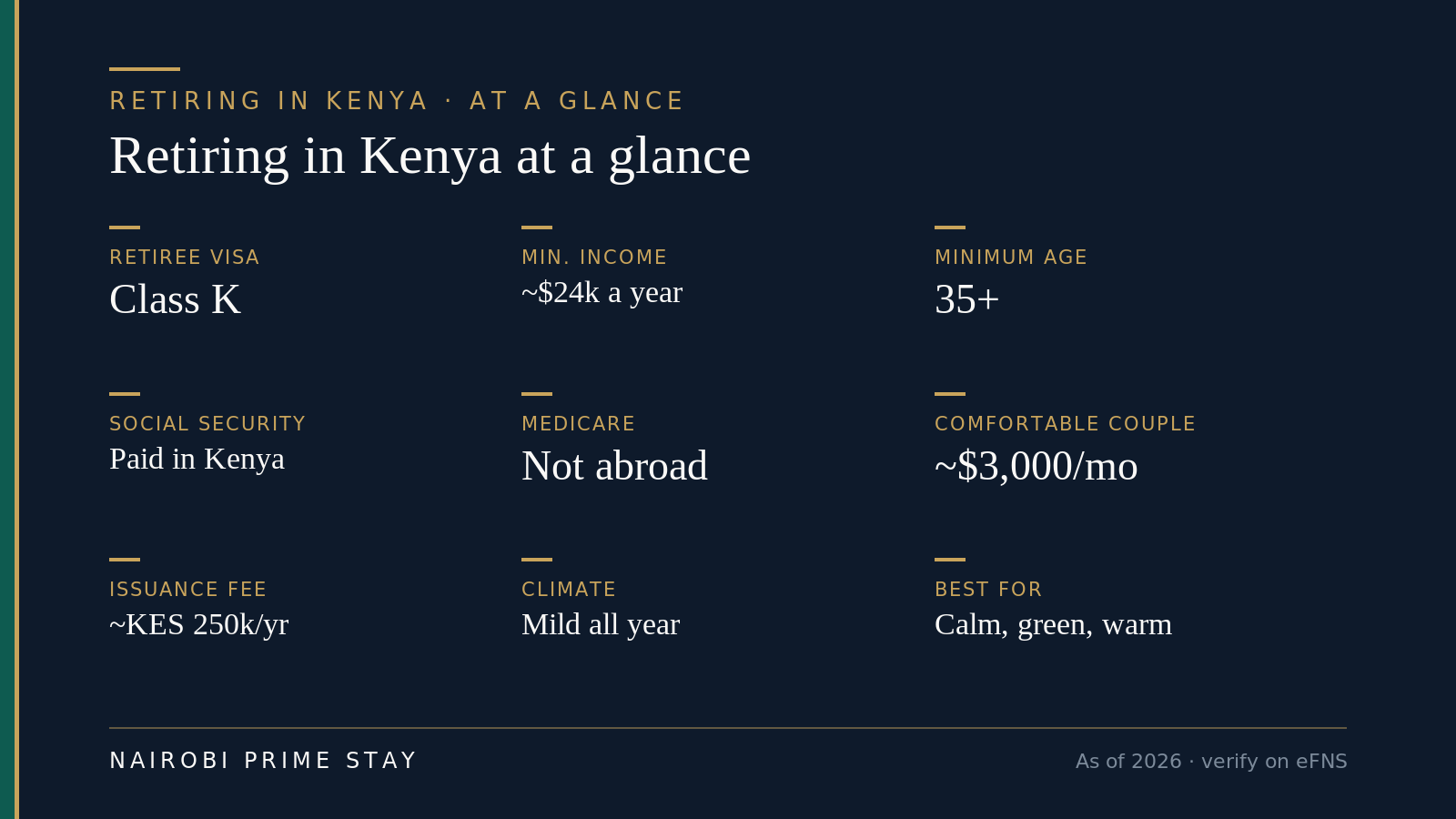
You retire in Kenya on a Class K permit — Kenya’s “ordinary resident” permit for people who can support themselves without working locally. As of 2026 it asks that you’re 35 or older and have an assured income of at least about USD 24,000 a year from a source that isn’t Kenyan employment — a pension, annuity, Social Security, or investments. You don’t work or run a business in Kenya on it. Budget roughly KES 20,000 (about USD 155) to process and KES 250,000 a year (about USD 1,900) to issue, and confirm the current figures on the official immigration portal.
A retired American couple lives comfortably on roughly USD 3,000–4,500 a month, less if you’re frugal and more if you want a big house and a driver. Your Social Security keeps paying into a Kenyan or US bank account — Kenya isn’t on the restricted list. The one thing to get right early is health cover: Medicare doesn’t cover care outside the US, so you’ll carry international private insurance, and premiums climb with age. Get all of that lined up and Kenya is a genuinely good place to grow older.

Why Americans retire in Kenya
The honest pitch starts with the weather. Nairobi sits at about 1,795 meters, so the climate is spring-like nearly every day — roughly 22–28°C (low 70s to low 80s°F) in the daytime, cooler at night, no hard winter and no brutal summer. For anyone tired of shoveling snow or hiding from August heat, that alone is worth a lot. (For the full picture, see our Nairobi weather and climate guide.)
Then there’s the math. A Western pension or Social Security check stretches much further here. Domestic help is affordable and normal, fresh produce is cheap, and you can rent a comfortable home in a green, secure suburb for a fraction of a US coastal city. Many retirees find they live better in Nairobi on the same income — a garden, someone to help with the house, more time, more travel.
The travel is real, too. From Jomo Kenyatta International you’re a short hop from the Maasai Mara, the Indian Ocean beaches around Diani, Mount Kilimanjaro, and the wider region. Retirement here can mean a safari for a long weekend, not a once-in-a-lifetime trip you save years for.
And the community is bigger than people expect. Nairobi has a large, long-established international population — diplomats, UN and NGO staff, missionaries, business people, and a growing number of retirees and members of the diaspora. It’s an easy place to make friends if you put yourself out there. Our guide to the expat community in Nairobi covers how people actually build a social life here.
Can you really retire here? An honest reality check
Yes — but it suits some people far better than others, and it’s worth being clear-eyed before you sell the house.
Kenya rewards retirees who are reasonably healthy, financially independent, and adaptable. You’ll need patience for traffic, the occasional power cut, and government paperwork that moves at its own pace. You’ll need to be comfortable being far from grandchildren and old friends, and to plan flights home around long-haul connections. And you’ll need a real plan for healthcare as you age, including the possibility that complex care means treatment abroad.
It’s a poorer fit if your health is fragile and unpredictable, if you can’t bear distance from family, or if you’d need to work locally to make ends meet — the retirement visa specifically doesn’t allow that. None of this rules Kenya out; it just means the decision deserves an honest weighing of the trade-offs, which we lay out plainly further down. If you’re new to the country entirely, start with our complete guide to moving to Nairobi for the big picture, then come back here for the retirement specifics.
The retirement visa: Kenya’s Class K permit
The Class K permit is the route most retirees use. Kenya calls it the “ordinary resident” permit, and it’s designed for a foreign national who wants to live in Kenya and can support themselves without working or running a business locally. In plain terms: it’s the financially independent retiree’s visa.
What Class K requires (as of 2026)
The core conditions are straightforward, but the figures change, so treat these as a starting point and confirm on the official portal before you rely on them:
- Age 35 or older. Class K isn’t open to younger applicants.
- An assured annual income of at least about USD 24,000 — roughly USD 2,000 a month — that you have in your own right and can freely dispose of. It must come from a source other than employment in Kenya: a pension, an annuity, Social Security, rental income, dividends, or investment returns all qualify.
- No local work or income-generating activity. You can live on your income and your savings, but you can’t take a Kenyan job or run a Kenyan business on this permit. If you want to do either, you need a different class (work or investor).
- The usual supporting documents: a passport valid well beyond your stay, passport photos, a clean police clearance, proof of income (pension statements, bank statements, an annuity letter), and proof of accommodation in Kenya.
What it costs and how to apply
Expect a non-refundable processing fee of around KES 20,000 (about USD 155) and, once approved, an annual issuance fee of around KES 250,000 (about USD 1,900). Permits are typically issued for a set term and are renewable. Applications go through the government’s eFNS immigration portal (fns.immigration.go.ke, linked from ecitizen.go.ke). Because the paperwork and the exact current fees can shift, almost everyone uses a Kenyan immigration lawyer or a reputable relocation agent — it’s money well spent to get the file right the first time.
A spouse and dependent children don’t each need their own Class K. The main applicant holds the permit, and the spouse and kids come in on a dependant’s pass linked to it. For the wider visa landscape — the eTA for scouting trips, work and investor permits, the tax-residency rules — see our Kenya visa guide for Americans.
The smart sequence
Don’t try to do everything from your living room in the States. The path that works:
- Come first on a 90-day eTA (the USD 30 electronic travel authorization) and actually spend time here. Scout neighborhoods, test the traffic, see a hospital, meet a few people.
- Choose where you’d live and use a serviced apartment as a base while you look — more on that below.
- Engage an immigration lawyer to file your Class K once you’re confident.
- Register a KRA PIN (your Kenyan tax ID) and open a local bank account.
- Sign a lease and settle in.
You can’t get the permit without taking it seriously, and you shouldn’t commit to the country without spending real time in it first. The eTA scouting trip is the cheap insurance policy here.
A note on tax
Spending 183 days or more in Kenya in a tax year can make you a Kenyan tax resident, and the US taxes its citizens on worldwide income no matter where they live. Kenya and the US don’t have a comprehensive double-tax treaty, so the interaction matters. This isn’t tax advice — get a cross-border tax professional who knows both systems before you move, so you’re not surprised at filing time.
What a comfortable retirement actually costs
A retired American couple lives comfortably in Nairobi on roughly USD 3,000–4,500 a month. You can do it for less — closer to USD 1,800–2,500 if you rent a modest place, cook at home, and keep help part-time — and you can spend a great deal more if you want a large house in a prime suburb, a car and driver, and frequent travel. The single biggest swing factors are rent, health insurance, and how much help you keep.
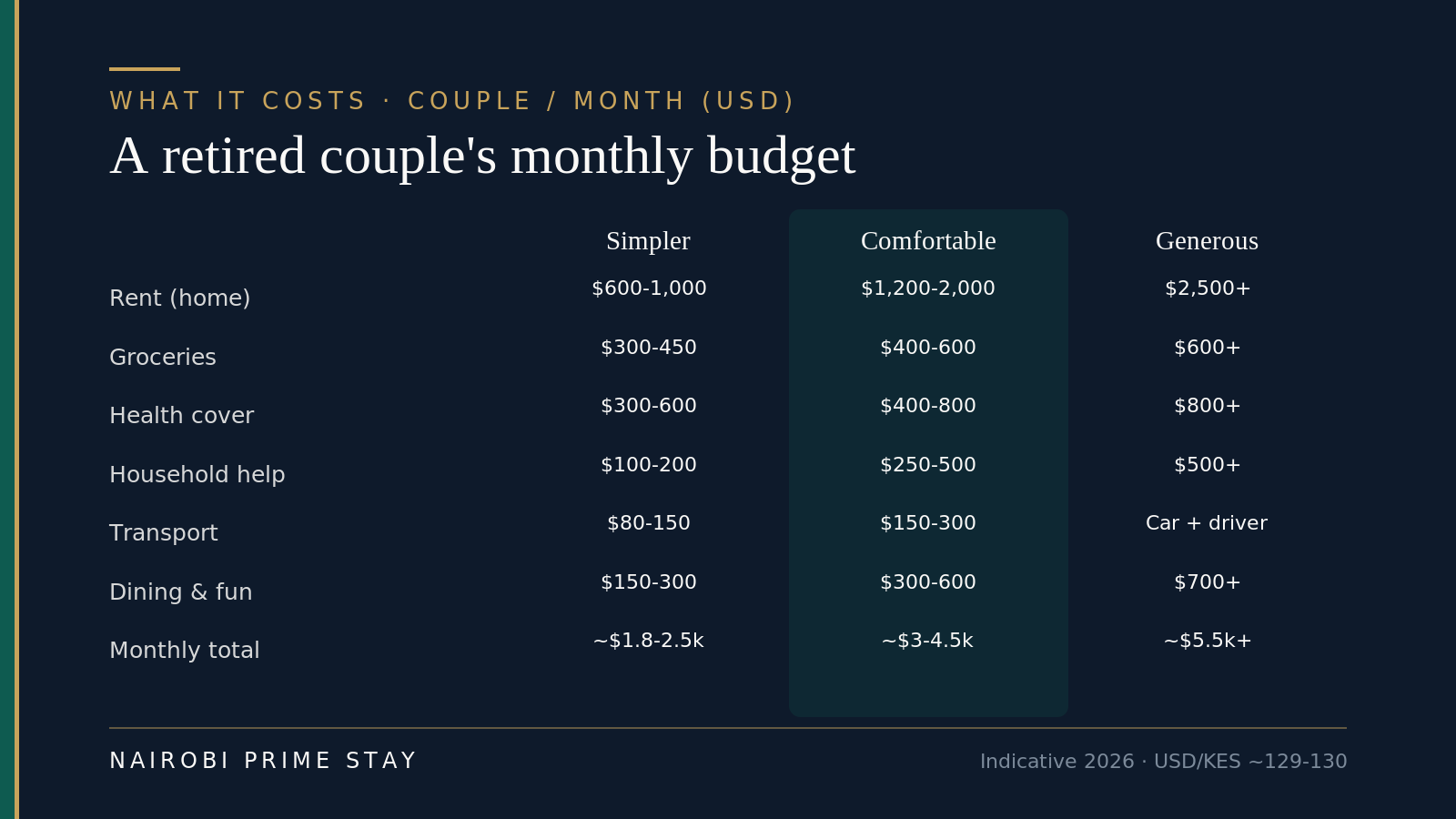
Here’s an indicative monthly budget for a retired couple. Treat it as orientation, not a quote — your numbers depend on your suburb and your habits.
| Monthly item (couple) | Simpler | Comfortable | Generous |
|---|---|---|---|
| Rent (home) | $600–1,000 | $1,200–2,000 | $2,500+ |
| Groceries | $300–450 | $400–600 | $600+ |
| Health insurance | $300–600 | $400–800 | $800+ |
| Household help & garden | $100–200 | $250–500 | $500+ |
| Transport (rides / fuel) | $80–150 | $150–300 | car + driver |
| Utilities & internet | $100–180 | $150–250 | $250+ |
| Dining & leisure | $150–300 | $300–600 | $700+ |
| Approx. total | ~$1,800–2,500 | ~$3,000–4,500 | ~$5,500+ |
A few honest notes on the table. Health insurance is unusually heavy for retirees compared with younger expats — for an older couple it can be the largest single line after rent, and it’s covered in detail below. Domestic help is genuinely affordable: a part-time housekeeper or a gardener is normal and humane to employ at a fair local wage. And the table leaves out big one-offs — flights home, buying a car, furnishing a place, and travel around the region — which you should budget for separately.
For a deeper breakdown of day-to-day prices, see our cost of living in Nairobi guide. The headline: a Western retirement income goes a long way here, as long as you’ve priced in insurance.
Social Security, pensions and getting paid
Good news for American retirees: you can keep collecting Social Security while living in Kenya. Kenya is on the Social Security Administration’s list of countries where payments continue, so as a US citizen you go on receiving your benefit — typically wired to a US bank account you can draw from here, or in some cases paid abroad. The average US retired-worker benefit is roughly USD 2,000 a month as of 2026; check your own figure at ssa.gov, since that, plus any pension or savings, is what your Kenyan budget runs on.
Moving money in is easy. Services like Wise and ordinary bank transfers convert USD to Kenyan shillings cheaply, and you can top up M-Pesa — the mobile-money system that runs daily life here — from your accounts. Many retirees keep a US card for international spending and use M-Pesa and a local account for everything on the ground. As of mid-2026 the shilling trades around KES 129–130 to the dollar; it moves, so check the Central Bank of Kenya or Wise for the live rate.
Healthcare for older expats — the part to get right
This is the most important section in the guide, so read it twice. Healthcare can be the deciding factor in whether retiring in Kenya works for you, and there are two facts every American retiree needs to absorb up front.
First: Medicare does not cover you in Kenya. Original Medicare (Parts A and B) almost never pays for care received outside the United States, and that doesn’t change because you’ve moved. Many retirees keep paying their Part B premium anyway, to preserve coverage for trips back to the States and to avoid late-enrollment penalties — but for day-to-day care in Nairobi, Medicare is not your safety net. You replace it with private international insurance.
Second: the private healthcare here is genuinely good. Nairobi has some of the best private hospitals in the region, staffed by English-speaking, often Western-trained specialists. Routine and even fairly serious care is high quality and far cheaper than in the US. A private specialist consult runs roughly USD 15–40. The catch is at the extreme end — very complex surgery, rare cancers, or specialized long-term care — where some expats choose to fly to South Africa, India, Europe, or home. That’s exactly why medical evacuation cover matters.
The hospitals retirees rely on
| Hospital | Area | Known for |
|---|---|---|
| Aga Khan University Hospital | Parklands | JCI-accredited; cardiac, cancer, full specialist care |
| The Nairobi Hospital | Upper Hill | Long-established, broad specialties, expat-trusted |
| MP Shah Hospital | Parklands | Well-regarded private general hospital |
| Karen Hospital | Karen | Convenient for the southern suburbs |
| Aga Khan / Nairobi Hospital outpatient centers | Several suburbs | Clinics closer to home for routine care |
Whichever suburb you choose, know your nearest private hospital before you need it, and keep 999 or 112 (emergency) saved. Our healthcare in Nairobi guide goes deeper on the hospitals, costs, pharmacies and how to find a good doctor.
Insurance: the honest version for older applicants
Here’s where age bites. International health insurance is the standard solution for retirees, but premiums rise sharply with age, and some insurers cap new enrollment (often around age 70–75) or exclude or surcharge pre-existing conditions. The practical advice:
- Buy your international policy before you move, while you’re younger and healthier. Continuity is easier than starting fresh at 72.
- Insist on regional or worldwide cover plus medical evacuation, so a serious case can be flown to the best available care.
- Read the pre-existing-conditions and renewal terms closely — can the insurer drop you, and does cover continue for life?
- Compare a local Kenyan plan against an international one. Local plans are cheaper but usually cap at Kenyan facilities; international plans cost more but travel with you.
This is the area where a little spreadsheet work and an honest conversation with a broker pays off for decades. For a full breakdown of what good cover should include and what to watch for, see our guide to health insurance in Kenya for expats and retirees.
Where retirees settle in Nairobi
Most retirees want the same things: quiet, greenery, real security, and a good hospital nearby. That points to a handful of leafy western and northern suburbs.
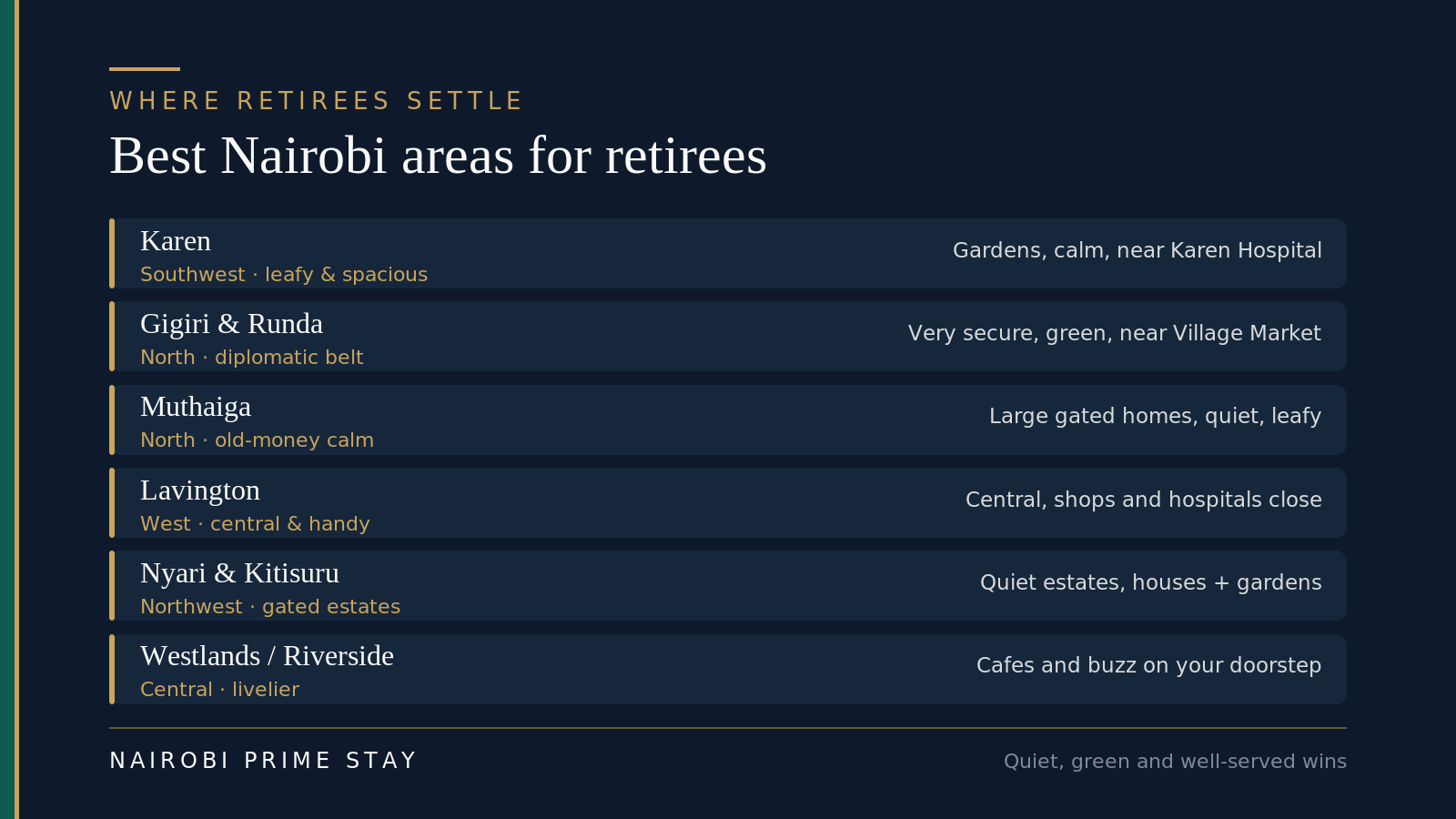
Karen is the classic retiree choice — spacious, green, low-density, with gardens, horse country, and Karen Hospital close at hand. It feels almost rural in places, and it has a strong, settled expat community. The trade-off is distance: it’s a long, traffic-prone drive to the city center. See our Karen neighborhood guide.
Gigiri and Runda, in the north, sit in the diplomatic belt around the UN headquarters. They’re among the most secure parts of the city, heavily patrolled, green, and close to the Village Market mall and good clinics — an easy, safe choice. Our Gigiri guide has the detail.
Muthaiga offers old-money calm and large gated homes; Lavington is more central and convenient, with shops and hospitals close and a cosmopolitan feel; Nyari and Kitisuru are quiet gated estates with houses and gardens. If you actually want cafes, restaurants and a bit of buzz on your doorstep, Westlands or Riverside put you in the middle of things, at the cost of more noise and traffic.
To compare all the prime areas side by side — character, rent, who each suits — see our best neighborhoods in Nairobi guide. And because where you live relative to your hospital, your friends and the shops shapes daily life more than anything, don’t rent sight-unseen.
Use a serviced apartment as your soft landing
The smartest first move for a retiree is not to sign a year-long lease from abroad. It’s to book a serviced apartment for your first four to eight weeks — fully furnished, with Wi-Fi, cleaning, a backup generator and security all included — and use it as a secure base while you view homes, test commutes to the hospital, and settle on an area. You move once, into the right place, instead of guessing.
That’s exactly what we set up. You can browse serviced apartments in Nairobi by area, and a small deposit reserves a place with the balance paid on arrival — nothing more before you travel. It takes the riskiest part of the move (committing to a home you’ve never seen) off the table.
The honest pros and cons
No place is right for everyone. Here’s the balanced reckoning — both columns are true at the same time.
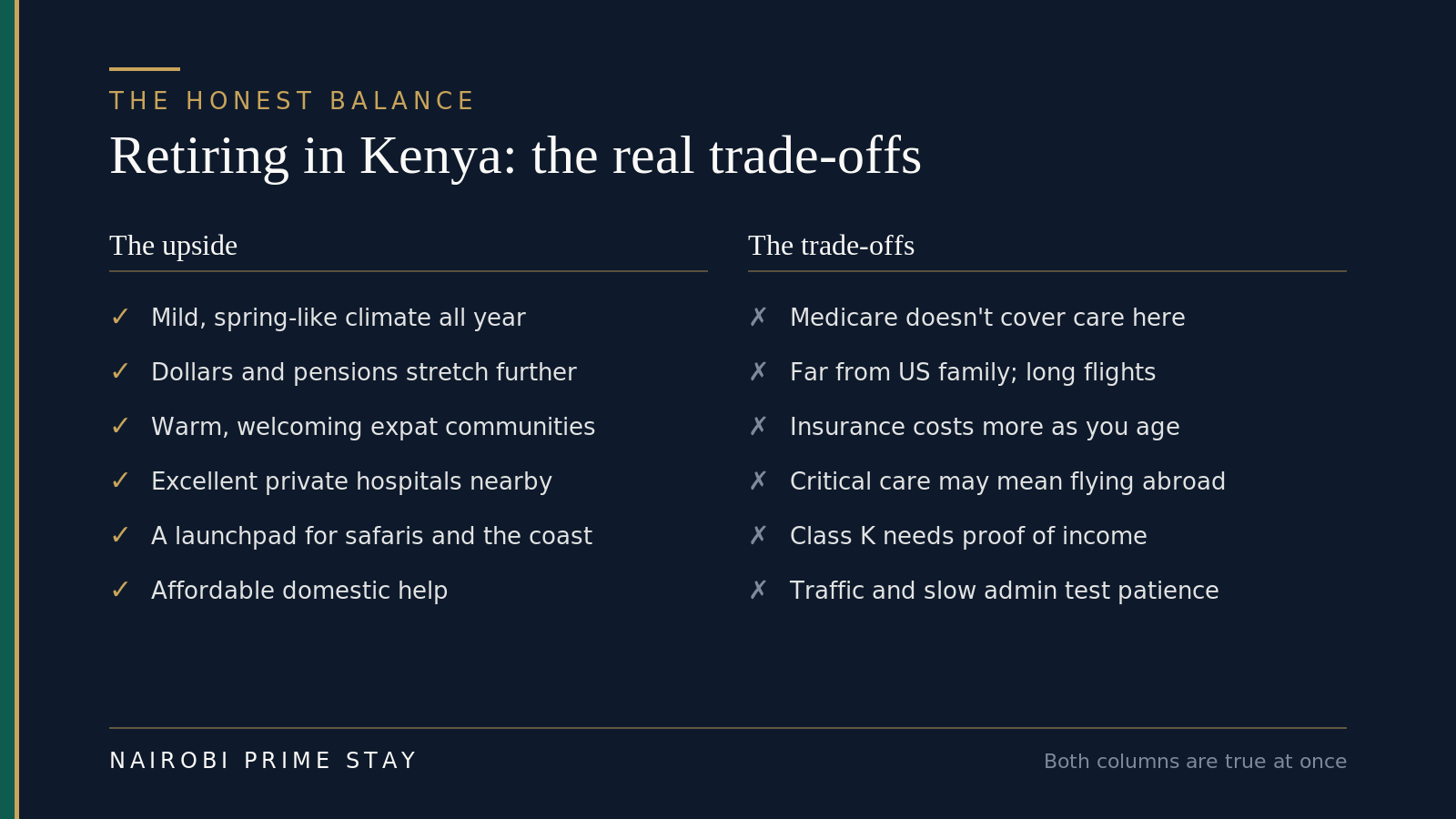
| The upside | The trade-offs |
|---|---|
| Mild, spring-like climate all year | Far from US family; flights are long and pricey |
| A Western income and pension stretch far | Medicare won’t cover your care here |
| Warm, established expat and faith communities | Insurance gets costlier and harder to get with age |
| Excellent private hospitals, English-speaking | Very complex care can mean flying abroad |
| A launchpad for safaris, the coast and the region | Class K needs proof of steady income + yearly fees |
| Affordable, normal domestic help | Traffic, occasional power cuts, slow paperwork |
If you read the right-hand column and think “manageable,” Kenya is probably a fit. If any single item there is a dealbreaker for you, take it seriously — better to know now.
Practical setup once you’ve decided
The administrative side of settling in is the same for retirees as for anyone, with a couple of retiree-specific notes:
- KRA PIN and bank account. Once you hold your Class K permit, register a KRA PIN at itax.kra.go.ke, then open a local bank account (Equity, KCB, Stanbic, NCBA, Absa and Standard Chartered are the common choices). You’ll need the permit, PIN, passport and proof of address. Tourists on an eTA generally can’t open accounts — this comes after the permit.
- M-Pesa from day one. Pick up a Safaricom SIM and register M-Pesa at the airport with your passport. It’s how you’ll pay for taxis, the market, bills and help.
- Getting around. Uber and Bolt are the expat default — safe, cheap, and payable by card or M-Pesa. Many retirees also buy a car for hospital runs and weekends; you drive on the left, and a US license is fine short-term with an International Driving Permit before you convert to a Kenyan one.
- Safety, sensibly. Most retirees live in gated homes or estates with 24/7 guards and have few problems. The main risk is opportunistic petty theft, not personal danger. Our is Nairobi safe guide gives the balanced picture and the precautions that matter.
- Bringing pets. Many retirees move with a dog or cat. It’s very doable with the right paperwork (an import permit, a recent health certificate and up-to-date rabies vaccination), but start early — approvals and airline pet bookings take time.
- Enroll in STEP. Register with the US State Department’s Smart Traveler Enrollment Program (step.state.gov) so the embassy in Gigiri can reach you, and keep digital copies of your passport, permit and insurance.
What it looks like in practice
Picture Jim and Carol, both 66, retiring from Ohio. Their combined Social Security and a modest pension come to about USD 4,200 a month. They fly out on eTAs for a five-week scouting trip and book a serviced apartment in Karen as a base. They spend the time viewing houses, visiting Karen Hospital and Aga Khan, meeting people through a church and a hiking group, and getting a feel for the traffic.
They like it. Back home, they buy an international health policy with worldwide cover and medical evacuation while they’re still 66, then engage a Nairobi immigration lawyer to file Carol’s Class K, with Jim coming in on a dependant’s pass. Once approved, they return, register KRA PINs, open an Equity account, and sign a 12-month lease on a three-bedroom house with a garden for about USD 1,600 a month. They keep a gardener and a part-time housekeeper, buy a small SUV, and settle into a rhythm of morning walks, weekend trips to Naivasha, and a safari whenever family visits. Their all-in spending lands around USD 3,800 a month — comfortably inside their income, with room for flights home twice a year.
It’s not a fairy tale — Carol misses the grandkids, and the first month of paperwork tested their patience. But two years in, they have no plans to leave. The pattern that worked: scout first, insure early, lawyer the visa, and use a soft landing to choose the right home.
Your retirement planning checklist
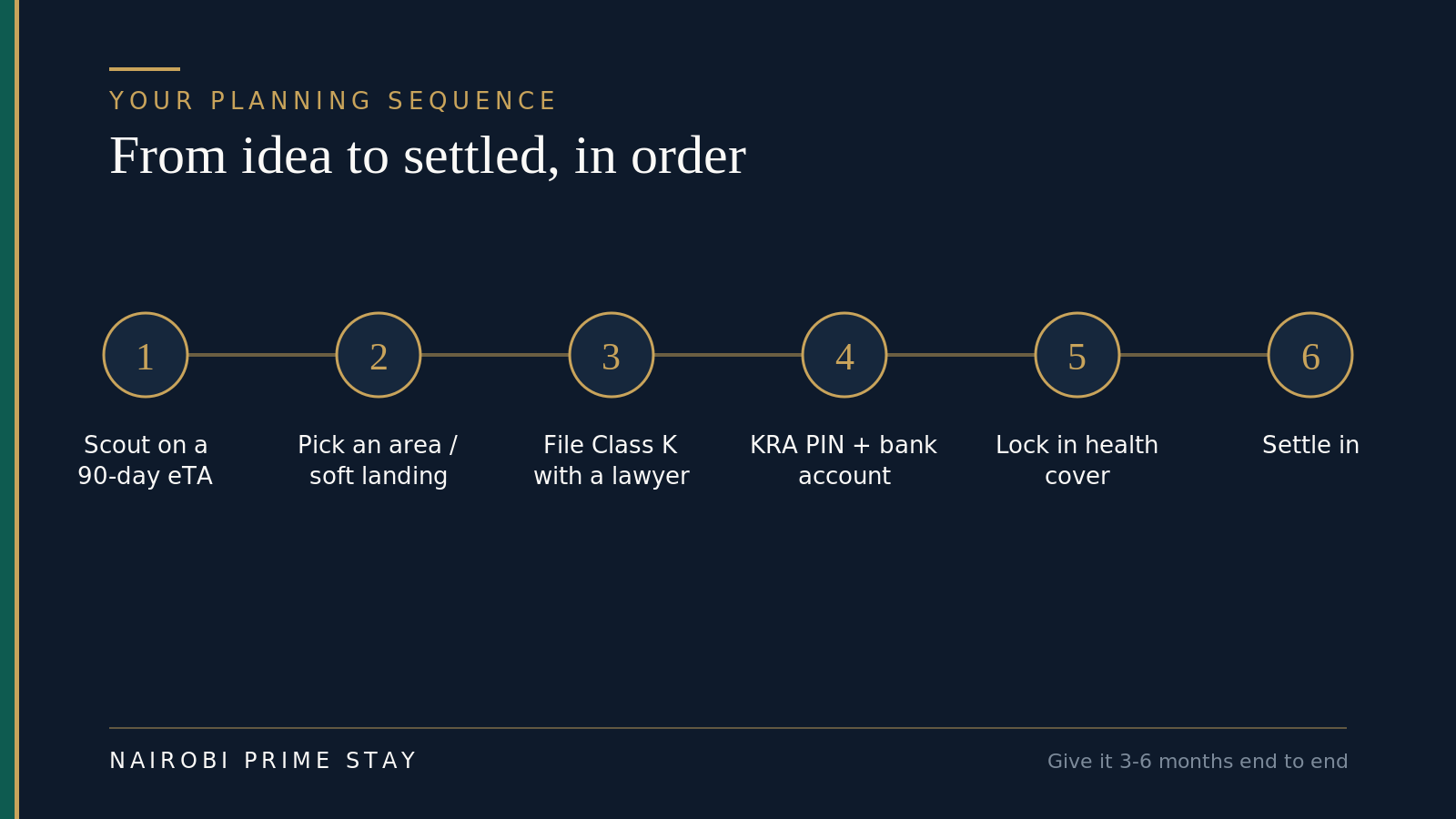
Work through these roughly in order:
- Do an honest fit check — health, distance from family, finances, adaptability.
- Confirm your income meets Class K (about USD 24,000+ a year from non-work sources) and gather proof.
- Price your international health insurance with evacuation cover — and buy it while you’re younger.
- Scout on a 90-day eTA: view neighborhoods, hospitals, and the daily reality.
- Book a serviced apartment as a soft landing for your first 4–8 weeks.
- Engage a Kenyan immigration lawyer to file your Class K (and a dependant’s pass for a spouse).
- Get cross-border tax advice before you trigger Kenyan residency.
- Register your KRA PIN and open a bank account once the permit is in hand.
- Sort pets, shipping and a car if you need them — start the pet paperwork early.
- Choose your home and sign a lease, then enroll in STEP and save your emergency numbers.
Give the whole sequence three to six months end to end, and don’t skip the scouting trip — it’s the cheapest insurance you’ll buy.
Frequently asked questions
Can Americans retire in Kenya?
Yes. Americans retire in Kenya on the Class K permit, Kenya’s ordinary resident permit for people who can support themselves without working locally. As of 2026 you generally need to be 35 or older with an assured income of at least about USD 24,000 a year from a non-employment source such as a pension, annuity, Social Security or investments. You apply through the eFNS immigration portal, usually with help from a Kenyan immigration lawyer. Confirm the current requirements and fees on the official portal before you rely on them.
What is the Class K (retirement) permit and what does it require?
The Class K permit lets a financially independent foreigner live in Kenya without taking a local job or running a business. The main conditions as of 2026 are being at least 35 years old and having an assured annual income of roughly USD 24,000 or more from sources other than Kenyan employment. Expect a non-refundable processing fee of about KES 20,000 (around USD 155) and an annual issuance fee of about KES 250,000 (around USD 1,900), plus documents like proof of income, a police clearance and proof of accommodation. A spouse and children join on a dependant’s pass linked to the permit.
How much does it cost to retire comfortably in Kenya?
A retired American couple lives comfortably on roughly USD 3,000 to 4,500 a month in Nairobi, covering a nice home, groceries, health insurance, some household help, transport and leisure. A simpler comfortable life is possible from about USD 1,800 to 2,500 a month, and a generous lifestyle with a large house and a driver runs USD 5,500 or more. The biggest variables are rent, health insurance and how much help you keep. These are indicative 2026 figures; the shilling trades around KES 129 to 130 to the dollar.
Can I collect Social Security if I retire in Kenya?
Yes. Kenya is on the US Social Security Administration’s list of countries where benefits keep being paid, so as a US citizen you continue to receive your Social Security while living there. Payments are typically wired to a US bank account you draw from in Kenya, or in some cases paid abroad. The average US retired-worker benefit is roughly USD 2,000 a month as of 2026; check your own figure at ssa.gov, since that plus any pension or savings is what your Kenyan budget runs on.
Does Medicare cover me if I live in Kenya?
No. Original Medicare (Parts A and B) almost never pays for care received outside the United States, and moving to Kenya doesn’t change that. Some retirees keep paying their Part B premium anyway to preserve coverage for trips home and avoid late-enrollment penalties, but for everyday care in Nairobi you’ll rely on private international health insurance instead. Buy a policy with regional or worldwide cover plus medical evacuation, ideally before you move while premiums are lower and pre-existing conditions are easier to insure.
Is healthcare in Kenya good enough for retirees?
For most needs, yes. Nairobi has some of the best private hospitals in the region, including Aga Khan University Hospital, The Nairobi Hospital and MP Shah, staffed by English-speaking, often Western-trained specialists, with costs well below US prices. The honest limit is at the extreme end: very complex surgery, rare cancers or specialized long-term care may be better handled in South Africa, India, Europe or back home, which is exactly why medical evacuation cover matters. Know your nearest private hospital before you need it and keep 999 or 112 saved.
Where do retirees live in Nairobi?
Retirees gravitate to quiet, green, secure suburbs with a good hospital nearby. Karen is the classic choice for space and gardens, with Karen Hospital close at hand. Gigiri and Runda, in the diplomatic belt, are among the most secure areas; Muthaiga offers old-money calm, and Lavington is more central and convenient. Nyari and Kitisuru are quiet gated estates, while Westlands or Riverside suit anyone who wants cafes and buzz nearby. Using a serviced apartment for the first few weeks lets you choose the right area before signing a lease.
Is Kenya a good place to retire?
It is for the right person. Kenya rewards retirees who are reasonably healthy, financially independent and adaptable, offering a mild climate, a Western income that stretches far, strong communities and easy access to safaris and the coast. It’s a poorer fit if your health is fragile and unpredictable, if you can’t bear being far from family, or if you’d need to work locally, which the retirement visa doesn’t allow. The deciding factors are usually healthcare planning and distance from home, so weigh those honestly before you commit.
Final thoughts
Retiring in Kenya is a real, achievable plan — not an exotic gamble — for Americans who go in with their eyes open. The visa is a known quantity, the cost of living is kind to a Western pension, the climate is a daily gift, and the private healthcare is far better than most people expect. The two things that decide it are usually healthcare planning as you age and your tolerance for distance from family. Sort the first with good international insurance bought early, be honest with yourself about the second, and the rest is logistics.
The people who thrive here are the ones who scouted first, insured early, used a lawyer for the visa, and chose their home after spending real time on the ground. Do it in that order and you give yourself the best shot at a retirement that’s not just cheaper, but genuinely better.
This is general guidance, not legal, tax, immigration or medical advice; details reflect 2026 and can change, so confirm with the official Kenyan authorities and qualified professionals before you act.
Related reading
- Moving to Nairobi: the complete guide — the big-picture overview for any new arrival.
- Kenya visas for Americans — the eTA, Class K and every other route, in plain English.
- Healthcare in Nairobi and health insurance for expats and retirees — the part to get right.
- Cost of living in Nairobi — real budgets and prices.
- Moving to Kenya as an African American — the diaspora relocation experience, honestly.
- Best neighborhoods in Nairobi, plus the Karen and Gigiri guides.
- Building a social life in Nairobi — how retirees make friends here.
When you’re ready to test the idea for real, the easiest first step is a soft landing. Browse our serviced apartments in Nairobi for a furnished, all-inclusive base while you scout, or ask our AI relocation assistant to shortlist options that fit your budget and the suburb and hospital you have in mind — day or night, no pressure.
Ready to look?
Find your apartment in Nairobi
Browse verified serviced apartments, or ask the AI concierge which area fits your life.