
Guides · Relocating
Moving to Kenya as an African American: An Honest 2026 Guide
Moving to Kenya as an African American: An Honest 2026 Guide

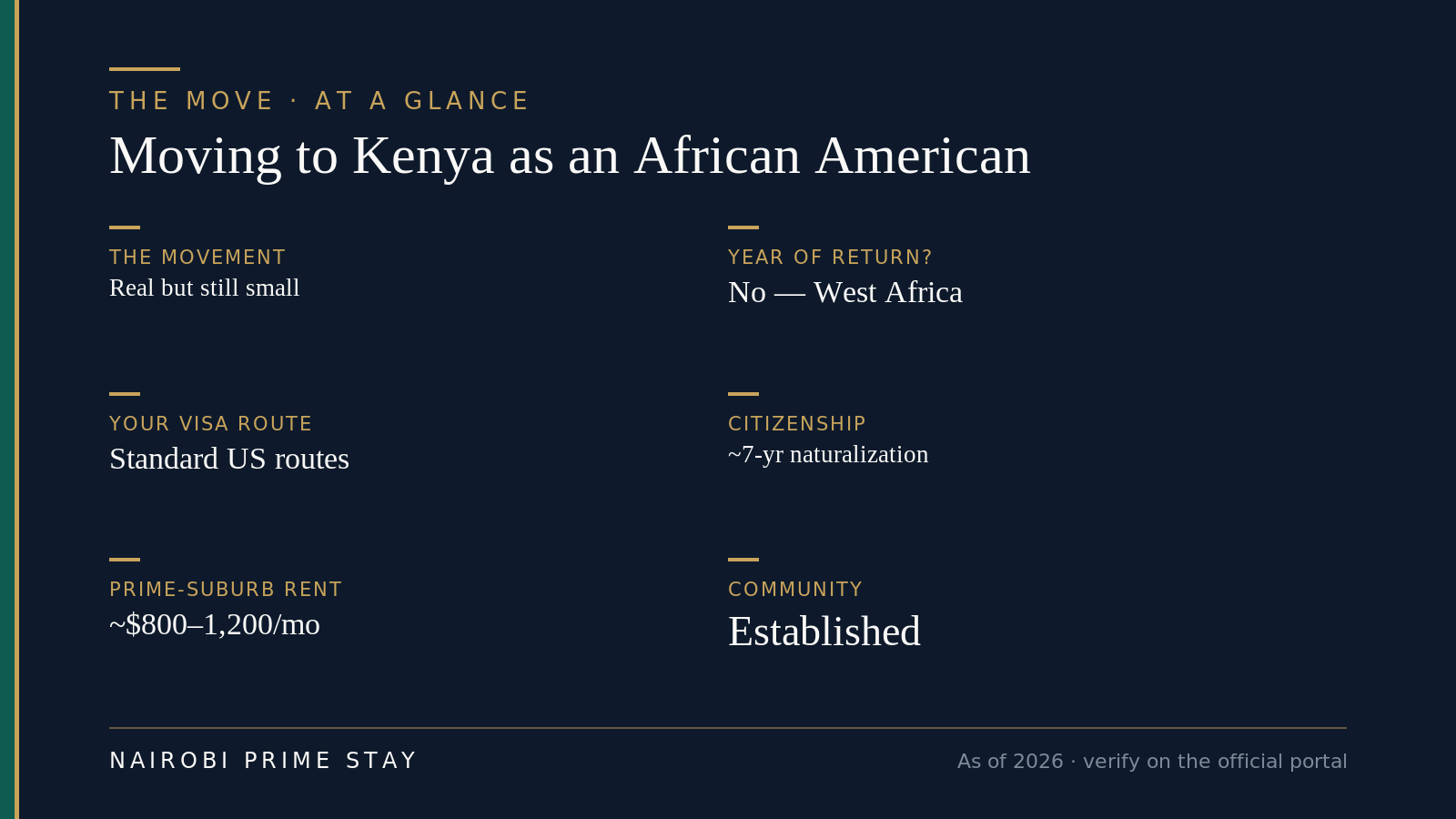
Yes, African Americans are moving to Kenya — and the number doing it has grown enough that US outlets like ABC News, BET and Travel Noire have all covered the trend in the past couple of years. People come for a Black-majority society where their skin color isn’t a daily liability, for a warm welcome, for a mild climate, and for a cost of living that lets a US income breathe. Most settle in Nairobi, where there’s already an established African American and wider diaspora community to land into.
This guide is for African Americans weighing a move to Kenya, whether that’s a clean-break relocation, a remote-work year, a business venture, or retirement. We’ll be warm but straight with you: what the welcome really feels like, the honest truth about identity and belonging in East Africa, how the visas and housing and schools actually work, how people build roots and businesses here, and the challenges nobody puts in the highlight reel. By the end you’ll know whether Kenya fits you, and how to set the move up properly.

The quick answer
There’s no special “return” visa or fast-track citizenship for African Americans in Kenya — that’s a Ghana and West Africa story, not an East Africa one. You relocate to Kenya on the same routes as any other American: scout on the $30 eTA, then move onto a longer permit — the Class N digital-nomad permit for remote workers, Class D for a job, Class G for an investor or business owner, or Class K if you’re self-funded. Kenyan citizenship is possible, but by naturalization after about seven years of lawful residence, not by heritage. (Our Kenya visa guide for Americans walks through every route.)
The welcome is real, and so is the community. What’s also real: most African Americans are read as American first here — by accent, dress and the “foreigner price” at the market — and your ancestral roots most likely trace to West and Central Africa, not Kenya. Belonging in Nairobi is less about DNA and more about building a life: learning a little Swahili, joining the community, putting down roots over months and years. Do that, and many find it the most at-home they’ve ever felt. Come expecting paradise and you’ll be disappointed; come expecting a real place with real upsides, and Kenya delivers.
Why African Americans are moving to Kenya
The clearest reason people give is relief. In a society where almost everyone is Black, your race stops being the first thing a room notices. Several recent arrivals have told reporters the same thing in different words: they wanted to live somewhere their skin color wasn’t a source of suspicion. That’s a quiet, daily kind of freedom, and for many it’s the whole point.
After that, the reasons look a lot like anyone’s reasons for choosing Nairobi. The climate is spring-like all year — Nairobi sits at about 1,795 meters, so days run a mild 70s-to-low-80s°F with cool nights and no hard winter. A US salary, pension or remote paycheck stretches much further: a home that would cost several thousand dollars a month in Atlanta, DC or the Bay Area rents for roughly $800–1,200 a month in a comfortable, secure Nairobi suburb. Domestic help is affordable and normal. And from Jomo Kenyatta International you’re a short flight from the Maasai Mara, the Indian Ocean coast and the rest of the region.
There’s also opportunity. Kenya is East Africa’s business, tech and diplomatic hub — “Silicon Savannah” isn’t just a slogan — and members of the diaspora here are building real things: travel companies, restaurants and cafés, farms, content studios, consultancies. People aren’t only retiring to Kenya; plenty are working and starting businesses.
How big is this movement? Honestly, still small but clearly growing. There’s no official count of African Americans in Kenya, and you should be skeptical of anyone who quotes one. What’s documented is a steady stream of arrivals and a community that’s organized enough to have its own groups, events and relocation services. It’s nothing like the scale of the move to Ghana — and that comparison is worth understanding properly.
”Coming home” — belonging in Kenya, honestly
Here’s the part most articles skip. The phrase “coming home” is real and it’s earned, but Kenya is a different kind of home than the one West Africa offers, and being clear about that will save you from a hard letdown.
The transatlantic slave trade drew overwhelmingly from West and Central Africa — today’s Ghana, Senegal, Benin, Nigeria, Angola and their neighbors. That’s why the “return” movement has its heart there. Ghana’s “Year of Return” (2019) and the follow-on “Beyond the Return” decade built an entire welcome around ancestry, complete with citizenship ceremonies for diaspora descendants. (Even that program has had growing pains: Ghana paused its flagship diaspora-citizenship pathway in early 2026 to retool it.) Senegal and The Gambia offer a similar roots-and-heritage pull.
Kenya is East Africa. For most African Americans, it is not the land of their specific ancestors, and Kenya has never marketed itself as a roots-return destination. There’s no Year of Return here, no heritage citizenship, no “welcome home, descendant” ceremony. What Kenya offers instead is a Pan-African home: a stable, English-speaking, Black-led society where you can build a comfortable life and be part of the African present and future rather than only its past. For a lot of people that turns out to mean more, not less. But it’s a choice to make with open eyes.
Day to day, expect to be read as American. Your accent, your clothes, often your manner give you away in seconds, and you’ll sometimes be quoted the “mzungu price” — the foreigner rate — at a market or by a taxi who hasn’t switched on the app. Mzungu historically means a white or European person; it gets used loosely for foreigners and Westerners, and yes, African Americans hear it too. None of this is hostile. It’s just the honest gap between looking like you belong and being read as a local, and it closes slowly as you learn the rhythms, pick up some Swahili and become a regular face.
So who finds deep belonging here? Usually the people who treat it as a relationship, not a homecoming switch that flips on arrival. They learn greetings and a little Swahili, they respect local culture and etiquette, they show up consistently, and they let belonging accrue. Months in, many describe a settledness they never felt in the US — not because Kenya is a fantasy, but because they did the work of actually living here.
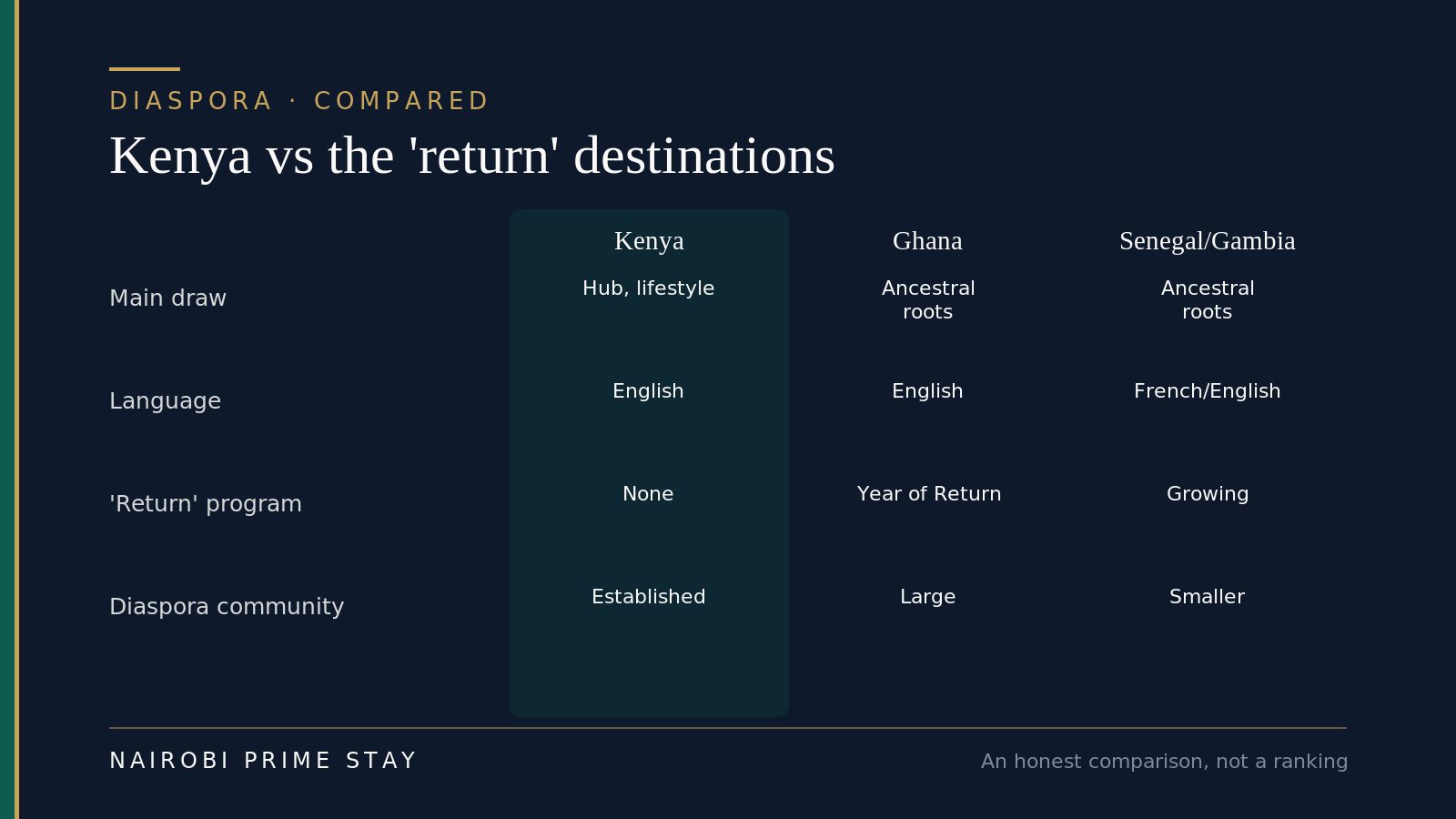 Kenya versus the classic West African “return” destinations — an honest comparison, not a ranking.
The welcome and the community
Kenyans are, as a rule, warm and quick to welcome a newcomer — karibu (welcome) is one of the first words you’ll hear and one of the most sincere. Greetings come before everything; skip the hello and you’ve started on the wrong foot, but offer it and doors open. As an African American you’ll often get an extra layer of curiosity and goodwill once people learn your story.
You won’t be starting your social life from zero. Nairobi has a large, long-established international population — UN and NGO staff, diplomats, business people, missionaries, remote workers, returning Kenyans and a growing diaspora from across the Black Atlantic. There’s an active “Black Expats in Kenya” community online, African American-run businesses and meetups, and the usual expat infrastructure of WhatsApp groups, sports clubs and church communities. The fastest way in is to arrive curious and say yes to invitations.
A few reliable on-ramps:
- Online first. Join the Black-expat and general “expats in Nairobi” Facebook groups before you fly; ask questions, read the archives, line up a coffee or two for your first week.
- Your building and estate. In a gated community or apartment block, the residents’ WhatsApp group is where daily life happens — recommendations, security alerts, the plumber’s number, the weekend plans.
- Faith communities. Nairobi’s churches, mosques and other congregations are social anchors, and many run small groups where real friendships form.
- Sport, running and clubs. Running crews, hiking groups, gyms and the country clubs are easy places to become a regular.
- The diaspora businesses. The African American-owned café, restaurant or tour company is often a community hub in its own right — go, introduce yourself, ask who else you should meet.
Our full guide to building a social life in Nairobi goes deeper on each of these. The headline: the community is here and it’s welcoming, but it rewards the proactive. Show up, follow up, and you’ll have a circle within a couple of months.
The practical setup: visa, housing, work and schools
The mechanics of moving to Kenya are the same for you as for any American, so this section is a quick orientation with links to the deep-dives.
Visas: the route depends on what you’ll do here
There’s no heritage or “return” visa, so you pick the route that matches your plans. The smart sequence is almost always to scout first on the eTA, then file the right permit with a Kenyan immigration lawyer once you’ve chosen your path.
- eTA (electronic travel authorization) — $30. Every visitor needs one before flying, applied for at the official portal etakenya.go.ke. It’s for visits and scouting up to 90 days, not for working or residing. Perfect for a look-before-you-leap trip.
- Class N — digital nomad permit. For remote workers and freelancers paid from outside Kenya. Roughly $200 to process plus about $1,000 a year, with proof of steady foreign income.
- Class D — work permit. Employer-sponsored, for taking a job with a Kenyan employer.
- Class G — investor permit. For starting or buying into a Kenyan business — the route many diaspora entrepreneurs use.
- Class K — self-funded resident. For people 35+ with assured non-work income (a pension, annuity or investments) of about $24,000+ a year; popular with retirees.
Fees and thresholds shift, so confirm the current details on the official immigration portal (ecitizen.go.ke / the eFNS system) and treat any figure here as a 2026 estimate. The full breakdown, including the documents and the tax-residency rules, is in our Kenya visa guide for Americans. One honest note: Kenya allows dual citizenship, but for someone without Kenyan ancestry the only route is naturalization after about seven years of lawful residence, with good character and a working knowledge of English or Swahili — a long game, not a starting point.
Housing: rent first, buy later
Don’t buy or sign a year-long lease sight-unseen. The proven playbook is to land into a furnished serviced apartment for your first 4–8 weeks, then use that secure base to view homes, test commutes and choose your suburb before committing. Prime western suburbs — Gigiri, Runda and Muthaiga in the diplomatic belt; Karen and Lavington for space and greenery; Kilimani, Kileleshwa, Westlands and Riverside for central apartment living — cover most newcomers. Our best neighborhoods in Nairobi guide compares them on character, rent and commute, and the serviced apartments guide explains the soft-landing approach. When you’re ready to look at long-term homes, expect a 12-month lease and a deposit of one to three months plus the first month up front.
Work and business: you can’t just freelance on a visitor stamp
If you’ll earn money in Kenya, you need the permit that allows it — Class D for a job, Class G for your own business. Remote income from US clients sits under the Class N nomad permit. Plenty of the diaspora here run businesses: tour and relocation companies, cafés and restaurants, farms, creative studios, consultancies. It’s very doable, but set it up properly — register the company, get your KRA PIN (the tax ID you’ll need for almost everything), and take local legal and tax advice early. If your plan is to invest rather than operate day to day, read on.
Schools: international options, mostly American or British
Families are well served. Nairobi has a strong cluster of international schools, several on an American or IB curriculum that will keep a US-bound student on track — the International School of Kenya (ISK) near the UN is the best-known, alongside Rosslyn Academy and British-curriculum options like Braeburn and Brookhouse. The good ones have waitlists, so enquire months ahead and gather transcripts early. Our international schools guide covers curricula, areas and the honest cost picture.
What it costs
A comfortable professional life in Nairobi runs roughly $2,500–4,500 a month for a couple — rent in a nice suburb, groceries, transport, some household help, insurance and a good social life — and less if you’re frugal or single. The big variables are rent, schooling for families, and health insurance. For real budgets broken down line by line, see our cost of living in Nairobi guide. The short version: most people who earn or saved in dollars find their money goes noticeably further here.
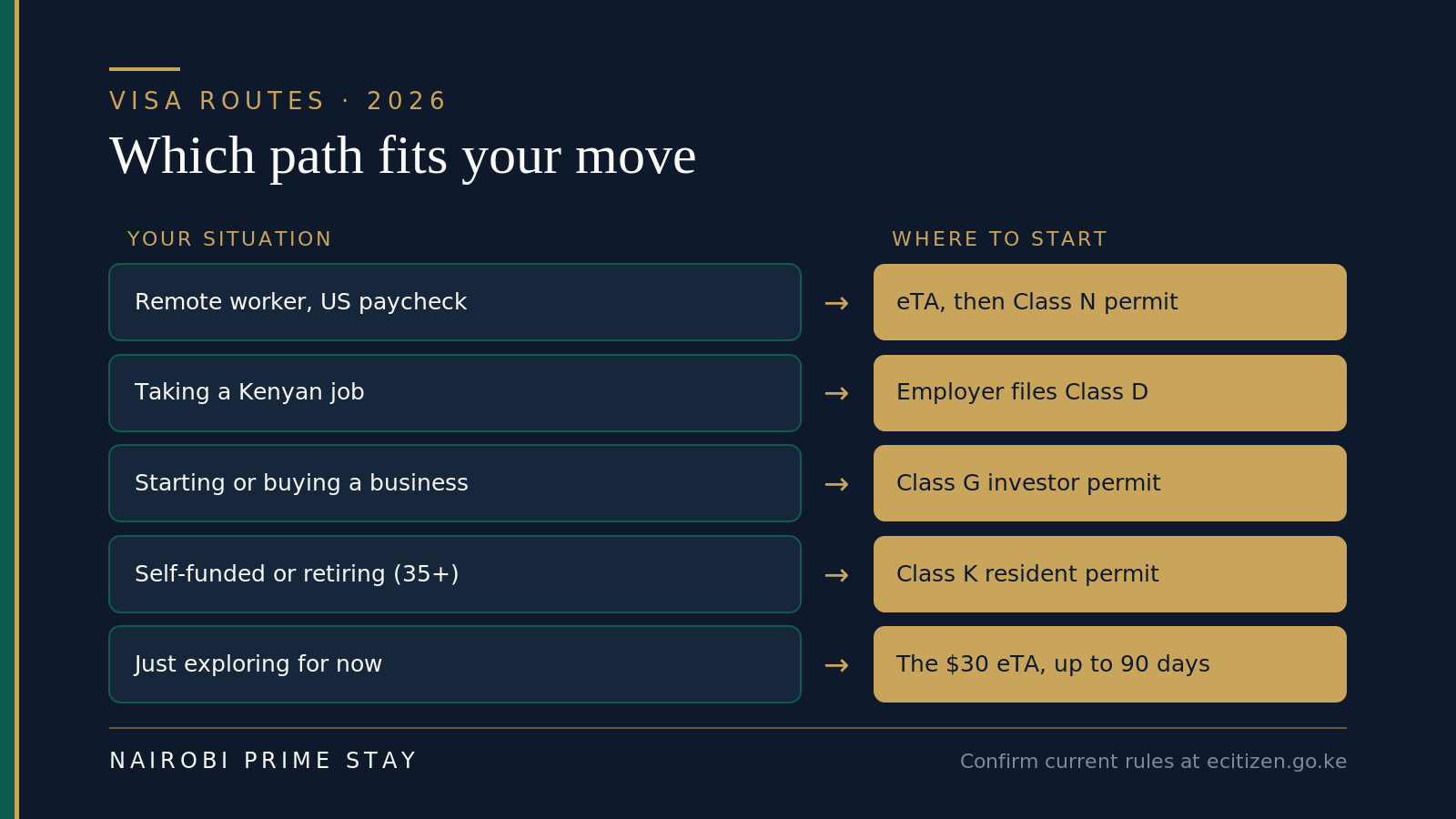 Pick the route that matches your plan — and confirm current rules on the official portal.
Building roots
Relocating is easy; putting down roots takes intention. The people who thrive here tend to do a handful of things on purpose.
Learn some Swahili. You don’t need it to get by — English is an official language and spoken everywhere — but twenty words of Swahili earn real warmth and often a fairer price. Greetings, thank-yous and numbers go a long way; our Swahili basics guide is a quick start.
Respect the culture and learn the unwritten rules. Greetings first, elders first, modest dress outside the home, pole pole (slowly) as a pace of life. Get these right and you’re no longer just a foreigner passing through. Our culture and etiquette guide covers the day-to-day.
Commit to something ongoing. A church, a running club, a class, a cause — one recurring thing where you see the same faces weekly is what turns acquaintances into friends.
Give back, carefully. Many in the diaspora get involved in education, mentorship, farming or local enterprise. The welcome is genuine; the wise approach is to listen first, partner with locals, and avoid the “I’m here to fix things” posture. You’re joining a place that works, not rescuing one.
Play the long game on status. If Kenya becomes home for good, naturalization after about seven years is the path to citizenship, and Kenya recognizes dual nationality so you generally won’t have to give up your US passport. Most people get there one renewed permit at a time.
Investing back home
For a lot of the diaspora, the move is also a chance to build wealth on the continent — and Kenyan property is the most common vehicle. The honest version: as a non-citizen you can own apartments and buildings, but you’re limited to leasehold of up to 99 years and you generally cannot own freehold or agricultural land. The process rewards patience and good lawyers, and land fraud is a genuine risk for the careless.
If that’s on your mind, start with our diaspora property investment in Kenya guide, which is written for exactly this audience — buying from abroad, financing, management and the scams to dodge — and the broader property investing in Kenya pillar for the legal and tax foundations. The one rule that saves people the most heartache: never wire money for a property or plot you (or a trusted advocate acting for you) haven’t independently verified.
The honest challenges
No relocation is all upside, and a guide that pretends otherwise isn’t worth trusting. Here’s the balanced picture.
| What wins | What to weigh |
|---|---|
| A Black-majority society where race isn’t a daily weight | You’re still read as American/foreign, and belonging takes time |
| Mild, spring-like climate nearly all year | An altitude and rainy-season adjustment; dust in dry months |
| A US income, pension or remote salary stretches far | Imported goods, cars and electronics cost more than at home |
| An established, genuinely welcoming community | Friendships take effort, and expat turnover is high |
| Excellent private hospitals; cheap specialist visits | Medicare won’t follow you; very complex care may mean flying out |
| Short flights to safari country and the coast | You’re far from US family, in a time zone 7–8 hours ahead |
| Pan-African belonging and a sense of purpose | Not your literal ancestral roots; no “return” program or fast-track |
| Real room to start a business or invest | Bureaucracy, permits and land due-diligence demand patience |
A few of these deserve a fuller word.
The in-between feeling is real. Some African Americans describe arriving expecting an instant homecoming and finding instead that they’re “too American” to be local here, even as they’d started to feel “too African” for the US. That’s not failure — it’s the honest experience of the diaspora, and most people make peace with holding both. Naming it ahead of time helps.
Bureaucracy tests your patience. Permits, the KRA PIN, opening a bank account, utilities — it all moves slower than you’re used to, with paper, queues and the occasional repeated trip. A good immigration lawyer and a pole pole attitude are worth their weight.
Safety is about street sense, not race. Nairobi is a big city with real but manageable petty-crime risk; violent crime rarely touches the gated western suburbs where most expats live. Your color doesn’t change the safety calculus here — the precautions are the same big-city habits as anywhere. Our is Nairobi safe? guide gives the honest, practical version.
Healthcare is good until it’s exceptional. Routine and even serious care at Aga Khan, Nairobi Hospital or MP Shah is strong and affordable. The gap is at the extreme end — rare cancers, the most complex surgery — which is exactly why you carry international insurance with medical evacuation.
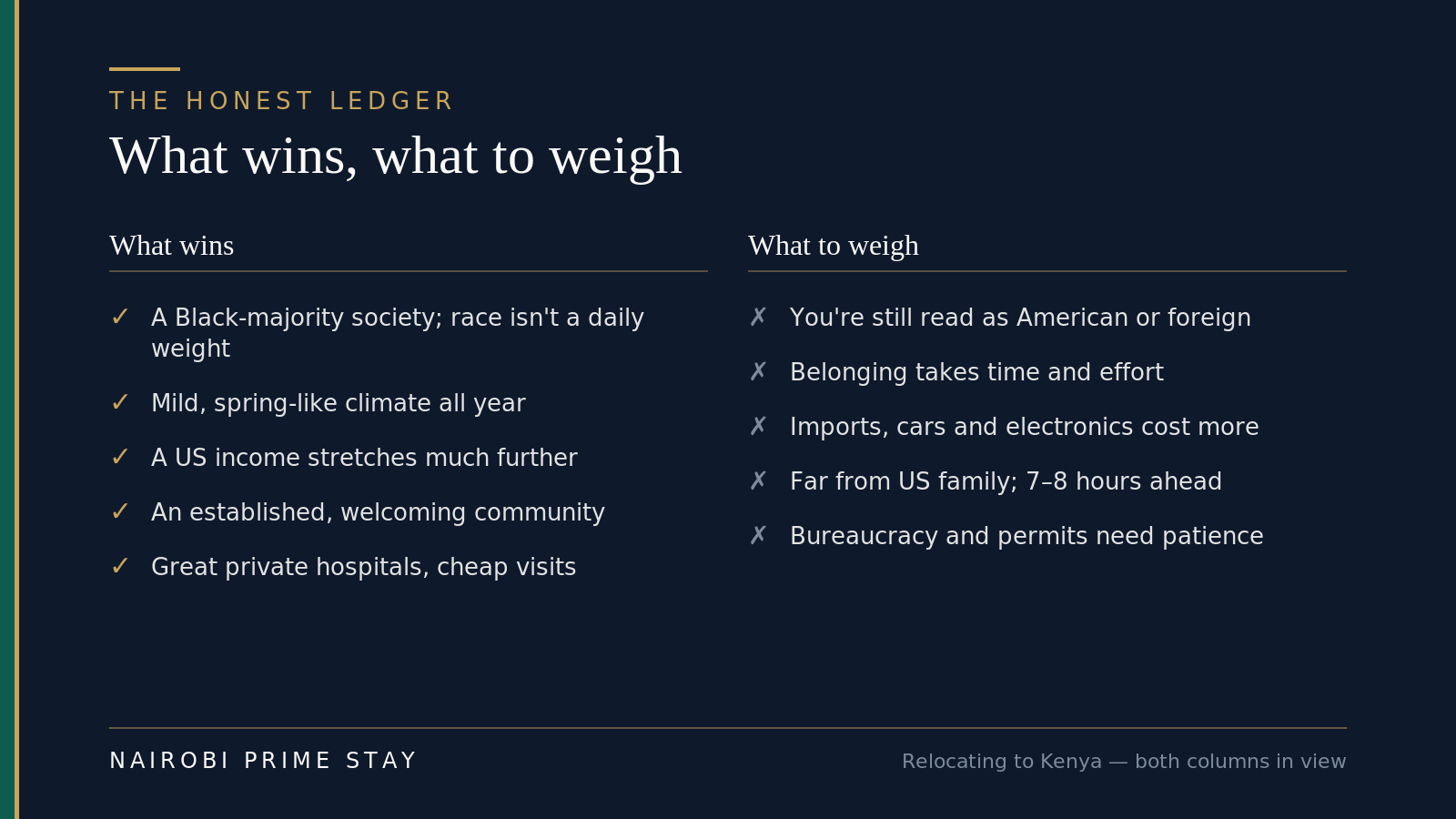 The honest ledger — go in with both columns in view.
A realistic first year
Picture Maya, a 41-year-old UX designer from Atlanta with remote US clients. She flies in on the $30 eTA in February for a two-week scouting trip, stays in a serviced apartment in Kilimani, and spends her evenings meeting people from the Black-expat Facebook group and a Sunday congregation. She likes the energy of Kilimani and Westlands, and pencils in a couple of buildings.
Back home, she lines up a Class N digital-nomad permit with a Nairobi immigration lawyer, sells what she can, and returns in May for good. Her serviced apartment is her base for six weeks while she views long-term flats, sorts her KRA PIN, opens a bank account and registers an M-Pesa line. She signs a 12-month lease on a furnished two-bed in Kileleshwa for about $950 a month, joins a Saturday running crew and a coworking space, and starts learning Swahili on her commute.
By month six she has a routine, a small circle of friends — some Kenyan, some diaspora, some other expats — and a standing safari-weekend habit. She still gets quoted the foreigner price at the curio market, and she misses her mom’s Sunday dinners. But she’s working US hours in the afternoon, paying a fraction of her old rent, and feels, for the first time in a while, unhurried. Year two, she’s looking at a small apartment to buy as a long-term anchor. None of it was magic; all of it was planned.
Your relocation checklist
In rough order, here’s how a sane move comes together:
- Scout first. Apply for the $30 eTA at etakenya.go.ke and spend one to three weeks on the ground before committing to anything.
- Plug into the community early — join the Black-expat and Nairobi expat groups online, and line up coffees for your first week.
- Choose your visa route (Class N, D, G or K) and engage a Kenyan immigration lawyer to file it.
- Book a serviced apartment for your first 4–8 weeks as a secure soft-landing base.
- Sort the essentials on arrival: a SIM and M-Pesa line at the airport, your KRA PIN, and a bank account once your permit allows it.
- View homes in person across two or three suburbs before signing a 12-month lease — never pay for an unseen place.
- Settle the family pieces: enquire at international schools months ahead; line up health insurance with medical evacuation cover.
- Build roots: learn some Swahili, commit to one recurring community, and get your bearings on the culture.
- Plan the long game: if you’ll invest, read up on diaspora property and leasehold rules; if you’ll stay for good, note the ~7-year path to naturalization.
- Stay connected to home — enroll in the US State Department’s STEP program and keep your US family in the loop.
 A calm, ordered first year beats a dramatic leap — every time.
Final thoughts
Kenya isn’t a fantasy of return, and it’s better for it. It’s a real, modern, welcoming country where an African American can build a comfortable life, be part of a Black-led society, and feel the daily weight of race lift in a way that’s hard to describe until you’ve lived it. The welcome is genuine, the community is here, and the practical setup is well-trodden. What it asks of you is honesty about what it is — a Pan-African home you build, not an ancestral one you inherit — and a little patience with the parts that move slowly. Come for that, and Kenya can be one of the best decisions you ever make.
Related reading
- Moving to Nairobi: the complete guide — the big-picture overview for any new arrival.
- Kenya visas for Americans — the eTA and every permit route, in plain English.
- Retiring in Kenya: an honest guide — the Class K route and the trade-offs, if you’re moving later in life.
- Diaspora property investment in Kenya — buying and building wealth back on the continent, written for the diaspora.
- Cost of living in Nairobi — real monthly budgets and prices.
- Best neighborhoods in Nairobi for expats — where to live, compared on character, rent and commute.
- Building a social life in Nairobi — how to find your people and plug into the community.
- Kenyan culture and etiquette and Swahili basics — the small things that turn a foreigner into a regular.
- Is Nairobi safe? — the balanced, practical reality.
When you’re ready to test it for yourself, the easiest first step is a soft landing. Browse our serviced apartments in Nairobi for a furnished, all-inclusive base while you scout and settle, or ask our AI relocation assistant to shortlist options that fit your budget and the suburb you’re eyeing — day or night, no pressure.
Frequently asked questions
Can African Americans move to Kenya?
Yes. African Americans relocate to Kenya the same way any American does, and a growing number have in the past few years. There is no special heritage or ‘return’ visa, so you scout on the 30-dollar eTA and then move onto a longer permit that matches your plans: a Class N digital-nomad permit for remote work, Class D for a job, Class G for a business, or Class K if you are self-funded. Nairobi already has an established African American and wider diaspora community to land into, and the welcome is genuine.
Does Kenya have a Year of Return or diaspora citizenship program like Ghana?
No. The Year of Return and Beyond the Return programs, and the citizenship ceremonies for diaspora descendants, are a Ghana and West Africa story, built around the fact that the transatlantic slave trade drew mainly from West and Central Africa. Kenya is in East Africa and has never marketed itself as a roots-return destination, so there is no heritage visa or fast-track citizenship here. You use the standard immigration routes, and citizenship is possible only by naturalization after about seven years of lawful residence.
Will I feel at home in Kenya as an African American?
Many do, but it grows over time rather than switching on at arrival. The relief of living in a Black-majority society where your race isn’t a daily weight is real and immediate. What’s also real is that you’ll usually be read as American, by accent and dress, and sometimes quoted the foreigner price at a market. Belonging in Kenya is something you build by learning a little Swahili, respecting local culture, joining the community and becoming a regular face. People who treat it as a relationship rather than a guaranteed homecoming tend to settle in deeply.
What visa do I need to move to Kenya from the US?
It depends on what you’ll do. Everyone scouts on the 30-dollar eTA from etakenya.go.ke, good for visits up to 90 days. For a longer stay you choose: Class N for remote workers paid from abroad (about 200 dollars plus 1,000 dollars a year), Class D for a job with a Kenyan employer, Class G for starting or buying a business, or Class K for self-funded residents 35 and older with assured non-work income. Fees and rules change, so confirm current details on the official portal at ecitizen.go.ke and consider using a Kenyan immigration lawyer.
Can African Americans get Kenyan citizenship?
Yes, but not by heritage. For someone without Kenyan ancestry, the route is naturalization after about seven years of lawful residence, with good character and a working knowledge of English or Swahili; processing can take several months to a couple of years. Kenya has recognized dual citizenship since its 2010 Constitution, so you generally won’t have to renounce your US passport. Confirm the current requirements with the Directorate of Immigration Services (immigration.go.ke) before you rely on them.
Is it cheaper to live in Kenya than the US?
For most people, yes. A US salary, pension or remote paycheck stretches noticeably further: a comfortable, secure apartment in a prime Nairobi suburb rents for roughly 800 to 1,200 dollars a month, and domestic help, fresh food and specialist doctor visits cost a fraction of US prices. The exceptions are imported goods, cars and electronics, which carry markups. A couple lives comfortably on about 2,500 to 4,500 dollars a month depending on rent, schooling and insurance.
Can I work or start a business in Kenya as an American?
Not on a visitor or nomad permit for local work, since those don’t let you earn money inside Kenya. To take a Kenyan job you need a Class D work permit; to run your own business you typically register a company and hold a Class G investor permit. Remote income from US clients is what the Class N nomad permit is for. Many in the diaspora successfully run tour companies, cafes, farms and consultancies here, but set it up properly with a KRA PIN and local legal and tax advice.
Is Nairobi safe for African American expats?
Yes, with the normal precautions you’d take in any large city. Most expats live in gated western suburbs with 24/7 security and rarely have trouble; the main risk is opportunistic petty theft, not violence, and your race doesn’t change that calculus. Keep valuables out of sight in traffic, use Uber or Bolt after dark, and trust local advice on areas and times to avoid. Save the emergency numbers 999 or 112 and enroll in the US State Department’s STEP program.
Ready to look?
Find your apartment in Nairobi
Browse verified serviced apartments, or ask the AI concierge which area fits your life.