
Guides · Cost of living
Furnishing a Home in Nairobi: Where to Buy & What It Costs (2026)
Furnishing a Home in Nairobi: Where to Buy & What It Costs (2026)

You can furnish a one-bedroom apartment in Nairobi for about $1,000 going local and secondhand, or spend $5,000 buying everything new — same apartment, very different bill. Where you land depends on how you shop, not just what you buy. This guide shows you both ends and everything between.
It’s written for Americans who’ve signed an unfurnished lease and are staring at empty rooms, or who are weighing whether to furnish at all. We’ll cover what it really costs to furnish a one- or two-bedroom place in 2026, where to buy — the Ngong Road furniture strip, the malls, custom carpenters, and the secondhand and expat-sale routes most newcomers miss — what appliances cost and how to power them safely, and when not buying at all is the smarter move. Prices float with the market and the exchange rate, so treat every figure as a 2026 range, not a quote.
The quick version
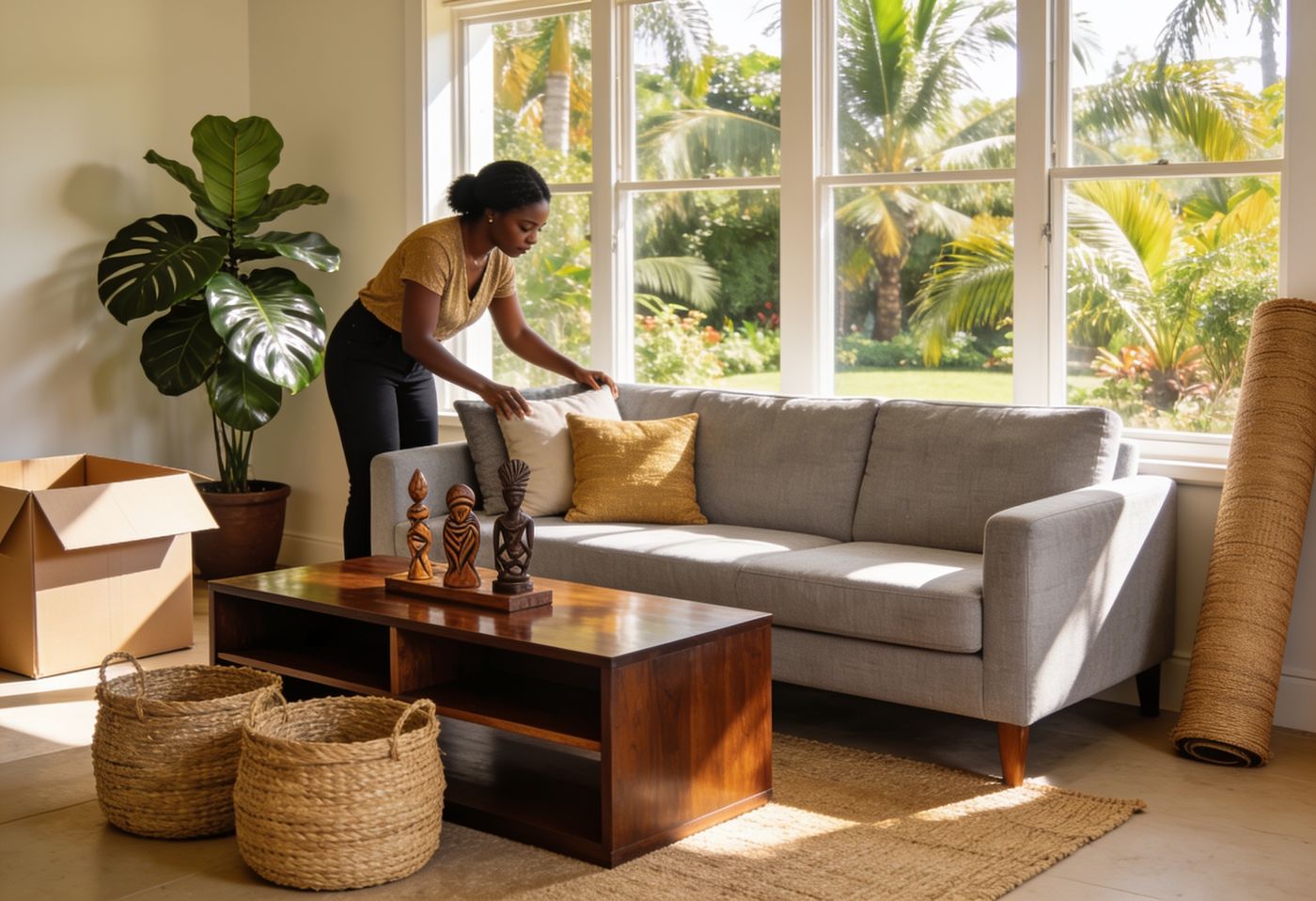
Furnishing an unfurnished Nairobi apartment to a comfortable standard — mostly new, mid-range pieces and full appliances — costs roughly $3,000–6,000 for a one- to two-bedroom in 2026. You can do it for far less: a budget furnish leaning on Ngara market, artisan carpenters and secondhand expat sales runs closer to $1,000 for a one-bed and $1,700 for a two-bed. You can also spend well past $10,000 going high-end and imported. The biggest single lever is sourcing: buying secondhand or commissioning local artisans is routinely a third to a half cheaper than the Ngong Road and mall showrooms. New furniture usually carries a one-to-three-week delivery wait, and custom pieces longer, so order early. And if you’re here for months rather than years — or still choosing a neighborhood — the cheapest, fastest option is to skip furnishing entirely and take a serviced apartment where it’s all included.
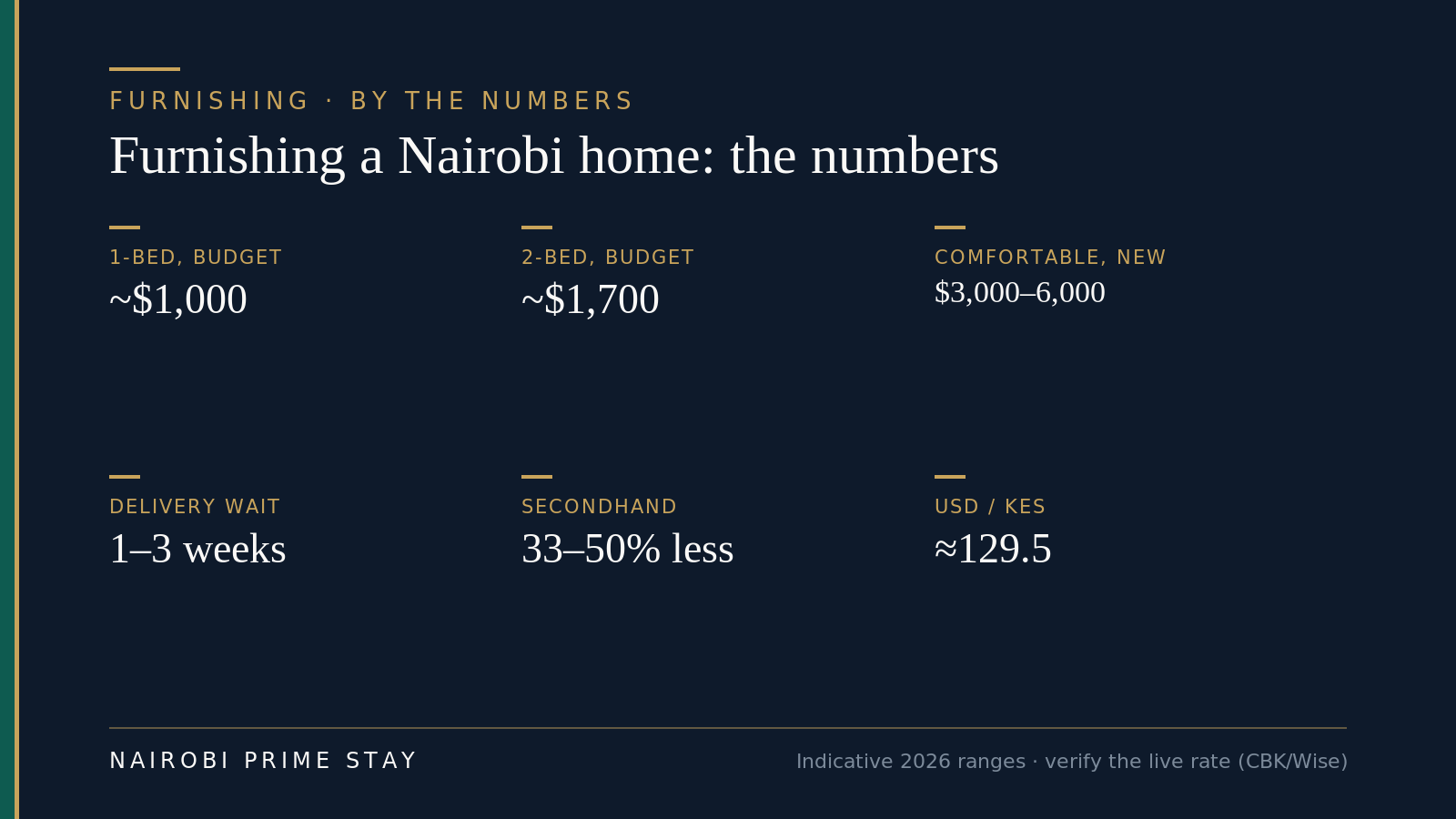 Indicative 2026 figures for orientation — furniture prices and the exchange rate move, so treat them as ranges and check the live rate before you budget.
Why you may be starting from scratch
In Nairobi, “unfurnished” often means genuinely bare — and that’s why furnishing is a bigger job here than it is back home. Many unfurnished apartments come without a fridge, a cooker, light fittings, curtains, or a water heater. You can get the keys to a beautiful place and have nowhere to cook dinner or hang a shirt. Modern builds usually include fitted wardrobes and kitchen cabinetry, but white goods and soft furnishings are typically the tenant’s job.
So before you budget, know exactly what you’re starting with. Walk the apartment at the viewing and get a written list of what stays. If the gap between “unfurnished” and “ready to live in” is large, the furnishing bill below is the real cost of that cheaper rent. For the full furnished-versus-unfurnished math — and when the premium for a furnished place is worth paying — see our guide to furnished vs unfurnished in Nairobi.
What it costs to furnish a 1- or 2-bed
Here’s the honest spread for 2026. The same apartment can cost wildly different amounts depending on whether you buy new from showrooms, mix in artisan-made and secondhand pieces, or go top-end and imported.
| Standard | How you shop | 1-bedroom | 2-bedroom |
|---|---|---|---|
| Budget | Mostly secondhand, Ngara market, local carpenters; basic appliances | ~$1,000 (KES ~130k) | ~$1,700 (KES ~215k) |
| Comfortable | Mix of new mid-range showroom pieces, custom wood, full appliances | $3,000–4,500 | $4,500–6,000 |
| High-end | Mostly new, branded and imported furniture and appliances | $8,000–12,000+ | $12,000–18,000+ |
The budget figures track recent 2026 furnishing-cost data for Nairobi; the comfortable range reflects what most relocating professionals actually spend buying largely new with a few custom pieces. Two things move these numbers most: how much you buy new versus used, and how patient you are. A weekend of shopping the showrooms is fast and expensive; a couple of weeks working secondhand listings and a carpenter is slower and far cheaper.
Item by item (comfortable, mostly new)
To see where the money goes, here’s a rough per-item budget for furnishing to a comfortable standard with mostly new, mid-range pieces in 2026. Secondhand can cut most of these by a third to a half.
- Bed, mattress and wardrobe: $400–900 per bedroom. A good mattress is the one place not to skimp.
- Sofa / living-room set: $500–1,200. The single biggest living-room line.
- Dining table and chairs: $250–600. Solid-wood custom often beats showroom prices here.
- Fridge: $350–800. Cooker (hob + oven): $300–700. Microwave: $80–200.
- Washing machine: $400–900. Not every building has laundry, so many people buy their own.
- Curtains, lighting, smaller kitchen items and decor: $400–1,000. Small things add up fast.
A water heater (an “instant” electric shower heater or a larger tank unit) is an easy line to forget — budget $80–250 installed if the apartment doesn’t already have one.
Where to buy furniture in Nairobi
There are five main routes, and most newcomers end up using all of them — appliances from a mall, a sofa from a showroom, a bed and wardrobe from a carpenter, the odd piece from an expat leaving the country. Here’s how they compare, then each one in detail.
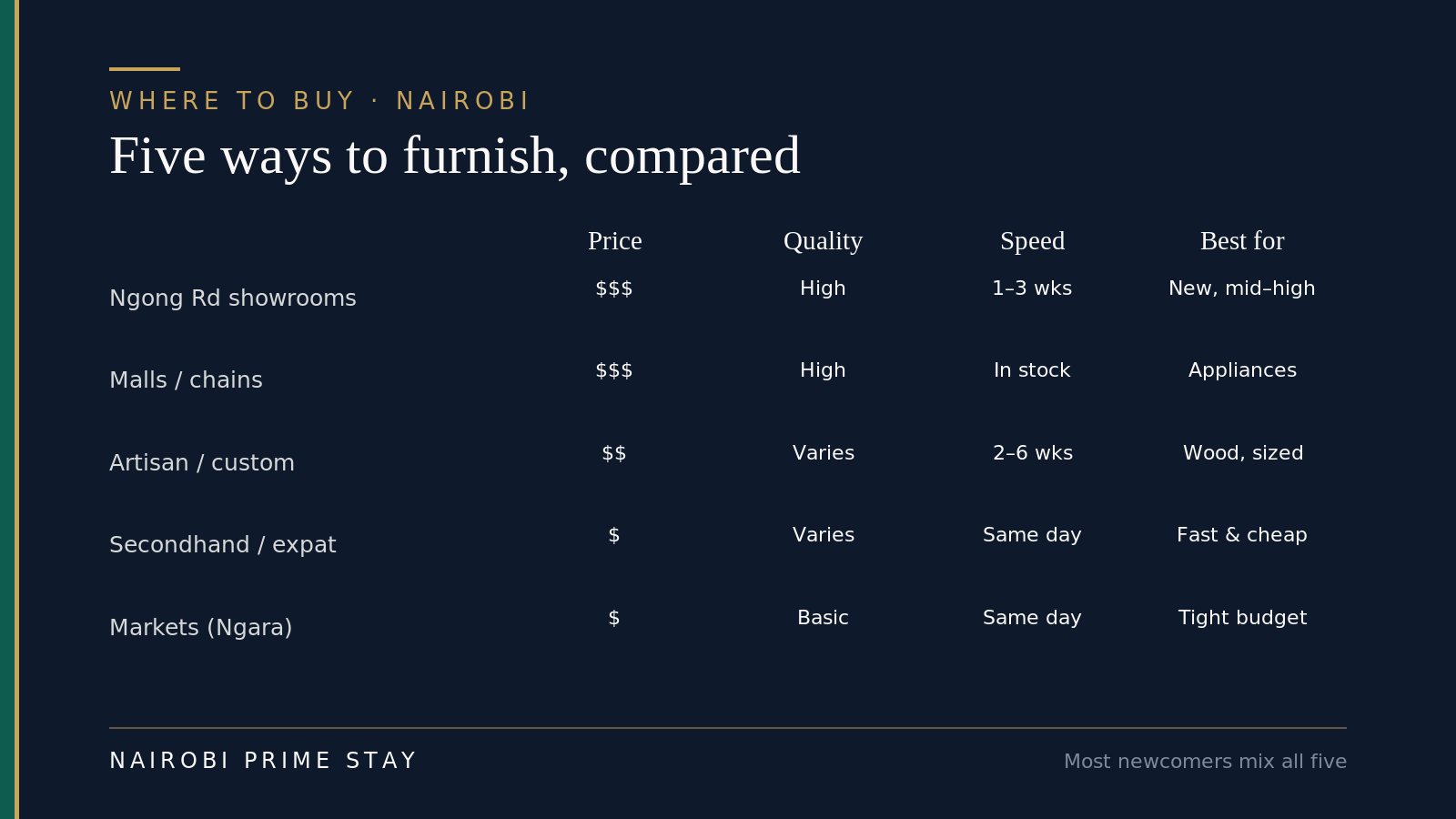 Five routes, side by side. Mixing them — new where it matters, used or custom where it doesn’t — is how you keep the bill down without living in a half-empty flat.
Ngong Road: the furniture strip
Ngong Road is Nairobi’s best-known furniture run — a long stretch of showrooms and roadside workshops where you can compare a dozen sofas and beds in an afternoon. The showrooms sell new, mid-to-high-end pieces with delivery and some warranty; the roadside stalls and workshops behind them make and sell solid-wood furniture, often to order, for noticeably less. It’s the natural first stop precisely because you can see the full range — formal retail and artisan-made — in one place. Bring measurements, haggle at the smaller shops, and confirm the delivery date in writing before you pay.
Malls and furniture chains
For appliances and reliable new furniture, the malls and established chains are the easy, no-drama option. Furniture Palace (Ngara Road) and Victoria Courts (branches off Ngong Road in Karen, in Westlands, and on Thika Road) are well-known names with showrooms, delivery and online ordering. For white goods and electronics, big-box retailers like Carrefour and Hotpoint in the major malls — Two Rivers, The Hub Karen, Sarit, Village Market, Garden City — stock fridges, cookers, washing machines and TVs in stock, so there’s no delivery wait. You’ll pay full retail, but you get warranties, returns and same-day pickup.
Custom carpenters and artisan workshops
Commissioning furniture is a Nairobi superpower most newcomers discover late. Skilled carpenters in Ngara, along Ngong Road, and on Kiambu Road will build a bed, wardrobe, dining table, bookshelf or TV unit to your exact dimensions in solid local hardwood, usually for less than an equivalent showroom piece. It’s ideal for awkward spaces and for anyone who wants real wood rather than veneer. The trade-offs: quality varies workshop to workshop, so ask to see finished work and get a clear quote and timeline (2–6 weeks is normal), and pay in stages rather than all up front.
Secondhand and expat “leaving sales”
This is the single best-kept secret for furnishing fast and cheap. Nairobi has a steady churn of expats, diplomats and NGO staff rotating out, and they sell whole apartments’ worth of good furniture at a steep discount through Facebook groups (search for Nairobi “expat” and “buy/sell” groups), WhatsApp groups, and on Jiji and PigiaMe, Kenya’s big classifieds sites. You can often buy a near-new sofa, bed, fridge and dining set from one departing family in a single afternoon, sometimes with curtains and kitchenware thrown in. Inspect everything in person, test appliances before paying, and arrange your own transport (a pickup or a “mtu wa mkokoteni” hire is cheap). Pay on collection, never in advance.
Markets
For the tightest budgets, the markets — Ngara, Gikomba and the Maasai Market for textiles and decor — sell basic new and used furniture and household goods for the least money in the city. Quality is hit and miss and you’ll need to look, but for a first cheap bed, a set of chairs, curtains or kitchenware, it’s hard to beat. Go with someone who knows the ropes if you can, keep your phone out of sight, and negotiate.
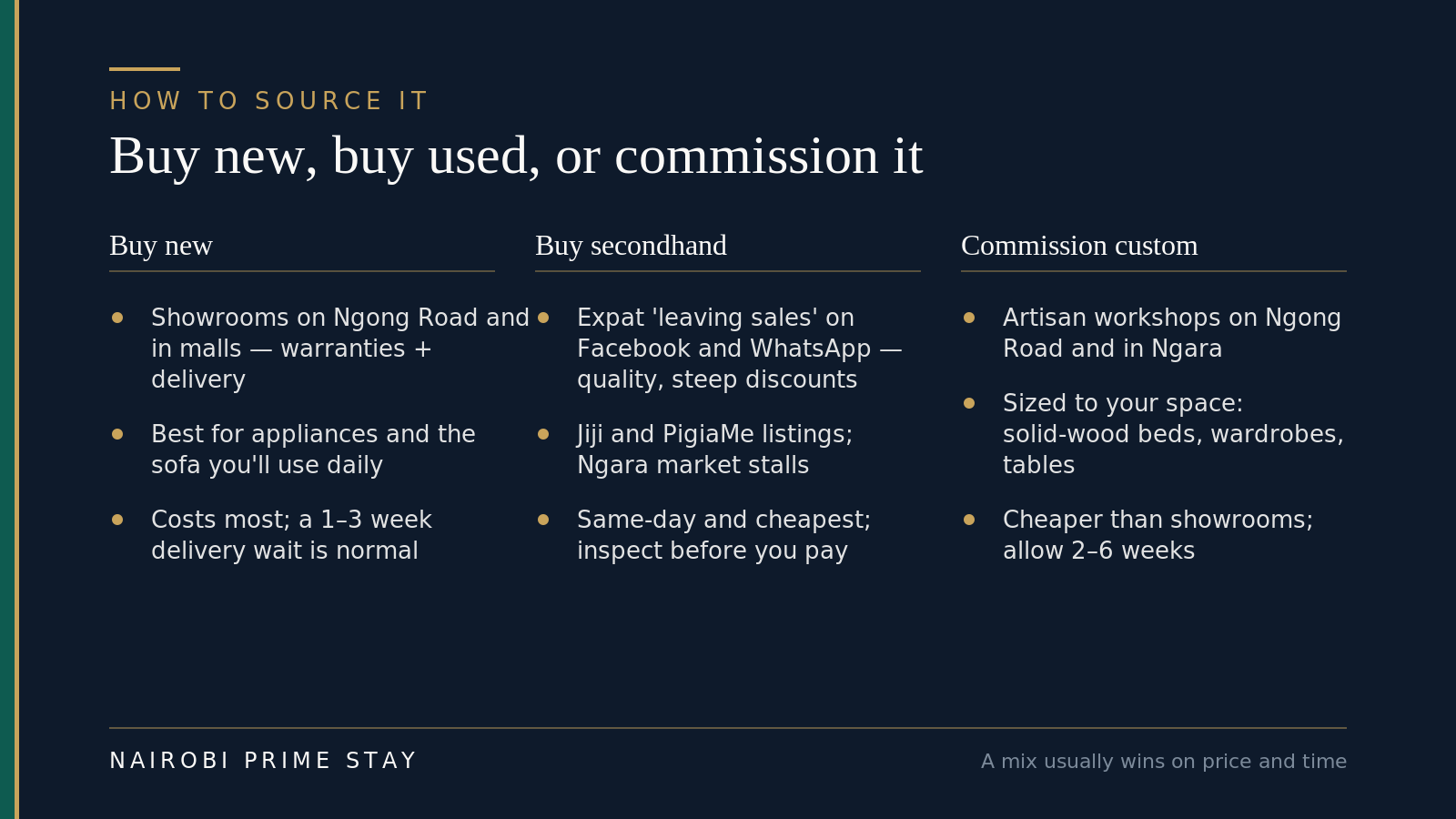 New for what you’ll use hardest, custom for wood and odd spaces, secondhand for everything else — that mix is how the budget furnish stays cheap.
Buying furniture online without getting scammed
Secondhand is where the real savings are — and where newcomers get burned. The rule is simple: never send money for furniture no one you trust has seen in person. Almost every furniture scam in Nairobi runs the same way. A too-good listing appears on Jiji, PigiaMe or a Facebook group. The “seller” is warm and quick on WhatsApp, then asks for a deposit to hold the item, or a delivery fee up front, paid to a personal M-Pesa number. You pay, and the sofa — or the seller — never turns up.
Protect yourself the same way you would against rental and property scams: see it live, test it, and pay only when you’re standing next to it.
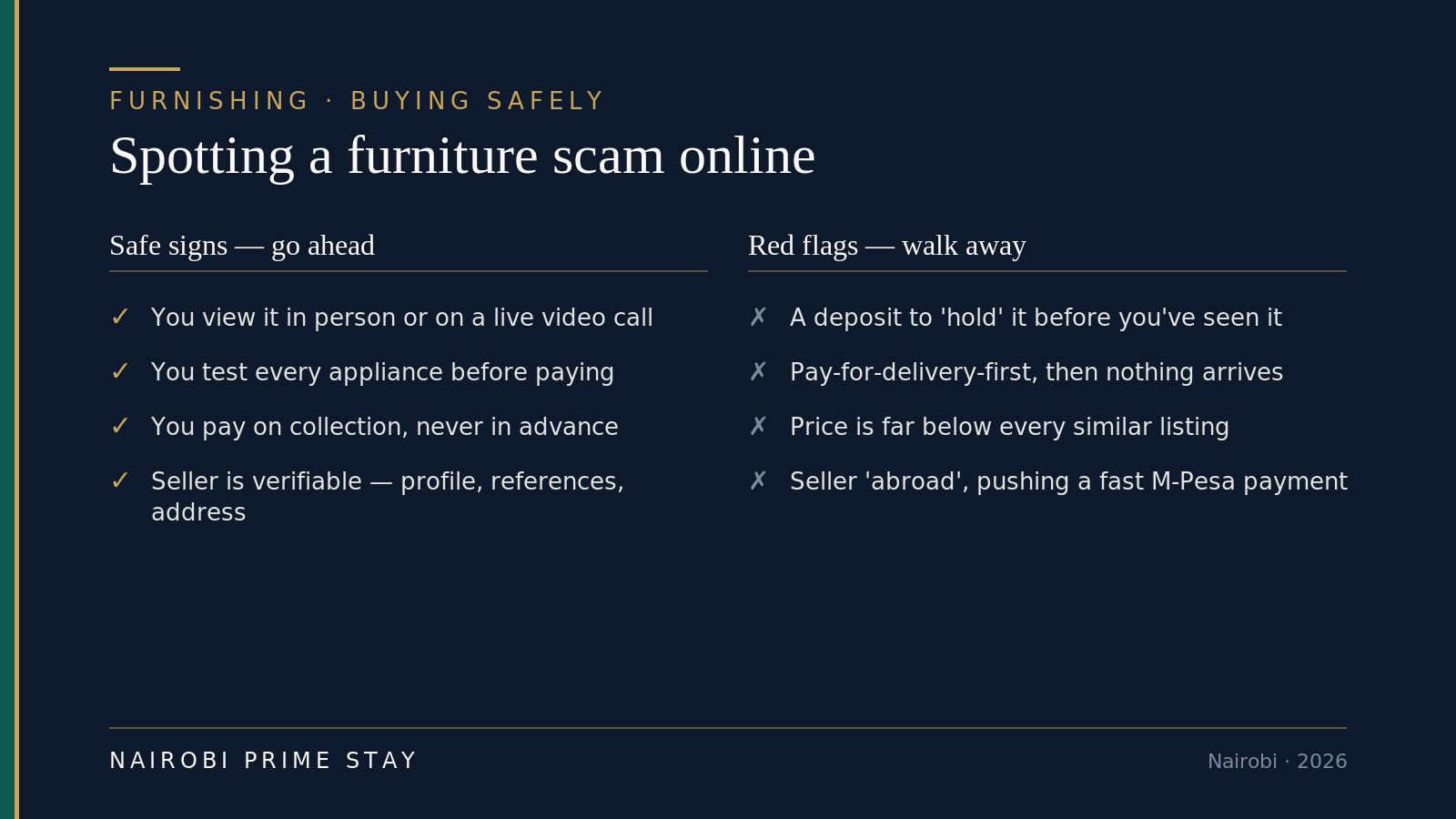 The pattern is always the same — money before you’ve seen the item. Flip that order and most furniture scams fall apart.
Here’s the safe order for any secondhand or classifieds buy:
- View before you pay. In person is best. If you can’t get there yourself, insist on a live video call showing the actual item — not photos that could be lifted from anywhere.
- Test every appliance. Plug in the fridge, run the washing machine, switch on the cooker. A dead appliance is the most common secondhand regret.
- Pay on collection, never in advance. Cash or M-Pesa to a named person when you’re taking the item away. No deposit to “hold” it, no delivery fee wired first.
- Check the seller is real. A genuine departing expat has an account with history, references from a building or agent, and a real address you can visit. A brand-new profile pushing a fast sale is a warning.
- Arrange your own collection. A pickup or a mkokoteni hire is cheap, and it means you control the handover instead of trusting a stranger’s “delivery.”
None of this is unique to furniture — it’s the same instinct that keeps you safe renting a home sight unseen. If a deal only works when you pay first, it isn’t a deal.
Appliances, electronics and power
Buy appliances new unless a secondhand one is nearly new and you can test it. A fridge, cooker or washing machine that fails is more hassle than the saving is worth, and the malls give you warranties. Carrefour, Hotpoint and the chain stores carry all the major brands; expect a fridge around $350–800, a cooker $300–700, and a washing machine $400–900 depending on size and brand.
A few Nairobi specifics worth knowing before you plug anything in:
- Power is 240V with UK-style Type G (three-pin) plugs. Anything you brought from the US needs at minimum a plug adapter, and anything that isn’t dual-voltage (check the label — most laptop and phone chargers are; hair dryers and kettles often aren’t) needs a voltage converter or it will fry. It’s usually simpler and cheaper to buy small appliances locally than to ship and convert them.
- Outages happen. A building with a backup generator keeps your fridge and Wi-Fi alive; if yours doesn’t have one, a small inverter or UPS for your router and laptop is a sensible buy. This is one of the “Nairobi Five” checks worth making before you sign a lease.
- Protect your electronics. Voltage can be uneven, so use surge protectors on the TV, fridge and computer. They’re cheap locally and save expensive kit.
If you’re shipping a container of your own furniture and appliances from home, the calculation is different — read shipping your belongings to Kenya for what’s worth bringing (and what isn’t) once you factor in duties, voltage and the sea-freight wait.
The smart order to buy in
You don’t have to buy everything at once, and you shouldn’t. Sort the essentials so you can live, then add the rest over your first few weeks as you find good pieces and learn the city.
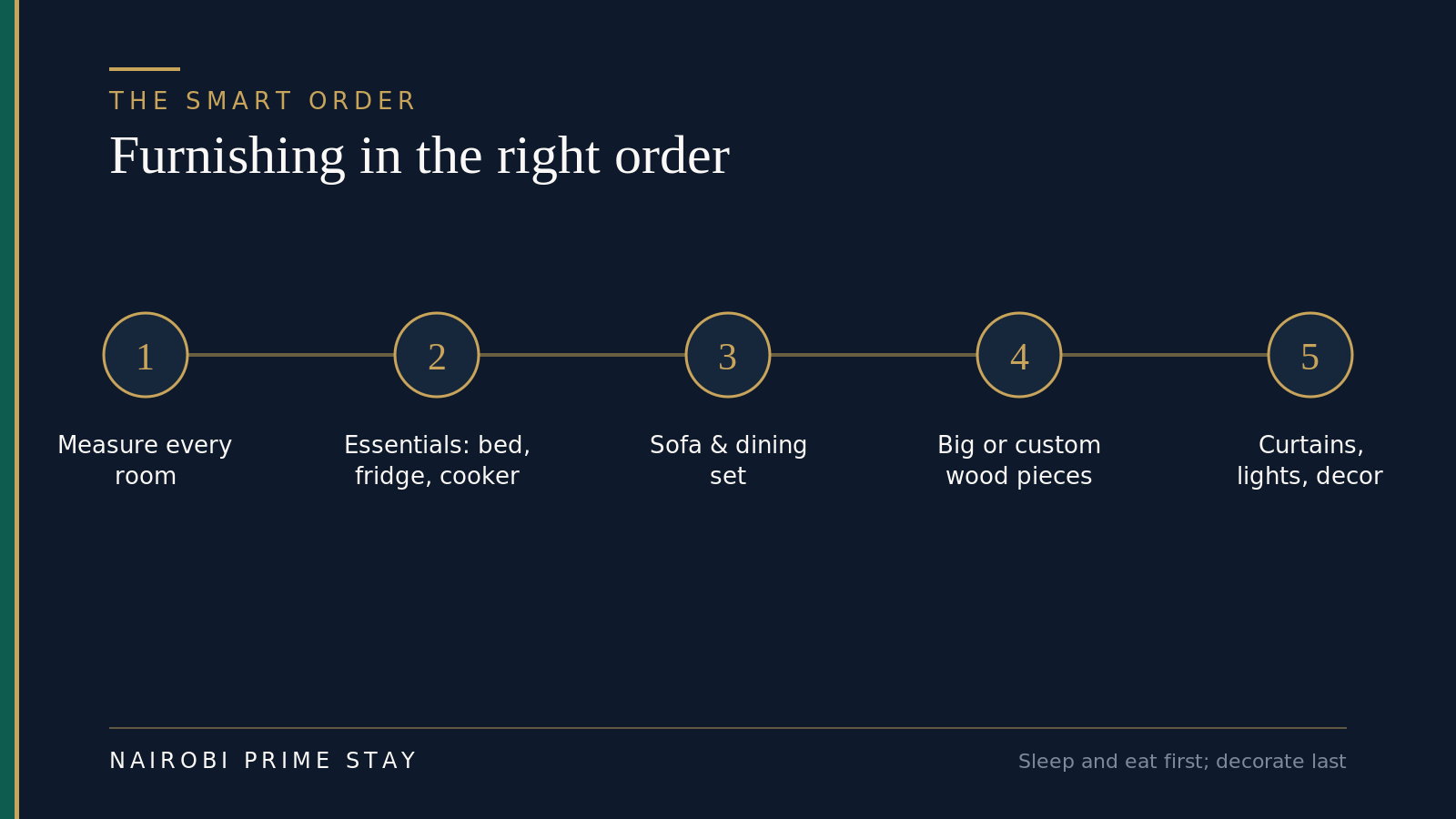 Sleep and eat first, decorate last. Measuring before you shop saves the most expensive mistake — furniture that won’t fit the room or the lift.
Start by measuring every room, doorway and the lift — Nairobi apartments and older stairwells can defeat a big sofa, and a custom carpenter needs your numbers anyway. Then buy the essentials that let you live: a bed and mattress, a fridge, a cooker, and a kettle. Next add the sofa and dining set so the place feels like home. Then commission or source the big and custom pieces — wardrobes, shelving, a proper dining table — which take longest to arrive. Finish with curtains, lighting, rugs and decor, the cheap, fast layer that makes the difference between furnished and finished.
The alternative: don’t furnish at all
Before you spend a weekend in showrooms, ask whether you should be furnishing at all yet. For a lot of newcomers, the answer is “not now.”
If you’re in Nairobi for months rather than years, or you’re still deciding which neighborhood fits your commute and budget, furnishing a place is money and time spent on a decision you haven’t fully made. A serviced apartment skips the whole job: it’s fully furnished and all-inclusive, with Wi-Fi, cleaning, a backup generator and security bundled into one monthly price. Nothing to buy, nothing to power, nothing to sell when you leave.
That’s why most people we host start serviced for their first four to eight weeks, use that time to view homes and test the traffic in person, and only furnish once they’ve signed a lease they’re sure about. It also dodges the most expensive furnishing mistake of all — kitting out a place in the wrong neighborhood, then doing it again. When you are ready to commit, our renting guide walks through leases, deposits and the viewing checks, and a $50 deposit reserves a serviced apartment with the balance paid on arrival.
One more honest cost to weigh: resale. Whatever you buy, you’ll likely sell at a loss when you leave — often a third to a half of what you paid, because expats are always selling. Factor that into the “buy versus serviced” math, especially for shorter stays.
Should you rent furniture instead of buying?
You can, and for some stays it’s the smartest move. A handful of Nairobi firms rent furniture by the month — anything from a single room to a whole house — and let you swap pieces, extend, or hand it all back when you leave. CORT and a few local companies run these packages. Ask for a written inventory, the monthly price, and what happens if something breaks before you sign.
Renting furniture sits between buying and going serviced. You skip the big upfront outlay and the resale headache, but you pay a monthly fee and you’re limited to the company’s catalogue. It suits a six-to-twenty-four-month stay in an unfurnished place — long enough that a serviced apartment adds up, short enough that buying and then reselling is a hassle you’d rather skip. If your employer arranges your housing, corporate housing sometimes folds furniture in too.
Here’s how the four main ways to set up a home compare:
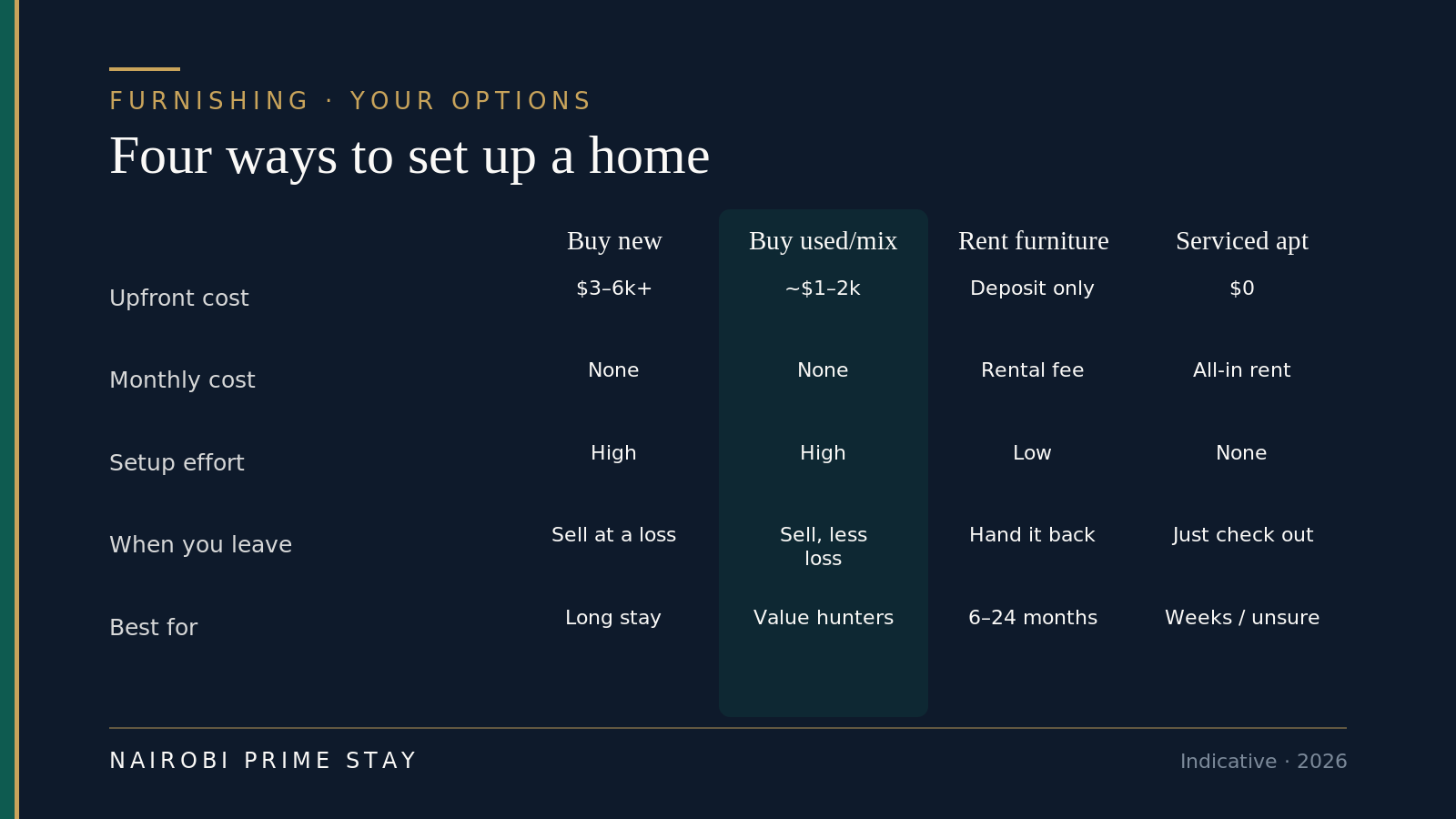 Four routes, honestly compared. Buying used is the value pick for a multi-year stay; renting furniture or going serviced wins when you’re here briefly or still deciding.
If you’re furnishing a place to let out rather than to live in, the math is different again — our short-let investment guide covers furnishing a home so it books well.
Furnishing for a fixed posting: buy smart, sell well
If you’re on a two-, three- or four-year posting and you’ve decided to buy, furnish with the exit in mind. Nairobi’s expat furniture market runs in both directions: the same churn of UN, NGO and embassy staff that lets you buy cheap on the way in lets you sell on the way out. Play it right and you recoup a third to a half of what you spent.
Some things hold their value; others don’t. Solid-wood custom pieces, a quality mattress (buy a protector so it stays sellable), and appliances with the box and warranty card resell well. Upholstered sofas, flat-pack and veneer, and anything electronic that dates quickly soften fast. Curtains, small decor and kitchenware are near-worthless secondhand — bundle them in free to close the sale on the big items.
When your time comes, run your own leaving sale rather than dumping everything at the last minute for pennies:
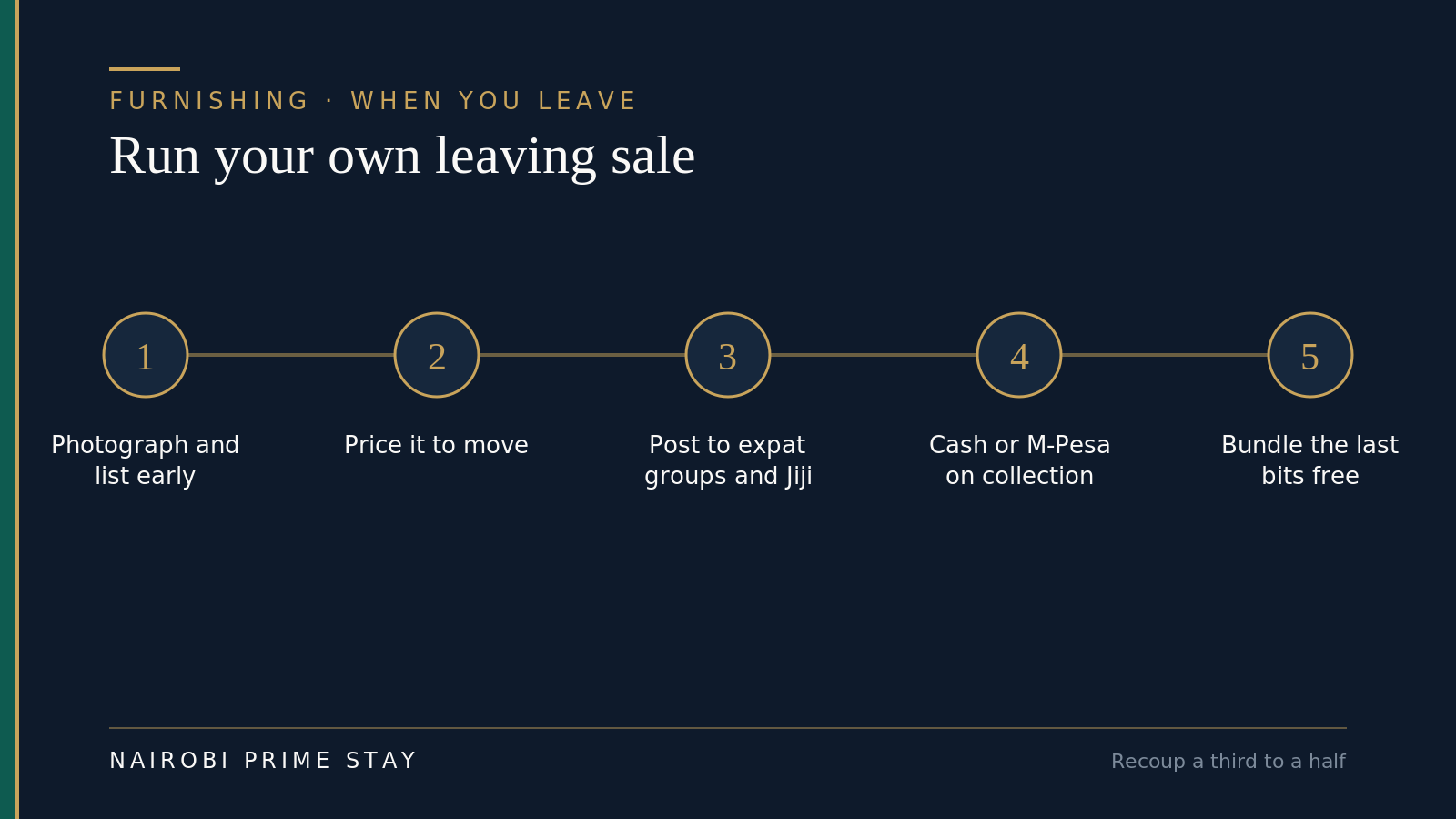 Start early and price to move. A family that lists three weeks out clears the lot; one that waits for the movers gives it away.
Start early: photograph and list two to three weeks before you go, while buyers still have time to arrange transport. Price it to move, not to break even — you’re competing with every other leaver. Post to the same expat Facebook and WhatsApp groups and Jiji you bought from. Take cash or M-Pesa on collection, and let buyers sort their own pickup. Bundle the last odds and ends free for whoever takes the biggest piece. Done well, the loss on your furniture across a multi-year stay is small — and far less than a serviced apartment would have cost over the same years.
How this plays out: two scenarios
The remote worker, here for a year. Dani signs a 12-month unfurnished lease in Kilimani to keep the rent low. Rather than buy everything new, she spends her first two weekends working the expat Facebook groups and Jiji: she buys a near-new sofa, bed and fridge from a departing UN family for a fraction of retail, commissions a simple wardrobe and desk from a carpenter in Ngara, and picks up curtains and kitchenware at the market. Total: a little over $1,500, and she sells most of it for a similar share when she leaves.
The family, here for the long haul. The Bensons take a four-year posting and a three-bedroom house in Karen. They furnish properly and mostly new — beds and a good mattress for each child, a large sofa, a custom solid-wood dining table that seats eight, full appliances including a washer-dryer. It runs them around $9,000 over their first two months, spread across a four-year stay, and the custom pieces are sized exactly to the house. For their timeline, buying well makes sense; for Dani’s, it wouldn’t have.
A furnishing checklist
Run through this before and during the job:
- Confirm what’s included in the apartment in writing — fridge, cooker, wardrobes, water heater, light fittings, curtains.
- Measure every room, doorway, stairwell and lift before you shop or commission anything.
- Set a budget by standard — roughly $1,000–1,700 budget, $3,000–6,000 comfortable for a 1–2 bed.
- Buy essentials first: bed and mattress, fridge, cooker, kettle — so you can live from night one.
- Check the expat sale groups and Jiji/PigiaMe before buying big items new; the savings are large.
- Get a quote and timeline in writing from any carpenter, and pay in stages.
- Buy appliances new with a warranty, and test any secondhand appliance before paying.
- Sort power: Type G plugs, surge protectors, and an inverter/UPS if there’s no generator.
- Confirm delivery dates in writing — a one-to-three-week wait on new furniture is normal.
- Keep receipts and inspect on delivery before signing anything off or paying the balance.
Frequently asked questions
Where do I buy furniture in Nairobi?
The main routes are the Ngong Road furniture strip (showrooms for new pieces plus roadside workshops that build to order), malls and chains like Furniture Palace and Victoria Courts, big-box stores such as Carrefour and Hotpoint for appliances, custom carpenters in Ngara, along Ngong Road and on Kiambu Road, and secondhand buys through expat “leaving sale” groups on Facebook and WhatsApp plus the Jiji and PigiaMe classifieds. Most newcomers use several: appliances from a mall, a sofa from a showroom, a bed from a carpenter, and the odd piece from a departing expat.
How much does it cost to furnish an apartment in Nairobi?
Furnishing a one- to two-bedroom apartment to a comfortable standard with mostly new, mid-range pieces and full appliances runs roughly $3,000–6,000 in 2026. A budget furnish leaning on secondhand, the Ngara market and local carpenters can come in near $1,000 for a one-bed and $1,700 for a two-bed, while high-end and imported furnishing runs well past $10,000. Prices move with the market and the USD/KES rate (around 129.4 in mid-2026), so treat any figure as an indicative range.
Is it cheaper to buy furniture new or secondhand in Nairobi?
Secondhand is much cheaper — often a third to a half of retail — because Nairobi has a steady churn of expats, diplomats and NGO staff rotating out and selling whole households at a discount through Facebook and WhatsApp groups, Jiji and PigiaMe. The catch is that you inspect in person and pay on collection, never in advance. Appliances are the exception: buy those new for the warranty unless a unit is nearly new and you can test it first.
What is the Ngong Road furniture strip?
Ngong Road is Nairobi’s best-known furniture run — a long stretch of showrooms and roadside workshops where you can compare beds, sofas and dining sets in a single afternoon. The showrooms sell new mid-to-high-end pieces with delivery and some warranty; the stalls and workshops behind them make solid-wood furniture, often to order, for noticeably less. Bring your room measurements, haggle at the smaller shops, and confirm the delivery date in writing before you pay.
Should I use a custom carpenter in Nairobi?
Often yes, especially for beds, wardrobes, dining tables and awkward spaces. Carpenters in Ngara, along Ngong Road and on Kiambu Road will build to your exact dimensions in solid local hardwood, usually for less than an equivalent showroom piece. Quality varies between workshops, so ask to see finished work, get a clear written quote and timeline (two to six weeks is normal), and pay in stages rather than all up front.
Does an unfurnished apartment in Nairobi come with appliances?
Often not. Unfurnished in Nairobi frequently means genuinely bare — no fridge, cooker or microwave, and sometimes no light fittings, curtains or water heater. Most modern buildings include fitted wardrobes and kitchen cabinetry, but white goods and soft furnishings are usually the tenant’s responsibility. Walk the apartment at the viewing and get a written list of exactly what is and isn’t included before you sign.
Can I use my US appliances and electronics in Kenya?
Only with care. Kenya runs on 240V with UK-style Type G three-pin plugs. Dual-voltage devices — most laptop and phone chargers — just need a plug adapter, but single-voltage US items like many hair dryers and kettles need a voltage converter or they’ll be damaged. For small appliances it’s usually cheaper and simpler to buy locally than to ship and convert them.
Is it worth furnishing a place or just renting a serviced apartment?
If you’re staying months rather than years, or you’re still choosing a neighborhood, a serviced apartment is usually cheaper and far less hassle — it’s fully furnished and all-inclusive, with nothing to buy, power or sell when you leave. For a multi-year stay, furnishing an unfurnished place is cheaper overall once the furniture is paid off. A common middle path is to start serviced for the first four to eight weeks, then furnish once you’ve signed a lease you’re sure about.
How do I avoid furniture scams on Jiji and Facebook Marketplace in Nairobi?
Never pay for furniture that you, or someone you trust, hasn’t seen in person. The common scam is a too-good listing where the seller asks for a deposit to hold the item or a delivery fee up front, paid to a personal M-Pesa number — then nothing arrives. View it live (in person or on a real-time video call), test any appliance, confirm the seller is verifiable, and pay only on collection, never in advance. Arrange your own transport so you control the handover.
Can I rent furniture in Nairobi instead of buying it?
Yes. A few firms, including CORT and some local companies, rent furniture by the month — from a single room to a whole house — and let you swap, extend, or return it when you leave. It sits between buying and a serviced apartment: no big upfront cost or resale hassle, but a monthly fee and a limited catalogue. It suits roughly a six-to-twenty-four-month stay in an unfurnished home. Ask for a written inventory, the monthly price, and what happens if something breaks.
How much of my furniture cost will I get back when I leave Nairobi?
Usually about a third to a half, if you sell well. Nairobi’s constant churn of departing expats keeps a strong secondhand market, so solid-wood custom pieces, good mattresses and boxed appliances with warranties hold value best; upholstery, flat-pack and dated electronics fade faster, and curtains and small decor are near-worthless. To get the most back, photograph and list two to three weeks before you go, price to move, and sell through the same expat groups and Jiji you bought from.
Final thoughts
Furnishing a home in Nairobi is one of those jobs that’s only expensive if you let it be. Shop entirely new from the showrooms and the bill climbs fast; lean on the city’s carpenters, markets and the constant flow of departing expats selling good furniture cheap, and you can do it for a fraction of that — and end up with solid wood pieces sized to your rooms. Buy appliances new, measure before you shop, sort your power, and get the essentials in first so you can actually live while the rest catches up. And if you’re not yet sure where or how long you’re staying, don’t furnish at all yet. The cheapest furniture is the kind you never had to buy because everything was already in the apartment.
Related reading
- Furnished vs unfurnished in Nairobi — the full cost math and which to rent for your stay.
- Serviced apartments in Nairobi — the all-inclusive option that skips furnishing entirely.
- How to rent an apartment in Nairobi — viewings, the “Nairobi Five” checks, deposits and leases.
- Shipping your belongings to Kenya — what’s worth bringing once you weigh duties, voltage and freight.
- Cost of living in Nairobi — how furniture and rent fit a realistic monthly budget.
- Leases, deposits and tenant rights in Kenya — what to pin down in the contract before you spend a shilling on furniture.
- Best neighborhoods in Nairobi for expats — choose the area before you furnish for it.
- How to spot property and rental scams in Kenya — the same rules that keep your furniture money safe.
- Shopping: malls and markets in Nairobi — where to find appliances, homeware and everything else.
- Moving to Nairobi: the complete guide — the end-to-end relocation hub.
Want to skip furnishing for your first month and decide in person? Browse our serviced apartments — fully furnished and all-inclusive, with honest monthly pricing and a $50 deposit to reserve (balance on arrival). Not sure whether to furnish, ship, or stay serviced for now? Our AI relocation assistant can talk through your timeline and budget and shortlist real options in a couple of minutes, day or night.
Ready to look?
Find your apartment in Nairobi
Browse verified serviced apartments, or ask the AI concierge which area fits your life.