
Guides · Relocating
Shipping Your Belongings to Kenya: An Honest 2026 Guide for Americans
Shipping Your Belongings to Kenya: An Honest 2026 Guide for Americans

Here’s the short version most moving companies won’t lead with: ship less than you think. A lot of what fills an American home either won’t work in Kenya, isn’t worth the freight, or can be replaced in Nairobi for less than it costs to bring. The smart move is to bring what you can’t replace and what you truly love, and buy or rebuild the rest once you land.
This guide is for Americans weighing whether to ship a container, send a few boxes, or just sell up and start fresh. We’ll walk through the ship-versus-buy decision, sea versus air freight, what it actually costs and how long it takes, the customs and duty rules — including the duty-free “First Arrival” exemption that can save you thousands if you qualify — how to pick a mover, what to insure, and the things that simply aren’t worth packing. Numbers float with the market and the exchange rate, so treat every figure here as a 2026 range, not a quote, and confirm duties with the Kenya Revenue Authority (KRA) or a licensed clearing agent.

The quick version (TL;DR)
Most people moving to Nairobi should ship a modest amount and buy the bulk locally. Sea freight from the US to Mombasa runs roughly four to eight weeks at sea, and realistically eight to twelve weeks door-to-door once customs and the inland leg to Nairobi are done; air freight is five to fourteen days but far pricier. If you arrive on a work permit or contract of at least two years and ship within 90 days, your used household goods can come in duty-free under Kenya’s First Arrival privileges — a big deal. If you don’t qualify, expect import duty, 16% VAT and a couple of smaller levies on the assessed value, which often makes shipping bulky, cheap, or US-voltage items pointless. Kenya runs on 240V with UK-style plugs, so most US appliances won’t work. Bring the irreplaceable; rebuy the replaceable.
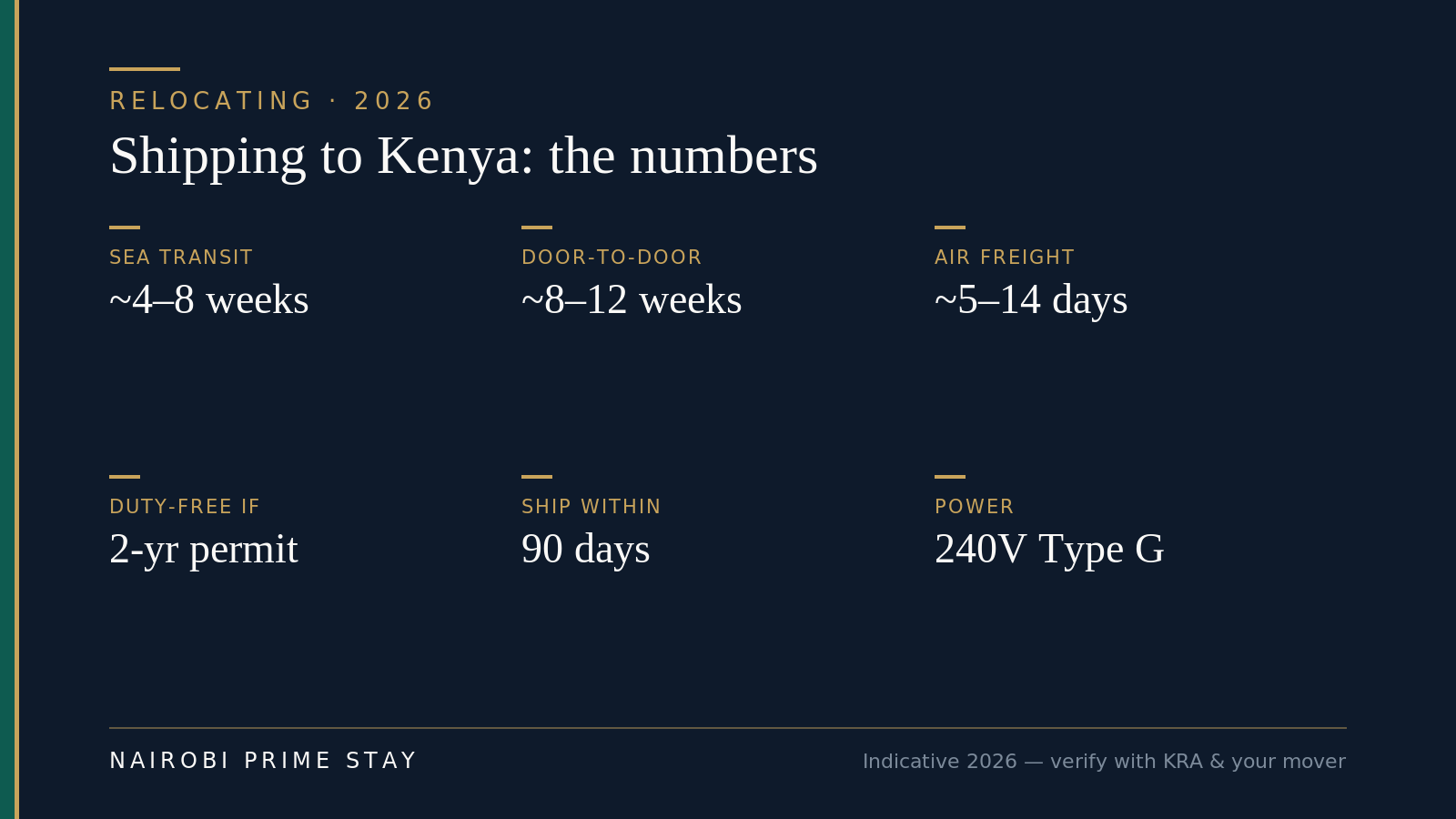 Indicative 2026 figures for orientation — freight times, costs and customs rules change, so confirm with KRA and your mover before you commit.
First question: should you ship at all?
Start here, before you price a single container. For most movers, the honest answer is “ship some, not all.” Three things decide it: how long you’re staying, whether you qualify for duty-free entry, and how much of your stuff actually survives the move to a 240V country.
If you’re coming for a year or less, or you haven’t chosen a neighborhood yet, shipping a household rarely pays. By the time your boxes arrive — two to three months later — you could have furnished a place locally or simply moved into a serviced apartment that already has everything. If you’re coming for several years with a family, a shipment of the furniture and belongings you love can be worth every dollar, especially if you qualify for the duty-free exemption below.
The middle path suits a lot of people: air-freight a few boxes of essentials so your home office and kitchen work in week one, and either sea-ship a small consignment of irreplaceable things or buy the rest in Nairobi. There’s no single right answer — only the one that fits your timeline and your stuff.
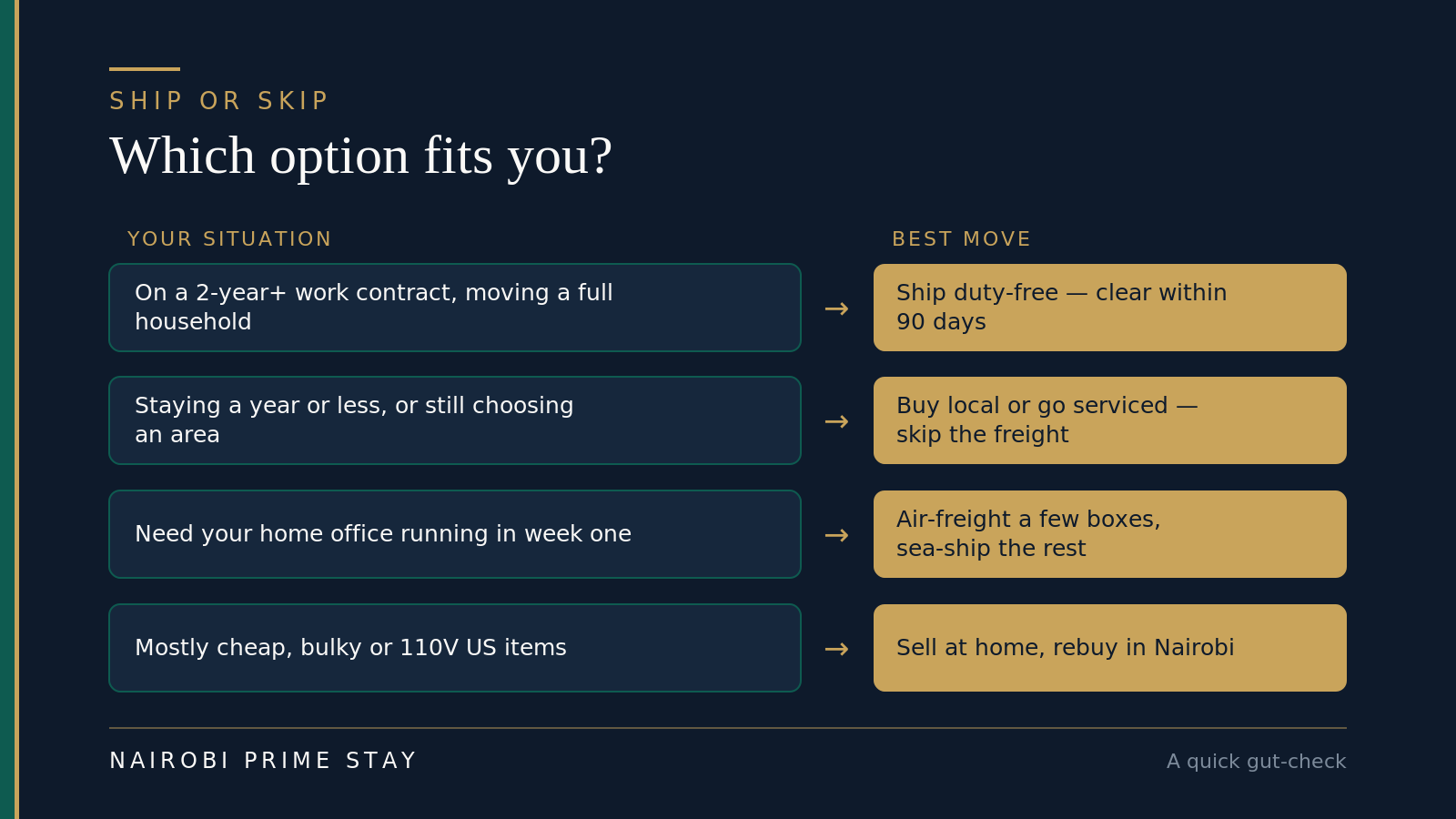 A quick gut-check — match your situation to the move that usually makes sense.
Why this matters when you’re new
Get this decision right and you save thousands of dollars and a lot of stress. Get it wrong and you can pay to ship a sofa across an ocean, wait three months for it, hand over a duty bill at the port, and discover your American fridge won’t even switch on.
Three forces shape every shipping choice to Kenya, and they all pull in the same direction — toward bringing less:
Duties. Kenya taxes imports, sometimes heavily, unless you qualify for an exemption. The duty-free First Arrival rule is generous but conditional. Miss the conditions and a container of ordinary household goods can attract a meaningful bill.
Voltage. Kenya runs on 240 volts with UK-style Type G three-pin plugs. The United States runs on 110–120 volts. Anything with a motor or a heating element — fridges, washers, dryers, microwaves, vacuums, kettles, most US air conditioners — either won’t run or will burn out. Only dual-voltage electronics survive the switch.
Time. Sea freight is slow. From the day your container leaves a US port, plan on roughly two to three months before it’s standing in your Nairobi living room. You’ll need a plan for how you live in the meantime.
Hold those three in mind and most of the specific questions answer themselves.
Sea freight, air freight, or buy it there?
There are really three ways to put a home together in Nairobi: ship it slowly by sea, fly a little of it in by air, or buy it after you arrive. Most movers use a blend.
Sea freight is the workhorse for a real household move. You ship either a full container that’s yours alone (a 20-foot box holds a modest one-to-two-bedroom home; a 40-foot box holds a large family house) or, for less stuff, a shared “groupage” load — LCL, or less-than-container-load — where you pay for the space you use in a container alongside other people’s goods. Sea is by far the cheapest way to move anything bulky or heavy. The trade-off is time: four to eight weeks on the water, plus clearing and the road haul up from Mombasa.
Air freight is fast and expensive. It’s right for a small volume of things you need quickly or can’t risk at sea — a few boxes of clothes, work gear, kitchen basics, documents, a child’s comfort items. Reckon on five to fourteen days door-to-door, but at several times the per-pound cost of sea. Few people air-freight furniture; many air-freight a box or two to bridge the gap while the sea shipment crawls across the Indian Ocean.
Buying locally is the quiet third option, and often the best one. Nairobi’s malls, the Ngong Road furniture strip, custom carpenters and a busy secondhand market mean you can furnish a place well without shipping a stick of furniture. For the full picture on where to buy and what it costs, see our guide to furnishing a home in Nairobi. Buying local also sidesteps both the voltage problem and the freight wait.
What it costs (honest ranges)
Freight pricing is quote-driven and moves with fuel, season and your exact origin, so treat these as orientation, not promises. Get two or three written quotes for your specific load and route.
A few boxes by air typically land in the hundreds to low thousands of dollars. A shared LCL sea consignment of a room or two of goods often runs somewhere around $1,500–4,000 all-in. A full 20-foot container, door-to-door and including clearing and the inland leg to Nairobi, commonly lands in the rough range of $5,000–9,000, with a 40-foot container higher again. Published US-origin examples to Mombasa have ranged from roughly $2,600 to $3,900 before duties and inland delivery, which tells you how much origin city and volume matter.
Whatever the headline freight figure, remember the add-ons: the clearing agent’s fee, port and terminal charges at Mombasa, the truck up to Nairobi, transit insurance, and any duty if you don’t qualify for relief. A cheap-looking port-to-port quote can quietly double once those are in.
| Option | Rough cost | Transit time | Best for |
|---|---|---|---|
| A few boxes by air | Hundreds to low thousands | 5–14 days | Essentials you need in week one |
| Shared LCL by sea | ~$1,500–4,000 | 8–12+ weeks door-to-door | A room or two of irreplaceable goods |
| Full 20ft container | ~$5,000–9,000+ | 8–12+ weeks door-to-door | A one-to-two-bed household |
| Full 40ft container | Higher again | 8–12+ weeks door-to-door | A large family house |
| Buy in Nairobi | Furnish a 1–2 bed ~$1,000–6,000 | Days to a few weeks | Most movers, most things |
Figures are indicative 2026 ranges; freight is quote-driven and duties may apply. Confirm with movers and a clearing agent.
How long it really takes
The number that surprises people is the door-to-door one. Ocean transit from the US to the port of Mombasa is about four to eight weeks depending on your coast and the routing — East Coast sailings tend toward the shorter end. But that’s just the sea leg. Add a week or two for customs clearing at Mombasa, then the road haul up to Nairobi, and the realistic door-to-door window is eight to twelve weeks, sometimes more if paperwork snags.
Plan your life around that gap. The common approach is to land, settle into a serviced apartment or a furnished short-let, choose your neighborhood and sign a lease, and let the sea shipment catch up to you. Air-freighting a box of true essentials makes those first weeks comfortable without committing to a full household move on day one.
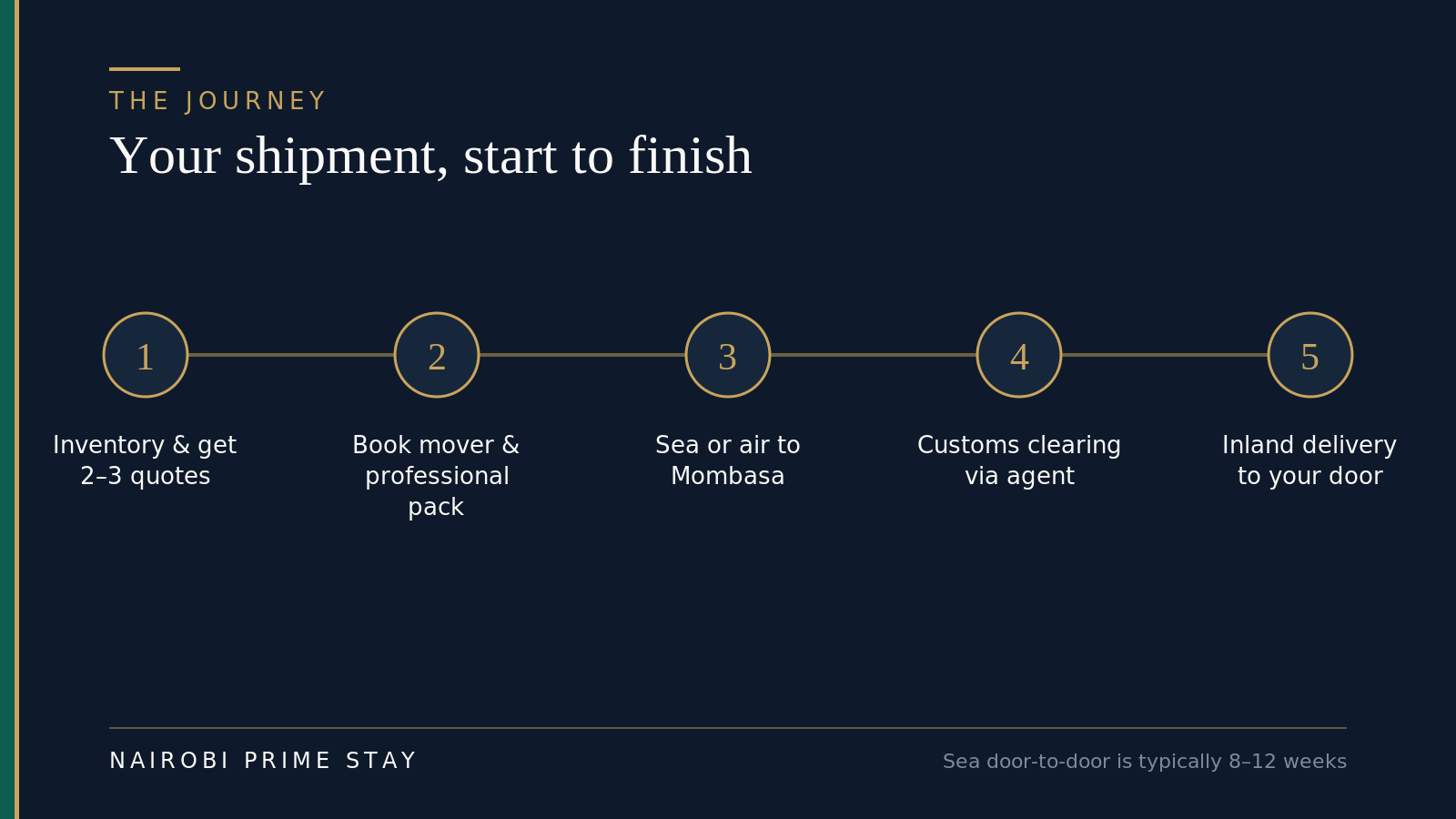 Sea door-to-door is typically eight to twelve weeks — build that wait into your arrival plan.
Customs, duties and the duty-free “First Arrival” rule
This is where shipping to Kenya gets either cheap or expensive, so it’s worth understanding before you book anything.
The exemption that matters for you
Kenya offers duty-free entry for the household and personal effects of people arriving to live and work in the country — the “First Arrival” privileges, set out in the East African Community Customs Management Act, 2004 (Fifth Schedule, Part A, Paragraph 4). If you qualify, your used household goods, and one motor vehicle, come in free of import duty, excise, VAT, the import declaration fee and the railway development levy. On a container of belongings, that’s a large sum saved.
To qualify as a First Arrival, the core conditions (as of 2026 — always confirm the current rules with KRA or your clearing agent) are:
- You’re arriving for a contract or assignment of not less than two years — a work permit is the usual evidence.
- The goods are your used personal and household effects, not new items for resale.
- They’re shipped in within 90 days of your arrival (extendable up to 360 days only with the Commissioner’s approval).
- You haven’t already claimed a returning-resident or diplomatic exemption, and you’re not coming to run another business on the side.
- A licensed customs clearing agent files the exemption for you through KRA’s Integrated Customs Management System (iCMS).
You’ll need your passport showing the entry endorsement, your work permit or contract proving the two-year term, and the shipping documents — the supplier or valued inventory, the bill of lading or airway bill, and the packing list. UN, embassy and other diplomatic staff have their own parallel privileges; if that’s you, your mission’s administration handles it, and our guide to embassy, UN and NGO housing covers how those postings work.
If you don’t qualify
Here’s the honest part. The duty-free route hinges on that two-year contract. If you’re entering on a visitor’s eTA, a short assignment, or most one-year permits, you likely won’t qualify, and your shipment becomes a normal commercial import. That means import duty (often 25% on furniture and similar goods under the regional tariff), plus 16% VAT, a 3.5% import declaration fee and a 2% railway development levy, all calculated on the assessed customs value of your goods — not what you paid, but what KRA values them at. Rates vary by item and change with each Finance Act, so verify the current position with KRA or your agent.
Once you stack those charges onto the freight, shipping a container of ordinary, replaceable furniture rarely makes sense if you can’t get the exemption. That’s the single biggest reason we tell short-stay movers to travel light and buy locally.
One quick note on cars and citizens
Your one duty-free vehicle rides on the same First Arrival privilege, but cars carry extra rules of their own — the roughly eight-year age limit, right-hand-drive requirement and a re-sale clawback if you sell within two years. We cover all of that separately in importing a car to Kenya; for most people, buying a well-kept car locally is simpler.
And a point that trips up returning African Americans and other US citizens: you are not a “returning resident” in KRA’s sense — that status is for Kenyan citizens moving home, and it has its own separate waiver. As a US passport holder, the First Arrival route above is your path to duty-free entry, provided you meet its two-year condition.
Choosing an international mover
A good mover makes this painless; a bad one turns it into a saga. You’re not just buying freight — you’re buying packing, paperwork, customs clearing and a person who answers the phone when a container is stuck at the port.
Look for a company that surveys your goods before quoting, either in your home or over video, and then gives you a written, inventory-based quote rather than a number plucked from the air. Favor movers that offer true door-to-door service including customs clearing in Mombasa, so you’re not left to find your own agent at the worst moment. Accreditation helps: membership of FIDI or the FAIM standard signals a vetted international mover, and a real, named partner or agent on the Nairobi side matters just as much. Read recent reviews, and get two or three quotes so you can tell a fair price from an outlier.
Walk away from anyone who quotes without seeing your goods, demands full payment up front, is vague about who clears your shipment through customs, has no traceable reviews or physical address, or — a real red flag — suggests under-declaring your shipment’s value to dodge duty. Under-declaration is the customer’s legal risk, not the mover’s, and it can cost you far more than it saves.
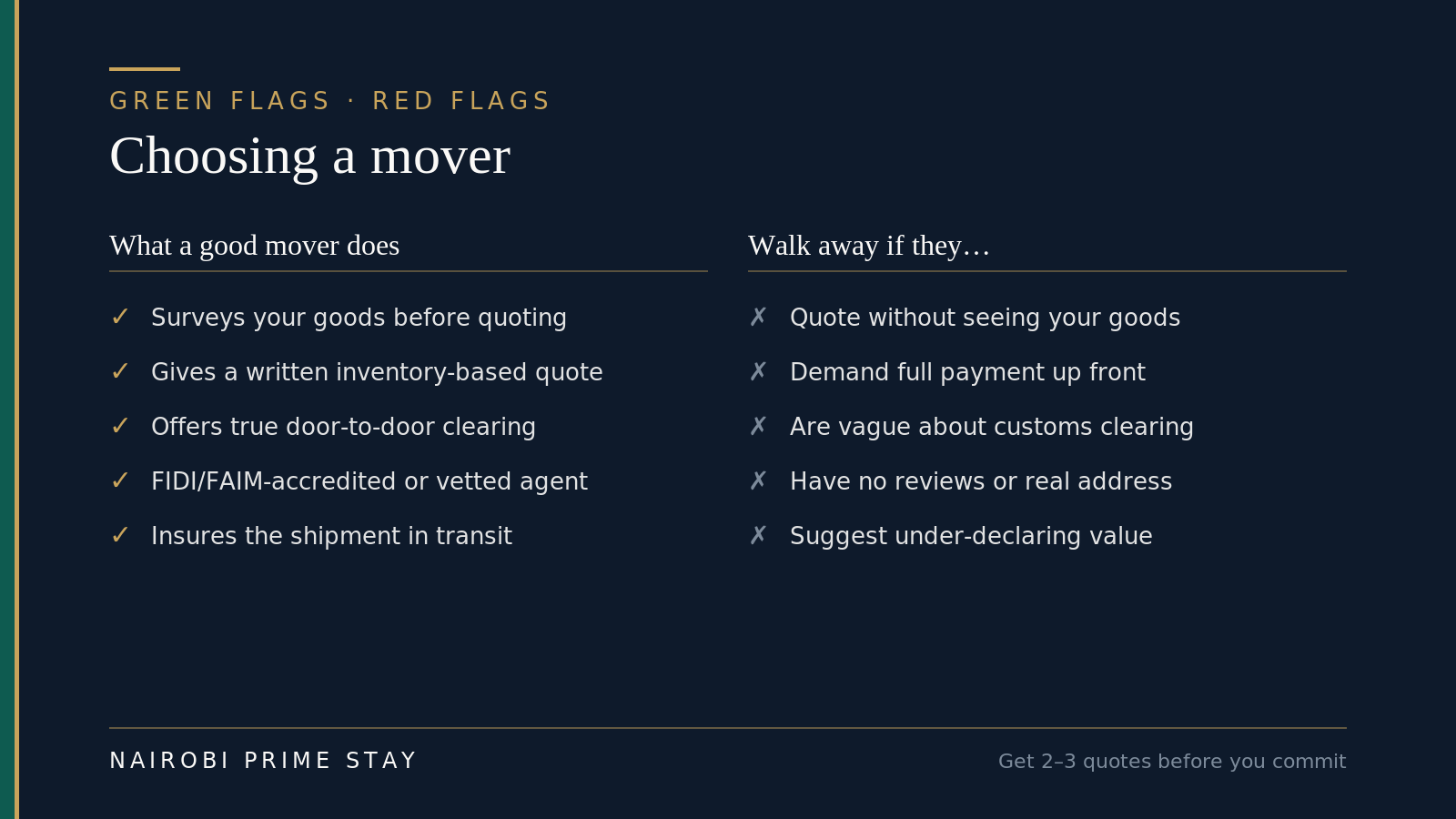 Get two or three quotes before you commit — the cheapest port-to-port number is rarely the cheapest move.
Insurance — don’t skip it
A shipment crosses an ocean, gets craned on and off ships, and bounces up a highway from Mombasa. Things break. Marine transit insurance — usually “all-risk” cover priced as a small percentage of your declared value — is cheap relative to what it protects, and worth taking for any container.
Two practical points. First, cover is built on a valued inventory, so list your goods honestly and itemize anything valuable; the claim is only as good as the declaration. Second, most policies pay full claims only when the goods were professionally packed by the mover, which is one more reason to let the professionals box your fragile and high-value items rather than packing them yourself.
What’s worth shipping — and what isn’t
The cleanest way to decide is to sort your home into “irreplaceable,” “expensive to replace here,” and “everything else.” Bring the first two; leave the rest.
Worth bringing: sentimental and irreplaceable things, quality furniture you genuinely love and would buy again, good knives and kitchen tools, books, children’s familiar toys and bedding, specialist work equipment, dual-voltage electronics and laptops, and clothing and shoes. These either can’t be replaced or cost more to rebuy in Nairobi than to ship.
Leave or sell: large US appliances that run on 110 volts — your fridge, washer, dryer and microwave simply won’t work on Kenya’s 240-volt supply — along with cheap or flat-pack furniture that’s easy to rebuy, single-voltage gadgets like kettles and hair dryers, and the general clutter every house accumulates. Selling it at home and rebuying locally is almost always cheaper than shipping it, and you’ll find what you need in Nairobi’s malls and markets.
For small appliances and electronics, the voltage rule is the deciding factor. Dual-voltage devices — most laptop and phone chargers, many modern TVs (check the label) — just need a UK-style plug adapter. Single-voltage US items need a bulky voltage converter and still risk damage, so they’re usually not worth the trouble. Our furnishing a home guide covers buying appliances locally with the right plug and a proper warranty.
 Guidance, not a rule — when in doubt, ask whether it’s truly irreplaceable or just familiar.
Don’t pack these: prohibited and restricted items
A few things will get your shipment held, fined or seized, so keep them out of the boxes and declare anything you’re unsure about. Kenya banned plastic carrier bags back in 2017 and enforces it, so don’t use them as packing material. Drones need authorization from the Kenya Civil Aviation Authority. Firearms and ammunition are tightly controlled and need permits arranged well in advance. Foodstuffs, plants and seeds can require phytosanitary clearance and are often simply not worth shipping. Counterfeit goods and, of course, narcotics are prohibited outright. When in doubt, ask your clearing agent before it’s packed, not after it’s at the port.
How this plays out: two real scenarios
An NGO family on a three-year posting. Two adults, two kids, a four-bedroom house in Ohio. They hold a three-year work contract, so they qualify for First Arrival relief. They sell the fridge, washer and dryer (all 110V), donate the flat-pack furniture, and ship a 20-foot container of the beds, sofas, dining set, books and the kids’ things they want to keep. Their mover surveys the house, packs it, and handles clearing in Mombasa through a licensed agent; the goods come in duty-free because they ship within 90 days and have the work permit to prove the two-year term. They land first, take a serviced apartment in Gigiri near the kids’ school for the eight weeks the container is in transit, then move into a leased house once it arrives. Total freight and insurance run a few thousand dollars; the duty saving more than covers it.
A remote worker on a one-year plan. One person, a one-bedroom apartment, a job paid from the US. No two-year contract, so no duty-free entry — and a small load that would be expensive to ship and taxed on arrival. They sell or store almost everything, fly in with two suitcases, air-freight a single box of work gear and kitchen favorites, and rent a furnished apartment so there’s nothing to buy. Their “shipping” bill is a few hundred dollars, and they’re set up in a week instead of three months.
Pros and cons of shipping your household
| Pros | Cons |
|---|---|
| Keep the furniture and belongings you love | Slow — eight to twelve weeks door-to-door by sea |
| Duty-free if you qualify for First Arrival relief | Duty, VAT and levies if you don’t qualify |
| One container can move a whole family home | US 110V appliances are dead weight at 240V |
| Sea freight is cheap per pound for bulky goods | Add-ons (clearing, port, inland, insurance) stack up |
| Insurance protects irreplaceable items in transit | You need a place to live while it’s in transit |
Your shipping checklist
Work through these in order and the move stays calm:
- Decide your timeline first — under two years usually means ship little and buy local.
- Check whether your permit or contract is two years or more (the key to duty-free entry).
- Inventory your home and sort it into bring / sell / leave.
- Get two or three written, inventory-based quotes from accredited movers.
- Confirm the quote is true door-to-door and includes customs clearing in Mombasa.
- Sell or donate 110V appliances and cheap furniture before you pack.
- Buy marine all-risk transit insurance based on a valued inventory.
- Have the mover professionally pack fragile and high-value items.
- Gather your documents: passport with entry endorsement, work permit, bill of lading/airway bill, packing list.
- Make sure the shipment leaves so it arrives within 90 days of your entry.
- Line up your first 8–12 weeks — a serviced apartment bridges the freight wait.
- Confirm current duty and exemption rules with KRA or your clearing agent before you sail.
Frequently asked questions
Should I ship my belongings to Kenya or buy everything there?
For most movers, ship the irreplaceable and buy the rest locally. Nairobi’s malls, the Ngong Road furniture strip and a busy secondhand market mean you can furnish a home well without shipping furniture. Shipping makes most sense when you’re staying several years and qualify for duty-free First Arrival entry; for short stays it rarely pays once you add freight, the two-to-three-month wait and possible duty.
How long does sea freight from the US to Kenya take?
Ocean transit from the US to the port of Mombasa is roughly four to eight weeks, with East Coast sailings tending to the shorter end. Add customs clearing and the road haul up to Nairobi and the realistic door-to-door time is eight to twelve weeks, sometimes more. Air freight is far faster at five to fourteen days, but several times the cost.
Do I have to pay customs duty on household goods in Kenya?
It depends on your status. If you arrive on a work permit or contract of at least two years and ship your used effects within 90 days, they can enter duty-free under Kenya’s First Arrival privileges. If you don’t qualify, expect import duty (often 25% on furniture), 16% VAT, a 3.5% import declaration fee and a 2% railway development levy on the assessed value. Confirm current rates with KRA or a licensed clearing agent.
What are Kenya’s First Arrival privileges?
They’re a customs exemption, under the East African Community Customs Management Act, that lets someone arriving for a contract of not less than two years bring in their used household and personal effects, plus one motor vehicle, free of import duty, excise, VAT and the usual levies. The goods must be shipped within 90 days of arrival, you must not have claimed a returning-resident or diplomatic exemption, and a licensed clearing agent files it through KRA’s iCMS system. You’ll need your passport entry endorsement, work permit and shipping documents.
Can I use my US appliances and electronics in Kenya?
Only some of them. Kenya runs on 240 volts with UK-style Type G plugs, while the US uses 110–120 volts. Dual-voltage devices like most laptop and phone chargers just need a plug adapter, but single-voltage US items with motors or heating elements — fridges, washers, microwaves, kettles, hair dryers — won’t work or will burn out. Leave the large appliances behind and buy 240V versions locally.
How much does it cost to ship a container to Kenya?
Freight is quote-driven, so get two or three written quotes. As a rough guide in 2026, a few boxes by air run from the hundreds into the low thousands, a shared LCL sea load around $1,500–4,000, and a full 20-foot container door-to-door roughly $5,000–9,000 or more, with a 40-foot container higher again. Remember to add clearing fees, port charges, inland delivery to Nairobi, insurance and any duty.
What can’t I ship to Kenya?
Keep prohibited and restricted items out of the boxes. Plastic carrier bags are banned and enforced, so don’t use them as packing. Drones need Civil Aviation Authority authorization, firearms and ammunition need permits arranged in advance, and food, plants and seeds can require phytosanitary clearance. Counterfeit goods and narcotics are prohibited outright — when unsure, ask your clearing agent before packing.
Should I ship my car to Kenya?
You can bring one vehicle duty-free under the same First Arrival privilege, but cars carry extra rules — roughly an eight-year age limit, a right-hand-drive requirement, and duty becoming payable if you sell within two years. For many people, buying a well-kept car locally is simpler and avoids the freight. See our guide to importing a car to Kenya for the full picture.
Do I need shipping insurance, and what does it cover?
Yes, take it for any container. Marine transit insurance, usually all-risk cover priced as a small percentage of declared value, protects your goods against loss and damage on a long sea journey. Cover is built on a valued inventory, so declare items honestly, and note that most policies pay full claims only when the mover packed the goods professionally.
Final thoughts
Shipping to Kenya is less about logistics and more about restraint. The movers who are happiest a year in are the ones who brought what they loved and couldn’t replace, sold or left the rest, and let Nairobi furnish the gaps. If you’ve got a two-year-plus contract and a household worth keeping, a duty-free container is a fine decision — just plan for the wait. If you’re here for a year, or still finding your feet, travel light and buy as you go. Either way, confirm the current customs rules with KRA or a licensed agent before anything leaves a US port; the details shift, and it’s your shipment on the line.
Related reading
- Moving to Nairobi: the complete guide — the hub that ties visas, neighborhoods, costs and your first 30 days together.
- Furnishing a home in Nairobi — where to buy furniture and appliances locally, and what it costs.
- Furnished vs unfurnished vs serviced — which housing route saves you a shipment in the first place.
- Serviced apartments in Nairobi — the soft landing that bridges the eight-to-twelve-week freight wait.
- Cost of living in Nairobi — budget the real monthly picture, including the exchange rate.
- Importing a car to Kenya — the age limit, right-hand-drive rule and duty math for vehicles.
- Visas and permits for Americans — the work permit that opens the door to duty-free First Arrival entry.
- How to rent an apartment in Nairobi — find and sign a home for your shipment to land in.
- Bringing pets to Kenya — moving a dog or cat: the import permit, rabies rules, flying as cargo and the costs.
- Nairobi weather and climate — pack for mild days, cool nights and strong sun, not tropical heat.
When you’re ready
Shipping is slow, so give yourself a soft landing. A serviced apartment for your first month or two gives you a fully-equipped, all-inclusive base — Wi-Fi, cleaning, generator and security included — while your container is on the water and you choose where to live. A $50 deposit reserves your dates and the balance is paid on arrival, nothing more before you travel. Not sure how to time the move around your freight? Our AI relocation assistant can map your arrival, your apartment and your shipment in a couple of minutes, any time of day.
Ready to look?
Find your apartment in Nairobi
Browse verified serviced apartments, or ask the AI concierge which area fits your life.