
Guides · Serviced apartments
Furnished vs Unfurnished in Nairobi: Which Should You Rent? (2026)
Furnished vs Unfurnished in Nairobi: Which Should You Rent? (2026)
Furnished costs more each month, but you can move in tonight. Unfurnished is cheaper, but you start with empty rooms — often emptier than you’d expect from the word “unfurnished.” That single trade-off is the whole decision, and the right answer comes down to one thing: how long you’re staying.
This guide is for Americans renting in Nairobi for the first time and trying to work out which way to go. We’ll cover what furnished and unfurnished actually mean here (they’re not what you might assume), the real cost difference in 2026, what it costs and takes to furnish a place yourself, and where a serviced apartment fits as the third, all-inclusive option. By the end you’ll know which one suits your stay — and roughly what it’ll cost you.
The quick version
If you’re staying under two years, rent furnished. You’ll pay more per month — roughly 30% to 80% more than the same place unfurnished, as of 2026 — but you skip thousands of dollars and several weeks of buying, waiting for, and eventually re-selling furniture. If you’re staying two years or more and want the lowest monthly rent, rent unfurnished and kit it out, budgeting around $3,000–6,000 to furnish a one- to two-bedroom place properly. And if you’re here for weeks rather than years, still scouting neighborhoods, or just want one all-inclusive price with zero setup, a serviced apartment is the easiest landing — furniture, Wi-Fi, cleaning, a backup generator and security all bundled into a single monthly figure. Most newcomers do best starting serviced for the first month, then signing a longer lease once they know the city.
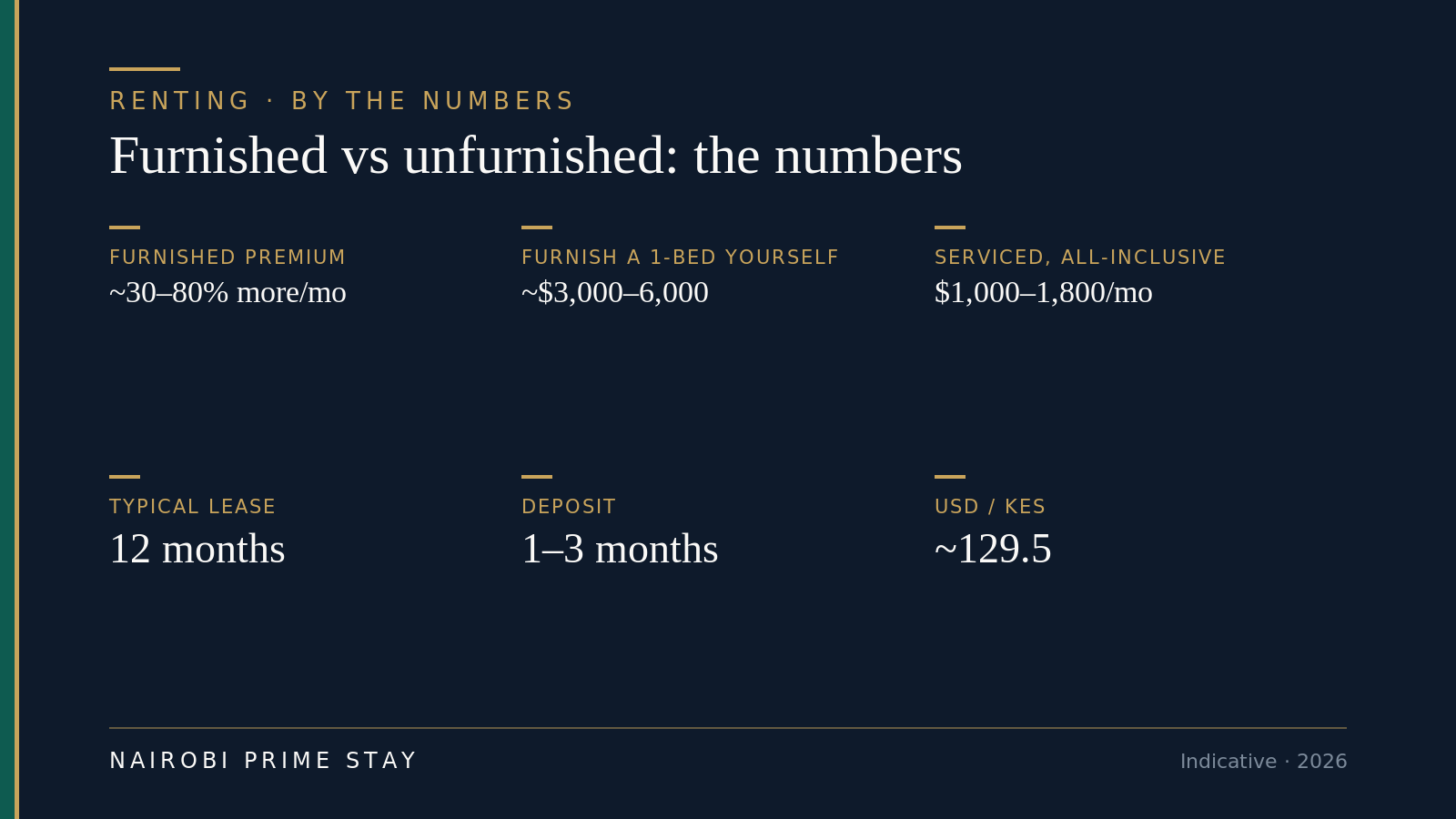 Indicative 2026 figures for orientation — rents float with the market and the exchange rate, so treat them as ranges, not quotes.
Why this choice matters more than it looks
In the US, “unfurnished” usually still means a working kitchen — a fridge, a stove, an oven, sometimes a dishwasher and a washer-dryer. In Nairobi, unfurnished often means genuinely bare. No fridge, no cooker, sometimes no light fittings, curtains or wardrobes. You could sign a lease, get the keys, and stand in a beautiful apartment with nowhere to cook dinner or hang a shirt.
That gap is why the furnished-versus-unfurnished question matters here in a way it might not back home. Get it right and you move in smoothly and pay a fair price for your situation. Get it wrong and you either overpay for furniture you’ll use for six months, or you sign a cheap unfurnished lease and then spend your first three weekends in traffic between furniture shops. The money is real, but so is the time — and your first month in a new country is when time is scarcest.
What “furnished” actually includes in Nairobi
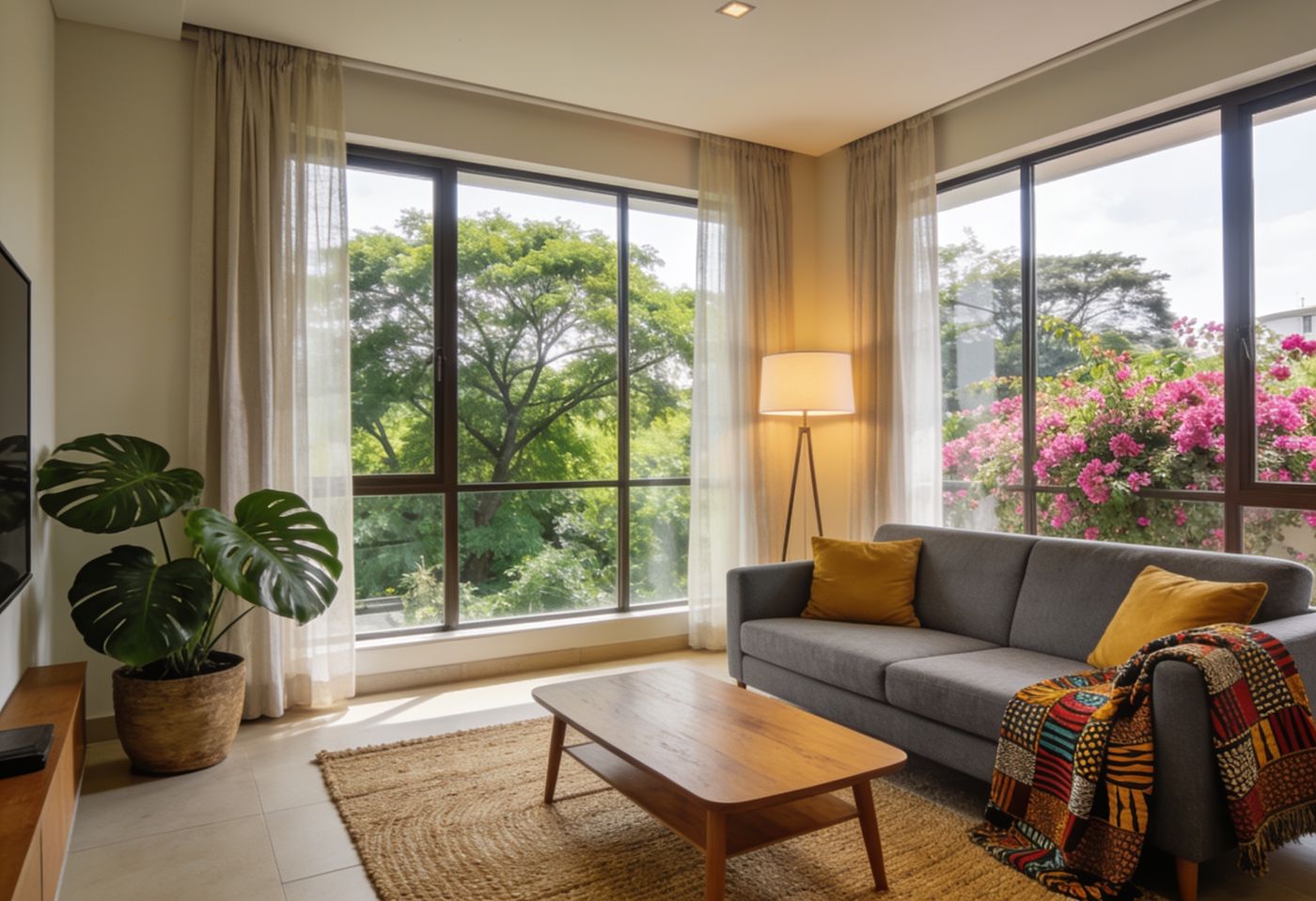
There’s no legal definition of “furnished” in Kenya, so it’s whatever the landlord says it is. In practice, a properly furnished prime apartment in Nairobi usually comes with the things you’d need to live there from day one. Always confirm the exact list in writing before you sign — the word alone tells you little.
A well-furnished Nairobi apartment typically includes:
- Living room: sofa, coffee table, TV unit, often a TV.
- Bedrooms: beds with mattresses, wardrobes, sometimes bedside tables and a dresser.
- Dining: a dining table and chairs.
- Kitchen: fridge, cooker (hob and oven), microwave, and usually a basic set of pots, pans, crockery and cutlery. Higher-end places add a washing machine.
- Throughout: curtains or blinds, light fittings, and often a water heater already installed.
“Fully furnished” at the top of the market — the kind of place aimed at diplomats and executives — can also include linens, kitchenware down to the wine glasses, a smart TV with a subscription, and sometimes a washer-dryer and a microwave you’d never have to think about. “Semi-furnished” is the slippery one: it might mean white goods and wardrobes but no sofa or bed, or the reverse. Never assume. Ask for a written inventory and read it.
What “unfurnished” really means here
Unfurnished in Nairobi usually means the apartment itself and not much else. You can expect the fixed parts — fitted wardrobes in many newer builds, bathroom and kitchen cabinetry, and the kitchen sink. Beyond that, assume nothing is included unless the lease says so.
Things that are commonly missing from an unfurnished Nairobi rental, and that catch newcomers out:
- No fridge, cooker or microwave. White goods are very often the tenant’s responsibility.
- No light fittings or bulbs in some places — just bare wires or fixtures.
- No curtains, blinds or curtain rails.
- No water heater in older buildings (you may need to buy and install an instant shower heater).
- Sometimes no wardrobes in older apartments, though most modern ones have them built in.
None of this is a problem if you’re planning to furnish anyway. It’s only a problem if “unfurnished” lulled you into thinking you could move in with a couple of suitcases. You can’t. Walk the apartment during the viewing and make a written list of exactly what stays and what doesn’t — this is the single most useful thing you can do before signing an unfurnished lease. For more on the viewing and the paperwork, see our guide on how to rent an apartment in Nairobi.
The cost difference: how much more is furnished?
Furnished apartments in Nairobi rent for roughly 30% to 80% more per month than the same place unfurnished, as of 2026. The exact premium depends on the area, the quality of the furniture, and how short your stay is — the shorter and more flexible the let, the higher the markup. A simply furnished long-term apartment might sit near the bottom of that range; a fully kitted, short-let-friendly place in Westlands or Kilimani sits near the top.
To make that concrete, here’s how a mid-range two-bedroom in a central prime area might look. These are illustrative 2026 figures, not quotes — your real numbers will move with the building, the landlord and the USD/KES rate (around 129.4 in mid-2026):
| Unfurnished | Furnished | Serviced | |
|---|---|---|---|
| Monthly rent | ~$900 | ~$1,300–1,500 | ~$1,600–2,200 |
| Furniture cost | $4,000–6,000 (you pay) | Included | Included |
| Utilities & Wi-Fi | You set up & pay | You set up & pay | Included |
| Cleaning | You arrange | You arrange | Included |
| Lease length | 12 months | 12 months | Monthly / flexible |
| Move-in time | 2–4 weeks to furnish | Same day | Same day |
| Deposit | 1–3 months’ rent | 1–3 months’ rent | $50 reserves; balance on arrival |
The headline rent is only part of the story. Unfurnished looks cheapest on the rent line, but you carry the furniture cost, the setup time, and the hassle of selling everything when you leave. Furnished costs more monthly but nets out cheaper for shorter stays once you count what you’d otherwise spend kitting a place out. Serviced costs the most per month and the least in total effort, because everything is in one price.
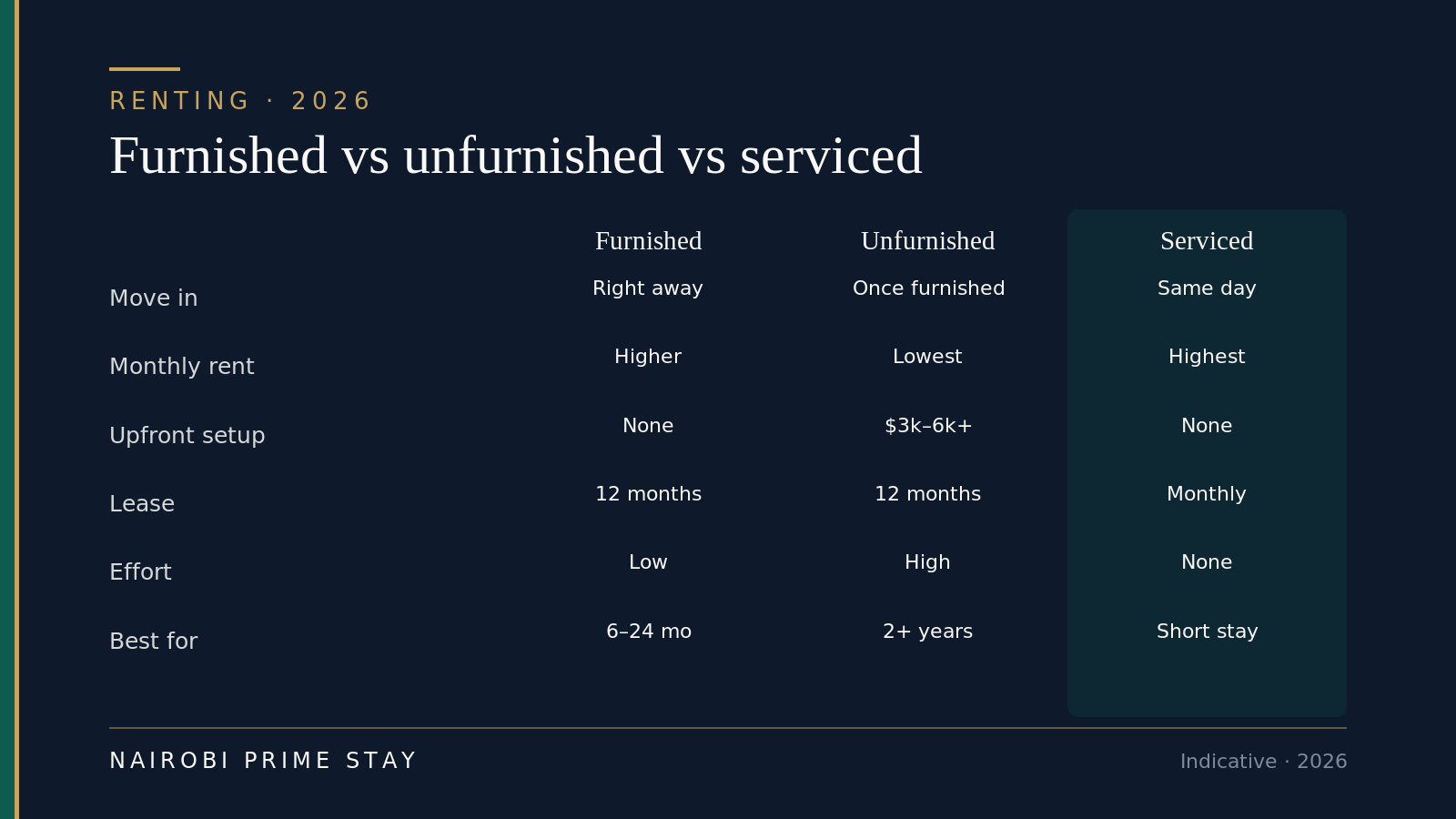 The three options side by side. Serviced trades a higher monthly rate for zero setup and full flexibility — which is why it suits short stays and first months.
The break-even, roughly
Here’s a simple way to think about it. Furnishing a one- to two-bedroom apartment yourself costs around $3,000–6,000. If furnished rent is, say, $400 a month more than unfurnished, that furniture pays for itself in roughly 8 to 15 months — but only if you can sell it for something on the way out, which you usually can’t at full price. Under about 18–24 months, furnished almost always wins on total cost and certainly on hassle. Past two years, unfurnished pulls ahead, and the longer you stay the bigger that gap grows.
Furnishing it yourself: the real cost and effort
If you go unfurnished, here’s what you’re signing up for. Furnishing a one- to two-bedroom apartment to a comfortable standard runs roughly $3,000–6,000 in 2026, depending on whether you buy new, secondhand, or a mix. A rough breakdown:
- Bed, mattress and wardrobe: $400–900 per bedroom.
- Sofa and living-room set: $500–1,200.
- Dining table and chairs: $250–600.
- Fridge: $350–800. Cooker: $300–700. Microwave: $80–200.
- Washing machine: $400–900.
- Curtains, lighting, smaller kitchen items, decor: $400–1,000.
You can spend far less by buying secondhand — Nairobi has a strong used-furniture market and active expat “leaving sale” groups on Facebook and WhatsApp, where departing families sell whole apartments’ worth of good furniture at a steep discount. You can also spend far more at the high-street furniture stores. New furniture often comes with a delivery wait of one to three weeks, and custom pieces longer, so even after you’ve paid you may not be sleeping in your own bed for a while.
Two honest costs people forget. First, time: sourcing, buying, waiting for delivery and assembly typically eats two to four weekends — weekends you might rather spend learning the city. Second, resale: when you leave, you’ll sell most of it at a loss, often for a third to a half of what you paid, because everyone else is selling too. Factor both in before you decide unfurnished is the “cheap” option. We go deeper into sourcing, budgets and the secondhand scene in our guide to furnishing a home in Nairobi; if you’re bringing things from home, see shipping your belongings to Kenya.
Furniture rental: the middle path most people miss
There’s a quieter third route between buying furniture and renting a fully furnished place: renting the furniture itself. A handful of Nairobi firms — CORT among the international names, plus local outfits — will furnish an unfurnished apartment for a monthly fee, from a single room to a whole house, and take it all back when you leave. You sign a cheaper unfurnished lease, then layer hired furniture on top for as long as you need it.
It suits a specific case well: a stay of roughly six to eighteen months where you want a lower base rent than a furnished let but don’t want to sink thousands into furniture you’ll dump at a loss. You avoid the upfront buy, the delivery wait and the leaving sale, and you can usually swap, add or return pieces as your needs change. The catch is that rent-plus-hire can end up close to what a furnished lease would have cost once you add it all up, so price both before you commit. Ask for a written inventory, the monthly figure, the minimum term, and who pays for breakages.
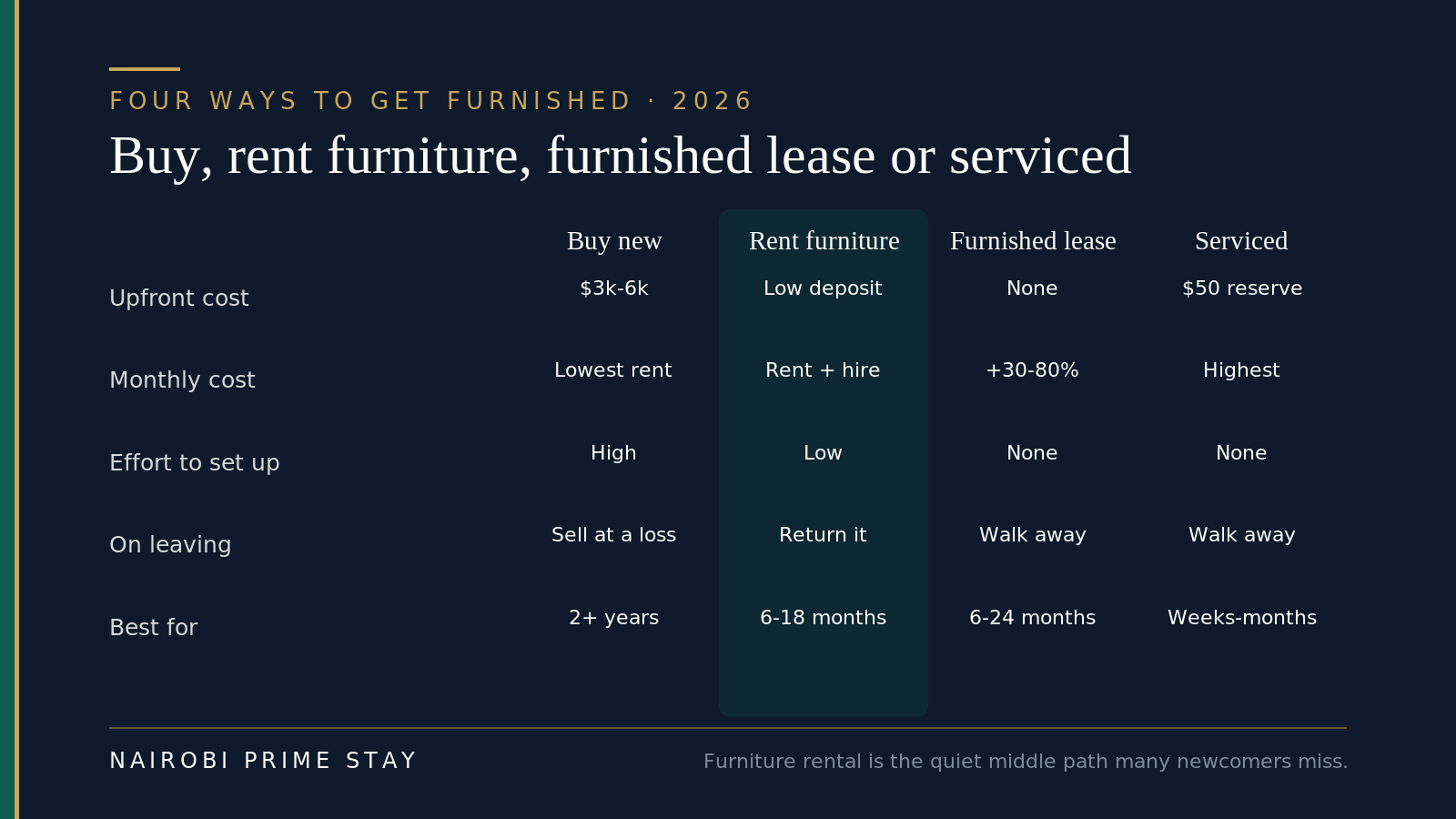 Furniture rental is the quiet middle path. Price rent-plus-hire against a straight furnished lease before you choose — they often land close.
The third option: a serviced apartment
There’s a reason most newcomers don’t actually choose between furnished and unfurnished on day one — they start with a serviced apartment instead. A serviced apartment is fully furnished and all-inclusive: one monthly price covers the furniture, Wi-Fi, regular cleaning, a backup generator, security, and usually water and electricity too. There’s nothing to set up and nothing to cancel when you leave. You arrive, turn the key, and you’re living.
That makes it the natural soft landing. Renting a long-term home in Nairobi well means viewing places in person, testing your commute in real traffic, and getting a feel for neighborhoods before you commit to a year. A serviced apartment for your first four to eight weeks gives you a secure, comfortable base to do exactly that — without wiring a deposit for a place you’ve only seen in photos, which is the most common way newcomers get caught out. You move once, properly, when you actually know the city.
The trade-off is the monthly rate: serviced is the most expensive way to rent by the month, because you’re paying for flexibility and for someone else handling everything. For a few weeks or a few months, that premium is well worth it. For a multi-year stay, it usually isn’t — by then you’ll want a standard lease. Our full guide to serviced apartments in Nairobi covers what’s included, typical pricing and who they suit. With us, a $50 deposit reserves your apartment and locks your dates, and you pay the balance on arrival — nothing more before you travel.
Renting furnished from the US before you land
Here’s the trap to avoid: wiring a deposit for a furnished apartment you’ve only seen in photos. It’s the most common way newcomers to Nairobi lose money. A listing looks perfect, someone asks for a “holding deposit” to a personal M-Pesa number or a wire, and once it’s sent the apartment — and the person — evaporate. Furnished short-lets attract this because they target exactly the people renting from abroad on a deadline.
The safe order is simple. Get a live video walk-through from inside the actual unit, not a reel of stock photos. Have your own agent verify that the person letting it really is the landlord or a registered agency. Get the furniture inventory in writing before any money moves. And pay a registered agency on arrival, not a stranger in advance. Better still, don’t rent your long-term home from abroad at all — soft-land in a serviced apartment for a few weeks, then view and sign in person once you’re on the ground. Our guide to property scams in Kenya covers the playbook in full.
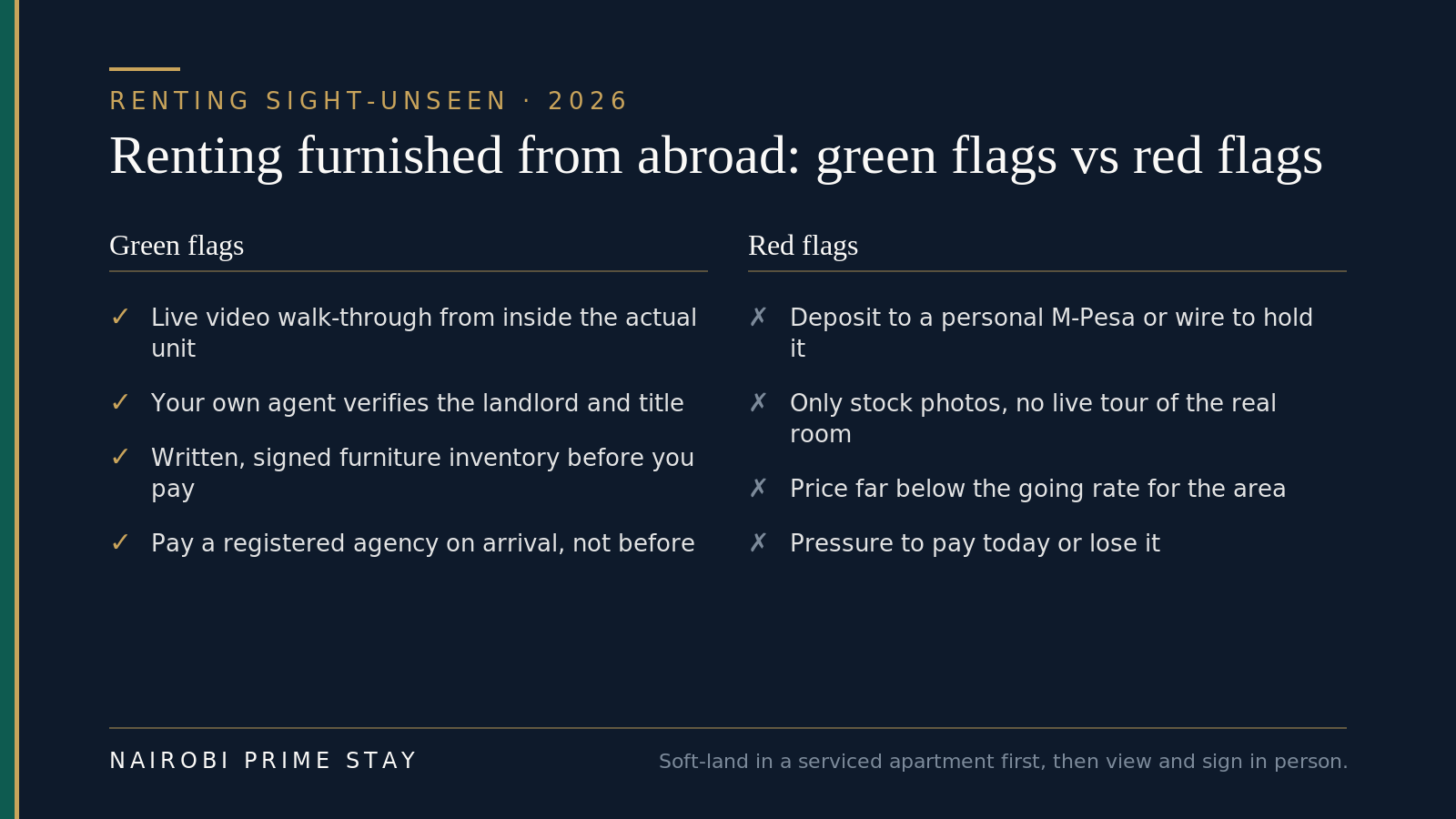 If a landlord wants money before you’ve seen the place live and verified who they are, walk away.
If your employer, embassy or the UN is arranging housing, the mechanics differ again — some postings assign and lease a home for you, others give a housing allowance and leave you to find your own. Our guides to corporate housing in Nairobi and how much day-to-day life costs in the cost-of-living guide fill in the rest.
How the lease and deposit differ, furnished vs unfurnished
The furnished-versus-unfurnished choice changes the paperwork, not just the price. On a furnished lease, the furniture is the sticking point: you want a signed inventory listing every item and its condition at move-in, because that same list is what the landlord checks against when you leave. Deposits are often a little higher to cover the furnishings, terms can be shorter, and short-lets are more common. On an unfurnished lease, the fight is over what counts as “fixed” — do the wardrobes, water heater and light fittings stay? Get that in writing. Deposits usually run one to three months’ rent with no furniture to argue over, terms are the standard twelve months, and you own and remove your own white goods.
Either way, the written inventory is what protects your deposit. Photograph everything at move-in, keep the signed list, and read the clauses on notice period, service charge, water and who fixes what. Our guide to leases, deposits and tenant rights in Kenya walks through the contract clause by clause, and setting up utilities in Nairobi covers what you’ll need to arrange yourself on an unfurnished place.
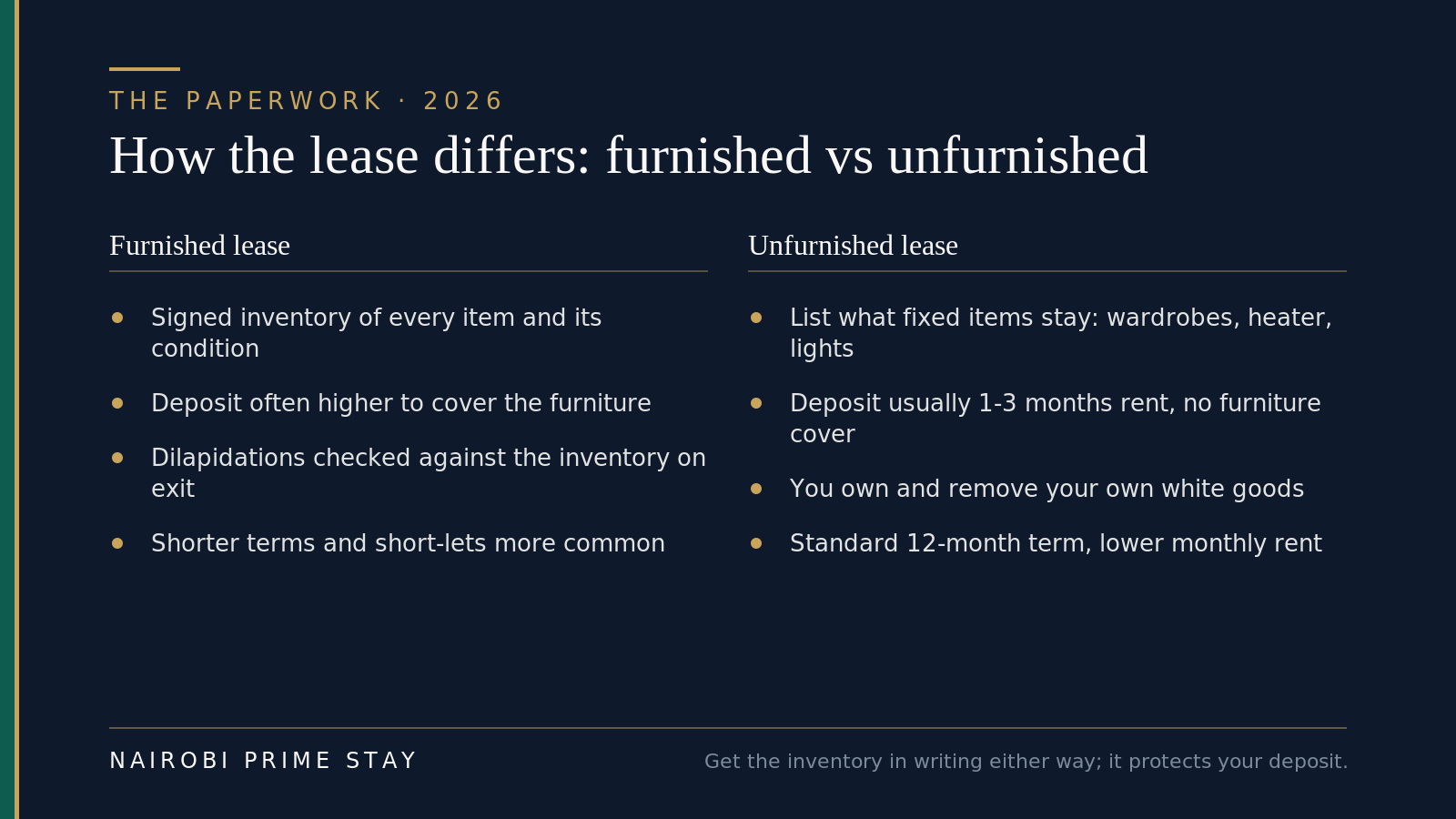 Whichever you pick, get the inventory in writing — it’s what stands between you and a withheld deposit.
Who each option suits
The length of your stay decides most of this, with your appetite for setup as the tie-breaker.
Rent furnished if you’re staying somewhere between six months and two years, you want to move in immediately, and you’d rather not buy and sell a household of furniture for a stay that has an end date. This fits most remote workers, people on a one- or two-year work contract, and anyone testing whether Nairobi is for them. You pay a monthly premium and buy back your weekends.
Rent unfurnished if you’re staying two years or more, you want the lowest possible monthly rent, and you either don’t mind kitting a place out or you’re shipping a household from home anyway. This fits families putting down roots, people who’ve bought property, and long-term residents who want their own things around them. You trade upfront money and effort for a lower run-rate.
Go serviced if you’re here for weeks rather than years, you’re still deciding which neighborhood fits your commute and budget, or you simply want one all-inclusive price and zero admin. This fits scouting trips, the first month of almost any relocation, short corporate postings, and anyone who values a clean, hands-off landing over the lowest sticker price.
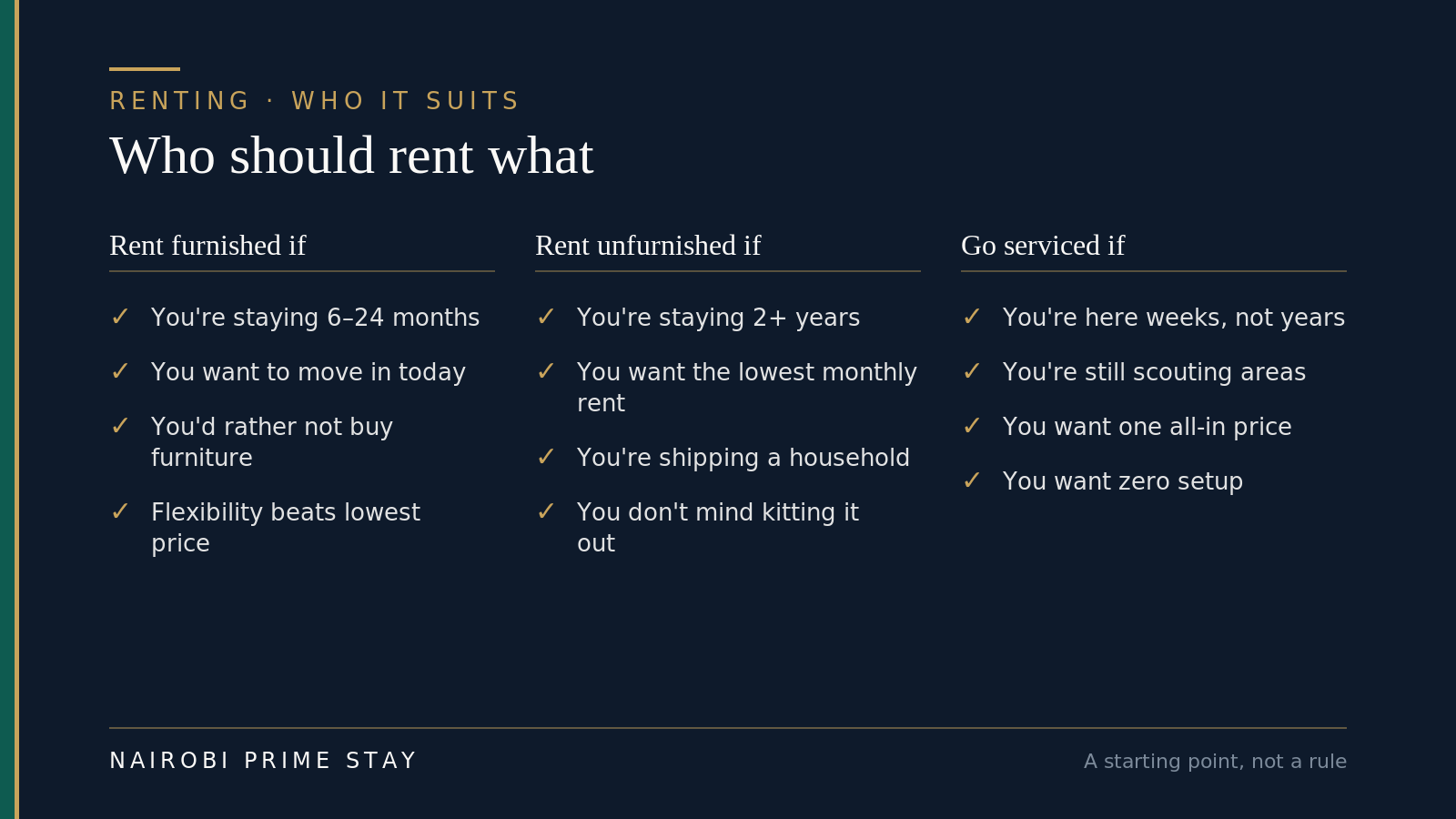 A starting point, not a rule — your commute, family and budget can tip the balance.
A quick way to decide
Match your situation to the closest row and you’ll rarely go wrong:
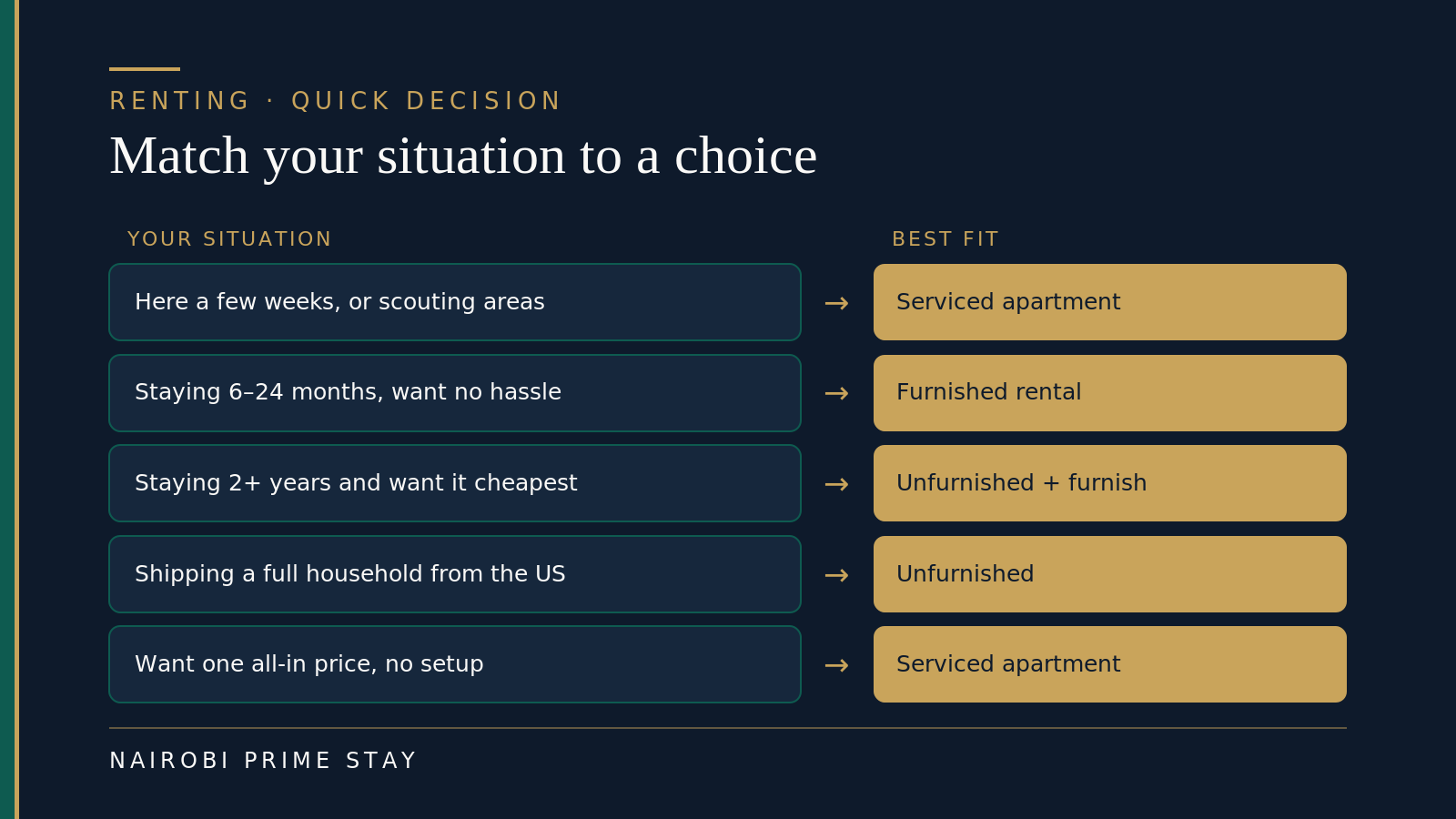 When two rows fit, default to the shorter-stay option — it’s easier to extend a flexible arrangement than to unwind a year-long lease and a houseful of furniture.
How this plays out: two real scenarios
The remote worker, here for a year. Maya takes a one-year remote contract and lands in Nairobi knowing nobody. She books a serviced apartment in Kilimani for her first six weeks, uses that time to drive the commute to her coworking spot and visit a few different neighborhoods, then signs a 12-month furnished lease in Lavington once she’s sure. She never buys a stick of furniture. Her rent is higher than an unfurnished place would be, but over a single year the furnished premium costs less than furnishing and re-selling would have — and she spent zero weekends in furniture shops.
The family, here for the long haul. The Okellos relocate for a four-year posting with two school-age kids. They start in a serviced two-bedroom for their first month while they choose a home near the kids’ school, then sign a two-year unfurnished lease on a house in Karen and ship their own furniture over. The unfurnished rent is meaningfully lower, the upfront furnishing and shipping cost is real but spread across four years, and the kids sleep in their own beds from back home. For their timeline, unfurnished is clearly the cheaper, more comfortable call.
Before you decide: a short checklist
Run through these before you commit either way:
- Pin down your timeline. Under two years leans furnished; two-plus years leans unfurnished; weeks or “not sure yet” leans serviced.
- Get the inventory in writing. For furnished, a signed list of every item and its condition. For unfurnished, a written list of exactly what stays (wardrobes? water heater? light fittings?).
- Confirm the white goods. Specifically ask whether the fridge, cooker and any washing machine are included — never assume.
- Price the furnishing job if unfurnished — budget around $3,000–6,000 for a one- to two-bed, plus a one-to-three-week delivery wait.
- Count the hidden costs: furniture resale loss on exit, utility setup, and the weekends spent sourcing it all.
- Check the lease terms either way — deposit (usually one to three months), notice period, and who pays service charge, security and water. See leases, deposits and tenant rights in Kenya.
- Do the “Nairobi Five” checks at viewing: backup generator, water storage, 24/7 security, fibre internet, and responsive management. These matter whatever you rent.
- Consider a serviced first month so you choose your long-term home in person, not from photos.
Whatever you choose, don’t wire money for a place you haven’t seen, and only pay traceably once you’ve verified the landlord and signed. The full process is in our step-by-step renting guide, and the bigger picture is in the complete guide to moving to Nairobi.
Frequently asked questions
Is it better to rent furnished or unfurnished in Nairobi? It depends almost entirely on how long you’re staying. If you’re in Nairobi for under two years, furnished usually wins: you pay more per month but skip thousands of dollars and several weekends spent buying — and later re-selling — furniture. If you’re staying two years or more and want the lowest monthly rent, unfurnished is cheaper overall once the furniture is paid off. For your first weeks, or while you’re still choosing a neighborhood, a serviced apartment is the easiest option because everything is bundled into one all-inclusive price.
How much more does a furnished apartment cost in Nairobi? As of 2026, furnished apartments rent for roughly 30% to 80% more per month than the same place unfurnished. The exact premium depends on the area, the quality of the furniture, and how short and flexible your lease is — shorter lets carry the biggest markup. Rents also move with the market and the USD/KES rate (around 129.4 in mid-2026), so treat any figure as indicative and confirm the current rate before you sign.
What does “furnished” include in a Nairobi apartment? There’s no legal definition, so it varies — always get a written inventory. A properly furnished prime apartment usually includes beds and wardrobes, a sofa and coffee table, a dining set, and a kitchen with a fridge, cooker and microwave, plus curtains and light fittings. Higher-end “fully furnished” places add linens, full kitchenware, a washing machine and sometimes a smart TV. “Semi-furnished” is the vague one and could mean almost anything, so ask exactly what stays before you commit.
Does an unfurnished rental in Kenya include a kitchen and appliances? Often not. Unlike in the US, unfurnished in Nairobi frequently means genuinely bare — no fridge, no cooker, no microwave, and sometimes no light fittings, curtains or water heater. Most modern apartments have built-in wardrobes and kitchen cabinetry, but white goods are usually the tenant’s responsibility. Walk the apartment at the viewing and get a written list of exactly what is and isn’t included before signing.
How much does it cost to furnish an apartment in Nairobi? Budget roughly $3,000–6,000 to furnish a one- to two-bedroom apartment to a comfortable standard in 2026, covering beds, a sofa, a dining set, a fridge, a cooker, a washing machine, plus curtains and smaller items. You can spend much less buying secondhand — Nairobi has an active used-furniture market and expat “leaving sale” groups — or more at high-street stores. Remember two hidden costs: delivery often takes one to three weeks, and you’ll usually re-sell furniture at a loss when you leave.
What is a serviced apartment, and how is it different from furnished? A serviced apartment is fully furnished and all-inclusive: one monthly price covers the furniture, Wi-Fi, regular cleaning, a backup generator, security and usually utilities, with nothing to set up or cancel. A standard furnished rental gives you the furniture but leaves you to arrange and pay for internet, cleaning and utilities yourself on a 12-month lease. Serviced costs the most per month but the least in effort, which is why it suits short stays and the first weeks of a move; furnished suits longer, settled stays.
Should I furnish a place myself or just rent furnished? Do the math on your timeline. Furnishing a place yourself costs around $3,000–6,000 upfront plus your time, and you’ll lose money re-selling it later. If the furnished version of the same apartment costs a few hundred dollars more a month, that furniture only pays for itself after roughly a year and a half to two years. Under about two years, renting furnished is usually cheaper and far less hassle; past two years, furnishing your own unfurnished place pulls ahead.
Can I rent a furnished apartment in Nairobi short-term? Yes. For short stays — a few weeks to a few months — a serviced apartment is the usual route, offered on flexible monthly terms with everything included, rather than a standard 12-month lease. Standard furnished rentals are generally still let on annual leases, so they suit stays of six months or more. If you only need a few weeks, book serviced; with us a $50 deposit reserves the apartment and the balance is paid on arrival.
Can I rent furniture instead of buying it in Nairobi? Yes. A few firms in Nairobi — CORT and local operators — rent furniture by the month, from a single room to a whole house, and collect it when you leave. You sign a cheaper unfurnished lease and hire the furniture on top, which suits a six-to-eighteen-month stay where you want a lower base rent without buying and re-selling a household. Add up rent-plus-hire before you commit, though — it can land close to a straight furnished lease. Ask for a written inventory, the monthly price, the minimum term and who covers breakages.
How do I rent a furnished apartment in Nairobi from the US without getting scammed? Never wire a deposit for a place you’ve only seen in photos — that’s the most common scam. Insist on a live video walk-through from inside the actual unit, have your own agent confirm the landlord or agency is genuine, get the furniture inventory in writing, and pay a registered agency on arrival rather than a personal M-Pesa or wire in advance. The safest route is to book a serviced apartment for your first weeks and sign your long-term lease in person once you’re on the ground.
Is the deposit higher for a furnished apartment? Often slightly, because it also has to cover the furniture. Unfurnished deposits usually run one to three months’ rent; furnished can be a touch more to protect the landlord’s furnishings, and the lease will reference a signed inventory that your deposit is checked against when you leave. Photograph everything at move-in, keep the signed inventory, and you’ll have far less to argue about on the way out.
Final thoughts
Furnished or unfurnished isn’t really a taste question in Nairobi — it’s a math question, and the main number is how long you’re staying. Stay under two years and furnished almost always wins on total cost and on your sanity. Stay longer and unfurnished is the cheaper home, as long as you go in clear-eyed about the upfront furniture bill and the bare-apartment reality. And whichever you land on, there’s no rule that says you have to decide on day one. Start with a serviced apartment, learn the city, drive the traffic, see the neighborhoods in person — then sign the lease that fits the life you’ve actually found here.
Related reading
- How to rent an apartment in Nairobi — the full step-by-step process, agents, deposits and scams to avoid.
- Serviced apartments in Nairobi — what the all-inclusive option includes and who it suits.
- Furnishing a home in Nairobi — where to buy, real budgets and the secondhand scene.
- Leases, deposits and tenant rights in Kenya — what to check in the contract before you sign.
- Cost of living in Nairobi — how rent fits a realistic monthly budget.
- Best neighborhoods in Nairobi for expats — where to look, by lifestyle and budget.
- Moving to Nairobi: the complete guide — the end-to-end relocation hub.
Want to skip the furniture math entirely for your first month? Browse our serviced apartments — fully furnished, all-inclusive, with honest monthly pricing and a $50 deposit to reserve (balance on arrival). Not sure whether furnished, unfurnished or serviced fits your stay and budget? Our AI relocation assistant can talk it through and shortlist real options in a couple of minutes, day or night.
Ready to look?
Find your apartment in Nairobi
Browse verified serviced apartments, or ask the AI concierge which area fits your life.