
Guides · Cost of living
Setting Up Utilities in Nairobi: Power, Water & Internet (2026)
Setting Up Utilities in Nairobi: Power, Water & Internet (2026)
Your first power top-up in Nairobi looks like this: you open M-Pesa, pay Kenya Power, and a 20-digit code arrives by text. You punch it into the meter on your wall and the lights stay on. That’s prepaid electricity, and it’s a fair snapshot of how utilities work here — mostly pay-as-you-go, mostly run from your phone, and a little different from what you’re used to.
Here’s the honest version, written for someone who has never lived in Kenya. Power, water, cooking gas and internet are each set up separately, and a good apartment quietly handles some of them for you. The two things that surprise Americans most are that you buy electricity before you use it, and that water comes with a storage system — tanks, sometimes a borehole — because the county supply isn’t always running.
By the end of this guide you’ll know how each utility works, what to check before you sign a lease, what it all costs each month, and how a serviced apartment folds the whole lot into one bill so your first weeks are simple.
TL;DR: Nairobi utilities are mostly prepaid and phone-based. Electricity comes from Kenya Power (KPLC) — most homes are on a prepaid meter, and you buy tokens on M-Pesa; all-in you pay roughly KES 20–30 per unit (kWh) as of July 2026. Water comes from the Nairobi City Water and Sewerage Company at about KES 68–117 per cubic metre by usage band, plus sewerage at 75% of the water bill — but supply is intermittent, so homes rely on storage tanks and often a borehole. Cooking is usually LPG gas (a 13kg refill is about KES 2,300–3,600). Internet is cheap fibre, from around KES 3,000/month. Budget KES 10,000–28,000 (~$77–216 at 129–130 KES/USD, July 2026) a month for utilities in a typical two-bed home, on top of rent. Many apartment blocks bundle water, security, garbage and a backup generator into a service charge, and a serviced apartment bundles everything — power, water, gas, Wi-Fi, cleaning — into one all-inclusive price.
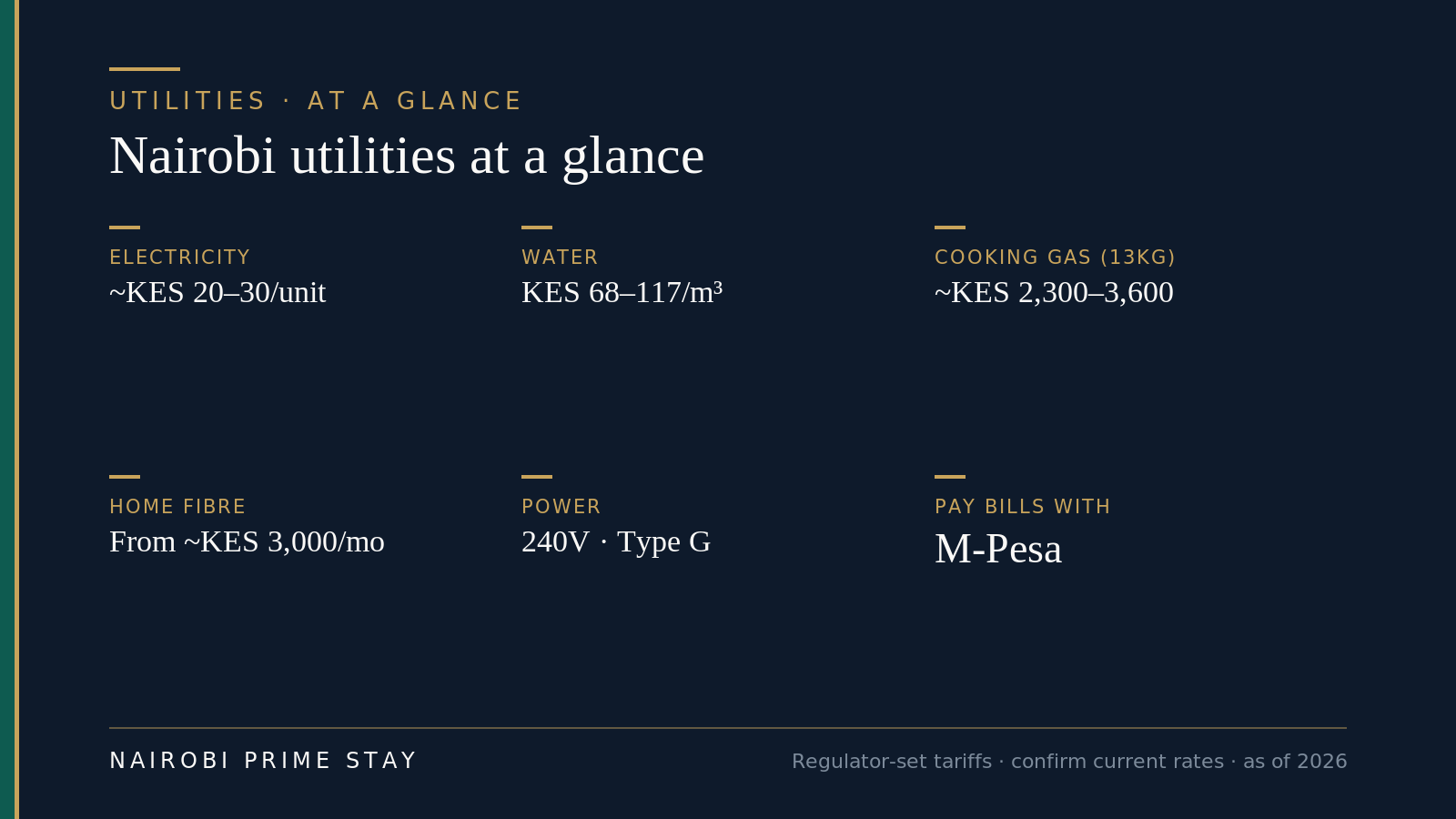 The numbers that matter, at a glance. Tariffs are set by regulators and change — confirm current figures with Kenya Power and Nairobi Water.
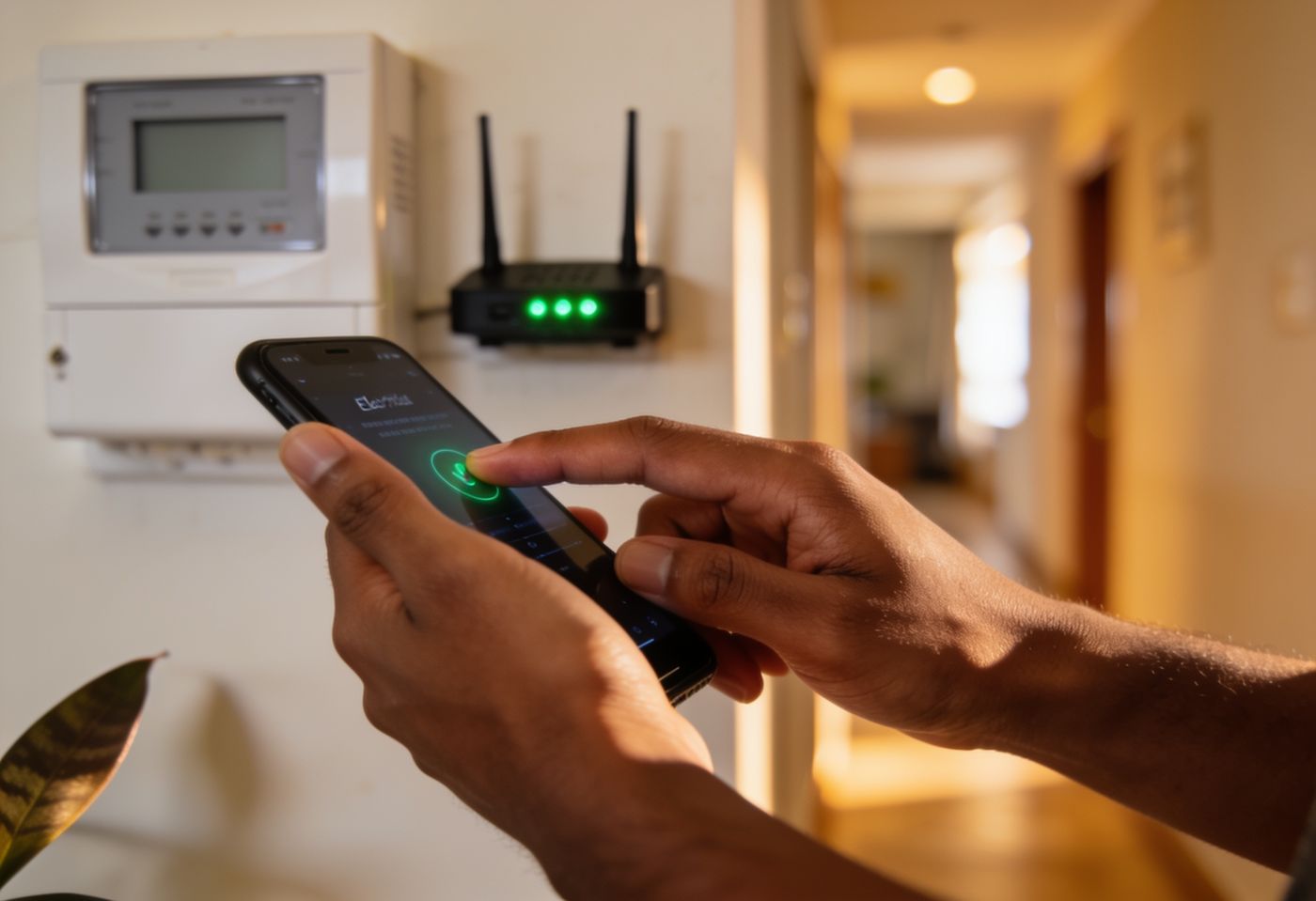
How utilities work in Nairobi — the quick mental model
Think of four separate utilities, each with its own provider and its own way to pay: electricity, water, cooking gas and internet. Garbage is a fifth, smaller one. There’s no single “utilities company” that bundles them, the way some US providers do.
Two features run through almost all of them. First, you pay with M-Pesa, the mobile-money wallet that runs daily life in Kenya — so getting your M-Pesa set up is step one for paying any bill. Second, much of it is prepaid: you load credit before you consume, rather than getting a bill at month’s end. It feels strange for a week, then it feels normal — and it makes budgeting unusually easy, because you literally watch the units tick down.
The other thing to understand up front: the apartment you choose does a lot of the work. A well-run building already has a water borehole, large storage tanks, a backup generator, fibre to the door and a garbage contract — all folded into a monthly service charge. A bare house on its own plot leaves more of that to you. This is exactly why the “Nairobi Five” — generator, water storage, security, fibre and responsive management — matter so much when you’re choosing where to live. Utilities are easiest when the building is good.
Power here is 240 volts, on UK-style Type G three-pin plugs. Your US 110V hair dryer or coffee maker won’t work without a voltage converter, and many people just buy local appliances instead — our guide to furnishing a home covers what’s worth shipping versus rebuying.
Electricity: Kenya Power and prepaid tokens
Electricity comes from Kenya Power (KPLC), the national utility, and most homes — especially apartments — run on a prepaid meter. Instead of a monthly bill, you buy “tokens” in advance: a 20-digit code you enter into the meter on your wall, which credits it with units (kWh). When the units run low, the meter beeps; you buy more. Simple, and it puts you in control of the spend.
How to buy tokens
You buy tokens in seconds on M-Pesa. Open the M-Pesa menu, choose Pay Bill, enter Kenya Power’s prepaid Pay Bill number — 888880 as of July 2026 (postpaid bills use 888888; confirm on kplc.co.ke rather than trusting a forwarded number), use your meter number as the account, and enter the amount. The token arrives by SMS within a minute. You can also buy through the My Power (Kenya Power) app, your bank app, or any little shop with a Kenya Power token sign. Buy KES 500 and you’ll get the units that KES 500 covers — there’s no fixed top-up size, and the M-Pesa minimum is only about KES 10.
Keep the SMS. If you mistype the token or change a faulty meter, you may need the history. And top up before you run dry — a Friday-night blackout because the units hit zero is a classic newcomer mistake.
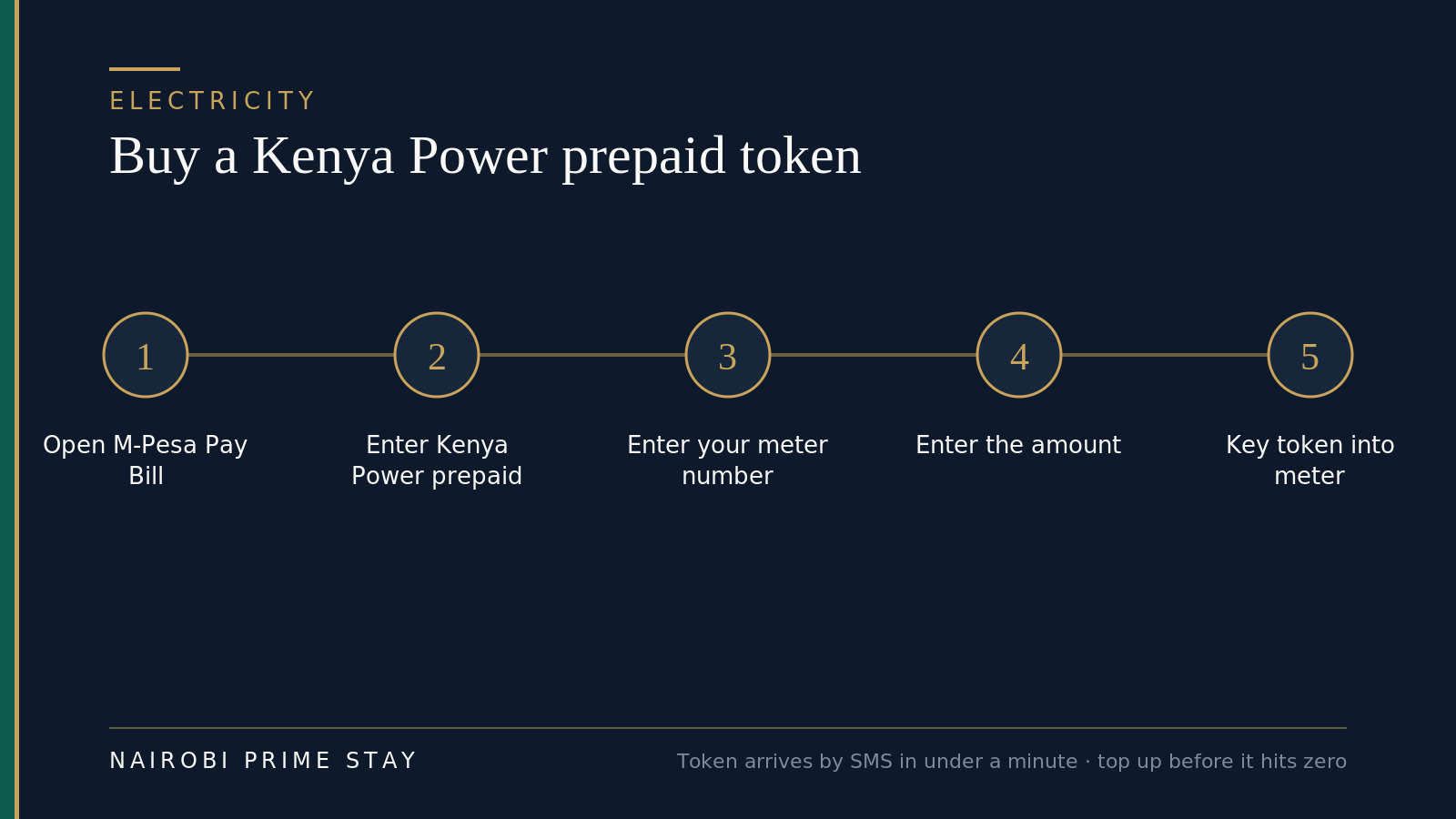 Buying power takes under a minute once your M-Pesa is set up. Top up before the meter hits zero.
What you actually pay
Kenya Power charges by consumption band, and the base energy rates (effective from mid-2025) are roughly:
| Domestic band | Monthly use | Base energy rate (2026) |
|---|---|---|
| Domestic Lifeline (DC1) | Up to ~30 units | ~KES 12.23 / unit |
| Domestic Ordinary (DC2) | ~31–100 units | ~KES 16.45 / unit |
| Domestic High (DC3) | Over ~100 units | ~KES 19.08 / unit |
Those are just the energy charge. On top sit several pass-through levies that change every month — a fuel energy cost, a forex adjustment, an inflation adjustment, plus EPRA and REP levies and 16% VAT. Added up, most households end up paying roughly KES 20–30 for every unit, all-in, in 2026. As a rule of thumb, budget around KES 25 a unit and you’ll be close. (For reference, Kenya Power’s proposed 2026/27 tariff increase was withdrawn by the government in June 2026, so rates have held steady — the June 2026 monthly adjustment actually reduced the all-in price by about KES 0.27 a unit. The fuel and forex components are reset every month by gazette notice, so treat any figure as “as of July 2026” and check your token receipt, which shows the breakdown.)
How many units does a home use? A modest one-bed with a fridge, lights, a laptop and the odd kettle might run 80–150 units a month (~KES 2,000–4,000). A comfortable two- or three-bed with a washing machine, more electronics and an electric water heater can hit 300–500 units (~KES 7,000–13,000+). The single biggest swing factor is how you heat water and whether you run an electric hot shower or an immersion tank — those quietly dominate the bill. Nairobi’s mild ~15–26°C climate means almost nobody runs air conditioning, which keeps bills lower than in much of the US.
Do you need to put utilities in your name?
Here’s a pleasant surprise for anyone braced for US-style account setups, credit checks and connection fees: usually, no. A prepaid meter is tied to the apartment, not to a person — from the day you get the keys, you simply buy tokens against the meter number. No transfer, no deposit, no paperwork. Water, garbage and the generator typically sit inside the building’s service charge, billed through the landlord or management. The one thing you’ll genuinely open in your own name is home internet, which takes a passport and a phone number. Renters in standalone houses on older postpaid KPLC accounts should ask the landlord whether to transfer the account or keep paying against their account number — either works, but agree it in writing as part of the lease.
If you’re moving into a brand-new place with no meter yet, a new Kenya Power connection is a separate (and slower) process the landlord or developer usually handles — confirm power is already connected before you sign, so you’re not waiting weeks in an unlit home.
Water: county supply, tanks and the storage reality
This is the one that catches Americans off guard. Piped water in Nairobi is not always running. The Nairobi City Water and Sewerage Company (NCWSC) supplies the city, but demand outstrips supply, and many areas get water on a rationed schedule — some days on, some days off. So nearly every functional home has storage: tanks that fill when the mains are flowing and carry you through when they’re not. You rarely notice the gaps, because of the tanks. The homes where people do notice are the ones with too little storage.
That changes what “good water” means when you’re house-hunting. You’re not just asking “is there water?” — you’re asking “what’s the storage and backup?” The strong setups have large tanks (often thousands of litres), frequently a private borehole on the compound, a booster pump for decent pressure, and sometimes a water-treatment or filtration step. In a dry stretch, a building can also top up its tanks from a water bowser (a delivery truck), usually billed through the service charge. Many expats still drink filtered or bottled water rather than straight from the tap, and brushing teeth with tap water is generally fine in the prime suburbs — but ask your landlord what the building does.
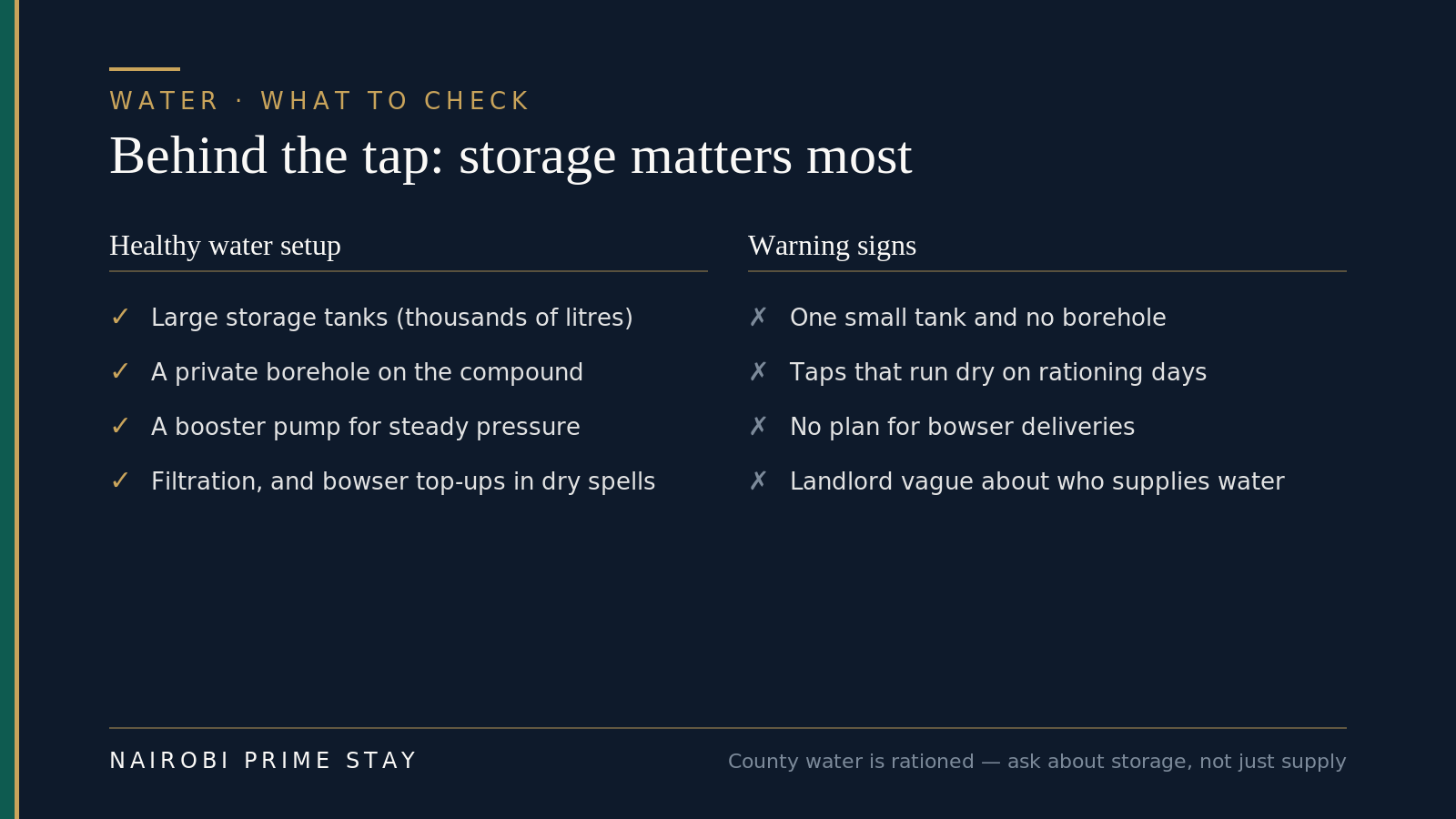 What to look for behind the tap. Storage and a borehole matter more than the headline “is there water?”
What water costs
If your home is on a metered county connection, NCWSC charges by a rising block tariff (rates approved from early 2026):
| Monthly use | Water rate | Notes |
|---|---|---|
| 1–6 cubic metres | ~KES 68 / m³ | Lowest band |
| 7–20 m³ | ~KES 85 / m³ | Typical small household |
| 21–50 m³ | ~KES 91 / m³ | Larger family / garden |
| 51–100 m³ | ~KES 101 / m³ | Big consumers |
| Over 100 m³ | ~KES 109–117 / m³ | Highest bands |
On top of the water charge, sewerage is billed at 75% of your water bill if you’re connected to the sewer. In practice, a small household using 10–20 m³ a month pays roughly KES 850–1,700 for water plus KES 650–1,300 for sewerage — call it KES 1,500–3,000 (~$12–25) all-in, more if you have a garden or a borehole pump to run. If a meter isn’t working, NCWSC bills you on the average of your last three months, which is worth knowing if you inherit someone else’s high average.
One more reality: in many apartment blocks you never see a county water bill at all. Water (often from a shared borehole), the pumps, tank cleaning and bowser top-ups are folded into your monthly service charge, alongside security and garbage. Ask exactly what the service charge covers before you sign — our guide to leases, deposits and tenant rights explains how that’s usually split.
Cooking gas (LPG)
Most Nairobi kitchens cook with LPG bottled gas, not mains gas or electricity. You buy a cylinder with a regulator and a hose, and when it runs out you swap or refill it. A 13kg cylinder refill runs roughly KES 2,200–3,530 as of July 2026 — the branded majors sit at the top (TotalEnergies ~KES 3,510, Rubis ~KES 3,530), while independent dealers go as low as ~KES 2,200, so it pays to shop around. A smaller 6kg cylinder refills for about KES 1,400–1,800. For a couple cooking at home, a 13kg bottle lasts roughly one to three months, so think of gas as KES 1,500–3,000 a month at most.
Dealers deliver to your door — you’ll find them on M-Pesa, on apps, or as a number on the fridge left by the last tenant. Buy your first full cylinder with a new regulator and hose from a reputable seller (gas safety is worth not cutting corners on), keep the kitchen ventilated, and turn the cylinder valve off when you travel. Unlike petrol and diesel, LPG prices are not capped by the regulator — dealers set their own, which is exactly why the same refill varies by over a thousand shillings across town. Treat any figure as a July 2026 snapshot.
Internet and Wi-Fi
Good news: home internet is one of Nairobi’s pleasant surprises — fast fibre, cheaply, in all the expat suburbs. Safaricom’s entry Bronze plan is 40 Mbps for KES 2,999 a month (speeds across its tiers were bumped up to 2.5× at no extra cost in April 2026 — Gold is now 150 Mbps for KES 6,299), and plans climb to a full gigabit for heavy users, with free installation on most contracts. Safaricom Home Fibre, Zuku and Faiba (JTL) are the common names, with newer entrants pushing prices down further — 100 Mbps from about KES 2,000 in covered estates; the key question when renting is simply “is fibre already serving this building?” — if it is, setup is a phone call and a day’s wait.
Because internet deserves its own deep-dive for anyone working from home — providers, real-world speeds, the backup-power angle and coworking spaces — we’ve covered it fully in our guide to internet, Wi-Fi and remote work in Nairobi. The short version: connectivity is rarely the problem; keeping it powered during an outage is, which brings us to backup power.
Will your American appliances work? The 240V question
Short answer: your electronics will, your kitchen gadgets mostly won’t. Kenya runs on 240 volts at 50Hz with UK-style Type G three-pin plugs — a different voltage and a different socket from the US 120V system.
The good news is that almost everything with a modern power brick is dual-voltage: laptops, phone chargers, tablets, cameras, most TVs and monitors. Check the label — if it says “100–240V, 50/60Hz”, all it needs is a cheap plug adapter (or just replace the cable with a local Type G one). The bad news is single-voltage 120V-only appliances: most US blenders, coffee makers, hair dryers, irons and stand mixers will burn out the moment they meet a Kenyan socket. A step-down transformer can save a treasured item, but transformers are heavy, hum, and cost more than most small appliances are worth — and anything with a motor or clock can still run oddly on 50Hz. The practical move is to sell the 120V kitchen before you ship and buy 240V versions in Nairobi, where supermarkets and appliance shops stock everything at reasonable prices. We cover the full ship-versus-buy maths in our guides to shipping your belongings to Kenya and furnishing a home in Nairobi.
One habit worth keeping from home: surge protection. Power that cuts and returns can spike, so put a surge-protected strip (locally available) behind the TV, router and computers, and consider a small UPS for the Wi-Fi router — it doubles as five minutes of grace to save your work when the lights blink.
Garbage collection
Garbage is low-drama. In the prime suburbs and apartment blocks, a private licensed collector picks up household waste once or twice a week, and the cost is small — often a few hundred shillings up to around KES 2,000 a month, frequently already inside your service charge. If you’re in a standalone house, you arrange a collector directly (neighbours will tell you who serves the street). Separately, Nairobi County is rolling out a “conservancy” waste fee added to water bills in 2026, so you may see a small line item appear there. Recycling is limited but growing; most homes simply separate what the collector or local recyclers will take.
The backup-power reality: generators, inverters and solar
Power cuts happen in Nairobi. Not constantly — many days you’ll see none — but often enough that backup matters, especially if you work from home. Outages can be a brief flicker or, after a big storm, a few hours. The fix is simple in a good building and a project in a bare house.
You have three layers of backup, and most people end up with one of them:
A building generator is the easiest by far. Many apartment blocks have a shared diesel generator that kicks in within seconds of an outage and runs the whole building — lights, lifts, water pumps, your sockets. You pay for it through the service charge and barely think about it. If you work from home, prioritising a building with a working generator is the single best utilities decision you can make.
An inverter and battery is the popular DIY option — silent, automatic, no fumes. The battery charges off the mains, and when the power drops it instantly runs your essentials (Wi-Fi, lights, laptop, phone). A basic setup starts around KES 35,000 and a solid hybrid inverter runs KES 80,000–180,000, plus a battery from about KES 35,000 (lead-acid) up to KES 300,000 for a lithium bank, and KES 15,000–60,000 for installation. It won’t run an electric kettle or hot shower, but it keeps a remote-work day alive.
Solar layers panels onto that inverter-and-battery base, so you generate your own power and lean less on Kenya Power. It costs more up front and makes most sense if you own the home or have a long lease — a renter on a one-year lease rarely bothers. A small portable petrol generator (from ~KES 20,000) is the cheap, noisy fallback some standalone houses keep for long cuts.
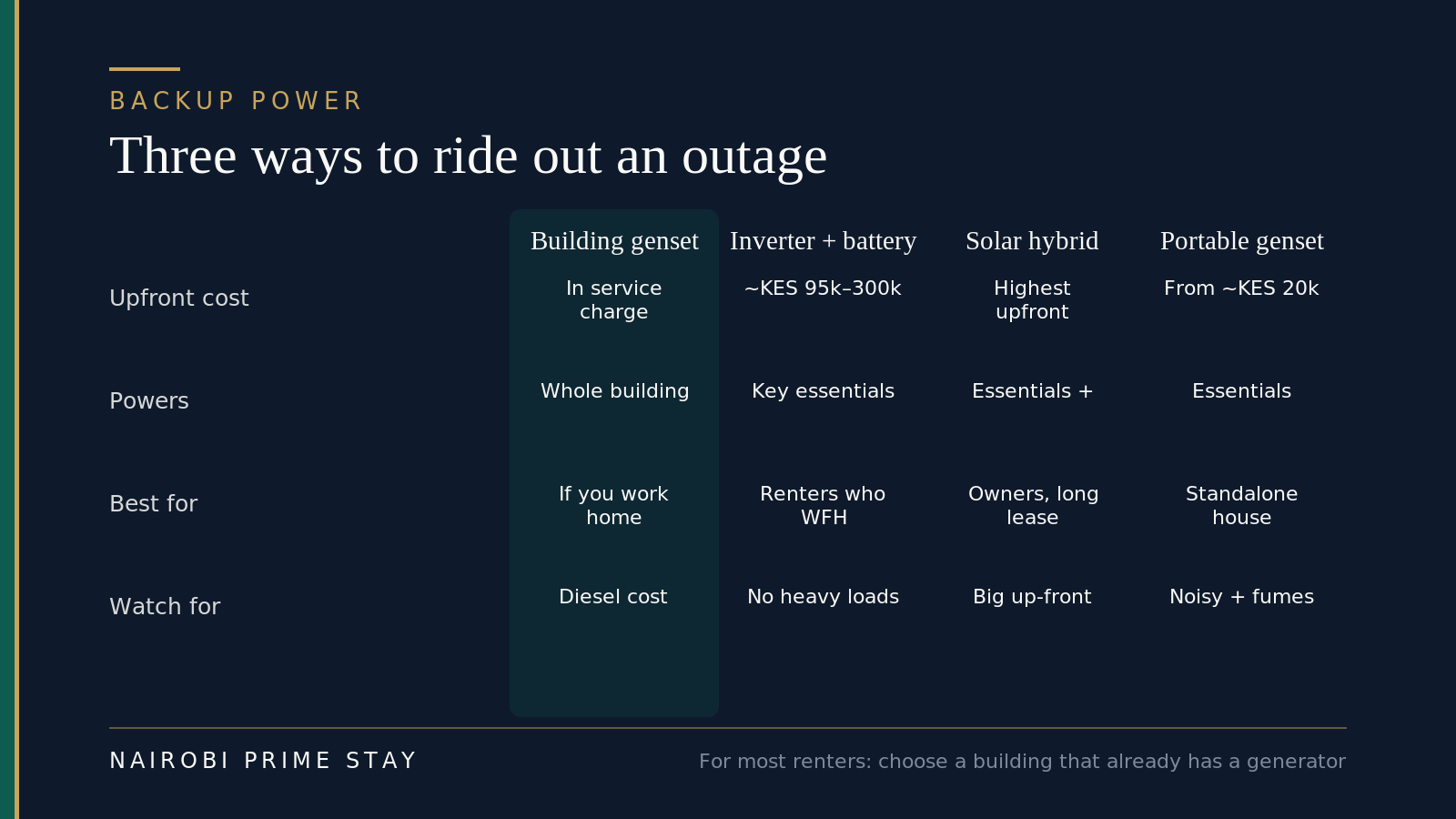 Three ways to stay powered through an outage. For most renters, the right answer is “rent a building that already has a generator.”
What utilities actually cost each month
Here’s an honest monthly picture for a comfortable two-bed home in a prime suburb, converted at roughly KES 129–130 to the dollar (the rate as of July 2026). Your real numbers depend most on home size, whether you heat water electrically, and how much your service charge already covers.
| Utility | Typical monthly cost (2026) | In USD (~130) |
|---|---|---|
| Electricity (KPLC prepaid) | KES 3,000–12,000 | ~$25–95 |
| Water + sewerage | KES 1,500–4,000 | ~$12–30 |
| Cooking gas (LPG) | KES 1,500–3,000 | ~$12–25 |
| Internet (home fibre) | KES 3,000–6,500 | ~$25–50 |
| Garbage collection | KES 500–2,000 | ~$4–15 |
| Rough total (DIY) | KES ~10,000–28,000 | ~$80–215 |
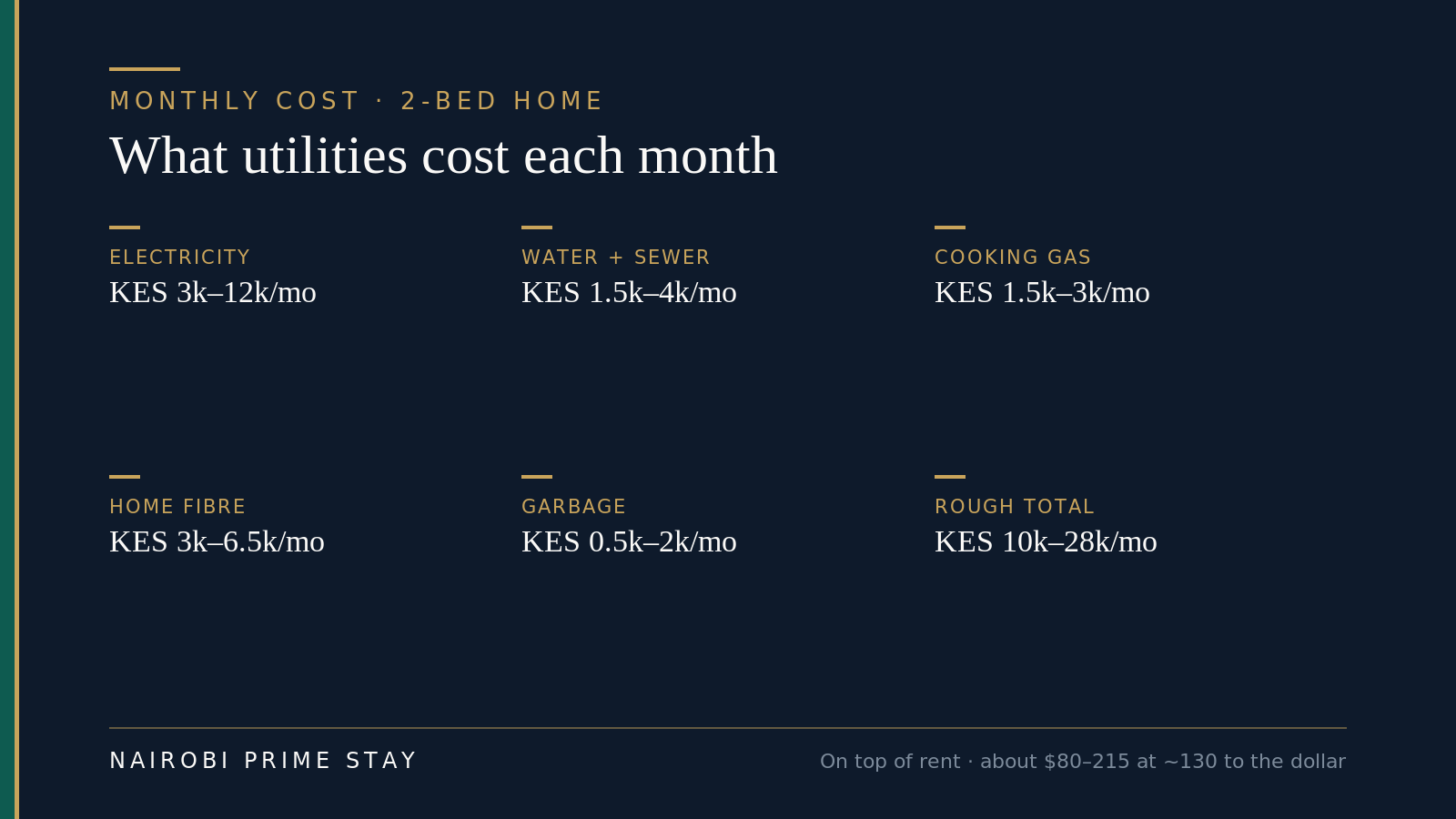 A realistic monthly utilities total for a two-bed home — on top of rent, and before any service charge. See the full picture in our cost-of-living guide.
A few honest caveats. This excludes rent and any service charge (which in an apartment may already cover water, garbage, security and the generator — sometimes KES 5,000–25,000+ a month on its own). It excludes the one-off setup costs — a gas cylinder and regulator, maybe an inverter — that you pay once. And it assumes a building with decent infrastructure; a place where you’re trucking in water or running a generator on diesel all evening costs more. For where utilities sit in your overall budget, see our full cost-of-living in Nairobi breakdown — and if you’re comparing against a US budget line by line, our Nairobi vs US cost-of-living comparison does exactly that.
How serviced apartments make this disappear
If setting up four utilities, vetting water storage and pricing an inverter sounds like a lot for your first month — it is. That’s the whole case for a serviced apartment as a soft landing. The price is all-inclusive: electricity, water, cooking gas, fast Wi-Fi, a backup generator, cleaning and security are already handled. No KPLC account, no token-buying, no tank to worry about, no service-charge negotiation. You arrive, the lights and the Wi-Fi work, and you spend your energy choosing a neighbourhood and viewing long-term homes instead of chasing meter numbers.
It’s the low-stress way to learn how Nairobi’s utilities actually behave — which areas have the steadiest water, how often the power really cuts where you’re looking — before you commit to a year-long lease and take all of it on yourself.
A realistic example
Say you’re a couple renting an unfurnished two-bed in Kileleshwa on a 12-month lease. Week one, you set up M-Pesa, then register a Kenya Power prepaid account in your name (the agent helps) and buy KES 2,000 of tokens to start. The building has a borehole and a generator, so water and outages are handled through a KES 12,000/month service charge — you never see a water bill. You buy a 13kg gas cylinder with a new regulator (~KES 6,000 the first time, then ~KES 3,200 to refill every couple of months) and call Safaricom for fibre (~KES 3,500/month, installed in two days). Your variable utilities settle at roughly KES 8,000–10,000 a month — power, gas and internet — on top of rent and the service charge. No inverter needed, because the generator covers outages. Total setup hassle: about three phone calls and one afternoon.
Now picture the same couple in a standalone house with no generator and a single small tank. They’d add an inverter (~KES 120,000 one-off), a bigger water-storage plan, and their own garbage contract — more control, more cost, more to manage. This is why, for a first year, most expats choose an apartment in a well-run block. The building absorbs the hard parts.
The honest balance
Nairobi utilities have real upsides and real quirks. Here’s the even reckoning.
| The good | The watch-outs |
|---|---|
| Prepaid power means no surprise bills — you control the spend | You can run out at the worst moment if you forget to top up |
| Pay almost everything from your phone via M-Pesa | You need M-Pesa working before you can pay anything |
| Fibre internet is fast and genuinely cheap | It’s only as reliable as your backup power during outages |
| Cooking gas is affordable and delivered to your door | Prices move monthly; buy the regulator/hose from a reputable seller |
| A good building bundles water, garbage, security and a generator | A bare house leaves all of that — especially water storage — to you |
| Mild climate means no AC and lower power bills than the US | Electric water heating can still dominate a bill if you’re not careful |
None of it is hard once you’ve done it once. The trick is choosing a home where the infrastructure is already sorted, then setting up the few things that are yours.
Your utilities setup checklist
Do these in roughly this order when you move into a long-term home:
- Before you sign: confirm the “Nairobi Five” — backup generator, water storage/borehole, security, fibre already in the building, responsive management.
- Ask what the service charge covers — water, garbage, security, generator, tank cleaning? Get it in writing.
- Set up M-Pesa first — it’s how you’ll pay every utility. (See our M-Pesa guide.)
- Electricity: confirm the meter is connected, note the meter number, register the prepaid account in your name, and buy your first tokens.
- Water: check tank size and borehole; confirm whether you’re billed by the county or through the service charge.
- Cooking gas: buy a 13kg cylinder with a new regulator and hose from a reputable dealer; save a delivery contact.
- Internet: confirm fibre serves the building, then book installation with Safaricom, Zuku or Faiba.
- Backup power: if you work from home and there’s no building generator, price an inverter and battery.
- Garbage: confirm the collector and day, or that it’s covered by the service charge.
- Appliances: check every US device for “100–240V” on the label; sell 120V-only appliances before shipping and budget to replace them locally.
- Keep records: save your meter number, token SMS history, and provider contacts in one note.
Final thoughts
Utilities in Nairobi feel foreign for about a week, then they’re routine. Buy power before you use it, respect the water-storage reality, keep a gas cylinder spare, and make sure something keeps your Wi-Fi alive when the grid blinks. Choose a well-run building and most of this is handled for you; choose a bare house and you take on more, for more control. Either way, it’s far cheaper than home, and you run almost all of it from your phone.
If you’d rather skip the setup entirely while you find your feet, that’s exactly what a serviced apartment is for — everything included, nothing to arrange, so your first month is about settling in, not chasing meter numbers.
Related reading
- Moving to Nairobi: the complete guide — the end-to-end relocation hub.
- Cost of living in Nairobi — where utilities fit in a real monthly budget.
- Internet, Wi-Fi and remote work in Nairobi — fibre providers, speeds and staying online.
- Furnishing a home in Nairobi — what to buy locally versus ship (and the 240V question).
- Shipping your belongings to Kenya — what’s worth putting in a container, and what isn’t.
- How to rent an apartment in Nairobi — the “Nairobi Five” and the rental process.
- Best neighborhoods in Nairobi for expats — which areas suit your commute and budget.
- Serviced apartments in Nairobi — the all-inclusive soft-landing option.
When you’re ready for a base where the power, water, gas and Wi-Fi just work from day one, browse our serviced apartments in Nairobi — all-inclusive, with honest monthly pricing. Not sure which area gives you the steadiest utilities for your budget? Our AI relocation assistant can shortlist apartments in a couple of minutes, any time of day.
Frequently asked questions
How do prepaid electricity tokens work in Nairobi?
Most Nairobi homes have a Kenya Power prepaid meter. You buy electricity in advance as a 20-digit ‘token’ — pay on M-Pesa using Kenya Power’s prepaid Pay Bill 888880 with your meter number as the account, get the code by SMS, and key it into the meter, which credits it with units (kWh). When units run low the meter beeps and you simply buy more. The tariff is the same as a postpaid bill — roughly KES 20–30 per unit all-in as of July 2026 — but you pay upfront, so there’s no month-end surprise.
What is Kenya Power’s Pay Bill number for buying tokens?
As of July 2026, the prepaid token Pay Bill is 888880 and the postpaid bill Pay Bill is 888888 — both under ‘Kenya Power’ in the M-Pesa menu. Use your meter number (prepaid) or account number (postpaid) as the account. The minimum token purchase via M-Pesa is about KES 10, the maximum whatever your M-Pesa tier allows, and the 20-digit token usually arrives by SMS within a minute. You can also buy through the Kenya Power self-service app or your bank app — always confirm the Pay Bill on kplc.co.ke rather than trusting a forwarded number.
How much does electricity cost in Nairobi in 2026?
Budget around KES 25 per unit (kWh) all-in, with most households paying between KES 20 and 30 once fuel, forex and inflation adjustments, levies and 16% VAT are added to the base energy rate. A proposed 2026/27 tariff increase was withdrawn in June 2026, so rates have held steady — the June 2026 adjustment actually shaved about KES 0.27 off a unit. A modest one-bed might use 80–150 units a month (about KES 2,000–4,000); a two- or three-bed with an electric water heater can use 300–500 units (about KES 7,000–13,000). Electric water heating is the biggest single driver, and the mild climate means almost no one runs air conditioning.
Is tap water safe to drink in Nairobi?
Many expats drink filtered or bottled water rather than straight from the tap, though brushing teeth with tap water is generally fine in the prime suburbs. The bigger issue isn’t quality but supply: Nairobi’s county water is rationed, so homes rely on storage tanks and often a private borehole that fill when the mains are flowing. When you’re house-hunting, ask less ‘is there water?’ and more ‘how big are the tanks, is there a borehole, and what’s the backup?’ — storage is what keeps your taps running on a dry day.
How much do utilities cost per month in Nairobi?
For a comfortable two-bed home, budget roughly KES 10,000–28,000 a month (about $77–216 at 129–130 to the dollar, July 2026) for electricity, water and sewerage, cooking gas, internet and garbage combined. Electricity is the biggest swing factor. This excludes rent and any service charge — in an apartment, water, garbage, security and a backup generator may already be folded into a monthly service charge of KES 5,000–25,000+. A serviced apartment bundles every utility into one all-inclusive price.
Will my American appliances work in Kenya?
Kenya runs on 240V / 50Hz with UK-style Type G three-pin plugs — not the 120V Type A/B system US homes use. Dual-voltage electronics (laptops, phone chargers, most modern TVs and cameras — check for ‘100–240V’ on the label) work fine with a simple plug adapter. Single-voltage 120V appliances — most US kitchen gadgets, hair dryers, some stand mixers — need a bulky step-down transformer or will burn out, so the practical answer is to sell them before you ship and buy 240V versions in Nairobi. Motorised or clock-driven appliances can also run oddly on 50Hz even with a transformer.
Do I need to put utilities in my own name as a renter?
Usually not, and that’s normal here. A prepaid electricity meter is tied to the apartment, not a person — you just buy tokens against the meter number from day one, no account transfer needed. Water, garbage, security and the generator typically sit inside the building’s service charge, billed by the landlord or management company. The one utility you’ll open in your own name is home internet, which needs just your passport and a phone number. If you’re in a standalone house on a postpaid KPLC account, ask the landlord whether to transfer it or keep paying against their account number.
How do I set up internet in a Nairobi apartment?
First confirm that fibre already serves the building — if it does, setup is a phone call and a day or two’s wait. Safaricom Home Fibre, Zuku and Faiba (JTL) are the main providers, with Safaricom’s entry Bronze plan at 40 Mbps for KES 2,999 a month (speeds were bumped at no extra cost in April 2026) and newer entrants offering 100 Mbps from about KES 2,000. Installation is free on most contracts. Nairobi’s fibre is fast and cheap; the thing to plan for is keeping it powered during an outage, via a building generator or your own inverter and battery.
Do I need a backup generator or inverter in Nairobi?
Power cuts happen, so some backup is wise — especially if you work from home. The easiest answer is to rent a building with a working shared generator, paid through the service charge, which covers your whole home automatically. If there’s no generator and you work remotely, a silent inverter-and-battery setup keeps essentials (Wi-Fi, lights, laptop) running; a solid hybrid inverter is about KES 80,000–180,000 plus a battery from KES 35,000, so it’s a one-off investment. Solar makes sense mainly for owners or long leases.
How does cooking gas work in Nairobi?
Most kitchens cook with LPG bottled gas. You buy a cylinder with a regulator and hose, and refill or swap it when it runs out. A 13kg refill costs roughly KES 2,200–3,530 as of July 2026 — the branded majors (TotalEnergies ~KES 3,510, Rubis ~KES 3,530) at the top, independent dealers from about KES 2,200 — and lasts one to three months for a couple, so think of gas as KES 1,500–3,000 a month. LPG prices aren’t capped by the regulator, which is why they vary so much between dealers. Buy your first regulator and hose from a reputable seller, keep the kitchen ventilated, and close the valve when you travel.
Why do the same shillings buy fewer token units some months?
Two reasons. First, part of your bill is made of pass-through charges — a fuel energy cost, a forex adjustment and an inflation adjustment — that the regulator EPRA resets every month by gazette notice, so the all-in price per unit genuinely moves month to month. Second, domestic tariffs are banded: your first ~30 units in a month are cheapest (lifeline rate), the next band costs more, and heavy use costs the most — so a top-up late in a heavy month buys fewer units than the same shillings bought on the 1st. Your token SMS shows the exact breakdown.
Do serviced apartments in Nairobi include utilities?
Yes — that’s the main appeal. A serviced apartment is all-inclusive: electricity, water, cooking gas, fast Wi-Fi, a backup generator, cleaning and security are all handled in one price. There’s no Kenya Power account to open, no tokens to buy, no water tank to worry about and no service charge to negotiate. It’s the low-stress way to spend your first weeks in Nairobi while you learn how the utilities behave and choose a long-term home.
Ready to look?
Find your apartment in Nairobi
Browse verified serviced apartments, or ask the AI concierge which area fits your life.