
Guides · Serviced apartments
Leases, Deposits and Tenant Rights in Kenya: An Honest Guide (2026)
Leases, Deposits and Tenant Rights in Kenya: An Honest Guide (2026)

Here’s the most important thing to know before you sign a lease in Kenya: if you’re renting a normal expat apartment, your written tenancy agreement is your real protection — not the law. Kenya’s main tenant-protection statute, the Rent Restriction Act, only covers homes renting for about KES 2,500 a month or less. Almost every prime Nairobi rental sits far above that, which puts you in what lawyers call an “uncontrolled” tenancy — governed mostly by the contract you sign and ordinary contract law.
That’s not as alarming as it sounds. You still have strong, enforceable rights. They just live in your lease rather than in a tenant-protection act, so the quality of that document matters enormously.
This guide is for Americans renting a home in Nairobi. We’ll cover what the law actually does and doesn’t do, typical lease terms, deposit norms and how to get yours back, notice periods, what a fair agreement should include, and what to do if a landlord plays unfair. If you haven’t yet found a place, start with our step-by-step guide to renting an apartment in Nairobi; this page is about your rights once you’re at the signing table.
One caveat up front: this is general information, not legal advice. Tenancy law here is mid-reform — a new Landlord and Tenant Bill has been working through Parliament for a few years — so for anything high-value or contested, have a Kenyan advocate read the agreement before you sign.

TL;DR — your rights in a nutshell
The short version, as of July 2026:
- Your lease is your law. Most expat rentals are “uncontrolled” (rent above ~KES 2,500/month), so the written agreement and common-law contract rules govern — not the Rent Restriction Tribunal.
- Deposit: usually 1–3 months’ rent plus the first month in advance. It’s refundable, less fair deductions for unpaid rent, unpaid bills, or damage beyond normal wear and tear.
- Getting it back: typically 14–30 days after you hand back the keys, as set out in your agreement. You’re owed an itemized statement for any deduction.
- Notice: commonly one to three months either way. A landlord ending your tenancy must give written notice — and cannot legally lock you out or seize your things without due process.
- Get everything in writing, with a signed inventory and your own dated move-in photos. That one habit protects your deposit more than any statute.
- If it goes wrong: prime-rental disputes go to the Magistrate’s Court or the Environment and Land Court, not the Rent Restriction Tribunal. A firm written demand often settles a deposit standoff before it gets that far.
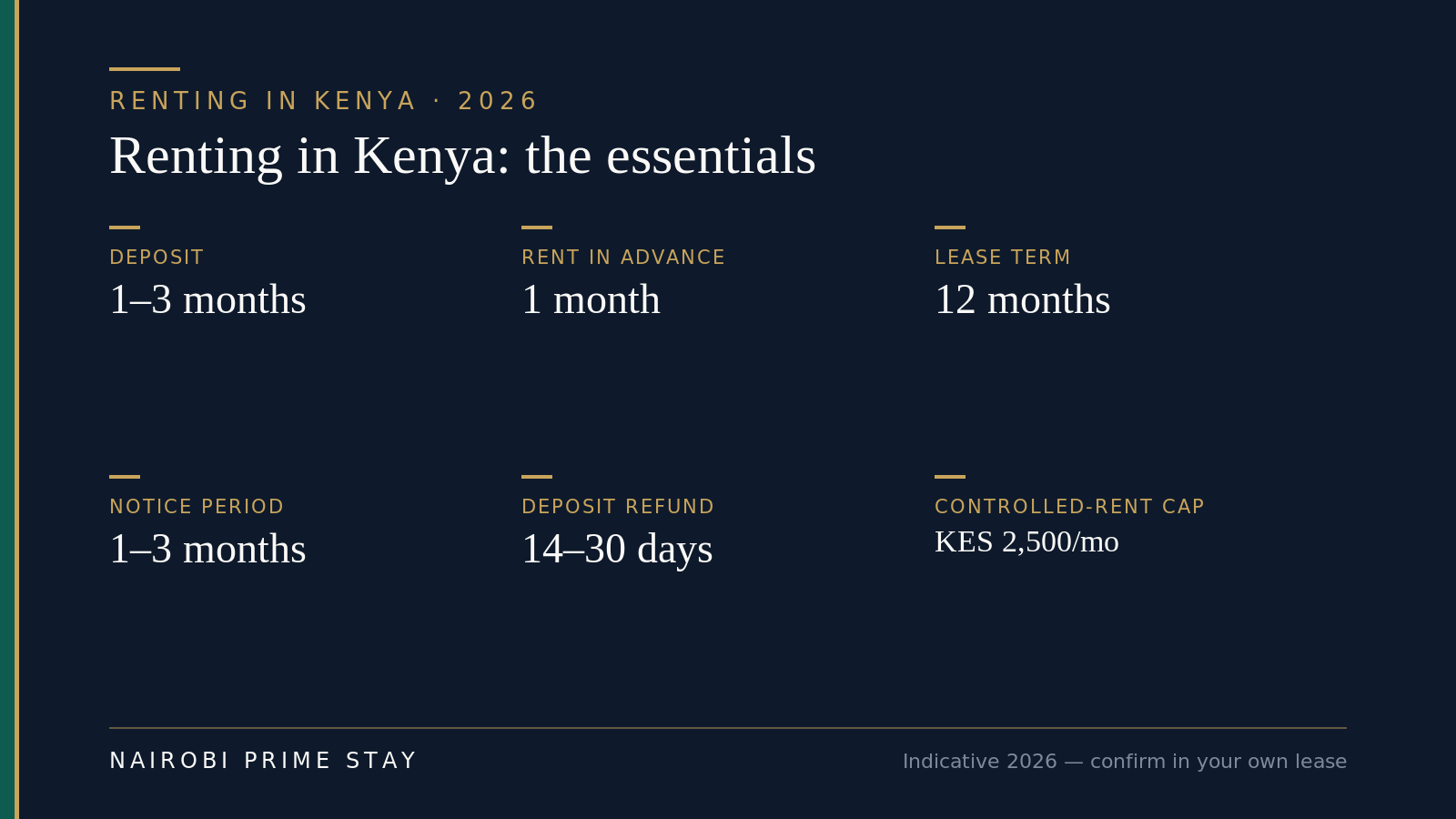 The essentials of a Kenyan tenancy in 2026 — all indicative, so confirm the exact figures in your own lease.
Why renting in Kenya feels different
Kenya doesn’t have a single, modern residential-tenancy code the way many US states do. Instead, renting sits on top of a patchwork: an old rent-control statute for cheap housing, ordinary contract law for everything else, and a couple of specialized acts for commercial premises and debt recovery. There’s no government deposit-protection scheme, no standard statutory lease, and no automatic cap on what a landlord can charge at the top of the market.
What fills the gap is your agreement. A clear, fair, written lease — with a signed inventory — does the job that a tenant-protection law does elsewhere. Get that right and you’re well covered. Skip it, or sign something vague, and you’ve given away most of your leverage before you’ve unpacked a box.
Controlled vs uncontrolled — which one are you?
This is the distinction that decides which rules protect you, so it’s worth a minute.
A controlled tenancy falls under the Rent Restriction Act (Cap 296). It applies to dwelling houses with a “standard rent” of roughly KES 2,500 a month or less — a figure set decades ago and never meaningfully updated. These tenants get real statutory protection: regulated rent increases, protection from arbitrary eviction, and a dedicated forum, the Rent Restriction Tribunal, to settle disputes cheaply.
An uncontrolled tenancy is everything above that threshold — which, in practice, is essentially every furnished apartment, townhouse and family home an expat would rent. Here there’s no statutory rent cap and no Tribunal jurisdiction. Your protection comes from the lease you signed and from common-law contract principles, and disputes are handled by the ordinary courts — the Magistrate’s Court for straightforward money claims, or the Environment and Land Court for weightier property questions.
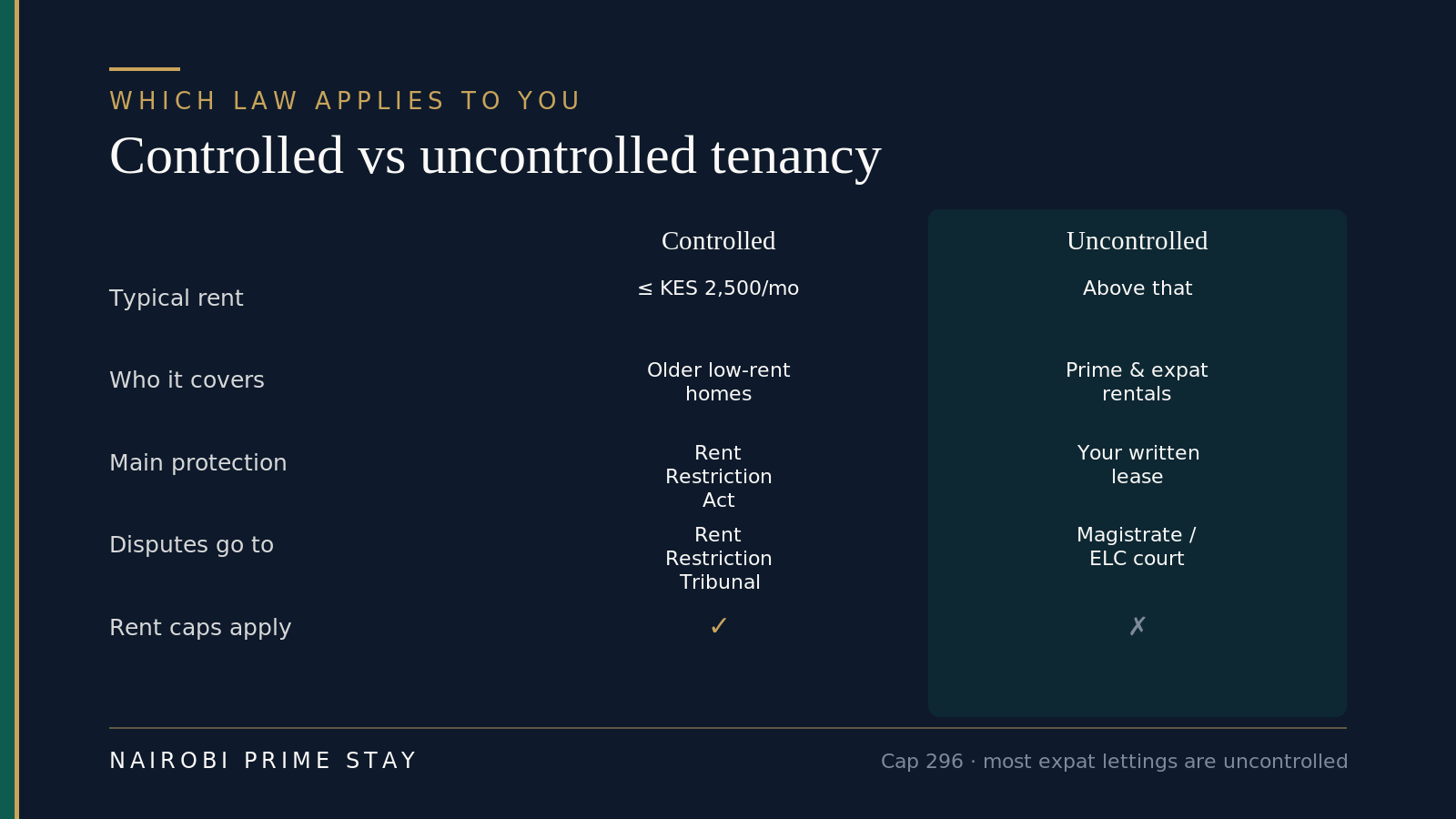 Almost all expat lettings are uncontrolled — so your written agreement, not the Rent Restriction Tribunal, is what protects you.
This surprises a lot of newcomers who read generic “know your tenant rights” articles and assume the Tribunal has their back. For a $2,000-a-month apartment in Lavington or Gigiri, it generally doesn’t. That’s not a reason to worry — it’s a reason to take the agreement seriously and document everything.
(There’s a third track you’ll see mentioned: the Landlord and Tenant (Shops, Hotels and Catering Establishments) Act (Cap 301), which governs controlled business premises through the Business Premises Rent Tribunal. That’s for commercial leases, not your home, so set it aside unless you’re renting an office or shop.)
What the law does — and doesn’t — do for you
A quick, honest map of the statutes that touch your tenancy:
- Rent Restriction Act (Cap 296): strong protections, but only for controlled (low-rent) tenancies. Almost certainly not you.
- Common-law contract: the real workhorse for expats. Your lease binds both sides, and a court will enforce its terms — which is exactly why those terms need to be clear and fair.
- Distress for Rent Act (Cap 293): governs how a landlord can recover unpaid rent by seizing goods. Crucially, distress must be carried out by a court-licensed auctioneer, not by the landlord personally. A landlord who changes the locks, welds a door, hauls out your furniture or cuts your power is committing unlawful “self-help,” and you can seek damages for it.
- Environment and Land Court Act (2011): establishes the court where larger tenancy, land and property disputes are heard when they fall outside the Tribunal’s scope.
There’s also reform on the horizon. The Landlord and Tenant Bill has been moving through Parliament and, if enacted, would consolidate these scattered rules into one modern law — proposing things like 90 days’ notice before any rent increase, increases no more than once a year for homes, a requirement for a court order before distress, and unified tribunals to hear disputes. As of 2026 it is not yet law, so don’t rely on it; check the Kenya Law and Parliament websites for its current status, and treat your signed lease as the binding document today.
Typical lease terms in Nairobi
Most prime homes let on a 12-month written tenancy agreement. Shorter, flexible stays are usually handled through serviced apartments rather than a standard lease, because a one-year commitment is the norm for an ordinary rental.
To sign, you’ll generally need a KRA PIN (Kenya’s tax ID, quick to get online once you hold a permit) plus your passport and your permit or ID. Rent is paid monthly, in advance, almost always by bank transfer or M-Pesa. Get a signed receipt for every payment and keep it — receipts are your proof of what you’ve paid and when.
A standard agreement should name the parties, the property, the rent and due date, the deposit, the term and notice periods, and who carries which costs (service charge, water, security, repairs). If you’re weighing a furnished place against a bare one, our guide to furnished vs unfurnished apartments explains what changes in the lease and the budget.
Deposits — how much, and how to get yours back
Expect a security deposit of one to three months’ rent, paid alongside the first month in advance. On a typical $1,000–2,000 apartment, that’s a meaningful sum sitting with your landlord, so treat it as the money most worth protecting.
To put it in dollars: at roughly KES 129 to the US dollar (July 2026), a two-month deposit on a KES 250,000-a-month family apartment is about $3,900, and with the first month’s rent on top you’re wiring close to $5,800 before you get the keys. Move that kind of money traceably — a bank transfer from your Kenyan account or a low-spread service like Wise (how to send money to Kenya) — and never in cash to an individual. Our dollar-to-shilling guide covers the mechanics and the rate.
The deposit is exactly that — security. It’s your money, held against the risk that you leave owing rent or having damaged the place. At the end of the tenancy it should come back to you, minus only fair, itemized deductions.
What a landlord can legitimately deduct:
- Unpaid rent or charges you genuinely owe.
- Unpaid utility bills left in your name (power, water, internet).
- Damage beyond normal wear and tear — a cracked basin, a burned countertop, a broken door.
What a landlord cannot fairly deduct:
- Normal wear and tear — faded paint, a worn carpet, scuffs from ordinary living. Routine repainting between tenants is the landlord’s cost, not yours.
- Vague “cleaning” or “refurbishment” charges with no evidence.
On timing, most agreements call for a refund within 14 to 30 days of you vacating and returning the keys, and that contractual deadline is enforceable. Where the lease is silent, common-law principles require return within a reasonable time, which courts have treated as roughly 30 days — enough for the landlord to inspect and tally any genuine damage. For any deduction, you’re entitled to an itemized statement with evidence, not a vague verbal explanation.
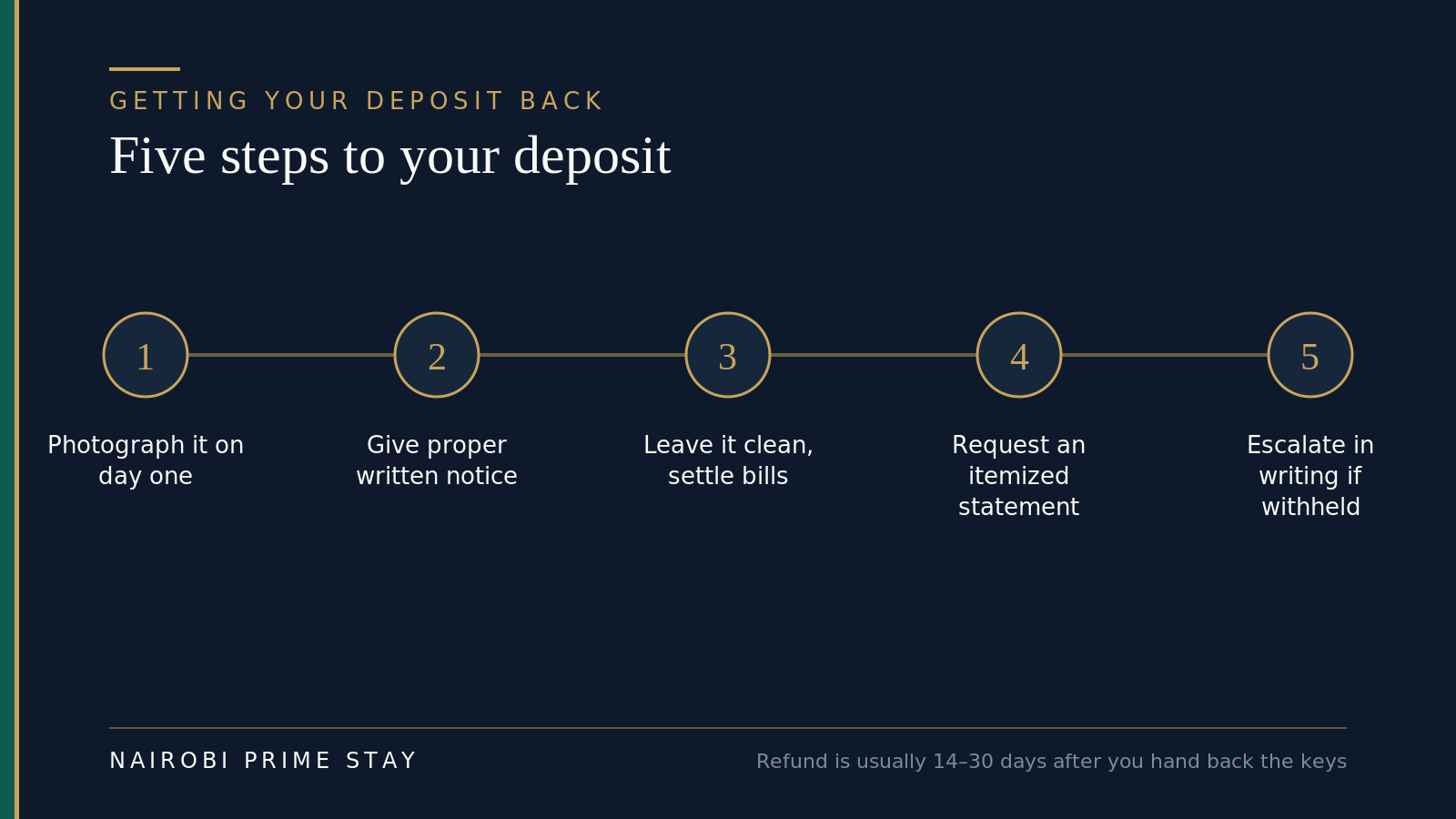 Deposit disputes are the most common rental friction in Nairobi — documentation on day one is what wins them.
The honest reality: deposit standoffs are the number-one source of landlord-tenant friction here. Most landlords are fair, but some drag their feet or invent deductions, betting that a departing tenant — especially one leaving the country — won’t fight back. The defense is unglamorous and completely effective: document the apartment’s condition the day you move in, keep every receipt, give proper notice, and leave the place clean. Paper beats argument.
Notice periods — both directions
Notice cuts both ways, and your lease should spell out the period for each side.
For a month-to-month tenancy, the convention is one month’s written notice either way. For a fixed-term lease, agreements commonly require one to three months’ notice before the end of the term — check your specific contract, because this is set by the document, not by a statute. A landlord who wants you out must give written notice stating the reason; they can’t simply decide you’re leaving and change the locks.
If you need to leave early, before the lease or notice period is up, you may forfeit part of the deposit or owe rent until the notice runs out — unless your lease allows early termination or you find an acceptable replacement tenant. It’s worth negotiating a break clause up front if there’s any chance your plans could change, which is common for remote workers and assignees on uncertain timelines.
What a fair tenancy agreement includes
Because the agreement carries the weight here, it pays to know what a good one looks like. Insist on these in writing before you sign:
- The rent and when it’s due, and whether it’s fixed for the term.
- The deposit amount and the exact conditions for getting it back, including the refund window.
- The notice period for both sides, and any break clause.
- Who pays the service charge, water, security and utilities — in apartment blocks the service charge can be significant, so know whether it’s on you or the landlord.
- Who is responsible for repairs, and how to report them.
- A signed inventory listing the condition and contents of the place on day one.
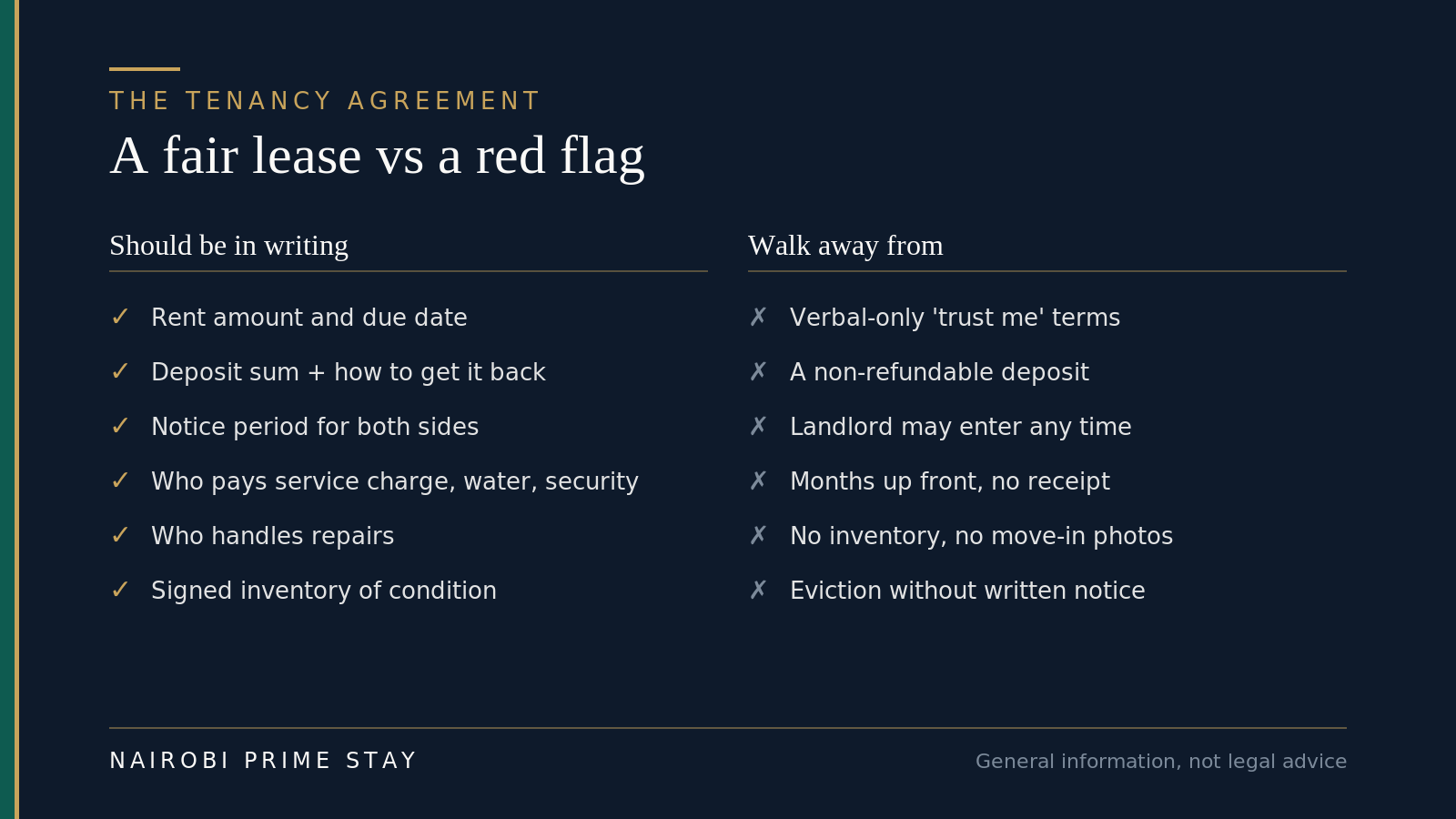 A fair lease puts the important things in writing; the red-flag column is your cue to keep looking.
The unsung hero on that list is the inventory. Walk the apartment on move-in day, note every existing mark and every appliance, photograph or video all of it with the date visible, and have both sides sign. That record is precisely what protects your deposit when you leave — it’s the difference between “the wall was already scuffed” and a he-said-she-said you’ll lose. Verify too that whoever signs actually owns or manages the property; our guide to common property scams in Kenya covers how fake “landlords” operate and how to check.
Can the rent go up?
During a fixed 12-month term, no — if the lease sets the rent for the year, the landlord can’t raise it mid-term. That’s one of the quiet benefits of a written fixed-term agreement.
At renewal, expect a market adjustment, and negotiate. A common, fair move is to agree a cap on annual increases (say, in line with inflation) written into the lease from the start, so renewal isn’t a surprise. The pending Landlord and Tenant Bill would, if passed, require 90 days’ notice for any increase and limit residential rises to once a year — but that’s not law yet, so for now the protection you have is the one written into your contract. Inflation in Kenya has been running in the mid-single digits, which is a reasonable yardstick for what “fair” looks like at renewal.
Repairs and responsibilities
As a rule of thumb, the landlord handles the structure and major systems — roof, plumbing, electrics, and usually the building’s generator and water infrastructure — while the tenant handles day-to-day upkeep and anything they break. The cleanest agreements say this explicitly and give you a clear way to report a fault and a reasonable time for it to be fixed. In an apartment block, the service charge funds shared things like security, common-area cleaning, lifts and water pumps; confirm in writing whether you or the landlord pays it, because it’s a recurring cost that catches people out.
If things go wrong — your options
Most tenancies run their course without drama. When friction does come, escalate in steady steps rather than jumping straight to conflict.
Start in writing. A polite, firm letter or email laying out the facts — the inventory, the receipts, the lease clause, and exactly what you’re owed — resolves most deposit standoffs on its own. Put a clear deadline on it. A landlord who realizes you’ve documented everything usually settles.
Use the middle layer. A good managing agent or the person who introduced you can often broker a fair outcome before anyone talks about court.
Then the formal route. If you’re a controlled (low-rent) tenant, the Rent Restriction Tribunal is your cheap, dedicated forum. For the uncontrolled tenancies most expats hold, a money claim such as a withheld deposit goes to the Magistrate’s Court, and weightier property or tenancy disputes go to the Environment and Land Court. For anything significant, instruct a Kenyan advocate — the same property advocates who handle conveyancing take tenancy disputes.
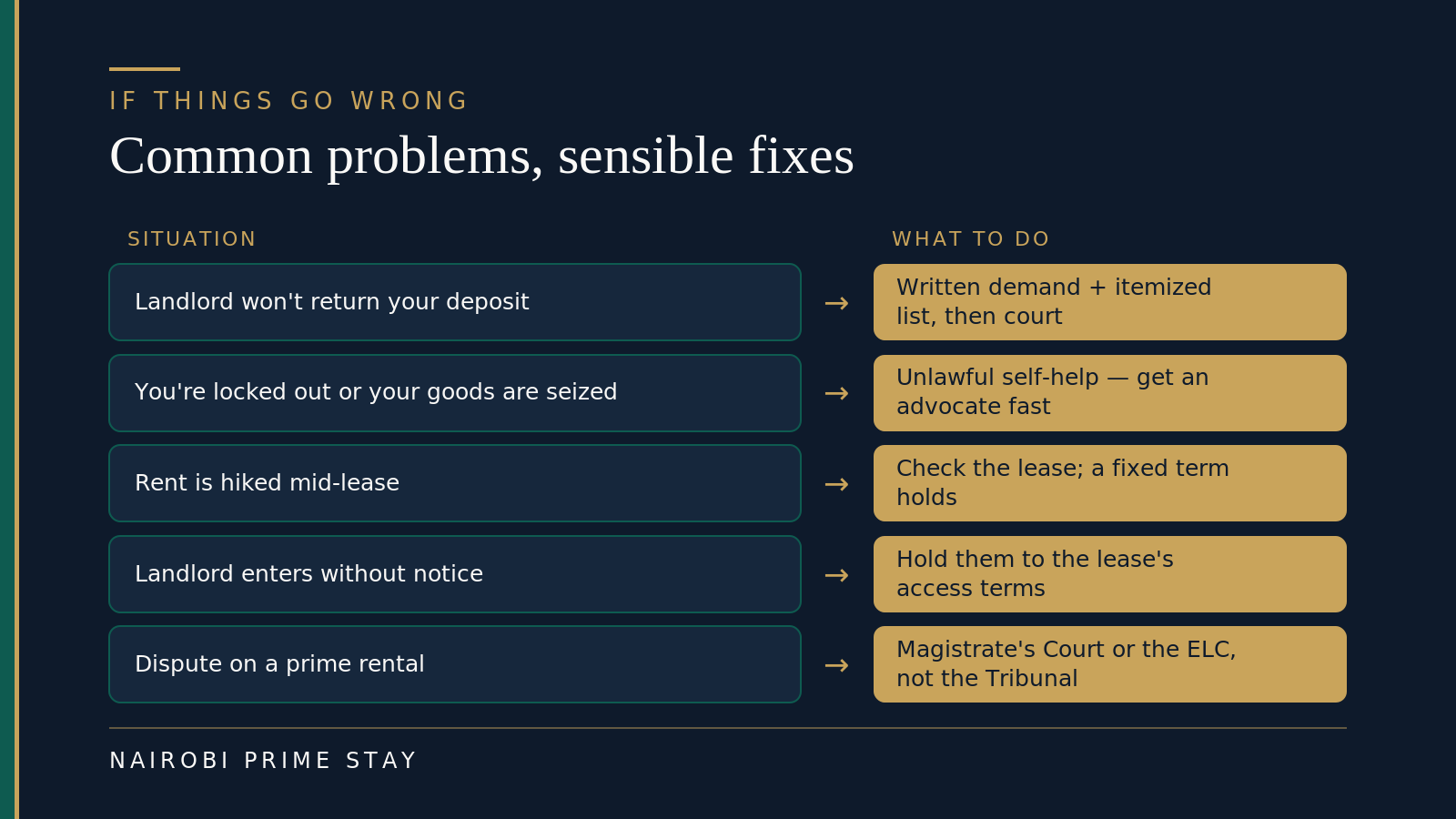 The honest fixes for the problems that actually come up — most start with a written record and end without a courtroom.
One bright line worth repeating: a landlord cannot lawfully lock you out, seize your belongings, or cut your power or water to force you out or recover rent. That’s unlawful self-help. Recovering arrears by seizing goods (distress) must go through a court-licensed auctioneer, not the landlord in person, and you can claim damages if a landlord takes the law into their own hands.
A realistic example
Say you’re a family on a $2,000-a-month house in Lavington, two-month deposit, on a 12-month lease. At move-out, the landlord proposes docking your whole deposit: a chunk for “repainting the place,” some for a worn living-room rug, and a line for a cracked bathroom basin.
Because you photographed everything on day one, kept a signed inventory, and made sure the lease promised an itemized statement, you reply in writing. Repainting between tenants and a rug worn by ordinary use are normal wear and tear — the landlord’s cost, not yours — so those come off. The cracked basin is genuine damage you caused, so you accept a fair, evidenced deduction for it. The remainder lands back in your account inside three weeks. No lawyer, no tribunal — the paperwork did the work. That’s the whole game: document on day one, and a deposit dispute is usually over before it begins.
Your tenant-rights checklist
Work through this and you’ll cover what matters:
- Get a written tenancy agreement — never rely on a handshake or a verbal promise.
- Read every clause: rent, deposit and refund terms, notice, repairs, who pays what.
- Confirm the rent is fixed for the term, and negotiate a cap on increases at renewal.
- Sign an inventory and take your own dated photos or video on move-in day.
- Verify the signer owns or manages the property before paying anything.
- Pay traceably — bank transfer or M-Pesa — and keep a signed receipt for every shilling.
- Know your notice period in both directions; ask for a break clause if your plans are uncertain.
- Keep utility accounts clear so nothing can be docked at the end.
- At move-out, give proper notice, leave the place clean, and request an itemized statement for any deduction.
- For a high-value or unusual lease, have a Kenyan advocate review it first.
Can you sign a lease from the US before you arrive?
You can — but for most people the honest answer is: don’t. Kenya’s most common rental scam is built around the overseas renter who pays a deposit for an apartment that nobody they trust has stood inside. The listing is real-looking, the “landlord” is responsive, and the money is gone the moment it lands on a personal M-Pesa number. Our guide to common property scams in Kenya walks through how these operate.
The safer sequence costs you nothing but patience: book a serviced apartment for your first month, view long-term homes in person, verify the owner, and sign at a table — not over email from 8,000 miles away. A month of flexibility is far cheaper than a lost deposit.
If you genuinely must commit remotely — a diplomatic posting with fixed dates, an employer that insists housing is settled before you fly — then stack the safeguards: work through your employer’s housing office or a registered, vetted agent; insist on a live video walkthrough (not pre-recorded); have someone conduct an official ownership check; and pay only into a law firm’s or registered agency’s account with a signed lease and receipt. Embassy and UN arrivals usually have exactly this machinery available — use it.
What is a diplomatic clause — and should you ask for one?
A diplomatic clause (a break clause by another name) lets you end a fixed-term lease early — typically on one to two months’ written notice, with proof — if your posting is cut short, you’re transferred, or the job that brought you to Kenya ends. It’s standard in leases signed by embassies, the UN and large NGOs, whose people move on short notice, and Nairobi landlords in the diplomatic belt are used to it.
If you’re renting privately on an assignment or a remote-work timeline that could change, ask for one before you sign. Landlords won’t always agree, but many will accept a version — say, exit allowed after month six with two months’ notice and an employer’s letter. Without it, leaving early usually means forfeiting some or all of the deposit, or paying rent until the notice period runs out. Two sentences in the lease can be worth thousands of dollars; this is the single most valuable clause an expat can negotiate.
Will the Landlord and Tenant Bill change your rights?
Kenya’s tenancy law has been “mid-reform” for years, and it still is. The Landlord and Tenant Bill, 2021 would consolidate the Rent Restriction Act and the business-premises tenancy law into a single modern regime covering the whole rental market — including the prime homes expats rent. Among its proposals: a dedicated Rent Tribunal for all tenancies, 90 days’ written notice for any rent increase, residential increases limited to once a year, and clearer statutory rules on termination notices and deposits.
As of July 2026, though, it is not law. The Bill was passed by the National Assembly and has been working through Parliament since 2021 without completing the journey. Until it does, nothing above changes: your written lease remains your real protection, and the negotiating advice in this guide is exactly as important as it was. If and when the Bill passes, we’ll update this guide — it would be the biggest shift in Kenyan tenant rights in decades.
Frequently asked questions
Do tenants have legal rights in Kenya?
Yes. Every tenant has enforceable rights, but where they come from depends on the rent. Low-rent homes (around KES 2,500 a month or less) are protected by the Rent Restriction Act and its Rent Restriction Tribunal. Almost all expat rentals sit above that, so their rights come from the written tenancy agreement and ordinary contract law, enforced through the regular courts. Either way, a landlord cannot evict you or seize your property without due process.
What is the Rent Restriction Act, and does it cover me?
The Rent Restriction Act (Cap 296) is Kenya’s rent-control law. It only covers ‘controlled’ tenancies — dwelling houses with a standard rent of about KES 2,500 a month or less — and gives those tenants regulated rents and a dedicated Rent Restriction Tribunal. If you rent a typical furnished apartment or family home, your rent is far above that threshold, so the Act and the Tribunal generally do not apply to you, and your real protection is your written lease.
How much deposit do you pay to rent in Kenya, and is it refundable?
Expect a security deposit of one to three months’ rent, plus the first month’s rent in advance. At about KES 129 to the US dollar (July 2026), a two-month deposit on a KES 250,000-a-month family apartment is roughly $3,900 before the first month’s rent. The deposit is refundable at the end of the tenancy, minus fair deductions for unpaid rent, unpaid utility bills, or damage beyond normal wear and tear. Pay it only after viewing the place and confirming who the landlord is, and always get a signed receipt.
How long does a landlord have to return your deposit in Kenya?
Most tenancy agreements require the deposit back within 14 to 30 days of you vacating and returning the keys, and that deadline is enforceable. Where the lease is silent, common law requires return within a reasonable time, which courts have treated as around 30 days — enough for the landlord to inspect for genuine damage. You are entitled to an itemized statement for any amount withheld.
What can a landlord deduct from your deposit in Kenya?
Only fair, evidenced amounts: unpaid rent, unpaid utility bills in your name, and damage beyond normal wear and tear, such as a cracked basin or a broken fixture. A landlord cannot fairly deduct for normal wear — faded paint, a worn carpet, or routine repainting between tenants — or for vague ‘cleaning’ charges with no evidence. Ask for an itemized statement for every deduction.
How much notice must a landlord give to end a tenancy in Kenya?
It depends on the agreement. A month-to-month tenancy usually needs one month’s written notice either way; a fixed-term lease commonly requires one to three months’ notice before the term ends — check your contract. A landlord ending your tenancy must give written notice stating the reason, and cannot simply change the locks or force you out without due process.
Can a landlord raise the rent during the lease?
Not during a fixed term. If your 12-month lease sets the rent for the year, it holds until renewal — that is one of the main reasons to insist on a written fixed-term agreement. At renewal, expect a market adjustment and negotiate; a cap on annual increases written into the lease from the start is a fair, common ask. The pending Landlord and Tenant Bill would require 90 days’ notice for increases and limit residential rises to once a year, but as of July 2026 it is not yet law.
Can a landlord lock you out or seize your belongings in Kenya?
No. Locking you out, welding doors, removing your goods, or cutting your power or water to force you out or recover rent is unlawful ‘self-help,’ and you can claim damages for it. Recovering unpaid rent by seizing goods, known as distress, must be done by a court-licensed auctioneer, not by the landlord personally. If this happens to you, get an advocate quickly.
Can I sign a lease and pay a deposit from the US before I arrive?
You can, but you usually shouldn’t. Fake listings target exactly this situation, and wiring a deposit for an apartment nobody you trust has stood inside is the classic Nairobi rental scam. The safer pattern is to book a serviced apartment for the first month, then view, verify the owner and sign in person. If you must commit remotely — a diplomatic posting, say — work through your employer’s housing office or a vetted agent, insist on a live video walkthrough, and pay into a law firm’s or registered agency’s account, never to a personal number.
What is a diplomatic clause in a Kenyan lease?
A diplomatic clause (or break clause) lets you end a fixed-term lease early — typically with one to two months’ written notice and proof — if your posting is cut short, you are transferred, or you lose the job that brought you to Kenya. It is standard in embassy and UN leases and worth requesting even as a private renter on an uncertain timeline. Without one, leaving early usually means forfeiting deposit or paying rent until the notice runs out.
Where do you take a landlord-tenant dispute in Kenya?
It depends on the tenancy. Controlled, low-rent tenants use the Rent Restriction Tribunal. For the uncontrolled tenancies most expats hold, a money claim like a withheld deposit goes to the Magistrate’s Court, and larger property or tenancy disputes go to the Environment and Land Court. Most deposit standoffs, though, settle with a firm written demand backed by your inventory and receipts, well before court.
Will the Landlord and Tenant Bill change my rights, and is it law yet?
Not yet. The Landlord and Tenant Bill, 2021 — which would consolidate Kenya’s tenancy laws into one regime with a dedicated tribunal, regulated rent-increase notice and once-a-year residential increases — was passed by the National Assembly but was still working through Parliament as of July 2026. Until it becomes law, your written lease remains your main protection. This guide is general information, not legal advice; for a high-value or unusual lease, have a Kenyan advocate review it.
Final thoughts
Renting in Kenya rewards the same thing good renting rewards anywhere: a clear written agreement and a paper trail. The twist is that the usual statutory safety net mostly sits below your end of the market, so the lease you sign does the heavy lifting. Read it properly, fix the rent for the term, sign an inventory, photograph the place on day one, pay traceably, and keep every receipt. Do that and your deposit, your notice and your peace of mind are well protected — and most disputes never get past a firm email.
If a landlord ever resorts to locking you out or seizing your things, remember that’s unlawful, and you have recourse. Stay calm, keep your records, and get an advocate for anything serious. This is general information rather than legal advice, and the law is mid-reform, so when a lease is large or unusual, a quick professional review is worth every shilling.
Related reading
- Moving to Nairobi: the complete guide — the big picture, start here.
- How to rent an apartment in Nairobi — the step-by-step process before you sign.
- Serviced apartments in Nairobi — the flexible, all-inclusive soft landing.
- Furnished vs unfurnished apartments in Nairobi — which to choose, and what each costs.
- Common property scams in Kenya — how fake landlords operate and how to check.
- Cost of living in Nairobi — where rent and deposits fit your budget.
- Best neighborhoods in Nairobi for expats — pick the right area first.
- Embassy & UN housing in Nairobi — how diplomatic leases and allowances work.
Before you sign anything
The calmest way to start is from a secure base, with no lease pressure at all. Browse our serviced apartments in Nairobi — handpicked, all-inclusive, with honest monthly pricing — and use your first weeks to view long-term homes and read leases without rushing. A $50 deposit reserves your place and locks your dates; you pay the balance on arrival.
Not sure whether a lease clause is fair, or which area fits your budget? Our AI relocation assistant can talk through the renting basics and shortlist apartments in a couple of minutes, any time of day.
Ready to look?
Find your apartment in Nairobi
Browse verified serviced apartments, or ask the AI concierge which area fits your life.