
Guides · Serviced apartments
Corporate Housing in Nairobi: The Complete 2026 Guide
Corporate Housing in Nairobi: The Complete 2026 Guide

If your company is sending someone to Nairobi, the housing question lands fast: where do they stay, who pays, and how is it billed? Corporate housing is the answer most firms reach for — a furnished, all-inclusive apartment the company books and pays for, ready on day one, with one invoice instead of a dozen.
This guide is for two people. The HR or global-mobility manager setting up the move, and the executive or specialist who’s actually going. We’ll cover what corporate housing means in Nairobi, what a relocation package usually pays for, how billing and contracts work, which areas suit executives, and what to budget. Honest numbers, real place names, and the tradeoffs nobody mentions until you’re mid-move.
We run serviced apartments in Nairobi and arrange them for companies every week, so some of this is our own bias — we’ll flag it where it matters and tell you when a straight lease or a hotel is the smarter call.

TL;DR — corporate housing in Nairobi, in five sentences
Corporate housing in Nairobi usually means a furnished serviced apartment the company books for an assignee — Wi-Fi, cleaning, power backup and security included, billed as one monthly invoice. It’s faster and far less hassle than setting up a leased home, and cheaper than a hotel once a stay runs past a week or two. Terms are flexible: book by the month, extend or end with short notice, no 12-month lease or deposit-juggling. Executives and their families cluster in Gigiri, Runda, Muthaiga, Westlands, Riverside and Karen depending on commute, schools and how much space they need. Budget roughly $1,500–$4,000+ a month for an executive-grade furnished apartment, and reserve with us for a $50 deposit with the balance paid on arrival.
Why corporate housing matters for a Nairobi move
A relocation is judged in the first two weeks. If your assignee lands to a clean, working, secure home with fast internet and no admin, they start contributing on day one. If they land into a half-set-up rental with no power backup and a SIM card they can’t register, you’ve bought yourself a month of distracted, unhappy emails.
Nairobi rewards getting this right. The city has excellent private infrastructure inside its prime suburbs — fibre internet, backup generators, 24/7 security, modern furnished apartments — but it’s unevenly distributed, and you can’t see it from a listing photo. A leased home can take weeks to set up: viewings, a KRA PIN and permit before anyone will sign a lease, deposits, then connecting power, water, internet and security one vendor at a time. Corporate housing collapses all of that into a single booking that’s live before the flight.
It also de-risks the area decision. Where someone lives relative to their office or their kids’ school shapes daily life more than the apartment itself, because distances are short but traffic is not. A serviced apartment for the first month lets the assignee test the commute and choose the right neighbourhood before committing to a year-long lease. For more on the move as a whole, see our hub guide on moving to Nairobi.
What “corporate housing” actually means in Nairobi
Corporate housing is short-to-medium-term furnished accommodation a company arranges for an employee, paid by the company and billed to the company. In Nairobi it almost always takes the form of a serviced apartment: a fully furnished home with hotel-style services folded into one price — utilities, fast Wi-Fi, weekly cleaning, a backup generator, water storage and 24/7 security. The assignee unpacks and starts work. Nobody sets up a single account.
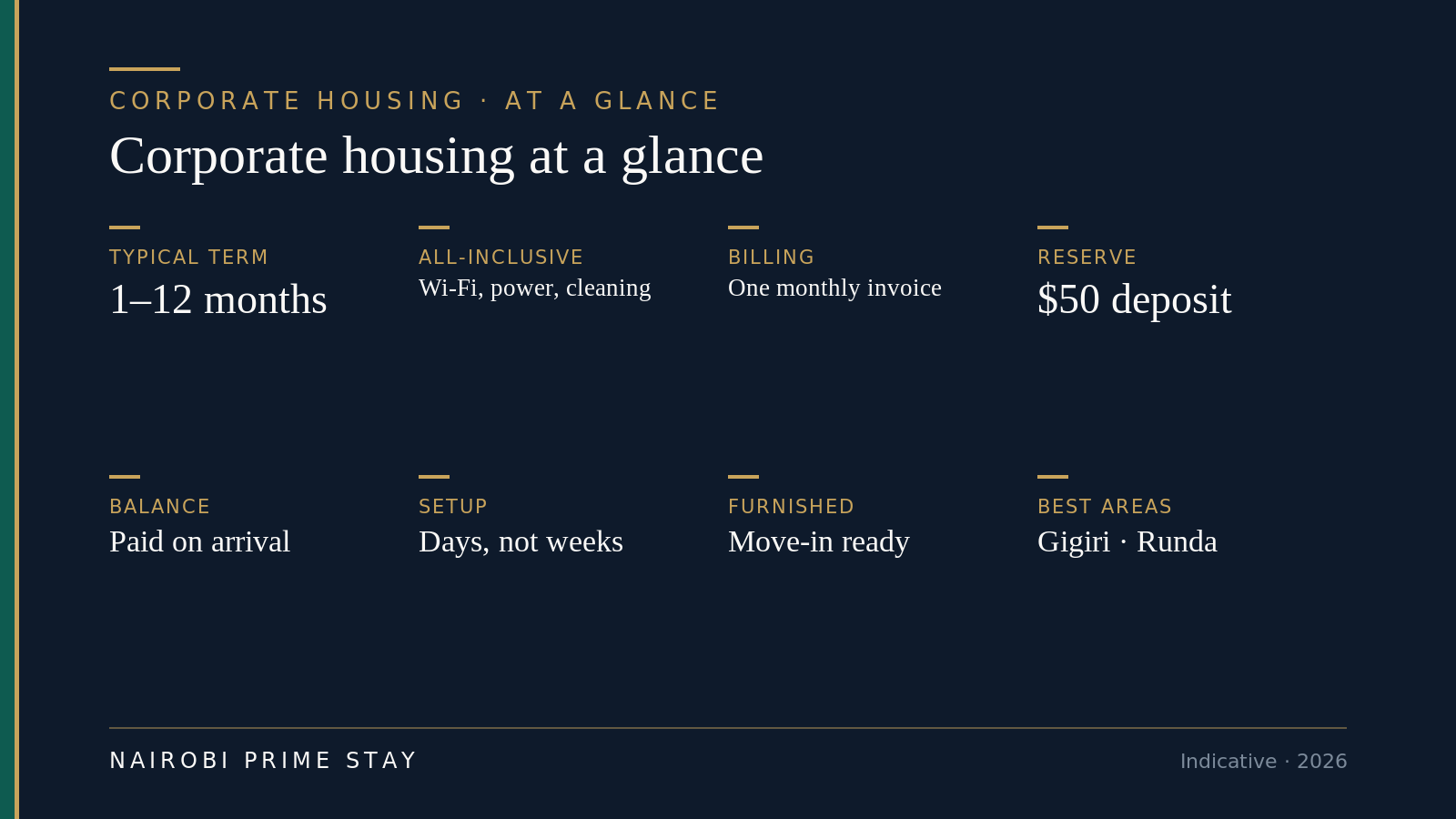 Corporate housing in Nairobi, at a glance — furnished, all-inclusive, billed once a month.
That’s different from the other three things companies sometimes use, and the differences matter for cost and admin:
- A serviced apartment is the corporate-housing default: furnished, all-inclusive, flexible by the month.
- A company-leased home is an unfurnished or furnished house or apartment the company signs a 12-month lease on. Lowest monthly rent, but slow to set up, with deposits, separate utility accounts and furniture to buy. It suits a multi-year posting, not a three-month project.
- A hotel or aparthotel is fastest to book and best for a few nights, but the nightly rate makes it the most expensive option once a stay runs past a week or two, and a hotel room is a grim place to spend three months.
- An extended-stay aparthotel sits between the two — more space than a hotel, less of a home than a serviced apartment.
For most assignments of one to twelve months, the serviced apartment wins on the combination of speed, cost and sanity. Here’s the honest comparison.
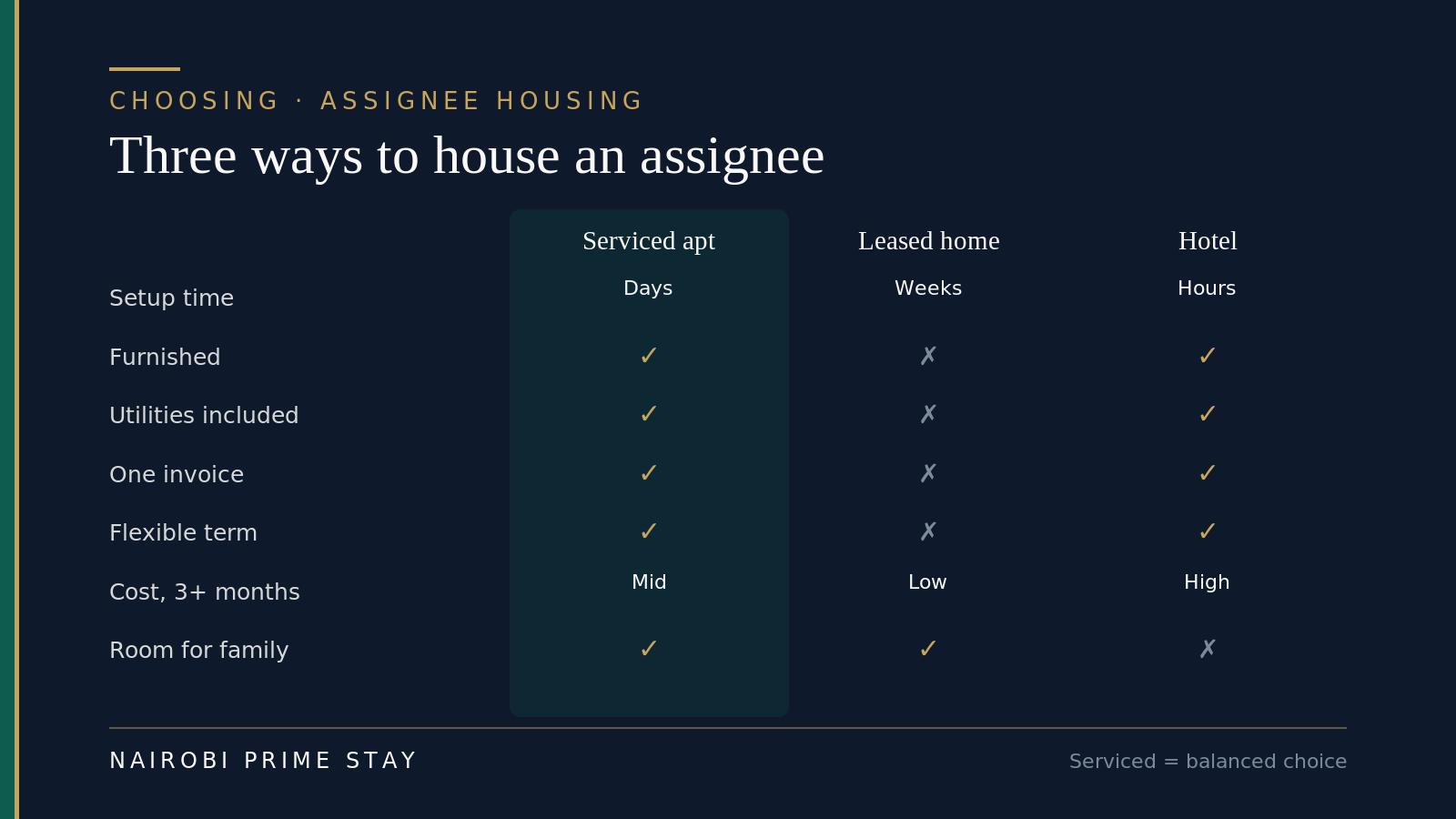 Three ways to house an assignee, compared. A leased home is cheapest per month but slow and admin-heavy; a hotel is fastest but dear for long stays.
A quick read of that table: if the stay is under a week, book a hotel. If it’s a confirmed multi-year posting and the assignee is happy to set up a home, a leased house gives the lowest monthly cost — see our guide on how to rent an apartment in Nairobi. For nearly everything in between, corporate serviced housing is the path of least resistance.
What a Nairobi relocation package usually covers
A relocation package is the bundle of support a company gives someone to move. There’s no single standard, but Nairobi packages tend to fall into three buckets: what’s nearly always covered, what’s commonly negotiated, and what usually stays on the employee.
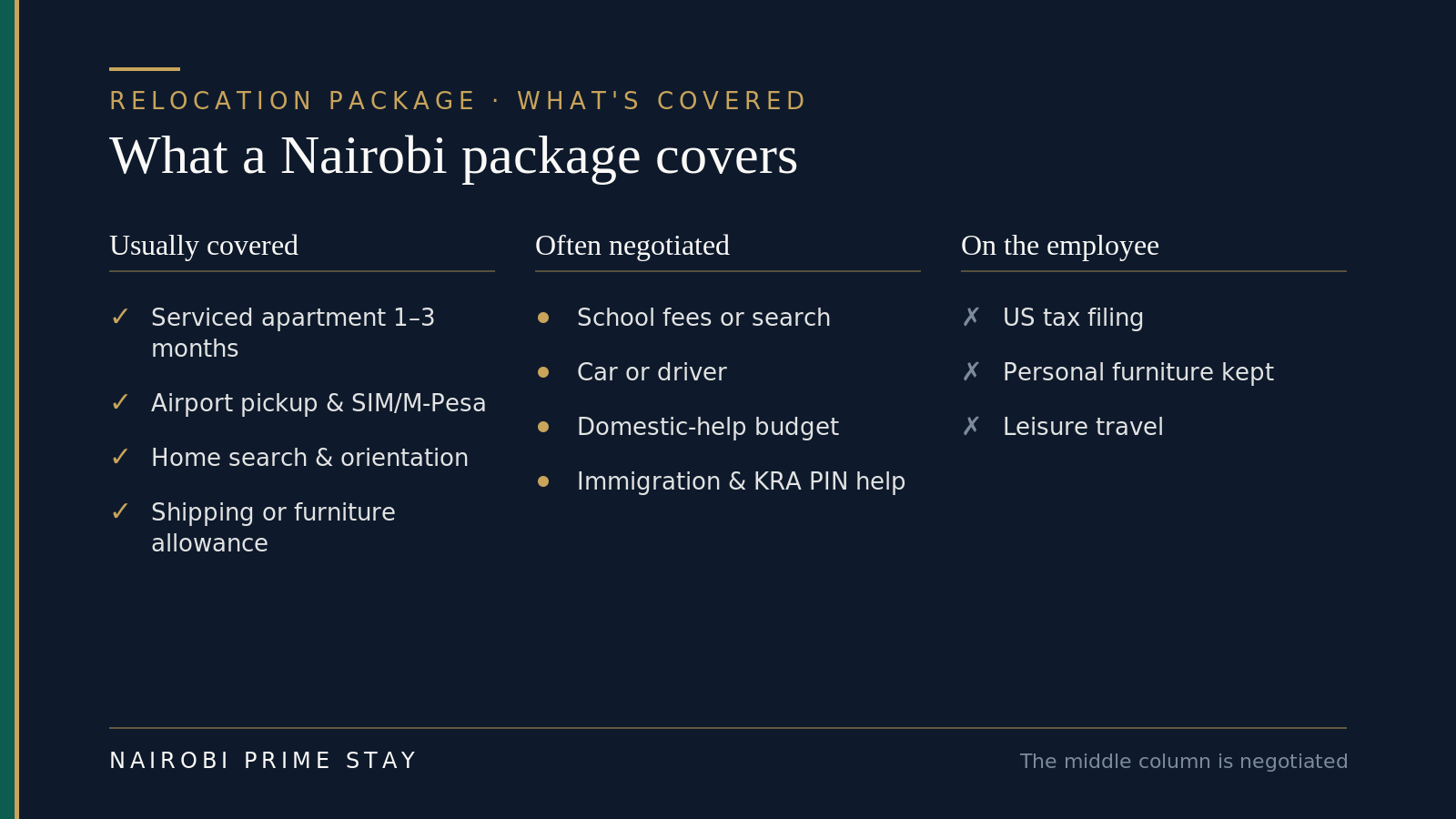 What’s typically in — and out of — a Nairobi package. The middle column is where most negotiation happens.
Nearly always covered. Temporary corporate housing for the first one to three months, an airport pickup, help getting a local SIM and M-Pesa registered, a home-search day or two with someone who knows the areas, and either a household shipment or a furniture allowance if they’re moving into an unfurnished home later.
Commonly negotiated. International school fees are the big one for families — they’re a major line, often $10,000–$40,000+ a year per child at the top international schools like the International School of Kenya, so spell out exactly what the company pays. A car or driver, a domestic-help budget, and immigration support (the work permit, dependant passes and KRA PIN) also sit here. Get these in writing; “we’ll sort it out there” is how disputes start.
Usually on the employee. US tax filing stays with the individual — remember the US taxes citizens on worldwide income, and 183+ days in Kenya can make someone a Kenyan tax resident too, so cross-border tax advice early is money well spent. Personal furniture they keep, and leisure travel, are theirs.
None of this is legal or tax advice — it’s the lay of the land. Confirm permit and tax specifics with an immigration lawyer and a cross-border accountant, and check fees against the official portals at ecitizen.go.ke and itax.kra.go.ke.
How serviced apartments work for assignees
A serviced apartment is a real home, not a hotel room. Expect a furnished one-, two- or three-bedroom with a proper kitchen, a workspace, a living room and, in the better buildings, a gym, pool or garden. The difference from a normal rental is that everything that makes a home function is already on and included in one price.
When we place a corporate guest, we check the things that actually decide whether someone can live and work well in Nairobi — what we call the “Nairobi Five”:
- Backup generator. Power cuts happen. A building generator keeps the Wi-Fi, lights and lift running so a workday isn’t lost.
- Water supply and storage. Tanks or a borehole mean water through the occasional municipal interruption.
- 24/7 security. Guards, gates and cameras — standard in the prime suburbs and the baseline for corporate guests.
- Fibre already in the building. Not “available in the area” — actually serving the unit, so calls and uploads are solid from hour one. More on this in our internet and remote-work guide.
- Responsive on-site management. Someone who fixes the geyser the same day, not next week.
For an executive who’ll be on video calls with head office, that fibre-plus-generator combination isn’t a luxury — it’s the job. Our serviced apartments guide goes deeper on what’s included and how stays are structured.
The HR and admin angle: billing, contracts and flexibility
This is where corporate housing earns its keep, and where serviced apartments beat a leased home outright.
One invoice. Rent, utilities, internet, cleaning, security and water arrive as a single monthly charge to the company. No chasing a power bill, a fibre bill and a security retainer across three vendors in a currency your finance team doesn’t hold. Pricing is usually quoted in USD per month, which makes budgeting and cost-recharge straightforward.
Simple corporate agreement, not a 12-month lease. A serviced-apartment booking is a short licence to occupy, not a year-long tenancy. There’s no large security deposit to recover at the end, no inventory dispute, no KRA PIN required from the occupant before they can sign — the company books, the guest moves in. Compare that with a standard Kenyan lease, which runs 12 months and asks for one to three months’ deposit plus the first month up front; see our guide to leases, deposits and tenant rights.
Flexibility. Extend a stay by a month when a project slips, or end it on short notice when plans change, without breaking a lease or forfeiting a deposit. For a six-week scouting assignment that turns into a six-month posting, that flexibility is the whole point.
Compliance and duty of care. For regulated employers — and especially for UN, embassy and NGO postings with their own security standards — a vetted building with guards, controlled access and a known management company makes the duty-of-care box easy to tick. If that’s your situation, our companion guides on where UN staff live in Nairobi and embassy, UN and NGO housing go into the security and proximity specifics.
Booking mechanics with us. We handpick from a vetted selection, a $50 deposit reserves the apartment and locks the dates, and the balance is paid on arrival — nothing more leaves the company account before travel. That keeps procurement simple and protects the booking from the moment it’s made.
Is company-paid housing taxable in Kenya?
Yes — and it’s the line most US mobility teams miss. When a company provides or pays for an employee’s housing in Kenya, the Kenya Revenue Authority (KRA) treats it as a taxable benefit in kind. It’s added to the employee’s pay and taxed under PAYE, just like salary. So the “free” apartment isn’t actually free to the person living in it unless the package accounts for it.
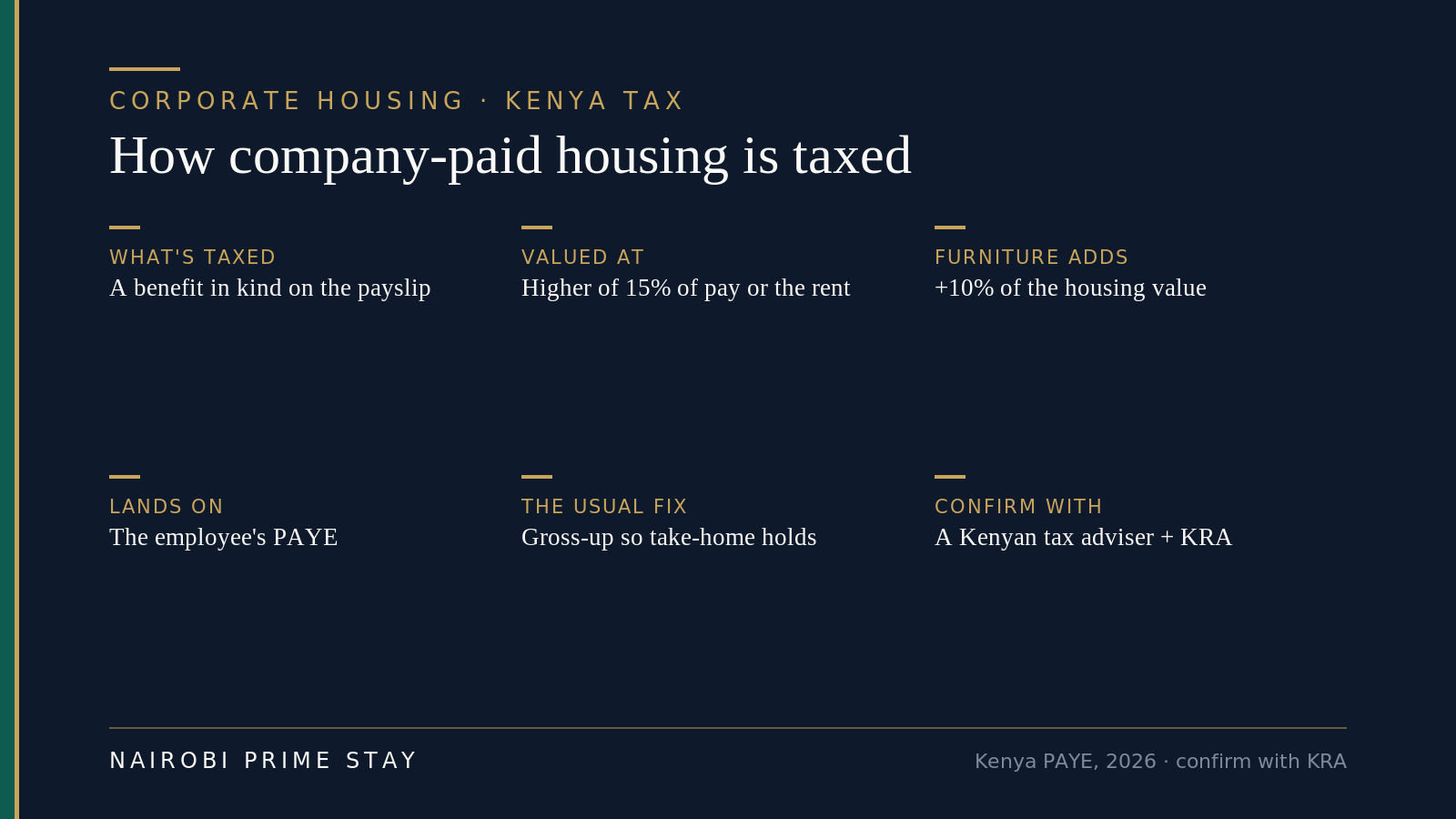 How Kenya taxes employer-provided housing. Decide the gross-up policy before you set the salary.
Here’s how the valuation works, as of 2026. The taxable value of employer-provided housing is the higher of 15% of the employee’s gross earnings (excluding the housing benefit itself) or the actual rent the employer pays for the home — whichever is larger is what shows up as extra taxable income. If the apartment is furnished, KRA adds a further 10% of the housing value for the furniture. Because Kenya’s top PAYE band reaches 35%, a high-rent executive apartment can add a real amount to a monthly tax bill — see our expat tax guide for the bands and the US side.
This is why serious relocation packages “gross up”: the company covers the extra Kenyan tax so the assignee’s take-home pay isn’t quietly eroded by the housing they were given. Decide that policy before you set the salary, not after the first payslip lands. And don’t forget the US layer — American citizens are taxed on worldwide income, and a company-provided home abroad interacts with the foreign housing exclusion, so a cross-border accountant earns their fee here.
None of this is tax advice, and rates change. Confirm current treatment with a Kenyan tax adviser and check KRA’s guidance at kra.go.ke before you finalise a package.
Where executives and assignees live in Nairobi
Where to house someone comes down to three things: the commute to their office, the school run if they have kids, and how much space they want. Nairobi’s prime residential areas each lean a certain way.
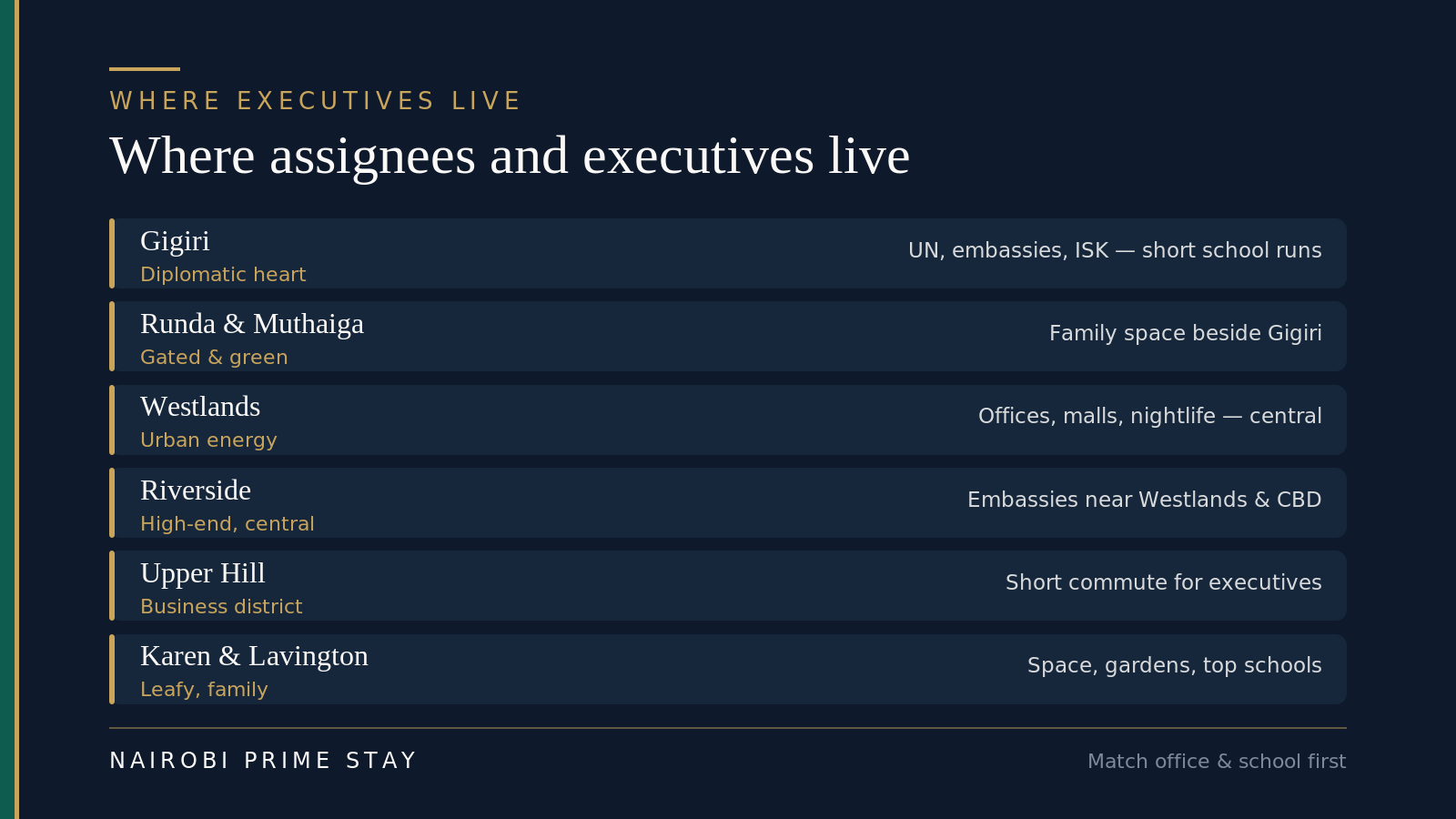 Where assignees cluster, by commute and family needs. Match the area to the office and the school first, the apartment second.
- Gigiri is the diplomatic heart — UN HQ, embassies and the International School of Kenya — and the obvious choice for anyone working at or with those institutions. Calm, green, heavily patrolled. See the Gigiri neighbourhood guide.
- Runda and Muthaiga offer large gated homes and gardens right beside Gigiri — the family favourite when you want space and a short school run.
- Westlands is the urban-energy pick: offices, malls, restaurants and nightlife, central and convenient. Strong for single executives and social professionals.
- Riverside is high-end and central, with embassies and quiet residences near Westlands and the CBD — a short, civilised commute.
- Upper Hill is the business district itself — hospitals and corporate HQs — and suits an executive who wants to walk or drive five minutes to work.
- Karen and Lavington trade central convenience for space, greenery and proximity to top schools — Karen especially for families who want a garden.
For the full picture, our best neighbourhoods in Nairobi guide compares all of them on safety, commute and price.
What to budget for executive housing in Nairobi
Plan for roughly $1,500–$4,000+ a month for an executive-grade furnished serviced apartment, all-inclusive. Where you land in that range depends on size, building quality and area — the diplomatic belt costs more than central apartment districts. These are indicative 2026 figures; confirm live pricing for the dates and unit, since the market moves and the USD/KES rate (around 129.4 as of July 2026, per our USD/KES currency guide) shifts the math.
| Housing line (all-inclusive, 2026) | Indicative USD/month |
|---|---|
| Studio / 1-bed serviced — central (Kilimani, Westlands) | $900–1,500 |
| 2-bed executive serviced (Westlands, Riverside, Kileleshwa) | $1,500–2,800 |
| 2–3 bed serviced in the diplomatic belt (Gigiri, Runda, Muthaiga) | $2,400–4,000+ |
| International school, if a family (per child, per year) | $10,000–40,000+ |
| Car / transport (ride-hailing or hire) | $80–400/mo |
A serviced rate already folds in utilities, fast internet, cleaning, security and a generator, so the headline number is close to the true number — unlike a leased home, where you add deposits, furniture, and a stack of separate bills. For a fuller picture of monthly costs, see our cost of living in Nairobi guide.
How to set up corporate housing — the timeline
Setting up corporate housing is quick when the brief is clear. The whole thing can be live in a few days.
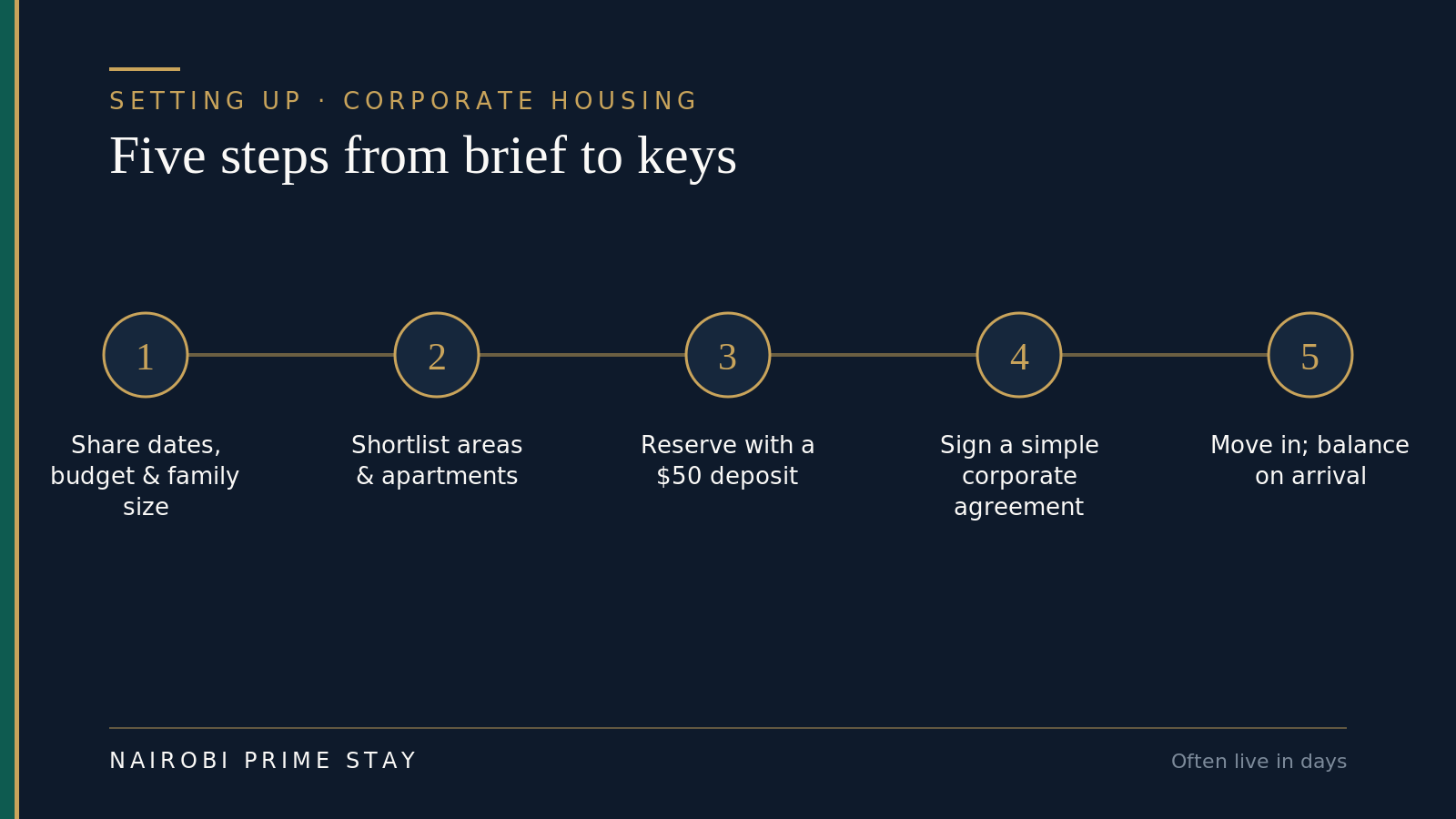 Five steps from brief to keys. With a clear brief, a Nairobi corporate apartment can be reserved the same day.
- Share the brief. Arrival date, length of stay, budget, family size, the office or school address, and any company security requirements.
- Shortlist areas and apartments. We match the commute, school run and budget to two or three real options — not a catalogue dump.
- Reserve with a $50 deposit. That locks the apartment and the dates. Nothing more leaves the company account before travel.
- Sign a simple corporate agreement. A short licence to occupy, billed to the company as one monthly invoice — no 12-month lease, no large deposit.
- Move in. The balance is paid on arrival. The assignee lands to a working home and starts day one without admin.
Not sure which area fits the commute and budget? Our AI relocation assistant can shortlist apartments in a couple of minutes, any time of day.
Booking corporate housing from the US before anyone flies
Most corporate apartments are booked sight-unseen from head office, which is fine — as long as you verify the provider the way you’d vet any overseas supplier. The risk isn’t the city; it’s the same fake-listing scam that targets any newcomer paying from abroad: a too-good apartment, a demand for full rent up front to a personal mobile-money number, then silence. The playbook that traps individual renters can just as easily catch a busy mobility team moving fast. Our property-scams guide covers it in depth.
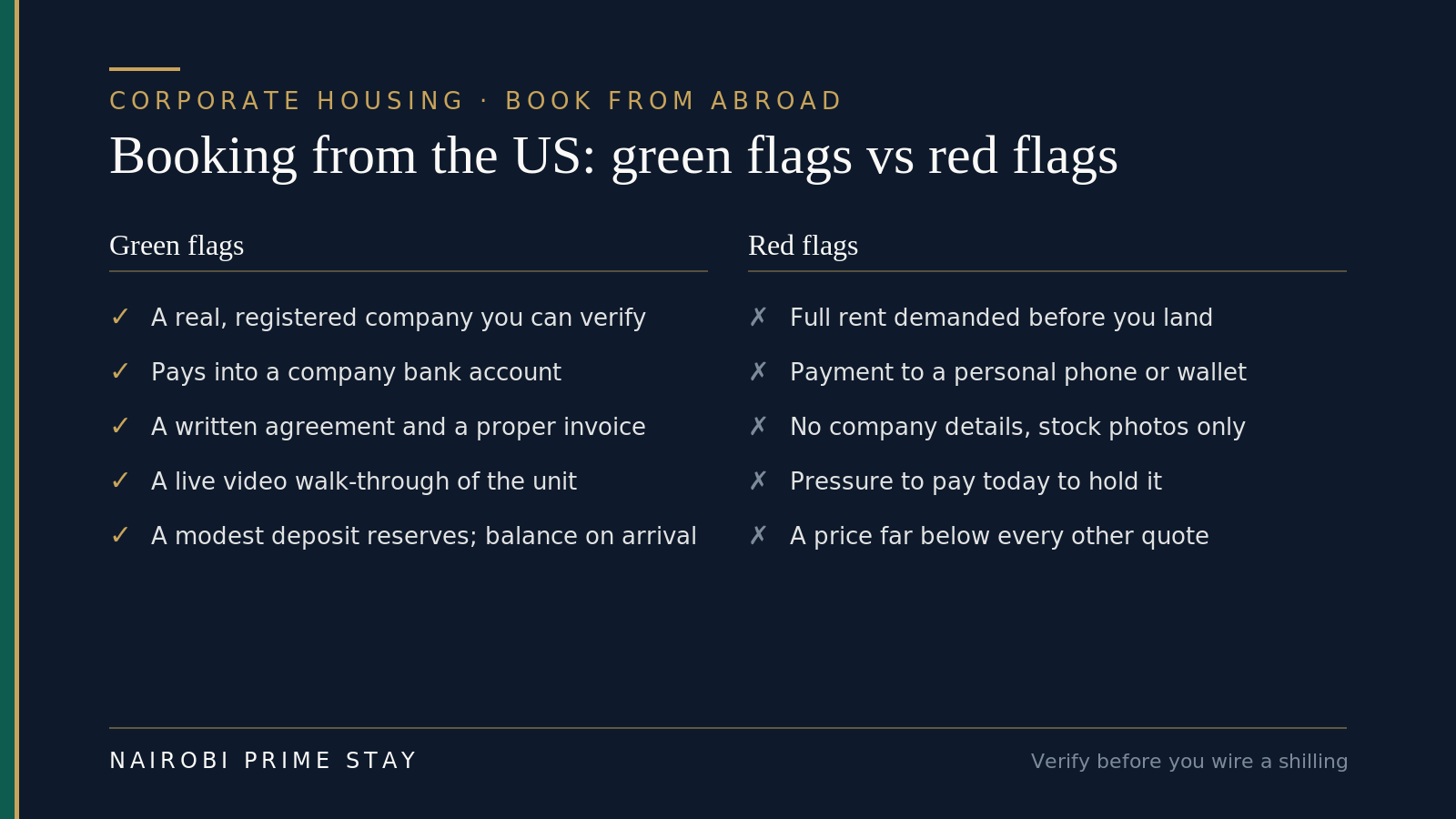 Green flags versus red flags for a sight-unseen booking. Verify before you wire a shilling.
The safe order is simple. Deal with a real, registered company you can look up, not a lone “agent” on social media. Ask for a live video walk-through from inside the actual unit, not just photos. Get a written agreement and a proper invoice with the company’s details on it. Pay into a company bank account — never a personal phone number or M-Pesa wallet — and resist any pressure to wire the full amount before arrival. A modest reservation deposit that holds the apartment, with the balance paid on arrival, is the pattern to look for: it protects the booking without exposing the whole cost. If a quote sits far below every other, treat it as a warning, not a win.
If you’d rather sidestep the question, the soft-landing route works for companies too: book a vetted serviced apartment for the first few weeks, then let the assignee view and sign anything longer-term in person once they’re on the ground. It’s also worth reading our take on furnished versus unfurnished before committing to a longer lease.
A realistic example
Say a tech firm is sending a regional director to Nairobi for an 18-month posting, with a spouse and two school-age kids. The smart play isn’t to sign a house lease from abroad — it’s to book a three-bedroom serviced apartment in Runda or Gigiri for the first six to eight weeks. The family lands to a furnished, secure home minutes from the International School of Kenya. They do the school run, test the Gigiri-to-office commute in real traffic, and view three or four long-term homes in person. By week six they know exactly which street they want, sign a 12-month lease with confidence, and move across town — or simply extend the serviced apartment if the numbers and the convenience win. Either way, the director was productive from week one and nobody gambled a year’s rent on a listing photo.
For a three-month project specialist with no family, the call is simpler: a one- or two-bedroom serviced apartment in Westlands for the whole stay. Central, social, walkable to offices and restaurants, and not a single utility account to open or close.
Serviced corporate housing vs going straight to a lease
Honest tradeoffs, because corporate housing isn’t always the answer.
Where serviced corporate housing wins: speed (live in days), zero setup admin, one invoice, flexible terms, no deposit to recover, and built-in security and infrastructure. Best for stays of one to twelve months, for arrivals who need to choose an area, and for any move where head office wants a clean, low-risk booking.
Where a leased home wins: lowest monthly cost over a multi-year posting, more space and choice of specific houses, and the chance to make a place truly your own. Best for confirmed long postings where the assignee is happy to set up utilities, buy or ship furniture, and commit to 12 months. The trade is weeks of setup and a lot more admin — see how to rent an apartment in Nairobi.
The common best-of-both: serviced for the first month or two, then a lease once the assignee has chosen the right area in person.
HR and mobility checklist
A quick run-through for whoever’s setting up the move:
- Confirm arrival date, length of stay and whether the assignee brings family.
- Fix the housing budget in USD per month and what it must include.
- Identify the office or school address — commute and school run drive the area choice.
- Choose temporary corporate housing for at least the first 4–8 weeks before any lease.
- Spell out in writing what the package covers: housing, school fees, immigration, car, shipping.
- Start the work permit, dependant passes and KRA PIN early (ecitizen.go.ke, itax.kra.go.ke).
- Arrange cross-border tax advice — US worldwide taxation plus possible Kenyan residency.
- Confirm the building meets your security/duty-of-care standard (guards, gates, generator, fibre).
- Reserve the apartment with a $50 deposit; settle the balance on arrival.
- Brief the assignee on M-Pesa, ride-hailing and the first-week essentials before they fly.
Housing a team or rotating staff
Corporate housing scales past a single assignee. If you’re standing up a project team, opening an office, or running fly-in-fly-out roster staff, the serviced-apartment model handles all three without a stack of separate leases.
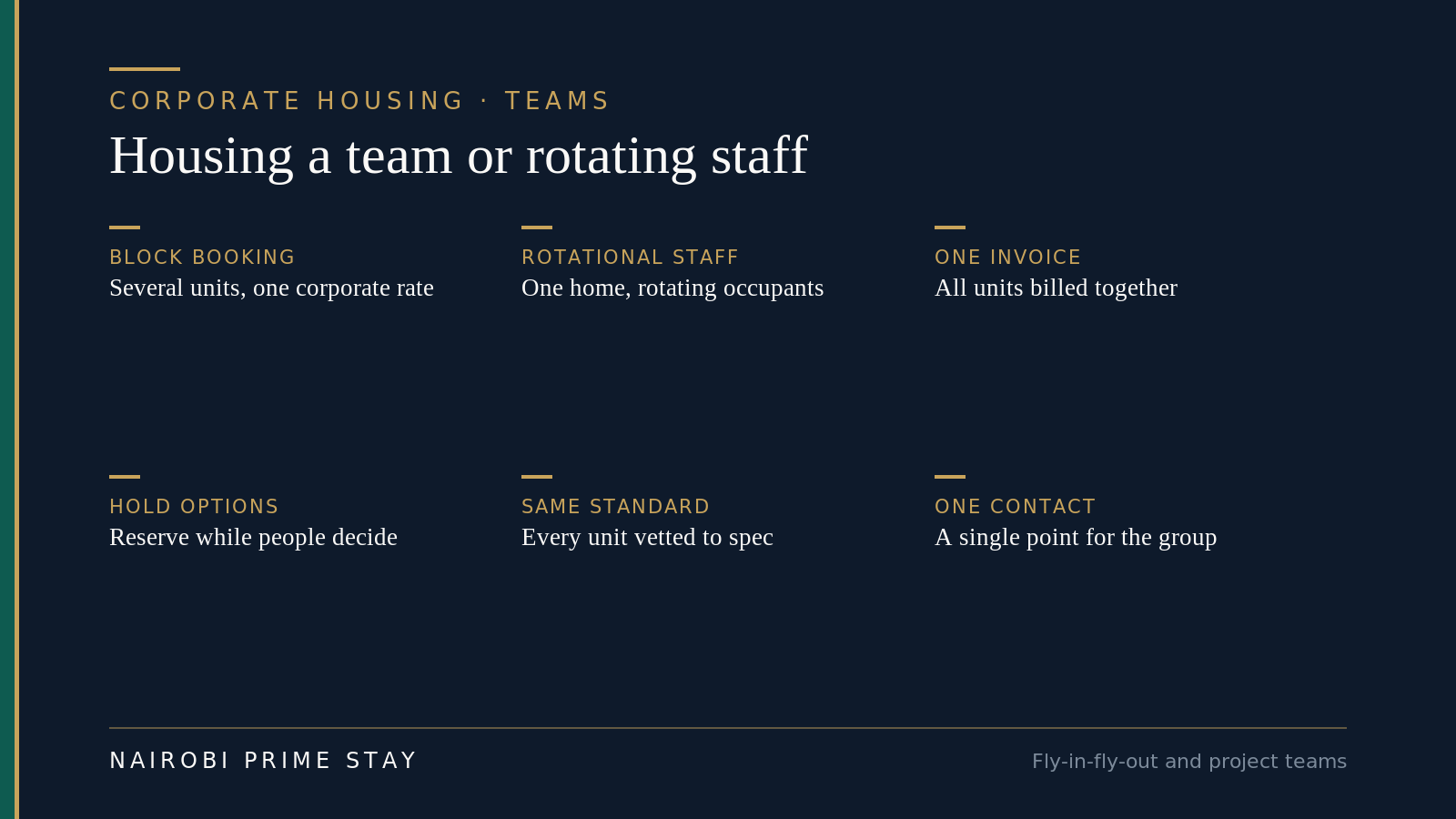 Serviced housing scales to teams and fly-in-fly-out rosters — one standard, one invoice, one contact.
For a project team, block-book several units — often across one or two buildings — on a single corporate rate, billed together as one monthly invoice. For rotational or fly-in-fly-out staff, one apartment can host a rotating cast: the home stays booked while occupants change on a roster, so nobody re-connects utilities every swing. And when several people are still deciding, we can hold a couple of options for a short window while the team firms up dates. Every unit is vetted to the same standard — generator, fibre, water storage, 24/7 security — so a director and a junior engineer both land somewhere that works, and you deal with one point of contact instead of ten landlords.
For a headcount that outgrows serviced apartments entirely, a company-leased block or dedicated staff housing can cost less per unit over years. But for anything short of a large, permanent presence, block-booked serviced housing keeps the admin and the risk low.
How booking works with us
We arrange corporate housing for companies often, so the process is built to be simple for a busy mobility team. You send the brief; we come back with two or three vetted, honestly priced options that fit the commute and budget. A $50 deposit reserves the apartment and locks the dates, the balance is paid on arrival, and the company gets one clean monthly invoice covering rent, Wi-Fi, cleaning, security, water and power backup. No furniture to buy, no utilities to connect, no deposit to chase at the end.
If you’re placing several people, or a senior hire with a family, we can shortlist across areas and hold a couple of options while the assignee decides.
Final thoughts
Corporate housing in Nairobi isn’t complicated once you see the shape of it. For most assignments — anything from a few weeks to a year — a furnished, all-inclusive serviced apartment gets your person living and working well from day one, keeps the admin and the invoicing simple, and buys time to choose the right neighbourhood before anyone signs a lease. For a confirmed multi-year posting, a leased home can cost less per month, but it asks for weeks of setup the serviced route skips. Match the option to the length of the stay and the assignee’s life, and the rest falls into place.
Related reading
- Moving to Nairobi: the complete guide — the hub, start here.
- Serviced apartments in Nairobi — what’s included and how stays work.
- Best neighbourhoods in Nairobi — compare areas on safety, commute and price.
- Gigiri neighbourhood guide — the diplomatic heart, for UN and embassy postings.
- Where UN staff live in Nairobi and embassy, UN and NGO housing — for compliance-heavy postings.
- How to rent an apartment in Nairobi and cost of living in Nairobi — for the longer-term move.
When you’re ready
Tell us the dates, the budget and the office address, and we’ll shortlist real corporate apartments that fit — browse serviced apartments or ask the AI relocation assistant for a two-minute shortlist. To set up an assignee or a group booking, get in touch; a $50 deposit reserves the place and the balance is paid on arrival.
Frequently asked questions
What is corporate housing in Nairobi?
Corporate housing is short-to-medium-term furnished accommodation a company arranges and pays for on behalf of an employee. In Nairobi it’s almost always a serviced apartment — fully furnished, with Wi-Fi, cleaning, security, water storage and a backup generator folded into one monthly price. The company books it and the assignee moves straight in, with no utilities to set up and one invoice instead of many.
What does a Nairobi relocation package usually cover?
Most packages cover temporary corporate housing for the first one to three months, an airport pickup, help with a SIM and M-Pesa, a home-search day, and either a household shipment or a furniture allowance. International school fees, a car or driver, domestic help and immigration support are commonly negotiated, so put them in writing. US tax filing and personal items usually stay with the employee. This is general guidance, not legal or tax advice — confirm specifics with professionals.
Are serviced apartments cheaper than a hotel for a long assignment?
Yes, once a stay runs past roughly a week or two. A hotel is fastest to book and fine for a few nights, but the nightly rate adds up quickly. A serviced apartment costs more than a bare leased home per month yet far less than a hotel over a multi-week stay, and you get a real home with a kitchen and workspace rather than a single room.
How long can an employee stay in corporate housing in Nairobi?
As long as needed — from a few weeks to a year or more. Serviced apartments are booked by the month and can be extended or ended on short notice, which suits assignments whose length isn’t fixed. For a confirmed multi-year posting, many companies start in corporate housing and then move the assignee to a 12-month leased home once they’ve chosen an area in person.
Which Nairobi neighborhoods suit relocating executives?
It depends on the office and the school. Gigiri suits anyone working with the UN or embassies and pairs with the International School of Kenya; Runda and Muthaiga add family space beside it. Westlands and Riverside are central and convenient for corporate offices, Upper Hill is the business district itself, and Karen and Lavington offer space and top schools for families. Match the area to the commute and school run first, the apartment second.
Can you invoice a company directly for corporate housing in Nairobi?
Yes. Serviced corporate housing is billed to the company as a single monthly invoice that bundles rent, utilities, internet, cleaning, security and water — usually quoted in USD, which makes budgeting and cost-recharge simple. There’s no large security deposit to recover and no separate vendor bills to reconcile, which is a big part of why mobility teams prefer it over a leased home.
How much should we budget for executive housing in Nairobi?
Budget roughly $1,500 to $4,000+ a month for an executive-grade furnished serviced apartment, all-inclusive, as of 2026. Central one-beds in Kilimani or Westlands start lower, around $900–$1,500, while two-to-three-bed apartments in the diplomatic belt of Gigiri, Runda and Muthaiga sit at the top. Families should budget international school fees separately, often $10,000–$40,000+ per child per year. Confirm live pricing for the exact dates and unit.
How quickly can corporate housing be arranged in Nairobi?
Often within a few days, sometimes the same day. With a clear brief — dates, budget, family size and office address — we shortlist two or three vetted apartments, a $50 deposit reserves the chosen one, and the balance is paid on arrival. Because a serviced apartment needs no utility setup or lease, the assignee can land straight into a working, secure home.
Is company-paid housing taxable in Kenya?
Yes. When a company provides or pays for an employee’s housing in Kenya, KRA treats it as a taxable benefit in kind, added to the employee’s pay and taxed under PAYE. The taxable value is the higher of 15% of the employee’s gross earnings or the actual rent the employer pays, plus 10% of the value if the home is furnished. Serious packages “gross up” to cover this so the assignee’s take-home isn’t reduced. This is general guidance, not tax advice — confirm current rules with a Kenyan tax adviser and KRA.
How do we book corporate housing from the US without getting scammed?
Verify the provider before you pay. Deal with a real, registered company you can look up, ask for a live video walk-through from inside the actual unit, and get a written agreement and invoice. Pay into a company bank account — never a personal phone number or M-Pesa wallet — and avoid anyone demanding full rent up front or pressuring you to pay today. A modest deposit that reserves the apartment with the balance on arrival is the safe pattern.
Can you house a whole team or rotating staff in Nairobi?
Yes. Serviced corporate housing scales to teams: block-book several units on one corporate rate and a single monthly invoice, or keep one apartment booked for fly-in-fly-out roster staff who rotate through it. Every unit is vetted to the same standard and you deal with one point of contact instead of many landlords. For a large, permanent presence a company-leased block may cost less per unit, but block-booked serviced housing keeps the admin and risk low for most teams.
Ready to look?
Find your apartment in Nairobi
Browse verified serviced apartments, or ask the AI concierge which area fits your life.