
Guides · Neighborhoods
Where Do UN Staff Live in Nairobi? The Diplomatic Belt Guide (2026)
Where Do UN Staff Live in Nairobi? The Diplomatic Belt Guide (2026)
Most UN staff in Nairobi live within a 15-minute drive of one place: the UN complex in Gigiri. The diplomatic community clusters in a tight band of leafy, heavily secured suburbs in the north-west of the city — Gigiri, Nyari, Rosslyn, Runda and Muthaiga. They’re close to work, close to the international schools, and among the safest addresses in Kenya.
This guide is for UN, embassy and NGO staff moving to Nairobi who want to know, honestly, where their colleagues live and why. We’ll cover each suburb, the commute to the UN Office at Nairobi (UNON), what rent buys, how residential security works, and how to land softly in your first month without renting a home you’ve never seen.
If you’re new to the city entirely, start with our complete guide to moving to Nairobi and our best neighborhoods overview — this page goes deeper on the diplomatic belt specifically.

TL;DR — the short answer
UN and diplomatic staff in Nairobi overwhelmingly live in five north-west suburbs, all a short drive from UNON in Gigiri:
- Gigiri — the diplomatic heart, wrapped around the UN complex and the embassies. The default, and the most apartment-friendly. Furnished rents roughly $1,500–4,000+/month.
- Nyari — a small, ultra-secure gated estate beside Gigiri with its own police post. Mostly large villas.
- Rosslyn — calm and school-focused along Limuru Road, next to Rosslyn Academy.
- Runda — a large classic diplomatic estate north of Gigiri, all space and gardens.
- Muthaiga — the old-money, very private leafy enclave, home to Gertrude’s Children’s Hospital.
Pick by what matters most: shortest commute and apartment choice (Gigiri), maximum security (Nyari), a particular school run (Rosslyn or Gigiri for ISK), or space and quiet (Runda, Muthaiga). Then bridge your first 4–8 weeks with a serviced apartment while you view homes and learn the traffic.
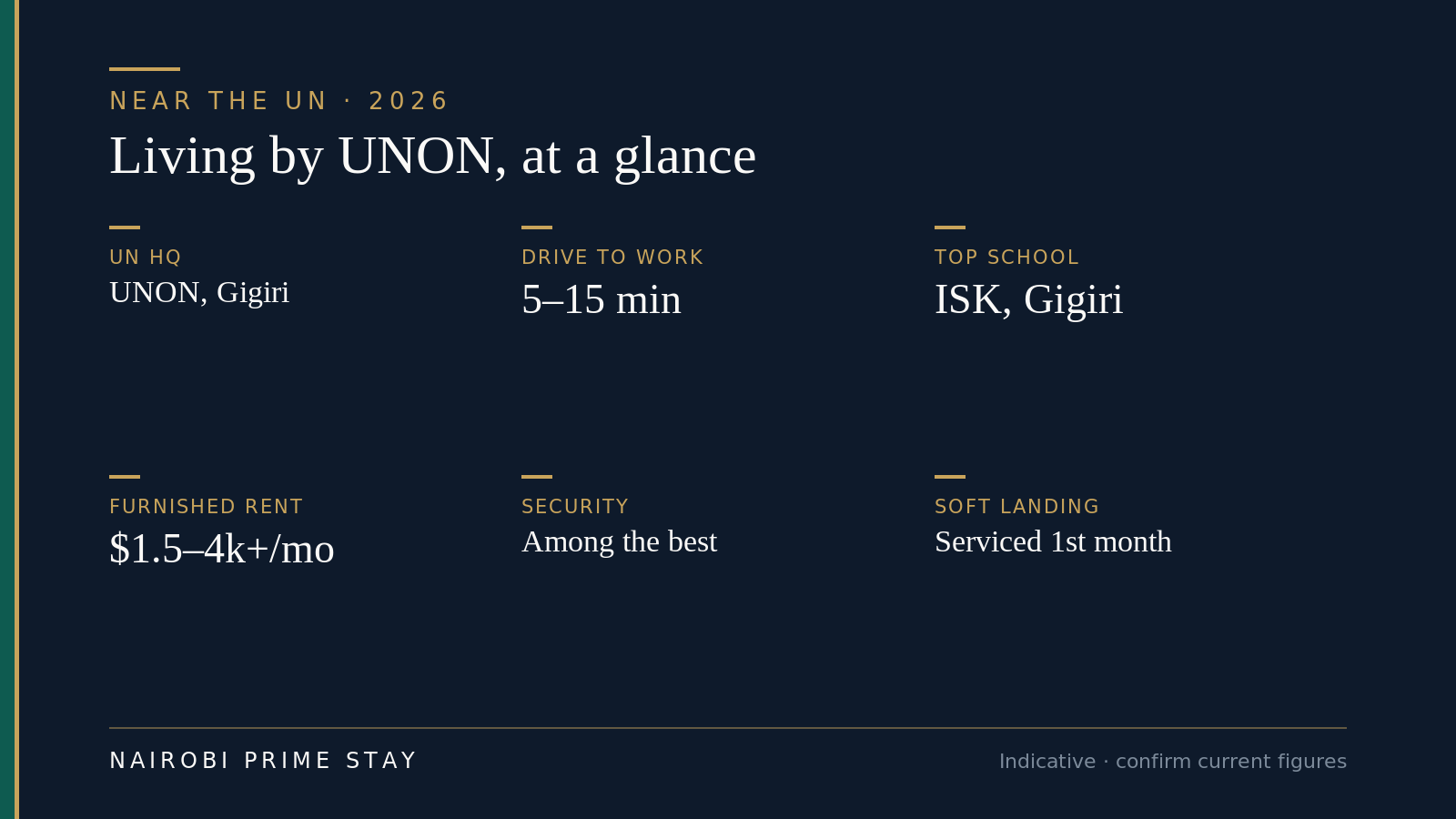 The diplomatic belt in one frame — work, school, rent and security all sit close together in north-west Nairobi.
Why UN staff cluster in one corner of the city
Three things pull the diplomatic community into the same few suburbs: the commute, the schools, and security. In Nairobi these three line up almost perfectly in the north-west.
UNON is one of only four major UN headquarters worldwide, alongside New York, Geneva and Vienna — and the only one in Africa and the global south. It sits on a 140-acre campus in Gigiri, bordered by the Gigiri district on one side and Karura Forest on the other, and hosts the UN Environment Programme (UNEP), UN-Habitat and the Resident Coordinator system. As of 2026 the complex is mid-expansion — conference capacity is being raised from 2,000 to 9,000, and the UN has announced plans to base new global offices for UN Women, UNICEF and UNFPA in Nairobi. In short, the gravity of the UN here is growing, not shrinking.
Because work, the embassies along United Nations Avenue, and the International School of Kenya all sit in or beside Gigiri, living nearby turns a Nairobi commute — which can be brutal — into a 5–15 minute drive. That’s the real prize. Distances in Nairobi are short; the traffic is not. Where you live relative to work and school shapes your daily life more than almost anything else.
The diplomatic belt at a glance
Here’s the lay of the land. These five suburbs sit within a few kilometers of each other and of UNON, and they share the same DNA: secure, green, low-density, internationally minded.
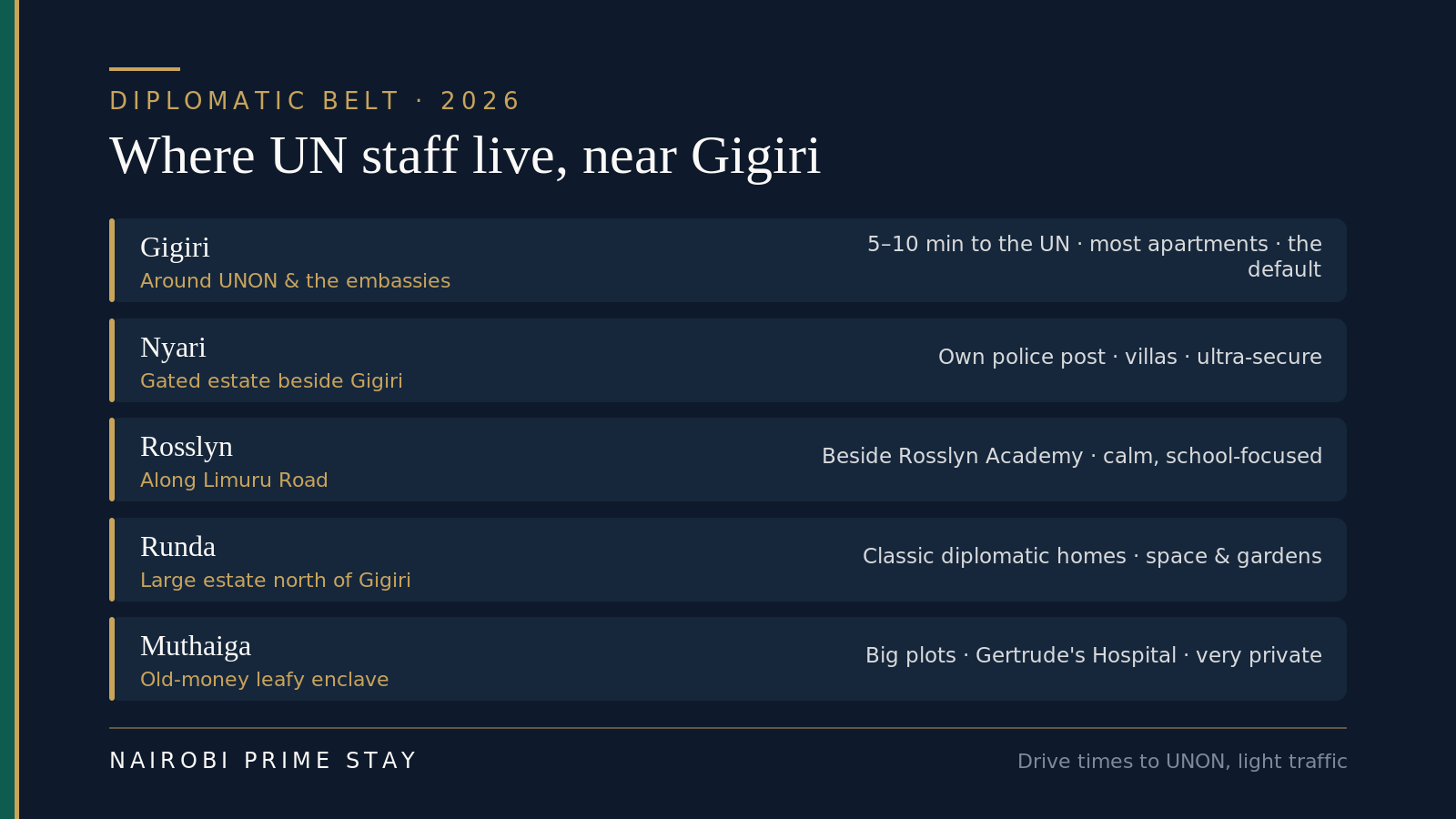 The five suburbs UN and diplomatic staff choose most, and what each is known for.
Gigiri — the diplomatic heart
Gigiri is the default, and for good reason. It wraps around the UN complex and dozens of embassies, including the US Embassy on United Nations Avenue. Most homes are a 5–10 minute drive from work — one of the shortest commutes available to anyone in Nairobi.
It’s also the most apartment-friendly suburb in the belt. The building stock runs from modern serviced-apartment blocks to gated townhouse compounds and standalone houses, so a single person, a couple and a family can all find something. Village Market — a mall with a supermarket, restaurants, a farmers’ market and a UN-adjacent crowd — anchors daily life. Furnished rents run roughly $1,500–4,000+/month, reflecting the location, the security and steady diplomatic demand.
Choose Gigiri if you want the shortest commute, the widest choice of apartments, and to be in the middle of the international community. Read the full Gigiri neighborhood guide for streets, buildings and schools, and see how Gigiri compares with Westlands if you’re torn between diplomatic calm and central buzz.
Nyari — maximum security, beside Gigiri
Nyari is the address people choose when security is the first concern and budget isn’t. It’s a small, gated estate just north-west of Gigiri, set between Red Hill, Thigiri Ridge and Ngecha roads, with its own police post at a controlled entrance where vehicles are checked. Homes are mostly large standalone villas and townhouses on generous compounds — many of them ambassadorial residences.
The trade-off is choice and price. There’s very little budget housing in Nyari, and far fewer apartments than in Gigiri, so it suits families and senior staff who want space and estate-level access control. The commute to UNON is still short — about 5–15 minutes. See the Nyari neighborhood guide for the full picture.
Rosslyn — calm, and built around the school run
Rosslyn is a quiet, leafy suburb strung along Limuru Road, about 11 km from the city center and right beside the Gigiri belt. Its defining feature is Rosslyn Academy, the American-curriculum school, which makes it a natural pick for families whose children will go there. Housing is mostly houses and gated compounds, with a small but growing cluster of modern apartments near Rosslyn Riviera mall.
The commute to UNON is short — 5–10 minutes — and you’re a few minutes from Runda and Gigiri. Rosslyn is less of a “scene” than Gigiri and more of a settled, residential, family place. See the Rosslyn neighborhood guide for details.
Runda — space, gardens and the classic diplomatic estate
Runda is the large, established gated suburb just north of Gigiri, and it’s a long-standing favorite of diplomats and families who want room to breathe. Think big houses on mature, walled gardens, leafy streets and a strong sense of security. There are very few apartments — Runda is house country.
The commute is a little longer than Gigiri’s, roughly 10–15 minutes to UNON depending on traffic and which side of the estate you’re on, but you’re trading a couple of minutes for considerably more space. Runda pairs well with Rosslyn Academy and ISK for the school run. The Runda neighborhood guide covers the estate in full, and our Karen vs Runda comparison helps if you’re weighing Runda against the southern suburbs.
Muthaiga — old-money privacy
Muthaiga is the oldest prestige address in this part of Nairobi — big plots, mature gardens, very private, and quietly diplomatic. It’s home to the Muthaiga Country Club and to Gertrude’s Children’s Hospital, which matters to families. It sits a little south-east of Gigiri, so the commute runs slightly longer — about 12–18 minutes to UNON — but you’re buying privacy and a settled, established feel rather than convenience.
Muthaiga is houses, not apartments, and it skews toward senior staff, ambassadors and families who value discretion. The Muthaiga neighborhood guide has the full rundown.
Compare the belt side by side
Read across the row that matters most to you. The numbers are indicative for 2026 and worth confirming against current listings — furnished rents in particular move with demand and the exchange rate (the shilling traded near KES 129.4 to the US dollar on 1 July 2026 — see our USD/KES currency guide).
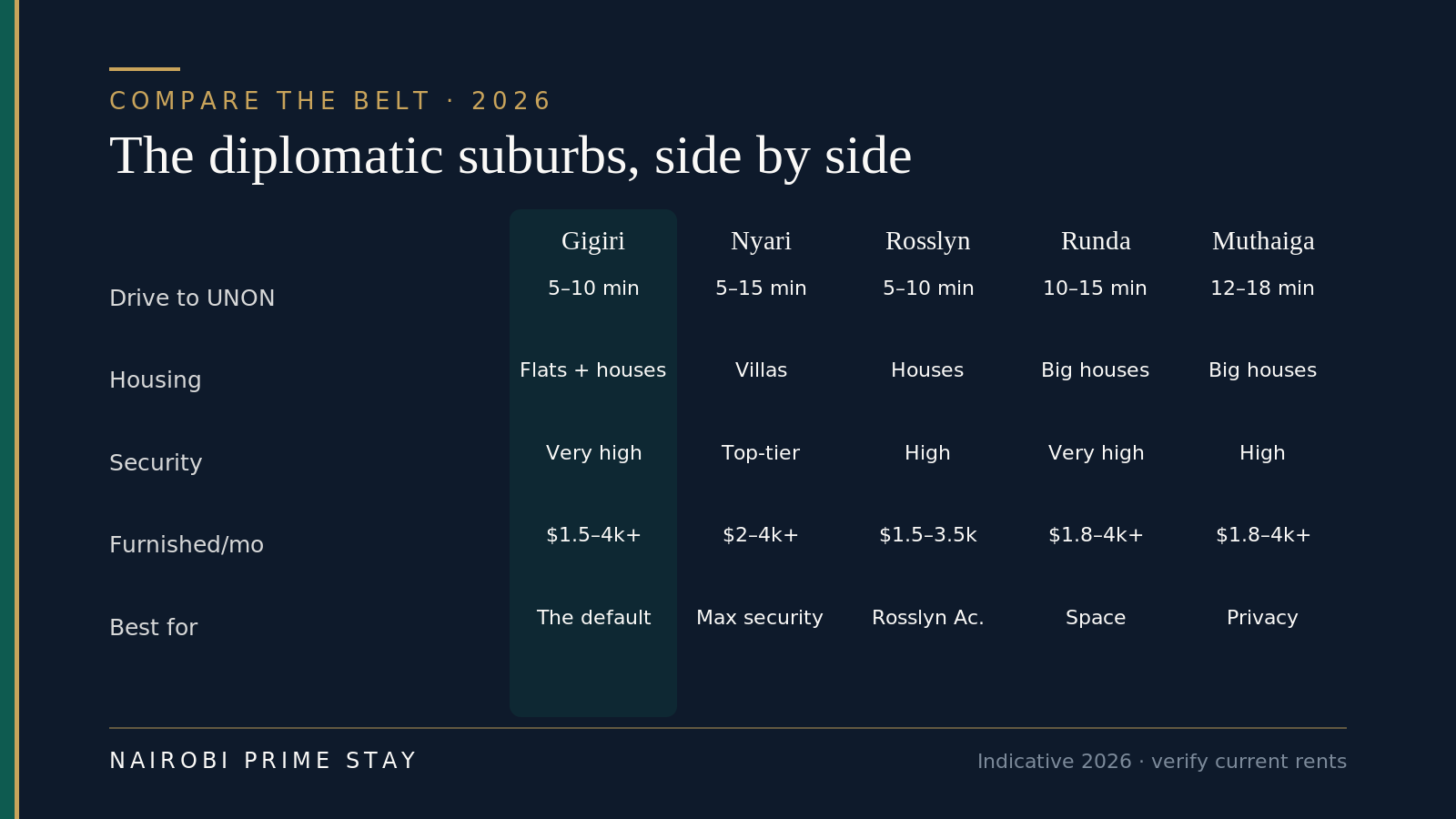 The diplomatic belt, side by side. Gigiri is the all-rounder; the others trade convenience for space, security or a school.
| Suburb | Drive to UNON | Housing | Furnished rent/mo | Best for |
|---|---|---|---|---|
| Gigiri | 5–10 min | Apartments + houses | $1,500–4,000+ | The default — shortest commute, most choice |
| Nyari | 5–15 min | Large villas | $2,000–4,000+ | Maximum security, space |
| Rosslyn | 5–10 min | Houses, some flats | $1,500–3,500 | Families at Rosslyn Academy |
| Runda | 10–15 min | Big gated houses | $1,800–4,000+ | Space and gardens |
| Muthaiga | 12–18 min | Big private houses | $1,800–4,000+ | Privacy, old-money calm |
Rents are indicative furnished monthly figures for 2026; unfurnished and longer leases cost less. Confirm current numbers with a local agent or our AI relocation assistant.
The commute to the UN — what to actually expect
The headline is genuinely good: from anywhere in the belt, work is a short drive. Gigiri, Nyari and Rosslyn are typically 5–15 minutes door-to-gate; Runda and Muthaiga add a few minutes. Compared with staff who live in, say, Karen or Kilimani and cross the city twice a day, belt residents get hours of their week back.
Two honest caveats. First, “short” assumes you’re heading to UNON or the embassies — getting to the central business district or the Westlands business hub from here is a different story, often 30–45 minutes in rush hour because you’re on the northern edge of the city. Second, the few main roads — Limuru Road, United Nations Avenue, Red Hill Road — do clog at peak times and around school drop-off. Most belt residents drive or use Uber and Bolt, which are the expat default: safe, cheap and payable by card or M-Pesa. Plan around the 7–9am and 5–7pm peaks and the belt is one of the easiest commutes in Nairobi.
Schools: ISK, Rosslyn Academy and the rest
For most UN and diplomatic families, the school decision and the housing decision are the same decision. The good news: the top international schools sit right in the belt.
- International School of Kenya (ISK) — American curriculum plus IB, in Gigiri, minutes from the UN. It’s the priciest school in the country: 2026/27 tuition runs from roughly $19,900 in the lower grades to about $37,300 in grades 11–12, plus a one-time capital levy near $11,000 for new families and a $400 application fee. Living in Gigiri or Runda turns the school run into a few minutes.
- Rosslyn Academy — American curriculum with AP, in Rosslyn near Runda; 2026/27 tuition runs roughly $6,300–16,800/year depending on grade (about KES 815,850–2,175,000), a clear step down from ISK.
- Braeburn and Brookhouse (British curriculum) and others serve the wider area too.
The best schools keep waitlists, so enquire months ahead and gather transcripts early. Pairing the school with a nearby home is the whole logic of the belt — a Gigiri or Runda address with ISK, or a Rosslyn home with Rosslyn Academy, keeps the daily run to minutes. Our international schools guide goes deeper on curricula, fees and admissions.
Security: how “UN-approved” housing actually works
This is where the diplomatic belt earns its premium. The whole area is well-patrolled, with a visible, constant security presence driven by the concentration of missions, and most homes sit inside gated estates or walled compounds with 24/7 guards. For a sense of the wider city picture — what’s real and what’s exaggerated — see our honest take on whether Nairobi is safe. The short version: the main risk is opportunistic petty crime, not personal danger, and belt residents rarely have problems.
If you’re internationally recruited UN staff, there’s a formal layer on top. The UN’s residential security framework means your home generally has to meet the Minimum Operating Residential Security Standards (MORSS) before it’s signed off. UN security (UNDSS) surveys the property against those standards, and the organization runs a home security scheme that entitles international staff to a private security firm, typically at the agency’s expense. Practically, that shapes where you can live: properties in gated estates with controlled access, perimeter walls, good lighting and a guard force clear easily; homes on informal or unlit access roads, with weak or shared entry, or in areas with a history of insecurity, often don’t.
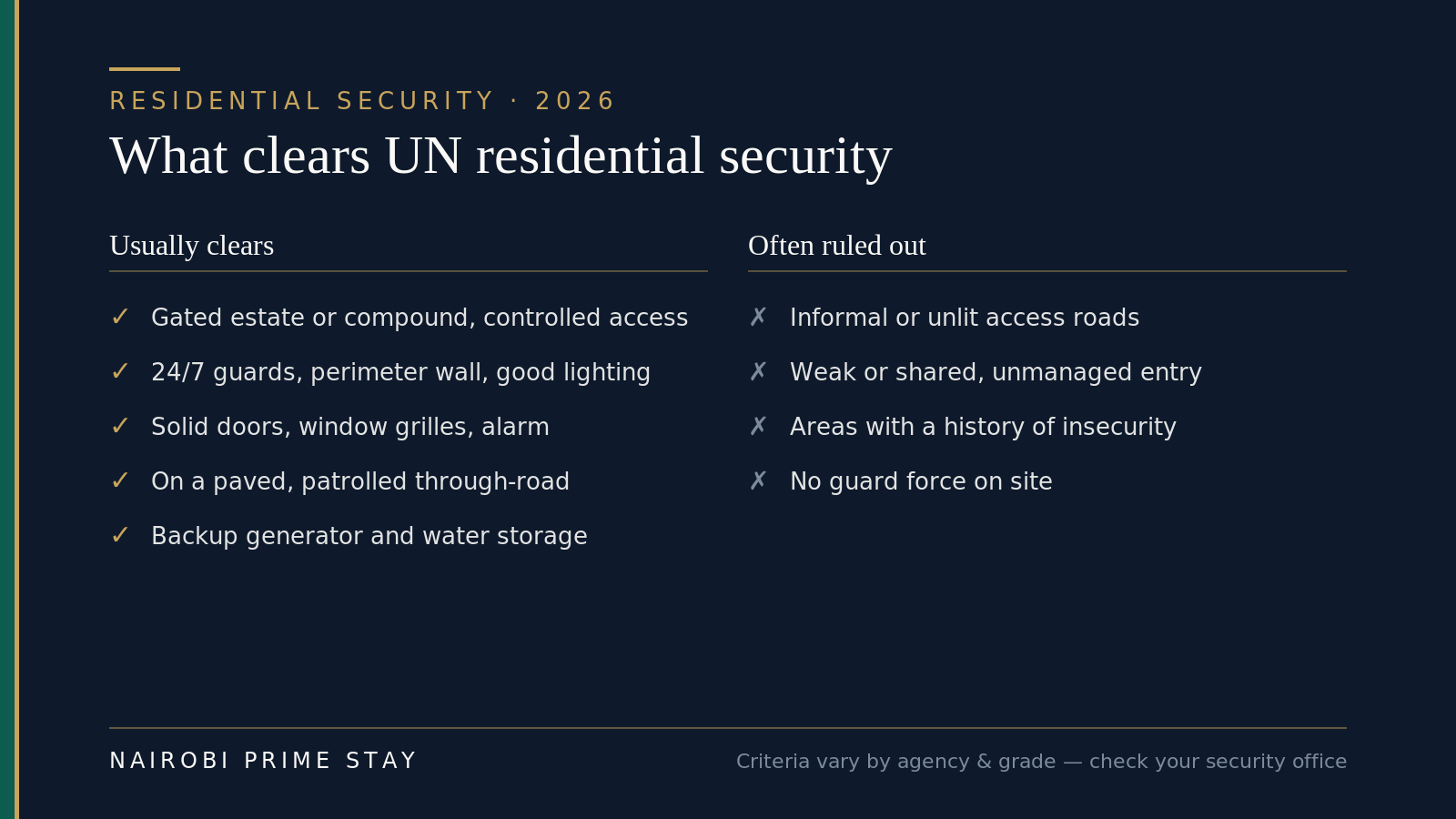 Indicative of what residential security checks look for. Criteria vary by agency and grade — confirm with your own security office.
A few honest notes. The exact criteria vary by agency, by your grade, and by the current security assessment, so treat the list above as a guide, not a rulebook — your own organization’s security office has the final word and the latest local advice. The belt is popular precisely because most of its housing clears these checks by default, which is one less thing to worry about when you’re choosing from abroad. And whether or not you’re bound by UN rules, the same five things make any Nairobi home easier to live in: a backup generator, water storage, 24/7 security, fibre internet already in the building, and responsive on-site management.
What your rent buys
Budget is usually the deciding line between the suburbs. Here’s the honest shape of it for 2026.
- $1,500–2,000/month — a comfortable furnished one- or two-bed apartment in Gigiri, or a smaller townhouse. The most flexible band, and the most apartment choice.
- $2,000–3,000/month — a larger apartment or a townhouse in Gigiri or Rosslyn; the entry point for a standalone house in Runda or a smaller villa.
- $3,000–4,000+/month — a full house with a garden in Runda, Muthaiga or Nyari, or a premium serviced apartment in Gigiri.
Unfurnished homes and longer leases cost less per month. Many staff receive a housing allowance that’s calibrated to these areas, so check what yours covers before you fall in love with a particular house. For the wider picture beyond rent — groceries, transport, domestic help, schooling — see our cost of living in Nairobi guide.
Does the UN assign your housing, or do you find your own?
Here’s a point that surprises a lot of new arrivals: the UN usually does not hand you a house. Unlike a US Embassy posting — where the mission typically leases and assigns your home, already vetted and ready — most internationally recruited UN staff find their own place on the open Nairobi market. You choose the suburb, you view the homes, and the lease is normally in your name. More freedom, more legwork.
Three things soften the legwork. First, a rental subsidy: the UN’s scheme can reimburse a large share of the rent that sits above a set threshold for your grade and family size — broadly, up to around 80% of that excess, capped at roughly 40% of the rent you pay — and it usually tapers the longer you stay at the same duty station. The exact threshold and taper depend on your agency and how your post is classified, so get the current figures from your own HR office, not a blog. Second, your post adjustment already reflects Nairobi’s cost of living. Third, the home has to clear a residential security survey, which quietly narrows the search to the belt’s gated, walled, well-lit housing — most of which passes by default.
NGO staff usually sit in between: a housing allowance and a do-it-yourself search, with security rules that vary by organization and are often lighter than the UN’s. Embassy staff, at the other end, often have the whole thing arranged for them.
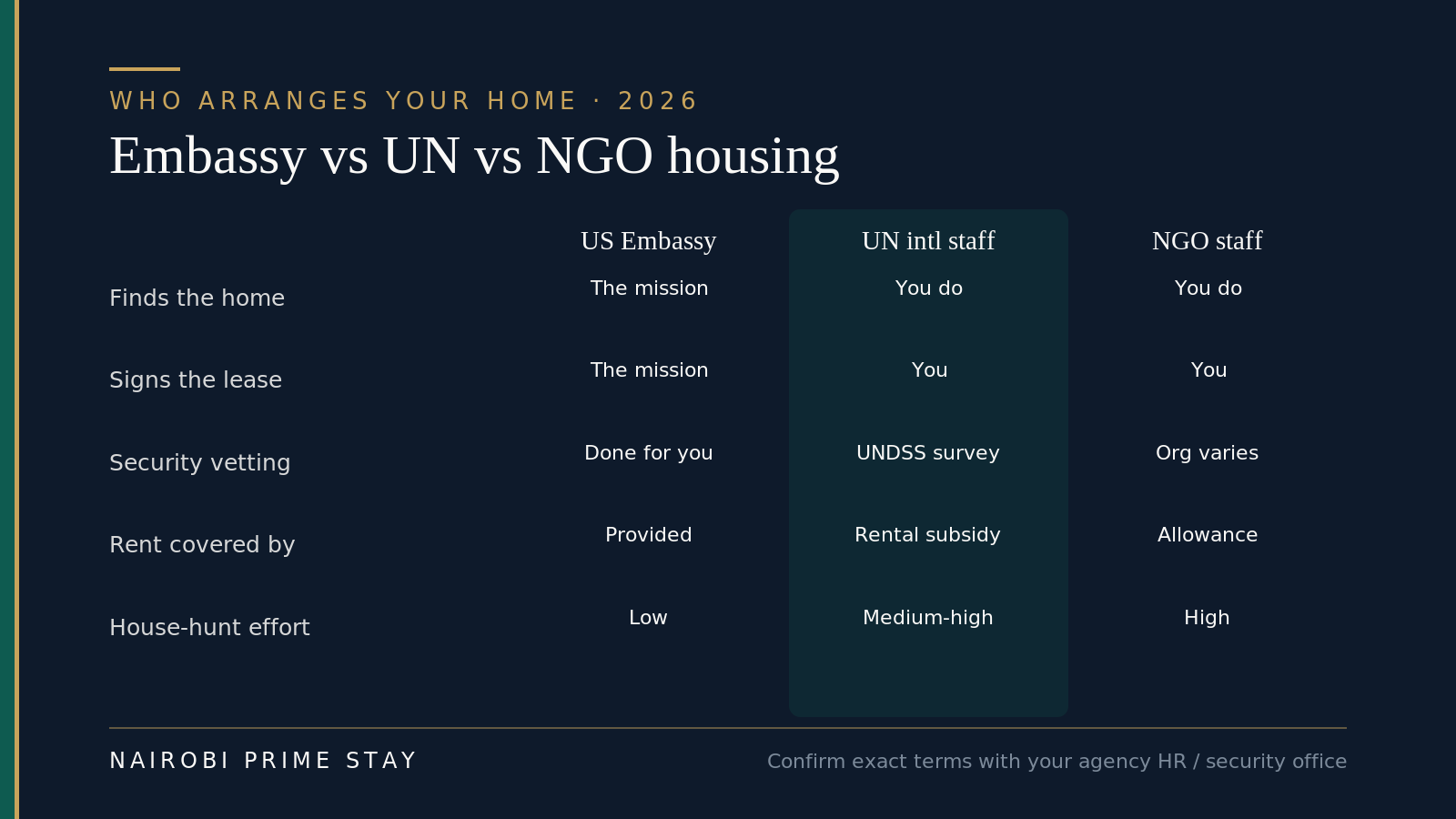 Who arranges your home depends on who you work for. UN staff get help with rent and security but do most of the house-hunting themselves.
Whichever bracket you’re in, the takeaway is the same: budget by what you actually pay after any subsidy or allowance, confirm the security rules that bind you, and don’t fall for a house your paperwork won’t let you rent. Our guides to corporate and organization housing and embassy, UN & NGO housing go deeper on allowances, leases and clearances.
A realistic example
Say you’re a UNEP officer arriving with a partner and two school-age kids. ISK is your first choice, so Gigiri and Runda are your shortlist. You want a three-bedroom house with a garden, a generator and a guard, on a housing allowance around $3,000.
The smart play: book a serviced apartment in Gigiri for your first month. It’s all-inclusive — Wi-Fi, cleaning, generator, security — so you have a safe, working base from day one while you sort your KRA PIN, open a bank account and start the school admissions. From there you view houses in Runda and Gigiri in person, learn which streets flood in the long rains and which have the easiest school run, and confirm the home clears your agency’s security check. You sign a 12-month lease only once you’ve seen the place and met the landlord — never wiring money for a home you haven’t visited. A month in, you move once, into the right house.
That sequence — land soft, look slowly, sign once — is how the people who settle best actually do it.
Renting a belt home from the US before you land
The most common way people lose money moving to Nairobi is paying for a home they’ve only seen in photos. It’s an easy trap when you’re arranging a move from 8,000 miles away against a start date: a polished listing appears, a warm WhatsApp chat follows, and a “reservation deposit” to a personal mobile-money number is all that stands between you and a lovely house. Sometimes the house is real and belongs to someone else; sometimes it doesn’t exist at all.
The fix is simple, and it’s the one the settled staff swear by: never send money for a home no one you trust has stood inside. Book a serviced apartment near Gigiri for your first few weeks, then house-hunt with your feet on the ground.
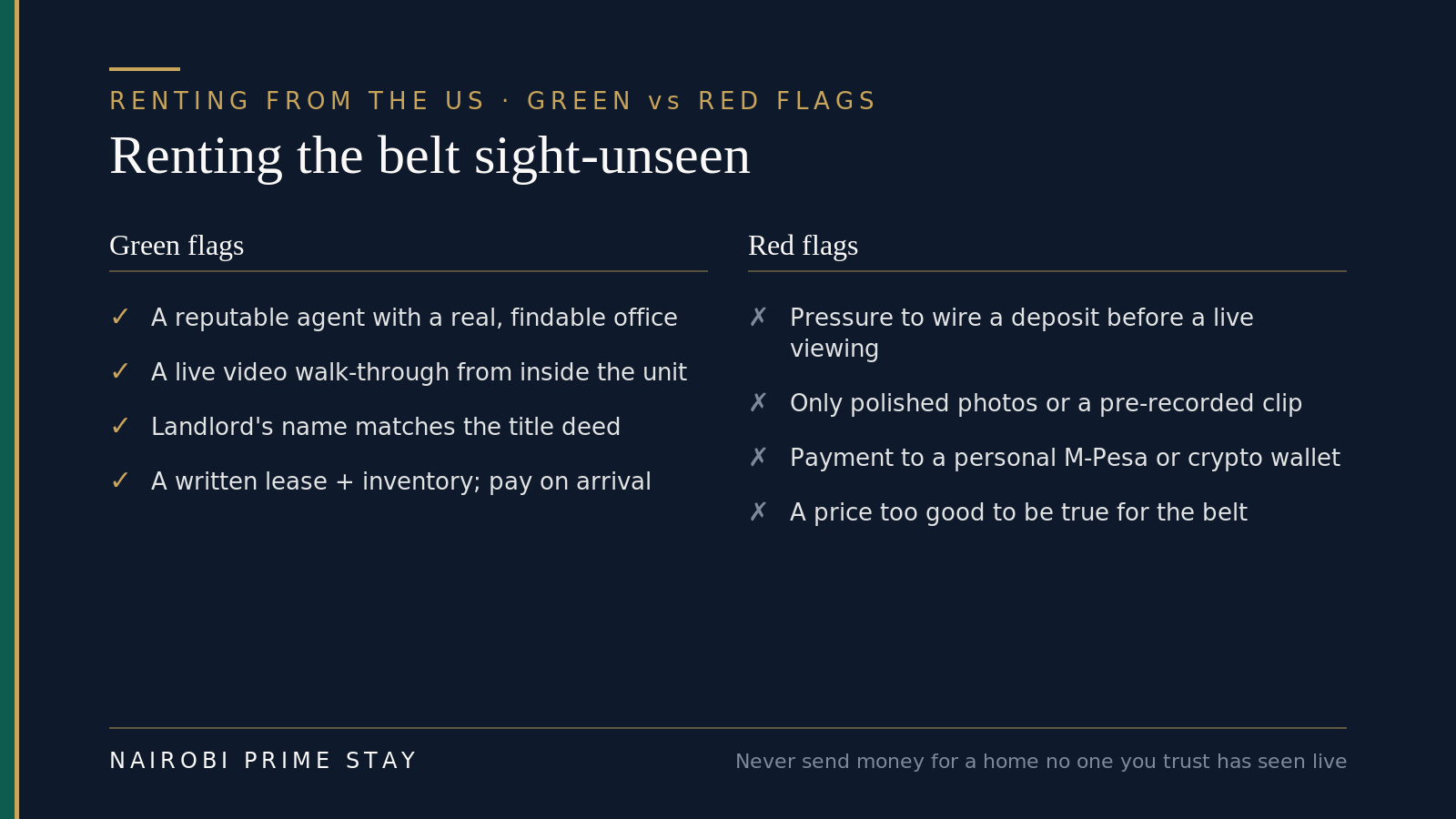 The tells, side by side. The moment you see the right-hand column, slow down.
If you want to line things up before you fly, do it in this order rather than paying blind:
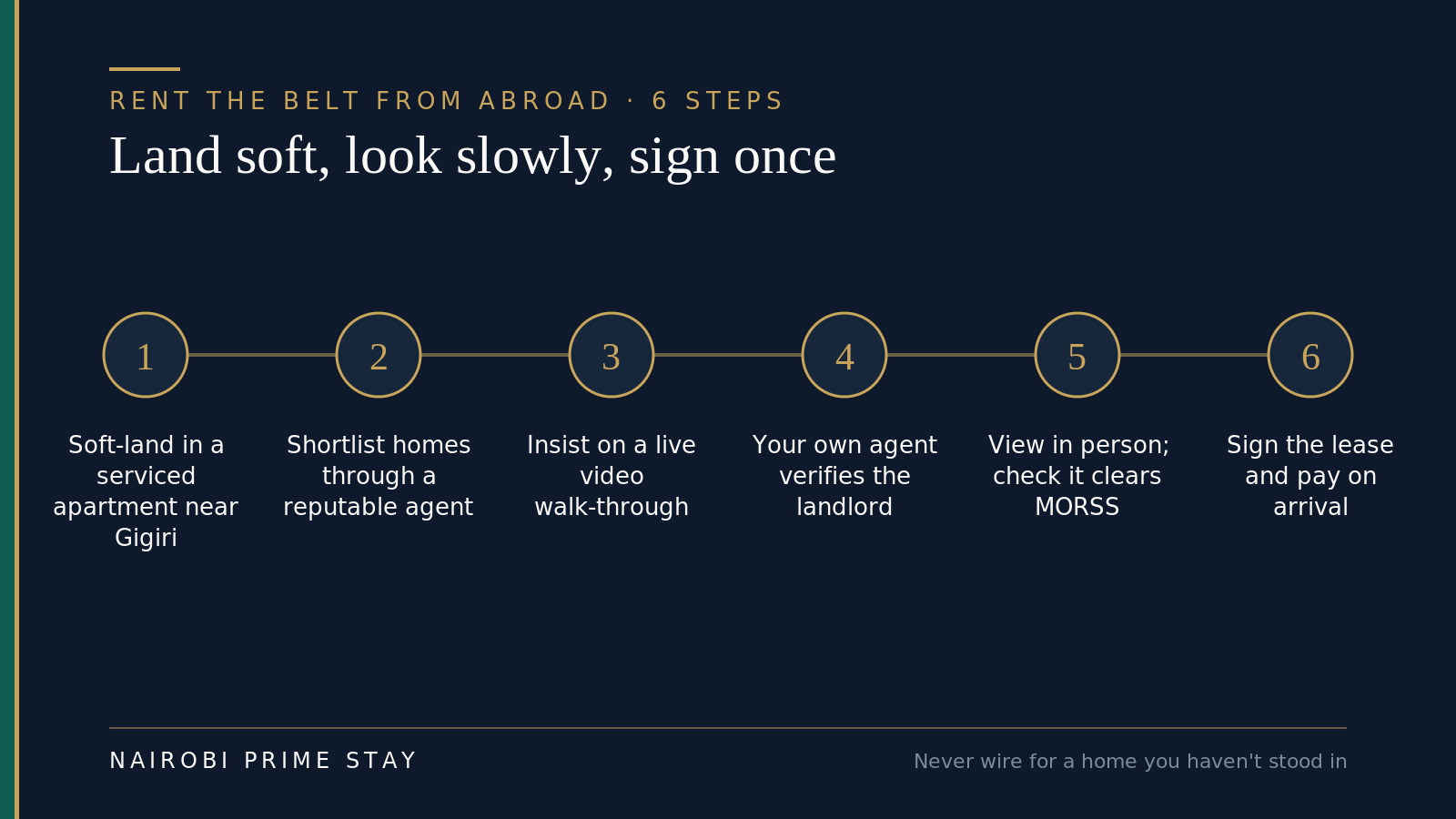 Land soft, look slowly, sign once — the sequence that keeps your deposit safe.
A few belt-specific notes. Use a reputable agent with a findable office — the diplomatic market is well served by established agencies — and let your own agent, not just the one on the listing, confirm the landlord actually controls the property. Insist on a live video walk-through from inside the unit, on a call, not a pre-recorded clip. Get a written lease and inventory, and pay the deposit — usually one to three months plus the first month — only after you’ve viewed the place and verified the landlord, and only to a registered agency or the landlord’s proper account, never a personal wallet. Our guides to how to rent an apartment in Nairobi, furnished vs unfurnished homes, leases and deposits and avoiding property scams in Kenya walk through each step.
Pros and cons of the diplomatic belt
Honest trade-offs, because no area is perfect.
| The upside | The trade-off |
|---|---|
| Shortest commute in the city to UNON and the embassies | Far from the CBD and Westlands business hub (30–45 min in traffic) |
| Among the safest, best-patrolled suburbs in Nairobi | You pay a clear premium for security and location |
| Top international schools (ISK, Rosslyn Academy) on your doorstep | School fees are a major separate cost, especially ISK |
| Green, calm, low-density, full of international neighbors | Quieter and more residential — less nightlife and buzz than Westlands |
| Housing that clears UN residential-security checks by default | Limited budget options; apartments concentrated in Gigiri |
How to choose — a quick checklist
Work through these in order and the right suburb usually picks itself.
- Pin your school first if you have kids. ISK points to Gigiri or Runda; Rosslyn Academy points to Rosslyn or Runda. The school run is the constraint that won’t budge.
- Check your housing allowance and security rules. Know your budget band and confirm what your agency requires before you shortlist homes.
- Decide apartment or house. Apartments mean Gigiri (or some of Rosslyn); a standalone house with a garden means Runda, Muthaiga or Nyari.
- Weigh security vs space vs price. Nyari for maximum access control, Runda and Muthaiga for space, Gigiri for the best all-round balance.
- Book a serviced apartment for your first 4–8 weeks. Use it as a base to view homes, test the commute and confirm the area before you sign anything.
- View in person, verify the landlord, then sign a 12-month lease with a written inventory. Pay the deposit (usually 1–3 months plus the first month) only after viewing.
Land softly before you commit
The single best piece of advice for the belt is also the simplest: don’t choose your home from abroad. A serviced apartment for your first month gives you a secure, fully-equipped base — Wi-Fi, cleaning, backup generator and 24/7 security included — while you view real homes, test the traffic and learn the streets. You move once, into a place you’ve actually stood in.
Frequently asked questions
Where do most UN staff live in Nairobi? Most UN staff live in the north-west diplomatic belt around the UN complex (UNON) in Gigiri — chiefly Gigiri itself, plus Nyari, Rosslyn, Runda and Muthaiga. These suburbs are leafy, heavily secured, and a 5–15 minute drive from work and the international schools, which is why the diplomatic community clusters there.
What is the best area for diplomats in Nairobi? Gigiri is the default and the best all-rounder — it’s closest to UNON and the embassies, has the most apartments, and is very secure. Choose Nyari for maximum security, Runda or Muthaiga for space and gardens, and Rosslyn if your children attend Rosslyn Academy. The right pick depends on your school, budget and whether you want an apartment or a house.
How far is the UN complex from these neighborhoods? Very close. Most of Gigiri, Nyari and Rosslyn are a 5–15 minute drive from UNON, and Runda and Muthaiga add only a few minutes. Getting to the central business district or Westlands is the slower trip — often 30–45 minutes in rush hour — because the belt sits on the northern edge of the city.
Does the UN give you a house in Nairobi, or do you find your own? Most internationally recruited UN staff find their own home on Nairobi’s open market and sign the lease in their own name — the UN doesn’t usually assign housing the way a US Embassy posting does. A rental subsidy can offset part of above-average rent and your post adjustment reflects local costs, but the home must first clear a UN residential security survey. NGO staff typically get a housing allowance and search themselves; confirm the exact terms with your agency’s HR.
What is “UN-approved” housing in Nairobi? Internationally recruited UN staff generally need a home that meets the organization’s residential security standard, known as MORSS. In practice that means gated estates or walled compounds with controlled access, 24/7 guards, good lighting and secure doors and windows. Homes on informal or unlit roads, or in areas with a history of insecurity, often don’t qualify. Criteria vary by agency and grade, so confirm with your own security office — most belt housing clears these checks by default.
What is MORSS or the UN residential security survey? MORSS stands for Minimum Operating Residential Security Standards — the UN’s baseline for staff housing. Before your lease is cleared, UN security (UNDSS) surveys the home against them: controlled access, a perimeter wall, 24/7 guards, good lighting, and secure doors and windows. Most gated belt housing passes by default, while homes on informal or unlit roads often don’t. Your own agency’s security office has the final say.
How do I rent a home in the diplomatic belt from the US without getting scammed? Never wire money for a home no one you trust has seen in person. Soft-land in a serviced apartment near Gigiri, shortlist through a reputable agent with a real office, insist on a live video walk-through from inside the unit, have your own agent confirm the landlord controls the property, and view, sign and pay only on arrival. Pay a registered agency or the landlord’s proper account — never a personal M-Pesa or crypto wallet.
How much is rent for UN staff in Nairobi? Indicative furnished rents in the belt run about $1,500–4,000+ a month in 2026. Roughly $1,500–2,000 gets a comfortable apartment in Gigiri; $3,000–4,000+ gets a full house with a garden in Runda, Muthaiga or Nyari. Unfurnished and longer leases cost less. Many staff have a housing allowance or rental subsidy calibrated to these areas — check what yours covers.
Which schools are near the UN in Nairobi? The International School of Kenya (ISK), offering American curriculum and IB, is in Gigiri, minutes from the UN, with 2026/27 tuition rising to roughly $37,300 in the senior grades. Rosslyn Academy (American curriculum with AP) is in Rosslyn near Runda and costs less. British-curriculum options like Braeburn and Brookhouse serve the wider area. Top schools keep waitlists, so apply months ahead.
Is the diplomatic belt safe? Yes — it’s among the safest parts of Nairobi. The concentration of missions means constant patrols, and most homes sit in gated estates with 24/7 guards. As anywhere in the city, the realistic risk is opportunistic petty theft rather than personal danger, and normal big-city precautions are enough. Nyari, with its own police post, is often singled out as especially secure.
Should I rent before arriving in Nairobi? No — don’t sign a lease for a home you haven’t seen. The safer path is to book a serviced apartment near Gigiri for your first 4–8 weeks, then view homes in person, verify the landlord and the security, and sign a 12-month lease once you’re sure. It’s how the staff who settle best actually do it.
Final thoughts
For UN and diplomatic staff, Nairobi makes the housing question unusually easy: live in the belt, and work, school and security all fall into place within a short drive. Gigiri is the natural starting point; Nyari, Rosslyn, Runda and Muthaiga each trade a little convenience for more security, a particular school, or more space. Decide what you can’t compromise on, land softly for a month, and then sign once.
Related reading
- Moving to Nairobi: the complete guide — the end-to-end hub for your whole move.
- Best neighborhoods in Nairobi — how the belt compares with the rest of the city.
- Gigiri neighborhood guide — the diplomatic heart, in depth.
- Runda, Muthaiga, Nyari and Rosslyn — the belt’s individual guides.
- Serviced apartments in Nairobi — how the soft-landing first month works.
- Is Nairobi safe? — an honest, practical read on city safety.
- Embassy, UN & NGO housing: how it works — security clearance (RSM/MORSS), allowances and leases for organization-affiliated staff.
Ready to land softly?
When you’re ready to see real options, browse our serviced apartments in Gigiri — verified, all-inclusive, with honest monthly pricing, minutes from the UN. Not sure which suburb fits your commute, school and budget? Our AI relocation assistant can shortlist homes in a couple of minutes, day or night. A $50 deposit reserves your place; the balance is paid on arrival.
Ready to look?
Find your apartment in Nairobi
Browse verified serviced apartments, or ask the AI concierge which area fits your life.