
Guides · Neighborhoods
Karen vs Runda: Which Nairobi Family Suburb Suits You? (2026)
Karen vs Runda: Which Nairobi Family Suburb Suits You?

Karen and Runda are the two suburbs families shortlist when they want space, gardens and good schools in Nairobi. Both are leafy, secure, low-density and built around houses rather than apartments. But they sit on opposite sides of the city and pull in opposite directions, and the choice usually comes down to two things: your schools and your commute.
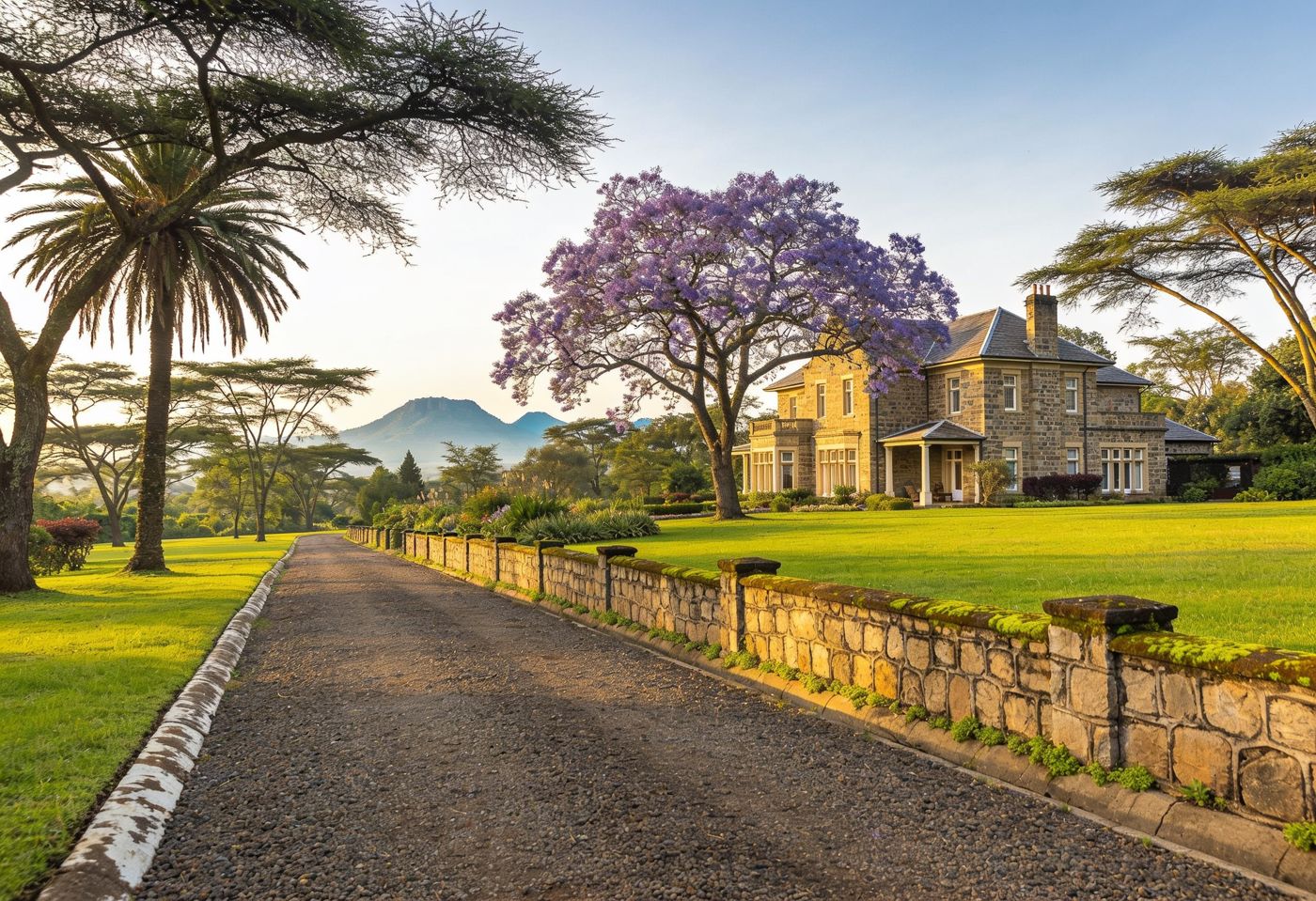
Karen is the semi-rural southwest — big plots, equestrian calm, British-curriculum schools and Nairobi National Park on the doorstep. Runda is the gated north — walled family houses minutes from the UN and the American-curriculum schools, behind some of the tightest security in the city.
This guide compares them head to head — space, schools, commute, security and price — for families who haven’t lived in Nairobi yet and want the honest version. If you’re still scoping the whole city, start with our best neighborhoods in Nairobi guide and the full moving to Nairobi hub.
The short answer
Choose Karen if you want the most space and greenery, your children are headed for a British-curriculum school like Brookhouse or Hillcrest, and your daily life is anchored at home and school rather than a downtown or UN office. Choose Runda if you work at or near the UN, an embassy or an NGO in Gigiri, your children are headed for the American-curriculum schools (ISK or Rosslyn), and you want the tightest gated-estate security with a short, predictable commute.
Put simply: Karen is the country house, Runda is the diplomatic compound. Both are leafy, safe, family-first and car-dependent. Karen gives you more land, lower entry rents and weekend access to the national park and safari flights, in exchange for a long drive to the north and the center. Runda gives you a ten-minute run to the UN and the top American schools, behind estate-wide security, in exchange for a higher floor on rent and almost no apartments. Neither is better — they’re built for different families.
The 30-second decision
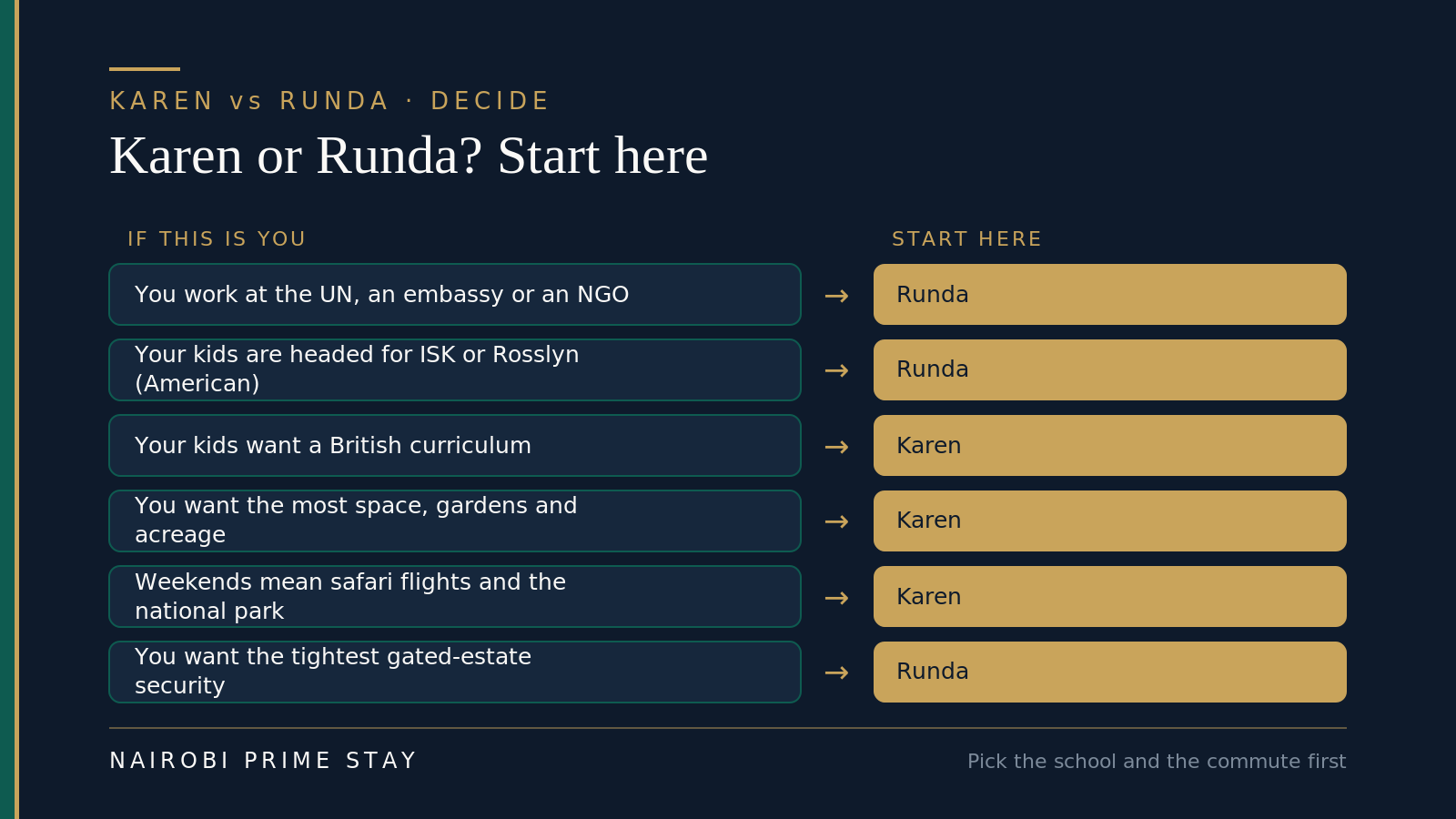
Pick the school and the commute first — in Nairobi, those two decide your daily life more than the address does.
Side by side: Karen vs Runda
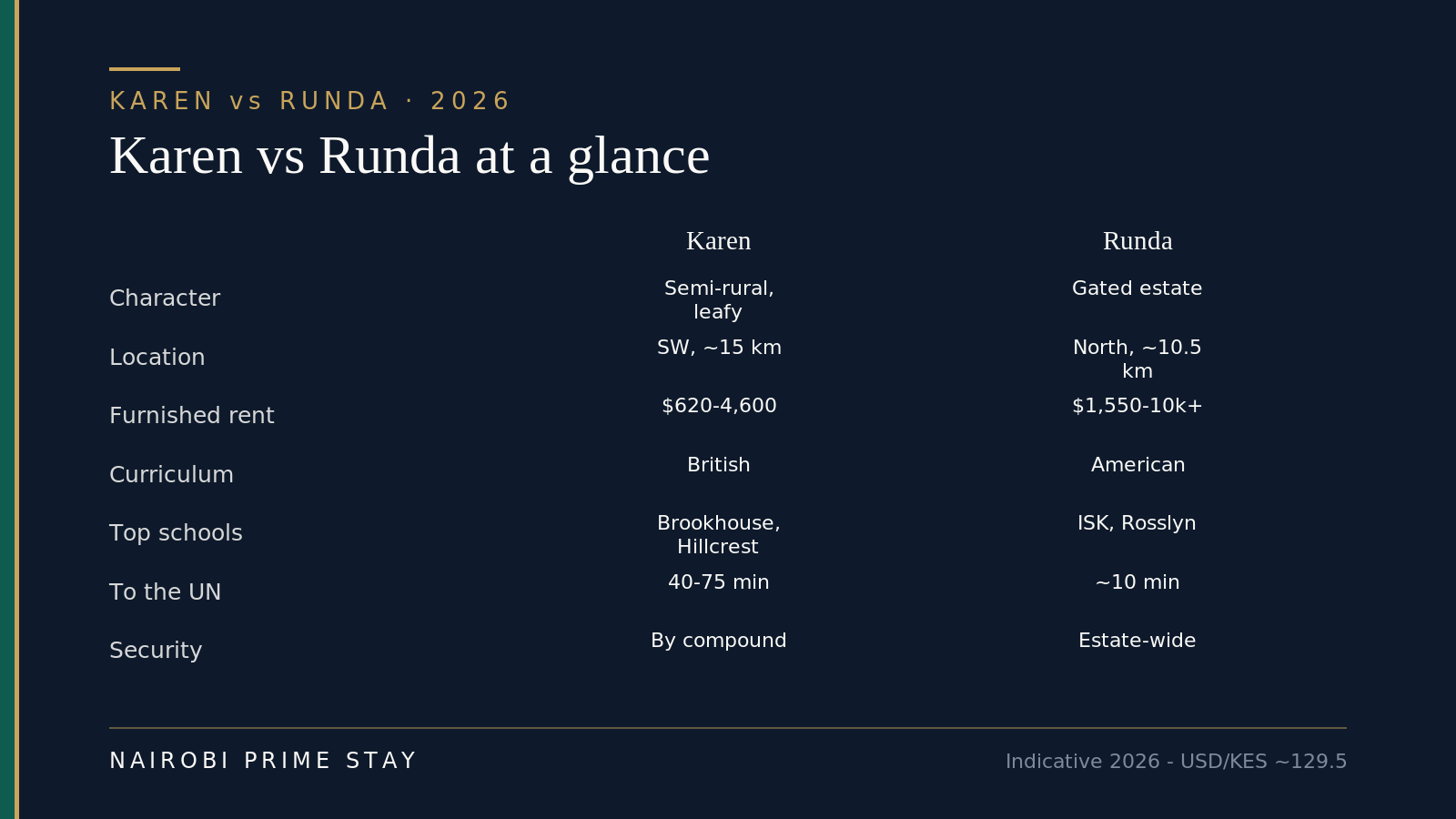
Here’s the comparison at a glance. All figures are indicative for 2026 at roughly KES 129–130 to the US dollar; verify live rents and the exchange rate before you sign (the Central Bank of Kenya or Wise has the current rate).
| Feature | Karen | Runda |
|---|---|---|
| Best for | Families wanting space, gardens, British schools | UN/embassy/NGO families near American schools |
| Vibe | Semi-rural, equestrian, leafy, calm | Gated diplomatic estate, walled, very private |
| Location | ~15 km southwest of the CBD | ~10.5 km north of the CBD, beside Gigiri |
| Homes | Houses on big plots + some townhouses & apartments | Almost all houses + gated townhouse compounds |
| Furnished rent / mo | ~$620–4,600 | ~$1,550–10,000+ |
| Schools | British: Brookhouse, Hillcrest, The Banda | American: ISK, Rosslyn Academy |
| To the UN / Gigiri | ~40–75 min at peak | ~10 min |
| Wilson Airport (safari flights) | ~15–25 min | ~30–45 min |
| Security feel | Calm; compound-by-compound | Among the city’s highest; estate-wide patrols |
| Walkable? | No — drive everywhere | No — drive everything |
| Green space | Gardens, Ngong Hills, national park | Karura Forest on the doorstep |
Space and character: country calm vs gated estate
Karen is the closest Nairobi gets to country living. Named after the Danish writer Karen Blixen of Out of Africa fame, it spreads across the city’s southwest in big walled plots, mature gardens, horse paddocks and quiet lanes, with a slower, almost rural pace. It’s houses and gardens first, with modern apartments and gated townhouses growing fast in the last few years but still the minority. The community is large, settled and international, and the feel is established — a place people put down roots, keep a dog and a couple of horses, and fill weekends in the garden rather than the city.
Runda is the gated north, and it feels engineered for privacy. It’s Nairobi’s most exclusive low-density estate: wide quiet lanes, tall trees, high garden walls and large standalone houses behind gates, with almost no apartment towers. It sits just north of the city beside Gigiri, where the UN headquarters and a row of embassies are, and it’s wrapped along one side by the 2,500-acre Karura Forest. Your neighbors are ambassadors, UN and NGO directors and multinational executives, and many homes are diplomatic or company residences. At the entry end, gated townhouse compounds — names like Runda Mumwe, Mimosa and Mhasibu — offer a more affordable, lower-maintenance way in.
The honest way to frame the difference: Karen is spread out and semi-rural, with the most land per shilling and a country-club, equestrian streak. Runda is a tighter, more uniform gated estate with the diplomatic-compound feel and the schools and the UN on its doorstep. Both are calm, green and private. Karen feels like the countryside that happens to be in a city; Runda feels like a secure village built for people who work at the UN.
Schools: British in Karen, American by Runda
For most families this decision is really a school decision, and the cleanest way to choose is by curriculum. Karen is British country; Runda is American by the UN. Pick the school first, then let it choose the suburb — in Nairobi traffic, living near your school is worth a great deal.
Karen leans British. Two of the city’s best-known British-curriculum schools sit right here — Brookhouse (IGCSE and A-level, day and boarding) and Hillcrest (Early Years to A-level) — with prep schools like The Banda nearby. Indicative 2026 senior fees run roughly KES 2.9 million a year in tuition at Brookhouse (about $22,000) and up to around KES 3.08 million (about $24,000) at Hillcrest, with younger years far less; boarding adds substantially. Fees rise yearly and are billed per term in shillings, so confirm the current figure with each school.
Runda is the American-curriculum cluster. The International School of Kenya (ISK, American plus IB) sits on the Gigiri–Runda edge, and Rosslyn Academy (American with AP) is inside Runda itself — both a short drive, sometimes a walk, from a Runda home. ISK is the city’s most expensive school: senior-grade tuition runs about $37,000 a year as of 2025/26, younger grades lower, plus a one-time capital levy of roughly $11,000 per child on entry. Rosslyn runs closer to $10,000 a year. Treat both as indicative and confirm current schedules directly.
The practical upshot is simple. If you want an American curriculum, Runda (or neighboring Gigiri) keeps the school run to ten minutes; from Karen, ISK and Rosslyn are a long cross-city drive in traffic. If you want a British curriculum, Karen puts Brookhouse and Hillcrest on your doorstep, while Runda families drive to British options. A few families split the difference with boarding, offered at Brookhouse’s Karen campus — but most simply live near the school. Our international schools in Nairobi guide lines up the curricula and fees; apply months ahead, as the best schools keep waitlists.
Rents: what your money gets in each
Karen has the lower floor and the wider range; Runda’s entry point sits higher. Karen still has cottages, garden annexes and townhouses near The Hub that start well below a Runda house, while Runda is almost all substantial walled homes, so the cheapest Runda rent is roughly where Karen’s mid-market begins. Both top out high. The numbers below are indicative furnished homes for 2026; unfurnished and longer leases cost less, and serviced, all-inclusive homes sit at the top of each band.
| Home type | Karen (furnished, USD/mo) | Runda (furnished, USD/mo) |
|---|---|---|
| Entry: cottage / townhouse / 1–2 bed | ~$620–1,800 | ~$1,550–2,550 |
| Family house, 3–4 bed + garden | ~$1,400–2,700 | ~$2,475–3,870 |
| Large 4–5 bed standalone | ~$2,700–4,600 | ~$3,870–6,190 |
| Executive / ambassadorial residence | ~$4,600+ | ~$6,190–10,000+ |
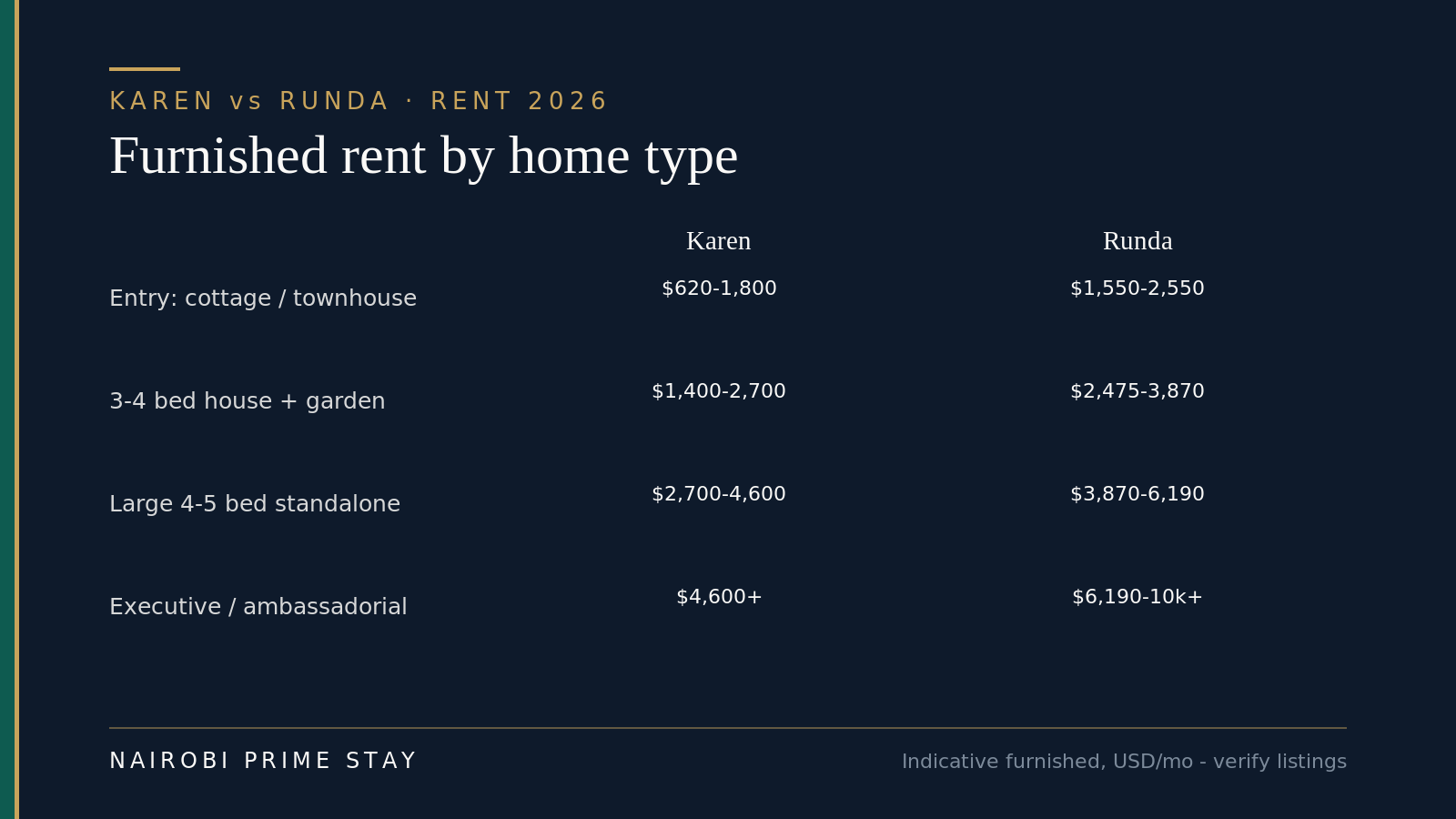
Indicative furnished rents at KES 129.4 to the dollar (2 July 2026 — check the current rate). Karen starts lower thanks to cottages and townhouses; Runda is almost all substantial houses, so its floor sits higher.
Why the gap? In Karen you’re paying for land and gardens, and there’s enough variety — annexes, townhouses, family houses, big villas — that budgets from the low four figures up are catered for. In Runda you’re paying for a walled house, estate-wide security and a ten-minute run to the UN and the American schools, and the stock is heavier and more uniform, so the cheapest entry is a gated townhouse rather than a cottage. One thing that softens Runda’s premium: employer housing. Many embassies, the UN and multinationals cover their staff’s rent, which is a big reason the estate is full of exactly those households. Whatever you view in either area, run the “Nairobi Five” check before signing — a backup generator, water supply and storage (boreholes are common in both), 24/7 security, fibre internet already serving the home, and responsive management. For the wider budget picture, see our cost of living in Nairobi guide, and never wire money for a place you haven’t viewed.
The commute: where each area wins
Geography splits these two harder than anything except schools. Runda wins the north and the UN; Karen wins the south and the safari weekends. In a city where distances are short but traffic is not, your daily route should drive this choice.
Runda’s advantage is the UN and the schools. Most homes are about a ten-minute drive from the UN complex and the embassies in Gigiri, with the International School of Kenya and Rosslyn Academy minutes away, the Village Market mall five to ten minutes off, and Two Rivers close by. The estate sits between Limuru Road on the west and Kiambu Road on the east, and the catch is the same one everyone faces: those arteries back up at rush hour and around school drop-off, so a ten-minute hop can stretch to thirty or forty at peak. Still, for anyone whose week revolves around the UN, that short, predictable run is hard to beat.
Karen sits on the southwestern edge, so the trade-off is distance to the north and center. Plan on roughly 30–60 minutes to the CBD, 25–50 to Upper Hill and 40–75 to the UN in Gigiri at peak, depending on exactly where you start. The Southern Bypass has helped link Karen to the airport and the east, but the drive to the diplomatic cluster is long. Karen’s hidden advantage is the other direction: Wilson Airport, the hub for light aircraft to the Maasai Mara, Diani and the safari strips, is barely 15–25 minutes away, and Nairobi National Park’s main gate is on the doorstep. For weekend flying and wildlife, Karen is one of the best-placed suburbs in the city.
A simple rule: if your week anchors on the UN, an embassy or an NGO in Gigiri, live in Runda. If it anchors at home and a Karen school — and you love weekend safari flights and the national park — live in Karen. Either way, both suburbs are car-dependent. There’s no walkable high street in either, so families keep at least one car and usually two, since a single car can’t cover a parent’s commute and a separate school run. Drive your real route at 8 a.m. and 5 p.m. before you sign; the off-peak and on-peak versions of the same trip feel like different cities.
Safety
Both areas are among the safest places to live in Nairobi, in slightly different styles. Runda is arguably the most secure address in the city. Three layers stack up: nearly every house sits behind a high wall and gate with an alarm and often its own guard; the long-established residents’ association funds estate-wide patrols and manned entry points on top of that; and the heavy diplomatic presence raises the baseline of policing across the area. Day to day, it feels exceptionally low-risk.
Karen is calm and secure too, but its security is more compound-by-compound. Homes sit behind walls and hedges in gated compounds or on private plots with guards, and the low density and quiet make it feel peaceful. Because plots are large and lanes are sleepy, the protection depends heavily on your specific compound — a well-guarded home with gates, alarm and good lighting is relaxed to live in, while an isolated plot with thin security is not. Check it carefully before you sign. In both suburbs the main risk is the same opportunistic petty crime you manage anywhere in the city, and the same habits apply: keep car doors locked in traffic, and use Uber or Bolt at night rather than walking the dark, quiet lanes. For the full, balanced picture, read our honest take on whether Nairobi is safe.
Lifestyle, shopping and weekends
Both suburbs are family-first and relaxed rather than nightlife districts — for a big night out, residents of either drive to Westlands. Where they differ is the flavor of the weekend.
Karen has a genuine local scene despite its calm. The Hub Karen is the modern shopping center, with supermarkets, shops and restaurants and an open-air feel; Galleria sits nearby toward Lang’ata, with long-standing shopping at Karen Crossroads. The dining leans toward leafy garden restaurants and cafés, some of the city’s best-loved. And the weekends are the real draw: the Giraffe Centre, the Sheldrick elephant orphanage, the Karen Blixen Museum, Nairobi National Park and the Ngong Hills are all close, with Wilson Airport handy for a quick safari hop. It’s a country-and-wildlife kind of weekend.
Runda has no high street of its own — you drive to everything — but it’s ringed by some of the best malls in the city. Village Market in next-door Gigiri is the anchor, a large mall with over 100 shops, restaurants, a cinema and a craft market; Two Rivers, one of East Africa’s biggest malls, sits just north, and the smaller Rosslyn Riviera covers a quick run. The standout is right at the edge: Karura Forest, 2,500 acres of indigenous forest with walking and cycling trails, a waterfall and forest cafés, where Runda families spend weekend mornings. It’s a mall-and-forest kind of weekend, all within a short, secure drive.
Healthcare
Both are well covered. Karen has its own well-known private hospital — The Karen Hospital — convenient for the southern suburbs, along with clinics and pharmacies for everyday needs; for specialist or major care, the city’s leading hospitals in Parklands and Upper Hill (Aga Khan, The Nairobi Hospital) are a drive away. From Runda, Gertrude’s Children’s Hospital — the city’s best-known pediatric hospital, which matters with kids — is a short drive in nearby Muthaiga, and Aga Khan University Hospital and MP Shah in Parklands are a manageable trip. In both suburbs, use the private system and carry good international insurance with medical evacuation. Our healthcare in Nairobi guide covers the main hospitals and what your policy should include.
Who should choose which
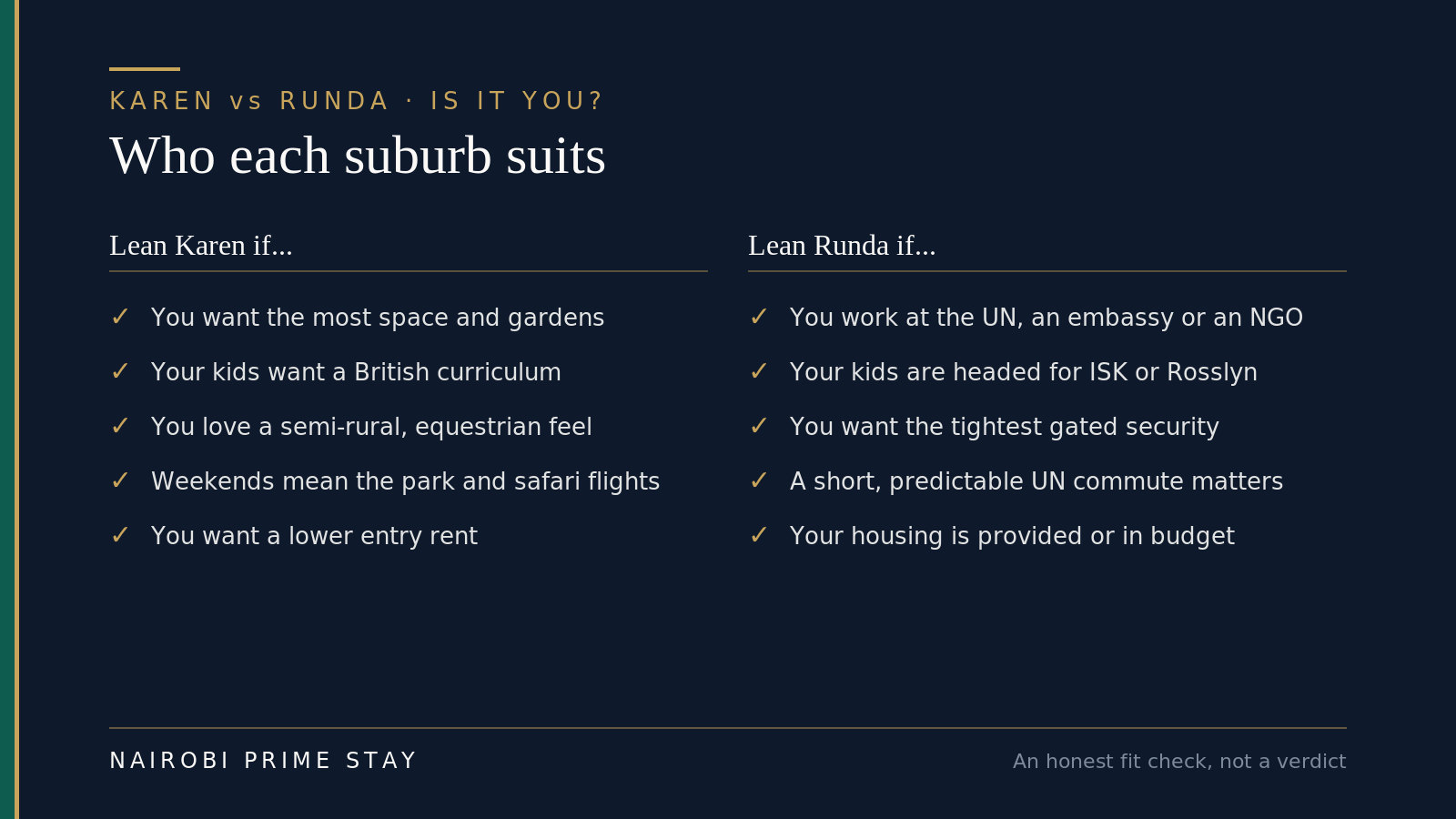
Karen is the right call if you want the most space and gardens in the city; your children are headed for a British-curriculum school like Brookhouse or Hillcrest; you love a semi-rural, equestrian feel; your weekends revolve around the national park, the Giraffe Centre and safari flights from Wilson; you’d like a lower entry rent than Runda; or your daily life is anchored at home and school rather than a downtown office.
Runda is the right call if you work at the UN, an embassy or an NGO in Gigiri; your children are headed for the American-curriculum schools, ISK or Rosslyn; you want the tightest gated-estate security in the city; a short, predictable commute matters more than acreage; your housing is provided or comfortably in budget; or you simply want a walled house with a garden minutes from both the office and the school.
If you find yourself wanting Karen’s space but a shorter run to the north and the UN, look at the middle options — Lavington sits between the center and the western suburbs, while Loresho and Kitisuru offer leafy, spacious family living closer to ISK. Widen the shortlist with the full best neighborhoods in Nairobi guide.
Two scenarios
The British-school family (Karen). You’re moving with two kids who’ll go into a British curriculum, and one parent works from home or runs a local business. Karen fits almost perfectly. You rent a four-bed house with a garden for around KES 320,000–400,000 a month (roughly $2,500–3,100), Brookhouse or Hillcrest is a short run, and weekends are the Giraffe Centre, the national park and the occasional 20-minute flight out of Wilson to the Mara. The drive downtown is long, but you rarely make it — life is local. You start in a serviced apartment in or near Karen for the first month, drive the school run in real traffic, and only then choose between a townhouse near The Hub and a garden house toward the Ngong Hills.
The UN family (Runda). You’ve taken a posting at the UN, you have two kids starting at ISK, and your package covers part of the rent. Runda is almost a foregone conclusion. You rent a four-bed walled house with a garden and a generator for around KES 450,000 a month, the kids are at ISK or Rosslyn within ten minutes, and the working parent is at the UN complex inside fifteen minutes off-peak. Weekend mornings are spent on the trails in Karura Forest, and the estate’s security lets everyone breathe. You keep two cars, base yourself in a serviced apartment near Gigiri for the first six weeks, and sign once you’ve toured the schools and driven the commute.
What does a house in either suburb cost to run?
The rent is only the start in both suburbs, because a big house with a garden runs on people and diesel. As of July 2026 the legal minimum wage for a domestic worker in Nairobi — a house help, gardener or day watchman — is about KES 18,047 a month, plus a 15% housing allowance if you don’t provide staff quarters, and experienced staff in these neighborhoods are often paid above the floor. A large Karen plot typically needs a gardener and often a dedicated guard if the home isn’t in a gated compound; a Runda household contributes to the residents’ association that funds the estate-wide patrols and manned entry points, which is part of what you’re buying. Our domestic help in Nairobi guide covers fair pay, contracts and hiring well.
Then come the utilities of self-sufficiency: generator diesel during outages, borehole or water-truck top-ups in dry months, garden (and sometimes pool) upkeep, fibre internet around KES 4,000–6,000 a month, and two cars, because one can’t cover a commute and a school run. Expect one to three months’ rent as a deposit up front — see our tenancy, leases and deposits guide for how that works. The practical difference: Karen’s bigger plots mean more garden and more staff; Runda trades some of that for estate fees and shared security. A serviced apartment or gated townhouse folds most of these lines into one predictable monthly figure, which is why many families start there.
Can you rent in Karen or Runda from the US?
You can do the research from your sofa in the US — but not the signing. The classic Nairobi rental scam is a polished listing for a house that isn’t actually available, priced temptingly below market, whose “landlord” collects a deposit by wire or M-Pesa from someone still abroad. The safe sequence is the one we recommend everywhere on this site: browse and shortlist from home, join the Karen and Runda community groups, line up an agent, and book a serviced apartment for your first four to eight weeks. Then do the parts that can only happen in person — walk through the actual house, verify the landlord or the agency, test the school run at 7:30 a.m., and pay traceably into a company or verified account against a signed lease.
Red flags from abroad: pressure to pay before you’ve seen the house, a personal M-Pesa number instead of a company account, a price clearly below every comparable listing, and a “landlord” who is conveniently overseas. Our how to rent an apartment in Nairobi guide walks the whole process step by step, and the property scams guide catalogs the tricks in detail.
Can a foreigner buy in Karen or Runda?
Yes — with a structure worth understanding before you fall for a house. Non-citizens can own property in Kenya on a 99-year leasehold, not freehold, and both suburbs see regular expat and diaspora purchases; Karen in particular has a lively sales market in townhouses and villas. The non-negotiables: hire your own conveyancing lawyer (never the seller’s), run an official land search — roughly KES 500–1,000 via eCitizen or Ardhisasa — and pay through your lawyer’s account, never directly to a seller you met online.
Two suburb-specific wrinkles. In Karen, some larger plots still sit on old agricultural titles, which means a sale can require Land Control Board consent — a known complication your lawyer must check early, not at signing. In Runda, most stock is standard residential title inside the estate, but confirm the residents’-association obligations that come with the house, since the shared security is funded by them. And if you’re buying remotely from the US, note that a power of attorney must be legalized through the Kenyan embassy — Kenya is not in the Apostille Convention, so a US notary stamp alone isn’t enough. Our guide to buying property in Kenya as a foreigner covers the full process, costs and pitfalls.
Not sure yet? Try before you commit
You don’t have to decide from your laptop at home. The smartest move is to spend your first few weeks in a serviced apartment, then view long-term homes once you’ve felt the traffic, tested the school run and walked the streets. Lean toward Karen and you can base yourself right there; lean toward Runda and the serviced options cluster in neighboring Gigiri and the wider north, since Runda itself is a house estate with very few — a short drive that still lets you house-hunt Runda properly.
That’s the soft-landing strategy we recommend for almost every family: stay serviced for the first four to eight weeks, use the time to compare the schools and commutes in person, then sign a year-long lease once you’re sure. A serviced apartment is all-inclusive — Wi-Fi, cleaning, a backup generator and 24/7 security in one monthly price — so you get a secure base with zero setup while you make up your mind. Our guide to serviced apartments in Nairobi explains what’s included and how the monthly pricing works. When you’re ready to compare real homes, browse apartments in Karen and apartments around Runda side by side.
Frequently asked questions
Is Karen or Runda better for families?
Both are among Nairobi’s top family suburbs — the right one depends on your schools and your commute. Choose Karen for the most space and gardens, British-curriculum schools like Brookhouse and Hillcrest, and weekends at the national park, with daily life anchored at home and school. Choose Runda for the American-curriculum schools (ISK and Rosslyn), a ten-minute run to the UN and embassies, and the tightest gated-estate security. Neither is better overall; they suit different families.
Is Karen or Runda cheaper?
Karen has the lower entry point. Indicative 2026 furnished homes start around $620–1,800 a month for a cottage or townhouse in Karen, versus roughly $1,550–2,550 for the cheapest gated townhouse in Runda, because Runda is almost all substantial walled houses. Both suburbs top out high — into the executive and ambassadorial range — and employer housing often covers Runda’s premium. Unfurnished and longer leases cost less in both; verify current listings before you sign.
Which is better for schools, Karen or Runda?
Curriculum decides it. Karen leans British, with Brookhouse, Hillcrest and The Banda on the doorstep, while Runda is the American-curriculum cluster, with the International School of Kenya (American plus IB) on the Gigiri–Runda edge and Rosslyn Academy (American with AP) inside the estate. If you want an American curriculum, Runda keeps the school run to about ten minutes; from Karen, ISK and Rosslyn are a long cross-city drive. Pick the school first, then the suburb.
Which is closer to the UN headquarters, Karen or Runda?
Runda, by a wide margin. Most Runda homes are about a ten-minute drive from the UN complex and the embassies in Gigiri, while Karen sits on the opposite, southwestern edge of the city — roughly 40–75 minutes to Gigiri at peak. UN, embassy and NGO staff almost always choose Runda or neighboring Gigiri for that short, predictable commute.
Which is safer, Karen or Runda?
Both are among the safest suburbs in Nairobi. Runda is arguably the most secure address in the city: walled houses with guards, estate-wide residents’-association patrols, and a heavy diplomatic policing presence. Karen is calm and secure too, but its protection is more compound-by-compound across larger, quieter plots, so choose a well-guarded home with gates, alarm and good lighting. In both, the main risk is opportunistic petty crime, managed with the usual city habits.
Do I need a car in Karen or Runda?
Yes, in both. Neither suburb has a walkable high street — you drive to groceries, school, coffee and errands — and most families keep at least one car, usually two, since one car can’t cover a parent’s commute and a separate school run. Uber and Bolt work for occasional trips, but day-to-day life in either area runs on a private car.
Which has more space, Karen or Runda?
Karen, generally. It’s the most spread-out, semi-rural suburb in the city, with the biggest plots, gardens and an equestrian streak, and more land per shilling. Runda is spacious too, but it’s a tighter, more uniform gated estate of walled houses. If maximum acreage and a country feel matter most, Karen wins; if you want a secure walled house near the UN and the American schools, Runda’s space is plenty.
Karen or Runda for weekends and the outdoors?
Both are leafy and family-friendly, with different weekends. Karen puts Nairobi National Park, the Giraffe Centre and the Sheldrick elephant orphanage on the doorstep, plus Wilson Airport 15–25 minutes away for safari and coast flights. Runda has Karura Forest — 2,500 acres of trails, a waterfall and forest cafés — right at its edge, with the Village Market and Two Rivers malls minutes away. Karen is the wildlife-and-safari weekend; Runda is the forest-and-mall weekend.
What does it cost to run a house in Karen or Runda?
Budget beyond the rent in both suburbs. As of July 2026 the legal minimum wage for a domestic worker in Nairobi — house help, gardener or day watchman — is about KES 18,047 a month plus a 15% housing allowance if you don’t provide a room, and larger homes employ two or three people. Add guards if the compound isn’t shared-security, generator diesel during outages, garden upkeep, fibre and water top-ups, plus Runda’s residents’-association contribution for estate-wide patrols. Karen’s bigger plots usually mean more garden and staff; Runda’s estate fees buy shared security. Most families also run two cars.
Can I rent a home in Karen or Runda from the US?
You can research from the US, but don’t pay a deposit on a house you’ve only seen online — fake listings that collect deposits from abroad are the classic Nairobi rental scam. Shortlist areas and join neighborhood groups from home, book a serviced apartment for your first four to eight weeks, then view homes, verify the landlord or agent, and pay traceably into a company or verified account once you’ve walked through the actual house. Anything that pressures you to wire money before arrival is a red flag.
Can a foreigner buy a house in Karen or Runda?
Yes. Non-citizens can own property in Kenya on a 99-year leasehold (not freehold), and both suburbs see regular expat and diaspora purchases. Always use your own conveyancing lawyer, run an official land search (roughly KES 500–1,000 via eCitizen or Ardhisasa) and pay through the lawyer’s account. In Karen specifically, some plots still carry old agricultural titles that need Land Control Board consent — a known wrinkle your lawyer must check. If you buy remotely, a power of attorney must be consularly legalized, as Kenya is not in the Apostille Convention.
Should I rent in Karen or Runda before I arrive?
Don’t sign a year-long lease sight-unseen in either area. Book a serviced apartment for your first four to eight weeks — in or near Karen if you’re leaning that way, or near Gigiri if you’re eyeing Runda, since Runda itself has few serviced options — then view long-term homes once you’ve tested the school run and the commute in real traffic. A serviced apartment is all-inclusive and bookable with a $50 deposit, with the balance paid on arrival.
Final thoughts
There’s no wrong answer here — only the right fit for your family. If your children are headed for a British curriculum and you want the most space, gardens and weekend wildlife the city offers, Karen is hard to beat. If you work at the UN and want the American schools and the tightest security on a short, predictable commute, Runda is built for exactly that life. Sort the school and the commute first, and the suburb chooses itself. And remember you can test-drive both before you lock in a year.
Related reading
- Moving to Nairobi: the complete guide — start here for the full relocation picture.
- Best neighborhoods in Nairobi — how every prime area compares, not just these two.
- Karen neighborhood guide — the semi-rural, school-rich southwest in depth.
- Runda neighborhood guide — the gated diplomatic estate in depth.
- International schools in Nairobi — curricula, fees and where each school sits.
- Is Nairobi safe? — an honest, practical look at safety.
- Cost of living in Nairobi — budget beyond rent.
- Serviced apartments in Nairobi — how the soft-landing month works.
See real homes in both areas
When you’re ready to compare actual homes, browse our verified serviced apartments in Karen and apartments around Runda, or see everything across the city on the apartments page — honest monthly pricing, no surprises. Not sure which suburb fits your schools, commute and budget? Our AI relocation assistant can shortlist apartments in either area in a couple of minutes, day or night, and a $50 deposit reserves your dates with the balance paid on arrival.
Ready to look?
Find your apartment in Nairobi
Browse verified serviced apartments, or ask the AI concierge which area fits your life.