
Guides · Property investment
Can Foreigners Buy Property in Kenya? An Honest 2026 Guide
Can Foreigners Buy Property in Kenya? An Honest 2026 Guide

Yes. Foreigners can buy property in Kenya, and plenty of Americans do. But there’s one big condition that shapes everything: as a non-citizen you can only hold land on a lease of up to 99 years. No freehold, and no farmland without special State consent. For most people that sounds more limiting than it is in practice, and a city apartment sidesteps the whole problem.
This guide explains the law in plain English: what you’re allowed to own, what you’re not, the routes foreigners actually use, and the traps that catch people out. It’s written for Americans and other non-citizens looking at a home or an investment in Nairobi.
One thing first. This is general information, not legal advice. Kenyan land law is specific, and the cost of getting it wrong is real money. Before you sign anything or send a shilling, hire your own advocate — never rely on the seller’s.
The short version (TL;DR). Foreigners can buy property in Kenya, but only on leasehold tenure of up to 99 years. You can’t hold freehold, and you can’t buy agricultural land without consent from the State. The clean, common route is a Nairobi apartment on a sectional title, where the title is registered in your name and there’s no farmland complication. A Kenyan company doesn’t get you around this unless it’s 100% owned by Kenyan citizens. Kenyan citizens — including the diaspora — can still hold freehold; a foreign spouse doesn’t automatically gain that right. Run an official title search, use your own advocate, and you can buy here safely.
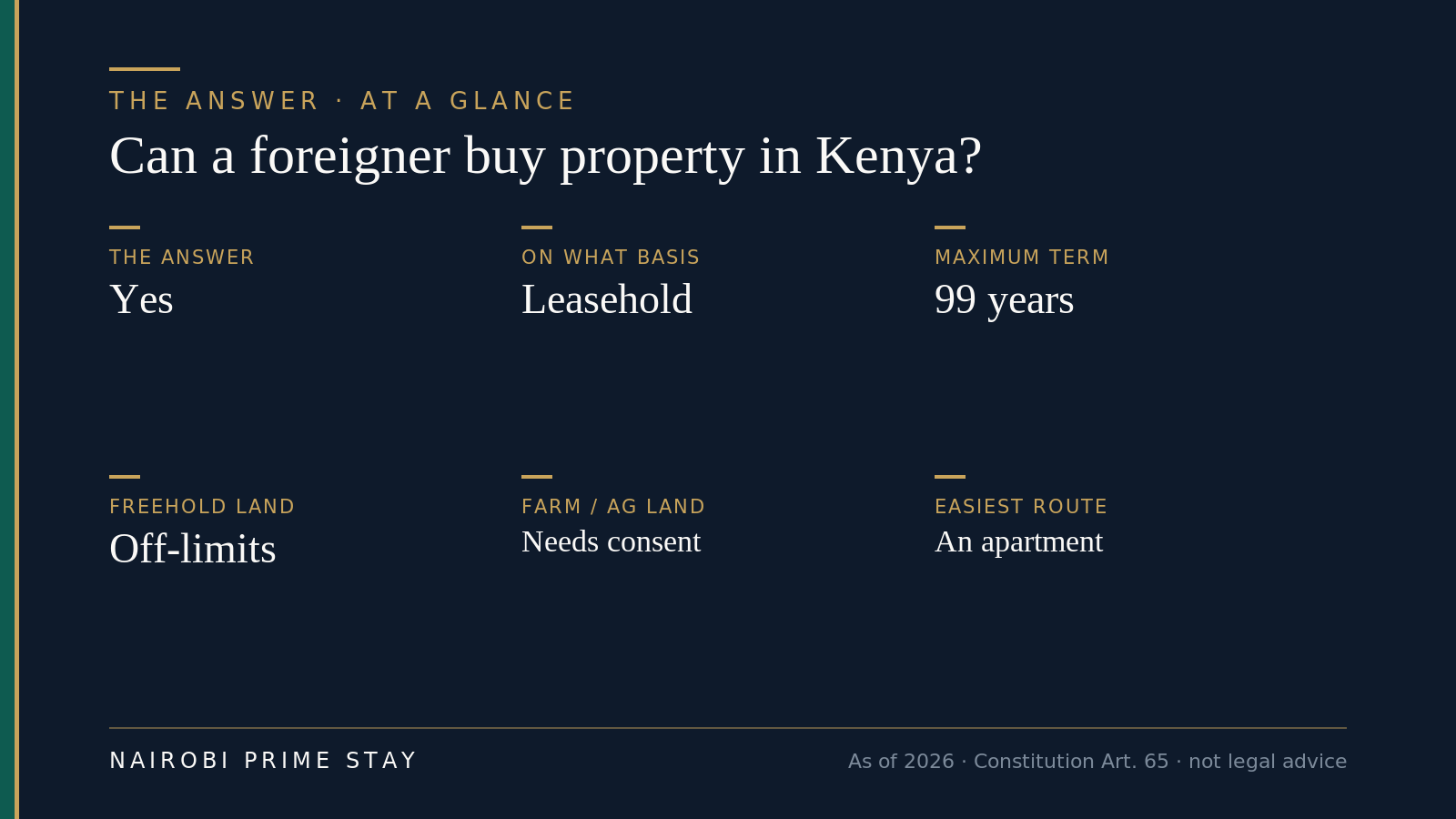 The answer in one screen. The 99-year leasehold cap comes straight from Article 65 of the Constitution — confirm your specific case with a Kenyan advocate.

The one rule that governs everything: Article 65
The whole topic comes down to a single clause. Article 65 of the Constitution of Kenya (2010) says a person who is not a citizen may hold land on the basis of leasehold tenure only, and that lease may not exceed 99 years. That’s it. Everything else is detail hanging off that rule.
A few consequences flow from it, and they matter:
- Try to take more, and the law shrinks it for you. If a contract or title tries to give a non-citizen anything bigger than a 99-year lease — a freehold, say — the Constitution treats it as a 99-year lease and no more. You can’t draft your way around the cap.
- A company is only “Kenyan” if it’s wholly Kenyan-owned. Article 65 says a company counts as a citizen only if every shareholder is a Kenyan citizen. Put one foreign shareholder in, and the company is treated as a non-citizen — still capped at leasehold. The same logic applies to land held in trust: it’s only citizen-held if every beneficiary is a citizen.
- It applies to everyone who isn’t a citizen. American, British, German, or a returning member of the diaspora who never took up Kenyan citizenship — the same 99-year rule applies.
This isn’t a dusty technicality, either. The Ministry of Lands has signaled tighter enforcement of Article 65 in recent years, including reviewing freehold titles that ended up in non-citizen hands and converting them to 99-year leases. So the rule isn’t just on paper. Build your plan around it from day one.
So what can a foreigner actually own?
Quite a lot, as it turns out — as long as it sits on leasehold. Here’s the honest list of what’s open to you as a non-citizen.
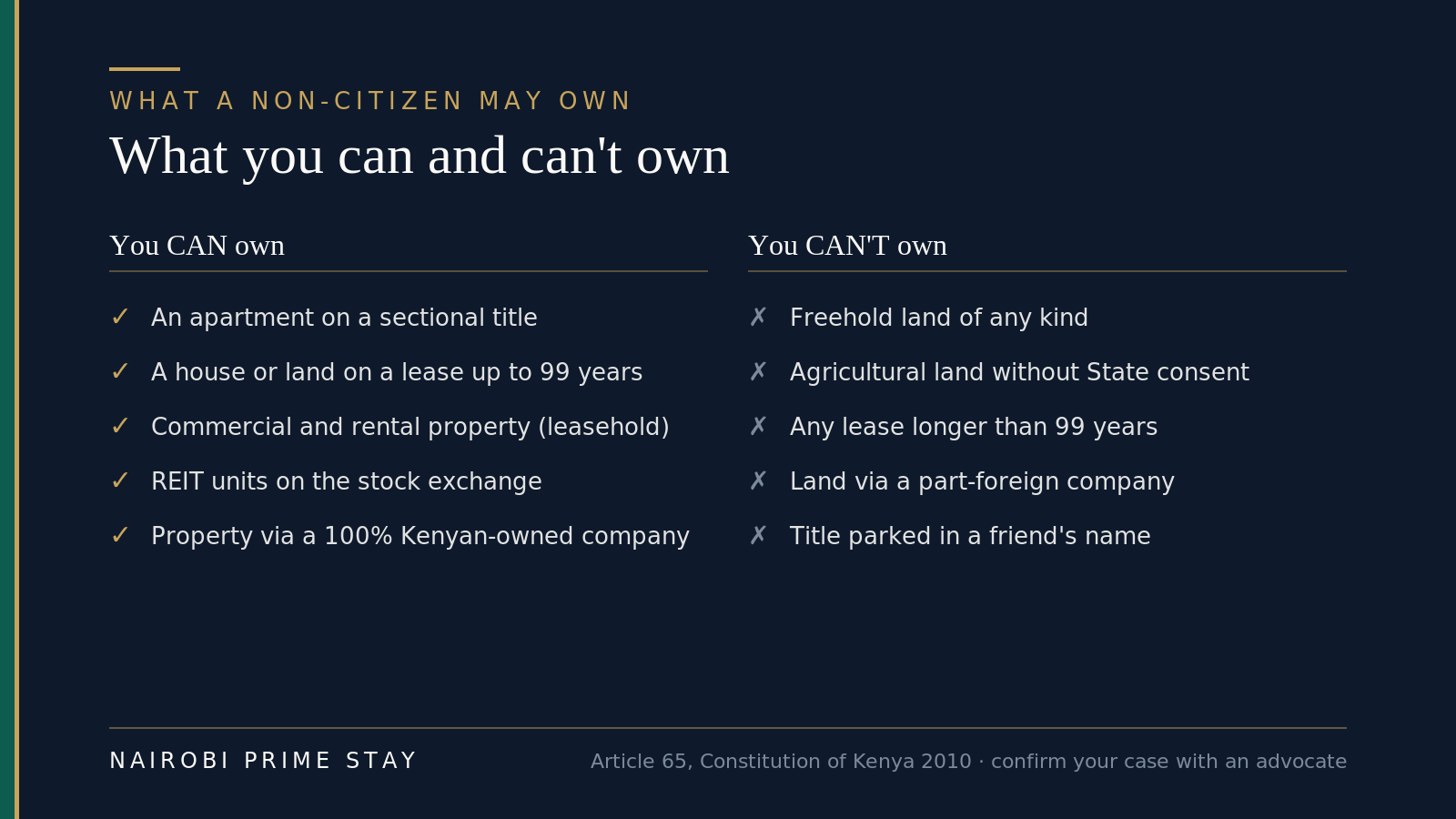 What a non-citizen can and can’t own under Article 65. The apartment route on the left is the one most foreign buyers take.
- An apartment on a sectional title. This is the clean route, and it’s why we lead with it. Under the Sectional Properties Act 2020, an apartment is registered to you as its own title. Because the building sits on leasehold land, your unit is a leasehold interest too — so the freehold restriction simply doesn’t apply to you. You get a title in your own name, it’s straightforward to verify, and there’s no farmland complication.
- A house or land on leasehold, up to 99 years. You can buy a stand-alone home or a residential plot, provided it’s leasehold and within the 99-year limit. This needs more care than an apartment (see the land due-diligence note below), but it’s allowed.
- Commercial and rental property. Offices, retail, a block of flats to let — all fine on leasehold. Foreign investment in commercial real estate is common and welcomed.
- REIT units. If you’d rather skip titles and tenants entirely, you can buy units in a Real Estate Investment Trust on the Nairobi Securities Exchange. None of the land rules apply, and you can start small.
- Property through a fully Kenyan-owned company. A company that is 100% owned by Kenyan citizens is treated as a citizen and can hold freehold. That route belongs to Kenyans and the diaspora, not to a foreign buyer using local nominees — more on why below.
The takeaway: for the vast majority of foreign buyers, a city apartment answers the question completely. For the different kinds of title — freehold, leasehold and sectional — our guide to title deeds in Kenya breaks each one down, and the bigger investment picture lives in our complete guide to property investment in Kenya.
What a foreigner can’t own — and the myths that cost people money
Three things are off the table, and a couple of “clever workarounds” deserve a blunt warning.
Freehold land. A non-citizen cannot hold freehold in Kenya, full stop. There’s no waiver, no special application, no exception. As covered above, any attempt to take freehold is automatically read down to a 99-year lease. So if an agent tells you they can “arrange freehold for a foreigner,” that’s your cue to walk away.
Agricultural land. Farmland is governed by the Land Control Act, and non-citizens — plus any company with foreign shareholding — are barred from owning it. The President can grant an exemption by notice in the Kenya Gazette, but that’s a rare process reserved for projects of national interest, not an ordinary home buyer. If a plot is classified as agricultural, treat it as out of reach unless a Kenyan advocate confirms otherwise in writing. This is one of the big reasons land is trickier for foreigners than an apartment, and we go deeper in buying land in Kenya.
Any lease over 99 years. Even where leases run longer on paper for citizens, your interest as a non-citizen is capped at 99.
Now the myths.
- “Just set up a Kenyan company.” This is the most common bad advice. A company only counts as Kenyan if every single shareholder is a citizen. Add one foreign shareholder — you — and the company is a non-citizen for land purposes, capped at leasehold and barred from agricultural land. Courts have unwound shell structures built to slip a foreigner into freehold. A company can still be a sensible vehicle for holding leasehold property or for scale, but it does not upgrade your rights.
- “Put the title in a friend’s name.” Please don’t. A nominee arrangement — land in a trusted Kenyan’s name that’s “really” yours — leaves you owning nothing on paper. We’ve seen these end in tears: the friend sells, dies, divorces, or simply refuses to hand it back, and you have little recourse. If you can legally hold a leasehold title in your own name, do that instead. Trust the title, not a handshake. Nominee deals are also a favorite of outright fraudsters — our guide to property scams in Kenya shows the common ones and how to dodge them.
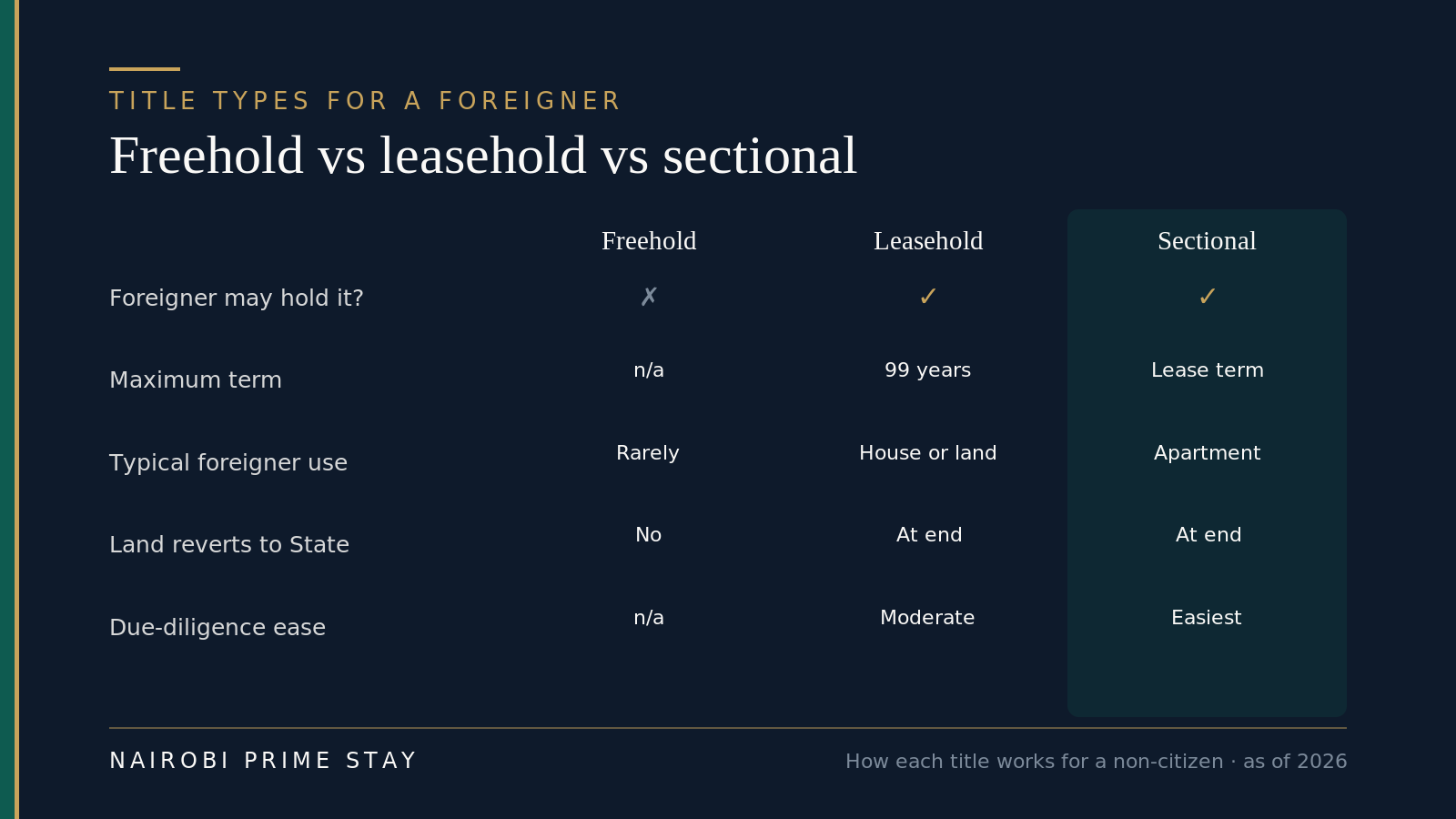 How the three title types work for a non-citizen. The sectional-title apartment (highlighted) is the simplest to buy and verify.
What “leasehold” actually means — and is 99 years a problem?
For most buyers, no. But it’s worth understanding what you’re getting.
A leasehold means you own the property for a fixed term — here, up to 99 years — after which, in theory, the land reverts to the State unless the lease is renewed. You pay a modest annual ground rent to the government on the lease, plus land rates to the county. Those are small, ongoing costs, not a catch.
Here’s the reassuring part: during the lease you hold the practical rights of an owner. You can live in the property, rent it out, sell it, mortgage it, renovate, and leave it to your heirs. A 99-year leasehold isn’t a long-term rental — it’s ownership with an expiry date most buyers will never reach.
Two practical points keep people out of trouble:
- “99 years” is the maximum, not what you automatically get. A lease granted in 1980 for 99 years has roughly 53 years left in 2026 — not a fresh 99. Always check the unexpired term on the title before you buy, and price a shorter remaining lease accordingly.
- Renewal isn’t automatic for non-citizens, but it’s usually granted. Citizens have stronger renewal rights. As a foreigner you should apply early, through the National Land Commission, rather than assume. In practice, leases on well-used land that isn’t needed for public purposes are generally renewed, sometimes with conditions. The honest caveat: renewals can come with strings, and disputes do happen, so don’t leave it to the last year.
For an apartment, this is mostly academic. The practical horizon of any flat is the lifespan of the building, which will matter long before a 90-plus-year lease runs down. A 99-year leasehold is, for day-to-day purposes, close enough to ownership that it shouldn’t put you off.
The routes foreigners actually use
In practice, foreign buyers cluster around a handful of clean paths:
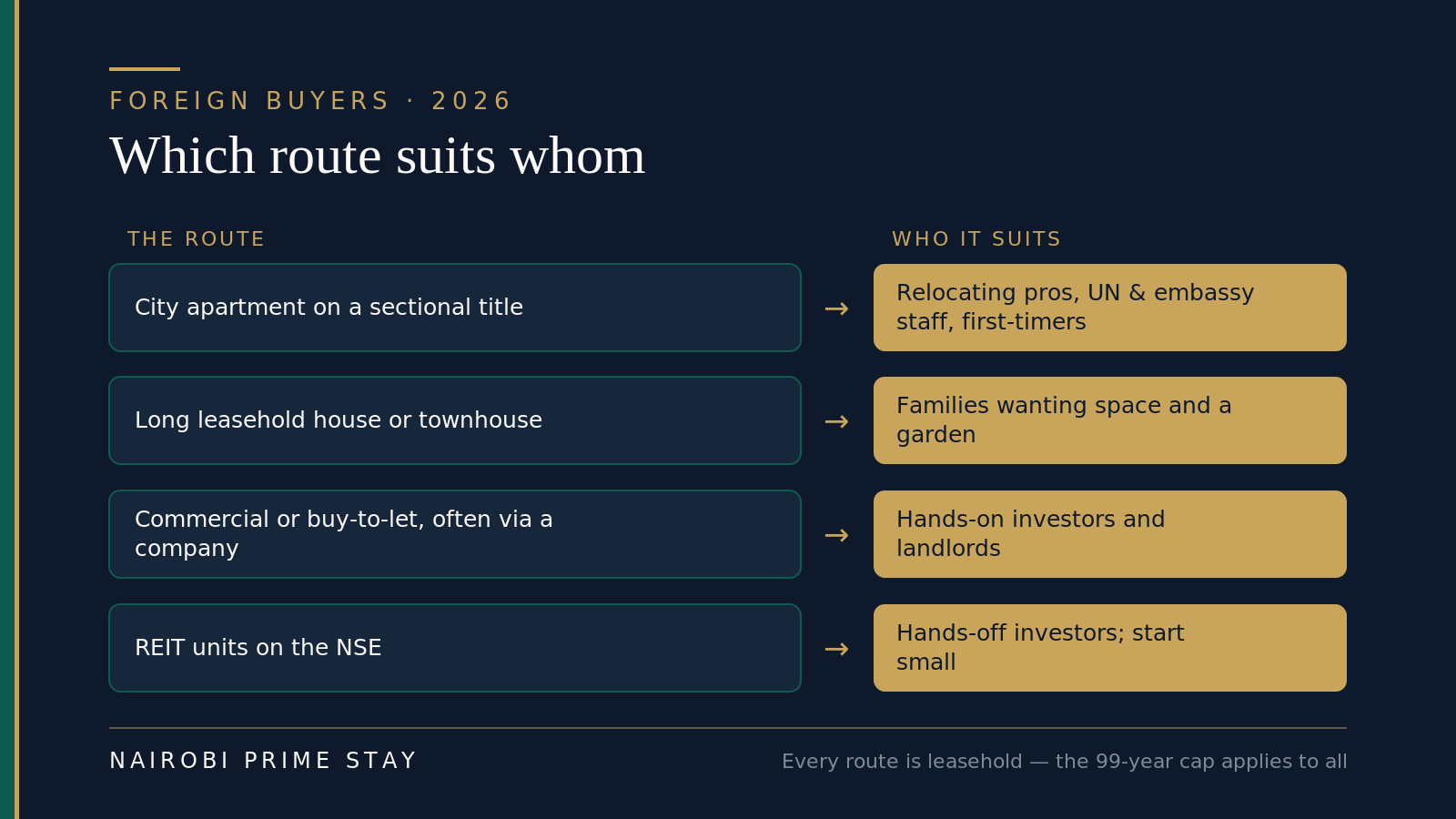 Four clean routes, and who each tends to suit. Every one of them is leasehold — the 99-year cap applies across the board.
- Buy a city apartment on a sectional title. The default for relocating professionals, UN and embassy staff, and hands-on investors. Title in your name, easy to verify, no farmland issue. Most of the homes we help people find sit here.
- Take a long leasehold on a house or townhouse. For families wanting space in the western suburbs, a leasehold home works — with proper due diligence on the title and the unexpired term.
- Hold commercial or buy-to-let property on leasehold, sometimes through a company for tax or partnership reasons. The company holds leasehold, not freehold.
- Go hands-off with REITs. No title, no tenants, start small on the Nairobi Securities Exchange through a Kenya REIT. The cleanest option if you mainly want exposure to the market without becoming a landlord.
Whichever route, the buying mechanics are the same and the order matters — find, agree a price, engage your own advocate, get a KRA PIN (the tax ID you need to transact), run an official title search, sign and pay a deposit into the advocate’s account, complete, pay stamp duty, and register. We walk through it in how to buy property in Kenya step by step, and the lawyer’s side — searches, agreement, consents and registration — in conveyancing in Kenya.
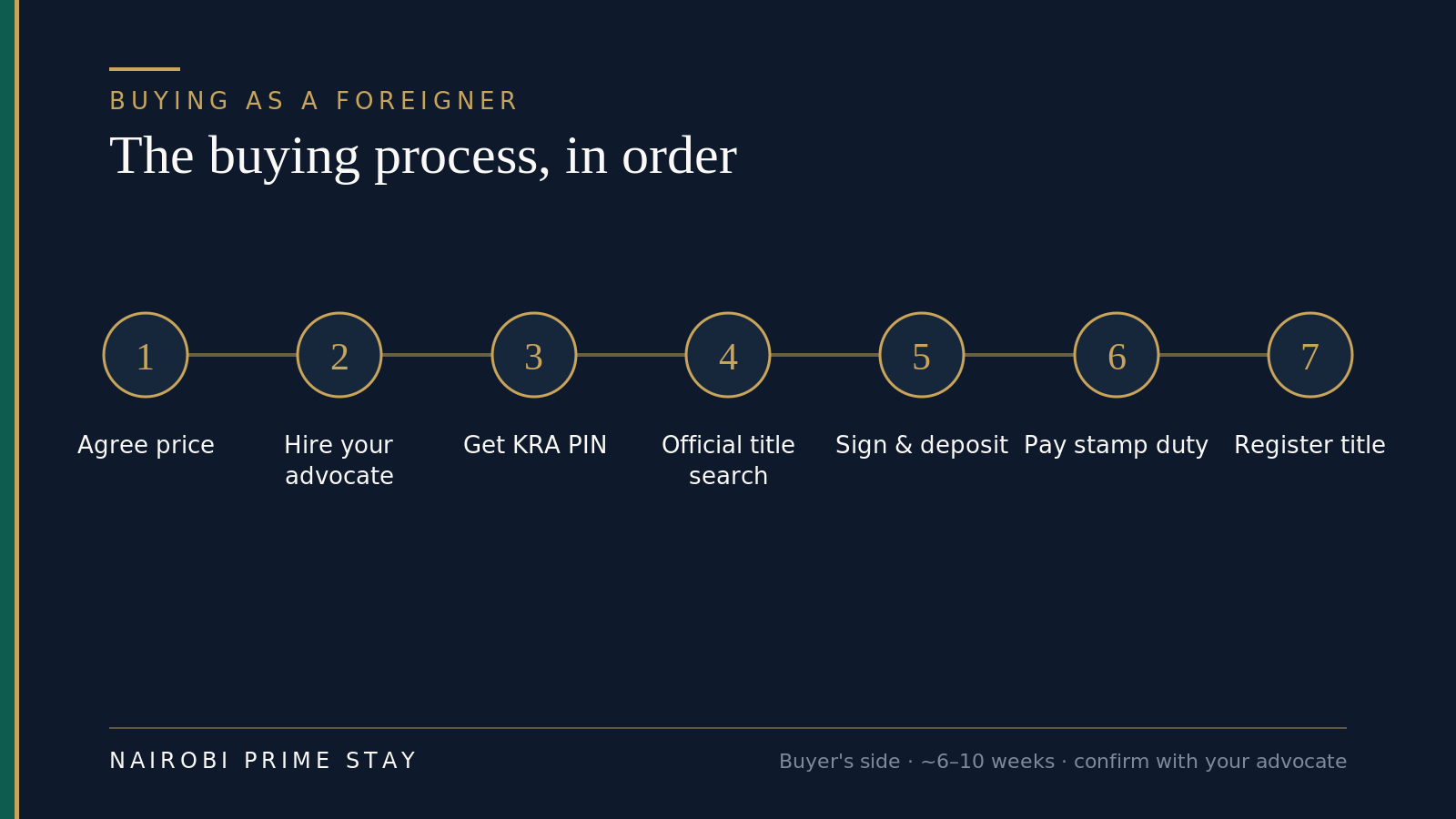 The buyer’s side, in order. Most clean purchases take about six to ten weeks — confirm timelines with your own advocate.
Married to a Kenyan? The diaspora? How citizenship changes things
Citizenship is the dividing line, so a few situations are worth spelling out.
Kenyan citizens can hold freehold — including dual citizens and members of the diaspora who hold a Kenyan passport. Since 2010, Kenya allows dual citizenship, so a Kenyan-American can usually own freehold and agricultural land as a citizen. If you have a claim to Kenyan citizenship, getting that sorted first can widen what you’re able to buy. The diaspora playbook — buying from abroad safely, financing, and project-managing remotely — has its own guide: diaspora property investment in Kenya.
A foreign spouse doesn’t automatically gain a citizen’s land rights. If you’re a non-citizen married to a Kenyan, you personally are still capped at leasehold. A common arrangement is to register a freehold property in the Kenyan spouse’s name, with the foreign spouse protected under the Matrimonial Property Act. That protection is real, but so is the risk if the marriage breaks down or the citizen spouse dies. Don’t lean on it casually — get independent legal advice, and consider whether a leasehold title in your own name is the cleaner answer for your situation.
Taking up citizenship is a longer road, but for someone settling permanently it changes the whole picture. It’s worth a conversation with an immigration lawyer if Kenya is a forever move rather than a few-year posting.
A realistic example
Say you’re an American moving to Nairobi for a three-year contract and you’d rather buy than rent. You settle on a two-bedroom apartment in Kilimani. Your advocate confirms the development is registered under the Sectional Properties Act, runs an official search showing clean leasehold title with 71 years unexpired, and checks there’s no agricultural-land issue (there isn’t — it’s a city plot). You get a KRA PIN, sign the sale agreement, pay the deposit into your advocate’s account, complete, pay stamp duty, and the unit is registered in your name. Start to finish, about eight weeks. Nothing exotic happened — and crucially, you own a title in your own name, not a promise.
What you can own, at a glance
| Property type | Can a foreigner buy it? | On what basis | Notes |
|---|---|---|---|
| Apartment (sectional title) | Yes | Leasehold | The clean, common route; title in your name |
| House or townhouse | Yes | Leasehold, up to 99 yrs | Check the unexpired term and title carefully |
| Residential plot | Yes, if not agricultural | Leasehold, up to 99 yrs | Confirm the land’s classification first |
| Commercial / buy-to-let | Yes | Leasehold | Often held via a company |
| Agricultural land | No (rare exemption only) | — | Barred by the Land Control Act |
| Freehold land | No | — | Auto-converted to a 99-yr lease |
| REIT units | Yes | Securities, not land | No title; buy via a broker on the NSE |
What does it cost a foreigner to buy?
Budget roughly 7–11% of the price in one-time closing costs on top of the purchase, then a small amount each year. The rules are the same for a foreigner as for a Kenyan buyer — there’s no extra “foreigner tax” on the purchase itself.
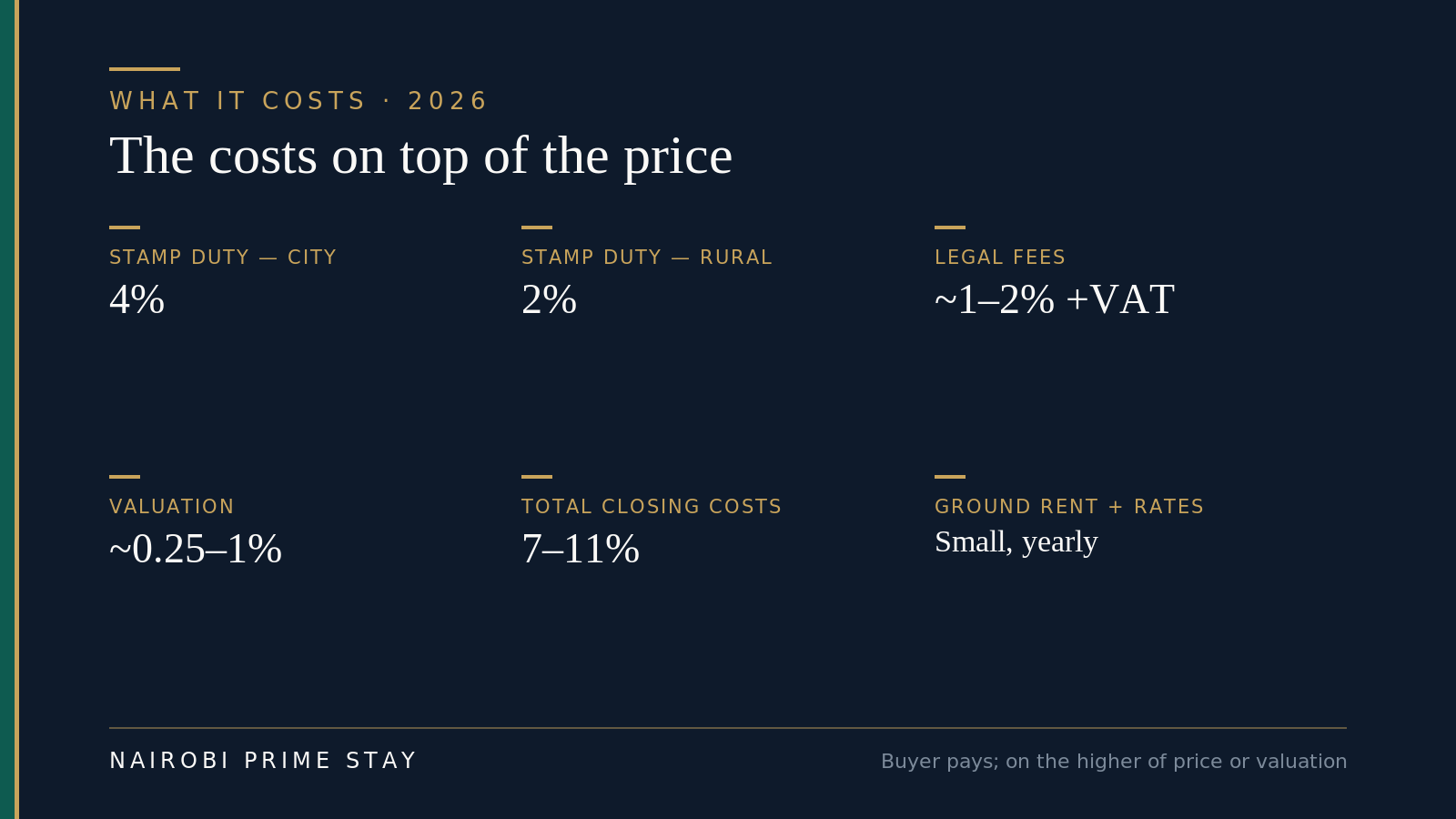 The costs that sit on top of the price. Stamp duty is the big one; budget 7–11% all in, as of 2026.
The largest line is stamp duty, paid by the buyer. It’s 4% of the value for property in a city or municipality — which covers almost all of Nairobi — and 2% for rural land, with commercial property at 6%. It’s charged on the higher of your purchase price or the government valuer’s figure, so a low “price on paper” won’t shrink the bill. An April 2024 reclassification also pulled several once-rural areas (parts of Kiambu, for instance) up into the 4% band, so confirm the rate for your exact plot.
The rest are smaller:
- Legal fees — your advocate charges on a regulated scale, roughly 1–2% of the price, plus 16% VAT. Worth every shilling; this is the person keeping you out of trouble.
- Valuation — a bank or registered valuer, about 0.25–1%.
- Searches, registration and disbursements — the official title search, registration and any consents add a few smaller fixed fees.
Then, every year, you’ll pay modest ground rent to the national government on the leasehold and land rates to the county. In an apartment you’ll also pay a monthly service charge for security, water, cleaning and the generator — ask for the exact figure before you buy, because a high service charge changes the math.
| Cost | Typical rate (2026) | Who pays / when |
|---|---|---|
| Stamp duty (city/municipal) | 4% of value | Buyer, on completion |
| Stamp duty (rural land) | 2% of value | Buyer, on completion |
| Legal fees | ~1–2% + 16% VAT | Buyer, on completion |
| Valuation | ~0.25–1% | Buyer |
| Registration, searches, disbursements | Smaller fixed fees | Buyer |
| Ground rent + land rates | Modest, annual | Owner, yearly |
| Service charge (apartments) | Varies by building | Owner, monthly |
A quick worked example. On a KES 15 million (about $116,000) Kilimani apartment, stamp duty at 4% is roughly KES 600,000, legal fees around KES 225,000 plus VAT, and valuation and registration a bit more — call it KES 1.05–1.65 million (~7–11%) in closing costs, on top of the price. A few stamp-duty exemptions exist — transfers between spouses, first-time buyers under the Affordable Housing Scheme, and inheritance — but most foreign buyers won’t qualify. Our guide to property taxes in Kenya breaks the ongoing bills down further.
Can a foreigner get a mortgage in Kenya?
Yes, though most foreign buyers still pay cash. Resident foreigners and the diaspora can borrow: KCB, Stanbic, Co-operative Bank, Absa and Standard Chartered all run mortgage or diaspora-mortgage products, some available in US dollars or pounds as well as shillings — Standard Chartered, for example, lends to non-residents up to KES 100 million. The catch is the cost of money. Kenyan mortgage rates run roughly 14–18% a year and are usually variable, though some promotional fixed rates near 9% have been on offer into late 2026. Expect to put down a sizeable deposit, and the bank will only lend against a clean leasehold title it can register a charge over. We go deeper in property financing in Kenya.
The honest balance of buying as a foreigner
The good: the process is well-trodden, the apartment route is clean, a 99-year lease is close to ownership in practice, and prime Nairobi has genuine, dollar-friendly rental demand. The trade-offs: you can’t hold freehold or farmland, leasehold renewal isn’t guaranteed, land fraud is a real risk if you skip due diligence, and currency swings can eat returns when you convert back to dollars. None of that is a reason to avoid Kenya — it’s a reason to go in with your eyes open and your own advocate beside you. For the full investment case — yields, the best areas to invest in Nairobi, and taxes — see the property investment hub and our breakdown of property taxes in Kenya.
Your legal checklist before buying as a foreigner
- Confirm you’re buying leasehold (or a sectional-title apartment), not freehold.
- Check the land isn’t classified agricultural — if it is, stop and take advice.
- Read the unexpired lease term off the title, not the original 99 years.
- Engage your own advocate — never the seller’s — before signing anything.
- Get your KRA PIN early; you need it to transact and register.
- Run an official title search at the land registry or on the ardhisasa portal.
- Pay any deposit into the advocate’s account, never directly to a seller or “agent.”
- Be wary of company or nominee “workarounds” — they rarely do what’s promised.
- Budget for stamp duty, legal fees, ground rent and land rates on top of the price.
- If you plan to borrow, line up a mortgage in principle early — foreign and diaspora buyers can get loans, but rates are high and deposits large.
- Never wire money for a property you (or your advocate) haven’t verified in person.
Frequently asked questions
Can foreigners buy property in Kenya?
Yes. Non-citizens can buy and own property in Kenya, but only on leasehold tenure of up to 99 years. You cannot hold freehold land, and you cannot buy agricultural land without rare State consent. The simplest and most common route is a city apartment on a sectional title, registered in your own name.
Can Americans buy land in Kenya?
Yes, on the same terms as any other non-citizen: leasehold of up to 99 years, not freehold. An American can buy an apartment, a leasehold house or a non-agricultural plot. Agricultural land is off-limits without a Presidential exemption, which is rare. Use your own advocate and run an official title search before paying.
Can a foreigner own an apartment in Kenya?
Yes, outright. Under the Sectional Properties Act 2020, an apartment is registered as its own title in your name. Because the building sits on leasehold land, your unit is a leasehold interest, so the freehold restriction does not affect you. This is why an apartment is the cleanest route for most foreign buyers.
Can foreigners own freehold land in Kenya?
No. Article 65 of the Constitution bars non-citizens from holding freehold, with no exception and no waiver. If a document tries to grant a foreigner freehold, the law automatically treats it as a 99-year lease and no more. Anyone offering to arrange freehold for a foreigner is misleading you.
Can a foreigner buy agricultural land in Kenya?
Generally no. The Land Control Act bars non-citizens, and companies with any foreign shareholding, from owning agricultural land. The President can grant an exemption by notice in the Kenya Gazette, but that is reserved for projects of national interest, not ordinary buyers. If a plot is classified as agricultural, treat it as out of reach until an advocate confirms otherwise.
Can I use a Kenyan company to buy freehold as a foreigner?
No. A company counts as Kenyan only if every shareholder is a Kenyan citizen. Add one foreign shareholder and the company is treated as a non-citizen, still capped at leasehold and barred from agricultural land. Courts have unwound shell structures built to get a foreigner freehold. A company can hold leasehold property, but it does not upgrade your rights.
What happens at the end of a 99-year lease in Kenya?
In principle the land reverts to the State unless the lease is renewed. Citizens have stronger renewal rights; as a non-citizen you should apply early through the National Land Commission rather than assume. In practice, leases on well-used land not needed for public purposes are usually renewed, sometimes with conditions. Always check the unexpired term before buying, not the original 99 years.
Does marrying a Kenyan let a foreigner own freehold?
Not directly. A foreign spouse is still capped at leasehold in their own name. A common arrangement is to register a freehold property in the Kenyan spouse’s name, with the foreign spouse protected under the Matrimonial Property Act. That protection is real but carries risk if the marriage ends, so get independent legal advice before relying on it.
Do I have to be in Kenya to buy property there?
Not necessarily. Many foreign and diaspora buyers purchase through an advocate, sometimes using a power of attorney. But verify everything first: an official title search, the seller’s identity, and the property itself. Never wire money for a place you or your advocate have not checked, and hold any deposit in the advocate’s account.
How much does it cost to buy property in Kenya as a foreigner?
Budget roughly 7 to 11 percent of the price in one-time closing costs, on top of the purchase. The biggest is stamp duty, paid by the buyer: 4% of the value in a city or municipality, which covers most of Nairobi, and 2% on rural land, charged on the higher of the price or the government valuation. Add legal fees of about 1 to 2 percent plus VAT, a valuation and registration fees, then small annual ground rent and county land rates. There is no extra purchase tax just for being a foreigner.
Can a foreigner get a mortgage in Kenya?
Yes, though most foreign buyers pay cash. Resident foreigners and the diaspora can borrow from banks such as KCB, Stanbic, Co-operative Bank, Absa and Standard Chartered, sometimes in US dollars or pounds as well as shillings; Standard Chartered lends to non-residents up to KES 100 million. Rates are high, roughly 14 to 18 percent a year and usually variable, though some promotional fixed rates near 9% have run into late 2026. Expect a large deposit, and the bank will only lend against a clean leasehold title it can secure a charge over.
Final thoughts
So, can foreigners buy property in Kenya? Yes — and once you accept the 99-year leasehold rule, most of the worry falls away. Buy an apartment on a clean sectional title, or a leasehold home with proper due diligence, and you’ll own a real title in your own name. The people who get burned here are the ones who chase freehold they can’t have, trust a nominee instead of a title, or skip the official search to save a few weeks. Don’t be one of them. Go slowly, hire your own advocate, and the door is genuinely open.
Related reading
- Property investment in Kenya: the complete guide — the hub for everything on buying and investing here.
- Title deeds in Kenya explained — freehold, leasehold and sectional title, side by side.
- How to buy property in Kenya, step by step — the full process and timeline.
- Buying land in Kenya — the extra due diligence land demands.
- Property taxes in Kenya — stamp duty, land rates and what you’ll owe.
- Diaspora property investment in Kenya — buying safely from abroad.
- Moving to Nairobi: the complete guide — the life side of the move.
A softer landing while you buy
You don’t have to rush a purchase from a hotel room. A serviced apartment for your first month gives you a secure, fully furnished base — Wi-Fi, cleaning, backup generator and security included — while you view homes, meet your advocate and learn the neighborhoods before you commit. Browse our serviced apartments, or let our AI relocation assistant shortlist options for your budget and timeline in a couple of minutes. A $50 deposit reserves your place and the balance is due on arrival — nothing more before you travel.
Ready to look?
Find your apartment in Nairobi
Browse verified serviced apartments, or ask the AI concierge which area fits your life.