
Guides · Property investment
Kenya REITs Explained: How to Invest in Property Without Being a Landlord (2026)
Kenya REITs Explained: How to Invest in Property Without Being a Landlord
Yes — you can own a slice of Nairobi real estate without ever buying a flat, screening a tenant, or fixing a leaking tap. The vehicle is a REIT: a real estate investment trust. You buy units in a regulated fund, the fund owns the buildings, and your share of the rent lands in your account.
This guide is for anyone who wants Kenyan property exposure without the landlording — people moving to Nairobi, people living abroad, and anyone who just wants a hands-off way in. We’ll cover what a REIT is, the funds you can actually buy in Kenya in 2026, how to buy them, what they pay, the tax, and the honest catch. REITs are still small and thinly traded here, so we won’t oversell them.
One note up front: this is general information, not financial advice. Verify current prices and rules before you commit money.

The short answer (TL;DR)
A REIT lets you invest in income-producing property by buying units in a regulated fund, instead of buying a building yourself. In Kenya, REITs are regulated by the Capital Markets Authority (CMA) and must pay out at least 80% of their income to investors. There are four to look at in 2026: the Acorn student-housing REITs (the easiest retail route, via the Vuka app, from a few thousand shillings), the ILAM Fahari I-REIT, the LAPTrust Imara I-REIT, and the new ALP Industrial REIT. The upside is a low entry price, true passivity, and open access for foreigners and diaspora. The catch is a tiny market, thin trading, and real price risk — Kenya’s first REIT lost about 45% of its value and has since gone restricted, which in 2026 leaves Acorn’s Vuka app as the one realistic retail route. Treat a REIT as a long-term income holding, not a quick flip.
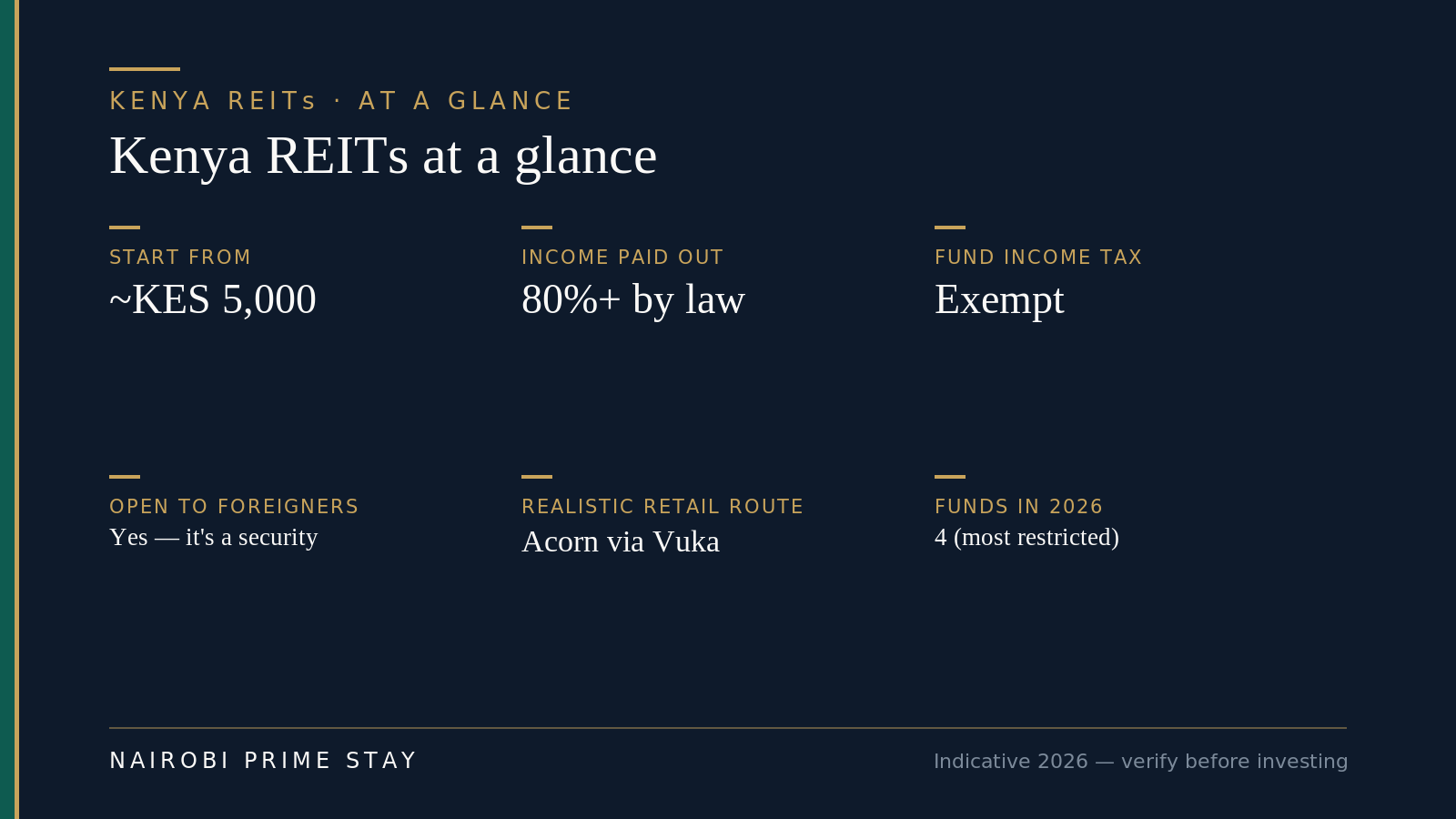 Indicative figures for 2026 — confirm current numbers before investing.
What is a REIT, in plain English?
A REIT is a fund that owns real estate and pays the rent out to its investors. You buy units the way you’d buy shares. The fund’s managers buy and run the buildings — student blocks, malls, offices, warehouses — collect the rent, and pass most of it back to you as regular distributions. You get the income and any growth in the property’s value without owning, managing, or even seeing the buildings.
Think of it as the difference between owning a whole apartment block and owning a small piece of a professionally-run one. You trade control for convenience, and a big lump sum for a small one.
Why REITs matter if you’re eyeing Kenyan property
For most people moving to or investing in Kenya, the appeal is simple: property exposure without the headaches. No tenant calls at midnight. No chasing rent. No 60-day buying process. No service-charge disputes.
Two groups get an outsized benefit. Foreigners, because buying property directly means you’re capped at a 99-year leasehold and barred from agricultural land — but a REIT unit is a financial security, so that cap doesn’t apply. You own the fund, not the land. Diaspora and remote investors, because a REIT removes the single biggest risk of buying from abroad: being scammed by a “trusted agent” you never meet. The fund is regulated, audited, and run by a licensed manager.
If you want the full picture on owning bricks directly, start with our guide to property investing in Kenya. REITs are the lighter-touch cousin of everything in there.
The three types of REIT in Kenya
Kenya’s rules — the Capital Markets REIT Regulations, 2013 — recognize three kinds. Knowing which is which tells you what you’re buying.
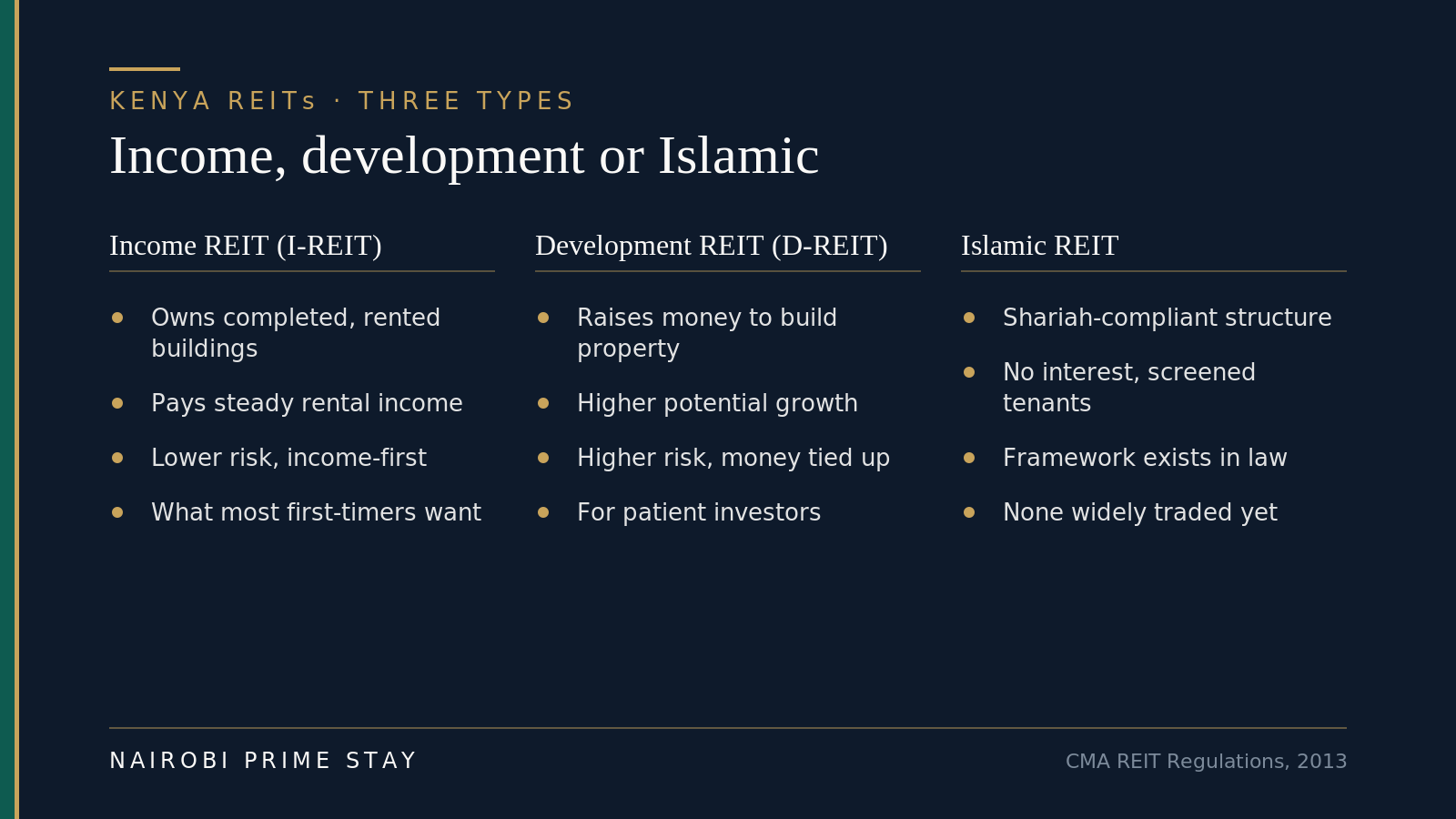 Kenya’s CMA rules recognize three REIT types; most first-timers want an I-REIT.
Income REIT (I-REIT). Owns completed, rent-producing property and pays you a steady stream of that rent. Lower risk, income-focused. This is what most first-time investors want.
Development REIT (D-REIT). Raises money to build or develop property, then sells or holds it. Higher potential growth, higher risk, and your return depends on projects finishing and filling up — much like buying off-plan. Aimed at investors who can tie money up for years.
Islamic REIT. A Shariah-compliant version that avoids interest and non-permissible tenants. None is widely traded yet, but the framework exists.
The Acorn group offers both an I-REIT and a D-REIT, so you can pick your risk level. We’ll get to the specific funds next.
The REITs you can actually buy in Kenya (2026)
Kenya’s REIT market is young and small — a handful of funds, with Acorn’s two REITs alone holding about KES 29 billion in assets in 2026, still a rounding error next to the property market itself. But it’s growing, and there are four names worth knowing. Here’s the honest state of each. Re-check current prices and yields before you act; these move.
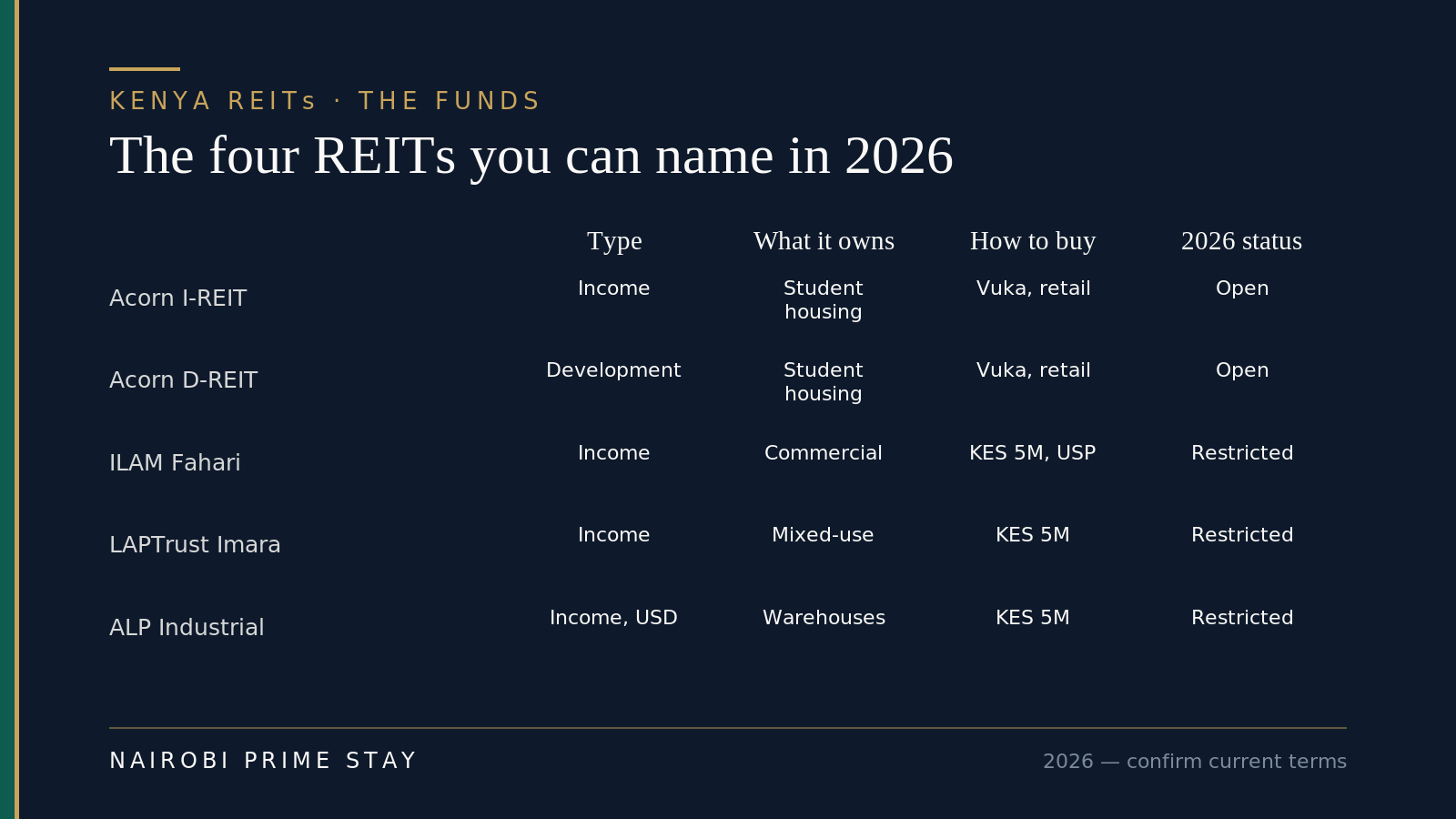 The two Acorn REITs are the only retail-accessible funds; the rest are restricted.
Acorn (ASA D-REIT and I-REIT) — student housing, the easy retail route
Acorn’s two REITs own purpose-built student housing under the Qwetu and Qejani brands across Nairobi. They’re the most accessible to ordinary investors because you can buy them through Vuka, Acorn’s CMA-regulated app, from just a few thousand shillings — no stockbroker required.
The numbers, from the funds’ 2025 results, are solid but unspectacular. Acorn’s two REITs together earned about KES 1.5 billion in net profit for the year (up roughly 9%), and their combined assets grew about 11% to KES 29 billion, across a portfolio nearing 21,000 student beds — now reaching beyond Nairobi into Kenya’s smaller university towns. Mature residences run 91–95% occupied. The I-REIT (income) carried a net asset value of about KES 24 per unit in early 2026, traded near KES 23 on the exchange’s unquoted platform, and paid about KES 0.84 per unit for the year — a 38% bigger payout than 2024, and its ninth straight half-yearly distribution since 2021. The D-REIT (development) sat around KES 27 per unit, up roughly a third on its KES 20 launch. The D-REIT chases growth; the I-REIT pays income. Acorn’s two Vuka products map onto them — Vuka Imara targets roughly 7–12% a year, and Vuka Prime (about 70% income, 30% development) targets 12%+. Those are targets, not promises.
ILAM Fahari I-REIT — the original, and a cautionary tale
Fahari was Kenya’s first REIT, listed back in 2015 at KES 20 a unit and managed by ICEA Lion Asset Management (ILAM). It owns a diversified commercial portfolio of retail and office space — and it’s the clearest cautionary tale in the market.
Here’s the honesty REITs need. Fahari’s units slid for years; by late 2023 they changed hands on the open market for around KES 6, far below the KES 20 launch. In 2024 the fund restructured: unit-holders voted to convert it from an open, unrestricted REIT into a restricted one, delist it from the Nairobi Securities Exchange’s main board (its last day there was February 2024), and move it to the exchange’s quieter Unquoted Securities Platform. Minority investors were bought out at a fixed KES 11 a unit — roughly 45% below the launch price. So if you’d bought at listing and held, you collected dividends along the way but were ultimately cashed out for just over half your money. Fahari now trades only on that restricted platform, where buying in needs about KES 5 million; ILAM aims to double the portfolio and may relist within a few years. The lesson stands: a REIT is not a savings account — the price can fall, and the fund that used to be the easy retail buy is now off-limits to small investors.
LAPTrust Imara I-REIT — pension-backed, restricted
Launched in 2023 by the Local Authorities Pension Trust, Imara owns a portfolio of commercial and residential assets. It trades on a “restricted” segment of the Nairobi Securities Exchange, which means it’s aimed at professional investors, and its price was effectively held at net asset value into early 2026. It’s real and regulated, but it isn’t a casual retail buy.
ALP Industrial REIT — new, industrial, and in dollars
The newest arrival listed on the Nairobi Securities Exchange in March 2026, run by Africa Logistics Properties. It owns modern warehouses and logistics space — the property segment with the strongest yields in Kenya right now — anchored by two parks: ALP North at Tatu City (about 50,000 m², top-grade) and ALP West in the Tilisi corridor (about 20,000 m²). Two firsts make it notable: it’s East Africa’s first industrial-focused REIT, and it’s the first US-dollar-denominated security ever listed on the Nairobi bourse, so it sidesteps the shilling-depreciation worry that nags dollar earners. The restricted offer raised about $29.5 million (roughly KES 3.8 billion) and was 115% subscribed, with the UK government anchoring about $24 million through its development-finance arms. Like Imara, it sits on the restricted segment for professional investors.
Who can buy what: restricted vs unrestricted
This is the fork that catches people out. Kenya splits REIT offers into two.
Unrestricted (open to everyone). Anyone can buy, minimums are small, and the units are meant to be listed and tradable. In 2026 this realistically means the Acorn REITs via Vuka — and not much else.
Restricted (professional investors only). These require a minimum investment of KES 5 million and are limited to “professional investors.” LAPTrust Imara, the ALP Industrial REIT, and — since its 2024 restructuring — ILAM Fahari all sit here. Good products, but not where a first-timer with KES 50,000 starts.
So for most readers, the practical menu is short, and it shrank in 2024 when Fahari went restricted: in 2026 it’s essentially Acorn through Vuka.
How to buy a REIT in Kenya
There are two practical routes, depending on which fund you want.
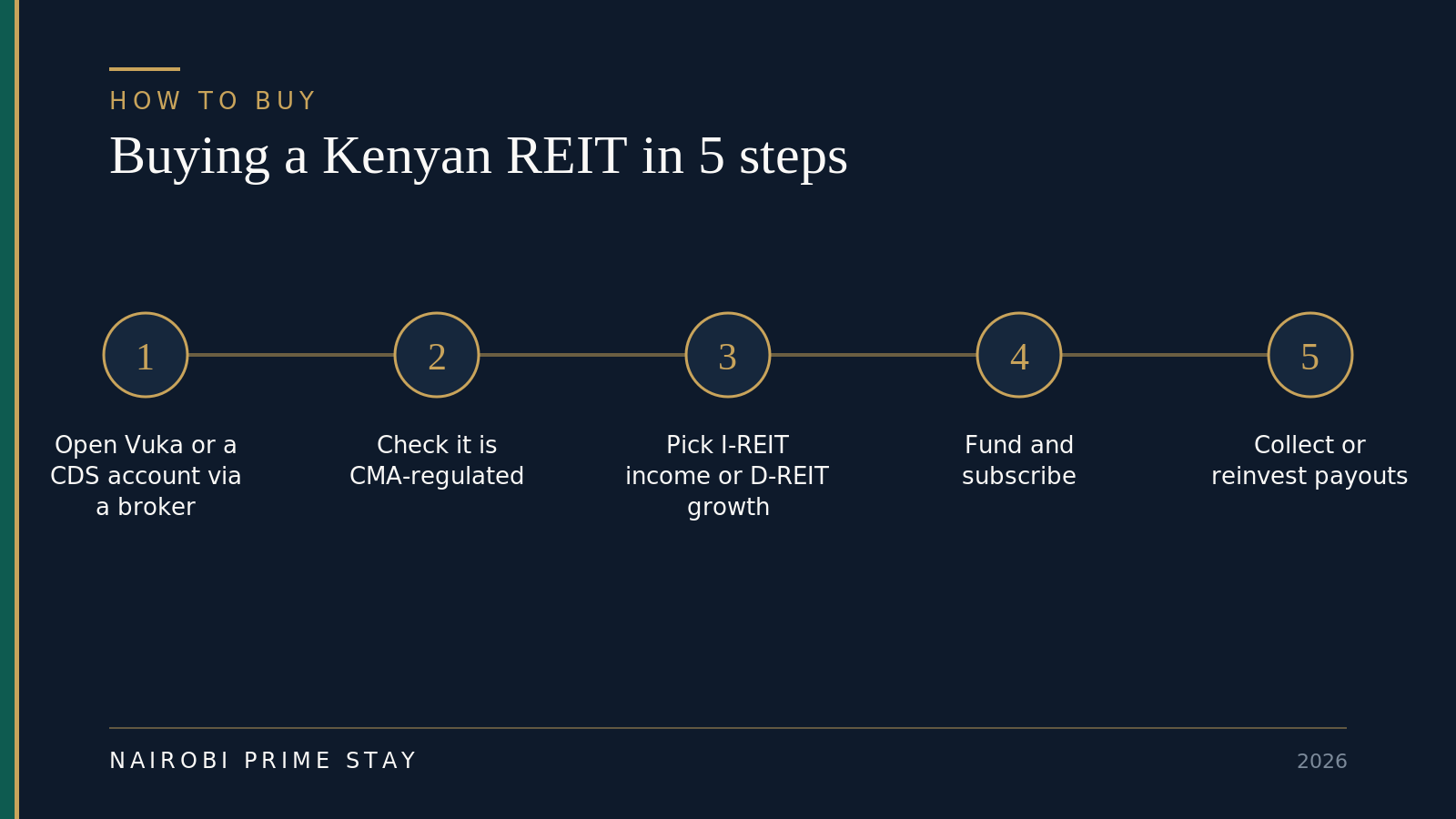 The Vuka route skips the stockbroker; the exchange route uses a CDS account.
The easy route — Vuka, for Acorn. Download the Vuka app, register with your ID or passport and KRA PIN, and you can buy Acorn I-REIT or D-REIT units from a few thousand shillings. It’s built for retail investors and diaspora, and it’s CMA-regulated. This is how most ordinary investors get in.
The exchange route — a stockbroker, for listed and restricted REITs. To buy units on the Nairobi Securities Exchange you open a CDS account through a licensed stockbroker, fund it, and place an order the way you’d buy a stock, using your KRA PIN and identification. The catch in 2026: the exchange-traded REITs — Fahari, Imara and ALP — all sit on restricted segments that need about KES 5 million and professional-investor status, so this route mostly isn’t open to a first-timer. Distributions land in your account; you sell by placing a sell order, though finding a buyer quickly isn’t guaranteed in such a thin market.
Whichever route you take, confirm the platform or broker is licensed by the Capital Markets Authority before you send any money. The CMA publishes its list of licensees.
What you actually earn
REIT returns come in two parts: the income, paid as distributions, and the change in the unit price.
Distributions. By law, a Kenyan REIT must pay out at least 80% of its income to unit-holders, usually once or twice a year. That’s the whole point of an income REIT — it’s an income machine. In FY2025, Fahari’s distribution yield was about 5.9% and Acorn’s I-REIT about 2.5%; underlying rental returns across the funds ran from roughly 4.5% to 9.7%.
Capital value. Your units can rise or fall with the property and the market’s appetite for them. Acorn’s D-REIT has gained on its launch price; Fahari has lost heavily. Don’t assume the price only moves up.
Put plainly: a good Kenyan I-REIT is competitive with a buy-to-let yield once you account for all the costs and hassle a landlord carries. Our buy-to-let in Nairobi guide walks through those net yields — a direct Nairobi rental nets roughly 5% after costs, which is a useful yardstick for judging a REIT.
How REITs are taxed
REITs get a deliberately friendly tax setup, because the point is to channel property income to ordinary investors.
A REIT that’s registered with the Commissioner of Domestic Taxes is exempt from the 30% corporate income tax at the fund level. Instead of the fund being taxed and then you being taxed again, the income flows through and is taxed in your hands. Withholding tax is deducted from the distributions paid to most investors before the money reaches you, so much of the tax is handled at source; some investors, such as registered pension schemes, are exempt. The exact rate sits in the Income Tax Act and changes from time to time, so confirm the current figure with the Kenya Revenue Authority.
The government is actively nudging REITs along, too. Transfers of property into a listed REIT are exempt from stamp duty, and Kenya’s 2026 finance proposals would exempt the capital gain when property is moved into a registered REIT — both designed to coax more buildings into these funds. None of that changes your own position much, but it tells you the structure has official wind behind it.
What you avoid is just as important. Buy a flat directly and you’ll pay around 4% stamp duty, conveyancing fees, and ongoing rental-income tax, land rates and land rent. A REIT unit carries none of that — no stamp duty, no advocate, no annual property-tax filing on your side. For the full direct-ownership tax picture, see our property taxes in Kenya guide. As always with tax, and especially if you’re American and taxed on worldwide income, get cross-border advice — there’s no US–Kenya tax treaty.
REITs vs buying property directly
This is the comparison most people are really asking about. Here’s the honest trade-off.
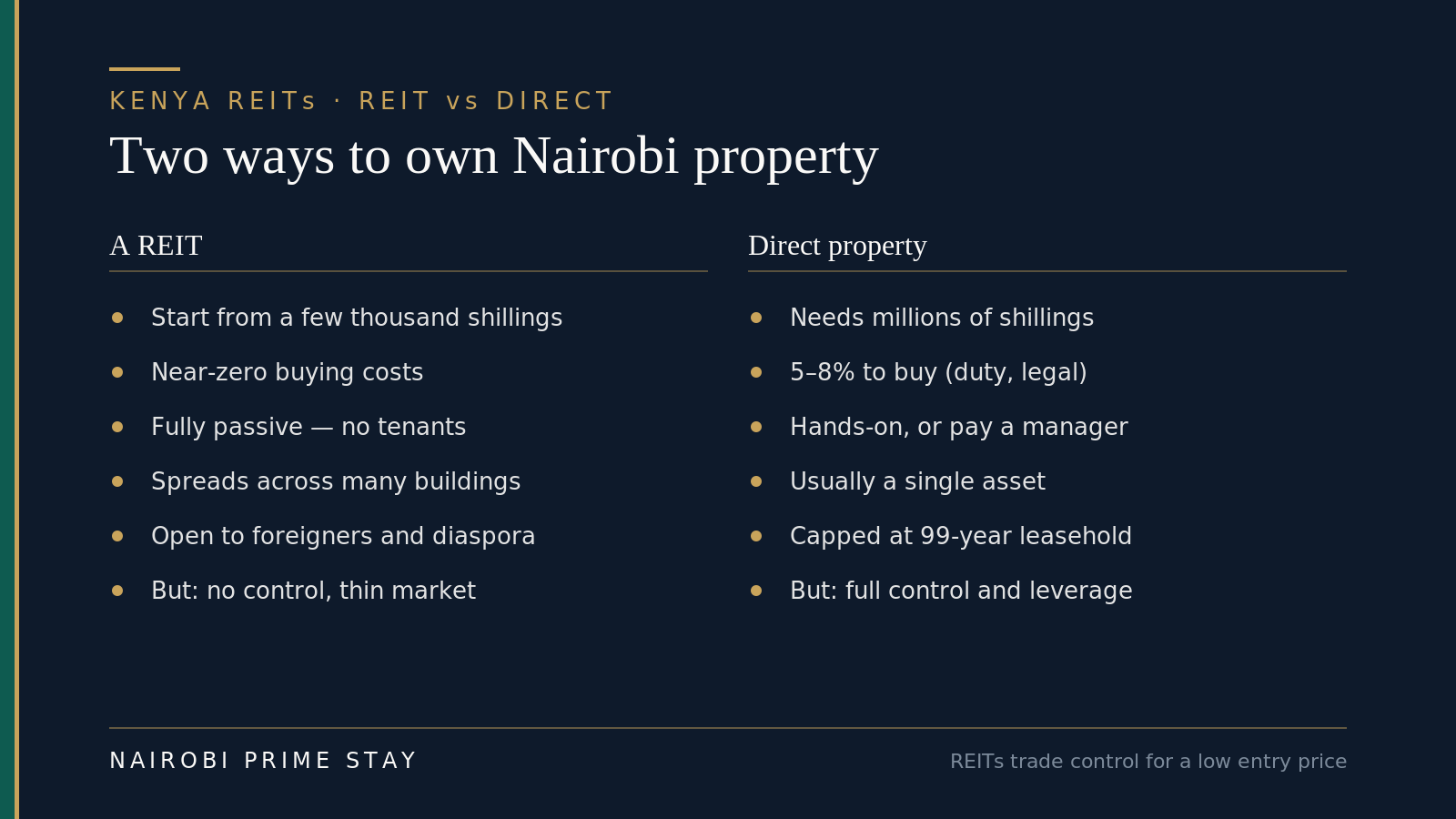 REITs trade control and choice for a low entry price and zero hassle.
| Factor | REIT | Direct property |
|---|---|---|
| Minimum to start | A few thousand KES (via Vuka) | Millions of shillings |
| Buying costs | Near zero | ~5–8% (stamp duty, legal, fees) |
| Effort | Fully passive | Hands-on, or pay a manager |
| Diversification | Many buildings | Usually just one |
| Liquidity | Limited, but possible | Low — selling takes months |
| Foreigner access | Open (it’s a security) | Capped at 99-year leasehold |
| Control | None | Full — you own the asset |
| Income | 80%+ of fund income | Rent, minus all your costs |
Neither wins outright. A REIT is better if you want in cheaply, hate hassle, or invest from abroad. Direct ownership is better if you want control, leverage, and an asset you can improve or live in.
The honest pros and cons
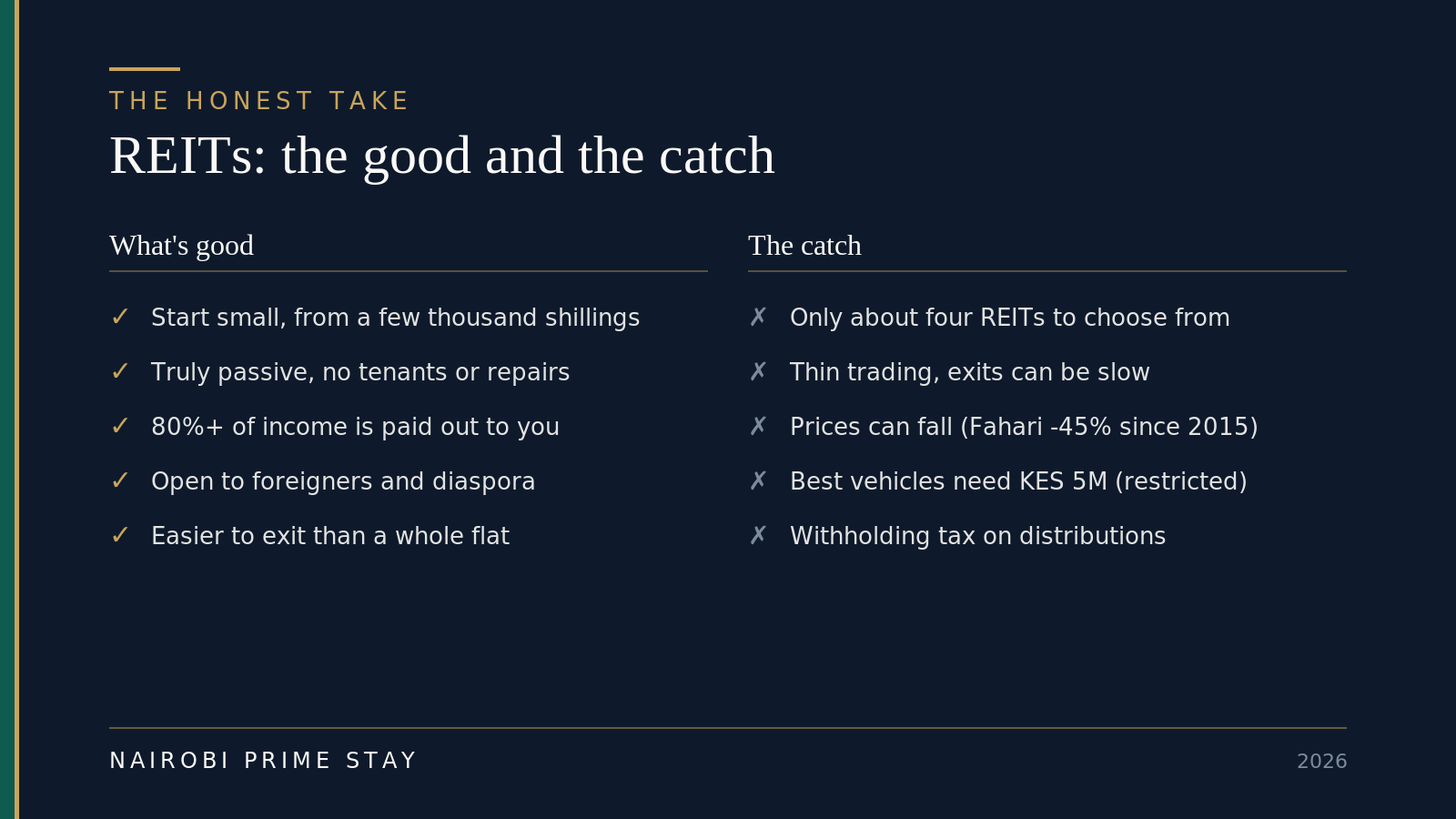 The upside is access and ease; the catch is a thin, young market.
What’s genuinely good. You start small. You do nothing — no tenants, no repairs, no agents. You get a legally-required 80% of income paid out. Foreigners and diaspora can buy freely. And selling a few units is far easier than selling a whole apartment.
The catch, stated plainly. The choice is tiny — about four REITs, versus thousands of buildings. Trading is thin: the listed REITs change hands rarely, so selling quickly at a fair price isn’t guaranteed. Prices can fall, and Fahari’s 45% slide proves it. The two newest, best-structured funds are restricted to professional investors with KES 5 million to commit. And while the tax setup is friendly, withholding tax still applies to your distributions.
None of this makes REITs bad. It makes them a long-term, income-first holding for money you won’t need back in a hurry.
Who REITs suit — and who they don’t
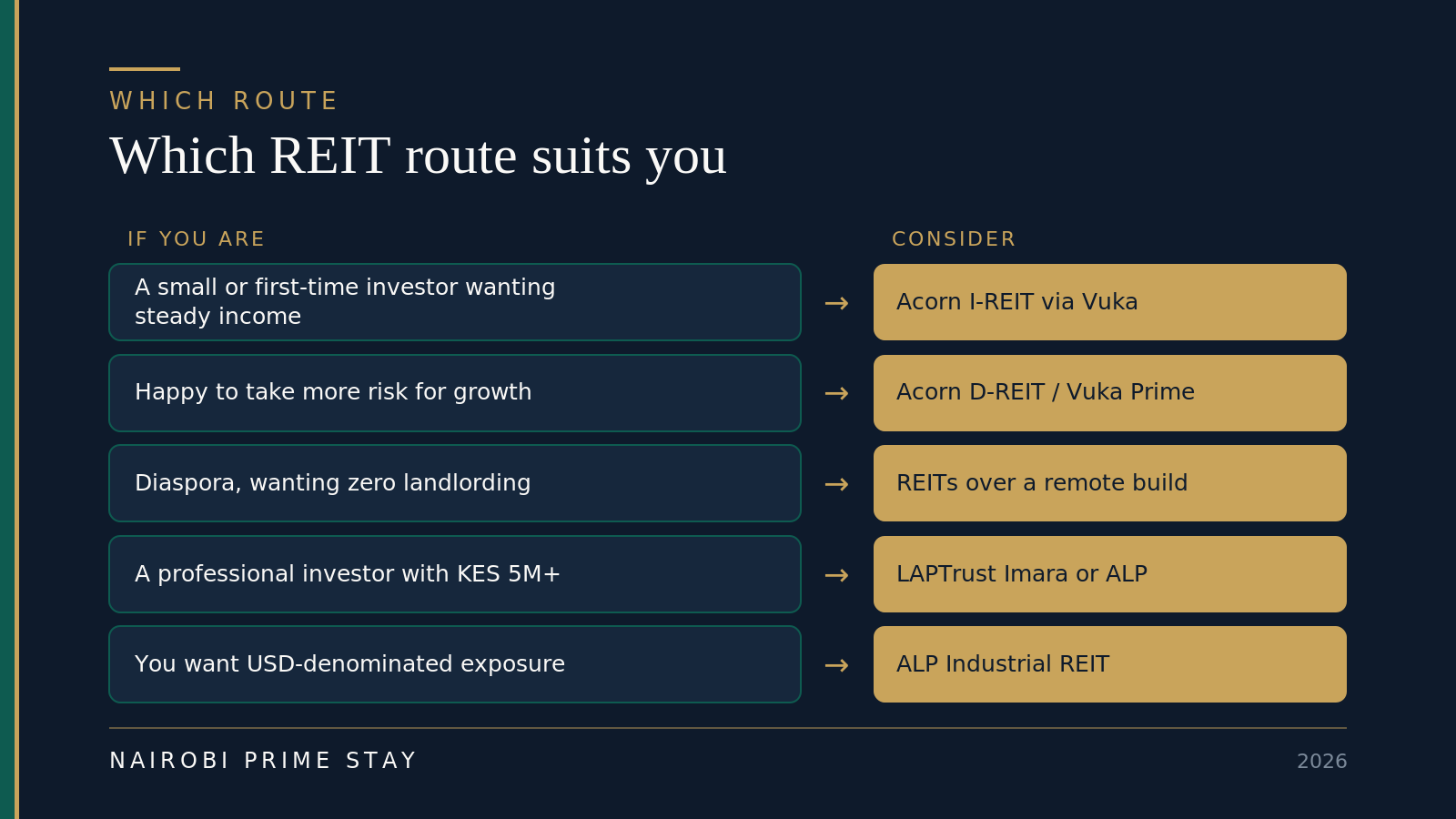 A rough map from your situation to a sensible starting point.
REITs suit you if you want hands-off income, you’re starting with a modest sum, or you’re investing from abroad and want to avoid the scam risk of a remote purchase. They suit a diaspora investor especially well — see our diaspora property investment guide for how this fits a broader plan.
They suit you less if you want control, leverage (you can’t easily mortgage a REIT unit the way you can a building), or a specific home in a specific area.
A quick scenario
Say you’re a remote worker with KES 300,000 to invest and no interest in becoming a landlord from 8,000 miles away. Buying a flat is off the table — it’s not enough money, and managing it remotely is a risk. So you put it into the Acorn I-REIT through Vuka. You collect distributions twice a year, reinvest them, and treat it as a slow-building income holding. If you later move to Nairobi and want a real asset, you’ve learned the market with money that stayed liquid and passive. That’s the role a REIT plays well.
The mistakes that cost REIT investors
Most REIT disappointments trace back to a handful of avoidable errors. None of them are exotic.
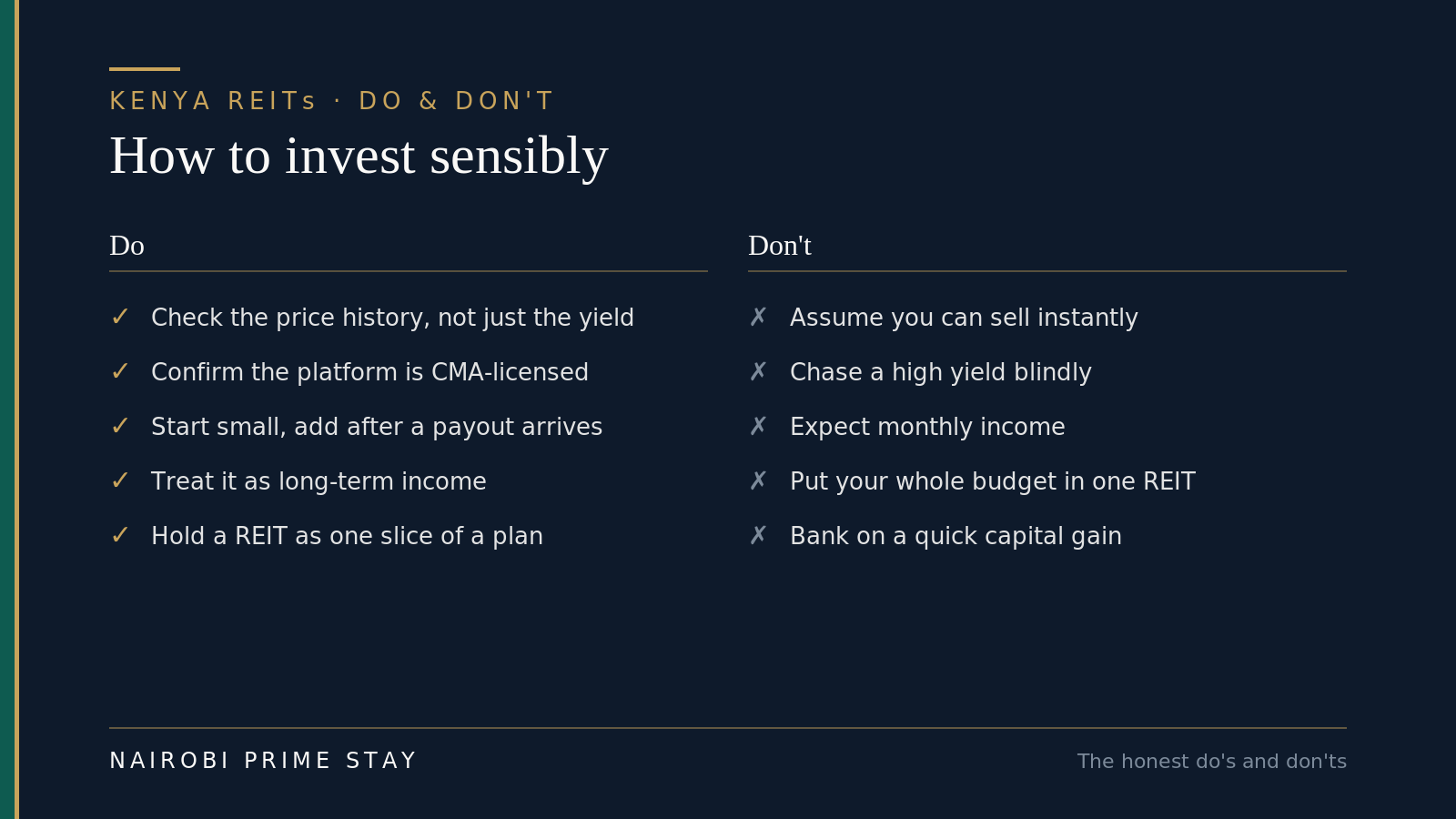 The honest do’s and don’ts of buying a Kenyan REIT.
The biggest one is chasing a headline yield without looking at the price history — Fahari paid dividends the whole way down. Close behind is assuming you can sell on a whim: trading is thin, so your exit may take time or a discount. People also expect monthly income, when Kenyan REITs pay roughly twice a year; they put their whole budget into a single fund; and they treat a long-term income holding like a short-term trade. Avoid those five and a REIT does the quiet job it’s built for.
A checklist before you invest
- Decide your goal first: steady income (I-REIT) or longer-term growth (D-REIT).
- Confirm the platform or broker is licensed by the Capital Markets Authority.
- Check whether the REIT is unrestricted (open to you) or restricted (KES 5M, professional investors only).
- Read the latest financials — distribution yield, net asset value, occupancy, and the trend.
- Look at the price history, not just the yield. Fahari shows that yield alone can mislead.
- Understand how, and how easily, you can sell. Thin trading is real.
- Check the tax: withholding on distributions, plus your home-country position if you’re a US taxpayer.
- Start small, then add once you’ve seen a distribution actually arrive.
- Keep REITs as one slice of a wider plan, not your whole bet.
Where REITs fit in the bigger picture
REITs are one rung on a ladder. At the hands-off end sits a REIT unit bought on an app. At the hands-on end sits a building you own, manage, and improve. In between sit buy-to-let flats, off-plan units, and commercial space. If you’re drawn to the income behind the ALP Industrial REIT, our commercial property in Nairobi guide explains why warehouses and logistics are the strongest segment in 2026 — the same demand that REIT is built to capture. To see how the wider market is priced — and whether bricks beat units for you — our Nairobi property prices guide lays out the latest numbers.
Many investors end up holding both: a REIT for liquid, passive income, and a flat or two for control and leverage. There’s no rule that says you must choose.
Final thoughts
REITs are the easiest, cheapest, most honest way for an ordinary person — foreigner or local — to own a slice of Kenyan real estate. They’re also small, thinly traded, and capable of losing value, so they reward patience and punish anyone expecting a quick win. Buy one for the income, start small, read the financials, and hold for years rather than months. Used that way, a Kenyan REIT is a genuinely useful building block. Used as a get-rich-quick punt, it will disappoint.
Related reading
- Property investing in Kenya: the complete guide — the pillar that frames every route, REITs included.
- Buy-to-let in Nairobi — the direct-ownership yields to judge a REIT against.
- Diaspora property investment in Kenya — investing from abroad, safely.
- Property taxes in Kenya — the tax you avoid by holding a REIT instead of a building.
- Commercial property in Nairobi — the offices and warehouses behind the newest REITs.
- Best areas to invest in Nairobi — if you decide you’d rather own the bricks.
- Property scams in Kenya — the remote-buying risks a regulated REIT sidesteps.
- Nairobi property prices — what the market costs if you’d rather own a building.
- Moving to Nairobi: the complete guide — the hub for everything about relocating.
Thinking about a move, not just an investment?
A REIT is a fine way to own a piece of Nairobi from afar. But if you’re actually planning to come — to scout the market, view buildings, or test a neighborhood before you commit — land softly first. A serviced apartment gives you a fully-equipped base for your first month, with Wi-Fi, security and a backup generator included, so you can get the lay of the land before signing anything. A $50 deposit reserves it, and you settle the balance on arrival. Not sure where to start? Our AI relocation assistant can point you to the right area and apartments in a couple of minutes.
Frequently asked questions
Can foreigners invest in Kenyan REITs?
Yes. A REIT unit is a financial security, not land, so the 99-year leasehold cap that limits foreigners buying property directly doesn’t apply. Foreigners and diaspora investors can buy Kenyan REITs, and the Acorn REITs through the Vuka app are the most accessible route. You’ll need identification and a KRA PIN.
What is the minimum to invest in a REIT in Kenya?
Through Acorn’s Vuka platform you can start from just a few thousand shillings (around KES 5,000), which is what makes REITs the cheapest way into Kenyan property. Restricted REITs aimed at professional investors — ILAM Fahari, LAPTrust Imara and the ALP Industrial REIT — require a minimum of about KES 5 million.
Which REITs are available in Kenya in 2026?
Four: the Acorn I-REIT and D-REIT (student housing, bought via Vuka), the ILAM Fahari I-REIT (diversified commercial, the oldest), the LAPTrust Imara I-REIT (pension-backed), and the ALP Industrial REIT (warehouses, dollar-denominated, listed in March 2026). Only Acorn, via Vuka, is open to ordinary retail investors; Fahari, Imara and ALP are restricted to professional investors with about KES 5 million.
What’s the difference between Acorn’s I-REIT and D-REIT?
The Acorn I-REIT (income) owns completed, rented student housing and pays steady half-yearly distributions — lower risk, income-first. The D-REIT (development) funds new projects for higher potential growth and more risk, with money tied up for longer. Income-seekers lean I-REIT; growth-seekers who can wait lean D-REIT. Vuka Prime blends the two.
How much do Kenyan REITs pay?
A Kenyan REIT must distribute at least 80% of its income to investors. In its 2025 financial year Acorn’s I-REIT paid about KES 0.84 per unit — roughly 3 to 4% on its unit price — and lifted its payout 38% on the year, while underlying rental returns across the funds run from about 4.5% to 9.7%. Yields change yearly, so check the latest figures before investing.
Are REITs a safe investment in Kenya?
They’re regulated by the Capital Markets Authority and audited, which lowers fraud risk. But they’re not risk-free: prices can fall — Kenya’s first REIT, ILAM Fahari, lost about 45% of its value and has since moved to a restricted platform — and trading is thin, so selling quickly at a fair price isn’t guaranteed. Treat a REIT as a long-term income holding.
Is the Vuka app safe and legitimate?
Vuka is operated by Acorn Investment Management and licensed by the Capital Markets Authority, and the units you buy are in CMA-regulated REITs — so it isn’t a scam. That regulation lowers fraud risk, but it doesn’t remove investment risk: unit prices and distributions can still fall, so only invest money you can leave in place for years.
Can I sell my Kenyan REIT units whenever I want?
Not always quickly. Acorn’s Vuka lets you redeem units at a net asset value that updates about twice a year, which helps. Exchange-traded units need a willing buyer, and REIT trading in Kenya is thin, so a fast sale at a fair price isn’t guaranteed. Treat REITs as multi-year holdings, not money you’ll need back next month.
How are REITs taxed in Kenya?
A registered REIT is exempt from the 30% corporate income tax at the fund level; income is instead taxed in investors’ hands, and withholding tax is deducted from distributions before you receive them. You avoid the stamp duty, conveyancing and rental-income tax that come with buying property directly. US taxpayers are taxed on worldwide income and there’s no US–Kenya tax treaty, so get cross-border advice.
REIT or buy-to-let: which is better?
It depends on what you want. A REIT is better for a small budget, total passivity, or investing from abroad. A buy-to-let flat is better for control, leverage and a tangible asset, and a well-run Nairobi rental nets roughly 5% after costs. Many investors hold both.
How do I buy a Kenyan REIT?
For the Acorn REITs, download the CMA-regulated Vuka app, register with your ID or passport and KRA PIN, and buy units from a few thousand shillings. The restricted REITs — Fahari, Imara and ALP — need about KES 5 million and are bought through a licensed stockbroker or the issuer. Always confirm the platform or broker is CMA-licensed first.
Ready to look?
Find your apartment in Nairobi
Browse verified serviced apartments, or ask the AI concierge which area fits your life.