
Guides · Property investment
Property Taxes in Kenya: Every Tax to Buy and Own (2026)
Property Taxes in Kenya: Every Tax to Buy and Own (2026)

Buying and owning property in Kenya comes with a short list of taxes. None of them is huge by US standards, but you need to know which is which, who you pay, and when — because a couple of them have to be cleared before a sale can even register. Miss one and your deal stalls.
This guide walks through every tax you’ll meet across the life of a property: what you pay to buy, what you pay each year you hold it, what you pay if you rent it out, and what you pay when you sell. It’s written for Americans and other foreigners buying in Nairobi, with the rates as they stand in 2026 and the official portals to confirm them against. There’s a separate section on the part that trips Americans up most — the US side, where Washington taxes you no matter where you live.
One honest note up front: this is general information, not tax advice. Tax rates change with every Finance Act, and the cross-border picture for a US citizen is genuinely complicated. Treat this as the map, then get a Kenyan tax adviser and a US cross-border accountant before you act.
TL;DR: Buying property in Kenya, you pay stamp duty — 4% of the value in towns (including all of Nairobi), 2% rural — on the higher of price or the government valuation. While you own it, you pay annual land rates to the county and, on leasehold, land rent to the national government. Rent it out and a resident landlord pays residential rental income tax at 7.5% of gross rent (on income of KES 288,000–15,000,000 a year), filed monthly. Sell at a profit and you pay capital gains tax at 15% of the net gain. VAT (16%) hits commercial property, not homes. As a US citizen you also report it all to the IRS — and there’s no US–Kenya tax treaty, so plan for that.

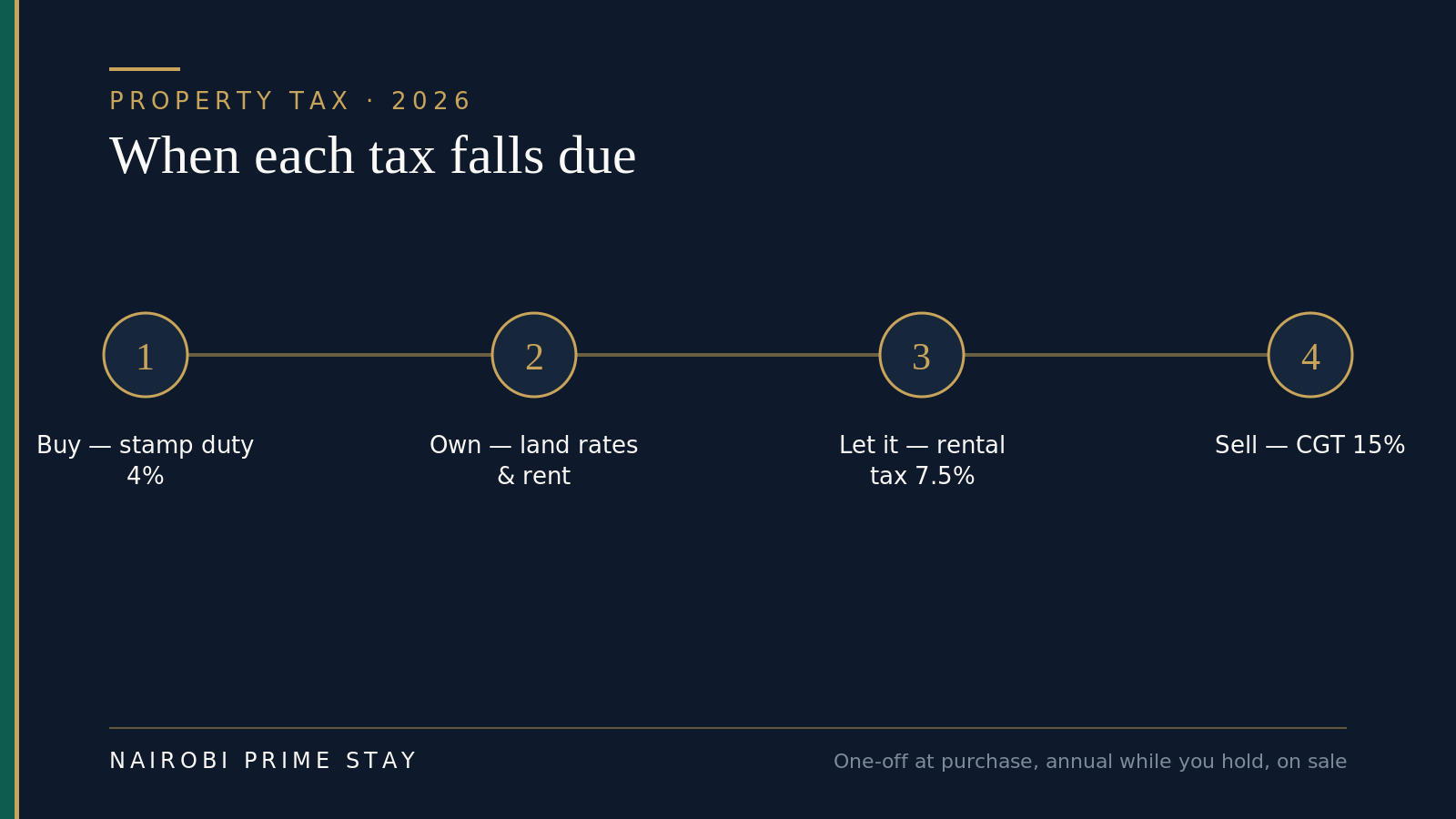 The four moments tax falls due — one-off at purchase, annual while you hold, and again on sale.
Why getting this right matters
Two of these taxes are completion conditions, not afterthoughts. Stamp duty has to be paid before your transfer can be registered, and a seller’s capital gains tax and rates and rent clearances all have to be settled before a title moves into your name. So tax isn’t the boring bit at the end — it sits in the critical path of every deal. Budget for it, and you sail through. Ignore it, and the registry simply won’t complete your purchase.
There’s an honesty angle too. Kenya values property for duty using its own government valuer, so the old trick of writing a low price on the agreement to save on duty doesn’t work — the KRA assesses duty on the higher of the price or its valuation, and an understated figure can also raise a red flag and inflate your capital gains tax later. Declaring the real number is both the legal path and, usually, the cheaper one over the life of the asset.
Every property tax at a glance
Here’s the full set in one table. The rest of the guide takes each one in turn.
| Tax | Rate (2026) | Who pays | When | Paid to |
|---|---|---|---|---|
| Stamp duty | 4% urban / 2% rural of value | Buyer | At purchase (before registration) | KRA (via iTax) |
| Land rates | County percentage of site value | Owner | Annually | County government |
| Land rent | Fixed in the lease (leasehold only) | Leaseholder | Annually | National government |
| Residential rental income tax (MRI) | 7.5% of gross rent | Resident landlord | Monthly, by the 20th | KRA (via iTax) |
| Capital gains tax (CGT) | 15% of net gain | Seller | On sale (before registration) | KRA (via iTax) |
| VAT | 16% | Buyer/tenant of commercial property | On the transaction | KRA (via the seller) |
| Service charge | Not a tax | Owner | Monthly/quarterly | Management company |
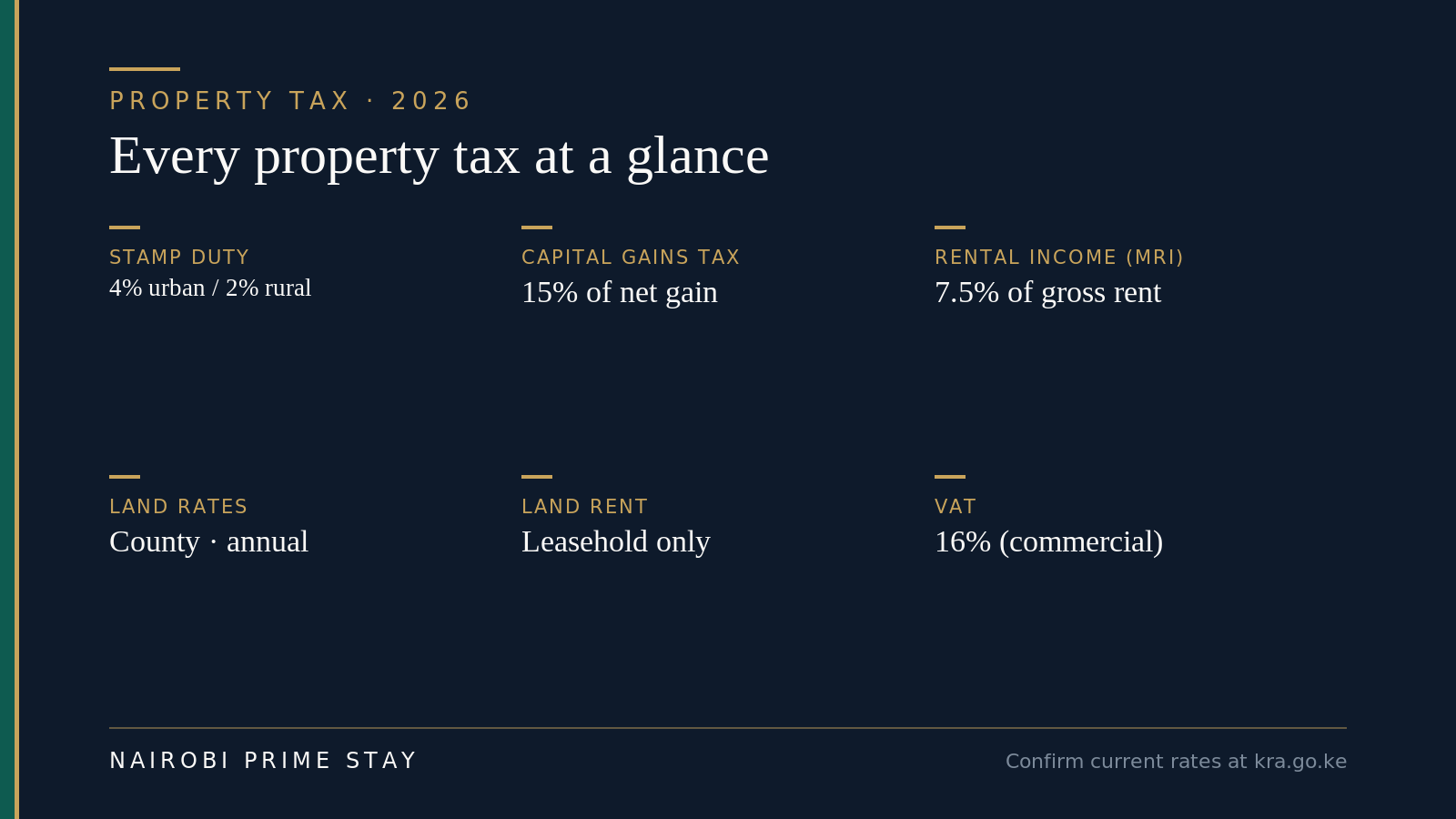 The headline rates. Always confirm the current figures on the KRA portal before you file.
One quick definition before we start, because people mix these up: land rates and land rent are different taxes paid to different governments, and service charge isn’t a tax at all — it’s what you pay your building’s management company for shared upkeep (security, water, gardens, the generator). We untangle all three below.
What you pay when you buy: stamp duty
Stamp duty is the big one-off tax at purchase, and the buyer pays it. As of 2026 it’s 4% of the property’s value in cities, municipalities and gazetted towns — which covers all of Nairobi — and 2% in rural areas. It’s charged on the higher of the purchase price or the government valuation, so there’s no advantage to understating the price on paper.
A few things worth knowing:
- It’s assessed on a government valuation. After you sign the sale agreement, a government valuer inspects the property and sets its value for duty. The KRA charges duty on whichever is higher — that figure or your agreed price. On a clean, market-priced apartment the two are usually close.
- In 2026, you pay it online. In Nairobi the duty is now assessed and paid through the national land platform, ardhisasa, using its Ardhipay module — by M-Pesa, bank transfer or card — and the e-stamp links to your file automatically. Physical stamping at the registry has been phased out since 16 February 2026. The transfer still can’t register until the duty is paid. Your advocate handles the mechanics; you provide the money and your KRA PIN. There’s a step-by-step of the new flow just below.
- Commercial property can be quoted at a higher rate by some advisers, so if you’re buying offices or retail space rather than a home, confirm the rate for your specific property with the KRA and your advocate before you budget.
- Leases attract their own stamp duty: roughly 1% of the annual rent for a lease of three years or less, and 2% for longer leases. This matters if you’re signing a long commercial lease rather than buying.
On top of duty you’ll meet a handful of smaller transaction costs — legal fees on the Advocates’ Remuneration Order scale (around 1.5% on the first KES 2.5 million, plus 16% VAT), a valuation fee, and small search and registration charges. Add it all up and the taxes and fees of buying usually come to about 6–8% of the price. Our step-by-step how to buy property in Kenya guide breaks the full closing-cost stack down, and the conveyancing guide explains what your advocate does for their fee.
How stamp duty actually gets paid now (2026)
Stamp duty in Nairobi went fully digital in early 2026, so the old picture of queuing at a registry is out of date. The whole flow — valuation, assessment and payment — now runs through ardhisasa, the national land platform, with the duty paid online through its Ardhipay module. Transacting through ardhisasa is mandatory in Nairobi (and Kiambu, Kajiado and Mombasa), and a title produced outside the system isn’t valid.
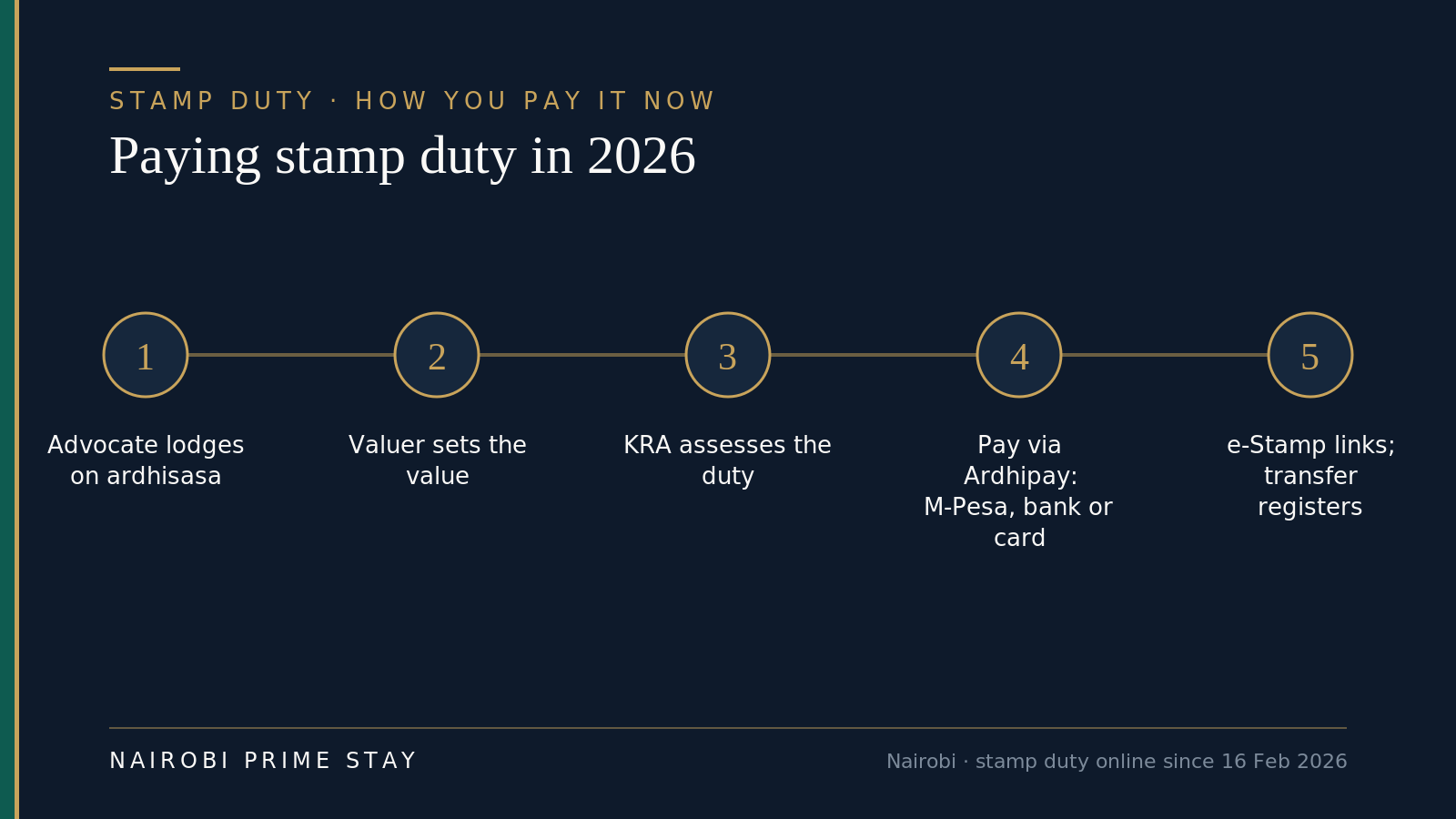 The 2026 flow. Your advocate drives it; you supply the funds and your KRA PIN.
In practice, your advocate lodges the transfer on ardhisasa, a government valuer sets the value, the KRA assesses the duty on the higher of price or valuation, and you settle it via Ardhipay — by M-Pesa, bank transfer (RTGS/EFT) or Visa/Mastercard. The e-stamp attaches to your file automatically, and only then can the transfer register and the new title deed issue in your name. You no longer file physical documents for stamping; since 16 February 2026 the registry doesn’t accept the old paper route. Our how to buy property in Kenya guide shows where this sits in the wider purchase.
What you pay every year you own: land rates and land rent
Once the property is yours, two annual charges can apply — and they’re constantly confused because the names are so similar. They’re separate taxes, paid to separate governments, for separate reasons.
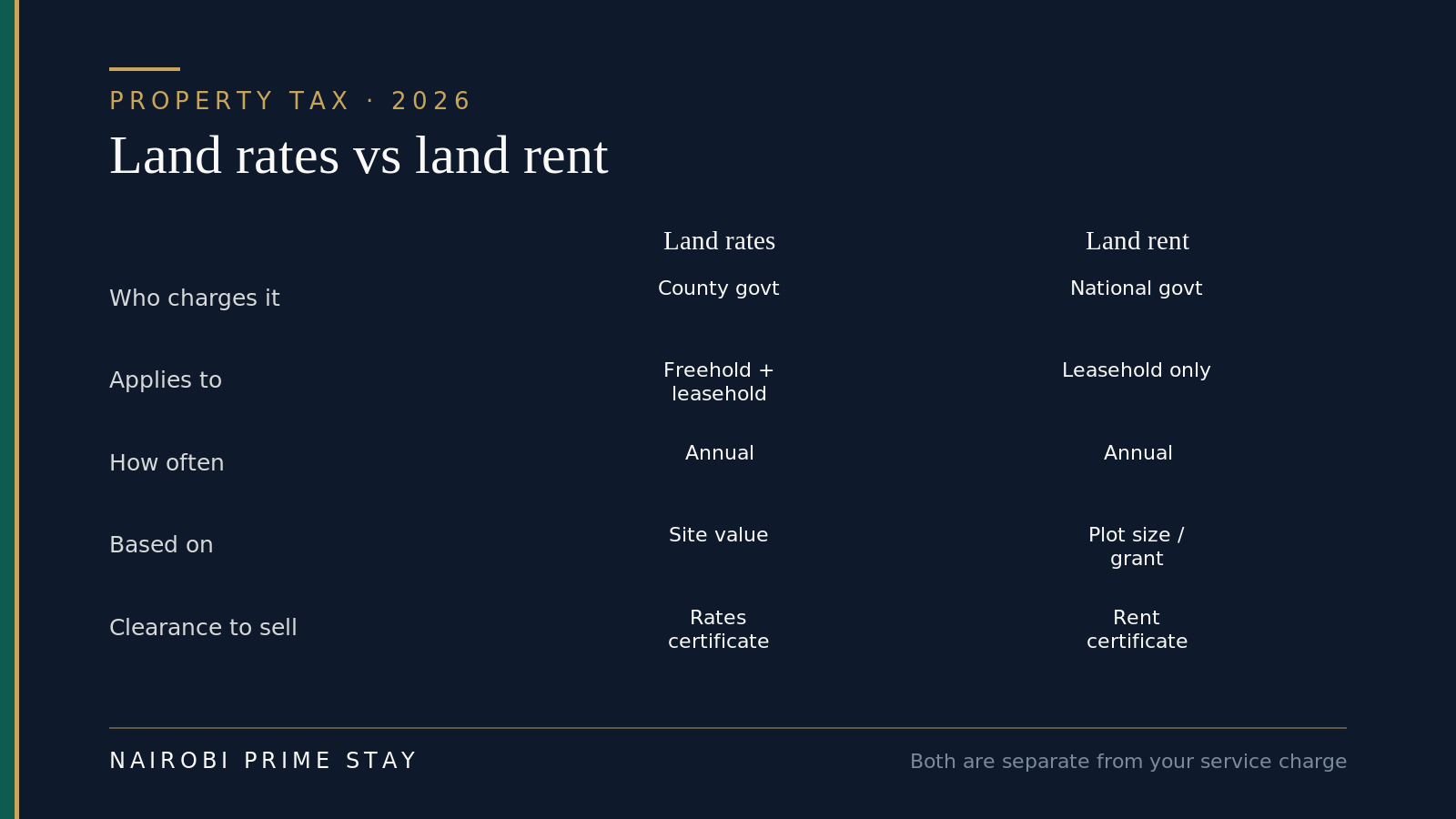 Land rates vs land rent — different taxes, different governments. Both are separate from your service charge.
Land rates (county)
Land rates are an annual tax paid to the county government — Nairobi City County, if you’re in the capital — on land in rated areas, which is to say towns and cities. The county bases the charge on the unimproved site value of your land in its valuation roll, and applies a percentage set by the county. The exact rate and your balance vary by county and zone, so confirm them directly with the county (Nairobi runs this through its revenue system) rather than relying on a rule of thumb. Nairobi has been updating its valuation roll, which can change bills, so check rather than assume.
Land rates matter at sale as well as during ownership: you need a Rates Clearance Certificate from the county to transfer the property, and unpaid rates accrue penalties and block the sale until cleared. If you buy, make sure the seller’s rates are paid up to date as a completion condition.
Land rent (national, leasehold only)
Land rent is an annual charge paid to the national government (through the Ministry of Lands) by holders of leasehold land only. It’s effectively the rent you pay the government as the ultimate landlord of leasehold land. If you own freehold, you pay no land rent at all. The amount is fixed in your lease or grant — often modest — and is revised when the lease is renewed.
Because most foreigners can only hold property on leasehold (a 99-year cap under the Constitution — see can foreigners buy property in Kenya), land rent is a line most foreign buyers will pay. As with rates, you need a Land Rent Clearance Certificate to transfer leasehold property, so keep it current.
Don’t confuse either with service charge
Neither of these is your service charge. Service charge is a private payment to your building or estate’s management company for shared services — security, water, the backup generator, gardens, lifts, common-area cleaning. It isn’t a tax, isn’t paid to any government, and varies hugely by building. When you weigh a building, ask for the service charge in writing; it’s a real monthly cost that the headline rent or price won’t show.
What you pay if you rent it out: residential rental income tax
If you let your property to a tenant, the rent is taxable income. For residential property held by a resident landlord, Kenya runs a simplified regime called Monthly Rental Income (MRI) tax: 7.5% of the gross rent you receive, as a final tax, with no deductions for expenses.
Here’s how it works in practice:
- It applies to annual residential rent between KES 288,000 and KES 15,000,000. Below KES 288,000 a year you fall outside MRI and declare the rent under the normal individual income tax bands (where you can deduct expenses). Above KES 15,000,000 a year you’re taxed under the regular regime instead.
- It’s 7.5% of gross rent — the full rent, before costs. You can’t deduct repairs, the caretaker’s pay, your service charge, agent fees or mortgage interest. The trade for that simplicity is a low flat rate.
- You file and pay it monthly, by the 20th of the following month, on iTax. If the unit sat empty that month, you file a nil return.
- The rate has been 7.5% since 1 January 2024, down from 10%. Watch this one: a Finance Bill 2026 proposal would push residential MRI back up to 10%. It isn’t law as of mid-2026, but confirm the current rate on the KRA portal before you file, because this is exactly the kind of figure that moves.
A crucial wrinkle for Americans: the 7.5% MRI regime is for tax residents of Kenya. If you own a Nairobi apartment but live in the US — so you’re a non-resident landlord — your Kenyan rental income is taxed under different rules, and the tenant or agent may be required to withhold tax and remit it to the KRA on your behalf. Don’t assume you get the 7.5% rate; get advice on which regime applies to you. If renting out is your plan, our buy-to-let in Nairobi guide goes deeper on the numbers and the management side.
Renting from the US: the non-resident landlord’s 30% tax
This is the part most American owners get wrong, so read it slowly. The 7.5% rate above is for tax residents of Kenya. If you live in the US and rent out a Nairobi apartment, you’re a non-resident landlord, and your Kenyan rent is taxed at 30%.
Here’s how it works. For rent paid to a non-resident, Kenyan law makes the tenant or letting agent withhold 30% of the gross rent and remit it to the KRA by the 20th of the following month, then hand you a withholding certificate. It’s a final tax — once it’s withheld, that income is settled in Kenya, with no annual filing and no deductions for expenses. So the headline is simple and a little painful: a resident pays 7.5% of gross, a non-resident pays 30% of gross.
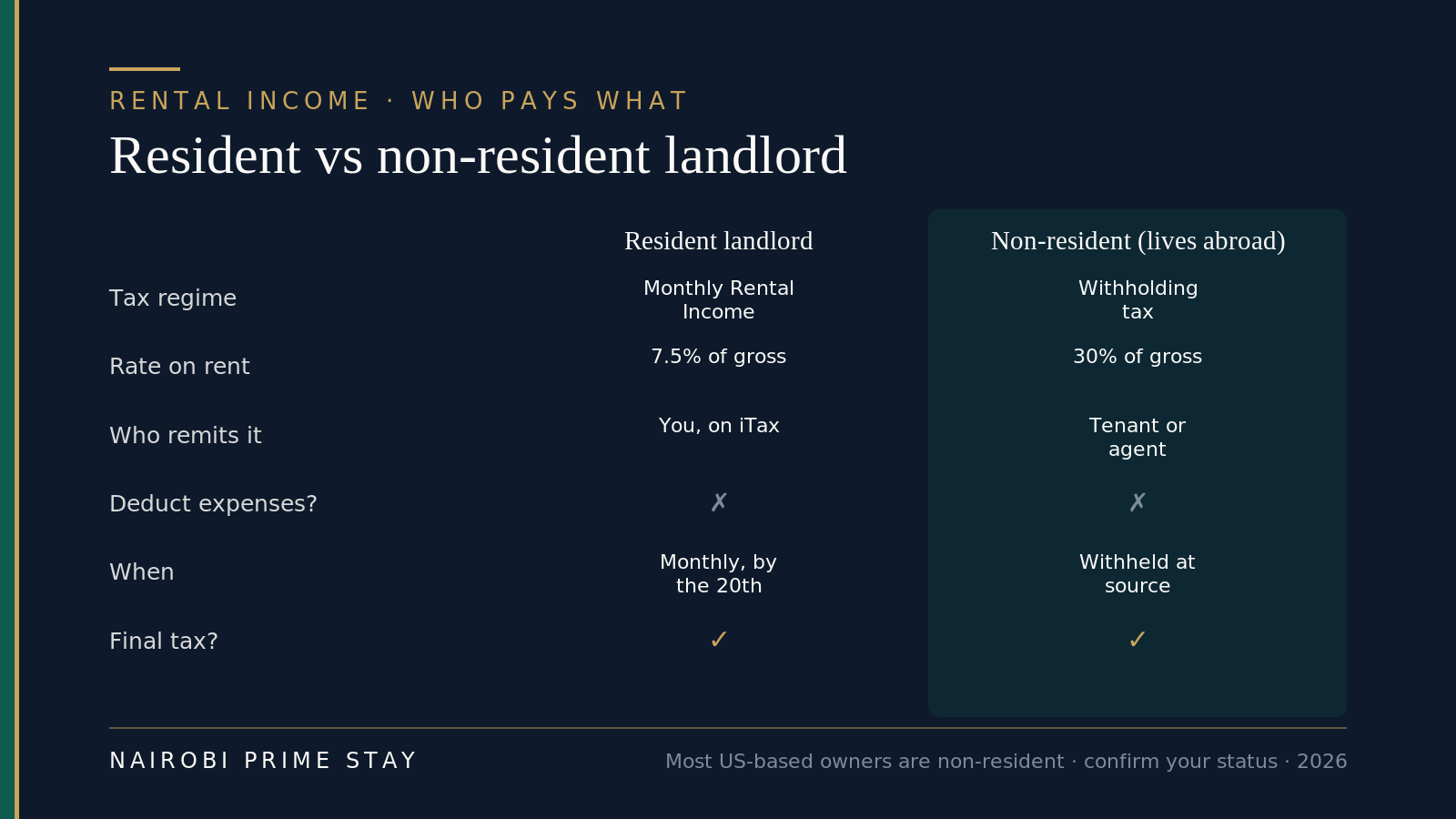 Live in the US and let a Nairobi flat, and you’re almost certainly in the right-hand column.
A few practical points:
- It’s withheld, not billed. A compliant agent deducts the 30% before passing you the rent, so the tax never reaches your account. Budget your returns on the after-tax figure.
- You still need a KRA PIN. The withholding is reported against your PIN, and you’ll want the certificates as proof of Kenyan tax paid when you file in the US.
- Use a managing agent. A good property manager in Nairobi handles the withholding and remittance correctly, which matters when you’re 8,000 miles away. Collecting gross rent into a personal account and ignoring the withholding is a common, costly diaspora mistake.
- It changes the math. 30% of gross is a heavier drag than the resident 7.5%, so factor it into any buy-to-let or diaspora investment sums before you buy. It also makes the US Foreign Tax Credit more valuable, since you’ve paid real Kenyan tax to offset.
When exactly you count as resident or non-resident is a technical test — it turns on days spent in Kenya and where your home and ties are — and it’s worth confirming with a tax adviser rather than guessing. If you split your time, don’t assume the 7.5% rate applies. For how the rest of your personal taxes work as an expat, see our taxes for expats in Kenya guide.
What you pay when you sell: capital gains tax
When you sell at a profit, you pay capital gains tax (CGT) at 15% of the net gain. The rate rose from 5% to 15% on 1 January 2023, and 15% is where it sits in 2026. The seller pays it, on iTax, and — like stamp duty — it has to be settled before the transfer registers, so it’s a completion item, not a bill that arrives later.
The word that matters is net. You’re taxed on the gain, not the sale price:
Net gain = transfer value − (what you paid for it + allowable costs).
Allowable costs include the original purchase price, your legal and valuation fees, stamp duty you paid on the way in, the cost of genuine improvements, and agent’s commission on the sale. Keep every receipt from the day you buy — each one lowers your taxable gain years later. If you sell at a loss, no CGT is due.
Several disposals are exempt, which is useful to know:
- Your main home, if you occupied it for at least three years before the sale.
- Transfers on inheritance, and certain transfers between spouses or to immediate family.
- Land sold by an individual where the transfer value is KES 3,000,000 or less.
- Agricultural land of less than 50 acres situated outside a municipality or gazetted township.
For an investor letting and later selling, CGT is the tax to plan around. It’s modest at 15%, but on a property that’s appreciated well it’s a real number — and the records you keep determine how big it is.
VAT, and when it actually applies
For most people buying a home, VAT doesn’t bite. The sale of land and of residential premises is exempt from VAT, and so is residential rent. You won’t add 16% to the price of an apartment you’re buying to live in or to let to a family.
Where VAT (16%) does apply is commercial property — the sale of commercial buildings and the lease or rent of commercial space such as offices, shops and warehouses. If you’re buying or leasing commercial premises, budget for VAT and talk to your adviser about whether you can register and recover it. For the residential investor this guide is mainly written for, VAT is a footnote; for a commercial one, it’s a headline.
The KRA PIN, and how filing works
Almost nothing happens without a KRA PIN — Kenya’s tax identification number. You need one to buy, to sell, to register a transfer, to pay stamp duty, and to set up utilities. It’s free to get on iTax at itax.kra.go.ke, and as a foreigner you can register once you hold the relevant immigration status; your advocate can guide you. Getting your PIN early is one of the first practical steps of any purchase — the same KRA PIN you’ll set up soon after sorting your Kenyan visa or permit.
The filing calendar, once you own, is straightforward:
- At purchase: stamp duty, via iTax/eCitizen, before registration.
- Each month you let residential property: MRI by the 20th of the following month (nil return if empty).
- Once a year: your annual income tax return, due by 30 June for the previous year.
- On sale: capital gains tax, before the transfer registers.
One thing that is not a property tax, despite the name: the Affordable Housing Levy (1.5% of gross salary, matched by employers). That’s a payroll levy on employment income, deducted from salaries — it has nothing to do with owning a house. Don’t budget for it as a property cost.
What late filing actually costs
File on time and this section is free. Miss a deadline and the KRA’s penalties are steep enough to dwarf the tax itself, especially on rental income. As of 2026, filing your Monthly Rental Income return late attracts a penalty of 5% of the tax due, with a minimum of KES 10,000 for an individual. Pay late and you add another 5% of the tax, plus interest of 1% a month until it’s cleared.
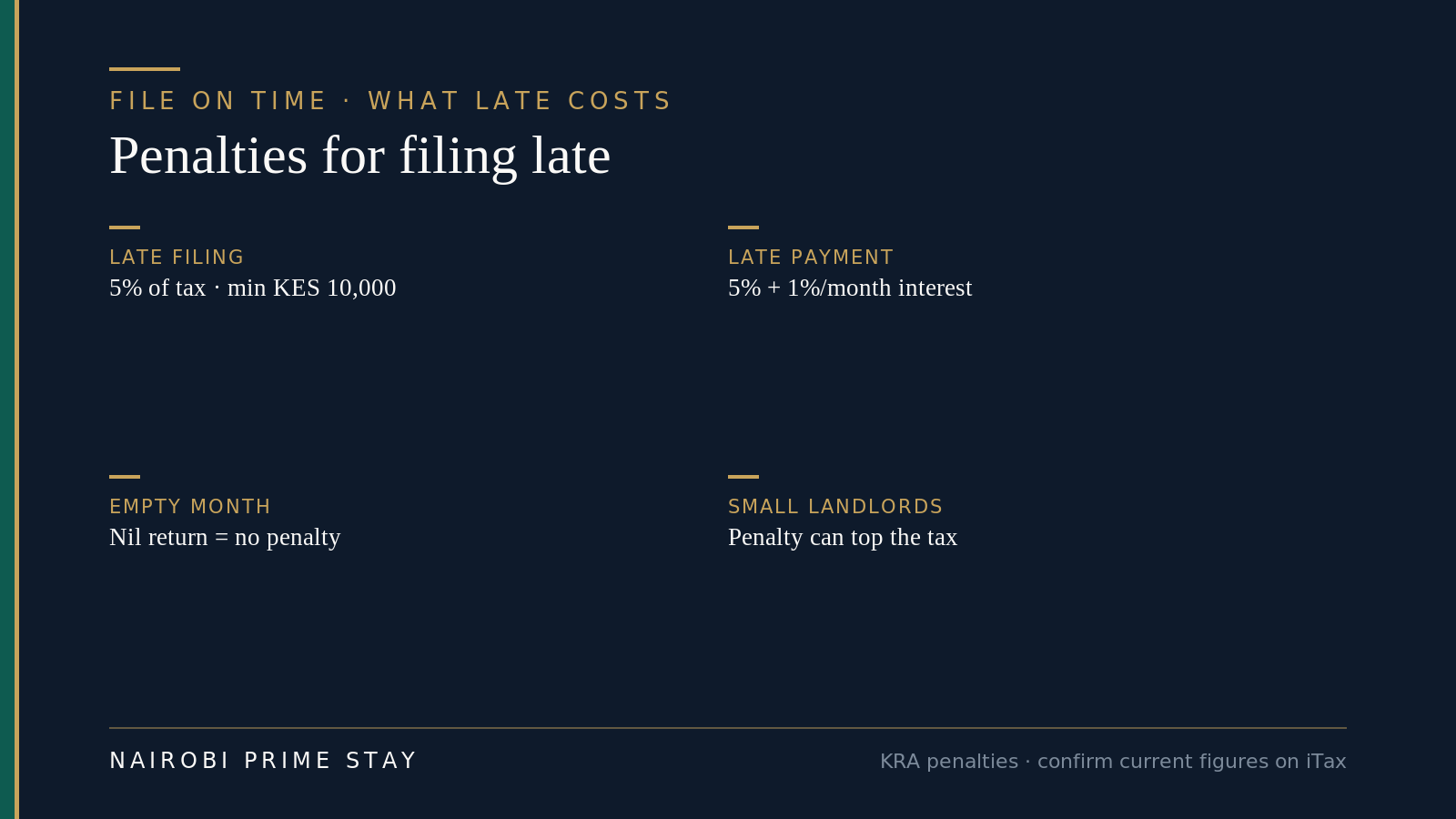 Why filing — even a nil return — beats forgetting.
Two things follow from those numbers. First, the minimum KES 10,000 filing penalty can be larger than the tax on a modest rent, so a small landlord who “wasn’t earning much that month” can still be stung. Second, an empty month isn’t a free pass — you still file, just a nil return, which costs nothing and keeps the penalty clock from starting. The habit that keeps you safe is boring and cheap: file every month on iTax, on time, even when there’s nothing to pay. Confirm the current penalty figures on the KRA portal, as they’re set by tax law and can change.
If you’re a US citizen: the double-tax problem
This is the section to read twice. The United States taxes its citizens and green-card holders on worldwide income, wherever they live. Your Kenyan rental income and any capital gain on a Kenyan property are reportable on your US return as well as in Kenya. Moving abroad doesn’t switch off the IRS.
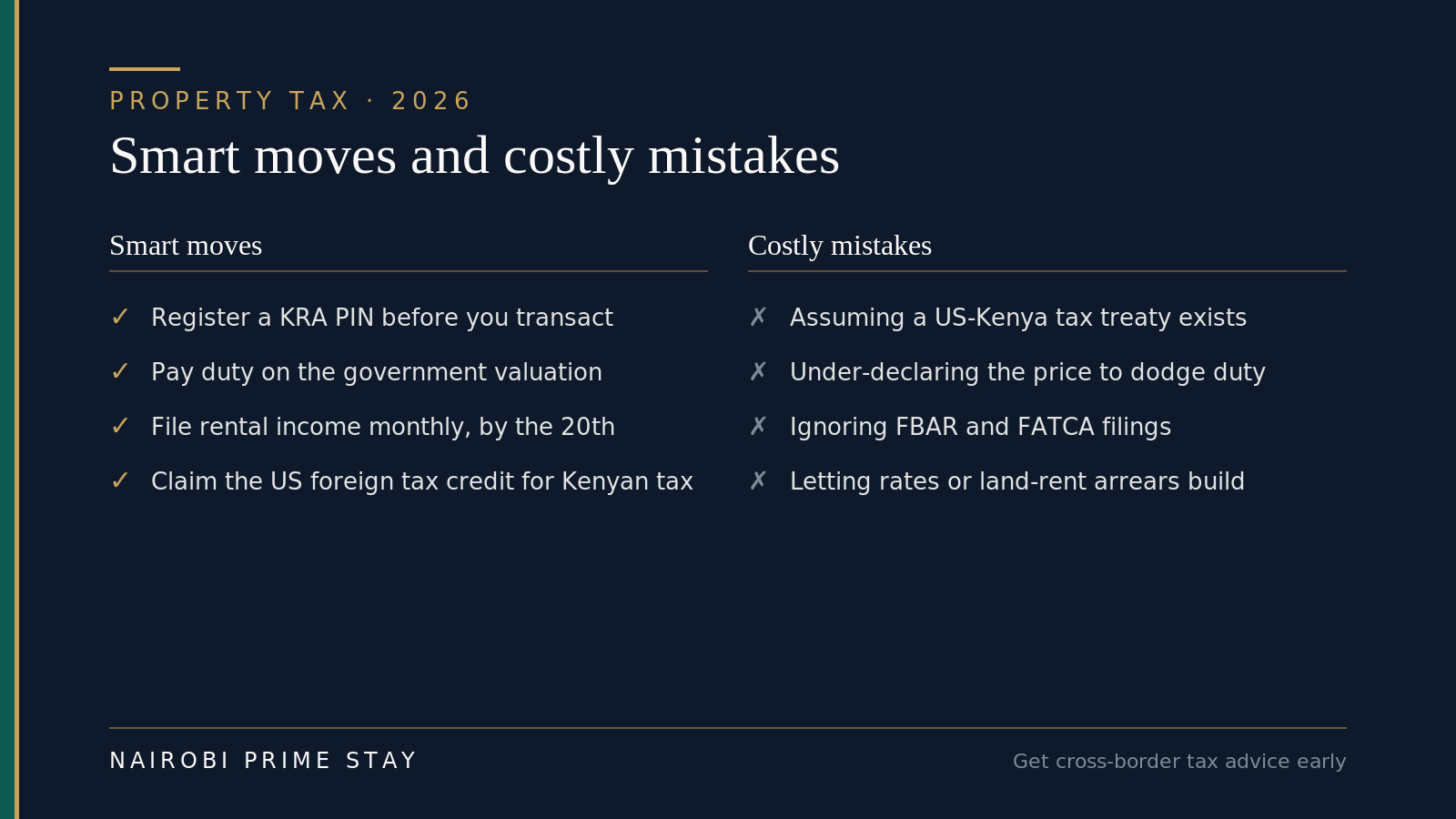 The habits that keep you out of trouble on both sides of the ocean.
The complications that catch Americans:
- There is no US–Kenya income tax treaty. Many countries have one that prevents the same income being taxed twice; the US and Kenya do not. So you can’t lean on treaty relief — you rely instead on the Foreign Tax Credit (IRS Form 1116) to offset your US tax by the Kenyan tax you’ve already paid. It usually prevents true double taxation, but it isn’t automatic and doesn’t always fully wash. Kenya’s flat 7.5% on gross rent, for instance, doesn’t map neatly onto the US system of taxing net rental income, so the credit can leave a gap.
- FBAR (FinCEN Form 114). If your foreign financial accounts together top $10,000 at any point in the year, you must report them. The Kenyan bank account or M-Pesa wallet that collects your rent will likely cross that line. The property itself isn’t an FBAR account, but the accounts around it are.
- FATCA (Form 8938). Higher thresholds than FBAR, but another annual report of specified foreign financial assets. Real estate held in your own name isn’t reportable here, but financial accounts and any foreign company you use can be.
- Holding property through a Kenyan company layers on US rules for foreign corporations (Form 5471 and more) that get expensive to get wrong.
The honest bottom line: get a cross-border tax professional who knows both systems before you buy, not after. This is the one area of a Kenyan property purchase where doing it yourself reliably costs more than the advice would. None of the above is tax or legal advice — confirm your own position with a qualified US and Kenyan adviser.
How this plays out: a worked example
Numbers make this concrete. Say you buy a two-bedroom apartment in Kilimani for about $180,000 (≈ KES 23 million) on leasehold, to let out. Here’s the tax across its life, with figures rounded and the exchange rate around KES 129.5 to the dollar as of mid-2026 (it has held in a 129–130 band through the year — see our USD to KES guide).
Buying it. Stamp duty at 4% of the value (Kilimani is in Nairobi, so the urban rate) is roughly KES 930,000. Add your advocate’s fee (around 1.5% plus VAT), a valuation fee and small search and registration charges, and the taxes-and-fees on top of the price land around 6–8% — call it KES 1.4–1.8 million all in, which you’d move in by bank transfer rather than cash (see sending money to Kenya). You pay duty before the transfer registers.
Owning it. Each year you pay land rates to Nairobi City County and, because it’s leasehold, land rent to the national government. Both are modest next to the purchase, but you keep them current — you’ll need clearance certificates for both to sell later. Your service charge to the building’s management company is separate again, and not a tax.
Letting it. Suppose you rent it for KES 130,000 a month — KES 1.56 million a year. That sits inside the MRI band, so as a resident landlord you’d pay 7.5% of the gross rent, about KES 117,000 a year, filed monthly on iTax by the 20th. (If you’re living in the US while you let it, you’re likely a non-resident landlord instead, so the tenant or agent withholds 30% of the gross rent — about KES 468,000 a year on the same rent. That’s a big swing, which is why pinning down your residency status matters.)
Selling it. Years on, you sell for KES 30 million. Your taxable gain is the sale price minus what you paid and your allowable costs — say a net gain around KES 5 million after the purchase price, duty, fees and any improvements. Capital gains tax at 15% on that is roughly KES 750,000, paid before the transfer to your buyer registers.
On your US return. You report the rental income and the eventual gain to the IRS too, use the foreign tax credit for the Kenyan tax you paid, and file an FBAR for the Kenyan account that collected the rent. With no US–Kenya treaty, this is where a cross-border accountant earns their fee.
None of these taxes is punishing on its own. The skill is simply knowing they exist, budgeting the 6–8% at purchase, and keeping your filings and clearances current so a future sale doesn’t snag.
Your property-tax checklist
Work through this and you’ll have the tax side covered:
- Register a KRA PIN on iTax before you transact — you can’t buy, sell or pay duty without it.
- Budget 6–8% of the price for stamp duty plus legal, valuation and registration costs.
- Declare the real price. Duty is charged on the higher of price or government valuation, and an honest figure lowers your capital gains tax later.
- Confirm the seller’s land rates and land rent are cleared as a completion condition, with the certificates to prove it.
- Keep land rates and (on leasehold) land rent current every year you own.
- If you let it, file MRI monthly by the 20th — and check whether the 7.5% resident rate or the non-resident rules apply to you.
- Keep every receipt — purchase price, duty, fees, improvements — to cut your future capital gains tax.
- Don’t confuse service charge with tax; ask for it in writing before you buy.
- US citizens: line up a cross-border tax pro, plan for the Foreign Tax Credit, and check your FBAR/FATCA filing duties.
- Re-verify the rates on the KRA portal before you file — they move with each Finance Act.
Frequently asked questions
What taxes do you pay when buying property in Kenya?
The main tax at purchase is stamp duty, paid by the buyer — 4% of the value for property in towns and cities including all of Nairobi, and 2% in rural areas, charged on the higher of the price or the government valuation. On top of duty you pay legal fees, a valuation fee and small search and registration charges, so the taxes and fees of buying usually total about 6 to 8% of the price. You need a KRA PIN to pay, and the transfer cannot register until the duty is paid.
How much is stamp duty in Kenya?
Stamp duty is 4% of the property value in cities, municipalities and gazetted towns — including all of Nairobi — and 2% in rural areas, as of 2026. It is charged on the higher of the purchase price or the government valuer’s assessment, and the buyer pays it through iTax before the transfer is registered. Long leases attract their own stamp duty of roughly 1 to 2% of the annual rent.
What is the capital gains tax on property in Kenya?
Capital gains tax is 15% of the net gain when you sell land or buildings — the rate rose from 5% to 15% on 1 January 2023. The net gain is the sale price minus what you paid and your allowable costs such as legal fees, duty and improvements, so keeping receipts lowers the bill. The seller pays it before the transfer registers, and your main home of at least three years, inherited property, and land sold for KES 3 million or less are exempt.
How much tax do landlords pay on rental income in Kenya?
A resident landlord letting residential property pays Monthly Rental Income tax at 7.5% of the gross rent, with no expense deductions, filed and paid monthly by the 20th. It applies to annual residential rent between KES 288,000 and KES 15 million; below that you use the normal income tax bands, and above it the regular regime. The 7.5% rate has applied since January 2024, though a Finance Bill 2026 proposal could raise it to 10%, so confirm the current rate before filing.
How is rental income taxed if I live in the US and rent out a Nairobi apartment?
Differently, and more heavily, than for a resident. If you live abroad you’re a non-resident landlord, so the 7.5% resident rate doesn’t apply. Instead the tenant or letting agent must withhold 30% of the gross rent and remit it to the KRA by the 20th of the following month. That withholding is a final tax in Kenya, with no expense deductions, so a managing agent who handles it correctly is worth having. You then report the same income on your US return and use the Foreign Tax Credit for the Kenyan tax paid.
What is the difference between land rates and land rent in Kenya?
Land rates are an annual tax paid to the county government on land in towns and cities, based on the site value in the county valuation roll. Land rent is a separate annual charge paid to the national government, but only on leasehold land — freehold owners pay none. You need a clearance certificate for each to sell, and both are different from your service charge, which is a private payment to your building’s management company and not a tax.
Do foreigners pay extra property tax in Kenya?
No, foreigners pay the same property taxes as Kenyans — stamp duty, land rates, land rent, rental income tax and capital gains tax — at the same rates. Because most foreigners can only hold property on leasehold, they will usually pay annual land rent, which freehold owners avoid. The bigger difference for Americans is the US side: the IRS taxes your worldwide income, and there is no US-Kenya tax treaty.
Do US citizens pay tax on Kenyan property in the US too?
Yes. The US taxes citizens and green-card holders on worldwide income, so your Kenyan rental income and any capital gain are reportable on your US return as well as in Kenya. There is no US-Kenya income tax treaty, so you rely on the Foreign Tax Credit to offset US tax by the Kenyan tax you paid rather than on treaty relief. You may also have FBAR and FATCA reporting on the Kenyan accounts around the property, so use a cross-border tax professional.
Is there VAT on property in Kenya?
For homes, generally no — the sale of land and residential premises, and residential rent, are exempt from VAT. VAT at 16% applies to commercial property, meaning the sale of commercial buildings and the lease or rent of offices, shops and warehouses. So a residential buyer or investor rarely meets VAT, while a commercial one should budget for it.
How do you pay property taxes in Kenya?
Most property taxes are paid to the Kenya Revenue Authority through the iTax portal at itax.kra.go.ke, for which you need a KRA PIN. Stamp duty is paid at purchase before registration, rental income tax monthly by the 20th, and capital gains tax on sale before the transfer registers. Land rates are paid to your county government and land rent to the national Ministry of Lands, each needing a clearance certificate when you sell.
How do you pay stamp duty in Kenya in 2026?
In Nairobi, stamp duty is now assessed and paid online through ardhisasa, the national land platform, using its Ardhipay module — by M-Pesa, bank transfer or card. Your advocate lodges the transfer, a government valuer sets the value, the KRA assesses the duty at 4% urban or 2% rural on the higher of price or valuation, and once you pay, the e-stamp links automatically so the transfer can register. Transacting through ardhisasa has been mandatory in Nairobi, Kiambu, Kajiado and Mombasa since early 2026, and the old physical stamping route stopped on 16 February 2026.
What are the penalties for filing rental income tax late in Kenya?
Filing your Monthly Rental Income return late attracts a penalty of 5% of the tax due, with a minimum of KES 10,000 for an individual, and paying late adds a further 5% plus interest of 1% a month. Because the minimum penalty can exceed the tax on a small rent, even a month with no income is worth a nil return, which costs nothing. Confirm the current figures on the KRA iTax portal, as penalty rules are set by tax law and can change.
Final thoughts
Kenya’s property taxes are not heavy, but they are specific, and a few of them gate the deal. Pay your stamp duty, keep your land rates and rent cleared, file your rental income each month, and hold on to your receipts for the eventual capital gains tax, and you’ll never be surprised. The figures here are current for 2026, but every Finance Act nudges something — so treat the KRA portal as the live source and re-check the rate before you file.
The part to take seriously is the American overlay. With no US–Kenya tax treaty, the interaction between the two systems is where money is quietly lost or saved. That’s an advisor’s job, not a blog’s. Get one early, and the rest of this is just admin.
A reminder, kindly meant: this is general guidance, not legal or tax advice, and your situation may differ. Confirm the details with the KRA, your county, and a qualified cross-border tax adviser before you act.
Related reading
- Property investing in Kenya — the cluster overview this guide sits under.
- How to buy property in Kenya — the step-by-step process, with the full closing-cost stack.
- Conveyancing in Kenya — what your advocate does, and where the tax payments fall.
- Can foreigners buy property in Kenya? — the leasehold rules behind your land-rent bill.
- Buy-to-let in Nairobi — the rental numbers in more depth.
- Financing property in Kenya — mortgages and payment plans for foreign and diaspora buyers.
- Visas and permits for Americans — getting the status you need before a KRA PIN.
- Moving to Nairobi: the complete guide — the hub for everything relocation.
Before you buy, land softly
You don’t need to own anything to start. The smartest buyers spend their first weeks on the ground — viewing properties, testing the commute, getting a feel for neighborhoods — before they sign for anything. A serviced apartment makes that easy: all-inclusive, furnished, with Wi-Fi, cleaning, security and a backup generator handled, so you can focus on the search.
When you’re ready, browse our serviced apartments for an honest monthly rate, or let our AI relocation assistant shortlist a base near the areas you’re considering. A $50 deposit reserves your place and the balance is paid on arrival — nothing more before you travel.
Ready to look?
Find your apartment in Nairobi
Browse verified serviced apartments, or ask the AI concierge which area fits your life.