
Guides · Property investment
Property Management in Nairobi: Fees, Agents and What to Expect (2026)
Property Management in Nairobi: Fees, Agents and What to Expect

If you own a rental in Nairobi and you don’t live next to it, you probably need a property manager. A good one finds and vets your tenant, collects the rent, handles the 11pm call about a burst pipe, and sends you a clean statement every month. You keep the income and skip the headaches. The catch: managers vary wildly in quality, and a bad one can cost you more than no manager at all.
This guide is for landlords — whether you live in Nairobi, elsewhere in Kenya, or abroad. We’ll cover exactly what a manager does, what they charge in 2026, how to tell a licensed agent from a chancer, when it’s smarter to self-manage, and how service charge fits in (it trips up almost everyone). Honest numbers, real names, no sales pitch.
One note up front: fees and rules shift, so treat every figure here as “as of 2026” and confirm current terms before you sign.

The short answer (TL;DR)
A Nairobi property manager runs your rental for you: tenant find, rent collection, repairs, inspections and monthly statements. For full management, expect to pay around 5–12% of the rent collected — most commonly 8–10% — plus 16% VAT, with a one-off letting fee of about half to one month’s rent when they place a new tenant. Use only an agent registered with the Estate Agents Registration Board (EARB); you can check the register before you hire. Service charge is a separate cost you still owe, even if your tenant pays it. If you live abroad or own more than a unit or two, a good manager is usually worth every shilling. If you own one flat and live nearby, you can self-manage and keep the fee.
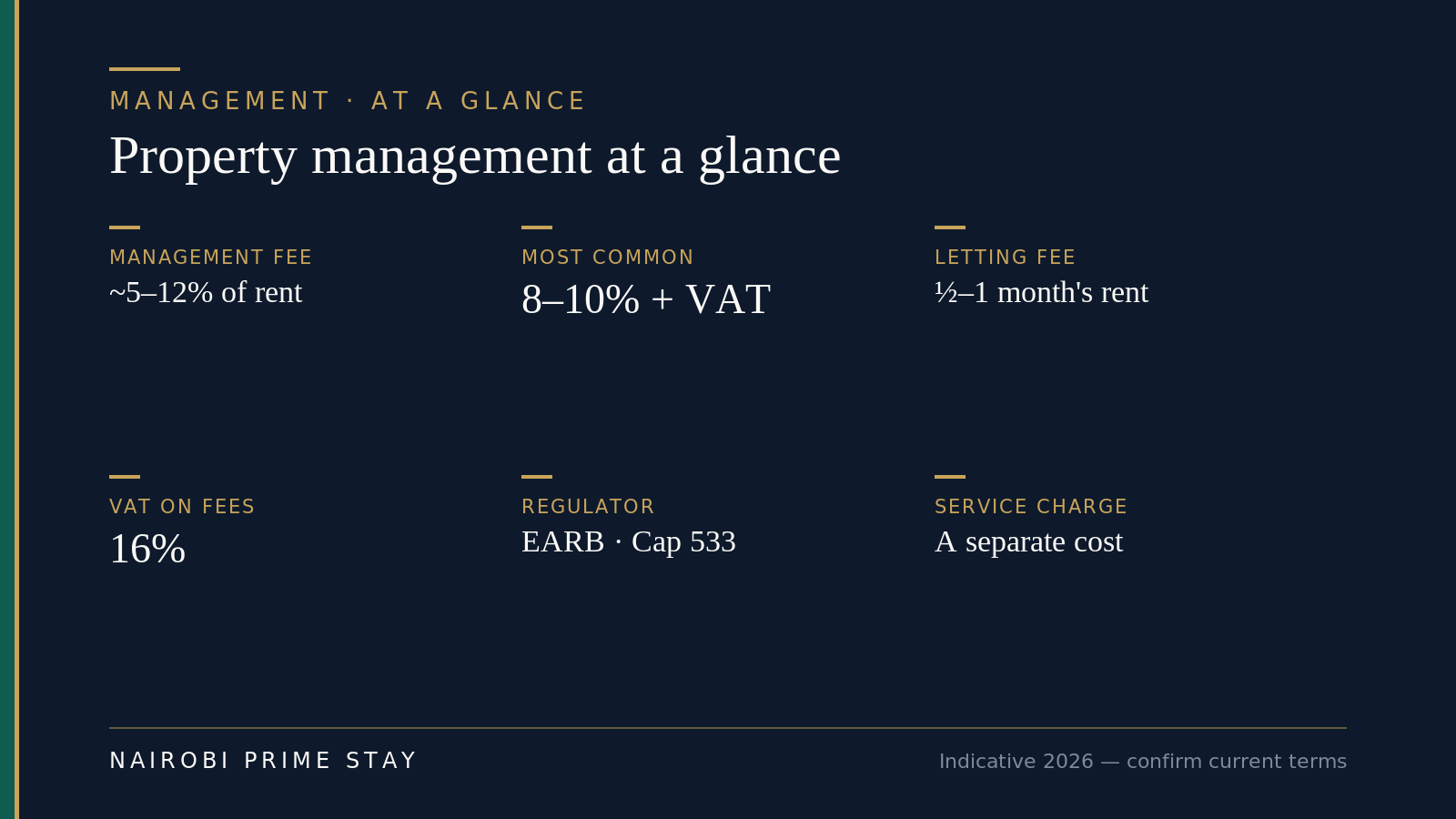 Indicative 2026 figures — confirm current terms with the agent and the EARB register.
Why this matters more than people expect
Rent in Nairobi is mostly collected by hand, chased by phone, and paid into accounts you have to reconcile yourself. Maintenance is reactive. Tenants expect a person to call. From 12,000 km away, none of that runs itself.
The gap between a managed and an unmanaged rental shows up in three places: voids, arrears and wear. An empty month is a 100% loss on that month’s rent. Late or unpaid rent eats your return. And small problems become big bills when nobody acts on them. A manager who keeps your place occupied with a vetted tenant, collects on time, and fixes the tap before it floods the kitchen earns their fee in problems you never hear about.
The honest flip side: a weak or dishonest manager is worse than none at all. The classic failure is the agent who collects your rent, pays themselves first, and goes quiet — or who never sends a statement, so you can’t tell what’s really happening. That’s why how you choose matters as much as whether you hire. More on that below.
If you’re weighing the returns before you even buy, read our buy-to-let in Nairobi guide — management cost is one of the line items that turns a healthy gross yield into a thinner net one.
What a property manager actually does
A full-service manager takes the day-to-day running of your property off your plate. The core jobs:
- Finding and vetting tenants. Marketing the unit, showing it, screening applicants (employment, references, ID, sometimes a CRB credit check) and handling the lease.
- Rent collection. Invoicing, collecting, chasing arrears and remitting your share — ideally into a separate client account, not their own.
- Repairs and maintenance. Taking tenant calls, dispatching trusted plumbers and electricians, and managing larger works. You pay for the repair; they coordinate it.
- Inspections. Periodic check-ins so problems and lease breaches are caught early, not at move-out.
- Statements and remittance. A monthly statement showing rent in, costs out, and what landed in your account.
- Lease renewals and exits. Renewing, adjusting rent to market, handling notice, deposit deductions and check-out.
- Compliance and disputes. Keeping you on the right side of tenancy norms and stepping in when something goes wrong.
What the fee does not buy is the bills themselves. The manager arranges the repair; you fund it. They remit your rent; you still owe service charge, land rates, insurance and tax. Keep that line clear in your head — it’s the single most common source of “wait, what am I actually paying for?”
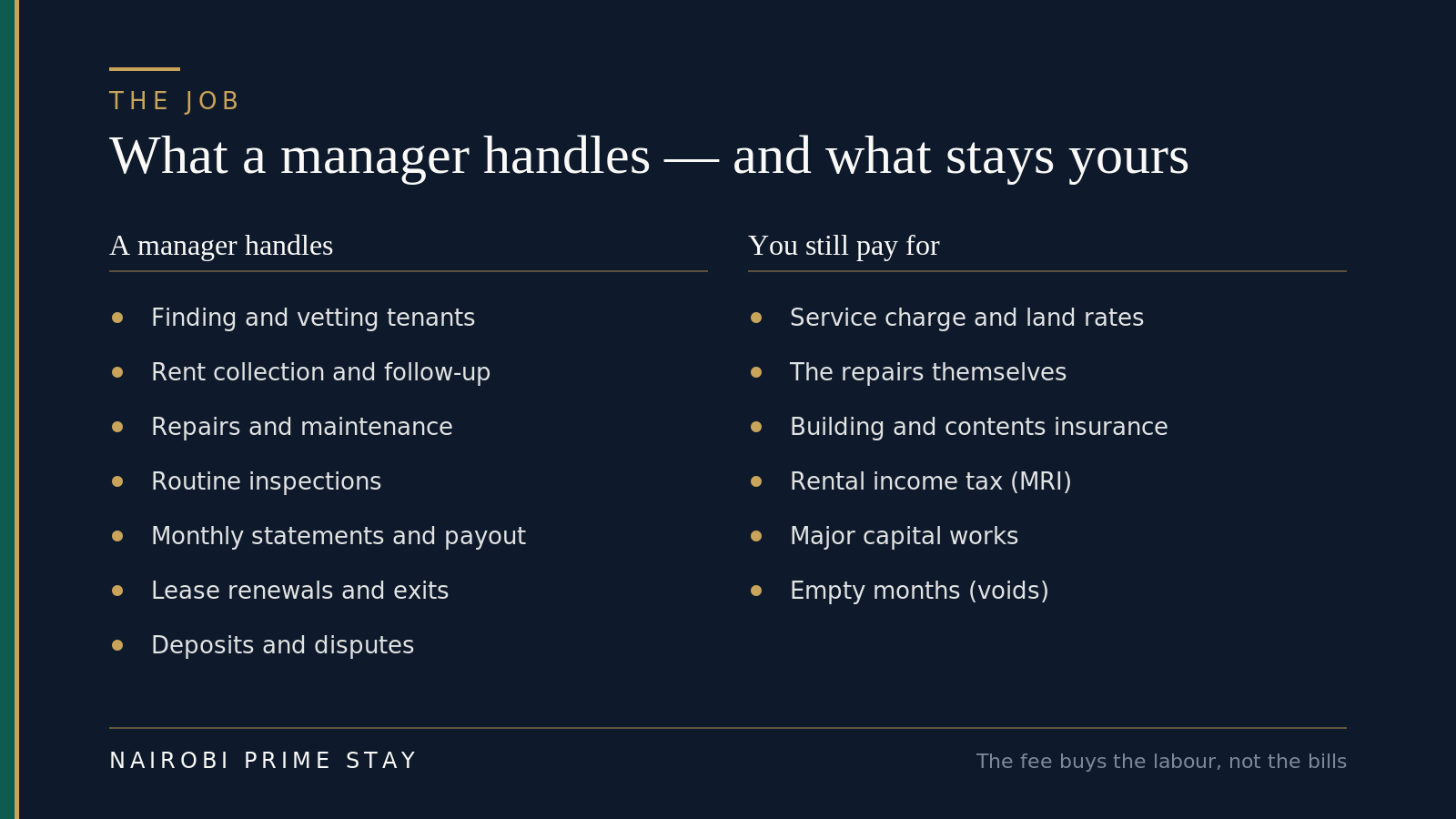 The management fee buys the labour and coordination, not the building’s running costs.
What it costs: management fees in plain numbers
Property management in Nairobi is priced as a percentage of the rent the manager actually collects for you. As of 2026, the going range is roughly 5–12% of monthly rent, with 8–10% the most common band for residential apartments and homes. Commercial property tends to sit a touch lower, around 5–10%, because the tickets are larger. Always read it as ”% of rent collected” — if the unit sits empty, a fair manager earns nothing that month, which keeps their incentive aligned with yours.
On top of the percentage you’ll meet a few other charges:
- VAT at 16%. Agency and management fees attract VAT. A quoted “10%” is really 11.6% once VAT is added. Always ask whether a number is VAT-inclusive.
- A letting (tenant-find) fee. A one-off charge when a new tenant is placed — commonly half a month’s to one full month’s rent, sometimes scaled to how much rent the tenant pays upfront. Under the official agency fee scale, a letting for a lease up to one year is set at 7.5% of the annual gross rent.
- Renewal fees. Some agents charge a smaller fee when a sitting tenant renews. Negotiable.
- Project or works supervision. For a major repair or refurbishment, a manager may add a percentage (often around 5–10%) to oversee the work. Agree this before, not after.
A fee table makes it concrete:
| Fee | Typical 2026 range | When it applies |
|---|---|---|
| Management fee (residential) | ~8–10% of rent collected (range 5–12%) | Monthly, ongoing |
| Management fee (commercial) | ~5–10% of rent collected | Monthly, ongoing |
| VAT on the fee | 16% on top of the fee | Always |
| Letting / tenant-find fee | ~½–1 month’s rent (scale: 7.5% of annual rent, lease ≤1 yr) | Once, per new tenant |
| Renewal fee | Smaller, negotiable | When a sitting tenant renews |
| Works / project supervision | ~5–10% of the job | Major repairs or refurbishment |
Indicative 2026 ranges; agency fees follow the estate-agency scale but are negotiable in practice. Confirm current terms — not every service is fixed by law.
Two practical points. First, the cheapest percentage is not always the best deal — a manager who keeps the place full and well-maintained at 10% beats one who loses you a month’s rent a year at 6%. Second, get the full fee menu in writing before you sign: management %, VAT, letting fee, renewals and anything for works. Surprises here are a red flag.
Service charge: the separate cost people mix up
Service charge is not the management fee, and confusing the two causes a lot of grief. Service charge is the monthly contribution every unit in an apartment block or gated development pays toward shared running costs — security guards and cameras, cleaning of common areas, water and power for shared spaces, lifts, the generator, the pool and gym, garden upkeep, and waste collection. It’s collected by the management company or residents’ association that runs the building, and it’s separate from whatever you pay an agent to manage your own unit.
How much? It varies widely with the building and its amenities. As a rough 2026 guide, a modest estate might charge around KES 3,000–5,000 a month, while a high-end Kilimani or Westlands apartment with a pool, gym, lifts and heavy security can run KES 15,000–25,000 or more. A one-bed in a mid-range block often lands near KES 5,000. Ask for the exact figure and what it covers before you buy a unit or rent it out — it comes straight off your net yield.
The part that catches landlords out: you, the owner, are ultimately liable for service charge, even when your tenant pays it directly. If a tenant defaults and leaves, the building can still pursue the owner for the arrears. Some leases fold service charge into the rent; others bill the tenant separately. Either way, make it explicit in writing who pays, and have your manager track it.
A well-run building also keeps a sinking fund — a reserve for big future costs like repainting or replacing a lift. A block with no reserve and vague accounts is a warning sign; you can be hit with a sudden special levy. Ask to see the service-charge accounts before you commit.
Choosing a licensed agent: the EARB rule
In Kenya, estate agency is a regulated profession. Only an agent registered with the Estate Agents Registration Board (EARB) and holding a current annual practising certificate may legally offer estate agency services for a fee, including letting and managing property. The EARB draws its mandate from the Estate Agents Act (Cap 533). This is your single biggest protection — and most people skip it.
To be registered, an agent generally must be a full member of the Institution of Surveyors of Kenya (ISK) in the valuation and estate management chapter, hold the relevant qualifications, carry professional indemnity insurance, and pay an annual licence (around KES 7,000 in 2026). The detail matters less than the point: a registered agent is qualified, insured, and accountable to a board that can discipline or strike them off.
How to actually check, before you hand over your keys or your rent:
- Search the EARB register. The Board publishes its list of registered estate agents and firms (gazetted annually) and has urged the public to verify an agent before any transaction. Confirm your agent or their firm appears on it — start at estateagentsboard.or.ke.
- Ask for their registration number and indemnity cover. A legitimate agent gives both without flinching.
- Confirm ISK membership for the individual handling your property.
- Get references — other landlords they manage for, ideally ones you can call.
Using an unregistered “agent” isn’t illegal for you, but it strips away your recourse. If they mishandle your money, there’s no board to complain to and often no insurance behind them. For something this quick to verify, there’s no reason to skip it.
Self-manage or hire a manager?
You don’t always need a manager. The decision comes down to where you live, how many units you own, and how you value your time.
Self-managing can make sense if you own a single unit, live in Nairobi near the property, have flexible time, and are comfortable screening tenants and fielding maintenance calls. You keep the whole rent. The cost is your time and attention — and the risk that a problem you’d rather not handle lands on a Sunday.
Hiring a manager makes sense if you live abroad or elsewhere in Kenya, own several units, travel often, or simply don’t want the calls. For absentee and diaspora owners it’s less a choice than a necessity: someone trustworthy has to be on the ground. This is the same logic that runs through our diaspora property investment guide — distance is the real risk, and a vetted manager (plus a separate set of eyes) is how you close it.
A middle path is letting-only: you pay an agent the one-off fee to find and place a good tenant, then manage the tenancy yourself. It suits a hands-on local owner who just wants help with the hardest part — finding the right tenant. Short-let and Airbnb units are a different job again, with far more turnover and guest contact; if that’s your plan, see our Airbnb and short-let investment guide and consider a specialist short-let manager.
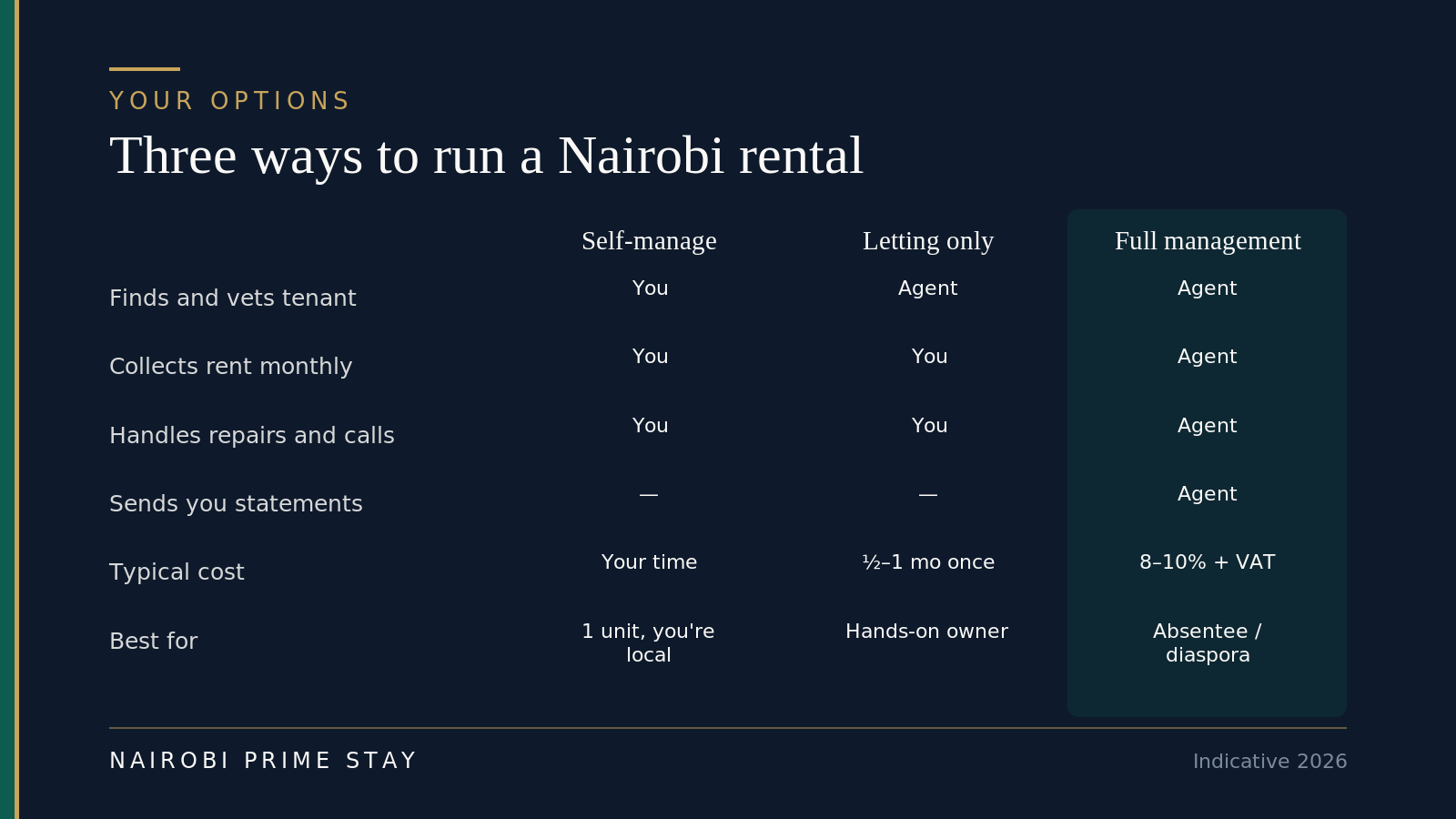 Three ways to run a rental — pick by where you live and how many units you hold.
If you’re still unsure, match your situation to the sensible default:
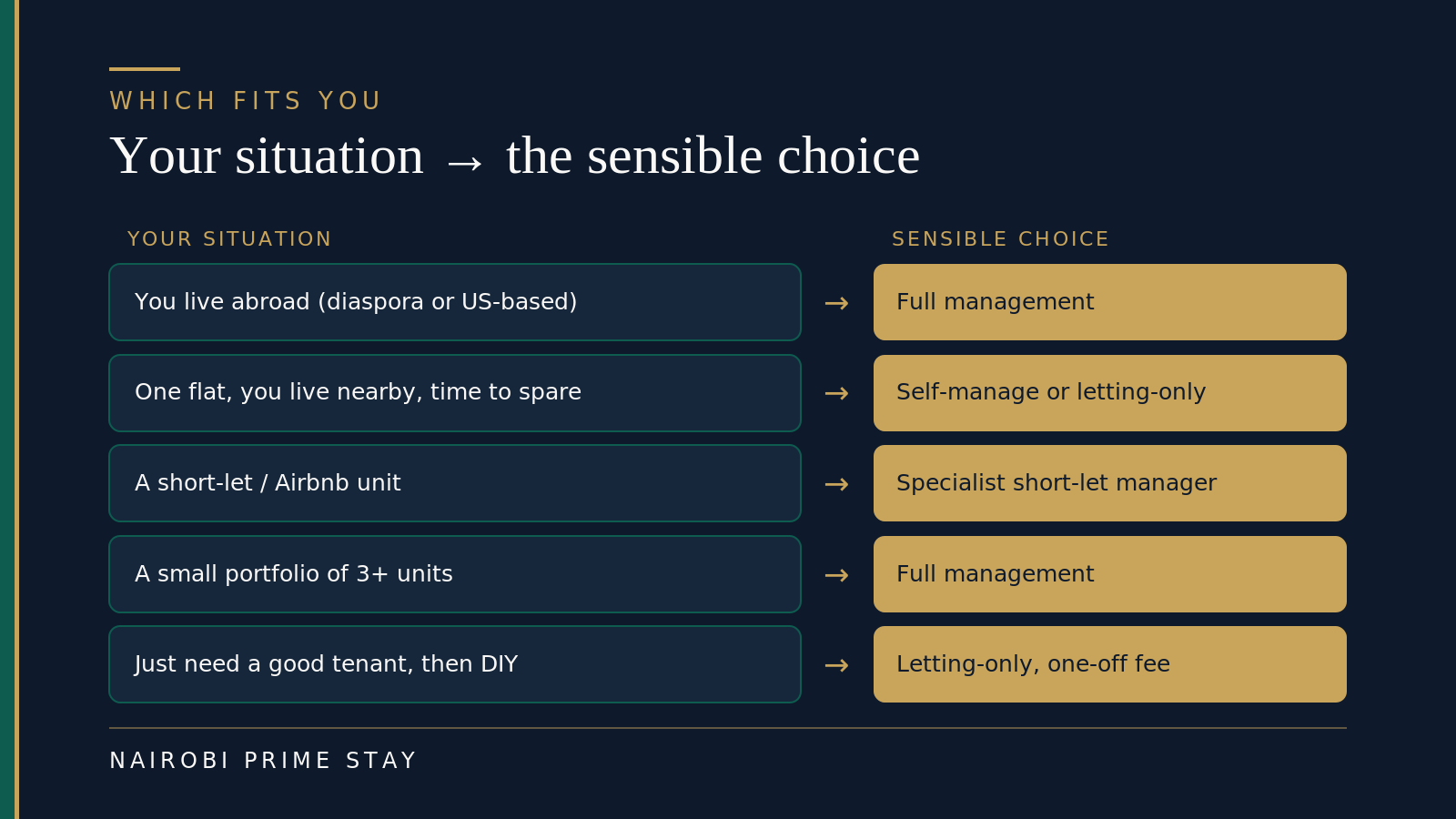 A rough guide — your circumstances and the specific manager matter more than any rule.
Red flags: a manager to walk away from
Most managers are fine. A few will cost you. The warning signs are consistent, and almost all of them are about money handling and transparency.
Walk away — or at least dig harder — if an agent:
- Isn’t on the EARB register, or won’t share a registration number.
- Wants your rent paid into a personal account or M-Pesa rather than a proper company client account. Your money should never sit in someone’s personal wallet.
- Won’t put the arrangement in writing — no management agreement, no clear fee schedule.
- Doesn’t send monthly statements, or sends ones you can’t reconcile. Opaque accounting is how skimming hides.
- Is vague about fees, or dangles a suspiciously cheap or “no fee” deal. Someone is paying somewhere.
- Won’t give references from other landlords.
- Pressures you to sign fast or pushes round-number “special” deals.
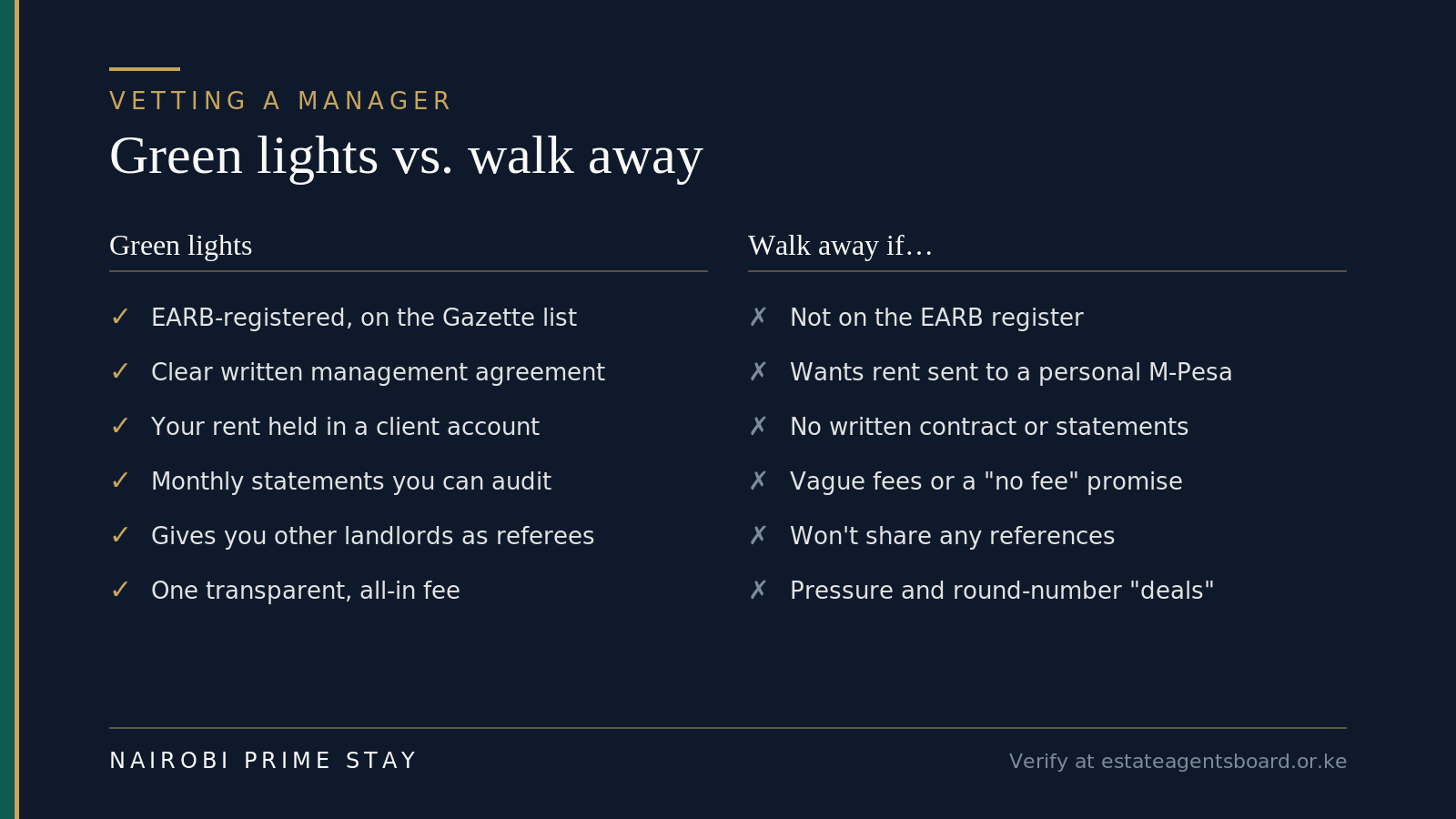 Verify the agent on the EARB register and insist your rent runs through a client account.
The single best protection is structural: a registered agent, a written contract, your rent into a client account, and a statement every month you can actually check. Get those four right and most bad outcomes simply can’t happen.
A realistic example
Say you own a furnished two-bedroom apartment in Kilimani renting at KES 110,000 a month — a typical prime-apartment figure in 2026. You live in Texas. Full management at 9% costs KES 9,900 a month, plus 16% VAT, so about KES 11,484. Across the year that’s roughly KES 138,000.
For that, the manager places and vets your tenant, collects the rent, handles repairs, inspects the place, and pays you a clean monthly statement. When the tenant leaves, a letting fee of around half a month’s rent (about KES 55,000) covers finding the next one.
Is it worth it? From Texas, almost certainly. One avoided void month (KES 110,000), one piece of arrears chased down, or one small leak fixed before it becomes a ceiling repair, and the fee has paid for itself. The owners who regret management are nearly always the ones who picked on price alone and skipped the EARB check — not the ones who paid a fair fee to a registered professional.
Note the tax line too, because from Texas it’s bigger than most guides admit. Kenya taxes rent by where the landlord is tax-resident, not by passport — so as a US-based owner you’re a non-resident landlord, and the rate isn’t the resident’s 7.5%. It’s 30% of your gross rent, a final tax your manager usually withholds before you ever see the money. That reshapes the sums above, and the next section walks through it.
If you live in the US, your manager withholds a 30% tax
If you own the rental from the US, the biggest deduction from your rent isn’t the management fee — it’s tax, and your manager is usually the one who takes it. Kenya taxes rental income by the landlord’s tax residency, not their nationality. Live in the US and you’re a non-resident landlord: your Kenyan rent is taxed at 30% of the gross, a final tax with no deductions for costs.
A Kenya-tax-resident landlord has it lighter. They pay the monthly residential rental income tax (MRI) — 7.5% of gross rent in 2026, on residential income roughly between KES 288,000 and KES 15 million a year, with the Finance Bill 2026 proposing to take the rate back to 10%. A non-resident gets none of that lighter treatment.
Here’s why it belongs in a management guide. Under Kenya’s Income Tax Act, anyone who pays rent to a non-resident is automatically a withholding agent — no formal appointment needed. In practice that’s your property manager. They deduct the 30% from each month’s rent, remit it to the Kenya Revenue Authority (KRA) — usually by the 20th of the following month — and send you the rest. So the real order of events is: rent in, 30% tax out, management fee plus VAT out, repair costs out, and what’s left is yours.
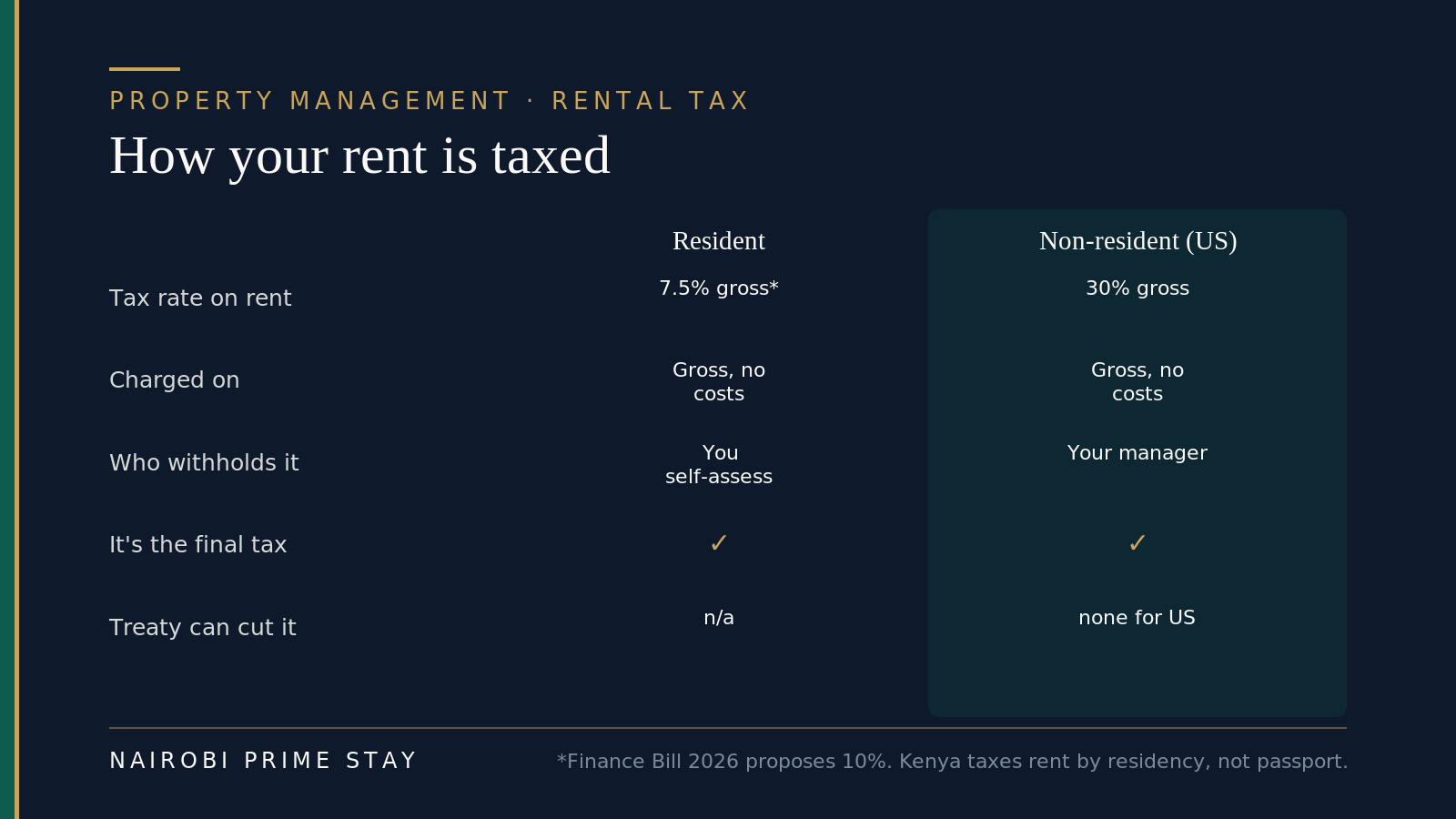 Kenya taxes rent by where the landlord is tax-resident, not by passport — a US owner pays 30%, not 7.5%.
The rate isn’t the same for everyone abroad. Kenya has double-tax treaties with the UK, Canada, Germany, France, the UAE, Mauritius and South Africa, several of which cap the rate below 30%. There is no US–Kenya tax treaty. A US-based owner — American, or a Kenyan living in America — pays the full 30%, then reports the same rent on their US return and claims a foreign tax credit (Form 1116) so it isn’t taxed twice. A cross-border accountant isn’t optional here; our taxes for expats in Kenya guide and property taxes in Kenya guide fill in the wider picture, and commercial landlords meet the same 30% in our commercial property guide.
The Finance Bill 2026 goes a step further, moving to require non-resident landlords to appoint a local agent to register, file and remit on their behalf — formalizing what a good manager already does. Three questions to put to any manager before you sign:
- Are you withholding the 30% and remitting it to the KRA on my behalf?
- Will you send me the withholding tax certificate every month?
- Can you, or an accountant you work with, file my Kenyan returns?
On the Kilimani flat above at KES 110,000 a month, the 30% is KES 33,000 withheld every month — about KES 396,000 a year — before the 9% management fee. It doesn’t make the rental a bad deal. It just means you budget on the number after tax, not the headline rent.
Getting paid across an ocean
Once tax and the fee come off, your manager still has to move the balance from a Nairobi bank account to yours. The good news: Kenya has no exchange controls. Rent — and one day your sale proceeds — can leave the country freely, in any currency, with no cap and no permission needed.
The mechanics run through the client account. Your rent lands there, never a personal wallet, and each month the manager deducts the 30% tax, their fee plus VAT, and any repairs they funded, then remits the net to you — by bank wire, or a service like Wise, into your US account. Agree up front how often they pay, by which route, and in what currency.
 Kenya has no exchange controls — rent and sale proceeds wire out freely. Confirm the live rate with the CBK or Wise.
The one real cost is the exchange rate. You earn in shillings and spend in dollars, so the USD/KES rate matters: it sat at about 129.4 on 1 July 2026 and has been broadly flat, but over years the shilling can drift. At the prime and corporate end, some leases are quoted in US dollars, which passes the currency risk to the tenant — a natural hedge if you can get it. Our USD–KES currency guide covers the moving parts, and sending money to Kenya covers funding a purchase or a big repair from the US. If you ever move money as physical cash, declare amounts over USD 10,000 at the border; wires have no such cap.
Build one habit and remote ownership stays honest: every month, three things should tie out — the statement your manager sends, the withholding tax certificate, and the credit that hits your bank. If they don’t match, ask why before the next rent cycle.
Hiring and running a manager from the US
You can hire and run a Nairobi manager entirely from the US — thousands of owners do — but the vetting has to replace the reassurance of a handshake. Do it in this order.
 Never let one person control both the property and the money — that single rule prevents most remote-owner horror stories.
Start with the EARB register — verify the firm before anything else. Then ask for a video walk-through of a unit they already manage, and the building’s client-account details. Then call two landlord references, and actually call them; don’t just collect the numbers.
The management agreement itself can be signed and scanned. But if the manager needs to act for you legally — sign a lease in your name, or represent you at the KRA or a bank — you’ll give them a limited power of attorney. For a US-based owner that document must be notarized in the US and then legalized at a Kenyan embassy or consulate, because Kenya isn’t part of the Apostille Convention. Our conveyancing in Kenya guide explains the same legalization step for buyers.
The golden rule for absentee owners: never let one person control both the property and the money. Line up a second set of eyes — a trusted friend, a relative, or a separate valuer — who can physically visit, unannounced, once or twice a year. It’s the cheapest insurance you’ll buy, and it’s the backbone of our diaspora property investment guide.
Finally, set the rhythm. Agree a fixed statement date and a short standing call; Nairobi runs on East Africa Time (UTC+3), seven to eight hours ahead of the US East Coast, so a late-afternoon Nairobi call catches a US morning. Ask for photos after any repair. And read the exit terms before you need them — the notice period, and how keys, the deposit and tenant contacts are handed back, should all be in the agreement, so you can change managers remotely if it isn’t working.
Self-manage vs letting-only vs full management
| Self-manage | Letting-only | Full management | |
|---|---|---|---|
| Who finds the tenant | You | Agent | Agent |
| Who collects rent | You | You | Agent |
| Who handles repairs | You | You | Agent (you fund them) |
| Monthly statement | — | — | Yes |
| Typical cost | Your time only | ~½–1 month’s rent, once | ~8–10% of rent + 16% VAT |
| Best suited to | One unit, owner in Nairobi | Hands-on local owner | Absentee / diaspora / multi-unit |
Pros and cons of hiring a manager
| Pros | Cons |
|---|---|
| Hands-off income — someone else takes the calls | Costs ~8–10% of rent + VAT, plus a letting fee |
| Professional tenant vetting reduces bad tenants | A weak manager can underperform or skim |
| Faster repairs through their trades network | You still fund repairs, service charge, rates and tax |
| Fewer and shorter void periods | Less direct contact with your tenant and property |
| Essential cover for absentee and diaspora owners | Quality varies — choosing well takes real effort |
| Local know-how on rent levels and compliance | Another relationship to monitor |
A practical checklist: hiring and setting up a manager
- Confirm EARB registration — find the agent or firm on the register; note the number.
- Check ISK membership and indemnity insurance for the person handling your unit.
- Get three landlord references and actually call one or two.
- Get the full fee menu in writing — management %, VAT, letting fee, renewals, works supervision.
- Insist on a client account for your rent; never a personal M-Pesa or personal account.
- Read the management agreement — scope, notice period, how either side exits, who approves repairs and up to what limit.
- Set a repair authorisation limit — say, they can spend up to an agreed amount without asking first.
- Agree the statement format and date — what you’ll receive each month, and when.
- Clarify service charge and rates — who pays, who tracks them, and that you remain liable.
- Confirm deposit handling — how much, where it’s held, and the check-out process.
- Line up your tax position — KRA PIN, rental income tax filing, and a cross-border accountant if you’re a US person.
- Review after six months — is the place full, paid on time, and well-kept? If not, you can change managers.
Frequently asked questions
How much do property managers charge in Nairobi?
Most charge a percentage of the rent they collect — roughly 5–12%, with 8–10% the most common band for residential property — plus 16% VAT. Expect a separate one-off letting fee of about half a month’s to one month’s rent each time they place a new tenant. Commercial property is often a little lower, around 5–10%. Treat these as 2026 ranges and confirm with the agent.
Do I really need a property manager?
It depends on where you live and how many units you own. If you’re abroad or hold several units, a manager is close to essential. If you own one flat, live nearby and have time to screen tenants and handle repairs, you can self-manage and keep the fee. A middle option is letting-only — pay an agent just to find a tenant, then run the tenancy yourself.
How do I check if a property agent is licensed in Kenya?
Confirm they’re registered with the Estate Agents Registration Board (EARB), the statutory regulator under the Estate Agents Act (Cap 533). The Board publishes a gazetted list of registered agents and firms — verify your agent appears on it at estateagentsboard.or.ke, and ask for their registration number, professional indemnity cover and ISK membership. Only registered agents with a current practising certificate may legally do estate agency for a fee.
What’s the difference between service charge and the management fee?
They’re two separate costs. Service charge is the monthly contribution every unit pays toward the building’s shared running costs — security, cleaning, lifts, generator, water and waste. The management fee is what you pay an agent to run your individual unit. Importantly, the owner is ultimately liable for service charge even when the tenant pays it directly.
Can a property manager collect rent into their own account?
They shouldn’t. Your rent should go into a dedicated client account, not the manager’s personal account or M-Pesa. A manager who wants rent paid to a personal wallet is a major red flag — that’s how funds go missing. Insist on a client account and a monthly statement you can reconcile.
What does a letting or tenant-find fee cover?
It covers marketing the unit, showing it, vetting applicants and preparing the lease for a new tenant. It’s a one-off charge, commonly half a month’s to one month’s rent; on the official scale, a letting for a lease up to one year is 7.5% of the annual gross rent. It’s separate from the ongoing management percentage.
Can a foreign or diaspora owner manage a Nairobi rental remotely?
It’s hard to do well alone. Most absentee owners use full management plus an independent set of eyes — a trusted contact or a separate valuer — so no single person controls both the property and the money. Insist on a registered agent, a client account and monthly statements. Our diaspora property investment guide covers the wider remote-ownership playbook.
Is rental income taxed in Kenya?
Yes, and how much depends on where you live. A Kenya-tax-resident landlord pays the monthly residential rental income tax — 7.5% of gross rent in 2026, with the Finance Bill 2026 proposing a rise to 10%. If you live in the US you’re a non-resident landlord, taxed at 30% of gross rent as a final tax that your manager or the tenant withholds before paying you. There’s no US–Kenya tax treaty, so US owners pay the full 30% and should get cross-border tax advice.
How is my Nairobi rent taxed if I live in the US?
As a non-resident landlord you’re taxed at 30% of gross rent — a final withholding tax with no deductions, not the resident’s 7.5%. Your property manager (or the tenant) is legally the withholding agent, so they deduct the 30% and remit it to the KRA before paying you. There’s no US–Kenya tax treaty, so you pay the full 30% and then claim a US foreign tax credit; a cross-border accountant is worth it.
Can I get my rent money out of Kenya to the US?
Yes. Kenya has no exchange controls, so rent — and one day your sale proceeds — can leave the country freely, in any currency, with no cap. Your manager remits the net rent from their client account by bank wire or a service like Wise. The main cost is the USD/KES exchange rate, about 129.4 in mid-2026; declare any physical cash over USD 10,000 at the border, though wires have no limit.
Can I hire and manage a Nairobi property manager from abroad?
Yes, and most diaspora owners do. Check the EARB register online, ask for a video tour and two landlord references you actually call, and insist on a client account with monthly statements. If the manager must act for you legally, give a limited power of attorney — notarized in the US and legalized at a Kenyan embassy, since Kenya isn’t in the Apostille Convention. Add an independent set of eyes so no one person controls both the property and the money.
Final thoughts
Property management in Nairobi is a small cost that solves a big problem — if you choose well. The fee is rarely what makes or breaks the deal; the manager’s honesty and diligence are. Verify the registration, insist on a client account and monthly statements, and you turn a rental thousands of miles away into something close to passive income. Skip those steps and the cheapest manager becomes the most expensive mistake.
This is general information, not legal or tax advice. Confirm fees and rules with the agent and the EARB, your contract with a Kenyan advocate, and your tax position with a qualified accountant.
Related reading
- Property investment in Kenya: the complete guide — the cluster hub for everything below.
- Buy-to-let in Nairobi: rental yields and the real ROI — where management cost fits into your net return.
- Short-let and Airbnb investment in Nairobi — a different, more hands-on management job.
- Diaspora property investment in Kenya — the remote-ownership playbook in full.
- Property taxes in Kenya — stamp duty, rental income tax, rates and more.
- Serviced apartments in Nairobi — the fully-managed, all-inclusive end of the market.
- Moving to Nairobi: the complete guide — the relocation hub if you’re moving here too.
Moving to Nairobi yourself?
If you’re relocating while you line up a rental or a purchase, a serviced apartment is the easy soft landing — all-inclusive, with Wi-Fi, cleaning, a backup generator and security, on flexible monthly terms. A $50 deposit reserves your place and the balance is paid on arrival. Browse our serviced apartments, or let our AI relocation assistant shortlist options that fit your budget and area in a couple of minutes.
Ready to look?
Find your apartment in Nairobi
Browse verified serviced apartments, or ask the AI concierge which area fits your life.