
Guides · Property investment
Airbnb & Short-Let Investment in Nairobi: The Honest 2026 Guide
Airbnb & Short-Let Investment in Nairobi: The Honest 2026 Guide
A short-let in Nairobi can earn more than a long-term rental — but only if you treat it as a small business, not passive income. The average Airbnb listing in the city earns about $4,180 a year on roughly 31% occupancy, which sounds bleak until you realize that figure is dragged down by thousands of dormant, badly run listings. A well-furnished unit in the right building, managed properly, books 50–65% of nights and can gross more than a long-let. The gap between those two outcomes is the whole story.
This guide gives you the honest 2026 numbers: where short-lets actually work in Nairobi, what nightly rates and occupancy you can really expect, the costs that quietly eat your return, the new licensing and tax rules, and a full worked example comparing short-let and long-let on the same apartment. It’s written for Americans and diaspora investors deciding whether to run an Airbnb here, or just buy and let the simple way.
Short version: short-let rewards location, furnishing and hands-on management. Get those right in a low-saturation area and you’ll beat a long-let. Get them wrong — average occupancy, an oversupplied street, costs you didn’t budget for — and you’ll net less than a quiet 12-month tenancy with a fraction of the work.
TL;DR — Airbnb investment in Nairobi (2026)
A typical Nairobi short-let grosses 7–12% a year on paper, but net yield ranges from about 2% to 8% depending almost entirely on occupancy, nightly rate and how well it’s run. The city-wide average is sobering — roughly 31% occupancy and ~$4,180 a year per listing — while good, well-located units hit 50–65% occupancy. Westlands offers the best risk/return today; Kilimani and Kileleshwa are oversupplied; Karen, Gigiri/Runda and the areas near big hospitals suit longer, premium stays. Short-lets earn more rent than long-lets but cost far more to run — furnishing, utilities, cleaning, and a manager taking 15–25% — and the 2% tourism levy that took effect at the end of June 2026, on top of county licensing, possible 16% VAT above the threshold, and income tax. On a real Kilimani two-bed, a long-let nets ~4.9% while the same flat as a short-let at average occupancy nets only ~2.4%. Treat every figure as “as of 2026” and verify against AirROI/AirDNA, HassConsult, the TRA and KRA.
Why this matters
The short-let pitch is seductive: furnish a flat, list it, collect nightly rent that’s three or four times the long-let daily rate. The brochures quote 10–12% yields and 80% occupancy. The reality in 2026 is more complicated, and getting it wrong is expensive — you’ve furnished a flat, taken on a business, and you’re still topping up the service charge on empty nights.
It matters more in Nairobi than in a mature market because the data is thin and the market moved fast. A flood of new apartments hit Kilimani and Kileleshwa, occupancy averages fell, and the rules are tightening just as margins thin. The honest question isn’t “can you make money on an Airbnb in Nairobi?” — some people do, well. It’s “will this flat, in this area, at realistic occupancy and full costs, beat the simpler alternative?” This guide is the math behind that question. For the bigger picture, start with our complete guide to property investment in Kenya; for the simpler route, compare it with buy-to-let in Nairobi.
How short-let income actually works
Short-let income is nightly rate multiplied by the nights you actually fill, minus a long list of running costs. The headline number everyone quotes is the nightly rate. The number that decides whether you make money is occupancy — and it’s the one the brochures inflate.
Here’s the at-a-glance picture for 2026:
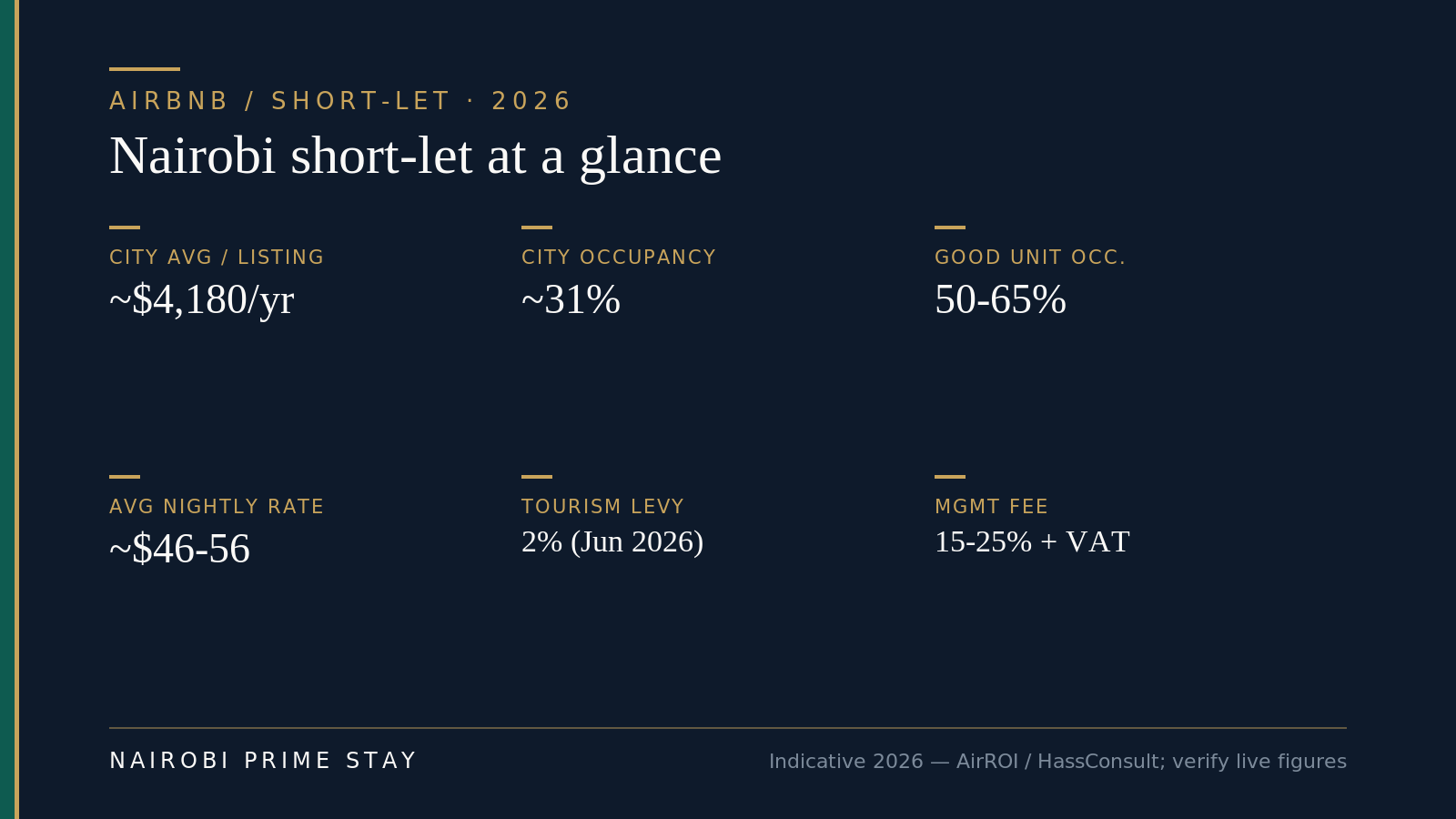 Indicative 2026 figures. City averages from AirROI; verify live data and confirm tax with the TRA and KRA.
Three numbers do the heavy lifting:
- Nightly rate (ADR). Nairobi’s city-wide average daily rate sits around $46–56 (roughly KES 6,000–7,200). Prime, well-furnished units charge far more — a premium one-bed in Westlands can fetch KES 8,000–15,000 a night ($62–116).
- Occupancy. The city-wide average is only about 31% across all listings, but that includes a huge tail of inactive and poorly run flats. A good unit in a strong area runs 50–65%. Kilimani’s neighborhood average is around 48%; premium Westlands units average closer to 60%.
- RevPAR (revenue per available night). This blends the two — rate times occupancy — and it’s the honest single number. A city-average RevPAR of about $18 is the reality check against a glossy “$100 a night!” listing that sits empty.
The trap is underwriting your purchase on 80% occupancy and a peak nightly rate. Use realistic numbers — 45–55% occupancy on a typical unit, the area’s average rate not its best night — and the math gets honest fast.
Two data sources are worth knowing, and they disagree. AirROI’s 2026 dataset (April 2025 to March 2026) puts the city at about 31% occupancy, a $56 average nightly rate and $18 RevPAR across roughly 3,700 active listings. AirDNA, which samples listings differently, reads rosier - closer to 42% occupancy at a $46 rate. They agree on the shape of the market, though: a long dead middle and a strong top. AirROI’s best decile of listings clears 75%+ occupancy, clustered in Riverside, Westlands and Upper Hill - proof that the city average is the floor for a poorly run flat, not the ceiling for a good one.
Where short-lets actually work in Nairobi
Short-lets work where there’s steady, repeating demand from people who’ll pay a premium for a furnished home over a hotel: relocating staff, corporate travelers, medical visitors, and leisure guests. That demand clusters in a handful of areas.
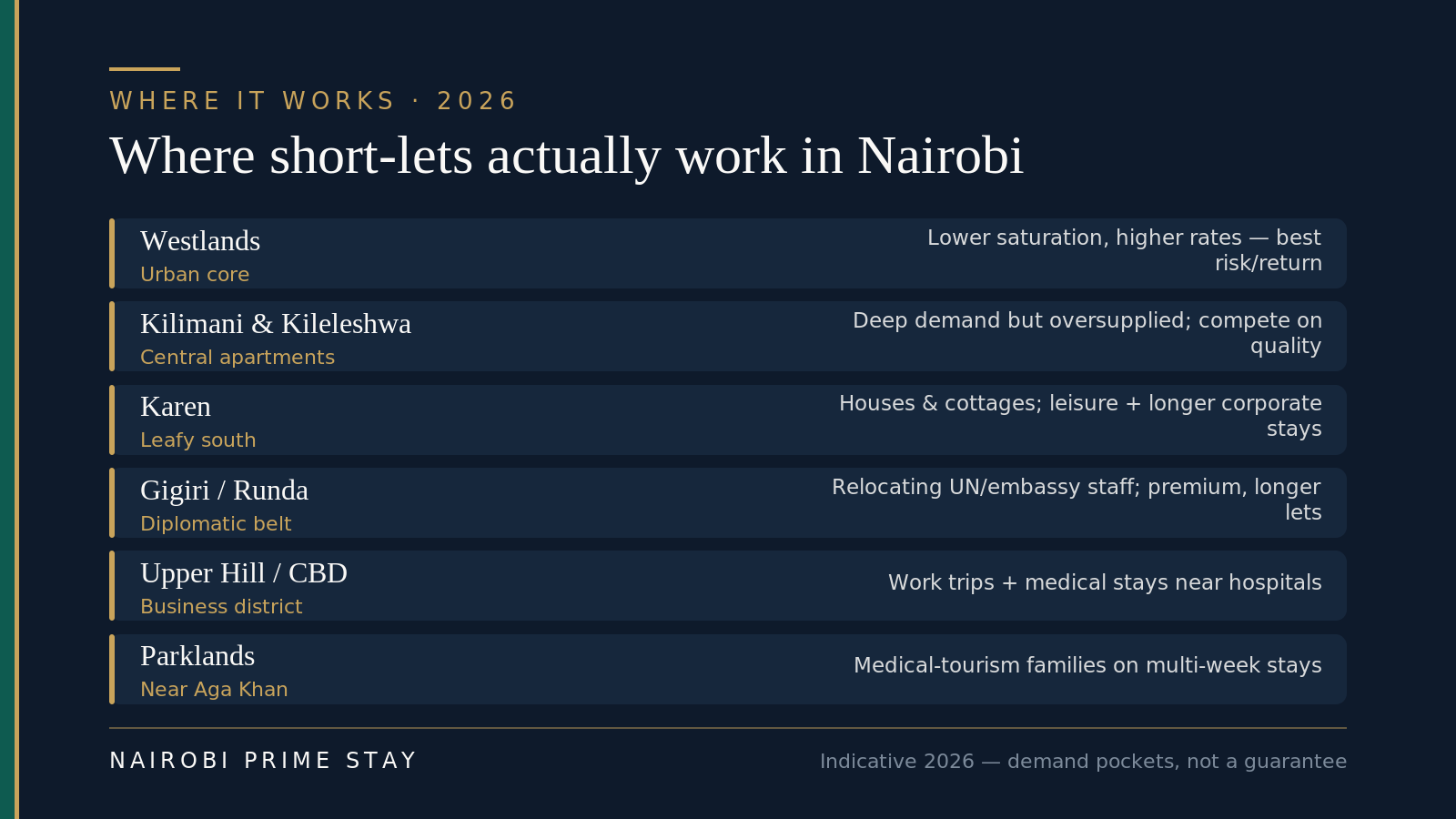 Demand pockets as of 2026 — strong areas, not a guarantee. Always check the saturation on your specific street.
- Westlands is the best risk/return area in 2026. It’s the city’s social and business core — restaurants, offices, nightlife, malls — with strong guest quality and lower saturation than Kilimani. Premium one-beds command the highest rates in this list.
- Kilimani and Kileleshwa have the deepest demand and the worst oversupply. Generic “beige box” apartments now compete on price in a race nobody wins. You can still do well here, but only with a genuinely better unit — design, light, a view, a real desk — not another identical flat.
- Karen suits houses, cottages and garden units. Demand skews to leisure guests, families and longer corporate or relocation stays rather than one-nighters. Higher nightly rates, lower volume.
- Gigiri and Runda (the diplomatic belt) draw relocating UN, embassy and NGO staff who need a furnished base for a few weeks while they find a home — exactly the serviced-apartment soft landing we run. Premium rates, longer average stays, quieter turnover.
- Upper Hill and the CBD capture business travelers and medical visitors near the hospitals and HQs. Steady mid-week demand, weaker weekends.
- Parklands and the streets around Aga Khan University Hospital have a specific, reliable niche: medical-tourism families on multi-week stays. Lower glamour, very loyal demand. The same logic applies near The Nairobi Hospital in Upper Hill.
For an investor’s view of which areas have rental demand and growth, cross-read our best areas to invest in Nairobi guide — the short-let map and the buy-to-let map overlap, but they’re not identical.
Nightly rate and occupancy by area (indicative 2026)
| Area | Indicative nightly (furnished) | Typical occupancy | Who’s booking |
|---|---|---|---|
| Westlands | KES 8,000–15,000 ($62–116) | ~55–60% | Corporates, social travelers, expats |
| Kilimani / Kileleshwa | KES 5,000–8,000 ($39–62) | ~45–50% | Young pros, regional visitors — but oversupplied |
| Karen | KES 8,000–18,000 ($62–140) | ~40–50% | Families, leisure, longer corporate stays |
| Gigiri / Runda | KES 9,000–18,000 ($70–140) | ~45–55% | Relocating UN/embassy staff, diplomats |
| Upper Hill / CBD | KES 4,500–7,000 ($35–54) | ~45–55% | Business travel, medical visitors |
| Parklands (near hospitals) | KES 5,000–9,000 ($39–70) | ~50–60% | Medical-tourism families, longer stays |
Rates are for well-furnished units and vary by finish, view, building and season. Verify current numbers on AirDNA or AirROI for your exact street before you buy.
Short-let vs long-let: the honest trade-off
The real decision isn’t “Airbnb or nothing.” It’s “Airbnb or a simple 12-month tenancy on the same flat.” Short-let wins on gross income and flexibility; long-let wins on effort, predictability and cost. Here’s the trade-off at a glance:
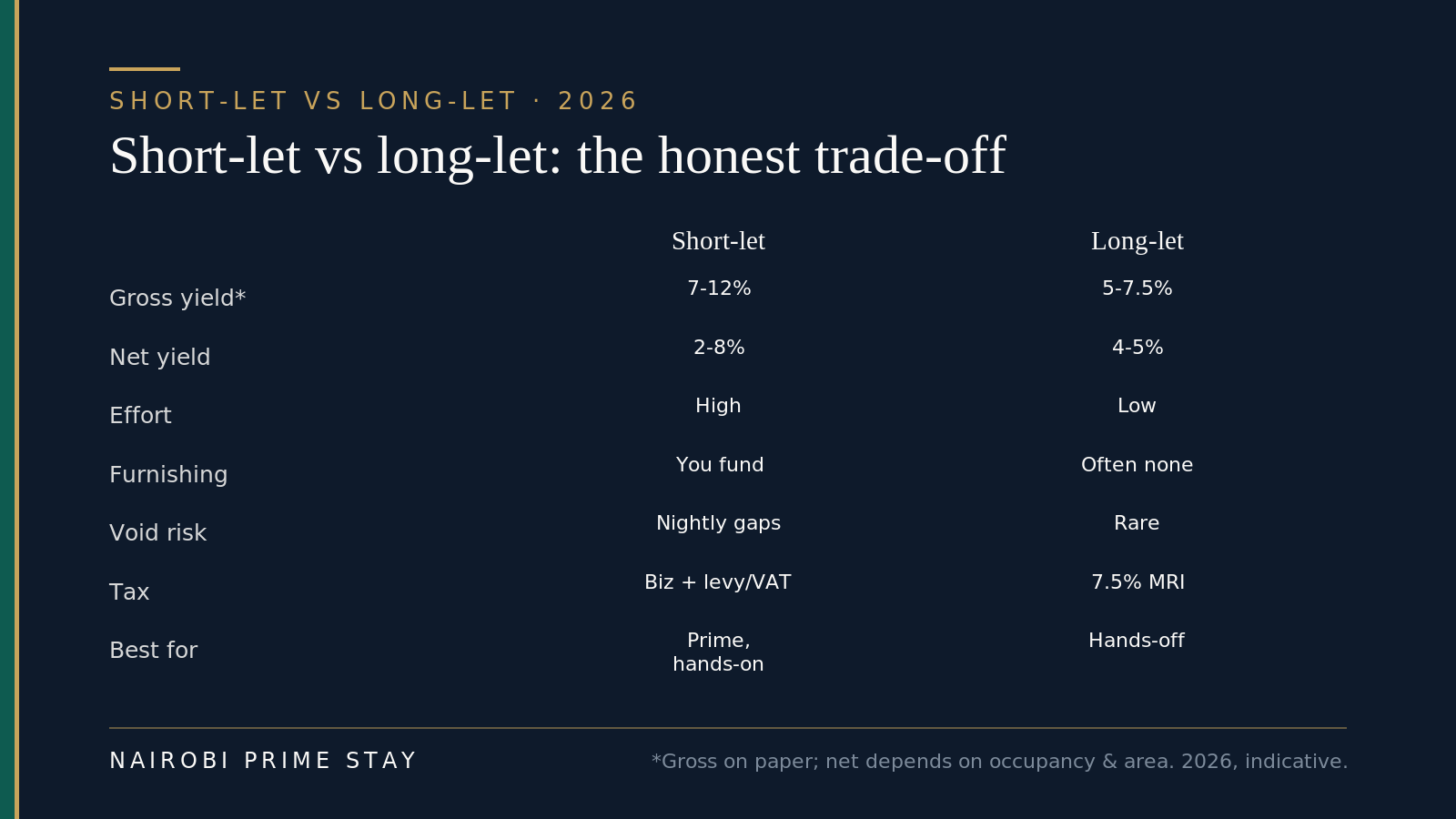 Gross figures are “on paper”; net depends heavily on occupancy and area. Indicative 2026.
The key insight: short-let almost always grosses more and often nets less. The higher nightly income is real, but so are the furnishing, utilities, cleaning, management and turnover costs that a long-let simply doesn’t have. Whether short-let comes out ahead depends on whether your occupancy and rate are high enough to clear that extra cost base. In a low-saturation premium area, they usually are. In an oversupplied one at average occupancy, they often aren’t.
Worked example: the same Kilimani two-bed, two ways
Take a real-world Kilimani two-bed bought for KES 14 million. In our buy-to-let guide we let it long-term for KES 90,000 a month — a 7.7% gross yield that nets about 4.9% after costs and tax. Now run the same flat as a furnished short-let at a realistic KES 7,000 a night and 50% occupancy:
| Same KES 14M Kilimani 2-bed | Long-let | Short-let (KES 7,000/night, 50% occ.) |
|---|---|---|
| Headline | KES 90,000/month | KES 7,000/night |
| Annual gross | KES 1,080,000 | ~KES 1,280,000 |
| Gross yield | 7.7% | ~9.1% |
| Annual running costs | ~KES 380,000 | ~KES 944,000 |
| Of which furnishing/replacements | — | ~KES 200,000 |
| Net income (before income tax) | ~KES 700,000 | ~KES 336,000 |
| Net yield | ~4.9% | ~2.4% |
| Your time | A few hours a year | A few hours a week |
Read that twice. The short-let grosses about KES 200,000 more — and nets about half. At average Kilimani occupancy, furnishing, utilities, cleaning, a 20% manager and the new levy eat the extra income and then some. You did much more work for a lower return.
Now the other side of the honesty: change the inputs and short-let wins. Put the same capital into a lower-saturation Westlands one-bed at KES 10,000 a night and 60% occupancy, and gross revenue jumps toward KES 2.1–2.5 million — enough that even after the heavier cost base, net yield can reach 6–8%, clearly beating the long-let. The strategy isn’t good or bad in the abstract. It’s good in the right building at the right occupancy, and bad in the wrong one.
The break-even is roughly 65–70% occupancy. On that Kilimani flat at KES 7,000 a night, you’d need to fill about two nights in three — above Nairobi’s realistic average — just to match what the long-let nets with almost no effort. That single number is the most useful sanity check in this guide: if you can’t credibly hit it, let it long-term.
The other worked example: a Westlands one-bed that wins
Flip the inputs in short-let’s favor and the math flips with them. Take the same KES 14 million, but buy a smaller, prime one-bed in lower-saturation Westlands and run it well at KES 10,000 a night and 60% occupancy - credible for a genuinely good unit there, where AirROI’s strongest listings clear 75%+ of nights. Here’s that winner beside the losing Kilimani flat:
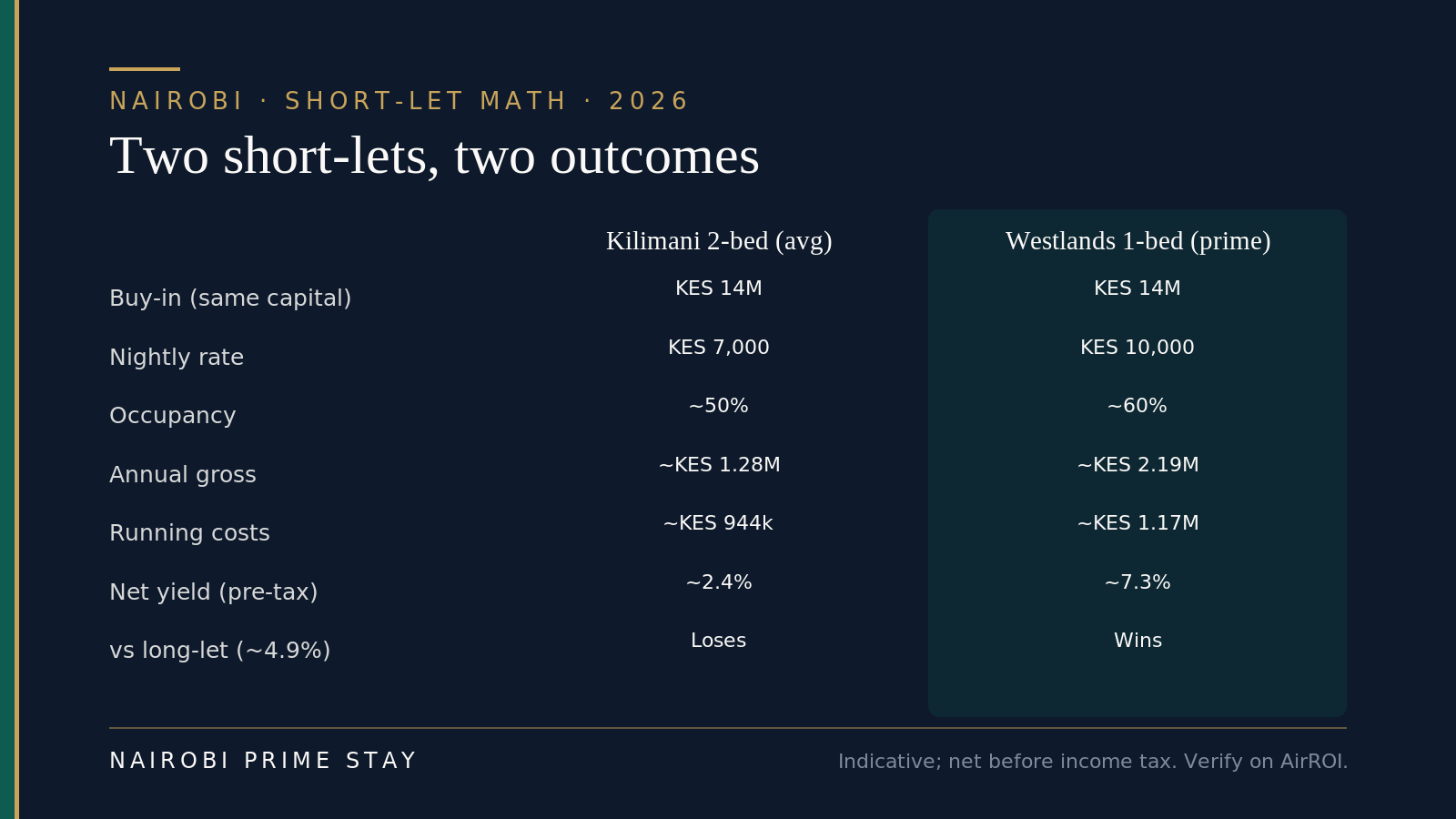 Same KES 14M, two different units. Indicative 2026; net is before income tax. Verify your exact street on AirROI.
| Same KES 14M, deployed two ways | Kilimani 2-bed (average) | Westlands 1-bed (prime) |
|---|---|---|
| Nightly rate | KES 7,000 | KES 10,000 |
| Occupancy | ~50% | ~60% |
| Annual gross | ~KES 1.28M | ~KES 2.19M |
| Running costs | ~KES 944,000 | ~KES 1.17M |
| Net income (pre-tax) | ~KES 336,000 | ~KES 1,016,000 |
| Net yield | ~2.4% | ~7.3% |
| vs long-let (~4.9%) | Loses | Wins |
Same capital, opposite result. The Westlands unit grosses nearly twice the Kilimani flat and, even after a heavier cost base, nets around 7.3% - comfortably ahead of the long-let’s 4.9%. Its gross yield (about 15%) sits above the usual 7-12% band precisely because a prime nightly rate is high, which is exactly why net, not gross, is the only number worth trusting. Nothing changed but location, unit size and occupancy. That’s the whole short-let thesis in one table: the strategy doesn’t win or lose, the building and the occupancy do.
The costs that quietly eat short-let returns
Short-let owners almost always overestimate income and underestimate cost. Here’s the full list, so you can budget honestly:
- Management: 15–25% of revenue (plus 16% VAT), versus 5–10% for a long-let. A short-let manager handles listings, pricing, guest messaging, check-ins, cleaning coordination and reviews — a real job. Self-managing from abroad is not realistic.
- Furnishing and replacements. Furnishing a two-bed to a bookable standard costs KES 800,000–1.2 million. Spread over ~5 years, plus the steady replacement of linens, crockery and worn pieces, that’s ~KES 150,000–250,000 a year most people forget entirely. It’s the single biggest hidden cost.
- Utilities you now pay. Power, water, fast fibre internet and often DSTV are on you, not the tenant — budget KES 10,000–15,000 a month.
- Cleaning and laundry between every stay. Some is recovered via the guest cleaning fee, but turnover still costs you, especially on one- and two-night bookings.
- Consumables — toiletries, coffee, a welcome basket — the small touches that protect your reviews.
- Platform fees. Airbnb’s host-only fee is around 3% of each booking; other models charge guests more but affect your conversion.
- Service charge, land rates and insurance — the same fixed building costs as a long-let, plus higher wear-and-tear from constant turnover.
- Voids. Not month-long gaps, but the empty nights between bookings — which is exactly what a sub-50% occupancy rate is.
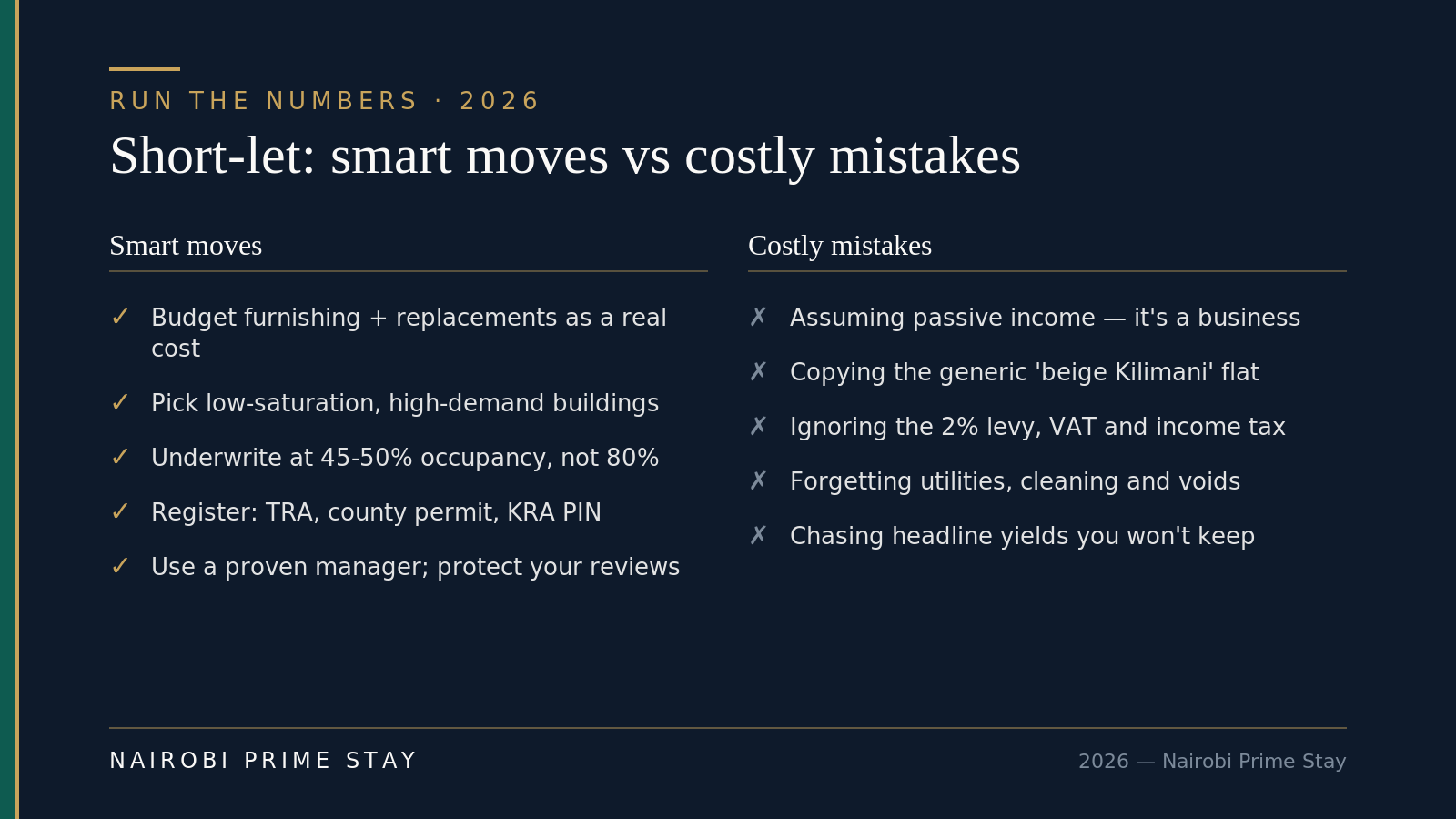 The difference between a short-let that works and one that doesn’t is usually in this list, not the nightly rate.
If you’d rather not run the business yourself, a professional property manager in Nairobi can operate the short-let for you — at a cost that, as the worked example shows, has to be earned back in higher occupancy.
What it takes to furnish a short-let that books
A short-let lives on its listing, and the listing lives on the unit. Guests here compare your flat with hotels and serviced apartments, so the bar is “better than a good hotel room,” not “nicer than my last rental.” Furnishing a two-bed to that standard runs KES 800,000-1.2 million, and a few things are genuinely non-negotiable.
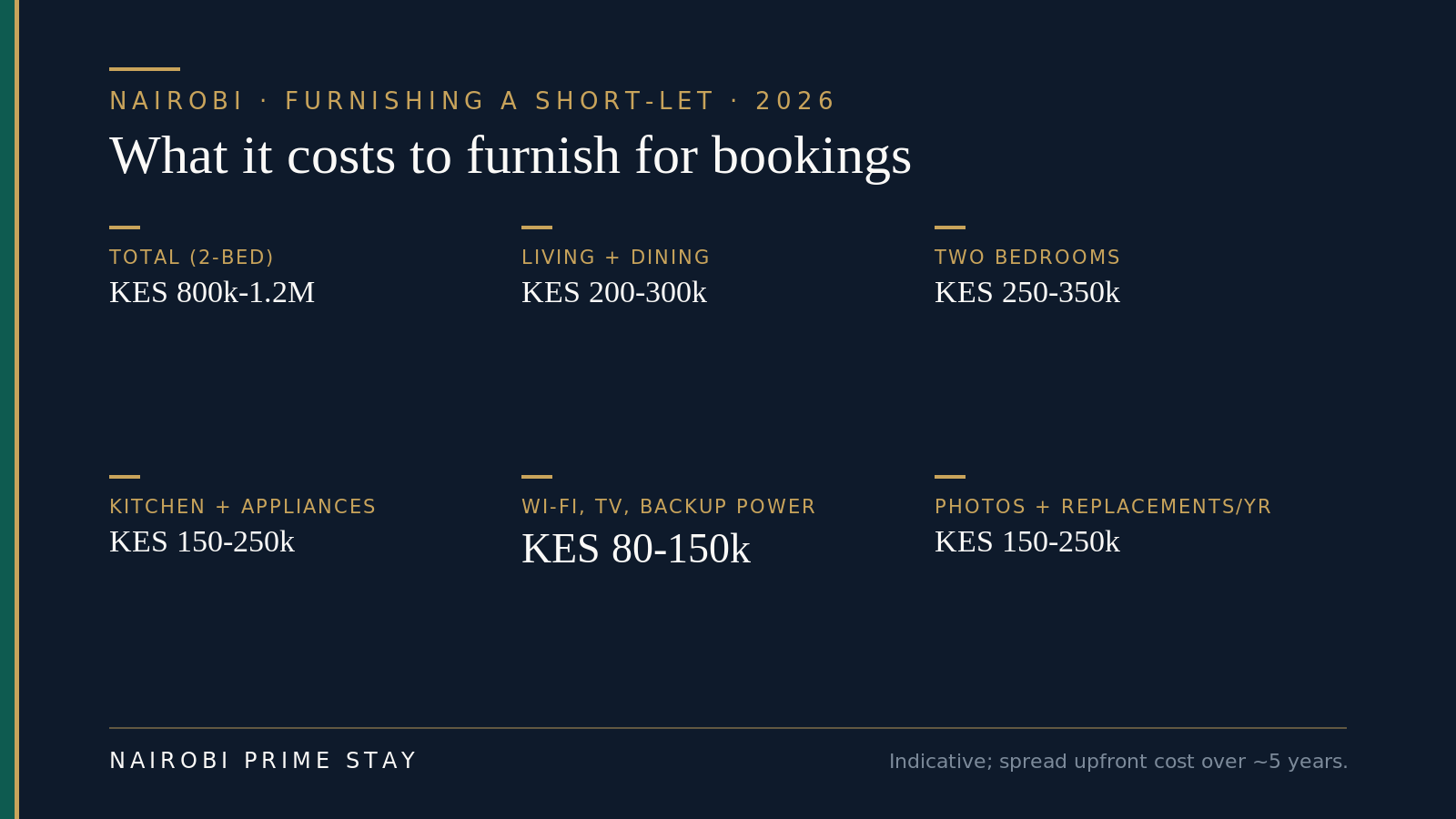 Indicative 2026 furnishing budget for a two-bed. Spread the upfront cost over about five years, then add replacements every year.
The non-negotiables are the ones guests punish you for missing: fast, reliable fibre Wi-Fi (remote workers book on this alone), a backup generator or inverter so a power cut doesn’t end the stay, a real desk and chair, a good mattress and blackout curtains, and a kitchen that actually works - kettle, fridge, hob, the basics stocked. After that, good light, professional photos and a clean, consistent look win the reviews that drive the next booking. Skip the clutter and the fragile decor; it just breaks.
Two decisions shape the budget. First, this is full, thoughtful furnishing - a different job from a furnished long-let, and our guide to furnishing a home in Nairobi covers where to buy and what to spend. Second, budget the replacements - linens, crockery, a tired sofa, a cracked screen. Constant turnover ages a unit fast, so set aside KES 150,000-250,000 a year from day one. The owners who skip that line are the ones whose reviews slide in year two.
Licensing, regulation and tax (the rules are tightening)
Kenya’s short-let rules are moving from loose to formal, fast. As of 2026, plan for four things, and confirm each against the official source — this is general information, not legal or tax advice.
- Tourism Regulatory Authority (TRA) registration. The TRA licenses accommodation establishments, and the clear direction is toward requiring all short-term-rental operators to register. If you run more than one or two units commercially, you should expect to register as an accommodation establishment now. A single unit let occasionally still sits in a grey area that isn’t firmly enforced — but that’s changing. Check tra.go.ke.
- County Single Business Permit. Operating a short-let is a business, so Nairobi City County requires a Single Business Permit. This is separate from, and additional to, TRA registration.
- The 2% tourism levy (now in force). At the end of June 2026 the tourism levy under the Tourism Act (2011) expanded to cover Airbnb, Booking.com and other short-term rentals — 2% of your booking turnover, remitted to the Tourism Fund through its eLevy portal once you’ve registered with the TRA, on top of income tax. Budget it in, and confirm the current mechanics at tourismfund.go.ke.
- Income tax and VAT. Short-let income is generally treated as business income — taxed on profit, with expenses deductible — not under the 7.5% Monthly Rental Income (MRI) regime that covers long-term residential rent (see property taxes in Kenya for that distinction). If your short-let turnover exceeds KES 5 million a year, you must also register for and charge 16% VAT (KRA has proposed scrapping this KES 5 million threshold so every business would register - not yet law as of 2026, so confirm the current rule). KRA is increasingly matching data from digital platforms to host income, so informal “off-the-books” letting is a shrinking option.
The takeaway isn’t that short-let is over-regulated — it’s that the easy, untaxed early days are ending, and your numbers must assume the levy, the permits and the tax. Get a Kenyan tax adviser before you list.
Running it from the US: management, payouts and tax
You can’t run a Nairobi short-let from another continent by yourself - the check-ins, cleaning turnarounds, guest messages and the occasional 2 a.m. problem all happen locally. For a diaspora or US-based owner, a good local operator is the difference between a real return and a slow headache. Here’s how the remote setup actually works.
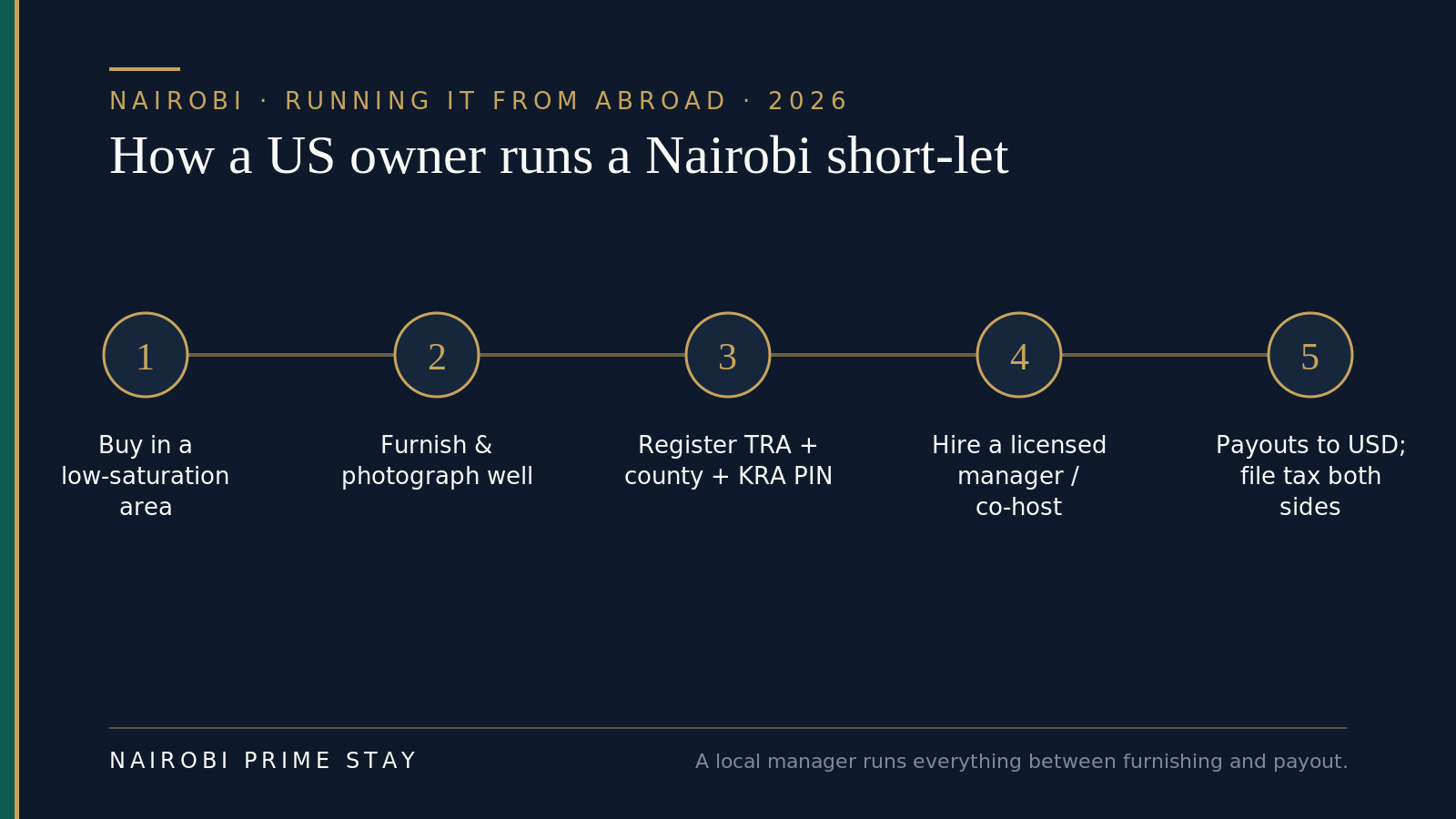 The remote-owner workflow. A licensed local manager handles everything between furnishing and payout.
Management is the keystone. A full-service short-let manager or an Airbnb co-host runs the listing, pricing, guest vetting, check-ins, cleaning and reviews for 15-25% of revenue plus 16% VAT - more than a long-let agent’s 5-10%, because it’s far more work. Vet them like a business partner: ask for their real occupancy numbers, their cleaning bench, and how they handle a bad guest. A property manager in Nairobi can run the whole operation, but, as the worked example showed, that fee has to be earned back in higher occupancy.
Getting paid. Airbnb and Booking.com pay out to a bank account you nominate - Kenyan or international - in the currency you choose. If you take payouts in shillings and spend in dollars, the USD/KES rate (~129.5 in mid-2026) moves your real return, and converting or sending money back costs a spread. Many owners keep a Kenyan account for local costs and sweep the profit out periodically.
Tax on both sides. Your Kenyan obligations are real - business income tax on profit, the 2% levy, VAT above KES 5 million, the county permit - and a local accountant should file them. But as a US citizen or green-card holder you’re taxed on worldwide income, so the same rental appears on your US return too. There’s no comprehensive US-Kenya tax treaty, so you lean on the US foreign tax credit to avoid being taxed twice. This is a genuine two-country picture - use an adviser who handles cross-border returns, and read our taxes for expats in Kenya primer alongside the diaspora property investment guide. This is general information, not tax advice.
The honest risks
- Oversupply. Too many new apartments chased the short-let dream in Kilimani and Kileleshwa, pushing occupancy and rates down. Adding another generic unit to a saturated street is the most common way to lose money here.
- Regulation and tax tightening. The levy, TRA registration, county permits and KRA’s data-matching all arrived or firmed up recently. Margins that looked fine in 2023 are thinner in 2026.
- Seasonality and events. Demand swings with conferences, holidays and the safari calendar. Slow months are real — a Westlands unit might earn KES 140,000–200,000 in a strong month and KES 80,000–100,000 in a weak one.
- Reviews are your business. A run of bad reviews, or a delisting, can halve your bookings overnight. This is reputation management, not landlording.
- Wear, breakage and the occasional bad guest. Constant turnover ages a flat faster and brings the rare party or no-show. Insurance and a deposit help, but don’t eliminate it.
- Currency and exit. Your costs are in shillings; if you measure returns in dollars, the USD/KES rate (~129.5 in mid-2026) moves your numbers. And a furnished short-let isn’t always quicker to sell than an ordinary flat.
Who short-let suits — and who should skip it
Short-let is a genuinely good fit for some owners and a poor one for others. Be honest about which you are.
It suits you if you’re hands-on or willing to pay a great manager; you’re buying in a low-saturation, high-demand area; you want flexibility to use the place yourself; and you can fund furnishing and ride out slow months without stress.
Skip it if you want truly passive income; you’re buying in an oversupplied area “because everyone’s doing Airbnb”; your numbers only work at 70%+ occupancy; or the furnishing and management costs would tip a thin deal into a loss. In those cases a long-term buy-to-let earns more for less effort.
A pre-purchase checklist
Before you commit to a short-let, work through this:
- Pull real occupancy and ADR for your exact street on AirDNA or AirROI — not the city average.
- Underwrite the deal at 45–55% occupancy and the area’s average nightly rate.
- Budget furnishing (KES 800k–1.2m) and annual replacements as real costs.
- Add the full running stack: utilities, cleaning, management (15–25% + VAT), platform fees, service charge, rates, insurance.
- Include the 2% tourism levy, income tax, and 16% VAT if turnover tops KES 5m.
- Compare the net result with the same flat let long-term — does short-let actually win?
- Confirm licensing: TRA registration and a county Single Business Permit.
- Line up a proven short-let manager and a reliable cleaner before you list.
- Check the building and lease allow short-letting — many newer managed estates now restrict it.
- Register a KRA PIN and get a tax adviser.
Short-let pros and cons
| Pros | Cons |
|---|---|
| Higher gross income than a long-let | Higher costs — often nets less |
| Flexibility to use or block the unit | Hands-on; a real small business |
| Furnished premium from corporates/relocators | Furnishing is a big upfront + ongoing cost |
| Dynamic pricing captures peak demand | Occupancy and rates swing with season |
| Strong in low-saturation prime areas | Oversupply has crushed parts of Kilimani |
| Diversifies who you can rent to | Tightening levy, VAT, TRA and county rules |
Final thoughts
An Airbnb in Nairobi can be a good investment in 2026 — but it’s a business, not a yield you collect in your sleep. The owners who do well buy in the right area, furnish properly, underwrite on realistic occupancy, register and pay their taxes, and either run it seriously or hire someone who does. The owners who struggle bought a generic flat in an oversupplied street, believed an 80%-occupancy brochure, and forgot the furnishing bill.
So run the honest version of the numbers first. If your unit can credibly clear ~65% occupancy in a low-saturation area, short-let can beat a long-let and give you flexibility too. If it can’t, a simple 12-month tenancy will quietly out-earn it with a fraction of the work. Either answer is fine — just make it with the real figures, not the brochure ones. This is general information, not financial, legal or tax advice; confirm current rules and rates with the TRA, KRA and a licensed adviser.
Related reading
- Property investing in Kenya: the complete guide — the pillar that ties the whole cluster together.
- Buy-to-let in Nairobi: yields and the real ROI — the simpler, more passive alternative, with the long-let worked example.
- Best areas to invest in Nairobi real estate — where the demand and growth actually are.
- Serviced apartments in Nairobi — how the professional end of short-let operates.
- Property management in Nairobi — agents, fees and what a manager really does.
- Property taxes in Kenya — MRI vs business income, VAT and rates.
- Nairobi property prices in 2026 — what units actually cost going in.
- Moving to Nairobi: the complete guide — the hub for everything relocation.
- Furnishing a home in Nairobi — what to buy and budget to reach a bookable standard.
- Diaspora property investment in Kenya — owning and earning from the US.
- The USD/KES currency guide — what the exchange rate does to a dollar-measured return.
Thinking about a soft landing instead of a landlord business?
Plenty of people researching an Airbnb investment are really just moving to Nairobi and want a furnished base while they settle. That’s exactly what we do — handpicked serviced apartments across Gigiri, Westlands, Kilimani and Karen, all-inclusive (Wi-Fi, cleaning, generator, security), with a $50 deposit to reserve and the balance on arrival. If you’d rather someone shortlist options around your budget and commute, our AI relocation assistant can do it in a couple of minutes, day or night.
Frequently asked questions
Is an Airbnb in Nairobi a good investment in 2026?
It can be, but it’s a hands-on business, not passive income. A well-furnished unit in a low-saturation area like Westlands, run properly at 50-65% occupancy, can net more than a long-term rental. But the city-wide average is only about 31% occupancy and roughly $4,180 a year per listing, and oversupplied areas like Kilimani have thin margins. Short-let rewards the right area, real furnishing and active management; in the wrong spot a simple 12-month let earns more for less work.
How much can a Nairobi Airbnb earn?
It varies enormously. The city-wide average is about $4,180 a year per listing at roughly 31% occupancy, but that includes many dormant flats. A good Westlands one-bed at KES 8,000-15,000 a night and around 60% occupancy can gross about KES 200,000 a month and net KES 70,000-120,000 after costs. Underwrite on realistic occupancy of 45-55% for a typical unit, not an 80% brochure figure.
What occupancy rate can I expect for a Nairobi short-let?
Plan for 45-55% on a typical unit and 50-65% on a strong, well-managed one in a good area. Nairobi’s all-listing average is only about 31%, dragged down by inactive and poorly run flats, while the strongest decile of listings clears 75%+ in areas like Riverside, Westlands and Upper Hill. Anyone promising you 80% sight-unseen is selling, not forecasting.
Where are the best areas for short-lets in Nairobi?
Westlands offers the best risk/return in 2026 - lower saturation, higher rates and strong guest quality. Karen suits houses and longer leisure or corporate stays; Gigiri and Runda draw relocating UN and embassy staff; Upper Hill, the CBD and Parklands near the big hospitals capture business and medical visitors. Kilimani and Kileleshwa have deep demand but heavy oversupply, so only a genuinely better unit stands out.
Is short-let or long-let more profitable in Nairobi?
Short-let almost always grosses more and often nets less. On a KES 14 million Kilimani two-bed, a long-let nets about 4.9%, while the same flat as a short-let at 50% occupancy nets only about 2.4% after furnishing, utilities, cleaning and management. You’d need roughly 65-70% occupancy just to match the long-let. But put the same capital into a prime Westlands one-bed at 60% occupancy and short-let pulls ahead, netting around 7.3% - it depends on occupancy, rate and area.
Do I need a license to run an Airbnb in Kenya?
Increasingly, yes. You need a county Single Business Permit, and the Tourism Regulatory Authority (TRA) now requires short-term-rental operators to register, which is also the first step to paying the new 2% tourism levy. A single unit let occasionally still sits in a grey area, but enforcement is tightening. Confirm current requirements at tra.go.ke and with Nairobi City County.
How is Airbnb income taxed in Kenya?
Short-let income is generally treated as business income - taxed on profit with expenses deductible - not under the 7.5% Monthly Rental Income regime that covers long-term residential rent. Since the end of June 2026 a 2% tourism levy also applies to your booking turnover, remitted to the Tourism Fund, and if turnover tops KES 5 million a year you must register for and charge 16% VAT. KRA is matching data from booking platforms to host income, so get a tax adviser. This is general information, not tax advice.
What are the biggest risks of short-let investing in Nairobi?
Oversupply is the main one - too many identical apartments in Kilimani and Kileleshwa have pushed occupancy and rates down. Add tightening regulation and tax (the new levy, TRA registration, VAT), seasonality with real slow months, reliance on guest reviews, and faster wear from constant turnover. The single biggest mistake is underwriting on optimistic occupancy and forgetting the furnishing and running costs.
Can I run a Nairobi Airbnb from the US?
Not by yourself - check-ins, cleaning and guest issues are all local. Hire a full-service short-let manager or an Airbnb co-host to handle the listing, pricing, guests and cleaning for about 15-25% of revenue plus 16% VAT. You still register with the Tourism Regulatory Authority, get a county Single Business Permit and a KRA PIN, and you choose where payouts land and in which currency. Build the manager’s fee into your numbers - it has to be earned back in higher occupancy.
Do I have to pay the 2% tourism levy on my short-let?
Yes. Since the end of June 2026 the 2% tourism levy applies to short-term rentals like Airbnb and Booking.com, not just hotels. You register with the Tourism Regulatory Authority and remit 2% of your booking turnover to the Tourism Fund through its eLevy portal. It’s on top of income tax, the county permit and 16% VAT if your turnover tops KES 5 million a year. Confirm the current mechanics at tourismfund.go.ke.
How much does it cost to furnish a Nairobi short-let?
Budget KES 800,000-1.2 million to furnish a two-bed to a bookable standard, then KES 150,000-250,000 a year for replacements. The things guests won’t forgive you for missing are fast fibre Wi-Fi, backup power, a real desk, a good mattress and a working kitchen. Spread the upfront cost over about five years in your yield math - it’s the single most-forgotten short-let expense.
Ready to look?
Find your apartment in Nairobi
Browse verified serviced apartments, or ask the AI concierge which area fits your life.