
Guides · Property investment
Title Deeds in Kenya Explained: Freehold, Leasehold & Sectional (2026)
Title Deeds in Kenya Explained: Freehold, Leasehold & Sectional (2026)
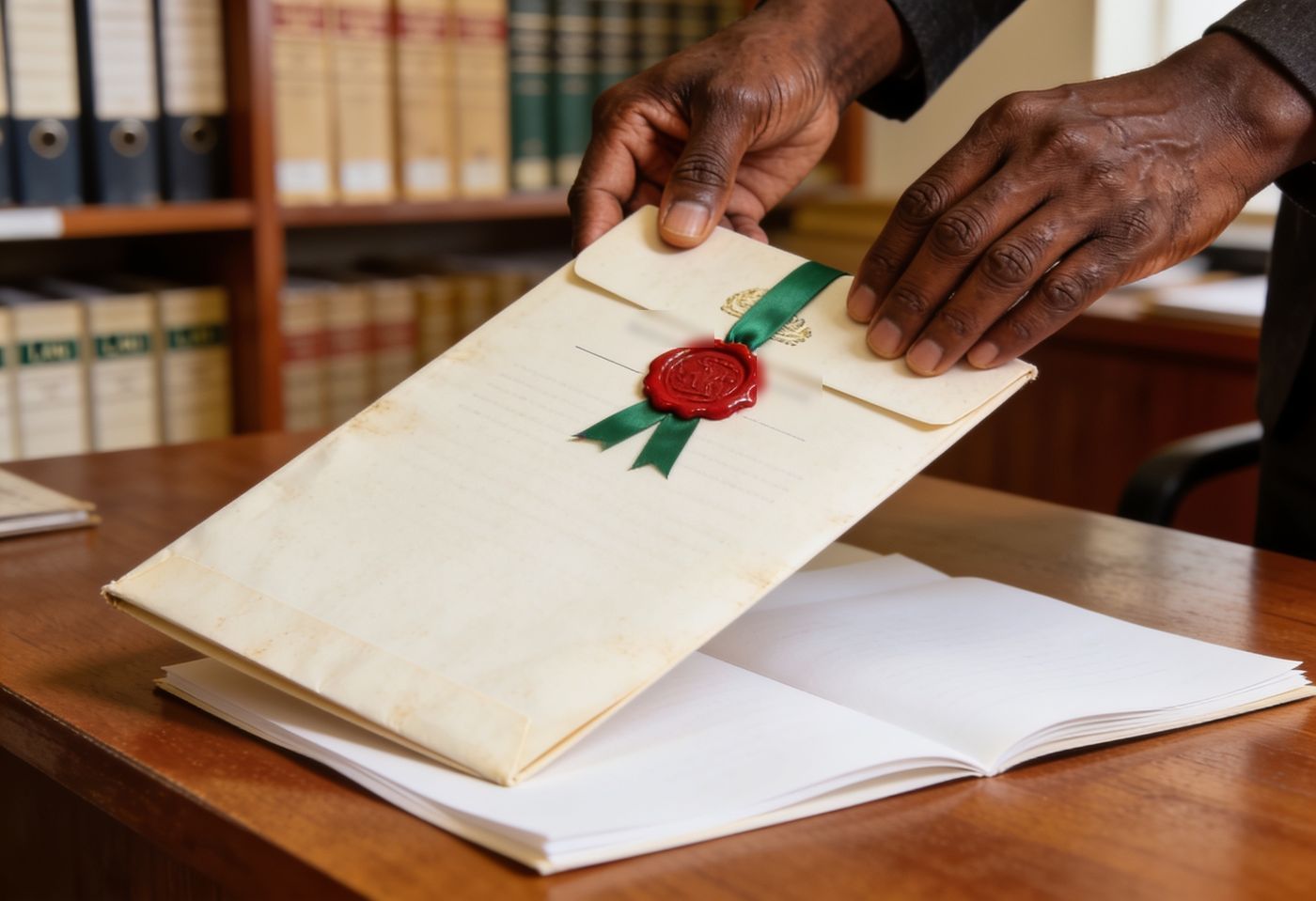
In Kenya, the kind of title you hold matters as much as the property itself. A title deed is the legal proof that you own a piece of land or a unit — and Kenya has a few different kinds. Freehold. Leasehold. Sectional title for apartments. The older “share certificate” you’ll still meet in some blocks. Each one gives you a different bundle of rights, a different document, and different yearly costs.
This guide explains every type in plain English, as of 2026. You’ll learn which title you’ll actually receive, what the paper should say, what foreigners can and can’t hold, and how to check a title is real before you part with a shilling. It’s written for Americans and other foreigners buying in Nairobi, but the law is the same countrywide.
One honest note up front: this is general information, not legal advice. Title is where Kenyan property deals go right or wrong, so engage a Kenyan advocate for your specific purchase. We’ll show you exactly what they should be checking.
TL;DR: Kenya has two underlying tenures — freehold (permanent, no time limit) and leasehold (a fixed term, usually 99 years, after which it reverts unless renewed). Your proof is either a Certificate of Title (freehold) or a Certificate of Lease (leasehold) under the Land Registration Act, 2012. Apartments now get their own sectional title under the Sectional Properties Act, 2020, which is replacing the old company share-certificate schemes. Non-citizens can only hold leasehold (max 99 years) — no freehold, no agricultural land — so a foreigner’s title is almost always a Certificate of Lease, often a sectional one for an apartment. Leasehold owners pay annual land rent to the national government; everyone pays land rates to the county. In Nairobi, titles are now digital on ardhisasa.
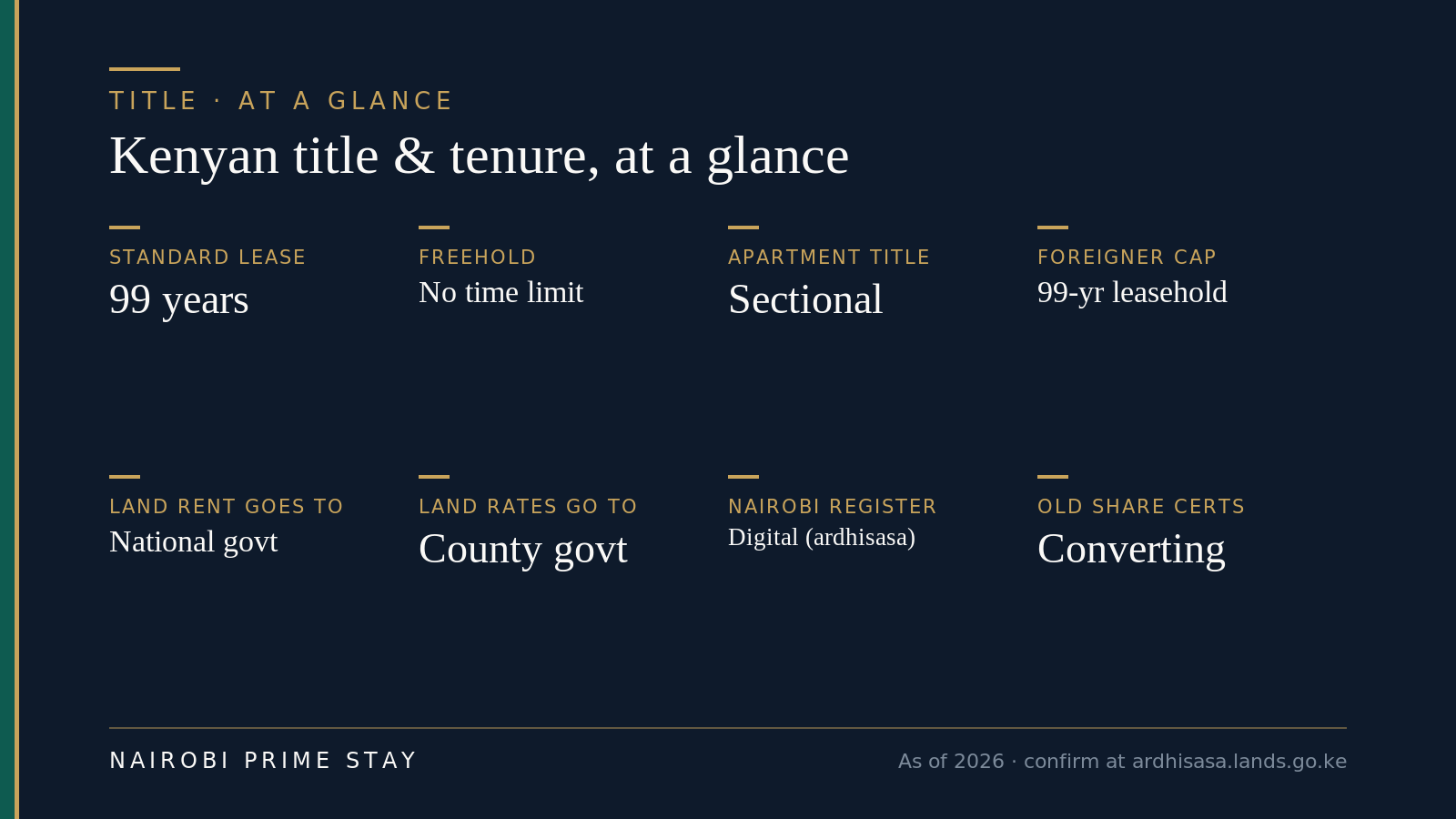 Kenyan title and tenure at a glance — the numbers and terms you’ll meet, as of 2026.
Why the type of title matters
Get the title wrong and everything else unravels. The type of title decides how long you own the property, whether you can pass it on freely, whether a bank will lend against it, what you pay each year, and — for a foreigner — whether you can legally hold it at all.
A clean, correctly registered title is also your best defense against Kenya’s most common property problem: fraud. Most scams come down to someone selling a title they don’t really hold, or a kind of “ownership” that isn’t ownership at all. Knowing what a real title looks like is half the protection. We go deeper on that in the guide to property scams in Kenya and the land due-diligence guide.
If you’re just orienting yourself, start with the complete guide to property investment in Kenya and the plain-English can foreigners buy property in Kenya? This article zooms in on the paper itself.
The two tenures: freehold and leasehold
Kenya has two basic kinds of land tenure, and every title flows from one of them.
Freehold is the closest thing to absolute ownership. There’s no time limit — you hold the land indefinitely, and it passes to your heirs. Freehold is common for residential land and farms, especially outside the big cities. Your document is a Certificate of Title. The catch for our readers: non-citizens cannot hold freehold. Under the Constitution, any attempt to grant a foreigner freehold automatically converts to a 99-year leasehold.
Leasehold means you hold the land for a fixed term, then it reverts to the owner (the “lessor”) unless the lease is renewed. The lessor is usually the national or county government, sometimes a private freeholder. Urban plots in Nairobi are typically leasehold. Terms you’ll see are 99 years (the modern standard), and on older grants 33, 50, or 66 years — and occasionally a 999-year lease that behaves almost like freehold. Your document is a Certificate of Lease.
Here’s the practical reality of leasehold. A 99-year lease is long, and leasehold is completely normal and bankable in Kenya — most prime apartments sit on it. But the clock is real. Always check the unexpired term before buying. A brand-new 99-year lease and one with 38 years left are very different assets. A short remaining term is harder to mortgage and resell, and renewal isn’t automatic.
Renewing a lease. When a government lease nears its end, you apply to extend it (for public land, through the National Land Commission). Renewal is usually granted to citizens for a fee, but it’s a process, not a guaranteed right — and for non-citizens it’s less certain. Apply early, ideally years before expiry. If you’re buying a leasehold with, say, under 45 to 50 years left, factor the cost and uncertainty of renewal into your offer.
Certificate of title vs certificate of lease
Since the Land Registration Act, 2012, Kenya folded a tangle of old title types into just two documents:
- A Certificate of Title proves ownership of freehold land.
- A Certificate of Lease proves ownership of leasehold land.
That’s the clean modern picture. Both are issued by the land registry, and both should carry a unique registration reference, the registered proprietor’s name, the size of the parcel, and a reference to the survey (the deed or registry map). For a foreigner, the document you receive will almost always be a Certificate of Lease, because that’s the only tenure you can legally hold.
Old titles vs new titles. Before 2012, land was registered under several different laws, each with its own paper — an RLA “title deed,” a “grant” under the old Government Lands Act, and others. Kenya has been migrating all of these onto one register and re-issuing them with new reference numbers (you’ll hear advocates mention C.R. numbers for freehold and I.R. numbers for leasehold). If you’re shown an old-style title, that isn’t automatically a red flag — but your advocate should confirm it’s still valid and check whether it needs to be converted before or at transfer. An official search will show the current, authoritative record either way.
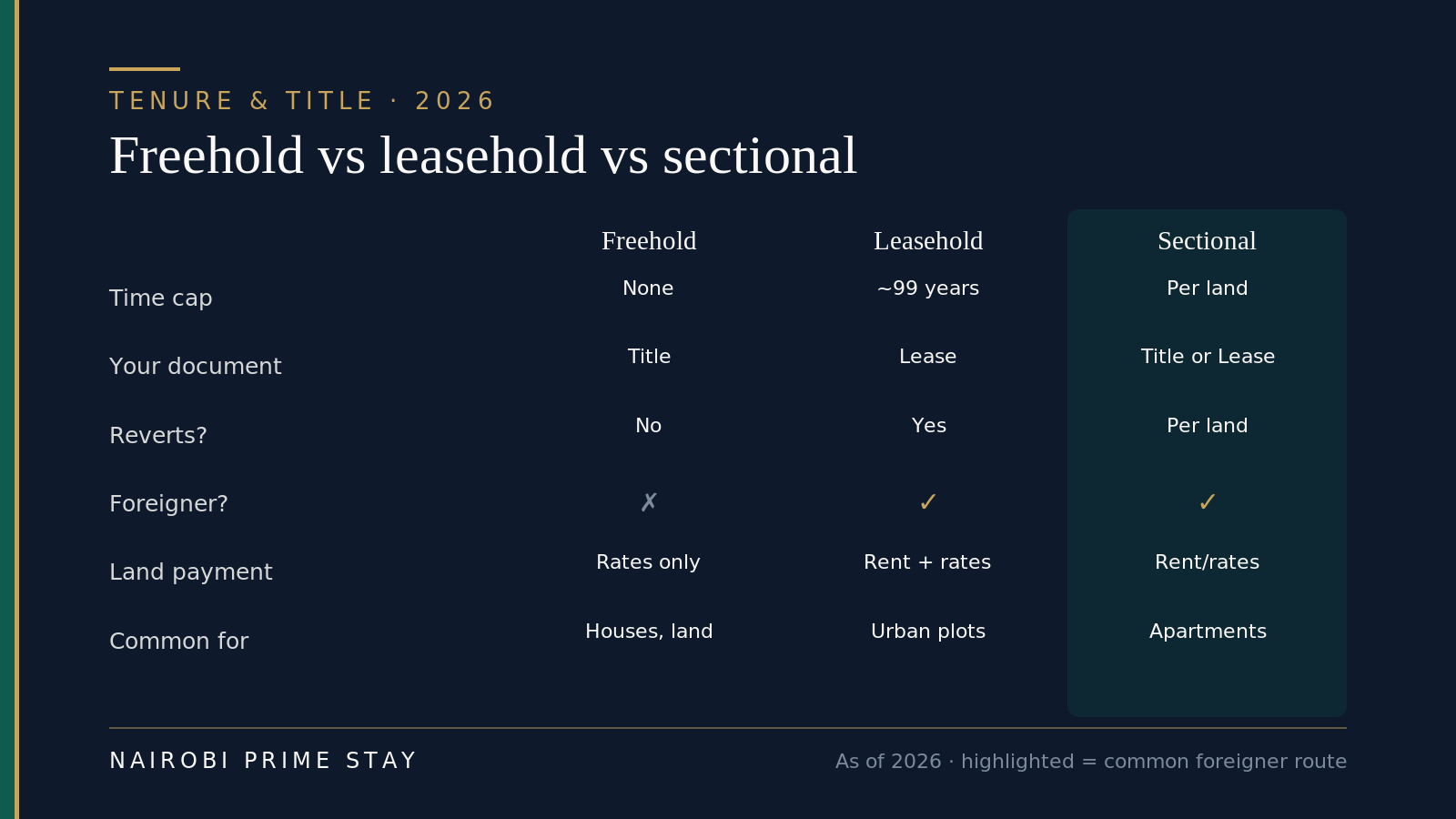 Freehold vs leasehold vs sectional title — time limits, documents, costs and what a foreigner can hold.
Sectional title: how apartments are owned
If you’re buying an apartment — which most of our readers are — you want a sectional title. It’s the modern, clean way to own a single unit in a multi-unit building.
A sectional title does two things at once. It gives you a registered title to your specific unit (your “section”), in your own name, plus an undivided share in the common property — the corridors, grounds, lifts, parking and so on. Your unit’s certificate even records that share. Because the unit sits on its own title, you can sell it, mortgage it, or pass it on like any other property.
This comes from the Sectional Properties Act, 2020, which replaced a 1987 law and is now the standard for flats, maisonettes, townhouses and offices that share common areas. Depending on the underlying land, your sectional title will be a Certificate of Title (if the land is freehold) or a Certificate of Lease (if it’s leasehold). For a foreigner buying an apartment on leasehold land — the usual case in Nairobi — you get a sectional Certificate of Lease in your own name. That’s the clean route into Kenyan property, and it’s exactly why apartments suit foreign buyers.
The old “share certificate” — and why it’s being phased out
You’ll still meet older apartment blocks sold on a share certificate, and you should understand the difference, because it’s a real one.
Under the old scheme, a company owned the whole building on one “head” title. When you “bought” a unit, you didn’t get a title to the apartment. You got shares in that company, plus a long-term sublease, which together gave you the right to live in a particular unit. On paper you were a shareholder, not a registered property owner.
That’s weaker in several ways. It’s harder to mortgage — many banks won’t lend against shares as readily as a title. It can be harder to sell, because the next buyer faces the same hesitation. And your security depends on the company being well run and its records clean. If the company’s affairs are a mess, so is your “ownership.”
The 2020 Act set out to fix this by requiring these old long-term-lease and share-certificate setups to convert to proper sectional titles, so every owner ends up with a real, individual title. The law set a two-year window — a deadline in December 2022 — but in practice conversion is still working through the system in 2026, and plenty of older blocks haven’t completed it. Here’s what changed by 2026, and why it matters to you: lenders stopped waiting. Banks now scrutinize apartment titles closely and increasingly treat an unconverted share certificate or long sublease as defective security — which can mean you cannot get a mortgage against it, and neither can the person you eventually sell to. So the honest advice: if you’re looking at an older apartment, ask exactly what title you’ll receive. A sectional title in your name is what you want. If it’s still a share certificate, treat that as a point to raise with your advocate — and ideally make conversion the seller’s job before completion.
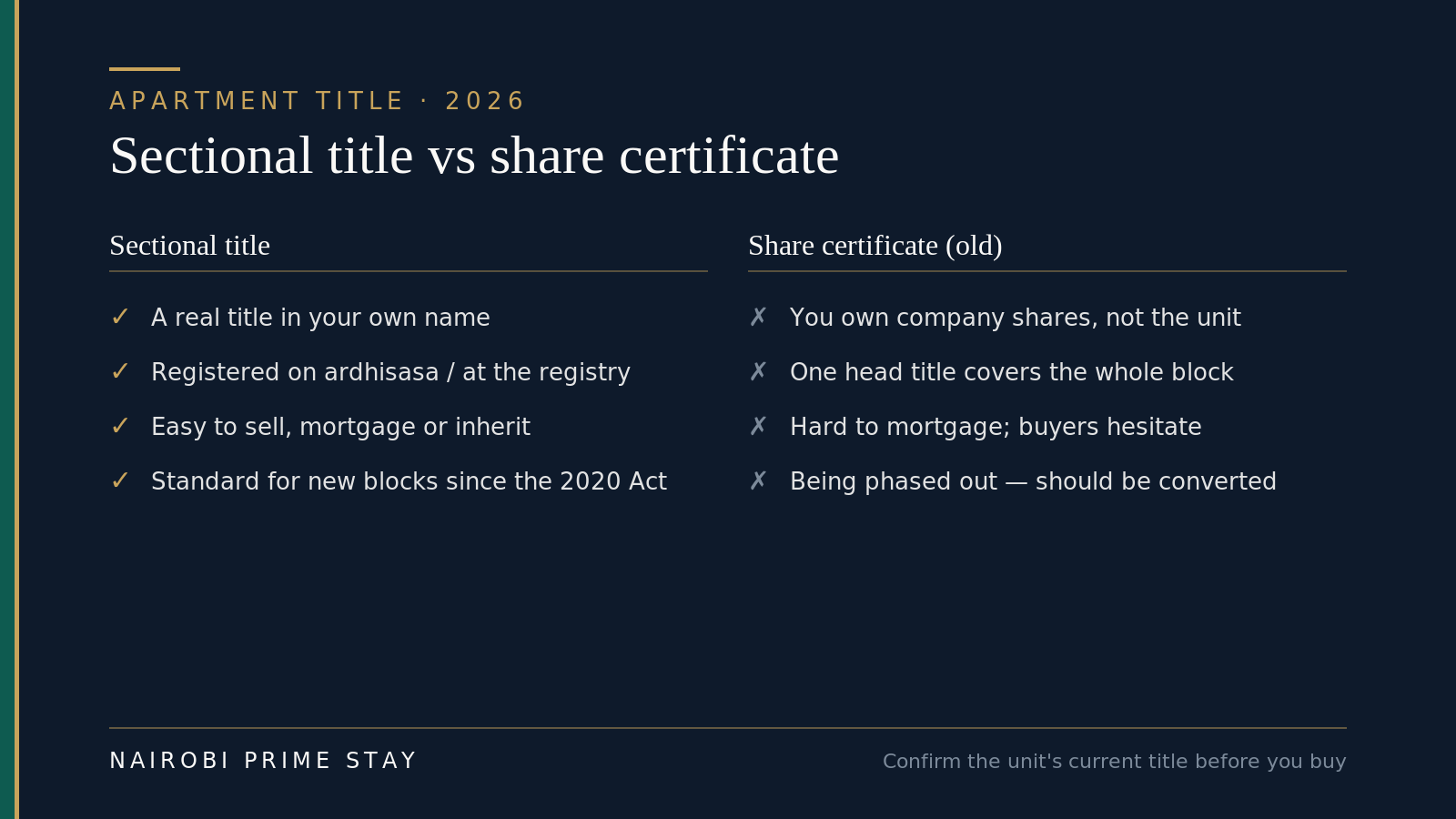 A sectional title gives you a real title in your own name; an old share certificate gives you company shares. Confirm which you’re getting.
Land rent, land rates and service charge — the ongoing costs
Owning a title isn’t a one-off. Depending on your tenure, you’ll have annual obligations, and clearing them is essential — you can’t transfer a property with arrears hanging over it.
- Land rent (ground rent) is an annual charge to the national government for leasehold land only. Freehold land doesn’t pay it. It’s paid through the Ministry of Lands (now via eCitizen/iTax) and is typically modest. You’ll need a Land Rent Clearance Certificate to transfer a leasehold property.
- Land rates are an annual tax to the county government (in our case, Nairobi City County) on both freehold and leasehold land. They fund local services, and you’ll need a Rates Clearance Certificate to transfer. Nairobi rates are generally due early in the year.
- Service charge is different again — it’s not a government tax but the monthly or annual fee an apartment block or gated community collects to run shared services (security, water, grounds, lifts, the generator). It’s set by the management company or owners’ association, not the State. Always ask what it is and what it covers before you buy a unit.
Don’t confuse the three. Land rent and land rates are statutory and tied to your title; service charge is the cost of running the building. All three should be current — your advocate will confirm during the conveyancing process, and you can read more on the full tax picture in the property taxes in Kenya guide.
Digital titles: ardhisasa and the move online
Kenya is moving land records onto a single online system called ardhisasa (ardhisasa.lands.go.ke — “land now” in Swahili). For our readers, the headline is simple: in Nairobi, titles and transactions are now digital. Searches, transfers, leases and charges in Nairobi County run through the platform, and the national stamp-duty module is live countrywide. Murang’a is also fully on the system, with Kiambu, Mombasa, Machakos and Isiolo in active rollout and a stated plan to reach all 47. The push has accelerated. As of early 2026, transacting through ardhisasa is mandatory in Nairobi, Kiambu, Kajiado and Mombasa, and since February 2026 stamp duty is paid online through the platform’s Ardhipay module rather than at a bank. So if you’re buying in or near Nairobi, your whole transaction — search, stamp duty, transfer — now lives on ardhisasa.
What this means in practice: in digitized areas, an old paper title generally has to be migrated to the digital register, and you transact through an ardhisasa account. It’s made the official search faster and cleaner, which is good for buyers. It has also had teething problems and disputes over some records, so it doesn’t replace your advocate — it’s a better tool for the same careful checks. Confirm a property’s current status directly on ardhisasa or through your lawyer.
How to run an official title search
We’ve said “run an official search” a few times now. Here’s exactly what that means, because it’s the single most important thing you’ll do before buying — and it’s cheap.
A title search is an official look-up of the land register for one specific parcel. It returns a search certificate that shows the current state of the title: who the registered owner is, the size of the parcel, the tenure and any unexpired lease term, and — crucially — any encumbrances registered against it, meaning charges (mortgages), cautions, caveats or court restrictions. It is the authoritative record. A glossy title document in the seller’s hand means little until the register agrees with it.
There are two ways to do it, depending on where the land is:
- Online, through ardhisasa, in digitized counties (Nairobi and the others above). You — or, normally, your advocate — log in with a verified account, enter the title number, pay a small fee, and download the result. It’s fast, often same-day.
- At the land registry, in counties not yet on ardhisasa. You or your advocate lodge a search application (historically Form RL26) with the title number and a copy of the title, pay at the registry, and collect the result.
The fee is small either way: budget roughly KES 500–1,000 (about $4–8) per parcel. That’s the cheapest insurance you’ll ever buy on a property. The one catch is access — the register works on the title number, so you need that from the seller first, and ardhisasa needs a verified account, which is why most buyers simply have their advocate run it.
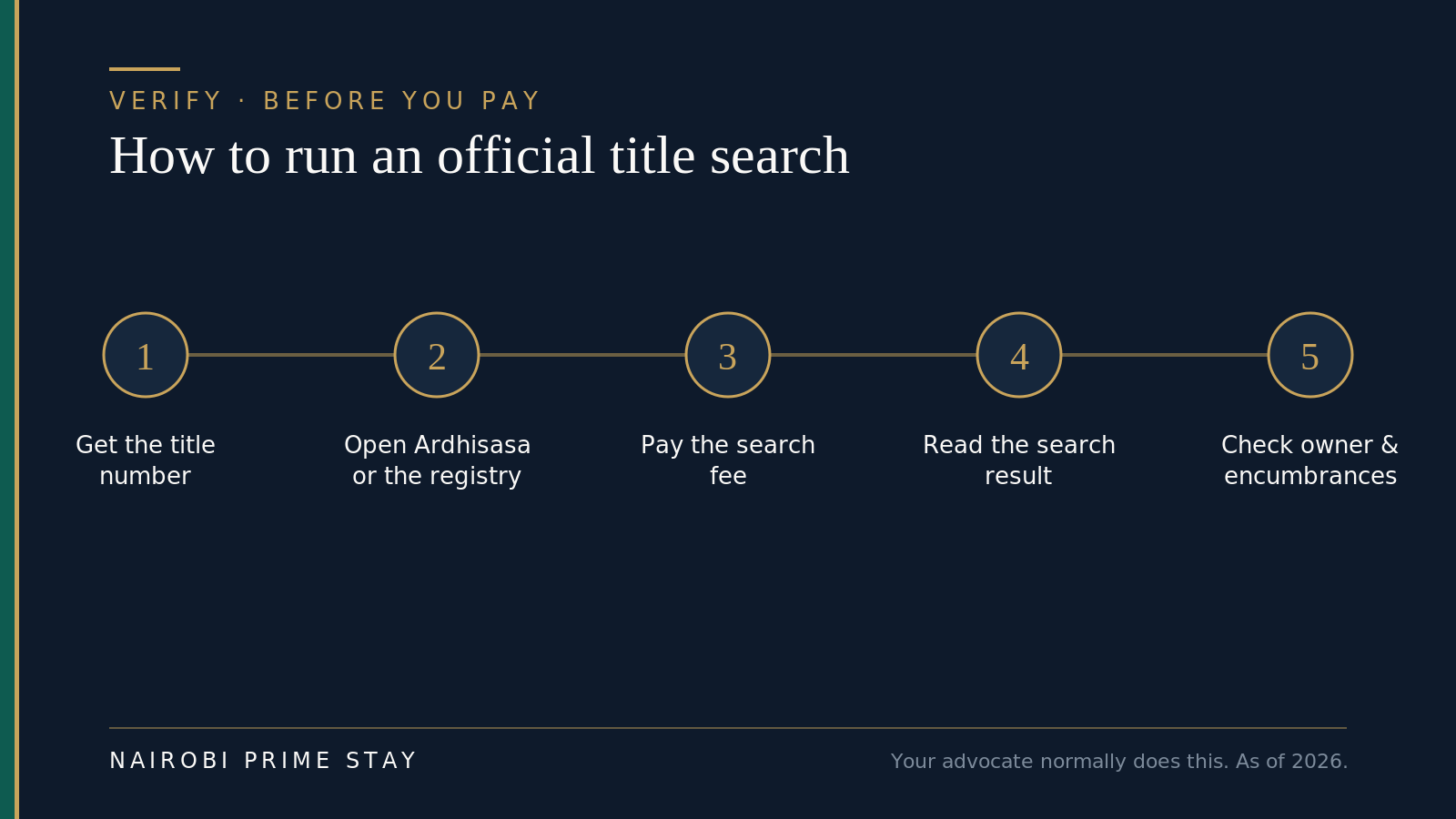 The official search is cheap, fast, and the single best check you can make. Your advocate normally runs it.
What you do with the result matters as much as getting it. Confirm the registered owner’s name matches the seller’s ID exactly — not “close enough.” Check there are no charges, cautions or caveats you didn’t expect. Confirm the tenure and unexpired term match what you were told. And run a fresh search close to completion, not just at the start — a clean title can pick up a charge or a caveat while you’re still negotiating. This search is the backbone of the step-by-step buying process.
Title fraud and the red flags that protect you
Land fraud is the real risk in Kenyan property, and it’s worth being clear-eyed about it. The Ministry of Lands and the Directorate of Criminal Investigations have estimated that roughly one in ten titles in circulation may carry some irregularity — a sobering figure, and the reason the official search exists. Most fraud is a version of one trick: someone tries to sell you a title they don’t really hold, or a kind of “ownership” that isn’t ownership.
The good news is that nearly all of it is avoidable with checks you’ve already met. Here’s how to read the danger signs.
What a genuine title looks like. A real Kenyan title is printed on secure paper with a government watermark, an embossed seal and microtext, carries the Chief Land Registrar’s signature and a red registry stamp, and shows a unique serial number that matches on every page. The parcel details are clear and consistent. But — and people miss this — even a perfect-looking document proves nothing on its own. The register is the truth. A genuine-looking deed that the official search contradicts is a forgery, full stop.
Document red flags. A missing or faint watermark or seal. Spelling errors, mismatched fonts, or signs of editing. Serial numbers that differ across pages, look altered, or are missing. Parcel or owner details that don’t match the official search.
Seller red flags. These matter just as much as the paper. Be wary of a seller who rushes you to pay, who insists on cash, who resists or stalls an official search, or who won’t deal through your advocate. A genuine seller has nothing to fear from a search and a careful process. Someone pushing you past those steps may know what the register would reveal.
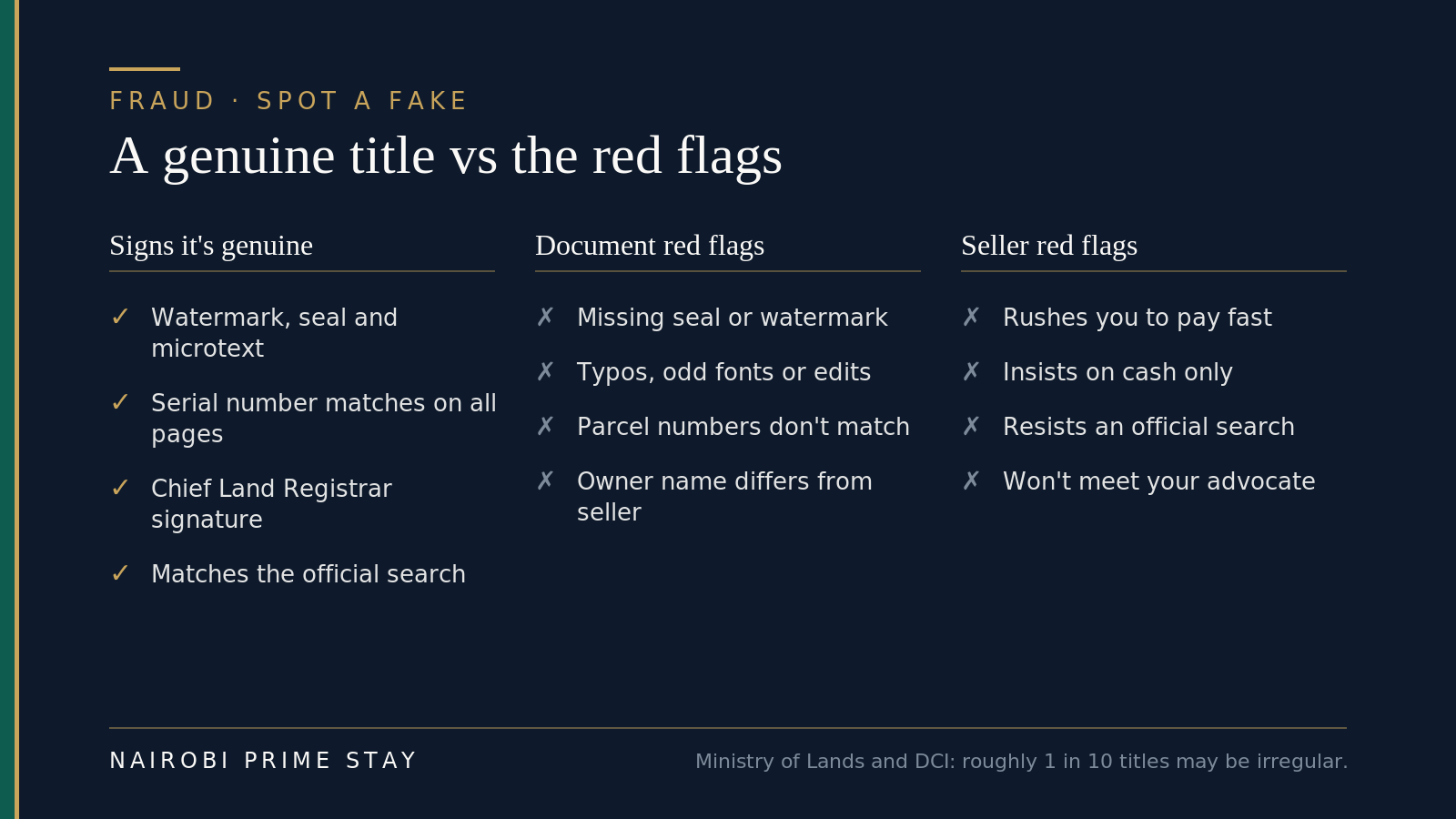 The paper can be faked; the register can’t. Run the search, match the names, and never let a seller rush you past it.
Your protection is a stack, not a single check: an official search through your advocate, a licensed surveyor to confirm the boundaries match the deed plan, funds held by your advocate as a stakeholder rather than cash handed to the seller, and a fresh search at completion. Do those and the one-in-ten figure stops being your problem. We go deeper in the guides to property scams in Kenya and buying land safely.
What foreigners can actually hold
Pulling the threads together for a non-citizen buyer:
- You can hold leasehold up to a maximum of 99 years — including a sectional Certificate of Lease for an apartment. This is the normal, legal route, and it’s bankable and sellable.
- You cannot hold freehold. Try to, and the law converts it to a 99-year lease.
- You cannot hold agricultural land as a non-citizen without a rare Presidential exemption — so “title” to a farm or a big rural plot is off the table for most foreigners.
- A company counts as Kenyan only if it’s 100% citizen-owned, so buying through a part-foreign company doesn’t upgrade your rights, and nominee arrangements (“hold it in a friend’s name”) give you no real title and a lot of risk.
Kenyan citizens, including dual citizens in the diaspora, can hold freehold and agricultural land — which is why a returning Kenyan or a diaspora buyer with dual citizenship has options a foreign passport-holder doesn’t. A foreign spouse doesn’t automatically gain those rights through marriage. For the full picture, see can foreigners buy property in Kenya?
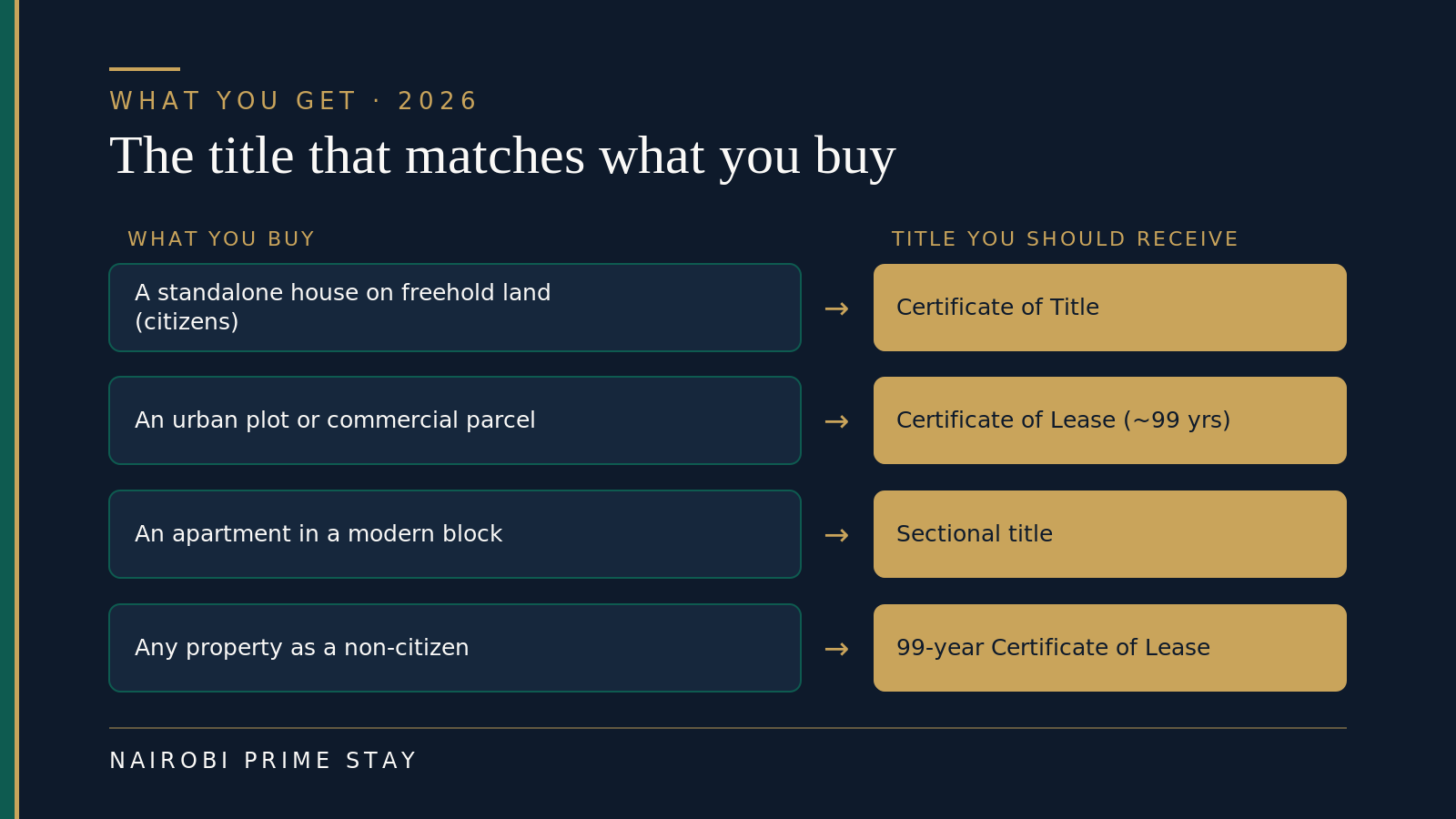 Match the purchase to the title: as a non-citizen, expect a 99-year Certificate of Lease — often a sectional one for an apartment.
How the title becomes yours: transfer and registration
Once the search is clean and you’ve agreed terms, the title has to move from the seller’s name into yours. That’s the transfer, and it’s worth knowing its shape even though your advocate drives it.
After the sale agreement and deposit, your advocate prepares the transfer documents and the property is valued by a government valuer (assigned within about 3–7 working days in digital counties). You then pay stamp duty — the tax that makes the transfer legal — to the Kenya Revenue Authority. The rate is 4% of the value for urban property (Nairobi and other gazetted towns and municipalities) and 2% for rural land, charged on the higher of the purchase price or the government valuation. Since February 2026, stamp duty in digitized counties is paid online through ardhisasa’s Ardhipay module rather than at a bank.
With duty paid and the seller’s land rent and rates cleared, the transfer is registered and a new title is issued in your name. In digital counties that can take roughly 30–90 days from a clean agreement; manual registries can be slower. If you’re buying off-plan or a new build, the title is usually issued after completion, so the clock runs from when the unit is ready — one more reason to use an advocate and a stakeholder arrangement for your money.
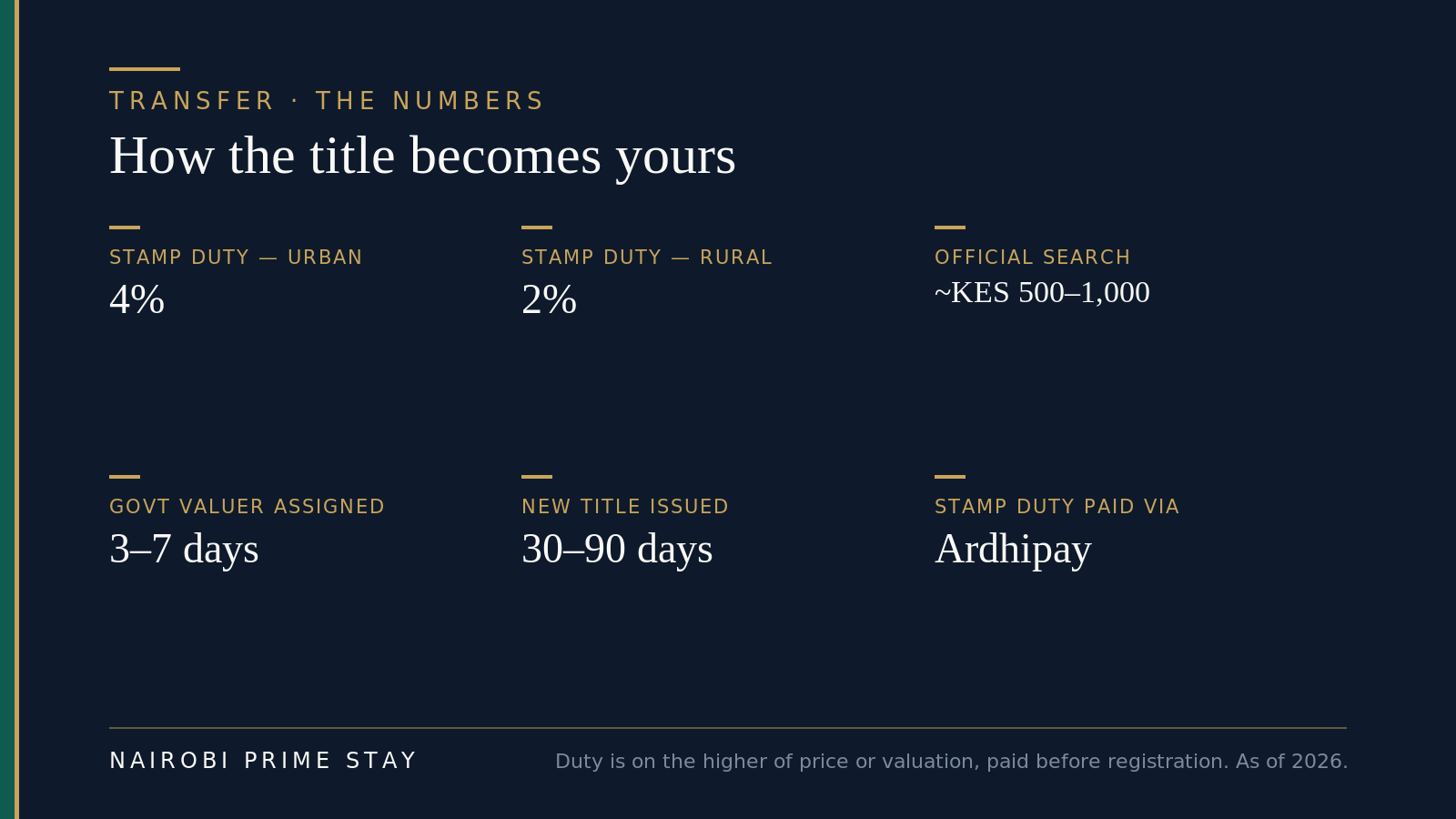 The transfer in numbers, as of 2026 — your advocate handles each step. Stamp duty is the big line.
Budget the full set of closing costs, not just the price: stamp duty is the largest, with legal fees, the search and registration on top. The property taxes in Kenya guide breaks down every line, and you’ll want clean shillings ready to move — see the US dollar to shilling guide for getting funds into the country.
The title types side by side
| Title type | Tenure | Time limit | Your document | Can a foreigner hold it? | Typical use |
|---|---|---|---|---|---|
| Freehold | Permanent | None | Certificate of Title | No — converts to a 99-year lease | Houses, rural and residential land |
| Leasehold | Fixed term | Usually 99 years | Certificate of Lease | Yes, up to 99 years | Urban plots, commercial, many homes |
| Sectional title | Follows the land | Per the land (freehold or lease) | Certificate of Title or Lease for the unit, plus a common-property share | Yes, when on leasehold land | Apartments, flats, townhouses, offices |
| Share certificate (old) | Company-owned head title | Per the head title | Company shares plus a long-term sublease — not a unit title | No real title — avoid or convert | Older apartment blocks |
A quick read of the table: as a foreigner buying in Nairobi, your safest, simplest target is a sectional Certificate of Lease on a modern apartment. It’s a real title in your name, easy to finance and resell, with none of the share-certificate baggage.
How this plays out: a real scenario
Say you’re an American who’s settled into Nairobi and wants to buy a two-bedroom apartment in Kileleshwa instead of renting. You find a unit you like in a ten-year-old block.
Your advocate runs an official search on ardhisasa. Two things surface. First, the building sits on leasehold land with 74 years left to run — fine for an apartment, and you note it. Second, the block was originally sold on share certificates, and this unit hasn’t yet been converted to a sectional title. So what you’d be “buying” is shares in the management company, not a title to the apartment.
You don’t walk away — but you don’t pay either, not yet. You ask the seller to complete the conversion to a sectional title before completion, so you receive a sectional Certificate of Lease in your own name. The seller agrees; your advocate writes it into the sale agreement as a condition, with the deposit held by the advocate as a stakeholder until it’s done. A few weeks later you complete, with a clean, registered, mortgageable title. That’s the difference knowing your titles makes — it turned a risky “ownership” into a real one.
Checklist: how to read a Kenyan title before you buy
- Confirm the tenure — freehold or leasehold? If leasehold, what’s the unexpired term?
- Match the document to the property — a Certificate of Title (freehold), a Certificate of Lease (leasehold), or a sectional title for an apartment.
- Run an official search (ardhisasa in Nairobi, or the registry elsewhere) and confirm the registered owner’s name matches the seller exactly.
- Check for encumbrances — charges (mortgages), cautions, caveats or court restrictions on the title.
- For apartments, insist on a sectional title in your own name — not a share certificate. If it’s still a share scheme, make conversion the seller’s job.
- Confirm land rent and land rates are cleared, and that clearance certificates can be issued.
- As a foreigner, verify you can legally hold it — leasehold only, and no agricultural land.
- Use a Kenyan advocate for the search, the sale agreement and registration. Never rely on a photocopy or a seller’s word.
Final thoughts
Title in Kenya is less complicated than it first looks. Two tenures — freehold and leasehold. Two documents — a Certificate of Title or a Certificate of Lease. One modern system for apartments — sectional title — replacing the old share certificates. And one rule that shapes everything for our readers: as a non-citizen, you hold leasehold, up to 99 years, which is exactly what a well-titled apartment gives you.
Know which title you’re getting, check the unexpired term, run the official search, and use an advocate. Do those four things and you’ve sidestepped the problems that catch most buyers. The paper really is the property here — so make sure the paper is right.
Related reading
- Property investment in Kenya: the complete guide — the cluster hub; start here.
- Can foreigners buy property in Kenya? — the ownership law in plain English.
- How to buy property in Kenya, step by step — the full buying process.
- Buying land in Kenya safely — due diligence and avoiding fraud.
- Conveyancing in Kenya — what your advocate actually does.
- Property taxes in Kenya — stamp duty, rates, land rent and more.
- Moving to Nairobi: the complete guide — the relocation hub.
Before you own, you have to live somewhere
Most foreign buyers rent first, learn the city, then buy with confidence. A furnished serviced apartment is the easy way to do that — all-inclusive, flexible, and a calm base while you view homes and meet your advocate. Browse our serviced apartments in Nairobi with honest monthly pricing, or let the AI relocation assistant shortlist a few in a couple of minutes. A $50 deposit reserves a place and the balance is paid on arrival — nothing more before you travel.
Frequently asked questions
What types of title deed exist in Kenya?
Kenya has two underlying tenures. Freehold is permanent ownership with no time limit, evidenced by a Certificate of Title. Leasehold is ownership for a fixed term (usually 99 years), evidenced by a Certificate of Lease, after which the land reverts unless the lease is renewed. Apartments get a sectional title under the Sectional Properties Act, 2020, and you may still meet old company share certificates in some older blocks.
What is the difference between freehold and leasehold in Kenya?
Freehold is permanent ownership with no expiry, and the land passes to your heirs. Leasehold is held for a fixed term, usually 99 years, after which it reverts to the lessor unless renewed. Leasehold is normal and bankable in Kenya, but always check the unexpired term. Non-citizens can only hold leasehold, not freehold.
What is a certificate of lease in Kenya?
A Certificate of Lease is the title document for leasehold land under the Land Registration Act, 2012 — the leasehold equivalent of a Certificate of Title, which is for freehold. It names the registered owner, the lease term and the parcel. Because non-citizens can only hold leasehold, a foreigner’s Kenyan title is almost always a Certificate of Lease.
What is a sectional title in Kenya?
A sectional title is a registered title to a single unit in a multi-unit building, plus an undivided share in the common areas, under the Sectional Properties Act, 2020. It is the standard, mortgageable way to own an apartment, flat or townhouse, and it has replaced the old share-certificate schemes. Depending on the land, the unit’s document is a Certificate of Title or a Certificate of Lease.
What is the difference between a sectional title and a share certificate?
A sectional title is a real title to your unit in your own name. A share certificate makes you a shareholder in the company that owns the whole block, with a long-term sublease — not a registered property owner. Sectional title is safer, easier to mortgage and easier to resell. If an older apartment is still on a share certificate, ask the seller to convert it before completion.
Can foreigners hold a title deed in Kenya?
Yes, but only leasehold, up to a maximum of 99 years — including a sectional Certificate of Lease for an apartment. Non-citizens cannot hold freehold (it converts to a 99-year lease) or agricultural land without a rare exemption. A company counts as Kenyan only if it is 100% citizen-owned, so a part-foreign company does not change these limits.
What is the difference between land rent and land rates in Kenya?
Land rent (ground rent) is an annual fee paid to the national government on leasehold land only; freehold land is exempt. Land rates are an annual tax paid to the county government on both freehold and leasehold land. Both must be cleared, with clearance certificates issued, before a property can be transferred.
How do I run an official land search in Kenya?
Run a search on the land register for the specific parcel, using the title number. In Nairobi and other digitized counties you (or your advocate) do it online through ardhisasa; elsewhere you lodge a search application at the land registry. It costs roughly KES 500–1,000 and returns a search certificate showing the registered owner, the parcel size, the tenure and unexpired term, and any encumbrances such as charges, cautions or caveats. Most buyers have their advocate run it, and run a fresh one again close to completion.
How do I check whether a Kenyan title deed is genuine?
Run an official search through an advocate — on ardhisasa in Nairobi, or at the relevant land registry elsewhere — and confirm the registered owner matches the seller exactly, check for charges, cautions or caveats, and verify the tenure and unexpired term. On the paper itself, a genuine title carries a watermark, an embossed seal, microtext, the Chief Land Registrar’s signature and a serial number that matches on every page. Never rely on a photocopy or a seller’s assurance; the official register is the authoritative record, and the Ministry of Lands estimates about one in ten titles in circulation may be irregular.
How much does it cost to transfer a title deed in Kenya?
The biggest cost is stamp duty: 4% of the value for urban property (Nairobi and other gazetted towns) or 2% for rural land, charged on the higher of the purchase price or the government valuation and paid to the Kenya Revenue Authority. On top of that, budget legal fees, an official search of about KES 500–1,000, and registration. Since February 2026 stamp duty in digitized counties is paid online through ardhisasa’s Ardhipay module, and a new title is typically issued within about 30–90 days of a clean agreement.
What is ardhisasa, and do I need it?
Ardhisasa (ardhisasa.lands.go.ke) is Kenya’s national digital land system. In Nairobi and other digitized counties, title searches, transfers, leases and charges are done on it — and as of 2026 transacting through the platform is mandatory in Nairobi, Kiambu, Kajiado and Mombasa, with stamp duty paid online via its Ardhipay module. You transact through a verified ardhisasa account, usually with your advocate, and old paper titles are migrated to the digital register.
Ready to look?
Find your apartment in Nairobi
Browse verified serviced apartments, or ask the AI concierge which area fits your life.