
Guides · Neighborhoods
Kilimani vs Kileleshwa: Which Central Nairobi Suburb Suits You? (2026)
Kilimani vs Kileleshwa: Which Central Nairobi Suburb Suits You?

Kilimani and Kileleshwa are the two suburbs people shortlist when they want a modern, central apartment in Nairobi without paying diplomatic-suburb prices. They sit right next to each other, about 4 km from the city center, share the same Argwings Kodhek spine, and both have filled up with new apartment towers over the last decade. On paper they look almost identical. In daily life they feel different.
Kilimani is the louder, cheaper, busier twin — the best value of Nairobi’s prime apartment areas, with cafés, bars and nightlife on the doorstep. Kileleshwa is the quieter, leafier, slightly pricier one — the same central location, but tree-lined streets and a more residential calm. The choice usually comes down to one question: do you want buzz, or do you want quiet?
This guide compares them head to head — rents, density and noise, investor yields, safety, schools and lifestyle — for someone who hasn’t lived in Nairobi yet and wants the honest version. If you’re still scoping the whole city, start with our best neighborhoods in Nairobi guide and the full moving to Nairobi hub.

The short answer
Choose Kilimani if you want the lowest rent among the prime apartment areas, you like cafés, restaurants and nightlife within walking distance, you’re a remote worker or young professional who wants to be in the middle of things, or you’re an investor chasing strong tenant demand and short-let potential. Choose Kileleshwa if you want the same central location but calmer and greener, you’re a couple or small family who values a quiet, tree-lined street, you’ll pay a little more for less noise, or you want a slightly larger, more upmarket unit.
Put simply: Kilimani is the lively value play, Kileleshwa is the calm middle path. Both are central, modern, apartment-first and safe with normal city sense. Both share the same trade-off — they’ve been built up fast, so you get traffic, construction and a few flood-prone streets if you pick the wrong one. Kilimani gives you the best price and the most life on the doorstep; Kileleshwa gives you more quiet and greenery for a small premium. Neither is better — they suit different people, and plenty of newcomers view both in the same week before deciding.
The 30-second decision
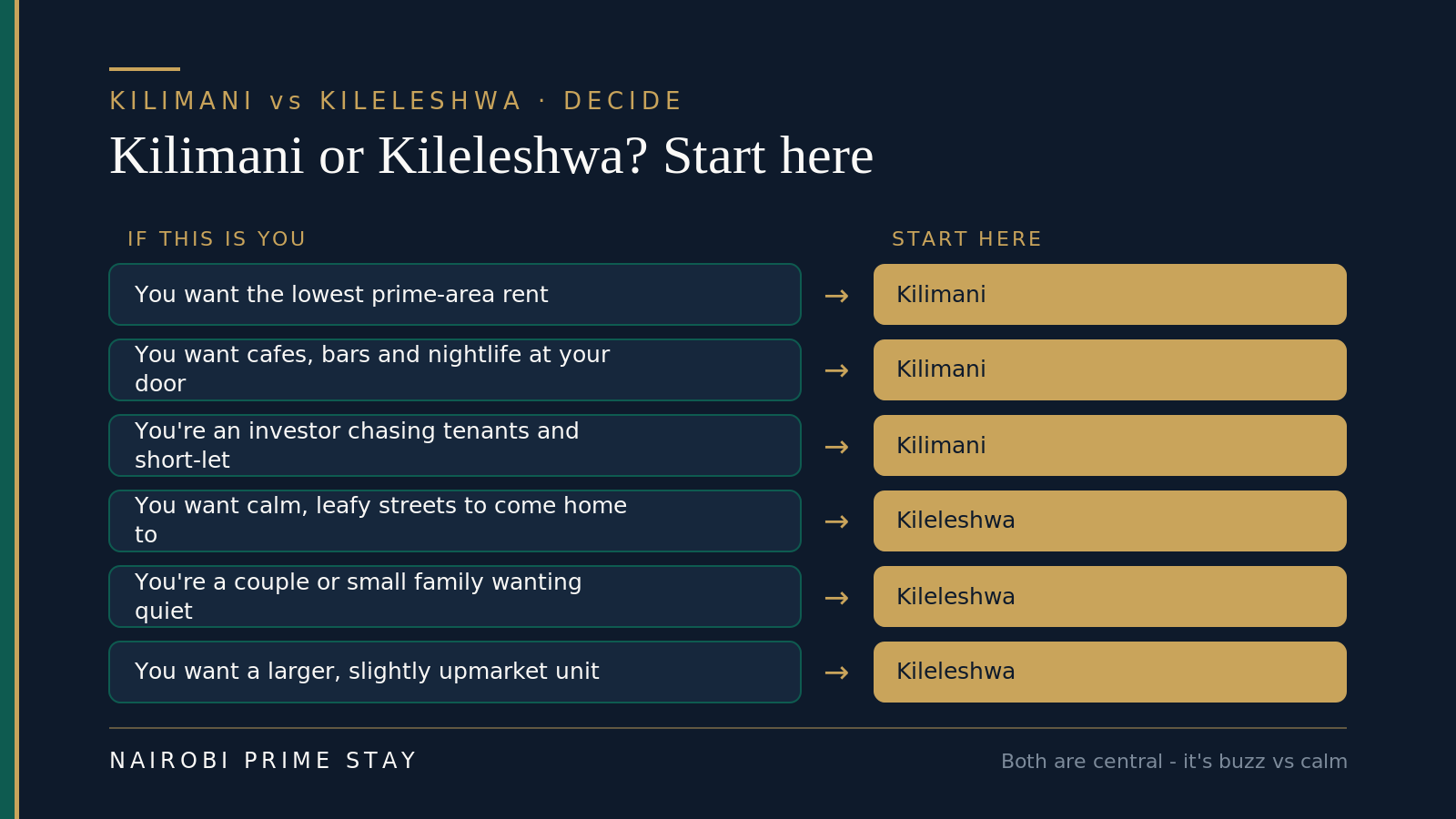
Both are central and modern — the real split is buzz versus calm, and price versus quiet. Pick the feel you want to come home to, then choose your specific street and building with care.
Side by side: Kilimani vs Kileleshwa
Here’s the comparison at a glance. All figures are indicative for 2026 at roughly KES 129.4 to the US dollar (2 July 2026); verify live rents and the exchange rate before you sign (the Central Bank of Kenya or Wise has the current rate).
| Feature | Kilimani | Kileleshwa |
|---|---|---|
| Best for | Value seekers, remote workers, investors | Couples, small families, calm-but-central |
| Vibe | Dense, modern, lively, urban | Leafy, modern, calmer, residential |
| Location | ~4 km SW of the CBD, beside Upper Hill | ~4 km W of the CBD, beside Westlands |
| Homes | Mostly modern apartment towers | Apartments + some townhouses, leafier blocks |
| Furnished 1-bed / mo | ~$540–1,230 | ~$580–1,160 |
| Furnished 2-bed / mo | ~$700–1,540 | ~$770–1,690 |
| Nightlife | High — bars, rooftops, restaurants | Low — drive 5 min to the buzz |
| To the CBD (off-peak) | ~5–20 min | ~12–18 min |
| To Westlands (off-peak) | ~10–15 min | ~5–10 min |
| Gross rental yield | ~6–7.5% | ~6–8% |
| Green space | Limited — it’s dense | More tree canopy, quieter streets |
Character and vibe: buzz vs calm
These two suburbs are close cousins that grew up differently. Both were low-density areas of mid-century bungalows on garden plots a generation ago, and both have been redeveloped into modern apartments faster than almost anywhere in Nairobi. The difference is degree. Kilimani went all-in on density; Kileleshwa kept more of its trees and more of its calm.
Kilimani is the central, modern, busy one. It’s the most affordable of the prime apartment areas, about 4 km southwest of the CBD and right next to the Upper Hill business district. The crowd skews young and cosmopolitan — Kenyan professionals, remote workers and digital nomads, students, couples, and a steady flow of expats on shorter postings. It buzzes through the day and into the night, with the city’s liveliest residential café-and-bar scene. If you want to be in the middle of everything, with a balcony over a busy, modern neighborhood, this is it.
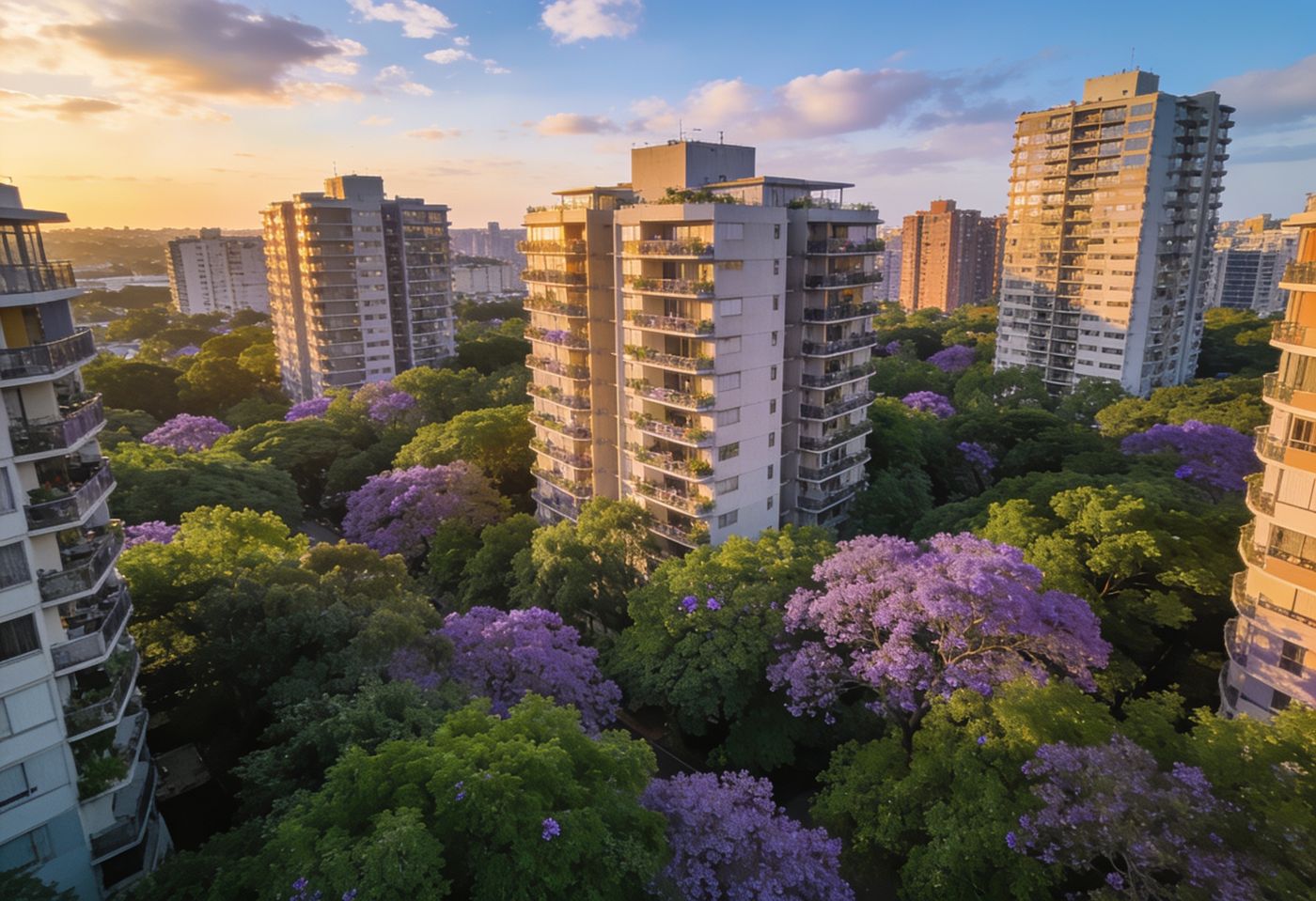
Kileleshwa is the quieter twin next door. It sits about 4 km west of the center, wedged between Kilimani, Hurlingham, Lavington and Westlands along the same Argwings Kodhek Road. It’s filling up with modern apartments too, but it has held onto more of its jacaranda-and-eucalyptus tree canopy and a settled, lived-in feel — old families on the original garden plots alongside newcomers in the new blocks. The mix skews a little older and more residential: professionals, business families, longer-posting expats, couples and small families who want central life without Kilimani’s density. You come here to be close to everything but sleep in quiet.
The honest way to frame it: Kilimani is denser, louder and cheaper; Kileleshwa is leafier, calmer and a touch pricier. Both are central, modern and apartment-led. Kilimani feels like a lively city neighborhood; Kileleshwa feels like a quiet one that happens to be in the middle of the city.
Rents: what your money gets in each
Kilimani is the cheaper of the two, and it’s the best value of all the prime apartment areas; Kileleshwa costs a little more for an equivalent unit, because the streets are leafier, the density lower and the units often larger. The gap is real but modest — you’re paying a small premium for calm and greenery, not jumping a tier. The numbers below are indicative furnished homes for 2026; unfurnished and longer leases cost less, and serviced, all-inclusive units sit at the top of each band.
| Apartment | Kilimani (furnished, USD/mo) | Kileleshwa (furnished, USD/mo) |
|---|---|---|
| 1-bed | ~$540–1,230 | ~$580–1,160 |
| 2-bed | ~$700–1,540 | ~$770–1,690 |
| 3-bed / townhouse | ~$1,385–2,460+ | ~$1,540–2,690+ |
| 2-bed, unfurnished | ~$460–850 | ~$500–1,000 |

Indicative rents, 2026, at about KES 129 to the dollar (July 2026). Kilimani is the value pick; Kileleshwa runs a little higher for leafier, often larger units. A good furnished two-bed in Kileleshwa averages around KES 160,000.
Why the small gap? In Kilimani you’re paying for the most central, most-built-up location and the best price-per-square-meter in the prime belt — there’s so much stock and so much competition that rents stay the most reasonable in their class. The newest, priciest blocks cluster along Dennis Pritt, Kindaruma, Wood Avenue and the Riverside edge; older buildings toward Ngong Road and Yaya Centre offer better value. In Kileleshwa you’re paying a touch more for lower density, more trees and often a bigger unit, with the newer blocks along the Ring Road, Othaya and Gatundu Roads at the top and the Kilimani-facing edge cheaper. Whatever you view in either area, run the “Nairobi Five” check before signing — a backup generator, water supply and storage (boreholes are common), 24/7 security, fibre internet already serving the building, and responsive management. On unfurnished places there’s usually a monthly service charge on top of rent for security, water and common areas, so always ask what’s included. For the wider budget picture, see our cost of living in Nairobi guide, and never wire money for a place you haven’t viewed.
Density, noise and traffic: the honest downside
Both suburbs share one trade-off, and it’s the flip side of being central and modern: they’ve been built up fast, and the infrastructure is still catching up. The difference is how much of it you feel day to day — and in Kilimani you feel more.
Kilimani’s density is its one big downside. It was a quiet area of bungalows a generation ago and is now block after block of apartment towers, often with fresh construction next door. That brings heavier traffic at peak hours on the main arteries — Argwings Kodhek, Ngong Road, Valley Road and Elgeyo Marakwet — plus tight parking on busy streets, construction noise, and a few low-lying roads that puddle or flood briefly in the heavy rains (March–May especially). If you live near the bar strip, you’ll hear the weekends. None of this makes Kilimani a bad choice; thousands happily call it home. But it’s exactly why some people who want the same central spot pick calmer Kileleshwa instead.
Kileleshwa has the same building boom, just dialed down. You still get construction on some streets, busier roads than a decade ago — the Ring Road and Argwings Kodhek back up at peak — and a handful of low spots that flood briefly in the long rains. But the lower density and the tree canopy keep it noticeably calmer and greener than Kilimani, which is the whole reason people pay a little more to live here. In both suburbs the fix is the same: choose your specific building and street with care, visit at rush hour and after dark (and ideally after heavy rain), and ask the watchman whether the road floods. The off-peak and on-peak versions of the same street can feel like different places.
Getting around and location
Location is where these two are nearly tied — both are central, so wherever you’re headed tends to be close. The small differences come down to which side of the center you’re on. Kilimani leans toward the CBD and Upper Hill; Kileleshwa leans toward Westlands.
From Kilimani, the CBD is about 5–20 minutes off-peak, Upper Hill’s offices and hospitals are minutes away, and Westlands is a short hop. The Nairobi Expressway is close for quick airport runs outside peak times. From Kileleshwa, the Ring Road gives you two clean exits — south via Ngong Road toward the CBD and Upper Hill (about 12–18 minutes off-peak), north toward Westlands and Waiyaki Way (just 5–10). Lavington, Hurlingham, Kilimani and the hospitals are all minutes away from either.
The catch, in both, is rush hour, when the same trips can double or triple. In both suburbs Uber and Bolt are everywhere, cheap and the expat default — a cross-town hop is a few dollars, and most people use ride-hailing rather than driving themselves into a jam. Parts of each are walkable for daily needs (a café, a supermarket, a gym, a pharmacy within a few blocks), so people who live and work locally sometimes skip a car entirely. If you’ll commute daily to a fixed office or school, drive the real route at 8 a.m. and 5 p.m. before you sign. For working from home, both are well served by fibre — see our internet and remote work in Nairobi guide — but always confirm a provider already serves your specific building.
How far is the airport (JKIA) from each?
About 18–20 km from either suburb. Off-peak, the Nairobi Expressway makes Jomo Kenyatta International Airport roughly a 30–45 minute drive from both Kilimani and Kileleshwa; at rush hour allow an hour and a half or more, especially on Mombasa Road’s feeder junctions. An Uber or Bolt to the airport typically runs around KES 1,500–2,500 depending on the hour and car class. Kilimani has a slight edge for airport runs because it sits closer to the Expressway’s southern access points, but in practice the difference is a few minutes. For the wider transport picture — matatus, boda bodas, the commuter rail and what a car actually costs to run — see our getting around Nairobi guide.
For property investors: yields and demand
If you’re buying rather than renting, both suburbs are among Nairobi’s most active apartment markets, and the choice is more about strategy than a clear winner. Both offer strong, steady tenant demand from professionals and expats, and gross rental yields in a similar band — indicative 2026 figures put Kilimani around 6–7.5% and Kileleshwa around 6–8%, both gross and before costs. Treat those as ranges, not promises, and verify against current data before you commit.
Kilimani is the high-liquidity, high-turnover play. Its central location, modern stock and constant tenant demand make it a perennial favorite for buy-to-let and short-let (Airbnb), and it’s usually near the top of any “best areas to invest” list. The same density that’s a lifestyle trade-off is an investment feature: lots of units, lots of tenants, easy to let and easy to exit.
Kileleshwa is the slightly more upmarket, lower-density cousin. Its mix of larger, leafier units gives it a clear identity next to busier Kilimani, and its quieter, more established feel draws longer-term professional tenants. Some analysts argue that areas with moderate supply and strong demand — Kileleshwa and parts of Kilimani among them — offer better risk-adjusted returns than the most oversupplied pockets of the city.
What are the rules for short lets (Airbnb) in 2026?
If short-let income is part of your plan in either suburb, know that Kenya has been formalizing the sector. Registration of short-stay accommodation with the Tourism Regulatory Authority has been mandatory since early 2024 (a first-time application costs about KES 1,000, and an annual serviced-apartment licence runs around KES 26,000), and from June 2026 a 2% tourism levy applies to short-stay bookings, collected through platforms like Airbnb. As of July 2026 enforcement is still uneven, but the direction of travel is clear: budget for registration, the levy and compliance in your numbers rather than treating short lets as informal income. Just as important, some buildings in both suburbs ban or cap short lets in their house rules — confirm the management policy in writing before you buy a unit with Airbnb in mind.
The honest caveat applies to both: supply. So much has been built so fast that some segments are oversupplied, which can soften rents and yields and lengthen void periods for generic, cookie-cutter units. The well-located, well-managed, genuinely modern apartments still perform; the me-too blocks compete on price. For the full picture — yields by area, the oversupply map and how these two stack up against the alternatives — read our best areas to invest in Nairobi real estate guide.
Safety
Both areas are safe with the normal big-city sense you’d use anywhere in Nairobi, and apartment living helps in both. The main risk in each is opportunistic petty theft — a snatched phone, the occasional mugging on a quiet side street late at night — rather than personal danger. Most blocks in both suburbs have a manned gate, perimeter wall, CCTV and secure parking, so your home itself is well protected.
The small difference is foot traffic and timing. Kilimani is busy and lively, especially around the nightlife strip on weekends, so the usual late-night street sense matters more: use Uber or Bolt after dark rather than walking with valuables, keep car doors locked in traffic, and stick to busier, better-lit roads at night. Kileleshwa’s quieter streets see less foot traffic, which feels calmer, but the same habits apply — a poorly secured compound can be a target anywhere. In both, keep your phone and bag out of sight in traffic, and choose a building with proper security. For the full, balanced picture, read our honest take on whether Nairobi is safe.
Schools
Neither suburb is primarily a school destination — these are apartment areas, not the big-garden family suburbs — but both sit within reach of good options, and Kileleshwa edges it for families. Within and beside Kileleshwa you’ll find the Riara Group of Schools on Riara Road, Braeburn on Gitanga Road (British/Cambridge curriculum, technically in Lavington but about ten minutes away), and the wider Lavington–Hurlingham cluster of British- and international-curriculum schools close by. Its calmer streets and slightly larger units make it the more natural fit for a small family that wants central living with a manageable school run.
Kilimani has good local schools too, and the same Lavington-side options are a short drive, but it’s denser and more apartment-focused, so it draws fewer families with young children. For the big American and IB campuses — like the International School of Kenya near Gigiri — both suburbs mean a longer cross-town drive, so families set on a particular Gigiri-side school often weigh a home closer to it. Apply months ahead either way; the best schools keep waitlists. Our best neighborhoods guide lines up the family-friendly areas side by side.
Lifestyle, shopping and nightlife
This is where the buzz-versus-calm split shows up most. Both eat and shop well; they differ on how much happens after dark.
Kilimani is the livelier one by a wide margin. Yaya Centre is its anchor mall — a long-standing favorite with a big supermarket, shops, a food court, a gym and rooftop restaurants — with Prestige Plaza and Adlife Plaza on Ngong Road and The Junction Mall close by. The food and nightlife are a genuine draw: restaurants, cafés and bars line Lenana Road, Wood Avenue and Galana Road — Kenyan nyama choma, Indian, Italian, Ethiopian, sushi and some of the best coffee in the city, plus rooftop bars that fill up on weekends. It’s livelier than Lavington or Kileleshwa and more residential than Westlands, which is much of its appeal. The flip side is noise: live right by the bar strip and you’ll hear it. Both suburbs also do laptop days well — several of the spots in our coworking spaces and work-friendly cafés guide are in or minutes from Kilimani.
Kileleshwa keeps its everyday shopping close and its nightlife a short drive away — which is exactly how its residents like it. Kasuku Centre on Oloitoktok Road is the local hub (supermarket, pharmacy, eateries), and Greenhouse Mall on the Ngong Road edge adds more, including a supermarket that often runs 24 hours. For a bigger run you’re minutes from Yaya Centre, Lavington Mall, and Westgate and Sarit in Westlands. Dining is a good spread of cafés and casual restaurants, with the city’s busiest food-and-drink strips a few minutes off in Kilimani, Lavington and Westlands. You come to Kileleshwa to sleep well and drive five minutes to the buzz when you want it. If your idea of a good neighborhood is one where the party is nearby but not under your window, that’s Kileleshwa.
Healthcare
Both are well covered, and nearly tied, because they share the same hospitals. The Nairobi Hospital — one of the city’s largest and most trusted — is in neighboring Upper Hill, minutes from either suburb, and Coptic Hospital sits on Ngong Road on the southern edge of both. Aga Khan University Hospital (JCI-accredited, full specialist care) and MP Shah are a manageable drive in Parklands, and Avenue Hospital is close to Kileleshwa. Private clinics, dentists and well-stocked pharmacies are scattered throughout both neighborhoods and their malls. In both, use the private system and carry good international insurance with medical evacuation. Our healthcare in Nairobi guide covers the main hospitals and what your policy should include.
Who should choose which

Kilimani is the right call if you want the best value among the prime apartment areas; you’re a remote worker, young professional or couple who wants to be central to Upper Hill, Westlands and the CBD; you like cafés, restaurants, gyms and nightlife within walking distance; you’re an investor chasing strong tenant demand and short-let potential; or you don’t mind density and a bit of noise in exchange for the liveliest, best-priced central spot.
Kileleshwa is the right call if you want the same central location but calmer and greener; you’re a couple or small family who values a quiet, tree-lined street; you’ll happily pay a small premium for less noise and more trees; you’d like a slightly larger or more upmarket unit; or you want the buzz nearby but not under your window.
If neither fits exactly, widen the shortlist: Westlands for the most amenities and the busiest nightlife, or Lavington for leafier, more family-friendly space with apartments and houses. The full best neighborhoods in Nairobi guide lines them all up.
Two scenarios
The remote worker (Kilimani). You’re in your early 30s, moving solo, working US hours for part of the day. Kilimani fits almost too well: a modern furnished one-bed off Wood Avenue runs around KES 110,000 a month all-in, you walk to a café for morning calls and to Yaya Centre for groceries, and your afternoons sync with your team back home. You pick a building with a generator and borehole so power and water cuts never reach you, skip a car, and use Bolt for nights out. Six months in you know the city — and if you decide you want more quiet, you move two streets over into Kileleshwa with your eyes open.
The couple (Kileleshwa). You’re in your late 30s — one of you works from home for a US company, the other commutes to an office in Westlands. Kileleshwa fits almost too neatly: a modern furnished two-bed off the Ring Road runs around KES 160,000 a month all-in, the home-based partner takes morning calls in quiet and walks to Kasuku Centre for lunch, and the commuter is in Westlands in ten minutes off-peak. You get Kilimani’s convenience without Kilimani’s noise — and when friends visit, the bars and restaurants are a five-minute drive, not under your window.
Can you rent in Kilimani or Kileleshwa from the US?
You can start the search from the US, but don’t finish it there. Browse listings, shortlist buildings and talk to agents by WhatsApp before you fly — but never wire a deposit for an apartment you (or someone you trust) haven’t physically seen. Fake listings that lift photos from real buildings in exactly these two suburbs are the most common scam aimed at new arrivals, and the pressure tactic is always the same: pay a “reservation fee” today or lose the unit.
Green flags: the agent agrees to a live video walk-through of the actual unit, the building checks out on Google Maps and in recent reviews, rent is paid to a company account with a written lease, and there’s no rush. Red flags: prices well below the bands above, payment demanded by M-Pesa to a personal number before any viewing, “the owner is abroad”, and refusal to do a live video call from inside the apartment.
The sequence that works: (1) browse and shortlist from home; (2) book a serviced apartment for your first month instead of a long lease; (3) view your shortlist in person during week one or two; (4) verify the agent and building, and read the lease against our tenancy, leases and deposits guide; (5) sign and pay only after viewing, into a verifiable account. Our how to rent an apartment in Nairobi guide walks through the whole process step by step, and if you’re weighing what to ship versus rent furnished, start with furnished vs unfurnished in Nairobi.
Not sure yet? Try before you commit
You don’t have to decide from your laptop at home — and with two suburbs this similar and this close, seeing them in person settles it fast. The smartest move is to spend your first few weeks in a serviced apartment, then view long-term homes once you’ve felt the traffic, heard the streets at night and walked both neighborhoods. They’re a five-minute drive apart, so you can base yourself in one and tour the other easily.
That’s the soft-landing strategy we recommend for almost every arrival: stay serviced for the first four to eight weeks, use the time to compare the two in person, then sign a year-long lease once you’re sure. A serviced apartment is all-inclusive — Wi-Fi, cleaning, a backup generator and 24/7 security in one monthly price — so you get a secure base with zero setup while you make up your mind. Our guide to serviced apartments in Nairobi explains what’s included and how the monthly pricing works. When you’re ready to compare real homes, browse apartments in Kilimani and apartments in Kileleshwa side by side.
Frequently asked questions
Is Kilimani or Kileleshwa better?
Both are central, modern apartment suburbs about 4 km from the city center, so it comes down to buzz versus calm. Kilimani is denser, livelier and the best value of the prime apartment areas, with nightlife and cafés on the doorstep. Kileleshwa is leafier, quieter and slightly more upmarket, usually costing a touch more for an equivalent unit. Remote workers, value seekers and night-owls lean Kilimani; couples and small families wanting quiet lean Kileleshwa. Many newcomers view both before deciding.
Is Kilimani or Kileleshwa cheaper?
Kilimani, slightly — it’s the best value of all Nairobi’s prime apartment areas. Indicative 2026 furnished rents run about $540–1,230 a month for a one-bed and $700–1,540 for a two-bed in Kilimani, versus roughly $580–1,160 and $770–1,690 in Kileleshwa, which costs a little more for leafier, often larger units. Unfurnished and longer leases cost less in both. Verify current listings before you sign.
Which is quieter, Kilimani or Kileleshwa?
Kileleshwa. Both were redeveloped from low-density bungalows into apartments, but Kileleshwa kept more of its tree canopy and lower density, so its streets are calmer and greener. Kilimani is denser and livelier, with more traffic, construction and weekend nightlife noise. People who want the same central location with more quiet specifically choose Kileleshwa — that calm is its main selling point over its busier neighbor.
Which is better for property investment, Kilimani or Kileleshwa?
Both are among Nairobi’s most active apartment markets, with similar indicative 2026 gross yields — roughly 6–7.5% in Kilimani and 6–8% in Kileleshwa. Kilimani offers high liquidity and strong short-let (Airbnb) demand thanks to its density and central buzz; Kileleshwa offers larger, more upmarket units and steady professional tenants. The shared caveat is oversupply: rapid building has softened rents for generic units, while well-located, well-managed apartments still perform. Weigh both against the alternatives before buying.
How far are Kilimani and Kileleshwa from the city center?
Both are central — about 4 km from the CBD. Off-peak, the city center is roughly 5–20 minutes from Kilimani and 12–18 from Kileleshwa, while Westlands is about 10–15 minutes from Kilimani and just 5–10 from Kileleshwa. Upper Hill, Lavington, Hurlingham and the main hospitals are minutes from either. At rush hour those times can double or triple, so drive your actual route at peak before you sign.
Which is better for families, Kilimani or Kileleshwa?
Kileleshwa, generally, among these two. It’s calmer and a little more spacious, with schools nearby along Gitanga and Riara Roads (Braeburn, Riara) and a quieter feel for small children. Kilimani is denser and more apartment-focused, so it draws fewer young families. That said, both are apartment areas rather than big-garden suburbs — families wanting a yard and acreage usually prefer Lavington, Karen or Runda, and those set on a Gigiri-side school often live closer to it.
Do I need a car in Kilimani or Kileleshwa?
Not necessarily in either. Both are central, and parts of each are walkable for daily needs — a café, supermarket, gym and pharmacy within a few blocks — so people who live and work locally often skip a car. Uber and Bolt are everywhere, cheap and the default for cross-town trips. Many residents keep a car for school runs and weekends, but plenty manage fine without one, especially remote workers.
Should I rent in Kilimani or Kileleshwa before I arrive?
Don’t sign a year-long lease sight-unseen in either area. The two are a five-minute drive apart, so book a serviced apartment for your first four to eight weeks, then view long-term homes once you’ve tested the traffic, heard the streets at night and walked both neighborhoods. A serviced apartment is all-inclusive and bookable with a $50 deposit, with the balance paid on arrival.
Can I run an Airbnb in Kilimani or Kileleshwa?
Often, yes — both are among Nairobi’s busiest short-let markets — but it’s now a regulated business. Short-stay hosts must register with the Tourism Regulatory Authority (a first-time application is about KES 1,000, with an annual serviced-apartment licence around KES 26,000), and from June 2026 a 2% tourism levy applies to short-stay bookings, collected through platforms like Airbnb. Just as important, some buildings ban or cap short lets in their house rules — confirm the management policy in writing before you buy or sign with Airbnb in mind.
How far is JKIA airport from Kilimani and Kileleshwa?
About 18–20 km from either suburb. Off-peak, the Nairobi Expressway makes the airport roughly a 30–45 minute drive from both; at rush hour allow an hour and a half or more. An Uber or Bolt to JKIA typically costs around KES 1,500–2,500 depending on the hour and car class. Kilimani is a few minutes closer to the Expressway’s southern access, but in practice the two are nearly tied.
Can a foreigner buy an apartment in Kilimani or Kileleshwa?
Yes. Foreigners can buy apartments in both suburbs; non-citizens hold Kenyan property on a 99-year leasehold rather than freehold, and apartments are typically sold under sectional titles. Use an independent conveyancing lawyer, run an official land search before paying anything, and pay only into your lawyer’s account — never to an individual. The process and paperwork are the same in both suburbs.
Is Kilimani or Kileleshwa better for remote work?
Both work well: fibre from Safaricom, Zuku and Faiba serves most modern blocks in each, and many buildings have backup generators, so a home office runs reliably in either. Kilimani wins if you like working from cafés and coworking spaces — the city’s densest café scene is on its doorstep. Kileleshwa wins for a quiet home office with fewer construction and nightlife interruptions. Either way, confirm fibre already serves your specific building before you sign.
Final thoughts
There’s no wrong answer here — only the right fit for how you want to live. If you want the best value in the prime belt, the liveliest central scene and nightlife on your doorstep, Kilimani is hard to beat. If you want the same central location but calmer, greener and a touch more upmarket, Kileleshwa is built for exactly that. They’re neighbors for a reason: choose the feel you want to come home to, pick your specific street and building with care, and you’ll be happy in either. And since they’re five minutes apart, you can test both before you lock in a year.
Related reading
- Moving to Nairobi: the complete guide — start here for the full relocation picture.
- Best neighborhoods in Nairobi — how every prime area compares, not just these two.
- Kilimani neighborhood guide — the dense, best-value apartment suburb in depth.
- Kileleshwa neighborhood guide — the leafy, central, calmer twin in depth.
- Best areas to invest in Nairobi real estate — where each fits for buyers.
- Cost of living in Nairobi — budget beyond rent.
- Is Nairobi safe? — an honest, practical look at safety.
- Serviced apartments in Nairobi — how the soft-landing month works.
See real homes in both areas
When you’re ready to compare actual homes, browse our verified serviced apartments in Kilimani and apartments in Kileleshwa, or see everything across the city on the apartments page — honest monthly pricing, no surprises. Not sure which suburb fits your budget, commute and style? Our AI relocation assistant can shortlist apartments in either area in a couple of minutes, day or night, and a $50 deposit reserves your dates with the balance paid on arrival.
Ready to look?
Find your apartment in Nairobi
Browse verified serviced apartments, or ask the AI concierge which area fits your life.